https://www.lifesitenews.com/news/uk-catholic-hermit-charged-with-harassment-for-trying-to-convert-lesbian-wi
I have been following this for months. I am personally connected with one of these hermits.
This did not have to happen if the bishops would have supported this man and the other two.
Monday, 15 June 2015
Trusting vs. Triumphalism I

In his great work, Providence, Garrigou-Lagrange clearly states that true trust involves humility, and the awareness that one is never worthy of God's graces or protection.
Starting with this quotation, one begins to sense the difference between Triumphalism and Trusting in Divine Providence.
As the psalms declare: "Blessed are they that trust in the Lord" (2: 12) ; "They that trust in the Lord shall be as Mount Sion: he shall not be moved forever that dwelleth in Jerusalem" (124: 1) ; "Preserve me, O Lord, for I have put my trust in Thee" (15: 1) ; "In Thee, O Lord, have I hoped, let me not be confounded" (30: 1).
St. Paul (Rom. 4: 18) reminds us how Abraham, in spite of his advanced years, believed in the divine promise that he would be the father of many nations, and adds: "Against hope, he believed in hope.... In the promise also of God he staggered not by distrust: but was strengthened in faith,, giving glory to God: most fully knowing that whatsoever He has promised, He is able to perform."
We, too, while fulfilling our daily duties, should look to our Lord for the realization of these words of His: "My sheep hear My voice: and I know them, and they follow Me... and no man shall pluck them out of My hand" (John 10: 27). As Father Piny notes, [74] to do one's duty in all earnestness and then to resign oneself with entire confidence into our Lord's hands is the true mark of a member of His flock. What better way can there be of hearkening to the voice of the good Shepherd than by constantly acquiescing in all that He demands of us, lovingly beseeching Him to have pity on us, throwing ourselves confidently into the arms of His mercy with all our failings and regrets? By so doing, we are at the same time placing in His hands all our fears for both the past and the future. This holy self-abandonment is not at all opposed to hope, but is childlike confidence in its holiest form united with a love becoming ever more and more purified.
Two keys to trusting and not falling into Triumphalism have been defined as humility and childlike confidence, which is not the same as a prideful arrogance which either borders on presumption, or leads to the sin of presumption.
The unpurified, those who have not gone through the Dark Nights, and have not moved into the Illuminative State, in other words, the beginners, float back and forth between presumption and doubt. This vacillation is caused by the lack of humility, and the still present predominant fault, which interferes with purity of heart.
One can see this dynamic in one's life, if one is honest.
More from the great Dominican:
Our Lord loves with a most tender love those who are so happy as to abandon themselves wholly to His fatherly care, letting themselves be governed by His divine providence, without any idle speculations as to whether the workings of this providence will be useful to them, to their profit, or painful to their loss, and this because they are well assured that nothing can be sent, nothing permitted by this paternal and most loving heart, which will not be a source of good and profit to them. All that is required is that they should place all their confidence in Him. [75]... When, in fulfilling our daily duties, we abandon everything, our Lord takes care of everything and orders everything.... The soul has nothing else to do but to rest in the arms of our Lord like a child on its mother's breast. When she puts it down to walk, it walks until she takes it up again, and when she wishes to carry it, she is allowed to do so. It neither knows nor thinks where it is going, but allows itself to be carried or led wherever its mother pleases. So this soul lets itself be carried when it lovingly accepts God's good pleasure in all things that happen, and walks when it carefully effects all that the known (expressed) will of God demands. [76]
Then it can truly say with our Lord: "My meat is to do the will of Him that sent Me" (John 4: 34). Therein it finds its peace, which even now is in some sort the beginning of eternal life within us—inchoatio vitae aeternae.
The mystery of the times of persecution involve the purification of the elect, those who desire God and want to learn to trust completely in Providence.
If, then, as a result of our failings, something happens to distress us, it is a providential lesson which we must accept in all humility and thus derive some profit from it. If, through no fault of our own, God permits us to be deprived of certain help, this is because that help is not really necessary for our sanctification and salvation. The saints find that in a sense nothing is wanting to them unless it be a greater love for God. If only we knew the inner meaning of those incidents we call hindrances, contradictions, reverses, disappointments, misfortunes, and failures, we should of course deplore any disorder they might involve (and the saints deplored it, were pained by it far more than we), but we should also reproach ourselves for complaining and give more consideration to the higher purpose God is pursuing in all that He wills and even in His divine permission of evil. [77]
Should we wonder that the ways of providence are some times mysterious and that reason is disconcerted at the mystery? "The just man liveth by faith" (Rom. 1: 17), says the Scripture, and in particular he lives by the mystery of providence and its ways. Eventually he realizes that, far from being contradictory, the mystery cannot be rejected without every phase of our life becoming a contradiction.
The problem is that most people do not want to spend the time necessary to learn patience, and humility.
Could we but grasp this truth, then not only the time of mass or our hours of prayer and visits to the Blessed Sacrament would be a source of sanctification to us, but every hour of the day would take on a supernatural significance and remind us that we are on our way to eternity. Hence the pious practice of blessing each hour as it begins, calling down the divine benediction upon it. At every moment we should be at God's service; there is no moment of the day that has not some duty for us to fulfil, some duty toward God or our neighbor, the duty at least of patiently waiting when external action is no longer possible. Every minute must find us hallowing the name of God as though there were nothing more to keep us here in time, as though the next moment must see our entry into eternity.
The reference to the War is significant for us today. War is just another form of the justice of God allowing people to be punished for serious sin, as we see over and over again in the Old and the New Testament.
In the World War this was the attitude of the more spiritually-minded when under gunfire. In those three-minute intervals before firing recommenced, they would say to themselves: "One moment, perhaps, and then death, " and they would live the present moment as though it were the prelude to eternity.
This, too, was the attitude of the saints, not only in exceptional circumstances, but in the ordinary routine of their lives: they never lost the sense of God's presence. Now light is thrown on this attitude of theirs by the Gospel principles we mentioned and which are as applicable to us as to them.
The key is humility, humility, humility...and the refusal to fall into subjective attitudes.
As often noted, in many cases where souls have given themselves to God in all sincerity and have made generous, even heroic efforts to prove their love for Him, a critical moment comes when they must abandon a too personal way of judging and acting—though it may be of a high order—so as to enter upon the path of true humility, that "little humility" which loses sight of self and looks henceforward on God alone.
One must move away from all narcissism. One must look at the Cross.
At that moment two widely different courses are possible: either the soul seeks for itself the course to take and pursues it, or it fails to do so, sometimes going so far astray in its upward path as to go back again without being altogether aware of it.
To see this path of true humility is to discover in our everyday life, from morning to night, opportunities of performing seemingly trivial acts for the love of God. But the frequent repetition of these acts is of immense value and leads to a delicacy of attitude to God and our neighbor which, if constant and truly sincere, is the mark of perfect charity.
Trivial acts bring us closer to the depth of cleaning out the ugliness of our hearts and minds. The little things are important., not just the big things.
If one truly gives one's self to God, He more than meets that generous spirit with His Own Abundant generosity. God cannot be outdone in generosity.
If a soul that has shown itself generous or even heroic, after reaching this point is still far too personal in its manner of judging and acting and does not see the need of a change, it continues on its way with a merely acquired impetus, and its prayer and activities are no longer what they should be. There is a real danger here. The soul may become stunted and its development arrested like one dwarfed through some deformity. Or it may take a false direction. Instead of true humility, it may almost unawares develop a sort of refined pride, which scarcely appears at first except in the small details of daily life. For that reason this will remain unknown to a spiritual director living apart from those he directs. This pride will steadily take the form of an amused condescension, and subsequently develop into an acerbity of manner in our relations with our neighbor, permeating the whole life of the day and thus stultifying everything. This acerbity may lead to rancor and contempt for our neighbor, whom nevertheless we should love for God's sake.
Triumphalism is based on pride or fear. Trust is based on a loving relationship with the Father, which destroys both pride and fear.
I have written on the Illumination State and I have only met three people in my life who have reached this state.
Here is Garrigou-Lagrange again, and look up the many posts on Providence and the Dark Nights posts.
In God's dealings with souls that abandon themselves to Him, much remains obscure, mysterious, disconcerting, impenetrable; but He makes it all contribute to their spiritual welfare, and some day they will see that what at times to them was the cause of profound desolation was the source of much joy to the angels.
Moreover, God enlightens the soul by means of this very darkness and just when He appears to blind it. When the things of sense, which once so charmed and fascinated us, are obliterated, then the grandeur of spiritual things begins to be seen. A fallen monarch, like Louis XVI after losing his throne, sees more clearly than ever before the sublimity of the Gospel and of the many graces he has received in the past. Formerly he scarcely gave them a thought, being too absorbed in the external splendors of his kingdom. And now it is the kingdom of heaven that is revealed to him.
An important law in the spiritual world is that the transcendent darkness of divine things is in a sense more illuminating than the obviousness of earthly things. We have an illustration of this in the sensible order. Surprising as the truth may at first appear, we see much farther in the darkness of the night than in the light of day. The sun, in fact, must first be hidden before we can see the stars and have a glimpse of the unfathomable depths of the sky. The spectacle presented to us on a starry night is sometimes incomparably more beautiful than anything to be seen on even the sunniest day. In the daytime, doubtless, our view may extend far over the surrounding country, and even to the sun itself, though its light takes eight minutes to reach us. But in the darkness of the night we see at a single glance thousands of stars, although the light from even the nearest requires four and a half years to reach us. From the spiritual point of view the same holds true: as the sun prevents our seeing the stars, so in human life there are things which by their glare obstruct our view of the splendors of the faith. It is fitting, then, that from time to time in our lives Providence should subdue this glare of inferior things so as to give us a glimpse of something far more precious for our soul and our salvation.
Mary is our model for such trust and humility. She is Queen of Heaven and Earth because she trusted in God, totally.
more later....


Time for Fasting and Prayer
Nothing has been said from any pulpit I have heard in the past four months on the pending horrible change in our country.
If your priests in your diocese are not encouraging you to fast and pray this week for the upcoming decision, if your bishops are not having a special prayer session for the decision, take it upon yourself to fast and prayers.
Fast and pray, now.

If your priests in your diocese are not encouraging you to fast and pray this week for the upcoming decision, if your bishops are not having a special prayer session for the decision, take it upon yourself to fast and prayers.
Fast and pray, now.

A Necessary Clarification

Thus, Pope Leo XIII in Apostolicae Curae defined the reality of Anglican ordinations. A few days ago, I was discussing this with a Catholic who did not understand that Anglican orders are and have been invalid.
Catholics recognize that their priests are in the line of Apostolic Succession-the unbroken tradition of the laying of hands in the Sacrament of Ordination which goes back to Christ's call of the Apostles. The Eucharist is only valid when consecrated by validly ordained Catholic priests.
Pope Leo XIII clearly did not mess with modern "false ecumenism".
39. We wish to direct our exhortation and our desires in a special way to those who are ministers of religion in their respective communities. They are men who from their very office take precedence in learning and authority, and who have at heart the glory of God and the salvation of souls. Let them be the first in joyfully submitting to the divine call and obey it, and furnish a glorious example to others. Assuredly, with an exceeding great joy, their Mother, the Church, will welcome them, and will cherish with all her love and care those whom the strength of their generous souls has, amidst many trials and difficulties, led back to her bosom. Nor could words express the recognition which this devoted courage will win for them from the assemblies of the brethren throughout the Catholic world, or what hope or confidence it will merit for them before Christ as their Judge, or what reward it will obtain from Him in the heavenly kingdom! And we, ourselves, in every lawful way, shall continue to promote their reconciliation with the Church in which individuals and masses, as we ardently desire, may find so much for their imitation. In the meantime, by the tender mercy of the Lord our God, we ask and beseech all to strive faithfully to follow in the path of divine grace and truth.
Some of the confusion has to do with the difference between intent and the words of ordination. But, the good pope covered this point as well. I read a modern commentator on line who was confused on this point, a convert from Anglicanism, who did not understand the following illumination.
32. Many of the more shrewd Anglican interpreters of the Ordinal have perceived the force of this argument, and they openly urge it against those who take the Ordinal in a new sense, and vainly attach to the Orders conferred thereby a value and efficacy which they do not possess. By this same argument is refuted the contention of those who think that the prayer, "Almighty God, giver of all good Things", which is found at the beginning of the ritual action, might suffice as a legitimate "form" of Orders, even in the hypothesis that it might be held to be sufficient in a Catholic rite approved by the Church.
33. With this inherent defect of "form" is joined the defect of "intention" which is equally essential to the Sacrament. The Church does not judge about the mind and intention, in so far as it is something by its nature internal; but in so far as it is manifested externally she is bound to judge concerning it. A person who has correctly and seriously used the requisite matter and form to effect and confer a sacrament is presumed for that very reason to have intended to do (intendisse) what the Church does. On this principle rests the doctrine that a Sacrament is truly conferred by the ministry of one who is a heretic or unbaptized, provided the Catholic rite be employed. On the other hand, if the rite be changed, with the manifest intention of introducing another rite not approved by the Church and of rejecting what the Church does, and what, by the institution of Christ, belongs to the nature of the Sacrament, then it is clear that not only is the necessary intention wanting to the Sacrament, but that the intention is adverse to and destructive of the Sacrament.
The intent of the original men who broke with Rome in the Anglican communion involved that desire to no longer be part of the Roman Catholic Church. The changes in the rite occurred in order to reflect the decision to break with Rome.
Those members of the Ordinariate understand this distinction and receive the sacrament of Catholic ordination. One can recall that Blessed John Henry Cardinal Newman was ordained in October, 1846, in Rome, one year after his conversion to Catholicism.
“To be deep in history is to cease to be a Protestant.”
Blessed John Henry Newman
One Last Gem from The Maritains

I want to share a bit more from the book, Prayer and Intelligence.
This holy couple gives advice to the laity who are caught up in the frenzy of the world.
Here are some points to help the laity when events and time do not allow for contemplation.
1) Throw one's self into one's "littleness" and embrace humility.
2) Abandon one's self to God's mercy.
3) Abandon one's self to God's Providence.
4) Constantly give thanks for all thinks, taking joy in the Lord.
5) Be kind to all creatures, great and small.
6) Abstain from judging others.
7) Enlarge one's heart by admiring, understanding the freedom and variety of how God's ways are in the world.
8) Prepare one's soul for the counsels of perfection , if one is not able to do these (poverty, chastity, obedience) in the same way as religious in the ways outlined below.
9)Work on purity of heart, which "cleanses the intelligence and the will from the imprint of created things...a spiritual chastity"..
10) Work on detachment "which causes us to make use of ourselves and created things 'as if not using them'...a kind of spiritual poverty".
11) Abandon one's self to Providence, "which causes us to cast all our care on God and give us up to his good pleasure....like a spiritual obedience, which penetrates to the most intimate depth of the soul, and, while it makes us free of the whole created world, (and) obliges us to depend in everything on the conduct of the Holy Spirit."
This is the whole perfection series in a nutshell.
In these ways, the Maritains write that one will be able to take up one's cross daily, faithfully following the Lord, and living in His Presence. In addition, one will "adhere with his whole soul...to Him who is above all thought and who wishes to transform us into himself by love."
Actually, I shall return to this book again at a later time,,,as there is more.
Family Litany
Many years ago, I made up a family litany, which I just found as well. I wrote this before Mary, Undoer of Knots was popular.

You may want to do something similar for your family. I used the saints who are our personal patrons of the names in my immediate family, and the members' favorite saints at the time. We just wrote down what came to mind without concern for historical timelines, or categories of saints.
Litany of Saints for Our Family
Infant of Prague, have mercy on us
Christ, Pantocrator, have mercy on us
Answer, Pray for us
Our Lady of Walsingham,
Our Lady of Good Counsel,
Our Lady of Good Remedy
Mary, Queen of the Rosary
Mary, Queen of Apostles
Mary, Queen of Heaven,
Mary, Undoer of Knots,
Theotokos,
Our Lady of Vladimir
Mary, Star of the Sea
Our Lady of Guadalupe
Our Lady of Fatima
Our Lady of Lourdes
Paul, Apostle to the Gentiles,
John, Beloved Disciple
Anne, Mother and Grandmother,
Rose of Lima,
Edmund Campion,
Thomas More,
Nicholas of Smyrna,
Cuthbert Mayne,
Thomas Aquinas,
Nicholas Owen
Margaret Clitherow
Anne Line
Anselm,
Augustine of Hippo,
Monica,
Augustine of Canterbury,
Mellitus,
Justus,
Wilfrid,
Felix of Burgundy,
Laurence of Canterbury,
Bede,
Thomas a Becket
Lanfranc,
Edmund, King,
Edmund of Canterbury,
Edmund Arrowsmith,
James, Apostle
David, King
Charles Borromeo,
Thomas, Apostle,
Edward, King,
Dominic
Benedict,
Francis,
Ignatius Loyola,
Francis Xavier
John Bosco
The Magi,
Therese, the Little Flower,
Teresa of Avila,
Catherine of Siena,
John the Baptist,
Padre Pio,
Joseph Cupertino,
Joseph, Foster-Father,
Damien the Leper,
Vladimir the Great, King,
Stephen of Hungary, King
Wenceslaus, King
Henry, Emperor,
Karl, Emperor
Gregory the Great
Peter, First Pope
Erconwald
Hermenegild, King
Philip Neri,
Alphonsus Liguori
Bernard of Clairvaux
Philip Howard,
William Howard, Viscount Stafford
Margaret Pole,
Ailred of Rievaulx,
Pier Giorgio Frassati
Elizabeth, Cousin
Elizabeth, Sister
Ebba the Elder
Hilda of Whitby
Mechthild
Etheldreda,
Walburga,
Sexburga,
Willibrord
Cunegunda,
Elizabeth of Schonau
Xenia of Petersburg
Basil, Fool
Ephrem, Fool,
John of Moscow.
Macrina the Elder
Macrina the Younger
Basil the Great
Gregory of Nyssa
Naucratius
Peter,
Cyril and Methodius
Saints of Alaska
Withburga
Saethrith
Hildegard of Bingen
Eanswythe,
Brigid of Sweden
Zita, Empress
Olga, Empress
Ludmila, Queen
Matilda, Queen
Stephen Harding
Robert Southwell
John Southworth
John Henry Newman
Teresa Benedicta of the Cross
Maximus the Confessor
Mary of Egypt
Benedict Labre
Robert Bellarmine


You may want to do something similar for your family. I used the saints who are our personal patrons of the names in my immediate family, and the members' favorite saints at the time. We just wrote down what came to mind without concern for historical timelines, or categories of saints.
Litany of Saints for Our Family
Infant of Prague, have mercy on us
Christ, Pantocrator, have mercy on us
Answer, Pray for us
Our Lady of Walsingham,
Our Lady of Good Counsel,
Our Lady of Good Remedy
Mary, Queen of the Rosary
Mary, Queen of Apostles
Mary, Queen of Heaven,
Mary, Undoer of Knots,
Theotokos,
Our Lady of Vladimir
Mary, Star of the Sea
Our Lady of Guadalupe
Our Lady of Fatima
Our Lady of Lourdes
Paul, Apostle to the Gentiles,
John, Beloved Disciple
Anne, Mother and Grandmother,
Rose of Lima,
Edmund Campion,
Thomas More,
Nicholas of Smyrna,
Cuthbert Mayne,
Thomas Aquinas,
Nicholas Owen
Margaret Clitherow
Anne Line
Anselm,
Augustine of Hippo,
Monica,
Augustine of Canterbury,
Mellitus,
Justus,
Wilfrid,
Felix of Burgundy,
Laurence of Canterbury,
Bede,
Thomas a Becket
Lanfranc,
Edmund, King,
Edmund of Canterbury,
Edmund Arrowsmith,
James, Apostle
David, King
Charles Borromeo,
Thomas, Apostle,
Edward, King,
Dominic
Benedict,
Francis,
Ignatius Loyola,
Francis Xavier
John Bosco
The Magi,
Therese, the Little Flower,
Teresa of Avila,
Catherine of Siena,
John the Baptist,
Padre Pio,
Joseph Cupertino,
Joseph, Foster-Father,
Damien the Leper,
Vladimir the Great, King,
Stephen of Hungary, King
Wenceslaus, King
Henry, Emperor,
Karl, Emperor
Gregory the Great
Peter, First Pope
Erconwald
Hermenegild, King
Philip Neri,
Alphonsus Liguori
Bernard of Clairvaux
Philip Howard,
William Howard, Viscount Stafford
Margaret Pole,
Ailred of Rievaulx,
Pier Giorgio Frassati
Elizabeth, Cousin
Elizabeth, Sister
Ebba the Elder
Hilda of Whitby
Mechthild
Etheldreda,
Walburga,
Sexburga,
Willibrord
Cunegunda,
Elizabeth of Schonau
Xenia of Petersburg
Basil, Fool
Ephrem, Fool,
John of Moscow.
Macrina the Elder
Macrina the Younger
Basil the Great
Gregory of Nyssa
Naucratius
Peter,
Cyril and Methodius
Saints of Alaska
Withburga
Saethrith
Hildegard of Bingen
Eanswythe,
Brigid of Sweden
Zita, Empress
Olga, Empress
Ludmila, Queen
Matilda, Queen
Stephen Harding
Robert Southwell
John Southworth
John Henry Newman
Teresa Benedicta of the Cross
Maximus the Confessor
Mary of Egypt
Benedict Labre
Robert Bellarmine
And I found many poems
..including this short one you may like.
Your words
are your gifts to me
like windows lit
in a distant house;
at night the path is hidden.
Your words
are your gifts to me
like windows lit
in a distant house;
at night the path is hidden.
I found this is my papers
I had a file of prayers I was saying during my cancer and thyroid year, 2009....here is one I found today.
The Litany of Divine Providence
For Private Use Only.
Lord, have mercy on us.
Christ, have mercy on us.
Lord, have mercy on us. Christ, hear us.
Christ, graciously hear us.
God the Father of Heaven,
Have mercy on us.
God the Son, Redeemer of the world,
Have mercy on us.
God the Holy Ghost,
Have mercy on us.
Holy Trinity, one God,
Have mercy on us.
God, all-knowing and all-wise,
Have mercy on us.
God, all-powerful and all-good,
Have mercy on us.
God, most patient and most merciful, etc.
Father of mercy and consolation,
God, wonderful and inscrutable in Thy plans,
God, in Whose hands is our life,
God, from Whom all good things and every perfect gift comes,
Thou Who hast made all things for the service of man,
Thou Who governest all with wisdom and love,
Thou Who fillest all living things with blessing,
Thou Who dost clothe the lilies of the field and feed the birds of the air,
Thou Who dost number the hairs of our head,
Thou Who seest in secret,
Thou Who makest the sun to shine upon the good and the bad,
Thou Who allowest it to rain upon the just and the unjust,
Thou Who workest all things for the benefit of those who love Thee,
Thou Who sendest temporal sufferings for our correction and good,
Thou Who dost reward Christian patience with an eternal reward,
God, our sole refuge and hope,
God, our only consoler and helper,
Be merciful,
Spare us, O Lord.
Be merciful,
Graciously hear us, O Lord.
From all evil,
Deliver us, O Lord.
From all sin,
Deliver us, O Lord.
From all murmurings and complaints against Thy holy decrees, etc.
From cowardice and impatience,
From mistrust in Thy Divine Providence,
From too great trust in riches and the favor of men,
From immoderate concern for temporal things,
From misuse or neglect of Thy gifts and benefits,
From ingratitude toward Thy loving kindness,
From uncharitableness toward our neighbor ,
From obduracy in sin,
From all dangers of body and soul,
From Thy well-merited chastisements,
From earthquake, pestilence, famine and distress,
From disease, hunger and war ,
From a wicked and unprovided death,
On the day of judgment,
We sinners
Beseech Thee, hear us.
That we may always trust in Thy Divine Providence,
We beseech Thee, hear us.
That in good fortune we may not become proud and godless,
We beseech Thee, hear us.
That in misfortune we may not become discouraged and impatient, etc.
That we may submit simply to all Thy decrees,
That we may praise Thy name whether Thou givest or takest away,
That Thy will may be done on earth as it is in Heaven,
That we may seek consolation from Thee in time of trial,
That Thou mayest give us what is necessary for the support of our life,
That in all adversities we may grow in patience and humility,
That Thou mayest accompany all our labors with Thy blessing,
That Thou mayest reward our temporal sufferings with eternal joys,
That Thou mayest fill our spiritual and civil rulers with the spirit of truth and the fear of God,
That Thou mayest pity all who suffer want,
That Thou mayest console and raise up all the abandoned and oppressed,
That Thou mayest reward our benefactors with eternal goods,
That we may praise and glorify Thy Divine Providence now and forever,
Lamb of God, Who takest away the sins of the world,
Spare us, O Lord.
Lamb of God, Who takest away the sins of the world,
Graciously hear us, O Lord.
Lamb of God, Who takest away the sins of the world,
Have mercy on us.
Christ hear us.
Christ, graciously hear us.
Lord, have mercy on us. Christ, have mercy on us.
Lord, have mercy on us.
Our Father [silently]. Hail Mary [silently].
All eyes are turned to Thee, O Lord,
And Thou givest them food in season.
Thou openest Thy gentle hand,
And fillest with blessing all living things.
V. Lord, show us Thy mercy,
R. And grant us Thy salvation.
Let Us Pray.
O God, Whose Providence is never frustrated in its decrees, we beseech
Thee to keep from us all harm and grant us every blessing,
through Jesus Christ Our Lord. R. Amen.
Sunday, 14 June 2015
A Great List from TFP
10 Reasons Why Homosexual “Marriage” is Harmful and Must be Opposed |
| By TFP Student Action |
1. It Is Not Marriage
Calling something marriage does not make it marriage. Marriage has always been a covenant between a man and a woman which is by its nature ordered toward the procreation and education of children and the unity and wellbeing of the spouses.
The promoters of same-sex “marriage” propose something entirely different. They propose the union between two men or two women. This denies the self-evident biological, physiological, and psychological differences between men and women which find their complementarity in marriage. It also denies the specific primary purpose of marriage: the perpetuation of the human race and the raising of children.
Two entirely different things cannot be considered the same thing.
Click "like" for TRUE marriage!
[Get the TFP newsletter for free]
2. It Violates Natural Law
Marriage is not just any relationship between human beings. It is a relationship rooted in human nature and thus governed by natural law.
Natural law’s most elementary precept is that “good is to be done and pursued, and evil is to be avoided.” By his natural reason, man can perceive what is morally good or bad for him. Thus, he can know the end or purpose of each of his acts and how it is morally wrong to transform the means that help him accomplish an act into the act’s purpose.
Any situation which institutionalizes the circumvention of the purpose of the sexual act violates natural law and the objective norm of morality.
Being rooted in human nature, natural law is universal and immutable. It applies to the entire human race, equally. It commands and forbids consistently, everywhere and always. Saint Paul taught in the Epistle to the Romans that the natural law is inscribed on the heart of every man. (Rom. 2:14-15)
3. It Always Denies a Child Either a Father or a Mother
It is in the child’s best interests that he be raised under the influence of his natural father and mother. This rule is confirmed by the evident difficulties faced by the many children who are orphans or are raised by a single parent, a relative, or a foster parent.
The unfortunate situation of these children will be the norm for all children of a same-sex “marriage.” A child of a same-sex “marriage” will always be deprived of either his natural mother or father. He will necessarily be raised by one party who has no blood relationship with him. He will always be deprived of either a mother or a father role model.
Same-sex “marriage” ignores a child’s best interests.
4. It Validates and Promotes the Homosexual Lifestyle
In the name of the “family,” same-sex “marriage” serves to validate not only such unions but the whole homosexual lifestyle in all its bisexual and transgender variants.
Civil laws are structuring principles of man's life in society. As such, they play a very important and sometimes decisive role in influencing patterns of thought and behavior. They externally shape the life of society, but also profoundly modify everyone’s perception and evaluation of forms of behavior.
Legal recognition of same-sex “marriage” would necessarily obscure certain basic moral values, devalue traditional marriage, and weaken public morality.
5. It Turns a Moral Wrong into a Civil Right
Homosexual activists argue that same-sex “marriage” is a civil rights issue similar to the struggle for racial equality in the 1960s.
This is false.
First of all, sexual behavior and race are essentially different realities. A man and a woman wanting to marry may be different in their characteristics: one may be black, the other white; one rich, the other poor; or one tall, the other short. None of these differences are insurmountable obstacles to marriage. The two individuals are still man and woman, and thus the requirements of nature are respected.
Same-sex “marriage” opposes nature. Two individuals of the same sex, regardless of their race, wealth, stature, erudition or fame, will never be able to marry because of an insurmountable biological impossibility.
Secondly, inherited and unchangeable racial traits cannot be compared with non-genetic and changeable behavior. There is simply no analogy between the interracial marriage of a man and a woman and the “marriage” between two individuals of the same sex.
6. It Does Not Create a Family but a Naturally Sterile Union
Traditional marriage is usually so fecund that those who would frustrate its end must do violence to nature to prevent the birth of children by using contraception. It naturally tends to create families.
On the contrary, same-sex “marriage” is intrinsically sterile. If the “spouses” want a child, they must circumvent nature by costly and artificial means or employ surrogates. The natural tendency of such a union is not to create families.
Therefore, we cannot call a same-sex union marriage and give it the benefits of true marriage.
7. It Defeats the State’s Purpose of Benefiting Marriage
One of the main reasons why the State bestows numerous benefits on marriage is that by its very nature and design, marriage provides the normal conditions for a stable, affectionate, and moral atmosphere that is beneficial to the upbringing of children—all fruit of the mutual affection of the parents. This aids in perpetuating the nation and strengthening society, an evident interest of the State.
Homosexual “marriage” does not provide such conditions. Its primary purpose, objectively speaking, is the personal gratification of two individuals whose union is sterile by nature. It is not entitled, therefore, to the protection the State extends to true marriage.
8. It Imposes Its Acceptance on All Society
By legalizing same-sex “marriage,” the State becomes its official and active promoter. The State calls on public officials to officiate at the new civil ceremony, orders public schools to teach its acceptability to children, and punishes any state employee who expresses disapproval.
In the private sphere, objecting parents will see their children exposed more than ever to this new “morality,” businesses offering wedding services will be forced to provide them for same-sex unions, and rental property owners will have to agree to accept same-sex couples as tenants.
In every situation where marriage affects society, the State will expect Christians and all people of good will to betray their consciences by condoning, through silence or act, an attack on the natural order and Christian morality.
9. It Is the Cutting Edge of the Sexual Revolution
In the 1960s, society was pressured to accept all kinds of immoral sexual relationships between men and women. Today we are seeing a new sexual revolution where society is being asked to accept sodomy and same-sex “marriage.”
If homosexual “marriage” is universally accepted as the present step in sexual “freedom,” what logical arguments can be used to stop the next steps of incest, pedophilia, bestiality, and other forms of unnatural behavior? Indeed, radical elements of certain “avant garde” subcultures are already advocating such aberrations.
The railroading of same-sex “marriage” on the American people makes increasingly clear what homosexual activist Paul Varnell wrote in the Chicago Free Press:
"The gay movement, whether we acknowledge it or not, is not a civil rights movement, not even a sexual liberation movement, but a moral revolution aimed at changing people's view of homosexuality."
10. It Offends God
This is the most important reason. Whenever one violates the natural moral order established by God, one sins and offends God. Same-sex “marriage” does just this. Accordingly, anyone who professes to love God must be opposed to it.
Marriage is not the creature of any State. Rather, it was established by God in Paradise for our first parents, Adam and Eve. As we read in the Book of Genesis: “God created man in His image; in the Divine image he created him; male and female He created them. God blessed them, saying: ‘Be fertile and multiply; fill the earth and subdue it.’” (Gen. 1:28-29)
The same was taught by Our Savior Jesus Christ: “From the beginning of the creation, God made them male and female. For this cause a man shall leave his father and mother; and shall cleave to his wife.” (Mark 10:6-7).
Genesis also teaches how God punished Sodom and Gomorrah for the sin of homosexuality: “The Lord rained down sulphurous fire upon Sodom and Gomorrah. He overthrew those cities and the whole Plain, together with the inhabitants of the cities and the produce of the soil.” (Gen. 19:24-25)
Triumphalism Two

I can skip dwelling on magical thinking, as one can look at all the posts I have written on this, with the links found through the tag.
But, stress, fear, and fantasy can cause some people to run away from the truth, whether it be within themselves or in the society.
One poor psychological manner of facing or not facing hard times has to be denial. Perhaps, many of those who lived in Nazi Germany chose denial rather than responsibility for the death of millions in the camps because of fear.
Spiritual sloth may be another reason-as some people get use to not looking at their own sins, thereby, not seeing how they themselves contribute to the general malaise of paganism, about to strangle religious freedom across the West.
Over and over again, I meet Catholics who have not read or studied the CCC, or any encyclicals, or looked at commentaries regarding the reality of the coming loss of religious freedom.
These Triumphalists decide either to ignore the real decisions being made at the highest levels of government, or among groups who are deciding policies outside of the public's control-Bilderberg, Tri-Lateral Committee, Council for Foreign Relations, and so on.
Americans swallow evening news reports from a small cache of news services all owned by about five people in the world, never thinking that there is real news out here to be found--if one takes the time.
Triumphalists trust governments to "do the right thing" even after years of most Western government deciding to murder babies in the womb either by abortions or chemical abortions. Triumphalists believe the main parties may change this slaughter, not understanding that there has never been a will to do so.
Triumphalists trust liberal clerics to do the right thing, or simply do not pay attention to what is going on in the local parishes, dioceses, or Rome, (see my many posts on this from 2013), until the Catholic Emancipation Act of 1829, Catholics were daily persecuted in England.
In America, the Ku Klux Clan and other Anti-Catholic groups, including the Masons, undermined freedom in many states. In fact, this undercurrent of hatred has never disappeared, only gone underground here.
 |
| "Conspiratorkkk" by Branford Clarke (March 18, 1885 – July 7, 1947) - From Klansmen: Guardians of Liberty, 1926. Published by the Pillar of Fire Church in Zarephath.. |
Too many Catholics have become idolators of the State, putting country before God, America before Rome, which forms the basis of the heresy of Americanism.
But, in those long years of intolerance in England, a minority remained true to Rome, defying public laws and choosing the Faith over country.
Triumphalists want it all-they want an America which is holy without understanding that America choose evil over God in the acceptance of Roe v. Wade, and the not-so-hidden socialist agenda of certain parties.
Now, Americans face the final act of intolerance towards our Faith-the most likely passing of ssm by the highest court in the land. Either it is made legal across the board, sin guaranteed by the Constitutional interpretation of SCOTUS, or the court will let each state decide. Either way, Catholics will again come under intense persecution.
Triumphalists live in fantasy land, thinking somehow God will be, like the deus ex machina in old dramas, the god in the machine who comes down into the play and changes the ending for the good. Aristotle (and others) criticized this method of solving plot problems in a play. I am so happy I just found two weeks ago by collection of all of his works in my books. Aristotle understood that this idea of false intervention was irrational, unnatural, and even against the rules of his heaven. From Poetics:
In the characters too, exactly as in the structure of the incidents, [the poet] ought always to seek what is either necessary or probable, so that it is either necessary or probable that a person of such-and-such a sort say or do things of the same sort, and it is either necessary or probable that this [incident] happen after that one. It is obvious that the solutions of plots too should come about as a result of the plot itself, and not from a contrivance, as in the Medea and in the passage about sailing home in the Iliad. A contrivance must be used for matters outside the drama — either previous events which are beyond human knowledge, or later ones that need to be foretold or announced. For we grant that the gods can see everything. There should be nothing improbable in the incidents; otherwise, it should be outside the tragedy, e.g., that in Sophocles' Oedipus.
Wiki has a great article on the god in the machine, which is found here and where I got this quotation today.
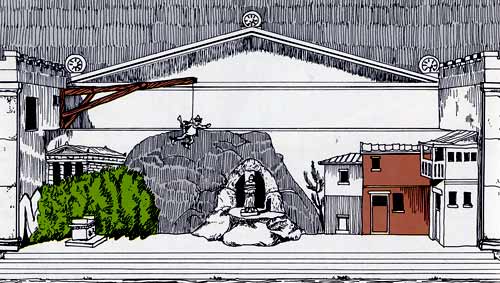
Triumphalists naively believe that God, like the god on the lever in Greek drama, will intervene to stop persecutions.
However, there is one problem with this type of fantastical thinking. God may and has promised to cut short the time of persecution for our sake, but He has told us this will come. Divine Providence allows persecution for the purification of the Church and each one of us.
Saints develop under persecution. People become converted, seeing the nobility and bravery of those who stand up for Christ, for Rome, for truth.
I remember taking a survey in a class in 2003. I asked my Catholic students who would be willing to die for the Faith. Out of about fifteen teens, only three raised their hands. Then, we discussed this.
Many could not see that compromise would cause the death of their immortal souls. Denial of the Faith is called apostasy. Yes, God does forgive if the person repents, and so does the Church, which is the great result of the condemnation of the Donatists, but one may not presume one can or will repent. Many great families joined with Henry VIII in his personal triumph over the Pope, the Catholics in England, the clergy. In fact, most families left the Church--most.
Triumphalists cannot believe that the person sitting next to them in the pew on Sunday could very well be the person who will persecute them, or may be doing so even now, by cooperating with evil.
A few reposts and...to be continued....
Sunday, 29 April 2012
On magical thinking and Catholics

I must write on the difference between magical thinking and belief in devotions. There are many Catholics, and sadly, many are Charismatics, who believe if someone does something, either with medals, cards, holy water or holy salt, that there will always be a one-one correspondence to a spiritual occurrence. Most of the time, these ideas are held by lay people, and not priests, who having been trained in sound thinking, realize the limitations of sacramentals, which are there to encourage the faithful in devotion.The idea behind magical thinking is that if one either does a certain activity, or if on repeats a certain ritualistic action, a certain good, or in the case of nasty people wanting to curse someone, an evil outcome will occur.
While not denying that certain actions do bring about grace, and these are called the Sacraments, which are efficacious, in that something happens when the material events occur. For example, Catholics know that when the water is poured over the person's head in baptism with the Trinitarian words given to us by Christ, that Original Sin is taken away, sanctifying grace enters the person, and that person becomes a child of God.
Magical thinking would make things or events into sacraments, that is, turn certain activities into efficacious events, when these are not.
If one is in mortal sin and wears a Miraculous Medal, if one does not repent, the medal will not stop one from going to hell. The idea that a medal, in and off itself, with keep one from hell is simply not true. For the believer, for the person who honors Mary in the heart, the medal represents an existing spiritual reality, that is, love and devotion to the Blessed Virgin Mary.
How to separate real supernatural thinking from magical thinking is difficult, in that humans want to control their lives and the lives of others with things. This is a common problem, as we all want to play God and be in control.
Real religion tells us that we are not in control, and that our wills need to be conformed to the Will of God. No amount of magical thinking, wearing medals, novenas, and prayer meetings will necessarily save us, if our minds and hearts, and our souls are not conformed to Jesus through the Teachings of the Catholic Church. We can only be saved through Jesus Christ and the merits of the Catholic Church.
A sign of a false religion is frequently the reliance of exterior pity, or externals talismans. For example, if one believes that if they have a rabbit's foot, good luck will happen. Or, if one says a certain number of prayers, then one is holy, or if one faces in a certain direction for prayer, one gets more merit. Not so.. The only way to God is through Christ and His Church. Nothing external can make one holy, or even a place holy, unless this is determined by the Church. Shrines are merely superstition if not approved by the Church, or if there is not a long history of devotion attached to such, which usually means the Church has approved the place, the spring, the chapel, etc.
Our family always marked the top of the doorway on January 6th with the initials of the three Kings and the year's date. However, even though this pious custom invokes those three saints to bless people going in and out, it is not a given that burglars will not enter the house and steal things if I leave the door open by mistake, which happened. The natural act of leaving a door open led to theft, and that it was not worse could be attributed to the Three Kings, but such a cause and effect would be magical thinking.
The only efficacy we know for sure lies in those sacraments of the Church and the bona fide indulgences given and approved by the Church authorities, using bishops, sometimes the authorities in Rome. I caution Catholics not to fall into magical thinking. Be pious, use the sacramentals approved by the Church and stay away from spurious items and unapproved prayers. Make sure what you use has been approved by some bishop somewhere.
Just a reminder, there is no such thing as a good witch, as cute as Glinda was in the movie.
Monday, 3 June 2013
Statistics, superstition, and magical thinking again....
I just read a statistic that only 3% of the world's population has OCD. I must have met 1.5% of them in Great Britain and Ireland!
Superstition is part of the OCD syndrome in that those who are superstitious. Of course, spiritually minded people can fall into superstition, but supposing an even or action is directly related in a irrational manner to another. This attitude has nothing to do with FAITH.
The CCC, my favourite book this past weekend, has something to say about superstition. It is a serious sin and deadens the virtues of faith, hope, and charity.
III. "YOU SHALL HAVE NO OTHER GODS BEFORE ME"
2110 The first commandment forbids honoring gods other than the one Lord who has revealed himself to his people. It proscribes superstition and irreligion. Superstition in some sense represents a perverse excess of religion; irreligion is the vice contrary by defect to the virtue of religion.
Superstition
2111 Superstition is the deviation of religious feeling and of the practices this feeling imposes. It can even affect the worship we offer the true God, e.g., when one attributes an importance in some way magical to certain practices otherwise lawful or necessary. To attribute the efficacy of prayers or of sacramental signs to their mere external performance, apart from the interior dispositions that they demand, is to fall into superstition.41
I have met many Catholics in Ireland and England who are superstitious and not faithful. They do not see the difference and this is connected to magical thinking. These good people are self-deceived into thinking that the externals of faith mean they are saved.
Interior disposition is ALL in real religion. The externals, such as pilgrimages, novenas, medals and other devotions cannot make up for conversion of the heart, the mind and the soul.
Why is superstition in the same category of sin as idolatry? Because one is hoping in something else rather than God Himself.
People are superstitious because it is easier to be so than to have real faith and hope.
Here is a reminder of those definitions.
Faith
1814 Faith is the theological virtue by which we believe in God and believe all that he has said and revealed to us, and that Holy Church proposes for our belief, because he is truth itself. By faith "man freely commits his entire self to God."78 For this reason the believer seeks to know and do God's will. "The righteous shall live by faith." Living faith "work[s] through charity."79
1815 The gift of faith remains in one who has not sinned against it.80 But "faith apart from works is dead":81 when it is deprived of hope and love, faith does not fully unite the believer to Christ and does not make him a living member of his Body.
1816 The disciple of Christ must not only keep the faith and live on it, but also profess it, confidently bear witness to it, and spread it: "All however must be prepared to confess Christ before men and to follow him along the way of the Cross, amidst the persecutions which the Church never lacks."82 Service of and witness to the faith are necessary for salvation: "So every one who acknowledges me before men, I also will acknowledge before my Father who is in heaven; but whoever denies me before men, I also will deny before my Father who is in heaven."83
1817 Hope is the theological virtue by which we desire the kingdom of heaven and eternal life as our happiness, placing our trust in Christ's promises and relying not on our own strength, but on the help of the grace of the Holy Spirit. "Let us hold fast the confession of our hope without wavering, for he who promised is faithful."84 "The Holy Spirit . . . he poured out upon us richly through Jesus Christ our Savior, so that we might be justified by his grace and become heirs in hope of eternal life."85
1818 The virtue of hope responds to the aspiration to happiness which God has placed in the heart of every man; it takes up the hopes that inspire men's activities and purifies them so as to order them to the Kingdom of heaven; it keeps man from discouragement; it sustains him during times of abandonment; it opens up his heart in expectation of eternal beatitude. Buoyed up by hope, he is preserved from selfishness and led to the happiness that flows from charity.
1819 Christian hope takes up and fulfills the hope of the chosen people which has its origin and model in the hope of Abraham, who was blessed abundantly by the promises of God fulfilled in Isaac, and who was purified by the test of the sacrifice.86 "Hoping against hope, he believed, and thus became the father of many nations."87
1820 Christian hope unfolds from the beginning of Jesus' preaching in the proclamation of the beatitudes. The beatitudes raise our hope toward heaven as the new Promised Land; they trace the path that leads through the trials that await the disciples of Jesus. But through the merits of Jesus Christ and of his Passion, God keeps us in the "hope that does not disappoint."88 Hope is the "sure and steadfast anchor of the soul . . . that enters . . . where Jesus has gone as a forerunner on our behalf."89 Hope is also a weapon that protects us in the struggle of salvation: "Let us . . . put on the breastplate of faith and charity, and for a helmet the hope of salvation."90 It affords us joy even under trial: "Rejoice in your hope, be patient in tribulation."91 Hope is expressed and nourished in prayer, especially in the Our Father, the summary of everything that hope leads us to desire.
1821 We can therefore hope in the glory of heaven promised by God to those who love him and do his will.92 In every circumstance, each one of us should hope, with the grace of God, to persevere "to the end"93 and to obtain the joy of heaven, as God's eternal reward for the good works accomplished with the grace of Christ. In hope, the Church prays for "all men to be saved."94 She longs to be united with Christ, her Bridegroom, in the glory of heaven:
- Hope, O my soul, hope. You know neither the day nor the hour. Watch carefully, for everything passes quickly, even though your impatience makes doubtful what is certain, and turns a very short time into a long one. Dream that the more you struggle, the more you prove the love that you bear your God, and the more you will rejoice one day with your Beloved, in a happiness and rapture that can never end.95
Tuesday, 23 July 2013
Grace Is Not Fairy Dust--Ranting on Magical Thinking Again
1667 "Holy Mother Church has, moreover, instituted sacramentals. These are sacred signs which bear a resemblance to the sacraments. They signify effects, particularly of a spiritual nature, which are obtained through the intercession of the Church. By them men are disposed to receive the chief effect of the sacraments, and various occasions in life are rendered holy."173
The characteristics of sacramentals
1668 Sacramentals are instituted for the sanctification of certain ministries of the Church, certain states of life, a great variety of circumstances in Christian life, and the use of many things helpful to man. In accordance with bishops' pastoral decisions, they can also respond to the needs, culture, and special history of the Christian people of a particular region or time. They always include a prayer, often accompanied by a specific sign, such as the laying on of hands, the sign of the cross, or the sprinkling of holy water (which recalls Baptism).
1669 Sacramentals derive from the baptismal priesthood: every baptized person is called to be a "blessing," and to bless.174 Hence lay people may preside at certain blessings; the more a blessing concerns ecclesial and sacramental life, the more is its administration reserved to the ordained ministry (bishops, priests, or deacons).175
1670 Sacramentals do not confer the grace of the Holy Spirit in the way that the sacraments do, but by the Church's prayer, they prepare us to receive grace and dispose us to cooperate with it. "For well-disposed members of the faithful, the liturgy of the sacraments and sacramentals sanctifies almost every event of their lives with the divine grace which flows from the Paschal mystery of the Passion, Death, and Resurrection of Christ. From this source all sacraments and sacramentals draw their power. There is scarcely any proper use of material things which cannot be thus directed toward the sanctification of men and the praise of God."176
1677 Sacramentals are sacred signs instituted by the Church. They prepare men to receive the fruit of the sacraments and sanctify different circumstances of life.
1678 Among the sacramentals blessings occupy an important place. They include both praise of God for his works and gifts, and the Church's intercession for men that they may be able to use God's gifts according to the spirit of the Gospel.
1679 In addition to the liturgy, Christian life is nourished by various forms of popular piety, rooted in the different cultures. While carefully clarifying them in the light of faith, the Church fosters the forms of popular piety that express an evangelical instinct and a human wisdom and that enrich Christian life.
Sacramentals are for the Faithful. If you are talking with a person to convert them and praying for them and the time is right to pass on a medal or rosary, fine. But, it is your prayers and your efforts, through the grace of God which converts. The Holy Spirit converts, not a thing.
I have written on the danger of magical thinking. This type of thinking is not the same as having faith and praying for people, situations or things.
Magical thinking is irrational, whereas intercessory prayer is not. Magical thinking believes that an item or a prayer must be attached to a particular object, or that a person must do particular things to get answers. Also, magical thinking denies suffering and working.
Working means work. So many women in Ireland have told me that God will take care of the abortion issue. No, we have to do such work. The laity, the Church Militant if you prefer that great title, provide the hands and eyes, and ears and feet of God in the world.
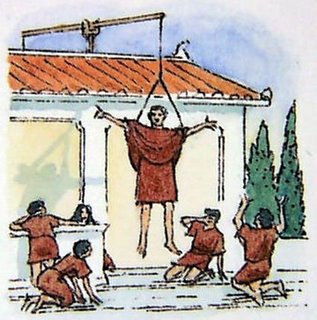 |
| http://literature.wikia.com/wiki/Deus_ex_machina |
There will be no deus ex machina.

And, I am sorry, but medals and holy water do not take the place of hard political work.
Prayer and fasting, yes. Throwing holy water on people will not convert them. This is a misuse of sacramentals, as is the idea that one can bury a medal in the ground and convert the people in that house. Sorry, that is a misuse of sacramentals and is superstitious thinking.
Sorry about the rant, but magical thinking ends in nothing happening and reveals a childish, not childlike, mindset.
Here are some other posts on the dangers of magical thinking. Work and pray, but do not indulge in magical thinking. It is not God's Way.
http://supertradmum-etheldredasplace.blogspot.ie/2013/06/confusion-as-to-purgatory-and-sin-more.html
http://supertradmum-etheldredasplace.blogspot.ie/2013/06/again-and-again-on-magical-thinking.html
http://supertradmum-etheldredasplace.blogspot.ie/2013/06/statistics-superstition-and-magical.html
http://supertradmum-etheldredasplace.blogspot.ie/2012/08/illogical-catholics.html
http://supertradmum-etheldredasplace.blogspot.ie/2012/04/on-magical-thinking-and-catholics.html
Sunday, 2 June 2013
Again and again on magical thinking with scary results...

Can I blame Walt Disney and Tinker Bell? Can I try and find a pattern as to why so many men and women in their 70s on down do not understand the theology of the sacraments?
Magical thinking seems to be the most common problem I constantly meet with Catholics regarding Baptism, Confirmation and the Last Rites.
Serious problems exist because many Catholics do not understand that the sacraments bring responsibility and must be met with responsibility.
Magical thinking is indicated by people who think that baptism of infants whose parents are either atheists, (a priest told me today that many priest baptize infants of practicing atheists and a priest in Walsingham a few years ago baptized anyone's children without preparation of any kind), or non-practicing Catholics. This is against the Canons, but indicates a lack of understanding on the part of the priests and the parents. Why would atheists, who have no intention of raising their children Catholic, desire baptism? Why would fallen away Catholics seek baptism for their children, when there is no demand that they come back into the Church or take classes?
Why do priests baptize infants and children of pagans, who will not raise their children in the Faith? I now know several priests in different dioceses who know the Canons and ignore these. Why?
Is this taught in the seminaries? Are bishops aware that this goes on in their dioceses?
Baptism takes away Original Sin and gives sanctifying grace. It makes a child an adopted child of God, and a member of the Catholic Church.
Magical thinking states that baptism saves a person once and for all-the fundamental option.
Magical thinking supposes the person stays in sanctifying grace without the sacraments or training to be a Catholic.
Why are priests baptizing babies of couples they will never see in Church again, thus putting that couple into the position breaking promises to raise the child Catholic? Why are priests not asking parents to raise the child Catholic?
Magical thinking is protestant. My attempting to talk with a few priests on this subject caused me not to be hired as a catechist in their parishes. The same magical thinking applies to Confirmation, when priests confirm young people who are not going to Mass on Sunday and are contracepting.
Magical thinking also effects many people who read the mystics and think that the writings are infallible. I have written on this. Not all the writings of those who have received personal, even approved, visions, are infallible and to believe such is magical thinking.
For example, only the Church can grant indulgences, not mystics. The Church may take blessings promised from God and make these promises into a set of indulgences-such as the Divine Mercy novena and Divine Mercy Sunday guidelines for the indulgence. But, not all things in St. Faustina's writings have been given indulgences.
Magical thinking wishes that people are saved without their free will being involved.
Magical thinking denies free will. We choose God and good. We have a lifetime to do this. We must respond to grace and work for our salvation in fear and trembling, states St. Paul.
Sanctifying grace is not a permanent state, nor is it once and for all, as many protestants believe. It can be lost and in the case of mortal sin. We are deprived of sanctifying grace by the sin of Adam and Eve, and we must, therefore, be baptized. But we can lose that state of grace and those who no longer go to Sunday Mass, or abort, or contracept, or are in irregular marriages, have not only removed themselves from sanctifying grace, but from the community of God, the Church.
Here is the CCC on this point:
1861 Mortal sin is a radical possibility of human freedom, as is love itself. It results in the loss of charity and the privation of sanctifying grace, that is, of the state of grace. If it is not redeemed by repentance and God's forgiveness, it causes exclusion from Christ's kingdom and the eternal death of hell, for our freedom has the power to make choices for ever, with no turning back. However, although we can judge that an act is in itself a grave offense, we must entrust judgment of persons to the justice and mercy of God.
Anything less is magical thinking. Here is the CCC again.
The Baptism of infants
1250 Born with a fallen human nature and tainted by original sin, children also have need of the new birth in Baptism to be freed from the power of darkness and brought into the realm of the freedom of the children of God, to which all men are called.50 The sheer gratuitousness of the grace of salvation is particularly manifest in infant Baptism. The Church and the parents would deny a child the priceless grace of becoming a child of God were they not to confer Baptism shortly after birth.51
1251 Christian parents will recognize that this practice also accords with their role as nurturers of the life that God has entrusted to them.52
1252 The practice of infant Baptism is an immemorial tradition of the Church. There is explicit testimony to this practice from the second century on, and it is quite possible that, from the beginning of the apostolic preaching, when whole "households" received baptism, infants may also have been baptized.53
1253 Baptism is the sacrament of faith.54 But faith needs the community of believers. It is only within the faith of the Church that each of the faithful can believe. The faith required for Baptism is not a perfect and mature faith, but a beginning that is called to develop. The catechumen or the godparent is asked: "What do you ask of God's Church?" The response is: "Faith!"
1254 For all the baptized, children or adults, faith must grow after Baptism. For this reason the Church celebrates each year at the Easter Vigil the renewal of baptismal promises. Preparation for Baptism leads only to the threshold of new life. Baptism is the source of that new life in Christ from which the entire Christian life springs forth.
1255 For the grace of Baptism to unfold, the parents' help is important. So too is the role of the godfather and godmother, who must be firm believers, able and ready to help the newly baptized - child or adult on the road of Christian life.55 Their task is a truly ecclesial function (officium).56 The whole ecclesial community bears some responsibility for the development and safeguarding of the grace given at Baptism.
1257 The Lord himself affirms that Baptism is necessary for salvation.60 He also commands his disciples to proclaim the Gospel to all nations and to baptize them.61Baptism is necessary for salvation for those to whom the Gospel has been proclaimed and who have had the possibility of asking for this sacrament.62 The Church does not know of any means other than Baptism that assures entry into eternal beatitude; this is why she takes care not to neglect the mission she has received from the Lord to see that all who can be baptized are "reborn of water and the Spirit." God has bound salvation to the sacrament of Baptism, but he himself is not bound by his sacraments.
1258 The Church has always held the firm conviction that those who suffer death for the sake of the faith without having received Baptism are baptized by their death for and with Christ. This Baptism of blood, like the desire for Baptism, brings about the fruits of Baptism without being a sacrament.
1259 For catechumens who die before their Baptism, their explicit desire to receive it, together with repentance for their sins, and charity, assures them the salvation that they were not able to receive through the sacrament.
1260 "Since Christ died for all, and since all men are in fact called to one and the same destiny, which is divine, we must hold that the Holy Spirit offers to all the possibility of being made partakers, in a way known to God, of the Paschal mystery."63 Every man who is ignorant of the Gospel of Christ and of his Church, but seeks the truth and does the will of God in accordance with his understanding of it, can be saved. It may be supposed that such persons would have desired Baptism explicitly if they had known its necessity.
1261 As regards children who have died without Baptism, the Church can only entrust them to the mercy of God, as she does in her funeral rites for them. Indeed, the great mercy of God who desires that all men should be saved, and Jesus' tenderness toward children which caused him to say: "Let the children come to me, do not hinder them,"64 allow us to hope that there is a way of salvation for children who have died without Baptism. All the more urgent is the Church's call not to prevent little children coming to Christ through the gift of holy Baptism
As to the Last Rites...
some people have been led to believe by some religious leaders, lay and priests, that people can be saved by certain prayers of others outside of the indulgences granted by the Vatican. Again, this is magical thinking. Faith allows us to pray for the dead and have Masses said for the dead. But, plenary indulgences are for the souls in purgatory, and may be prayed for those who have died outside the Church, but these indulgences are not prayers outside the merit of the entire Catholic Church. Quite the contrary. The Church passes the merit onto those people.
Prayers which are not given approval by the Church cannot provide a living person with a magical assurance that someone is in heaven.
We are called to evangelize and no amount of magical thinking can substitute for spreading the Gospel.
Subscribe to:
Posts (Atom)