Recent Posts

Saturday, 1 November 2014

Another Saint Repost

Sunday, 8 June 2014

Virgin of The Order of Malta


St. Flora, 1347A.D. Patron of abandoned, converts, single laywomen, and victims of betrayal. Flora was born in France about the year 1309. She was a devout child and later resisted all attempts on the part of her parents to find a husband for her. In 1324, she entered the Priory of Beaulieu of the Hospitaller nuns of St. John of Jerusalem. Here she was beset with many and diverse trials, fell into a depressed state, and were made sport of by some of her religious sisters. However, she never ceased to find favor with God and was granted many unusual and mystical favors. One year on the feast of All Saints, she fell into an ecstasy and took no nourishment until three weeks later on the feast of St. Cecelia. On another occasion, while meditating on the Holy Spirit, she was raised four feet from the ground and hung in the air in full view of many onlookers. She also seemed to be pierced with the arms of Our Lord's cross, causing blood to flow freely at times from her side and at others, from her mouth. Other instances of God's favoring of his servant were also reported, concerning prophetic knowledge of matters of which she could not naturally know. Through it all, St. Flora remained humble and in complete communion with her Divine Master, rendering wise counsel to all who flocked to her because of her holiness and spiritual discernment. In 1347, she was called to her eternal reward and many miracles were worked at her tomb. 

A reader gave me this tip. Now, Flora's feast day is either on June 11th or October 5th, but as I have been thinking of my single, laywomen friends, I wanted to highlight her today.

She is also a Virgin of the Order of Malta, which is highly interesting to me.

More here about her.


I think it would be very cool to be a woman saint of the Order of the Knights of Malta.

Repost for Today

Saturday, 2 August 2014


New Series Starts Today-Part One: Saints of the Knights of Malta

I discovered a great website on the saints who were Knights of Malta. I shall highlight one daily for a week or so.

If you cannot wait, here is the website. I shall get information from more than this site, however.

http://www.smom-za.org/saints/

The first one to be noted is Blessed David Gunston, here in this older article, called Venerable.

VEN. DAVID GONSON (GUNSTON), KNIGHT OF ST. JOHN

MARTYRED AT ST. THOMAS WATERINGS, SOUTHWARK, 12TH JULY, 1541.

At Malta, against the name of Sir David Gonson in the register of the Knights of St. John, a subsequent hand has written "The Good Knight": and there is little doubt that the comment was added to indicate the fact that he died in the cause of religion at the time when the Order was suppressed in England by Henry VIII.
The Order of St. John of Jerusalem was a religious body, the members of which lived under the patronage of St. John Baptist _ and according to the rule of St. Augustine. It extended through the different nations of Europe, was divided into eight " tongues " (nations), and owned considerable property in each country. All the brethren were under the authority of the Grand Master who acknowledged the spiritual allegiance due by- himself and by all his brethren to the Pope. Their preoccupation was the defence of Christian Europe against the Turks.
Henry VIII had his eye upon the possessions of the Order in England as early as 1527. Between the loss of Rhodes to the Turks in 1522 and the grant of Malta by the Emperor Charles V, in 1530, the head-quarters (Conventus) of the Knights had no permanent abode. Henry seized on this fact for an attempt to form the knights of the English tongue into a body, independent of the Grand Master, for the defence of Calais and district. The cost to the Crown of holding Calais was great, and Henry proposed that the English knights should form its permanent garrison and the revenues of their tongue finance his project. Many protests came from the Grand Master, but the danger was averted by Sir William Weston, Prior of the Order in England, who bought off the king by paying him a "benevolence" of 4,000 sterling, paid out of the Common Treasury.
In 1530, Malta became the head-quarters of the Order, the island was converted into a fortress, and from it as a base the war galleys of the knights issued forth to harass the Turks.
David Gonson was received into the English Auberge at Malta - on 20th October, 1533, and submitted his " proofs of nobility"; for each applicant for admission as a Knight of justice must produce proofs of gentle birth, of legitimacy, of good health, and of good character. David could prove his right to bear the arms of Gonson quartering Tussell, Walter, Beckett, Young and Colfax. He was the fourth son of William Gonson by his marriage with Bennet Walter, sister and heiress of John Walter. William Gonson was a Gentleman Usher of the King's Chamber and later became responsible for the naval administration of this country. In one contemporary record he is called Vice-Admiral and Paymaster of the Navy. He did at one time command ships but his principal work was covered by the later title " Treasurer of Marine Causes," and he is so described in the Gonson pedigree. David's eldest brother Benjamin was " Surveyor of all our Shippes" in 1546 and " Treasurer of Marine Causes " in 1549. Benjamin's Daughter Katherine married Sir John Hawkins, the famous sea captain. The name Gonson was pronounced as if Goonson, and was sometimes written Gunston. It is as Sir David Gunston that the knight is found in the list of English Martyrs.
According to the regulations of the Order the first year was spent in the Auberge of the Tongue at Malta, during which period the knight was inured to the hardships of a soldier's life-" to learn frugality, discipline and benificence." This was followed by at least three years general service, and general service included a number of " caravans " or fixed periods of service aboard the galleys of the Order. Sir David remained at Malta from his reception in 1533 until 22nd April, 1540, except for two periods of absence, granted 2nd September; 1534 and 13th July, 1536: in 1536 he was still on caravan duty-. The discipline at Malta was very strict, and in 1535 a fracas with a fellow knight, Sir Philip Babington, led to a short term of imprisonment for Sir David and a loss of seniority-, a common punishment in the Order which affected the order of appointment to Commanderies. He was restored to his original place in the seniority list in 1,536. Presently we shall see Sir Philip Babington as the informer who sent Sir David to his Martyrdom.
Meanwhile things were changing in England under Henry's religious policy. The king had declared himself Head of the Church in England and had repudiated its spiritual allegiance to the Pope. The suppression and spoliation of the Religious Orders followed, but the Knights of St. John were not at first included in the general ruin. In 1539, two knights of the English Tongue, Blessed Adrian Fortescue and Ven. Thomas Dingley, a nephew of Sir William Weston, Grand Prior of England, were martyred on Tower Hill for denying the Royal Supremacy. By Letters Patent 7th July, 1539, Henry reminded the knights of the English Tongue that he was a Protector of the Order : and it was his will that in future every appointment must be confirmed by him, and that he was to receive the first year's revenue of the office. By Section 4. he orders that in the granting of dignities and commanderies the authority of the Pope must be ignored ("shall not recognise, support or promote the jurisdiction, authority, rank or title of the Bishop of Rome ") The General Chapter raised its protest against this subversive constitution and declared it impossible for the Order to accept it.
It was while the affairs of the Order were in this dangerous condition that Sir David Gonson obtained leave of absence (granted 22nd April, 1540) to proceed to England. The English State Papers contain a letter from Sir Giles Russell, Turcopolier, and three from Sir Nicholas Upton dated from Malta, April, 1540, and in all of them the recipients are told that Master Gunston is coming to England and will inform them how affairs stand at Malta. One letter of Sir Nicholas Upton contains the information "Sir Philip Babington has left the galeys . . . and forsoke the banner of your religion and without the licence of the Grand Master.”
Before Gonson arrived home, Henry had determined to suppress the Order in England and confiscate its property. A servile parliament passed the necessary bill on 10th May, 1540. the reasons put forward for the suppression being " that the friars of the order drew large sums yearly out of the kingdom : they maintained the usurped power of the Church of Rome : they defamed and slandered the king and his subjects.' . . . . Thus fell that ancient and pious order, not without much scandal abroad both to the king and the government " (Lord Herbert).
Sir David arrived in England, and on 8th October was accused of treason. The Privy Council minute of that date states " John Story who put in articles of treason against Davy Gunston, which seemed to depend on the sayings of one Philip Babington : commanded to appear on the seventeenth and bring Babington with him." On their evidence Gunston was arrested and confined in the Tower. He had no trial but was prosecuted b%- attainder in the Trinity term of 1541. This new form of procedure had been introduced by Henry- in 1539. Having asked the judges whether_ anyone could be attainted of treason in his absence without being called upon to defend himself, Henry was told that it was a very dangerous question, but that parliament could do anything and the attainder would be good in law. This was good enough for the Tudor tyrant : he had a servile parliament, thanks to Thomas Cromwell, and he acted at once on the judges' opinion.
Henry no doubt thought it necessary to find a victim among the knights to stifle the agitation against his suppression of the Order. The General Chapter issued a strong protest and the Grand blaster wrote to Henry (15th September, 1540) declaring the impossibility of accepting the conditions. Two commanders, Enrico Pereyra and L. de Vallee, were sent as envoys to Henry to solicit the restoration of their rights, but in view of the imprisonment of Gunston and Tyrrell, and the execution of Fortescue and Dingley, they remained at the French Court until they could obtain a safe conduct from Henry. It is very doubtful whether they ever came to England. They were still at Fontainebleau in January, 1541.
Sir David, as we have said, was condemned by a bill of attainder in the Trinity term of 1541. That he died for denying the Royal Supremacy of Henry in spiritual matters cannot be doubted. Fortunately the official statement of his offence and his sentence is preserved in the Public Record Office (Coram Rege de Termino Sanctae Trinitatis anno 33 Regis Henrici VIII, it. 130, rot xiii). The- document is in Latin except for the words said to have been spoken by Gonson, these. are in English. The accusation against him was-that while living in parts outside the kingdom, viz : from 10th July, 28 Henry VIII to 20th August, 31 Henry VIII, he persistently during that time, at Malta and elsewhere, publicly and distinctly, denied and opposed, falsely and traitorously, that the aforesaid King (Henry) was Supreme Head on earth of the Church of England1. That he had called the king a heretic1 and all those who upheld the patent of the king, heretics. Also that the afore- said David Gunston as part of his aforesaid wickedness against the duty of his allegiance, on 1st Ma}-, 29 Henry VIII, before and after, at Malta and at other places, did use, among other traitorous words, the following.
"That no person might appeale unto the Byssope of Rome on earth under God and they that would maynteyn the appellation to the king for good were worse than Turks and Lutheryans." Wherefore, continues the document, David Gunston is to be handed to the King's Marshall, confined in the Marshalsea, and thence to be draw n to the usual place of execution, where he shall be hanged, out 'it down while still alive, be eviscerated, his body quartered and the quarters exhibited where the king pleases.
Henry had forbidden any appeal to Rome by the "Act in Restraint of Appeals," 1533 and Gonson's words mean " No person is; allowed by the king to appeal to the Bishop of Rome, God's Vicar on earth and therefore supreme in spiritual matters." This Was an assertion of Papal Supremacy. " That they who maintain an appeal (in spiritual matters) to the king to be valid are worse than Turks and Lutherans." Not only a denial of the Royal Supremacy but by implication calling the king a heretic.
Gonson after his condemnation was confined in the King's Bench prison, Southwark, whence on 12th July, 1541, he was dragged on a hurdle to St. Thomas Waterings, at the second milestone from the city, and there hanged, drawn and quartered.
The Martyrologies and Catholic writers generally give the 1st July as the date of the execution. In this they follow Stow, who wrote in his Chronicles under the year 1541 : " The first of July .... Sir David Genson, Knight of Rhodes2 was drawn through Southwarke to St. Thomas of Waterings and there executed for the Supremacy." Stow wrote 40 years after the event. On the other hand Wriothesley, who was a contemporary of Gonson, has in his Chronicle-" 1541. The 12th daie of Julie, one of Mr. Gunston's Sonnes which was a Knight of Rodes, was drawen from the Kinges Bench to Sainct Thomas Wateringes and there hanged and quartered for treason."
That Stow was wrong the following minute of the Privy Council is proof. " 7th July, 1541. Upon advertisement from the Lord Chancellor of the attainder of David Gunston . . . Tyrrell, and Robert Harvy, commissary of Calais, a letter was written to him that Tyrrell should be reprieved and the other two suffer at London."
JOHN FLETCHER.
1 Made treason by the Act of 1534
2 Although the knights had been at Malta since 1530 the old name "Knights of Rhodes" was still commonly used.

Reposts on The Saints of The Knights of Malta for Today's Feast

Monday, 25 February 2013


Blessed Gerard Tonque, Founder of the Knights of Malta


The founder of the Order of John is another Saint of Malta, although he was not Maltese. Here is a bit about him and the Charter from Rome for the Order's recognition. He died on September 3, 1120.


http://www.smom-za.org/saints/bgt_text.htm

It is not certain whether Gerard came from present-day Italy or France. He went to Jerusalem and there, towards the end of the eleventh century, he established a hospice for pilgrims and the sick next to the Church of St. John. To maintain this work he founded a religious community, which he governed in accordance with the Rule of St. Augustine. On 15 February 1113, Pope Paschal II solemnly approved the new Order, which had been established even before the first Crusaders went to Palestine to recover the Holy Sepulchre. The Pope's Letters Apostolic, Piae postulatio voluntatis, were addressed to 'Gerard, Founder and Warden of the hospice at Jerusalem and to his lawful successors.' Gerard died at Jerusalem in 1120. This is also the day on which, in 1993, the Grandmaster decreed the Restoration of the Grand Priory of England.

Prayer:

O God, who exalted blessed Gérard because of his care for the poor and the sick, and through him founded in Jerusalem the Order of St. John the Baptist, give us the grace of seeing, as he did, the image of your Son in our brothers and sisters. We ask this through our Lord Jesus Christ your Son, who lives and reigns with you and the Holy Spirit One God, for ever and ever. Amen.(From: The Missal with readings of the Order of St. John of Jerusalem of Rhodes, & of Malta, London 1997)


The fifth saint of Malta is, of course, St. Publius.

The first bishop and convert of St. Paul.

Oh My Goodness, Pray for Me


I have to talk to four people here who believe that aliens are running the show and are behind the NWO.

There are no aliens, only demons of the air. Man, I have to come up with some good arguments to counteract this idea. And, these Maltese people are all Catholics.

Goodbye to October, 2014

A busy blogging month and a record set, I think, for posts.

Time is short.


It is not our feast day, folks!

Again, I see on the Net comments from priests who claim November 1st is the feast of the Church Militant, as these priests call all Catholics in the pews "saints".

Not so.

It is not our feast day, but the feast day of the Church Triumphant, those saints who have won the crown of blessedness in heaven.

Those who are canonized saints are honored today, as well as those who we do not know who are saints in heaven.

If a person is living and thinks that he or she is a saint, assuredly, that person is not.

Humility and self-abnegation mark the saints.

Let us honor the real saints today, our models of perfection.

Untermenschen

Time to talk about what is happening in the States and what may happen here.

Untermenschen,the term coined by the Nazi regime, means "sub-human" or "inferior people".

Anyone who was not Aryan by Nazi terms fell into the Untermenschen category.

The first to be targeted by the Nazis were the gypsies. Remember my posting on the now illegal homeless who were rounded up in SC.

Target groups will be labeled Untermenschen. These groups will include, besides the homeless, the elderly, the invalids, those on aid of any kind, those who are not seen as "useful" or those deemed terrorists, including pro-lifers, and Catholics.

The  Ãœbermensch, or supposed super men, decide on who the Untermenschen are. Recall in Nazi Germany, the list included blacks, brown, gypsies, Slavic peoples , (Czechs, Poles, Russians, Slovaks, etc.) and of course, the Jews.

Do not think this cannot happen in the States, as it already has happened.

So, who are the Ãœbermensch, in the Western World?

The uber-rich, the powerful, the seculars, the Masons, the self-appointed leaders of the NWO...those who hate the Catholic Church, those who are being used by the evil demons in attempting to destroy the Church.

Those unelected leaders of the West and East who are pulling the strings of all the puppet leaders, who sadly, many Americans and Europeans believe are their elected representatives form the  Ãœbermensch,

Do not kid yourselves about these types as in the minds of those so-called liberals who cannot discern good from evil and instead make evil into a false good.

Such is the face of Modernist heretics in the Church.

Such is the face of those who are in power in what use to be the great democracies of the world.


Friday, 31 October 2014

Some of the Reparation Posts


There are fourteen posts minimum in this series. Why the search bar does not bring all of them up, I do not know. Start with October 14th and move up to today.
18 Oct 2014
We can make reparation for our friends in order to enter into more perfect friendships. If one sees an imperfection in a friend, one may pray and do penance so that person becomes a saint. Leading others to perfection through ...
19 Oct 2014
If one is called to Reparation, one takes on a little bit of this compassion for others and suffers with that person in order for them to reach heaven. Those who are in difficult relationships understand this concept.
18 Oct 2014
And so on...do not waste any opportunity to pray, to do reparation. Again, I think that most reparation is for our own sins and predominant faults until we are in the Illuminative State, but I am willing to be corrected on that matter.
14 Oct 2014
Labels: abortion and confession, perfection, perfection again, perfection series IV, perfection series II, perfection series III, Perfection Series V: Mary, perfection series VI, reparation ...

14 Oct 2014
Those for whom God has placed on own hearts and in our minds great love, who are in need of having someone do reparation for them, are those to whom God wants you to focus your prayers and energies. Mortification ...
15 Oct 2014
Chose that priest, bishop or cardinal who seems farthest away from the truth of the sanctity of marriage and do reparation for him starting today. Here is the prayer given to us by Pope Pius XI. Ask, no beg, the Reparatress to ...

16 Oct 2014
St. Margaret Mary did make reparation while on earth, suffering not only from her companions in the convent, but from the revelations from Christ, Who showed her His loving Heart, wounded by ungrateful humanity. Today is ...

15 Oct 2014
Chose that priest, bishop or cardinal who seems farthest away from the truth of the sanctity of marriage and do reparation for him starting today. Here is the prayer given to us by Pope Pius XI. Ask, no beg, the Reparatress to ...

14 Oct 2014
Labels: abortion and confession, perfection, perfection again, perfection series IV, perfection series II, perfection series III, Perfection Series V: Mary, perfection series

16 Oct 2014
Feast Day of St. Margaret Mary-Perfection Series VI:IX Reparation. Posted by Supertradmum. One forgets how young St. Margaret Mary Alacoque was when she died-43-and what sufferings she endured at home before she ...
15 Oct 2014
Perfection Series VI: VIII Reparation--The Reparatress and The Synod. Posted by Supertradmum. One totally generous person shows us the way to practice reparation and that is Mary, Our Mother. Pope Pius XI labels her the ...
14 Oct 2014
Labels: abortion and confession, perfection, perfection again, perfection series IV, perfection series II, perfection series III, perfection series IV, Perfection Series V: Mary, perfection series VI, reparation ...
14 Oct 2014
Perfection Series VI. Posted by Supertradmum. I am not finished yet with the encyclical or the series. More later tomorrow. Email ThisBlogThis!Share to TwitterShare to FacebookShare to Pinterest ...

18 Oct 2014
Perfection VI: XI Reparation. Posted by Supertradmum. Many types of suffering may be used in reparation. For example, illness or aches and pains make perfect offerings for one's own sins and the failings of others. I have chronic pain in some parts of my body as I cannot get surgery as ... Beatification Mass Time · Great Blog with Great News on Synod · Perfection Series VI: XII Reparation and Religious... On Fasting · A Reminder · Later Reporting · Perfection VI: XI ...

16 Oct 2014
Feast Day of St. Margaret Mary-Perfection Series VI:IX Reparation. Posted by Supertradmum. One forgets how young St. Margaret Mary Alacoque was when she died-43-and what sufferings she endured at home before she ...

14 Oct 2014
Labels: abortion and confession, perfection, perfection again, perfection series IV, perfection series II, perfection series III, Perfection Series V: Mary, perfection series VI, reparation ...


Sigh....why the search bar does not bring up all the series, I do not know, but begin with October 14th and move up to today for the full series on reparation. There are a minimum of fourteen postings in this mini-series.

Time for a reposting of a link to one of my most popular articles

http://supertradmum-etheldredasplace.blogspot.com/2012/01/unusual-controversial-catholic-subject.html

On Reparation, Final Posting in Mini-Series Perfection Series VI: XIV

The excellent priest I asked about making reparation before one is in the Illuminative State answered me with a wise and simple answer.

Two parts: one, yes one can make reparation while not through the purification process, such as when one is in the Dark Night, but it depends for what the reparation is being made...and I add that most likely, reparation before purification is mostly for our own sins rather than for other people or situations. One could not, for example, make reparation for serious situations beyond the merit one has gained through the early stages of one's own purification.

Two: the reparation made before the Illuminative State is less efficacious, and the example the priest gave me is the comparison between imperfect and perfect contrition.

If one is sorry for sins because one does not want to go to hell, or purgatory, that motivation does constitute contrition but imperfectly done. Perfect contrition is the sorrow for sin because one has offended God and because one loves God and is sorry out of love, not fear. Likewise, reparation done in the Dark Night is imperfect, as one is still imperfect.

Therefore, for one to make the most efficacious reparation for the sins of others or in intercessory prayer, one must be in the Illuminative or Unitive State.

These facts add to the impetus to allow God to purify one.

Homeschooling Alert

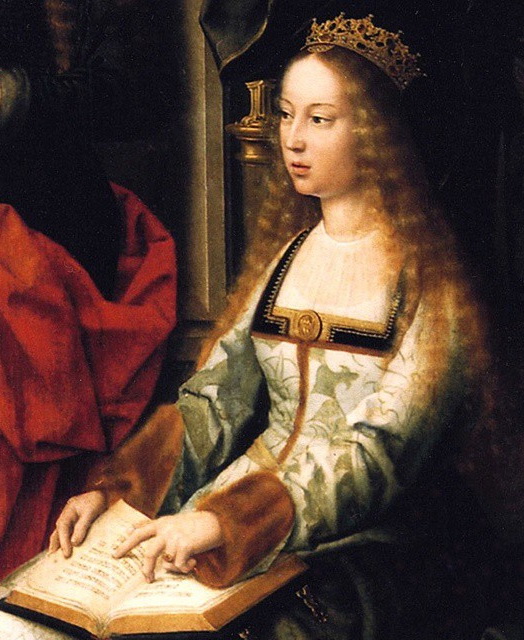
http://en.wikipedia.org/wiki/Isabella_I_of_Castile
http://en.wikipedia.org/wiki/Reconquista

Mums and Dads,

Make sure you cover this period in your home schooling curriculum. I recommend this book.

http://www.amazon.co.uk/Isabel-Spain-The-Catholic-Queen/dp/0931888433

And, here is an article to get you going...

Isabel of Spain, The Catholic Queen
Warren H. Carroll, Ph.D.
Why has this queen, out of the many hundreds who have reigned during the long course of Christian history, always been called in her homeland "the Catholic Queen" - as though there were no others? Because Queen Isabel was a Catholic first, a Catholic above all, a Catholic who served God as few others have ever served Him, a Catholic whose service and rule her land and her age needed as our own land and our own age need her prayers in Heaven. It was in Isabel's name, under Isabel's banners, by Isabel's authority that the Catholic faith was brought to America by Christopher Columbus, the man she chose, and his companions. Today, as a result, a larger percentage of the people of the Americas are Catholic than on any other continent, even Europe itself.
The land of Castile, in Spain, into which Isabel was born in the year 1451, was sickened by long misrule, distracted by bitter passions, and ravaged by the uncontrolled greed of the nobility, where bishops regularly went to war, and the Church seemed helpless. Castile had been in this sad condition for a century and more. Isabel's royal father died when she was three years old; her mother became insane. Her brother was younger than she. Growing up as a princess alone and unprotected, fair game for ambitious plotters, she put all her trust in God. She attended Mass every day, illuminating her own missal; she prayed the entire Divine Office daily, and spent hours at her devotions.
Despite the hostility of her half-brother King Henry IV, when only seventeen years of age she refused the advice of all her counsellors by rejecting all thought of lending her name to a revolt against him, after her young brother had died. She married Prince Ferdinand of Aragon - who is known, with her and largely because of her, as the Catholic King. As rulers they were equals. As Ferdinand's wife , Isabel was always submissive to her husband, whom she loved devotedly and unceasingly. She knitted his shirts herself. A chronicler of her time says: "Even if necessity parted them, love held their wills in unison...Many persons tried to divide them, but they were resolved not to disagree."
Devoted to Establishing Peace
Almost as soon as Isabel was crowned Queen, Castile was attacked. Archbishop Carrillo of Toledo, primate of Spain and once Isabel's friend, joined her foes. Coming from an interview in which he coldly and contemptuously rejected her, Isabel said only: "My Lord Jesus Christ, in your hands I place all my affairs, and I implore your protection and aid."
Going among her people to seek their support in this crisis, she would end each appeal with this prayer: "Lord, in whose hands lies the sway of kingdoms, I humbly beseech Thee to hear the prayer of thy servant, and show forth the truth, and manifest Thy will with Thy marvellous works: so that if my cause is not just, I may not be allowed to sin through ignorance, and if its just, Thou give me wisdom and courage to sustain it with the aid of Thine arm, that through Thy grace we may have peace in these kingdoms."
Her people rallied to Isabel, so that her cause prevailed. She gave thanks to God in a barefoot procession across the harsh cobblestones of Tordesillas.
Isabel brought justice to Castile, which had hardly known it in the lifetime of any man then living. She was incorruptible, so devoted to establishing peace and respect for law that evildoers fled from a city when it was heard that she was coming there to hold court, knowing they could never bend her to their will. But Isabel always remained humble before God. When she found a priest, Hernando de Talavera, who for the first time in her experience required that even she as Queen kneel before him in confession, she at once selected him for her personal confessor.
Isabel led her army to the liberation of Granada, the last part of Spain still held by the alien Moorish conquerors. Her effect on her soldiers was like that of Saint Joan of Arc. Their customary profane swearing ceased; they knelt in the field for Mass, and received spiritual counsel from the friars. Isabel visited the sick and wounded, sometimes dressing their wounds with her own hands. When the tents of the great Spanish camp before Granada caught fire and were almost burned, Isabel rebuilt the camp in stone, and named it Holy Faith (Santa Fe).
The Greatest Voyage in History
With the splendid victory of Granada won, Isabel was ready to send Columbus on the greatest voyage in history, the voyage that opened up a New World which had never before known Christ, with millions of souls to save. Before leaving Spain, Columbus and his men confessed their sins, attended Mass, received Holy Communion, invoked the Most Holy Trinity, and sang the "Salve Regina" - as Queen Isabel herself would have done, if she had been there with them. Her spiritual example and leadership were making their mark.
She applied her example and leadership more directly on one occasion in a convent of lax nuns, by taking her spinning wheel to the convent and working at it all day to remind them of the humble diligence to which they were called, and which the Queen did not disdain. When the primate of Spain, Cardinal Mendoza, died, Isabel urged the Pope to confirm as his successor a holy, ascetic Franciscan monk, Jimene de Cisneros, who had fled all worldly and church honors. Cisneros, accepting the appointment only under obedience with the greatest reluctance, who always wore a hair shirt under his archbishop's robes, reformed the Church in Spain so thoroughly that the widespread abuses of the time which afflicted the Church elsewhere were almost completely rooted out.
When an assassin nearly killed Ferdinand, Isabel wrote to her former confessor, Talavera, humbly grateful to God for sparing her husband's life, but bewailing her own sins: "I don't know how we shall thank God for so great a grace - many virtues would not suffice to do it. And what shall I do, who have none? Please god, henceforth I shall serve Him as I ought. Your prayers and your counsels will aid me in this, as they have always helped me."
After Columbus had returned from his first voyage with the glorious news of the greatest discovery of all time, and Spain began opening up America, Isabel was confronted with the question of what to do about the natives of the New World. When the first shiploads of Indians arrived in Spain in 1495, Isabel at once ordered that the "sale of slaves must be absolutely suspended." She strictly forbade enslavement of the Indians. When Columbus, after his third voyage, nevertheless gave each of his men an Indian as a personal servant, Isabel's response was: "Who authorized my admiral to dispose of my subjects in this manner?" - and she sent them all back home to America.
Her Last Years
In her last years Isabel had heavy crosses to bear. Her only son, Crown Prince John, died tragically on his honeymoon. Her oldest daughter died in childbirth, and her baby son then born, died just two years later. Isabel's second daughter lost her mind. Her youngest daughter, Catherine, married Crown Prince Arthur of England, who also died a few months after their marriage, leaving Catherine later to marry his brother, Henry VIII - who, long afterward, was to break from the Catholic Church in order to put her away. Isabel bore everything in union with the suffering Christ. During her last illness she begged for her sorrowing people not to pray for a restoration of health to her body, but for the salvation of her soul. She asked to be buried beside her husband when he died, so "that the union we have enjoyed in this world, and through the mercy of God may hope again for our souls in heaven, may be represented by our bodies in the earth."
In a reign of thirty years Isabel had lifted her people from the mire to the stars. She had made Spain the leading nation of the world - not just in wealth and power, but above all in justice, good government, a vibrant faith, and a strong and healthy Church. From Isabel's Spain went forth not only conquistadors, but missionaries and saints, crossing mighty oceans, into many lands never before known to Christians, converting millions who have remained Catholic ever since. She bore the enormous responsibilities of supreme public authority and her many heavy personal crosses without discouragement or complaint, above all without any change in her faith, her morality, or her charity - except to strengthen them all. For all her victories she gave God the glory, claiming only her sins - of which she remained ever conscious - as her own. Yet no scandal ever stained her person. Well might Washington Irving call her "one of the purest and most beautiful characters in the pages of history."
Is it not fitting that her Church at last extend the highest honor - that of being raised to the altars she loved - to one who honored the Church so greatly and constantly all during her life? Is it not time that we showed Isabel that her fellow Catholics - especially in America - love her as she loved her people, Spanish and American alike, for and in the glory of God?

A Vision of The Future Church

There are 55,000 Catholics in Norway and 5 seminarians; 2 are Swedish, the rest are Polish.

There are 100,000 Catholics in the Diocese of Arundel and Brighton, and there are 7 seminarians total.

Actually, A and B is better off than some other dioceses in England.

But, one sees the problem.

Over two years ago, it came to me that in the future, the Church will resemble Northern Africa in the Fourth Century, when in Carthage and the immediate area around Carthage alone, there were seventeen bishops.

Each church was a cathedral. Each cathedral needed autonomy.

http://upload.wikimedia.org/wikipedia/commons/8/85/Citadella%2C_Victoria_%28Gozo%29.png

I believe every priest will be a bishop in certain countries, because of the breakdown of communication and the need to have local authority.

Centralized authority will be almost impossible, even though the Church is universal.

I think that in many, if not most European countries, each priest will have to be a bishop.

I know this sounds impossible or even improbable, but with the interruption of civilization, local organization of the Church will be necessary.

Some dioceses we see now will disappear completely, like the earliest churches in the Levant.

But, imagine the Church divided by schism and persecution. Imagine most churches closed and those existing separated by great distances.

At one time, there were three-hundred bishops in Northern Africa who were Donatists. Imagine...

4.2 million Catholic in England and Wales have about, (rough estimate), 150 seminarians at this time.

Right now, England and Wales has the best Catholic priest to laity ratios in Europe. 25% of the Catholic population go to church regularly according to some statistics, which are only taken now at the diocesan level and not by the bishops' conference, as in the States.

Now, my vision of the future Church is that the local bishops will have to have local control as the priests disappear. A diocese could have one bishop, two priests and a monk.

In the face of schismatics and persecution, local bishops would be important.

Local councils, such as those in the early Church, would have to make decisions. Communication with Rome may be completely out of the question.

I may not see this development, but I think my son will, and those of his generation.


Articles from SPUC

 
Population control won't save the planet, admit experts
Top stories:
Population control won't save the planet, admit experts
Population control will not cure the so-called ‘crisis’ of a perceived shortage of resources for future generations, according to a study published in the Proceedings of the National Academy of Sciences. Professor Corey Bradshaw from the University of Adelaide said: "Even if we had a third world war in the middle of this century, you would barely make a dent in the trajectory over the next 100 years" [BBC, 27 October] Scientists such as the late Julian Simon argued that a growing population would adapt to the growing number of humans on the planet.
Safe at School condemns government plans on alleged homophobic bullying
SPUC's Safe at School campaign has condemned plans to sink £2 million into dealing with alleged homophobic bullying in schools. The move was announced by Nicky Morgan, the education secretary, in an interview with a homosexual news service. Antonia Tully of Safe at School said: "Tax-paying parents will soon become aware that their money is actually being spent on the promotion of homosexuality. [SPUC, 29 October]
Mother speaks after legal battle to kill daughter
The mother has spoken of her relief after winning a legal battle to allow her disabled daughter to be dehydrated to death. Charlotte Fitzmaurice said: "Although I will live with the guilt forever, I know I have done everything I can for her and she is at peace." Nancy, her daughter, was not terminally-ill and was able to breathe unaided. Dr Andrew Ferguson, chairman of Care Not Killing, said: "It is never ethical to speed up the process of dying by any intervention which has the primary intention to end life".  [Express, 27 October]

Legal bid launched against sex-selective abortions
The Christian Legal Centre is backing a legal bid by a young pro-life activist against the Crown Prosecution Service (CPS). Aisling Hupert instructed solicitors to bring action after it was announced that the CPS would not press charges against two medics who were filmed by undercover journalists, agreeing to abort babies because they were girls. Andrew Minichello Williams, director of the Christian Legal Centre said: "The Director of Public Prosecutions has refused to enforce the law and this sends the wrong message to the medical world. This case shines a spotlight on this grave injustice against women." [Telegraph, 24 October]

Because I have young readers.....

http://existentialcomics.com/comic/51

When is someone culpable for sin?

In the past few days, some people have asked me when a person is responsible for sin.

We are always culpable to some extent for sin.

Always.

Now, when a person plans a murder, it is a more serious sin than if a person murders out of anger. However, anger is a sin to begin with and one is culpable for harboring anger and not dealing with a violent nature.

The Catholic Church teaches that God gives grace to all persons for salvation.

We may have circumstances which ameliorate certain levels of responsibility, but we are always responsible to some extent.

One of the greatest heresies now is the denial of free will.

We cannot psychoanalyze away sin, Sin is against reason. That is the problem with so many people who want to rationalize away sin. They cannot do so.

When we die, God is not going to ask us how remiss our parents were in teaching us the Catholic Faith. That omission will be part of the parents' particular judgment.

We see our sins and basically judge ourselves in the light of truth.

See the other posts on general and particular judgment.

And, from the CCC.

II. THE DEFINITION OF SIN

1849 Sin is an offense against reason, truth, and right conscience; it is failure in genuine love for God and neighbor caused by a perverse attachment to certain goods. It wounds the nature of man and injures human solidarity. It has been defined as "an utterance, a deed, or a desire contrary to the eternal law."121
1850 Sin is an offense against God: "Against you, you alone, have I sinned, and done that which is evil in your sight."122 Sin sets itself against God's love for us and turns our hearts away from it. Like the first sin, it is disobedience, a revolt against God through the will to become "like gods,"123 knowing and determining good and evil. Sin is thus "love of oneself even to contempt of God."124 In this proud self- exaltation, sin is diametrically opposed to the obedience of Jesus, which achieves our salvation.125
1851 It is precisely in the Passion, when the mercy of Christ is about to vanquish it, that sin most clearly manifests its violence and its many forms: unbelief, murderous hatred, shunning and mockery by the leaders and the people, Pilate's cowardice and the cruelty of the soldiers, Judas' betrayal - so bitter to Jesus, Peter's denial and the disciples' flight. However, at the very hour of darkness, the hour of the prince of this world,126 the sacrifice of Christ secretly becomes the source from which the forgiveness of our sins will pour forth inexhaustibly.

Recommended Book by A Friend of Mine

http://www.amazon.co.uk/The-Language-Dissent-Answering-Catholic


Prayer for A and B, Gibraltar, and Malta

“Grant us, O Lord, a Shepherd according to your heart, who incessantly works for your
glory and the good of the Church in a spirit of wisdom and knowledge, in a spirit of strength
and gentleness, in a spirit of humility and patience. Lord hear us.” from the Church in Malta.

Father Z's Reminder on Indulgence This Sunday

http://wdtprs.com/blog/2014/10/action-item-all-souls-day-indulgences/

and Fr. Z. refers us to Fr. Tim Finegan on detachment from venial sin...

http://the-hermeneutic-of-continuity.blogspot.com/2006/05/plenary-indulgences-not-impossible.html

Pay attention...

http://www.moneynews.com/MKTNewsIntl/stock-market-crash-warren-buffett-indicator/2014/10/03/id/598461/?dkt_nbr=ufos34vz&utm_source=taboola&utm_medium=referral

Raissa, continued

I am begging for a huge favor. I gave away my copy of Raissa's diary in 2003, but would love to have a copy now.

Is there a reader who has a copy or would like to get one for me?

It was called, in English, Raissa's Journal. My copy was in a red cover.