Recent Posts

Showing posts with label American culture. Show all posts

Monday, 13 April 2015

A Covering of Consumerism

As soon as I fly into some countries, I sense a spiritual presence surrounding that country. I distinctly remember flying into Ireland for the first time, through churning black clouds in the twilight, over a landscape of lights and darkness.

The entire feeling was one of chaos and turbulence.

When I flew into France, the air was bitter cold and sharp, like a knife, the day ending in rain and gloom, on that day after the Je suis Charlie shootings.

Flying into the States, I had a sense of a huge dome covering the entire nation, a dome of self-sufficiency, arrogance, and most of all, consumerism.


The main demon of this country is gross consumerism. I call it a god, an idol, to which millions of people bow and scrape, desiring comfort and solace in this time of anxiety. One can almost feel this presence of consumerism, like a smothering blanket of constant buying and selling woven by fear, and the lack of trust in Divine Providence.

Consumerism is fed by narcissism, because the narcissist always has to have the best that money can buy. Consumerism destroys neighborhoods and communities as people are too busy working and shopping. 


It is too easy to get caught up with this consumeristic philosophy, the main one of this once free and simple land. Or, was it always this way?

Looking back over the history of America, one sees the tension of dreams of peace and prosperity mixed with clever greed and anxious conformity. Because things, stuff, are relatively inexpensive, one is tempted to buy what one does not need and ignore the millions of people who need basics for life, daily.


Consumer goods have dulled the sense of personal responsibility for the other. The real other, the outsider, is not considered when one is discussing with one's significant other whether one needs to buy a new car, when the old one is running just fine, or whether one needs to redecorate, because one is bored, or whether one needs just one more pair of shoes.

For four years exactly, I lived out of two suitcases and a carry on. Now, I am facing taking my few things out of storage this week and doing the last cull. I have no furniture, except the chapel furnishings, and mostly books and personal papers, plus photos of you-know-who.

Still, STS said, "Mum, get rid of it all," like a true apostle, knowing that what one really needs is limited. Things get in the way of God. Things demand time and attention, time and attention taken away from God. Detachment forms the real backbone of the spiritual man or woman.


For years, when I was married, a long time ago now, in England, we had no car (we never did get one), no phone (we used the local red box), no refrigerator (I shopped daily-- butter and cheese were left out, while the milk was put on the window sill).

Honestly, we did not miss these things-car, phone, fridge. I never had a freezer, and only had a washer-dryer the last year of my marriage.

We managed. We did not miss modern conveniences. We ate well and entertained friends, including sems and priests, without all the mod-cons.

I never had a crock pot, or a microwave, cooking all things the "long way" as I had learned.

If someone wanted to get ahold of us, they had to stop by, or write a note. Imagine. No phone.


I realized today that our little house was rather monastic. 

Even when I had the Montessori school, things were simple, like Montessori's original ideas.

I made much of the materials, as one learns when one is studying to be a directress.

Amazing how people lived before PCs and the Internet.


I am going back towards those times. Poverty limits what I own, what I have, what I use. Poverty determines if I even have the Net or a cell phone.

One learns to do without. And, it is refreshingly freeing.

I never want to go back to accumulation and consumerism. I pray to God not to ever get caught up in that again. Being poor and not having credit cards provides me with discipline. If I do not have the money, I cannot buy even, sometimes, necessities.

So be it.


I considered my passive purgation a stand against consumerism. May God wean me from every single venial sin and tendency towards sin, especially the sin of this nation of shopkeepers and shopdwellers.

I defy the covering of consumerism. However, I do need a place to live, to pray, to set up the chapel I shall have to take down in one month. Please pray for me to find this place, and help if you can.

Consumerism hates need, as needs are basic.....consumerism thrives on wants, not needs.

Friday, 10 April 2015

Vintage Buchanan

http://www.arcamax.com/politics/fromtheright/patrickbuchanan/s-1638957?source=outbrain

On the assumption of power, revolutionaries become more intolerant than those they dispossessed.
The French Revolution was many times more terrible than the Bourbon monarchy. The Russian Revolution made the Romanovs look benign. Fidel Castro's criminality exceeded anything dreamt of by Fulgencio Batista.
...
What explains the rout in Indianapolis? The GOP simply cannot stand up to media denunciations as intolerant bigots, especially if the corporations upon which they depend threaten economic reprisals.
With the Democratic Party irretrievably lost, and the Republican Party moving to neutrality in the culture wars, traditionalists should probably take comfort in the counsel, "Put not your trust in princes."
When that father and daughter at Memories Pizza in Walkerton, Ind., said their religious beliefs forbade them from catering a same-sex wedding, they were subjected to a hailstorm of hate, but were also showered with $840,000 from folks who admired their moral courage.
Religious folks who do not believe in collaborating with what they think is wrong should go forth and do likewise.
Courage as well as cowardice is contagious

Friday, 6 February 2015

The Universal Church-Friendship in the Lord Two

The Roman Catholic Church has been, for a very long time, called the "one, holy, Catholic, and apostolic Church".  What universal means may be misunderstood by the vast majority of Catholics.

Today, I want to reference the CCC on this point of the Church being universal and what that attribute actually means to the person in the pew.

First, an overview.


811 "This is the sole Church of Christ, which in the Creed we profess to be one, holy, catholic and apostolic."256 These four characteristics, inseparably linked with each other,257 indicate essential features of the Church and her mission. The Church does not possess them of herself; it is Christ who, through the Holy Spirit, makes his Church one, holy, catholic, and apostolic, and it is he who calls her to realize each of these qualities.
812 Only faith can recognize that the Church possesses these properties from her divine source. But their historical manifestations are signs that also speak clearly to human reason. As the First Vatican Council noted, the "Church herself, with her marvelous propagation, eminent holiness, and inexhaustible fruitfulness in everything good, her catholic unity and invincible stability, is a great and perpetual motive of credibility and an irrefutable witness of her divine mission."258


The Church as universal indicates that communities join in this aspect of Catholicity.

What does "catholic" mean?
830 The word "catholic" means "universal," in the sense of "according to the totality" or "in keeping with the whole." The Church is catholic in a double sense:
First, the Church is catholic because Christ is present in her. "Where there is Christ Jesus, there is the Catholic Church."307 In her subsists the fullness of Christ's body united with its head; this implies that she receives from him "the fullness of the means of salvation"308 which he has willed: correct and complete confession of faith, full sacramental life, and ordained ministry in apostolic succession. The Church was, in this fundamental sense, catholic on the day of Pentecost309 and will always be so until the day of the Parousia.
831 Secondly, the Church is catholic because she has been sent out by Christ on a mission to the whole of the human race:310

All men are called to belong to the new People of God. This People, therefore, while remaining one and only one, is to be spread throughout the whole world and to all ages in order that the design of God's will may be fulfilled: he made human nature one in the beginning and has decreed that all his children who were scattered should be finally gathered together as one. . . . The character of universality which adorns the People of God is a gift from the Lord himself whereby the Catholic Church ceaselessly and efficaciously seeks for the return of all humanity and all its goods, under Christ the Head in the unity of his Spirit.311
Each particular Church is "catholic"
832 "The Church of Christ is really present in all legitimately organized local groups of the faithful, which, in so far as they are united to their pastors, are also quite appropriately called Churches in the New Testament. . . . In them the faithful are gathered together through the preaching of the Gospel of Christ, and the mystery of the Lord's Supper is celebrated. . . . In these communities, though they may often be small and poor, or existing in the diaspora, Christ is present, through whose power and influence the One, Holy, Catholic, and Apostolic Church is constituted."312
833 The phrase "particular Church," which is first of all the diocese (or eparchy), refers to a community of the Christian faithful in communion of faith and sacraments with their bishop ordained in apostolic succession.313 These particular Churches "are constituted after the model of the universal Church; it is in these and formed out of them that the one and unique Catholic Church exists."314
834 Particular Churches are fully catholic through their communion with one of them, the Church of Rome "which presides in charity."315 "For with this church, by reason of its pre-eminence, the whole Church, that is the faithful everywhere, must necessarily be in accord."316 Indeed, "from the incarnate Word's descent to us, all Christian churches everywhere have held and hold the great Church that is here [at Rome] to be their only basis and foundation since, according to the Savior's promise, the gates of hell have never prevailed against her."317
835 "Let us be very careful not to conceive of the universal Church as the simple sum, or . . . the more or less anomalous federation of essentially different particular churches. In the mind of the Lord the Church is universal by vocation and mission, but when she put down her roots in a variety of cultural, social, and human terrains, she takes on different external expressions and appearances in each part of the world."318 The rich variety of ecclesiastical disciplines, liturgical rites, and theological and spiritual heritages proper to the local churches "unified in a common effort, shows all the more resplendently the catholicity of the undivided Church."319
Who belongs to the Catholic Church?
836 "All men are called to this catholic unity of the People of God. . . . And to it, in different ways, belong or are ordered: the Catholic faithful, others who believe in Christ, and finally all mankind, called by God's grace to salvation."320
837 "Fully incorporated into the society of the Church are those who, possessing the Spirit of Christ, accept all the means of salvation given to the Church together with her entire organization, and who - by the bonds constituted by the profession of faith, the sacraments, ecclesiastical government, and communion - are joined in the visible structure of the Church of Christ, who rules her through the Supreme Pontiff and the bishops. Even though incorporated into the Church, one who does not however persevere in charity is not saved. He remains indeed in the bosom of the Church, but 'in body' not 'in heart.'"321
838 "The Church knows that she is joined in many ways to the baptized who are honored by the name of Christian, but do not profess the Catholic faith in its entirety or have not preserved unity or communion under the successor of Peter."322 Those "who believe in Christ and have been properly baptized are put in a certain, although imperfect, communion with the Catholic Church."323 With the Orthodox Churches, this communion is so profound "that it lacks little to attain the fullness that would permit a common celebration of the Lord's Eucharist."324

Catholicity is the opposite of provincialism. The idea of the "local" church being the only Church came in with the Protestant revolt. One forgets that even in ancient times, the bishop's cathedral was the center of church life, and the rise of pilgrimages added to the sense of unity in catholicity with all Catholics.

Thus, Christendom was born from the real understanding of the unity and catholicity of the Church.

Catholicity and unity are connected. The Protestants do not have unity, nor catholicity-their churches cannot claim such attributes. Too many people have a protestant attitude about their own church experience. They fall into a gross provincialism which excludes the ideal set by Christ of unity with the Trinity throughout the world.

The real Church, the Catholic Church, reflects this unity and catholicity only.

But, this has been forgotten or set aside in America especially, much more than in Europe, where Catholics go back and forth between "national churches", moving out of cultural comfort zones into the reality of the one, true, holy, catholic and apostolic Church.

That Catholics marry outside their national and ethnic groups proves the hierarchy of both catholicity and unity. Our Faith transcends boundaries. What has happened in America is the two-fold resurrection of the heresy of Americanism, discussed on this blog in early days, and the fact that people have separated themselves into groupings which are not Catholic communities.

More on this in Part Three...

813 The Church is one because of her source: "the highest exemplar and source of this mystery is the unity, in the Trinity of Persons, of one God, the Father and the Son in the Holy Spirit."259 The Church is one because of her founder: for "the Word made flesh, the prince of peace, reconciled all men to God by the cross, . . . restoring the unity of all in one people and one body."260 The Church is one because of her "soul": "It is the Holy Spirit, dwelling in those who believe and pervading and ruling over the entire Church, who brings about that wonderful communion of the faithful and joins them together so intimately in Christ that he is the principle of the Church's unity."261 Unity is of the essence of the Church:

What an astonishing mystery! There is one Father of the universe, one Logos of the universe, and also one Holy Spirit, everywhere one and the same; there is also one virgin become mother, and I should like to call her "Church."262
814 From the beginning, this one Church has been marked by a great diversity which comes from both the variety of God's gifts and the diversity of those who receive them. Within the unity of the People of God, a multiplicity of peoples and cultures is gathered together. Among the Church's members, there are different gifts, offices, conditions, and ways of life. "Holding a rightful place in the communion of the Church there are also particular Churches that retain their own traditions."263 The great richness of such diversity is not opposed to the Church's unity. Yet sin and the burden of its consequences constantly threaten the gift of unity. And so the Apostle has to exhort Christians to "maintain the unity of the Spirit in the bond of peace."264
815 What are these bonds of unity? Above all, charity "binds everything together in perfect harmony."265 But the unity of the pilgrim Church is also assured by visible bonds of communion:
- profession of one faith received from the Apostles;
-common celebration of divine worship, especially of the sacraments;
- apostolic succession through the sacrament of Holy Orders, maintaining the fraternal concord of God's family.266
816 "The sole Church of Christ [is that] which our Savior, after his Resurrection, entrusted to Peter's pastoral care, commissioning him and the other apostles to extend and rule it. . . . This Church, constituted and organized as a society in the present world, subsists in (subsistit in) the Catholic Church, which is governed by the successor of Peter and by the bishops in communion with him."267

The Second Vatican Council's Decree on Ecumenism explains: "For it is through Christ's Catholic Church alone, which is the universal help toward salvation, that the fullness of the means of salvation can be obtained. It was to the apostolic college alone, of which Peter is the head, that we believe that our Lord entrusted all the blessings of the New Covenant, in order to establish on earth the one Body of Christ into which all those should be fully incorporated who belong in any way to the People of God."26

Monday, 10 March 2014

Saying What People Want To Hear


In the past few days, most of us online have been made aware of comments by a leading cardinal here in the States.

One of the greatest evils of our times has been the misguided ideal of dialogue with unbelievers. Spread through-out the seminaries both here and in Great Britain, this ideal, based on a false premise of discussion in order to come to understandings between those in the secular world and those in the Church, has brought about close to zero conversions, and confusion among the faithful.

As Solzhenitsyn said, how can one have detente with evil?

Sadly, I think too many Church leaders have fallen into a habit of telling people what they want to hear. This is true in Germany right now as well as in New York. Is this to avoid conflict? Is this to be popular? Telling people what they want to hear is not evangelization.

The Church has always been a sign of contradiction in the world until the last hundred, when a middle-class Americanism or nationalism, as in the case of Great Britain, has watered down the message of the Gospel of Christ.

Unless we are willing to speak the real truth of salvation, as only possible through and in Christ, through and in His Church, we shall lose the war against evil.

Christ died for our sins, and He died so that we would be redeemed.

St. Peter left Rome trying to avoid the cross, his cross. God called him back.

Too many leaders among the clergy deny there is anything from which we need to be redeemed.

Too many leaders are telling people merely what they want to hear, instead of what Christ said.

Either we believe in the radical Gospel, or we do not. Either we accept suffering for Christ, like Peter, or we do not.

There is no middle ground.

I suggest prayers and fasting for our cardinals both in the States and in Europe.


Tuesday, 18 February 2014

Beginning of a one-system in America?

End of the GOP? Start of a one party America?

Let’s Read the Polls About Amnesty  

http://www.eagleforum.org/publications/column/lets-read-polls-amnesty.html

by Phyllis Schlafly
February 12, 2014
http://www.crisismagazine.com/2013/common-core-a-threat-to-catholic-education

The Congressional Budget Office just reported that Obamacare will shrink the U.S. workforce by 2.5 million full-time jobs. That’s stunning confirmation of how Barack Obama’s favorite legislative legacy is (as even Democrats have admitted) a “train wreck.”
The job loss is caused by businesses reducing their employees’ hours in order to avoid paying the employee mandate to buy insurance. Even more striking is the callous way Obama’s friends are trying to put a happy face on this bad news by claiming that Americans who are reduced to part-time jobs by Obamacare will be better off because they are liberated to exercise choice about how they spend their unemployed hours. As the New York Times wrote, it will be “more possible” to leave jobs (or reduce hours for less pay) because “new government subsidies will help pay premiums.”
more on site above....


The Death of Creativity-Part Two


Slaves do not create. Free people create. Creativity grows out of three things in a civilization: the first is leisure time to create; the second is a spiritual view of the world, not merely a materialistic one; the third is a group of patrons who will support those in the community who are artists.

As a poet and a painter, as a writer of fairy tales and stories, novellas and plays, I write more and more in a vacuum of those who cannot understand symbols or images.

David Jones wrote a long time ago that WWI was the "Break" of Western Civilization. Before that war, most people, even "peasants" knew the common symbols and images of the West, such as chalices, the fleur-de-lis, the unicorn, and such symbols of authority as crowns, scepters, and orbs.

Now, without a common Christian basis, without a common world view which includes the spiritual and not merely the material, civilization turns into a utilitarian machine geared at the god Mammon.

A stressful life full of activity either seen as necessary or necessary, destroys the ability to create.

Without prayer, creativity becomes an image of the wicked witch in the mirror desiring only power and control over the lives of others. Ugliness comes from sin and the evil one. Period. Are you allowing ugliness to take over the culture of your house? Have you lost the ability to judge what is beautiful and what is not?


Apologies to Readers from the Wood Between the Worlds


I am living in Iowa still, and the winter here has been harsh. We had another blizzard this morning and more snow is predicted for Wednesday and Thursday. The deer in the backyard had snow up to its flanks this morning.

I have not been able to write much, as you have seen, for two reasons. I have been very ill with asthma for almost three months now, and I am very tired.

However, the good news is that I am meeting people who are interested in podding. This is something I wrote about last week in the community series. I highly suggest thinking of this plan.

I shall not be in Iowa after the end of March. Keep me in your prayers.


I call this the Wood between the Worlds. This is not a new name for me to apply to Iowa.  This state is always like limbo, or purgatory, as it seems to be merely an unknown door to another world. As my son said, and many before him, Iowa is a place where those over twenty leave as soon as possible. The siren song of prosperity is an empty melody and the Middle West is dying.

Sometimes, I feel like the little guinea pig, safe and eating grass but utterly in a plain and sleepy world.

One needs a yellow ring and a green ring.

Will write more later later tonight.


Wednesday, 12 February 2014

New Salem, Illinois

Lincoln spent six years of his young life at New Salem, Illinois. My family visited the historical site several times when I was a child and teen. What impressed me the most was the fact that Lincoln, a very tall man, managed to study for his law degree in a very small room, and by candlelight.

I thought, even as a child, that a poor person with discipline, energy and talent could become someone who could do something good for the world. He was the first president to be born in a log cabin, in Kentucky, as well as the first president to be born outside the original thirteen states. These facts impressed me as a child.


Ideals in a child are built upon examples. From a small settlement in Illinois to the White House and into the tragic times of the Civil War, Lincoln remains one of the most fascinating presidents. Whether one agrees with all his decisions or not, one can state that his real stand against slavery marks him as an extraordinary man for his time.

We Americans have lost the ideal of the "self-made-man", an ideal many of my generation valued.

All parents have a duty to introduce their children to the heroes of the times or of history. New Salem, a car drive away, was part of the fabric of my childhood, just as were the lives of the saints.

Are you, parents, showing your children good role models, or are you letting them be sucked down into the sewer of the false gods of entertainment and music?

Today would be a good day to look at Lincoln.

On June 16, 1858 Lincoln accepted the Republican nomination to run against Douglas and delivered his famous "House Divided Speech" in the Illinois state house. "A house divided against itself cannot stand. I believe this government cannot endure, permanently half slave and half free. I do not expect the Union to be dissolved---I do not expect the house to fall---but I do expect it will cease to be divided. It will become all one thing, or all the other. Either the opponents of slavery, will arrest the further spread of it, and place it where the public mind shall rest in the belief that it is in course of ultimate extinction; or its advocates will push it forward, till it shall become alike lawful in all the States, old as well as new---North as well as South." http://www.nps.gov/liho/historyculture/life.htm


Monday, 10 February 2014

Perfection Series II: xxi


Retarded souls...At the beginning of the third part of this work, we shall speak of the second conversion through which one passes, with greater or lesser generosity, from the purgative way of beginners to the illuminative way of the advanced. Some souls, because of their negligence or spiritual sloth, do not pass from the age of beginners to that of proficients. These are retarded souls; in the spiritual life they are like abnormal children, who do not happily pass through the crisis of adolescence and who, though they do not remain children, never reach the full development of maturity. Thus these retarded souls belong neither among beginners nor among proficients. Unfortunately they are numerous.

Garrigou-Lagrange is clear that many, many Catholics get stuck at the beginners stage and do not pass on to the proficients. That is, they remain spiritual adolescents.

The Church is horribly weakened by spiritual adolescents, as only those who have allowed God to destroy their egos can go on to the Illuminative State.

Here is another snippet from the great Dominican.


The neglect of little things seems slight in itself, but it may become grave in its results. Our daily merit is ordinarily constituted by little acts of virtue from morning to night. As drops of water gradually wear away a stone, as drops of rain render the dried-up earth fertile, so our good acts by their repetition engender a good habit, an acquired virtue; they preserve it and increase it; and, if they proceed from a supernatural or infused virtue, they obtain the increase of this virtue.
In the service of God, things which seem small in themselves are great in their relation to our last end, to God who should be loved , above all else. They are also great by reason of the supernatural spirit of faith, confidence, and love which should make us accomplish them. If we acted thus, we would live from morning to night in the presence of God, which is infinitely precious; and we would live by Him, by His spirit, instead of living by the natural spirit in accordance with the inclination of egoism. Little by little there would grow up in us zeal for the glory of God and the salvation of souls. Unless we strive in this way, we may end by following the downward path of practical naturalism, allowing ourselves to be dominated by the more or less unconscious gross selfishness which inspires many of our acts.

In other words, we need to be faithful in the little things in order to be trusted by God in the big things. The next reason Garrigou-Lagrange gives is more serious, in that this is THE main fault of many Americans in the Catholic Church.


A second cause of tepidity in retarded souls is the refusal to make the sacrifices which the Lord asks. Some persons feel themselves called to a more serious, a more perfect life, to true prayer, to the practice of humility, without which there are no true virtues; but these souls refuse, if not directly at least indirectly, by seeking diversion. They do not wish to hear the words that recur daily in the invitatory of Matins: "Today, if you shall hear His voice, harden not your hearts." Some, who are preoccupied with doing something, for example, a book, a work that would let the world know they exist, say to themselves from time to time: "First of all, it is essential to become an interior soul; if the soul is empty, it can give nothing. To do something exterior is unprofitable unless the soul is united to God." To become an interior soul, only some sacrifices of self-love would be necessary; God would have to be truly sought instead of self. Without these sacrifices, how can anyone enter on a true interior life? If these sacrifices are refused, the soul remains retarded; it may stay so permanently.

Then it loses zeal for the glory of God and the salvation of its neighbor, the fervor of charity. It falls into tepidity, which, with habitual negligence, is affection for venial sin or the disposition of the will to commit certain venial sins deliberately when the occasion presents itself. There is finally, as it were, the firm resolution to remain in this state. In addition to the lack of the spirit of sacrifice, other causes may produce this tepidity of retarded souls: namely, levity of spirit, the thoughtlessness with which one tells, for example, officious lies (i.e., lies of expediency) whenever the occasion offers; spiritual sloth, which leads finally to the abandonment of the spiritual war against our defects, against our predominant fault, which quite frequently tries to pass for a virtue, and gives rise in us to other more or less inordinate passions. A person thus arrives at carelessness and indifference in regard to perfection and no longer truly tends toward it. The fact that he has perhaps promised to tend toward it by the way of the counsels is forgotten, as is also the loftiness of the supreme precept: "Thou shalt love the Lord thy God with thy whole heart and with thy whole soul and with all thy strength and with all thy mind." (3)

The next section is terrifying, as I know people who deride, who mock the good or who are constantly cynical.

Cynicism is a huge fault of our day. 

Among the causes of tepidity in retarded souls, the tendency to derision should be particularly noted. St. Thomas speaks of the derider when he discusses the vices opposed to justice: insult, detraction, murmuring against the reputation of our neighbor. He points out (4) that to deride or to ridicule someone, is to show that we do not esteem him; and derision, says the saint, may become a mortal sin if it affects persons or things that deserve high esteem. It is a grievous sin to ridicule the things of God, or our parents, or superiors, or good persons who lead a virtuous life. Derision may even become very grievous by reason of its consequences, for it may turn weak souls forever away from the practice of good. Job replied to his friends: "He that is mocked by his friends as I, shall call upon God; and He will hear him. For the simplicity of the just man is laughed to scorn." (5) But it is also said of deriders: "He that dwelleth in heaven shall laugh at them." (6) The terrible irony of heaven will chastise that of earth.
The derider is himself a retarded soul, holding others back and becoming, often without being aware of it, the instrument of the spirit of evil. His cast of soul, which is the direct opposite of evangelical simplicity, is the one most opposed to supernatural contemplation. The derider, who wishes "to play the rogue," ridicules the just man who tends truly to perfection; he emphasizes the latter's defects and depreciates his good qualities. Why is this? Because he feels that he himself has little virtue, and he is unwilling to admit his inferiority. Then, out of spite, he lessens the real and fundamental value of his neighbor and the necessity of virtue itself. He may greatly harm weak souls which he intimidates, and, while working his own ruin, he may labor at their perdition.

And one more scary paragraph


The saints tell us that retarded and tepid souls may reach such a state of blindness of spirit and hardness of heart that it is very difficult to reform them. This statement is borne out by St. Bernard, who says: "You will more easily see a great number of seculars renounce vice and embrace virtue than a single religious pass from tepidity to fervor." (7) The higher a retarded or tepid soul has been raised, the more deplorable is its fall and also the more difficult is its conversion; in fact, it reaches the point where it judges its state to be satisfactory, and no longer has a desire to ascend higher. When the time of the Lord's visit is disregarded, He sometimes returns only after long petitions. Retarded souls are in danger; they should be entrusted to the Blessed Virgin Mary, who alone can bring them back to the Savior and obtain for them the graces that will rekindle in them the desire for perfection.
....

To be continued.............


Tuesday, 4 February 2014

February 24, 303 XIV

A False Messiah

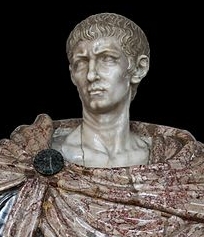
What most people do not know, because the history of Western Civilization stopped being taught in most high schools in the 1980s, is that Diocletian came into power with an agenda because of the serious economic problems preceding his reign. This man knew who to organize. He knew how to push the envelope in order to save Rome.

He did something which may happen again in the States and in the EU. Because the Romans were no longer taking over new lands and bringing back slaves, there was a shortage of workers. (Does this sound familiar now, with abortion and contraception?)

He made, through law, a serfdom, by taking away the small farmers civil rights and tying them to their land. This created the coloni underclass who farmed the land and paid rent to the owner. This rent was either money, part of the harvest or more labor.

Many people were forced into becoming coloni.  At the same time, the trade of Rome was dropping. If one could compare the times with today, one could say that Wall Street collapsed. The difference was that the emperor sought reforms by taxation and an emphasis on control of personal freedom and rights.

This may happen. This can happen. That the Great Persecution was part of the overall plan of renewal meant that it was accepted both as necessary for the continuance of the empire and the lifestyles of the empire, and as a necessity for the return of the "true Rome."

Inflation caused the Roman currency to drop. Here is a chart of early "quantitative easing".


And here is a detailed description of Diocletian's monetary reforms.

The reforms of Diocletian (284-305 CE) completed the recovery. He again tried to issue a new stable gold and silver coinage but, more importantly, he revised and regularized the tax system with some revolutionary new concepts. First he conducted a census of the Empire and divided everything into two types of tax units based on productive capabilities. These were land units called “iugera” and head count or “capita” (and yes, that’s where our modern term “per capita” comes from).
These were flexible units which took into account the different productive capacities of various types of land and the different productive capabilities of men, women, slaves and children. For instance, adult men were each calculated as one capito or one head count, but it took two women to make up the same amount of head (and I’m going to bite my tongue before I take a straight line like that any further!) and even larger numbers of children.
The greatest innovation was the concept of Capitatio. What this meant was that the state has the right to demand whatever it needs from its citizens in whatever form it wants provided it is done legally and correctly… as follows…
Each year on September 1st, the state’s total requirements were published and taxes would be apportioned to each province according to its assessed resources. In effect, what Diocletian had created was the modern idea of a national budget and tax system. Though the burden was undoubtedly heavy, it was at least equally assessed in all areas.
So efficient was this new system that the money seemed to pour into government coffers like it hadn’t in memory. No longer did the citizenry suffer the regular experience of being treated like conquered territory by armed men who were supposed to be their protectors. People’s iuga and capita were known to them in advance, tax receipts could prove what they had paid, and appeal could be made if collectors tried to abuse them. http://www.accla.org/actaaccla/kramer.html

Diocletian the financial saviour became Diocletian the moral saviour by killing those whose god was not Rome. All we need is one crisis, folks. One.....................

To be continued......

February 24, 201? XII

A Converted British Family Sheltering a Christian Missionary from the Persecution of the Druids


In the last analysis, the Great Persecution of Diocletian was a huge failure. If as many as 20,000 Catholics were killed in the Roman Empire, in all the provinces, the spread of Catholicism outweighed the death of the martyrs.

Christianity spread quickly throughout Europe, Africa, the Middle East.

Further persecutions would continue in all these areas, but the systematic killing of Catholics would only break out again at certain times, such as in the Druids (earlier), the Persian Sassanid Empire, under the Muslim Caliphates and Tamerlane, under the Chinese, Japanese, the English, and other groups or nations.

In every case, Catholics would have needed to help each other, as in Holman Hunt's famous painting here.

To be naive about the future helps no one, especially one's self.

To think that life will go on and on and on as it has in the past fifty years is naive, or purposefully blind.

The next persecution will not destroy Catholicism, but it will create a very small remnant. May we all be ready.


Monday, 3 February 2014

February 24, 303 X

Persecution under Nero
Diocletian retired and left his empire's laws against the Catholics on the books. In fact, after he abdicated on May 1, 305, some of the provinces saw less persecution. However, in the eastern one, under Galerius and Maximian, the horrors of torture and death continued until 313, with some persecutions happening even after the Edit of Milan Edictum Mediolanense. Maximian hated the Catholics particularly.

But, the persecution did end, only to be taken up again later by others. Here is a section of the Edict.

When you see that this has been granted to [Christians] by us, your Worship will know that we have also conceded to other religions the right of open and free observance of their worship for the sake of the peace of our times, that each one may have the free opportunity to worship as he pleases; this regulation is made that we may not seem to detract from any dignity of any religion.
—"Edict of Milan", Lactantius, On the Deaths of the Persecutors (De Mortibus Persecutorum), ch. 48. opera, ed. 0. F. Fritzsche, II, p 288 sq. (Bibl Patr. Ecc. Lat.XI).[8]

But, for those of us on this side of the persecution, that is, those of us who are watching the ratcheting up of forces being put into place to either make Catholics scapegoats, or merely to constrict them severely, the coming days of fines, imprisonment and even death are yet to come.
We have time to prepare in four areas:
1) Find that truth in ourselves, that cell with God to know what it is he wants you to do and where to go. If you are married with children, this means praying about the entire family.
2) We have time to seek the perfection of the virtues necessary for the evil times. There will be many suicides and apostazsing. We must be in a good place spiritually ourselves not to be tempted to despair and to be able to help others.
3) This is the last call for building communities. Travel will be restricted or very expensive. Movements will not be free.
4) Children must be prepared to be little soldiers for Christ. Parents need to pray how this is to be done.

Notice how I have said nothing about the clergy or the sacraments. The laity need to be prepared not to have either priests or the sacraments. Time to grow up and think and live like Catholics.


February 24, 303 VIII


A reminder in this series that the Great Persecution occurred throughout the entire Roman Empire. Europe, the Middle Eastern provinces, Africa, including Egypt, all saw the imposition of the laws against Catholics.

The great cathedrals were destroyed, such as the one in Nicomedia.

The attitude of the Catholics would have been one of watchfulness and prayer. The maximum number killed as determined by historians is set at 5,000.

One of the most familiar martyrs of this time is St. Agnes.

She was young, very young. So, she was prepared for the trial she had to endure.

Living in a society where one is bound to be persecuted clarifies the mind and intentions.

Moderns think that the Catholics at the time of the Great Persecution were all slaves. Not so, but some were, and some were from all the classes. These included the highly educated and people of the urbs. No one was spared because of position or rank. We know that the Church spread throughout the continents because of the Christian diaspora.

But, what is important for today is to realize that God has a plan. And, Catholics must not be complacent.

They can plan as well. It is important to remember that when one faces death or imprisonment, we are not assured that we shall persevere to the end. We need to pray for final perseverance.

That is my prayer.

And, here is St. Francis Ligouri's prayer for final perseverance.

Eternal Father, I Humbly Adore and Thank You, for having Created me, and for having Redeemed me. I Thank You for having made me a Christian, by giving me the True Faith, and for Adopting me as Your Child in Baptism. I Thank You for having given me Time-to Repent, after my many Sins, and for having Pardoned all my Offenses. I Renew my Sorrow for them, because I have Displeased You. I Thank You also for having Preserved me from Falling-again, as I would have done, if You had not Held me up, and Saved me. But my Enemies, do not cease Fighting-against me, nor will they, until I Die. If You do not Help me Continually, I will Lose Your Grace again. I, therefore, Pray-for Perseverance till Death. Your Son Jesus, has Promised that You will give us whatever we Ask-for in His Name. By the Merits-of Jesus Christ, I beg You, for myself and for all those who are in Your Grace, the Grace-of Never-more being Separated-from Your Love. May we always Love You in this Life, and in the Next.
Mary, Mother of God, Pray to Jesus for me. So I Hope. So may it be.
Amen

To be continued.............

February 24, 303 VII

Diocletian was seen as a "saviour", a reformer of good, old fashioned Roman values. He was successful in targeting a few groups which were increasingly seen as threatening the empire. The empire and the gods were one. The emperors and the gods were one. Security and peace, low inflation and financial progress were the priorities.

The Roman household had a strong identity. They were proudly "Roman". Could one be a Catholic and a Roman?

Sound familiar?

He decided that instead of emperor, he would be called Dominus Noster. One can see immediately that his intent was to consolidate power, even propagandist power, under his rule. Some historians claim that Galerius, one of the four emperors in the Tetrarchy, really pushed for the Great Persecution but the fact is that it started and was overseen by Diocletian.

All rulers want to make a mark on history. That Diocletian reorganize Roman life and finances, even down to creating hereditary jobs, made him popular.

The scene for persecution was set by a determined group who put the Roman Empire before the one, true God. 

The Dominus Noster fought the Domino Dominorum.  Today, we call this impetus narcissism. 


Therefore, in the empire built on law, the Catholics became a group under watch, under suspicion for being
"not quite Roman". (Not quite British, not quite American?). The Romans had a highly successful civilization. They took pride in their history and accomplishments. Would they let a growing group which included foreigners to take over their cultural norms?  They saw themselves as virtous against other barbarians. But, here was a group which refused to buy into the whole deal of complete loyalty to the state in the person of the emperor. Perhaps the Catholics were seen as "racists", as "anti-Roman" by their neighbors.

These attitudes have all been seen before and enshrined in law before.

To have loyalties beyond the empire and emperor at such times became a rallying cry for persecution.

How does a remnant respond? Once the clergy were imprisoned, killed or dispersed, what options would the remnant have?

Few, but some.

The first characteristic of such Catholics who persevered would be the four cardinal virtues of prudence, temperance, justice and courage. In other words, personal holiness kept those in the remnant from compromise.

The second characteristic would have been mutual support in the face of danger. In other words, a quiet, low-key community.

The third characteristic would have been the readiness to face whatever suffering came their way.

Actions and beliefs have consequences beyond the grave, and this the early Catholics knew well.

A mind-set of readiness is essential in persecution.

Watch ye therefore, because ye know not what hour your Lord will come. Matthew 24:42. DR

This readiness would not be confined to adults. The necessity of the times meant that parents had to prepare their children for imprisonment, loss, death.


Too many Catholics want to protect their children from such thoughts. They do so at the peril of their children's lives.

The readiness is all, as Hamlet states.


Not a whit. We defy augury. There’s a special providence in the fall of a sparrow. If it be now, ’tis not to come. If it be not to come, it will be now. If it be not now, yet it will come—the readiness is all. Since no man of aught he leaves knows, what is ’t to leave betimes? Let be. Act V: scene ii.

To be continued....


February 24, 303 V

Diocletian re-introduced the draft, or conscription. The Persians had attacked the empire, but were successfully defeated. However, Diocletian, being an uber-organizer, seized the anxiety of the time to build up the military.

The other thing he did was to divide the army into two parts, the limitanei, which were the legions on the borders, or the frontier troops, and the comitantenses, the inland troops, which could be moved quickly to parts of the empire. One can see this in America with the militarization of the police in some areas, and the use of drones.

Diocletian built up an army of half-a-million troops. He also changed the system of taxation, as he was faced with inflation and the burden of the military. All this information can be found in any history of the time.

His organizational skills and his strong religious ideology proved to be forces against which the Catholics could not stand.
The steps to persecution were incremental. First, all Catholic churches and scrolls were to be destroyed. This was part of the February 24th edict. Note that the Church buildings, some obvious, large and prominent, were targeted by the state. Without gathering places of worship, the people could be weakened.

Then, shortly after this date, other edicts followed. The Catholic clergy were to be rounded up and thrown into prison and only released if they honored the gods of Rome.

Finally, all Catholics were ordered to honor the gods of Rome or be executed.

Clergy first, laity second. This is the way it happened in England under Henry. Carthusians first...and so on...

When the shepherds are taken, the lambs and sheep are scattered.

How will this happen? Same sex marriage is a strong possibility for the line in the sand...the fining of the priests who refuse, the imprisonment if fines are not paid, the confiscation of property as fines are not paid, the imprisonment of the laity when fines are not paid, the taking away of Catholic lay properties if fines are not paid and so on.

Imprisonment will be incremental.

So, how did the Catholics in 303 respond? How did they continue? How did they pass on the Faith?

How did they survive? How will we survive?

To be continued.....


Sunday, 2 February 2014

February 24, 303 IV


Anxiety and stress, one terrorist attack of any medium size and a financial downturn could set off persecution.

The Irish classical scholar, E. R. Dodds wrote Pagan and Christian in an Age of Anxiety. Among many points he makes is one which should seem realistic to Catholics today. An agnostic, this scholar notes that in the unsettled economic times of the late 240s, the Church had grown and was beginning to be accepted in some circles as a force in society. But, alongside of that fact, was the hardening of ideas which in Dodd's opinion had been more fluid among the pagan and Christian intellectuals, of the doctrines and intellectuals in the Church. In other words, the pagan intellectuals were turning more and more against the Catholic intellectuals.

For example, Porphyry wrote Against the Christians in 270. Dodd notes in his book that the growing wealth and confidence of the Christians, as well as there many scholars upset the status quo of the pagan elite and the pagan intellectuals.

Does this sound familiar in the fact that so many of our universities in the West are increasingly anti-Catholic, atheistic and on the defensive against religion?

That the establishment of intellectuals would then find support and give support to the political powers seems a natural alliance against Catholicism.

And, Dodds quotes ancient authors in the fact that Catholics were not only "upstarts", a new religion, but "multicultural", that is "an immigrant religion", if I may use that phrase.

How "un-Roman" could a religion which included converted barbarians be?

That the intellectual snobbery and atheistic sophisticated pagans of the ancient world mirror our own is a comparison which is rather obvious.

Ergo, the stage is further set for persecution, as the intelligentsia spurs on the state to eliminate the "undesirables" which threaten the so-called common good.

Dodd himself writes that Christianity was seen as "divisive". And, the Catholic Church IS divisive, now more than ever.

The fact that the Christian God is Incarnated and not merely a spirit is also a problem, but that may be discussed later.

The stage is almost completely set up for persecution. The laws are in place, popular sentiment is growing against Catholics, and the common good will be an excuses for "unity".

The next things to be put into place are already in place in America-the militarization of the police and the use of drones as well as the entire lack of privacy.

But,  how do the Catholics become singled out, rather than, for example, the Tea Party members, or Evangelical pro-lifers?

And, how do the Catholics react as persecution starts in earnest, causing a smaller and smaller remnant?

To be continued........tomorrow.


February 24, 303 III


Moving from the established fact that totalitarian states guard the status quo by eliminating threats, and that such resulting persecutions are legal. one can state that such times of terror are actually popular with the vast majority of people.

One thinks of the crowds at Tyburn who came to watch the death of "traitors". Remember, Diocletian's laws against the Catholics were seen as necessary for the "morality" of the Roman Empire. He had an ideology and he was an authoritarian. Does this sound familiar?

He created his own popularity. He was seen as a "reformer" for the good of the people. Of course, he would make sure his ideas were popular. By definition, popularity is conformist.

Catholics, by design, are non-conformists, a sign of contradiction in the world. So, too, were those in the time of Diocletian.

Popular support of any type of persecution can be outlined.

1) Those who hate the Catholic would be relieved to join in such a persecution, and there are many who hate Catholics.

2) Catholics would be unpopular because their lifestyle makes people uncomfortable, reminding them of natural law and the Ten Commandments.

3) Popular support comes from a mind-set that "peace in our times" is more important than standing up for minorities or religious groups.

4) People thrive on the spoils of war from persecutions. My own family lost land and houses in the Holocaust, for example. Most of the existing aristocracy in Great Britain became wealthy land owners under Henry VIII and Elizabeth I from stolen land and resources taken from the monasteries, churches, and laity.


5) The unseen powers of the air, satan and his minions, hate the Church and use their slaves to bring down the Church. This is one of the goals of demonic activity. People involved in the occult and Masonry know this and cooperate with evil in popular movements.

6) Many people are just plain cowards or apathetic and will go along with the times.

And so on.....

The stage is being set for the out and out persecution of the Catholic Church in the Western World. And, those who want a false peace, to placate their stained consciences, who hate God and His Church, and who live carpe diem, will go along with whatever a state decides.

To be continued....


February 24, 303 II

from  Mosiacarum et Romanarum Legum Collatio 6.4, qtd. and tr. in Clarke, 649; Barnes,Constantine and Eusebius, 19–20.

"the immortal gods themselves will favour and be at peace with the Roman name...if we have seen to it that all subject to our rule entirely lead a pious, religious, peaceable and chaste life in every respect"

The first thing to understand about the Great Persecution is that it was not only legal, but religious. The national religion of the empire was being renewed by Diocletian and co-emperors


Maximian, Galerius and Constantius, for the good of the empire. The financial and military good of the empire meant that the old gods of Olympus had to be appeased. In the face of difficult times, it was necessary for the citizens to worship the "true" gods of the empire. In a sense, Diocletian and his fellow emperors in the Tetrarchy were revitalizing the entire Roman world with a new sense of dedication to the old gods.

So, why would the Catholics be the particular subjects of persecution?  (For the record, the Manicheans were also persecuted.)

The answer is obvious today. Any group of people which shows an allegiance to something other than the totalitarian heads of state form a threat. And, any group of people which holds beliefs contrary to those of the totalitarian state is a threat.

The problem with too many Catholics today, is that they do not see themselves as a threat to the growing totalitarianism of both the EU and America, now both run by anti-Christian principles, and increasingly anti-Catholic values or ideals.

Too many Catholics honestly believe that they can "talk" or have detente with the growing evil of the world.

This prevailing attitude can only lead to an increase in self-deceit and a false hope for change.


Small battles have been won here and there, but the battle for souls is being hindered by communism, socialism, secularism, and neo-paganism. It really does not matter, at this time, what "ism" will push through the draconian laws, as it only takes one.

We have all seen this before under Henry VIII, Elizabeth I, and Mao, among others.

The Catholics are the threat, always, as our kingdom is not of this world.

So, the stage is being set, quickly, very quickly for a new February 24, 303.

To be continued....