Recent Posts

Showing posts with label perfection series IV. Show all posts

Saturday, 11 April 2015

A Reminder of Purgation

Too many Catholics seek after consolations. Too many Catholics are apparitions chasers and experience chasers.

Until a person stops looking for consolations or signs and wonders, no progress will be made in the spiritual life.

I am repeating from the perfection series a long piece from Garrigou-Lagrange. I am astounded that so many Catholics still follow false and unapproved seers.

We actually do not need seers at all. Apparitions which have been approved by Rome should be the only ones we follow.

Lourdes, Fatima, Akita....and so on. My comments are in blue.

Here is an important section I am repeating:


HOW THE PASSIVE PURIFICATION OF THE SENSES IS
PRODUCED

This state is manifested by three signs which St. John of the
Cross describes as follows:
The first is this: when we find no comfort in the things of God, and none also in created things. For when God brings the soul into the dark night in order to wean it from sweetness and to purge the desire of sense, He does not allow it to find sweetness or comfort anywhere. It is then probable, in such a case, that this dryness is not the result of sins or of imperfections recently committed; for if it were, we should feel some inclination or desire for other things than those of God. . . . But still, inasmuch as this absence of pleasure in the things of heaven and of earth may proceed from bodily indisposition or a melancholy temperament, which frequently causes dissatisfaction with all things, the second test and condition become necessary.
This lack of comfort yet with persistent and consistent prayer and devotion signals passive purgation. Dryness just means that God is taking the soul away from exterior consolations, including devotions and apparitions. If one is not willing to set aside following these things, and not concentrating on Christ alone, one will never experience purgation on earth.
The second test and condition of this purgation are that the memory dwells ordinarily upon God with a painful anxiety and carefulness, the soul thinks it is not serving God, but going backwards, because it is no longer conscious of any sweetness in the things of God. . . . The true purgative aridity is accompanied in general by a painful anxiety, because the soul thinks that it is not serving God. Though this be occasionally increased by melancholy or other infirmity - so it sometimes happens ­ yet it is not for that reason without its purgative effects on the desires, because the soul is deprived of all sweetness, and its sole anxieties are referred to God. For when mere bodily indisposition is the cause, all that it does is to produce disgust and the ruin of bodily health, without the desire of serving God which belongs to the purgative aridity. In this aridity, though the sensual part of man be greatly depressed, weak and sluggish in good works, by reason of the little satisfaction they furnish, the spirit is, nevertheless, ready and strong.
One becomes aware of one's incapacity to please God without grace. One actually knows how easily it would be for one to go to hell. 
The cause of this dryness is that God is transferring to the spirit the goods and energies of the senses, which, having no natural fitness for them, become dry, parched up, and empty; for the sensual nature of man is helpless in those things which belong to the spirit simply. Thus the spirit having been tasted, the flesh becomes weak and remiss; but the spirit, having received its proper nourishment, becomes strong, more vigilant and careful than before, lest there should be any negligence in serving God. At first it is not conscious of any spiritual sweetness and delight, but rather of aridities and distaste, because of the novelty of the change. The palate accustomed to sensible sweetness looks for it still. And the spiritual palate is not prepared and purified for so delicious a taste until it shall have been for some time disposed for it in this arid and dark night. . . .(12)

Those who avoid suffering will never get to this place.
But when these aridities arise in the purgative way of the sensual appetite the spirit though at first without any sweetness, for the reasons I have given, is conscious of strength and energy to act because of the substantial nature of its interior food, which is the commencement of contemplation, dim and dry to the senses. This contemplation is in general secret, and unknown to him who is admitted into it, and with the aridity and emptiness which it produces in the senses, it makes the soul long for solitude and quiet, without the power of reflecting on anything distinctly, or even desiring to do so.
Now, if they who are in this state knew how to be quiet, . . . they would have, in this tranquillity, a most delicious sense of this interior food. This food is so delicate that, in general, it eludes our perceptions if we make any special effort to feel it; it is like the air which vanishes when we shut our hands to grasp it. For this is God's way of bringing the soul into this state; the road by which He leads it is so different from the first, that if it will do anything in its own strength, it will hinder rather than aid His work. Therefore, at this time, all that the soul can do of itself ends, as I have said, in disturbing the peace and the work of God in the spirit amid the dryness of sense.(13)

One can absolutely do nothing in this state but wait on God.

 The third sign we have for ascertaining whether this dryness be the purgation of sense, is inability to meditate and make reflections, and to excite the imagination, as before, notwithstanding all the efforts we may make; for God begins now to communicate Himself, no longer through the channel of sense, as formerly, in consecutive reflections, by which we arranged and divided our knowledge, but in pure spirit, which admits not of successive reflections, and in the act of pure contemplation (to which the special inspiration of the Holy Ghost gives rise in us).(14)

One cannot force meditation. If it comes, it comes. Reflections dry up. The imagination becomes almost emptied of images. God wants to come Himself into the person's imagination without any impediments.


In regard to this third sign, St. John of the Cross points out that this inability to meditate in a reasoned or discursive manner "does not arise out of any bodily ailment. When it arises from this, the indisposition, which is always changeable, having ceased, the powers of the soul recover their former energies and find their previous satisfactions at once. It is otherwise in the purgation of the appetite, for as soon as we enter upon this, the inability to make our meditations continually grows. It is true that this purgation at first is not continuous in some persons." (15)
Though this state is manifested by two negative characteristics (sensible aridity and great difficulty in meditating according to a reasoned manner), evidently the most important element in it is the positive side, that is, initial infused contemplation and the keen desire for God to which it gives rise in us. It must even be admitted that then sensible aridity and the difficulty in meditating come  precisely from the fact that grace takes a new, purely spiritual form, superior to the senses and to the discourse of reason, which makes use of the imagination. Here the Lord seems to take from the soul, for He deprives it of sensible consolation, but in reality He bestows a precious gift, nascent contemplation and a love that is more spirit­ual, pure, and strong. Only, we must keep in mind the saying: "The roots of knowledge are bitter and the fruits sweet"; the same must be said in a higher order of the roots and fruits of contemplation.

Some people are in the first two stages for years, some for weeks. This is the time when one is beyond mortal sin, being weaned of venial sin, and being purged of the tendencies to sin.

I am repeating much of what I have in the perfection series, but this is for the benefit of someone with whom I had a conversation last week.

St John of the Cross notes this:

 "These aridities and the emptiness of the faculties as to their former abounding, and the difficulty which good works present, bring the soul to a knowledge of its own vileness and misery." (20)
This knowledge is the effect of nascent infused contemplation, which shows that infused contemplation is in the normal way of sanctity. St. John of the Cross says: "The soul possesses and retains more truly that excellent and necessary virtue of self-knowledge, counting itself for nothing, and having no satisfaction in itself, because it sees that of itself it does and can do nothing. This diminished satisfaction with self, and the affliction it feels because it thinks that it is not serving God, God esteems more highly than all its former delights and all its good works." (21)

to be continued...see labels perfection, perfection again, perfection series II, perfection series III, perfection series IV, perfection series V: Mary, perfection series V, perfection series VI, perfection series VIII, doctors of the Church

Friday, 3 April 2015

Divine Mercy and Purgation

Today begins the greatest novena of all, to The Divine Mercy.

Please take time to say this beautiful prayer. One more penance for your Good Friday....

In all humility, I must admit I omitted this for years. How careless I was not thinking of all those who would have benefited from these prayers.

Here is the novena...print this out, if you do not have a copy.

http://www.shoj.org/docs/prayer/divine-novena/divine-mercy-novena-and-chaplet-brochure-2-per_page.pdf

I am in the passive purgative way. But, one can also enter into the active purgation, by choosing mortification and extra prayer. As I have noted in the perfection series, one cannot be useful to the Church without personal sanctity. Another state rather than humility only creates actions of egotism.

Here is St. Faustina on this.  "O my Jesus, I know that, in order to be useful to souls, one has to strive for the closest possible union with You, who are Eternal Love... I can be wholly useful to the Church by my personal sanctity, which throbs with life in the whole Church, for we all make up one organism in Jesus."

Thursday, 26 February 2015

Wow! Heresy in The Back of Church

Several weeks ago, I picked up three free booklets in the back of a church I was visiting. All three have out and out heresy and other errors in them. One is published by a diocese, one by an religious order, and one by a famous Catholic press.

Do not use these meditation books for Lent. They are corrupted by Modernist heresies and errors of judgement..

Lay people, please give up secondary texts and go straight to the Divine Office, for the sake of your souls. Blessed Paul VI told us to use the Breviary. Do it!

Some of the errors are so outrageous, they indicate a really worldly, and not God-given approach to Scripture. Some of the writings show a lack of knowledge of God and His saints.

A list of some errors:

Christ did not have the love of God but had to learn this. False. He is the Perfect Man, and God, never imperfect. This idea reflects the heresy of Arianism.

Christ "healed" Pilate's relationship with Herod. False, Pilate used Christ to make political points only.

Dorothy Day is an example of a saint. No, she was a Marxist, sadly,believing in what she called "Christian communism" which is a fallacy. She was confused as to distributism.

The confusion, maybe purposeful, of liberation theology (condemned by the Church) and the theology of liberation.

Huge emphasis on me, me, me, me and my gifts. This is all false theology, as all  spiritual gifts come through the sacraments, and from God, not nature. Natural gifts do not gain us heaven.

Outright denial of Christ's call to all of us for perfection and the misquoting of Christ....He did not say, "Be perfect, as I am", but "Be perfect, even as your heavenly Father is perfect." And, perfection is demanded of all of us.

Perfection is NOT maturity or wholeness. This is a modern, psychological interpretation which is wrong. Maturity has to do with natural growth, NOT supernatural perfection.

The denial that there is a call to perfection, to holiness, is a sign of the weakening Church and the lack of holiness among the priests. Most of the homilies and sermons on holiness I have heard in the last five years have been at St. Kevin's Harrington Street, in Dublin, where there are at least three priests who understand the road to perfection, because they have done or are walking on this road. What a difference of perspective!

Wholeness is not a measure of sanctity and never has been. This term is "New Age" and has nothing to do with perfection.....see my over 700 posts on perfection and the Doctors of the Church series I have done on perfection.

Following the letter of the law is "meaningless" wrote one priest. Absolutely not...we are formed in obedience and following the law is the first step to holiness.

References to tv shows. WHY? To be trendy and encourage modern entertainment show a lack of holiness on the part of the priest. Why is he watching tv anyway? He should be using the time for contemplative prayer.

Stop calling Mary a teenager! That word did not exist until the 20th century as there was no such category in Western or Eastern society. Mary was a child but by adolescence was being trained to be married and do all the chores and duties of a married person. To call Mary a teen is ridiculously anti-historical and implies all the problems and errors of the modern teen.

Misunderstandings of the time and people in the Bible--to many to mention any.

And so on,,,,

All these books which are on "gifting" are false and from the Protestant denominations.

All our gifts come in Confirmation. Any natural talents must be perfected in the Dark Night when egotism is destroyed before they can be used and bear fruit. To concentrate on the self is to deny the author of all gifts, God.

Too much me will not get anyone to heaven...Do not rely on other people's interpretations, but learn to read Scripture yourself through the guidance of the Church-St. Augustine, and the other saintly Doctors of the Church are better than these so-called modern expert priests.


Thursday, 20 November 2014

Perfection Series VIII: Part III Perfection and Justice


Raissa was called to be a contemplative in the world. Some of us seemed to be called to this. Such a life means that one moves from solitude to being with people easily.

Too much solitude is not a good, nor is too much time with people. A balance must be met.


Like Raissa, if I am with people too much in one day, I find the experience exhausting. The interior life demands attention and discipline, and for the beginner, like myself, much focusing.

Sometimes, I can be at Adoration for an hour, but not always.

Raissa was given the graces to be with Christ in the Eucharist for many hours in the day. But, she also needed to go out to her husband, his work, their friends, and the call of God to work in the larger world, as necessary.

Jacques notes in the Journal that she was given this ability to move back and forth between the two worlds of contemplation and activity.

He wrote this elsewhere: Contemplation… is frequently the treasure of persons hidden in the world… souls who live by it in all simplicity, without visions, without miracles, but with such a flame of love for God and neighbour that good happens all around them without noise and without agitation.

To get to the point of not experiencing agitation means that one must allow God to show one the ugliness of one's soul and live in a state of humility.  I am not there, yet.


This happens in the Dark Night, the time of no consolations, no resting in the Lord, just the awareness of one's sinfulness.

I think it is easier for an intellectual, to be honest, as one is use to study and reflection. The very active person must change the style and pace of life to meet the demands of contemplation.

For the definitions of meditation and contemplation, see the other series. I am not going to repeat those.

However, I shall use the terms which Raissa uses and which Jacques kept in the original French, as the English translation of both ideas lacks precision. But, before I mention those, I want to emphasize that Raissa knew in 1915 that God was calling all Catholics to perfection.


She writes that perfection is not merely for one's self, but for the sake of justice. She quotes the Mass:

Sursum corda. Habemus ad dominum. Dignum et justum est. Vere dignum et justum est, aequum et salutare, nos tibi semper et ubique gratias agere, and this is perfection. December 10th, 1915.

Lift up your hearts. We lift them up to the Lord.....It is right to give Him thanks and praise....it is our duty and our salvation always and everywhere to give You thanks.

It is our duty to be perfect. God demand justice, which is righteousness, and this is the call of each one of us. Raissa notes that do we not all desire justice? So does God.

We are justified in God through perfection. On November 26th, 1914, Raissa writes that the horror of World War I, which has caused all people in Europe suffering,

...would make the world hateful if one did not know that in some way all is well because there is divine will and permission. There remains nothing for us but to ask more than ever for the perfecting of our souls, so that by aspiring to nothing but Heaven, they too may be worthy to be admitted there the day God wills.

From the beginning of this part of my blog, from January, 2012, this has been the reason for my writing to you, my readers... for the perfecting of your souls and my soul.

to be continued....


Perfection Series VIII: Pressing Towards The Goal Introduction


All of us are given graces in order to cooperate with God's call to holiness.

First is the grace of conversion, which I have explained on this blog.

Then, we are given efficacious grace in order to grow in love.

Sacramental grace, which is sanctifying grace, gives us the Life of God in which we live if we are not in mortal sin.

God at this time is pouring out graces on His People. One of these graces is that of prayer, so that we can press forward on the road to purification and holiness.

In this mini-perfection series, I shall concentrate on the writings of Raissa Maritain, who should be canonized. The lay saints have trouble being canonized as it costs so much money to do so and orders are better equipped to put forward their priests. monks and nuns.

I met in 2013, the man behind the push to get Zelie and Louis Martin canonized. This is a full-time job.

Once you begin to see Raissa's reflections, you will realize how far advanced in holiness God brought her.

Of course, suffering physically had to be endured by this sensitive, highly intelligent and highly gifted woman.

In this series, I shall choose words from her Journal which add to the copious posts on perfection already on this blog, dating back to January, 2012.

She is able in her own words to explain grace to us in simple terms. That she and Jacques were personal friends with Garrioug-Lagrange is no accident.

Neither it is an accident that God led me to both Raissa and that great Dominican.

I call these events, these movements in one's life, "God-incidents."

Take advantage of the sharing of "God-incidents".

to be continued....


Friday, 7 November 2014

Overwhelmed by the Incarnation-Perfection Series VII: I

I am surrounded by people in the cities who do not believe in the Incarnation. They do not believe that the Second Son of the Blessed Trinity became Man. They do not believe in the Trinity.

The thought of the Incarnation overwhelms me, shapes my life, informs my prayers, and gives me energy.

The Incarnated Christ is not on the Way, the Truth and the Life. He is Love Personified.

No other loves in this world can compare with the Love Who Is a Person.

Those of us who are baptized and in sanctifying grace have the Indwelling of of the Blessed Trinity.

I shall pick this apart a bit, but the real lessons are in the experience of Christ Himself, through the Church, the sacraments and Adoration. As usual, my comments are in blue.

REALITY—A Synthesis Of Thomistic Thought
by Reginald Garrigou-Lagrange, O. P.
CH 21: THE INDWELLING OF THE BLESSED TRINITY

We cannot here treat of the missions of the divine persons. [578] But we must look briefly at Thomistic doctrine concerning the mode of the Trinity's indwelling in the souls of the just.
This doctrine derives from the words of our Savior: [579] "If anyone love Me, he will keep My word, and My Father will love him, and We will come to him and make Our abode with him." What will come? Not merely created effects, sanctifying grace, infused virtues, the seven gifts, but the divine persons themselves, the Father and the Son, from whom the Holy Spirit is never separated. Besides, the Holy Spirit was explicitly promised by our Lord and was sent visibly on Pentecost. [580] This special presence of the Trinity in the just differs notably from the presence of God as preserving cause of all creatures.
We must note three different explanations of this indwelling: that of Vasquez, that of Suarez, and that of St. Thomas.
Vasquez reduces all real indwelling of God in us to the general presence of immensity, by which God is present in all things which He preserves in existence. As known and loved, God is in no way really present in the just man. He is there only as represented, like a loved friend who is absent. This view allows very little to the special presence of God in the just.

OK, that is clear. All living creatures would die if it were not for the general Presence of God. He keeps us in this life. Even those who do not believe in God as kept alive, in His presence of immensity. But,the Indwelling of the Trinity is more than this.

Suarez, on the contrary, maintains that God, even if He were not present by immensity, would still, by the charity which unites men to Him, be really and substantially present in the just. This opinion has to face a very grave objection, which runs thus: When we love the humanity of our Lord and Savior, or the Blessed Virgin, it does not follow that they are really present in our souls. Charity certainly is an affective union and creates a desire for real union, but cannot itself constitute that union.

Love alone does not bring about this Indwelling, as tempting of an idea that is...as much as I like Suarez, he misses a main point here. Suarez also denies the need for the presence of immensity. For such a fantastic scholar, this seems a huge oversight in his thinking. There are levels of presence.

Here again the thought of St. Thomas [581] dominates two opposed views, one of Vasquez, the other of Suarez.
According to the Angelic Doctor, [582] the special presence of the Trinity in the just presupposes the general presence of immensity. This is against Suarez. But again (and this is what Vasquez did not see): God, by sanctifying grace, by infused virtues, by the seven gifts, becomes really present in a new and higher manner, as object experimentally knowable, which the just soul can enjoy, which it at times knows actually. God is not like a loved friend who is absent, but He is really present.
The saint [583] assigns the reason. The soul in the state of grace, he says, has God as its supernatural object of knowledge and of love and with that object the power of enjoying God.
To say truly that the divine persons dwell in us, we must be able to know them, not in abstract fashion, like distant friends, but in a manner quasi-experimental, with the vibrancy of infused charity, which gives a connatural intimacy with the inner life of God. [584] It is the very characteristic of experimental knowledge that it terminates in an object really present.

Thomas varies from Suarez in that infused love, or charity, given to the soul in the state of grace, allows for the real experience of the Trinity. This is real knowledge, not merely based on faith or hope, but on infused love. When this love is perfected, one is in the Unitive State.

But this experimental knowledge need not always be actual. Thus the indwelling of the Blessed Trinity lasts even during sleep. But as long as, by grace, virtue, and gifts, this indwelling continues, this experimental knowledge will, from time to time, become actual, when God makes Himself known to us as the soul of our soul, the life of our life. "You have received," says St. Paul, "the spirit of adoption wherein we cry Abba, Father. It is the Spirit Himself who testifies that we are children of God." [585].

When I am overwhelmed by the experience of the Incarnated Christ, this experience is real in the emotions, soul, heart and mind. But, even if I am walking in the Dark Night, the Indwelling of the Trinity is with me, although I perceive this Presence imperfectly.

Commenting on this passage in Romans, St. Thomas speaks thus: The Holy Spirit gives this testimony, by the filial love He produces in us. And elsewhere [586] he traces this experimental knowledge to the gift of wisdom which clarifies living faith. And in another passage [587] he is still more explicit. Not merely any kind of knowledge, he says, is in question when we speak of the mission and indwelling of a divine person. It must be a mode of knowledge coming from a gift appropriated to that person, a gift by which we are conjoined to God. That gift, when the Holy Spirit is given, is love, and therefore the knowledge is quasi-experimental.
Here lies the meaning of our Savior's words: [588] "The Spirit of truth, whom the Father will send in My name, will be in you, and will teach you all things, and bring all things to your mind whatsoever I have said to you."

Purification occurs so that one may experience the fullness of this Love to which each one of us is called in a different manner or even depth, according to God's Will. But, experience this we shall in the Illuminative and Unitive States.

To be continued....

Thursday, 16 October 2014

Feast Day of St. Margaret Mary-Perfection Series VI:IX Reparation


One forgets how young St. Margaret Mary Alacoque was when she died-43-and what sufferings she endured at home before she entered the convent, and afterwards.

Her life would not have been particularly noticed by anyone, as she lived in a family who lost wealth, lived in poverty, gained back some status, and as she was not particularly excellent about her chores in the convent.

Like St. Faustina, St. Margaret seems "ordinary" to the point of being overlooked or suspected.

These are the types of saints God chooses so that His Glory shines forth from such clay vessels. As the Sixth Perfection Series is on Reparation, today's feast is timely.

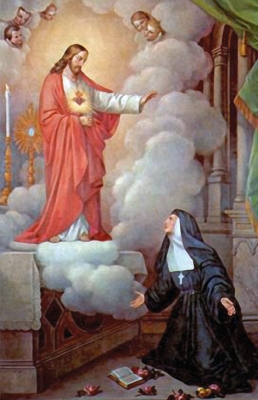
St. Margaret Mary did make reparation while on earth, suffering not only from her companions in the convent, but from the revelations from Christ, Who showed her His loving Heart, wounded by ungrateful humanity.

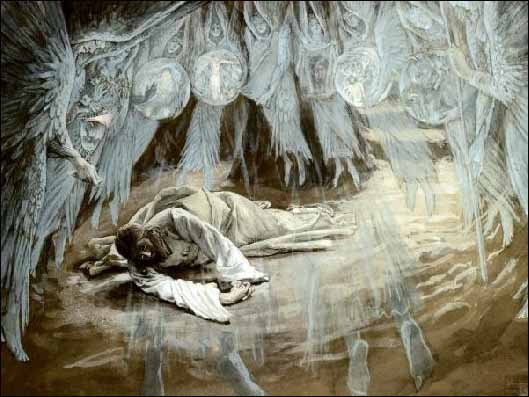
Today is Thursday, and St. Margaret Mary asked the Church to sit with Jesus in the Agony in the Garden on this day. How appropriate that my other mini-series is on Christ's suffering in Gethsemane.

When I was growing up in the pre-Vatican II, pre-NO Church, Holy Hours were common. Men coming from work could pop into churches for this devotion.

Even in Malta, it is hard to find Adoration unless one travels. (I do not count the ugly Millennium Chapel with Jesus in the lava lamp--see
http://supertradmum-etheldredasplace.blogspot.com/2013/01/do-you-like-this-monstrance.html)

Why there is not more public Adoration, I do not know.

Is there any in Walshingham now, regularly? That is what I wanted to set up.

Reparation for ignoring Christ needs to be made now. His Sacred Heart bleeds still. Reparation may be done by us little ones of God.

Wednesday, 15 October 2014

Perfection Series VI: VIII Reparation--The Reparatress and The Synod

One totally generous person shows us the way to practice reparation and that is Mary, Our Mother.

Pope Pius XI labels her the "reparatress". Can we not follow her, begging her for the graces necessary to suffer for others?

I challenge my readers to choose one of the most recalcitrant bishops or cardinal in the synod today and make reparation for him.

Do it!

But the just shall be justified and shall be sanctified still (Cf.Apoc. xxii. 11) and they will devote themselves wholly and with new ardor to the service of their King, when they see Him contemned and attacked and assailed with so many and such great insults, but more than all will they burn with zeal for the eternal salvation of souls when they have pondered on the complaint of the Divine Victim: "What profit is there in my blood?" (Psalm xxix, 10), and likewise on the joy that will be felt by the same Most Sacred Heart of Jesus "upon one sinner doing penance" (Luke xv, 10). And this indeed we more especially and vehemently desire and confidently expect, that the just and merciful God who would have spared Sodom for the sake of ten just men, will much more be ready to spare the whole race of men, when He is moved by the humble petitions and happily appeased by the prayers of the community of the faithful praying together in union with Christ their Mediator and Head, in the name of all. And now lastly may the most benign Virgin Mother of God smile on this purpose and on these desires of ours; for since she brought forth for us Jesus our Redeemer, and nourished Him, and offered Him as a victim by the Cross, by her mystic union with Christ and His very special grace she likewise became and is piously called a reparatress. Trusting in her intercession with Christ, who whereas He is the "one mediator of God and men" (1Timothy ii, 5), chose to make His Mother the advocate of sinners, and the minister and mediatress of grace, as an earnest of heavenly gifts and as a token of Our paternal affection we most lovingly impart the Apostolic Blessing to you, Venerable Brethren, and to all the flock committed to your care.
Given at Rome, at St. Peter's, on the eighth day of May, 1928, in the seventh year of Our Pontificate.


Chose that priest, bishop or cardinal who seems farthest away from the truth of the sanctity of marriage and do reparation for him starting today. Here is the prayer given to us by Pope Pius XI. Ask, no beg, the Reparatress to intercede now, today for what is happening in Rome.

Fast, pray, mortify yourself. We are responsible for the Church as well as those in Rome.

Prayer of Reparation
O sweetest Jesus, whose overflowing charity towards men is most ungratefully repaid by such great forgetfulness, neglect and contempt, see, prostrate before Thy altars, we strive by special honor to make amends for the wicked coldness of men and the contumely with which Thy most loving Heart is everywhere treated.
At the same time, mindful of the fact that we too have sometimes not been free from unworthiness, and moved therefore with most vehement sorrow, in the first place we implore Thy mercy on us, being prepared by voluntary expiation to make amends for the sins we have ourselves committed, and also for the sins of those who wander far from the way of salvation, whether because, being obstinate in their unbelief, they refuse to follow Thee as their shepherd and leader, or because, spurning the promises of their Baptism, they have cast off the most sweet yoke of Thy law. We now endeavor to expiate all these lamentable crimes together, and it is also our purpose to make amends for each one of them severally: for the want of modesty in life and dress, for impurities, for so many snares set for the minds of the innocent, for the violation of feast days, for the horrid blasphemies against Thee and Thy saints, for the insults offered to Thy Vicar and to the priestly order, for the neglect of the Sacrament of Divine love or its profanation by horrible sacrileges, and lastly for the public sins of nations which resist the rights and the teaching authority of the Church which Thou hast instituted. Would that we could wash away these crimes with our own blood! And now, to make amends for the outrage offered to the Divine honor, we offer to Thee the same satisfaction which Thou didst once offer to Thy Father on the Cross and which Thou dost continually renew on our altars, we offer this conjoined with the expiations of the Virgin Mother and of all the Saints, and of all pious Christians, promising from our heart that so far as in us lies, with the help of Thy grace, we will make amends for our own past sins, and for the sins of others, and for the neglect of Thy boundless love, by firm faith, by a pure way of life, and by a perfect observance of the Gospel law, especially that of charity; we will also strive with all our strength to prevent injuries being offered to Thee, and gather as many as we can to become Thy followers. Receive, we beseech Thee, O most benign Jesus, by the intercession of the Blessed Virgin Mary, the Reparatress, the voluntary homage of this expiation, and vouchsafe, by that great gift of final perseverance, to keep us most faithful until death in our duty and in Thy service, so that at length we may all come to that fatherland, where Thou with the Father and the Holy Ghost livest and reignest God for ever and ever. Amen.


Tuesday, 14 October 2014

Perfection Series VI: V Reparation

Till We Have Faces: A Myth Retold by C.S.Lewis is a book I taught for years at several colleges and universities, as well as in home schooling situations.

I have been obsessed with this story and love it, considering it Lewis' masterpiece.

I am not going into all the details of the plot, but will refer merely to two of the main characters, Psyche and Orual. By the way, I have written on this book before on this blog way back before 2009 and some of my older readers may remember my comments.

For me, the most important two elements of the novel are these: first, that Pysche must do penance for disobedience, for not trusting in Cupid, and for giving in to manipulation and lies.

Second, Psyche's reparation made it possible for Orual to have an excellent life, but as she is so full of pride, denial and ingratitude, she must be brought to see her sins and that fact that Pysche did all the work of reparation so that Orual could be successful and loved.

Such is reparation in Christian terms applied to the ancient myth. Perhaps my constant returning to this book both in my private reading and in teaching (my students loved this book on the whole, btw) is connected to my now realized call to do reparation for whomever or whatever God calls me.

Orual thought her love for Pysche was pure, but it was not. However, Psyche's love for Orual was pure. She got nothing in return for her labors until the very end of the journey.


That is the point. Reparative love must be purified, completely unselfish love.

That Psyche loved Orual purely allowed her to complete the tasks, to do the reparation necessary to save Orual.

In the end, Orual realizes that she, although ugly from birth physically, is truly beautiful to the gods, as Psyche is beautiful.

Of course, allegorically, we know that Psyche is the soul of Orual.

Love and reparation create something new in a soul. This newness may be a portal, and opening wherein grace can flow, heal, deliver.

Obviously, Christ has done the work, but He calls us in that mysterious manner to share in His sufferings for a particular person or group or situation.

When one becomes joined to Christ in suffering, only love transcends the pain, and it does, bringing a peace, and, as St. Therese the Little Flower writes, "unfelt joy".

to be continued...


Perfection Series VI:II.5 Reparation

Continuing with the theme of how does one know for whom or what to make reparation, I have one clear answer. This is a follow-up of II.

Those for whom God has placed on own hearts and in our minds great love, who are in need of having someone do reparation for them, are those to whom God wants you to focus your prayers and energies.

Mortification, penance, prayers, either for one person, a few people, the clergy in general, the Church, become focused as God pours sacrificial love into hearts in order for this reparation to occur.

Reparation takes tremendous energy and will-power. Those for whom one prays may never know until heaven that one made reparation for them.

So be it.


Like Christ seeing all the elements, stages, tortures of His Passion and Death, and seeing the ingratitude and horror of sin from all mankind, one may see sin, corruption, ingratitude and remain silent.

One may not see such things if one is praying for a friend or family member, but if one is praying for the clergy, the bishops, the cardinals who are insulting Truth both in the Person of Christ and in His 
Church, one may see such painful realities.

But, the real pain is the sacrificial love which is not acknowledged and cannot be.

Suffering in silence, alone, like Christ in the Garden, may be part of one's call to the ministry of reparation.

At that point, one experiences tremendous peace and even joy in pain. The reason for this is that one is joining Christ in the Garden of Gethsemane, as He has called one to join Him there.

Such is the calling of those who make reparation for others.

to be continued....

Monday, 8 September 2014

On Virtue, Again-Heroic Virtue

Some readers are still confused on the life of the virtues. I recommend, again, the posts I have mostly referrencing Garrigou-Lagrange on this subject through the tags.

However, a little review is good. Here is Thomas Aquinas:

Summa Theologica  I-II:61:4
Virtue consists in the following, or imitation, of God. Every virtue, like every other thing, has its type [exemplar] in God. Thus the Divine mind itself is the type of prudence; God using all things to minister to His glory is the type of temperance, by which man subjects his lower appetites to reason; justice is typified by God's application of the eternal law to all His works; Divine immutability is the type of fortitude. And, since it is man's nature to live in society, the four cardinal virtues are social [politicae] virtues, inasmuch as by them man rightly ordains his conduct in daily life. Man, however, must raise himself beyond his natural life unto a life Divine: 'Be you therefore perfect, as also your heavenly Father is perfect' (Matthew 5:48). It is, therefore, necessary to posit certain virtues midway between the social virtues, which are human, and the exemplary virtues, which are Divine. These intermediate virtues are of two degrees of perfection: the lesser in the soul still struggling upwards from a life of sin to a likeness with God — these are called purifying virtues [virtutes purgatoriae]; the greater in the souls which have already attained to the Divine likeness — these are called virtues of the purified soul [virtutes jam purgati animi]. In the lesser degree, prudence, moved by the contemplation of things Divine, despises all things earthly and directs all the soul's thought unto God alone; temperance relinquishes, as far as nature allows, the things required for bodily wants; fortitude removes the fear of departing this life and facing the life beyond; justice approves of the aforesaid dispositions. In the higher perfection of souls already purified and firmly united with God, prudence knows nothing but what it beholds in God; temperance ignores earthly desires; fortitude knows nothing of passions; justice is bound to the Divine mind by a perpetual compact to do as it does. This degree of perfection belongs to the blessed in heaven or to a few of the most perfect in this life.

The greatest blockages to virtue are sin, mortal and venial, and the persistence of our being influenced by our predominant fault.

One flaw can block a life of the virtues, which is why one must beg for purgation.

Heroic virtue is working under horribly difficult circumstances in order to become perfect. One sees, of course, heroic virtue in the lives of the martyrs, but heroic virtue may also point to quiet lives of constant suffering.

For example, a person who is chronically ill, but accepts God's grace to live in suffering cheerfully and with gratitude is exemplifying heroic virtue.

 A man living with a wife who is unsaved, or a woman, like St. Monica, living with a pagan until he died, exhibits heroic virtue in suffering unequal yoking and even derision.

A person unable to pull themselves out of dire poverty but accepts the limitations in grace and peace shows heroic virtue.

Someone who forgives a betrayal from a friend, or from a spouse in a marriage, may show us heroic virtue.

Some holy people in heaven are there because of manifesting heroic virtue, rather than perfection. For example, a person under an oppression may gain heaven through a lifetime of suffering.

Padre Pio showed us many virtues, but he also shows us heroic virtue, as he was persecuted by his own monastery.

So many saints had to endure misunderstandings, or sins, lies, even the envy, of others around them, such as St. Faustina and St. Bernadette.

Heroic virtue means enduring under very difficult circumstances. One person who will be recognized as "blessed" soon is Pope Paul VI. I have maintained for a long time that his holiness, as stated by the Pope Emeritus in December of 2012, is based on heroic virtue.

Paul VI promulgated Humanae Vitae against the advice of many in the Church, indeed, in the Vatican.

As the most significant and prophetic encyclical of our time, this document shows that the Pope endured with heroic virtue. He may have found himself isolated even in his own place for this decision to share God's Will concerning life and procreation.

Some get to heaven purely by martyrdom. Some by actions and consistency of heroic virtue.

As a loyal daughter of the Church, I trust the canonization process and the current Pope to only follow the promptings of the Holy Spirit when expressing opinions from the Chair of Peter.

May many Catholics, who do not reach perfection on earth, merit heaven through heroic virtue. I think we are even now being given the chance.


Friday, 22 August 2014

Perfection Series IV: Part Twenty; The Star of Love and Simplicity in Unity; II

I want to end this section on the Unitive State by referring to a chapter, (41) from Garrigou-Lagrange. As usual, the priest's insights are extremely clear. In a chapter on the Unitive State and "holy childhood", the Dominican notes this:

 The simplicity, or the absence of duplicity, of a child is wholly spontaneous; in him there is no labored refinement, no affectation. He generally says what he thinks and expresses what he desires without subterfuge, without fear of what people will say. As a rule he does not pose; he shows himself as he is. Conscious of his weakness, for he can do nothing of himself, he depends in everything on his father and mother, from whom he should receive everything. This awareness of his weakness is the seed of humility, which leads him to practice the three theological virtues, often in a profoundly simple manner.

One of the signs of someone in the Unitive State is a childlike dependence on God, a complete trusting in God the Father, a complete realization that without Christ nothing is possible, and that one needs the Holy Ghost in order to live the Christian life.

Most of us love the Little Flower for her great simplicity and love. She was raised by loving and faithful parents, which allowed her to make great strides in perfection at a very young age. 


Garrogue-Lagrange understands the virtues of childhood grow quickly in "good soil."

St. Teresa of the Child Jesus reminds us that the principal virtues of the child of God are those in which are reproduced in an eminent degree the innate qualities of the child, minus his defects. Consequently the way of spiritual childhood will teach us to be supernaturally ourselves minus our defects.
The child of God should, first of all, be simple and upright, without duplicity; he should exclude hypocrisy and falsehood from his life, and not seek to pass for what he is not, as our Lord declares in the Sermon on the Mount: "If thy eye be single, thy whole body shall be lightsome": (2) that is, if the gaze of your spirit is honest, if your intention is upright, your whole life will be illumined.
The child of God should preserve the consciousness of his weakness and indigence; he should constantly recall that God our Father freely created him from nothing, and that without God's grace he can do absolutely nothing in the order of sanctification and salvation. If the child of God grows in this humility, he will have an ever deeper faith in the divine word, greater even than little children have in the words of their parents. He will have a faith devoid of human respect, he will be proud of his faith; and from time to time it will become in him penetrating and sweet, above all reasoning. He will truly live by the mysteries of salvation and will taste them; he will contemplate them with admiration, as a little child looks into the eyes of his beloved father.

 Why are characteristics of the loving, trusting child indicative of a state of union? A child always loves, without the cost and without strings attached. A child is not jaded and wonders at the beauty of life. This simplicity of love and awe grows out of abandonment to God's Perfect Will. I have highlighted some passages for emphasis.


These characteristics of the child are the same as those of the trusting bride one sees illumined in the sermons of St. Bernard of Clairvaux. Those who trust are able to love.


If the child of God does not go astray, he will see his hope grow stronger from day to day and become transformed into trusting abandonment to Providence. In proportion to his fidelity to the duty of the moment, to the signified divine will, will be his abandonment to the divine good pleasure as yet unknown. The arms of the Lord are, says St. Teresa Of the Child Jesus, like a divine elevator that lifts man up to God.
Finally, the child of God grows steadily in the love of his Father. He loves Him for Himself and not simply for His benefits, as a little child loves his mother more than the caresses he receives from her. The child of God loves his Father in trial as in joy; when life is difficult, he remembers that he should love the Lord with all his strength and even with all his mind, and be always united to Him in the higher part of his soul as an adorer "in spirit and in truth."

This last characteristic shows that the way of spiritual childhood often demands courage in trial, the virtue of Christian fortitude united to the gift of fortitude. This is especially evident toward the end of the life of St. Teresa of the Child Jesus (3) when she had to pass through the tunnel, which St. John of the Cross calls the night of the spirit. She passed through this profound darkness with admirable faith, praying for unbelievers, with perfect abandonment and most pure and ardent charity, which led her to the transforming union, the immediate prelude of eternal life.


But, here is the mystery. One becomes childlike while retaining the virtues of strength and even martyrdom.

Garrigou-Lagrange does a good job in showing us that this seemingly contradiction is based on Christ's very words. 

The way of childhood thus understood wonderfully harmonizes several seemingly contradictory virtues: meekness and fortitude, and also simplicity and prudence, to which Jesus referred when He said to His apostles: "Behold I send you as sheep in the midst of wolves. Be ye therefore wise as serpents and simple as doves."


We must be prudent with the world, which is often perverse; we must also be strong, at times even to martyrdom, as in Spain and Mexico in recent years. But to have this superior prudence and fortitude, we need the gifts of counsel and fortitude, and to have them we must be increasingly simple and childlike toward God, our Lord, and the Blessed Virgin. The less we should be children in our dealings with men, the more we should become children of God. From Him alone can come the fortitude and prudence we need in the struggles of today: we must hope in God and divine grace more than in the strength of popular movements; and should this force stray farther and farther into the way of atheistic communism, we should continue to resist even to martyrdom, placing our trust in God like a little child in the goodness of his father. Father H. Petitot, O.P., in his book, St. Teresa of Lisieux: a Spiritual Renascence, emphasizes this intimate union of virtues so contrary in appearance in St. Teresa of Lisieux.

After the time of purification, one is again regaining lost innocence. Humility brings trust and self-knowledge. A child knows he cannot do anything without his parents' help. But, he also knows he CAN do things and he begins to understand his own capabilities.


Another point of capital importance is that when well understood the way of spiritual childhood wonderfully harmonizes also true humility with the desire for the loving contemplation of the mysteries of salvation. Thereby we see that this contemplation, which proceeds from living faith illumined by the gifts of understanding and wisdom, is in the normal way of sanctity. This penetrating and at times sweet contemplation of the mysteries of faith is not something extraordinary like visions, revelations, and the stigmata, extrinsic favors, so to speak, which we do not find in the life of St. Teresa of Lisieux; it is, on the contrary, the normal fruit of sanctifying grace, called the grace of the virtues and the gifts and the seed of glory. It is the normal prelude of eternal life. This point of doctrine stands out clearly in the writings of St. Teresa of the Child Jesus. She makes us desire and ask the Lord for this loving contemplation of the mysteries of the Incarnation, the redemption, the Eucharist, the Mass, and the indwelling of the Blessed Trinity in our souls.

"Jesus, Your ineffable image is the star which guides my steps."


The saint comes to the threshold of eternal life like a little lamb. 

The virtue of obedience is key at this state, and a sign of a saint, one in the Unitive State is complete obedience to Holy Mother Church. Obedience reveals humility and simplicity.

Maybe someday I can write more about this wonderful state of being one with God. I pray that God in His mercy and love will guide all of us on this blog, both me and readers, to become true children of Light.

I can say no more at this time about the Unitive State, but encourage my readers to read Garrigou-Lagrange's book found here.


We also have the saints, that "cloud of witnesses", the Church Triumphant, which tell us how to move on the road to perfection. What wonderful truths in the lives of the saints may be found in the readings from their feast days, the readings in the Divine Office, and the myriad biographies and autobiographies. There are no reasons, but our own reluctance and sin, in becoming the saint God wants each one of us to be.

I want to end with a song from my youth. St. Therese called Jesus her "Star of Love", echoed here in this song. The words are underneath this video of the Notre Dame Liturgical Alumni Choir.


I want to walk as a child of the light;
I want to follow Jesus.
God set the stars to give light to the world;
The star of my life is Jesus.


Refrain

In him there is no darkness at all;
The night and the day are both alike.
The Lamb is the light of the city of God;
Shine in my heart, Lord Jesus.
I want to see the brightness of God;
I want to look at Jesus.
Clear Sun of righteousness, shine on my path,
And show me the way to the Father.


Refrain
I’m looking for the coming of Christ;
I want to be with Jesus.
When we have run with patience the race,
We shall know the joy of Jesus.


Refrain


Perfection Series IV: Part Nineteen; Simplicity in Unity; I


Too many people assume or think even after study that the state of Union with God means that one has to have a complicated spiritual life.

On the contrary, simplicity is a mark of unity in and with God I am going to devote the last two parts of this fourth series on simplicity as a mark of unity.

Simplicity actually begins or comes in the Illuminative State, but is seen most clearly in the mature saint.

Little Rose of Lima, whose feast day is tomorrow, was united to God at an early age, shows us the way of simplicity. So, too, do SS. Therese, the Little Flower, and Joseph Cupertino.

Here is the great Dominican again:

SUPERIOR SIMPLICITY, THE IMAGE OF THAT OF GOD

Another aspect of veracity, the superior simplicity of the saints, prepares the soul even more for contemplation. Simplicity is opposed not only to duplicity, but to every useless complexity, to all that is pretentious or tainted with affectation, like sentimentality which affects a love that one does not have. What falsity to wish to talk in a glowing style as if one were already in the seventh mansion of the interior castle, when one has not yet entered the fourth! How far superior is the simplicity of the Gospel!

We say that a child's gaze is simple because the child goes straight to the point without any mental reservation. With this meaning Christ says to us: "If thy eye be single, thy whole body shall be lightsome"; that is, if our intention is upright and simple, our whole life will be one, true, and luminous, instead of being divided like that of those who try to serve two masters, God and money, at the same time. In the presence of the complexities, the pretenses, the more or less untruthful complications of the world, we feel instinctively that the moral virtue of simplicity or of perfect loyalty is a reflection of a divine perfection.

The simplicity of God is that of the pure Spirit who is Truth itself and Goodness itself. In Him are no thoughts that succeed one another; there is but one thought, ever the same, which subsists and embraces every truth. The simplicity of His intellect is that of a most pure gaze which, without any admixture of error or ignorance, has unchangeably as its object every knowable truth. The simplicity of His will or of His love is that of a sovereignly pure intention ordering all things admirably and permitting evil only for a greater good.


The most beautiful characteristic of God's simplicity is that it unites in itself perfections which in appearance are most contradictory: absolute immutability and absolute liberty; infinite wisdom and the freest good pleasure, which at times seems arbitrary to us; or again infinite justice, which is inexorable toward unrepented sin, and infinite mercy. All these perfections are fused and identified without destroying each other in the eminent simplicity of God.
We find a reflection of this lofty simplicity in the smile of a child and in the simplicity of the gaze of the saints, which is far superior to all the more or less untruthful intricacies of worldly wisdom and prudence.


What a false notion of simplicity we sometimes form when we imagine that it consists in telling frankly all that passes through our minds or hearts, at the risk of contradicting ourselves from one day to the next, when circumstances will have changed and the persons whom we see will have ceased to please us! This quasi-simplicity is instability itself and contradiction, and consequently complexity and more or less conscious untruth; whereas the superior simplicity of the saints, the image of that of God, is the simplicity of an unchanging wisdom and of a pure and strong love, superior to our impressionability and successive opinions.


St. Francis de Sales often speaks of simplicity.(11) He reduces it to the upright intention of the love of God, which should prevail over all our sentiments, and which does not tarry over the useless search for a quantity of exercises that would make us lose sight of the unity of the end to be attained. He says also that simplicity is the best of artifices because it goes straight toward its goal. He adds that it is not opposed to prudence, and that it does not interfere with what others do.

The perfect soul is thus a simplified soul, which reaches the point of judging everything, not according to the subjective impression of the moment, but in the divine light, and of willing things only for God. And whereas the complex soul, which judges according to its whims, is disturbed for a trifle, the simplified soul is in a constant state of peace because of its wisdom and its love. This superior simplicity, which is quite different from naivete, or ingenuousness, harmonizes perfectly, therefore, with the most cautious Christian prudence that is attentive to the least details of our acts and to their proximate or remote repercussion.


In my last section on the Unitive State, I shall go back to Garrigou-Lagrange on the childlike soul of the saint.

I know I have not exhausted this topic, but only given some hints, some indications as to the beauty of life in and with God.

We are ALL called to this state. Whether we cooperate with grace or not is our own decisions, made daily, until we die.

to be continued....

Perfection Series IV: Part Eighteen; The Marks of The Unitive State

Love, or charity, is the mark of the Unitive State. Perhaps some of you have met a person who is truly loving, kind, charitable, generous, calm, exhibiting all of the virtues and showing the world the life of the pouring out of the gifts of the Holy Spirit.

I have not met a person in the Unitive State. I did see and touch St. John Paul II, but to my knowledge, he was not yet in the Unitive State.

All Christians in Baptism are given the Indwelling of the Holy Spirit, a state which is altered when one commits mortal sin.

Those in mortal sin no longer walk in love or towards love.

Some people may have met such a person who walks in love. Garrigou-Lagrange sites several signs of a person who is in the Unitive State. Here is the section of his book which deal with these:

THE SIGNS OF THE INDWELLING OF THE BLESSED TRINITY IN THE PURIFIED SOUL

The signs of this indwelling are set forth at length by St. Thomas in the Contra Gentes,(14) and more briefly in the Summa theologica (15) where he asks whether a man can know if he is in the state of grace. Without having absolute certitude that he has grace, he has signs which enable him, for example, to approach the Holy Table without fear of making a sacrilegious Communion.
The principal signs of the state of grace, in ascending gradation, are the following.
The first sign is the testimony of a good conscience, in the sense that he is not conscious of any mortal sin. This is the fundamental sign, presupposed by the following signs which confirm it.
A second sign is joy in hearing the word of God preached, not only for the sake of hearing it, but to put it into practice. This may be observed in several countries where there is preserved, together with a simple life, a great Christian faith which leads the faithful to listen willingly to their pastor when he explains the great truths of the Gospel.

A third sign, confirming the preceding ones, is the relish of divine wisdom, which leads a man to read the Gospel privately, to seek in it the spirit under the letter, to nourish his soul with it, even when it deals with the mystery of the cross and with the cross he must bear every day.
A fourth sign is the inclination leading the soul to converse intimately with God, and faithfully to resume this conversation when it has been interrupted. We cannot repeat too often that every man carries on an intimate conversation with himself, which, at times, is not good. True interior life begins, as we have often pointed out, when this intimate conversation is no longer only with self, but with God. St. Thomas says: "Friendship inclines a man to wish to converse with his friend. The conversation of man with God is made through the contemplation of God, according to these words of St. Paul: 'Our conversation is in heaven' (Phil. 3: 20). And as the Holy Ghost gives us the love of God, He also inclines us to contemplate Him. That is why the Apostle also says: 'But we all beholding the glory of the Lord with open face, are transformed into the same image from glory to glory, as by the Spirit of the Lord'" (II Cor. 3: 18).(16)


and


A fifth sign is to rejoice in God, fully consenting to His will even in adversity. Sometimes in the midst of dejection there is given us a pure and lofty joy which dissipates all sadness. This is a great sign of the Lord's visit. Moreover, Jesus, in promising the Holy Ghost, called Him the Paraclete, or Comforter. And normally we rejoice so much the more in the Lord as we more perfectly fulfill His precepts, for by so doing we form increasingly one sole heart with Him.
A sixth sign is found in the liberty of the children of God. On this subject, St. Thomas writes: "The children of God are led by the Holy Ghost, not like slaves, but like free creatures. . . . The Holy Ghost, in fact, makes us act by inclining our free will to will, for He gives us to love God and inclines us to act for love of Him and not through fear in a servile manner. That is why St. Paul tells us: 'You have not received the spirit of bondage again in fear; but you have received the spirit of adoption of sons, whereby we cry: Abba (Father). For the Spirit Himself giveth testimony to our spirit, that we are the sons of God.' (19) The Apostle also says: 'Where the Spirit of the Lord is, there is liberty' (II Cor. 3: 17, deliverance from the slavery of sin, and 'If by the Spirit you mortify the deeds [and affections] of the flesh, you shall live' (Rom. 8: 13)'" (20) This is truly the deliverance or the holy liberty of the children of God, who reign with Him over inordinate desires, the spirit of the world, and the spirit of evil.


Lastly, a seventh sign of the indwelling of the Blessed Trinity in the soul, according to St. Thomas,(21) is that the person speaks of God out of the abundance of his heart. In this sense is realized what the holy doctor says elsewhere: "Preaching should spring from the plenitude of the contemplation of the mysteries of faith." (22) Thus, from Pentecost on, St. Peter and the apostles preached the mystery of the redemption; so too, St. Stephen, the first martyr, preached before being stoned; and likewise St. Dominic, who knew how to speak only with God or of God. Thus the Holy Ghost appears increasingly as a source of ever new graces, an unexhausted and inexhaustible source, "the source of living water springing up into life eternal," the source of light and love.
He is, as the saints say, our consolation in the sorrows of exile. A great hope is left to us in the present world crisis, for the hand of the Lord is not shortened. The numerous saints recently canonized evidence the fact that God is always rich in mercy. These saints who are His great servants, furnish us with magnificent, and often imitable, examples of faith, hope, and love. Proof of this statement is found in the lives of St. Teresa of the Child Jesus, St. Gemma Galgani, St. John Bosco, St. Joseph Cottolengo, Blessed Anthony Mary Claret, St. Catherine Laboure, St. Louise de Marillac, St. Conrad of Parzham, the humble Capuchin lay brother in whom are so admirably fulfilled our Savior's words: "I confess to Thee, O Father, Lord of heaven and earth, because Thou hast hid these things from the wise and prudent, and hast revealed them to little ones" (Matt. 11:25).

to be continued....