Recent Posts

Showing posts with label deceit. Show all posts

Sunday, 23 August 2015

Voice of Sanity Part IV

Part Two in Dr. Sanity's "strategies" is so good I decided to post this as well....you can look up Part One.


 APRIL 14, 2006

STRATEGIES FOR DEALING WITH DENIAL - Part II : Logical Fallacies and Rhetorical Ploys Used in Denial

This is the second of a three-part series on Strategies for dealing with denial. Part I -The Many Faces of Denial can be found here. Part III is here.

In this post I am going to discuss some of the techniques that those in denial use in order to maintain and facilitate their denial and to prevent any confrontation about it or their motivations. There are a number of logical fallacies and rhetorical ploys that frequently pop up when dealing with someone in denial. People in denial may believe they are engaging in substantive arguments and presenting their case, but when examined, the grounds they present are actually examples of pseudo-reasoning.

Although not precisely a fallacy or rhetorical ploy, physical coercion is another important technique that is used to defuse and/or disrupt rational argument or discussion. For the denier, coercion has the advantage of eliminating any possibiity they might have to confront their denial and what is driving it.

Understanding all of these techniques is essential for being able to deal with individuals in denial.

There is frequently a connection between the pseudo-reasoning technique employed to perpetuate denial, and the style of denial being used (as described in Part I). The list that follows is not exhaustive, and only includes some of what I consider the more important techniques being used. The table is only intended to be a preliminary guide. A brief discussion of each of the fallacies or rhetorical ploys referred to follows after table.


COMMON RHETORICAL PLOYS

From: Critical Thinking A Concise Guide (Bowell and Kemp):
Rhetoric is any verbal or written attempt to persuade someone to beieve, desire or do something that does not attempt to give good reasons for the belief, desire or action, but attempts ot motivate that belief, desire or action solely through the power of the words used.

The difference between fallacies and rhetorical ploys is understood most eaily as a difference in the function of the language being employed....politicians, advertisers and newspaper columnists tend to be experts when it come to using rhetorical ploys. Rhetorical ploys typically make a more or less direct appeal to feeling and emotion rather than to reason, which is the domin of argument. Fallacies, on the other hand, are simply defective attempts at arguments....They may fool us into thinking they are not defective, but they are still presented as attempts at argument. Of course, manny writers and speakers will use a mixture of rhetorical ploys, fallacies, and genuine arguments when attempting to persuade us of the truth of their claim.


Let us first consider some of the most common rhetorical ploys in use:

-Appeals to FEELINGS : this type of ploy is very common and the user tries to appeal to specific feelings or desires. For example, you may be enticed to believe what is said because of the passion with which it is said (rather than analyzing the content); or because it stimulates compassion, pity, guilt, fear or any number of other feelings.

Eliciting fear is also known as using "scare tactics", and should be distinguished from genuine warnings for which there is a good reason to act and/or experience the emotion.

Additionally, when one appeals to feelings; emphasis may be placed on the novelty of the idea; or popularity ("everyone thinks this!") or the sexiness or cuteness etc.; all of which can easily distract from a rational analysis of the idea or product.

-Direct attack is simply the unapologetic assertion that something is true or not true without any evidence presented.

-Buzzwords are the use of emotion-laden terms that subtly influence the listener but which offer no information about the truth of what is being said.

-Scare quotes are used to mock the opposition (I use them myself at times!) by calling into question a particular concept (e.g., terrorism vs "terrorism").

-Smokescreen is diverting attention from the topic of discussion by introducing a new topic.

-Equivocation is deliberately making ambiguous statements in order to mislead.

LOGICAL FALLACIES

-Formal fallacies can be found in almost any text on logic and include affirming the consequent (i.e., if P then Q; Q; therefore P) or denying the antecedent (i.e., if P then Q; not-P; therefore not-Q). As a group they are invalid arguments because of formal mistakes in reasoning.

-Substantive fallacies are fallacies that rely on an implied but not expressed general premise, but which are false when scrutinized. They include:
Majority belief - concluding that because a majority believe something it must be true. This category includes the excessive reliance on polls to be the arbiter of what is true or false and how one should behave.
Common practice - concluding that because everyone does a certain thing, you should do it too.
Ad hominem is responding to an argument by attacking your opponent rather than addressing the argument itself.
Appeal to an alleged authority - is problematic when the authority appealed to has no expertise in a particular field; or even if he does, there is no automatic guarantee that he is correct.
Perfectionist fallacy - where an idea or proposal is rejected because it cannot completely solve a particular problem.
Weak analogy -use of an unjustied or unsustainable analogy;
Causal fallacies are also very common and involve making assumptions that (1)because things are temporally related that there is a cause and effect (temporal fallacy); or (2) that because two things are correlated there is a causal relationship between them; (3) going from knowing a certain thing is true to believing that something else also must be true when there is no evidence to support the belief is called the Epistemic fallacy.

OTHER LOGICICAL FALLACIES AND DENIAL TECHNIQUES

The following techniques don't fit into the previous categories; or are a combination of one or more already mentioned. They include:

-Red Herrings are premises or ideas that are irrelevant to a particular conclusion but which are offered as evidence of the conclusion;

-Straw man is deliberately setting up a false target that is easier to defeat in argument;

-Begging the question is the situation where the truth of a conclusion is assumed by its premises;

-Selective use of evidence: in any analysis there is usually a large amount of evidence to consider; particularly when there is sufficient complexity involved, it is sometimes easy to pay attention only to evidence that supports the desired conclusions and not to evidence which contradicts it;

-Moving the goalposts is a common practice in denial and occurs when someone always demands more evidence than can currently be provided. If that evidence becomes available at a later date, the demand is then made for even more evidence ad infinitum;

-Argument by definition is changing the meaning of words or concepts so that they support your argument (e.g., "it depends on what the meaning of 'is' is."; and other distortions of language like using the opposite meaning of a word as in Orwell's Newspeak)

-Liar paradox is one of my personal favorites and is the use of paradoxical statements (e.g., "This statement is false" or "There is no objective truth") that are linguistically correct but internally inconsistent and cannot be demonstrated to be either true or false.

AGGRESSION AND PHYSICAL ATTACK

The most obvious technique in this category is the physical analog of the ad hominemattack. This clearly requires no thinking or logic manipulations at all. We see this in the physical attacks that are made by the left on whoever incurs their ire; or dares to spread ideas that deviate from their own script.

Isaac Asimov famously said that "violence is the last refuge of the incompetent." From a psychiatric perspective, I would amend the saying to: physical coercion is the last refuge of a person in denial. 

Coercion is the historically tried and true method by which most totalitarian regimes perpetuate themselves. They must control the flow of information; ruthlessly suppress any ideas that delegitimize their ideology; eliminate any persons threatening to expose their weaknesses; and even physically prevent their own people from being able to freely leave the country where they might pick up alien ideas. All of these measures ensure that psychological denial and the underlying motives of those in control are never questioned or challenged. A tyrant is, from this perspective, the ultimate person in denial.

There are many deluded people who claim that this situation already exists in the U.S. under the BusHitler. I'm sure you have noticed the frequent round-ups and imprisonment of all those Hollywood stars; and courageous antiwar protesters whose opinions are being ruthlessly suppressed by the Bush Administration.

Nevertheless, the real physical suppression and aggressive attacks that are occurring instead of rational debate are not coming from either the government or conservatives for the most part.

Some of the most recent examples can be seen here and here. The latter story about the attempt by law schools to ban US military recruiters is particularly amusing in light of the law school's belief that not only should they be able to effectively prevent the military from recruiting on campus, but they should also continue to receive money (and protection from the military, I assume) from the organization that runs the military (i.e., the US government).

Further, there are numerous physical attempts to shut people up that also use the rhetorical ploy of appeal to feelings--in particular, an appeal to cuteness--when protesters throw pies in the faces of speakers they don't agree with; or the mindless--and loud-- chanting of cute slogans to drown out speakers with whom protesters disagree.

Not only do these individuals and groups not bother to argue their side of an issue, but they can't even bear to listen to someone who might stimulate them to consider alternative ideas or confront their own denial.

Jeff at Beautiful Atrocities suggests to me some other ways that today's political left have developed to control the flow of information. He mentions Amazon, where you can track swarms of those on the left panning new conservative books they've obviously never bothered to read. Jeff suggests that this occurs, "As though the very existence of material that challenges their worldview is a threat that must be extinguished (rather than letting people make up their mind)."

Exactly. The last thing a person in denial wants is the free flow of information about a topic that threatens the perfection and contentment of his denial.

Wikipedia is another forum where people deep in denial have painstakingly tried to rewrite history so that it conforms with their ideology. If you read about the Aztecs, for instance, you'll find that their mass human sacrifice was really no different from European warmongering.

Democrats have also stated their intention, should they get the opportunity, to reinstate the 'Fairness Doctrine' aka govt regulation of private radio stations, which would have the effect of forcing conservative talk radio stations to jettison half their content in favor of Air America type shows, regardless of whether anyone wants to listen to them.

How many times have you heard those from the left side of the political spectrum state that the FCC should shut down FOX for its "lies". At college campuses all over the country, every time a campus newspaper runs an editorial that goes against the ideology, all the papers are stolen by the ideological minions of the left. Military recruiters are run off campus by the threat of violence (either to them or any who would like to listen to them).

I won't even go into the entire issue of leftist mainstream media bias, which has been taken up in many other venues.

The pattern remains the same. To physically prevent people access to alternate
worldviews or information instead of persuading them by rational argument of the truth of your own position.

None of these techniques (rhetorical ploys, logical fallacies, or physical control) are unique to one side of the political spectrum or the other certainly; but in today's political climate, most of the denial manifested--particularly since 9/11--is almost all on one side. Back in the 40's and 50's of the last century, the situation was reverse.

In Part III, I will discuss various strategies for dealing with your own psychological denial; as well as psychological denial in others. One commenter in the discussion thread for Part I said:
You have a solution? After only four years and seven months? But now we have to wait for it? Please hurry, early voting for the primaries starts tomorrow here in NC.


Well, I hate to disappoint. You can only lead a denier to reality, but you can't make him (or her) drink. That said, there are some useful strategies that may be helpful in dealing with the problem!

UPDATE: Anyone who would like to send a link to examples of any of the above techniques will have it listed here.
-SC&A found an example of coercion where a college librarian is being sued for sexual harassment because he recommend several conservative books to a freshman.
-LLB sent me this article about a display on abortion being destroyed.
-Junior says that with latest news today about the Iranian president saying that Israel will be annihilatedthis blogger is more worried about what Bush will do. (Displacement)

UPDATE II: At the Volokh Conspiracy, Eugene Volokh writes this about the SC&A referred article:
It's quite sad, I think, that these university professors are responding to offensive ideas not just by arguing against them, but by trying to coercively suppress them (apparently, according to the ADF's letter, with considerable support from their colleagues).


Yes, isn't it?

UPDATE IIINeo-neocon has a great post up on Critical Thinking. She agrees that it is...critical! Great minds think alike.

STM is posting these because of the upcoming Synod, wherein many are not thinking in terms of Christ's teaching or the long teaching of the Church. I taught Logic and Critical Thinking for years. Sadly, most Catholics cannot think, and do not think like Catholics.

Hope these posts jar some into reality.


The Voice of Sanity Part III

This article of Dr. Sanity is the last of three parts, and I highly suggest reading the first two parts. Part Two of her series on denial has a great chart.

In this Age of Narcissists, and now moving into a second level of that Age, I feel impelled to repeat her good stuff here.

APRIL 17, 2006


STRATEGIES FOR DEALING WITH DENIAL - Part III

In this final essay, I will discuss strategies for dealing with denial in one's self and in others. I apologize in advance for the length; but bear with me because I think this is an important topic.

Part I is here. 
and Part II is here.

At the center of all psychological denial is a hidden agenda. That agenda is usually not completely conscious--meaning that the denier has not thought through the issues surrounding his denial; and may not even be aware of what his motivation is in asserting something is true when it isn't; or false when it isn't.

Denial need not be absolute and completely cut off from reality. Even among alcoholics and drug users there is a varying level of awareness of their problem. Some accept that they are in jail or sick because of their substance use, but yet are still not willing to do anything about it. Some may recognize some facts about their drinking (like that they get put in jail), but completely deny the impact of those facts on themselves or their families; or the future implications of continued drinking or drug use (e.g., that they are killing themselves and will die).

The hidden agenda or underlying motivation behind the denial is very frequently related to the potential adverse consequences that could ensue if the denial were eliminated and reality acknowledged. That is where the unnacceptable feelings, needs, and thoughts come in. The denier (or part of him) has made an unconscious decision that awareness of certain feelings, needs, or thoughts is more threatening to his sense of self than the act of denial.

As an example, consider a person who develops a chronic cough. He might rationalize to themselves that his cough is because of a lack of humidity in the air; or because he has a slight infection; and most certainly is not a result of his smoking habits. He could go see a doctor, but doesn't, telling himself he is fine. As the cough gets worse, he become even more creative in his thinking about it (or not thinking about it) and is "too busy" to see a doctor; or tend to minimize the symptom even as it worsens.

This strategy of ignoring the problem goes on for some time--maybe months. The person may next fail to notice that he is losing weight and looking a bit drawn-out. The rationalizations now even include benign explanations for the specks of blood that can be seen in the cough. Finally, after much resistance, a loved one firmly intervenes--or the person faces the truth, confronts the issue-- and schedules an appointment. After a few tests, lung cancer is diagnosed. The prognosis is very poor because the cancer has already progessed to advanced stages during the months of denial.

Why would such a person deny the symptom to begin with? Because by denying the symptom, the person can pretend that everything is normal. Early on, when the symptom is new or minor, this possiblity may even be true. But as the evidence accumulates that something is very wrong; the person has now entered a phase of magical thinking and/or fantasy where he effortlessly pretends to himself that everything is as he wishes it to be. Eventually, the individual may become totally psychologically invested in believing that nothing is wrong ("lalalalala I can't heaaaar you"), and reacts (or overreacts) with anger and rage toward anyone who questions his view of things.

The entire act of denial was initiated to begin with by the psyche for a good psychological reason-- to temporarilly supress awareness that something was wrong--while the person struggled with the effort to face that possibility.

That awareness was so frightening, that a temporary psychological bargain evolved into a binding contract that allows the person to suspend cognition and reason so that he is able to ignore any knowledge or evidence that alters his fantasy reality.

Unfortunately, if the person really does have a cancerous process going on within them, it is completely unaffected by the psychological bargain made by the psyche. There are certain rules that govern the progression of cancers and they will be in force, whether or not the person is aware of them or not. Hence, the denier has made a short-term pact to feel better at the expense of his long-term health. In the case of this type of cancer, he has chosen to enjoy a period of relative complacency and blissful ignorance at the cost of catching the cancer earlier when it might be more treatable. In the long-run his unconscious choice is a very bad one.

But the reality is that some people in denial prefer the lethal consequences of their denial as long as they don't have to question their own motivations, beliefs, and ideologies.

Those individuals, groups, or nations who live in the world of deep denial are practically untouchable by reality or rational argument. They go through their daily lives secure in the knowledge that their self-image is protected against any information, feelings, or awareness that might make them have to change their view of the world. Nothing--not facts, not observable behavior; not the use of reason, logic, or the evidence of their own senses will make them reevaluate that world view.

All events will simply be reinterpreted to fit into the belief system of that world--no matter how ridiculous, how distorted, hysterical or how psychotic that reinterpretation appears to others. Consistency, common sense, reality, and objective truth are unimportant and are easily discarded--as long as the world view remains intact. As discussed in Part II, there are countless strategies --rhetorical ploys and logical fallacies--that can be used to keep the truth at bay.

Identifying the underlying motivational factors are important to understand the phenomenon of denial; the reasons why denial is used; and the overally psychology of deniers--whether they are individuals, groups, or even entire nations. There are limitations to this kind of analysis, however; and it is that exposing a motivation or even a hidden agenda in denial is not the same thing as a rational argument or analysis of what the denier is saying or arguing.

In a therapeutic relationship (i.e. therapist /patient) theoretically, a person in denial and the therapist collaborate and work together to discover the underlying problem. Even when very motivated to change, it is often the case that the denier exhibits a great deal of resistance to the idea that he or she is in denial.

In real life (not a therapeutic or professional relationship) we all have to deal with people in denial, and getting a person to accept that he or she is in denial is even more problematic. Unless there is a serious crisis in the person's life, there is little or no incentive for a person to emerge from the comforting cocoon of denial and rationalization--particularly when the consequences of doing so are more threatening to the sense of self than remaining ignorant or oblivious to one's true motivations.

What the psychiatrist does when a patient uses any psychological defense to interfere with treatment is to interpret the defense.

In psychiatry, particularly in psychoanalysis, the psychological defenses --especially the immature ones such as denial and projection --often stand in the way of a person being able to understand the source of their dysfunction and to deal with reality. These unconscious mechanisms act to protect the individual from reality by distorting that reality.

That is why I sound like a broken record and talk about DENIAL, PROJECTION and PARANOIA (see here and here for example) over and over again. Each time I observe such defenses, I work to get those who are using them to be conscious of what they are doing. Only then can they change their behavior.

Ultimately, an individual must CHOOSE to deal with reality. Noone can make anyone face a terrible truth they wish to avoid. One of the purposes of this blog is to "shine a psychological spotlight" on the maladaptive responses to the realities of our world.


(My choice of photo-stm)

A crisis may stimulate self-analysis and make the person more open to reflection and insight; but waiting for a crisis to happen, especially when someone's denial threatens your own well-being, is frustrating and irritating, to say the least. Also, those who have to deal with people outside of a therapeutic alliance, have neither the patience or desire to wait for the hoped-for epiphany in the denier.

Sometimes a crisis occurs (e.g. the events of 9/11) that should shake everyone out of their complacency for all time--but sadly, even that horrible day was not enough to open the eyes of some.

We have discussed the many faces of denial; i.e., the different psychological mechanisms used to facilitate and maintain an avoidance of a painful truth or reality; and we have discussed some of the cognitive tricks that are used to pretend to the rest of the world that one's fantasy is reality. What are the consequences of denial--both the positive (and there must be positive ones) and the negative?

THE CONSEQUENCES OF DENIAL

Positive consequences of denial include:

• In the short-term, psychological denial can help a person maintain their sanity--which would be threatened by awareness of a painful truth or reality
• In the short-term, denial can help a person function day to day
• In the short-term, denial can prevent a person from having to acknowledge painful thoughts, feelings or behavior and help them maintain their worldview from unacceptable reality

In the short-term, defenses--even denial-- may be creative, healthy, comforting, and coping. While they may strike observers as downright peculiar, in the short-term, they may be adaptative. Denial is a way to integrate one's experience by providing a variety of filters for pain and mechanisms for self-deception. It creatively rearranges the sources of conflict so that it becomes manageable.

Some negative consequences of denial include:

• In the longer-term, denial requires continued compromises with reality to maintain the pretense that "Everything is fine!" or "If only X would happen, everything would be fine!" Eventually, delusional thinking, along with paranoia and the inevitable conspiracy theories begin to take the place of rational thought in those who deny reality for long periods of time.

• The denier must then place the blame for the unacceptable reality on someone else and that leads to increased conflict between deniers and non-deniers. Efforts to maintain their denial consumes them and will lead them to escalate their anger and rage as their denial becomes untenable and ever more obvious.

• The denier will begin distort language and logic to rationalize and justify their behavior. Eventually, cognitive strategies and rational argument will be abandoned altogether by the denier, because those strategies are not sustainable and are unable to convince others; at which point the person in denial will simply refer to his feelings or emotions as the sole justification.

• The denier will feel justified in acting out against those who threaten the peacefulness of their fantasy.

• Problem solving and decision making will deteriorate as the entire focus of energy becomes the maintenance of the denial. In place of rational alternatives, excessive emotionality in general; and specifically anger and rage escalate toward those who are "blamed" for the reality that does not conform to the denier's worldview.

• In the end, interactions with those in denial are characterized by the denier's frequent smugness; sense of superiority; arrogance; belittlement of alternative views; and undiluted hatred toward anyone or any idea that questions their worldview.

In order to deal with someone who refuses to acknowledge reality or truth, there several basic approaches.

GET YOUR OWN HOUSE IN ORDER!
First, when confronting denial in others, your own house must be in order. In other words, if you are to have any hope of convincing someone else that they have a problem, you must be able to honestly and objectively assess any personal issues you yourself are carrying around that could cause you to distort reality.

In psychiatry, we call this process insight and self-awareness.

What do you look for?
• Hidden motives for your own behavior or beliefs
• Hidden agendas or ideologies that underlie your own thinking; or any thing in your own life that might facilitate distortion of reality or truth.
• Know yourself! Everyone has vulnerabilities, sensitivities, biases etc. These are not contraindicators for confronting denial in others--you don't have to be perfect; just honest with yourself.

Considering all the different vulnerabilities, sensitivities, and biases all human beings have, it actually requires a considerable effort of will to remain in touch with reality.; as well as a continual and conscious effort at a committment to truth. This is fundamental to personal honesty and integrity. Obviously this is not easy, and we are all prone to those self-deceptions that spare us from unpleasant truths about ourselves.

One of my frequent commenters, "Oh Bloody Hell" left a quote from Isaac Asimov on the Part II thread which is particularly relevant here:

"What I'm doing, really, is to look at things as they are. It's what you must do. Forget your ideals, your theories, your notions as to what people OUGHT to do. Consider what they ARE doing. Once a person is oriented to face facts rather than delusions, problems tend to disappear. At the very least, they fall into their true perspective and become soluble."
So many people look at the world through glasses that filter unacceptable thoughts, feelings and reality; and hence they are only able to see what they want to see, instead of what is (and no, that does not depend on the meaning of the word "is").

Again, this does not require perfection--you don't even have to have "pure" motives--just conscious ones that help you to understand why you think and/or feel a certain way. Then you will be open to recognizing the truth and what is. Then you will have a choice in your actions.

If you are lucky, your scrutinized motives, beliefs, wishes, and desires will not seriously conflict with reality. But, if they do, then you must face the music.

Reality is completely indifferent to your feelings, wishes, or your unresolved issues.

DEALING WITH OTHERS IN DENIAL
Once you have applied some self-awareness and know your own limitations--or, as the philosoher Eastwood has said, "A man's gotta know his limitations."-- then you can begin to appreciate the magnitude of the task that lies ahead for someone who is chronically in denial about reality.

The second step in the process is to accept the fact that there are positive rewards for the person in denial (at least in the short-term), and that the psychological defense that you would like them to abandon is actually a creative strategy designed to help them keep their sanity and their sense of self and worldview intact.

You have two choices at this point. You can engage the denier in rational argument in the hopes of breaking through their denial; or you can work around them and let them suffer the consequences of their denial. The second strategy may be the best in some cases, but is obviously more difficult if your own fate is tied to theirs. Let's discuss engagement first.

Just because you wish to engage the denier in argument does not mean that you have to allow them to abuse you or threaten you (this has been an issue several times on this blog--while I want to engage people, I don't have to put up with their abuse). That means that the first principle of engagement is

• Limit Setting - you must make sure that the rules of engagement are followed and that what you are seeking is a rational discussion of issues; not a name-calling session where the person who screams the loudest or speaks with the most swear words considers himself the "winner".
Once the limits are set; be prepared for the person in denial to ignore them.

If you still want to engage, then the second principle is:

• Redirection - where you point out what the rules are again and only respond to the rational argument thatmight be buried in all the emotion. Gently (or at least as respectfully as you can--remember, it is your choice to engage them) point out to the person that they are avoiding the point by using such and such a rhetorical ploy or logical fallacy, etc. You can then challenge them to use a rational argument or present their premises and any evidence to support them. This is as close as you might get to "interpreting the defense". Either they will come back more appropriately and logically, or they'll ignore you; or they'll simply abandon the argument. Limit set and redirect as often as necessary.

If you can get the person back on the topic, and expressing his perspective honestly:

• Give constructive feedback (but not in a condescending tone). You can say something like, "that's a good point; let me see if I can counter it."

• Be ready then, to present your own rational perspective, with whatever evidence or facts you have available that might help them begin to question their own irrational beliefs; or even their own honesty.

• Be ready to point out the specific errors in logic; or fallacies and/or rhetorical ploys in their own arguments. Call them on it and ask for objective evidence from that that you would consider. Make sure you know what these fallacies and ploys are!

• Be willing to acknowledge when they have a point..

• Try as much as possible to engage them with what really exists--not what either of you would like to exist.

• Ask them for specific suggestions on how to deal with the problems you can both agree on. Be ready to give your own specific suggestions.

• When applicable, don't solve their problems for them; or shelter, protect or help them avoid the consequences of their denial --unless those consequences also impact you. If that is the case, understand that by letting them off the hook, you have encouraged them to think that their worldview is correct and yours is not.

• Have some standby information to direct them to that they can read on their own time that may help them to face the problem.

• Don't give into the temptation to call them names or to do unto them what they might be doing unto you…unless, of course, you are human; then in that case once in a while it might help your own mental health.

As you can see from the above list, it is quite difficult and time-consuming; as well as frustrating and endlessly repetitive to engage a person in denial.

Sometimes you may think you have put an issue to rest and successfully argued your point; only to discover that later the denier will bring up exactly the same slogans or mantras that you had previously and painstakingly countered!

That is why the level of denial is important to ascertain. Some people simply need to be nudged or reminded of certain facts--e.g., seeing a movie like United 93, which can bring back the reality of the events of 9/11 which may have slipped from conscious awareness simply from the everyday vissictitudes of living one's own life.

At the other end of the spectrum are those people, groups, and nations committed to the denial of reality the way others are committed to truth. Their entire sense of identity is dependent on a certain view of the world and they would rather die than relinquish that view.

If you want to continue with the challenge of engaging someone in denial, you must recognize that moments of epiphany and breakthroughs in insight are few and far between. In therapy, you can wait for months and even years for people to confront their own denial and understand the motivations that underlie their own unhappiness--but that is in therapy, where they presumably come to see you to get well and/or happier.

Unless the person you want to engage is a loved one, engaging a person in denial can be a thankless task. As I said in Part II, "You can lead a denier to reality, but you can't make him/her drink think."

As I said earlier, ultimately, an individual must CHOOSE to deal with reality. Neo-neoconhas written about her own journey in her excellent series, "A Mind is a Difficult Thing To Change" which I highly recommend (click on the link and go down her right sidebar to access those posts).

Finally, what do you do if you conclude that you must find a way to ignore or work-around people in denial because you are at risk due to their behavior?

Let me return to my own major motivation for blogging: my observations of the psychological denial --particularly after 9/11--and increasingly psychopathological responses of the left (including many in the Democratic Party) to the war on terror. My hope when I started blogging was that I could offer a unique perspective on the problem and by "shining a psychological spotlight" on the dysfunctional behavior, I could help those with an open mind to to come to grips with the critical issues of our time--Radical Islam and the threat to western civilization.

I remain hopeful that there are many people out who can be motivated to do exactly that. I don't expect them to all think exactly the same as I do about the current situation in the world; nor do I expect them to agree with me on what to do. Surely, reasonable people can differ on these points and amicably work together to come up with optimal solutions.

But what I do expect is some fundamental agreement on what the reality is.

The left's current concensus view on terrorism, Iraq, Afghanistan, the war on terror and Freedom is flatly wrong and cannot be justified by the facts that are out there. Their rhetoric is designed to obfuscate and deny objective reality --which they don't even believe in to begin with (or, they believe in it until it become threatening then they seek refuge behind postmodern political rhetoric). The motivation for their continual Bush/Republican bashing is simple: Bush is the current symbol of their demise--the fly in their utopian ointment; the light shining in their darkness; or, to be more precise, the symbol of the end of their ideology.

How do I know this? Since Bush's election at the millennium, things have been going very badly for the left. As the real world presses in on them, their voices have become more shrill and hysterical; their rage is escalating out of control. No longer do most of them even bother to argue their points logically; they simply loudly denounce any idea or person who threatens their worldview; or deliberately and with the ruthless finesse of all tyrants and thugs, simply attempt to supress all dissenting opinions.

9/11 did not wake them up; rather it forced them to openly move toward what they have supported surreptitiously all along--the elimination of free speech in the name of political correctness and multiculturalism; a dictatorship where the pseudo-intellectual, politically correct priesthood rule; and complete control over the lives of others (for their own good, of course). Since their objectives dovetail nicely with those of the Islamic terrorists, they have made common cause with them and have not lost many opportunities to enable and encourage them, even as they denounce America and the principles of freedom and democracy.

They pretend their actions are motivated from love and peace and patriotism; but this is only how they rationalize it to themselves. Their self-deception and denial is simply stunning in its sweeping grandiosity and self-righteousness betrayal of the good.

Gerard Vanderleun has a post up about the eerie appropriateness of the recently discovered "Judas gospel". The money quote:

Treason, done with the kiss of "my personal freedom," proves that you do not really hate your country, you love it. You are, in the final analysis, your country's best friend. In these "new" old tales about Jesus we read that Judas betrayed the Son of God because Jesus told him to do it. Really? Or did his betrayal come, not from any request that may or may not have been made, but from humanity's persistant lust to sin freely and without even the thin penalty of remorse? Was this final treason done because this sin had been secretly blessed by God, or for the sheer dark thrill of asserting the self at the expense of life in the light?

"I betrayed my friend, because he gave me the freedom to do so. Feel my love for him."

"I betrayed my country because it gave me the freedom to do so. Feel my love for it."

Black is white. Hate is Love. Slavery is Freedom. Treason is Loyalty. That last phrase fits right in to the secular catechism, doesn't it? All it needs to become holy writ is an avatar, a solid historical personage with the power to turn darkness into light, lies into truth, and betrayal into something that was, in the final analysis, "all good."

Saint Judas, step right up to the Gates, ring that bell, and don your halo -- you the man.
Careful observation and analysis of behavior is what I do for a living. I am very good at it. My patients tend to get well for the most part. I am not always correct and I have a great tolerance for ambiguity and doubt. I can be convinced that I am incorrect because I accept my own humanity and its limitations. But if you want to convince me, you will have to give me some compelling argument that is rational and which conforms to what I observe in the real world. Calling me names and threatening me (try reading my email for a week) just will not do it; and, quite frankly, only confirms my premises.

If you can look in the mirror and truly know yourself, including all those hidden motives and agendas and unresolved issues in life which we all must grapple with; you can gain some control over your own life; make choices and attack problems based on a clear view of reality. Yes, people may still make the wrong choices, or screw up in dealing with the problems even when they are aware of their own unconscious conflicts. Human beings are not perfect.

But when denial distorts or obscures reality, we are far more likely to make the wrong choices and ignore the serious problems. Our energy becomes solely focused on maintaining and nurturing the denial as we get angrier and more out of touch with reality all the time.

As long as the left continues to live in the world of denial and play their rhetorical games and use their non-logic to justify the unjustifiable; to tolerate the intolerable; and support the unsupportable; then I will continue to blog and expose their motives and hidden agendas; and do everything I can to prevent them from regaining political power.

This means that no matter how badly I think of the current crop of Republicans--and I do think very badly of them--when the alternative is the Party of Denial, better known as the Democrats and the loud lunatic fringe that they cater to; then the Republicans are going to get my vote every time. Where once I had the luxury of voting for third party candidates (e.g. libertarian), the stakes are far too crucial now to waste my votes.

There is hope, however that the cocoon of denial may finally be breaking up. Those who are still rational on the left have come together around the "Euston Manifesto," which is a manifesto that, among other things says it stands for democracy; for human rights; and for freedom. It refuses to apologize for tyranny; and rejects the knee-jerk anti-Americanism that has become the hallmark of leftist politics. One can only ask, what took so long ?

At any rate, the Euston Manifesto may represent the left's first small steps back toward the real world.

Tuesday, 18 August 2015

Deceit: The Epidemic in America

A strange poem, incorrectly attributed to William Blake, and of an unknown writer gives the source of a popular child's refrain--"liar, liar, pants on fire".

 The Liar

Deceiver, dissembler
Your trousers are alight
From what pole or gallows
Shall they dangle in the night?
 
When I asked of your career
Why did you have to kick my rear
With that stinking lie of thine
Proclaiming that you owned a mine?
 
When you asked to borrow my stallion
To visit a nearby-moored galleon
How could I ever know that you
Intended only to turn him into glue?
 
What red devil of mendacity
Grips your soul with such tenacity?
Will one you cruelly shower with lies
Put a pistol ball between your eyes?
 
What infernal serpent
Has lent you his forked tongue?
From what pit of foul deceit
Are all these whoppers sprung?
 
Deceiver, dissembler
Your trousers are alight
From what pole or gallows
Do they dangle in the night?


One the other hand, we have this sublime truth from Our Lord Himself.

John 14:6 Douay-Rheims

6 Jesus saith to him: I am the way, and the truth, and the life. No man cometh to the Father, but by me.


This passage from Scripture is not merely a strong statement of the Identity of Christ, as the Way, the Truth, and the Life, but a clarion call to choose Him over deceit and eternal death. If Christ is the Truth, and He is, the Antichrist will be the Deceiver. Get ready.

People comment almost daily about the political leaders who have consistently lied to the public about foreign affairs, finances, even personal sins, which cannot be hidden and should not, in a public person's life.

People talk to me about betrayal in their families, children who lie, adult children who lie and, tragically, husbands and wives who live in various levels of deceit. When married couples lie to each other, this symptom of the complete breakdown of the trust in marriage leads to the inevitable break-up,

The world, and America face an enemy which does not consider lying to their enemies as a sin, as in their religious code, one may do so.

I have been told by some people "that everyone lies". Of course, this is not true. Many good Christians do not lie. Some good "nones" do not lie. However, this culture of deceit, which includes big business, as well as the kid on the block, seems to have been created almost overnight.

Perhaps one can blame the mad pursuit of money and status. Perhaps one can blame advertising, which is based on deceit. Perhaps one can blame the "texting culture", which fudges communication.

Or, perhaps we forget who is the Father of Lies and has managed, rather succinctly to undermine society and a civilization which must have trust in commerce and relationships as a basis for normal interactions.

I found these statistics, which is a way, do not surprise me, but show the prevalence of deceit in our culture. From here.

The Most Honest Cities for Online Dating

MEN
1. Houston
2. Phoenix
3. Boston
4. Pittsburgh
5. Chicago

WOMEN
1. Charlotte
2. Houston
3. Minneapolis
4. Seattle
5. Phoenix
The Least Honest Cities for Online Dating

MEN
1. Washington D.C. (Career & Education) 37%
2. San Francisco (Career & Money Earned) 35%
3. New York (Everything) 34%
4. Philadelphia (Height & Money Earned) 33%
5. Miami (Relationship Status & Height) 31%

WOMEN
1. Las Vegas (Age & Career) 39%
2. Washington D.C. (Career & Education) 37%
3. Atlanta (Age & Weight) 36%
4. Los Angeles (Age & Weight) 35%
5. New York (Age & Career) 33%


Scary, and I had a friend years ago who had to take out a restraining order on a man from a Catholic dating website. His life consisted of a huge spider's web of lies, including hiding a violent temperament.


Deceit is born in the desire not to suffer, to avoid suffering. Deceit denies Providence. Deceit covers other sins, like greed, gluttony, adultery, stealing, fornication, and contraception. When life is denied, in abortion and euthanasia, this denial comes from the deceit that God is God and is in charge of life, from conception to natural death.

But the real source of lying, the deep root of small and large lies, is self-deceit. When one refuses to face one's sins, when one refuses to admit evil in one's own soul, the pattern of deceit becomes a habit.

Some of us know compulsive liars. Some of us know those who always "get a deal" by lying or doing underhand business deals.  Some of us know those who lie about their own state of grace, thinking they will get to heaven without repentance or penance. Some of us know men and women who persist in unhealthy, even abusive relationships, because they lie about their boyfriend or girlfriend "changing" after marriage. The pursuit of security or "love" creates a life of deceit.

Now, with the recent SCOTUS decision, lying has been enshrined into law, a false law contrary to God's natural and revealed law.  This huge unnatural lie permeates the family lives of so many, that lies will not be able to be ignored to the cost of individual souls. People will go to hell not only for lying about God's perfect plan for humans and the real meaning of marriage, but for tolerating evil, which is a lie against conscience.

Tolerating evil is based on deceit, coupled with a fear of rejection. I know too many families which tolerate the evil of fornication, adultery, and sodomy in their families, creating an atmosphere of lies, setting up an entire false structure of family unity and security.

Christ instructs us plainly as to what Truth is--Himself, the Second Person of the Blessed Trinity.

When we lie, we reject Christ, choosing other gods, such as family members, or status, or security.

One of the greatest lies has to do with the reality of "love". Love is not sex, or passion, or lust.

We cannot label something love which is impure, immoral, unnatural.

But, the greatest lie is the denial of God being God. Idolatry of any kind comes from self-deceit.

The other day, I posted an article about a bishop who may go to prison for up to six years for upholding Church teaching regarding ssm in his diocese in Switzerland.

What struck me most in that article was the great lie that the Bible truths cannot be applied to daily life. Can you imagine laws of this land and in Europe no longer being based on Biblical truths, on Revelation? Can you imagine a life lived without Bibles, and the trust in God's Own Word?

Recall this statement, 

The bishop had crossed a “red line,” said the head of Pink Cross, in a statement reported by Newsweek. “We believe in freedom of expression, and taking quotes from the bible is fine. But then he said the words should be applied to real life, which is the equivalent of calling for the death penalty for gay people. We were worried about that. He is the leader of a big church, and he was calling for people to follow his words, and we thought this could be dangerous.”


Two lies can be spotted here. The first is that the passage quoted called for the death of homosexual people; the second is that the Bible cannot be used to apply to life.

See how far Western culture has fallen into deceit?


If one is not faithful in small things, one cannot be faithful in large things. Those who grew up lying, or fell into deceit through repeated sin, must heed Christ's words.

Luke 16:10-12 Douay-Rheims

10 He that is faithful in that which is least, is faithful also in that which is greater: and he that is unjust in that which is little, is unjust also in that which is greater.

11 If then you have not been faithful in the unjust mammon; who will trust you with that which is the true?

12 And if you have not been faithful in that which is another's; who will give you that which is your own?


Teach your children to be honest. Do not think that deceit is a lesser sin. It comes out of the damned spirit, the Father of Lies. Christ addressed those living in lies, as those in the religious system had created a false religion, far from the deep spirituality of the Revelation of the Old Testament.

May God preserve us from such hypocrisy.

John 8:44 Douay-Rheims 


44 You are of your father the devil, and the desires of your father you will do. He was a murderer from the beginning, and he stood not in the truth; because truth is not in him. When he speaketh a lie, he speaketh of his own: for he is a liar, and the father thereof.

Lying about one's spiritual life has to be the worst symptom of deep-seated deceit. Some think that they are holier than they are because they act holy, do good works, or attend Sunday, even daily Mass.

Years ago, I had to speak with a priest about my trying to understand how a woman I know who was embezzling money, (I tried to tell her board members of her company as I discovered this, as well as another woman with whom I was working),  I could not understand how this woman could go to daily Mass, receive Christ, and continue her stealing and misuse of funds. Several of us tried to convince those who ran the company that this was happening. They did not want to admit this, as the people were all "friends" as well as business partners.

The priest, from the FSSP congregation, told me that one does not receive grace if one receives Communion unworthily. I was struck by the level of deceit, not only in this woman, but in those who refused to admit what she was doing. Some did come to the truth later, after I left the company, but they did not press charges. Fear kept them from doing so. Fear and the fact that they had chosen to live in self-deceit for years concerning this problem involving their friend kept the lie going. They would have had to face repentance for not listening to me and others. who brought this sin to their attention. One person was fired, and two of us resigned rather than take part in this charade.

Fear of repercussions makes people accept deceit. I do not mind telling people that I was a whistleblower years ago, and acted honestly, which interfered with and finally ended an academic career. Before I brought a serious situation to light, some of my friends told me to be quiet and not bring the evil thing to light. However, the situation was serious, very, and I suffered the consequences of not being able to continue in my position, being forced out, not being protected by those in authority who said they would do so.

I could not have lived with myself for overlooking a dangerous situation for students.  And, I am convinced that if more people were willing to suffer for the truth, evil would vanish from this land. But, no, people allow evil to grow and grow and grow. They cooperate with evil.

There is no doubt that God will judge us for complicity with evil.

When we lie, or ignore others lies, reparation has to be made. God will have His Justice done. I have seen this in my own life as well, that personal purgation involves facing one's sins not only of the day, but of the past. Thank God if He lets you be purged now, in this world, accepting your purgatory not only for your own sake, but for the sake of the Church. Purgation brings self-knowledge and truth into one's own life and into the society around one.

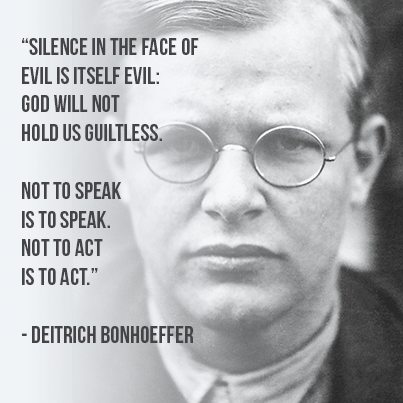
The Holocaust happened because people were complicit with evil, not ignorant, but willing to either turn a blind eye, or tolerate, or even support great evil. This type of persecution, but against Catholics, will happen for the same reasons--cowardice, fear, and deceit.

Cowardice and fear allow deceit to flourish.  We allow lying to flourish by compromise and false tolerance.  A civilization, a culture, a family, a marriage, a friendship, cannot endure in deceit. Our nation will not endure, lying about Who is God and what are His eternal laws.

When the Bible is attacked, deceit has been allowed to have the upper hand. 

The Church, even you, even me, will be persecuted for upholding the Truth.

But, being that strong involves the daily encounter with one;s own sins. Self-knowledge marks the saint.