Recent Posts

Showing posts with label perfection series IV. Show all posts

Tuesday, 31 March 2015

From Today's Office of Readings

I love readings on holiness, as these fall into my long theme of perfection on this blog. Today, the great Basil, notes that to be holy is not merely living the life of the virtues, but dying to self, to sin, to the world.

Again, baptism must be the most misunderstood sacrament today. Many Catholics no longer believe that an unbaptized person is any different than a baptized one. But, oh, yes. The difference is eternal.
Basil is speaking to adult converts, who are breaking away from their life of sin in baptism. The beginning of new life can happen to a newly baptized adult, child, or baby. Using the same metaphor of the race as St. Paul, St. Basil remarks that once we start the race to holiness after baptism, we must continue until we reach the finish line.

Apparently, in this race track of Basil's acquaintance, the runners had to stop at one point, turn around and run back to finish the race. This reverse of direction provides a clear symbol of one turning away from all sin and living in the new life of grace.

The symbol of the water is not only the real, efficacious cleansing of the baptized person from Original Sin, but the death to that sin and those inclinations of sin. The person is on the road to perfection. Virtues become part of the soul and intellect.

In baptism, we repeat the Death and Resurrection of Christ, Whose sacrifice on the Cross and the winning of the battle with Evil over sin and death, brings life.

Indeed, we are, at that moment of baptism, washed whiter than snow.


By one death and resurrection the world was saved from the book On the Holy Spirit by Saint Basil, bishop
When mankind was estranged from him by disobedience, God our Saviour made a plan for raising us from our fall and restoring us to friendship with himself. According to this plan Christ came in the flesh, he showed us the gospel way of life, he suffered, died on the cross, was buried and rose from the dead. He did this so that we could be saved by imitation of him, and recover our original status as sons of God by adoption.
  To attain holiness, then, we must not only pattern our lives on Christ’s by being gentle, humble and patient, we must also imitate him in his death. Taking Christ for his model, Paul said that he wanted to become like him in his death in the hope that he too would be raised from death to life.
  We imitate Christ’s death by being buried with him in baptism. If we ask what this kind of burial means and what benefit we may hope to derive from it, it means first of all making a complete break with our former way of life, and our Lord himself said that this cannot be done unless a man is born again. In other words, we have to begin a new life, and we cannot do so until our previous life has been brought to an end. When runners reach the turning point on a racecourse, they have to pause briefly before they can go back in the opposite direction. So also when we wish to reverse the direction of our lives there must be a pause, or a death, to mark the end of one life and the beginning of another.
  Our descent into hell takes place when we imitate the burial of Christ by our baptism. The bodies of the baptized are in a sense buried in the water as a symbol of their renunciation of the sins of their unregenerate nature. As the Apostle says: The circumcision you have undergone is not an operation performed by human hands, but the complete stripping away of your unregenerate nature. This is the circumcision that Christ gave us, and it is accomplished by our burial with him in baptism. Baptism cleanses the soul from the pollution of worldly thoughts and inclinations: You will wash me, says the psalmist, and I shall be whiter than snow. We receive this saving baptism only once because there was only one death and one resurrection for the salvation of the world, and baptism is its symbol.

Thursday, 20 November 2014

Perfection Series VIII:Part II Pressing Towards The Goal

When one is pressing towards the goal of perfection, one must be and is forced to be aware of the great enemy who tries to move one away from this goal. But, Raissa was doing more than just clearing the field for her own race to holiness. She was praying for Jacques who was working in the world of art, philosophy, and poetry, and meeting the ancient foe in each arena.

Both Jacques and Raissa were aware that the battles which are spiritual prove to be more intense than those which are physical.

Jacques writes in the Forward,

"Raissa was well aware of it--she wrote The Prince of this World. I see better now why she had to suffer so much. It was she who bore the heavier burden of the conflict--in the invisible depths of her prayer and her self-sacrifice. I see better too why the battle was so ruthless and so swift--the baptisms rained down, so did the blows. Conflicts of this kind can be only fought in raids carried out at full speed. And the territory gained is not gained for long. For where the prince of this world has his kingdom, the Christian cannot establish his permanent dwelling as on definitely conquered soil. On such a domain, what he should hope to see, at certain particularly propitious moments in the course of history, is the flaring up of a kind of cultural blaze--what matter is less the result that can be expected than the work of the flame itself while the blaze lasts."

He continues that founders of orders know this, but that when projects or groups fail to grow or are persecuted, what lasts are the friendships in the Lord, the small groups which carry on the kingdom of God in the world.

It has taken me a long time to understand this. As I have looked back on my life, I see times when I thought communities were going to be permanent. First, the lay community I was in seemed to be something permanent. It was not. Then, various parish groupings, including some TLM groups which no longer exist, seemed to be the way.

But, what Raissa and Jacques knew as young people was the quick response in the fighting with evil is primary. When one hesitates, ground and souls are lost.

We are all given "propitious moments" to grow in holiness and to set people on fire with the love of God. In my peripatetic life, I have seen this movement of grace too well not to finally understand that we are all missionaries in the field, wherever we are.

The great evil which has ruined the Church is the false sense of spiritual permanency some people have. They think they are saved once and for all, therefore losing the edge of spiritual warfare.

One cannot be a procrastinator in the spiritual realm of prayer and penance, reading and reflection.

One cannot put off tomorrow finding where God wants one to work, to pray, to love.

For years, I was praying to God to let me die in the vocation to which He called me. I was married, raised a child, single for a long time before those events and single for a long time afterwards.

In all those times, I was being called to study, prayer, reflection, meditation, contemplation.

Now, it is clear to me, as it was to Raissa, (only for her, she came to this very early in her life), that this movement of contemplation and activity is exactly my vocation.


To encounter God and to encounter His People create themes and variations in one's life.

To balance both demands attention, but also a knowledge of when to rest in the Lord.

Raissa was given that grace to rest in the Lord, which I shall examine in the next post.

to be continued....


Sunday, 9 November 2014

Perfection Series VII: Part V

Finally, let us reflect that in Holy Communion we unite ourselves not only to Jesus but also to all the members of the Mystical Body of Christ, especially to the souls most dear to Jesus and most dear to our heart. It is in Holy Communion that we realize fully the words of Jesus, “I in them ... that they may be perfect in unity” (John 17:23). The Eucharist renders us one, even among ourselves, His members, “all one in Jesus” as St. Paul says (Gal. 3:28). Holy Communion is truly all love of God and neighbor. It is the true “feast of love,” as St. Gemma Galgani said. And in this “feast of love” the soul in love can exult singing with St. John of the Cross, “Mine are the heavens and mine is the earth, mine are men, the Just are mine and sinners are mine. The Angels are mine, and also the Mother of God, all things are mine. God Himself is mine and for me because Christ is mine and all for me.”


This selection from the book in this series reminds us all that we are united to others and that our reception of Communion is not merely a private devotion, but connects us to the entire Mystical Body of Christ.

Therefore, receiving is worthily becomes an act of charity for the entire Church and not just for our own benefit. As we grow in love, so the Church grows in love as well.

All of the members of the Church, the Church Militant, the Church Suffering in purgatory, and the Church Triumphant are joined in Holy Communion.


St. Bonaventure made himself an apostle of this truth and he spoke of it in vibrant tones, “O Christian souls, do you wish to prove your true love towards your dead? Do you wish to send them the most precious help and golden key to Heaven? Receive Holy Communion often for the repose of their souls.”
For the souls in Purgatory, then, Holy Communion is the dearest personal gift which they can receive from us. Who can say how much Holy Communions are helpful in their liberation? One day St. Mary Magdalene of Pazzi's dead father appeared to her and he said that one hundred and seven Holy Communions were necessary for him to be able to leave Purgatory. In fact, at the last of the one hundred and seven Holy Communions offered for him, the saint saw her father ascend into Heaven.
When Jesus is mine, the whole Church exalts, the Church in Heaven, in Purgatory and the Church on earth. Who can express the joy of the Angels and Saints at every Holy Communion devoutly received? A new current of love arrives in Paradise and it makes the blessed spirits vibrate every time that a creature unites himself to Jesus to possess Him and be possessed by Him. A Holy Communion is of much greater value than an ecstasy, a rapture or a vision. Holy Communion transports the whole of Paradise into my poor heart!
St. Philip Neri loved the Eucharist so much that, even when he was gravely ill, he received Holy Communion every day, and if Jesus was not brought to him very early in the morning he became very upset and he could not find rest in any way. “I have such a desire to receive Jesus,” he exclaimed, “that I cannot give myself peace while I wait.” The same thing took place in our own time to Padre Pio of Pietrelcina, since only obedience could make him wait until 4 or 5 a.m. to celebrate Mass. Truly, the love of God is a “Devouring Fire” (Deut. 4:24).

Perfection Series VII: Part Four

Staying with Father Manelli's book, one sees the centrality of the Eucharist for holiness.

In light of the Synod discussions, perhaps this section provides readers with some clarity.

To receive Christ in mortal sin is to commit sacrilege. The darkness of these sins take repentance and the moving away from the sources of sin, as well as Confession.


...Confession made before Holy Communion to render a soul already in the state of Sanctifying Grace more pure and more beautiful, is something precious even though not required. It is precious because it clothes the soul with a more beautiful “wedding garment” (cf. Matt. 22:12) with which it may take its place at the table of the angels. For this reason the most conscientious souls have always made frequent use (at least once a week) of the sacramental cleansing of absolution, even for venial sins. If you want great purity of soul in order to receive Jesus, no purity shines brighter than that which one obtains when he makes a good confession, where the cleansing Blood of Jesus renders the repentant soul divinely bright and beautiful. “The soul that receives the Divine Blood becomes beautiful, as being clothed in a more precious garment, and it appears so beautifully aglow that if you could see it you would be tempted to adore it,” declared St. Mary Magdalene di Pazzi.
St. Ambrose said that persons who commit this sacrilege “come into church with a few sins, and leave it burdened with many.” St. Cyril wrote something yet stronger: “They who make a sacrilegious Communion receive satan and Jesus Christ into their hearts — satan, that they may let him rule, and Jesus Christ, that they may offer Him in sacrifice as a Victim to satan.” Thus the Catechism of the Council of Trent (De Euch., v.i) declares: “As of all the sacred mysteries ... none can compare with the ... Eucharist, so likewise for no crime is there heavier punishment to be feared from God than for the unholy or irreligious use by the faithful of that which ... contains the very Author and Source of holiness.”
"There does not exist on earth a punishment which is great enough to punish it sufficiently!” , for which Jesus said to St. Bridget, sacrilege to confess oneself first before receiving Holy Communion, otherwise one commits a most grave sin of indispensible and necessary In this regard it is well to recall the teaching of the Church. Holy Communion must be received only while one is in the grace of God. Therefore, when one has committed a mortal sin, even if one has repented of it and has a great desire to receive Holy Communion, it is
For this reason St. Francis de Sales taught his spiritual children, “Go to Confession with humility and devotion ... if it is possible, every time that you go to Holy Communion, even though you do not feel in your conscience any remorse of mortal sin.”
St. Anthony Mary Claret illustrates this fact very well: “When we go to Holy Communion, all of us receive the same Lord Jesus, but not all receive the same grace nor are the same effects produced in all. This comes from our greater or lesser disposition. To explain this fact, I will take an example from nature. Consider the process of grafting, the more similar the one plant is to the other, the better the graft will succeed. Likewise, the more resemblance there is between the one that goes to Communion and Jesus, so much the better will the fruits of Holy Communion be.” The Sacrament of Confession is in fact the excellent means whereby the similarity between the soul and Jesus is restored.
To examine themselves, to repent, to accuse themselves in Confession and to ask pardon of God, and in this way, every day profit from the Sacrament of Confession, was something natural for the saints. How fortunate they were to be capable of so much! The fruits of sanctification were constant and abundant because the purity of soul with which each saint welcomed into himself Jesus, “the Wheat of the elect,” (Zach. 9:17) was like the good ground “... which brings forth fruit in patience” (Luke 8:15).
The saints applied to perfection the directive of the Holy Spirit, “Let everyone first examine himself, and then eat of that Bread and drink of that Chalice; because he who eats and drinks unworthily, eats and drinks unto his own condemnation” (1 Cor. 11:28-29).
Also, St. Alphonsus, St. Joseph Cafasso, St. John Bosco, St. Pius X, and Padre Pio of Pietrelcina went to Confession very often. And why did St. Pius X wish to lower the age for First Holy Communion to seven years, if not to allow Jesus to enter into the innocent hearts of children, which are so similar to angels. And why was Padre Pio so delighted when they brought him children five years old who were prepared for First Holy Communion?
St. Camillus de Lellis never celebrated Holy Mass without first going to Confession, because he wanted at least “to dust off” his soul. Once, at sundown, in a public square in Livorno, before taking leave of a priest of the same religious order, foreseeing that he would not have a priest to confess to on the following morning before his Mass, paused, took off his hat, made the sign of the Cross and went to Confession right there in the square to his confrere.
.... For this reason St. Hugh, St. Thomas Aquinas, St. Francis de Sales, St. Ignatius, St. Charles Borromeo, St. Francis Borgia, St. Louis Bertrand, St. Joseph of Cupertino, St. Leonard of Port Maurice and many other saints went to Confession
“Oh, if we could only understand Who is that God Whom we receive in Holy Communion, then what purity of heart we would bring to Him!” exclaimed St. Mary Magdalen of Pazzi.
.......
What is there to say about the great purity of soul with which the saints approached to receive the Bread of Angels? We know that they had a great delicacy of conscience which was truly angelic. Aware of their own misery, they tried to present themselves to Jesus “holy and immaculate,” (Eph. 1:4) repeating with the Publican, “O God, be merciful to me a sinner” (Luke 18:13), and having recourse with great care to the cleansing of Confession.

Sunday, 19 October 2014

Perfection Series VI: XIII Reparation And Mary Again

The Pope Emeritus writes about Mary and the Presentation of Christ in his book  Jesus of Nazareth: The Infancy Narratives. Simeon told Mary she would suffer-her heart would be pierced. Such are the paintings of the Sorrowful Mother we see throughout the centuries.


The Pope Emeritus notes that Mary had true "com-passion" with her Son. And, that is "quite unsentimentally assuming the suffering of other's as one's own."

This is another way to describe Reparation. Now, Mary is then the "Co-Redemptorix" as some theologians have explained through this compassion.

If one is called to Reparation, one takes on a little bit of this compassion for others and suffers with that person in order for them to reach heaven.

Those who are in difficult relationships understand this concept.

To be continued...


Thursday, 16 October 2014

Feast Day of St. Margaret Mary-Perfection Series VI:IX Reparation


One forgets how young St. Margaret Mary Alacoque was when she died-43-and what sufferings she endured at home before she entered the convent, and afterwards.

Her life would not have been particularly noticed by anyone, as she lived in a family who lost wealth, lived in poverty, gained back some status, and as she was not particularly excellent about her chores in the convent.

Like St. Faustina, St. Margaret seems "ordinary" to the point of being overlooked or suspected.

These are the types of saints God chooses so that His Glory shines forth from such clay vessels. As the Sixth Perfection Series is on Reparation, today's feast is timely.

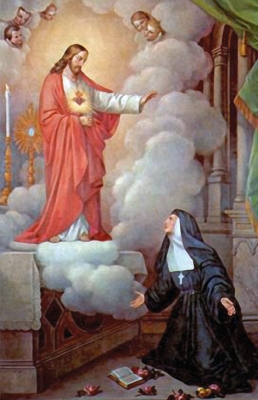
St. Margaret Mary did make reparation while on earth, suffering not only from her companions in the convent, but from the revelations from Christ, Who showed her His loving Heart, wounded by ungrateful humanity.

Today is Thursday, and St. Margaret Mary asked the Church to sit with Jesus in the Agony in the Garden on this day. How appropriate that my other mini-series is on Christ's suffering in Gethsemane.

When I was growing up in the pre-Vatican II, pre-NO Church, Holy Hours were common. Men coming from work could pop into churches for this devotion.

Even in Malta, it is hard to find Adoration unless one travels. (I do not count the ugly Millennium Chapel with Jesus in the lava lamp--see
http://supertradmum-etheldredasplace.blogspot.com/2013/01/do-you-like-this-monstrance.html)

Why there is not more public Adoration, I do not know.

Is there any in Walshingham now, regularly? That is what I wanted to set up.

Reparation for ignoring Christ needs to be made now. His Sacred Heart bleeds still. Reparation may be done by us little ones of God.

Tuesday, 14 October 2014

Perfection Series VI:VII Reparation

Too many people tell me they are too busy to pray, much less do penance.

As Fulton J. Sheen once said, if you are too busy to pray, you are too busy.

One must come to the realization that certain other activities and interests must be sacrificed in order to make time for reparation. Here is Pope Pius XI on this point.

19. And for this reason also there have been established many religious families of men and women whose purpose it is by earnest service, both by day and by night, in some manner to fulfill the office of the Angel consoling Jesus in the garden; hence come certain associations of pious men, approved by the Apostolic See and enriched with indulgences, who take upon themselves this same duty of making expiation, a duty which is to be fulfilled by fitting exercises of devotion and of the virtues; hence lastly, to omit other things, come the devotions and solemn demonstrations for the purpose of making reparation to the offended Divine honor, which are inaugurated everywhere, not only by pious members of the faithful, but by parishes, dioceses and cities.

Do Catholics understand the real reason for the celebration of the Feast of the Sacred Heart? Do you want the current crisis in the Church to abate? Honor the Sacred Heart. Do you want changes in your governments? Honor the Sacred Heart. Do you want conversions among the lapsed Catholics in your own families? Honor the Sacred Heart.


20. These things being so, Venerable Brethren, just as the rite of consecration, starting from humble beginnings, and afterwards more widely propagated, was at length crowned with success by Our confirmation; so in like manner, we earnestly desire that this custom of expiation or pious reparation, long since devoutly introduced and devoutly propagated, may also be more firmly sanctioned by Our Apostolic authority and more solemnly celebrated by the whole Catholic name. Wherefore, we decree and command that every year on the Feast of the Most Sacred Heart of Jesus, - which feast indeed on this occasion we have ordered to be raised to the degree of a double of the first class with an octave - in all churches throughout the whole world, the same expiatory prayer or protestation as it is called, to Our most loving Savior, set forth in the same words according to the copy subjoined to this letter shall be solemnly recited, so that all our faults may be washed away with tears, and reparation may be made for the violated rights of Christ the supreme King and Our most loving Lord.

One of the problems is that people, even Catholics, do not understand just how transcendent God is. We have, as a society, as Western cultures, "dumbed-down God". One of the messages of Fatima, especially seen in the life of Blessed Jacinta, is the need for suffering in order for souls to be saved.

This young holy girl puts us to shame with her courage and determination to follow Mary's call for reparation.


21. There is surely no reason for doubting, Venerable Brethren, that from this devotion piously established and commanded to the whole Church, many excellent benefits will flow forth not only to individual men but also to society, sacred, civil, and domestic, seeing that our Redeemer Himself promised to Margaret Mary that "all those who rendered this honor to His Heart would be endowed with an abundance of heavenly graces." Sinners indeed, looking on Him whom they pierced (John xix, 37), moved by the sighs and tears of the whole Church, by grieving for the injuries offered to the supreme King, will return to the heart (Isaias xlvi, 8), lest perchance being hardened in their faults, when they see Him whom they pierced "coming in the clouds of heaven" (Matth. xxvi, 64), too late and in vain they shall bewail themselves because of Him 
(Cf. Apoc. i, 7)

Absolutely, now is the time for reparation to the Sacred Heart. The time for wasting opportunities must be seen as over. The Pope here sensed an urgency. Are not these times more urgent?

to be continued...

Perfection Series VI: V Reparation

Till We Have Faces: A Myth Retold by C.S.Lewis is a book I taught for years at several colleges and universities, as well as in home schooling situations.

I have been obsessed with this story and love it, considering it Lewis' masterpiece.

I am not going into all the details of the plot, but will refer merely to two of the main characters, Psyche and Orual. By the way, I have written on this book before on this blog way back before 2009 and some of my older readers may remember my comments.

For me, the most important two elements of the novel are these: first, that Pysche must do penance for disobedience, for not trusting in Cupid, and for giving in to manipulation and lies.

Second, Psyche's reparation made it possible for Orual to have an excellent life, but as she is so full of pride, denial and ingratitude, she must be brought to see her sins and that fact that Pysche did all the work of reparation so that Orual could be successful and loved.

Such is reparation in Christian terms applied to the ancient myth. Perhaps my constant returning to this book both in my private reading and in teaching (my students loved this book on the whole, btw) is connected to my now realized call to do reparation for whomever or whatever God calls me.

Orual thought her love for Pysche was pure, but it was not. However, Psyche's love for Orual was pure. She got nothing in return for her labors until the very end of the journey.


That is the point. Reparative love must be purified, completely unselfish love.

That Psyche loved Orual purely allowed her to complete the tasks, to do the reparation necessary to save Orual.

In the end, Orual realizes that she, although ugly from birth physically, is truly beautiful to the gods, as Psyche is beautiful.

Of course, allegorically, we know that Psyche is the soul of Orual.

Love and reparation create something new in a soul. This newness may be a portal, and opening wherein grace can flow, heal, deliver.

Obviously, Christ has done the work, but He calls us in that mysterious manner to share in His sufferings for a particular person or group or situation.

When one becomes joined to Christ in suffering, only love transcends the pain, and it does, bringing a peace, and, as St. Therese the Little Flower writes, "unfelt joy".

to be continued...


Perfection Series VI:II.5 Reparation

Continuing with the theme of how does one know for whom or what to make reparation, I have one clear answer. This is a follow-up of II.

Those for whom God has placed on own hearts and in our minds great love, who are in need of having someone do reparation for them, are those to whom God wants you to focus your prayers and energies.

Mortification, penance, prayers, either for one person, a few people, the clergy in general, the Church, become focused as God pours sacrificial love into hearts in order for this reparation to occur.

Reparation takes tremendous energy and will-power. Those for whom one prays may never know until heaven that one made reparation for them.

So be it.


Like Christ seeing all the elements, stages, tortures of His Passion and Death, and seeing the ingratitude and horror of sin from all mankind, one may see sin, corruption, ingratitude and remain silent.

One may not see such things if one is praying for a friend or family member, but if one is praying for the clergy, the bishops, the cardinals who are insulting Truth both in the Person of Christ and in His 
Church, one may see such painful realities.

But, the real pain is the sacrificial love which is not acknowledged and cannot be.

Suffering in silence, alone, like Christ in the Garden, may be part of one's call to the ministry of reparation.

At that point, one experiences tremendous peace and even joy in pain. The reason for this is that one is joining Christ in the Garden of Gethsemane, as He has called one to join Him there.

Such is the calling of those who make reparation for others.

to be continued....

Perfection Series VI:III Reparation

I shall come back to the devotion to the Sacred Heart, but as Pope Pius XI places it in this context, I leave it here. But, I want to go on the section 13, the lines I highlighted.

12. And truly the spirit of expiation or reparation has always had the first and foremost place in the worship given to the Most Sacred Heart of Jesus, and nothing is more in keeping with the origin, the character, the power, and the distinctive practices of this form of devotion, as appears from the record of history and custom, as well as from the sacred liturgy and the acts of the Sovereign Pontiffs. For when Christ manifested Himself to Margaret Mary, and declared to her the infinitude of His love, at the same time, in the manner of a mourner, He complained that so many and such great injuries were done to Him by ungrateful men - and we would that these words in which He made this complaint were fixed in the minds of the faithful, and were never blotted out by oblivion: "Behold this Heart" - He said - "which has loved men so much and has loaded them with all benefits, and for this boundless love has had no return but neglect, and contumely, and this often from those who were bound by a debt and duty of a more special love." In order that these faults might be washed away, He then recommended several things to be done, and in particular the following as most pleasing to Himself, namely that men should approach the Altar with this purpose of expiating sin, making what is called a Communion of Reparation, - and that they should likewise make expiatory supplications and prayers, prolonged for a whole hour, - which is rightly called the "Holy Hour." These pious exercises have been approved by the Church and have also been enriched with copious indulgences.
13. But how can these rites of expiation bring solace now, when Christ is already reigning in the beatitude of Heaven? To this we may answer in some words of St. Augustine which are very apposite here, - "Give me one who loves, and he will understand what I say" (In Johannis evangelium, tract. XXVI, 4).

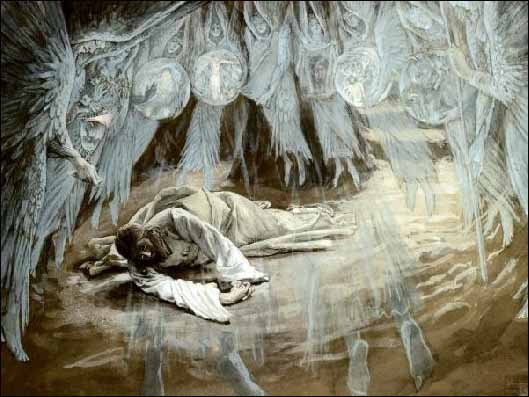
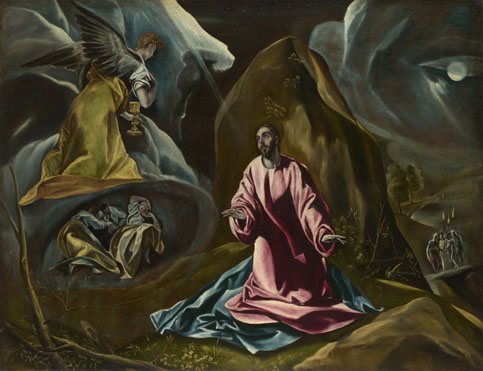
I shall come back to this theme of Christ in the Garden of Gethsemane, the Agony in the Garden, in a long post later, but here I want to emphasize that Christ already suffered for our sins, but that He, in the Garden, received some consolation from the Angel sent to Him, which the Pope states here, was the consolation WE created through reparation for our own sins and those of others.

Imagine, the Angel of the Agony bringing our mortifications, penances, sufferings to Christ in that hour? What a tremendous insight from this Pope.


For any one who has great love of God, if he will look back through the tract of past time may dwell in meditation on Christ, and see Him laboring for man, sorrowing, suffering the greatest hardships, "for us men and for our salvation," well-nigh worn out with sadness, with anguish, nay "bruised for our sins" (Isaias liii, 5), and healing us by His bruises. And the minds of the pious meditate on all these things the more truly, because the sins of men and their crimes committed in every age were the cause why Christ was delivered up to death, and now also they would of themselves bring death to Christ, joined with the same griefs and sorrows, since each several sin in its own way is held to renew the passion of Our Lord: "Crucifying again to themselves the Son of God, and making him a mockery" (Hebrews vi, 6). Now if, because of our sins also which were as yet in the future, but were foreseen, the soul of Christ became sorrowful unto death, it cannot be doubted that then, too, already He derived somewhat of solace from our reparation, which was likewise foreseen, when "there appeared to Him an angel from heaven" (Luke xxii, 43), in order that His Heart, oppressed with weariness and anguish, might find consolation. And so even now, in a wondrous yet true manner, we can and ought to console that Most Sacred Heart which is continually wounded by the sins of thankless men, since - as we also read in the sacred liturgy - Christ Himself, by the mouth of the Psalmist complains that He is forsaken by His friends: "My Heart hath expected reproach and misery, and I looked for one that would grieve together with me, but there was none: and for one that would comfort me, and I found none" (Psalm lxviii, 21).

The forsaking of friends and family creates a horrible void, a pain in Christ, which one cannot imagine, as He is all Pure, all Good, all Innocent. Those who have been forsaken in their lives have experienced a smidgen of this great pain of Our Lord's.

But, this is not all the Pope tells us.


14. To this it may be added that the expiatory passion of Christ is renewed and in a manner continued and fulfilled in His mystical body, which is the Church. For, to use once more the words of St. Augustine, "Christ suffered whatever it behoved Him to suffer; now nothing is wanting of the measure of the sufferings. Therefore the sufferings were fulfilled, but in the head; there were yet remaining the sufferings of Christ in His body" (In Psalm lxxxvi). This, indeed, Our Lord Jesus Himself vouchsafed to explain when, speaking to Saul, "as yet breathing out threatenings and slaughter" (Acts ix, 1), He said, "I am Jesus whom thou persecutest" (Acts ix, 5), clearly signifying that when persecutions are stirred up against the Church, the Divine Head of the Church is Himself attacked and troubled. Rightly, therefore, does Christ, still suffering in His mystical body, desire to have us partakers of His expiation, and this is also demanded by our intimate union with Him, for since we are "the body of Christ and members of member" (1 Corinthians xii, 27), whatever the head suffers, all the members must suffer with it (Cf. 1 Corinthians xii, 26).

As it is obvious that we are now living in the Age of Martyrs, we can see how those who are tortured and killed join not only with Christ, but with us, as all members both suffer and rejoice in martyrdom. So, too, Christ suffered in Gethsemane and throughout His Passion and Death the pain of those who die for Him and the pain of those who torture and kill. Christ took all that suffering unto Himself.

So, where does this leave us and for whom are we doing reparation? This next section could have been written this morning..................


15. Now, how great is the necessity of this expiation or reparation, more especially in this our age, will be manifest to every one who, as we said at the outset, will examine the world, "seated in wickedness" (1 John v, 19), with his eyes and with his mind. For from all sides the cry of the peoples who are mourning comes up to us, and their princes or rulers have indeed stood up and met together in one against the Lord and against His Church (Cf. Psalm ii, 2). Throughout those regions indeed, we see that all rights both human and Divine are confounded. Churches are thrown down and overturned, religious men and sacred virgins are torn from their homes and are afflicted with abuse, with barbarities, with hunger and imprisonment; bands of boys and girls are snatched from the bosom of their mother the Church, and are induced to renounce Christ, to blaspheme and to attempt the worst crimes of lust; the whole Christian people, sadly disheartened and disrupted, are continually in danger of falling away from the faith, or of suffering the most cruel death. These things in truth are so sad that you might say that such events foreshadow and portend the "beginning of sorrows," that is to say of those that shall be brought by the man of sin, "who is lifted up above all that is called God or is worshipped" (2 Thessalonians ii, 4).

And, here is the mystery...God chooses for whom we do acts and prayers of reparation.

God chooses. 


This reparation could be for individual blasphemers, haters, apostates, heretics, false leaders, false friends, betrayers of all types, or even person for whom God gives us a particular love in order to pray for them. 

Some may be stranger, some may be friends, some may be our blood brothers and sisters, some may be our spouses.

Some may be our enemies.

God can also call someone to make reparation in general: for dead babies of abortion; for heresy and apostasy in the Church; for a group which is schismatic. for bad priests in general, for bad bishops in general, and so on.

God decides for whom or even for what, such as these times, one may be called to reparation.

to be continued..............


Perfection Series VI:II Reparation


Continuing with the same encyclical for a bit, one reads this.

11. Wherefore, even as consecration proclaims and confirms this union with Christ, so does expiation begin that same union by washing away faults, and perfect it by participating in the sufferings of Christ, and consummate it by offering victims for the brethren. And this indeed was the purpose of the merciful Jesus, when He showed His Heart to us bearing about it the symbols of the passion and displaying the flames of love, that from the one we might know the infinite malice of sin, and in the other we might admire the infinite charity of Our Redeemer, and so might have a more vehement hatred of sin, and make a more ardent return of love for His love.

Several points here, which I hope to clear up for your benefit and mine.

One, the first step is the purification of sin, and faults, like those predominant faults. That must happen in order to be able to pray for others freely, without egotism and desires.


One must be completely detached from all ideas, expectations, dreams, people, places, things. Of course, as you all know from reading the Dark Night series and the other perfection series. this purification must include suffering in order that one is freed from egoism.


How can one join in the love of Christ on the Cross with flaws, with faults?


God wants to make us pure so that we can love purely.


Two, the malice of sin, so obvious in our day, wounds the Human and Divine Heart of Christ. Reparation must be made.

But, one cannot take one, little, teeny-weeny pride in this endeavor. That is one reason this purity of love follows the purification of the spirit. Now, the line between "offering up" sacrifices for others and self-interest and pride is a thin line until one is purified.

And, that is the reason I have come to think one can only really, truly love in a sacrificial manner when one gets to the Illumination State. As long as any faults, flaws, not even counting venial sins, stand between us and pure sacrificial love, our offerings may not only be incomplete, but useless.

This fact alone demands that we cooperate with God in the stripping which occurs in the Dark Night.

What follows that purity of sight and mind are both clarity as to the horror of sin, and a great love for Christ Who died for us to free us and others from sin and death.

God truly desires that we are purified before death, for several reasons, but one would be the efficacious sacrificial reparation done for others.

Now, for what or whom is one doing such reparation? That answer will be part of the next posting.

to be continued...

New MINI-Series on Miserentissimus Redemptor-Perfection Series VI:I


Thinking, praying, experiencing a new call to make reparation daily in my life for.....what God is calling me to do, I have decided to share with you some thoughts from Pope Pius XI from his encyclical Miserentissimus Redemptor.

I shall not dwell at this point on the obvious devotion to the Sacred Heart of Jesus, the central devotion concerning reparation. However, I shall return to that.


Let me start with this quotation from the encyclical:

 ...we must ever remember that the whole virtue of the expiation depends on the one bloody sacrifice of Christ, which without intermission of time is renewed on our altars in an unbloody manner, "For the victim is one and the same, the same now offering by the ministry of priests, who then offered Himself on the cross, the manner alone of offering being different" (Council of Trent, Session XXIII, Chapter 2). Wherefore with this most august Eucharistic Sacrifice there ought to be joined an oblation both of the ministers and of all the faithful, so that they also may "present themselves living sacrifices, holy, pleasing unto God" (Romans xii, 1). Nay more, St. Cyprian does not hesitate to affirm that "the Lord's sacrifice is not celebrated with legitimate sanctification, unless our oblation and sacrifice correspond to His passion" (Ephesians 63). For this reason, the Apostle admonishes us that "bearing about in our body the mortification of Jesus" (2Corinthians iv, 10), and buried together with Christ, and planted together in the likeness of His death (Cf. Romans vi, 4-5), we must not only crucify our flesh with the vices and concupiscences (Cf. Galatians v, 24), "flying the corruption of that concupiscence which is in the world" (2 Peter i, 4), but "that the life also of Jesus may be made manifest in our bodies" (2 Corinthians iv, 10) and being made partakers of His eternal priesthood we are to offer up "gifts and sacrifices for sins" (Hebrews v, 1). Nor do those only enjoy a participation in this mystic priesthood and in the office of satisfying and sacrificing, whom our Pontiff Christ Jesus uses as His ministers to offer up the clean oblation to God's Name in every place from the rising of the sun to the going down (Malachias i, 11), but the whole Christian people rightly called by the Prince of the Apostles "a chosen generation, a kingly priesthood" (1 Peter ii, 9), ought to offer for sins both for itself and for all mankind (Cf. Hebrews v, 3), in much the same manner as every priest and pontiff "taken from among men, is ordained for men in the things that appertain to God" (Hebrews v, 1).

The highlighted part has been a tradition ignored in preaching and teaching since the 1970s. All are called to mortification, to crucifying the flesh in some way, to accepting the purification of the senses in the Dark Night. No one can skip these calls to penance and expect to be made perfect.


Of course, the unbloody sacrifice of the Mass forms the center of worship and focus for reparation.


But, as Cyprian points out in the section above, we must bring to the Mass our own mortification and penances in order to not only join ourselves with Christ in the sacrifice of the Mass, but to be made more perfect in the union with Christ when we received Holy Communion.


Here is another section.

10. But the more perfectly that our oblation and sacrifice corresponds to the sacrifice of Our Lord, that is to say, the more perfectly we have immolated our love and our desires and have crucified our flesh by that mystic crucifixion of which the Apostle speaks, the more abundant fruits of that propitiation and expiation shall we receive for ourselves and for others. For there is a wondrous and close union of all the faithful with Christ, such as that which prevails between the head and the other members; moreover by that mystic Communion of Saints which we profess in the Catholic creed, both individual men and peoples are joined together not only with one another but also with him, "who is the head, Christ; from whom the whole body, being compacted and fitly joined together, by what every joint supplieth, according to the operation in the measure of every part, maketh increase of the body unto the edifying of itself in charity" (Ephesians iv, 15-16). It was this indeed that the Mediator of God and men, Christ Jesus, when He was near to death, asked of His Father: "I in them, and thou in me: that they may be made perfect in one" (John xvii, 23)

Notice that Pius XI emphasizes the union with Christ through suffering, as well as the reparation necessary made when we engage in penance.

Love grows out of these mortifications. 


And, note, we are only made perfect through this type of denial of the self, both in the physical (purification of the senses) and in the spiritual  (purification of the spirit). Giving up things must be part of these penances, and the patient acceptance of suffering which God has ordained, forms another part.


More to come...