http://rorate-caeli.blogspot.com/2015/03/events-holy-week-schedules-constantly.html
I phoned the TLM parish a hour away from here and had a nice talk with the secretary, who told me that no one from from P......, where I am, to the TLM. Sigh....
I shall suffer with Christ in Gethsemane who saw all the aberrations and disobedience of His own priests and bishops.
Showing posts with label liturgy. Show all posts
Showing posts with label liturgy. Show all posts
Sunday, 29 March 2015
Friday, 27 March 2015
Calendars in the Church
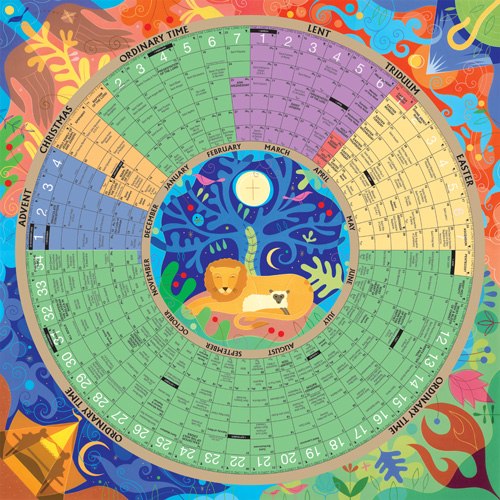
I have four possible calendars to follow on this blog. The first is the one most of us follow daily, and from where I get my daily readings for meditation for you. That is the Novus Ordo calendar. Home schoolers could buy the liturgical calendar poster I did for my son for years and have it on the home school wall.

The second calendar is that of the 1962 Missal, that of the Extraordinary Form.
The third is the Byzantine Catholic calendar, with the Eastern saints honored, and which has different holydays of obligation.
The fourth is the Benedictine calendar, which I follow daily in my breviary, which is the order of the Monastic Diurnal.
Those who read my blog know I use a mix of these, so do not get confused, go with the flow, and enjoy the riches of the liturgical heritage of our beautiful Church.

The third is the Byzantine Catholic calendar, with the Eastern saints honored, and which has different holydays of obligation.
The fourth is the Benedictine calendar, which I follow daily in my breviary, which is the order of the Monastic Diurnal.
Those who read my blog know I use a mix of these, so do not get confused, go with the flow, and enjoy the riches of the liturgical heritage of our beautiful Church.


Tuesday, 4 March 2014
Tuesday, 10 December 2013
The Rhythm of the Liturgical Year
I could label this post, Advent in the Domestic Church.
Sometimes, Catholics forget, or may not know, some of the simpler truths of the liturgical year. That there is a liturgical year should be obvious to all who attend, at least, Sunday Mass.
However, the colors are not the only indications of themes in these seasons. I am discovering, since I have been here, a lack of knowledge as to the meaning and customs which attend the rhythm of the liturgical seasons.
It is not my intention in this small post to cover the entire year. When I was teaching home schooling, I always had the large, round poster of the liturgical year in the classroom. This symbol and teaching method revealed to my son, and others who joined us, the priority of that year over the calendar year. Priority-yes, as the liturgical year is the calendar of God, not men, through the authority and teaching of the Church.
We are in one of the purple seasons, with the rose interlude approaching next Sunday. And, purple means penance.
Do Catholic families follow a penitential Advent? In my little family, we did not eat sweets, desserts, or other goodies except on St. Nicholas Day. Our Swedish neighbors had goodies on St. Lucy's Day. These were the exceptions. We did not go to parties, and begged off those to which we were invited, assuring friends we would celebrate between Christmas and January 6th, inclusive, with them.
We had the Advent Calendar, not with chocolates, but with Scripture passages.
We did the Jesse Tree, reading the appropriate Scriptures daily, and finally, the O Antiphons, which are on this blog.
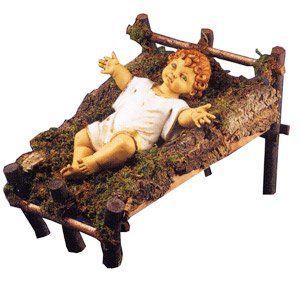
We also collected money for the poor in a little box, and did extra good deeds, which were acknowledged by the placing of a straw in the empty manger.
On Christmas Eve, we had a little play of knocking on the doors and slamming them, in imitation of the full inns, until Baby Jesus, the largish Italian Bambino, found a home in the manger, hopefully with enough straw for comfort. We made costumes out of our robes for this.
The joy of Christmas Day was the beginning of feasting. We began after Midnight Mass, as we were in the choir and came back home for champagne and panettone, going to bed and getting up again to sing at the High Mass. We put the tree up Christmas Eve.
We also made apostle fake candles, out of toilet rolls covered with paper, with cotton flames, on which were the names of the apostles, to put underneath the tree, reminding us that Christmas is the beginning of the Good News which went out to all the world, including us, the Gentiles. This reminded us that Christ is the Light of the world, but that we all have to carry this light out into the darkness.
Sometimes, we bought hay and put it underneath the tree to remind us of the humility of Christ. Our rabbit loved that, and slept happily there in the hay during the season.

The creche was set up and the kings put on the far side of the living room to make their long trip around to the manger by January 6th.

I hope families can rediscover the rhythm of the liturgical year.
Monday, 1 April 2013
At least one post today....the politicizing of the Mass
It is Easter Monday. I am concerned about something which I saw starting in the 1980s when I was at Notre Dame.
I call it the politicizing of the liturgy.
Liturgy should never be used for political statements.
The Liberation Theology priests did this in the 1970s and some priests did this in the 1960s in America in the Civil Rights Movement.
It is very "Dorothy Day" to use the liturgy as a platform for political ideas.
Liturgy is for the worship of God.
I do not want my Church arguing points within the context of the Liturgy.
No.
I want GOD not people to be the source of inspiration and focus.
A thought on Easter Monday.
I call it the politicizing of the liturgy.
Liturgy should never be used for political statements.
The Liberation Theology priests did this in the 1970s and some priests did this in the 1960s in America in the Civil Rights Movement.
It is very "Dorothy Day" to use the liturgy as a platform for political ideas.
Liturgy is for the worship of God.
I do not want my Church arguing points within the context of the Liturgy.
No.
I want GOD not people to be the source of inspiration and focus.
A thought on Easter Monday.
Monday, 11 February 2013
The Passion and the Eucharist
Joseph of Arimathea helps take down the Body of Christ with a ladder. Nicodemus takes the Body of Christ. Our Blessed Lady receives Him, as do John and Mary Magdalen. This is the Eucharist. Take My Body; Take My Blood Christ had said the night before at the Last Supper. The Passion started at the Last Supper. The Eucharist is the Sacrificial Body and Blood of Christ given to us for all ages until the end of the world. The Mass is the Unbloody Sacrifice.
How fortunate we are to have the Catholic Faith. Thank you, Jesus, thank you.
 |
| http://www.conceptionabbey.org/basilica/beuronese-murals?start=19 |
Saturday, 4 August 2012
Fr. Ripperger on the Sacrifice of the Mass and the Passion

On the Sacrifice of the Mass--we need it and it continues throughout history as we are not perfect.
In Colossians 1:24, St. Paul states, Who now rejoice in my sufferings for you, and fill up those things that are wanting of the sufferings of Christ, in my flesh, for his body, which is the church. DR
There is a mystery of suffering in the Church. How many saints and even those who have died recently for the Faith, are martyrs? How many people suffer in charity and goodness for no apparent reason? If we are in sanctifying grace, that does not mean we shall have a smooth life. Quite the opposite.
St. Thomas Aquinas tells us that all the virtues were preached by Christ from the Cross.
His Passion was infinite in merit in their cause, but not in the effects. But, there is more.
Not because there is something lacking in Christ's suffering, which is infinite, God chose the effects would not take effect so that we can take part in the suffering, passion and death with those.
Prayers, sufferings and merits which we gain in suffering is planned and willed by God the Father, who wanted us to be part of our own salvation. We cooperate in the Passion of Christ and therefore merit higher places in heaven.
You may have never heard this before. Most of the priests in some seminaries teach that we only preach the Resurrection and not the Passion. I have heard this recently in a talk by Father Chad Ripperger. But, I heard this as a girl in both elementary and high school. The teaching of the Church has always maintained that we must gain merit.
God may want, says Father Ripperger, that God sometimes does not answer our prayers right away as He wants us to gain more merit. If our prayers are not answered immediately, even in the Mass, God is waiting for us to change, to grow, to gain more merit. Not everyone gets to heaven, Fr. reminds us. The efficacy of the Calvary sacrifice, he states, to those who are the "elect". People forget this. We do not believe in universal salvation, as Father reminds us.
Go, if you can, to daily Mass. It is part of His Will for us that we try and go to daily Mass. We are changed, which Fr. Ripperger reminds us, to sons and daughter of God, through baptism and the sacraments. Be a grace-pig. Go to Mass daily.
Friday, 3 August 2012
Catholic Kulturkampf

Father Z., Father Ripperger and others have repeated the phrase lex orandi, lex credendi. This phrase means several things, including how we pray is how we believe. Or, how we believe is how we pray.
But, these priests take the phrase a step further. The belief of the Church can be changed by the liturgy. Some people do not understand what this means.
If one continually goes to the Tridentine Mass, one's Faith will change. Those who are there participating at the TLM already have their Faith in keeping with the Church. They have accepted Tradition in Teaching and in Liturgy.
Those who come new will have their Faith change, as they will accept the patrimony of the Church. This is the duty of parents, the prime duty of parents. To be holy, to be reverent, to pass on the Tradition of the Church is all of our duties.
However, Father Z., Father Ripperger and others go further in this description of the impact of the Traditional Latin Mass. The phrase I want to use in describing their view is "Catholic kulturkampf".
The reason why two generations of evangelization has failed for the most part is that the culture WAS being changed by the Mass, but this is no longer happening with the Novus Ordo. Why? And, what can we do about it?
Father Ripperger states that the culture was being created and renewed by the TLM. When the interruption of tradition took place, that is, when the NO was promulgated, the liturgy merely became a mirror of the secular and even sinful culture, while the Transcendent TLM had changed it and renewed it over and over.
I am studying how the TLM affected the Oxford Movement and the Anglo-Catholics in England. The culture was changed! I believe this and we see the fruits in the Ordinariate.
However, the point of Father Ripperger and others is that when the NO merely represents the music, styles, and culture of a given society, the Mass no longer can change and renew that society.
How we worship is how we think and believe.
Many of those commenting on my posts on modesty and androgynous clothes were raised under the NO. They were raised not in a counter cultural movement, the "Catholic kulturkampf" but merely allowed to continue to be influenced by barbarism and sin.
Many of those commenting on the fact that remaining single is merely non-commitment and a relinquishing of duty (and of course for those who were following this, I do not mean those who have consecrated themselves to an order, and Opus Dei is one despite the arguments one gets) do not realize that they have been brainwashed by the secular culture of death.
More and more, we need "Catholic kulturkampf". It was there. We lost it. Let it happen again.
Tuesday, 17 July 2012
What is missing is love...An open letter to the SSPX
Dear Members of the SSPX,

When I returned to the Church years ago at the age of 22, I had to make a decision, not only about the truth that Christ was God, but that the Church, as unholy as it had been manifested in my life, was the One, True, Holy and Catholic Church.
Now, the first decision was one based on Faith. The second was based on Love. I had grown up having priests and nuns in the family and being very familiar with religious people. The Church seemed to be so imperfect in so many ways, especially growing up in one of the most liberal dioceses in the United States.
So, my decision was not based on some dewy-eyed idea of the seen perfection of the Church, but on the Church as it really was in the world. That bishops were wrong in some areas of doctrine, that some priests were pedophiles, that many lay people were hypocrites using contraceptives and not carrying about the poor, did not make any difference to me anymore. Four people in my family had been abused by a priest for years and years. Nothing mattered as to sin or falsehood. The Church was and is the one institution created by Christ for our salvation. I could no longer be outside this institution. It was no longer a question of me judging, but submitting myself to the authority of the Church. I could not be holier than Rome. I could not be holy without Rome.
Please come back. For the sake of Love, Who is a Person and needs you.
Supertradmum

When I returned to the Church years ago at the age of 22, I had to make a decision, not only about the truth that Christ was God, but that the Church, as unholy as it had been manifested in my life, was the One, True, Holy and Catholic Church.
Now, the first decision was one based on Faith. The second was based on Love. I had grown up having priests and nuns in the family and being very familiar with religious people. The Church seemed to be so imperfect in so many ways, especially growing up in one of the most liberal dioceses in the United States.
So, my decision was not based on some dewy-eyed idea of the seen perfection of the Church, but on the Church as it really was in the world. That bishops were wrong in some areas of doctrine, that some priests were pedophiles, that many lay people were hypocrites using contraceptives and not carrying about the poor, did not make any difference to me anymore. Four people in my family had been abused by a priest for years and years. Nothing mattered as to sin or falsehood. The Church was and is the one institution created by Christ for our salvation. I could no longer be outside this institution. It was no longer a question of me judging, but submitting myself to the authority of the Church. I could not be holier than Rome. I could not be holy without Rome.
I, too, am and was at that time, a great sinner. We say the Church is made up of sinners, and we quote Christ stating that "...They that are well have no need of a physician, but they that are sick. For I came not to call the just, but sinners." Mark 2:17 Douay Rheims
But, do you, dear members and friends, want to fight the fight with sinners, side-by-side with the Pope, or on the outside? Can you love the Church, which is imperfect, in order for Her to be made perfect? As in marriage, would you die for your Spouse, dear SSPX priests? Please come back. For the sake of Love, Who is a Person and needs you.
Supertradmum
Sunday, 8 July 2012
To think like a priest...
One of the things I do is pray for seminarians and priests. Seminarians talk to me, because they know I take their lives and discernment process seriously and that I shall pray for them.
One of the things I have noticed about seminarians is that the one's who succeed in following their vocation undergo not only a spiritual formation, and an academic formation, but also an intellectual formation. What do I mean by this?
The young men who end up ordained undergo a "head change". They slowly but surely stop "thinking" like a lay person and start thinking like a cleric. I have never read anyone define or describe this before, so I am all alone, I think, in my observation. Let me explain.
Spiritual formation we understand as moving away from bad habits, learning the discipline of prayer, and developing a close, love relationship with Christ, His Mother and the Church. Academic formation involves getting the necessary training in philosophy, theology, and liturgy, as well as developing pastoral skills.
Thinking like a priest is another thing altogether. What do I mean?
A layman relates to the world as "in" the world. A lay person is concerned with a job, a profession, most likely looking for a wife and being open to marriage and children. A lay person views the world as his place of work, play and spirituality. Lay spirituality is not that of the Benedictine, Dominican or even that of the secular priest, except in a limited manner. So, these various approaches to life create a world view, a "thinking" process which involve engaging in the world as a lay person. The world is our "stage". It is where we live out our salvation. It is the rough material for our souls wherein we grow in virtue and holiness.
Our entertainment, goals, friends, joys and sorrows are in the world, within families and lay gatherings of friends.
If I see a seminarian spending most of his time with his lay friends and not as much time with his fellow seminarians or with priests, I am concerned. That young man IS NOT IDENTIFYING with the priesthood.
This is a thinking process, of self-identification.
When I see a seminarian involved with other seminarians, socializing with priests and sems, I know that he is identifying with the clerical lifestyle. He identifies with his fellow clerics and this is good.
There is a huge difference in the way we think about ourselves and the world in which we live.
Unless a sem begins to really like all the trappings and manifestations, as well as the work of a cleric, he may not follow through with his vocation. He may not even have one. It is not about the work, merely, it is about who he is and how he thinks. How we act follows how we see ourselves.
.
It is not about the work for a an active sister, for example, but about her relationship with Christ, as He is her Lover, she His Bride. For the priest is it about his work to a certain extent, as he is persona Christi, and he is what he does. But that is the key, being a priest is about being, and thinking is part of being. More than most vocations, the priest is Christ. That he is a professor, or canon lawyer, or counselor is secondary.
As a lay person, I can evangelize the world daily in my little way. This is my call, to evangelize the world,
If a young man thinks like a lay person and wants to evangelize the world while being in the world, he is thinking like a lay person.

The priest is set apart, as a sign of contradiction in the world. His vocation is not merely a career. He is not "one of us", nor should he think he is.
Several years ago, some sisters with whom I was having lunch expressed that they could not understand why their order had no vocations. They talked for one hour about careers, flying here and there, including to Washington, doing this good thing in the ghetto and doing that good thing as a principal, but never once, in their discussion on their vocations did they refer to the Perfect Man Who loved them each individually enough to call each one to Himself, for Himself. They had forgotten their first Love and they were not thinking like sisters but like lay people. That is why they did not and still do not have new vocations.
For a seminarian to love God and His Church as his bride, to think like a priest, is a sign of a vocation which will flourish. For some, this is a quick transition, but for others, this may take a few years.
To put on the mind of Christ for a young man is to become Christ, to think like Christ, the High Priest and this means thinking like a priest and having his primary community that of his fellow priests.
Thinking and being indicate who we are.
I would ask a seminarian these questions?
Does the young man love Mary as his Mother and Lady? Does He love Christ above all and want to be like Christ? Does he love the Church, the Bride of Christ? Does He love God's people as a father loves his children? Does he like being with other priests and other seminarians? Does he know what it means to think like a cleric and not a layman? Does he know that a vocation is not simply a career? Does he desire to say the Mass?
Does he want to form his mind to think like a priest? Does he want to dress like a priest? Does he like the life of a priest? Does he think like a priest?
One of the things I have noticed about seminarians is that the one's who succeed in following their vocation undergo not only a spiritual formation, and an academic formation, but also an intellectual formation. What do I mean by this?
The young men who end up ordained undergo a "head change". They slowly but surely stop "thinking" like a lay person and start thinking like a cleric. I have never read anyone define or describe this before, so I am all alone, I think, in my observation. Let me explain.
Spiritual formation we understand as moving away from bad habits, learning the discipline of prayer, and developing a close, love relationship with Christ, His Mother and the Church. Academic formation involves getting the necessary training in philosophy, theology, and liturgy, as well as developing pastoral skills.
Thinking like a priest is another thing altogether. What do I mean?
A layman relates to the world as "in" the world. A lay person is concerned with a job, a profession, most likely looking for a wife and being open to marriage and children. A lay person views the world as his place of work, play and spirituality. Lay spirituality is not that of the Benedictine, Dominican or even that of the secular priest, except in a limited manner. So, these various approaches to life create a world view, a "thinking" process which involve engaging in the world as a lay person. The world is our "stage". It is where we live out our salvation. It is the rough material for our souls wherein we grow in virtue and holiness.
Our entertainment, goals, friends, joys and sorrows are in the world, within families and lay gatherings of friends.
If I see a seminarian spending most of his time with his lay friends and not as much time with his fellow seminarians or with priests, I am concerned. That young man IS NOT IDENTIFYING with the priesthood.
This is a thinking process, of self-identification.
When I see a seminarian involved with other seminarians, socializing with priests and sems, I know that he is identifying with the clerical lifestyle. He identifies with his fellow clerics and this is good.
There is a huge difference in the way we think about ourselves and the world in which we live.
Unless a sem begins to really like all the trappings and manifestations, as well as the work of a cleric, he may not follow through with his vocation. He may not even have one. It is not about the work, merely, it is about who he is and how he thinks. How we act follows how we see ourselves.
.
It is not about the work for a an active sister, for example, but about her relationship with Christ, as He is her Lover, she His Bride. For the priest is it about his work to a certain extent, as he is persona Christi, and he is what he does. But that is the key, being a priest is about being, and thinking is part of being. More than most vocations, the priest is Christ. That he is a professor, or canon lawyer, or counselor is secondary.
As a lay person, I can evangelize the world daily in my little way. This is my call, to evangelize the world,
If a young man thinks like a lay person and wants to evangelize the world while being in the world, he is thinking like a lay person.

The priest is set apart, as a sign of contradiction in the world. His vocation is not merely a career. He is not "one of us", nor should he think he is.
Several years ago, some sisters with whom I was having lunch expressed that they could not understand why their order had no vocations. They talked for one hour about careers, flying here and there, including to Washington, doing this good thing in the ghetto and doing that good thing as a principal, but never once, in their discussion on their vocations did they refer to the Perfect Man Who loved them each individually enough to call each one to Himself, for Himself. They had forgotten their first Love and they were not thinking like sisters but like lay people. That is why they did not and still do not have new vocations.
For a seminarian to love God and His Church as his bride, to think like a priest, is a sign of a vocation which will flourish. For some, this is a quick transition, but for others, this may take a few years.
To put on the mind of Christ for a young man is to become Christ, to think like Christ, the High Priest and this means thinking like a priest and having his primary community that of his fellow priests.
Thinking and being indicate who we are.
I would ask a seminarian these questions?
Does the young man love Mary as his Mother and Lady? Does He love Christ above all and want to be like Christ? Does he love the Church, the Bride of Christ? Does He love God's people as a father loves his children? Does he like being with other priests and other seminarians? Does he know what it means to think like a cleric and not a layman? Does he know that a vocation is not simply a career? Does he desire to say the Mass?
Does he want to form his mind to think like a priest? Does he want to dress like a priest? Does he like the life of a priest? Does he think like a priest?
Saturday, 7 July 2012
ORDINATIO SACERDOTALIS
Time for some to re-read this document from the Vatican. Just to keep things simple.....
ORDINATIO SACERDOTALIS OF JOHN PAUL II TO THE BISHOPS OF THE CATHOLIC CHURCH ON RESERVING PRIESTLY ORDINATION TO MEN ALONE 1. Priestly ordination, which hands on the office entrusted by Christ to his Apostles of teaching, sanctifying and governing the faithful, has in the Catholic Church from the beginning always been reserved to men alone. This tradition has also been faithfully maintained by the Oriental Churches. When the question of the ordination of women arose in the Anglican Communion, Pope Paul VI, out of fidelity to his office of safeguarding the Apostolic Tradition, and also with a view to removing a new obstacle placed in the way of Christian unity, reminded Anglicans of the position of the Catholic Church: "She holds that it is not admissible to ordain women to the priesthood, for very fundamental reasons. These reasons include: the example recorded in the Sacred Scriptures of Christ choosing his Apostles only from among men; the constant practice of the Church, which has imitated Christ in choosing only men; and her living teaching authority which has consistently held that the exclusion of women from the priesthood is in accordance with God's plan for his Church."(1) But since the question had also become the subject of debate among theologians and in certain Catholic circles, Paul VI directed the Congregation for the Doctrine of the Faith to set forth and expound the teaching of the Church on this matter. This was done through the Declaration Inter Insigniores, which the Supreme Pontiff approved and ordered to be published.(2) 2. The Declaration recalls and explains the fundamental reasons for this teaching, reasons expounded by Paul VI, and concludes that the Church "does not consider herself authorized to admit women to priestly ordination."(3) To these fundamental reasons the document adds other theological reasons which illustrate the appropriateness of the divine provision, and it also shows clearly that Christ's way of acting did not proceed from sociological or cultural motives peculiar to his time. As Paul VI later explained: "The real reason is that, in giving the Church her fundamental constitution, her theological anthropology-thereafter always followed by the Church's Tradition- Christ established things in this way."(4) In the Apostolic Letter Mulieris Dignitatem, I myself wrote in this regard: "In calling only men as his Apostles, Christ acted in a completely free and sovereign manner. In doing so, he exercised the same freedom with which, in all his behavior, he emphasized the dignity and the vocation of women, without conforming to the prevailing customs and to the traditions sanctioned by the legislation of the time."(5) In fact the Gospels and the Acts of the Apostles attest that this call was made in accordance with God's eternal plan; Christ chose those whom he willed (cf. Mk 3:13-14; Jn 6:70), and he did so in union with the Father, "through the Holy Spirit" (Acts 1:2), after having spent the night in prayer (cf. Lk 6:12). Therefore, in granting admission to the ministerial priesthood,(6) the Church has always acknowledged as a perennial norm her Lord's way of acting in choosing the twelve men whom he made the foundation of his Church (cf. Rv 21:14). These men did not in fact receive only a function which could thereafter be exercised by any member of the Church; rather they were specifically and intimately associated in the mission of the Incarnate Word himself (cf. Mt 10:1, 7-8; 28:16-20; Mk 3:13-16; 16:14-15). The Apostles did the same when they chose fellow workers(7) who would succeed them in their ministry.(8) Also included in this choice were those who, throughout the time of the Church, would carry on the Apostles' mission of representing Christ the Lord and Redeemer.(9) 3. Furthermore, the fact that the Blessed Virgin Mary, Mother of God and Mother of the Church, received neither the mission proper to the Apostles nor the ministerial priesthood clearly shows that the non-admission of women to priestly ordination cannot mean that women are of lesser dignity, nor can it be construed as discrimination against them. Rather, it is to be seen as the faithful observance of a plan to be ascribed to the wisdom of the Lord of the universe. The presence and the role of women in the life and mission of the Church, although not linked to the ministerial priesthood, remain absolutely necessary and irreplaceable. As the Declaration Inter Insigniores points out, "the Church desires that Christian women should become fully aware of the greatness of their mission: today their role is of capital importance both for the renewal and humanization of society and for the rediscovery by believers of the true face of the Church."(10) The New Testament and the whole history of the Church give ample evidence of the presence in the Church of women, true disciples, witnesses to Christ in the family and in society, as well as in total consecration to the service of God and of the Gospel. "By defending the dignity of women and their vocation, the Church has shown honor and gratitude for those women who-faithful to the Gospel-have shared in every age in the apostolic mission of the whole People of God. They are the holy martyrs, virgins and mothers of families, who bravely bore witness to their faith and passed on the Church's faith and tradition by bringing up their children in the spirit of the Gospel."(11) Moreover, it is to the holiness of the faithful that the hierarchical structure of the Church is totally ordered. For this reason, the Declaration Inter Insigniores recalls: "the only better gift, which can and must be desired, is love (cf. 1 Cor 12 and 13). The greatest in the Kingdom of Heaven are not the ministers but the saints."(12) 4. Although the teaching that priestly ordination is to be reserved to men alone has been preserved by the constant and universal Tradition of the Church and firmly taught by the Magisterium in its more recent documents, at the present time in some places it is nonetheless considered still open to debate, or the Church's judgment that women are not to be admitted to ordination is considered to have a merely disciplinary force. Wherefore, in order that all doubt may be removed regarding a matter of great importance, a matter which pertains to the Church's divine constitution itself, in virtue of my ministry of confirming the brethren (cf. Lk 22:32) I declare that the Church has no authority whatsoever to confer priestly ordination on women and that this judgment is to be definitively held by all the Church's faithful. Invoking an abundance of divine assistance upon you, venerable brothers, and upon all the faithful, I impart my apostolic blessing. From the Vatican, on May 22, the Solemnity of Pentecost, in the year 1994, the sixteenth of my Pontificate. NOTES 1. Paul VI, Response to the Letter of His Grace the Most Reverend Dr. F.D. Coggan, Archbishop of Canterbury, concerning the Ordination of Women to the Priesthood (November 30, 1975); AAS 68 (1976), 599. 2. Cf. Congregation for the Doctrine of the Faith, Declaration Inter Insigniores on the question of the Admission of Women to the Ministerial Priesthood (October 15, 1976): AAS 69 (1977), 98-116. 3. Ibid., 100. 4. Paul VI, Address on the Role of Women in the Plan of Salvation (January 30, 1977): Insegnamenti, XV (1977), 111. Cf. Also John Paul II Apostolic Exhortation Christifideles laici (December 30, 1988), n. 51: AAS 81 (1989), 393-521; Catechism of the Catholic Church, n. 1577. 5. Apsotolic Letter Mulieris Dignnitatem (August 15, 1988), n. 26: AAS 80 (1988), 1715. 6. Cf. Dogmatic Constitution Lumen Gentium, n. 28 Decree Presbyterorum Ordinis, n. 2b. 7. Cf. 1 Tm 3:1-13; 2 Tm 1:6; Ti 1:5-9. 8. Cf. Catechism of the Catholic Church, n. 1577. 9. Cf. Dogmatic Constitution on the Church Lumen Gentium, nn. 20,21. 10. Congregation for the Doctrine of the Faith, Declaration Inter Insigniores, n. 6: AAS 69 (1977), 115-116. 11. Apostolic Letter Mulieris Dignitatem, n. 27: AAS 80 (1988), 1719. 12. Congregation for the Doctrine of the Faith, Declaration Inter Insigniores n. 6: AAS 69 (1977), 115.
Copyright © Libreria Editrice Vaticana
|
Friday, 6 July 2012
On Factions in the Church

Christ's Humility and His rejection of human power must be remembered by all in the Church.
I have just finished reading two histories of the Anglican Church, which has a synod coming up. Two things have struck me on this history, the history of Protestantism and the factions within the Catholic Church.

Firstly, the Revolt of the Protestants, like the defection of the Arians, hurt the Church with a wound which is still bleeding. The effects of the revolt are not conservative sects, but anarchy. Without authority, humans split into many groups, like the languages splitting humanity at the Tower of Babel. Split follows split, division follows division. The life of the founder of Unitarianism gives us a mini-history of Protestantism. Francis David had originally trained as a Catholic priest. Then, he became a Lutheran, and then a Calvinist. He then founded the Unitarian church. The impetus of Protestantism is separation, division, pain...
Secondly, factions which remain in the Church do as much, if not more damage than those without. Schisms are never to be desired, as souls are at stake. However, factions within the Church weaken the mission of the Church. I shall give an example.
Recently, I have been trying to facilitate some meetings. The meetings are of a missionary nature. The problems caused by different viewpoints of Catholics at these groupings has come to a point where the missionary activity may not take place. Seven Catholics around a table seem to have seven different points of view. How did this happen?
The "smoke of Satan" entering the Church is the demon of factions, of divisions. That there are so many means several things-bad catechesis being the first and foremost problem. Hatred of another's viewpoint on liturgy, or the nature of the laity causes other factions. Heresy, such as the view of marriage and cohabitation or even political parties cause factions.

I do not know how the Church spread across Europe and Asia so quickly when I look at the number of factions in a small room. Only the Holy Spirit can prevail over egos, prejudices, a stubborn lack of knowledge, sin. Where there is pride and arrogance, self-righteousness and bias, there are factions. How grieved I am....
Tuesday, 3 July 2012
On Msgr. Guido Marini
.jpg)
If I were a male person, which I am not, I could think of no better job, for honor and for fun, than being the Pope's MC. This past week in The Catholic Herald, there was an interview of Msgr. Guido Marini, who has a famous cat named after him as well. Msgr. Marini is responsible for implementing the more traditional changes in the Liturgy we have seen since his appointment in 2005. The two priests, the Pope and this MC are experts in the Liturgy and aware that a Papal Liturgy should look and feel differently. One of the most succinct statements in the interview reads, "Pope Benedict ensures that the liturgical celebrations are 'always an example and reference point for the universal Church.'" Yes and thank you.
Marini was quoted, again referring to the Pope, regarding the message at the recent Eucharistic Congress, that "much still remains to be done on the path of real liturgical renewal." One could start with the closing Mass of the Congress.
Just taking one point, the Pope requires those who receive Holy Communion from his to kneel. I do this daily, when my right knee does not hurt. Thankfully, the priests from whom I receive Holy Communion do not mind, but know what the Pope is doing as well--setting the tone of more respect.
Calling this and other changes, "exemplary gestures" is enough for me.
On large outdoor Masses, which I am totally against, having been involved in such as a younger person at the level of organization and help, and realizing all the pitfalls, Marini notes that these bring out problems as the journalist writes. Read the entire article in the paper, June 29th Edition.
Tuesday, 26 June 2012
Thoughts on this feast day of St. Josemaria Escriva

Today is the feast day of St. Josemaria Escriva, the founder of Opus Dei. Now, a disclaimer, I am not a member of Opus Dei. However, I have read most of Escriva's works and have used them for prayer and meditation in the past. Many of his prayers and thoughts show his personal holiness. I know he has had many prestigious critics; a examination of these is not the venue of this post. However, I want to mention how Opus Dei manages to become, at regular intervals, a lightening rod of anti-Catholicism, despite the saintliness of its founder. I have a theory about this aggregation of negativity which seems to happen in certain circles in a timely manner. Here is my theory, which has three points.
First, organizations which actually "do" something and get things done either spiritually or materially, are highly criticized either because of envy of power in areas of the Church, the worst case scenario, or just plain ignorance. Opus Dei seems private and secretive to a point of mystery to many, not myself, as I really have not looked into the movement except for reading Escriva, going to some talks with women friends of mine several years ago, and having mutual friends who are in Opus Dei, I do not care for gossip. There are many societies in the Church which have less than open membership, or have low-key memberships. Not all members of any given group are the same in temperament or activity. Some Opus Dei people may not like the EF, some may. Is this not a smaller manifestation of opinions in the larger Church? If something like a dislike of the EF becomes a ruling ideology of a group, then there is a problem. Spurious comments do not help.
Either facts are real and provable, or the opinion of this old Midwesterner is MYOB. If a group decides to be quiet or even somewhat secretive about certain aspects, does it matter? Unless there is abuse, one should error on the side of trust. However, the human mind likes mystery and darkness and the stuff of gossip. Some myths die hard, such as those relating to the old Jesuits.
Anti-Catholicism is rife in both America and in England. I imagine it is in other places as well. That those who engage in Anti-Catholicism need a locus of attention does not surprise me. That Opus Dei provides this focal point of attention, collecting myth with facts, does not surprise me. I would only hope that allegations of anything, from mismanagement of monies, to suppression of individual rights, to hatred of the Traditional Latin Mass, would be discussed openly by all involved. Innuendo adds to the mystique of Opus Dei and does not help its cause, nor the cause of the Catholic Church. We are all working for the same goal-the salvation of souls.
Another point has to do with roles of men and women. Herein I think lies the real hatred of Opus Dei. Traditional roles of women is a teaching in the Church much larger than any one group, at least in America, where there are many more stay-at-home moms then in European countries, for some reasons we could discuss here. I think this is an argument which transcends culture and has to do with the over-influence of radical feminism and the contraceptive culture in the Church.
The last point has to do with the suspicion of zeal or "enthusiasm". In England, for example, since the Civil War, enthusiasm in religion has been judged as not only anti-intellectual, but dangerous and to be avoided. The ideal of the via media has affected not only liturgy and doctrine, but personal religious practices. I think the Spanish zeal is misunderstood in some places and seen as excessive rather than normal. I do not know what these critics would think of St. John of the Cross, or St. Teresa of Avila, for example. We not all the same in our way to God. The penances of Opus Dei have been a discussion for years. So be it. Thomas More wore a hair shirt, and if there was ever a time which needed penances which were beyond what most people would be willing to endure, this is the time. Perhaps, that is part of the problem. Some Catholics are in denial of the need for serious religion, but being different, for penance.
Those who have been members and have left, have spoken to me of no coercion or pressure, only a way of life and a commitment they could not follow. Would that all on the outside would be so measured and fair. Comments would be welcomed.
Friday, 22 June 2012
SS. Thomas More and John Fisher at the "end point of the Reformation"

Father Edward Holloway, of the Faith Movement in England, coined the phrase used by the priest at Mass this morning, regarding this feast day of SS. Thomas More and John Fisher.
"The end point of the Reformation", the phrase used by Fr. Hugh, refers to the fact that England is still reeling from the secularization and fragmentation of Faith brought on by Henry VIII's break with Rome, and with morality.
Indeed, it was not only Tradition that was broken by the English Revolt, but the cultural positions on morality and ethics, pushing the English into a relativism and individualism the results of which we see today in society.
Nothing is new and all have roots in sin and degradation. That a society with law and juries would put to death such lights of Europe at Thomas More and John Fisher created a schizophrenia of justice and a break with the Greco-Roman tradition of law and order impacts us all in the West today.

To state that we are still experiencing the Reformation, or Revolt, as I prefer to call it, is an insight into the long arm of evil reaching down into our present day--the results of the Revolt were the Enlightenment and the relegation of the Catholic Truth into private lives and out of the public domain. This was the continuation of Machiavelli's real politique, not invented by him, but defined, and part of the reality of English history, up to the present time. The modernist heresies are all embedded in this Revolt, as well, with Tradition and authority undermined to the point of complete disdain for the Scriptures and the Liturgy as well as the Vatican.
The fight continues and we shall see more martyrs, some "green" and some "red". Suffering for the Faith is the test of the real Catholic. If you are not suffering for your Faith, at this point of the Reformation, you are not living your Faith.
I would like to quote Michael Davies as well today, as it was not the people who wanted change, but one leader and his minions:
If the Protestant claim that because the Reformation in England happened it must have been both necessary and wanted is incorrect, then why did it take place? The answer is simple. The innovations in both doctrine and liturgy during the reigns of Henry VIII, Edward VI, and Elizabeth I were imposed on the people from above without any evidence of popular support for the changes among the people. The Protestant historian Sir Maurice Powicke accepts this unequivocally: "The Reformation in England was a parliamentary transaction. All the important changes were made under statutes, and the actions of the King as supreme head of the Church were done under a title and in virtue of powers given to him by statute." 31The only instance of such popular support for religious change in England was for the restoration of the Catholic Faith during the tragically brief reign of Mary Tudor. Another Protestant historian, Professor S. T. Bindoff notes that soon after Mary's accession to the throne in 1553: ". . . the Mass was being celebrated in London churches 'not by commandment but of the people's devotion', and news was coming in of its unopposed revival throughout the country." 32 Catholicism flourished once again in Mary's reign. http://www.catholictradition.org/Saints/john-fisher5.htm
Also from Davies book, two notes which caught my eye--one, that John Fisher was ordained at 22, with a Papal Dispensation. Happy event! The second was that one of his sisters, Elizabeth, a Dominican nun, refused to take the Oath of Supremacy, and fled England, living and dying on the then island of Zeeland, part of the Netherlands. We do not know anything about her, but she had to become an exile for her faith in the Primacy of Peter.
We have a leadership crisis in the Church world-wide, but especially in GB and America. Let us pray to these great men whose feast we celebrate today, June 22nd, for leaders, both lay and clerical. Otherwise, the end point of the Revolt will end in a desiccation in the Church--a worse scenario than under the "reforming" Tudors.
SS. Thomas More and John Fisher, pray for us. And, happy name day to my son.
Saturday, 16 June 2012
Comments for another blog and Inter Insigniores as a reminder
A three post day for your Saturday reading.... Some readers know I have posted Ordinatio Sacerdotalis as a permanent marker on my blog. Now, this discussion has come up again, and will, I suppose, as part of the run-up to the Anglican Synod this summer which will vote on women bishops, thus creating, one assumes, a final break with any integrity, at pretending that community is "Catholic".

Here are some bits from readers on wdtprs which will help, plus my own comments and an encyclical to boot.
Prepared by the Sacred Congregation for the Doctrine of the Faith
Approved for Publication by His Holiness Pope John Paul II October 28, 1995
Responsum ad Dubium Concerning the Teaching Contained in Ordinatio Sacerdotalis
Dubium: Whether the teaching that the Church has no authority whatsoever to confer priestly ordination on women, which is presented in the Apostolic Letter Ordinatio Sacerdotalis to be held definitively, is to be understood as belonging to the deposit of faith.
Responsum: In the affirmative.
This teaching requires definitive assent, since, founded on the written Word of God, and from the beginning constantly preserved and applied in the Tradition of the Church, it has been set forth infallibly by the ordinary and universal Magisterium (cf. Second Vatican Council, Dogmatic Constitution on the Church Lumen Gentium 25, 2). Thus, in the present circumstances, the Roman Pontiff, exercising his proper office of confirming the brethren (cf. Lk 22:32), has handed on this same teaching by a formal declaration, explicitly stating what is to be held always, everywhere, and by all, as belonging to the deposit of the faith.
The Sovereign Pontiff John Paul II, at the Audience granted to the undersigned Cardinal Prefect, approved this Reply, adopted in the ordinary session of this Congregation, and ordered it to be published.
“The Roman Pontiff, head of the college of bishops, enjoys this infallibility in virtue of his office, when, as supreme pastor and teacher of all the faithful – who confirms his brethren in the faith he proclaims by a definitive act a doctrine pertaining to faith or morals. . . . The infallibility promised to the Church is also present in the body of bishops when, together with Peter’s successor, they exercise the supreme Magisterium,” above all in an Ecumenical Council.418 When the Church through its supreme Magisterium proposes a doctrine “for belief as being divinely revealed,”419 and as the teaching of Christ, the definitions “must be adhered to with the obedience of faith.”420 This infallibility extends as far as the deposit of divine Revelation itself.421 (CCC 891, footnote 421 quoting Lument Gentium 25)
So, the “deposit of divine Revelation” is infallible.
According to Responsum ad Dubium Concerning the Teaching Contained in Ordinatio Sacerdotalis – “the Apostolic Letter Ordinatio Sacerdotalis to be held definitively, is to be understood as belonging to the deposit of faith”:
This means it is infallible per the last sentence in paragraph 891 in the CCC.
.jpg)
These two commentators agree with the Teaching Magisterium of the Church. Some do not, for less than convincing reasons.
Where is common sense in all of these arguments for women priests? For over 2000 years, the Holy Catholic Church has not ordained women for many reasons, including the fact that Christ, the Second Person in the Blessed Trinity, chose men to be his apostles and established that succession through Peter.
Either we believe in three things or not: one, that Christ was truly God and Man and was not, as the modernists state, a captive of His time. He created His time.
Two, that Christ is Incarnated God and a Man and is the High Priest, the Priest of Priests, all of which are alter Christus in body as well as soul.
Three, that the Tradition of the Church, with Scripture, is infallible with regard to statements from the Vatican, and honored practice, constituting the Teaching Magisterium of the Church. The only reason why Rome had to make statements at any time was to clarify doctrine as against heresies.

Wait until the Anglican Church implodes this summer at the Synod, which in all indications, will be deciding on women bishops. Either one believe in Christ and His Church or does not; I do.
And just to remind my Anglican brothers and sisters, and some Catholics, here is Pope Paul VI's document, an encyclical; and, therefore, there should be no doubts as to infallibility. I quote it in its entirety.
Declaration On The Question Of Admission Of Women To The Ministerial Priesthood
Inter InsignioresOctober 15, 1976
Sacred Congregation for the Doctrine of the Faith
The Role Of Women In Modern Society And The ChurchAmong the characteristics that mark our present age, Pope John XXIII indicated, in his Encyclical "Pacem in Terris" of 11 April 1963, "the part that women are now taking in public life . . . This is a development that is perhaps of swifter growth among Christian nations, but it is also happening extensively, if more slowly, among nations that are heirs to different traditions and imbued with a different culture".1 Along the same lines, the Second Vatican Council, enumerating in its Pastoral Constitution "Gaudium et Spes" the forms of discrimination touching upon the basic rights of the person which must be overcome and eliminated as being contrary to God's plan, gives first place to discrimination based upon sex.2 The resulting equality will secure the building up of a world that is not leveled out and uniform but harmonious and unified, if men and women contribute to it their own resources and dynamism, as Pope Paul VI recently stated.3
In the life of the Church herself, as history shows us, women have played a decisive role and accomplished tasks of outstanding value. One has only to think of the foundresses of the great religious families, such as Saint Clare and Saint Teresa of Avila. The latter, moreover, and Saint Catherine of Siena, have left writings so rich in spiritual doctrine that Pope Paul VI has included them among the Doctors of the Church. Nor could one forget the great number of women who have consecrated themselves to the Lord for the exercise of charity or for the missions, and the Christian wives who have had a profound influence on their families, particularly for the passing on of the faith to their children.
But our age gives rise to increased demands: "Since in our time women have an ever more active share in the whole life of society, it is very important that they participate more widely also in the various sectors of the Church's apostolate".4 This charge of the Second Vatican Council has already set in motion the whole process of change now taking place: these various experiences of course need to come to maturity. But as Pope Paul VI also remarked,5 a very large number of Christian communities are already benefiting from the apostolic commitment of women. Some of these women are called to take part in councils set up for pastoral reflection, at the diocesan or parish level; and the Apostolic See has brought women into some of its working bodies.
For some years now various Christian communities stemming from the sixteenth-century Reformation or of later origin have been admitting women to the pastoral office on a par with men. This initiative has led to petitions and writings by members of these communities and similar groups, directed towards making this admission a general thing; it has also led to contrary reactions. This therefore constitutes an ecumenical problem, and the Catholic Church must make her thinking known on it, all the more because in various sectors of opinion the question has been asked whether she too could not modify her discipline and admit women to priestly ordination. A number of Catholic theologians have even posed this question publicly, evoking studies not only in the sphere of exegesis, patrology and Church history but also in the field of the history of institutions and customs, of sociology and of psychology. The various arguments capable of clarifying this important problem have been submitted to a critical examination. As we are dealing with a debate which classical theology scarcely touched upon, the current argumentation runs the risk of neglecting essential elements.
For these reasons, in execution of a mandate received from the Holy Father and echoing the declaration which he himself made in his letter of 30 November 1975,6 the Sacred Congregation for the Doctrine of the Faith judges it necessary to recall that the Church, in fidelity to the example of the Lord, does not consider herself authorized to admit women to priestly ordination. The Sacred Congregation deems it opportune at the present juncture to explain this position of the Church. It is a position which will perhaps cause pain but whose positive value will become apparent in the long run, since it can be of help in deepening understanding of the respective roles of men and of women.
1. The Church's Constant Tradition
The Catholic Church has never felt that priestly or episcopal ordination can be validly conferred on women. A few heretical sects in the first centuries, especially Gnostic ones, entrusted the exercise of the priestly ministry to women: This innovation was immediately noted and condemned by the Fathers, who considered it as unacceptable in the Church.7 It is true that in the writings of the Fathers, one will find the undeniable influence of prejudices unfavourable to woman, but nevertheless, it should be noted that these prejudices had hardly any influences on their pastoral activity, and still less on their spiritual direction. But over and above these considerations inspired by the spirit of the times, one finds expressed -- especially in the canonical documents of the Antiochan and Egyptian traditions -- this essential reason, namely, that by calling only men to the priestly Order and ministry in its true sense, the Church intends to remain faithful to the type of ordained ministry willed by the Lord Jesus Christ and carefully maintained by the Apostles.8
The same conviction animates medieval theology9, even if the Scholastic doctors, in their desire to clarify by reason the data of faith, often present arguments on this point that modern thought would have difficulty in admitting, or would even rightly reject. Since that period and up till our own time, it can be said that the question has not been raised again for the practice has enjoyed peaceful and universal acceptance.
The Church's tradition in the matter has thus been so firm in the course of the centuries that the Magisterium has not felt the need to intervene in order to formulate a principle which was not attacked, or to defend a law which was not challenged. But each time that this tradition had the occasion to manifest itself, it witnessed to the Church's desire to conform to the model left her by the Lord.
The same tradition has been faithfully safeguarded by the Churches of the East. Their unanimity on this point is all the more remarkable since in many other questions their discipline admits of a great diversity. At present time these same Churches refuse to associate themselves with requests directed towards securing the accession of women to priestly ordination.
2. The Attitude of Christ.
Jesus Christ did not call any women to become part of the Twelve. If he acted in this way, it was not in order to conform to the customs of his time, for his attitude towards women was quite different from that of his millieu, and he deliberately and courageously broke with it.For example, to the great astonishment of his own disciples Jesus converses publicly with the Samaritan woman (Jn 4:27); he takes no notice of the state of legal impurity of the woman who had suffered from hemorrhages (Mt 9:20); he allows a sinful woman to approach him in the house of Simon the Pharisee (Lk 7:37); and by pardoning the woman taken in adultery, he means to show that one must not be more severe towards the fault of a woman than towards that of a man (Jn 8:11). He does not hesitate to depart from the Mosaic Law in order to affirm the equality of the rights and duties of men and women with regard to the marriage bond (Mk 10:2; Mt 19:3).
In his itinerant ministry Jesus was accompanied not only by the Twelve but also by a group of women (Lk 8:2). Contrary to the Jewish mentality, which did not accord great value to the testimony of women, as Jewish law attests, it was nevertheless women who were the fist to have the privilege of seeing the risen Lord, and it was they who were charged by Jesus to take the first paschal message to the Apostles themselves (Mt 28:7 ; Lk 24:9 ; Jn 20:11), in order to prepare the latter to become the official witnesses to the Resurrection.
It is true that these facts do not make the matter immediately obvious. This is no surprise, for the questions that the Word of God brings before us go beyond the obvious. In order to reach the the ultimate meaning of the mission of Jesus and the ultimate meaning of Scripture, a purely historical exegesis of the texts cannot suffice. But it must be recognised that we have here a number of convergent indications that make all the more remarkable that Jesus did not entrust the apostolic charge10 to women. Even his Mother, who was so closely associated with the mystery of her Son, and whose incomparable role is emphasized by the Gospels of Luke and John, was not invested with the apostolic ministry. This fact was to lead the Fathers to present her as an example of Christ's will in this domain; as Pope Innocent III repeated later, at the beginning of the thirteenth century, 'Although the Blessed Virgin Mary surpassed in dignity and in excellence all the Apostles, nevertheless it was not to her but to them that the Lord entrusted the Keys of the Kingdom of Heaven.'11
3. The Practice of the Apostles.
The apostolic community remained faithful to the attitude of Jesus towards women. Although Mary occupied a privileged place in the little circle of those gathered in the Upper Room after the Lord's Ascension (Acts 1:14), it was not she who was called to enter the College of the Twelve at the time of the election that resulted in the choice of Mathias: those who were put forward were two disciples whom the Gospels do not even mention.
On the day of Pentecost, the Holy Spirit filled them all, men and women (Acts 2:1, 1:14), yet the proclamation of the fulfillment of the prophecies in Jesus was made only by 'Peter and the Eleven' (Acts 2:14).
When they and Paul went beyond the confines of the Jewish world, the preaching of the Gospel and the Christian life in the Greco-Roman civilisation impelled them to break with Mosaic practices, sometimes regretfully. They could therefore have envisaged conferring ordination on women, if they had not been convinced of their duty of fidelity to the Lord on this point. In fact the Greeks did not share the ideas of the Jews: although their philosophers taught the inferiority of women, historians nevertheless emphasize the existence of a certain movement for the advancement of women during the Imperial period. In fact we know from the book of Acts and from the letter of St.Paul, that certain women worked with the Apostle for the Gospel (Rm 16:3-12; Phil 4:3). Saint Paul lists their names with gratitude in the final salutations of the Letters. Some of them often exercised an important influence on conversions: Priscilla, Lydia and others; especially Priscilla, who took it on herself to complete the instruction of Apollos (Acts 18:26); Phoebe, in the service of the Church of Cenchreae (Rm 16:1). All these facts manifest within the Apostolic Church a considerable evolution vis-a-vis the customs of Judaism. Nevertheless at no time was there a question of conferring ordination on these women.
In the Pauline letters, exegetes of authority have noted a difference between two formulas used by the Apostle: he writes indiscriminately 'My fellow workers' (Rom. 16:3;Phil 4:2-3) when referring to men and women helping him in his apostolate in one way or another; but he reserves the title of 'God's fellow workers' (1 Cor. 3-9; 1 Thess 3:2) to Apollos, Timothy and himself, thus designated because they are directly set apart for the apostolic ministry and the preaching of the Word of God. In spite of the so important role played by women on the day of the Resurrection, their collaboration was not extended by St.Paul to the official and public proclamation of the message, since this proclamation belongs exclusively to the apostolic mission.
4. Permanent Value of the Attitude of Jesus and the Apostles.
Could the Church today depart from this attitude of Jesus and the Apostles, which has been considered as normative by the whole of tradition up to our own day? Various arguments have been put forward in favour of a positive reply to this question, and these must now be examined.
It has been claimed in particular that the attitude of Jesus and the Apostles is explained by the influence of their milieu and their times. It is said that, if Jesus did not entrust to women and not even to his Mother a ministry assimilating them to the Twelve, this was because historical circumstances did not permit him to do so. No one however has ever proved- and it is clearly impossible to prove- that this attitude is inspired only by social and cultural reasons. As we have seen, and examination of the Gospels shows on the contrary that Jesus broke with the prejudices of his time, by widely contravening the discriminations practiced with regard to women. One therefore cannot maintain that, by not calling women to enter the group of the Apostles, Jesus was simply letting himself be guided by reasons of expediency. For all the more reason, social and cultural conditioning did not hold back the Apostles working in the Greek milieu, where the same forms of discrimination did not exist.
Another objection is based upon the transitory character that one claims to see today in some of the prescriptions of Saint Paul concerning women, and upon the difficulties that some aspects of his teaching raise in this regard. But it must be noted that these ordinances, probably inspired by the customs of the period, concern scarcely more than disciplinary practices of minor importance, such as the obligation imposed upon women to wear a veil on their head (1 Cor 11:2-16); such requirements no longer have a normative value. However, the Apostle's forbidding of women to speak in the assemblies (1 Cor 14:34-35; 1 Ti, 2:12) is of a different nature, and exegetes define its meaning in this way: Paul in no way opposes the right, which he elsewhere recognises as possessed by women, to prophesy in the assembly (1 Cor 11:15); the prohibition solely concerns the official function of teaching in the Christian assembly. For Saint Paul this prescription is bound up with the divine plan of creation (1 Cor 11:7; Gen 2:18-24): it would be difficult to see in it the expression of a cultural fact. Nor should it be forgotten that we owe to Saint Paul one of the most vigorous texts in the New Testament on the fundamental equality of men and women, as children of God in Christ (Gal 3:28). Therefore there is no reason for accusing him of prejudices against women, when we note the trust that he shows towards them and the collaboration that he asks of them in his apostolate.
But over and above these objections taken from the history of apostolic times, those who support the legitimacy of change in the matter turn to the Church's practice in her sacramental discipline. It has been noted, in our day especially, to what extent the Church is conscious of possessing a certain power over the sacraments, even though they were instituted by Christ. She has used this power down the centuries in order to determine their signs and the conditions of their administration: recent decisions of Popes Pius XII and Paul IV are proof of this.12 However, it must be emphasized that this power, which is a real one, has definite limits. As Pope Pius XII recalled: 'The Church has no power over the substance of the sacraments, that is to say, over what Christ the Lord, as the sources of Revelation bear witness, determined should be maintained in the sacramental sign.'13 This was already the teaching of the council of Trent , which declared: 'In the Church there has always existed this power, that in the administration of the sacraments, provided that their substance remains unaltered, she can lay down or modify what she considers more fitting either for the benefit of those who receive them or for respect towards those same sacraments, according to varying circumstances, times or places.14
Moreover, it must not be forgotten that the sacramental signs are not conventional ones. Not only is it true that, in many respects, they are natural signs because they respond to the deep symbolism of actions and things, but they are more than this: they are principally meant to link the person of every period to the supreme Event of the history of salvation, in order to enable that person to understand, through all the Bible's wealth of pedagogy and symbolism, what grace they signify and produce. For example, the sacrament of the Eucharist is not only a fraternal meal, but at the same time a memorial which makes present and actual Christ's sacrifice and his offering by the Church. Again the priestly ministry is not just a pastoral service; it ensures the continuity of the functions entrusted by Christ to the Apostles and the continuity of the powers related to those functions. Adaptations to civilizations and times therefore cannot abolish on essential points, the sacramental reference to constitutive events of Christianity and to Christ himself.
In the final analysis it is the Church through the voice of the Magisterium, that, in these various domains, decides what can change and what must remain immutable. When she judges she cannot accept certain changes, it is because she knows she is bound by Christ's manner of acting. Her attitude, despite appearances, is therefore not one of archaism but of fidelity: it can be truly understood only in this light. The Church makes pronouncements in virtue of the Lord's promise and the presence of the Holy Spirit, in order to proclaim better the mystery of Christ and to safeguard and manifest the whole of its rich content.
The practice of the Church therefore has a normative character: in the fact of conferring priestly ordination only on men, it is a question of unbroken tradition throughout the history of the Church, universal in the East and in the West, and alert to repress abuses immediately. This norm, based on Christ's example, has been and is still observed because it is considered to conform to God's plan for his Church.
5. The Ministerial Priesthood in the Light of The Mystery of Christ.
Having recalled the Church's norm and the basis thereof, it seems useful and opportune to illustrate this norm by showing the profound fittingness that theological reflection discovers between the proper nature of the sacrament of Order, with its specific reference to the mystery of Christ, and the fact that only men have been called to receive priestly ordination. It is not a question here of bringing forward a demonstrative argument, but of clarifying this teaching by the analogy of faith.
The Church's constant teaching, repeated and clarified by the Second Vatican Council and again recalled by the 1971 Synod of Bishops and by the Sacred Congregation for the Doctrine of the Faith in its Declaration of 24th. June 1973, declares that the bishop or the priest in the exercise of his ministry, does not act in his own name, in persona propria: he represents Christ, who acts through him: "the priest truly acts in the place of Christ', as St. Cyprian already wrote in the third century.15 It is this ability to represent Christ that St.Paul considered as characteristic of his apostolic function (2 Cor. 5:20; Gal. 4:14). The supreme expression of this representation is found in the altogether special form it assumes in the celebration of the Eucharist, which is the source and centre of the Church's unity, the sacrificial meal in which the People of God are associated in the sacrifice of Christ: the priest, who alone has the power to perform it, then acts not only through the effective power conferred on him by Christ, but in persona Christi,16 taking the role of Christ, to the point of being his very image, when he pronounces the words of consecration.17
The Christian priesthood is therefore of a sacramental nature: the priest is a sign, the supernatural effectiveness of which comes from the ordination received, but a sign that must be perceptible18 and which the faithful must be able to recognise with ease. The whole sacramental economy is in fact based upon natural signs, on symbols imprinted on the human psychology: 'Sacramental signs,' says St.Thomas,' represent what they signify by natural resemblance.'19 The same natural resemblance is required for persons as for things: when Christ's role in the Eucharist is to be expressed sacramentally, there would not be this 'natural resemblance' which must exist between Christ and his minister if the role of Christ were not taken by a man: in such a case it would be difficult to see in the minister the image of Christ. For Christ himself was and remains a man.
Christ is of course the firstborn of all humanity, of women as well as men: the unity which he re-established after sin is such that there are no more distinctions between Jew and Greek, slave and free, male and female, but all are one in Christ Jesus (Gal.3:28). Nevertheless, the incarnation of the Word took place according to the male sex: this is indeed a question of fact, and this fact, while not implying and alleged natural superiority of man over woman, cannot be disassociated from the economy of salvation: it is indeed in harmony with the entirety of God's plan as God himself has revealed it, and of which the mystery of the Covenant is the nucleus.
For the salvation offered by God to men and women, the union with him to which they are called - in short, the Covenant- took on, from the Old Testament Prophets onwards, the privileged form of a nuptial mystery: for God the Chosen People is seen as his ardently loved spouse. Both Jewish and Christian tradition has discovered the depth of this intimacy of love by reading and rereading the Song of Songs; the divine Bridegroom will remain faithful even when the Bride betrays his love, when Israel is unfaithful to God (Hos.1-3; Jer.2). When the 'fullness of time'(Gal.4:4) comes, the Word, the Son of God, takes on flesh in order to establish and seal the new and eternal Covenant in his blood, which will be shed for many so that sins may be forgiven. His death will gather together again the scattered children of God; from his pierced side will be born the Church, as Eve was born from Adam's side. At that time there is fully and eternally accomplished the nuptial mystery proclaimed and hymned in the Old Testament: Christ is the Bridegroom; the Church his Bride, whom he loves because he has gained her by his blood and made her glorious, holy and without blemish, and henceforth he is inseparable from her. This nuptial theme, which is developed from the Letters of St.Paul onwards (2 Cor.11:2; Eph.5:22-23) to the writings of St.John (especially in Jn.3:29; Rev.19:7,9), is present also in the Synoptic Gospels: the Bridegroom's friends must not fast as long as he is with them (Mk.2:19); the Kingdom of Heaven is like a king who gave a feast for his son's weeding (Mt.22:1-14). It is through this Sciptural language, all interwoven with symbols, and which expresses and affects man and women in their profound identity, that there is revealed to us the mystery of God and Christ, a mystery which of itself is unfathomable.
That is why we can never ignore the fact that Christ is a man. And therefore, unless one is to disregard the importance of this symbolism for the economy of Revelation, it must be admitted that, in actions which demand the character of ordination and in which Christ himself, the author of the Covenant, the Bridegroom, the Head of the Church, is represented, exercising his ministry of salvation- which is in the highest degree the case of the Eucharist- his role (this is the original sense of the word 'persona')must be taken by a man. This does not stem from any personal superiority of the latter in the order of values, but only from a difference of fact on the level of functions and service.
Could one say that, since Christ is now in the heavenly condition, from now on it is a matter of indifference whether he be represented by a man or by a woman, since 'at the resurrection men and women do not marry' (Mat.22:30)? But this text does not mean that the distinction between man and women, insofar as it determines the identity proper to the person, is suppressed in the glorified state; what holds for us also holds for Christ. It is indeed evident that in human beings the difference of sex exercises an important influence, much deeper than, for example, ethnic differences: the latter do not affect the human person as intimately as the difference of sex, which is directly ordained both for the communion of persons and for the generation of human beings. In Biblical Revelation this difference is the effect of God's will from the beginning: 'male and female he created them' (Gen 1:27).
However, it will perhaps be further objected that the priest, especially when he presides at the liturgical and sacramental functions, equally represents the Church: he acts in her name with 'the intention of doing what she does'. In this sense, the theologians of the Middle Ages said that the minister also acts in persona Ecclesiae, that is to say, in the name of the whole Church and in order to represent her. And in fact, leaving aside the question of the participation of the faithful in a liturgical action, it is indeed in the name of the whole Church that the action is celebrated by the priest: he prays in the name of all, and in the Mass he offers the sacrifice of the whole Church. In the new Passover, the Church, under visible signs, immolates Christ through the ministry of the priest.20 And so, it is asserted, since the priest also represents the Church, would it not be possible to think that this representation could be carried out by a woman, according to the symbolism already explained? It is true that the priest represents the Church, which is the Body of Christ. But if he does so, it is precisely because he first represents Christ himself, who is the Head and the Shepherd of the Church. The Second Vatican Council21 used this phrase to make more precise and complete the expression 'in persona Christi'. It is in this quality that the priest presides over the Christian assembly and celebrates the Eucharistic sacrifice 'in which the whole Church offers and is herself wholly offered'.22
If one does justice to these reflections, one will better understand how well-founded is the basis of the Church's practice; and will conclude that the controversies raised in our days over the ordination of women are for all Christians a pressing invitation to meditate on the mystery of the Church, to study in greater detail the meaning of the episcopate and the priesthood, and to rediscover the real and pre-eminent place of the priest in the community of the baptized, of which he indeed forms part but from which he is distinguished because, in the actions that call for the character of ordination, for the community he is - with all the effectiveness proper to the sacraments- the image and symbol of Christ himself who calls, forgives, and accomplishes the sacrifice of the Covenant.
6. The Ministerial Priesthood Illustrated by The Mystery of the Church.
It is opportune to recall that problems of sacramental theology, especially when they concern the ministerial priesthood, as is the case here, cannot be solved except in the light of Revelation. The human sciences, however valuable their contribution in their own domain, cannot suffice here, for they cannot grasp the realities of faith: the properly supernatural content of these realities is beyond their competence.
Thus one must note the extent to which the Church is a society different from other societies, original in her nature and in her structures. The pastoral charge in the Church is normally linked to the sacrament of Order; it is not a simple government, comparable to the modes of authority found in the States. It is not granted by people's spontaneous choice: even when it involves designation through election, it is the laying on of hands and the prayer of the successors of the Apostles which guarantee God's choice; and it is the Holy Spirit, given by ordination, who grants participation in the ruling power of the Supreme Pastor, Christ (Acts 20:28). It is a charge of service and love: 'If you love me, feed my sheep' ( Jn.21:15-17).
For this reason one cannot see how it is possible to propose the admission of women to the priesthood in virtue of the equality of rights of the human person, an equality which holds good also for Christians. To this end, use is sometimes made of the text quoted above, from the Letter to the Galatians (3:28), which says that in Christ there is no longer any distinction between men and women. But this passage does not concern ministries: it only affirms the universal calling to divine filiation, which is the same for all. Moreover, and above all, to consider the ministerial priesthood as a human right would be to misjudge it's nature completely: baptism does not confer any personal title to public ministry within the Church. The priesthood is not conferred for the honour or advantage of the recipient, but for the service of God and the Church; it is the object of a specific and totally gratuitous vocation: 'You did not choose me, no, I chose you; and I commissioned you...' (Jn.15:16; Heb.5:4).
It is sometimes said and written in books and periodicals that some women feel that they have a vocation to the priesthood. Such an attraction however noble and understandable, still does not suffice for a genuine vocation. In fact a vocation cannot be reduced to a mere personal attraction, which can remain purely subjective. Since the priesthood is a particular ministry of which the Church has received the charge and the control, authentication by the Church is indispensable here and is a constitutive part of the vocation: Christ chose 'those he wanted' (Mk.3:13). On the other hand, there is a universal vocation of all the baptized to the exercise of the royal priesthood by offering their lives to God and by giving witness for his praise.
Women who express a desire for the ministerial priesthood are doubtless motivated by the desire to serve Christ and the Church. And it is not surprising that, at a time when they are becoming more aware of the discriminations to which they have been subjected, they should desire the ministerial priesthood itself. But it must not be forgotten that the priesthood does not form part of the rights of the individual, but stems from the economy of the mystery of Christ and the Church. The priestly office cannot become the goal of social advancement: no merely human progress of society or of the individual can of itself give access to it: it is of another order.
It therefore remains for us to meditate more deeply on the nature of the real equality of the baptized which is one of the great affirmations of Christianity; equality is in no way identity, for the Church is a differentiated body, in which each individual has his or her role. The roles are distinct, and must not be confused; they do not favour the superiority of some vis-a-vis the others, nor do they provide an excuse for jealousy; the only better gift, which can and must be desired, is love (1 Cor. 12-13). The greatest in the Kingdom of Heaven are not the ministers but the saints.
The Church desires that Christian women should become more fully aware of the greatness of their mission; today their role is of capital importance, both for the renewal and humanization of society and for the rediscovery of believers of the true face of the Church.
Given in Rome, at the Sacred Congregation for the Doctrine of the Faith, on 15 October 1976, the feast of Saint Theresa of Avila.
Franjo Cardinal Seper
Prefect
==================================================================
Endnotes
1. AAS 55 (1963), pp. 267-268.
2. Cf. Second Vatican Council, Pastoral Constitution "Gaudium et Spes," 29 (7 December 1965): AAS 58 (1966), pp. 1048-1049.
3. Cf. Pope Paul VI, Address to the members of the Study Commission on the Role of Women in Society and in the Church and to the members of the Committee for International Women's Year, 18 April 1975; AAS 67 (1975), p. 265.
4. Second Vatican Council, Decree "Apostolicam Actuositatem," 9 (18 November 1965) AAS 58 (1966), p. 846.
5. Cf. Pope Paul VI, Address to the members of the Study Commission on the Role of Women in Society and in the Church and to the members of the Committee for International Women's Year, 18 April 1975: AAS 67 (1975), p. 266.
6. Cf. AAS 68 (1976), pp. 599-600; cf. ibid, pp. 600 601.
7. Saint Irenaeus, "Adversus Haereses," 1, 13, 2: PG 7 580-581; ed Harvey, I, 114-122; Tertullian, "De Praescrip. Haeretic." 41, 5: CCL 1, p 221; Firmilian of Caesarea, in Saint Cyprian, "Epist.," 75: CSEL 3, pp. 817-818; Origen, "Fragmentum in 1 Cor." 74, in "Journal of Theological Studies" 10(1909), pp. 41-42; Saint Epiphanius, "Panarion" 49, 2-3; 78, 23; 79, 2-4; vol. 2, GCS 31, pp. 243-244; vol. 3, GCS 37, pp. 473, 477-479.
8. "Didascalia Apostolorum," ch. 15, ed. R. H. Connolly, pp. 133 and 142; "Constitutiones Apostolicae," bk. 3, ch. 6, nos. 1-2; ch. 9 3-4: ed. F. H. Funk, pp. 191, 201; Saint John Chrysostom, "De Sacerdotio" 2, 2: PG 48, 633.
9. Saint Bonaventure, "In IV Sent.," Dist. 25, art. 2, q. 1 ed. Quaracchi vol. 4, 649; Richard of Middleton, "In IV Sent.," Dist. 25 art. 4, n. 1, ed. Venice, 1499, f 177r; John Duns Scotus, "In IV Sent., Dist. 25: Opus Oxoniense," ed. Vives, vol. 19, p. 140; "Reportata Parisiensia," vol. 24, pp. 369-371; Durandus of Saint Pourcain, "In IV Sent.," Dist. 25, q. 2, ed. Venice, 1571, f 364V.
10. Some who also wished to explain this fact by a symbolic intention of Jesus: the Twelve were to represent the ancestors of the twelve tribes of Israel (cf. Mt 19:28; Lk 22:30). But in these texts it is only a question of their participation in the eschatological judgment. The essential meaning of the choice of the Twelve should rather be sought in the totality of their mission (cf. Mk 3: 14): they are to represent Jesus to the people and carry on his work.
11. Pope Innocent III, "Epist." (11 December 1210 to the Bishops of Palencia and Burgos, included in "Corpus Iuris, Decret. Lib. 5," tit. 38 "De Paenit.," ch. 10 "Nova:" ed. A. Friedberg, vol. 2, col. 886-887; cf. "Glossa in Decretal. Lib. 1," tit. 33, ch. 12 "Dilecta, vo Iurisdictioni." Cf. Saint Thomas, "Summa Theologiae," III, q. 27, a. 5 ad 3; Pseudo-Albert the Great, "Mariale," quaest. 42, ed. Borgnet 37, 81.
12. Pope Pius XII, Apostolic Constitution "Sacramentum Ordinis" 30 November 1947: AAS 40 (1948), pp. 5-7; Pope Paul VI, Apostolic Constitution "Divinae Consortium Naturae," 15 August 1971: AAS 63 (1971), pp. 657 664; Apostolic Constitution "Sacram Unctionem," 30 November 1972: AAS 65 (1973), pp. 5-9.
13. Pope Pius XII, Apostolic Constitution "Sacramentum Ordinis: loc. cit.," p. 5.
14. Session 21, chap. 2: Denzinger-Schonmetzer, "Enchiridion Symbolorum" 1728.
15. Saint Cyprian, "Epist." 63, 14: PL 4, 397 B; ed. Hartel, vol. 3, p. 713.
16. Second Vatican Council, Constitution "Sacrosanctum Concilium," 33 (4 December 1963): ". ..by the priest who presides over the assembly in the person of Christ. . . "; Dogmatic Constitution "Lumen Gentium," 10 (21 November 1964): "The ministerial priest, by the sacred power he enjoys, moulds and rules the priestly people. Acting in the person of Christ, he brings about the Eucharistic Sacrifice, and offers it to God in the name of all the people. . . " 28: "By the powers of the sacrament of Order, and in the image of Christ the eternal High Priest. . . they exercise this sacred function of Christ above all in the Eucharistic liturgy or synaxis. There, acting in the person of Christ . . . " Decree "Presbyterorum Ordinis," 2 (7 December 1965): "...priests by the anointing of the Holy Spirit, are marked with a special character and are so configured to Christ the Priest that they can act in the person of Christ the Head"; 13: "As ministers of sacred realities, especially in the Sacrifice of the Mass, priests represent the person of Christ in a special way"; cf. 1971 Synod of Bishops, "De Sacerdotio Ministeriali" I, 4; Sacred Congregation for the Doctrine of the Faith, "Declaratio circa catholicam doctrinam de Ecclesia," 6 (24 June 1973).
17. Saint Thomas, "Summa Theologiae," III, q. 83, art. I, ad 3: "It is to be said that [just as the celebration of this sacrament is the representative image of Christ's Cross: ibid. ad 2]. for the same reason the priest also enacts the image of Christ, in whose person and by whose power he pronounces the words of consecration".
18. "For since a sacrament is a sign, there is required in the things that are done in the sacraments not only the 'res' but the signification of the 'res"', recalls Saint Thomas, precisely in order to reject the ordination of women: "In IV Sent.," dist. 25, q. 2 art. 1, quaestiuncula 1a. corp.
19. Saint Thomas, "In IV Sent.," dist. 25 q. 2, quaestiuncula 1a ad 4um.
20. Cf. Council of Trent, Session 22, chap. 1: DS 1741.
21. Second Vatican Council, Dogmatic Constitution "Lumen Gentium," 28: "Exercising within the limits of their authority the function of Christ as Shepherd and Head"; Decree "Presbyterorum Ordinis," 2: "that they can act in the person of Christ the Head"; 6: "the office of Christ the Head and the Shepherd". Cf. Pope Pius XII, Encyclical Letter "Mediator Dei:" "the minister of the altar represents the person of Christ as the Head, offering in the name of all his members": AAS 39 (1947), p. 556; 1971 Synod of Bishops, "De Sacerdotio Ministeriali," I, 4: "[The priestly ministry]...makes Christ, the Head of the community, present. . . ".
22. Pope Paul VI, Encyclical Letter "Mysterium Fidei," 3 September 1965: AAS 57 (1965), p. 761.

http://www.papalencyclicals.net/Paul06/p6interi.htm
Subscribe to:
Posts (Atom)
Prefect
Archbishop Emeritus of Vercelli
Secretary