O, wear your tribulation like a rose.....
Wednesday, 21 November 2012
Thoughts on walking back from Mass today
An American notices dirt. Now, some of our Midwest towns and cities are very clean, with monies going to upkeep as civic pride is an important community aspect of life.
One thing I have noticed over the past twenty-five years in the deterioration of some European cities. Dublin, for example, is filthy, with dog excrement everywhere and garbage piled outside even nice shops. People smoke while walking, which was considered a no-no where I am from, and drop cigarette butts everywhere. I noticed in parts of London the same deterioration of cleanliness.
This sad fact is part of the culture of individualism, which undermines a sense of belonging to a community. The idea that a street, a road, a neighbourhood belongs to you and your family and friends is gone. No one seems to care and the younger ones, who are less than thirty, probably have not seen anything else than urban dirt. To me this is an indication of the lack of communal pride and community, period.
There are no young people in the churches for daily Masses, except at the Latin Mass, which creates a sub-community of sorts. However, the only young people I have met at the TLM are all foreigners and none Irish. These young college students or young marrieds are from Singapore, Poland, France, Germany.
They go to the TLM at home and go here in Dublin. But, how sad that the local youth are steeped in a rebellious spirit and reeling farther and farther away from God.

Today, on the Feast of the Presentation of Mary, I pray for her youth in Eire. May they come back to the faith soon. Mary belonged to a community, a strict bound community, with cultural rules and customs which not only gave the individual identity, but created an extended family.
All that is lost in Eire. Perhaps, forever....
One thing I have noticed over the past twenty-five years in the deterioration of some European cities. Dublin, for example, is filthy, with dog excrement everywhere and garbage piled outside even nice shops. People smoke while walking, which was considered a no-no where I am from, and drop cigarette butts everywhere. I noticed in parts of London the same deterioration of cleanliness.
This sad fact is part of the culture of individualism, which undermines a sense of belonging to a community. The idea that a street, a road, a neighbourhood belongs to you and your family and friends is gone. No one seems to care and the younger ones, who are less than thirty, probably have not seen anything else than urban dirt. To me this is an indication of the lack of communal pride and community, period.
There are no young people in the churches for daily Masses, except at the Latin Mass, which creates a sub-community of sorts. However, the only young people I have met at the TLM are all foreigners and none Irish. These young college students or young marrieds are from Singapore, Poland, France, Germany.
They go to the TLM at home and go here in Dublin. But, how sad that the local youth are steeped in a rebellious spirit and reeling farther and farther away from God.
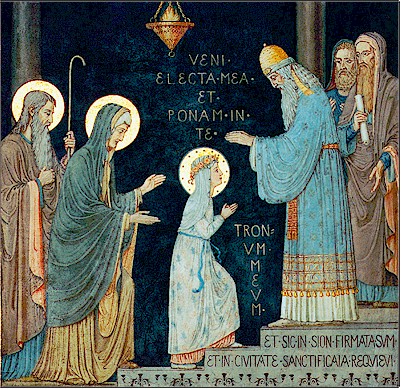
Today, on the Feast of the Presentation of Mary, I pray for her youth in Eire. May they come back to the faith soon. Mary belonged to a community, a strict bound community, with cultural rules and customs which not only gave the individual identity, but created an extended family.
All that is lost in Eire. Perhaps, forever....


To be Supertradmum...

By the way, I asked God what my real vocation was when I was in the monastery. Too simple, but my vocation is to be Supertradmum. And, pray for priests, pray for seminarians.
Christ Within Us, Two

Bernard of Clairvaux's famous sermon on the meeting of Christ and Mary Magdalen in the Garden highlights the theme I have here and in the previous post on the Presence of Christ within us. Bernard states that Mary was looking in the wrong place. Christ was in her, with her, in her heart, and in her soul. Why was she looking for Him?
The heart of Mary Magdalen was full of the love of Christ. Her heart, notes Bernard, was a garden for Him to be in with her, like the garden in the Song of Songs.
There is a mystery about Christ being in us, which the new agers, in their perversion, have said loudly to the modern age. But, the Christ of the new agers is not the Christ in the Garden, the Resurrected Christ bearing the signs of His passion, the wounds in the Sacred Hands and Feet, as well as Side and Head. No. They want a Christ without suffering.
Sorry. The Resurrected Christ Who comes to us when we humble ourselves and allow suffering to carve out our hearts to make room for Him, this Christ, had suffered for us, and with us, and in us. This is the scandal of God's Love for us.
The Eucharist is the daily reminder of this diminishing of the power and the glory of God. I call the Eucharist the Vulnerable God.
The horses of the visitants at Fountains Abbey were forced to stomp on the Eucharist, thrown from the Nine Altars. I have written many long poems on the desecration and lost Love caused by those men, who in their arrogance, wrote back to Thomas Cromwell and bragged of their duties. I am the poet of the honour of Fountains, a numinous place for me.
Over and over again, the Christ in the Eucharist has been abused.
We abuse Him with our selfishness and sins.
But, He desires to forgive us and go even further into a love relationship which is stronger than death, as the Scripture states.
So, Bernard says, look into yourselves and find Christ, find the Father, find the Holy Spirit.
You will need the strength of this relationship in days to come, if not now.
Christ Within Us

The Church pastors tell us to join our sufferings to Christ. This is backwards. What am learning is that Christ joins His sufferings to ours. I first had an inkling of this when I had cancer.
What do I mean? The Child in the stable was cold. He did not need to come down from heaven and join into that cold, a result of Original Sin, as the Fathers tell us that Adam and Eve would not, before the Fall, experienced pain in harsh weather. But, as Joseph and Mary adored the Holy Babe, they must have been amazed at the power of God being set aside, diminished, ignored, completely made subservient to pain and suffering.
In Mel Gibson's The Passion of the Christ, there is a particular statement of Mary, the Blessed Mother, at the foot of the Cross. She states something like, and I paraphrase (apologies if out of order), "Jesuah, Bone of my bone, and Flesh of my flesh, let me die with You." At that point, Christ gives Mary to John and to us.
She is the co-redemptrix and the scene indicates such. But, Christ, Who dwells in us, redeems our suffering daily. As we carry Him into the world in suffering, frustration, physical pain, He is there joining us in those results of sin. He decided to do that. We do not join with Him, He joins with us, in us, and raises us up into a relationship of love because of that joining. I am never alone in my suffering, as Christ is with me. I know this. \It is not merely my Faith which tells me this, or the great teaching of the Church, which explains my baptismal union with God in His Trinity. I know this. When one is with Christ, nothing else matters. This is why Mary wanted to die; not merely to end the nightmare of the Crucifixion which she witnessed, but to be with Christ, her beloved Son. The lay person does not need to seek crosses, as these are given and to some of us, in number. It does not matter. What matters is that we each recognize the Crucified One in our own hearts. He is there.
On the Fool for Christ

Some of my friends, both on-line and virtual, are sad that I left the monastery. I do not want anyone to be sad if I am following God's Will, which I am, by being out in the big, bad world. I know that some of my dear friends who have known me for years want me settled and I want this as well. But, one can only do what is in the plan of God and not pretend to be something other than what one is. One cannot play God.
Recently, I was reading the life of St. Benedict Labre. In the eyes of the world and indeed, even many in the Church, he was a Failure. I stand with the Failures of the world, and even the Church. Perhaps the small group of those saints called "fools" are where God has put me. I hope so...there is a long list of such people who did not fit in the world, nor did not want to fit in the world, and yet had no other place. This list includes saints who were women fools, as well as the better known men. Some of the well-known men are Basil of Moscow and Theodore of Novgorod. I cannot imagine wandering about Russia. Eire is cold enough. Now, I have not chosen a peripatetic lifestyle, but here I am. I can only trust in God, in Divine Providence, as I have no one else to trust and this is the Truth of our existence anyway.
Modern people, especially Americans and particularly the British, want to put people in boxes, usually by profession or by family. Now, to a point, there is nothing wrong with this. But, our real identification is neither in what we do or to whom we are related. Our identification is only is who we are, sons and daughters of God. We, the baptized, are heirs of heaven. We cannot forget that. We sin daily. We cannot forget that. We fail each other and ourselves. But, there is a God Who orders our ways, be as illogical as these may seem. The illogicality is suffering.
But, the point of this is that the world and myself need constant reminders of sinfulness and self-will. Some of the fools were peasant stock and some were from the upper classes. Modern psychologists have tried to undermine the holiness of these people by pointing out the eccentricities. But, Christ Himself said,
"The foxes have holes, and the birds of the air nests: but the son of man hath not where to lay his head". Matthew 8:20.
And from Tuesday's Mass:
Lesson from the first letter of St Paul the Apostle to the Corinthians
1 Cor. 4:9-14
Brethren: We have been made a spectacle to the world, and to angels, and to men. We are fools for Christ, but you are wise in Christ! We are weak, but you are strong! You are honored, but we are without honor! To this very hour we hunger and thirst, and we are naked and buffeted, and have no fixed abode. And we toil, working with our own hands. We are reviled and we bless, we are persecuted and we bear with it, we are maligned and we entreat, we have become as the refuse of this world, the offscouring of all, even until now! I write these things not to put you to shame, but to admonish you as my dearest children, in Christ Jesus our Lord.
R. Thanks be to God
Continuation ☩ of the Holy Gospel according to Luke
R. Glory be to Thee, O Lord.
Luke 12:32-34
At that time, Jesus said to His disciples, "Do not be afraid, little flock, for it has pleased your Father to give you the kingdom. Sell what you have and give alms. Make for yourselves purses that do not grow old, a treasure unfailing in heaven, where neither thief draws near nor moth destroys. For where your treasure is, there also will your heart be."
R. Praise be to Thee, O Christ.
S. By the words of the Gospel may our sins be blotted out.
Tuesday, 20 November 2012
To the young and not so young--on debt

If you are in debt, get out of debt. If you are not in debt, do not go into debt. The American government will demand payments for college and university debts. And, those who are debt-ridden will find themselves in greater danger of any independence, politically, in the future.
Some people, even Catholics, have told me that it does not matter if one borrows more money on the edge of a national fiscal melt-down. It does. Just as for years priests have not told youth that getting drunk is a mortal sin, so getting bogged down unnecessarily in debt, in order to live a certain lifestyle, is wrong.
I am not writing about necessities, such as medical expenses, but other things not really needed.
I am concerned about the soul of Catholics burdened by debt. Pray and act responsibly. I am convinced that exorbitant university debts must be avoided. To be in slavery to a government or institution connected to the government is dangerous.
Stop using a credit card. Go to local, community colleges if at all possible. Wait and work first even if the work is menial, as that is honourable as well. I am afraid that people think there will be no consequences for their debts in a complete economic rout. We have to face a Just Judge. Good stewardship is not merely being green or tithing. It is the courage to live a lower lifestyle than one may want. It involves the courage to be poor and seem poor.
Many of decisions on money will be made this week as it is the busiest shopping weekend for Christmas in the States. Pray and talk to your family about expenses. Be honest. Make things. Do something together which is not over-the-top. For your soul and for the greater good, do not go into debt this Christmas.
Where is the media outrage?
http://www.jihadwatch.org/2012/11/savagery-in-antwerp-protesters-chant-hamas-hamas-jews-to-the-gas.html
On the Contemplative Life

One reason I went into the monastery for two months is that I do have a contemplative vocation. I have known this for years. God has allowed me to have graces for hours of prayer and meditation, which moves into contemplation. I have also, in the past, been blessed with excellent spiritual directors. Not recently.
Nuns in the Benedictine monastery where I was do not receive spiritual direction at all. Now, this may seem strange, and it was hard for me in discernment, but the Rule of Benedict provides the format for discernment: that is, if one can follow the Rule, one is on the right track as it were. The nuns only have Confession once every two weeks, which I think is sad. There is a priest shortage. I went to the Cathedral once a week and the priests were excellent.
However, being trained in Ignatian spirituality and having done Ignatian retreats three times in the past, including the thirty day, I decided to use the tried and true method of the eight day shortened retreat for discernment. The reason I did this was that I wanted to know for sure my path, not merely from the physical perspective, but from the spiritual. I got my answer.
One must trust in the Indwelling the the Holy Spirit, which we are all given at baptism. Lay people are not taught to get in touch with God Who dwells within and, horribly, the new age people have taken some of the language of the saints and twisted it for their own ends.
SS. Teresa of Avila and John of the Cross understood and practiced contemplative prayer. It is a grace, and I am convinced, for all Catholics. One must start with meditation, which is using the events in the Life of Christ in the Bible and entering into these events, much like meditating on the Mysteries of the Rosary. Good luck finding an orthodox, trained and holy spiritual director. Since I have been in Europe, I have found only one, and he is too busy to take on another person.
God will bless all of your efforts, and that is one of the consoling ideas I came away with in the past few days-God can do in the lay person what He does in the religious. The religious is focussed on perfection and holiness. The entire set-up of monastic life is geared towards that goal. We have many distractions. But, it is possible in God, as He calls us all to be perfect. The difference is the call in which this holiness is to be perfected. The nuns and monks have a ready-made situation and the fantastic Rule of St. Benedict, which gives a short-cut to sanctity.

By the way, one of the things which concerns me is that the monasteries, for the most part, and the one I was in particularly, are not self-sufficient. This is dangerous. That the nuns need to shop, rely on outside amenities, such as bulk laundry, etc. is not good. One hopes for more vocations to create self-sufficient communities again. If this does not happen, the orders are vulnerable to the hard times to come. And, I am afraid there will not be many who care to help....In small communities where the majority of sisters are old, these nuns are very vulnerable, indeed.
May I also add, and this is not a criticism as much as a lament, that I strongly feel that the lack of the TLM and the Gregorian Chant replaced by modern versions is a loss of spirituality for some Benedictine monasteries. There is a sublimity in the EF and the chant, as well as the older translations, which has been set aside for less exact and less aesthetically pleasing modes of singing. There is more to this than mere "taste". This comment is based on my personal experience of growing in the TLM, as well as others, including parents, who have shared with me that their faith and the faith of their children changed once they went regularly to the TLM. We could discuss the difference of spirituality as the focus from people back to God. It is a sad fact that so many English and other communities have their own translations and own melodies. I wish the Pope would ask the orders to embrace the Latin Mass again, and the Gregorian chant.
On Holy Indifference

Today's Gospel in the EF reminds us that those who sell all and follow Christ merit the Kingdom of God. However, it is not merely the choosing of the simple life, or the getting rid of distractions which allows for holiness to grow in the mind and heart and soul.
Getting rid of things, or "downsizing"is the first step. The second step is not to care or to give up preferences. For example, in the last two months, I at what was given to me for breakfast, dinner and supper. Whether I liked the food or not was immaterial. When I dressed, I dressed simply, for cleaning or for Church. When I washed, it could be in cold water or water out of a kettle depending on the situation the superior decided for me. The room was not my room, but anyone's room and so on.
What this type of detachment brings is the awareness that I still wanted things or food or drink. Not having fresh veggies was not a problem for me, but not having fresh sheets after one week was. I was not detached.
Not having disinfectants or cleaning materials, as the nuns only use a cream cleaner and water, and only water on the floors, for example, caused my American hyper-cleanliness sensibilities to rebel, especially in the guest house. I bought disinfectants.
This is not detachment, nor is thinking of real coffee or even a glass of wine now and then. Desiring the things of the world is not indifference. Indifference for most of us must be pounded into the soul by days, weeks, months of habit. And, of course, with grace.
To be attached to anything distracts one from the love of God. I like to think of this in a physical way. If my heart is full of desires for people or things or places, then there is less room for God. And, as my heart is small to begin with, this creates a need for prayer.
For one year I have been praying for God to take my puny, little heart and give me His. This has been a process. Ask and you shall receive, but do not anticipate the means.
Comment rule
Sadly, I have to write that comments with obscenities will not be posted. No one in my family speaks in my parents' house with such and when I had a house, the same. When I was teaching college, students were not allowed disrepectful speech in the classroom. This should be an obvious rule but apparently not.
Monday, 19 November 2012
The Supernatural Builds on the Natural

Something came to my attention when in the monastery which I feel is applicable to us lay people.
Two ideas which are as simple as life--one; the supernatural life builds on the natural life; two, the supernatural must be naturalized.
These are not new ideas but I want to share what I mean in terms which we can apply to our lives.
 In the first case, that the supernatural must build on the natural, those of us who have been married and have children may be able to understand this. We fall in love and that love changes over the years, if we are fortunate enough to have the time and committed partner to do so. The natural love with all of the joys therein changes, mutates into the sacrificial love of God. As I noted in the series on the Pope's encyclical on Love, which you can search and read on this blog, the types of love change and grow into the sublime connection with God Himself. If one is open to the movement of love, one will find God in the other and in the relationships at home.
This is true in monasteries, but the road is different. The challenge is to learn to love strangers. However, I am with St. Ailred that love in monasteries must build into friendships and then into the great families of communities. This may not be happening in some places.
Friendships and love in a family must include basic human respect, manners, a recognition of dignity and gifts.

Natural love must proceed the supernatural or we are missing a step. The supernatural must be naturalized or we are not living out our vocations.
Those of us who grew up in nature, instead of in front of a computer all day, understand the natural. We must help those younger to understand and embrace the natural. Without being both body and soul we are not persons. Without nature, we are not fulfilled as humans. We are both, natural and supernatural and part of the argument with atheists is being lost because we have lost sight of who we are.
This is why I want lay people to get married, to be committed. Without natural love, the road to supernatural love is much harder, if not impossible. Christ, the Eternal Word, became Man to show us this. The Law was impossible to do and to save. Only through Love is salvation possible.
What to do after losing a war
Many of us are sitting back and wondering where the world will be moving politically now that America has lost the culture? war. We cannot be in cloud-cuckoo land, pretending that this week is the same as a week last month. We cannot pretend that a great day of the Church, a new Christendom, will bless the earth with a homogenous vision of God, His rule, good and bad, brotherly and sisterly love.

Sorry, the moment has passed. Those of us who have been praying for a long time or involved in the work of the Church for a long time have seen this day coming. We knew in the 1970s, after Roe v. Wade, that the Christian community would have to fight, or be persecuted. We can fight, but the majority is against us.
Some people do not believe this. I met many guests and religious in the past two months who believe in the resurrection of the dead Western Civilization and a time of Christ's reign on earth which will bring world peace. I do not know which Bible these people read or why they are not hearing the Holy Spirit.
That I try, gently, and maybe not so gently, to speak the truth is that there is not much time.
There are NO safe havens. One may be able to withstand evil in an excellent Catholic community for awhile, but persecution will come. First, the established Church will be more openly attacked, then priests, nuns, sisters and the laity.

The Church Triumphant is in Heaven.
The emphasis on this blog, therefore, will be on the interior person and personal holiness. Why? If we are facing martyrdom, or sacrifices beyond our imagination, we must be prepared spiritually. One cannot exhibit virtue without living in the Presence of God, of Love Himself, in the days to come.
There is no time frame on this coming persecution. Catholics in England saw incremental, increasingly harsh times and some were martyred. It became illegal to leave the country in order to practice Catholicism elsewhere and avoid fines or imprisonment.
Where are the Catholic havens now? Not Ireland, where I am sitting, looking out over the downtown of Dublin, witnessing the fall of the one of the most faithful countries in the world, now racked with gross materialism, hatred for the Church and selfishness. The winter is already more severe than last year, as if the gods of nature, metaphorically, of course, were grieving at the loss of innocence on this once holy isle.

Malta? The socialist agenda, including abortion and civil marriage, is gaining ground. France? The eldest daughter of the Church has wedded herself with a son of Gramsci. Italy, Spain, Portugal are grasping for life, both spiritually and physically.
I merely stated facts. One must learn to accept suffering, love the enemy and serve God in all circumstances. One must beg God to reveal His Love to you in your hearts so that you can carry Him with you wherever you go and preach the Gospel through the life of the virtues. 1 Corinthians 13 is our road map, as well as the Passions narratives.
A God-Man has already experience what you have and will experience. It was His Will to suffer. And, now, for the sake of His Holiness, all will suffer. This is not because He is a vengeful god but because His is Just. The time of Mercy is coming to an end.
Some of you will be betrayed. This has happened to me more than once by those I trusted. Some of you will be isolated. Focus on Christ. Some of you will need to move. Be ready and willing to go wherever. Some of you will merely disappear. Only a few will remember you.
Be strong, be disciplined. Those of us who are physically weakened by circumstances or ill-health appeal to the strong to reach out and take us many, many in, as the weak will be the first to go in the utilitarian world where only those who are useful will be rewarded.

I shall continue to write about this journey to perfection. It is our way to be in and with God and lead others to Him.
These persecutions have all happened before. The scale will be larger and sadly, America, which used to be a Christian nation, is leading the way into darkness now.
Be holy, put on the mind of Christ. He is with us, as He was in Gethsemane. We are a privileged generation.

Sorry, the moment has passed. Those of us who have been praying for a long time or involved in the work of the Church for a long time have seen this day coming. We knew in the 1970s, after Roe v. Wade, that the Christian community would have to fight, or be persecuted. We can fight, but the majority is against us.
Some people do not believe this. I met many guests and religious in the past two months who believe in the resurrection of the dead Western Civilization and a time of Christ's reign on earth which will bring world peace. I do not know which Bible these people read or why they are not hearing the Holy Spirit.
That I try, gently, and maybe not so gently, to speak the truth is that there is not much time.
There are NO safe havens. One may be able to withstand evil in an excellent Catholic community for awhile, but persecution will come. First, the established Church will be more openly attacked, then priests, nuns, sisters and the laity.

The Church Triumphant is in Heaven.
The emphasis on this blog, therefore, will be on the interior person and personal holiness. Why? If we are facing martyrdom, or sacrifices beyond our imagination, we must be prepared spiritually. One cannot exhibit virtue without living in the Presence of God, of Love Himself, in the days to come.
There is no time frame on this coming persecution. Catholics in England saw incremental, increasingly harsh times and some were martyred. It became illegal to leave the country in order to practice Catholicism elsewhere and avoid fines or imprisonment.
Where are the Catholic havens now? Not Ireland, where I am sitting, looking out over the downtown of Dublin, witnessing the fall of the one of the most faithful countries in the world, now racked with gross materialism, hatred for the Church and selfishness. The winter is already more severe than last year, as if the gods of nature, metaphorically, of course, were grieving at the loss of innocence on this once holy isle.
Malta? The socialist agenda, including abortion and civil marriage, is gaining ground. France? The eldest daughter of the Church has wedded herself with a son of Gramsci. Italy, Spain, Portugal are grasping for life, both spiritually and physically.
I merely stated facts. One must learn to accept suffering, love the enemy and serve God in all circumstances. One must beg God to reveal His Love to you in your hearts so that you can carry Him with you wherever you go and preach the Gospel through the life of the virtues. 1 Corinthians 13 is our road map, as well as the Passions narratives.
A God-Man has already experience what you have and will experience. It was His Will to suffer. And, now, for the sake of His Holiness, all will suffer. This is not because He is a vengeful god but because His is Just. The time of Mercy is coming to an end.
Some of you will be betrayed. This has happened to me more than once by those I trusted. Some of you will be isolated. Focus on Christ. Some of you will need to move. Be ready and willing to go wherever. Some of you will merely disappear. Only a few will remember you.
Be strong, be disciplined. Those of us who are physically weakened by circumstances or ill-health appeal to the strong to reach out and take us many, many in, as the weak will be the first to go in the utilitarian world where only those who are useful will be rewarded.

I shall continue to write about this journey to perfection. It is our way to be in and with God and lead others to Him.
These persecutions have all happened before. The scale will be larger and sadly, America, which used to be a Christian nation, is leading the way into darkness now.
Be holy, put on the mind of Christ. He is with us, as He was in Gethsemane. We are a privileged generation.
Sunday, 18 November 2012
The Brothers and Sisters of the Crown of Trent

An idea came to my mind when I was at the monastery and I am throwing it out into the blogasphere for feedback. A group, which I do not think I can call an order, of men and women whose have pledged themselves to pray for priests and seminarians who specifically say the Tridentine Mass.
The group would have to make some commitments to belong.
The name of the group is the Brothers and Sisters of the Crown of Trent.
This is a feeler posting.
First, daily prayer for all sems and priests in Latin Mass orders and seculars who say the Latin Mass, such as Father Z.
Second, a promise to read at least two of the hours of the breviary a day, such as lauds and vespers, or sext and compline, etc.
Third, a promise to do three hours of adoration before the Blessed Sacrament a week, either in the Exposed Host in a monstrance, or adoring Christ hidden in the tabernacle.
Four, abstinence from meat one day a week.
Five, if possible, if more than one person can join in this endeavor in an area, for those two or more to meet up once a month and pray and communicate, supporting the ministry.
What do you think, readers? Can there be such a grouping starting online?
On offering things up
I would like to challenge an old and useful phrase, "offer it up". For our times, I want to change the sentiment to "absorb it". What do I mean?
The crosses we endure provide us with THE opportunity to become one with God, the Trinity. By absorbing pain of any kind, we cooperate with a mysterious plan in the purgative stage. We cannot live the life of the virtues without absorbing these pains. The illuminative stage, which follows that of purgation, allows the soul to see and experience that all is in God, whether good or evil, loss or gain. Such purgation cleans the heart and mind so that one can love those who hate them, criticize them, spurn them, judge them. Illumination reveals that the love of God is in all things and all people. One can love the enemy.
My mother lost three children. Is this God's Will? I had cancer. Is this God's Will? Some people have horrible experiences, such as abuse as children. Is this God's Will?
He has seen from all time the evil which men and women do to each other. After the Fall, the choice of Adam and Eve to rebel against God's plan for them, the Trinity allowed all of us our free wills, to do good or evil.
We have all done both.
That God allows such freedom is a scandal to some, but Love can only happen in freedom. Love is an act of the free will and heart, not a coercion.
That God freely loves me and that I live and move and have my being in that Love is FREE GIFT.
Does it matter how I came to accept this free gift of love?
What matters is that the illumination of God's love puts all failure and pain into perspective. As I sit in a student flat wondering what will be my next step in God's plan, I move with and in God. How I got here and where I am going next does not matter. That failures happen does not matter if one sees that God has allowed certain events to break down the self-will and rebellion left from the First Parents' defection from God.
May I add that we are not alone in this journey. We each, those of us who are baptized, have an angel guardian to help us on the way. Pray to your angel. There are other angels who God may send to help one, just as God sent Raphael to help Tobit.

The crosses we endure provide us with THE opportunity to become one with God, the Trinity. By absorbing pain of any kind, we cooperate with a mysterious plan in the purgative stage. We cannot live the life of the virtues without absorbing these pains. The illuminative stage, which follows that of purgation, allows the soul to see and experience that all is in God, whether good or evil, loss or gain. Such purgation cleans the heart and mind so that one can love those who hate them, criticize them, spurn them, judge them. Illumination reveals that the love of God is in all things and all people. One can love the enemy.
My mother lost three children. Is this God's Will? I had cancer. Is this God's Will? Some people have horrible experiences, such as abuse as children. Is this God's Will?
He has seen from all time the evil which men and women do to each other. After the Fall, the choice of Adam and Eve to rebel against God's plan for them, the Trinity allowed all of us our free wills, to do good or evil.
We have all done both.
That God allows such freedom is a scandal to some, but Love can only happen in freedom. Love is an act of the free will and heart, not a coercion.
That God freely loves me and that I live and move and have my being in that Love is FREE GIFT.
Does it matter how I came to accept this free gift of love?
What matters is that the illumination of God's love puts all failure and pain into perspective. As I sit in a student flat wondering what will be my next step in God's plan, I move with and in God. How I got here and where I am going next does not matter. That failures happen does not matter if one sees that God has allowed certain events to break down the self-will and rebellion left from the First Parents' defection from God.
May I add that we are not alone in this journey. We each, those of us who are baptized, have an angel guardian to help us on the way. Pray to your angel. There are other angels who God may send to help one, just as God sent Raphael to help Tobit.

On Perfection and Indifference
Following up this theme of the possibility of the lay person achieving the sanctity of one in the religious life must be presented along with the idea that the lay person has duties and graces from baptism.
As the sacrament which makes one a child of God and heir to heaven, the sacrament changes one forever. The ebb and flow of the active and contemplative life can be adjusted in a lay life, but with great difficulty. What the nuns and monks have is a greenhouse situation tailor made for the pursuit of perfection, which therefore, happens more readily and quickly.
That we are not in this special environment, or called to the obedience, and strict observance of rules does not let us off the hook in the pursuit of perfection.
In addition, I look at the lives of SS. Teresa of Avila, Bernard, and many others, realizing that they were busy in the world as well.
The contemplative prayer and meditation allowed them to be effective in the world. St. Catherine of Siena was a great player in the world, despite or because of her intense interior life. How can we do this, while working or studying, or commuting? Of course, the singing of the seven hours and the silence is not possible, but the ebb and flow of being attuned to grace in a balance of activity and reflection must be possible. The Jesuits managed it for centuries. The key is discipline of a different sort We waste so much time and miss the pursuit of holiness in that waste. We also miss the vision of holiness by concentrating on nonessentials. So, how can a lay person follow the purgative, illuminative and unitive way? First of all, one must find a good spiritual director.
This is very hard, as I know from personal experience. Secondly, one must believe that every event in one's life has been ordained by God. That the pattern of one's life reveals the way to holiness. One may be following, by God's choice, the way of affirmation or the way of negation.
Suffering comes to us all, but the way of negation would include a life of suffering and denial, imposed by the Holy Spirit. Once one realizes the pattern and sees how God is working, through love in one's life, the vocation is seen more clearly. For example, I thought my life was a series of failures. God showed me that none of these events were failures but part of the larger pattern of the breaking down of my desires for worldly things, pleasures, success, a place in the sun. What the nuns learn by being obedient to Mother Prioress, God has taught me through suffering of a different kind. Both ways lead to self-denial and finally, to an indifference.
Indifference is key. One must not care what happens, not in a quietist way (see previous posts on this danger of quietism) but, in the acceptance of the Will of God, and the freedom of the thrall of slavery to things and relationships not ordained by God. Those saints who have been martyred did not come to their martyrdom easily, but through a process of steps, which freed them to experience pain and loss of status, prestige, life. St. Oliver Plunkett, for example, was a great bishop, but slandered and treated with contempt. How many of us could absorb that type of hatred without his humility and the grace of God?
But, laity, this is possible for us as well. Believe me, that the Church and God in His Trinity wants us to reach out and be saints NOW. We are being prepared for heaven daily.

The contemplative prayer and meditation allowed them to be effective in the world. St. Catherine of Siena was a great player in the world, despite or because of her intense interior life. How can we do this, while working or studying, or commuting? Of course, the singing of the seven hours and the silence is not possible, but the ebb and flow of being attuned to grace in a balance of activity and reflection must be possible. The Jesuits managed it for centuries. The key is discipline of a different sort We waste so much time and miss the pursuit of holiness in that waste. We also miss the vision of holiness by concentrating on nonessentials. So, how can a lay person follow the purgative, illuminative and unitive way? First of all, one must find a good spiritual director.
This is very hard, as I know from personal experience. Secondly, one must believe that every event in one's life has been ordained by God. That the pattern of one's life reveals the way to holiness. One may be following, by God's choice, the way of affirmation or the way of negation.
Suffering comes to us all, but the way of negation would include a life of suffering and denial, imposed by the Holy Spirit. Once one realizes the pattern and sees how God is working, through love in one's life, the vocation is seen more clearly. For example, I thought my life was a series of failures. God showed me that none of these events were failures but part of the larger pattern of the breaking down of my desires for worldly things, pleasures, success, a place in the sun. What the nuns learn by being obedient to Mother Prioress, God has taught me through suffering of a different kind. Both ways lead to self-denial and finally, to an indifference.
Indifference is key. One must not care what happens, not in a quietist way (see previous posts on this danger of quietism) but, in the acceptance of the Will of God, and the freedom of the thrall of slavery to things and relationships not ordained by God. Those saints who have been martyred did not come to their martyrdom easily, but through a process of steps, which freed them to experience pain and loss of status, prestige, life. St. Oliver Plunkett, for example, was a great bishop, but slandered and treated with contempt. How many of us could absorb that type of hatred without his humility and the grace of God?
But, laity, this is possible for us as well. Believe me, that the Church and God in His Trinity wants us to reach out and be saints NOW. We are being prepared for heaven daily.

Saturday, 17 November 2012
Answer to Jack
A reader notes that being a Catholic seems masochistic. If original sin had not happened and if our natures were not bent on selfishness and narcissism, one could say that such mortification seems harsh. However, the self-love and sin we to experience must be challenged. To put this topic in a positive light, how can we love God with our whole heart, mind, and soul if there is no room in our heart for God? The purgative state cleanses our imagination, purifies our intentions, enlargens our heart in order to really love.
Scroll down to my posts on the will, read the articles using material by Saints Bernard and Thomas Aquinas.I just read your second comment. The key is trying not to worry and trusting in Divine Providence, begging for healing and grace. Showing God you are serious about wanting to love Him above all things and people....accepting poverty and even chosing it as He has allowed it. The joy of seeing all suffering as opportunity to love God in reality and not sentimentality is the challenge. Jack, ask for the grace. Ask yourself if you want to love God first.
Suffering and the purgative way
For the lay person, just as with the religious, the first step is found in the purgative way: that is, the ego, the self-will must be destroyed...the losing of one's self. In the monastery, this could mean doing things which seem nonsensical...like not giving a guest a coffee spoon because only so many spoons are allowed in the kitchen; or having to use only water for cleaning and not soap. Obedience over-rules common sense. In the lay life, this could mean being overlooked for a well-earned promotion, or being unemployed and very poor.
The suffering, if seen as a moment of grace and accepted, becomes part of the molding of the soul into humility. A great Failure, for example, can be a huge grace. I do not have my computer. I am blogging by phone..a moment of grace, rather than frustration. Criticisms by someone in the church who said I was odd and a burden, becomes a moment of joy, indifference and peace....to be continued.
R.I.P.
My godfather, Uncle Charlie, died this past week. Please pray for his soul. He was a Catholic, very funny, a marathon runner, and a lover of movies. He is responsible for my love of the cinema, especially Audrey Hepburn movies and musicals. He is the first in that maternal side of his generation to pass away. He never married and I last saw him in early 2011. He will be buried in a military cemetary. May the angels take his soul into Paradise.
Friday, 16 November 2012
On the way of perfection....again
One cannot explain spiritual growth for the lay person as easily as one can for the religious simply because the Rule of Benedict, or any rule is objective. Therefore, if one is obeying a simple command, or following carefully the duties of the day in a reflective and humble manner, a religious can somewhat judge by conscience the inner workings of the Holy Spirit. The layperson does not have a rule as such, except, perhaps the Beatitudes and the guidelines in the epistles on love. The point is rather complicated by the fact that the active life has to be lived in an life where things are out of our control-there is no rule.
One thing I noticed was that unless there is contemplation and reflection behind action, the action is useless in and of itself. In other words, caritas, that is love, must inform everything we do. I am to do a series on some of the things I learned about the ability, the skill to pray and work, moving towards contemplation and meditation in the lay life.
If my readers remember the series on the Pope's encyclical on love, I tried to highlight the need to move naturally from one stage to the next. In the monastery, the focus allows one to move quickly in a shorthand manner to accomplish the stages of the purgative, illuminative, and finally, unitive stage. As lay people, you and I can move as well into these stages by allowing the sufferings in our lives to be real and effective. We do not avoid suffering, but accept it as a mortification in order to become humble and pliable to God's Will. In the next few weeks, I shall try and make some progress in showing the connections between the monastic spirituality I experienced and our way of life.

Why do I want to do this? Because we are all called to perfection in order to see God. Only the perfect are allowed into the presence of God.
In the next post, I shall try and explain how the purgative state, which is obvious in the monastic life, happens more organically in the lay life, but cannot be ignored if the benefits of sufferings are to lead us to the next levels.
One thing I noticed was that unless there is contemplation and reflection behind action, the action is useless in and of itself. In other words, caritas, that is love, must inform everything we do. I am to do a series on some of the things I learned about the ability, the skill to pray and work, moving towards contemplation and meditation in the lay life.
If my readers remember the series on the Pope's encyclical on love, I tried to highlight the need to move naturally from one stage to the next. In the monastery, the focus allows one to move quickly in a shorthand manner to accomplish the stages of the purgative, illuminative, and finally, unitive stage. As lay people, you and I can move as well into these stages by allowing the sufferings in our lives to be real and effective. We do not avoid suffering, but accept it as a mortification in order to become humble and pliable to God's Will. In the next few weeks, I shall try and make some progress in showing the connections between the monastic spirituality I experienced and our way of life.
Why do I want to do this? Because we are all called to perfection in order to see God. Only the perfect are allowed into the presence of God.
In the next post, I shall try and explain how the purgative state, which is obvious in the monastic life, happens more organically in the lay life, but cannot be ignored if the benefits of sufferings are to lead us to the next levels.
Subscribe to:
Posts (Atom)