Recent Posts

Sunday, 9 December 2012

Multi-post day again.....it is very cold outside!


Multi-post day, at least ten and here are some cuties for your attention.

Is she going to post more today?


Stocking stuffer for men this Christmas?

Dismas, one of my readers, sent me this link for a lapel pin. Maybe this will give some men a sense of belonging to the tribe of courageous ones. Nice pin. You can order it here: http://veritatisthecartoon.blogspot.ie/2012/08/defy-tyranny-defend-faith-lapel-pin.html


A new voting bloc-no religious affiliation


News of the day which may not be news to some is that Obama won the vote from those who do not have religious affiliation. Here are two small sections from the article from NPR. Are we surprised?

http://www.npr.org/blogs/itsallpolitics/2012/12/09/166753248/add-this-group-to-obamas-winning-coalition-religiously-unaffiliated

Their overwhelming support of Obama proved crucial in a number of swing states where the president lost both the Catholic and Protestant vote by single and low-double digits, but won the "nones" by capturing 70-plus percent of their votes..........


 Pew has tracked their growth, and found that in 2010 about a quarter of those in the "millennial generation" defined themselves as religiously unaffiliated. That's up from the 20 percent of Gen X-ers who said they had no religious affiliation, and 13 percent of baby boomers who said the same.

The Pope Looks at the Two Figures of Advent: Mary and John the Baptist


In today's Angelus message, the Pope brings together the Old and the New Testaments, the prophetic word and the priestly line, the historical and the spiritual. I love St. John the Baptist as he is the greatest of men, as Christ said, and points us always to Christ. 

Here is part of today's message, again, found on the easier to us Vatican website. And, Caravaggio painted a young John. Very interesting. And, St. Augustine is quoted here again, but this time by the Pope, who is an Augustinian scholar.

Thanks, Wiki

In the season of Advent, the liturgy emphasizes, in particular, two figures who prepare the coming of the Messiah, the Virgin Mary and John the Baptist. Today St. Luke presents it, and does so with different characteristics from the other Evangelists. "All four Gospels put at the beginning of Jesus' ministry, the figure of John the Baptist and present it as its precursor. St. Luke has moved back the connection between the two figures and their respective missions ... Already in the conception and birth, Jesus and John are brought into relation with each other "( The childhood of Jesus , 23). This setting helps to understand that John, as the son of Zechariah and Elizabeth, both of priestly families, not only is the last of the prophets, but also represents the whole priesthood of the Old Covenant and therefore prepares men to the worship of the spiritual New Covenant inaugurated by Jesus (cf. ibid. 27-28). Luke also dispels any mythic reading that is often made ​​of the Gospels and places historically the life of John the Baptist, writing: "In the fifteenth year of Tiberius Caesar, when Pontius Pilate was governor ... during the high priesthood of Annas and Caiaphas" ( Lk 3:1-2).Within this historical framework lies the true great event, the birth of Christ, that his contemporaries will not even notice. By God the great men of history form the backdrop to small!
John the Baptist is defined as the "voice of one crying in the wilderness: Prepare the way of the Lord, make straight his paths" ( Lk 3:4). The voice proclaims the word, but in this case the Word of God above, as it is itself down to John the son of Zacharias in the wilderness (cf. Lk 3:2). He then plays a great role, but always in relation to Christ. St. Augustine says: "John is heading. Instead of the Lord says: "In the beginning was the Word" ( Jn 1:1). John is the voice that goes, Christ is the eternal Word who was in the beginning. If the item you take away the word, what is left? A faint sound. The voice without the word strikes but the hearing, but does not build up the heart "(Sermon 293, 3: PL 38, 1328). Our aim is to give today listening to that voice to give space and welcome to the heart of Jesus, the Word that saves us. In this time of Advent, prepare to see, with the eyes of faith, the humble stable in Bethlehem, God's salvation (cf. Lk 3:6). In the consumer society, in which they seek joy in things, the Baptist teaches us to live in an essential way, so Christmas is experienced not only as a party outside, but as the feast of the Son of God who came to bring peace to the people, life and true joy.

Happy Chanukah, Augustine, Cologne and West Point


Happy Chanukah to my Jewish friends. We Catholics love the Maccabees as symbols of the Church Militant.  They are saints and martyrs, honoured in the calendar. 

In the Church of St. Andreas in Cologne, there are stained glass windows of these men. Sadly, most of the photos cannot be reproduced here, so look these up.


Take time to read of the deeds of the Maccabees. 

Perhaps someone can tell me if the statue of Judah Maccabees is still at West Point. We have, in the States, moved so far away from our Judeo-Christian roots.


Here is a commentary and a quotation from St. Augustine on the Feast of the Maccabees, August 

1st Sermon 300. (Other Fathers of the Church commented on the Maccabean martyrs as well).


Let no one think that before there was a Christian people, there was no people of God. There was not at that time of the Old Dispensation, the usage of the Christian name. Nevertheless, the Christian people existed at that time (christianus etiam ille tunc populus fuit)...These Christian peoples were born of Abraham. When you admire the Maccabbean martyrs, do not think that they were not Christian martyrs (ne...illos martyres..putetis non fuisse christianos) They were Christians (christiani fuerunt), but the name of "Christian"was divulged only later, while the deeds proper to Christians anteceded the name.

http://www1.villanova.edu/content/villanova/mission/augustinianinstitute/lectures/staugustine/_jcr_content/widgetiparsys/download_7/file.res/as_1988.pdf


Parents: Get ready for the O Antiphons

Some children grow up with the Jesse Tree in Advent. I did this in my little family.

I went to a Catholic school where the nuns had the students say the O Antiphons before we broke up for the short, American holiday. We drew pictures of the symbols connected to the Messianic Names of Our Lord, which form the basis of the Antiphons.

In my Monastic Diurnal, these are called the Great Antiphons and are those said at the Magnificat at Vespers. This is a long tradition in the Benedictine Monasteries and most likely where these prophecies were put to verse and music.

That the good nuns had us saying these was a brilliant and simple way of having children join in the wonderful daily prayer of the Hours from the 17th-23rd.

I shall list these by day, but here is the entire set for you to ponder now as part of your Advent meditation.

All of these refer to the great prophet Isaiah, so we are also entering into the mystery of the Old Testament leading up to the New. The drawings are in the common domain. You can make ornaments for your children to put on the Jesse Tree. You could just print off this page and enlarge the drawings for colouring in and hanging up. Also, the prayers may be copied if one does not have a breviary.

By the way, for those who are going to the EF today, the first reading from the Epistle of Paul to the Romans 15:4-13 also refers to the same references from Isaiah concerning the Root of Jesse and the call of the Gentiles to the King of All Nations. That St. Paul knew the Old Testament inside and out and could apply these passages to Christ is part of our wonderful heritage as Catholics. Perhaps those early monks were inspired by the Holy Spirit to use St. Paul in the making of the Antiphons.


      December 17th


O Sapientia, quae ex ore Altissimi prodiisti,
attingens a fine usque ad finem,
fortiter suaviterque disponens omnia:
veni ad docendum nos viam prudentiae.

O Wisdom, coming forth from the mouth of the Most High,
reaching from one end to the other mightily,
and sweetly ordering all things:
Come and teach us the way of prudence.

 December 18th


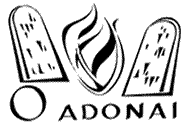
O Adonai, et Dux domus Israel,
qui Moysi in igne flammae rubi apparuisti,
et ei in Sina legem dedisti:
veni ad redimendum nos in brachio extento.

O Adonai, and leader of the House of Israel,
who appeared to Moses in the fire of the burning bush
and gave him the law on Sinai:
Come and redeem us with an outstretched arm.

     December 19th


O Radix Jesse, qui stas in signum populorum,
super quem continebunt reges os suum,
quem Gentes deprecabuntur:
veni ad liberandum nos, jam noli tardare.

O Root of Jesse, standing as a sign among the peoples;
before you kings will shut their mouths,
to you the nations will make their prayer:
Come and deliver us, and delay no longer.


December 20th


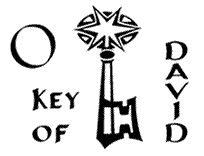
O Clavis David, et sceptrum domus Israel;
qui aperis, et nemo claudit;
claudis, et nemo aperit:
veni, et educ vinctum de domo carceris,
sedentem in tenebris, et umbra mortis.

O Key of David and sceptre of the House of Israel;
you open and no one can shut;
you shut and no one can open:
Come and lead the prisoners from the prison house,


December 21st


O Oriens,
splendor lucis aeternae, et sol justitiae:
veni, et illumina sedentes in tenebris, et umbra mortis.

O Rising Sun,
splendour of light eternal and sun of righteousness:
Come and enlighten those who dwell in darkness and the shadow of death.


December 22nd


O Rex Gentium, et desideratus earum,
lapisque angularis, qui facis utraque unum:
veni, et salva hominem,
quem de limo formasti.

O King of the nations, and their desire,
the cornerstone making both one:
Come and save the human race,
which you fashioned from clay.


December 23rd


O Emmanuel, Rex et legifer noster,
exspectatio Gentium, et Salvator earum:
veni ad salvandum nos, Domine, Deus noster.

O Emmanuel, our king and our lawgiver,
the hope of the nations and their Saviour:
Come and save us, O Lord our God.

What to say to those who think religion causes wars...


The Vatican Website is a treasure trove of truth. Check it out on a regular basis. This past week, the Pope made several important statements. One can click on the main page, under the section, Latest, and get links to all the things this amazing Bishop of Rome has said recently. One can hardly keep up with him and he is brilliant. That the Holy Spirit has given us this man at this time is key.

There is a not so long an address to the International Theological Commission at its annual session from Friday, December 7th for you to read. I only want to highlight one part, which is a answer to a common comment in today's secular world.

Many atheists and agnostics blame the great world religions for violence. These lazy historians and arm-chair critics say things like, "Religions just cause wars", or "We would be better off with religions as these cause violence."

I see this comment on blogs and hear it among young people who do not want to commit to a faith.

Youth look at Christianity and Islam, for example, and blame violence on religious differences.

However, the Holy Father rightly shows all of us, the entire world, that only the pursuit of objective truth can bring peace.

This should be obvious. If everyone has their own interpretation of truth, which is called the heresy of relativism, or the heresy of individualism, then there is no consensus for truth. And, only in the Church is that consensus possible.

We have the Holy Spirit and the Teaching Magisterium of the Church to guide us. Do not pass up opportunities to meditate on the words of the Pope, who is God's gift to the Church.

We need to be able to encourage the seeking of objectivity. As I have written here many times in the perfection series, only those who can be objective can be saints.

If we persist in judgements based on our own criteria, we cannot approach God, Who is Truth.

Sin causes war, selfishness and ideologies which are godless cause war. True religion can only bring peace to the soul and, therefore, to the world.

When the Pope refers to agape in this section, he can bring us back to his work on love, which I wrote about on this blog. Follow the tags at the bottom. We must understand the principle of agape in order to restore harmony to the world.

I mistrust those who merely pray for world peace without knowing what God means by peace of the soul and mind and heart. Peace only comes with love and personal conversion.

Nothing else.

Here is a section of the Pope's address on this link-http://www.vatican.va/holy_father/benedict_xvi/speeches/2012/december/documents/hf_ben-xvi_spe_20121207_cti_it.html

The bold highlights are my emphases.

Today, however, it is particularly important to clarify the criteria that distinguish the sensus fidelium authentic from its counterfeits. In fact, it is not some kind of public opinion of the Church, and it is unthinkable to mention being able to challenge the teachings of the Magisterium, as the sensus fideium not grow in the authentically believer except to the extent in which he participates fully in the life of the Church, and this requires an adherence responsible to her Magisterium, the deposit of faith.
Today, this same supernatural sense of the faith of believers leads to react with force even against the notion that religions, especially the monotheistic religions are inherently bearers of violence, mainly because of the claim that they advance the existence of a universal truth. Some believe that only the "polytheism of values" to guarantee tolerance and civil peace and be in the spirit of a pluralistic democratic society. In this direction, your study on "the Triune God, unity of men.Christianity and monotheism "is alive actuality. On the one hand, it is essential to remember that the faith in one God, Creator of heaven and earth, meets the needs of rational metaphysical reflection, which is not weakened but strengthened and deepened by the revelation of the mystery of the Triune God. On the other hand, it should be noted that the shape of the final revelation of the mystery of God takes the life and death of Jesus Christ, which meets the Cross as "a lamb led to the slaughter" ( Is 53:7). The Lord came a radical rejection of all forms of hatred and violence in favor of the absolute primacy of ' agape . If, therefore, in history there have been or are forms of violence made ​​in the name of God, these are not to be attributed to monotheism, but historical causes, mainly the result of human errors. Rather it is the forgetfulness of God to immerse human societies in a form of relativism, which inevitably generates violence. When you deny the opportunity for everyone to refer to an objective truth, the dialogue is rendered impossible and violence, whether declared or hidden, becomes the rule of human relationships. Without openness to the transcendent, which allows you to find answers to questions about the meaning of life and the way of life in a moral manner, without opening this man becomes unable to act in accordance with justice and work for peace.
If the failure of the relationship between people and God brings with it a deep imbalance in the relationship between men themselves, reconciliation with God, made ​​by the Cross of Christ "our peace" ( Eph 2:14) is the fundamental source unit and fraternity. In this perspective, it also places your reflection on the third theme, that of the Social Doctrine of the Church throughout the Doctrine of the Faith. It confirms that the social doctrine is not an addition extrinsic, but without neglecting the contribution of a social philosophy, draws its principles underlying the very sources of the faith. This doctrine seeks to make effective, in the great diversity of social situations, the new commandment that the Lord Jesus has left us: "As I have loved you, so you also should love one another" ( Jn13:34).
We pray to the Immaculate Virgin, model of the listener and meditates on the Word of God, obtain for you the grace to serve joyfully always the understanding of faith for the benefit of the whole Church. Renewing the expression of my profound gratitude for your service to the Church, I assure you of my constant closeness in prayer and cordially impart to all of you my Apostolic Blessing.

On Private Revelations, again


I remind readers of the list on the right-hand side of this blog of many posts on the dangers of private revelations.

The preoccupation of this type of thing is growing among Catholics. This is a dangerous trend.

We are not required to believe private revelations, and we should only follow those which have been approved. Sometimes, a person is a Servant of God or Venerable for personal holiness, but the writings or visions are not approved.

Be careful. Get a good spiritual director. A Catholic must never persist in believing a condemned seer or  one warned about from the Vatican. This would not only be disobedience but pride, the Original Sin.

Do not lose your salvation because of a seer or visionary. Do not think that you know better than your local ordinary or Rome.

Perfection and humility continued

How does God bring about humility in us? The list below is partly from the book from New Melleray, I quoted earlier today..

For the lay person, illness may be the most common way, as we lose control over parts of our bodies and the abilities we take for granted.

These bodily afflictions are out of our control and are both consequences of  Original Sin and means of humiliation. Where I come from, a very Protestant area, people are still judged as sinners under the wrath of God for illness and failures. This is only partly true. To the extreme, this is heresy.

Another way God humbles the lay person is through financial set-backs and a lack of success in the world. Again, these events can be seen as opportunities for spiritual growth.

Another way is spiritual dryness, when God withholds comfort and lets a person live in the desert. This can go on for years and one must rely on Faith and Hope in a time when one does not feel Love.

Yet another manner in which God allows one to grow in humility are the hidden, interior pains of suffering which others may not see.

God needs to heal us all of our disorders caused by our sins and the sin of Adam.

We need to be healed of rebellion.

Humility, if accepted graciously, can be healing.

In the same book by the Cistercian I quoted earlier on the other posting,  the author writes this:
"...pride, by the process of compression , is eventually forced out of the heart; they are indeed terrestrial purgatories but at the same time propitious and hallowed spots where, by God's mercy, some temporal penalties, brief and light, can make sanctification for past delinquencies  can effect the remission of daily faults, can become the remedy of our weakness, a treasure of virtues and of merits, a testimony of our attachment to God, the price of divine friendship and the instrument of our perfection."

And here is the kicker, "The heart that has intimate knowledge of self, regards the last place in the house of God more than it deserves."

To summarize, the heart that is full of self cannot experience the Love of God.

This is much easier in a monastery, where the focus of life is perfection. But, we are also called to this challenge. The arguments of false teachers that we reach perfection through works is simply wrong. We must work out of contemplation and that begins with a basis of humility.

Become a saint


If you are not a saint or moving towards being a saint, you will not survive the coming persecutions.

Perfection is not an option. It is a necessary.

Do you want to be perfect?


St. Bernard of Clairvaux writes that great men ask God for great things. Moses, Joshua, David, Daniel, and many others asked God for great things, including the revelation of the Glory of God.

We do not ask because we are afraid to lose our own judgement. When we ask for God to do great things in our lives, He may ask something of us. And, indeed, He does. He will ask,"Peter, do you love Me?"

Francis de Sales is referred to in an old, but excellent book on formation from New Melleray, in Peosta, Iowa. This book was written in 1932 and is a translation of a French text for Cistercian novitates.

The quotation from St. Francis is put into a paraphrase. "According to St. Francis de Sales, attachment to our own judgement is one of the most necessary things to abandon is we desire to attain true humility and true perfection. It is, however, the last thing we part with, and hence there are so few perfect souls."

How does the lay person, who is in the world without being in obedience to a superior attain such perfection and move away from own's own judgement? And what is my own judgement? It is subjectivity instead of objectivity.

By humility.

This is very hard. We need to be dependent on God and His Church.

The anonymous monk continues: "Without humility, contemplation is impossible,. The proud man cannot give due adoration to God; he is too much occupies with self to realize the distance that separates the greatness of God form our nothingness, His infinite sanctity form our misery. Such a one attributes to himself the gift of heave and feels not obligation of returning thanks."

I hear from some lay persons that they do not think they are called to contemplation. Yes, we are if we want to see God. Humility and contemplation mean that we are objective about our own spiritual life. A good formation of conscience helps.

"Humility leads to purification of the heart and the perfection of charity", states St. Benedict in his Rule, VII.

What is humility and how do we know we have acquired this virtue? How do you answer these questions? This is a partial list.

Do you get angry when people are rude to you?
Do you get upset when people misunderstand you and criticize you?
Are you always wanting to be right and be first?
Can you give way to others in lines, in preference, in conversation?
Can you forgive others when they ignore you?
Can you suffer and be grateful for the suffering?
Can you be silent and listen instead of needing to be heard?
Can you be obedient to Holy Mother Church even if you do not understand something?
Can you decide to learn and seek answers and not be ignorant?
Is God always first in your life and in your decision making?
Do you love the Church?
Can you ask God to show you how sinful you really are?
Can you really believe that most people are better than you are?


Saturday, 8 December 2012

Another sad day for so-called Catholic institutions


Gonzaga To Begin Offering Contraceptive Coverage Next Month

published in November
http://blog.cardinalnewmansociety.org/2012/11/29/gonzaga-to-begin-offering-contraceptive-coverage-next-month/
In a Nov. 20th memo obtained by The Cardinal Newman Society, Gonzaga University President Thayne McCulloh has announced to faculty and staff that in response to the HHS mandate it will begin covering contraceptives starting next month.
While many Catholic colleges and dioceses are battling the HHS mandate on religious liberty grounds in court, Gonzaga, a Jesuit University, announced to faculty and staff that even while they vow to clearly communicate the Church’s position on contraception, they are “compelled by the federal government to fulfill our legal obligation under the mandate.” According to the memo, the university will begin covering contraceptives on December 1st, 2012:
Gonzaga is a Catholic and Jesuit university and as such demonstrates its membership in and fidelity to the Roman Catholic Church in many ways. One of these involves promulgating Church teachings as regards respect for, and the promotion of, human life. The Church has, since before the issue of the Apostolic Letter of Pope Paul VI, Humanae Vitae (1968) held that engaging in any action which has as its purpose interference with the (sexually) procreative process is both immoral and unlawful. This position is well known and has been affirmed by the Church many times since. While there are many opinions about the Church’s position on these matters, heretofore Catholic institutions, like Gonzaga, have been permitted to construct and maintain policies in accord with this position…
Irrespective of the specific issue (e.g. contraception), the mandate is seen by many as oppressive and as creating an unresolvable conflict between the obligation to promote and support Church teaching and the obligation to follow the law. While the conflict remains, we conclude that it is incumbent upon us as a Catholic Jesuit institution to ensure that the position of the Roman Catholic Church on the specific issue of contraception is clearly communicated, even as we are compelled by the federal government to fulfill our legal obligation under the mandate.
But McCulloh also wrote, “Gonzaga’s own health care coverage has not heretofore included coverage of contraceptive prescriptions, unless determined to be ‘medically necessary.” We have contacted the University but have not yet received an explanation why Gonzaga’s health plan would not be at least temporarily “grandfathered” to keep the health plan they had previously and thus avoid the dictates of the HHS mandate. Moreover, the Obama administration has indicated that it will not enforce the mandate against religious employers for one year — the so-called “safe harbor” rule.
Despite the fact that several Catholic colleges including Belmont Abbey College, Ave Maria University, Franciscan University of Steubenville, and the University of Notre Dame among others have filed suit against the HHS mandate, not one Jesuit university has joined them. McCulloh did write that the Board of Trustees commissioned the Legal Committee of the Trustees to evaluate options regarding the issue of a “friend of the court (amicus curiae) brief” in support of one of the cases pending in federal court opposing the HHS mandate.
Gonzaga isn’t the first Jesuit university to recently announce they’ll be providing contraceptive coverage. Even though Xavier University announced earlier this year that it would cease covering contraceptives, University President Fr. Michael Graham, S.J., suddenly reversed that decision and announced that the university will cover contraceptives for its 950 employees.

On Works and Salvation


The works vs. faith argument was under-way when SS. Paul and James were writing their epistles to confused and upset communities.  There is not contradiction regarding faith and works, as the present Pope noted several years ago.

What is confusing to Catholics is this point. That when they see someone doing good works, they assume that person is in sanctifying grace.

Not necessarily so. And, our works are only efficacious if done in and for the love of God and not for other altruistic reasons. We are not saved by works but by the salvific act of Christ on the Cross. If we believe, are baptised and live as good Catholics, our justification in Christ is seen by our works.

Good works are a simple manifestation of a life of grace; but not always.

The liberal Catholics emphasize good works at the expense of obedience to doctrine. These good works do not merit grace unless these good people, who may be confused, are in and with the Catholic Church. Many heretics begin as good Catholics but get caught up in one or more "disagreements"with the Church. If one is in disobedience knowingly in any way

Our redemption by the Blood of Christ on the Cross demands that we respond in Love and gratitude and charity towards our neighbor. This is lost in many congregations, and the socialist mentality, that the government is there to help people in need has deceived many Catholics into thinking that real charity is not their business.

So the problem is a two-edged sword. Good works without real faith are useless and faith without good works is selfishness. Our good works must be an overflowing of the realization and gratitude that we are not only saved but made holy in Christ.

The balance is a hard lesson. The argument I hear is that all one needs to do is be good, that all good people go to heaven.

Sadly, this is not so. Only God is the judge, but we do have objective criteria in the Church to help us understand.

Here are some helpful quotations from the CCC.


1996 Our justification comes from the grace of God. Grace is favor, the free and undeserved help that God gives us to respond to his call to become children of God, adoptive sons, partakers of the divine nature and of eternal life.46
1997 Grace is a participation in the life of God. It introduces us into the intimacy of Trinitarian life: by Baptism the Christian participates in the grace of Christ, the Head of his Body. As an "adopted son" he can henceforth call God "Father," in union with the only Son. He receives the life of the Spirit who breathes charity into him and who forms the Church.
1998 This vocation to eternal life is supernatural. It depends entirely on God's gratuitous initiative, for he alone can reveal and give himself. It surpasses the power of human intellect and will, as that of every other creature.47
1999 The grace of Christ is the gratuitous gift that God makes to us of his own life, infused by the Holy Spirit into our soul to heal it of sin and to sanctify it. It is the sanctifying or deifying grace received in Baptism. It is in us the source of the work of sanctification:48

Therefore if any one is in Christ, he is a new creation; the old has passed away, behold, the new has come. All this is from God, who through Christ reconciled us to himself.49
2000 Sanctifying grace is an habitual gift, a stable and supernatural disposition that perfects the soul itself to enable it to live with God, to act by his love. Habitual grace, the permanent disposition to live and act in keeping with God's call, is distinguished from actual graces which refer to God's interventions, whether at the beginning of conversion or in the course of the work of sanctification.

If we are not doing good works in faith and in grace, these mean nothing. Here is another quotation.

Gregory of Nyssa stated that “Paul, joining righteousness to faith and weaving them together, constructs of them the breastplates for the infantryman, armouring the soldier properly and safely on both sides. A soldier cannot be considered safely armoured when either shield is disjointed from the other. Faith without works of justice is not sufficient for salvation; neither is righteous living secure in itself of salvation, if it is disjointed from faith.


End of the World Panicking

People, would God tell pagans a secret which Christ Himself claimed He did not know-the time of the end of the world? Calm down.

Why people in Russia and China are panicking is beyond me.

Anyway, the Catholic Encyclopaedia has something to add to the conversation, a part which is quoted below.

http://www.newadvent.org/cathen/08552a.htm


Time

As was stated above, the signs that are to precede the judgment give no accurate indication of the time when it will occur (Mark 13:32). When the Disciples asked the Saviour: "Lord, wilt thou at this time restore again the kingdom to Israel?" He answered: "It is not for you toknow the times or moments, which the Father hath put in his own power" (Acts 1:6-7). The uncertainty of the day of judgment is continually urged by Christ and the Apostles as an incentive to vigilance. The day of the Lord will come "as a thief" (Matthew 24:42-43), like lightning suddenly appearing (Matthew 24:27), like a snare (Luke 21:34), as the Deluge (Matthew 24:37).

Because of the black hole of Internet interruption in eight days

In eight days or so, I shall be taking a retreat and not on the Net. I am loading up the archives for you readers, especially on the perfection series. One can also go back and read the entire list of postings using the tags at the bottom.

From Monday, December 16th to the 22nd, I shall have very limited or no access to the Net. One can read some things which I shall put on ahead of time, such as the O Antiphons and other Advent goodies. There will be postings, but not news.


The end of private religious education in Canada

If you want to give to a worthy charity, LifeSiteNews would be a worthy organization. Here is a report from the website.


MONTREAL, December 7, 2012 (LifeSiteNews.com) – Quebec’s Court of Appeal has ruled that a private Catholic high school in Montreal must cease teaching a Catholic course on religion and morality and switch to the “secular” and “neutral” Ethics and Religious Culture (ERC) course provided by the province’s government.
The judges ruled on Tuesday that “exposing students to the global study of religions in a neutral perspective without requiring them to adhere to it, is not an infringement of freedom of religion”.
Quebec's Court of Appeal.
Patrick Andries, secretary of the Coalition for Freedom in Education, told LifeSiteNews.com that he was “surprised” that three Quebec judges found it to be “perfectly reasonable” to “secularize the education provided in a Catholic private school.” He pointed out that the move is an “oxymoron at the very least.”
The Catholic Civil Rights League (CCRL) called the ruling “a grand social experiment” that raised the “legitimate objections of religious parents”.
“With this decision, the Court of Appeal has seriously infringed upon the right of parents to direct the religious education of their children,” said League President Philip Horgan.
The CCRL pointed out that the decision “creates a dilemma” for Catholic parents in Quebec who send their children to private Catholic schools “to avail their children of an authentic moral and religious upbringing in accordance with their faith”.
The case arose in 2008 when the Education Minister at that time forbade the Jesuit run Loyola High School from covering the mandatory curriculum by means of an already developed equivalent course but from a Catholic perspective. The Minister argued that Loyola’s course would not meet the requirements because it was faith-based rather than secular, and thus manifested a religious bias.

The ERC program was mandated at the beginning of the 2008-2009 school year for all students, and spans from grade one to the end of high school. The course purports to take a “neutral” stance on world religions, giving equal merit to Christianity, Judaism, Islam, Buddhism, Hinduism, and aboriginal spirituality, as well as pseudo-religions such as atheism.
The highly-controversial course has been criticized for its “relativistic” approach to moral issues, teaching even at the earliest grades, for instance, that homosexuality is a normal/healthy expression of sexuality.
Loyola argued that the ERC program was “incompatible with Catholic beliefs of the school and it is not really neutral because it promotes an ideology of relativism”.
Loyola responded by taking the Education Ministry to court and won a resounding victory.
In the 2010 strongly-worded ruling, the Quebec Superior Court ruled that the Ministry’s attempt to force Loyola to teach the strictly secular course violated their freedom of religion under the Quebec Charter of Rights. The Superior Court reversed the Ministry’s decision and allowed the school to teach its substitute and equivalent program.
The judge at that time found it “surprising” that Quebec’s Ministry of Education had assumed what he called “a totalitarian character essentially equivalent to Galileo’s being ordered by the Inquisition to deny the Copernican universe”.
The Ministry appealed that decision and this week the Court of Appeal overturned the lower court.
“The program offered by Loyola seems to target the teaching content similar to that of the Ministry, but the perspective adopted is unquestionably religious,” wrote judge Jacques Fournier, whose decision was supported by judges Allan Hilton and Richard Wagner.
The judges ruled that “in light of the political will to secularize education” Loyola’s Catholic-perspective course cannot be considered “equivalent” to the ERC program, because the ERC course was specifically designed to be religiously “neutral”.
Judge Fournier pointed out that if the ECR course were to harm the faith of students, the “damage” would be “negligible because this is only one course among many.”
The judges noted in their ruling that teachers are not being asked to “refute the teachings of the Catholic religion, but to refrain from expressing their opinion or belief.”
Andries noted that the judges do not explain in their ruling why the “new ‘secular’ ERC program is a more effective way to learn for students than the old proven Catholic approach of Loyola”.
“Ultimately, this judgement strongly reinforces the discretion of the Ministry of Education to decide what is an equivalent program. This raises the bar for private schools who oppose the ideology or the pedagogy set out in the curriculum by the Ministry.”
Andries scored it, “State: 1—Parents and private schools: 0.”
Douglas Farrow, a McGill University professor, who testified at Loyola’s original case, told LifeSiteNews that “there is currently in Canada no more important case respecting religious liberty than this one.” Farrow noted that Loyola is considering an appeal to the Supreme Court of Canada

The reason for the perfection series...........


On the Feast of the Immaculata, from the Collect today: "grant we beseech Thee, that through her intercession, we may become cleansed from sin and come with pure hearts to Thee."

More from Bloy on Sanctity or Perfection........


We are created that we may become saints. 

If anything is written, this surely is. Sanctity is so required of us, it is so inherent in human nature, that God presumes its existence, so to speak, in each of us, by means of the sacraments of His Church, that is, by means of mystical signs invisibly making operative in souls the beginning of Glory. Sacramentum nihil aliud nisi rem sacram, abditam atque occultam significat. (A Sacrament is nothing other than a sacred, withdrawn and mysterious thing.) This sacred and mysterious thing thus alluded to by the Council of Trent has the effect of uniting souls to God. The most transcendent theology contains nothing stronger than this affirmation.

There are even three sacraments that imprint a character, and whose mark cannot be effaced. Thus we are virtually saints, pillars of eternal Glory. A Christian may disown his baptism, debar the Holy Spirit from his thought, and, if he is a spoiled priest, reject the succession of the Apostles conferred upon him by holy orders; in short, he may damn himself forever; nothing will be able to disunite him, to separate him from God, and what an unfathomable mystery of terror is this persistence of the sacred Sign even into the infinite pangs of perdition. Hence it must be said that hell is peopled with fearsome saints become the companions of the hideous angels!

However evil such saints or angels may be, they have God in them. Otherwise they would not be able to subsist, even in the state of nothingness, since nothingness, also inconceivable without God, is the eternal reservoir of Creation.

All that God has made is sacred after a fashion which only He could explain.Water is holy, stones are holy, plants and animals are holy, fire is the devouring likeness of His Holy Spirit. His entire work is holy. Man alone, who is more holy than other creatures, will have none of sanctity.e considers it ridiculous and even insulting to his dignity. Such is, in the twentieth century of the Redemption, the visible and perceptible result of the unfaithfulness of so many shepherds, of the monstrous blindness brought about by those who should have been the light of the world, and who extinguished all light.

It is certain indeed that never, at no age of the world’s history, were men as far from God, as contemptuous of the Sanctity which He demands, and yet never has the necessity for being saints been so manifest. In these apocalyptic days it truly seems as though only a film of nothingness separates us from the eternal gulfs.

“Not all men are called to saintliness,” says a Satanic cant phrase. To what then are you called, O wretch? and above all in our day and age? The Master said you must be perfect. He said it in an imperative, absolute way, giving to be understood that there is no alternative, and those whose duty it is to teach His word, by themselves presenting an example of perfection, ceaselessly assert that it is not necessary, that a reasonably trifling average of love is more than enough for salvation, and that the desire for the supernatural way of life is rash, when it is not culpable presumption.
Aliquam partem, “a certain portion,” they argue, debasing an expression in the Liturgy, a tiny little corner in Paradise, that is what we need. To this base retreat, to this formal denial of the divine Promise, they give a color of humility, cunningly omitting the heroic sequel to the two liturgical words, in which is specified that the “portion” in case is nothing less than “the company of the Apostles and the Martyrs.”

But cowardly minds and mediocre hearts can avail nothing against the Word of God, and the Estote perfecti (Be ye perfect) of the Sermon on the Mount continues to weigh upon us infinitely more than all the globes in the firmament.

Sanctity has always been required of us. In older days, it was possible to believe that sanctity was demanded from afar, like a debt due on a vague date, which might possibly lapse. Today sanctity is laid on our doorstep by a wild-eyed, blood-smeared messenger. Behind him, a few steps behind him, are panic, fire, pillage, torture, despair, the most frightful death ..

And we have not even a moment in which to choose!

I began 2012 writing about the pursuit of love and perfection without any idea this would lead to almost the entire them of this blog.

The journey continues, moving from the specific to the general and back to the specific.

Be a saint, through love, wherever you may be.

From Leon Bloy, the apostle of suffering


Jacques Maritain was an agnostic and his lovely bride, Raissa, was Jewish. They made a suicide pact that if they did not find truth in one year, they would die together. Then, they discovered Leon Bloy. He converted them and, as we say, the rest is history.

I discovered Bloy through my philosophical studies of Maritain. Bloy's books were in the library at Notre Dame, which houses the famous Jacques Maritain Center. I also had for thirty years the diary of Raissa, which I would like to find again. I gave it to a tutor of my son's. Raissa is definetly a mystic. 

Bloy is hard to read if one is inclined to be rational. His message is ageless and truthful, but he is bombastic and emotional. Here is a sample, on suffering.


Suffering! Here then is the key word! Here the solution for every human life on earth! the springboard for every superiority, the sieve for every merit, the infallible criterion for every moral beauty! People absolutely refuse to understand that suffering is needful. Those who say that suffering is useful understand nothing about the matter. Usefulness always supposes something adjectival and contingent, and Suffering is necessary. It is the backbone, the very essence of moral life.

Love is recognized by this sign, and when this sign is lacking, love is but a prostitution of strength or of beauty. I say that someone loves me when that someone consents to suffer through or for me.

Well, we are — what, Lord God? — yes, we are the MEMBERS of Jesus Christ! His very members! Our unutterable wretchedness comes from our continually taking for figures or inanimate symbols the clearest and most living assertions of the Scriptures. We believe, but not substantially. Ah! the words of the Holy Ghost should enter and flow through our souls as did molten lead in the mouth of a parricide or a blasphemer. We do not understand that we are the members of the Man of Sorrows, of the Man who is supreme Joy, Love, Truth, Beauty, Light and Life solely because

He is the Lover eternally stricken with the supreme Suffering, the Pilgrim of the last torment, who, to endure it, rushed up through infinity, from the far deep of eternity, and on whose head have been heaped in an appallingly tragic unity of time, place and person, all the elements of torture, collected from every human act performed during each second, over the whole surface of the earth, for the length of sixty centuries! 

from Pilgrim of the Absolute by the Maritains. 

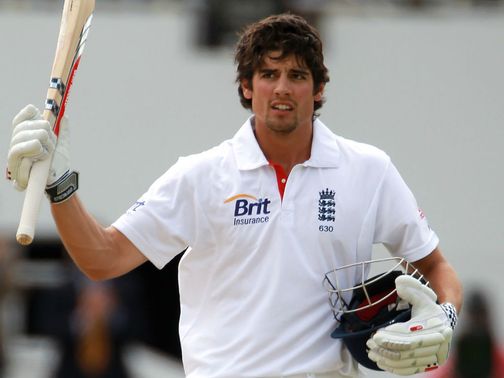
Just in case you have not noticed...England has a genius at cricket


Alastair Cook is most likely the greatest cricketer England has seen for a long time.  If he continues in this way, he may end up being England's greatest cricketer ever.


Text is from Wiki....
He reached the 7,000 run mark on 6 December 2012 in the third test match against India, at Eden Gardens, Calcutta, overtaking Sachin Tendulkar as the youngest player of all time to have made 7,000 runs. He is also the only Englishman to score seven Test centuries before his 23rd birthday.[1] He has scored the most test centuries for England, 23, and is the first captain to score a century in each of his first five Tests in charge.[2]