Traditional Mass celebrated in the Metropolitan Cathedral and Basilica of Our Lady of Paris (Notre-Dame de Paris), May 29, 2013
http://rorate-caeli.blogspot.com/2013/05/hic-domus-dei-est-et-porta-caeli.html
One can click to see over 300 images.
http://rorate-caeli.blogspot.com/2013/06/mass-for-850th-anniversary-of.html
http://www.flickr.com/photos/96802117@N06/sets/72157633851563066/
Saturday, 1 June 2013

Pray to be ready to receive the Body of Christ

O Sacrament Most Holy, O Sacrament Divine, All Praise and All Thanksgiving, Be Every Moment Thine.


Anglican Bishop Compares Those Against SSM to Proponents of Slavery
http://blogs.telegraph.co.uk/news/author/timstanley/. With friends like this Anglican, who needs enemies? Superb blog, by the way...
and thanks to to sources on twitter for the heads up on this one--Xander Lucie-Smith and Giles MacDonogh
and thanks to to sources on twitter for the heads up on this one--Xander Lucie-Smith and Giles MacDonogh
For my Maltese Readers, especially--the Bilderberg is about to meet
http://www.telegraph.co.uk/news/uknews/law-and-order/10091659/The-Bilderberg-Group-Fiendish-plots-are-a-hatching-in-Watford.html
Feel free to comment and contradict this author, if you so desire, here or there.
Feel free to comment and contradict this author, if you so desire, here or there.
Update on Papal Eucharistic Adoration Tomorrow
Papal Adoration at St. George's Cathedral, Southwark tomorrow and in many of that dioceses' parishes...see yesterday for more dioceses which are involved. Scroll down for more information from A and B, Westminster, Shrewsbury, and others, or click on tag Papal Holy Hour.


Ask yourself these questions, Catholics

If you are involved in ministries or activities in the Church, please ask yourself these questions today.
1) Is the group following the Teaching Magisterium of the Church in all things, great and small? If not, get out.
2) Is there an Bishop appointed chaplain in charge of the spirituality of your group? If not, get out.
3) Is the group more concerned about consolations, spiritual candy, rather than service? If so, get out.
4) Is the group successfully leading people back to the parishes and to themselves? If not, get out.
5) If the group has people claiming healing gifts, are they trained in psychology, psychiatry, or medicine? Are they involved in Eastern healing modes? If not for the former, and if so for the latter, get out.
6) Have they all read the CCC and encyclicals concerning their ministries? If not, get out.
7) Are they following seers and so-called visionaries either condemned or warned about from the CDF or the local bishops? If so, get out.
8) Is the group based on protestant theology rather than Catholic? If so, get out.
9) Is the group anti-intellectual? If so, get out. Our religion is based on Faith, Reason and Revelation.
10) Are the leaders taking money for spiritual direction or so-called healing? If so, get out.
11) If the leaders are living openly in sin, either in irregular marriages or in some other obvious area, get out.
Satan does not care how you get to hell, just that you go there.
Weakening the Church from Within

Why? Here are some hints.
Without doubt God sometimes reveals to the living the time that remains to them on this earth, the trials that they will undergo, what will happen to a nation, to a certain person. But the devil can easily counterfeit these things and, to gain credence for his lies, he begins by nourishing the spirit with likely things or even with partial truths.(28) St. John of the Cross says: "It is almost impossible to escape his wiles if the soul does not immediately get rid of them, because the spirit of evil knows well how to assume the appearance of truth and give this appearance credit." (29) "In order to be perfect there is, therefore, no reason to desire these extraordinary supernatural things. . . . The soul must prudently guard itself against all these communications if it wishes, in purity and without illusions, to reach divine union by the night of faith." (30) No words could make a clearer distinction between these extraordinary supernatural things and infused contemplation, and more effectively show that infused contemplation is normal in the perfect.
What Garrioug-Lagrange is stating is that one can get caught up in illusions and leave the path of Faith.
Here are some points which indicate that healing and so-called deliverance ministries weaken the Church and are based on the lies of false illusions.
One: many of the so-called healers are involved in New Age and non-professional activities, such are reiki, the enneagram and other condemned practices. The Church is always rational and never anti-intellectual. Ministries based on emotions involve gross manipulation of people's hurts and emotional chaos. Manipulation come from personal needs and the lack of purification of the passions.
Two: many of these ministries, if not all, undermine the hierarchy and traditions of the Church. Many have no spiritual directors who are solid priests and many work with priests or nuns who have left their orders and not living according to the vows of their communities. Such people should be suspect, as they are in disobedience.
Three: many people are on power-trips not having cooperated with the humbling and purification processes described by the great saints.
Four: many people take money for healing courses, and spiritual direction. This is a huge no-no. St. Paul was a tent maker even while he was preaching the Gospel.
Five: these people are not in the unitive state. Once someone is in that state, it is obvious.
Six: so many of these people and their followers get publicity and encourage it.
Seven: many of these people come from backgrounds and cultures of superstition; if a person is involved in what is called pre-pagan practices, you know he or she is not of God.
2) Revelations improperly so called, which give us a greater understanding of revealed truths, are associated with infused contemplation, especially if they concern God Himself and do not stop at particular things, but profoundly penetrate His wisdom, infinite goodness, or omnipotence. In The Ascent of Mount Carmel St. John of the Cross says on this subject: "This profound loving knowledge is, moreover, accessible only to a soul in union with God. Such knowledge is this union itself, for it has its origin precisely in a certain contact of the soul with the Divinity. Consequently it is God Himself who is felt and tasted, though He is not perceived manifestly in full light, as He is in glory; but the touch is so strong and so profound, by reason of the knowledge and attraction, that it penetrates the substance of the soul. It is impossible for the devil to interfere in this and to deceive by imitation, for nothing is comparable to it, or approaches it in enjoyment and delights. These touches savor of the divine essence and of eternal life, and the devil cannot counterfeit such lofty things. . . . In regard to the other perceptions, we said that the soul should abstract itself from them, but this duty ceases in the case of this lofty loving knowledge, since it is the manifestation of that union to which we are trying to conduct the soul. All that we have taught previously on the subject of despoliation and of complete detachment was directed toward this union; and the divine favors which result from it are the fruit of humility, of the desire to suffer for the love of God, with resignation and disinterestedness as to all reward." (31)
To be continued....
The Irony of the Charismatics, Two
False gifts are the kiss of Judas. A kiss seems like a loving gesture, but may indicate betrayal and selfishness.
The betrayal of Christ was the ultimate act of narcissism and self-deceit. Many people say, "Well, God can give His gifts to whom He chooses." I answer in two-fold fashion: Christ does not trust Himself to those who are not following Him and His Church fully, and I am addressing Catholic; second, He allowed Judas to betray Him, although Judas used his self-will, God willed the Passion and Death.

Here is more clarification on the reality of the gift of the Spirit from Garrigou-Lagrange and my comments are in blue:
The betrayal of Christ was the ultimate act of narcissism and self-deceit. Many people say, "Well, God can give His gifts to whom He chooses." I answer in two-fold fashion: Christ does not trust Himself to those who are not following Him and His Church fully, and I am addressing Catholic; second, He allowed Judas to betray Him, although Judas used his self-will, God willed the Passion and Death.
Here is more clarification on the reality of the gift of the Spirit from Garrigou-Lagrange and my comments are in blue:
APPLICATION OF THIS DOCTRINE BY ST. JOHN OF THE CROSS
To these charisms are generally linked the extraordinary favors which sometimes accompany infused contemplation, that is, private revelations, supernatural words, visions. St. John of the Cross treats these favors at length in The Ascent of Mount Carmel,(6) distinguishing them with great care from infused contemplation, which belongs to the grace of the virtues and gifts, or sanctifying grace, as we saw earlier in this work.
What John of the Cross is explalining is that those gifts which people assume they have when at very low stages of conversion in reality do not occur until the late state of extreme holiness, which follows the several conversions and passive purification of the heart, mind, soul, and will
Thomas Aquinas illuminates these states and gifts as well.
The teaching of St. John of the Cross on this point rests theologically on the tract on prophecy expounded by St. Thomas Aquinas in the
Summa theologica.(7) In question 175 St. Thomas devotes six articles (8) to rapture which sometimes accompanies prophetic revelation, as it may also accompany infused contemplation.
St. Thomas there explains in particular that prophetic revelation may be made in three ways: by a sensible vision, an imaginary vision, or an intellectual vision; and the prophet may be awake, asleep, or in ecstasy.
Infused contemplation is the result of years of meditation and discipline, as well as orthodoxy. The intellect must be involved in all these stages, not merely the emotions, obviously.
The vision is said to be sensible or corporeal when a sensible and exterior sign appears to the eyes or when an exterior voice is heard.(9) The vision is called imaginary when God, in order to express His thought to us, coordinates certain images that pre-exist in our imagination, or imprints new ones on it.(10) There is a supernatural intellectual vision when He acts immediately on the intellect by coordinating our acquired ideas or by imprinting new ideas, called infused.(11) There is always infused prophetic light to judge supernaturally of what is proposed, and indeed this light alone suffices to interpret certain signs, as Joseph interpreted the dreams of Pharaoh.(12)
The proliferation of false seers is a direct result of this confusion regarding the charismatic gifts.
Such saints as Teresa of Avila, John of the Cross, Bernard of Clairvaux, Francis of Assisi, and others are given these amazing gifts as a direct result of years of purification.
One does not merely come to a first conversion and then directly into the gifts. Those gifts must be suspect and frequently lead good people astray, especially those who are seeking consolations.
If the prophet is awake, the vision is more perfect than if given to him during sleep, because he has the full use of his faculties. (13) Occasionally, the so-called imaginary vision and the intellectual vision are accompanied by ecstasy, or alienation of the senses.(14) Ecstasy, especially when it is only partial (the alienation of one sense and not of all), may be a natural effect of the absorption of the higher faculties in the object manifested; the soul can no longer be attentive to exterior things.(15) But when ecstasy, instead of following, so to speak, precedes the vision or infused contemplation and prepares the soul for it, then ecstasy is extraordinary and deserves the name of rapture; it then implies a certain violence which lifts the soul above inferior things in order to fix it in God.(16)
One reason why there is so much confusion is that priests themselves do not understand the process of purification leading to perfection. To find a spiritually mature, such as a Dom Marmion, or Padre Pio, is almost impossible.
Christ and the Blessed Virgin had all these charisms in an eminent degree, but without losing the use of their senses. It is said of St. Gertrude that she never knew the weakness of ecstasy; of our Savior and His holy Mother it must be said that from the very beginning of their lives they were superior to ecstasy and rapture. (17)
To think that one is at these states of holiness is sheer arrogance. By their fruits, one knows the saints.
Following these principles accepted by theologians, St. John of the Cross draws a clear distinction between general and obscure infused contemplation (18) and different modes of particular and distinct supernatural knowledge: (I) visions, sensible, imaginary, or intellectual; (19) (2) revelations; ()20) (3) interior words.(21) After enumerating these modes of knowledge, St. John of the Cross adds: "In regard to obscure and general knowledge, there is no division; it is contemplation received in faith. This contemplation is the end to which we should lead the soul; all other knowledge should be directed toward this, beginning with the first; and the soul should progress by detaching itself from all of them." (22)
The arrogance of so many lay leaders of the charismatic renewal is staggering, especially when so many lack the basic necessary level of orthodoxy, that is, obedience to the teachings of the Church. I have met charismatics who are involved in false teaching (such as universal salvation, the denial of hell, relativism, and other modernists heresies, false seers, IVF, contraception, disobedience regarding sacramental rules, disobedience regarding Sunday Mass observance, etc. who think they have the higher gifts. If one is still committing mortal sin or in a habit of venial sins, one is not at the stage of the giving of the gifts.
Following the example of St. Thomas,(23) we shall proceed from the general to the particular, and we shall first discuss revelations; then we shall see the special modes of their manifestation, that is, either by visions, or by words, a mode which is generally more expressive.
Moreover, we shall consider first among these favors those that are more exterior, that are manifestly directed toward the benefit of our neighbor and are more directly connected with charisms or graces gratis datae. Next, we shall consider those which are more directly ordained to the sanctification of the person who receives them. This is particularly the case with various interior locutions and also with divine touches received in the will, which St. John of the Cross discusses last.(24)
So, if these words of the great saints are true, what are people experiencing?
These good people are deceived by self-will and pride and are receiving bogus, false gifts from the evil one to lead them out of the Church and out of orthodoxy.
Satan does not care how one gets to hell, even on a road which seems good and holy, externally. In effect, many of these charismatics have become protestants.
External gifts only come have the purification of the interior life.
Divine revelations manifest supernaturally a hidden truth by means of a vision, a word, or only a prophetic instinct; they presuppose the gift of prophecy. They are called public if they have been made by the prophets, Christ, or the apostles, and are proposed to all by the Church, which preserves them in Scripture and tradition. They are called private when they are directed only to the particular benefit of certain persons. Private revelations, no matter what their importance, do not belong to the deposit of Catholic faith. However, some may draw attention to a certain form of worship of a nature to interest all the faithful, for example, the devotion to the Sacred Heart. After examining the reasons which motivate this worship, the Church may promote it and establish it without judging infallibly about the divine origin of the private revelation which gave rise to this movement of prayer. These private revelations will remain the object of pious belief, as will the supernatural origin of exceptional favors which occasionally accompany them, such as the stigmata of a particular servant of God.(1)
Note, as I have written here before, the lack of infalliblity concerning even the greatest saints' writings. For example, Hildegard of Bingen's ideas of sex or herbs are not infallible. So too, the Church is very careful about approving things even said by saints....much less so called prophets in private prayer meetings.
To be continued..
The Irony of the Charismatics
There is an irony among most charismatics in England that must and can be addressed by Garrigou-Lagrange. The problem has to do with the great confusion on the charismatic gifts of the Holy Spirit.
First of all, St. Paul puts the lists of gifts in the context of real, living, solid and daily communities. Few of those exist in England. I personally have experience of real communities which involved discipline and oversight from the hierarchy of the Church.
Second, St. Paul admits that love is more important than the charismatic gifts, and these are gifts for the Church, not for small and self-referenced prayer groups.
Third, the gifts come only in the latter stages of the three ages of the interior life, and not before one has become orthodox, purified, and gone through the several layers of conversion, entering into a very late stage of holiness. Holiness first, then the gifts. Here is Garrigou-Lagrange:
It is easy to see that St. Paul and St. John the Evangelist excelled in the word of wisdom; St. Matthew and St. James in the word of knowledge; that certain saints, such as St. Vincent Ferrer, received the gift of miracles in a striking manner; others, such as St. John Bosco, that of prophecy; still others, like the holy Cure of Ars, the discerning of spirits
I cannot emphasize that a person must be orthodox to start with the very first stage of growth.
If one is at all heterodox, one is not even on the path to the charismatic graces.
Here is a list from Garrigou-Lagrange. These are excellent gifts which John of the Cross and others note come in the highest levels of holiness.
How can I convince so many deluded people, who are living in the early levels of the first conversion, still sinning, and not cooperating with the real pain of purification, that so many of their gifts are from the wrong spirit?
If one is not an obedient son or daughter of the Church, take care of self-deceit. To be continued....
| Graces gratis datae to instruct one's neighbor concerning divine things. | 1. Graces that give full knowledge of divine things | -faith or special certitude as to principles. -word of wisdom, on the principal conclusions known through the first cause. -word of knowledge, on the examples and effects which manifest the causes |
| 2. Graces that confirm divine revelation | -by works: gift of healing, gift of miracles. -by knowledge:discerning of spirits, prophecy. | |
| 3. Graces that aid in preaching the word of God | -gift of tongues; -gift of interpretat |
from an interesting website
http://catholicsouthernfront.wordpress.com/chapter-951-the-world-wars-and-our-lady%E2%80%99s-feasts/
Mary Our Mother as the Lady of Carafa

Friday, 31 May 2013

A blogger's vocation
My people perish for want of knowledge! – Hosea 4:6
A blogger may look on his or her efforts as part of the larger vocation of the new evangelization. I prefer to call it teaching. In addition, prayer, in fact, intense, even contemplative prayer, must be part of the call to lead the sheep to the Living Water, Who is Christ. Without the purification of the imagination and intellect, one merely does one's own thing and not God's. Purifying prayer and suffering must be behind each word.

A blogger may look on his or her efforts as part of the larger vocation of the new evangelization. I prefer to call it teaching. In addition, prayer, in fact, intense, even contemplative prayer, must be part of the call to lead the sheep to the Living Water, Who is Christ. Without the purification of the imagination and intellect, one merely does one's own thing and not God's. Purifying prayer and suffering must be behind each word.

In reply to questions from a reader
| ABUSE |
1) What did the Church leaders really want to do through Sacrosanctum Concilium?
To begin with, one merely needs to look at the document for some hints on the intention of, at least, Pope Paul VI. Here is one snippet to look at first: what is obvious is that the Pope wanted more participation of the Faithful in the Mass, but notice the emphasis here on the clergy, who are to be "imbued with the spirit and power of the litugy" and, therefore, be able to teach the people.
What the power and the spirit of the liturgy may be could be open to discussion, but I would hope it would primarily be to all who read this the public worship of God in the Holy Sacrifice of the Mass, in reverence and in Truth.
In the restoration and promotion of the sacred liturgy, this full and active participation by all the people is the aim to be considered before all else; for it is the primary and indispensable source from which the faithful are to derive the true Christian spirit; and therefore pastors of souls must zealously strive to achieve it, by means of the necessary instruction, in all their pastoral work.
Yet it would be futile to entertain any hopes of realizing this unless the pastors themselves, in the first place, become thoroughly imbued with the spirit and power of the liturgy, and undertake to give instruction about it. A prime need, therefore, is that attention be directed, first of all, to the liturgical instruction of the clergy.
Liturgical instruction does not mean that the clergy is free to do what they want. As I have highlighted recently, too many clergy here abuse the Eucharist in Adoration with novelties, such as healing Adoration services, which violate rules of GIRM. Of course, we are all too aware of liturgical abuses in the Mass. One knows that where there is disobedience to the norms and a lack of respect for the Mass and the Eucharist, there is sin, not merely ignorance. Sin, not ignorance...
| ABUSE |
The complete revision, in the document called "restoration" was specifically stated in this document. This is the problem with many who want to defend the great changes, as the question may and should be asked, why was such a revision or "restoration" necessary?
Again, a snippet from the norms:
A) General norms
22. 1. Regulation of the sacred liturgy depends solely on the authority of the Church, that is, on the Apostolic See and, as laws may determine, on the bishop.
2. In virtue of power conceded by the law, the regulation of the liturgy within certain defined limits belongs also to various kinds of competent territorial bodies of bishops legitimately established.
3. Therefore no other person, even if he be a priest, may add, remove, or change anything in the liturgy on his own authority.
23. That sound tradition may be retained, and yet the way remain open to legitimate progress careful investigation is always to be made into each part of the liturgy which is to be revised. This investigation should be theological, historical, and pastoral. Also the general laws governing the structure and meaning of the liturgy must be studied in conjunction with the experience derived from recent liturgical reforms and from the indults conceded to various places. Finally, there must be no innovations unless the good of the Church genuinely and certainly requires them; and care must be taken that any new forms adopted should in some way grow organically from forms already existing.
As far as possible, notable differences between the rites used in adjacent regions must be carefully avoided.
24. Sacred scripture is of the greatest importance in the celebration of the liturgy. For it is from scripture that lessons are read and explained in the homily, and psalms are sung; the prayers, collects, and liturgical songs are scriptural in their inspiration and their force, and it is from the scriptures that actions and signs derive their meaning. Thus to achieve the restoration, progress, and adaptation of the sacred liturgy, it is essential to promote that warm and living love for scripture to which the venerable tradition of both eastern and western rites gives testimony.
25. The liturgical books are to be revised as soon as possible; experts are to be employed on the task, and bishops are to be consulted, from various parts of the world.
B) Norms drawn from the hierarchic and communal nature of the Liturgy
26. Liturgical services are not private functions, but are celebrations of the Church, which is the "sacrament of unity," namely, the holy people united and ordered under their bishops [33]
Therefore liturgical services pertain to the whole body of the Church; they manifest it and have effects upon it; but they concern the individual members of the Church in different ways, according to their differing rank, office, and actual participation.
27. It is to be stressed that whenever rites, according to their specific nature, make provision for communal celebration involving the presence and active participation of the faithful, this way of celebrating them is to be preferred, so far as possible, to a celebration that is individual and quasi-private.
This applies with especial force to the celebration of Mass and the administration of the sacraments, even though every Mass has of itself a public and social nature.
28. In liturgical celebrations each person, minister or layman, who has an office to perform, should do all of, but only, those parts which pertain to his office by the nature of the rite and the principles of liturgy.
29. Servers, lectors commentators, and members of the choir also exercise a genuine liturgical function. They ought, therefore, to discharge their office with the sincere piety and decorum demanded by so exalted a ministry and rightly expected of them by God's people.
Consequently they must all be deeply imbued with the spirit of the liturgy, each in his own measure, and they must be trained to perform their functions in a correct and orderly manner.
30. To promote active participation, the people should be encouraged to take part by means of acclamations, responses, psalmody, antiphons, and songs, as well as by actions, gestures, and bodily attitudes. And at the proper times all should observe a reverent silence.
31. The revision of the liturgical books must carefully attend to the provision of rubrics also for the people's parts.
32. The liturgy makes distinctions between persons according to their liturgical function and sacred Orders, and there are liturgical laws providing for due honors to be given to civil authorities. Apart from these instances, no special honors are to be paid in the liturgy to any private persons or classes of persons, whether in the ceremonies or by external display
......
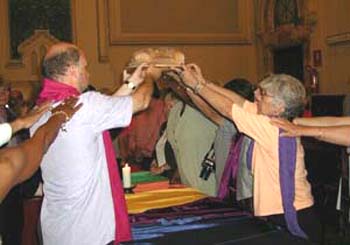 |
| ABUSE |
D) Norms for adapting the Liturgy to the culture and traditions of peoples
37. Even in the liturgy, the Church has no wish to impose a rigid uniformity in matters which do not implicate the faith or the good of the whole community; rather does she respect and foster the genius and talents of the various races and peoples. Anything in these peoples' way of life which is not indissolubly bound up with superstition and error she studies with sympathy and, if possible, preserves intact. Sometimes in fact she admits such things into the liturgy itself, so long as they harmonize with its true and authentic spirit.
38. Provisions shall also be made, when revising the liturgical books, for legitimate variations and adaptations to different groups, regions, and peoples, especially in mission lands, provided that the substantial unity of the Roman rite is preserved; and this should be borne in mind when drawing up the rites and devising rubrics.
There is more, but one can clearly see the huge departures from the TLM, although the Latin Participatory Mass had been in effect for many years before this 1963 document.
So, as to "intent", I think it is clear that the NO must be seen as a departure from the hermenuetic of continuity.
I suggest reading the rest of the norms here. http://www.vatican.va/archive/hist_councils/ii_vatican_council/documents/vat-ii_const_19631204_sacrosanctum-concilium_en.html
Remember, however, that Latin was and is the official language of the Church and the Liturgy of the Church and the TLM was never abrogated.
 |
| ABUSE |
The dogmatic principles which were laid down by the Council of Trent remaining intact [40], communion under both kinds may be granted when the bishops think fit, not only to clerics and religious, but also to the laity, in cases to be determined by the Apostolic See, as, for instance, to the newly ordained in the Mass of their sacred ordination, to the newly professed in the Mass of their religious profession, and to the newly baptized in the Mass which follows their baptism.
.....
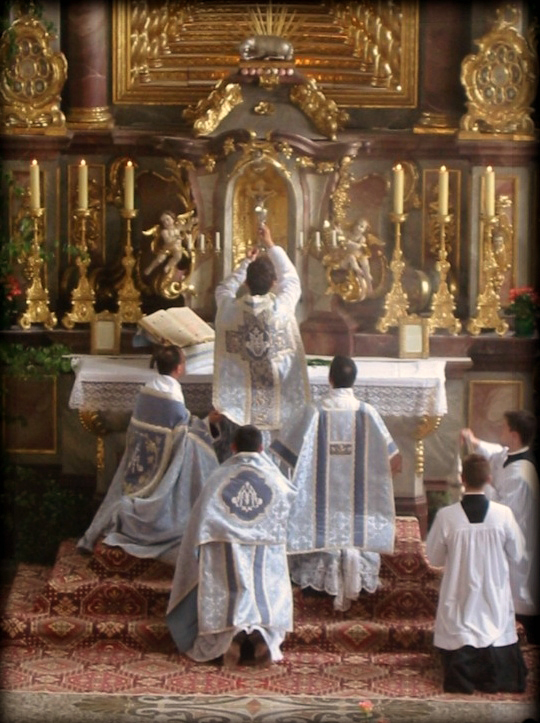 |
| Thanks to WikiCommons--Ancient Beauty |
Note as well, the pride of place given to Gregorian Chant and THIS has been ignored in most parishes and even in many cathedrals.
116. The Church acknowledges Gregorian chant as specially suited to the Roman liturgy: therefore, other things being equal, it should be given pride of place in liturgical services.
But other kinds of sacred music, especially polyphony, are by no means excluded from liturgical celebrations, so long as they accord with the spirit of the liturgical action, as laid down in Art. 30.
117. The typical edition of the books of Gregorian chant is to be completed; and a more critical edition is to be prepared of those books already published since the restoration by St. Pius X.
It is desirable also that an edition be prepared containing simpler melodies, for use in small churches.
118. Religious singing by the people is to be intelligently fostered so that in devotions and sacred exercises, as also during liturgical services, the voices of the faithful may ring out according to the norms and requirements of the rubrics.
2) How could the liturgy as it stood, as the TLM, been "tweaked" to help Catholics who were wanting the Mass in the venancular?
I cannot see that anything needed tweaking. As one who grew up in a TLM time and when more converts were coming into the Church with the TLM in place, I am mystified by the changes, which IMO, were never necessary. The Latin Mass had been changed to allow for the participation of the people in the singing and answering of certain parts-again, what was called the Participatory Mass.
| The TLM is the Mass of the Ages |
3) Why can't bishops see the exodus from the Church and the lack of converts as connected to the NO?
I have come to the conclusion that a lack of discernment in any Catholic is owing to hidden sin and the refusal to allow God to purify one. Discernment is totally lacking in so many "leaders", we are spoiled for choice for examples of minds and hearts caught in a spiritual darkness. I cannot add to that.
American Seminarians Abroad

Pray for these good men from several dioceses, who are traveling in France and Spain, on their way to Rome. Pray for vocations.
Pray for the men at Mundelein.

Subscribe to:
Posts (Atom)