Monday, 2 September 2013
Last Post on The Dark Night-Post 50: The Cardinal Virtues
Well, at least for a long while...I shall take a break from discussing the Dark Night. But, in this last post, let me note what St. John of the Cross tells us, that all the virtues are liberated and come to the fore in the Dark Night, finally coming into a greater power in the Illumination state. But, this Dark Night is the time for the maturation of faith, hope and love especially.
 I want to mention just a few significant aspects of the Dark Night concerning the cardinal virtues.
One, the Dark Night is a grace. One can and must ask for this. Many people do not realize what they are experiencing and become disheartened or depressed, which is not necessary and hinders the process of learning to trust in God. This trust is an act of faith. The cardinal virtue becomes operative at a new level, as one cannot see clearly.
The Dark Night is the time of faith. Living in faith is easier when God strips all away.
As a grace, a time of grace, one who knows what is happening has the advantage of resting in God to finish the task of purgation. David allowed himself to be purged of sin, and Saul did not. One became humble, and one remained proud. One became obedient, and one remained a rebel to the end. One accepted the truth and one did not. One king lived in faith, and the other lost his faith.
Two, one cannot become holy without suffering and in this suffering, hope is born. Suffering rids us of all that stands between us and God. Cooperating with suffering and becoming humble in the face of suffering is contrary to what most modern people think. One may feel alone in this suffering. Therefore, knowing that God is in control is of the utmost importance. Saul thought his suffering was all punishment from God, but he did not repent. He missed the point of redemption. He lost hope. Hope follows faith, and is the virtue which brings us confidence in what is not seen.

Three, the Dark Night brings self-knowledge and love. David loved God, but had to come to terrible self-knowledge before that final union of God could occur. He had to see his innermost evil and no longer lie to himself. Remember, he had a heart that was willing to be changed. Because of his great love for God, which overcame self-love and attachments to others, he finally came into union with Love, Who is God.
Timing is entirely up to God and as one learns both real patience and humility in the Dark Night, one can expect some length of time to be involved. However, I have known young people, in their early twenties or thirties, move through these stages of purgation fairly quickly, accepting suffering and resting in God.
The remembrance that God seeks us out to love us gets one through the hard times. God is always seeking us, but in the Dark Night, He changes the milestone.
St. John of the Cross is more clear on this stage than St. Teresa of Avila, simply because he has the theological and philosophical background to make it less mysterious and more accessible to the mind.
John explains what Teresa describes. Both are good,
St. David in the Psalms explains and describes his journey of purification, understanding this time of darkness moving into light. The fact that David could move from sin, to repentance, to the acceptance of suffering and judgment, to the realization that his sin was against God alone, to knowledge of his entire sinful state, to the understanding of the justice of God, and then to the knowledge of His deep mercy, are stages of intense spiritual growth. David ends up walking in faith and praising God, hoping, trusting Him and living in the Love Who is God.
Notice how that movement involves faith, hope and love, the cardinal virtues used and liberated in the Dark Night of the Soul, a movement seen in this famous psalm of David.
Psalm 50 Miserere. The repentance and confession of David after his sin. The fourth penitential psalm. Douay Rheims
 [6] To thee only have I sinned, and have done evil before thee: that thou mayst be justified in thy words and mayst overcome when thou art judged. [7] For behold I was conceived in iniquities; and in sins did my mother conceive me. [8] For behold thou hast loved truth: the uncertain and hidden things of thy wisdom thou hast made manifest to me. [9] Thou shalt sprinkle me with hyssop, and I shall be cleansed: thou shalt wash me, and I shall be made whiter than snow. [10] To my hearing thou shalt give joy and gladness: and the bones that have been humbled shall rejoice.
 I want to mention just a few significant aspects of the Dark Night concerning the cardinal virtues.
One, the Dark Night is a grace. One can and must ask for this. Many people do not realize what they are experiencing and become disheartened or depressed, which is not necessary and hinders the process of learning to trust in God. This trust is an act of faith. The cardinal virtue becomes operative at a new level, as one cannot see clearly.
The Dark Night is the time of faith. Living in faith is easier when God strips all away.
Two, one cannot become holy without suffering and in this suffering, hope is born. Suffering rids us of all that stands between us and God. Cooperating with suffering and becoming humble in the face of suffering is contrary to what most modern people think. One may feel alone in this suffering. Therefore, knowing that God is in control is of the utmost importance. Saul thought his suffering was all punishment from God, but he did not repent. He missed the point of redemption. He lost hope. Hope follows faith, and is the virtue which brings us confidence in what is not seen.

Three, the Dark Night brings self-knowledge and love. David loved God, but had to come to terrible self-knowledge before that final union of God could occur. He had to see his innermost evil and no longer lie to himself. Remember, he had a heart that was willing to be changed. Because of his great love for God, which overcame self-love and attachments to others, he finally came into union with Love, Who is God.
Timing is entirely up to God and as one learns both real patience and humility in the Dark Night, one can expect some length of time to be involved. However, I have known young people, in their early twenties or thirties, move through these stages of purgation fairly quickly, accepting suffering and resting in God.
The remembrance that God seeks us out to love us gets one through the hard times. God is always seeking us, but in the Dark Night, He changes the milestone.
St. John of the Cross is more clear on this stage than St. Teresa of Avila, simply because he has the theological and philosophical background to make it less mysterious and more accessible to the mind.
John explains what Teresa describes. Both are good,
St. David in the Psalms explains and describes his journey of purification, understanding this time of darkness moving into light. The fact that David could move from sin, to repentance, to the acceptance of suffering and judgment, to the realization that his sin was against God alone, to knowledge of his entire sinful state, to the understanding of the justice of God, and then to the knowledge of His deep mercy, are stages of intense spiritual growth. David ends up walking in faith and praising God, hoping, trusting Him and living in the Love Who is God.
Notice how that movement involves faith, hope and love, the cardinal virtues used and liberated in the Dark Night of the Soul, a movement seen in this famous psalm of David.
Psalm 50 Miserere. The repentance and confession of David after his sin. The fourth penitential psalm. Douay Rheims
[1] Unto the end, a psalm of David, [2] When Nathan the prophet came to him after he had sinned with Bethsabee.
[3] Have mercy on me, O God, according to thy great mercy. And according to the multitude of thy tender mercies blot out my iniquity. [4] Wash me yet more from my iniquity, and cleanse me from my sin. [5] For I know my iniquity, and my sin is always before me.
 [6] To thee only have I sinned, and have done evil before thee: that thou mayst be justified in thy words and mayst overcome when thou art judged. [7] For behold I was conceived in iniquities; and in sins did my mother conceive me. [8] For behold thou hast loved truth: the uncertain and hidden things of thy wisdom thou hast made manifest to me. [9] Thou shalt sprinkle me with hyssop, and I shall be cleansed: thou shalt wash me, and I shall be made whiter than snow. [10] To my hearing thou shalt give joy and gladness: and the bones that have been humbled shall rejoice.
[11] Turn away thy face from my sins, and blot out all my iniquities. [12] Create a clean heart in me, O God: and renew a right spirit within my bowels. [13] Cast me not away from thy face; and take not thy holy spirit from me. [14] Restore unto me the joy of thy salvation, and strengthen me with a perfect spirit. [15] I will teach the unjust thy ways: and the wicked shall be converted to thee.
[16] Deliver me from blood, O God, thou God of my salvation: and my tongue shall extol thy justice. [17] O Lord, thou wilt open my lips: and my mouth shall declare thy praise. [18] For if thou hadst desired sacrifice, I would indeed have given it: with burnt offerings thou wilt not be delighted.[19] A sacrifice to God is an afflicted spirit: a contrite and humbled heart, O God, thou wilt not despise. [20] Deal favourably, O Lord, in thy good will with Sion; that the walls of Jerusalem may be built up.
[21] Then shalt thou accept the sacrifice of justice, oblations and whole burnt offerings: then shall they lay calves upon thy altar.
Now, I have written on all these points at length in the perfection series as well, but I just wanted to remind you of these simple truths with regard to the cardinal virtues.


Just wondering...

Ireland raises and sells some of the best beef in Europe.
Why are the deli beef sandwiches SO bad?
Ireland had some of the best cheese in the world.
Why do the deli sandwiches have such wretched, boring cheese?
Ireland bakes some of the yummiest whole wheat bread ever?
Why are the deli sandwiches made with such lame, tasteless bread?

The vegies in the grocery shops are top drawer.
Why are the vegies on deli sandwiches so horrid?
For reasons that I had to be out and about a few times in the past two months, I have been to delis for sandwiches four times in different places in Dublin.
Never again. Without a doubt, unless someone points me to a good deli, the sandwiches in Dublin delis are by far the worst I have ever tasted anywhere else hands-down.
Yuck! Even when these are made right in front of you...really bad.The bread is either old and stale, or mushy and falls apart; the beef is really bad; the vegies old and brown; the cheese tasteless. If one gets chicken, the sandwich is worse-no taste and very boring.
Is there a Dubliner who can make a good sandwich? If I have to be out and about again, I shall just go to McDonald's, which is pricey, but not any more expensive than a so-called fresh deli sandwich. At least I know what I am getting at Macs, and the beef is excellent.
Maybe the wee folk know....

Wow, Freedom of Speech Gone in America For Sure?
http://rt.com/
http://www.extremnews.com/nachrichten/weltgeschehen/13814883a6a297
America is blocking Russia Today, where I and a million other Americans get really good news, especially on the Middle East conflict and on financial information.
This is iniquitous.
Many of the real stories coming out of Egypt and Syria have not been on American stations, but on France24 and RT.
All citizens should have a choice on news.
Wonder why the block? Guess....
UPDATE-a reader has a note on this. It was not the American government which did the blocking but, blocked by subreddit mods.
http://www.extremnews.com/nachrichten/weltgeschehen/13814883a6a297
America is blocking Russia Today, where I and a million other Americans get really good news, especially on the Middle East conflict and on financial information.
This is iniquitous.
Many of the real stories coming out of Egypt and Syria have not been on American stations, but on France24 and RT.
All citizens should have a choice on news.
Wonder why the block? Guess....
UPDATE-a reader has a note on this. It was not the American government which did the blocking but, blocked by subreddit mods.
The Dark Night Part 49
This is the penultimate post on the Dark Night of the Soul and the Spirit. I want, in this short post, to list the desires which mark the soul in the darkness of being brought closer to God. One moves beyond desire to a passivity in waiting for God, a trust in the darkness.
One could make a little prayer out of this list. These are sixteen desires, like the sixteen small tanzanites on this ring. I use this picture, as if Christ was the amethyst goal of all my desires and my small desires lead to Him.
 Want to be weak in the world, made strong only in and through God.
Want to love God in silence, the silence of meditation and finally, contemplation.
Want to overcome the predominant fault and be brutally honest with one's self.
Want to become love for the sake of Love, not for one's own sake, but for God's alone,
Want all who one meets to experience not the "me" but the love of God.
Want all who one meets to experience a peace, and love even if one does or says nothing.
Want to love Christ in silent love, willing to do anything to meet Him there.
Want to live entirely on and in faith, relying on Christ alone.
Want to die with Christ, in order to live in Christ.
Want to embrace suffering.
Want to walk in the footsteps of Mary on the Way of the Cross.
Want to be in the desert of the Dark Night in order for the seven virtues to shine forth unknown.
Want the one thing that matters, be in and with Christ no matter what the obstacles.
Want to be love.
Want to love more than one receives, but know this is impossible with God.
Want to be a Bride of Christ, the Bridegroom.

One could make a little prayer out of this list. These are sixteen desires, like the sixteen small tanzanites on this ring. I use this picture, as if Christ was the amethyst goal of all my desires and my small desires lead to Him.

Want to love God in silence, the silence of meditation and finally, contemplation.
Want to overcome the predominant fault and be brutally honest with one's self.
Want to become love for the sake of Love, not for one's own sake, but for God's alone,
Want all who one meets to experience not the "me" but the love of God.
Want all who one meets to experience a peace, and love even if one does or says nothing.
Want to love Christ in silent love, willing to do anything to meet Him there.
Want to live entirely on and in faith, relying on Christ alone.
Want to die with Christ, in order to live in Christ.
Want to embrace suffering.
Want to walk in the footsteps of Mary on the Way of the Cross.
Want to be in the desert of the Dark Night in order for the seven virtues to shine forth unknown.
Want the one thing that matters, be in and with Christ no matter what the obstacles.
Want to be love.
Want to love more than one receives, but know this is impossible with God.
Want to be a Bride of Christ, the Bridegroom.
Home Schooling Advice Part 27 Virtues and Concentration
The second state of the normalized child is concentration. Barring a learning disability, and in a house with no television, the normal time for a three year old to concentrate on one thing is 45 minutes.
(2) Concentration
To help such development, it is not enough to provide objects chosen at random, but we [teachers] have to organize a world of 'progressive interest' (The Absorbent Mind, p. 206)
And I add; virtues of peace, patience, diligence, temperance, purity of mind and heart, faith, hope, integrity, obedience, zeal.
What usually breaks a child's ability to concentrate is the parent herself.
One thing about home schooling is that one cannot rush a child in early learning stages.
For example, I was making land forms with my three-year old son and he was learning vocabulary and the reality of peninsula, island, gulf, isthmus, cape, strait, bay, and lake with clay and water. There are myriad sites which tell you how to do this at home. I am delineating virtues and concentration. Now, after making and baking the clay forms, when these are dry, the child pours water into the small containers, (I used aluminium baking tins), and does this in silence first. Vocabulary and cards for labeling follow.
Well, the three-year-old wanted to do this over and over and over and over. Of course, the vocabulary was provided by me.
That is an island ....and so on.
Concentration went over an hour, and then longer. The child was basking in concentration, peace, patience (emptying the water and pouring again and so on). Zeal and integrity as well as confidence grew. Then, when I suggested it was time to do something else, the child was so happy, that he agreed. Of course, he helped clean up and obedience in that and putting away the items followed.
But, one must give time to the natural love of learning and the natural concentration. Schools ruin these and once lost, these are almost impossible to regain.
When the Dorset Council education lady came for the first visit, as required, the child showed her the 1,000 chain which takes a long time to set up with the cards. At three and a half, he did it all by himself. She was delighted at both peace, concentration, zeal, order, confidence, and obedience.
The child showed her a portfolio of other things he had learned, such as parts of a bird, shapes, colors, numbers, and so on. I did not have to say a thing. He took her by the hand and showed her other things in the school room which he could do-I just watched.
Concentration, if not interrupted, lasts a life-time as do the virtues learned. And, when the child knows peace, he can share with others, and be charitable.
Obviously, older children helping with the younger ones teaches virtue as well. The great virtue of charity and the lesser one of generosity come when the older ones help the younger ones. Patience and hope are also encouraged by sharing and helping. The older ones cannot always see how their patience helps, but such activities build hope.
Obviously, older children helping with the younger ones teaches virtue as well. The great virtue of charity and the lesser one of generosity come when the older ones help the younger ones. Patience and hope are also encouraged by sharing and helping. The older ones cannot always see how their patience helps, but such activities build hope.
Now, situations like illness interrupt the natural process, but not the supernatural process. The same virtues learned in doing studies pass over into other situations.
My son contracted a serious illness at the age of nine. His life changed from one of a normal child to a child in pain and in a wheelchair off and on for four years. For eleven years, he had health issues from that original illness. Thankfully, he was finally free of all of those. But, the virtues the formation of patience and courage, learned in simple things, like early sensorial and practical life training, geography and math studies, helped him through harder times.
As a teacher, it was so hard for me to see students who no longer wanted to learn. Their natural gift of wanting to learn and find God had been destroyed by the school systems.
One of the things I did was become a consultant for classical education and the Socratic method, helping schools either from scratch or change from newer forms of methodology back to classical and Socratic methods. Parents were shocked when they saw their children regain a love of learning after one half-semester.
All I did was see the drive which was latent and encourage that God-given gift.
I have wonderful stories of even junior-high boys wanting to learn religion, Latin, and literature because the desire for learning was re-kindled in them. The same thing was done with high school students, young men and young women. All I did was fan the little sparks which became flames.
God gives grace, but we have to cooperate with that grace.
To be continued....
To be continued....
Home Schooling Advice-The Virtues Part 26 Coping with Frustration
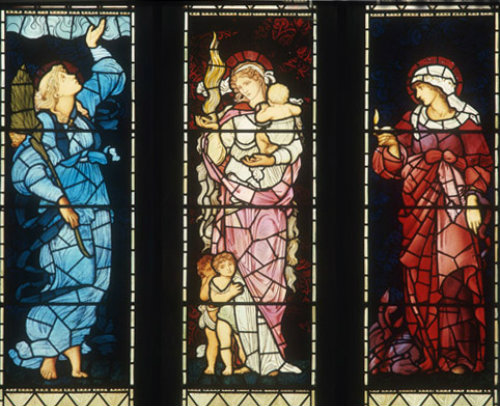
Looking at all the possible ways of encouraging the virtues, one sees the need to create a pattern of hands-on activities and studies leading to the formation of the Catholic child.
Teaching virtues through the use of the senses and practical life skills may see obvious to most parents. When the child is learning to pour milk, he is learning patience and temperance.
When the child is learning to put his work back on the shelf, he is learning obedience, perseverance, patience, temperance. And so on....
The small chart in a previous post early yesterday shows the sensitive periods of the child's growth. In each of those, virtues can be encouraged. Remember two things: the child has the gift of the virtues from baptism, and he wants to learn these through grace and his natural hunger for God.
Learning small and large motor/muscle movements also develops patience, and in a family of more than one child, justice and mercy are soon learned as part of sharing. Indeed, charity is one of the first virtues obviously learned through sharing and selflessness.
Even pushing a chair back in under the table, and bringing dishes to the sink form the child in virtue.
I want to emphasize, however, in the next few posts the learning of virtues through the subjects the child learns before eight.
All things that the child does is for the creation of the man he will become. The parent guides that process
Let me start with language skills, such as speech, reading and writing, which I shall put under the title of Grammar.
The time for a child's sensitive period in language skills is early, between one-and-a-half and three. This process is enhanced by the parent using all the material at hand, which I said could be found on the Montessori sites. But, what I want to emphasize is the beginning of virtue formation.
How does this happen? Going back to the four abilities of the normalized child, one sees that the first is the love of learning. This is God-given and encouraged by the parents.
In language formation, the child begins by imitating the parent and other children in the house, if there are some siblings.
What the parents are doing is cooperating with nature in the development of these language skills which quickly move from speech to reading and writing. By five or six, this initial process is mostly finished with the proper tools, but I am repeating a bit here for emphasis.
1) Love of work
The first characteristic of the process of normalization is love of work. Love of work includes the ability to choose work freely and to find serenity and joy in work (The Absorbent Mind, p. 202).
And I add; virtues of love, honesty, wisdom, peace, diligence, patience, zeal, perseverance. prudence, justice, temperance, fortitude, faith, hope, rectitude, obedience, reverence, humility.
And I add; virtues of love, honesty, wisdom, peace, diligence, patience, zeal, perseverance. prudence, justice, temperance, fortitude, faith, hope, rectitude, obedience, reverence, humility.
The problems occur when the parents do not cooperate with the sensitive periods or when there are outside influences which interrupt the love of work. The virtues help stem deviations.
All children want to learn, but this is ruined early in some cases by deviations. Here is a list from this website. http://montessoritraining.blogspot.ie/2008/04/deviations-in-normalization-process.html#.UiOfGTasim4
There are several deviations that are not fostered by adults and are often seen as "normal" stages of development. Dr. Montessori referred to these as deviations as fugues and barriers (The Secret of Childhood) and deviations that are demonstrated by the strong and the weak (The Absorbent Mind).
- Fugues – A fugue is when a child "runs away" from a task. While they are never still, they lack purpose. They begin a work, leave it unfinished, and rush to another.
- Barriers – A barrier is a deviation which is strong enough to keep a child from engaging in his surroundings. It may be disguised as disobedience or obstinacy. It manifests itself as dependence, possessiveness, power struggles, feelings of inferiority, fear, lying, and psychosomatic illness.
- Strong – Being strong means being able to overcome obstacles. When children are not strong, they are prone to aggression, violence, rage, insubordination. They can be destructive and unable to concentrate. They are termed naughty, disobedient. Dr. Montessori observed that "They have difficulty in coordinating their hands. They are generally noisy, unkind, and often greedy at the table."
- Weak – Children who are demonstrating a deviation in the weak give in to unfavorable conditions. They cry easily, are passive, manipulative, and easily bored. Rather than do something for themselves, they exert effort in trying to get others to do it for them. They are afraid of the world around them and cling to adults.
Now, I do not need to emphasize the negative, as deviations can be controlled in most cases by virtue formation. What the parent-teacher does is gently help by emphasizing not the negative, but the opposing virtue.
For example, if a child is not still, which is abnormal and not normal, the parent needs to determine if the child has enough time for large motor movement, such as walking, dancing, playing outside and so on. Most Americans are good about such things as sport, but may not realize that simple tasks or chores can give the very young child the same needed motor movement.
The parent guides the child to the opposite of the problem through a gentle arrangement of the situation. Many parents know how to do this automatically, but if a virtue is in mind, it becomes easier.
The child's body, mind, and soul cry out for order and discipline, but never in anger from the parent, and always with patience.
For example, a two year old throws her work across the room in frustration. Ask yourself why, do not merely discipline. There is a reason for every action. Does she need more physical exercise? Is she tired? Does she not understand the work?
In homeschooling I learned a simple rule very fast, and here it is.
The biggest reason for deviant behavior is boredom.
And, here is the corrollary which must be learned by the parent.
Boredom is caused by two things-and this is very important, parents.
Boredom is caused because the child wants to learn but the material is too hard.
OR
Boredom is caused because the child wants to learn but the material is too easy.
I learned this in Montessori teacher training and applied it to home schooling.
Pay attention to the child's real needs.
Help the child develop patience and perseverance, moving into that love of learning, which is the first characteristic of the normalized child.
So, if the language materials are too easy, the child may be frustrated. She might not be able to say, "I know all this, Mom!"
Or, if too hard, the frustration is real as well. Go back and try other methods of showing that same skill.
And, in yourself and in the child, emphasize, even verbalize, the corresponding virtues. One can say, "Let us be peaceful and look at this....".
And pray, God inspires parents daily.
I shall look at the other three characteristics of the normalized child in the next several posts.
To be continued...
Home Schooling Advice Part 25 The Lost Tools of Learning
When I was teaching teachers and parents, either for classical education school start-ups, or for home schooling talks, I used Dorothy Sayer's The Lost Tools of Learning-a must for all home schooling parents.
http://www.gbt.org/text/sayers.html
Also, of late, I have been running into more and more young Millennials in religious or lay orders, or seminaries, who have been home schooled.
That is no accident.
http://www.gbt.org/text/sayers.html
Also, of late, I have been running into more and more young Millennials in religious or lay orders, or seminaries, who have been home schooled.
That is no accident.
The Dark Night Part 48
Drawing to a close on this series, I want to highlight a few points from St. John of the Cross.
Some of this is repetition.
 One, St. David, King, went through these states and into Union with God. His psalms reference the journey, as St. John so clearly notes. If we meditate on the Psalms, one of the points of using the Breviary, we join in that process.
Two, St. John refers to Aristotle, calling him The Philosopher, as does Aquinas. In one reference, John notes that Aristotle writes in Metaphysics that the clearer and brighter are Divine things, such as infused contemplation, the darker these things seem to the soul which has not been completely purified.
St. John also refers to St. Dionysius writing of this same light and dark observation.
One commentator notes that the root of infused contemplation is darkness but that it brings light. This is not necessarily a fast process. (Kavanaugh)
Only in Union is all light.
Three, the Dark Night of the Spirit brings the experience of love into the soul, mind, will and body which has undergone purgation. If these faculties are purified, one experiences the power of the Holy Spirit, yet unknowingly, until the Illumination State, when the Catholic becomes a powerhouse of holiness, which spills out in obviously inspired work. Such was the enduring work of SS. Benedict, Dominic, Francis, and other founders of orders and great movements, notes Garrigou-Lagrange.
Four, Grace leads one into forgetfulness of self. But only one attachment, states St. John, only one, ruins the whole process and puts the liberty of the fruits of the Spirit on hold. One attachment interferes with the experience of the true love of God.

Five, St. John of the Cross and St. Bernard state the same thing, that the Bride must go out and seek the Bridegroom. She realizes finally that she was lost and not the Groom. The poem of St. John's on the Dark Night echoes the Song of Songs, and St. Bernard's sermons that the purged and humbled Bride must seek the Groom, correspond. This is our position in the Dark Night-seeking God Who is hidden until we can bear to see Him. Here is the passage from the Bible. Song of Songs, 3: 1-3; DR
In my bed by night I sought him whom my soul loveth: I sought him, and found him not.
To be continued.....
Some of this is repetition.
 One, St. David, King, went through these states and into Union with God. His psalms reference the journey, as St. John so clearly notes. If we meditate on the Psalms, one of the points of using the Breviary, we join in that process.
Two, St. John refers to Aristotle, calling him The Philosopher, as does Aquinas. In one reference, John notes that Aristotle writes in Metaphysics that the clearer and brighter are Divine things, such as infused contemplation, the darker these things seem to the soul which has not been completely purified.
St. John also refers to St. Dionysius writing of this same light and dark observation.
One commentator notes that the root of infused contemplation is darkness but that it brings light. This is not necessarily a fast process. (Kavanaugh)
Only in Union is all light.
Three, the Dark Night of the Spirit brings the experience of love into the soul, mind, will and body which has undergone purgation. If these faculties are purified, one experiences the power of the Holy Spirit, yet unknowingly, until the Illumination State, when the Catholic becomes a powerhouse of holiness, which spills out in obviously inspired work. Such was the enduring work of SS. Benedict, Dominic, Francis, and other founders of orders and great movements, notes Garrigou-Lagrange.
Four, Grace leads one into forgetfulness of self. But only one attachment, states St. John, only one, ruins the whole process and puts the liberty of the fruits of the Spirit on hold. One attachment interferes with the experience of the true love of God.

Five, St. John of the Cross and St. Bernard state the same thing, that the Bride must go out and seek the Bridegroom. She realizes finally that she was lost and not the Groom. The poem of St. John's on the Dark Night echoes the Song of Songs, and St. Bernard's sermons that the purged and humbled Bride must seek the Groom, correspond. This is our position in the Dark Night-seeking God Who is hidden until we can bear to see Him. Here is the passage from the Bible. Song of Songs, 3: 1-3; DR
In my bed by night I sought him whom my soul loveth: I sought him, and found him not.
I will rise, and will go about the city: in the streets and the broad ways I will seek him whom my soul loveth: I sought him, and I found him not.
The watchmen who keep the city, found me: Have you seen him, whom my soul loveth?
To be continued.....
Sunday, 1 September 2013
More Padre Pio Quotations
.jpg)
Never let a day go by without meditating on the Passion of Christ.
Just staying humbly in His presence is an excellent sign of perfection. St.Padre Pio
Padre Pio Quotations
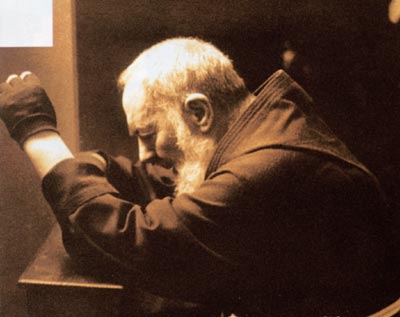
Prayer must be persistent. Persistence denotes faith.
All that you ask in prayer with faith, you will receive. Padre Pio
Jumping into the fire
Answer me this question? Who IS the Pope, not merely in rank but in BEING?
His Holiness Bishop of Rome, Vicar of Jesus Christ, Successor of the Prince of the Apostles, Supreme Pontiff of the Universal Church, Primate of Italy, Archbishop and Metropolitan of the Roman Province, Sovereign of the Vatican City State, Servant of the servants of God
should not bow to anyone, even though many popes, if not all, since John XXIII have. This present pope is just continuing the dialogue with the world. He may not understand who he IS, not only what he represents.
No one else in the world has these titles. No one else in the world is the Vicar of Christ. No one else in the world can make infallible statements in the Name of Peter, from the Chair of Peter.
The Pope's position has been purposefully undermined for fifty years.
Why?
Think about it.
Read, Think, Act
http://canadafreepress.com/index.php/article/57600#.UiNjRjJubBo.twitter
Thanks to James T. for link...
Thanks to James T. for link...
Some of us just can't

Anything which is an institution breeds mostly people who think in terms of institutional thinking.
The main reason that institution think exists is for one reason alone: for the continuation of the institution.
I repeat that: The main reason that institution think exists is for one reason alone: for the continuation of the institution.
I got a plummy job one time a long time ago in an academic institution, Early on, one of the faculty members took me aside and said this to me, "You will be fine as long as you remember one thing. The life of the institution is the most important thing in the minds of all here. If anything or anyone disturbs or threatens the life of the institution, that person is expendable."
I lasted 18 months and it was a seminary where homosexuals were still being accepted. It was an institution which hated and still hates the TLM. It is not in Europe.
I have been cautioned as well as been encouraged to think in terms of institution think, but have never been able to do it.

A person with a fierce sense of what it is to be an individual, to have a core of being which is independent of manipulation, that person cannot and does not fall into institution think.
I know many who have. They have lost their souls to their institutions. Some have lost their souls to the devil because of institution think.
These institutions are prone to institution think: large high schools, colleges, universities, chancery offices, seminaries, governmental offices at all levels, the military, organized crime, gangs, political parties.
Some huge families adopt institution think-the only important thing is the continuation of the line and property.

Good luck. This thinking is not the same as loyalty based on mutual respect and honesty.
I remind Catholics that the prophets of old where not part of the institution, not part of the Sanhedrin or court. Even then, they were killed by those who thought in institution think. Being outside the institution does not protect one, especially in a world which is being taken over by global institution think.
Immediate Prayers Needed
A lovely TLM family just saw the arrival of the fourth child, a little girl, joining her three brothers.
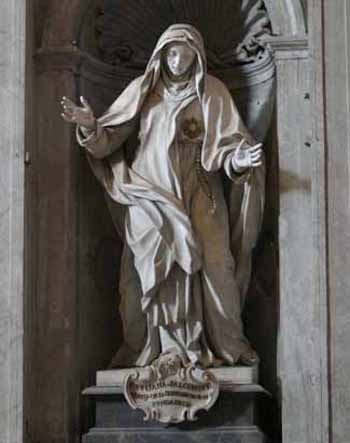
But, prayers are needed. Both the baby and mother were seriously ill. The baby is doing well, but the mother is still very ill.
Please pray for this young couple and their lovely family and especially for the mother.
Let us pray to St. Juliana Falconieri for this woman.

Prayer
O faithful Spouse of Jesus Christ and most humble Servant of the Sorrowful Virgin, glorious S. Juliana, when nearing the term of a life all spent in the practice of the most heroic virtues, you felt but the one grief of being prevented by sickness from receiving in viaticum your Beloved; but this grief proved to be so pleasing to your heavenly Spouse Jesus that He deigned Himself to reward it by an extraordinary prodigy, when, behold, at your supplications, the Divine Sacrament having been placed on your virginal breast, it instantly penetrated the same, leaving the image of the Crucified visibly impressed thereon, whilst your soul, with a sweet smile, expired in His sacred embrace. O great Saint, and my special Patroness, obtain for us from God, we pray, the grace to live a holy life like to yours, that we may die a like holy death; and in particular that, prepared for this last voyage, provided with the Holy Sacrament, and strengthened with God's grace, I may deserve a holy demise and escape eternal death.
Dark Night Part 47-Temptations
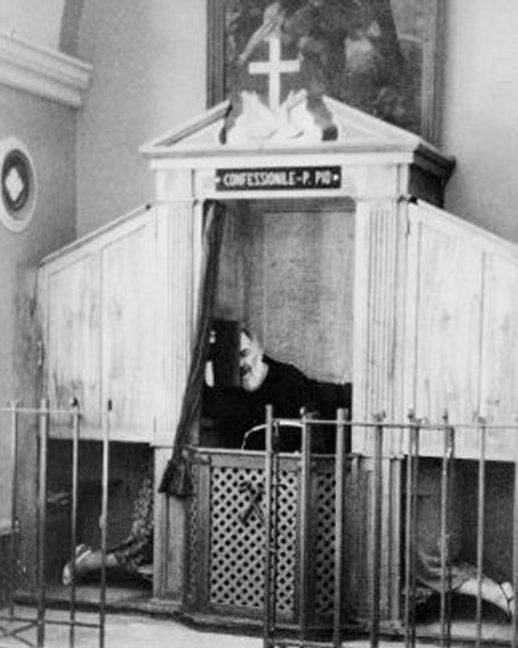
When we have less and less priests, it will be harder to pursue holiness, so do it now, please.
Why so often? As purgation is occurring one sees the layers of imperfections and habits of sin more clearly, and if one can get to confession, the grace of the sacrament encourages the process. I cannot emphasize weekly confession enough.
Even as a child, monthly or bi-weekly was considered satisfactory, but in the Dark Night, confession is needed to keep the reality of one's sin and salvation at hand.
It is too easy to become discouraged when faced with one's pathetic state of imperfection, but real humility means confessing those things which the Holy Spirit is revealing day after day.
St. John of the Cross compares this light in the darkness to light streaming through a dusty window. When it is grey outside, one does not notice the little motes or specks of dust. But, when the light is shining brightly, one sees all the little bits. One cannot fall into impatience with one's self, as that is spiritual pride, a deeper sin, and more serious, but common in the Dark Night.
Padre Pio said something which is applicable to the Dark Night.
He said this: "Temptation is like the soap. It seems to soil but in reality cleans." When one first hears this, it does not make sense. But the great temptations of the Dark Night, spiritual pride and sexual sins, reveal the deep of imperfection in the soul, mind, heart, senses. The temptations are blessings, the soap, which cleans the heart, mind, soul, as one sees more clearly one's weaknesses and lack of humility. Humility is self-knowledge and the knowledge that one can fall at any time into sin is a great blessing-the soap cleaning out pride.
When the appetites are cleaned, then God will reveal Himself to the pure soul, pure mind, pure heart.
Blessed are the poor in spirit: for theirs is the kingdom of heaven. Matthew 5:3 DR
 This passage makes so much more sense in the Dark Night than before this experience. One begins to see that the kingdom of heaven is made up of the Presence of God and the freeing of all the virtues, gifts and fruits which God has given. Can you imagine the power unleashed in the world through the people of the Catholic Church is all reached this state of perfection-the Illuminative?
The truth is that few people cooperate with suffering to get to that state.
The Kingdom of God would be seen on earth, here and now. To be continued...
Dark Night Part 46-The Freeing of the Fruits
St. John writes about habitual ignorances and imperfections. These must go, as only the perfect see God. Natural and spiritual imperfections stop the entrance of God in us. He waits at the door, as it were, until we are purified, for that union of love.
However, one good thing which happens is that one's desire to serve God only in all things becomes stronger and stronger in this Dark Night. One yearns for Him more.
This yearning leads one to more frequent confession and more frequent Communion. Daily Mass, if possible, helps greatly at this time, NOT because one is feeling consolations, but because one wants to be with and in God.
My prayer in 2011 was that God would take my little shriveled heart and give me His Heart. My prayers in 2013 have been God take me completely into Yourself and make me into love, and my second prayer has been God, show me my sins and imperfections, all things that keep me from you so the first two things can happen. One's prayers actually become simpler, more basic in the Dark Night because one only has one desire, eventually, when all other desires are destroyed. That is to see and be loved by the Bridegroom.
Now, here is an important point of St. John's which I know to be true.
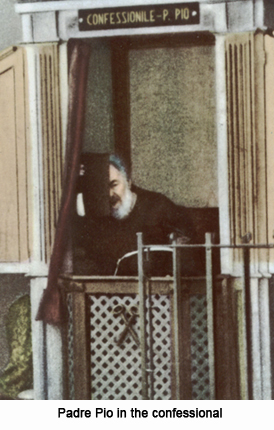
 |
| Padre Pio in the Confessional |
One does not experience the freedom, the liberty of seeing in one's life the twelve fruits of the Holy Spirit until one has been purged of all sensory appetites and sensory affections.
Here is a list of those fruits to remind us all what these are: love, joy, peace, modesty, patience, kindness, goodness, generosity, gentleness, faithfulness. self-control and chastity.
St. John means that, again, like a clogged pipe, our hearts, minds, souls do not have the ability to release these fruits. We may have thought we were experiencing these, but if we did before purgation, these were tainted by self-aggrandizement and pride.
The real liberty comes with purity. Then, these fruits are grounded in God's love, in our love for Him and His love for us, instead of self-love.
Real humility in the Dark Night comes when one realizes that one has never really been good, or peaceful, or patient, or kind or gentle or so on.
These fruits come with one's cooperating with purification.
Now, the gifts of the Holy Spirit, received in confirmation, help one get to and through the purgation-remember that these are wisdom, understanding, prudence, courage, knowledge, reverence and fear of the Lord, In the Dark Night, these gifts are enhanced in the infused contemplation.
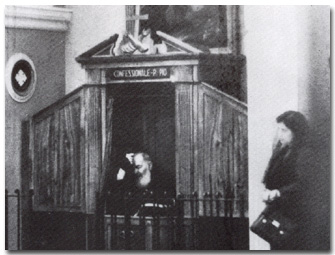 |
| Padre Pio in the Confessional |
One can and must still practice the moral and cardinal virtues at this time, but these, also, are not perfectly experienced in the soul until the Illumination State, when all these virtues, gifts and fruits come into being in real power.
Let us all pray for this journey.
Dark Night Part 45

I have decided to stop the Dark Night discussion at Part 50, as I do not want to talk about something beyond my experience. In this spiritual journey, it is absolutely essential not to confuse the study with the experience. I can described the Illuminative and Unitive States, and have done so in the past. But, after the Dark Night series, I shall take yet another break from the process to holiness. Remember, only the perfect see God and we can ask for our Purgatory on earth, which is what this is all about.
St. John helps us all understand the process. One must go through this if one is an adult who has habits of sin, although, of course, God can do it all in a day, an hour a minute, or in fifty years.
I want to go over a few random points in this post.
First of all, St. Teresa states one can still venially sin at this state, but some theologians say nay. I think that imperfections can occur, but that venial sins become more and more rare, as habits of sin are broken.
Temptations come until one breaths one's last breath, and the purpose of the Dark Night is to purge one of sins and and the imperfections. Most commonly, one has to get rid of the thinking sins; those sins which one does not act upon, but which well up from the shrunken hearts to remind us of our impurity. The two greatest temptations in the dark night might surprise one and I have mentioned these before. St. John states these temptations and he is right. These are the temptations to spiritual pride and sexual sins. Amazing-the reality of one's humanity stares one in the face in the Dark Night. All sensual sins have root in the spirit, a point St. John makes clearly. But, there are more subtle sins which the Dark Night reveals.
For example, one many never act on being critical, but find that one has a habit of critical thoughts towards others. This is a sin and shows a habitual imperfection. The same could be of envy, where one would never give in to random thoughts of wishing one had someone's job, status or money, or even love, but one has to let God's light into those dark areas to purge one of even thinking those thoughts. Automatic responses are killed in the Dark Night. One must confess everything which comes up, and this means finding a holy priest who understands the way of perfection.
Second point today, the Dark Night is an odd time of both hard work and complete passivity.
This ebb and flow of cooperating with grace and being passive is totally in God's Hands and in His timing.
St. John writes that in the Dark Night, God "leaves the intellect in darkness; the will in aridity; the memory in emptiness; and the affections in supreme affliction, bitterness, and anguish, by depriving the soul of the feeling and satisfaction it previously obtained form spiritual blessings."
This is suffering. How does this look? One is not loved, or rarely; one does not understand what is happening, nor can one use memory for solace or example; one has no comfort from men or God and is frequently misunderstood; one does not even experience the comforts or solace, for example, at Adoration, one did in the past.
For me, the one word which describes this time is nada, nothing. One no longer expects specific things or people or events, but rests in the knowledge that God is in control. This mode of being demands faith.
Third and last point today--a real sigh of this state is the quiet joy in suffering and a grateful spirit, springing up from new humility. One waits for God to love, and if one does not feel or see this, so what? God is the hidden God, loving anyway.
The Dark Night is the great time for faith, living without seeing; hope, in the promise of a deeper love; and love, which is totally in the will.
To be continued....
Subscribe to:
Posts (Atom)