Tuesday, 21 January 2014


Notes on John Holden today
- .@LJCambria yes, his entire perspective is wrought in the destruction of humanity. Will the media say anything? No!
 James Toups

On Entering into The Presence of God
Garrigou-Lagrange continues explaining the result of the purification of the soul, in the Dark Night leading to the Illuminative State. This state leads to an almost constant awareness of the Presence of God. This Illuminative State is an active state of doing and being, which will lead to the Unitive State.

After the passive purification of the spirit, which is like a third conversion and transformation, the perfect know God in a quasiexperimental manner that is not transitory, but almost continual. Not only during Mass, the Divine Office, or prayer, but in the midst of external occupations, they remain in the presence of God and preserve actual union with Him.
Here, following, is a real sign of the Illuminative State-the absence of talking and thinking about the self.
Formerly, the ego held one back in a constant state of focusing on the self. Now, in this liberation of purity of heart, one thinks of God and talks of God. The entire focus of one's life is now the Trinity.
After the passive purification of the spirit, which is like a third conversion and transformation, the perfect know God in a quasiexperimental manner that is not transitory, but almost continual. Not only during Mass, the Divine Office, or prayer, but in the midst of external occupations, they remain in the presence of God and preserve actual union with Him.
Here, following, is a real sign of the Illuminative State-the absence of talking and thinking about the self.
Formerly, the ego held one back in a constant state of focusing on the self. Now, in this liberation of purity of heart, one thinks of God and talks of God. The entire focus of one's life is now the Trinity.
One has moved beyond the senses. One is illumined.
The reason for this state is that the perfect man, unlike the beginner, no longer contemplates God only in the mirror of sensible things or of the Gospel parables, about which it is impossible to think continually. Neither does he, like the proficient, contemplate God only in the mirror of the mysteries of the life of Christ, a prayer that cannot last all day long; but, in the penumbra of faith, he contemplates the divine goodness itself, a little as we see the diffused light that always surrounds us and illumines everything from above.
This light is the light of the Bride's joy in discovering, or rather, in letting the Bridegroom discover her. The light of grace and the Presence of God changes the view of life and death. All things are seen in a different light, literally, both physically and spiritually. The "yes" of the Dark Night's journey changes into the "yes" of accepting the light, the Light, Who is Christ.
All events are seen in this light as from the Hand of God, including suffering. God's Will becomes obvious and God's Presence is a daily sustenance, underneath sorrow and pain, or grace and glory.
This light is the light of the Bride's joy in discovering, or rather, in letting the Bridegroom discover her. The light of grace and the Presence of God changes the view of life and death. All things are seen in a different light, literally, both physically and spiritually. The "yes" of the Dark Night's journey changes into the "yes" of accepting the light, the Light, Who is Christ.
All events are seen in this light as from the Hand of God, including suffering. God's Will becomes obvious and God's Presence is a daily sustenance, underneath sorrow and pain, or grace and glory.


According to the terms used by Dionysius the Mystic and preserved by St. Thomas,(1) this is the movement of circular contemplation, superior to the straight and the oblique movements. The straight movement, like the flight of the lark, rises from a sensible fact recalled in a parable to a divine perfection, from the sight of the prodigal son to infinite mercy.
The oblique movement rises, for example, from the mysteries of the childhood of Christ to those of His passion, of His glory, and finally to the infinite love of God for us. The circular movement is similar to the flight of the eagle, which, after soaring aloft, delights in describing the same circle several times, then hovers seemingly motionless in the light of the sun, scrutinizing the depths of the horizon.
Here it is a question of a knowledge of the radiating goodness of God. The soul sees now in a quasi-experimental manner that everything God has done in the order of nature and that of grace is intended to manifest His goodness, and that if He permits evil, like a dissonance, it is for a higher good, which is glimpsed at times and which will appear on the last day.
The Purification of Love Again
Here is Garrigou-Lagrange on the purification of love continued. My comments are in blue



Then the most pure motive of this love of charity appears in all its elevation: namely, that God is sovereignly lovable in Himself, infinitely more so than all the gifts which He has given us and which we expect from Him. Here the acts of faith, hope, and charity fuse, so to speak, in an act of perfect abandonment to the divine will, while the soul repeats the words of Christ on the cross: "Father, into Thy hands I commend My spirit." (32)
This abandonment is what we have seen in Jean Pierre de Caussade and his Abandonment to Divine Providence. We also see this in the little book, The Practice of the Presence of God. The important action here for the soul is the complete reliance on Divine Providence, and not the self. The ego has been surpassed.
Then the soul understands what St. John of the Cross says: "For this is a certain fire of love in the spirit whereby the soul, amidst these dark trials, feels itself wounded to the quick by this strong love divine. . . . And inasmuch as this love is infused in a special way, the soul corresponds only passively with it, and thus a strong passion of love is begotten within it. . . . The soul is itself touched, wounded, and set on fire with love. . . . The soul, however, amidst these gloomy and loving pains, is conscious of a certain companionship and inward strength which attends upon it and invigorates it." (33)
This movement of love does not have to be passionately felt. This can be "felt" or "sensed" as a quiet trust in sorrow, a soft peace in trials, a strength in difficulties.
St. Teresa speaks in like manner of this last purification which precedes the transforming union: "She sees herself still far away from God, yet with her increased knowledge of His attributes, her longing and her love for Him grow ever stronger as she learns more fully how this great God and Sovereign deserves to be loved. . . . She is like one suspended in mid-air, who can neither touch the earth nor mount to heaven; she is unable to reach the water while parched with thirst, and this is not a thirst that can be borne, but one which nothing will quench." (34)
For the one who is being purified, nothing is satisfactory but an perfect act of faith. As love is purified, it grows stronger, with no outward consolations or even understandings.
At the end of this trial, charity toward God and one's neighbor is purified of all alloy, as gold in the crucible is freed from its dross. And not only is the love of charity thus purified, but notably increased. The soul now makes intense and heroic acts of charity, which obtain immediately the increase of grace which they merit, and with sanctifying grace increase greatly at the same time all the infused virtues and the seven gifts of the Holy Ghost, which are connected with charity.
This last section of this last paragraph is so important, I cannot emphasize this enough. Love does increase, and one is able to love those who hate one, who are those who set themselves up as enemies.
As one acts on this love over and over, it becomes a habit of grace. And, therefore, grace and merit increase. Sanctifying grace abounds. And, here is when the virtues, received in baptism and formed through the other sacraments and through trials, burst out like fireworks, allowing one to, finally, after all this time, work for, and in the Lord. The ego is dead, all love is focused on Christ, and the virtues are free to flourish, in a person who is, at least, able to do God's work in building the Kingdom and not one's own.
Only after purgation, does one enter into the Illuminative State of great works. Such saints as St Benedict, Dominic, Francis, and other founders of orders, reveal the lasting goodness, the lasting effect of the purification of love.
St. Bernard of Clairvaux notes that at this stage, "reason is no longer preoccupied with itself and the will is no longer concerned with other men; for this blessed soul is lost in one delight: 'The King has led me into His chamber.'"
The soul has become a worthy bride of the Bridegroom in this purified love. The Illuminative State is the age of the interior life of excellent works, of the building of the Church, of the lives of the saints.
To be continued...
The Purification of Love

We love freely, and we love God, and others, for the sake of God and not for the sake of others or ourselves. We cannot love until we enter into a life of humility. Humility forms the basis for all virtues.
This is key to understanding the Illuminative and Unitive States. The Illuminative State of love and good works, only comes after the passive purgation. St. Therese explains so well the process. Charity must be purified.
At this stage particularly, the passive purifications of the present life resemble those of purgatory, although they differ greatly from it, since in purgatory there is no longer any merit or increase of charity.
This theological virtue, the highest of the infused virtues, is that which makes us love God for Himself, because He is infinitely lovable in Himself, infinitely better than every creature and than all His gifts. It makes us love Him also because He first loved us, by communicating to us a participation in His intimate life. Charity is thus a holy friendship by which we give back to God the love He has for us, and by which also we love our neighbor inasmuch as he is loved by God, inasmuch as he is a child of God or called to become one.

Every good Christian undoubtedly has this virtue. By it we love God for Himself; but we also love Him for the consolations He gives us, because He makes Himself felt by us, because what we undertake for Him succeeds and gives us contentment. Likewise, we love our neighbor for the love of God, because he is loved by our common Father; but we also love him because he responds to our charity, our courtesies, our devotion, because he gives evidence of gratitude. And at times when, instead of gratitude, we see ingratitude, we do not love the soul of our seemingly ungrateful neighbor as we should, for, as a matter of fact, we should love even our enemies and pray for those who persecute us, that they may return to the road of salvation. Consequently there is some alloy in our charity. This base element is evident occasionally when our charity fails to overcome some bitterness or ill-temper, following on a want of consideration.
Therefore, when the Lord wishes to lead a soul, already possessed of great hope, to a more pure, more disinterested love of God for Himself, above all His gifts, He deprives it of all spiritual consolation, of His sensible presence, for months and years, though He becomes more intimately present in the soul and acts more profoundly in it. He seems to withdraw from it, as God the Father seemed to withdraw from the soul of Jesus on the cross when in His agony He cried out: "My God, My God, why hast Thou forsaken Me?" (27) This exclamation, taken from a Messianic psalm,(28) is immediately followed in the same psalm, as it was in the heart of Christ, by sentiments of perfect trust, abandonment, and love.
When in this spiritual night the soul seems to be abandoned by God, it makes a great act of love for this sole and most pure motive: God is infinitely good in Himself, infinitely better than every created gift, and it is He who first loved us. Following the example of His crucified Son, I must return Him love for love.
St. Teresa of the Child Jesus was well acquainted with these very painful hours, and what we learn about them in her life helps us to a clearer understanding of the doctrine of St. John of the Cross on the purification of love, and of St. Thomas' teaching on the formal motive of charity. At this stage of the spiritual life, this motive appears in all its elevation, like a star of first magnitude in the night of the spirit, together with the motive of faith and that of hope.
We read, in fact, toward the end of the life of St. Teresa of the Child Jesus:
My soul has known many kinds of trials. I have suffered greatly here on earth. In my childhood, I suffered with sadness; today, in peace and joy I taste all bitter fruits. . . . During the luminous days of the paschal season last year, Jesus made me understand that there are really impious souls without faith and hope (which I found it hard to believe). He then allowed my soul to be invaded by the thickest darkness, and the thought of heaven, which had been so sweet to me since my early childhood, to become for me a subject for struggle and torment. The duration of this trial was not limited to a few days, a few weeks; I have been suffering for months and I am still waiting for the hour of my deliverance. I wish I could express what I feel, but it is impossible. One must have passed through this dark tunnel to understand its obscurity. . . .
Lord, Thy child has understood Thy divine light which shines in the darkness. She begs Thee to pardon her unbelieving brethren, and is willing to eat the bread of suffering as long as Thou mayest wish. For love of Thee she takes her place at this table filled with bitterness where poor sinners take their food, and she does not wish to rise from it before receiving a sign from Thy hand. But may she not say in her own name and in the name of her guilty brethren: "O God, be merciful to us sinners"? (29) Send us away justified. May all those who are not enlightened by the torch of faith at last see it shine. . . . When, weary of the surrounding darkness, I wish to rest my heart by the fortifying memory of a future and eternal life, my torment redoubles. It seems to me that the shadows, borrowing the voice of the impious mockingly say to me: "You dream of light, of a sweet-scented country, you dream of the eternal possession of the Creator of these marvels; you believe that you will one day emerge from the mists in which you languish. Forward! Forward! Rejoice in death, which will give you, not what you hope for, but a still darker night, the night of nothingness. . . ."
Knowing that it is cowardly to fight a duel, I turn my back on my adversary without ever looking him in the face; then I run to Jesus and tell Him that I am ready to shed every drop of my blood to acknowledge that there is a heaven. I tell Him that I am happy not to be able to contemplate here on earth with the eyes of my soul the beautiful heaven which awaits me, in order that He may deign to open it for eternity to poor unbelievers.
Consequently, in spite of this trial which takes from me every feeling of enjoyment, I can still cry out: "Thou hast given me, O Lord, a delight in Thy doings." (30) For what joy can be greater than that of suffering for Thy love? The more intense the suffering is and the less it appears to men, the more it causes Thee to smile, O my God. . . . May I prevent or make reparation for a single sin committed against faith. . .


To be continued....
Please pray for my intentions...thank you.
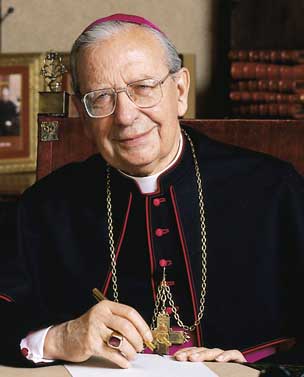
O God, merciful Father, you granted your servant Álvaro, Bishop, the grace of being an exemplary pastor in the service of the Church, and a most faithful son and successor of Saint Josemaría, the founder of Opus Dei. Grant that I too may respond faithfully to the demands of the Christian vocation, turning all the circumstances and events of my life into opportunities to love you and serve the kingdom of Jesus Christ. Deign to glorify your servant Álvaro, and through his intercession grant me the favor I request ... (here make your petition). Amen.
Our Father. Hail Mary. Glory be to the Father.
In conformity with the decrees of Pope Urban VIII, we declare that there is no intention of anticipating in any way the judgment of the Church, and that this prayer is not intended for public use.
Real Charity

Most of the posts deal with the Dark Night of the Senses and the Dark Night of the Soul. I have written little on the Illumination State and the Unitive State, as I have wanted to add my own personal experiences to the intellectual study, but, of course, I am not at those stages yet.
I do, however, want to highlight an important point made by St. Bernard of Clairvaux in his writings on these stages to perfection.
His ladder of humility, about which I wrote days ago, leads us to meditate on the necessary virtues which accompany the progress to perfection.
The first is "the severity of truth", in his words. This is the state of purification, when we allow God to show us our failings, who we are and what our predominant faults are. Only a complete dedication to finding the truth about ourselves and God pushes us forward into the Dark Night of the Senses and the Soul. We are standing back and letting God show us ourselves and we are allowed to judge ourselves, as in our particular judgement.
In the second stage, the Holy Spirit evokes a tenderness from our hearts. This leads to mercy towards others, as we have seen our sin and, therefore, can be merciful to others.

Only those who have endured the purifying fires of the Dark Night can truly love freely. St. Bernard teaches us that without purification, we cannot express charity. We cannot really love.
The ego is so entrenched in most people that real love cannot be exercised-the love one has for others for the sake of Christ Alone. This time is one of mercy and justice. This state is that of the latter stages of the purgation of the soul, leading into the Illuminative State. But, and this is important, without the Dark Night, one cannot enter into the mercy and justice of God. The freedom to really love in Christ, and not through the ego comes only after purification.
This state of mercy and compassion is the state of the "second conversion" when the ego is finally dealt with.
Here is Garrigou-Lagrange:
The necessity of a second conversion arises from all that remains in us of often unconscious egoism which mingles in the greater number of our acts. In a number of people this necessity comes from their unwillingness to be considered naive and their failure to recognize sufficiently the naivete of a superior simplicity which should grow in them. As a result, they become less simple and true with God, their superiors, and themselves. They lose sight practically of the grandeur of the theological virtues, of the importance of humility; then they no longer understand Christ's words: "Unless you be converted, and become as little children, you shall not enter into the kingdom of heaven."

Under the pretext of prudence, they begin to consider the little aspects of great things and to see less and less the great aspect of the daily duties of Christian life and the value of fidelity in little things. They forget that the day is composed of hours and the hour of minutes. They neglect a number of their obligations and gradually, in place of the radical simplicity of a gaze that was already lofty, a simplicity which should become that of contemplation, they find themselves in the quasi-learned complexity of a waning knowledge.

Love cannot happen without the passive purification of the senses. Here is Garrigou-Lagrange again.
What occurs at the beginning of the second conversion? God begins to pursue the soul, and it likewise seeks God, not, however, without a struggle against the inclinations of the exterior man and without anxiety. This state is manifested by a keen desire for God and for perfection, and also by what St. Paul calls the struggle of the spirit against the flesh or the inferior part of man.(10) From this struggle originates anxiety or even a certain anguish; the soul asks itself if it will reach the end so keenly desired.
Tauler gives a good description of this state, which St. John of the Cross later on calls the passive purification of the senses, in which there is a beginning of infused contemplation. In the sermon for the second Sunday of Lent, the old Dominican master declares: "From this pursuit of God (and of the soul who seek each other) keen anguish results. When a man is plunged into this anxiety and becomes aware of this pursuit of God in his soul, it is then without doubt that Jesus comes and enters into him. But when one does not feel this pursuit or experience this anguish, Jesus does not come.
Without this time of anguish, love cannot blossom and is tainted by the ego.
Real charity comes alive only in the Illuminative State.
To be continued..
On The Sacrifice of Talents

I have met women whose husbands died young and did not have anyone else ask them to be married, who raised children by themselves heroically. But, their vocation as a wife was not fulfilled.
I have met women who have dedicated their lives to the care of old parents, without having the ability to use any talents of science, liberal arts, or other intellectual pursuits, or the pursuit of a career
I have met men whose fathers did not understand that their sons were not given the same talents as they were given, but were fathers who insisted that these sons go into the family business or another career other than the ones to which they were called.
I have met men whose lives were dotted with understandable failures, such as business closing, being downsized, loosing investments, facing financial ruin because of circumstances, which prevented them from using their skills.
I have met men who gave up pursuing a talent they loved in order to become excellent providers for their families in a field not as personally desired. This is sacrifice.
The world is full of those who did not or could not use the gifts God gave them for some reason or another.
This is a great suffering, a great loss and a dying to self. This type of suffering may be used by God to purify one's imagination, ego, desires so that God can use one for the building of His Kingdom.
Failure does not mean spiritual death. Failure in the world may be a sign of a call to holiness.
Some people would say that Blessed Pier Giorgio Frassati was a failure as he died so young, or that Blessed Titus Brandsma did not maximize his ministry of printing and publishing by not giving in the Nazi propaganda.
Those who have had sorrow and failure are blessed by God to undergo the detachment from things, status, comfort.
Here is a quotation from Blessed Pier Giorgio Frassati. Many modern day Catholics would see Frassati as a failure, dying at 24, accomplishing nothing worldly. And, yet, he is among the blessed.
"In order to be Christian, our lives must be a continual renunciation and sacrifice. However, we know that the difficulties of this world are nothing compared to the eternal happiness that awaits us, where there will be no limit to our joy, no end to our happiness, and we shall enjoy unimaginable peace. And so, young people, learn from our Lord Jesus Christ the meaning of sacrifice."
Feast of St Agnes

The Eve of St Agnes was the day when young maidens would ask the virgin martyr for a vision or dream of their future husband. The English have a custom of putting a piece of wedding cake (which is hard fruit cake with marzipan frosting) under the pillow in order to dream of one's husband to be. Most girls just wake up with squashed pieces of cake under their pillows.
John Keats, an interesting Romantic poet, wrote a poem on this event The Eve of St. Agnes, which is a Romeo and Juliet type of poem.
I am reminded today of all the beautiful, single TLM women I know who cannot find husbands who are trad Catholics.
Here is the NO Collect of the day. Almighty ever-living God, who choose what is weak in the world to confound the strong, mercifully grant, that we, who celebrate the heavenly birthday of your Martyr Saint Agnes, may follow her constancy in the faith. Through our Lord Jesus Christ, your Son, who lives and reigns with you in the unity of the Holy Spirit, one God, for ever and ever.
The Journeys of St. Paul
Some of us have to be called out of a nice, calm and secure existence to make it to heaven.
St. Paul was called out of Judah and was sent by God to many countries of the world. The Romans had created the Pax Romana, a time of relative peace, and had created some of the best roads in the world, some lasting to this day.
Getting about to preach the Gospel and teach was planned by God, using the engineering and military expertise of the Romans to facilitate the spread of Catholicism. I list the places to where he went, omitting the duplicate visits.
St. Paul traveled to Damascus, Jerusalem, Antioch, which was in Syria, Seleucia, Cyprus, Salamis, Paphos, Perga, Antioch in Pisidia. He went to Iconium, Attalia, Cilicia, Derbe and Lystra, Phrygia and Galatia. Then, he went from Mysia to Troas, the island of Samothracia, and then to Neapolis in Macedonia. After that, Paul went to Philippi, Amphipolis, Appolonia, and Thessalonica.
He then traveled to Berea, Achaia to Athens, and Corinth.
Paul then traveled to Cenchrea, Ephesus, Caesarea, Troas and Macedonia. Then, he went to Achaia, Assos, Mitylene, Chios, Samos, Trogylium, and Miletus. Then he went to Coos, Rhodes, Patara, and Tyre. After that, he traveled to Ptolemais. He continued to Sidon, Myra, Lasea, and Malta.
Then, Paul went to Syracuse, to Rhegium, Puteoli, and Rome.
What are you doing to evangelize the world?
Monday, 20 January 2014
The Organist and Schola leader at our TLM
http://qconline.com/archives/qco/print_display.php?id=666866
Can we just skip a generation, please?
http://www.mirror.co.uk/news/uk-news/queen-elizabeth-ii-hand-over-3039892
Real Pacificism III
Wrapping up these posts on Just War Doctrine and pacifism, I want to point out the sad reality of the lack of understanding of duties of defense among so many "new men".
Too many men today do not think it is their duty to protect themselves, their families, wives, children, Church, country. Part of this has been the brain-washing of the false pacifist position of the past 40 years, which is a view that states that all confrontation, including physical, is by definition "bad". This is, obviously, not the case.
But, that view of many men is that they do not have to learn how to defend, nor do they have a duty to do so.
God put women and children in family and clan units for their protection. Men have lost this sense of being protectors. They rationalize their stand by claiming a false pacifism, which is merely an excuse not to fight.
Many men do not know that patriotism is a virtue. Many men have fallen into the cynicism referred to yesterday and the day before in posts. Cynicism denies the need for protection. Fear also denies the traditional male role of protector.
Too many men will not fight, refuse to defend, the innocent, the weak. This fear or state of weakness is not real pacifism, like the men of the Anabaptists exhibit, but a denial of what it is to be a man. Our nation and other nations of the West have lost leadership because of these false ideals and fear.
The protectors are becoming an extinct species......
Too many men today do not think it is their duty to protect themselves, their families, wives, children, Church, country. Part of this has been the brain-washing of the false pacifist position of the past 40 years, which is a view that states that all confrontation, including physical, is by definition "bad". This is, obviously, not the case.
But, that view of many men is that they do not have to learn how to defend, nor do they have a duty to do so.
God put women and children in family and clan units for their protection. Men have lost this sense of being protectors. They rationalize their stand by claiming a false pacifism, which is merely an excuse not to fight.
Many men do not know that patriotism is a virtue. Many men have fallen into the cynicism referred to yesterday and the day before in posts. Cynicism denies the need for protection. Fear also denies the traditional male role of protector.
Too many men will not fight, refuse to defend, the innocent, the weak. This fear or state of weakness is not real pacifism, like the men of the Anabaptists exhibit, but a denial of what it is to be a man. Our nation and other nations of the West have lost leadership because of these false ideals and fear.
The protectors are becoming an extinct species......
The ashikikomori
I had an article on men not dating in Japan several years ago. Two readers have contributed to this discussion. I cannot find the original interview of the young men in 2012, who said they would not get married and were not dating.
One reader wrote this in 2012
1. Japanese (men and women both) tend to fall into extremes of femininity or masculinity. There is never such a thing as "gender neutral". Much of this has to do with the language which differs strongly between feminine and masculine forms of speech. Kawaii culture is often simply an expression (or marketing) of that extreme femininity, while there is an equally prevalent Samurai culture of high speed trains, magnificent architecture, and competitiveness that expresses the extreme masculine. While Japan has a deep tradition of subtlety of social expression, it has a deeper tradition of profound emotion - it is not unusual to see a fistfight in parliament, or a man weeping in public.
2. The Japanese are perfectly aware of this fact that they love the childish, and some contemporary Japanese popular art pokes fun at this. Once recent anime features an ingenious "Professor" who makes sentient robots. She is also about 8 years old and would live on snacks and read manga all day - were it not for the admonishments of one of her more sensible creations. The Professor is a critique of Japan - as brilliantly intelligent, magnificently creative, and absurdly infantile.
3. Captain Tylor from the "Musekinin Kansho Tylor" which we watched is a similar critique. The Captain is a Japanese everyman - naturally cunning, innocent, good-hearted, yet completely irresponsible. He is contrasted with the old imperial Japanese ideal, Lt. Yamamoto, who is consumed by duty and has to find his heart. This sharp contrast between the not-so-past feudal Japan and modern democratic Japan is still a daily reality for many Japanese.
4.. Japanese culture has from the earliest times has had what Fr. Isaac, (a teacher at the seminary) might call an "irrealist" mode of thinking and artistic expression. It is perhaps the first culture to attempt to depict nothingness. Traditional Japanese art is minimalist and ideological, like modern western art. Of course, the impressionist movement was heavily influenced by Japanese art. Similarly, western Realism has had a huge impact on Japanese society, which is radically apparent in the postwar anime and manga sphere, which is full of western "practical fantasy" such as princes, dragons, and faeries acting out morality plays. Kawaii is a polite derivative of Greek ideals - celebration of the physical form, a frank but positive view of humanity, and the benevolent leadership of fate (or grace!) - as much as it is an organic progression of Japanese ideals.
Remember Ayu from Kanon, who uses "Boku" for "I", a masculine form - probably from talking with boys more than girls as a child. Yuuichi suggests she use "Atashi" which is feminine, or "Watashi" which is a more modern, gender-neutral construction. She says she doesn't like these and so Yuuichi teases her by suggesting she use "Ore" - a medieval super-masculine form used for oration and commands. She tries it and the combination of her using "Ore" with her petite size and high voice is so absurd that Yuuichi reels over in laughter. Ayu, like Japan, is outwardly cute and feminine, but inwardly tomboyish, independent, and assertive.
And, another reader sent this:
An epidemic of shut-ins
One reader wrote this in 2012
1. Japanese (men and women both) tend to fall into extremes of femininity or masculinity. There is never such a thing as "gender neutral". Much of this has to do with the language which differs strongly between feminine and masculine forms of speech. Kawaii culture is often simply an expression (or marketing) of that extreme femininity, while there is an equally prevalent Samurai culture of high speed trains, magnificent architecture, and competitiveness that expresses the extreme masculine. While Japan has a deep tradition of subtlety of social expression, it has a deeper tradition of profound emotion - it is not unusual to see a fistfight in parliament, or a man weeping in public.
2. The Japanese are perfectly aware of this fact that they love the childish, and some contemporary Japanese popular art pokes fun at this. Once recent anime features an ingenious "Professor" who makes sentient robots. She is also about 8 years old and would live on snacks and read manga all day - were it not for the admonishments of one of her more sensible creations. The Professor is a critique of Japan - as brilliantly intelligent, magnificently creative, and absurdly infantile.
3. Captain Tylor from the "Musekinin Kansho Tylor" which we watched is a similar critique. The Captain is a Japanese everyman - naturally cunning, innocent, good-hearted, yet completely irresponsible. He is contrasted with the old imperial Japanese ideal, Lt. Yamamoto, who is consumed by duty and has to find his heart. This sharp contrast between the not-so-past feudal Japan and modern democratic Japan is still a daily reality for many Japanese.
4.. Japanese culture has from the earliest times has had what Fr. Isaac, (a teacher at the seminary) might call an "irrealist" mode of thinking and artistic expression. It is perhaps the first culture to attempt to depict nothingness. Traditional Japanese art is minimalist and ideological, like modern western art. Of course, the impressionist movement was heavily influenced by Japanese art. Similarly, western Realism has had a huge impact on Japanese society, which is radically apparent in the postwar anime and manga sphere, which is full of western "practical fantasy" such as princes, dragons, and faeries acting out morality plays. Kawaii is a polite derivative of Greek ideals - celebration of the physical form, a frank but positive view of humanity, and the benevolent leadership of fate (or grace!) - as much as it is an organic progression of Japanese ideals.
Remember Ayu from Kanon, who uses "Boku" for "I", a masculine form - probably from talking with boys more than girls as a child. Yuuichi suggests she use "Atashi" which is feminine, or "Watashi" which is a more modern, gender-neutral construction. She says she doesn't like these and so Yuuichi teases her by suggesting she use "Ore" - a medieval super-masculine form used for oration and commands. She tries it and the combination of her using "Ore" with her petite size and high voice is so absurd that Yuuichi reels over in laughter. Ayu, like Japan, is outwardly cute and feminine, but inwardly tomboyish, independent, and assertive.
And, another reader sent this:
Everything you need to know about Japan's population crisis
Japan's birthrate is plummeting. Why have so many young Japanese given up on getting married?
By Sarah Eberspacher | January 11, 2014
There clearly is a subset of Japanese youth who have withdrawn from dating. Instead, they focus on online porn and games like Nintendo's Love Plus, in which players conduct a relationship with an anime girlfriend. Hundreds of thousands of young men are known ashikikomori, shut-ins who eschew human contact and spend their days playing video games and reading comics in their parents' homes.
For years, Takeshi hid from the world, playing video games all night and sleeping all day, eating from a tray his mother left outside his room. He was a hikikomori, one of an estimated 1 million Japanese teens and young men who have become shut-ins, with virtually no human contact beyond their parents. Some of the hikikomori first withdraw because of some social embarrassment — bad grades, or a romantic rejection. The longer they drop out, the more shame they feel in a society where one's status and reputation are paramount and hard to change. Parents, and especially mothers, often enable the withdrawal. "In Japan, mothers and sons often have a symbiotic, codependent relationship," says psychiatrist Tamaki Saito, who first identified the disorder in the 1990s. Takeshi re-entered society after four years, thanks to a government program that sends female outreach counselors known as "rental sisters" to coax the hikikomori out of the house. But that program doesn't always work. As one shut-in of 15 years said, "I missed my chance." sekkusu shinai shokogun, or "celibacy syndrome,"
Real Pacifism II
From day one, I was against the preemptive strikes from America, the 2003 war in Iraq, because of the teachings of the Catholic Church on Just War.
I was teaching at the time and the head of the board had lunch with me and asked me to explain my position, as the entire faculty, but me supported the war. I explained, as I had in religion classes, that the Church did no support strikes which may stop a war as part of the Just War doctrine. Preemptive strikes are not part of the criteria for a just war.
The Catholic Church has been clear on the doctrine of Just War. Defense and means, as well as reason for such must follow real criteria. Sadly, too many Catholics have not understood the Church's position and either fall into false pacifism or false aggression. Here are some of the points Note, a summary of the CCC as to the necessary criteria for a Just War may be seen in a previous post.
Therefore, there are times when a Catholic can object to national aggression. Not all wars are just. One may be against a particular war and still uphold the Just War doctrine.
Here is another source
http://www.vatican.va/roman_curia/pontifical_councils/justpeace/documents/rc_pc_justpeace_doc_20060526_compendio-dott-soc_en.html
I was teaching at the time and the head of the board had lunch with me and asked me to explain my position, as the entire faculty, but me supported the war. I explained, as I had in religion classes, that the Church did no support strikes which may stop a war as part of the Just War doctrine. Preemptive strikes are not part of the criteria for a just war.
The Catholic Church has been clear on the doctrine of Just War. Defense and means, as well as reason for such must follow real criteria. Sadly, too many Catholics have not understood the Church's position and either fall into false pacifism or false aggression. Here are some of the points Note, a summary of the CCC as to the necessary criteria for a Just War may be seen in a previous post.
Therefore, there are times when a Catholic can object to national aggression. Not all wars are just. One may be against a particular war and still uphold the Just War doctrine.
Here is another source
http://www.vatican.va/roman_curia/pontifical_councils/justpeace/documents/rc_pc_justpeace_doc_20060526_compendio-dott-soc_en.html
III. THE FAILURE OF PEACE: WAR
497. The Magisterium condemns "the savagery of war" [1032] and asks that war be considered in a new way.[1033] In fact, "it is hardly possible to imagine that in an atomic era, war could be used as an instrument of justice".[1034] War is a "scourge" [1035] and is never an appropriate way to resolve problems that arise between nations, "it has never been and it will never be",[1036] because it creates new and still more complicated conflicts.[1037] When it erupts, war becomes an "unnecessary massacre",[1038] an "adventure without return"[1039] that compromises humanity's present and threatens its future. "Nothing is lost by peace; everything may be lost by war".[1040] The damage caused by an armed conflict is not only material but also moral.[1041] In the end, war is "the failure of all true humanism",[1042] "it is always a defeat for humanity": [1043] "never again some peoples against others, never again! ... no more war, no more war!" [1044]
498. Seeking alternative solutions to war for resolving international conflicts has taken on tremendous urgency today, since "the terrifying power of the means of destruction - to which even medium and small-sized countries have access - and the ever closer links between the peoples of the whole world make it very difficult or practically impossible to limit the consequences of a conflict".[1045] It is therefore essential to seek out the causes underlying bellicose conflicts, especially those connected with structural situations of injustice, poverty and exploitation, which require intervention so that they may be removed. "For this reason, another name for peace is development. Just as there is a collective responsibility for avoiding war, so too there is a collective responsibility for promoting development".[1046]
499. States do not always possess adequate means to provide effectively for their own defence, from this derives the need and importance of international and regional organizations, which should be in a position to work together to resolve conflicts and promote peace, re-establishing relationships of mutual trust that make recourse to war unthinkable.[1047] "There is reason to hope ... that by meeting and negotiating, men may come to discover better the bonds that unite them together, deriving from the human nature which they have in common; and that they may also come to discover that one of the most profound requirements of their common nature is this: that between them and their respective peoples it is not fear which should reign but love, a love which tends to express itself in a collaboration that is loyal, manifold in form and productive of many benefits".[1048]
a. Legitimate defence
500. A war of aggression is intrinsically immoral. In the tragic case where such a war breaks out, leaders of the State that has been attacked have the right and the duty to organize a defence even using the force of arms.[1049] To be licit, the use of force must correspond to certain strict conditions: "the damage inflicted by the aggressor on the nation or community of nations must be lasting, grave and certain; all other means of putting an end to it must have been shown to be impractical or ineffective; there must be serious prospects of success; the use of arms must not produce evils and disorders graver than the evil to be eliminated. The power of modern means of destruction weighs very heavily in evaluating this condition. These are the traditional elements enumerated in what is called the 'just war' doctrine. The evaluation of these conditions for moral legitimacy belongs to the prudential judgment of those who have responsibility for the common good".[1050 ]
If this responsibility justifies the possession of sufficient means to exercise this right to defence, States still have the obligation to do everything possible "to ensure that the conditions of peace exist, not only within their own territory but throughout the world".[1051] It is important to remember that "it is one thing to wage a war of self-defence; it is quite another to seek to impose domination on another nation. The possession of war potential does not justify the use of force for political or military objectives. Nor does the mere fact that war has unfortunately broken out mean that all is fair between the warring parties".[1052]
501. The Charter of the United Nations, born from the tragedy of the Second World War with the intention of preserving future generations from the scourge of war, is based on a generalized prohibition of a recourse to force to resolve disputes between States, with the exception of two cases: legitimate defence and measures taken by the Security Council within the area of its responsibilities for maintaining peace. In every case, exercising the right to self-defence must respect "the traditional limits of necessity and proportionality".[1053]
Therefore, engaging in a preventive war without clear proof that an attack is imminent cannot fail to raise serious moral and juridical questions. International legitimacy for the use of armed force, on the basis of rigorous assessment and with well-founded motivations, can only be given by the decision of a competent body that identifies specific situations as threats to peace and authorizes an intrusion into the sphere of autonomy usually reserved to a State.
b. Defending peace
502. The requirements of legitimate defence justify the existence in States of armed forces, the activity of which should be at the service of peace. Those who defend the security and freedom of a country, in such a spirit, make an authentic contribution to peace.[1054] Everyone who serves in the armed forces is concretely called to defend good, truth and justice in the world. Many are those who, in such circumstances, have sacrificed their lives for these values and in defence of innocent lives. Very significant in this regard is the increasing number of military personnel serving in multinational forces on humanitarian or peace-keeping missions promoted by the United Nations.[1055]
503. Every member of the armed forces is morally obliged to resist orders that call for perpetrating crimes against the law of nations and the universal principles of this law.[1056] Military personnel remain fully responsible for the acts they commit in violation of the rights of individuals and peoples, or of the norms of international humanitarian law. Such acts cannot be justified by claiming obedience to the orders of superiors.
Conscientious objectors who, out of principle, refuse military service in those cases where it is obligatory because their conscience rejects any kind of recourse to the use of force or because they are opposed to the participation in a particular conflict, must be open to accepting alternative forms of service. "It seems just that laws should make humane provision for the case of conscientious objectors who refuse to carry arms, provided they accept some other form of community service".[1057]
c. The duty to protect the innocent
504. The right to use force for purposes of legitimate defence is associated with the duty to protect and help innocent victims who are not able to defend themselves from acts of aggression. In modern conflicts, which are often within a State, the precepts of international humanitarian law must be fully respected. Far too often, the civilian population is hit and at times even becomes a target of war. In some cases, they are brutally massacred or taken from their homes and land by forced transfers, under the guise of "ethnic cleansing",[1058] which is always unacceptable. In such tragic circumstances, humanitarian aid must reach the civilian population and must never be used to influence those receiving it; the good of the human person must take precedence over the interests of the parties to the conflict.
505. The principle of humanity inscribed in the conscience of every person and all peoples includes the obligation to protect civil populations from the effects of war. "That minimum protection of the dignity of every person, guaranteed by international humanitarian law, is all too often violated in the name of military or political demands which should never prevail over the value of the human person. Today we are aware of the need to find a new consensus on humanitarian principles and to reinforce their foundation to prevent the recurrence of atrocities and abuse".[1059]
A particular category of war victim is formed by refugees, forced by combat to flee the places where they habitually live and to seek refuge in foreign countries. The Church is close to them not only with her pastoral presence and material support, but also with her commitment to defend their human dignity: "Concern for refugees must lead us to reaffirm and highlight universally recognized human rights, and to ask that the effective recognition of these rights be guaranteed to refugees".[1060]
506. Attempts to eliminate entire national, ethnic, religious or linguistic groups are crimes against God and humanity itself, and those responsible for such crimes must answer for them before justice.[1061] The twentieth century bears the tragic mark of different genocides: from that of the Armenians to that of the Ukrainians, from that of the Cambodians to those perpetrated in Africa and in the Balkans. Among these, the Holocaust of the Jewish people, the Shoah, stands out: "the days of the Shoah marked a true night of history, with unimaginable crimes against God and humanity".[1062]
The international community as a whole has the moral obligation to intervene on behalf of those groups whose very survival is threatened or whose basic human rights are seriously violated. As members of an international community, States cannot remain indifferent; on the contrary, if all other available means should prove ineffective, it is "legitimate and even obligatory to take concrete measures to disarm the aggressor".[1063] The principle of national sovereignty cannot be claimed as a motive for preventing an intervention in defence of innocent victims.[1064] The measures adopted must be carried out in full respect of international law and the fundamental principle of equality among States.
Subscribe to:
Posts (Atom)