Recent Posts

Sunday, 8 June 2014

Called to Be A Cell Within A Cell

The journey into contemplative prayer is hard work. Beginners need guidance. I am a beginner.

The pitfalls are discouragement and pride. But, one must go forward and not falter. Contemplative prayer begins with hard work, and for the proficient, ends up in infused contemplation.

This type of prayer leads to the infused knowledge of God, but begins with acquired contemplation. One cannot confuse the two, and Garrigou-Lagrange is clear on the definitions.  But, this is the prayer which begins when one gives time to God in order to meet Him as He wants to be found. One cannot rush this type of prayer, nor expect God to work in every person in the exact same way. Yet, we are all called to this.

Because intellectuals have such active lives and imaginations, time must be set aside for the emptying of memory, understanding, and will. I have written on this before on this blog.

The happy correspondence of this type of prayer for me is that it follows a life of reading and thinking in overlaps involving the Maritains, Garrigou-Lagrange, and, of course, Thomas Aquinas.

We are all called to this type of prayer, but I could not arrange my life to answer this deepening call until today. My health did not let me stay in Tyburn, but i still need the door to open for me to be in a place where I have the freedom to follow this call. One needs strict privacy and time to be with God, to wait on God. I can become more of a cell within a cell in quiet but not in noise or interruption. As a beginner, I want to share the trials and tribulations of contemplation.

I shall share insights with you all as I go along, as I am, always, a teacher as well as a pray-er.

This is not a prayer of visions, by the way. One moves into a mental and spiritual state where God can finally reveal Himself as He wants to be known. This is the way of emptying. I am grateful for the opportunity to pursue the Bridegroom, Who removed Himself from me for a time. But, I need the space.

All preconceived ideas of how He meets us pass away. One is not in control of the relationship, but God is totally.

Here is the goal of giving this time to God.


Song of Solomon 3

Douay-Rheims 
In my bed by night I sought him whom my soul loveth: I sought him, and found him not.
I will rise, and will go about the city: in the streets and the broad ways I will seek him whom my soul loveth: I sought him, and I found him not.
The watchmen who keep the city, found me: Have you seen him, whom my soul loveth?
When I had a little passed by them, I found him whom my soul loveth: I held him: and I will not let him go, till I bring him into my mother's house, and into the chamber of her that bore me.


Virgin of The Order of Malta


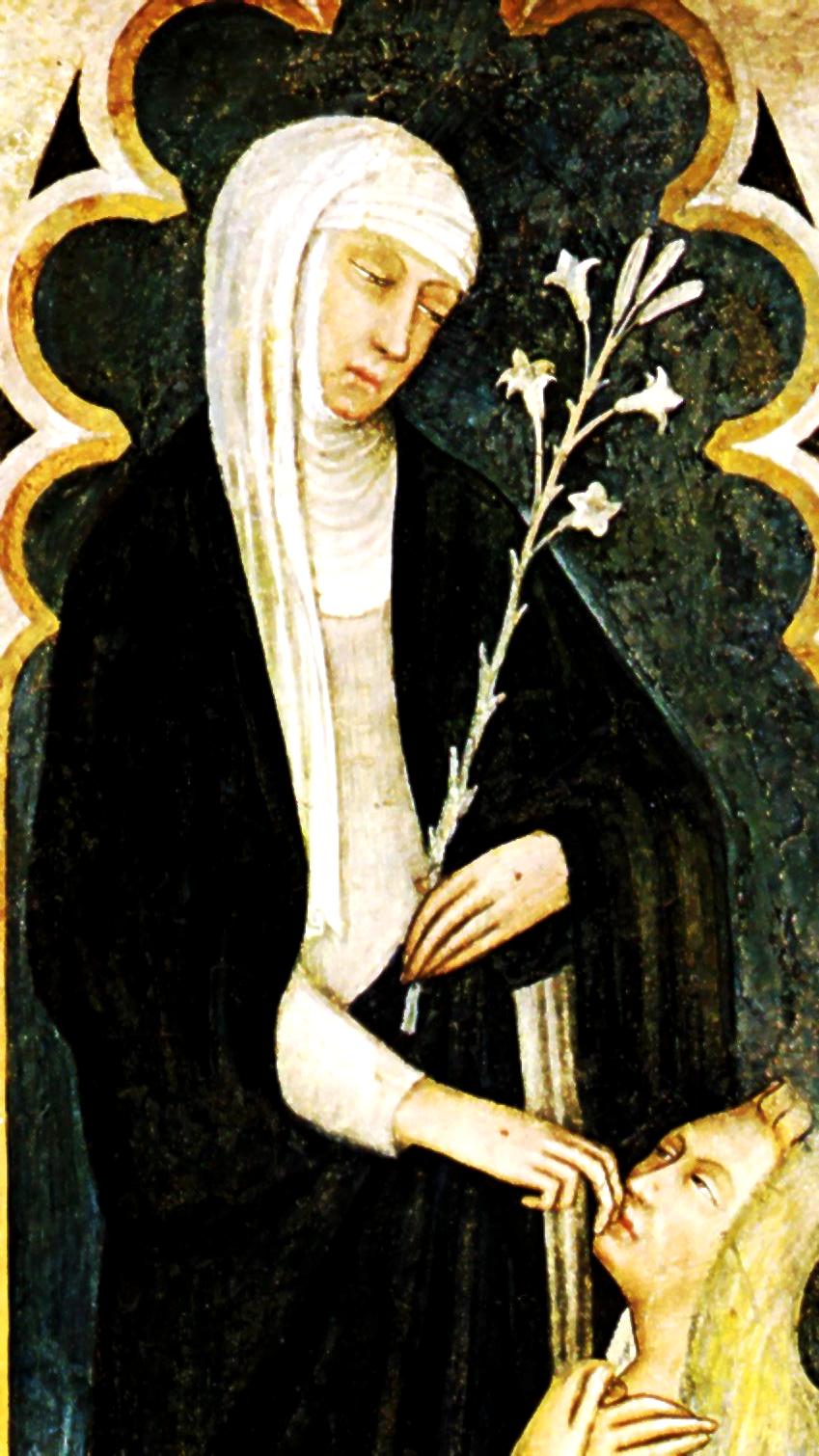
St. Flora, 1347A.D. Patron of abandoned, converts, single laywomen, and victims of betrayal. Flora was born in France about the year 1309. She was a devout child and later resisted all attempts on the part of her parents to find a husband for her. In 1324, she entered the Priory of Beaulieu of the Hospitaller nuns of St. John of Jerusalem. Here she was beset with many and diverse trials, fell into a depressed state, and were made sport of by some of her religious sisters. However, she never ceased to find favor with God and was granted many unusual and mystical favors. One year on the feast of All Saints, she fell into an ecstasy and took no nourishment until three weeks later on the feast of St. Cecelia. On another occasion, while meditating on the Holy Spirit, she was raised four feet from the ground and hung in the air in full view of many onlookers. She also seemed to be pierced with the arms of Our Lord's cross, causing blood to flow freely at times from her side and at others, from her mouth. Other instances of God's favoring of his servant were also reported, concerning prophetic knowledge of matters of which she could not naturally know. Through it all, St. Flora remained humble and in complete communion with her Divine Master, rendering wise counsel to all who flocked to her because of her holiness and spiritual discernment. In 1347, she was called to her eternal reward and many miracles were worked at her tomb. 

A reader gave me this tip. Now, Flora's feast day is either on June 11th or October 5th, but as I have been thinking of my single, laywomen friends, I wanted to highlight her today.

She is also a Virgin of the Order of Malta, which is highly interesting to me.

More here about her.


I think it would be very cool to be a woman saint of the Order of the Knights of Malta.


Prayer:
Almighty and merciful God, who wished blessed Fleur to love and live as a virgin in the Order of St. John of Jerusalem, grant that, following her example, we also may love you more and more. We ask this through our Lord Jesus Christ your Son, who lives and reigns with you and the Holy Spirit, one God, for ever and ever. Amen.
(From: The Missal with readings of the Order of St. John of Jerusalem of Rhodes, & of Malta, London 1997)


Saturday, 7 June 2014

An Unusual but Beautiful Facebook Page

https://www.facebook.com/DivineIntimacyFrGabrielCarmeliteSpirituality

Lest there be confusion concerning one's conscience


 from the CCC
1795 "Conscience is man's most secret core, and his sanctuary. There he is alone with God whose voice echoes in his depths" (GS 16).

1796 Conscience is a judgment of reason by which the human person recognizes the moral quality of a concrete act.

1797 For the man who has committed evil, the verdict of his conscience remains a pledge of conversion and of hope.

1798 A well-formed conscience is upright and truthful. It formulates its judgments according to reason, in conformity with the true good willed by the wisdom of the Creator. Everyone must avail himself of the means to form his conscience.

1799 Faced with a moral choice, conscience can make either a right judgment in accordance with reason and the divine law or, on the contrary, an erroneous judgment that departs from them.

1800 A human being must always obey the certain judgment of his conscience.

1801 Conscience can remain in ignorance or make erroneous judgments. Such ignorance and errors are not always free of guilt.

1802 The Word of God is a light for our path. We must assimilate it in faith and prayer and put it into practice. This is how moral conscience is formed.

Sometimes, a small thing is wondrous

http://holycardheaven.blogspot.ie/2011/08/holy-heart-of-mary-our-model-bouasse.html

A Repost Sort Of...

Monday, 28 January 2013


Part Five: Saints on the Illuminative State-on the way to the one thing necessary


Sometimes people do not read footnotes in texts.

I do. Garrigou-Lagrange has these three in his section on the Illuminative State, which I think will be helpful for all of us.  Garrigou-Lagrange's next chapter highlight St. Catherine and Bl. Henry, and here are some of his extensive points. My boldface type highlights.................


8. In the prologue of his Rule, St. Benedict wrote: "Let us therefore at length arise, since the Scriptures stir us up, saying: 'It is now the hour for us to rise from sleep' (Rom. 13:11). And our eyes being now open to the divine light, let us hear with wonderment the divine voice admonishing us, in that it cries out daily and says: 'Today if you shall hear His voice, harden not your hearts.' " That is to say: It is time to rise from the sleep of negligence and to walk courageously in the way of God.

Garrigou-Lagrange rightly and clearly expresses that the Illuminative State is a second conversion. This waking up is absolutely a gift from God, but one has to cooperate with this.

It does not happen if one is NOT ORTHODOX and if one is orthodox and falls away from the Church, the Illuminative State ends in heresy and condemnation. Now, one may be "outside" the Catholic Church and receive great graces for the very purpose of God calling one to become Catholic. This can be a painful decision.

One falls because of pride, mostly, and stupidly thinking that one is arriving at these stages by one's own efforts and not by grace.


9. We shall see farther on that, as St. Catherine of Siena says in her Dialogue (chaps. 60, 63), the second conversion of the apostles took place more properly at the end of the Passion when Peter wept over his denial, and that Pentecost was like a third conversion or more properly a transformation of the soul, which marks the entrance into the unitive way.

This is absolutely spot on.

Garrigou-Lagrange should be canonized. His insights as to Catherine of Siena's Dialogue, a book I recommend to all, shows that Catherine received graces for the Unitive Way, which I have not discussed yet.

One cannot enter the Illuminative State without purgation and one finishes purgation in the Illuminative State.

No pain, no gain. Sorry, but the Protestants miss this point by insisting that a sign of election is wealth. Nope.

I shall write about the Third Transformation when I have exhausted the Illuminative State explanations. I have never personally met a living man, woman or child in the Unitive State, although I have met several in the Illuminative State. Age, by the way, does not matter. Catherine died at 33.

Here is G-L on her contribution: Christ is speaking to Catherine. 

We read in chapter 60: "Some there are who have become faithful servants, serving Me with fidelity without servile fear of punishment, but rather with love. This very love, however, if they serve Me with a view to their own profit, or the delight and pleasure which they find in Me, is imperfect. Dost thou know what proves the imperfection of this love? The withdrawal of the consolations which they found in Me, and the insufficiency and short duration of their love for their neighbor, which grows weak by degrees, and oft-times disappears. Toward Me their love grows weak when, on occasion, in order to exercise them in virtue and raise them above their imperfection, I withdraw from their minds My consolation and allow them to fall into battles and perplexities. This I do so that, coming to perfect self-knowledge, they may know that of themselves they are nothing and have no grace, and, accordingly in time of battle fly to Me as their benefactor, seeking Me alone, with true humility, for which purpose I treat them thus, withdrawing from them consolation indeed, but not grace. At such a time these weak ones of whom I speak relax their energy, impatiently turning backward, and so sometimes abandon, under color of virtue, many of their exercises, saying to themselves: This labor does not profit me. All this they do, because they feel themselves deprived of mental consolation. Such a soul acts imperfectly, for she has not yet unwound the bandage of spiritual self-love, for had she unwound it, she would see that, in truth, everything proceeds from Me, that no leaf of a tree falls to the ground without My providence, and that what I give and promise to My creatures, I give and promise to them for their sanctification, which is the good and the end for which I created them."

and again,

In chapter 63 of The Dialogue, the saint says, in speaking of the passage from mercenary to filial love: "Every perfection and every virtue proceeds from charity, and charity is nourished by humility, which results from the knowledge and holy hatred of self, that is, sensuality. . . . To arrive thereat. . . a man must exercise himself in the extirpation of his perverse self-will, both spiritual and temporal, hiding himself in his own house, as did Peter, who, after the sin of denying My Son, began to weep. Yet his lamentations were imperfect, and remained so until after the forty days, that is, until after the Ascension. But when My Truth returned, to Me in His humanity, Peter and the others concealed themselves in the house awaiting the coming of the Holy Spirit, which My Truth had promised them. They remained barred in from fear, because the soul always fears until she arrives at true love. But when they had persevered in fasting and in humble and continual prayer, until they had received the abundance of the Holy Spirit, they lost their fear, and followed and preached Christ crucified."
St. Catherine of Siena shows in this passage that the imperfect soul which loves the Lord with a love that is still mercenary, ought to follow Peter's example after his denial of Christ. Not infrequently this time Providence permits us also to fall into some visible fault to humiliate us and oblige us to enter into ourselves, y at as Peter did, when immediately after his fall, seeing that Jesus looked at him, he "wept bitterly." (1)


And more, and a warning: this second conversion is not obvious, nor is it necessarily "charismatic".

The second conversion may also take place, though we have no grave sin to expiate, for example, at a time when we are suffering from an injustice, or a calumny, which, under divine grace, awakens in us not sentiments of vengeance, but hunger and thirst for the justice of God. In such a case, the generous forgiving of a grave injurysometimes draws down on the soul of the one who pardons, a great grace, which makes him enter a higher region of the spiritual life. The soul then receives a new insight into divine things and an impulse which it did not know before. David received such a grace when he pardoned Semei who had outraged and cursed him, while throwing stones at him.(3)

This has been in my experience and forgiveness opens the door to grace. But, this
"yes" opens the door to great suffering as well.


A more profound insight into the life of the soul may originate also on the occasion of the death of a dear one, or of a disaster, or of a great rebuff, when anything occurs which is of a nature to reveal the vanity of earthly things and by contrast the importance of the one thing necessary, union with God, the prelude of the life of heaven.

In her Dialogue St. Catherine also speaks often of the necessity of leaving the imperfect state in which a person serves God more or less through interest and for his own satisfaction, and in which he wishes to go to God the Fatherwithout passing through Jesus crucified.(4) To leave this imperfect state, the soul which still seeks itself must be converted that it may cease to seek itself and may truly go in search of God by the way of abnegation, which is that of profound peace.

There is no short-cut.


Staying with the Dominicans today, on the Feast of the Greatest, I pick up on G-L's reference to Henry Suso, who I first discovered in about 1980. Here is a section of his writings to help us. Again, read footnotes, as they are good for you! They led up to the following chapter.


10. For example, the second conversion of Blessed Henry Suso, of St. Catherine of Genoa, of Blessed Anthony Neyrot, O.P., and of many others, is well known.


The works of Blessed Henry Suso contain a number of instructions relative to the second conversion. He himself experienced this conversion after a few years of religious life, during which he had slipped into some negligences. Particular attention ought to be given to what he says about the necessity of a more interior and deep Christian life in religious who give themselves most exclusively to study, and in others who are chiefly attentive to exterior observances and austerities. In the divine light he saw "these two classes of persons circling about the Savior's cross, without being able to reach Him," (5) because both groups sought themselves, either in study or in exterior observances, and because they judged each other without charity. He understood then that he should remain in complete self-abnegation, ready to accept all that God might will, and to accept it with love, at the same time practicing great fraternal charity. (6)

Do not circle the Cross. Embrace it.


And I end with a helpful footnote and also section on St. Thomas Aquinas.......


15. This mode of acting conforms perfectly to what St. Thomas says of the difference between acquired prudence (a true virtue, already described by Aristotle) and infused prudence. and the gift of counsel (IIa IIae, q.47, a.14 and q. 52). Should a man tend to perfection under the almost exclusive direction of acquired prudence (which is, nevertheless, not that of the flesh), he would never reach true Christian perfection, which belongs to the supernatural order; such perfection requires the frequent exercise of infused prudence and of the gift of counsel. These three sources of actions (habitus) are among themselves a little like what agility of the fingers, the acquired art which is in the practical intellect, and musical inspiration are in the musician. Without art, properly so called, and this inspiration, a man will certainly never produce a masterpiece, and will never be able even to comprehend one.

And, so that we do not become full of pride, God allows us to fall......

In connection with Peter's second conversion, we should recall that St. Thomas teaches (2) that even after a serious sin, if a man has a truly fervent contrition proportionate to the degree of grace lost, he recovers this degree of grace; he may even receive a higher degree if he has a still more fervent contrition. He is, therefore, not obliged to recommence his ascent from the very beginning, but continues it, taking it up again at the point he had reached when he fell. A mountain climber who stumbles halfway up, rises immediately, and continues the ascent. The same is true in the spiritual order. Everything leads us to think that by the fervor of his repentance Peter not only recovered the degree of grace that he had lost, but was raised to a higher degree of the supernatural life. The Lord permitted this fall only to cure him of his presumption so that he might become more humble and thereafter place his confidence, not in himself, but in God. Thus, the humiliated Peter on his knees weeping over his sin is greater than the Peter on Thabor, who did not as yet sufficiently know his frailty.


To be perfect is to be conformed to Christ. We become like Him. We are His Face in the world...........


Sigh....looking for wifi...sounds like a novel title


Does Everyone Have A Guardian Angel?


In recent times, it has been brought to my attention that the Church has not made a definite statement as to whether all humans have a guardian angel, or whether just the baptized.

The CCC states this:

The angels in the life of the Church
334 In the meantime, the whole life of the Church benefits from the mysterious and powerful help of angels.201
335 In her liturgy, the Church joins with the angels to adore the thrice-holy God. She invokes their assistance (in the funeral liturgy's In Paradisum deducant te angeli. . .["May the angels lead you into Paradise. . ."]). Moreover, in the "Cherubic Hymn" of the Byzantine Liturgy, she celebrates the memory of certain angels more particularly (St. Michael, St. Gabriel, St. Raphael, and the guardian angels).
336 From its beginning until death, human life is surrounded by their watchful care and intercession.202 "Beside each believer stands an angel as protector and shepherd leading him to life."203 Already here on earth the Christian life shares by faith in the blessed company of angels and men united in God.

The footnote is to a work by St. Basil, which indicates that only those who are baptized have an angel.

203 St. Basil, Adv. Eunomium III, I: PG 29,656B.

St. Thomas Aquinas, as well as St. Jerome, write that all humans have a guardian angel.


Each man has an angel guardian appointed to him. This rests upon the fact that the guardianship of angels belongs to the execution of Divine providence concerning men. But God'sprovidence acts differently as regards men and as regards other corruptible creatures, for they are related differently to incorruptibility. For men are not only incorruptible in the common species, but also in the proper forms of each individual, which are the rational souls, which cannot be said of other incorruptible things. Now it is manifest that the providence of God is chiefly exercised towards what remains for ever; whereas as regards things which pass away, the providence of God acts so as to order their existence to the things which are perpetual. Thus the providence of God is related to each man as it is to every genus or species of things corruptible. But, according to Gregory (Hom. xxxiv in Evang.), the different orders are deputed to the different "genera" of things, for instance, the "Powers" to coerce the demons, the "Virtues" to work miracles in things corporeal; while it is probable that the differentspecies are presided over by different angels of the same order. Hence it is also reasonable to suppose that different angels are appointed to the guardianship of different men.

Reply to Objection 1. A guardian may be assigned to a man for two reasons: first, inasmuch as a man is an individual, and thus to one man one guardian is due; and sometimes several are appointed to guard one.

Secondly, inasmuch as a man is part of a community, and thus one man is appointed as guardian of a whole community; to whom it belongs to provide what concerns one man in his relation to the whole community, such as external works, which are sources of strength or weakness to others. But angel guardians are given to men also as regards invisible and occult things, concerning the salvation of each one in his own regard. Hence individual angels are appointed to guard individual men.


Article 5. Whether an angel is appointed to guard a man from his birth?

Objection 1. It would seem that an angel is not appointed to guard a man from his birth. For angelsare "sent to minister for them who shall receive the inheritance of salvation," as the Apostle says (Hebrews 1:14). But men begin to receive the inheritance of salvation, when they are baptized. Therefore an angel is appointed to guard a man from the time of his baptism, not of his birth.
Objection 2. Further, men are guarded by angels in as far as angels enlighten and instruct them. But children are not capable of instruction as soon as they are born, for they have not the use of reason. Therefore angels are not appointed to guard children as soon as they are born.
Objection 3. Further, a child has a rational soul for some time before birth, just as well as after. But it does not appear that an angel is appointed to guard a child before its birth, for they are not then admitted to the sacraments of the Church. Therefore angels are not appointed to guard men from the moment of their birth.

On the contrary, Jerome says (vide A, 4) that "each soul has an angel appointed to guard it from its birth."

I answer that, as Origen observes (Tract. v, super Matt.) there are two opinions on this matter. For some have held that the angel guardian is appointed at the time of baptism, others, that he is appointed at the time of birth. The latter opinion Jerome approves (vide A, 4), and with reason. For those benefits which are conferred by God on man as a Christian, begin with his baptism; such as receiving the Eucharist, and the like. But those which are conferred by God on man as a rational being, are bestowed on him at his birth, for then it is that he receives that nature. Among the latter benefits we must count the guardianship of angels, as we have said above (1,4). Wherefore from the very moment of his birth man has an angel guardian appointed to him.

Reply to Objection 1. Angels are sent to minister, and that efficaciously indeed, for those who shall receive the inheritance of salvation, if we consider the ultimate effect of their guardianship, which is the realizing of that inheritance. But for all that, the angelic ministrations are not withdrawn for others although they are not so efficacious as to bring them to salvation: efficacious, nevertheless, they are, inasmuch as they ward off many evils.

Reply to Objection 2. Guardianship is ordained to enlightenment by instruction, as to its ultimate and principal effect. Nevertheless it has many other effects consistent with childhood; for instance to ward off the demons, and to prevent both bodily and spiritual harm.

Reply to Objection 3. As long as the child is in the mother's womb it is not entirely separate, but by reason of a certain intimate tie, is still part of her: just as the fruit while hanging on the tree is part of the tree. And therefore it can be said with some degree of probability, that the angel who guards the mother guards the child while in the womb. But at its birth, when it becomes separate from the mother, an angel guardian is appointed to it; as Jerome, above quoted, says.

It is interesting that the CCC takes the older definition or opinion and not the latter one of Thomas.

to be continued...

Friday, 6 June 2014

For The Critics

Over the past six months on this blog, and in comments, I have highlighted Fr. Chad Ripperger and his work. Here is a short bio from here.

Fr. Chad Ripperger, PhD is a Theologian, Thomistic Psychologist, Philosopher, and Author. Fr. Ripperger has served as professor of Dogmatic and Moral Theology and Philosophy at Our Lady of Guadalupe Seminary in Denton, Nebraska. Father Ripperger was ordained in 1997. He currently works in the Diocese of Tulsa. His published works include “Introduction to the Science of Mental Health”, “The Binding Force of Holy Tradition”, “The Metaphysics of Evolution”, “The Morality of the Exterior Act: In the Writings of Saint Thomas Aquinas”, and “Topics on Tradition.”

As a trained psychologist as well as a Thomist, Fr. Ripperger brings a genius to the entire study of the psychological unmatched in the United States.

Many of his talks are online and found at http://www.sensustraditionis.org/

Now, what I find odd are those lay people, either with or without training, (mostly without) who do not take this amazing priest seriously. I think it is because Fr. Ripperger has had (oh dear) the audacity to criticize both the right and the left "wings" of the Church: that is, he has pointed out difficulties among the trads as well as the liberals.

I have found more defensiveness coming from trads quoting Fr Ripperger than I have concerning any other source.

This type of defensiveness is a sign of the very things which Father notes in his excellent talks, all of which I recommend.

Defensiveness usually occurs when people are being criticized for something true. If a critique is false, one can ignore it or let it go. 

The truth causes discomfort.

Several points cause people to dismiss a priest who is an expert in several fields. 

Outside of pride, some dismiss him because he is experienced. Hmmm, Catholic trads do not like FSSP priests who are experienced, as well as trained?

I suggest that those who have trouble with some of Fr. Ripperger's statements concerning the occult, Catholic spirituality, sin, the gnostic tendencies of traditionals and other fascinating topics, pray and listen to his talks.

One will be changed and for the better.

(By the way, another great but secular psychiatrist on line, who is no longer writing, is Dr. Sanity, who I have also recommended on this blog many times. Here comments may be found here. http://drsanity.blogspot.com/  She was the forerunner and first critic of the present administration, as well as a great critic of the culture. God bless her wherever she is working.

Sadly, most of the psychology taught today, as Fr. Ripperger notes, is taught without consideration of the soul. The brain and the body have been separated from the eternal in humans. How can psychology work without consideration of the soul?

Fr. Ripperger has encouraged his listeners to find a Thomistic psychologist for counseling only.

I agree wholeheartedly, but good luck finding one.

Some of my favorite photos

Add caption


One of my brothers....

Readers, use the tags and labels and a novena reminder

Those are there to help you find older series and articles. Just a reminder. By the way, a friend recommended the 54 day rosary novena. Hers will end on the feast of SS. Joachim and Anne.

One can find that novena here...http://www.fatima.org/apostolate/vlarchive/pdf/vl130_prayer_card.pdf


The Matter of Sin, Five

Continuing with an brief examination of St. Thomas on how the angels help humans, one sees in his section on angels that they can affect the senses, as well.

This section is long, but worth reading. Note that all these quotations are found in the same section, found here.  All the bold on these last few posts are my highlights.

As to angels changing the senses, I know for a fact that my guardian angels have helped me to fast and to keep fasting at certain times. This is a subtle movement of the senses regarding food, feeling hungry, or not feeling hungry.

If we really want our angels to help us become holy, they are more than willing. But, they may have to help us overcome the matter of sin, through our cooperation with discipline and prayer. Anything, such a art or a design, a song, or a view, can lead us to holiness or sin. The senses become more sensitive the more we pray, and for the good.


Article 4. Whether an angel can change the human senses?

Objection 1. It seems that an angel cannot change the human senses. For the sensitive operation is a vital operation. But such an operation does not come from an extrinsic principle. Therefore the sensitive operation cannot be caused by an angel.
Objection 2. Further, the sensitive operation is nobler than the nutritive. But the angel cannot change the nutritive power, nor other natural forms. Therefore neither can he change the sensitive power.
Objection 3. Further, the senses are naturally moved by the sensible objects. But an angel cannot change the order of nature (110, 4). Therefore an angel cannot change the senses; but these are changed always by the sensible object.

On the contrary, The angels who overturned Sodom, "struck the people of Sodom with blindness oraorasia, so that they could not find the door" (Genesis 19:11). [It is worth noting that these are the only two passages in the Greek version where the word aorasia appears. It expresses, in fact, the effect produced on the people of Sodom--namely, dazzling (French version, "eblouissement"), which the Latin "caecitas" (blindness) does not necessarily imply.] The same is recorded of the Syrians whomEliseus led into Samaria (2 Kings 6:18).

I answer that, The senses may be changed in a twofold manner; from without, as when affected by the sensible object: and from within, for we see that the senses are changed when the spirits and humors are disturbed; as for example, a sick man's tongue, charged with choleric humor, tastes everything as bitter, and the like with the other senses. Now an angel, by his natural power, can work a change in the senses both ways. For an angel can offer the senses a sensible object from without, formed by nature or by the angel himself, as when he assumes a body, as we have said above (Question 51, Article 2). Likewise he can move the spirits and humors from within, as above remarked, whereby the senses are changed in various ways.


Reply to Objection 1. The principle of the sensitive operation cannot be without the interior principle which is the sensitive power; but this interior principle can be moved in many ways by the exterior principle, as above explained.

Reply to Objection 2. By the interior movement of the spirits and humors an angel can do something towards changing the act of the nutritive power, and also of the appetitive and sensitive power, and of any other power using a corporeal organ.

Reply to Objection 3. An angel can do nothing outside the entire order of creatures; but he can outside some particular order of nature, since he is not subject to that order; thus in some special way an angel can work a change in the senses outside the common mode of nature.


The Matter of Sin, Four


Our guardian angels can help us with the Matter of Sin. Because sin affects our intellects and imaginations, we can ask our guardian angels to enlighten us.

Here is what St. Thomas says. See here.

Natural reason, which is immediately from God, can be strengthened by an angel so that he may obtain from creatures a more perfect knowledge of God.
...

Intellectual operation and enlightenment can be understood in two ways.
First, on the part of the object understood; thus whoever understands or is enlightened, knows that he understands or is enlightened, because he knows that the object is made known to him.

Secondly, on the part of the principle; and thus it does not follow that whoever understands a truth, knows what the intellect is, which is the principle of the intellectual operation. In like manner not everyone who is enlightened by an angel, knows that he is enlightened by him.

If we ask our angels to help illuminate our minds, they will do so.

Here is St. Thomas again on this subject:

The demon cannot put thoughts in our minds by causing them from within, since the act of the cogitative faculty is subject to the will; nevertheless the devil is called the kindler of thoughts, inasmuch as he incites to thought, by the desire of the things thought of, by way of persuasion, or by rousing the passions. Damascene calls this because such a work is accomplished within. But good thoughts are attributed to a higher principle, namely, God, though they may be procured by the ministry of the kindling "a putting in" angels.

The will is moved only by God, but angels aid us in our intellect, our imagination and our senses.

Again, Thomas, and this is a long section on the influence of the imagination by both demons and the good angels:


Both a good and a bad angel by their own natural power can move the human imagination. This may be explained as follows. For it was said above (Question 110, Article 3), that corporeal nature obeys the angel as regards local movement, so that whatever can be caused by the local movement of bodies is subject to the natural power of the angels. Now it is manifest that imaginative apparitions are sometimes caused in us by the local movement of animal spirits and humors. Hence Aristotle says (De Somn. et Vigil.) [De Insomniis iii.], when assigning the cause ofvisions in dreams, that "when an animal sleeps, the blood descends in abundance to the sensitive principle, and movements descend with it," that is, the impressions left from the movements are preserved in the animal spirits, "and move the sensitive principle"; so that a certain appearance ensues, as if the sensitive principle were being then changed by the external objects themselves. Indeed, the commotion of the spirits and humors may be so great that such appearances may even occur to those who are awake, as is seen in mad people, and the like. So, as this happens by a natural disturbance of the humors, and sometimes also by the will of man who voluntarily imagines what he previously experienced, so also the same may be done by the power of a good or a bad angel, sometimes with alienation from the bodily senses, sometimes without such alienation.

Reply to Objection 1. The first principle of the imagination is from the sense in act. For we cannot imagine what we have never perceived by the senses, either wholly or partly; as a man born blind cannot imagine color. Sometimes, however, the imagination is informed in such a way that the act of the imaginative movement arises from the impressions preserved within.

Reply to Objection 2. An angel changes the imagination, not indeed by the impression of an imaginative form in no way previously received from the senses (for he cannot make a man born blind imagine color), but by local movement of the spirits and humors, as above explained.

Reply to Objection 3. The commingling of the angelic spirit with the human imagination is not a mingling of essences, but by reason of an effect which he produces in the imagination in the way above stated; so that he shows man what he [the angel] knows, but not in the way he knows.

Reply to Objection 4. An angel causing an imaginative vision, sometimes enlightens the intellect at the same time, so that it knows what these images signify; and then there is not deception. But sometimes by the angelic operation the similitudes of things only appear in the imagination; but neither then is deception caused by the angel, but by the defect in the intellect to whom such things appear. Thus neither was Christ a cause of deception when He spoke many things to the people inparables, which He did not explain to them.

Each one of us must cooperate with the guardian angels and not ignore each one's own duty to create a disciplined mind.


One can see how important it is for one to control one's eyes, ears, indeed all the senses, and discipline the imagination.

That the angels want to help us is fantastic, but one cannot assume help if one refuses to discipline one's own mind.

Such is the danger and down-side of the matter of sin.

to be continued...

The Matter of Sin, Three

Early this year, I had two posts which referred to the "matter of sin". Few priests talk about this and today, I want to refer to one aspect of the left-over weaknesses we have from falling into sin.

First of all, once a person sins mortally, that is chooses a serious sin, even after the sacrament of confession, there is a weakness in the will, imagination and the senses.

This "matter of sin" may cause us to stray when we would not have been tempted in an area if we had never committed mortal sin at all.

Some people did not like the scene in the last Narnia movie when the White Witch tempts Edmund when the crew of the Dawn Treader is fighting the sea serpent. I found that scene most believable and connected to this conversation on the matter of sin.

If Edmund has never betrayed his brother and sisters, he would not have been tempted either in his imagination or in his senses by the White Witch. But, like anyone who falls, his person became vulnerable to suggestions.

This is why we must have control over our emotions regarding past sins. And, we must have custody over our imaginations.

Everything we see, watch, read, hear and so on goes into our imaginations.  A person who has watched porn, for example, will be tempted in the imagination in a much more severe manner than the person who has never looked at porn.

One absolutely must guard the imagination from anything sinful.

Or stupid, or silly, or merely a waster of time....our brains feed our souls and what is in the mind is in the soul.

The matter of sin affects the senses, which is why some people cannot go into certain places, like pubs or bars if they are alcoholics.

Once we have fallen, we nurse a weakness, perhaps for years and years.

God does strengthen ones spiritual life and will, but it is so much better never to have sinned in the first place.

Teach your children about the matter of sin. Innocence cannot be tempted in the same way as the weakness of will and senses, imagination and memory.

Some priest teach that the healing of memories should include forgetfulness. This is a good, as one must forget past sins and the matter of sin, so as not to be constantly tempted in that area.

to be continued...


Taking Time Off

Which means three or four posts, not seventeen.. However, I shall write this weekend on angels and the matter of sin.


I have not taken a break from blogging since I was in Tyburn. I need a few days to listen to God as much as possible, as I have had some sad news, which I am not free to share.

I need to digest this news and also pray for wisdom and clarity regarding God's Will in my life.

Please pray for me Friday, Saturday and Sunday especially. This is a time of acute suffering.

Christ showed us how to suffer in trust and in silence.  I promised to get back to Cardinal Manning's wonderful book and I shall, but I am needing to recover from packing and unpacking yet again.


Thursday, 5 June 2014

SPUC in Nigeria

3 Whitacre Mews, Stannary Street
London, SE11 4AB, United Kingdom
Telephone: (020) 7091 7091
Email: information@spuc.org.uk
http://www.spuc.org.uk
Catholic knights in Nigeria do major pro-life projects

Thursday, 5 June 2014

Catholic knights in Nigeria do major pro-life projects

Antonia Tully, my SPUC colleague for over 30 years, and I are in Abuja, Nigeria. We are speaking at a pro-life conference organised by the Catholic Bishops' Conference of Nigeria. Last night we were the guests of the Knights of St Mulumba of Nigeria and our host is Sir Alexander Bazuaye, a doctor and the Supreme Physician of the Knights of St Mulumba. We are joined by Obianuju Ekeocha, the founder of Culture of Life Africa, who is the eminence grise behind the bishops' conference. In the second picture we are joined by Professor Anthony Emeribe, chief executive officer of the Medical Laboratory Science Council of Nigeria and secretary of the Knights of St Mulumba. The Knights carry out major pro-life projects, including speaking in schools about abortion, as well as pro-life marches and religious processions on the Feast of the Annunciation each year involving their 24,000 members and 202 local Councils.

......

I presented Sir Alexander with a letter from Ron Lynch, the Supreme Knight of theKnights of St Columba, which, like the Knights of St Mulumba, is a member of theInternational Association of Catholic Knights. Among other things, Ron wrote:
"I was delighted to hear that John Smeaton, who is a member of the Knights of St Columba here in Britain, will have the privilege and pleasure of meeting you during his trip this week to Abuja for the pro-life conference organised by the Catholic Bishops' Conference of Nigeria.

John is also, of course, the chief executive of the Society for the Protection of Unborn Children, the oldest pro-life group in the world, with which the Knights of St Columba works closely.

Our Order is very much aware of the huge pressures on African nations from powerful western governments - including the US and the British governments as well as the European Union, of course - to legalise abortion. We also know that abortion is anathema to Nigerians. Your love of children, your championing of the traditional family, your respect for the role of parents and grandparents, are qualities which are known throughout the world. We will be praying that your love and respect for life, for marriage and for the family will strengthen you in your resistance to abortion, euthanasia, same-sex marriage, and of classroom sex education usurping the role of parents as primary educators."
Comments on this blog? Email them to johnsmeaton@spuc.org.uk 

Traveling


I am traveling. Will keep you posted.

The New Cynics


One cannot love someone without trust. Trust in a person allows one to be open to that person. Love stems from trust.

Those who trust in God believe in Divine Providence. These people see a pattern of love in their lives, despite difficulties.

Trusting in Divine Providence simply means knowing that God is in charge and that one can totally trust in a the Father's love.

But, what happens if one loses trust, for a friend, a spouse, even a country? What happens if a people begins to lose trust in their leaders governments, even venerable institutions?

In the United States, a crisis of mistrust seems to be creating a generation of New Cynics. Many young people under the age of fifty no longer believe in the value of families, democracy, the basic systems, even the Church.

These New Cynics do not live in a level of trust with their spouses, in a deep intimacy and the sharing of souls, which was sought after by those in my generation.

We value our friendships as Boomers, and those who are married to their best friends, value these relationships.

But, so many young individuals decide to remain single because of a lack of trust.

So many of my students in the recent past had never experienced a long time in their lives when they could say, "I trust in my parents" or "I trust in my spouse".

Now, we all know that people sin and disappoint us. This is the nature of imperfection. We all sin and fall short of the glory of God, as St. Paul states. But, one must forgive.

Forgiveness is opening the door to trust again, after trust has been betrayed.

Forgiveness is looking towards God, not men or women, for comfort.

Forgiveness is embracing suffering, sometimes called long-suffering.

Forgiveness means that one looks beyond the sin and learns to trust again.

Such is love.

Sadly, too many young people have not experienced love.  Broken families, broken promises, lack of stability and lack of real friendships have impaired their ability to trust.

Only God can heal this lack of trust.

Personally, I am not only grieved at the New Cynic's attitudes, but saddened that they are so closed to real love. Love opens the heart to creativity, renewal, new life.

Many deny themselves marriage and family, as this seems "too hard".

Pray for the New Cynics. They are the generation that will rule the world or who are taking over now.

They only trust in legalism or anarchy.

And, we know who is the most legalistic of creatures, as well as the most anarchic.

Cynicism rests in fear. Cynicism creates hatred and division.

It denies the basic goodness of human beings, that we are all created in God's Image and Likeness.

It denies natural law and the standards of humanity.

The Old Cynics, such as Diogenes, believed in some natural law, some set of transcendent values which would draw men away from greed, from seeking power, from legalism, from anarchy.

Diogenes denied, however, the value of suffering, seeing suffering as merely the fault of the imperfections of men in society. However, he was a born ascetic, but without focus. As a controversial figure, who purposefully stirred up popular disdain as well as honor, Diogenes seems like a sensible man compared to today's New Cynics. Why?

Diogenes did not live to see Christ or the Good News of the Gospel. Diogenes had no one to save him or society from corruption. Hence, his cynicism was merely prophetic as to showing disorder, but without redemptive value.

In other words, Diogenes had no philosophy of salvation from sin, corruption, error.

He could point out the deceitful heart of man without giving a way to find healing, comfort, wholeness.

But, the world was given Christ, the Second Person of the Blessed Trinity. All changed forever.

Christ, as the Way, the Truth, and the Life is the answer to the question of the cynics, which is, "Is this all man is?

As Diogenes supposedly said to Alexander the Great, as the philosopher was looking at a pile of bones, that he was looking for the bones of Alexander's father but could not tell the difference between royal bones and those of a slave, Diogenes revealed the underlying fault of cynicism.

Cynics can only see the body and not the soul. They cannot see the great call which we all have to spend eternity with God in the Beatific Vision.

Only a true view of humanity saves the New Cynics from spiritual death. To lack trust in humanity is to forget one important Truth-the Incarnation.

Christ became Man, redeemed us from sin and death, and gave us the Holy Spirit.

The entire game plan changed from one of death and cynicism to one of life and hope.

As we approach Pentecost, let us pray for the New Cynics, for those who have never known the love of God, for them to be open to healing graces, to repentance, to renewal, to hope.

Join me in prayer in the next few days for the millions of New Cynics.


Nostalgia from a mum who remembers happy days


Yesterday

...was a seventeen post day...

Take time to read those and I shall get back to you later today with Cardinal Manning's insights.

Yawn!