Recent Posts

Wednesday, 11 June 2014

Perfection Series II: St. Angela of Foligno 2


Perfection Series II: St. Angela

Continuing with Angela of Foligno, one sees the progression of her road to holiness. This saint admits that she had lived a loose life. She is sharing insights concerning the siren call of the world as one who escaped, through the grace of God, from the world.

Angela clearly writes that the men of the world fall into damnation by pursuing status, riches, comfort. She notes that this wisdom of the world revolves around the immediate and not the eternal.

As one who is writing from the Illuminative State, and finally, the Unitive State, Angela warns us that only the illumination from God regarding our sins and the falsity of worldly goals can keep us on the path.

This Illuminative State, which has been described here in the perfection series, is a gift for those who accept the humiliation of poverty and nothingness.

I have heard priests state that humility is not the same as humiliation. Angela (and I, from experience) assures us that this idea is false. To desire humility, one must be ready for humiliations, over and over again.

These humiliations happen according to the Mind of God. He allows some people to experience more humiliations than others for the sake of their souls. When humiliations come, one is inclined to see these as punishment from God. Some may be punishments for sins, a purgatory on earth.

Some humiliations are simply opportunities for growth. One cannot look for reward, as this is vainglory.

Angela admits that she was extremely impure on her road to perfection, by thinking she was holier than she was. God took her and showed her vainglory and pride.

Pride, the number one sin, gets in the way of holiness, and must be crushed. Angela of Foligno warns us all against these things, in her own words.

“…in order that our minds may be the better fixed upon God it is needful that we should cast off all perverse and useless habits, all superfluous familiarity with men and women of whatsoever nature, all superfluous knowledge and the desire to hear many new things, all superfluous labours and occupations. And, briefly, it is needful that man should put away from him all things which do distract his mind.”

Poverty takes care of many distractions. When one is poor, one cannot afford cable television, the Internet, newspapers, magazines, going out to plays, going on vacations,  or even books.

One cannot afford dinners out, or needless socializing. One can barely afford the basics necessary for life, which creates a gratitude, as one realizes that all one has is really from God and not from one’s own worth, value, efforts.

Focusing on God is not an automatic response of the poor, but not having other distractions helps to clear the mind of trivia.

Our model is Christ Crucified.  As Angela notes,  regarding the Sacrifice of Christ on the Cross, “….he (the sinner) must take heed that never forget this great benefit.”

To fix one’s mind totally on Christ demands the simplicity of life, and poverty provides this simplicity.

Ask yourselves today these simple questions:

How much time do I spend watching useless programs, or playing distracting computer games?

How much time do I fill my imagination with decorating the house, or planting more flowers, or fixing elaborate meals?

How much time do I waste on line reading copious comments, tweets, or news items, not necessary for my work or salvation?

The call to poverty should be cherished. Those who hate those of us who are poor fear facing the real poverty, which is the poverty of the soul.

To be continued…

More Beauty from Yorkshire


From A Friend of Mine in My Most Favorite Place


Perfection II: Angela Part Four


Perfection Series II yet again and again

Angela of Foligno writes that the worst poverty, abject poverty, is knowing one’s sins are the cause of the suffering of Christ. Such poverty is that which should be sought by all Catholics.

Why?

Unless one is emptied of self, one cannot love God as He desires to be loved.
Unless one allows purgation, one cannot come to know the Bridegroom.

Angela notes: “ …in order to raise man up again from out of this adverse poverty, the most high God, Christ Jesus, the most rich in all thing, did make Himself poor for our sake; how He, the most beatific and most joyful, did make Himself most wretched in order that through His infinite suffering He might redeem man and save him from everlasting and unspeakable pain.”

The more we meditate on the Crucifixion, the more we see and understand this great sacrifice of God Himself.  Angela explain, “ For the more clearly the soul doth know God and His exaltedness, His mercy and infinite goodness and worthiness…and the more clearly it beholdeth the wretchedness of man, his faults, is unworthiness, his ingratitude, infirmities, and vileness, the more deeply is it moved towards the love of Christ and the grief of His Passion, and is transformed into the likeness thereof, wherein consisteth all the perfection of man”

One cannot, absolutely cannot, become perfect without being transformed into Christ Himself, the Christ Who is on the Cross.

May I add that this meditation of Christ on the Cross is not merely a devotion, but a lifestyle. What I mean by this is that the contemplation of God as the Suffering Servant cannot be merely something which happens now and then, but daily, in order to conform one’s self to Christ.

The problem is that people honestly do not believe in the Suffering Christ.

To be continued….

Perfection Series II. Angela Part Three


Those who are poor endure many sufferings, which if accepted, join one to the sufferings of Christ. People who can avoid suffering poverty, should and rejoice in the gifts of God. But, they absolutely must not look down or scorn those who are not so blessed.

The blessings of wealth come completely freely from God, and despite the feelings or convictions of those who are wealthy, these gifts do not come from our own efforts, but from God’s Providence.

Angela of Foligno reminds us that only in realizing our own wretchedness can we find God. I have moments of joy, but not consistently, as I am so far from perfection, when people revile me. “Why don’t you get a job?” (I have applied to so many, I have lost count.) “Why don’t you buy a car to get to a job?” (Banks do not give car loans to people without incomes. And, I could not afford to keep a car.)  “Why don’t you move in with some man to pay your way?” (No answer to that one.., which I heard last week.)  “Why does not son not leave the seminary to help you? (He does not exist for my happiness, but for God, to Whom he belongs. And, he would merely join the 50% of the unemployed of his age group.) “Why don’t you move back to Europe?” (Ummm…again, no answer to that one.) “Why don’t you apply for HUD housing?” (There is an eight year waiting list in this city and a ten year waiting list across the River.)

For those who have never faced their own wretchedness, the idea that to know one is nothing and to know that one is helpless in the face of poverty can be freeing is completely mysterious. The freeing of one’s self from the opinions of others brings an objectivity about grace and sin. Angela writes this and I paraphrase-that all knowledge of God comes from knowledge of self.  The self is a prison which keeps us from the Love and Mercy of God.

There is only one way to achieve both the knowledge of God and knowledge of self. This is the way of meditating, contemplating on the Crucifixion of Christ.

Thinking about the Passion of Christ reveals many things to one’s self. If one cannot do this, one is running away from suffering. If one can meditate on the sufferings of Our Lord, He begins to join His sufferings with ours.  One begins to enter into His suffering by this invitation.

We know we love someone when we want to share in their sufferings and not run away from these pains.  To focus on the sufferings of Christ is to be reminded that He actually chose to endure these pains so that we can join Him in eternal bliss.

St. Angela states that if one wants to become perfect, one must accept suffering, penance, disdain...

Such is love….

To be continued…


St. Angela of Foligno


Perfection Series II: Angela of Foligno

The Book of Divine Consolation of The Blessed Angela of Foligno provides another help for those seeking perfection. The perfection series will continue with some of her thoughts this week.

One of the most important points which the saints make is the absolute importance of poverty. Sadly, especially in America, the teaching of poverty has been suppressed by priests, who hardly ever mention this way to holiness.

In fact, I have heard sermons wherein priests have denied that Christ, while on earth, was poor. Of course, this liberal teaching, which emphasizes that Christ was “middle-class” is ludicrous, anti-historical, and against 2000 plus years of Church teaching. In fact, one cannot understand the Incarnation without an understanding of the deep poverty which God allowed His Son to endure by giving up for a time, the power of God. We see this in the Temptation of Christ, a lesson in deep humility. We see this in the beautiful hymn in Ephesians.

Angela of Foligno writes this: “Verily, God spake thus unto me: ‘If poverty had not been a most noble thing…I myself would not have assumed it.’ Certain it is that pride only exist in those who do possess something. For this reason, because they did believe themselves to be possessed of something, came the pride and fall  of the first man and the angel; neither the angel nor the man did possess anything in themselves of themselves, for God alone hate this, and humility is found along those who are poor and who are persuaded that they do possess nothing. Wherefore is poverty a most excellent thing, and God Himself did cause His dearly beloved Son to be more poor than any man ever was before or will be hereafter…”

To deny the poverty of Christ is to deny His Incarnation.

That poverty bring humiliation is something those of us who have experienced poverty can attest is a truism. Especially in the States, where poverty seems to be connected with sin and failure,  all left-over fallacies from Calvinism, which has infected the Catholic Church.

Those who see the value of poverty, notes Angela of Foligno, freely give up things and status. The nuns and monks who give up owing their own personal things, give up any chance of being seen as worthwhile in the world. But, these good people do not care, as they see the goal of finding God and clinging to Him in their nothingness.

Part of being poor is losing confidence in one’s own abilities and self. But, again, this is the truth of our situation in life-that all we have is from God and not ourselves.

Sadly, Catholics do not help the poor, or rarely, passing the job demanded by God for holiness to the State, which neither cares about the poor but only merely wants to create a dependent under-class. To help the poor is to try and confer dignity on those who are poor, so that they can live within their means, but with their own means.

Two aspects of poverty, as pointed out by Angela of Foligno, show us the way to perfection.

One is that people who are poor no longer can be deceived by demons. Why? Because the demons hate the humility which comes from those who no longer rest in their own talents, but rely entirely on God.

The second point clarifies that one who is poor “receive a clear and perfect comprehension and hath a most enlightened understanding of all the matters of this life, so that it can never be deceived the whiles it doth posses this truth. Wherefore do I know that poverty is the mother of all virtues and the revelation of the divine wisdom.”

BTW an Angela sent me this book by Angela of  Foligno, a book rich in wisdom on the way to perfection.

To be continued…

Tuesday, 10 June 2014

From A Reader

http://vultus.stblogs.org/index.php/2014/06/a-sacerdotal-pentecost/

Tomorrow, I hope

I shall post several thoughts from St. Angela Foligno, the great mystic.  Here is a site on her life.

Thank you to another Angela for sending me the book.

http://franwomen.sbu.edu/franwomen/woman_display.aspx?WID=76&PID=8&Sort=A

I am having trouble getting to wifi places in this fair town.

God bless you all and keep me in your prayers.

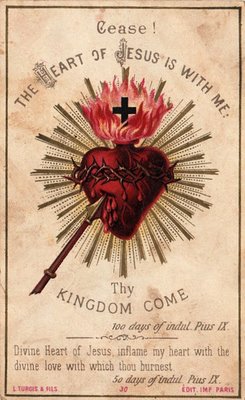
Consecration to The Sacred Heart.

Act of Consecration to the Sacred Heart

O Sacred Heart of Jesus, to Thee I consecrate and offer up my person and my life, my actions, trials, and sufferings, that my entire being may henceforth only be employed in loving, honoring and glorifying Thee. This is my irrevocable will, to belong entirely to Thee, and to do all for Thy love, renouncing with my whole heart all that can displease Thee.

I take Thee, O Sacred Heart, for the sole object of my love, the protection of my life, the pledge of my salvation, the remedy of my frailty and inconstancy, the reparation for all the defects of my life, and my secure refuge at the hour of my death. Be Thou, O Most Merciful Heart, my justification before God Thy Father, and screen me from His anger which I have so justly merited. I fear all from my own weakness and malice, but placing my entire confidence in Thee, O Heart of Love, I hope all from Thine infinite Goodness. Annihilate in me all that can displease or resist Thee. Imprint Thy pure love so deeply in my heart that I may never forget Thee or be separated from Thee.

I beseech Thee, through Thine infinite Goodness, grant that my name be engraved upon Thy Heart, for in this I place all my happiness and all my glory, to live and to die as one of Thy devoted servants.

Amen.
.-- St. Margaret Mary Alacoque

from the book
Devotion To The Sacred Heartby Fr. John Croiset, S.J.


Monday, 9 June 2014

Spiritual Warfare Is Real Folks


Those who do not believe in the activity of the demonic, or of the good angels around us cannot see that what is unseen is greater than what is seen.

Several of us who pray had a horrible weekend, despite the great joy and glory of three new priests and two new deacons in this diocese.

Some had terrible nightmares, some headaches, some nervousness and gross, unnatural anxiety.

Something happened for two days in this city to cause this. You can look up the reason, but talking to my prayer warrior friends last night, we were aware of a huge evil bearing down upon us all, reminding us all never to become complacent in the fight for goodness, for the Church, and as the Church Militant, there is no respite.

None.

If you want to find out the details, just look at several things happening in the Midwest this past weekend.

The jaws of evil are open, swallowing thousands, if not millions, of people who do not realize to where they are headed.

The jaws of hell open to those who flaunt God's natural and supernatural laws.

I cannot believe how many parents take their children to the various parades which wove through small cities in this part of the world this weekend.

June is official  Lesbian, Gay, Bisexual, and Transgender Pride Month. It is REALLY the month dedicated to  the Sacred Heart of Jesus.

Take your pick. 

One must choose.


Ok, I am working on the book


The book by Cardinal Manning, sitting here on the table in the coffee shop, is fantastic. I can hardly decided what to highlight.

Three small points:

One, all people are given enough grace for salvation.

Two, there are, (I have written on this before, under "grace" tag), three types of grace. Preventing grace is "God going before us by His operations in every good thing we do."

In fact, preventing grace is why we were baptized in the first place. God thought of us from all eternity, planning our baptisms and our entries into grace.

The second type of grace is cooperating grace, which is not merely leading but helping grace.  This grace strengthens us.

The third type is that which makes us perfect. This grace "accomplishes and crowns the work of God in us."

Imagine Divine Providence, God from all time thinking of each one of us, seeing us in sanctifying grace, desiring that we persevere in baptismal innocence, as do so many of the saints.

Each one of us is the object of God's special love. Faith, hope and charity spring from God's graces in us.

As Manning writes, "God is both the author and the perfecter of our salvation" However, our will is "actively at work in it from the beginning to the end." The Cardinal reminds us that there is only one grace in which our wills are not operative, and that is the grace of baptism.

God begins grace in us, as He does our natural existence. Manning notes, "It was the love of God which willed to create us; and His power following His will called us into existence out of the boundless multitude of possible creatures, leaving more than the mind of man can imagine non-existent still. This wonderful work of God's love to us, calling us into existence, was a preventing grace of His sovereign love, wisdom, and goodness towards us."

Stuff for meditation, indeed.

to be continued...

From SPUC


Saturday, 7 June 2014

Nigerian village chief astonished to meet English woman with six children

Antonia Tully, along with other speakers at the International Family and Pro-Life Conference hosted by the Catholic Bishops of Nigeria, visited a poor village on the outskirts of Abuja where the conference is taking place. Antonia, Pat Buckley and I are speaking at the bishops' conference on behalf of SPUC.

Here's how Antonia described her trip:
"The group was accompanied by Sister Cecilia, a Medical Missionary of Mary, who runs an outreach project to support and care for vulnerable families in the village of Dutse Alhaji.
"By western standards, Dutse Alhaji presents a shocking picture. The houses are crumbling, roughly-built brick dwellings with corrugated iron roofs. Families cook over open fires. The narrow pathways between the houses are umade dirt tracks, with open waste waterways criss-crossing the village. This is a very poor place.
"The visiting party was welcomed by the village chief, a Muslim, who invited the group into his palace - a lowly building only slightly better than the surrounding houses.
"Having removed their shoes, the other visitors and I sat on the floor while the chief presided over the gathering from his sofa, dressed in his regal robes.
"I introduced myself saying that I was married with six children and in my role at SPUC I do a lot of work with Muslim mothers in England, helping them to protect their children from immoral sex education.
"Replying to his visitors, the village chief expressed his astonishment at meeting a white woman who has six children. 'Why are we being told that we should only have two children?' he exclaimed.
"The chief spoke of the common ground tween Islam and Christianity ... that the people of both religions should strive to lead Godly lives and protect unborn children. The chief also said that he wanted to give a message to the people of his village that men and women must be faithful to their partners.
"The purpose of the visit to Dutse Alhaji was to witness at first hand the target of the International Planned Parenthood Federation and the other agencies of the culture of death. 
"Yes, the villagers of Dutse Alhaji are living in very poor circumstances. Yes, every effort must be made to improve their material circumstances.
"But bribing and cajoling the villagers of Dutse Alhaji, as the population control lobby commonly does, into accepting contraception and abortion, is not the solution. Offering the poor people of villages like Dutse Alhaji contraception and abortion is not the answer to their daily hardships."

 
Comments on this blog? Email them to johnsmeaton@spuc.org.uk

How Did These Kids Become This Way?

I was in a waiting room today and the twenty-something girl next to me was playing a game on her phone. Ping, ping, ping..

The receptionist's phone was ringing as the waiting room was crowded. The young gamer said out loud, "Answer your phone. It bothers me." No one said anything. No one corrected her.

I was so amazed, I could hardly believe the insanity.

Sigh....the future does not look good here, folks.

For Me, For You

“Don’t let yourselves be discouraged by failure or anxiousness that wants to remove your dreams, that wants to close you into its dark mentality rather than letting you fly in the light of hope. Please, do not fall into mediocrity, into that mediocrity that lowers and makes us grey, for life is not grey, life is for betting on grand ideas and for great things." ~Pope Francis to a young pilgrim, June 7, 2014

There will be more photos

Sacred Heart Cathedral

My Weekend

My "second son". Guillermo Trevino, was ordained a transitional deacon this weekend. He is one of my son's best friends. I have another second son in a seminary in London, plus supertradson. I have promised to pray for these men for the rest of my days.

I suggest you choose three sems, deacons and priest to pray for especially.

Lots of photos. See if you can find my Aged Ps. The Deacon served at the Mass on Sunday in the parish where I was baptized, received First Confession, First Communion and Confirmation. The ordination, one of several, was in the Cathedral.

Viva Christo Rey.


A Positive And A Negative in The Dark Night

http://upload.wikimedia.org/wikipedia/commons/c/ce/2012-mule-deer-male.jpg
Many weeks have passed since I have written on the Dark Night. Today, I want to emphasize one aspect, returning to some of the ideas written last year. Just use the tags.

A double-edged sword of the Dark Night is the revelation of the depth of one's sins, and more specifically, the deep-rooted predominant fault.

The down-side is the realization that one should and does deserve hell for one's sins. To face the pure God and see the horror of sin is part of the purgation of the Dark Night.

The upside of this is the gaining of the virtue of humility.

Being in the Dark Night and sensing one's sins is very much like an experience I have been having for three weeks, since about May 23rd.

As a star-gazer, I go out at night and study the sky. But, on that night dated above, I could hear the loud snorting of a large deer. Now, most of the deer in this area are White-Tails, but this deer which I could barely sense in the darkness, was much larger and probably a Mule Deer.

Since that time, almost every night, this large deer has passed through the property, snorting, pawing, making noises which indicate that it is claiming the farmyard for its territory.

I have not been able to see this large, loud deer, most likely a buck.

But, I know it is here, even tonight, underneath my window.

It lets me know who is boss. It is intelligent enough to avoid the motion lights.

The same is true for my predominant fault. I can sense it and see the results of it, but to shine the light on it fully seems impossible. But, I must ask God to shine the light on this sin, or I shall never be one with Him, the Bridegroom.

He will not come until the Bride is purified.

Like the buck, the sin comes and goes, making noises in the dark. I must pray for complete sight and this is scary, as one immediately realizes how unlovely one actually is and of all things, we all want to be loved.

Disclosure brings risk, but without taking the risk, one can never be united with God until after purgatory.

And, the Church needs saints.

To see one's sins humbly and humbly to accept the radical love of God forms the basis for the journey into the Dark Night.

There are times when one is persuaded one is going to hell,.

This is not a bad insight but a truthful one.

Such are some of the notes from the Dark Night....


BTW, the Mule Deer have a black bit on the tail and the White-Tails do not.

Repost Out of Frustration

Wednesday, 29 May 2013


The Rational Catholic....needed

by Vivian Forbes (1927) for Parliament’s History of the “Building of Britain”
© Palace of Westminster
Sigh, the same old problem is on twitter and the net again...people simply do not know how to argue rationally.

Which brings me to the point of debate with atheists and even fallen-away Catholics. As a former teacher of 

argumentation and debate, I taught my students to look at both sides and argue point by point.

This is the classical way of debating. One must understand the opponents' points of views before engaging in debate.

Most modern people do not know how to argue from reason. They have knee-jerk reactions, and very low 

levels of rational discourse. Logic has not been required in secondary education for two generations in the States.

Many of the huge cultural problems which will be and are facing Catholics today are owing to the lack of the 

ability to argue one's point from reason. We have been let down both by Catholic politicians and Catholic clergy 
on the moral issues of the day in this fair land of common law.

Argumentation was part of the training of and used by some of the great martyrs of England, Wales, 

Scotland, and Ireland. I think especially of SS. Thomas More, Edmund Campion and Oliver Plunkett. 
You can read the transcripts. One may call their methods "apologetics", such as Campion's Brag.

The knew how to put forth the Catholic position and engaged those of opposing beliefs.

Doncha' think we need to teach our children and grandchildren how to engage the enemy with the question 

and answer method of Thomas Aquinas, for one example?

I always start by asking questions, such as "Well, what do you think of this?"

Learn how to debate before you will not be able to do so, before freedom of speech disappears in Great Britain 

and in America.

Sunday, 8 June 2014

Called to Be A Cell Within A Cell

The journey into contemplative prayer is hard work. Beginners need guidance. I am a beginner.

The pitfalls are discouragement and pride. But, one must go forward and not falter. Contemplative prayer begins with hard work, and for the proficient, ends up in infused contemplation.

This type of prayer leads to the infused knowledge of God, but begins with acquired contemplation. One cannot confuse the two, and Garrigou-Lagrange is clear on the definitions.  But, this is the prayer which begins when one gives time to God in order to meet Him as He wants to be found. One cannot rush this type of prayer, nor expect God to work in every person in the exact same way. Yet, we are all called to this.

Because intellectuals have such active lives and imaginations, time must be set aside for the emptying of memory, understanding, and will. I have written on this before on this blog.

The happy correspondence of this type of prayer for me is that it follows a life of reading and thinking in overlaps involving the Maritains, Garrigou-Lagrange, and, of course, Thomas Aquinas.

We are all called to this type of prayer, but I could not arrange my life to answer this deepening call until today. My health did not let me stay in Tyburn, but i still need the door to open for me to be in a place where I have the freedom to follow this call. One needs strict privacy and time to be with God, to wait on God. I can become more of a cell within a cell in quiet but not in noise or interruption. As a beginner, I want to share the trials and tribulations of contemplation.

I shall share insights with you all as I go along, as I am, always, a teacher as well as a pray-er.

This is not a prayer of visions, by the way. One moves into a mental and spiritual state where God can finally reveal Himself as He wants to be known. This is the way of emptying. I am grateful for the opportunity to pursue the Bridegroom, Who removed Himself from me for a time. But, I need the space.

All preconceived ideas of how He meets us pass away. One is not in control of the relationship, but God is totally.

Here is the goal of giving this time to God.


Song of Solomon 3

Douay-Rheims 
In my bed by night I sought him whom my soul loveth: I sought him, and found him not.
I will rise, and will go about the city: in the streets and the broad ways I will seek him whom my soul loveth: I sought him, and I found him not.
The watchmen who keep the city, found me: Have you seen him, whom my soul loveth?
When I had a little passed by them, I found him whom my soul loveth: I held him: and I will not let him go, till I bring him into my mother's house, and into the chamber of her that bore me.


Virgin of The Order of Malta


St. Flora, 1347A.D. Patron of abandoned, converts, single laywomen, and victims of betrayal. Flora was born in France about the year 1309. She was a devout child and later resisted all attempts on the part of her parents to find a husband for her. In 1324, she entered the Priory of Beaulieu of the Hospitaller nuns of St. John of Jerusalem. Here she was beset with many and diverse trials, fell into a depressed state, and were made sport of by some of her religious sisters. However, she never ceased to find favor with God and was granted many unusual and mystical favors. One year on the feast of All Saints, she fell into an ecstasy and took no nourishment until three weeks later on the feast of St. Cecelia. On another occasion, while meditating on the Holy Spirit, she was raised four feet from the ground and hung in the air in full view of many onlookers. She also seemed to be pierced with the arms of Our Lord's cross, causing blood to flow freely at times from her side and at others, from her mouth. Other instances of God's favoring of his servant were also reported, concerning prophetic knowledge of matters of which she could not naturally know. Through it all, St. Flora remained humble and in complete communion with her Divine Master, rendering wise counsel to all who flocked to her because of her holiness and spiritual discernment. In 1347, she was called to her eternal reward and many miracles were worked at her tomb. 

A reader gave me this tip. Now, Flora's feast day is either on June 11th or October 5th, but as I have been thinking of my single, laywomen friends, I wanted to highlight her today.

She is also a Virgin of the Order of Malta, which is highly interesting to me.

More here about her.


I think it would be very cool to be a woman saint of the Order of the Knights of Malta.


Prayer:
Almighty and merciful God, who wished blessed Fleur to love and live as a virgin in the Order of St. John of Jerusalem, grant that, following her example, we also may love you more and more. We ask this through our Lord Jesus Christ your Son, who lives and reigns with you and the Holy Spirit, one God, for ever and ever. Amen.
(From: The Missal with readings of the Order of St. John of Jerusalem of Rhodes, & of Malta, London 1997)