Friday, 25 October 2013
On The Lectio Divina

I went to a prayer and study day on the Lectio Divina, not because I needed to learn about this practice, but in order to meet some old friends. The two priests involved in the day were fantastic, and, as I was the only one taking notes, one of the organizers asked me to share some of the ideas of the day.
The priest who presented the material from the Book of Ruth was Father Stefan Attard, who teaches at the University here in Malta.
I shall not share all the details of the talks, but will highlight some of the important parts of Fr. Attard's unpacking of Ruth, and also his prayer meditation.
First, when one is approaching using Scripture in the Lectio Divina, as many of you know, the Catholic does not use any interpretations of Scripture, but those instructed by the Church. The first step is to understand the text from a historical and linguistic point of view, as well as how the particular book fits into the Canon of the Bible, as decided by Holy Mother Church.
Fr. Attard reminded us that Ruth, a story taking place in the time of the Judges, actually was written much later, as late as 450 BC.
As this short book is known to most Catholics, let me move on to a few points made by Father Attard for our consideration. The significance of marriage would be one of these seminal points. The book begins with marriages and ends with a marriage. The theme of marriage is important, as the love of God is shown through marriage, but also the love of God for His People, the Hebrews, is shown through the excellence of the person of Ruth herself.
Father emphasized Ruth's superior holiness by underlining the passage in the last chapter, Chapter Four, when the comparison of Ruth to Leah, Rachel and Tamar was made. The significance of the comparison is my second point from this talk. Ruth's holiness is seen in her fidelity, selflessness and purity.
Ruth is compared to the great wives of Israel, the mothers of the Twelve Tribes. These women are keys to the entire nation of Israel and to the genealogy of King David, and Christ Himself. But, Father pointed out that Ruth, as a Gentile, is being held up as equal and even superior in her love for Naomi and for Boaz, as she followed a poor mother-in-law into the Promised Land without any promises, with only a future of poverty. Ruth's faith in God was greater than most.
Also, Ruth is compared as being superior to Tamar, who had to trick Judah into fulfilling the levirate law of descendants. Ruth did not trick Boaz, but remained pure and trusting in God for the fulfillment of her destiny and the carrying on the the family name.
Ruth is shown as having complete trust in God, and as a Gentile, this is important for all of us who come from Gentile stock.
Another point made by Father Attard was that Ruth was a foreigner, and that the people of God should always be open to foreigners. As one of two foreigners in an audience of about sixty ladies, I found this emphasis interesting. That the people of God, of the promise, have a Moabitess as one of them shows the inclusiveness of God in His plan for salvation.
Father noted that at the time of the writing of the book, there had been a reaction by the Prophet Ezra and Nehemiah regarding the number of Hebrew men who were marrying Moabite women. (Perhaps they were better looking--or more virtuous.) That the author of the book repeats that Ruth was a Moabitess at least seven times, indicates that he wanted to show that even Gentiles could be holy spouses.
This background of the book led to the second talk which was a small prayer service, skipping the second stage of Lectio Divina, which is personal meditation, a la St. Ignatius, involving the active imagination, to the third stage, which is prayer. Father led the group through a series of prayers based on the book, including a prayer for openness to foreigners, to trusting totally in God, and the fact that God wants us to pursue holiness here and now.
It should be noted that Lectio Divina takes time and practice, even years, before one enters into Active Reflection, which I have noted on this blog in the perfection series.
On other women from the Bible...
http://supertradmum-etheldredasplace.blogspot.com/2013/09/on-beauty-two.html
http://supertradmum-etheldredasplace.blogspot.com/2012/06/meditation-on-rebekah-for-my-sisters.html


The Breaking of the Storm

...is the name of this painting of the great first martyrs in England in 1535, the great Carthusians of London. I have written about them before. See links below.
Today is the Feast of the 40 Martyrs of England and Wales, a feast which includes the above and SS. Edmund Campion, Cuthbert Mayne, Margaret Ward and others.
I think it is a good time to teach the lives of these saints to your children. Name your new babies after them. Seek their patronage for your families.
My own son is named after two of the greatest martyrs of England. I could senses the signs of the times over 25 years ago.
The Breaking of the Storm will happen in my lifetime and yours.......
Here are some other posts on this subject.
http://supertradmum-etheldredasplace.blogspot.com/2013/02/are-you-willing-charterhouse-martyrs.html
http://supertradmum-etheldredasplace.blogspot.com/2013/02/the-charterhouse-martyrs-two.html
http://supertradmum-etheldredasplace.blogspot.com/2012/09/charterhouse-in-london.html
http://supertradmum-etheldredasplace.blogspot.com/2012/09/st-hughs-parkminster.html
http://supertradmum-etheldredasplace.blogspot.com/2013/01/perfection-and-martyrdom.html
correction from Catholic Online thanks to a reader
In England, these martyrs were formerly commemorated within the Catholic Church by a feast day on 25 October, which is also the feast of Saints Crispin and Crispinian, but they are now celebrated together with all the 284 canonized or beatified martyrs of the English Reformation on 4 May.
In Wales, the Catholic Church keeps 25 October as the feast of the 'Six Welsh Martyrs and their companions'. The Welsh Martyrs are the priests Philip Evans and John Lloyd, John Jones, David Lewis,John Roberts, and the teacher Richard Gwyn. The 'companions' are the 34 English Martyrs listed above. Wales continues to keep 4 May as a separate feast for the beatified martyrs of England and Wales.
Living in Truth or Deceit

People make choices daily whether to lie or tell the truth. Now, some people begin to lie on a regular basis and finally lose the ability to distinguish truth and deceit. Sometimes, people feel they have a right to lie to certain people and not to others.
In Catholicism, lying is a sin. Deceitfulness is a sign of pride and irresponsibility. Catholics follow the Bible in calling Satan, "the Father of Lies".
However, some religions allow deceit. Today, I met a person who was asking me questions. I asked him if he was a Catholic. He said "yes", but immediately, I knew he was lying. He told me his name and it is a Muslim name. He has a right, according to his religion, to lie to me, as I am, in his religion, as a Catholic, an infidel.
Sadly, I could tell that for this man, lying was a habit. Sadly, one cannot trust liars or have real friendships with them. Sadly, one must come to shun those who live in lies. These people have chosen to live in a darkness and not in a light, the Light Who is Christ.
I found this information on an Islamic website. You may find it interesting.
http://www.thereligionofpeace.com/quran/011-taqiyya.htm
Question:
Are Muslims permitted to lie?
Summary Answer:
Muslim scholars teach that Muslims should generally be truthful to each other, unless the purpose of lying is to "smooth over differences."
There are two forms of lying to non-believers that are permitted under certain circumstances,taqiyya and kitman. These circumstances are typically those that advance the cause Islam - in some cases by gaining the trust of non-believers in order to draw out their vulnerability and defeat them.
The Qur'an:
Qur'an (16:106) - Establishes that there are circumstances that can "compel" a Muslim to tell a lie.
Qur'an (3:28) - This verse tells Muslims not to take those outside the faith as friends, unless it is to "guard themselves."
Qur'an (9:3) - "...Allah and His Messenger are free from liability to the idolaters..." The dissolution of oaths with the pagans who remained at Mecca following its capture. They did nothing wrong, but were evicted anyway.
Qur'an (40:28) - A man is introduced as a believer, but one who must "hide his faith" among those who are not believers.
Qur'an (2:225) - "Allah will not call you to account for thoughtlessness in your oaths, but for the intention in your hearts" The context of this remark is marriage, which explains why Sharia allows spouses to lie to each other for the greater good.
Qur'an (66:2) - "Allah has already ordained for you, (O men), the dissolution of your oaths"
Qur'an (3:54) - "And they (the disbelievers) schemed, and Allah schemed (against them): and Allah is the best of schemers." The Arabic word used here for scheme (or plot) ismakara, which literally means deceit. If Allah is deceitful toward unbelievers, then there is little basis for denying that Muslims are allowed to do the same. (See also 8:30 and 10:21)
Taken collectively these verses are interpreted to mean that there are circumstances when a Muslim may be "compelled" to deceive others for a greater purpose
From the Hadith:
Bukhari (52:269) - "The Prophet said, 'War is deceit.'" The context of this is thought to be the murder of Usayr ibn Zarim and his thirty unarmed men by Muhammad's men after he "guaranteed" them safe passage (see Additional Notes below).
Bukhari (49:857) - "He who makes peace between the people by inventing good information or saying good things, is not a liar." Lying is permitted when the end justifies the means.
Bukhari (84:64-65) - Speaking from a position of power at the time, Ali confirms that lying is permissible in order to deceive an "enemy."
Muslim (32:6303) - "...he did not hear that exemption was granted in anything what the people speak as lie but in three cases: in battle, for bringing reconciliation amongst persons and the narration of the words of the husband to his wife, and the narration of the words of a wife to her husband (in a twisted form in order to bring reconciliation between them)."
Bukhari (50:369) - Recounts the murder of a poet, Ka'b bin al-Ashraf, at Muhammad's insistence. The men who volunteered for the assassination used dishonesty to gain Ka'b's trust, pretending that they had turned against Muhammad. This drew the victim out of his fortress, whereupon he was brutally slaughtered despite putting up a ferocious struggle for his life.
There is more on that website on this subject of permissible lying. A reader reminded me that we are to pray for our enemies. I do and hope you do as well.
Thursday, 24 October 2013
Persecution Watch from Fort Hood
http://www.infowars.com/fort-hood-soldiers-told-christians-tea-partiers-a-radical-terror-threat/
This is important, readers. Please take a minute and read the article and links.
This is important, readers. Please take a minute and read the article and links.
Wednesday, 23 October 2013
The Fear of Being Loved and the Dark Night of the Spirit

Pysche and Eros
I have written on this subject before on this blog. In ourselves, as one approachs God in the Dark Night, one begins to realize that for a long time, fear has blocked one's openness to the love of God and the love of other people.
When I wrote about this phenomenon before, I was thinking of particular people I knew in the past who never became intimate with another person. I thought of one beautiful young woman who was hurt several times in love affairs and finally decided never to love or be loved again.
She decided to live in the shadows of what it means to be human.
Like a grey ghost, her life was circumscribed to choosing death rather than life, because the soul curls up and dies without love. She decided that the suffering of love was not worth the joy of love. She decided that it was too painful to both love a person who was imperfect and to love herself as imperfect.
| Thanks to Wiki for Teresa in Ecstasy |
I thought of three men I knew who closed their lives to the adventure of love for three completely different reasons. The first only wanted to give and not take. He was too afraid to take, which meant that his emotional life was stunted by pain from his past.
The second could only take and not give. He was incapable of breaking through defensiveness and pain, moving into a forgiveness, and letting go of his past so that he could love those in his present life. Again, his life remained ghostly and on the edges of human potential. Although he wanted love, he did not learn how to give and get out of himself.
The third person was too afraid to engage at all in either giving or taking love. The traumas of his life caused to live in a safe world, not taking any chances to love or be loved. Of all these three men, this one remained the most haunted and circumscribed, again, like a familiar ghost, stuck in his small surroundings and highly organized world, not letting anyone break down the walls of fear and self-hatred.
How sad.
In the Dark Night, one faces the real fear of both losing God's love through sin and self-will, and gaining God's love in humility and truth.
Real love demands that one see one's gross failings and yet remains open to love, not hiding, not saying no out of a false pride or false self-loathing.
The balance is all.
In the Dark Night, God comes again and again into the shadow world of the loss of memory, understanding and will to meet one in a completely new way.
A wise priest who understands the way of perfection told me three things today I would like to share with you. I have added ideals from the myth of Psyche and Eros, one of my favorite myths, to help clarify these words.
The first is not to give up on the slow process of perfection, paying attention as one goes along and even finding joy in the painful stages. But, one must pray for all blocks to God to be removed. One of these blocks can be the fear of being loved by a God...remember the myth of Psyche. She did not know she was being loved by God and was tricked into trying to see who it was who was loving her. She should have waited and trusted in the darkness of the night and not lit the candle to see Love. She was rushing illumination and infused knowledge, which the god would have given her if she would have waited. She thought that the most beautiful god in the heavens was a beast who was deceiving her. So, too, one must learn to trust God in the Dark Night.
This joy is part of the knowledge that one is truly following God to the best of one's ability and that God is faithful in His pursuit of His beloved. One must wait for God but also wait for one's self and not do damage to the natural process of the growth to perfection, which leads to the second point.

The second is that the process is faster for some and slower for others totally depending on God's Will and plan for that person. One cannot push the process to go faster, or to slow it down without doing great harm to the soul. Psyche had to perform tasks in order for her to be reunited with Eros. She could not rush these, and several things aided her in these tasks because she was open and humble. So too, one must do the work, but in humility, not always knowing the way. One is afraid that if the other person who loves really knows one, that the love would end. The tasks given to each one of us strengthen one's trust in God. The tasks demand that one learns to be humble enough to accept love even though one is imperfect and still sinning those little venial sins.
The third wise thing the priest said was that God wants to give each one of us more than one can imagine. He desire to reveal Himself to us and to be one with us. So, too, with Pysche, who not only ended up marrying her beloved god, Eros, but having a child with him, named Joy. Sometimes people are afraid of what God will ask of them if they accept God's Love. This fear of responsibility fades away in the Face of Divine Providence.
What the ancients tell us is also what the mystics tell us in that joy only comes through trials and trust and loving God. Joy comes eventually, after fear and false pride die. One must not be afraid. One must trust.
Such are hints for those in the Dark Night of the Spirit....
Re-post from Bloy
Saturday, 8 December 2012
More from Bloy on Sanctity or Perfection........

We are created that we may become saints.
If anything is written, this surely is. Sanctity is so required of us, it is so inherent in human nature, that God presumes its existence, so to speak, in each of us, by means of the sacraments of His Church, that is, by means of mystical signs invisibly making operative in souls the beginning of Glory. Sacramentum nihil aliud nisi rem sacram, abditam atque occultam significat. (A Sacrament is nothing other than a sacred, withdrawn and mysterious thing.) This sacred and mysterious thing thus alluded to by the Council of Trent has the effect of uniting souls to God. The most transcendent theology contains nothing stronger than this affirmation.
There are even three sacraments that imprint a character, and whose mark cannot be effaced. Thus we are virtually saints, pillars of eternal Glory. A Christian may disown his baptism, debar the Holy Spirit from his thought, and, if he is a spoiled priest, reject the succession of the Apostles conferred upon him by holy orders; in short, he may damn himself forever; nothing will be able to disunite him, to separate him from God, and what an unfathomable mystery of terror is this persistence of the sacred Sign even into the infinite pangs of perdition. Hence it must be said that hell is peopled with fearsome saints become the companions of the hideous angels!
However evil such saints or angels may be, they have God in them. Otherwise they would not be able to subsist, even in the state of nothingness, since nothingness, also inconceivable without God, is the eternal reservoir of Creation.
All that God has made is sacred after a fashion which only He could explain.Water is holy, stones are holy, plants and animals are holy, fire is the devouring likeness of His Holy Spirit. His entire work is holy. Man alone, who is more holy than other creatures, will have none of sanctity.e considers it ridiculous and even insulting to his dignity. Such is, in the twentieth century of the Redemption, the visible and perceptible result of the unfaithfulness of so many shepherds, of the monstrous blindness brought about by those who should have been the light of the world, and who extinguished all light.
It is certain indeed that never, at no age of the world’s history, were men as far from God, as contemptuous of the Sanctity which He demands, and yet never has the necessity for being saints been so manifest. In these apocalyptic days it truly seems as though only a film of nothingness separates us from the eternal gulfs.
“Not all men are called to saintliness,” says a Satanic cant phrase. To what then are you called, O wretch? and above all in our day and age? The Master said you must be perfect. He said it in an imperative, absolute way, giving to be understood that there is no alternative, and those whose duty it is to teach His word, by themselves presenting an example of perfection, ceaselessly assert that it is not necessary, that a reasonably trifling average of love is more than enough for salvation, and that the desire for the supernatural way of life is rash, when it is not culpable presumption.
Aliquam partem, “a certain portion,” they argue, debasing an expression in the Liturgy, a tiny little corner in Paradise, that is what we need. To this base retreat, to this formal denial of the divine Promise, they give a color of humility, cunningly omitting the heroic sequel to the two liturgical words, in which is specified that the “portion” in case is nothing less than “the company of the Apostles and the Martyrs.”
But cowardly minds and mediocre hearts can avail nothing against the Word of God, and the Estote perfecti (Be ye perfect) of the Sermon on the Mount continues to weigh upon us infinitely more than all the globes in the firmament.
Sanctity has always been required of us. In older days, it was possible to believe that sanctity was demanded from afar, like a debt due on a vague date, which might possibly lapse. Today sanctity is laid on our doorstep by a wild-eyed, blood-smeared messenger. Behind him, a few steps behind him, are panic, fire, pillage, torture, despair, the most frightful death ..
And we have not even a moment in which to choose!
I began 2012 writing about the pursuit of love and perfection without any idea this would lead to almost the entire them of this blog.
The journey continues, moving from the specific to the general and back to the specific.
Be a saint, through love, wherever you may be.
Statistics on English Catholics

| White British | 74.6% |
| White Eastern European | 9.5% |
| White Irish | 4.4% |
| White Other | 3.9% |
| Black African | 2.5% |
| Mixed other | 1.9% |
| Afro-Caribbean/Other | 1.7% |
| Asian | 1.5% |
Does this list surprise you? It did surprise me. From 2008 statistics on Catholics in England, which make up only 4.2 million of the entire population. We are a minority Church. And dropping. There are less Catholics in England now than a hundred years ago by some statistics.
In the 2001 UK census, there were 4.2 million Catholics in England and Wales, some 8 per cent of the population. One hundred years earlier, in 1901, they had represented only 4.8 per cent of the population. The percentage of Catholics was at its highest in the 1981 census, with 8.7 per cent.[7] In 2009 an Ipsos Mori poll found 9.6 percent, or 5.2 million, Catholics in England and Wales.[8] Sizeable Catholic populations include North West England where one in five is Catholic.[9] This includes Liverpool which has the highest proportion of any city in Great Britain at 46 per cent; historically, this is due both to a large influx of Irish migrantsafter the 1800 Act of Union, in which Ireland became part of the United Kingdom,[10][11] as well as a high concentration of English recusants living in Lancashire.
To Our Father in Heaven
Pater noster qui es in coelis,
sanctificetur nomen tuum;
adveniat regnum tuum,
fiat voluntas tua,
sicut in coelo et in terra.
Panem nostrum quotidianum da nobis hodie,
et dimitte nobis debita nostra,
sicut et nos dimittimus debitoribus nostris.
et ne nos inducas in tentationem
sed libera nos a malo.

The Unknown God vs. The Known God
We do not worship the Unknown God, as St. Paul reminded the Athenians. We worship a God Who came to earth and made Himself vulnerable to the very creatures He had created.
This vulnerable God is Jesus Christ, the Second Person of the Blessed Trinity, the Son of God and Son of Man. His vulnerability is met by us daily in the Holy Eucharist.
This God comes to us in abject humility. Can we do less than meet Him in humility? God has already endured a Dark Night which none of us could endure. He let Himself be killed on the Cross and experience all the sins, depressions, abandonments, failings of every human being who was ever created.
This God is Pure Love. And, He calls each one of us daily to find Him, as He wants to be found.
He calls and calls and calls. Only fear and pride keep one from responding.
Do not be afraid.
God desires that we know Him and love Him. This is a call to freedom.
Love is only given freely, and is only responded to freely if it is real love.
Manipulation, greed, self-will stop love, both the giving and the taking.
Do not be afraid. From Acts 17...

This vulnerable God is Jesus Christ, the Second Person of the Blessed Trinity, the Son of God and Son of Man. His vulnerability is met by us daily in the Holy Eucharist.
This God comes to us in abject humility. Can we do less than meet Him in humility? God has already endured a Dark Night which none of us could endure. He let Himself be killed on the Cross and experience all the sins, depressions, abandonments, failings of every human being who was ever created.
This God is Pure Love. And, He calls each one of us daily to find Him, as He wants to be found.
He calls and calls and calls. Only fear and pride keep one from responding.
Do not be afraid.
God desires that we know Him and love Him. This is a call to freedom.
Love is only given freely, and is only responded to freely if it is real love.
Manipulation, greed, self-will stop love, both the giving and the taking.
Do not be afraid. From Acts 17...

22 But Paul standing in the midst of the Areopagus, said: Ye men of Athens, I perceive that in all things you are too superstitious.
23 For passing by, and seeing your idols, I found an altar also, on which was written: To the unknown God. What therefore you worship, without knowing it, that I preach to you:
24 God, who made the world, and all things therein; he, being Lord of heaven and earth, dwelleth not in temples made with hands;
25 Neither is he served with men's hands, as though he needed any thing; seeing it is he who giveth to all life, and breath, and all things:
26 And hath made of one, all mankind, to dwell upon the whole face of the earth, determining appointed times, and the limits of their habitation.
27 That they should seek God, if happily they may feel after him or find him, although he be not far from every one of us:
28 For in him we live, and move, and are; as some also of your own poets said: For we are also his offspring.
29 Being therefore the offspring of God, we must not suppose the divinity to be like unto gold, or silver, or stone, the graving of art, and device of man.
30 And God indeed having winked at the times of this ignorance, now declareth unto men, that all should everywhere do penance.
31 Because he hath appointed a day wherein he will judge the world in equity, by the man whom he hath appointed; giving faith to all, by raising him up from the dead.
32 And when they had heard of the resurrection of the dead, some indeed mocked, but others said: We will hear thee again concerning this matter.
33 So Paul went out from among them.
34 But certain men adhering to him, did believe; among whom was also Dionysius, the Areopagite, and a woman named Damaris, and others with them.
Tuesday, 22 October 2013
The Sleeping Lady of Malta
 |
| Thanks to Wiki for The Sleeping Lady of Malta, circa 1,500 BC Of what does she dream, this heavy lady of Malta, resting on her hard bed, hand under her head, like a goddess taking a break from listening to her votaries singing chants over the wine-dark sea? Does she dream, or is her sleep dreamless, that of the dead, who no longer hold imagination or memory? Has she let go of the last images of the Middle Sea's ships bringing her necklaces of shells from Syracuse? Is her dream one of the dancing star-skirted lady? Did her dreams end abruptly, like one caught off-guard in the night, facing a soft journey into eternity? Or, is she still dreaming, holding on to images which she creates for the people of Malta, who no longer know her name? This lady wears the billowing skirts of many goddesses and reveals her breasts to the world, as if to say she is worthy of the worship from those who need fertility. Those yearnings of Maltese maidens lie in the dust of Ħal-Saflieni-few want offspring now. This lady's hair was done by one of the ancestor's of the blow-dry experts of Valletta, and she does not worry about her bare feet, so broken, so lost in memory. Does she does dream of some one, some god beyond the walls of Athens or Kedash? Does he dream of her, he, buried in a cave or sandstorm, with his arm under his head? Or did he find a lissome lass of Dalmanutha or the ancient springs of Achsah? Maybe he preferred dark, like the tents of Kedar? His left arm is under my head and his right arm embraces me. Daughters of Jerusalem, I charge you: Do not arouse or awaken love until it so desires. And, so, perhaps, she sleeps into this tumultuous century, dreaming of lost love.... copyright 2013 |
The Strength of Love in the Dark Night
from St. John of the Cross
But here we must note that although, at the beginning, when this spiritual night commences, this enkindling of love is not felt, because this fire of love has not begun to take a hold, God gives the soul, in place of it, an estimative love of Himself so great that, as we have said, the greatest sufferings and trials of which it is conscious in this night are the anguished thoughts that it195 has lost God and the fears that He has abandoned it. And thus we may always say that from the very beginning of this night the soul is touched with yearnings of love, which is now that of estimation,196and now again, that of enkindling. And it is evident that the greatest suffering which it feels in these trials is this misgiving; for, if it could be certified at that time that all is not lost and over, but that what is happening to it is for the best—as it is—and that God is not wroth, it would care naught for all these afflictions, but would rejoice to know that God is making use of them for His good pleasure. For the love of estimation which it has for God is so great, even though it may not realize this and may be in darkness, that it would be glad, not only to suffer in this way, but even to die many times over in order to give Him satisfaction. But when once the flame has enkindled the soul, it is wont to conceive, together with the estimation that it already has for God, such power and energy, and such yearning for Him, when He communicates to it the heat of love, that, with great boldness, it disregards everything and ceases to pay respect to anything, such are the power and the inebriation of love and desire. It regards not what it does, for it would do strange and unusual things in whatever way and manner may present themselves, if thereby its soul might find Him Whom it loves.
6. It was for this reason that Mary Magdalene, though as greatly concerned for her own appearance as she was aforetime, took no heed of the multitude of men who were at the feast, whether they were of little or of great importance; neither did she consider that it was not seemly, and that it looked ill, to go and weep and shed tears among the guests provided that, without delaying an hour or waiting for another time and season, she could reach Him for love of Whom her soul was already wounded and enkindled. And such is the inebriating power and the boldness of love, that, though she knew her Beloved to be enclosed in the sepulchre by the great sealed stone, and surrounded by soldiers who were guarding Him lest His disciples should steal Him away,197 she allowed none of these things to impede her, but went before daybreak with the ointments to anoint Him.
From the Race Site
Morning Update: Day Four Rolex Middle Sea Race
22 October 2013
Morning Glory Takes the Gun Louay Habib 2013 Rolex Middle Sea Race Line Honours Winner - Morning Glory (GER) Kristina Plattner’s Z-86, Morning Glory has claimed line honours in the Rolex Middle Sea Race. The German Maxi crossed the finish line at the Royal Malta Yacht Club on Tuesday, 22 October at 04:02 19sec, in an elapsed time of 2days 16hrs 12mins 19secs. “I have only raced offshore with my father before, so this was a new experience for me and I was a bit anxious before the race about how it would turn out. However, so many of the crew are old friends and they really looked after me, so it was not too difficult and I really enjoyed the race.” commented Morning Glory skipper, Kristina Plattner. “It is a beautiful race course and watching the sunrise at Stromboli will be a lasting memory. It was so beautiful and calm but at the same time my four hour watch was just finishing, so the dawn meant we could get some rest. The long beat near the finish was very tiring but it was so nice to get a warm reception when we crossed the line.” Volvo Ocean Race skipper, Chris Nicholson was one of the after-guard on board Morning Glory. “The conditions were lighter than predicted but that doesn't surprise anyone. This is a very changeable racecourse, which definitely keeps your concentration. Weather forecast and routing software are not that useful, you have to see what is happening around you and react. We definitely lost a lot of ground in the latter part of the race. It was a dead beat to Lampedusa with a lot of tacks that really slowed our speed towards the end.” Andres Soriano's Mills 72, Alegre was the second yacht to finish the race just before dawn. Alegre beat her close rival Luca Simone's JV72, Robertissima III to the line by more than an hour.
Purgatory or The Dark Night
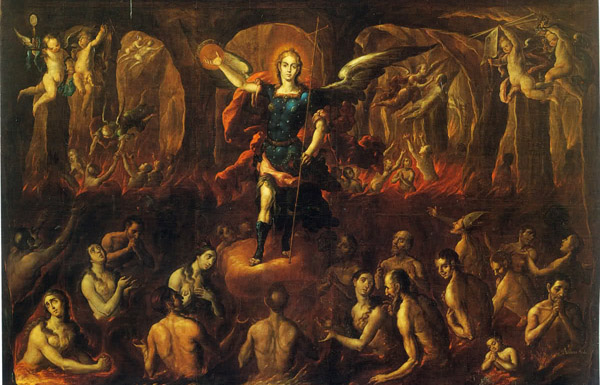
St. John of the Cross calls the Dark Night a "purgatory". And, as he, and later Garrigou-Lagrange tell us over and over, only the perfect see God.
Knowing that only those who have gone through the Dark Night of the Senses and who go into the Dark Night of the Spirit actually are pure enough to be free of the ego and work for God in the Church and not themselves. one wonders why more people do not cooperate with the graces of the Dark Night.
The list I made yesterday, distilling some of the characteristics of the Dark Night from John of the Cross' writings shows that one can endure this purgation here and now.
Why wait until purgatory? Why put off what can be done for the benefit of the Church as a whole and not merely for one's own benefit?
Many Church leaders are stuck in the lowest stages of spiritual growth. This is often too obvious, as actions from those cardinals, bishops, priests, nuns, lay people who are caught up in acting out of their egos rather than doing God's work are clear, if one is allowing God to deal with one in purification.
I do not need to name personages, but it is clear to me that too many cardinals and bishops are acting totally out of worldly standards of seeking fame, status, or achieving worldly goals. If we had more leaders who could give us good examples of humility and a purified will, the Church would be in a different place.
That so many of the laity think they can only achieve purgatory, instead of perfection, is a tragedy of our times. One is not a saint if one makes it to purgatory. Sorry, saints are those willing to go through purgatory on earth, another name for the Dark Nights of the Senses and Spirit.
To be continued....
Monday, 21 October 2013


Interesting discussion
I and others have commented on the Times of Malta article on ssm. Do you want to jump in? We are living in increasingly godless times. http://www.timesofmalta.com/articles/view/20131020/opinion/No-to-same-sex-marriage-by-stealth.491096#.UmUmSnDVBD8
Subscribe to:
Posts (Atom)