http://bigstory.ap.org/article/e1e6d95aac1b4a3ca24d6ce40b1aec02/ethiopia-3-days-mourning-islamic-state-killings
and the number of people fleeing Libya who drowned in two ship accidents is 720 at least.
http://www.france24.com/en/20150420-mediterranean-migrants-distress-signal-boat-italy-greece/
and
http://www.france24.com/en/20150419-eu-hold-urgent-meeting-after-migrant-boat-disaster-libya-italy/
Monday, 20 April 2015
All along, I have said
Catholic institutions of learning should not accept government money....ever for anything.
http://www.cardinalnewmansociety.org/CatholicEducationDaily/DetailsPage/tabid/102/ArticleID/4136/Wyoming-College%E2%80%99s-Decision-to-Forego-Federal-Aid-Protects-Catholic-Identity.aspx
http://www.cardinalnewmansociety.org/CatholicEducationDaily/DetailsPage/tabid/102/ArticleID/4136/Wyoming-College%E2%80%99s-Decision-to-Forego-Federal-Aid-Protects-Catholic-Identity.aspx


Here we go...from LifeSiteNews
Public records show that Rick Estridge, Catholic Relief Services’ Vice President of Overseas Finance, who has worked for the U.S. Bishops’ official international humanitarian agency since as long ago as 2001, “married” his homosexual partner in Baltimore, Maryland, on April 4, 2013.
The Lepanto Institute obtained thepublic marriage record from the City of Baltimore for Estridge and William Goretsas, Jr. The document confirmed the homosexual “marriage,” which took place the same month that Estridge was promoted by CRS to a vice president role, according to Estridge’s LinkedIn profile.
SPUC News
| 20 April 2015 |
|---|
| Top story: Morning-after pill leads to higher rates of sexually-transmitted infections, study suggests A recently-published study suggests that access to morning-after pills leads to higher rates of sexually-transmitted infections (STIs). The study was authored by Dr Karen Mulligan, associate professor of economics and finance at Middle Tennessee State University, USA. [Wiley Online Library, accessed 20 April] Dr David Paton, professor of industrial economics at Nottingham University Business School, told SPUC today: "It is very interesting to see further confirmation that access to emergency birth control (EBC) does not seem to reduce abortions but leads to higher rates of STIs. This paper is one of the first to explore the mechanisms whereby EBC affects STIs, finding that both rates of 'unprotected' sex and numbers of partners increase in response to over-the-counter EBC. Although this paper uses US data, it is consistent with evidence from the UK. In the light of the evidence from this paper, local and national governments urgently need to review their current policy of aggressive promotion of EBC to young people in schools, pharmacies and sexual health centres." Other stories: Abortion
Family issues
|
Today's Response from The Office of Readings-Waiting
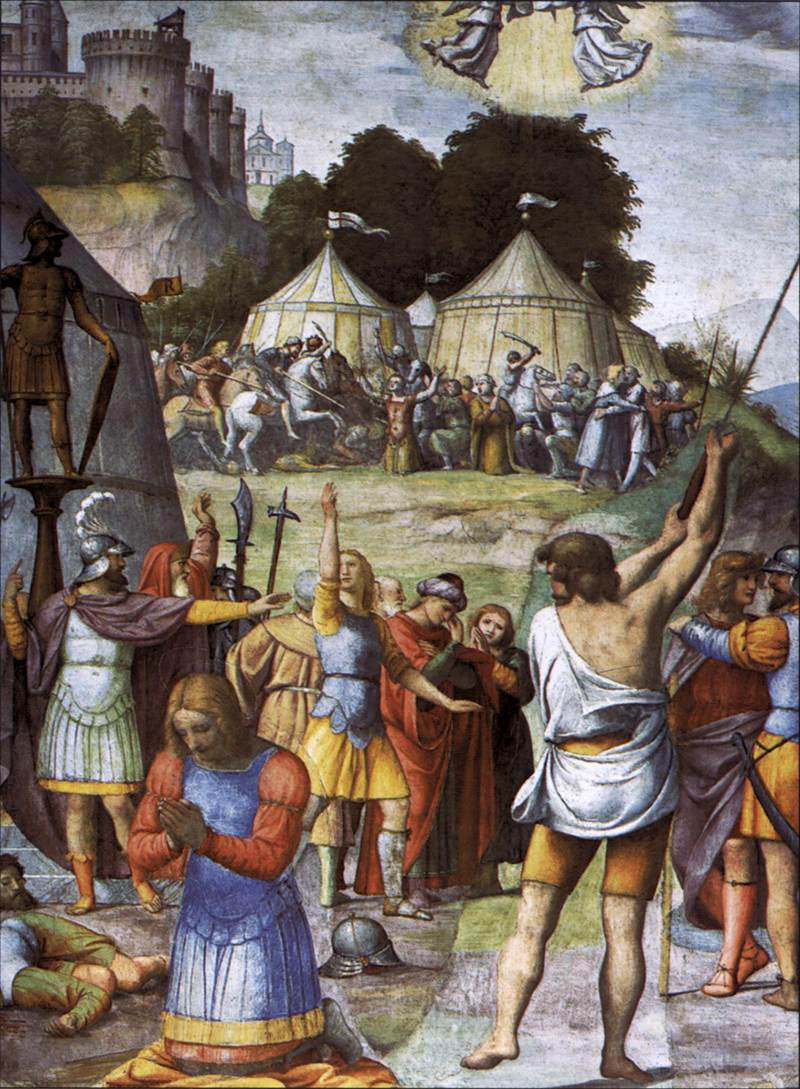
From the altar of God, I heard the voices of those who had been killed, saying: Why do you not avenge our blood? And they received this answer from the Lord: Wait a little longer, until the total number of your brothers and sisters has been reached, alleluia.
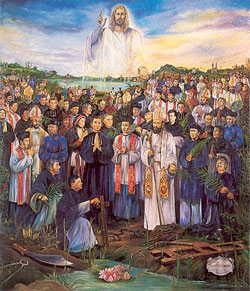 |
| Martyrs of the Dominican Order |
If you, Dear Readers, are not taking advantage of the graces of daily Mass, which some of us desire to attend but cannot, you are passing up a higher place in heaven. The same is true for every hour spent before Adoration.
Passing up chances for grace is a sin of omission and time-wasting. Too many Catholics live in the presumption that they will be saved and go to heaven. We can never be sure of our salvation until we die.
 |
| Claretian Martyrs |
Since we have spoken of the spirit of faith, it is fitting that we
consider what hope in God, or confidence in Him, should be in proficients, and that we state precisely what must be understood by the certitude of hope, which is based on that of faith and has a character sui generis which it is important to note.
Infused hope, no less than faith, is necessary to salvation and perfection. Moreover, to have a generous interior life, it is not sufficient to hope in God weakly and intermittently, as so many Christians do. His often obscure and occasionally disconcerting good pleasure must be loved, accepted with a spirit of filial submission, and the divine help awaited with a firm, humble, and persevering confidence.
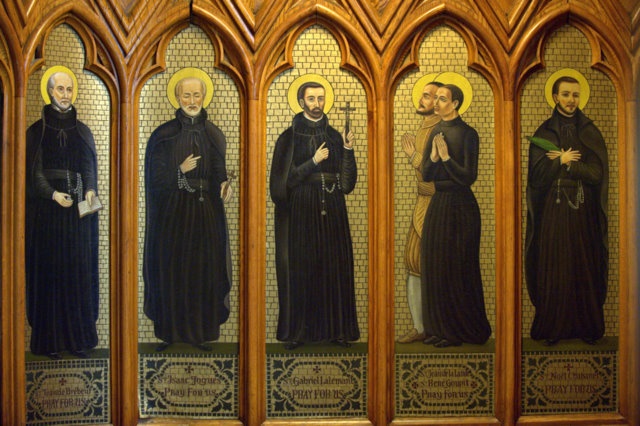
Some of the many Jesuit martyrs below...

DEFECTS TO BE AVOIDED
In connection with this virtue, we should avoid two contrary defects: presumption and discouragement. By noting them at the beginning of our discussion, we may see more clearly the true nature of hope, which rises like a summit between these opposing deviations.
There are two kinds of presumption: either man relies excessively on his own powers, like the Pelagians, not asking as much as he should for the help of God, not recalling sufficiently the necessity of grace for every salutary act; or, on the other hand, he expects from the divine mercy what God cannot grant: for example, pardon without true repentance, or eternal life without any effort to merit it. These two forms of presumption are mutually contradictory, since the first presumes on our strength, whereas the second expects from God what He has in no way promised.
Moreover, when trial and contradiction come, the presumptuous fall into the opposite defect, discouragement, as if the difficult good (bonum arduum), which is the object of hope, becomes inaccessible. Discouragement might lead to spiritual sloth, to acedia, which makes a man judge the work of sanctification too difficult and turns him away from every effort in this direction. He might thus even fall into despair. Many souls oscillate thus between presumption and discouragement, and never succeed in arriving, at least practically, at a true notion of Christian hope and in living by it as they should.
THE TRUE NATURE OF CHRISTIAN HOPE
Less is said about the virtue of hope than about faith and charity. Yet hope is of great importance. Most certainly Christian hope, as an infused and theological virtue, is essentially supernatural, and consequently immensely surpasses the natural desire to be happy and also a natural knowledge of the divine goodness.
By infused hope we tend toward eternal life, toward supernatural beatitude, which is nothing less than the possession of God: seeing God immediately as He sees Himself, loving Him as He loves Himself. We tend toward Him, relying on the divine help which He has promised us. The formal motive of hope is not our effort, it is God our Helper (Deus auxiliator et auxilians), according to His mercy, His promises, His omnipotence.(1)
Thus we desire God for ourselves, but first for Himself; for He is the last End of the act of hope, which should, moreover, be vivified by charity: (2) in other words, by hope, we desire God, our last End, not by subordinating Him to ourselves, like the food necessary to our subsistence, but by subordinating ourselves to Him. Thus it is evident, in contradistinction to the teaching of the quietists, that hope, although inferior to charity, contains nothing inordinate. It is a lofty virtue, though not the greatest of all.
Since, in fact, among the moral virtues, acquired magnanimity, and especially infused magnanimity, has a high place, so far as it makes us tend to great things (as we see in the founders of religious orders, in their works and struggles); with even greater reason, infused hope is a lofty virtue that makes us tend not only toward great things, but also toward God Himself to be possessed for eternity. This truth is emphasized by the fact that hope does not make us desire only an inferior degree of supernatural beatitude, but eternal life itself without fixing the degree. Indeed it leads us to advance always more generously toward God by giving us a greater desire for Him. Three Ages of the Interior Life
Generosity is key.

To be continued this week...
See also this...http://www.speroforum.com/a/COAKSGQWVV7/75602-Coptic-Church-recognizes-sainthood-of-martyrs#.VTUEhyFViko
Why Are American Catholic Bishops Silent?
http://www.asianews.it/news-en/Bishop-of-Sylhet:-Protection-for-tribal-Catholics,-victims-of-expropriation-and-threats-34004.html
Catholic priest stabbed in Bangladesh.
Christians are becoming refugees in huge numbers.
http://www.telegraph.co.uk/news/religion/11546441/Christians-driven-from-the-ruins-of-Nineveh.html
from the article...
Catholic priest stabbed in Bangladesh.
Christians are becoming refugees in huge numbers.
http://www.telegraph.co.uk/news/religion/11546441/Christians-driven-from-the-ruins-of-Nineveh.html
from the article...
It’s the people that one feels sorry for. A generation ago, there were more than a million Christians living in Iraq, a country of 35 million. A year ago there were 400,000. About two thirds are Chaldean Catholic. Tens of thousands took refuge in the city of Erbil, which is under Kurdish protection.
Cardinal Vincent Nichols, the Archbishop of Westminster, has just visited Erbil. He found hundreds of families living in mobile containers. Archbishop Bashar Warda, the Chaldean Archbishop of Erbil, had turned over his cathedral and land to help them. Cardinal Nichols spoke of “hugely impressive” efforts among the refugees to find work and continue education. “It is mostly down to the efforts of the Catholic churches,” he reported, “both here and abroad.”
Speaking of the refugee centres he said: “To begin with, food was provided communally. Now each family cooks for itself. Now families are expected to pay towards their rent, if at all possible.” He saw this as a way of keeping families together, with a sense of self-worth and responsibility. He said: “These families want to go home. They want to go back to their houses and land.”
The Cardinal told the press on Tuesday that a Christian presence in Iraq is essential “not out of a nostalgic sense that this community is 2,000 years old, but as part of building a stable, balanced society in that region.”
People in Britain, I think, can feel helpless at distant suffering on television news. But there is a point in organising aid and showing the Government that the Christians of Syria and Iraq are not forgotten. At the Holy Name church in Manchester, for example, an all-night vigil begins this evening at eight.
Christians say in the Creed each week that they believe in the “Communion of saints”. The belief is that prayer and (if it comes to that) martyrdom benefit all members of the Church. So what happens in Syria and Iraq is of immediate consequence
And here? Why doesn't Cardinal Dolan go visit the areas Cardinal Nichols just did?
Join Me on This Rosary Petition
For some time, I have been using the Our Father and three Hail Marys at the beginning of the rosary to pray not for the Pope's intentions, but for him to fall in love with the Latin Mass.
If you want to join me in this petition, use the poll on the right to say "yes".
UPDATE: the poll is not working as the Yes votes are going into the No category. I tried it more than once. I am taking the poll down. Just comment if you would like to do so on the idea.

If you want to join me in this petition, use the poll on the right to say "yes".
UPDATE: the poll is not working as the Yes votes are going into the No category. I tried it more than once. I am taking the poll down. Just comment if you would like to do so on the idea.
Any Catholic Groups Doing This?

PRESS RELEASE
Pro-Family Leaders Gather at Supreme Court to "Restrain the Judges"
Hundreds of Thousands of "Restraining Orders" to be Delivered
Contact:
Pastor Corey Shankleton 567-337-9399
Steven Hotze, MD 512-799-2260
Mark Gurley: 616-884-5314
FOR IMMEDIATE RELEASE--April 20, 2015
Leaders from across the Nation will host a press conference at the steps of the Supreme Court at 10:00 a.m. on Monday, April 27th--the day before the oral arguments on marriage.
"We will be delivering hundreds of thousands of 'Restraining Orders' from Americans who stand united against a Court contemplating the Roe v. Wade of Marriage." said Janet (Folger) Porter, President of Faith2Action, and producer of the new documentary film on marriage entitled "Light Wins: How to Overcome The Criminalization of Christianity."
"We will obey God rather than judges who violate our Christian beliefs, and the First Amendment of the Constitution," added Porter. "We are calling on Congress to remove their jurisdiction to rule on marriage and defund all enforcement and implementation of every federal anti-marriage ruling."
Steven Hotze, M.D., President of Conservative Republicans of Texas said, "Texans will not follow an unjust ruling, so unless the Supreme Court wants to become irrevelant, they better not issue one."
Those in attendance include:
Janet Porter, President, Faith2Action
Dr. Steven Hotze, President, Conservative Republicans of Texas
Andy Schlafly, Attorney, Eagle Forum
Rev. Bill Owens, Coalition of African American Pastors
Peter LaBarbera, Americans for Truth
Bill Johnson, American Decency
Scott Lively, Abiding Truth Ministries
Glyn Wright, Executive Director, Eagle Forum, Washington, D.C.
David Pickup, LMFT/Reparative Therapy Center of Dallas
Greg Quinlan, Ex-Homosexual, New Jersey Family Policy Council
Grace Harley, Ex-transgender, One Solitary Voice International
Pastor Corey Shankleton, Ex-homosexual, Emerging Streams
Mark Gurley, The Oak Initiative
Diane Gramley, American Family Association, PA
Kay Daly, Coalition for a Fair Judiciary
More information about the "Restraining Orders" can be found at RestrainTheJudges.com. See the trailer for the film at: LightWinsTheMovie.com.
LifeSiteNews has the petition for Archbishop Cordileone.
https://www.lifesitenews.com/petitions/i-stand-with-archbishop-cordileone
On Gifts Three, with a bit of humor...
My images for the understanding of gifts are four saints. Bear with me as I examine their lives to show the difference in "gifting".
The first is Blessed Margaret of Castello, probably the ugliest, and most unlikely of women ever to be called blessed.
This woman was born a dwarf, blind, deformed, hunchbacked and lame. Her "noble" parents disowned her to the point of abandoning her in a church when God did not answer their prayers for a healing. Before that, she had been virtually imprisoned and kept out of sight. She was, therefore, psychologically abused.
But, Margaret was given the gifts of heroic charity, forgiving her horrid parents, and remaining cheerful. She was also given a great intellect, plus infused knowledge, and could even tutor children and teach adults, despite her great infirmities. She could discern demons, and healed those who were sick.
She was homeless, and had to be passed from house to house in the community which finally adopted her. She was never bitter. Her beauty was interior, and God gave her the gift of dying at the age Jesus did, plus being an incorruptible, just to prove to us that God's chosen ones are His choice, not ours.

She would have not been able to take a gifting course as she was too poor to pay the fees, blind, and deaf.


The first is Blessed Margaret of Castello, probably the ugliest, and most unlikely of women ever to be called blessed.
This woman was born a dwarf, blind, deformed, hunchbacked and lame. Her "noble" parents disowned her to the point of abandoning her in a church when God did not answer their prayers for a healing. Before that, she had been virtually imprisoned and kept out of sight. She was, therefore, psychologically abused.
But, Margaret was given the gifts of heroic charity, forgiving her horrid parents, and remaining cheerful. She was also given a great intellect, plus infused knowledge, and could even tutor children and teach adults, despite her great infirmities. She could discern demons, and healed those who were sick.
She was homeless, and had to be passed from house to house in the community which finally adopted her. She was never bitter. Her beauty was interior, and God gave her the gift of dying at the age Jesus did, plus being an incorruptible, just to prove to us that God's chosen ones are His choice, not ours.

She would have not been able to take a gifting course as she was too poor to pay the fees, blind, and deaf.
The second is one of my personal patrons, St. Joseph Cupertino. Born into poverty with a harsh mother and an alcoholic father, he was "retarded" or what we call today, "mentally challenged". Yet, God gave him extraordinary gifts of knowledge and wisdom, as well as visions. His love for Mary is well-known. His amazing gifts included levitation. His gifts were highly personal, but also for the upbuilding of his own community.
St. Joseph Cupertino would not have been able to take the "gifted and talented" courses, as his intellect was too low.


The third is my favorite saint of all men, St. Bernard of Clairvaux, one of the most talented and charismatically gifted men to ever walk this earth. Not only was he handsome, but he was noble, highly intelligent, a real intellectual with great gifts of meditation, contemplation, counsel, writing, preaching, and leadership. He is rare among saints for the number and quality of his gifts. His love for his monks shines through his works. His love for Mary is found in his prayers and meditations. His great love for Christ, as seen in his sermons on the Song of Songs, cannot be matched among male saints,except for the assumption of the love of SS. John the Baptist and Joseph.
He would have refused the gift courses, exorcised the presenters, then given them all a course on humility.

The fourth is Mary of Egypt, a prostitute and most likely a nymphomaniac from the age of twelve, who underwent a complete conversion at the age of seventeen. She was told by God to cross the Jordan after going to confession and the Eucharist, living a life of complete denial of self in the desert. St. Zosima was led to her and gave her Communion the day of the night she died, coming back to bury her with the help of a lion.

She would have been refused the gifting course, for sure, as she would have smelled bad, been stark naked, and refused to leave the desert.
Gifting and talented classes are part a narcissistic trend in middle-class spirituality. I hope these courses fade away and people return to common sense and humility. Once one is praying and reflecting, living in grace, God reveals His gifts. Hopefully before one is an adult, one has a sense of one's talents as well as one's gifts. One does not have to pay for such knowledge. For those who pray, God gives self-knowledge.
On Gifts Two

So, how to we come to know what our gifts are without paying for weeks of intense self-centeredness?
1. The first route to knowing one's gifts in a Catholic context would be the discernment God gives every parent. Parents know from the moment of a child's birth something of the character and natural gifts of that child. God gives much information about children to praying and reflective parents. Parents who seem estranged from their children or who claim they do not understand a child's gifts are not listening to God in the daily event of domestic life. The character and gifts of a child blossom early in good, nurturing homes. The sacraments inform the natural gifts and give additional supernatural ones, the next point.
2.Gifts of the theological virtues are given at baptism as well as helps to develop the cardinal virtues. Gifts of the Holy Spirit are given at confirmation and a good parent helps form these gifts into lasting character traits, as well as even strong charisms for a certain vocation.
3.Simplicity teaches us what our gifts actually are. Here is Garrigou-Lagrange, again, as I have posted this before, on simplicity.
The souls of such men as St. Joseph, St. John, St. Francis, St. Dominic, the Cure of Ars give us some idea of this simplicity of God; but still more the soul of Mary, and especially the holy soul of Jesus, who said: "If thy eye be single, thy whole body shall be lightsome." That is, if your soul is simple in its outlook, it will be in all things enlightened, steadfast, loyal, sincere, and free from all duplicity." Be ye wise as serpents [so as not to be seduced by the world], and simple as doves, " so as to remain always in God's truth." I confess to Thee, O Father,... because Thou hast hid these things from the wise and prudent, and hast revealed them to little ones." "Let your speech be yea, yea: no, no" (Matt. 10: 16; 11: 25; 5: 37)

It is a great gift not ever to fall into mortal sin, as simplicity comes to the pure in heart.
.jpeg)
In the Old Testament we read: "Seek the Lord in simplicity of heart" (Wis. 1: 1) ; "Better is the poor man that walketh in his simplicity, than a rich man that is perverse in his lips and unwise" (Prov. 19:1). "Let us all die in our innocency," cried the Maccabees amid the injustices that oppressed them (I Mach. 2:37). "Obey... in simplicity of heart," said St. Paul (Col. 3: 22) ; and he admonishes the Corinthians not to lose "the simplicity that is in Christ" (II Cor. 11: 3).

This simplicity, says Bossuet, enables an introverted soul to comprehend even the heights of God, the ways of Providence, the unfathomable mysteries which to a complex soul are a scandal, the mysteries of infinite justice and mercy, and the supreme liberty of the divine good pleasure. All these mysteries, in spite of their transcendence and obscurity, are simple for those of simple vision.
The reason is that, in divine matters, the simplest things, such as the Our Father, are also the most profound. On the other hand, in the things of this world, containing both good and evil closely intermingled and thereby exceedingly complex, anybody who is simple is lacking in penetration and will remain naive, unsuspecting, and shallow. In the things of God simplicity is combined with depth and loftiness; for the sublimest of divine things as also the deepest things of our heart, are simplicity itself.
4. Teachers, working with parents, have a duty to find out the external and even the internal gifts of a child. How many times have I sensed as a Catholic teacher, a vocation, and encouraged the young person to follow this to conclusion?
5. Leadership training is not the same as knowing or acknowledging gifts, as leadership qualities are encouraged after a person is seen as having such gifts. But, natural gifts should impinge on supernatural gifts.

6. Most people who are praying and reflective have a sense of their gifts. The most obvious way is to see what interests a person. Does someone love pencils, papers, computers, words, reading, researching? Most likely that person has a gift of writing and perhaps, teaching. Does someone love baking, being in the kitchen, reading about recipes, sharing baked goods? Most likely that person has the gift of baking and hospitality, even motherhood. Does a little boy want to read about martyrs, and dress up like them on All Saints, and follow the Church calendar of saints? Most likely that child will be a martyr or be involved in a servant-type of vocation. Does a little girl love her baby brothers and sisters to the point of loving to care for them, even in the hard work? She may be called to motherhood. Or she may have a vocation to be a sister, as she loves to serve.
7. Not everyone has charismatic gifts as some charismatics believe. There are few prophets and fewer interpreters of tongues. The list of gifts in St. Paul mix both charisms and more ordinary, natural gifts which can be supernaturalized by God. Sometimes a person obviously has a charism, such as a woman who has a stutter can sing in the choir without halting, clearly an intervention from God.
1 Corinthians 12:4-11
4 Now there are varieties of gifts, but the same Spirit; 5 and there are varieties of services, but the same Lord; 6 and there are varieties of activities, but it is the same God who activates all of them in everyone. 7 To each is given the manifestation of the Spirit for the common good. 8 To one is given through the Spirit the utterance of wisdom, and to another the utterance of knowledge according to the same Spirit, 9 to another faith by the same Spirit, to another gifts of healing by the one Spirit, 10 to another the working of miracles, to another prophecy, to another the discernment of spirits, to another various kinds of tongues, to another the interpretation of tongues. 11 All these are activated by one and the same Spirit, who allots to each one individually just as the Spirit chooses.8. Notice that St. Paul refers to services as well as gifts. To pretend that a service is a charismatic gift confuses the levels of gifts. Remember, the Church is not a democracy, and people do not have to "feel equal" about gifts or services. One of the greatest deceits of the gifting courses is to level out gifts, instead of teaching humility.

9. The gifts received in confirmation are for all the confirmed, not merely for some. These gifts PERFECT the virtues given at baptism. They are: wisdom, understanding, knowledge, counsel, fortitude, piety and fear of the Lord. We all have these, all who are confirmed in the Catholic Church.
10. Some gifts are for the Church and some are for growing in personal holiness, but there can be overlaps, which I can cover later today. Not all have the same gifts, and some gifts are less obvious than others.
More from Father Rodriguez, et moi, on Gifts

The good Jesuit notes that God does not need our gifts. I have always had a visceral repulsion to those gifting courses some Catholic retreat houses have picked up from the Protestants.
The theology behind these is absolutely wrong.
Why? Maybe numbered points would help.
Just a few...
- As the superb spiritual writer. Father Rodriguez indicates, God does not need our gifts, so why concentrate on these?
- Society does not need our gifts.
- God and society need our holiness, our lack of egotism, our humility and perfection.
- All gifts are not ours anyway, but God's. Anything we have in our temperaments or natural talents, or even supernatural gifts come from God and go back to God. These are not ours to claim.
- Gifts only are given from Divine Providence, as Providence sees fit to use and nurture. We do not determine our gifts.
- Providence not only determines our gifts, but how we use these.
- Providence can also deny us the use of our gifts-this is a great suffering which causes death to egotism-I know!
- The gifts one may think one has may not be those from God at all.
- Charismatic gifts should not be confused with natural or other supernatural gifts, such as vocations.
- Only those in sanctifying grace can actually use gifts from God, Those in mortal sin cannot, and may have strong natural gifts which are confused with supernatural ones.
- God frequently chooses the less gifted--St. Bernadette is a case in point.
- There are internal and external gifts-gifts for one's self and gifts for the Church. Sometimes these overlap.
- Some people are more gifted than others. God is not the Great Democrat in the Sky.
- Leadership training of the young is not the same as these gift courses.
- Some gifts involve duty, some merit.
- Ergo, do not waste money on these false gifting programs. Interesting that I never liked these and suspected New Age influences as well as the Protestant confusion about grace. See my many posts on that subject of grace.
Here is the great Dominican, Garrigou-Lagrange, again, on Providence and gifts.
There is a great inequality, no doubt, in circumstances, natural and supernatural, among men here on earth. Some are rich, others are poor; some are possessed of great natural gifts, whereas others are of a thankless disposition, weak in health, of a melancholy temperament. But God never commands the impossible; no one is tempted beyond his strength reinforced by the grace offered him. The savage of Central Africa or Central America has received far less than we have; but if he does what he can to follow the dictates of conscience, Providence will lead him on from grace to grace and eventually to a happy death; for him eternal life is possible of attainment. Jesus died for all men, and among those who have the use of reason only those are deprived of the grace necessary for salvation who by their resistance reject it. Since He never commands the impossible, God offers to all the means necessary for salvation.
Moreover, not infrequently providence and justice will make up for the inequality in natural conditions by their distribution of supernatural gifts. Often the poor man in his simplicity will be more pleasing to God than the rich man, and will receive greater graces. Let us recall the parable of the wicked rich man recorded in St. Luke (16: 19-31) :
There was a certain rich man who was clothed in purple and fine linen and feasted sumptuously every day. And there was a certain beggar named Lazarus, who lay at his gate, full of sores, desiring to be filled with the crumbs that fell from the rich man's table. And no one did give him: moreover the dogs came and licked his sores. And it came to pass that the beggar died and was carried by the angels into Abraham's bosom. And the rich man also died.... And lifting up his eyes when he was in torments, he saw Abraham... and he cried and said: Father Abraham, have mercy on me.... And Abraham said to him; Son, remember that thou didst receive good things in thy lifetime, and likewise Lazarus evil things: but now he is comforted and thou art tormented.
This is to declare in effect that, where natural conditions are unequal, providence and justice will sometimes make up for it in the distribution of natural gifts. Again, the Gospel beatitudes tell us that one who is bereft of this world's enjoyments will in some cases feel more powerfully drawn to the joys of the interior life. This is what our Lord would have us understand when He says: "Blessed are the poor in spirit.... Blessed are the meek... that suffer persecution for justice' sake: for theirs is the kingdom of heaven." [138]
The love of Jesus goes out to those servants of His nailed to the cross, because then they are more like Him through the effective oblation they make of their entire being for the salvation of sinners. In them He continues to live; in them He may be said to prolong down to the end of time His own prayers and sufferings, and above all His love, for perfect love consists in the complete surrender of self.

For some there comes a time when every road in life is barred against them; humanly speaking, the future holds out no prospect whatever to them. In some cases this is the moment when the call comes to something higher. Some there are who spend long years confined to a bed of pain; for these henceforth there is no way open but the way of holiness. [139]
And so providence and justice, while giving to each one what is strictly necessary, will often make up for any disparity in natural conditions by the bestowal of grace. They reward us, even in this life, for the merits we have gained, reminding us, too, of our solemn duties by salutary warnings and well-deserved corrections, which are no more than medicinal punishments for the purpose of bringing us back into the right path. In this way will a mother correct her child if she loves it with a really enlightened, ardent love. When these salutary corrections are well received, we make expiation for our sins, and God takes the opportunity of inspiring us with a more sincere humility and a purer, stronger love. There is a sharp distinction between souls according to their willingness or unwillingness to listen to these warnings from God.
More on this later... as it is a pet peeve of mine that people charge for this theologically dubious nonsense..next post, how to know what your real gifts are....and without a fee due.
St. Maruthas, pray for Iran and Old Persia
An Aussie reader suggested we pray to St. Maruthas, the Patron Saint of Iran and Persia.
One learns something new every day.
From the Catholic Encyclopedia:
St. Maruthas
Bishop of Tagrit or Maypherkat in Mesopotamia, friend of St. John Chrysostom, d. before 420. Feast, 4 Dec. He is honoured by the Latins, Greeks, Copts, and Syrians. He brought into his episcopal city the relics of so manymartyrs that it received the name Martyropolis. In the interests of the Church of Persia, which had suffered much in the persecution of Sapor II, he came to Constantinople, but found Emperor Arcadius too busily engaged in the affairs of St. John Chrysostom. Later Maruthas was sent by Theodosius II to the Court of Persia, and here, in spite of the jealousy and intrigues of the Magi, he won the esteem of King Yezdigerd by his affability, saintly life, and, as is claimed, by his knowledge of medicine. He was present at the general Council of Constantinople in 381 and at a Council of Antioch in 383 (or 390), at which the Messalians were condemned. For the benefit of the Persian Church he is said to have held two synods at Ctesiphon. He must not be confounded with Maruthas (Maruta), Monophysite Bishop of Tagrit (d. 649).His writings include: (1) "Acts of the Persian Martyrs", found partly in Assemani, "Acta SS. mart. orient. et occident.", I (Rome, 1748), and more completely in Bedpan, ibid, II (Paris, 1891), 37-396. W. Wright's English translation was printed in "Journal of Sacred Literature" (Oct., 1865-Jan., 1866). Zingerle published it in German(Innsbruck, 1836). A school edition was made by Leitzmann, "Die drei ältesten Martyrologien" (Bonn, 1903). See Achelis, "Die Martyrologien" (Berlin, 1900), 30-71. (2) "History of the Council of Nicaea", on which see Braun in "Kirchengeschichtliche Studien", IV, 3, and Harnack's "Ketzerkatalog des Bischofs Maruta" in "Texte u. Untersuchungen", XIX, 1, b. (3) "Acts of the Council of Seleucia-Ctesiphon", edited in Syriac and Latin by Lamy(Louvain, 1869), on which see Hefele, "Conciliengeschichte", II, 102. He also wrote hymns on the Holy Eucharist, on the Cross, and on saints
Sunday, 19 April 2015
To Destroy Concupiscence
A few weeks ago in prayer, an inspiration came to me that one could be completely freed from concupiscence. Now, I have never had a spiritual director tell me this, or have I ever heard a priest preach or teach this. I have never been taught that one can be free of the tendency towards sin.
However, in that moment of insight, I could see that if God was moving one away from venial sin, and if one was working on the imperfections, concupiscence would be silenced and eventually disappear. One is not doomed to live in the throes of Original Sin.
Today, reading Fr. Alphonsus Rodriguez, in his second volume of The Practice of Christian Religious Perfection, I found this quotation from St. Augustine:
"The diminution of concupiscence is the increase of charity and the greatest perfection consists in having our concupiscence quite extinguished."
Praise God! So, what the Holy Spirit put in my head two weeks ago or so is that if one continues to cooperate with the graces of purification, concupiscence becomes a thing of the past, as one moves out of the consequences of Original Sin into Illumination and Unity.
I am not there by any stretch of the imagination, but the Holy Spirit was encouraging me. When the inordinate and unruly love of self and love of the world disappear, and when the love of God takes over one's heart, mind, soul, body, concupiscence dies.
Death to self-will forms the basis for all of this movement of the soul to God.
So, why do priests and bishops not talk about this? Because they have not let themselves suffer through purgation. Some have, like Bishop Schneider and Cardinal Burke, who see things clearly, because the world, the flesh and the devil have been, like scales, taken away from their eyes.
Those of us who are not religious, but who are called to aid others in their spiritual lives, even by writing, encouraging, listening, giving advice in the world, are instructed by Fr. Rodriguez, to do mortification in order to become more perfect and a real servant. No one should be ministering in any capacity in the Church as a lay person unless one is willing to be purged of egotism, self-will. I have many posts on this fact.
And, again, I am encouraged in my way after reading in Rodriguez one of my favorite passages used in other posts on this blog.
"The kingdom of God is at hand and the violent are taking it by storm."
We need to be violent with ourselves as I have noted here. Rodriguez quotes St. Gregory the Great:
"It is he, who, after this manner, having broken down the rampart of his passions, ascends with violence to the kingdom of heaven."
Father Xavier told me at the retreat in March that, yes, it is possible to be free from all venial sins.
To even be free of concupiscence provides another impetus to be violent with one's self regarding mortification.
Suggestions for mortification:
I shall do more soon on this book. Here are some similar posts.
http://supertradmum-etheldredasplace.blogspot.com/2014/11/without-contemplatives-there-can-be-no.html
please ignore spacing problems....
Sep 4, 2014 - The Church is weak everywhere, but there are pockets of resistance. .... http://
Feb 4, 2013 - Posted by Supertradmum ... If seminaries accept weak men, theChurch's hierarchy will remain weak, and become ... a blog since early 2007 ...
Aug 24, 2014 - And the Church Militant is made up of those who fight for the truth of the ..... who, neither broken down by the weakness of her sex, nor moved by her .... http://
Nov 6, 2014 - http://supertradmum-etheldredasplace.blogspot.com/2014/10/quiet- ....of co-
Feb 15, 2014 - Posted by Supertradmum. Why do you let your children ... Follow thisblog on persecution and community tags. The second leap is to ... Stop blaming priests and bishops for the weakness in the Church. The weakness in your
However, in that moment of insight, I could see that if God was moving one away from venial sin, and if one was working on the imperfections, concupiscence would be silenced and eventually disappear. One is not doomed to live in the throes of Original Sin.
Today, reading Fr. Alphonsus Rodriguez, in his second volume of The Practice of Christian Religious Perfection, I found this quotation from St. Augustine:
"The diminution of concupiscence is the increase of charity and the greatest perfection consists in having our concupiscence quite extinguished."
Praise God! So, what the Holy Spirit put in my head two weeks ago or so is that if one continues to cooperate with the graces of purification, concupiscence becomes a thing of the past, as one moves out of the consequences of Original Sin into Illumination and Unity.
I am not there by any stretch of the imagination, but the Holy Spirit was encouraging me. When the inordinate and unruly love of self and love of the world disappear, and when the love of God takes over one's heart, mind, soul, body, concupiscence dies.
Death to self-will forms the basis for all of this movement of the soul to God.
So, why do priests and bishops not talk about this? Because they have not let themselves suffer through purgation. Some have, like Bishop Schneider and Cardinal Burke, who see things clearly, because the world, the flesh and the devil have been, like scales, taken away from their eyes.
Those of us who are not religious, but who are called to aid others in their spiritual lives, even by writing, encouraging, listening, giving advice in the world, are instructed by Fr. Rodriguez, to do mortification in order to become more perfect and a real servant. No one should be ministering in any capacity in the Church as a lay person unless one is willing to be purged of egotism, self-will. I have many posts on this fact.
And, again, I am encouraged in my way after reading in Rodriguez one of my favorite passages used in other posts on this blog.
"The kingdom of God is at hand and the violent are taking it by storm."
We need to be violent with ourselves as I have noted here. Rodriguez quotes St. Gregory the Great:
"It is he, who, after this manner, having broken down the rampart of his passions, ascends with violence to the kingdom of heaven."
Father Xavier told me at the retreat in March that, yes, it is possible to be free from all venial sins.
To even be free of concupiscence provides another impetus to be violent with one's self regarding mortification.
Suggestions for mortification:
- Eat less
- Eat less meat
- Give up desserts, candy
- Give up snacks
- Sleep on the floor
- Drink less alcohol
- Never complain or mention pain except to your doctor
- Do not go to the doctor unless something is serious
- Endure ridicule peacefully
- Reflect constantly on actions
- Do not tolerate any evil or imperfect thoughts
- Never fantasize
- Never waste time
- Correct faults immediately
- Confess sins weekly if possible
- Go to daily Mass and Adoration
- Pray as much as possible for yourself and others
- Leave off complaining entirely
- Be humble about your real needs
- Never tolerate your predominant fault
- Live out of two or three suitcases of clothes and shoes only
- Wives, truly be obedient to your good Catholic husbands in matters of religion
- Children, be obedient to your good Catholic parents
I shall do more soon on this book. Here are some similar posts.
http://supertradmum-etheldredasplace.blogspot.com/2014/11/without-contemplatives-there-can-be-no.html
please ignore spacing problems....
Etheldredasplace: Grieving Over Lost Generations
supertradmum-etheldredasplace.blogspot.com/.../grieving-over-lost-gene...
Etheldredasplace: Challenge to the Church Militant ...
supertradmum-etheldredasplace.blogspot.com/.../challenge-to-church-mi...
Etheldredasplace: Family Idolatry or The Church?
supertradmum-etheldredasplace.blogspot.com/.../family-idolatry-or-chur...
Etheldredasplace: Silence is Consent
supertradmum-etheldredasplace.blogspot.com/.../silence-is-consent.html
Etheldredasplace: 02/15/14
supertradmum-etheldredasplace.blogspot.com/2014_02_15_archive.html
"The Church is weak because people stop allowing God to purify the soul, the mind, the imagination. "This accounts for the number of weak priests, weak teachers, and weak parents." True! And, exceptions duly noted, weak ...
13 Aug 2014
Why The Church Is Weak Three. Posted by Supertradmum. I may not be able to blog or be online today. The Net here is literally on and off, in seconds and in minutes. Apologies for interruptions. Many years ago, for several ...
06 Nov 2014
I believe there are two reasons why the Catholic Church is weak today. First, the apostasy and sins of the clergy weaken the Church from within. One cannot list all the problems, but this blog has highlighted some. The spirit of ...
14 Aug 2013
As long as the laity in any country keep looking towards the priests and bishops for their own personal holiness, the slide into chaos in the Church will continue. Read my posts on Catholic thinking...we are responsible for our ...
Misunderstanding the Third Commandment
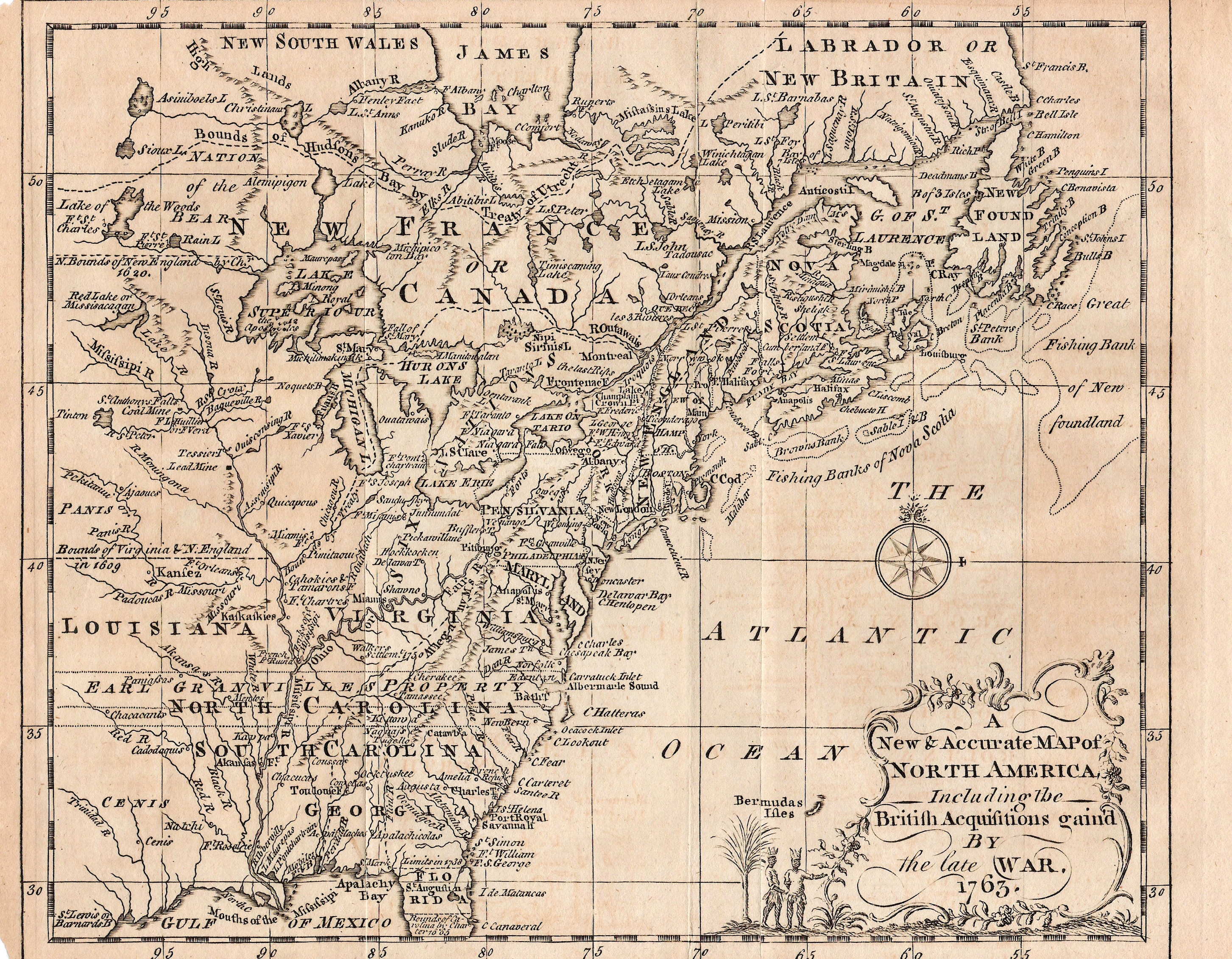
There is an odd memorial in Upper State New York I have seen several times which notes that past this marker, there is no Sunday observance.
This marker noted the end of Christian influence and civilization in long ago colonial days.
The end of Sunday observance practically forms one boundary of the Adirondack State Park area.
Even today, as I have lived up there for months in the recent past, Sunday is simply not kept by the vast majority of people. The Ten Commandments were apparently set aside early on in that part of the States.
As the CCC states, the Ten Commandments are the moral voice of God, reminding us of our own moral voice, the conscience, reminding man of natural law.
The Ten Commandments are not extras, but fundamentals, all based on the natural duties man has towards God and other men.
The Catholic Church teaches an important point-all the commandments may be known by reason.
Revelation underscores reason, and makes the commandments key to the life of the followers of God.

Today, at nine in the morning, I was reminded that America is a nation of pagans. Grass cutting, weed clipping, pruning of trees and hedges all commenced, as if these things could not be done on Saturday or other days.
These jobs in this area are done by lawn contractors, who have their own businesses and could choose not to work on Sundays.
Only those who absolutely must work on Sundays, like nurses, doctors, firefighters, police and so on are given a pass to work on Sunday. Primary care workers and people in industries who cater to travellers who must travel, must work. Soldiers in the field must work on Sunday. Priests and those involved in ministries must work on Sunday.
Americans have forgotten God, and His Day.
However, when I was a child, restaurants were all closed on Sunday. This is true of many places in Malta, although sadly, the big shops are now open. I remember when gas stations were closed on Sunday. Big stores for sure....
and some little ones...
I remember when shops were all closed on Sunday in Iowa. My mother remembers the silence of Sundays in St. Louis.
To purposefully and carelessly break the Sunday work-ban is to commit grave sin.
I grew up in Protestant territory and no one, not the Lutherans or Methodists or Presbyterians, cut grass or worked in the gardens on Sunday.
Garden shops were closed as well.
In one Midwest town and in another town in another state, the Catholic schools had to create their own league for soccer, as the public schools changed all the games to the morning of Sundays.
This type of scheduling is sinful and unnecessary.
St. James notes that to break one of the commandments is to break them all as there is a unity in the following of the law.
Before I continue. a few notes from the CCC. Notice the last note--God does not ask the impossible. We make choices.
2075 "What good deed must I do, to have eternal life?" - "If you would enter into life, keep the commandments" (Mt 19:16-17).
2076 By his life and by his preaching Jesus attested to the permanent validity of the Decalogue.
2077 The gift of the Decalogue is bestowed from within the covenant concluded by God with his people. God's commandments take on their true meaning in and through this covenant.
2078 In fidelity to Scripture and in conformity with Jesus' example, the tradition of the Church has always acknowledged the primordial importance and significance of the Decalogue.
2079 The Decalogue forms an organic unity in which each "word" or "commandment" refers to all the others taken together. To transgress one commandment is to infringe the whole Law (cf. Jas 2:10-11).
2080 The Decalogue contains a privileged expression of the natural law. It is made known to us by divine revelation and by human reason.
2081 The Ten Commandments, in their fundamental content, state grave obligations. However, obedience to these precepts also implies obligations in matter which is, in itself, light.
2082 What God commands he makes possible by his grace.
Some playing fields for sport are still closed on Sunday in Scotland. Some places here are closed on Sundays. Support those, like the one below...

That the West allowed work on Sunday, which occurred under the greed and avarice of the Industrial Revolution, as feeding animals and mucking out barns would be considered necessary and still are, was the beginning of the death of the West.
People point to sexual sins as serious and these are, but working on Sunday, part of the first three commandments which owe God worship and justice, creates a godless society, one no longer focused on true worship of God, prayer, or reflection.
A day of grace and rest from work
2184 Just as God "rested on the seventh day from all his work which he had done,"121 human life has a rhythm of work and rest. The institution of the Lord's Day helps everyone enjoy adequate rest and leisure to cultivate their familial, cultural, social, and religious lives.122
2185 On Sundays and other holy days of obligation, the faithful are to refrain from engaging in work or activities that hinder the worship owed to God, the joy proper to the Lord's Day, the performance of the works of mercy, and the appropriate relaxation of mind and body.123 Family needs or important social service can legitimately excuse from the obligation of Sunday rest. The faithful should see to it that legitimate excuses do not lead to habits prejudicial to religion, family life, and health.
- The charity of truth seeks holy leisure- the necessity of charity accepts just work.124

2187 Sanctifying Sundays and holy days requires a common effort. Every Christian should avoid making unnecessary demands on others that would hinder them from observing the Lord's Day. Traditional activities (sport, restaurants, etc.), and social necessities (public services, etc.), require some people to work on Sundays, but everyone should still take care to set aside sufficient time for leisure. With temperance and charity the faithful will see to it that they avoid the excesses and violence sometimes associated with popular leisure activities. In spite of economic constraints, public authorities should ensure citizens a time intended for rest and divine worship. Employers have a similar obligation toward their employees.
2188 In respecting religious liberty and the common good of all, Christians should seek recognition of Sundays and the Church's holy days as legal holidays. They have to give everyone a public example of prayer, respect, and joy and defend their traditions as a precious contribution to the spiritual life of society. If a country's legislation or other reasons require work on Sunday, the day should nevertheless be lived as the day of our deliverance which lets us share in this "festal gathering," this "assembly of the firstborn who are enrolled in heaven."125
That many places of work now demand unnecessary work on Sunday actually is a tyranny against Christians. Some drug stores or chemists only have the pharmacies open on Sundays, which is reasonable, but to have the entire day of shopping open, making people work long hours, is a crime against God.
God will judge severely those owners who make money by forcing labor on Sunday. This situation has caused great injustice in America and other places.
Shopping and working are idols here. Idolatry of money (Mammon is a demon) and the capital sin of Avarice undermine the lives of millions of people who may not have a choice to not work on Sunday.
But, one does not have to work in the home, do laundry, do yard work, work on cars and so on.
If one owns a business, one cannot make the workers work on Sunday.
Some people think that they are blessed when they get rich or prosperous. God is not the god of money. Prosperity may very well be from satan, not God.
No longer is the "common good" considered but only personal wealth. Avarice has destroyed Catholic communities, which even in my lifetime, would get together on Sundays.
We are the "Sunday People", an ancient phrase from a Catholic who was asked why he was going to Mass on Sunday. To work on purpose when it can be avoided is a serious sin.
Did you know that Sunday was a day for engaging in the corporal and spiritual works of mercy?
I remind all of these:
The corporal works of mercy are:
- To feed the hungry;
- To give drink to the thirsty;
- To clothe the naked;
- To harbour the harbourless;
- To visit the sick;
- To ransom the captive;
- To bury the dead.
- To instruct the ignorant;
- To counsel the doubtful;
- To admonish sinners;
- To bear wrongs patiently;
- To forgive offences willingly;
- To comfort the afflicted;
- To pray for the living and the dead.
These are not options, but duties.
America is a pagan nation. The spiritual and corporal works of mercy to be done especially on Sunday have been forgotten. I am moving to nowhere soon. That would be a corporal work of mercy for someone to take me in...I instruct the ignorant, counsel the doubtful, admonish sinners, bear wrongs more and more patiently, forgive offences willingly, comfort the afflicted and pray for the living and the dead. Not having a car, I cannot visit the sick, but I do give water to workmen if they are in the vicinity, and I do pass on clothes readily if needed, if I can.
As a very poor person, I am limited in my ability to do the corporal works of mercy, but one can be creative.
I can phone a sick person and pray with them, or encourage them, if I cannot get to them. Thankfully, in most cities past Ohio, buses do not run on Sunday. This is a hang-over from the times when shops were shut. Better if all the shops would shut.
Sunday is the day to really do these works of mercy.
If one is not choosing to be a "Sunday Person", one mocks the very Eucharist we receive on this day.
Justin Martyr gave us the name... First Apology 67:
On the day called Sunday all who live in cities or in the country gather together to one place, and the memoirs of the apostles or the writings of the prophets are read, as long as time permits; then, when the reader has ceased, the president verbally instructs, and exhorts to the imitation of these good things. Then we all rise together and pray, and, as we before said, when our prayer is ended, bread and wine and water are brought, and the president in like manner offers prayers and thanksgivings, according to his ability, and the people assent, saying Amen….
But Sunday is the day on which we all hold our common assembly, because it is the first day on which God, having wrought a change in the darkness and matter, made the world; and Jesus Christ our Savior in the same day rose from the dead. For He was crucified on the day before that of Saturn (Saturday); and on the day after that of Saturn, which is the day of the Sun, having appeared to His apostles and disciples, He taught them these things, which we have submitted to you also for your consideration.
Update-when I chose this passage from Justin, I did not know it would be in Monday's Office of Readings--synchronicity.


Consider your own Sunday observance. Believe that the Lord will bless you, if not now, in heaven, for keeping His Day holy.
Subscribe to:
Posts (Atom)