http://www.lifenews.com/2015/07/14/shock-video-catches-planned-parenthoods-top-doctor-selling-body-parts-of-aborted-babies/
Update: http://www.wnd.com/2015/07/huckabee-selling-unborn-body-parts-grotesque/
Tuesday, 14 July 2015
Framing Prayer 22 Jesuits and Detachment

A hallmark of a true Jesuit, whether priest or lay member, is detachment. Lately, God has been leading me down the path, again, of detachment.
As some readers know, I have things in storage ruined and stolen. Then, I moved my few things,(mostly books and photos of a certain seminarian), into, the house of a friend of mine. After five weeks of feeling a bit "at home" and having some of my little red wagon of things around me, my friend's house incurred a flood. Many things were ruined, including almost 1000 USD worth of books.
As the basement still is wet after two weeks, I had to move my things back into storage, with the chapel things, which I had to wrap up and store.
Sitting in my little room, which is full of my and other people's stuff, (like a real English box room), I pondered the missionary like life of yours truly. Detachment includes, for me, at this time, not having the joy of my things, or the access to my smallish library. Loved icons were repacked, (the ones remaining), and off things went into storage, the great American symbol of our mobile and comparatively wealthy lifestyles. Of course, half the things belong to that certain seminarian in England, but I have not been able to afford to send him his own things.
Detachment means not grieving over soaked and ruined books, It means thanking God for trials regarding possessions. It means realizing that, really, all things belong to God and not me.
All I have are gifts from God, all.
A freak chemical accident of bug spray in the last storage facility ruined some things when the owner had to get rid of wasps. Scarily, the chemical ate through about six or seven boxes, destroying an expensive guilt given to me by the mother of a priest years ago,which I called my St. Therese's quilt, as it was covered with gold roses. That same mother just replaced that for me with a red one. God bless her.
She is as poor as I am and gave her only son to God to become a priest. One is blessed more in friendship than in goods.
But, that is what detachment for the Jesuits, and for us, is all about--priorities and making room in one's small heart for God.
Things cause worry, anxiety, time, space....the lack of things is truly freeing. I think some of the most peaceful days of my lift were those last four and a half years when I lived out of two suitcases and wandered about the West meeting fantastic people and praying.
I wonder is St. Paul had a knapsack or a large duffel bag. St. Ignatius carried practically nothing on his journeys, and was criticized by the Catholics in Paris for his rude clothing. (I look at my old jean jacket and wonder if I should carry this around....as my black jackets are not suited for outside work. I wonder what Ignatius would advise?)
The sadness which I offer to the Lord, and it is not a crushing sadness, is not to have a place where I can again set up the little blog chapel and have the books on shelves.
For now, God denies me this to teach me to be even more detached and to live in greater simplicity.
As I look at the beautiful Our Lady of Mt. Carmel statue given to me by a faithful blog reader, I think of St. Teresa of Avila's well-known story of losing all her things and her donkey in a flash flood when moving from one convent to another. This prompted her famous saying, "God, no wonder you have so many enemies the way you treat your friends."
She shares this incident with us to help us carry on.
St. Ignatius, like St. Paul, after his conversion, went off to pray with practically nothing. St. Ignatius' life was one of a series of trials, failures, abandonment, false accusations, set-backs, illness, and the working out over a relatively long period of time the form of his order. Sometimes people think saints figure out God's Will immediately, but each person has a different path and some are quite rockier than others. I suggest looking at the shorten biography of Ignatius here.
St. Ignatius' life was one trial leading to detachment after another. He worked out his call through the events of his life, as well as through the deep prayers and insights given to him by the Holy Spirit, which make up his Spiritual Exercises.
If St. Ignatius had been attached to home, family, status, fame, things, the order would never have been founded. If he has been attached to his own reputation or false peace among his members, the order would never have been founded.
Many times in his life, he had to decide to plunge forward with the insights given to him by God. He was even examined by the Inquisition, as was St. Teresa of Avila.
We can see that Ignatius, as well as other saints experienced many years of unsettled life.
What kept him focused was, simply, prayer and the evangelical counsels.
As lay persons, one can decide as well, like St. Ignatius, to follow Christ daily despite upsets, and to be obedient to the call of our lives, working out our salvation with the "stuff" of life.
Detachment creates peace and an inner stability.
to be continued..


Framing Prayer 21 The Jesuits and Mary

While some orders have a day of discipline, by setting aside certain hours for prayer and some for work and necessities, such as eating and sleeping, the Jesuit must organize his own day according to his work.
In this way, the day of the Jesuit, especially in the missions, would resemble a lay day. And, if the Jesuit teaches at one of the many colleges or universities, his day would be similar to that of a college professor--with a huge difference.
I assume that most readers do not know that the patron of the Jesuit order is Our Lady Mary, under the title of Madonna Della Strada, Our Lady of the Road.
St. Ignatius chose this devotion to Mary as she interceded for him under this title. But, for me, this name of Mary evokes the peripatetic nature of missionary work and the movement of the Jesuit order across the world. In addition, such a patron would help a lay person realize, in his or her busy life, that Mary is with him or her on the way.
Like the popes before him, Pope Francis has a great love for Mary, especially Our Lady Undoer of Knots. But, this love of Mary has been a mark of the Jesuit order from day one. This image of Mary may be found in the Gesu, the main Jesuit Church in Rome. I was there twice.
Other chapels are dedicated to Our Lady of the Road, like the one at Loyola in Chicago.

Mary calls each one of us to follow her to Jesus, to take up a "way", a life, which includes prayer and discipline. One of the readings for the Feast of Our Lady of the Way, or Road (May 24th) follows. In this selection from Proverbs, the reader is exhorted to become wise, become just, and then, perfect.
Proverbs 4:10-18Douay-Rheims
10 Hear, O my son, and receive my words, that years of life may be multiplied to thee.
11 I will shew thee the way of wisdom, I will lead thee by the paths of equity:
12 Which when thou shalt have entered, thy steps shall not be straitened, and when thou runnest thou shalt not meet a stumbling block.
13 Take hold on instruction, leave it not: keep it, because it is thy life.
14 Be not delighted in the paths of the wicked, neither let the way of evil men please thee.
15 Flee from it, pass not by it: go aside, and forsake it.
16 For they sleep not except they have done evil: and their sleep is taken away unless they have made some to fall.
17 They eat the bread of wickedness, and drink the wine of iniquity.
18 But the path of the just, as a shining light, goeth forwards and increaseth even to perfect day.
Of course, one of my favorite paintings of Christ, mentioned several times on this blog, the original Sacred Heart by Batoni is also in the Gesu, and in the old Jesuit Church in Malta, the Church of the Circumcision, where I would go pray daily when I lived in Valletta.
Of course, one of my favorite paintings of Christ, mentioned several times on this blog, the original Sacred Heart by Batoni is also in the Gesu, and in the old Jesuit Church in Malta, the Church of the Circumcision, where I would go pray daily when I lived in Valletta.
Lord,
we rejoice in your sacraments
and ask your mercy
as we honour the memory of the Virgin Mary.
May her faith and love inspire us to serve you more faithfully
in the work of salvation.
Grant this in the name of Jesus the Lord. Amen.
we rejoice in your sacraments
and ask your mercy
as we honour the memory of the Virgin Mary.
May her faith and love inspire us to serve you more faithfully
in the work of salvation.
Grant this in the name of Jesus the Lord. Amen.
Perhaps Mary of the Road is a good companion for a lay person on the way to deep prayer and union with Christ.
to be continued....
Framing Prayer 20 The Jesuits and The Examen

St. Ignatius writes this: “We should not fix our desires on health or sickness, wealth or poverty, success or failure, a long life or a short one.” Detachment is the hallmark of any serious Catholic who wants to be a saint, but for the Jesuit who chooses poverty as a vow, it is a keystone of the approach to God, having nothing in the way for meditation or contemplation to bear fruit.
For the lay person, this ideal can be met by getting rid of superfluous distractions. So how can we tell if we are attached to something? Use the imagination and think of your life without this thing, person, place.
A lay person can easily find time to employ the Daily Examen of the Jesuits. I suggest what the Jesuits do, a morning and evening evaluation and reflection on your life. If one adds this to morning and evening prayer, it becomes a habit. And, as I noted in another post earlier this year, one can each this message to children as part of Confirmation preparation.
The examen is not merely an examination of conscience, a review of one's sins and imperfections, but a tool for discerning how the Holy Spirit is working in one's life. Discernment, from the gift of knowledge given in Confirmation,
Why this should be a daily examen is that one cannot perceive the movement of God unless one is "on" daily. Obviously, one cannot do the Examen outside of prayer. This would be falling into the new age technique of self-consciousness outside of God. When one does the Examen daily, it is a habit which is carried out throughout the day. One can stop one's self from sinning, see patterns of weakness and learn what is temptation and what is an imperfection.
In order to be in union with God, this habit of reflection, which only needs to take seconds after awhile, helps one through the purgation of the senses and the spirit.

Remember that it is God who gives the grace for such an Examen and the habit of reflection leading one through the Dark Night to Illumination. How wonderful is very young people can learn this early on in life.
Finally, the two daily examens end in gratefulness, in thanks for the graces of the day. Discernment is listening, and then acting on what is heard. The virtues of faith, hope and love grow daily through this easy method of daily conversion. One does not have to be self-absorbed to do this, and in fact, self-denial is really the reason for recognizing sin.
to be continued....
Monday, 13 July 2015
Framing Prayer 19 The Jesuits--Paying Attention

Starting now... perhaps the most useful approach to prayer for the laity--the Jesuit method. I want to begin with a basic idea that the Jesuits absolutely believe that God is always active and active now. This idea forms the foundation for our responses to God daily.
Remember when I wrote of active contemplation in the perfection series? The key is to still our hearts and minds so that we can be attentive. Attentiveness underlines the Jesuit way of prayer.
Do you pay attention to signs in your life regarding God's Presence?
Do you pay attention to the Word of God, in Scripture, as Mass, in the homily, in discussions with your friends?
Do you pay attention to excellent spiritual leaders?
Do you pay attention to movements of the Holy Spirit in your life, the ebb and flow of grace?
Attentiveness, of course, means that you cannot pay attention to trivia, to entertainment, to gossip, etc.?
Recently, someone told me that the good emphasis on excellence and individuality in the Jesuit order is connected to attentiveness. What talents has God given the priest to use in the world? What gifts are for the building up of the Kingdom? What does the Church need now?
God does not want to grab us by the face with His "two hands" and say "pay attention". He wants to meet us in the attentive time of prayer, in the silence of our hearts and minds.
Number one lesson today from the Jesuits--be attentive to God.
Time To Pray for The Pope
...on this point. Pray he declares the last doctrine--Mary as Mediatrix of All Grace, and Co-Redemptorix.
This would be a good time to do this...doncha' think?

This would be a good time to do this...doncha' think?

Brain Drain Possible
I predicted this....a long time ago in another galaxy far away...
http://www.dailymail.co.uk/news/article-3158012/Foreign-students-banned-working-forced-leave-UK-course-ends.html
"'Restricting talented workers from staying on in the UK would damage business and lead to a loss of important skills.'"
http://www.dailymail.co.uk/news/article-3158012/Foreign-students-banned-working-forced-leave-UK-course-ends.html
"'Restricting talented workers from staying on in the UK would damage business and lead to a loss of important skills.'"
Feast of St. Henry
Today is the feast of the great St. Henry. His wife has been spotlighted on this blog--St. Cunegunda.
Pray to them for me and for STS, please.
Thank you.

Pray to them for me and for STS, please.
Thank you.

Framing Prayer 18 Cell and City
So much more could be written on the deep spirituality of this young saint, Elizabeth of the Trinity. However, I need to move on to the Jesuits and to the Benedictines this week, so this post is the last one.
I cannot recommend her books enough to my readers. I have been borrowing these from a friend, and if any readers would like to purchase for me her complete works, in several volumes, I would greatly appreciate that.
Today I end with an amazingly appropriate image from Elizabeth for all lay persons to ponder.
Recall how I wrote several posts highlighting St.Catherine of Siena's guidance on creating a little cell within your self to which you can go for solitude and entering into the Presence of God. Recall that we must calm our own warlike instincts before building the space God wants us to have in order to meet us-St. Catherine's little cell.

I think I have written about her little cell of contemplation more than any other one phrase-
One interiorizes the holy city, notes Elizabeth. And, how does one do this? "If I want my city to have some similarity and likeness to that of 'the King of eternal ages and to receive the great illumination from God, I must extinguish every other light, as in the holy city, the Lamb must be its 'only light'",
When Christ stated that the Kingdom of God is within, this insight of Elizabeth's is what He meant.
We internalize this place in order to meet the Indwelling of the Trinity, Who is already there within us, waiting to be discovered. We have this Indwelling (follow the tags) from baptism. Only sin and imperfections keep us from finding God within. This is not pantheism, but a grace for those predestined by Divine Providence to be with God in the heavenly Jerusalem.
But, the quest begins here.
To create this little citadel within, one must get rid of trivial distractions and useless occupations which distract us. Distraction is the main reason, in my opinion, for the lack of interior solitude. Are we like Martha in our daily lives, too busy to sit at the feet of Christ and listen?
Elizabeth's interior city is not only where we meet God, and prepare a place for him, but where we meet the Love to give to others.

When things fall apart around us, and they will, we must be able to stand in the midst of chaos in the little city of our minds and heart, with Christ, listening, resting, praying, counseling.
Cell and city become one and those without this will have no protection in the days to come.
http://supertradmum-etheldredasplace.blogspot.com/2013/04/build-cell-inside-your-mind-from-which.html

I cannot recommend her books enough to my readers. I have been borrowing these from a friend, and if any readers would like to purchase for me her complete works, in several volumes, I would greatly appreciate that.
Today I end with an amazingly appropriate image from Elizabeth for all lay persons to ponder.
Recall how I wrote several posts highlighting St.Catherine of Siena's guidance on creating a little cell within your self to which you can go for solitude and entering into the Presence of God. Recall that we must calm our own warlike instincts before building the space God wants us to have in order to meet us-St. Catherine's little cell.
I think I have written about her little cell of contemplation more than any other one phrase-
"Build a cell inside your mind, from which you can never flee."
Elizabeth takes this idea and makes the interior cell into a city, the City of Jerusalem, the "inner kingdom of the soul", the "the fortress, the unassailable citadel of interior recollection".
One interiorizes the holy city, notes Elizabeth. And, how does one do this? "If I want my city to have some similarity and likeness to that of 'the King of eternal ages and to receive the great illumination from God, I must extinguish every other light, as in the holy city, the Lamb must be its 'only light'",
When Christ stated that the Kingdom of God is within, this insight of Elizabeth's is what He meant.
We internalize this place in order to meet the Indwelling of the Trinity, Who is already there within us, waiting to be discovered. We have this Indwelling (follow the tags) from baptism. Only sin and imperfections keep us from finding God within. This is not pantheism, but a grace for those predestined by Divine Providence to be with God in the heavenly Jerusalem.
But, the quest begins here.
To create this little citadel within, one must get rid of trivial distractions and useless occupations which distract us. Distraction is the main reason, in my opinion, for the lack of interior solitude. Are we like Martha in our daily lives, too busy to sit at the feet of Christ and listen?
Elizabeth's interior city is not only where we meet God, and prepare a place for him, but where we meet the Love to give to others.

When things fall apart around us, and they will, we must be able to stand in the midst of chaos in the little city of our minds and heart, with Christ, listening, resting, praying, counseling.
Cell and city become one and those without this will have no protection in the days to come.
http://supertradmum-etheldredasplace.blogspot.com/2013/04/build-cell-inside-your-mind-from-which.html

Framing Prayer 17 Humility and Love

Elizabeth's insights into the Scriptures make one forget that she wrote over one-hundred years ago-- she is a saint with infused knowledge regarding the works of St. Paul, and the Gospels.
Let me share two of her insights into those who are humble. First, "...their weakness turns into wisdom, and the imperfection of their acts, always insufficient in their eyes, will be the greatest delight of their lives."
In other words, one experiences joy when one sees one's sins, as then one understands the soul's real relationship to God and is grateful for His love and mercy. Perhaps, this is why some saints struggle with imperfections and even venial sins for years, while others are freed of these early on in their lives---for greater humility. St. Augustine comes to mind.
And, even more profound is this note from Elizabeth, an extension from a quotation from the Belgium mystic Ruybroeck . "...to be plunged into humility is to be plunged into God, for God is at the bottom of the abyss. That is why humility, like charity, is capable of increasing."
Elizabeth was meditating on the words of both St. Teresa of Avila and Blessed John of Ruysbroeck, a mystic who wrote on humility. He used the word "abyss" but Elizabeth takes his reference to humility a step further and applies this experience of the Dark Night to an experience of bridal love, the bridal love of the soul of a contemplative, which joins with humility in the mystery of God's Presence within the soul-the Indwelling of the Trinity.
Ruysbroeck taught, among other things. that the contemplative life, a life which brings a clarity of mind, (Illuminative State) creates these following attributes in a person of prayer: a spiritual freedom from worldliness, including detachment from things and desires--which would correspond with the purgation of the senses and spirit as described by St. John of the Cross; an inward silence--the little "cell" of St. Catherine of Siena, which brings with it a purgation of the imagination; and lastly, union. Shades of Garrigou-Lagrange and the perfection series.....
Elizabeth was allowed to see the connection between deep humility and love. Her bridal love for Christ and the perception of Christ's bridal love for the individual soul create a bridge from the abyss of the Dark Night to the stage of enlightenment, which brings to the soul a seeing of the world and one's self as Christ does, and a living in constant virtue. In other words, Elizabeth's gift to us on these levels of prayer is that love moves one through the stages, and love is the reward of each stage.
It is significant that this young saint experienced the love of union with God, as did St. Therese of Lisieux, but both were asked to suffer after that unitive experience, as victims of reparation for others.
For the lay person, this seeking of the contemplative life cannot be seen as a luxury, but a necessity.
(By the way, I just found out today that Dag Hammarskjöld's Markings, a book I came across as a teenager and which may have been the first book I read on the mystical life, was influenced by Ruysbroeck in a manner I missed as a young person. Interesting. I read it and moved on to the Catholic mystics, not dwelling on Markings, but using it as a reference--I had no one to explain the real meaning of contemplation found therein, but, thankfully was introduced to Ignatian spirituality, which put me on the right Catholic track.)
Elizabeth, even in the last sufferings of her illness, maintained her great faith and hope for union with Christ in heaven. She was very aware that she was destined for heaven. Her humility, founded on love, teaches us all that even in a young and simple life, one can endure suffering more easily when one has self-knowledge of one's sins and also clings to Christ.
Let us ask for these graces, in order to withstand the coming suffering we shall all have to face. After one more posting on Elizabeth of the Trinity, I shall move on to St. Ignatius.
Framing Prayer 16 Gratitude

"When I read in the Gospel that "Mary went in haste to the hill country of Judea," to perform her loving service to her cousin Elizabeth, I imagine her passing by, so beautiful, so calm and so majestic, so absorbed in recollection of the Word of God within her. Like Him, her prayer was always this: "Ecce. Here I am." Who? "The servant of the Lord," the lowliest of His creatures: she, His Mother! Her humility was so real, for she was always forgetful of self, free from all anxiety. And she could sing,"The Almighty has done great things for me; henceforth all people will call me blessed."
Gratitude is the mark of this young saint. More than many other holy people, Blessed Elizabeth of the Trinity expressed gratitude over and over in her prayers, meditations, comments. She knew she was a grateful person and taught others to be grateful.
So many lay people complain, and some do so almost constantly. The prayer of gratitude never crosses their lips, except, perhaps, in the prayer before meals.
Gratitude indicates humility. One must know one has received something and not because one is worthy, but because one is needy.
Look at the simplicity of her gratitude here. We can all learn this lesson. I thank God almost daily for water, for baths or showers, for clothes, for housing....all is from Him. I thank Him for being able to write, to think, to read, to meditate. I thank God for my bed, my bedding, and my books...most of all, I thank God for my friends and for His care, especially in the sacraments.
I thank God for my very life.
"I sleep deeply on my straw mattress, something I never experienced before. The first night I did not feel very secure and I thought that before morning i would roll out of one side or the other, but nothing happened, and now my bed seems delightful to me. If you only knew how quickly time passes in Carmel, and yet it seems to me that I have always lived in this dear house. I can't find words to express my happiness. Here, there is no longer anything but Him. He is All. He suffices and we live by Him alone.
I find Him everywhere, while doing the wash as well as while praying. Just picture to yourself Elizabeth in her little cell which is so dear to her; it is our sanctuary, just for HIM and for me... "
And, she wrote to a friend:"If you walk rooted in Christ, strengthened in your faith, you will live in thanksgiving, the love of the sons of God"
This thanksgiving bubbles over from the grace to accept either suffering or consolation equally.
Pray like this, dear lay readers. A prayer of Elizabeth of the Trinity....
"O Eternal Word, Word of my God. I want to spend my life in listening to you, to become wholly teachable that I may learn all from you. Then, through all nights, all voids, all helplessness, I want to gaze on you always and remain in your great light . . . O my Three, my all, my Beatitude, infinite Solitude, immensity in which I lose myself, I surrender myself to you as your prey. Bury yourself in me that I may bury myself in you until I depart to contemplate in your light the abyss of your greatness."
I thank God for my very life.
"I sleep deeply on my straw mattress, something I never experienced before. The first night I did not feel very secure and I thought that before morning i would roll out of one side or the other, but nothing happened, and now my bed seems delightful to me. If you only knew how quickly time passes in Carmel, and yet it seems to me that I have always lived in this dear house. I can't find words to express my happiness. Here, there is no longer anything but Him. He is All. He suffices and we live by Him alone.
I find Him everywhere, while doing the wash as well as while praying. Just picture to yourself Elizabeth in her little cell which is so dear to her; it is our sanctuary, just for HIM and for me... "
And, she wrote to a friend:"If you walk rooted in Christ, strengthened in your faith, you will live in thanksgiving, the love of the sons of God"
This thanksgiving bubbles over from the grace to accept either suffering or consolation equally.
Pray like this, dear lay readers. A prayer of Elizabeth of the Trinity....
"O Eternal Word, Word of my God. I want to spend my life in listening to you, to become wholly teachable that I may learn all from you. Then, through all nights, all voids, all helplessness, I want to gaze on you always and remain in your great light . . . O my Three, my all, my Beatitude, infinite Solitude, immensity in which I lose myself, I surrender myself to you as your prey. Bury yourself in me that I may bury myself in you until I depart to contemplate in your light the abyss of your greatness."
Accidents and Framing Prayer 15
On Thursday, I hurt my hand and it is still sore, and today, a heavy 70 pound box fell on my arm. My left side now feels quite painful.
I shall try and type, but it hurts.

Moving on to Elizabeth of the Trinity, I am asked again and again, why is it that one must go to the single, celibate saints for examples.
Three simple reasons. One, lay saints rarely wrote down their thoughts--if and when Raissa and Jacques Maritain are canonized, we can finally say we have lay saints who wrote copiously on the spiritual life. And, of course, they are unusual, as they had a Josephite marriage almost from the beginning, as a young couple deciding on this path.
Two, most lay saints lack the framework of rules, such as the Dominican, Ignatian or Benedictine rules of the orders with which to form a vocabulary for writing about prayer.
Three, many lay saints never wrote about anything. We have some letters from a few, but for the most part, the active life does not lend itself to putting pen on paper for most people in the lay life.
Also, many lay saints became oblates or tertiaries, and, therefore, used the spirituality of those orders to which they joined themselves for frameworks of prayer.
Therefore, I think that looking at these great saints of prayer who have written about the levels of prayer can help us pick and choose spiritualities which give us a daily framework of prayer.
Elizabeth of the Trinity, under the spotlight already this year on this blog, died at 26. Thankfully, her prioress recognize early on that this young nun was a saint and the Carmelite was allowed, and encouraged to write. Of course, we have the writings of St. Therese of Lisieux, and the great Teresa, revealing a tendency in the Carmelites for knowing the value of sharing biographies, essays, poems and so forth. We have many writings of Edith Stein.
Elizabeth wrote quite a bit for an extremely ill young person. In this short post, I want to outline a few points of her prayer life which can be applied to the lay person attempting to love God in prayer times.
I shall try and type, but it hurts.

Moving on to Elizabeth of the Trinity, I am asked again and again, why is it that one must go to the single, celibate saints for examples.
Three simple reasons. One, lay saints rarely wrote down their thoughts--if and when Raissa and Jacques Maritain are canonized, we can finally say we have lay saints who wrote copiously on the spiritual life. And, of course, they are unusual, as they had a Josephite marriage almost from the beginning, as a young couple deciding on this path.
Two, most lay saints lack the framework of rules, such as the Dominican, Ignatian or Benedictine rules of the orders with which to form a vocabulary for writing about prayer.
Three, many lay saints never wrote about anything. We have some letters from a few, but for the most part, the active life does not lend itself to putting pen on paper for most people in the lay life.
Also, many lay saints became oblates or tertiaries, and, therefore, used the spirituality of those orders to which they joined themselves for frameworks of prayer.
Therefore, I think that looking at these great saints of prayer who have written about the levels of prayer can help us pick and choose spiritualities which give us a daily framework of prayer.
Elizabeth of the Trinity, under the spotlight already this year on this blog, died at 26. Thankfully, her prioress recognize early on that this young nun was a saint and the Carmelite was allowed, and encouraged to write. Of course, we have the writings of St. Therese of Lisieux, and the great Teresa, revealing a tendency in the Carmelites for knowing the value of sharing biographies, essays, poems and so forth. We have many writings of Edith Stein.
Elizabeth wrote quite a bit for an extremely ill young person. In this short post, I want to outline a few points of her prayer life which can be applied to the lay person attempting to love God in prayer times.
- Elizabeth's hidden life, one she stressed as vitally important for a relationship with the -Bridegroom Christ, applies to many lay lives. Stay-at-home mums live mostly hidden lives. Even dads who work have hidden spiritual lives. Students, who spend, hopefully, much time in study and reflection, should develop, as the growth in prayer is connected with study, time and manners of praying. The hidden life is a humble life, and Elizabeth reminds us over and over that humility draws Christ to the simple, lowly soul.
- Order and silence, a repeated theme here, are absolutely necessary for developing a prayer life. Too many lay people cloud their minds with trivia, nonsense, gossip. God waits for us all to slow down, simplify and wait on him. Elizabeth as a contemplative reminds us over and over to spend time in simple silence waiting for God.
- Poverty is a gift, Period. STS once told me that he was grateful that he grew up poor as it was easier for him to concentrate on the good stuff of God as he had learned, out of necessity, a high level of detachment from things. The young Carmelite told her mother, who had a hard time detaching herself from her daughter, that such partings, as going into the convent, and then dying young, both God's will, were elements of the process of detachment. Just before she died, Elizabeth realized that is was much harder for her mother to let go, than herself, as Elizabeth was looking forward to being with Jesus, the Bridegroom. She welcomed her suffering and death. Lay people can embrace the suffering brought about by family traumas of all sorts, and come to the same detachment from persons, places, and things.
- Nothing matters but love, the love of Christ, the love for Christ, the love for the Church, the love for one's neighbor. Elizabeth sang of love her entire short life, showing us the intimacy possible for everyone with Christ.
Sadly, I am nursing now two wounds from two separate accidental domestic happenings, and must stop typing. Please pray for me.
More on Elizabeth later....
Sunday, 12 July 2015
Marie-Julie Jahenny
As my dear readers know, I am a mega-skeptic regarding visionaries and caution all to only follow approved apparitions, such as Our Lady of Akita and Our Lady of Kibeho.
Two other modern ones not approved, but in the process of being examined do intrigue me. The first, Marthe Robin, seems genuine, and the other, Marie Julie Jahenny, seems very mysterious.
Father Dan likes Marie Julie Jahenny because she spoke of the coming persecution. However, as one who waits for Rome, I caution others and do not recommend, only point out this fact that she exists and one can read about her here.
My instincts are much more comfortable with Marthe Robin, who one can read about there.
If anyone is interested, there are the links, but I shall wait for Rome.
Also, on some of the websites, other non-approved or even condemned apparitions are found side-by-side with these two above.
If the local bishop approves, it is approved. If the local bishop condemns or states such a thing is not of supernatural origin, it is not true.
This is the way our Church works. And, of course, we do not have to believe in any apparitional words or specific prophecies.
I have not enough time to read the Doctors of the Church, the Early Church Fathers, the encyclicals and the details of approved apparitions.
Sigh....
Two other modern ones not approved, but in the process of being examined do intrigue me. The first, Marthe Robin, seems genuine, and the other, Marie Julie Jahenny, seems very mysterious.
Father Dan likes Marie Julie Jahenny because she spoke of the coming persecution. However, as one who waits for Rome, I caution others and do not recommend, only point out this fact that she exists and one can read about her here.
My instincts are much more comfortable with Marthe Robin, who one can read about there.
If anyone is interested, there are the links, but I shall wait for Rome.
Also, on some of the websites, other non-approved or even condemned apparitions are found side-by-side with these two above.
If the local bishop approves, it is approved. If the local bishop condemns or states such a thing is not of supernatural origin, it is not true.
This is the way our Church works. And, of course, we do not have to believe in any apparitional words or specific prophecies.
I have not enough time to read the Doctors of the Church, the Early Church Fathers, the encyclicals and the details of approved apparitions.
Sigh....
On The Three Days of Darkness
One of the interesting things Father Dan said yesterday was a comment he made on the three days of darkness. He said that he thought it could mean not a physical darkness (this is not a teaching of the Church, but some saints have prophesied such), but a tearing back of the veil between hell and earth, so that we all can see the spiritual warfare, and, hopefully, repent. The days of darkness would be a vision of the reality of demonic influences on the earth.
But, more importantly than this statement was Father's comment that those who dwell on the negative, on evil, and do not prepare themselves spiritually, these people will fall into either despair or presumption.
Two good points.
But, more importantly than this statement was Father's comment that those who dwell on the negative, on evil, and do not prepare themselves spiritually, these people will fall into either despair or presumption.
Two good points.
Framing Prayer 14 Carmelites and The Cross

Continuing with the same meditation of St. Teresa Benedicta of the Cross, one reads:
"....there is also a danger that any natural affection may degenerate into passion with all of its devastating consequences. God has provided two remedies for this : marriage and virginity. Virginity is the more radical and precisely therefore the easier...Marriage is already a great mystery as the symbol of the bond between Christ and the Church and at the same time as its instrument. But virginity is still the deeper mystery. It is not only the symbol and instrument of bridal union with Christ and of the union's supernatural fruitfulness, but also participates in the union. It originates in the depths of the divine life and leads back to it again. The eternal Father in unconditional love has given his entire being to his Son. ..."
These thoughts are why one priest I know encourages young men to either choose celibacy as a brother, or get married, as there are graces in the decision of a lifestyle if one does not feel called to be a priest.
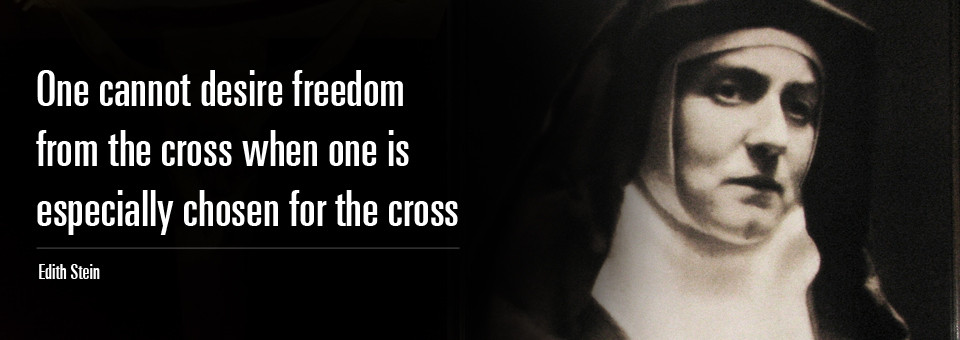
One's prayer flows out of one's vocation. God the Son came into the world into order to bring us all up to His Father. The saint writes, "This is the divine fertility of his (Jesus) eternal virginity: that he can give souls supernatural life."
"Divine virginity has a characteristic aversion to sin as the contrary of divine holiness."
And, yet, sinners find love from the true celibate, as they share in Christ's love. "Christ has come to tear sinners away from sin and to restore the divine image in defiled souls. He comes as a child of sin--his genealogy and the entire history of the Old Covenant show this--and he seeks the company of sinners as as to take all the sins of the world upon himself and carry them away to the infamous wood of the cross, which thereby precisely becomes the sign of his victory."
St. Teresa Benedicta writes that the virginal soul has no fear of sin. Mary at the foot of the Cross, the most perfect of humans and most pure, "becomes the Mother of Grace."
For the laity, choice of vocation determines prayer, but the Carmelite embracing of the Cross may be a very useful focus in these times for many lay people.
This end the view taken from the works of Edith Stein. Tomorrow I move back to Elizabeth of the Trinity, looked at briefly early this year.
Framing Prayer 13 Carmelites and The Cross 2
How wonderful to have synchronicity in one's spiritual life. This type of thing happens to me frequently.
Deciding to use St. Teresa Benedicta is this series was a no brainer, as she lived in horrid times of persecution of the Jews and the Church. We are at the cusp of such a time now.
Her movement back into Thomism has been another reason why I have been attracted to her, as I studied Phenomenology for so many years, becoming more and more unhappy with the system, and moving into a more disciplined study of Aquinas.
But, it is St. Teresa Benedicta's love of the cross, and her great understanding of keeping the Faith under trials which makes her a person to emulate regarding prayer.
Prayer just does not pop out of nothing. We need frameworks of prayer. For many of the laity, the rosary and daily Mass, with the readings, (an excellent source for meditations, as I have shared on this blog), form the frame of prayer. But, the richness of the orders give us so much more.
Let me share one more part of a meditation of St. Teresa Benedicta's which she wrote for sharing on September 14, 1941, less than a year before her death. I remember that my dad, who is still alive, was in Europe in the trenches fighting the same foes which would kill this lovely saint.
In this meditation, St. Teresa Benedicta reminds her readers and her listeners of the three nails in the Cross representing the three vows taken by the nuns-poverty, chastity, and obedience, three ways Christ Himself chose to live in His life on earth.
She notes that Christ did not need to embrace poverty, celibacy and obedience, as He was completely detached from all worldly things, but she writes, "Whoever follows him must know that we have no lasting dwelling here. The more deeply we feel this, the more zealous we are in striving for the future, and we rejoice in the thought of our citizenship of heaven."
Teresa was aware and shared in this meditation that the nuns may have had to vacate their monastery because of the coming persecution against orders as revenge for the bishops' statement against the treatment of the Jews. She reminded her sisters in the Lord that God did not promise them when they made vows that they could stay behind the walls. And, her insight moves to something WE must ponder, as I have mentioned this many times on this blog--life without the sacraments.
"For us they are the prescribed means to grace, and we cannot receive them eagerly enough. But God is not bound to them. At the moment when some external force were to cut us off from receiving the sacraments, he would compensate us, superabundantly, in some other way, and he will do so all the more certainly and generously the more faithfully we have adhered to the sacraments previously."
As lay people, we should not hesitate to receive the sacraments as much as possible. Father Dan yesterday stressed this as well-synchronicity, indeed. Teresa reminds us that our lives are determined by God's will if we so desire his will. Then, she returns to the ideal of obedience, pointing out that Christ's life was reparation for the Original Sin of disobedience.
"The created will is not destined to be free to exalt itself. It is called to come into unison with the divine will. If it freely submits itself to this unison, then it is permitted in freedom to participate in the perfection of creation"
Go back and re-read the perfection posts....Here, St Teresa sounds like Garrigou-Lagrange and the other teachers of prayer quoted on this blog.
"If a free creature declines this unison, it lapses into bondage. The human will continues to retain the possibility of choice, but it is constrained by creatures that pull and pressure it in directions from straying from the directions straying from the development of the nature desired by God, and so away from the goal toward which it was directed by its original freedom. With the loss of original freedom, it also loses security in making decisions. It becomes unsteady and wavering, buffeted by doubt and scruples or obdurate in its error. There is no other remedy for this than the following of Christ, the Son of Man, who not only promptly obeyed his heavenly Father, but also subjected himself to people who imposed the Father's will on him. The obedience enjoined by God releases the enslaved will from the bonds of creatures and leads it back to freedom. Thus, it is also the way to purity of heart."
I need to rush off, so I shall continue with this meditation of St. Teresa Benedicta's later in the day. Those of us who are about to experience persecution need her comforting words.
Deciding to use St. Teresa Benedicta is this series was a no brainer, as she lived in horrid times of persecution of the Jews and the Church. We are at the cusp of such a time now.
Her movement back into Thomism has been another reason why I have been attracted to her, as I studied Phenomenology for so many years, becoming more and more unhappy with the system, and moving into a more disciplined study of Aquinas.
But, it is St. Teresa Benedicta's love of the cross, and her great understanding of keeping the Faith under trials which makes her a person to emulate regarding prayer.
Prayer just does not pop out of nothing. We need frameworks of prayer. For many of the laity, the rosary and daily Mass, with the readings, (an excellent source for meditations, as I have shared on this blog), form the frame of prayer. But, the richness of the orders give us so much more.
Let me share one more part of a meditation of St. Teresa Benedicta's which she wrote for sharing on September 14, 1941, less than a year before her death. I remember that my dad, who is still alive, was in Europe in the trenches fighting the same foes which would kill this lovely saint.
In this meditation, St. Teresa Benedicta reminds her readers and her listeners of the three nails in the Cross representing the three vows taken by the nuns-poverty, chastity, and obedience, three ways Christ Himself chose to live in His life on earth.
She notes that Christ did not need to embrace poverty, celibacy and obedience, as He was completely detached from all worldly things, but she writes, "Whoever follows him must know that we have no lasting dwelling here. The more deeply we feel this, the more zealous we are in striving for the future, and we rejoice in the thought of our citizenship of heaven."
Teresa was aware and shared in this meditation that the nuns may have had to vacate their monastery because of the coming persecution against orders as revenge for the bishops' statement against the treatment of the Jews. She reminded her sisters in the Lord that God did not promise them when they made vows that they could stay behind the walls. And, her insight moves to something WE must ponder, as I have mentioned this many times on this blog--life without the sacraments.
"For us they are the prescribed means to grace, and we cannot receive them eagerly enough. But God is not bound to them. At the moment when some external force were to cut us off from receiving the sacraments, he would compensate us, superabundantly, in some other way, and he will do so all the more certainly and generously the more faithfully we have adhered to the sacraments previously."
As lay people, we should not hesitate to receive the sacraments as much as possible. Father Dan yesterday stressed this as well-synchronicity, indeed. Teresa reminds us that our lives are determined by God's will if we so desire his will. Then, she returns to the ideal of obedience, pointing out that Christ's life was reparation for the Original Sin of disobedience.
"The created will is not destined to be free to exalt itself. It is called to come into unison with the divine will. If it freely submits itself to this unison, then it is permitted in freedom to participate in the perfection of creation"
Go back and re-read the perfection posts....Here, St Teresa sounds like Garrigou-Lagrange and the other teachers of prayer quoted on this blog.
"If a free creature declines this unison, it lapses into bondage. The human will continues to retain the possibility of choice, but it is constrained by creatures that pull and pressure it in directions from straying from the directions straying from the development of the nature desired by God, and so away from the goal toward which it was directed by its original freedom. With the loss of original freedom, it also loses security in making decisions. It becomes unsteady and wavering, buffeted by doubt and scruples or obdurate in its error. There is no other remedy for this than the following of Christ, the Son of Man, who not only promptly obeyed his heavenly Father, but also subjected himself to people who imposed the Father's will on him. The obedience enjoined by God releases the enslaved will from the bonds of creatures and leads it back to freedom. Thus, it is also the way to purity of heart."
I need to rush off, so I shall continue with this meditation of St. Teresa Benedicta's later in the day. Those of us who are about to experience persecution need her comforting words.
Choosing Lesser Gods
In my long perfection series, I noted again and again, the God purifies the imagination in the Dark Night. For most of us who go through this process, this means the total giving up of television, movies, and other forms of imaginative creations which take over the place where God wants to meet us in contemplation. I no longer listen to classical music which I love, because it distracts my imagination from God. I get to much "into " the music. Yes, sometimes classical music and art can lead us to a powerful aesthetic experience and then, into a transcendent experience of God--this has happened to me. But, silence is a better choice for me. Beauty may be found in silence.
I hope you remember my quotation from Thomas Merton. Here is a section of those postings where I shared his great insight on this point....
.. I am certainly no judge of television, since I have never watched it. All I know is that there is a significantly general agreement, among men, whose judgement I respect, that commercial television is degraded, meretricious and absurd. Certainly it would seems that TV could become a kind of unnatural surrogate for contemplation: a completely inert subjection to vulgar images, a descent to a sub-natural passivity rather than an ascent to a supremely active passivity in understanding and love. It would seem that television should be used with extreme care and discrimination by anyone who might hope to take interior life seriously. from Seeds of Contemplation, Thomas Merton
I wrote about this years ago on this blog. I quoted Merton from this source: Cistercian Studies Quarterly, "Inner Experience: Problems of the Contemplative Life (VII)", Vol 19, 1984, notes on pp. 269-270,
God has given each human being the capacity of passive contemplation. This capacity is for God alone, for the creation of the space which He fills in the Unitive State.
Being passive before the tv fills that space with sewage and deadens the capacity for real contemplation. Worse than that, one becomes contemplatively united with whatever is on the tv through this passive contemplation, which brings one into "mystic attraction until one is spellbound in a state of complete union."
Merton states that either God or tv takes over the "will on a temporal or material level...the other...is the nadir of intellectual and emotional slavery."
Satan knows this and uses tv for his grooming of damned souls.
To move from meditation, to active contemplation, to passive contemplation, is the call of each Catholic.
Are you clogging up the very gift God has given you by passive contemplation of tv? More on this in these posts.
The reason I return to these thoughts today has to do with the fact that I had a discussion with a young person last night on computer games. This young woman told me that she did not have any clue about spiritual warfare and was curious about my ability to see clearly the spiritual warfare around me. She and I had discussed this before, but this was the first time I made the connection with Thomas Merton's insight and her life choices.
As the great teachers of prayer tell us, to give up the passivity of our minds to another source rather than God means that we give up discernment, a gift given to us in confirmation, connected to the gift of knowledge. Many things can interfere with this gift but too much entertainment, and the type of entertainment can clog the imagination, stopping the use of the gift so needed in today's world.
Note the dates on the posts above. I have tried to point out the need for the clarification of the imagination for years. There must be an unclogging of the imagination which has been purposefully "clogged up".
Silence and passivity before God must be priorities in our lives now. How can we hear God and see with His Mind if we are not cooperating with the gift of knowledge?
My young friend is not convinced. She and I have discussed this subject for a long time But, she cannot yet make the connection I have tried to explain to her. Perhaps readers who "get" this can pray for her and those other young people she plays games with online. All these people in her group of gamers are good people, several are Catholic-- they are in their twenties and thirties, but God is calling them to a greater use of their imaginations than gaming---contemplative prayer.
How can one come into union with Christ when the imagination is full of lesser gods?
UPDATE: Since we spoke, the young woman emailed me to say she has given up playing computer games. I am truly grateful to God for this grace. Please continue to pray for her in her pursuit of prayer. This is a huge turn-around! She will keep me posted on her efforts of prayer.
I hope you remember my quotation from Thomas Merton. Here is a section of those postings where I shared his great insight on this point....
.. I am certainly no judge of television, since I have never watched it. All I know is that there is a significantly general agreement, among men, whose judgement I respect, that commercial television is degraded, meretricious and absurd. Certainly it would seems that TV could become a kind of unnatural surrogate for contemplation: a completely inert subjection to vulgar images, a descent to a sub-natural passivity rather than an ascent to a supremely active passivity in understanding and love. It would seem that television should be used with extreme care and discrimination by anyone who might hope to take interior life seriously. from Seeds of Contemplation, Thomas Merton
I wrote about this years ago on this blog. I quoted Merton from this source: Cistercian Studies Quarterly, "Inner Experience: Problems of the Contemplative Life (VII)", Vol 19, 1984, notes on pp. 269-270,
God has given each human being the capacity of passive contemplation. This capacity is for God alone, for the creation of the space which He fills in the Unitive State.
Being passive before the tv fills that space with sewage and deadens the capacity for real contemplation. Worse than that, one becomes contemplatively united with whatever is on the tv through this passive contemplation, which brings one into "mystic attraction until one is spellbound in a state of complete union."
Merton states that either God or tv takes over the "will on a temporal or material level...the other...is the nadir of intellectual and emotional slavery."
Satan knows this and uses tv for his grooming of damned souls.
To move from meditation, to active contemplation, to passive contemplation, is the call of each Catholic.
Are you clogging up the very gift God has given you by passive contemplation of tv? More on this in these posts.
11 Sep 2012
Figures for an Apocalypse by Thomas Merton. Posted by Supertradmum. As a foreigner in a foreign land, I shall not be able to talk about 9-11 as I would want to do today. But, I was in Canada on 9-11. Father Z has part of ...
22 Jan 2013
We only have so much time...watch the video here and the next one posted. I have read all of Thomas Merton's books many, many years ago but I have missed some of his articles. Now, I have come across a startling one ...
27 Oct 2014
He also mentioned Thomas Merton, who I had just put back on the blog this morning. Synchronicity. One more point this good priest made was that we all need to think about death. Again, synchronicity considering I just wrote ...
27 Oct 2014
Remember what Thomas Merton said, which I have quoted here before on this blog that television is the opposite of contemplation. And that the very energies of passivity which most men use in watching television are the .
21 Nov 2013
I have shared on this blog the great insight of Thomas Merton on the biggest danger of television-that the passivity which one approaches tv is the aspect, the gift of the mind and soul for passive prayer. The television takes ...
10 Aug 2014
Re meditation, is there room for 'quieting' the mind, stopping the mental chatter and allowing God into the stillness? are Thomas Murton's thoughts upon meditation in Western Christianity agreeable with Catholic Christian ...
09 Jan 2015
... anonymous contemplatives in the city, going about their daily tasks? 9 January 2015 at 17:31 · Supertradmum said... Mary Ann, actually, the reference I know is from Thomas Merton, but Maritain may have said this as well.
28 Nov 2013
Remember what Thomas Merton said, which I have quoted here before on this blog that television is the opposite of contemplation. And that the very energies of passivity which most men use in watching television are the ...
29 Nov 2013
As Thomas Merton notes, we are geared to passive intake of knowledge, which happens at the contemplative stage, but if our minds are full of goo from the television, we shall never learn either meditation or contemplation.
07 Dec 2014
Remember the posts on Thomas Merton's brilliant insight into the evil of television? Without a strong intellect, one cannot properly deal with the bombardment of images, good or bad, in this hyperactive world. Even to get on ...
25 Jan 2013
Cardinal Bernadine of Chicago, Thomas Merton (in a yoga pose), Martin Luther King, or homosexual "saints" such as Mychal Judge, Mark Bingham, Harvey Milk, or such people as Oscar Romero, John Donne, We-wha the ...
11 Nov 2014
http://www.amazon.co.uk/New-Seeds-Contemplation-Directions-Paperbook/dp/0811217248/ref=sr_1_1?ie=UTF8&qid=1415803141&sr=8-1&keywords=merton+contemplation. 12 November 2014 at 14:39 · Supertradmum ...
11 Sep 2012
... Father Mark "Vultus Christi" Kirby's first Oblate, I have to say my Benedictine soul is envious. Please know that you're in my prayers, and I'll be asking St. Scholastica and St. Thomas More for their intercession on your behalf.
The reason I return to these thoughts today has to do with the fact that I had a discussion with a young person last night on computer games. This young woman told me that she did not have any clue about spiritual warfare and was curious about my ability to see clearly the spiritual warfare around me. She and I had discussed this before, but this was the first time I made the connection with Thomas Merton's insight and her life choices.
As the great teachers of prayer tell us, to give up the passivity of our minds to another source rather than God means that we give up discernment, a gift given to us in confirmation, connected to the gift of knowledge. Many things can interfere with this gift but too much entertainment, and the type of entertainment can clog the imagination, stopping the use of the gift so needed in today's world.
Note the dates on the posts above. I have tried to point out the need for the clarification of the imagination for years. There must be an unclogging of the imagination which has been purposefully "clogged up".
Silence and passivity before God must be priorities in our lives now. How can we hear God and see with His Mind if we are not cooperating with the gift of knowledge?
My young friend is not convinced. She and I have discussed this subject for a long time But, she cannot yet make the connection I have tried to explain to her. Perhaps readers who "get" this can pray for her and those other young people she plays games with online. All these people in her group of gamers are good people, several are Catholic-- they are in their twenties and thirties, but God is calling them to a greater use of their imaginations than gaming---contemplative prayer.
How can one come into union with Christ when the imagination is full of lesser gods?
UPDATE: Since we spoke, the young woman emailed me to say she has given up playing computer games. I am truly grateful to God for this grace. Please continue to pray for her in her pursuit of prayer. This is a huge turn-around! She will keep me posted on her efforts of prayer.
Subscribe to:
Posts (Atom)