Recent Posts

Tuesday, 19 June 2012

Pray for Our Brothers and Sisters in Nigeria

Four post day--please pray for the people of Christ the King Church in Nigeria-martyrs.
Articles here and there. The main stream media insists on making both sides the same, whereas the Christians are being killed, and are not the aggressors. We have a right to defend ourselves, but the main stream media sometimes calls defense "revenge killings". Revenge is wrong, always a sin, but defense is necessary. No photo is needed.

from the CBS news source listed above:

The group known as Boko Haram said in an email that it was responsible for the attacks.
"Allah has given us victory in the attacks we launched (Sunday) against churches in Kaduna and Zaria towns which resulted in the deaths of many Christians and security personnel," the statement said in the local Hausa language.
Boko Haram, whose name means "Western education is sacrilege" in Hausa, is waging an increasingly bloody fight with Nigeria's security agencies and public. More than 580 people have been killed in violence blamed on the sect this year alone, according to an AP count.
.......The most deadly attacks seem to have targeted Christian holidays: An Easter Day blast in Kaduna left at least 38 people dead, and a Christmas Day suicide bombing of a Catholic church near Nigeria's capital killed at least 44. Boko Haram claimed responsibility for both attacks.

Alexis de Tocqueville and 2012: part one for early high school home schooling moms

If Catholics in the pew in any country of the West do not start working to save their own rights regarding religious freedom, they have only themselves to blame if they find themselves under totalitarian democracies. de Tocqueville, who I taught for years, spoke of the "tyranny of the mob". If you have not read his Democracy in America, which should be required for every early high school course, you must. His many insights have not been surpassed. He saw that Americans preferred equality to rights, an interesting comment. And, he was critical of an anti-intellectualism in which Americans preferred opinions to rational discourse.

Does this sound familiar? However, his greatest insight in my reading is that he foresaw the rise of the tyranny of the majority.  His view of the tendency for Americans to be conformists, which is true, led him to observe that a mob or a majority can not only be wrong, but force error on others. He was also aware of the possibility of the Government giving up power to money and using money to control the masses. Does this sound familiar? His concern was that the American dream of material well-being would cause a shadow to fall over the lofty ideals of the Constitutional government.

How well he prophesied the ruin of American independence.

As a scholar and a Catholic, de Tocqueville realized the importance of both understanding history and the need for religion. He was painfully aware that Americans, even when he was observing them, were not as concerned with religion as perhaps they should have been, preferring to be so tolerant as not to be critical, even in a good sense. He wrote that, "The main business of religions is to purify, control, and restrain that excessive and exclusive taste for well-being which men acquire in times of equality."


How well he understood human nature and the American Experience.

When I taught American History, de Tocqueville was on the syllabus. He must be studied. Home schooling moms, please consider him seriously. 

Here are some long quotations from his writings from a website found here.  What follows is from that website.


"A great democratic revolution is taking place in our midst. "
--Alexis de Tocqueville
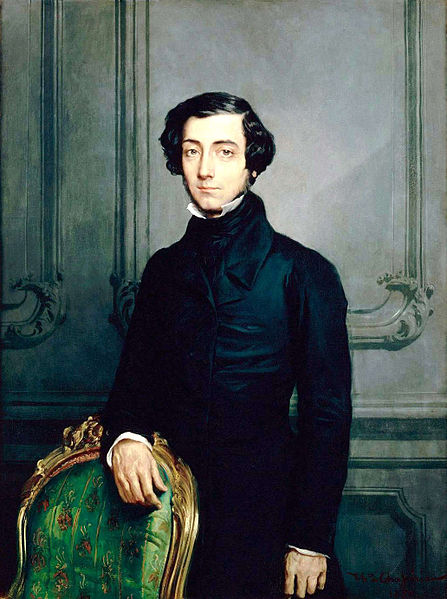
447px-alexis_de_tocqueville
(Wikimedia Commons)
On May 9, 1831, two young Frenchmen sailed into the harbor of Newport, Rhode Island and began a remarkable journey through the United States. Alexis de Tocqueville and Gustave de Beaumont, both minor French court officials, had been sent by their government to study new experimental prisons in America. However, even before leaving France, de Tocqueville and de Beaumont decided to spend most of their time observing American democracy in action. Both were excited by the prospect. America was such a young nation, and most Europeans had only a vague idea about its unique democratic system.
After traveling thousands of miles over a period of nine months, the young men returned to France. De Tocqueville spent the next eight years writing two volumes on his observations. In 1840 the two volumes became one book which de Tocqueville titled Democracy in America. Much more than a mere record of his travels, Democracy in America, in the words of one modern historian, turned out to be "perhaps the greatest commentary ever written about any culture by any person at any time."Alexis de Tocqueville was born into an aristocratic family in 1805, the year after Napoleon Bonaparte was crowned emperor of France. De Tocqueville's parents had been imprisoned earlier during the French Revolution. Both escaped execution, the fate of many aristocrats at the time.
De Tocqueville studied law and became a low-level judge in the French court system. Early 19th-century political events in France convinced de Tocqueville that aristocratic government in Europe was doomed, soon to be replaced by democracy. It was at this time that he and his fellow nobleman, de Beaumont, arranged their trip to America. From de Tocqueville's point of view, it would also be a journey into the future.

American Equality

During his travels which took him from the East Coast to the Mississippi River, de Tfocqueville filled 14 notebooks with his observations, thoughts, and interviews with over 200 Americans. De Tocqueville's relentless curiosity urged him to probe into every area of American culture, but it was the American people that interested him the most. Specifically, he wanted to find out about the role of the American citizen in this new democratic society. De Tocqueville set out to find the answers.
"No novelty," he wrote, "struck me more vividly during my stay there than the equality of conditions." Coming from a society still heavily influenced by its aristocratic heritage, de Tocqueville was astounded at how much equality had become a part of American life. It surprised him to see everyone shaking hands with one another. De Tocqueville marveled, and also worried, about a society where social class did not seem to matter and everyone expected to be treated the same.
From our point of view today, the United States in 1831 was far from being a society based on equality. The Indians were viewed as an alien people to be driven outside the bounds of civilization. Black slaves were considered the property of their masters. Women could not vote and were legally controlled by their husbands. "In America," wrote de Tocqueville, "a woman loses her independence forever in the bonds of matrimony."
In de Tocqueville's America, the idea of equality applied mainly to free white adult males. Full citizenship rights belonged only to this group. Yet, even this limited degree of equality made the United States radically different from the rest of the world and fascinated de Tocqueville.

Politics in de Tocqueville's America

"No sooner do you set foot on American soil than you find yourself in a sort of tumult," de Tocqueville wrote in his book. "A confused clamor rises on every side, and a thousand voices are heard at once, each expressing some social requirements." De Tocqueville was amazed at the large number of people active in public affairs. "All around you everything is on the move," he reported. De Tocqueville saw all kinds of people busily planning local projects, choosing representatives and assembling to criticize their leaders. He was especially impressed with New England town meetings where every citizen had the right to vote on public matters.
De Tocqueville thought it remarkable how often Americans joined together in various organizations which he called associations. "Americans of all ages, all stations of life and all types of disposition are forever forming associations," he wrote. "There are not only commercial and industrial associations in which all take part, but others of a thousand types-religious, moral, serious, futile, very general and very limited, immensely large and very minute."
De Tocqueville went on to observe that Americans naturally formed groups when they wanted to hold a celebration, found a church, build a school, distribute books or do almost anything else. "Finally, if they want to proclaim a truth or propagate some feeling ...they form an association. In every case, at the head of any new undertaking, where in France you would find the government ... in the United States you are sure to find an association."
"The people reign over the American political world as God rules over the universe," wrote de Tocqueville. Although property requirements for voting were still common, they were beginning to disappear. Elections were usually held every year for local and state offices. Those who had the right to vote did so and in large numbers. During the time that de Tocqueville toured America, 70% or more of the voters turned out on election day, compared to under 50% today.
The four-year cycle of presidential elections, which de Tocqueville called a "revolution ... in the name of the law," fascinated him. He wrote:
Long before the appointed day arrives, the election becomes the greatest, and one might say the only, affair occupying men's minds.... The President, for his part, is absorbed in the task of defending himself before the majority.... As the election draws near, intrigues grow more active and agitation is more lively and widespread. The citizens divide up into several camps.... The whole nation gets into a feverish state. . ..
With the election over, de Tocqueville reported, everything quickly calmed down like a river that only momentarily overflowed its banks. "But was it not astonishing," remarked de Tocqueville, "that such a storm could ever have arisen?"
At- the time of de Tocqueville's visit, political parties in America were undergoing great change as old ones died out and new ones emerged. The most significant development was the birth of the Democratic Party under the leadership of Andrew Jackson, elected president in 1828.
De Tocqueville observed a "constant agitation of parties," each attempting to draw voters over to its side. In his notes he wrote that a party candidate ". . . must haunt the taverns, drink and argue with the mob; that is what is called Electioneering in America."
De Tocqueville leveled some of his sharpest criticism against American political leaders themselves. He became convinced that outstanding men avoided elected office in order to pursue their private ambitions and careers. Those who did seek public office, he believed, were often poorly educated and open to corruption.
In one of his notebooks, de Tocqueville ridiculed Congressman Davy Crockett as a man "...who had received no education, could read only with difficulty, had no property, no fixed dwelling, but spent his time hunting, selling his game for a living, and 1pending his whole life in the woods." But de Tocqueville saved his sharpest barbs for President Jackson whom he described in his book as a "man of violent character and middling capacities." In his view, Jackson possessed few qualities for political leadership.

Law and Citizenship

De Tocqueville found a deep respect for the law in America. The reason, he felt, was that the American citizens themselves held the ultimate power to change any laws they disliked.
On the other hand, those who chose to violate the law were immediately branded as outcasts by the law-abiding majority. In Europe, de Tocqueville observed, the people merely watched as the authorities tracked down a criminal, while in America "...everyone thinks he has an interest in furnishing proof of an offense and in arresting the guilty man."
De Tocqueville wondered how American citizens learned about the law and their rights. Public schools, even at an elementary level, hardly existed outside of New England. Newspapers helped to inform the public, but the majority of Americans could not read. De Tocqueville discovered that the courtroom and jury actually served as a "free school" for civic education. "I do not know whether a jury is useful to the parties involved," de Tocqueville wrote, "but I am sure it is very good for those who have to decide the case." De Tocqueville also declared that juries "...make all men feel that they have duties toward society and that they take a share in its government."

"Tyranny of the Majority"

A number of things bothered de Tocqueville about democracy. One of them was that in a society made up of equal citizens, the majority is always right. To de Tocqueville, a majority of equals, just like a single all-powerful ruler, could abuse its power. In a democracy, de Tocqueville argued, this abuse becomes the "tyranny of the majority."
De Tocqueville did not claim that the tyranny of the majority as yet existed to any great degree in America. Still, he saw evidence of it developing. For example, de Tocqueville found that in the North, free black males who had the right to vote often were discouraged from voting by the white majority.
De Tocqueville maintained that even freedom of speech, guaranteed in the Bill of Rights, was affected by majority opinion.
"I know no country," he wrote, "in which, generally speaking, there is less independence of mind and true freedom of discussion than in America." He added that the lack of great writers in the United States was due to the absence of "freedom of spirit" brought on by a majority intolerant of minority views.
"If ever freedom is lost in America," de Tocqueville warned, "that will be due to the ... majority driving minorities to desperation...." De Tocqueville did identify certain elements at work in American democracy which checked the formation of a tyranny of the majority. Among these elements were the large number of independent associations, the press and the courts.


I used a great site called the de Tocqueville Project when I was teaching in the classroom and at home. I hope you moms can find it. The site provided activities for students as well as excellent commentary. I am off to Mass and cannot write more this morning. God bless you all and remember, when a right is given up, it is lost forever.


Is anyone really paying attention to what is happening in Syria?

http://www.telegraph.co.uk/news/worldnews/middleeast/syria/9339933/Britain-stops-Russian-ship-carrying-attack-helicopters-for-Syria.html

and


from the Financial Times online


David Cameron, the British prime minister, also met Mr Putin in Los Cabos and told him that he did not support the involvement of Iran in a conference to discuss a solution to the crisis in Syria. “The key is to work on that bit of the Annan plan which could help to deliver political change at the top of Syria,” Mr Cameron said before the meeting.
Mr Putin warned Mr Cameron that the removal of the Syrian regime could lead to the rise of radical Islamic parties or terrorist organisations – drawing comparisons with Somalia – according to officials at the summit. The British premier countered that authoritarian regimes were not always an insurance against terrorism.

Soviet launch sites, `Cuba 1962

Fresh fighting across Syria killed 56 people on Monday. Activists said government forces were continuing to pound opposition strongholds in different parts of the country.

I am reminded of the Cuba Missile Crisis, when my dad could have been called up for active duty again in 1962, a mere fifty years ago. My dad sat us kids down in front of the President's message on television and told us how dangerous the situation was. Americans were in the middle of the Cold War, which was heating up.

We have been lulled into thinking the Russia is not dangerous. Sorry, but this is not true. The "election" of Putin gave the world a dull warning that Russia would be flexing her international muscles in the Middle East.

We are not in a strong position under our current President. He is very weak and unsure in foreign policies.  Between October 18–29, 1962, America was on edge and forced the Soviets to back down, making them dismantle weapons brought into Cuba which could reach the States.

The West is asleep at the wheel and I have a strong sense of deja vu. Here is the entire speech I heard at the age of thirteen, and I remember where I was sitting, where my dad was standing, where my mom and brothers were as is it were yesterday. 

Syria is an excuse for another Russian, man-made crisis.

Good evening my fellow citizens:
This Government, as promised, has maintained the closest surveillance of the Soviet Military buildup on the island of Cuba. Within the past week, unmistakable evidence has established the fact that a series of offensive missile sites is now in preparation on that imprisoned island. The purpose of these bases can be none other than to provide a nuclear strike capability against the Western Hemisphere.
Upon receiving the first preliminary hard information of this nature last Tuesday morning at 9 a.m., I directed that our surveillance be stepped up. And having now confirmed and completed our evaluation of the evidence and our decision on a course of action, this Government feels obliged to report this new crisis to you in fullest detail.
The characteristics of these new missile sites indicate two distinct types of installations. Several of them include medium range ballistic missiles capable of carrying a nuclear warhead for a distance of more than 1,000 nautical miles. Each of these missiles, in short, is capable of striking Washington, D.C., the Panama Canal, Cape Canaveral, Mexico City, or any other city in the southeastern part of the United States, in Central America, or in the Caribbean area.
Additional sites not yet completed appear to be designed for intermediate range ballistic missiles--capable of traveling more than twice as far--and thus capable of striking most of the major cities in the Western Hemisphere, ranging as far north as Hudson Bay, Canada, and as far south as Lima, Peru. In addition, jet bombers, capable of carrying nuclear weapons, are now being uncrated and assembled in Cuba, while the necessary air bases are being prepared.
This urgent transformation of Cuba into an important strategic base--by the presence of these large, long range, and clearly offensive weapons of sudden mass destruction--constitutes an explicit threat to the peace and security of all the Americas, in flagrant and deliberate defiance of the Rio Pact of 1947, the traditions of this Nation and hemisphere, the joint resolution of the 87th Congress, the Charter of the United Nations, and my own public warnings to the Soviets on September 4 and 13. This action also contradicts the repeated assurances of Soviet spokesmen, both publicly and privately delivered, that the arms buildup in Cuba would retain its original defensive character, and that the Soviet Union had no need or desire to station strategic missiles on the territory of any other nation.
The size of this undertaking makes clear that it has been planned for some months. Yet only last month, after I had made clear the distinction between any introduction of ground-to-ground missiles and the existence of defensive antiaircraft missiles, the Soviet Government publicly stated on September 11, and I quote, "the armaments and military equipment sent to Cuba are designed exclusively for defensive purposes," that, and I quote the Soviet Government, "there is no need for the Soviet Government to shift its weapons . . . for a retaliatory blow to any other country, for instance Cuba," and that, and I quote their government, "the Soviet Union has so powerful rockets to carry these nuclear warheads that there is no need to search for sites for them beyond the boundaries of the Soviet Union." That statement was false.
Only last Thursday, as evidence of this rapid offensive buildup was already in my hand, Soviet Foreign Minister Gromyko told me in my office that he was instructed to make it clear once again, as he said his government had already done, that Soviet assistance to Cuba, and I quote, "pursued solely the purpose of contributing to the the defense capabilities of Cuba," that, and I quote him, "training by Soviet specialists of Cuban nationals in handling defensive armaments was by no means offensive, and if it were otherwise," Mr. Gromyko went on, "the Soviet Government would never become involved in rendering such assistance." That statement also was false.
Neither the United States of America nor the world community of nations can tolerate deliberate deception and offensive threats on the part of any nation, large or small. We no longer live in a world where only the actual firing of weapons represents a sufficient challenge to a nation's security to constitute maximum peril. Nuclear weapons are so destructive and ballistic missiles are so swift, that any substantially increased possibility of their use or any sudden change in their deployment may well be regarded as a definite threat to peace.
For many years both the Soviet Union and the United States, recognizing this fact, have deployed strategic nuclear weapons with great care, never upsetting the precarious status quo which insured that these weapons would not be used in the absence of some vital challenge. Our own strategic missiles have never been transferred to the territory of any other nation under a cloak of secrecy and deception; and our history--unlike that of the Soviets since the end of World War II--demonstrates that we have no desire to dominate or conquer any other nation or impose our system upon its people. Nevertheless, American citizens have become adjusted to living daily on the Bull's-eye of Soviet missiles located inside the U.S.S.R. or in submarines.
In that sense, missiles in Cuba add to an already clear and present danger--although it should be noted the nations of Latin America have never previously been subjected to a potential nuclear threat.
But this secret, swift, and extraordinary buildup of Communist missiles--in an area well known to have a special and historical relationship to the United States and the nations of the Western Hemisphere, in violation of Soviet assurances, and in defiance of American and hemispheric policy--this sudden, clandestine decision to station strategic weapons for the first time outside of Soviet soil--is a deliberately provocative and unjustified change in the status quo which cannot be accepted by this country, if our courage and our commitments are ever to be trusted again by either friend or foe.
The 1930's taught us a clear lesson: aggressive conduct, if allowed to go unchecked and unchallenged ultimately leads to war. This nation is opposed to war. We are also true to our word. Our unswerving objective, therefore, must be to prevent the use of these missiles against this or any other country, and to secure their withdrawal or elimination from the Western Hemisphere.
Our policy has been one of patience and restraint, as befits a peaceful and powerful nation, which leads a worldwide alliance. We have been determined not to be diverted from our central concerns by mere irritants and fanatics. But now further action is required--and it is under way; and these actions may only be the beginning. We will not prematurely or unnecessarily risk the costs of worldwide nuclear war in which even the fruits of victory would be ashes in our mouth--but neither will we shrink from that risk at any time it must be faced.
Acting, therefore, in the defense of our own security and of the entire Western Hemisphere, and under the authority entrusted to me by the Constitution as endorsed by the resolution of the Congress, I have directed that the following initial steps be taken immediately:
First: To halt this offensive buildup, a strict quarantine on all offensive military equipment under shipment to Cuba is being initiated. All ships of any kind bound for Cuba from whatever nation or port will, if found to contain cargoes of offensive weapons, be turned back. This quarantine will be extended, if needed, to other types of cargo and carriers. We are not at this time, however, denying the necessities of life as the Soviets attempted to do in their Berlin blockade of 1948.
Second: I have directed the continued and increased close surveillance of Cuba and its military buildup. The foreign ministers of the OAS, in their communique of October 6, rejected secrecy in such matters in this hemisphere. Should these offensive military preparations continue, thus increasing the threat to the hemisphere, further action will be justified. I have directed the Armed Forces to prepare for any eventualities; and I trust that in the interest of both the Cuban people and the Soviet technicians at the sites, the hazards to all concerned in continuing this threat will be recognized.
Third: It shall be the policy of this Nation to regard any nuclear missile launched from Cuba against any nation in the Western Hemisphere as an attack by the Soviet Union on the United States, requiring a full retaliatory response upon the Soviet Union.
Fourth: As a necessary military precaution, I have reinforced our base at Guantanamo, evacuated today the dependents of our personnel there, and ordered additional military units to be on a standby alert basis.
Fifth: We are calling tonight for an immediate meeting of the Organ of Consultation under the Organization of American States, to consider this threat to hemispheric security and to invoke articles 6 and 8 of the Rio Treaty in support of all necessary action. The United Nations Charter allows for regional security arrangements--and the nations of this hemisphere decided long ago against the military presence of outside powers. Our other allies around the world have also been alerted.
Sixth: Under the Charter of the United Nations, we are asking tonight that an emergency meeting of the Security Council be convoked without delay to take action against this latest Soviet threat to world peace. Our resolution will call for the prompt dismantling and withdrawal of all offensive weapons in Cuba, under the supervision of U.N. observers, before the quarantine can be lifted.
Seventh and finally: I call upon Chairman Khrushchev to halt and eliminate this clandestine, reckless and provocative threat to world peace and to stable relations between our two nations. I call upon him further to abandon this course of world domination, and to join in an historic effort to end the perilous arms race and to transform the history of man. He has an opportunity now to move the world back from the abyss of destruction--by returning to his government's own words that it had no need to station missiles outside its own territory, and withdrawing these weapons from Cuba--by refraining from any action which will widen or deepen the present crisis--and then by participating in a search for peaceful and permanent solutions.
This Nation is prepared to present its case against the Soviet threat to peace, and our own proposals for a peaceful world, at any time and in any forum--in the OAS, in the United Nations, or in any other meeting that could be useful--without limiting our freedom of action. We have in the past made strenuous efforts to limit the spread of nuclear weapons. We have proposed the elimination of all arms and military bases in a fair and effective disarmament treaty. We are prepared to discuss new proposals for the removal of tensions on both sides--including the possibility of a genuinely independent Cuba, free to determine its own destiny. We have no wish to war with the Soviet Union--for we are a peaceful people who desire to live in peace with all other peoples.
But it is difficult to settle or even discuss these problems in an atmosphere of intimidation. That is why this latest Soviet threat--or any other threat which is made independently or in response to our actions this week--must and will be met with determination. Any hostile move anywhere in the world against the safety and freedom of peoples to whom we are committed--including in particular the brave people of West Berlin--will be met by whatever action is needed.
Finally, I want to say a few words to the captive people of Cuba, to whom this speech is being directly carried by special radio facilities. I speak to you as a friend, as one who knows of your deep attachment to your fatherland, as one who shares your aspirations for liberty and justice for all. And I have watched and the American people have watched with deep sorrow how your nationalist revolution was betrayed-- and how your fatherland fell under foreign domination. Now your leaders are no longer Cuban leaders inspired by Cuban ideals. They are puppets and agents of an international conspiracy which has turned Cuba against your friends and neighbors in the Americas--and turned it into the first Latin American country to become a target for nuclear war--the first Latin American country to have these weapons on its soil.
These new weapons are not in your interest. They contribute nothing to your peace and well-being. They can only undermine it. But this country has no wish to cause you to suffer or to impose any system upon you. We know that your lives and land are being used as pawns by those who deny your freedom.
Many times in the past, the Cuban people have risen to throw out tyrants who destroyed their liberty. And I have no doubt that most Cubans today look forward to the time when they will be truly free--free from foreign domination, free to choose their own leaders, free to select their own system, free to own their own land, free to speak and write and worship without fear or degradation. And then shall Cuba be welcomed back to the society of free nations and to the associations of this hemisphere.
My fellow citizens: let no one doubt that this is a difficult and dangerous effort on which we have set out. No one can see precisely what course it will take or what costs or casualties will be incurred. Many months of sacrifice and self-discipline lie ahead--months in which our patience and our will will be tested--months in which many threats and denunciations will keep us aware of our dangers. But the greatest danger of all would be to do nothing.
The path we have chosen for the present is full of hazards, as all paths are--but it is the one most consistent with our character and courage as a nation and our commitments around the world. The cost of freedom is always high--and Americans have always paid it. And one path we shall never choose, and that is the path of surrender or submission.
Our goal is not the victory of might, but the vindication of right- -not peace at the expense of freedom, but both peace and freedom, here in this hemisphere, and, we hope, around the world. God willing, that goal will be achieved.
Thank you and good night.


President John F. Kennedy - October 22, 1962


Mysterious China Clouds

No real explanation, but locals in Beijing, China claim these clouds were connected with a chemical plant malfunction. Two people have been arrested for false rumors. What do you think?