Recent Posts

Showing posts with label women. Show all posts

Friday, 7 August 2015

A Re-post for My Sisters in The Lord

Especially for C, J, S, D, J, S, T, and others...
Saturday, 16 June 2012

A Meditation on Rebekah for My Sisters Online


The women of the Old Testament came into their own in the Catholic Church when I was in my twenties, as Bible Studies for the home and church groups became popular. However, I grew up with the Bible, perhaps an usual scenario for a Catholic family in the 1950s and 1960s, but we had Bible Study in my Catholic school and I had my own Bible, which I loved, illustrated not only with beautiful pictures, but with photos from the Holy Land. The drawings were by an order of nuns. I gave it away years ago to another child.

One of my favorite women, who is human and not as perfect as a saint, is Rebekah. Her caring spirit led her to happiness. Now, for some reason, I have always liked camels. I have actually ridden on a camel in the past, and would do so again. I like the fact that they as "ships of the desert", strong, resilient, and fast, apparently. The one I rode went at a leisurely pace.

Rebekah gave water to the servant of Abraham, Eliezer, and to his camels. Maybe that is one reason I like the story so much. She took care of the man and the animals quite freely and drawing water for thirsty camels, and some commentaries state there were ten, would take a long time, perhaps all morning. Some commentators have noted that the girl would have made 34 trips to the well, based on how much water the typical camel would take after a journey and how much water she could hold in her jar. This girl was not selfish! And, she was strong of mind and body, as well, as the Book of Genesis tells us, beautiful. I like Rebekah. She is a woman of the prairie, if I may use that term, like my ancestors, those women who worked hard and were kind and generous with whatever material things they had. Rebekah reminds us that if we are doing our duty, working hard at what God has called us to do, we shall be rewarded by His Grace. Rebekah was given gold and a nose ring, the signs of redemption. We have that sign of redemption through Jesus Christ in baptism

Rebekah met Eliezer at the well, always a sign of life in the Scriptures, whether in the Old or New Testament. Christ is the Living Water and this story points to the fulfillment of love in the New Covenant.

Rebekah freely , with her own will served Eliezer and his camels, but also, freely, agreed to the marriage to Isaac. She was asked if she would marry him and if she would leave her family and go back with Eliezer to Isaac. She said "yes". This was one brave girl. But, I would like to think that she answered in love. Love surrounds this story, as does the Presence of God. Eliezer prayed for a sign and  as soon as he prayed, his answer came. He trusted in God. Rebekah, a woman of virtue, responded in love and care to Eliezer and his needs.

I want to emphasize that, unusually for the time, Rebekah was asked whether she wanted to be married to the unknown Isaac. She replied "yes" and her yes led to life and goodness. She was given a gold coin and a nose ring, as I noted above, the sign of a person being redeemed from slavery at the time. We are redeemed and the sign of our redemption is the indelible mark we receive at baptism. All this is in Chapter 24. Free will is so important in our relationship with God. He desires that we love Him freely.

Rebekah had free will and she answered yes to a new life. To respond in the affirmative to God brings new life to people around us as well as to ourselves.

Be brave and kind, and like Rebekah, concentric circles of love and goodness will reach out to others from your soul.

One more note, Rebekah and Eliezer met at the well, always a sign of life in the Bible. Water was necessary for life and Christ is the Living Water, as He told the Woman at the Well.

Meetings at wells signify new life and conversion. Again, we are reminded of our baptisms. Live, love, give life, that is our role as Catholic women in the world

Sunday, 2 November 2014

OK I Am Old-Fashioned

Growing up in a family where more than one woman were dress makers, one a milliner, and all were drop-dead stylish, I knew that the season brought different colors of clothes out for public wear.

After Labor Day in the States, no one wore white shoes, or used a white bag, unless these were bling-type whites for Christmas or New Year's parties. Here are Max Mara's Spring and Summer whites below, with a Summer red at the top here.


White stayed in the summer, just as pastels were worn in the Spring, and bright fall-leave colors dotted the streets in the form of dresses, skirts, sweaters, and jackets in Autumn.

In the Autumn, we wore red, orange, yellow, mustard, olive green, brown, tan and golden hues rivaling the leaves of the trees and plants.

Once snow set in, we went into winter colors; deep reds, blues, black, and emerald green.

Now, this may sound boring to some of the Millennials, but I am having difficulty seeing ladies in white lace, white shoes, using white bags and wearing pastels in November. And, it is not that warm here.


Most people in Church had to wear jackets or coats this morning. Winter is settling into Malta early this year.

Florals are in for Fall and Winter, which is lovely-such feminine, almost Alpine colors, dark but cheerful are being seen in dresses and skirts.

But, those who are clinging to summer colors seem to be making a statement, and to wear low cut tops at Church speaks loudly that the lady is gauche. It is almost as if these few ladies are saying they do not want Summer to end.

What happened and when did designers drop Fall colors? I am glad to see that Marksies and Max Mara, a place I cannot afford, but have been in several times with a friend who wanted me to go shopping with her for my opinion, are showing traditional Autumn colors.


Now, black and white are seasonless. And, this morning at Mass, many women showed up in black or black and some white mixed in, including one lovely lady in a Max Mara black and white checked skirt. Very wintery and retro...

I love it when women dress up for Sunday Mass here and most do.

I was the only one out of maybe 100 women with a hat on, Fall color, of course, but one other lady was wearing a chapel veil.

Men also dress up for Mass here, most, not all, wearing suit jackets. Sadly, there are two regulars who insist on jeans and these men, in their fifties, look ridiculous. They are not poor and the jeans are designer, but in my mind, jeans on men in Church indicate a Peter Pan. Wear jeans anywhere but in Church, please....

Bring back seasonal colors, is my cry for fashion.

BTW, for Winter, grey is in and so are skirts and dresses. Here is Max Mara again. Styles are feminine and ladylike. I wish Americans dressed like this for Holy Mass. I, of course, would add a few scarves to the lower tops.....

I am grateful that I grew up in a family where women wanted to look and act feminine. Of course, on my budget, I have some "pre-worn" finds from America and a few things from my mother dragging me shopping this Summer. But, those are put away, and the blacks and greys plus a dark wine (cranberry?) or two have surfaced out of the suitcases.  I love Autumn and Winter colors.


Friday, 1 August 2014

Re-post and Addition at The End

Wednesday, 24 July 2013

A Serious Question for Women


One of my dear friends, a widow from the States, is pursuing the road to perfection. When we see each other once a year, we discuss everything we can in the few days we have to spare in our travels.

This woman, who I shall call Elizabeth, asked me a very excellent and perturbing question recently when we met up.

She said, and this is a paraphrase, "A woman cannot pursue this road to purification and perfection with a man, can she?"

I was taken aback, but she has a point. I do know of two women who have husbands who allow them to pursue perfection in their marriages. The husbands acknowledge that Christ comes first and is the True Bridegroom, and they are there to help themselves and their wives become saints.

My friend was dubious. I do not blame her. Elizabeth is very beautiful and was married twice. Both of her husbands died; one of a heart attack and one of cancer. I knew her second husband, a great Christian man, but not a Catholic. She said, "In my experience, all most men want is sex. I finally realized this, and will not marry again."

Brave and focused woman.

But, the question is real. And, disturbing. To find a male person who would not be jealous of Christ, who does not see that the real purpose of marriage is procreation, and the leading of each other to heaven, is almost impossible.

Many of my young female friends want to marry, but they cannot find holy men. They will settle for nothing less.

Good. A marriage must be based on Christ and the goal of all Catholics-life everlasting.

When Christ is first in a marriage, this means that both partners have a relationship with Christ and with the Church.

 On August 1st, 2014, my addition is this. Some men have spoken with me recently about being "yoked unequally". By this they mean that they have decided to walk the road of perfection, but their wives are not in the same place.

I can recommend three things. One, absolutely get a good, trad spiritual director. Two, be patient. As the man is the head of the spiritual family, it is easier to move the family to the right place through the husband. Three, read Scott Hahn. He had to wait for his wife on their journey.

Monday, 30 June 2014

Anyone Clergy Out There Need A Housekeeper?

from http://whispersintheloggia.blogspot.com/2014/06/on-peters-day-francis-to-bishops-are-we.html

Our Pope said this lovely thing....

Saying that "Women are the most beautiful thing God has made," the Pope reiterated his call in Evangelii Gaudium that the "feminine question" in ecclesial life "must be deepened, otherwise you can't understand the church herself." 

While Giansoldati explicitly set aside the question of female clergy, she asked Francis whether a woman would be named as head of a Curial dicastery, a prospect which the pontiff left the door wide open to by replying with a chuckle that "Well [orig: 'Beh'], many times priests [already] end up under the authority of their housekeepers."

Tuesday, 25 March 2014

(I rarely disagree with Voris but) Original Sin is the Sin of Adam


The women's liberation movement is indeed evil. But, the feminization of men happened much earlier than the 1960s. The great storm of forty years ago was a result of the emasculation of men which had happened as early as three generations before 1960.

What weakened men over the centuries was not the uprising of women in the '60s and '70s, but the result of two world wars and the selfishness of the new generations of peter pans.

If one looks at the history of the family, the male leadership of the family became undermined at the latest in World War I.  The First World War killed off the old aristocracy.  The First World War killed off thousands of good Catholic men..

The best and the brightest men of Europe were killed in that unnecessary war. The cream of the crop of men from all the European nations died going over the trenches.

The Jazz Age revealed a "Lost Generation" of men who acted like peter pans, refusing to get married and playing until they died. Contraception grew up in the 1920s and 1930s. In fact, the Anglican Church approved contraception at the 1930 Lambeth Council. The men who were marrying and not marrying could be Christians and expect women to contracept.

Men took the lead at the Lambeth Council. Men decided on contraception there, and in the other Protestant denominations.

In 1970, the Presbyterian church allowed contraception and abortion.

In 1970, the Lutheran Church of America accepted contraception and abortion.

In 1977, the UCC accepted both.

Except for the Presbyterians, there were no female "clergy" at these times.

All these decisions came from men, who were voting to destroy the family.

One of the missing ingredients in those who blame the feminist movement for such evils is this history and the fact that many men came back from both World War I and World War II not wanting anything to do with discipline or authority. Peter pans existed a plenty in the 1960s.

The generation of peter pans grew up in the 1902s and 1930s first. Many women in that age group failed to find strong men as husbands, as the damage was done earlier. Boys were not trained to be like their fathers, or worse, they rebelled against strong fathers, leaving the women without protectors. This pattern repeated itself in the 1950s aand 1960s. How many dads told their daughters not to wear mini-skirts, or not to be out late; not to go to pubs, or not to date weak men? Few...very few dads really were involved in their daughters' lives in these times.  Dads no longer looked out for suitable mates for their girls, letting females fend for themselves in this important decision. Few brothers watched out for the good of their sisters, instead, not growing up themselves, not taking responsibility in being protectors.

Women were rebelling against weak men, as well as those who abused their roles in the families. Did satan jump in and push the feminist agenda? Of course.  But, the evil began with the abdication of men as real leaders in the family and in the Church.

To blame women is like Adam blaming Eve. It is not the sin of Eve for which we and Christ Himself suffered, but the sin of Adam, who refused to take responsibility for his own mate.

And, can we not see that the weakness of the clergy before Vatican II LED to Vatican II?  The crisis in leadership had hit the Church earlier than the feminist movement. Those who think that the priests who were ordained in the 1950s did not contain in their ranks those who wanted to protestantize and liberalize the Church should look at the members of the committees. I have had priests in their 80s tell me that they became priests in order to make the Church more protestant. They succeeded.

The fact is that there was a leadership crisis in the Church from the 1930s, of those who wanted to have a Pan-Christian church. This ideal of false ecumenism came out of the fear of communism and fascism, but created a modernist mind-set which directly fed into the changes we see among Catholics today.

Men controlled the Church in the 1930s, not women, and these men were modernists and followers of the heresy of Americanism. The rot had set in much earlier than 1960.

Think again. If Adam had not accepted Eve's sin, there would be no Original Sin.

Men, start taking responsibility for your own lack of manhood and stop blaming the Eves of this world.

Adam's cowardice is the cowardice of all men who do not take responsibility for history.

Friday, 27 December 2013

Female Mate Material

Ok, this is to answer a request.

I shall quote Fr. Chad Ripperger.

He told men that one should look for a virtuous woman to marry. His words were something like this,
"If she is ugly, but virtuous, marry her. If you marry a beautiful selfish woman, your life will be hell." Loose paraphrase.

Men, look for the virtuous woman-a woman exhibiting all the virtues.

Faith, hope, love, prudence, temperance, justice, courage, and the fruits which follow the virtues.

Simple, really. From Proverbs 31, DR
10 Who shall find a valiant woman? far and from the uttermost coasts is the price of her.
11 The heart of her husband trusteth in her, and he shall have no need of spoils.
12 She will render him good, and not evil, all the days of her life.
13 She hath sought wool and flax, and hath wrought by the counsel of her hands.
14 She is like the merchant's ship, she bringeth her bread from afar.
15 And she hath risen in the night, and given a prey to her household, and victuals to her maidens.
16 She hath considered a field, and bought it: with the fruit of her hands she hath planted a vineyard.
17 She hath girded her loins with strength, and hath strengthened her arm.
18 She hath tasted and seen that her traffic is good: her lamp shall not be put out in the night.
19 She hath put out her hand to strong things, and her fingers have taken hold of the spindle.
20 She hath opened her hand to the needy, and stretched out her hands to the poor.
21 She shall not fear for her house in the cold of snow: for all her domestics are clothed with double garments.
22 She hath made for herself clothing of tapestry: fine linen, and purple is her covering.
23 Her husband is honourable in the gates, when he sitteth among the senators of the land.
24 She made fine linen, and sold it, and delivered a girdle to the Chanaanite.
25 Strength and beauty are her clothing, and she shall laugh in the latter day.
26 She hath opened her mouth to wisdom, and the law of clemency is on her tongue.
27 She hath looked well to the paths of her house, and hath not eaten her bread idle.
28 Her children rose up, and called her blessed: her husband, and he praised her.
29 Many daughters have gathered together riches: thou hast surpassed them all.
30 Favour is deceitful, and beauty is vain: the woman that feareth the Lord, she shall be praised

Friday, 27 September 2013

Virtues in Children Continued on The Predominant Fault

As the regular readers know, I did a long posting theme in the Summer on forming virtues in children. This is in the home schooling, home education series and quite detailed. The labels are on the side. Also, one can find many posts on the predominant fault in the perfection and perfection again series.


However, mothers and fathers are responsible, as I wrote in that series, on helping the child crush the predominant fault. I did not go into detail on how mothers can help their daughters not be proud, but be humble, and not be vain, but be humble, and shall do so now.

To start with, vainglory, or vanity, like pride, is one of the seven deadly sins. These sins form the roots of others sins and as predominant faults must be faced and uprooted, like briars. I am reminding the readers of Garrigou-Lagrange's definition of the predominant fault.

May I add, before quoting this, that to start young in determining what the fault is and dealing with it saves one from life of both mortal and venial sin.

The predominant fault is the defect in us that tends to prevail over the others, and thereby over our manner of feeling, judging, sympathizing, willing, and acting. It is a defect that has in each of us an intimate relation to our individual temperament.(1) There are temperaments inclined to effeminacy, indolence, sloth, gluttony, and sensuality. Others are inclined especially to anger and pride. We do not all climb the same slope toward the summit of perfection: those who are effeminate by temperament must by prayer, grace, and virtue become strong; and those who are naturally strong, to the point of easily becoming severe, must, by working at themselves and by grace, become gentle.
Before this progressive transformation of our temperament, the predominant defect in the soul often makes itself felt. It is our domestic enemy, dwelling in our interior; for, if it develops, it may succeed in completely ruining the work of grace or the interior life. At times it is like a crack in a wall that seems to be solid but is not so; like a crevice, imperceptible at times but deep, in the beautiful facade of a building, which a vigorous jolt may shake to the foundations. For example, an antipathy, an instinctive aversion to someone, may, if it is not watched over and corrected by right reason, the spirit of faith, and charity, produce disasters in the soul and lead it to grave injustice. By yielding to such an antipathy, it does itself far more harm than it does its neighbor, for it is much more harmful to commit injustice than to be the object of it.

Giving in is not a good
The predominant fault is so much the more dangerous as it often compromises our principal good point, which is a happy inclination of our nature that ought to develop and to be increased by grace. For example, a man is naturally inclined to gentleness; but if by reason of his predominant fault, which may be effeminacy, his gentleness degenerates into weakness, into excessive indulgence, he may even reach the complete loss of energy. Another, on the contrary, is naturally inclined to fortitude, but if he gives free rein to his irascible temperament, fortitude in him degenerates into unreasonable violence, the cause of every type of disorder.

Now, the predominant fault is what makes each one of us a slave to sin. Also, it is the evil which sometimes is confused with our character. We do not and should not identify with our predominant fault.

Habits of sin are formed early in the child. We have all met children who lie, for example, at an early age. This child is giving in to her predominant fault of deceitfulness. The parent has a duty to turn the child away form encouraging the predominant fault and moving that child into the virtues received at baptism.

I shall go through the seven deadly sins, each one which could be a predominant fault even though on is not in mortal sin, but has the tendency to commit sins from that basis.

A good parent sees these, and parents must be very careful not to identify the child with the predominant fault. 

For example, one does not preach the gospel of negativity, saying over and over, "You are so lazy. You are a lazy person" and so on. That is actually encouraging the predominant fault thinking so that the youth, the child would identify with sin rather than with virtue.


The predominant fault is sometimes the dark side of one's strength of character which must be developed in the child. Again, a good parent has discernment for their children to help them find their strengths and cultivate those.

Below is a repetition of what I have quoted in other posts, but read it from the viewpoint of a parent. 

Here is Garrigou-Lagrange again:

But how can we discern it? For beginners who are sincere, this is quite easy. But later the predominant fault is less apparent, for it tries to hide itself and to put on the appearances of a virtue: pride clothes itself in the outward appearances of magnanimity, and pusillanimity seeks to cover itself with those of humility. Yet we must succeed in discerning the predominant fault, for if we do not know it, we cannot fight it; and if we do not fight it, we have no true interior life.
That we may discern it, we must first of all ask God for light: "Lord, make me know the obstacles I more or less consciously place in the way of the working of Thy grace in me. Then give me the strength to rid myself of them, and, if I am negligent in doing so, do Thou deign to free me from them, though I should suffer greatly."
After thus asking sincerely for light, we must make a serious examination. How? By asking ourselves: "Toward what do my most ordinary preoccupations tend, in the morning when I awake, or when I am alone? Where do my thoughts and desires go spontaneously?" We should keep in mind that the predominant fault, which easily commands all our passions, takes on the appearance of a virtue and, if it is not opposed, it may lead to impenitence. Judas fell into impenitence through avarice, which he did not will to dominate; it led him to impenitence like a violent wind that hurls a ship on the rocks.


A second step in discerning the predominant fault, is to ask ourselves: "What is generally the cause or source of my sadness and joy? What is the general motive of my actions, the ordinary origin of my sins, especially when it is not a question of an accidental sin, but rather a succession of sins or a state of resistance to grace, notably when this resistance persists for several days and leads me to omit my exercises of piety?" Then we must seek sincerely to know the motive of the soul's refusal to return to the good.
In addition, we must ask ourselves: "What does my director think of this? In his opinion, what is my predominant fault? He is a better judge than I am." No one, in fact, is a good judge in his own case; here self-love deceives us. Often our director has discovered this fault before we have; perhaps he has tried more than once to talk to us about it. Have we not sought to excuse ourselves? Excuses come promptly, for the predominant fault easily excites all our passions: it commands them as a master, and they obey instantly. Thus, wounded self-love immediately excites irony, anger, impatience. Moreover, when the predominant fault has taken root in us, it experiences a particular repugnance to being unmasked and fought, because it wishes to reign in us. This condition sometimes reaches such a point that, when our neighbor accuses us of this fault, we reply that we have many bad habits, but truly not the one mentioned".(4)
The predominant fault may also be recognized by the temptations that our enemy arouses most frequently in us, for he attacks us especially through this weak point in our soul.
Lastly, in moments of true fervor the inspirations of the Holy Ghost ask us for the sacrifice of this particular fault.

To be continued....in the next post on the choice of books, models and the destruction of vanity and pride.

The Predominant Fault of Some Women Two

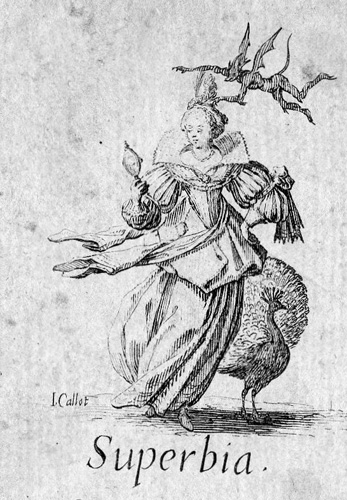
The second most common predominant fault of women could be pride. This is the primordial sin and one easy to fall into. But, if this is the main, underlining fault of all faults, it must be rooted out through serious attention, prayer, fasting. Pride can be inherited in a family where family pride continues to separate people from God.

Pride stops all growth in holiness. For a woman, this is deadly, as in order for her to be holy, the virtues must flourish into the small daily loveliness we see in the saints, such as St. Therese of Lisieux and St. Gemma Galgani.

Here is Aquinas on pride: thanks to New Advent's Summa.

Question 162. Pride


Pride is directly opposed to the virtue of humility, which, in a way, is concerned about the same matter as magnanimity, as stated above (161, 1, ad 3). Hence the vice opposed to pride by default is akin to the vice of pusillanimity, which is opposed by default to magnanimity. For just as it belongs to magnanimity to urge the mind to great things against despair, so it belongs to humility to withdraw the mind from the inordinate desire of great things against presumption. Now pusillanimity, if we take it for a deficiency in pursuing great things, is properly opposed to magnanimity by default; but if we take it for the mind's attachment to things beneath what is becoming to a man, it is opposed to humility by default; since each proceeds from a smallness of mind.


On the same way, on the other hand, pride may be opposed by excess, both to magnanimity and humility, from different points of view: to humility, inasmuch as it scorns subjection, to magnanimity, inasmuch as it tends to great things inordinately. Since, however, pride implies a certain elation, it is more directly opposed to humility, even as pusillanimity, which denotes littleness of soul in tending towards great things, is more directly opposed to magnanimity.


A sin may destroy a virtue in two ways. On one way by direct contrariety to a virtue, and thus pride does not corrupt every virtue, but only humility; even as every special sin destroys the special virtue opposed to it, by acting counter thereto. On another way a sin destroys a virtue, by making ill use of that virtue: and thus pride destroys every virtue, in so far as it finds an occasion of pride in every virtue, just as in everything else pertaining to excellence. Hence it does not follow that it is a general sin.


...Pride regards a special aspect in its object, which aspect may be found in various matters: for it is inordinate love of one's excellence, and excellence may be found in various things.


Those women who are proud honestly believe they are better than other people. They are the proverbial "snobs".  They also live a life of complete narcissism, thinking that the entire world revolves around them. This predominant fault is the First Sin of our First Parents. One can fall into pride concerning status, money, power, beauty and so on.  Pride wants to be served instead of wanting to serve.


In a marriage, pride in a woman belittles a man and dominates him and the children. Pride also manipulates, lies, and causes dissension. Women, battle this if this is your predominant fault. Life is more than all about you.


The Predominant Fault of Some Women

Just to be fair, I have been talking with lovely, good Catholic women who want to become saints. They would be in the category of the really beautiful women who are working on virtues.

What has been shared with me are two main predominant faults; vainglory and pride.

Vainglory is one of the Seven Deadly Sins-Vanity. And, this is connected to the two posts I did on inner beauty and the life of the virtues.

Vainglory may be described as Thomas Aquinas states:

Question 132. Vainglory


Now the sin of vainglory, considered in itself, does not seem to be contrary to charity as regards the love of one's neighbor: yet as regards the love of God it may be contrary to charity in two ways. On one way, by reason of the matter about which one glories: for instance when one glories in something false that is opposed to the reverence we owe God, according to Ezekiel 28:2, "Thy heart is lifted up, and Thou hast said: I am God," and 1 Corinthians 4:7, "What hast thou that thou hast not received? And if thou hast received, why dost thou glory, as if thou hadst not received it?" Or again when a man prefers to God the temporal good in which he glories: for this is forbidden (Jeremiah 9:23-24): "Let not the wise man glory in his wisdom, and let not the strong man glory in his strength, and let not the rich man glory in his riches. But let him that glorieth glory in this, that he understandeth and knoweth Me." Or again when a man prefers the testimony of man to God's; thus it is written in reproval of certain people (John 12:43): "For they loved the glory of men more than the glory of God."


In another way vainglory may be contrary to charity, on the part of the one who glories, in that he refers his intention to glory as his last end: so that he directs even virtuous deeds thereto, and, in order to obtain it, forbears not from doing even that which is against God. On this way it is a mortal sin. Wherefore Augustine says (De Civ. Dei v, 14) that "this vice," namely the love ofhuman praise, "is so hostile to a godly faith, if the heart desires glory more than it fears or loves God, that our Lord said (John 5:44): How can you believe, who receive glory one from another, and the glory which is from God alone, you do not seek?"

Now the end of vainglory is the manifestation of one's own excellence, as stated above (A1,4): and to this end a man may tend in two ways. On one way directly, either by words, and this is boasting, or by deeds, and then if they be true and call for astonishment, it is love of novelties which men are wont to wonder at most; but if they be false, it is hypocrisy. On another way a man strives to make known his excellence by showing that he is not inferior to another, and this in four ways. First, as regards the intellect, and thus we have "obstinacy," by which a man is too much attached to his own opinion, being unwilling to believe one that is better. Secondly, as regards the will, and then we have "discord," whereby a man is unwilling to give up his own will, and agree with others. Thirdly, as regards "speech," and then we have "contention," whereby a man quarrels noisily with another. Fourthly as regards deeds, and this is "disobedience," whereby a man refuses to carry out the command of his superiors.


One needs to grow in humility and God will give a person many opportunities for this.


Praise God, Women, when God allows the ebbing of your looks, the lessening your personal power, the clouding of your intelligent and the suffering of illness. All of these trials breakdown vainglory.


To be continued...more on this here 


http://supertradmum-etheldredasplace.blogspot.ie/2013/09/the-predominant-fault-of-some-women-two.html


See also http://supertradmum-etheldredasplace.blogspot.ie/2013/09/on-beauty.html

and

http://supertradmum-etheldredasplace.blogspot.ie/2013/09/on-beauty-two.html

Thursday, 26 September 2013

On Beauty Two

When I was in my twenties and thirties, the popular Bible studies for women were based on the characteristics of certain women in the Bible. Most of these were Protestant based. Such holy women as Ruth, Esther, Judith and others were highlighted with a particular virtue. I do not know if these are still floating around out there, and I have written my own thoughts on some women on this post, which you can find. I have emphasized Judith, Ruth and Deborah.

Of course, we have the most perfect woman of all as our model, Mary, Mother of God.

However, besides her great faith, hope and love, what virtues can we see in order to emulate her daily?

Let us look at a few. Mary's obedience is the hallmark of the Annunciation, as well as her meekness and trust in Providence. We do not see a panicking youth, but a calm and cooperating spirit open to God's Will.

We also see prudence, as Mary did not run out and tell people of her special position. A mark of a real saint is humility, another virtue.

The silent years of Christ in the home of Joseph and Mary remind us that Mary had to have and did, of course, all the virtues a woman needs in running a peaceful house. I like to think of Mary having the fullness of the Spirit and therefore the fullness of the virtues of temperance, justice, prudence and fortitude. We know in our own lives how much we, as women, need these virtues.

Remember, we are entering into perilous times, when the woman with virtue will be needed more than ever. A great trust in Providence will be a necessity.

Ask Mary for a removal of the blocks we put up in our lives through sin which stop the flow of the virtues given at baptism and the gifts of confirmation. Ask to become an interiorly beautiful woman.

It is our duty as women to learn humility and beg God for the full loosening of the virtues in our lives.

The times demand this.


On Beauty

When I was younger, I use to marvel at these handsome men who married less than pretty women. I would think in my adolescent brain, "What does he see in her?" Well, those men had more sense than those who chose for exterior beauty only. These handsome men saw the real beauty of these plain girls-their virtues. Two of my plain friends are extremely holy women.

Listening to Father Chad Ripperger on what type of woman makes a good wife, I was thrilled to hear him say that virtue is more important than beauty. He went so far to say that if a woman is ugly but virtuous, marry her.

This problem of not looking for the virtuous but for the outward beauty for men is that they buy the culture's obsession with beauty instead of virtue. The women of our culture are also obsessed with outward beauty.


As Catholics, we have models of virtuous women, which I shall write about in my next post.

Now, do we have to dress like the Amish? No, and we have had this conversation on this blog before. But, the problem is not merely modesty. The lack of formation from parents allow this preoccupation with outward looks instead of inward beauty. One can look at my series on virtues and formation for more on that subject.

One question has to be, how can we adjust our views either as parents or as women on developing inward beauty? What does it mean to be a virtuous woman?  Fr. Ripperger goes through the famous Biblical passage from Proverbs 31-10-31. This is a good meditation for both parents and daughters.

However, the real problem lies in the predominant faults of pride and vainglory. A parent can actually encourage faults rather than form the opposite virtues. This is a hard lesson for many moms to learn, but frequently they pass on their preoccupation with the latest cloths to their daughters. To be "in" becomes more important than being virtuous. Moms can encourage the predominant faults of pride and vainglory.

I am in complete agreement with Father Ripperger on this point. Single men, if you find a virtuous woman, marry her. Do not pass her up if she is not Miss America or poor. In fact, those plain women and poor women may have become virtuous because they were not raised to be princesses. They did not expect the handsome prince because they were and are humble.

As Father Ripperger states, if a man marries a virtuous woman, his life will be happy. If a man marries for beauty instead without virtue, he will be miserable.

To be continued....


Monday, 23 September 2013

Vatican Insider on The Women's Question And Our Role Models

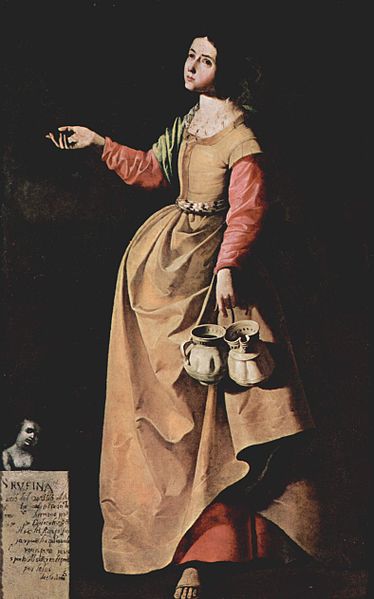
St. Rufina

In the years of militant atheism in the USSR State communities of the few Orthodox parishes consisted mainly of lay women. As they say, the faith in the twentieth century in Russia was saved from grandmas church that, despite the atheistic propaganda, continued to attend church services, sure to put icons and Bibles in chests, baptized secretly grandchildren ... Patriarch Kirill never misses an opportunity to emphasize the heroism of these women in their faithfulness to God and to the Church.

This snippet from an article from La Stampa should catch the attention of our Catholic women.


http://vaticaninsider.lastampa.it/inchieste-ed-interviste/dettaglio-articolo/articolo/chiesa-church-iglesia-orthodoxia-ortodossia-orthodox-28045/


While many people are pushing for unorthodox positions of women in the Church such as women's ordination and women deacons, a question settled in Church teaching already, the Orthodox Church has a different emphasis according to Vatican Insider.

I want to take the issue further by stating that Catholic women who are orthodox with a small o and who are wondering what their role is to consider the role of women in the early Church.


St. Macrina


We have hundreds of female saints from the first centuries of Church history, and these women are the ones we should be looking to for guidance, both in understanding their history and in prayer.

Let me give just a few names to share the great heritage, that "cloud of witnesses" of women, part of the Church Triumphant.


SS. Anne, Mary Magdelen, Felicity, Perpetua, Macrina (two), Mary, Martha, Kalliopi, Agnes, Agatha, Justa, Rufina,  Catherine of Alexandria, Symphorosa, Thekla, Cecelia, Lucy, Manna, Aurea, Dominina, Faith, Flavina, Pelagia, Triduna, Reparata, Palatias, Laurentia,  Epicharis, Sabina, Theodata, Paula, Eustochium, Gudelia, Rhipsime, Verissimus, Maxima and Julia and more.....

I suggest meditating on the lives of these early sisters in the Lord. We need their strength and courage in the days to come. Also, home schooling mums may want to do a series on women saints with their girls.

(Thanks to Wiki for the two paintings.)

Thursday, 1 August 2013

On Women Teachers, Judges, and Super-Heroines

Cranach's Judith

Sadly, a rather young American man became angry with me and told me that he would not let a woman tell him anything. He disagrees with the Jewish commentators of the Old Testament. They list several woman as teaching the Law, and the Hebrew Scriptures.

St. Solomoni, who I wrote about earlier today, and other women in the Old Testament, were honored for teaching the Torah. Susanna's mother is mentioned doing this according to Jewish texts, and Deborah did not only teach the Torah, but led her people in the Book of Judges. Deborah, by the way, is Tobit's grandmother, again according to Jewish texts. I wish I had the books I could use at Tyburn, and my notes with me. The scholars of Judaism have some great books. One is Moses' Women by Shera Aranoff Tuchman.  The Jews value their women as we love the stories of Judith, Esther, Ruth and others.

Caravaggio's Judith


There has been a long tradition in both Judaism and in Catholicism that the mother and grandmother pass down knowledge to their sons. In ancient times, the boys would finally leave their mothers about the age of five and start to work under their fathers, and go to school to learn and to study the Torah.

Some mystics claim that Anne and Joachim sent Mary to the temple school, but of course, that is not Church teaching  Thousands of statues exist across the world which show St. Anne teaching Mary the Hebrew Scriptures. I am sure she did.


I agree that at a certain age, a boy should be taught by men, for the sake of learning to be a man. Jesus most likely worked with St. Joseph from the age of five. After the child was nursed completely, and after his time with his mother ended, the mother would walk the child to the father's place of work and hand the boy over to the father. 
Deborah


But, women were accepted as leaders, as we see with Deborah in the Book of Judges, and even Judith, whose orders were followed by the commanders of the Israelite army in the book named after her. Jael actually killed Sisera in Judges, but Deborah gave the commands. 

Jael, Deborah and Barak, Salomon de Bray


Well, one cannot please everyone and I hope this young man learns to appreciate women more before he finds a wife, if he does. In marriage, the husband and wife lead each other to God. 


I skipped Esther, as I shall return to her another time. But, let us praise brave women, who did many things with the gifts of God: Deborah, Judith, Jael, Solomoni and others....

Sunday, 16 June 2013

One of the most beautiful passages in Scripture-Today's Gospel


Luke 7:
 36 - 50

36One of the Pharisees asked him to eat with him, and he went into the Pharisee's house, and took his place at table.
37And behold, a woman of the city, who was a sinner, when she learned that he was at table in the Pharisee's house, brought an alabaster flask of ointment,
38and standing behind him at his feet, weeping, she began to wet his feet with her tears, and wiped them with the hair of her head, and kissed his feet, and anointed them with the ointment.
39Now when the Pharisee who had invited him saw it, he said to himself, "If this man were a prophet, he would have known who and what sort of woman this is who is touching him, for she is a sinner."
40And Jesus answering said to him, "Simon, I have something to say to you." And he answered, "What is it, Teacher?"
41"A certain creditor had two debtors; one owed five hundred denarii, and the other fifty.
42When they could not pay, he forgave them both. Now which of them will love him more?"
43Simon answered, "The one, I suppose, to whom he forgave more." And he said to him, "You have judged rightly."
44Then turning toward the woman he said to Simon, "Do you see this woman? I entered your house, you gave me no water for my feet, but she has wet my feet with her tears and wiped them with her hair.
45You gave me no kiss, but from the time I came in she has not ceased to kiss my feet.
46You did not anoint my head with oil, but she has anointed my feet with ointment.
47Therefore I tell you, her sins, which are many, are forgiven, for she loved much; but he who is forgiven little, loves little."
48And he said to her, "Your sins are forgiven."
49Then those who were at table with him began to say among themselves, "Who is this, who even forgives sins?"
50And he said to the woman, "Your faith has saved you; go in peace."

Tuesday, 5 February 2013

"The restlessness of the external man"....lust in marriage and NFP. fourth part regarding ToB


Many, many years ago when I took an NFP course, (I ended up teaching it as well later), my fiancée and I, taking this as part of our pre-nuptial prep in our diocese, met a lovely Evangelical couple. I talked with the woman and learned that she and her husband, also a Protestant, had taken the course and were part of the team presenting the classes. I was at first surprised that an Evangelical couple were part of the team teaching the course, but soon learned that their story provided a background for the entire weekend of classes.

Her witness was extremely powerful, as she told us (a very large group at the time in the hundreds, as it was a diocesan course), that her marriage changed dramatically once the couple decided on NFP.

She explained that she and her husband had fallen into a less than Christian relationship in marriage. They had fallen, as a married couple, into the sin of lust and were approaching sex in a way, as they came to understand, not pleasing to the growth of their own spirits and not pleasing to God.

The grace of their married state had slipped away and the pursuit of pleasure became a goal in and of itself.

They forgot about love and sacrifice, procreation and child bearing. IT was all about THEM. God was out of the relationship.

NFP broke the spell and brought a conversion to both the man and the woman. They grew in love with each other and most importantly, with God. God became the centre of their marriage again, not themselves.

This is the number one danger of ToB. It replaces God with gods, little gods, little idols which entrap the soul and keep a couple bound to the material instead of addressing the needs of the soul.

That God gave such a wonderful grace of conversion to this Evangelical couple allowed them to spread the Good News of the Gospel in their own marriage, which had moved from eros, to agape, to caritas.

Only abstinence and the awareness of the needs of the soul can allow this movement of grace.Only the emphasis on the souls of the man and woman in the marriage can bring about this growth in holiness.

And, by the way, this movement of the souls of the couple in marriage, between a man and a woman, is ordained by God, made into the sacrament of marriage, which is for the salvation of the souls of the man and the woman primarily. The inner man and inner woman must be made strong. Too much emphasis on the material body, which is only part of who we are and not entirely our being, leads to a different emphasis.

Let me quote Bl. John Paul II on this point.

In suffocating the voice of conscience, passion carries with itself a restlessness of the body and the senses. It is the restlessness of the external man. When the internal man has been reduced to silence, then passion, once it has been given freedom of action, exhibits itself as an insistent tendency to satisfy the senses and the body.

This gratification, according to the criterion of the man dominated by passion, should put out the fire; but on the contrary, it does not reach the source of internal peace and it only touches the outermost level of the human individual. And here the biblical author rightly observes that man, whose will is committed to satisfying the senses, finds neither peace nor himself, but, on the contrary, "is consumed." Passion aims at satisfaction; therefore it blunts reflective activity and pays no attention to the voice of conscience. Thus, without itself having any principle of indestructibility, it "wears out." The dynamism of usage is natural for its continuity, but it tends to exhaust itself. Where passion enters into the whole of the most profound energies of the spirit, it can also become a creative force. In this case, however, it must undergo a radical transformation. If instead it suppresses the deepest forces of the heart and conscience (as occurs in the text of Sirach 23:17-22), it "wears out" and indirectly, man, who is its prey, is consumed.

This destructive force can happen in marriage, if the couple is contracepting and if the love is stuck in the material goals. Sex education in schools and in religious education leads to sin because the corresponding element of mature, caritas love, is not presented and cannot be as this is for a married couple to discover.  I am convinced that ToB is not the way for youth or adults to learn about real love, sacrificial love. It is severely flawed philosophically.


Only parents should teach youth sex education in the environment of the loving, mature relationship which the young person sees in the marriage. Teachers have no right to usurp this role. And, these types of love real love, sacrificial love, are learned in the relationship in sacramental marriage, which confers sanctifying grace.

 To be continued...