Recent Posts

Showing posts with label saints and martyrs. Show all posts

Wednesday, 26 August 2015

9 October 1845.


A miraculous thing happened on that date. Blessed John Henry Cardinal Newman came into the Catholic Church at Littlemore near Oxford,

Many years ago, I visited that holy place, saw Newman's little cell, and breathed the air of simplicity and peace, only found in areas where saints have lived. I wanted to stay there forever.

Oxford is a bustling city of golden hues and modern stores, but Littlemore seems frozen in time, a reminder of quieter, slower days, and the great spirit of  Blessed Newman.

Today is the feast day of the extraordinary priest who brought Newman into the Church, Blessed Dominic Barberi. This mostly unknown man had a "way" with non-Catholics, bringing a rather Mediterranean view of Catholicism to the old and very English manners of Oxford and Littlemore.


Blessed Dominic, a Passionist Father from Italy, founded four houses of that order in England, after working some time both in Italy and Belgium. His energy and great love brought many Anglicans into the Church right at the time when the anti-Catholic laws were finally being changed, but when, in response to more legal rights, the Papists became the butt of new prejudices and ugliness. Indeed, many people fell back into the fear and frenzy of hatred towards the new Catholic hierarchy re-established just one year after Blessed Dominic's death in Reading on August 27, 1849.

I cannot imagine the turbulent times in which he worked as a pastor and missionary, but the fruit of his work blesses us all today.  Let us pray to Blessed Dominic Barberi, a saint I truly would like to meet someday.


Blessed Dominic had a heart attack in Reading, when coming out of the train station. He was taken to a nearby pub, where he died. Amazing. I wonder if any other saints have died in English pubs?

The old station became a pub, but I do not know if the Victorian building is the same one in Blessed Dominic's story.


Sunday, 23 August 2015

Another Lay Saint To Emulate--Rose of Lima


The Chapel of St. Mary of The Angels and Martyrs is almost completely packed. I am getting ready for my next adventure, organized by God. Learning to be obedient, (and, possibly living out one's purgatory on earth,), requires complete trust in God. This way of life also demands flexibility.

One of the signs of a decaying soul, like a decaying mind, is rigidity. Those who cannot change may be missing daily opportunities for metanoia, for that call from God to change anew.

Today is the feast day of my chosen confirmation saint, Rose of Lima. I chose her when I was twelve, the age of my confirmation, for many reasons.

The first is that, at the time, she was the only female saint born in the New World. She is an American saint, albeit South American.

Second, I was struck at my tender age, by her selflessness to others. She had a true servant's heart.

Third, I wanted to give all to Christ and live the simple life as she did, choosing simplicity over complexity in her life.

Fourth, she chose penances, such as becoming a perpetual vegetarian, and wearing coarse, rough clothes, among other mortifications. I was entranced by her fortitude and focus.

Fifth, she was noted, even early on, for her exact obedience. I wanted to be obedient.

Sixth, she experienced, like St. Catherine of Siena, whom Rose loves, a mystical marriage with Christ.

Seventh, Rose remained a lay person, a Third Order Dominican, like Catherine of Siena, another saint admired by me.

Eighth, she prayed for the souls in purgatory, and even as a little girl, I was draw to this work of mercy.

To me, St. Rose seemed like a breath of fresh air when I read her life in 1960. I was confirmed in March of 1961, and wanted to be like Rose. I still do....

Well, God gives grace according to His designs, and I still do not have my little hermitage, as Rose did in the back of her parents' property.

But, she still is a witness of a lay life worth living.

The only statue out now is my Infant of Prague, Who also reminds me of simplicity and innocence, the simplicity and innocence mirrored in the life of Rose of Lima. I have one of my crucifixes out, a Benedictine one, which is rather grand. I have several crucifixes and I look at the various interpretations of My Lord on these for meditation-but the rest are packed now.

Little Rose of Lima, a lay person and a penitent, one choosing suffering for the sake of others, should speak to all of us today, on the edge of the ruin of our nations. May this little saint, patron of all South America, speak to our hearts so that we can live the radical Gospel wherever God calls us to be.


Saturday, 15 August 2015

The Strong One


Perhaps most Catholics do not know that we have a gypsy saint. Now, gypsies are a separate group of people from Europeans, a group which originated in India and began migrating into Europe around 600 A. D. Gypsies, or Romanies, may be found in most countries in Europe, in Brazil, America, Africa and many other places.

A people who have their own language with many dialects, and a wandering people, who endured slavery, as well as genocidal laws, the Romani were granted a patron saint by St. John Paul II in 1997.

As a person who has stayed in Walsingham  many times, and for months, I have come across the Romani, who, when I was there, came in hundreds around and for the feast of the Assumption. Stark reminders of a subculture of stealing meant that many shops closed for the day, at least, and the police went door to door giving us numbers to phone in case of emergency.

I had a few encounters with the Romani when I was in Walsingham, mostly from a Roma (male gypsy) who wanted to buy a life-sized statue of St. Therese of Lisieux for hundreds of dollars cash he happened to have. This statue was in the window of the b and b where I was staying.

Years before, some Romani women had taken a large doily from underneath another huge statue, this time one of Our Lady, when they came into the b and b to pray. How they manage to lift this statue up and take what, I assume, they thought was some type of holy relic, defies the imagination.


But, for many years, these people, the good and the bad, have had their own saint, Ceferino Giménez Malla, a holy man from Spain, killed by the Republicans, who hated and persecuted the Church, before and during the Spanish Civil War. Ceferino, a catechist, tried to save a Catholic priest. Both were arrested and Ceferino, with other Catholics, was finally shot on August 9th, in 1936. Ceferino is a Blessed. He is pictured and sculpted with a rosary in his hand, which he called his "weapon", and which he was clutching when he was killed. BTW, he was a Third Order Franciscan.

Blessed Ceferino reminds us all that no matter how lowly, we may be called to martyrdom. May he intercede for his people, so many who are pagans and worship false gods, as well as being into the occult. May Blessed Ceferino be invoked as a true saint for our time. His pet name is The Strong One, El Pele.

Here is an old article on his beatification from the NY


Monday, 10 August 2015

When Tolerance and Unity Become Gods

In my last posting, I quoted Our Lord and Saviour, Jesus Christ, Who clearly stated that Catholicism, in its true form, true teaching, would cause divisions.

There would be Zero marytyrs if Christianity did not separate those who are obedienct from those who are not.

St. Thomas More died for the power of the pope and the universality of the Church over the usurpation of the entire Church in England, Scotland, Wales and Ireland.

St. Maximillian Kolbe and Blessed Titus Brandsma  refused to cooperate with the Nazis, and even some Catholics who had decided to side with the government, and were killed for upholding Church teaching.

A partial list of martyrs who refused to cooperate with communists and masons in Mexico reveals those who knew that believing in the orthodox teachings of the Church was more important than tolerating sin and a false unity of compromise.

St. Cristóbal Magallanes Jara, secular priest
St. Román Adame Rosales, secular priest
St. Rodrigo Aguilar Aleman, secular priest
St. Julio Álvarez Mendoza, secular priest
St. Luis Batis Sáinz, secular priest
St. Agustín Caloca Cortés, secular priest
St. Mateo Correa Magallanes, secular priest
St. Atilano Cruz Alvarado, secular priest
St. Miguel De La Mora, secular priest
St. Pedro Esqueda Ramirez, secular priest
St. Margarito Flores Garcia, secular priest
St. José Isabel Flores Varela, secular priest
St. David Galván Bermudes, secular priest
St. Salvador Lara Puente, layman
St. Pedro de Jesús Maldonado, secular priest
St. Jesús Méndez Montoya, secular priest
St. Manuel Morales, layman
St. Justino Orona Madrigal, secular priest
St. Sabas Reyes Salazar, secular priest
St. José María Robles Hurtado, secular priest
St. David Roldán Lara, layman
St. Toribio Romo González, secular priest
St. Jenaro Sánchez Delgadillo, secular priest
St. Tranquilino Ubiarco Robles, secular priest

In Spain, those martyrs who were killed for not giving up the true faith in the face of totalitarianism encourage us not to compromise for the sake of unity, The 598 saints canonized by Pope Francis make up part of the cloud of witnesses who stood up for the true one, true, holy, catholic, and apostolic Church in the face of terrible violence. There are 731 more....
 
And there are more saints from the Spanish Civil War than this list indicates.

Mariano Alcala Perez & 18 Companions from the Mercedarian Province of Aragon
Aurelia Arambarri Fuente & 3 Companions from the Servants of Mary, Ministers of the Sick
Manuel Basulto Jimenez & 5 Companions from the Diocesan clergy and lay faithful of Jaen
Manuel Borras Ferre & 146 Companions from the clergy and religious of the Archdiocese of Tarragona
Raymundo Joaquín Castano Gonzalez, professed priest, Dominicans
José María Gonzalez Solis, professed priest, Dominicans
Melchora Adoración Cortes Bueno & 14 Companions from the Daughters of Charity of Saint Vincent de Paul in the Archdiocese of Madrid
Antonio Faundez Lopez & 3 Companions from the Franciscan Friars Minors and Clergy of the Diocese of Cartagena
Teófilo Fernandez de Legaria Goni & 4 Companions from the Congregation of the Sacred Hearts of Jesus and Mary (Picpus)
María Montserrat Garcia Solanas & 9 Companions from the Minim nuns and the lay faithful of Barcelona
Ricardo Gil Barcelon, professed priest, Sons of Divine Providence
Antonio Isidoro Arrue Peiro, layperson of the archdiocese of Valencia; postulant, Sons of Divine Providence
Andrés Gonzalez-Diez Gonzalez-Nunez from Palazuelo & 31 Companions from the Franciscan Capuchins of Madrid, Asturias, Cantabria, Malaga, and Alicante
Crisanto Gonzalez Garcia, Aquilino Baro Riera, Cipriano José Iglesias Banuelos, Guzmán Becerril Merino & 64 Companions from the Marist Brother of the Schools from the Dioceses of Madrid and Cuenca
María Asumpta Gonzalez Trujillano & 2 Companions from the Franciscan Missionaries of the Mother of the Divine Shepherd
José Xavier Gorosterratzu Jaunarena & 5 Companions from the Redemptorists of Cuenca
Joseph Guardiet Pujol, priest of the Archdiocese of Barcelona
Joan Huguet Cardona, priest of the Diocese of Minorca
Salvi Huix Miralpeix, priest of the Oratorians; Bishop of Lleida
Mauricio Iniguez de Heredia Alzola, & 23 Companions from the Hospitallers of Saint John of God of Madrid, Barcelona, Valencia and Malaga
Hermenegildo Iza Aregita of the Assumption & 5 Companions from the Trinitarians of Ciudad Real
Joaquín Jovani Marin & 14 Companions from the Diocesan Laborer Priests of Sacred Heart of Jesus
Alberto María Marco Aleman, Agustín María Garcia Tribaldos & 23 Companions from the Carmelites of the Ancient Observance and the De La Salle Brothers of Madrid
Josefa Martines Perez & 12 Companions from the Daughters of Charity of Saint Vincent de Paul and lay faithful of Valencia
José Máximo Moro Briz & 4 Companions from the Diocesan Clergy of Avila
Carmelo Moyano Linares & 9 Companions from the Carmelites of Ancient Observance of Cordoba
Joseph Nadal Guiu, priest of the Diocese of Lleida
José Jordan Blecua, priest of the Diocese of Lleida
Mauro Palazuelos Maruri & 17 Companions from the Benedictines of El Pueyo
Jaume Puig Mirosa & 19 Companions from the Sons of the Holy Family and lay faithful of Catalunya
José María Ruiz Cano, Jesús Aníbal Gomez y Gomez, Tomás Cordero y Cordero & 13 Companions from Siguenza
Manuel Sanz Dominguez of the Holy Family, professed priest, Hieronymites; restorer
Orencio Luis Sola Garriga & 19 Companions, along with Antonio Mateo Salamero from De La Salle Brothers, Diocesan Clergy and lay faithful of Madrid
Victoria Valeverde Gonzalez, professed religious, Calasanzian Institute, Daughters of the Divine Shepherdess
Fortunato Velasco Tobar & 13 Companions from the Congregation of the Missions (Vincentians)
Joan of Jesus Vilaregut Farre & 4 Companions from the Discalced Carmelites and the Diocesan Clergy of Urgell

The martyrs of the Church come from every country and nation of the world, people who refused to tolerant evil by the witness of their own lives, and people who refused to make unity of their country a god.

The generation of Gen-X is also the generation of peer pressure. My generation looked to parents first for approval, not other children or adolescents. The Millennials are much more independent and individualistic.

But, who is in charge, of the Church, the government and who will be?

Those adults who learned to "get ahead" by giving in to peer pressure cannot be evangelists, or follow the real teachings of the Church in moral issues, as compromising becomes a way of life.

Adults who want peace at any price will sell out their souls and the souls of others for this peace. The Holocaust demonstrates this type of turning a blind eye to evil, as is the scourge of abortion and now ssm.

Those Catholics who value peace over truth will not find themselves in the list of martyrs. Those Catholics who tolerate evil will be swallowed up by the same evil machine they supported, and when tolerance and unity betray Truth, Who Is a Person, Judas lives again and acts again in our midst.

Robert Hugh Benson delineated what the end product of tolerance and unity is-the complete hatred of Catholicism and Catholics. Those who again and again compromise, refuse to face their own sins, and refuse self-knowledge will lose discernment and cooperate with evil.

Ordinary people make ordinary decisions daily either for truth or tolerance, integrity or unity. In these times, there is no room for "slush".

Do you know people involved in New Age spirituality, very common in the Midwest? Help them to the Truth. Do you know people who do not pay their taxes? Help them to the Truth. Do you know people who contracept, and even, horrible as it is, agree with abortion? Help them to the Truth. Do you know people who accept ssm? Help them to the Truth.

When Christ returns, will He find any faith upon the earth?

Remember, the spiritual and corporal works of mercy are not options, but duties.


Friday, 7 August 2015

Do Prophets Run Out of Things To Say?

About two weeks ago, I lamented, as did the prophets, quoting Jeremiah, on the fact that people do not want to hear about doom and gloom. They do not want to repent, or face changing their lifestyles.

You can look back at that complaint.


But, today, I wonder if the prophets ever ran out of things to say, and became weary of saying the same-old, same-old?

The Douay-Rheims translation of Habakkuk makes a strong point in a chapter heading. The prophet is fed up with ignorance, with hard-heartedness, knowing that God is about to bring judgement on the people who have left His covenant, His laws.

Habakkuk 3 Douay-Rheims 1

3 A PRAYER OF HABACUC THE PROPHET FOR IGNORANCES.

2 O Lord, I have heard thy hearing, and was afraid. O Lord, thy work, in the midst of the years bring it to life: In the midst of the years thou shalt make it known: when thou art angry, thou wilt remember mercy.

3 God will come from the south, and the holy one from mount Pharan: His glory covered the heavens, and the earth is full of his praise.

4 His brightness shall be as the light; horns are in his hands: There is his strength hid:

5 Death shall go before his face. And the devil shall go forth before his feet.

6 He stood and measured the earth. He beheld, and melted the nations: and the ancient mountains were crushed to pieces. The hills of the world were bowed down by the journeys of his eternity.

7 I saw the tents of Ethiopia for their iniquity, the curtains of the land of Madian shall be troubled.

8 Wast thou angry, O Lord, with the rivers? or was thy wrath upon the rivers? or thy indignation in the sea? Who will ride upon thy horses: and thy chariots are salvation.

9 Thou wilt surely take up thy bow: according to the oaths which thou hast spoken to the tribes. Thou wilt divide the rivers of the earth.

10 The mountains saw thee, and were grieved: the great body of waters passed away. The deep put forth its voice: the deep lifted up its hands.

11 The sun and the moon stood still in their habitation, in the light of thy arrows, they shall go in the brightness of thy glittering spear.

12 In thy anger thou wilt tread the earth under foot: in thy wrath thou wilt astonish the nations.

13 Thou wentest forth for the salvation of thy people: for salvation with thy Christ. Thou struckest the head of the house of the wicked: thou hast laid bare his foundation even to the neck.

14 Thou hast cursed his sceptres, the head of his warriors, them that came out as a whirlwind to scatter me. Their joy was like that of him that devoureth the poor man in secret.

15 Thou madest a way in the sea for thy horses, in the mud of many waters.

16 I have heard and my bowels were troubled: my lips trembled at the voice. Let rottenness enter into my bones, and swarm under me. That I may rest in the day of tribulation: that I may go up to our people that are girded.

17 For the fig tree shall not blossom: and there shall be no spring in the vines. The labour of the olive tree shall fail: and the fields shall yield no food: the flock shall be cut off from the fold, and there shall be no herd in the stalls.

18 But I will rejoice in the Lord: and I will joy in God my Jesus.

19 The Lord God is my strength: and he will make my feet like the feet of harts: and he the conqueror will lead me upon my high places singing psalms.


The main reason for prophesying is to call people to repentance, not to tell the future. 

To be honest, most Catholics only want consolations, like the people in my vision only wanting Smarties.

But, we are not living, will we ever live again in the time of consolations.

We are the generation of trial.

The Old Testament prophets kept on speaking until they were killed by their own people. The great John the Baptist kept reminding Herod of his sins up to end of this prophet's life.

But, I shall admit, it is very difficult to speak with those who simply do not want to hear the truth.


The prophets went into the desert to pray and came out again.  St. Francis went into the wilderness, as did many others, but he came out again.

I am about to go into the desert again, 

Many of the saints went into the desert and never came out again: Mary of Egypt is one.

Whether I come out again is God's business..


Thursday, 6 August 2015

The Meaning of the Transfiguration


The real meaning of the Transfiguration sometimes is missed. Some Catholics think that Christ entered into His Glory for a brief moment.

No. Christ was never separated from His Father, and the Holy Ghost. He was always one with the and in the Trinity. What the three special apostles saw was Christ "unmasked".

The situation of Christ's humanity and divinity was not that He flipped back and forth, a heresy made up for a class on heresies by a certain smartie sem, but that He was truly God and truly Man.

Christ, in order to prepare the apostles for the deep meaning of the Passion, showed Himself as He truly is.

They missed the point, obviously, as Peter went on to deny Him.

Christ, the Second Son of the Blessed Trinity, reveals Himself to us daily in the Eucharist, but again, as the Hidden God.

With the Indwelling of the Trinity, Christ reveals Himself, with the Trinity, to those who seek Him. The Transfiguration reminds us of that Indwelling, the Trinity in and with those in sanctifying grace.

More later..


Monday, 3 August 2015

"My Bible Passage" and Meditation for The Day

I think many of us, when we came to Christ, either as re-verts or converts, have a favorite Scripture passage which marked our life decision to follow Our Lord.

I have two. The first is from today's Gospel. God reminds me that I only have a few talents, like five loaves of bread and two fish, and nothing else. But, God, can and does multiple our talents, which He gave us in the first place, and feed many people, if we are willing to be humble.

The second "personal passage", which is the call of Matthew, shows me daily the need to consecrate myself to God over and over to do His Will without knowing exactly what that means.

I am amused when people ask me if I have a business plan for the house of prayer. The apostles and St. Paul had no business plans for spreading the Gospel. The key for them and for me must be complete dependence on Providence, working as hard as one can but realizing that God is the only one Who can do the seemingly impossible.


Matthew 14:13-21 Douay-Rheims

13 Which when Jesus had heard, he retired from thence by boat, into a desert place apart, and the multitudes having heard of it, followed him on foot out of the cities.

14 And he coming forth saw a great multitude, and had compassion on them, and healed their sick.

15 And when it was evening, his disciples came to him, saying: This is a desert place, and the hour is now past: send away the multitudes, that going into the towns, they may buy themselves victuals.

16 But Jesus said to them, They have no need to go: give you them to eat.

17 They answered him: We have not here, but five loaves, and two fishes.

18 He said to them: Bring them hither to me.

19 And when he had commanded the multitudes to sit down upon the grass, he took the five loaves and the two fishes, and looking up to heaven, he blessed, and brake, and gave the loaves to his disciples, and the disciples to the multitudes.

20 And they did all eat, and were filled. And they took up what remained, twelve full baskets of fragments.

21 And the number of them that did eat, was five thousand men, besides women and children.


Luke 5:27-32 Douay-Rheims

27 And after these things he went forth, and saw a publican named Levi, sitting at the receipt of custom, and he said to him: Follow me.

28 And leaving all things, he rose up and followed him.

29 And Levi made him a great feast in his own house; and there was a great company of publicans, and of others, that were at table with them.

30 But the Pharisees and scribes murmured, saying to his disciples: Why do you eat and drink with publicans and sinners?

31 And Jesus answering, said to them: They that are whole, need not the physician: but they that are sick.

32 I came not to call the just, but sinners to penance.

And, one of my favorite saints is today:

St Oswald (c.604 - 642)

Saint Oswald was born at the very beginning of the 7th century. He was the youngest son of the pagan Ethelfrid, the first king of a united Northumbria. After his father’s death in battle, the young Oswald fled to Iona for safety and was baptised there and became a devoted Christian.
In 633 Oswald returned to Northumbria to regain his father’s kingdom. It was said that he set up a wooden cross as his standard and dedicated himself and his people to God’s protection before engaging himself in battle with the occupying Welsh King Cadwallon, not far from the present Hexham. He defeated and killed Cadwallon and at once invited the monks from Iona to begin the evangelisation of his kingdom which extended from the Forth to the Humber. After initial difficulties, the monk Aidan was sent to lead these Irish missionaries and Oswald found him to be both a valued adviser and a good friend. Oswald took seriously the work of bringing Christianity to his people and was even known to accompany Aidan on his missionary expeditions and to act as interpreter during the time Aidan was learning the language of the English. He was also well known both for his personal prayerfulness and his charity to those in need.
Sadly the reign of King Oswald lasted only eight years. In 642 he was killed in battle by Penda the pagan king of the Mercians. It was said that as he fell in death he was heard to pray for those who died with him. Oswald was a popular hero and his reputation as a saint was widespread even into mainland Europe.
Middlesbrough Ordo

Sunday, 26 July 2015

St. Anne

Today, St. Anne got bumped off the calendar by the Sunday Liturgy. However, as she is one of my personal patrons, having a middle name, like millions of Catholic girls in my generation, of Ann, I take time to wish you all Happy St. Anne's Day. In some liturgies, it is the feast of both Anne and Joachim.

It is hard to imagine St. Ann's part in the life of Jesus. She was not there at the birth, apparently, and may have already died. We have no indication in Scripture as to where she lived, (although, most likely in Nazareth), or how long she lived.

God gave St. Joseph to Mary for protection and status, so most likely, the parents of Mary were already dead, awaiting the Harrowing of Hell, awaiting their Grand Son's majestic Resurrection and destruction of Lucifer's reign.

In my school days, some of the girls prayed, "St. Ann, find me a man" when searching for a husband. I have to admit, I never did this. I had too many boys interested in me, and I was happy just being me. But, then, I had three brothers, and knew what boys were really like!

But, today, let us remember the woman who bore the Immaculate Conception, taught her when she was growing up, and, perhaps, presented her to Joseph on Mary and Joseph's wedding day.

I am not nor ever shall be a grandmother, but St. Ann is your patron, grandmothers, as well as the patron of carpenters; childless people;equestrians; grandparents; homemakers/housewives; lacemakers; lost articles; Fasnia (Tenerife); Mainar; Detroit; miners; mothers; moving house; old-clothes dealers; poverty; pregnancy; seamstresses; stablemen; sterility,.

She must be very busy answering prayers in heaven. and as I am moving in four weeks, please pray to her for me, please. It would be nice if I could move into a real house, instead of one room.

Saturday, 25 July 2015

St. James Compostela and Pilgrimages

By the middle of the 9th century, the relics of St. James made their way to Spain, brought by the Catholics who were already in Spain, but needed the graces of pilgrimages because of the new invasions. This shrine reminds us all of the falsity of so much revisionist history.  St. James, one of the three special apostles closer to Christ than the others, with Peter and John, saw the Transfiguration, but also was one in the Garden of Gethsemane who could not stay awake with Christ in His Agony.

Therefore, he experienced his own martyrdom in 44 A.D.

For Europeans, the road to Compostela is an internationally protected historical site, and includes the shrine. In 2013, my pastor in England walked the walk at the age of 50, and in honor of his 25 years as a priest. He shared the great physical travail of the walk, as well as the spiritual benefits.

I have one friend who was converted on the walk many years ago from a life of youthful sin and negligence of the Faith. I know another man who made the walk and did the long hard way of sleeping in barns, over thirty years ago.

America has no walking pilgrimages, which tells you something about the problem of religion here. Without cars, no one can go to the only two approved apparitions in the Americas, Guadalupe, and Our Lady of Good Hope, which you can read about here.

I would have loved to walk Compostela, but could not find anyone to go with me when I was able to do so. I would like to see the Shrine of Our Lady of Good Hope, but do not have a car, although I do have a license.

The lack of local shrines forms part of America's sad Low Protestant heritage, which has now crumbled into gross paganism. Without the sacramental life of the Church, religion fades into relativism and individualism--see my posts on the solas.

A pilgrimage is not a picnic or a vacation, but a walk, or ride, of penance. One goes on pilgrimage for many reasons. Some go to Lourdes to be healed. Some go to Fatima to be close to Mary and her words for these troubled times. Some go to Akita for prayer and reparation. Some go to Guadeloupe for petitions.

But, the lack of shrines in the States points to exactly the same trouble I am having, even in these obviously anti-religious times, of setting up a house of prayer.

American Catholics just do not believe in penance or sustained quiet. The cult of activity deadens their perception of finding God in the silence of smallness.

St. Juan Diego Cuauhtlatoatzin and Adele Brise were simple people. Sister Agnes Katsuko Sasagawa is a simple, quiet nun in a simple, quiet order.

Pray for the house of prayer. Pray for people to come and to desire to do reparation for our world.

Mary comes in times of stress. Here are some of her words from Akita. 

St. James, pray for us today.


"As I told you, if men do not repent and better themselves, the Father will inflict a terrible punishment on all humanity. It will be a punishment greater than the deluge, such as one will never seen before. Fire will fall from the sky and will wipe out a great part of humanity, the good as well as the bad, sparing neither priests nor faithful. The survivors will find themselves so desolate that they will envy the dead. The only arms which will remain for you will be the Rosary and the Sign left by My Son. Each day recite the prayers of the Rosary. With the Rosary, pray for the Pope, the bishops and priests."
"The work of the devil will infiltrate even into the Church in such a way that one will see cardinals opposing cardinals, bishops against bishops. The priests who venerate me will be scorned and opposed by their confreres...churches and altars sacked; the Church will be full of those who accept compromises and the demon will press many priests and consecrated souls to leave the service of the Lord.
"The demon will be especially implacable against souls consecrated to God. The thought of the loss of so many souls is the cause of my sadness. If sins increase in number and gravity, there will be no longer pardon for them"
"With courage, speak to your superior. He will know how to encourage each one of you to pray and to accomplish works of reparation."
"It is Bishop Ito, who directs your community."

(P.S.A friend of mine has never seen The Mission, The Passion of the Christ, or The Way. If any of you want to order these for me so I can show him these movies, please let me know, asap.)

More on the pilgrimage to Compostela may be found at this site.


Friday, 24 July 2015

From Universalis Today--More Martyrs

Raise your children to become saints...

St John Boste (c.1544-1594)

John Boste was born in Westmorland around 1544. He studied at Queen’s College, Oxford where he became a Fellow. He converted to Catholicism in 1576. He left England and was ordained a priest at Reims in 1581. He returned as an active missionary priest to Northern England. He was betrayed to the authorities near Durham in 1593. Following his arrest he was taken to the Tower of London for interrogation. Returned to Durham he was condemned by the Assizes and hanged, drawn and quartered at nearby Dryburn on 24 July 1594. He denied that he was a traitor saying: “My function is to invade souls, not to meddle in temporal invasions”.
DK

Other saints: Blessed Robert Ludlam and Nicholas Garlick (d. 1588)

Robert Ludlam around 1551, in Derbyshire, the son of a yeoman. After studying at Oxford he went to the English College at Rheims and was ordained priest there in September 1581. At the end of April 1582 he set out for England to pursue his ministry there.
Nicholas Garlick was born around 1555, also in Derbyshire. He spend several years as a schoolmaster, then went to the English College and was ordained at the end of March 1582. He came to England in January 1583.
Both Ludlam and Garlick were arrested at the home of a Catholic recusant, convicted of the crime of being priests, and hanged, drawn, and quartered on 24 July 1588 in Derby. According to eyewitnesses Ludlam stood smiling while the execution of Garlick was being carried out, and smiled still when his own turn came.

Thursday, 23 July 2015

Repeat of A Phrase


Saint Anthony the Hermit "There is no perfect prayer if the religious perceives that he is praying?"


How do we lose ourselves in prayer? Love, love is the answer.


Do not reject graces which are being poured out upon us at this time.


Be open to God in and through the Dark Night and in and through suffering.

From Universalis...Two Great Martyrs for Today


Philip Evans was born in Monmouth, 1645, and was educated at St Omer where he joined the Society of Jesus. After ordination he was sent to South Wales to work. Despite the official anti-Catholic policy he was left alone for some years by the local officials. In 1678 in the wake of the so-called ‘Popish Plot’ he was taken prisoner, £200 (then a huge sum of money) having been offered as a reward for his arrest. He refused to take the Oath of Allegiance and was kept in Cardiff Castle. He was not put on trial for several months because, it is said, no one could be found to testify against him.
  John Lloyd was a Welshman, born in Brecon about the year 1630. He studied for the priesthood in Valladolid, Spain and then returned to Wales where he ministered as a diocesan priest for over twenty years without any recorded problems. Following the ‘Popish Plot’ of Titus Oates, Lloyd was arrested in Glamorgan and charged with having said Mass at Llantilio, Penrhos, and Trievor. He was imprisoned at Cardiff Castle with Philip Evans. They were tried together and were both condemned for their priesthood. They were hanged, drawn, and quartered together on 22 July, 1679 on Gallows Field in Cardiff. Philip Evans spoke at some length to the crowd in both English and Welsh. In the course of his speech he said: “I die for God and religion’s sake; and I think myself so happy that if I had many lives I would willingly give them all for so great a cause.” His companion John Lloyd said very little: “I never was a good speaker in my life”, but that he died in “the true Catholic and Apostolic faith”

Thursday, 16 July 2015

Where are the athleta Christi?

http://www.crisismagazine.com/2015/europe-a-land-without-love

I taught ancient Greek and Roman History. My students loved the stories of Marathon and even
Thermopylae. The great exploits of the armies of Sparta and Athens inspired generations of students before my classes read about the battles which made Europe Europe.

Same with the history of the battles of Vienna and Lepanto. Same with the Battle of the Bulge.

Tyrants who hated liberty and tyrants who hated God lay in the dust because of brave men, like my dad, still alive at 92, and a World War II veteran.

The above article reveals a perspective not new to me. I remember asking my class of mostly young men in 2003 in Alaska if they would fight another war to save the Church and the West. The answer was a resounding "No"! I knew my students, all Catholic, and I knew what their answer would be, but I was still disappointed.

Boys who do not learn to sacrifice do not become men.

Patriotism is a minor virtue. It springs from the virtue of duty towards one's parents, a command of God to honor one's parents,and by extension, one's home land.

Patriotism includes a love of place, of a people with whom one can identify. The great heresies of individualism, an American blight, and relativism, both parts of the heresy of Modernism, has ruined the hearts of so many Americans and Catholics. The lack of patriotism is a lack of identity with the common good.

Some love countries other than, or in addition to the land of their births. I am like that type of person. loving the country which gave me my son, and moving there years before I was married and had a child because of a deep identity with this certain country.

One cannot always explain a "spiritual home" but for me, the Faith which built Europe, was still more obvious in Great Britain, than in Protestant America, despite years of oppression, when I move there so many, many years ago.

What causes love of a country is this identity, and for me, the identity of Catholicism. Having read history in college, as well as theology and philosophy, I knew the great heritage of thought and practice which made Europe unique, totally believing even as a young person, like Belloc, that Europe was the Faith and the Faith was Europe. I loved the heritage of art, architecture, music, education, even food, which was the heritage of Christian Europe.

I read every book (and still have every book) on this subject that Christopher Dawson ever wrote as early as the late 1970s. Because I knew history, I could sense the signs of the times. Because I knew my religion, I understood what was happening on the European front of the war, as well as on the American front.

The Catholic Church has lost great influence in the European world, just as Protestantism morphed into secularism in America. We know witness the rise of pagan nations, and paganism is rooted in selfishness, self-love and not love of a people or nation.

This passing of patriotism must be mourned by those of us who understand what this death of the heart means. Charity towards neighbor dies in a land of those who do not love their country. Civilization dies once individual desires take the place of sacrifice for the common good.

Men like my dad who spent their youth in trenches fighting against the real tyranny of  Nazism perhaps no longer exist in the numbers needed to preserve freedom. And, when a nation turns its back on God, to be honest, freedom no longer exists to preserve.

God will let nations die for lack of love, love of patria, love of neighbor, love of Him. He will punish nations which turn to lust, greed, gluttony, pride and so on. He will let people go their own way until there is no other way to turn but to Him.

This movement of punishment, death and rebirth forms a persistent theme in the Old Testament, when God called His People to repentance over and over through the words and deeds of the Prophets, who frequently, where killed rather than heeded. 

Christ Himself prophesied the Fall of Jerusalem and He wept, one of the few times mentioned of His weeping.

O Jerusalem, Jerusalem, killing the prophets and stoning those who are sent to you! How often would I have gathered your children together as a hen gathers her brood under her wings, and you would not! Luke 13:34

Satan has successfully spent years emasculating the men of my and following generations. Leadership simply cannot be found, either in the Church or in the State. We face the death of nations for one simple reason. Without Christianity, without God being the center of one's life, men stay as children, lost in the never, never land of self , pleasure, sloth.

How many times I have written about the "peter pans". The Lost Boys were lost not only physically but mentally, psychologically, spiritually. But, even they fought in the story, pushed to rescue and defend their own little world.

We have no defense, no cohesive energy to withstand whatever enemies decide to come against us. Women who are Christian have seen this for two, if not three, generations, lamenting the lack of protectors and the overwhelming presence of predators among the males with whom they come into contact at work, college, or even in church.

We await the canonization of the first couple to be canonized together, Louis and Zelie Martin. Louis was a quiet, monklike man who God called to raise a house of saints. His type, the sacrificial man, is so rare that the day of his canonization, along with that of his brave and loving wife, will be a tribute to a truly lost generation.

Catholics forget that God commanded the take-over of the Promised Land. Abraham fought, Moses fought, Joshua fought, Gideon fought. David fought--all saints, all men of God.

No Charles Martel, no Charlemagne, no Men of the West, no Louis Martin walks the streets of Athens today, or Chicago, or Canberra. The heart needs God, needs Christ to be a patriot.

All the pagan cities fell to the energies of the new generations of those focused on Christ and His Kingdom. Christendom died a long time ago, but now, even the vestiges of civilization crumble from the lack of will and, more importantly, the lack of virtue.

War began in Heaven. It was an extremely short war, but the battles continue on Earth. St. Michael, one of the lower echelons of the heavenly host, won the day. However, the mop-up falls to us.

Thirteen years ago, when I was facing death, I told my young son that I wanted a certain phrase on my tombstone. This phrase was one I had pondered for many, many years before this occurrence. 

Now, we do not even have heroes of fiction.

I put the phrase in boldface.

“I wish it need not have happened in my time," said Frodo.

"So do I," said Gandalf, "and so do all who live to see such times. But that is not for them to decide. 

All we have to decide is what to do with the time that is given us.”

 J.R.R. Tolkien, The Fellowship of the Ring

I decided to become a saint, and to raise a saint. That is what Louis and Zelie Martin decided to do.

That is the call of every Catholic parent. Some saints may become leaders, even leaders of war.

Pray that God puts a heart of warriors into some of the sons born to real Catholics today. The great spiritual war is not over, yet.

I have given God a spiritual warrior. May other parents give their sons to God, both for prayer and penance, and even for war.

St. David, pray for us. St. Martin, pray for us. Saint Joan of Arc, pray for us. St. George, pray for us.

(P.S. Did you read the encyclical in the previous post on the Church Militant in my repost?)


Wednesday, 15 July 2015

Framing Prayer 23 Jesuits-God's Glory


Interestingly, all orders have a "character" which means the prayer of the order has a certain characteristic.

For me, for example, character of the Salesians is the love for youth, and the prayers reflect purity of heart.

For the Carmelites, as we have recently seen, the character is the embracing of the Cross, and the prayer is one of joining with Christ in His Passion.

For the Benedictines, the character is humility, a practical humility, and the prayer is one of humble discipline and simplicity.

I see the character of the Jesuits as primarily one of honesty,and the prayer reflects honesty regarding the self, and regarding others. How one is honest with others is through forgiveness.

For me, the Jesuit spirituality moves from the stark honesty of the awareness of one's sins, to the glory of the Resurrection. Even the order's motto, "Ad maiorem Dei gloriam" indicates this self-knowledge of sin, forgiveness and service pointing to giving all things to God for His glory, not for self, not vainglory.

One reason there are so many Jesuit martyrs has to do with this focus on God's glory in the world--one chooses suffering and death for Christ, forgiving others, moving on to glory.
 
The Resurrection reveals God's glory and service to others, as Christ commanded us to go forth and teach all nations, baptizing, saving souls. This stark commission of Christ may be clearly see in Jesuit spirituality and history.

The list of martyrs includes men from almost every nation. The glory of God is to fill the Earth, if not in peace, than in martyrdom.

Our prayers today could reflect this desire for honesty, forgiveness, service, God's glory.

Ignatius' great but simple prayer could be our own.

Can we laity make this our prayer as well daily in these hard times, and the worst to come?

A good prayer to teach your children, homeschoolers....

Suscipe

Take, Lord, and receive all my liberty,
my memory, my understanding,
and my entire will,
All I have and call my own.

You have given all to me.
To you, Lord, I return it.

Everything is yours; do with it what you will.
Give me only your love and your grace,
that is enough for me.


Friday, 10 July 2015

Future


http://www.afr.com/business/agriculture/billionaires-beef-up-in-bush-20150710-gi8qlk

The more I read about the shrinking of the middle class through debt and gross consumerism, as well as unemployment, and the more I read about the fast growing underclass completely dependent on the government, the more I am reminded of the old story The Time Machine.

Those with gobs of money seem to be buying up land in many areas, They will control the food supplies.

I predict, and I have thought this for a long time, that in the end, after financial chaos, there will be two classes-the mega-wealthy privileged, who belong to Bilderberg et al, and a slave class.

What I saw in Europe was the sadness of the middle class, from which most of us online have come, as they see their rights and status slipping into the ocean of big interests. In America, people pretend they have money by using credit, and have slipped into la-la land regarding their personal financial futures.

The American Dream was never a reality, but a progressive fallacy based on the isms of Americanism, materialism, consumerism. My intelligent wealthy friends are not in debt, have sold their investments, and are buying land. Why? They know the value of land, and the not-so-future need for access to food supplies. They can see the take-over of a few multi-national companies and they are nervous about this government's ability to control OWG interests.

Big is in, small is out.

The easiest examples to see must be the almost total lack of Ma and Pa shops of any kind. Yesterday, a friend of mine and I had to go through my old neighborhood on our way to a restaurant. He is much younger than I am and we had worked on moving my books in the afternoon.


Time for dinner at a new Middle Eastern place brought us through the streets which in the 1950s and 1960s were choc-a-bloc with all the shops necessary for baby-boomer parents-small independent shops and businesses, now all gone--all but one barbershop.

In two generations, small entrepreneurs, once the backbone of America business, have disappeared.

More than that, the good, old work ethic has been swept away as well.


Up and down those blocks were large houses of large families of children of Catholic and Lutheran parents, playing ball, swimming in the local pool, now gone, going in and out of each others' houses and walking to school.

That middle class and lower middle class groupings have contracepted themselves into extinction.

Churches have been decimated and at most daily Masses, I am one of the youngest in the pews, at 66!

The frenetic seeking for comfort has destroyed the middle and lower middle class ability to wait until one has the money to buy something, to put children before goods, to be content with small.

Catholics wanted to be Americans first and Catholics second--this lack of family life and the lack of a cohesive communities are results.


Bargain hunting is now the main entertainment for many people....and garage sales sell things people have bought in knee-jerk compulsive buying.  When I speak to people about frugality or simplicity of life, except for the few, most do not understand the language of temperance.

Less is more. But, the middle class has forgotten this. This class will be forgotten in the future, as a failed experiment growing out of the prosperity and new trade, family banking systems and businesses of the great boom of the birth of the bourgeoisie.

This demographic change will affect the Catholic Church, which historically in America, was made up of the lower middle class and the lower upper classes, not the middle class until the 20th century.

We were a Church of the poor and the wealthy who knew what noblesse oblige was all about. That concept went the way of gross greed and gross capitalism based on gross individualism.

Result: an underclass stuck dependent on the socialist system the Founding Fathers never dreamed of and would decry; and the institutionalized greed of the mega-wealthy.

I shall not see this future of master and slaves, as the process will escalate only after many other changes, which will give power to the few who have been planning this destruction of Christian lifestyles, but this cultural scenario has all happened before in pagan times. Now, that we are in the great time of the Neo-Pagans, one cannot expect either a work ethic or noblesse oblige.

The Church keeps us from the worst errors a civilization can endure and still continue. Without the Church, no family is protected, children are not protected, women are not protected, and the general communal spirit which brings people to work together in simplicity and sharing falls away, decays, and dies.

"See how they love one another" cannot merely be a dream but a reality in the face of the shock of the future, to make a pun out of a famous book.

God will allow us all to be purged of sins, all sins, and purified. Thanks be to God for these times in which we live, but saints are more necessary than ever.

My view of the future of the Church is that God will raise us mighty saints in these times-men like Bernard, Dominic, and Benedict, and women like Etheldreda, Mechthild, Catherine.

I may not see these great saints, but for the Church to survive in the future, families could be these great souls for the benefit of the universal Church.

Exciting but trying times ahead. From today's Lauds:

Habakkuk 3

The Lord will appear in judgement

In spite of your anger, Lord, have compassion.
Lord, I heard what you gave me to hear,
and I was struck with awe of your work.
In the midst of the years, bring it to life;
in the midst of the years you will make it known.
When you are angry, you will remember your mercy.
God will come from Theman,
the holy one from the mountain of Pharan.
His glory has covered the heavens
and the earth is full of his praise.
His brightness shall be like light itself,
rays shining from his hands –
there is his strength hidden.
You went forth for the salvation of the people,
for salvation with your anointed one.
You made a way through the sea for your horses,
in the silt of many waters.
I have heard you, Lord,
and my stomach churns within me;
at the sound of your voice my lips tremble.
My bones rot away, my steps stumble.
I will rest and be quiet on the day of tribulation
and let it overtake those who have invaded us.
For the fig will not flower,
the vines will not fruit,
the work of the olive will be lost.
The fields will yield no food,
the flocks will be cut off from the sheepfold,
there will be no cattle in the stalls.
But I will rejoice in the Lord, take joy in God my saviour.
The Lord God is my strength.
He will make me as sure-footed as the deer.
He will lead me up to the heights.
Glory be to the Father and to the Son and to the Holy Spirit,
as it was in the beginning, is now, and ever shall be,
world without end.
Amen.
In spite of your anger, Lord, have compassion.


Thursday, 9 July 2015

Thursday Theme

Martyrdom seems to be a theme today. Please check out this neat article and a second one, on the Carmelite, Titus Brandsma, I highlighted earlier this week.

He encourages me.

http://guildofblessedtitus.blogspot.com/2011/07/our-patrons-feast-day-blessed-titus.html

http://guildofblessedtitus.blogspot.com/2015/07/passivity-vs-activity.html

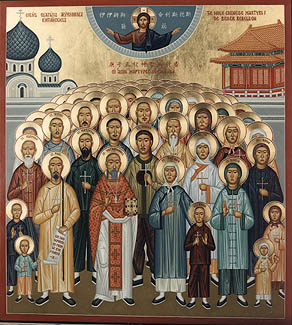
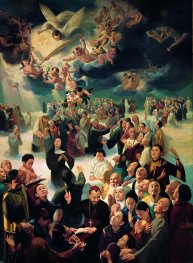
The Martyrs of China

https://upload.wikimedia.org/wikipedia/commons/9/92/Chinesemartyrs-htm_sm.jpg


 AGOSTINO ZHAO RONG (+ 1815)
AND 119 COMPANIONS, MARTYRS IN CHINA (+ 1648 – 1930)

1st. October 2000
http://www.vatican.va/news_services/liturgy/saints/ns_lit_doc_20001001_zhao-rong-compagni_en.html
From the earliest beginnings of the Chinese people (sometime about the middle of the third millennium before Christ) religious sentiment towards the Supreme Being and diligent filial piety towards ancestors were the most conspicuous characteristics of their culture, which had existed for thousands of years.

This note of distinct religiousness is found to a greater or lesser extent in the Chinese people of all centuries up to our own time, when, under the influence of western atheism, some intellectuals, especially those educated in foreign countries, wished to rid themselves of all religious ideas, like some of their western teachers.

In the fifth century, the Gospel was preached in China, and at the beginning of the seventh century the first church was built there. During the T'ang dynasty (618-907) the Christian community flourished for two centuries. In the thirteenth, thanks to the understanding of the Chinese people and culture shown by missionaries like Giovanni da Montecorvino, it became possible to begin the first Catholic mission in the Middle Kingdom, with the episcopal see in Beijing.

It is not surprising, especially in the modern era (that is, from the sixteenth century, when communications between the east and west began to be, in a way, more frequent) that there was on the part of the Catholic Church a longing to take the light of the Gospel to this people in order to enrich still more their treasure of cultural and religious traditions, so rich and profound.

And so, beginning from the last decades of the sixteenth century, various Catholic missionaries were sent to China: people like Matteo Ricci and others were chosen with great care, keeping in mind their cultural abilities and their qualifications in various fields of science, especially astronomy and mathematics, in addition to their spirit of faith and love. In fact, it was thanks to this and to the appreciation that the missionaries showed for the remarkable spirit of research shown by the studious Chinese, that it was possible to establish very useful collaborative relationships in the scientific field. These relationships served in their turn to open many doors, even that of the Imperial Court, and this led to the development of very useful relations with various people of great ability.

The quality of the religious life of these missionaries was such as to lead not a few people at a high level to feel the need to know better the evangelical spirit that animated them and, then, to be instructed with regard to the Christian religion. This instruction was carried out in a manner suited to their cultural characteristics and way of thinking. At the end of the sixteenth century and the beginning of the seventeenth, there were numerous people who, having undergone the necessary preparation, asked for baptism and became fervent Christians, while always preserving with just pride their Chinese identity and culture.

Christianity was seen in that period as a reality that did not oppose the highest values of the traditions of the Chinese people, nor place itself above these traditions. Rather, it was regarded as something that enriched them with a new light and dimension.

Thanks to the excellent relations that existed between some missionaries and the Emperor K'ang Hsi himself, and thanks to the services they rendered towards re-establishing peace between the “Czar” of Russia and the “Son of Heaven”, namely the Emperor, the latter issued in 1692 the first decree of religious liberty by virtue of which all his subjects could follow the Christian religion and all the missionaries could preach in his vast domains.

In consequence, there were notable developments in missionary activity and the spread of the Gospel message; and many Chinese people, attracted by the light of Christ, asked to be able to receive baptism.

Unfortunately, however, the difficult question of “Chinese rites”, greatly irritated the Emperor K'ang Hsi and prepared the persecution. The latter, strongly influenced by that in nearby Japan, to a greater or lesser extent, open or insidious, violent or veiled, extended in successive waves practically from the first decade of the seventeenth century to about the middle of the nineteenth. Missionaries and faithful lay people were killed, and many churches destroyed.

It was on 15 January 1648 that the Manchu Tartars, having invaded the region of Fujian and shown themselves hostile to the Christian religion, killed Blessed Francis Fernández de Capillas, a priest of the Order of Preachers (Dominicans). After having imprisoned and tortured him, they beheaded him while he recited with others the Sorrowful Mysteries of the Rosary.

Blessed Francis Fernández de Capillas has been recognised by the Holy See as a Protomartyr of China.

Towards the middle of the following century (the eighteenth) another five Spanish missionaries, who had carried out their activity between 1715-1747, were put to death as a result of a new wave of persecution that started in 1729 and broke out again in 1746. This was in the epoch of the Emperor Yung-Cheng and of his son, K'ien-Lung.

Blessed Peter Sans i Yordà, O.P, Bishop, was martyred in 1747,at Fuzou.

All four of the following were killed on 28 October 1748:

Blessed Francis Serrano, O.P., Priest,
Blessed Joachim Royo, O.P., Priest,
Blessed John Alcober, O.P., Priest,
Blessed Francis Diaz, O.P., Priest.


A new period of persecution in regard to the Christian religion then occurred in the nineteenth century.

While Catholicism had been authorised by some Emperors in the preceding centuries, Emperor Kia-Kin (1796-1821) published, instead, numerous and severe decrees against it. The first was issued in 1805. Two edicts of 1811 were directed against those among the Chinese who were studying to receive sacred orders, and against priests who were propagating the Christian religion. A decree of 1813 exonerated voluntary apostates from every chastisement, that is, Christians who spontaneously declared that they would abandon their faith, but all others were to be dealt with harshly.

In this period the following underwent martyrdom:

Blessed Peter Wu, a Chinese lay catechist. Born of a pagan family, he received baptism in 1796 and passed the rest of his life proclaiming the truth of the Christian religion. All attempts to make him apostasize were in vain. The sentence having been pronounced against him, he was strangled on 7 November 1814.


Following him in fidelity to Christ was:

Blessed Joseph Zhang Dapeng, a lay catechist, and a merchant. Baptised in 1800, he had become the heart of the mission in the city of Kony-Yang. He was imprisoned, and then strangled to death on12 March 1815.


In this same year (1815) there came two other decrees, with which approval was given to the conduct of the Viceroy of Sichuan who had beheaded Monsignor Dufresse, of the Paris Foreign Missions Society, and some Chinese Christians. As a result, there was a worsening of the persecution.


The following martyrs belong to this period:

Blessed John Gabriel Taurin Dufresse, M.E.P., Bishop. He was arrested on 18 May 1815, taken to Chengdu, condemned and executed on 14 September 1815.


Blessed Augustine Zhao Rong, a Chinese diocesan priest. Having first been one of the soldiers who had escorted Monsignor Dufresse from Chengdu to Beijing, he was moved by his patience and had then asked to be numbered among the neophytes. Once baptised, he was sent to the seminary and then ordained a priest. Arrested, he had to suffer the most cruel tortures and then died in 1815.


Blessed John da Triora, O.F.M., Priest. Put in prison together with others in the summer of 1815, he was then condemned to death, and strangled on 7 February 1816.


Blessed Joseph Yuan, a Chinese diocesan priest. Having heard Monsignor Dufresse speak of the Christian Faith, he was overcome by its beauty and then became an exemplary neophyte. Later, he was ordained a priest and, as such, was dedicated to evangelisation in various districts. He was arrested in August 1816, condemned to be strangled, and was killed in this way on 24 June 1817.


Blessed Francis Regis Clet of the Congregation of the Mission (Vincentians). After obtaining permission to go to the Missions in China, he embarked for the Orient in 1791. Having reached there, for thirty years he spent a life of missionary sacrifice. Upheld by an untiring zeal, he evangelised three immense provinces of the Chinese Empire: Jiangxi, Hubei, Hunan. Betrayed by a Christian, he was arrested and thrown into prison where he underwent atrocious tortures. Following sentence by the Emperor he was killed by strangling on 17 February 1820.


Blessed Thaddeus Liu, a Chinese diocesan priest. He refused to apostasize, saying that he was a priest and wanted to be faithful to the religion that he had preached. Condemned to death, he was strangled on 30 November 1823.


Blessed Peter Liu, a Chinese lay catechist. He was arrested in 1814 and condemned to exile in Tartary, where he remained for almost twenty years. Returning to his homeland he was again arrested, and was strangled on 17 May 1834.


Blessed Joachim Ho, a Chinese lay catechist. He was baptised at the age of about twenty years. In the great persecution of 1814 he had been taken with many others of the faithful and subjected to cruel torture. Sent into exile in Tartary, he remained there for almost twenty years. Returning to his homeland he was arrested again and refused to apostasize. Following that, and the death sentence having been confirmed by the Emperor, he was strangled on 9 July 1839.


Blessed Augustus Chapdelaine, M.E.P., a priest of the diocese of Coutances. He entered the Seminary of the Paris Foreign Missions Society, and embarked for China in 1852. He arrived in Guangxi at the end of 1854. Arrested in 1856, he was tortured, condemned to death in prison, and died in February 1856.


Blessed Laurence Bai Xiaoman, a Chinese layman, and an unassuming worker. He joined Blessed Chapdelaine in the refuge that was given to the missionary and was arrested with him and brought before the tribunal. Nothing could make him renounce his religious beliefs. He was beheaded on 25 February 1856.


Blessed Agnes Cao Guiying, a widow, born into an old Christian family. Being dedicated to the instruction of young girls who had recently been converted by Blessed Chapdelaine, she was arrested and condemned to death in prison. She was executed on 1 March 1856.


Three catechists, known as the Martyrs of MaoKou (in the province of Guizhou) were killed on 28 January 1858, by order of the Mandarin of MaoKou:

Blessed Jerome Lu Tingmei,
Blessed Laurence Wang Bing,
Blessed Agatha Lin Zao.

All three had been called on to renounce the Christian religion and having refused to do so were condemned to be beheaded.


Two seminarians and two lay people, one of whom was a farmer, the other a widow who worked as a cook in the seminary, suffered martyrdom together on 29 July 1861. They are known as the Martyrs of Qingyanzhen (Guizhou):

Blessed Joseph Zhang Wenlan, seminarian,
Blessed Paul Chen Changpin, seminarian,
Blessed John Baptist Luo Tingying, layman,
Blessed Martha Wang Luo Mande, laywoman.


In the following year, on 18 and 19 February 1862, another five people gave their life for Christ. They are known as the Martyrs of Guizhou.

Blessed John Peter Neel, a priest of the Paris Foreign Missions Society,
Blessed Martin Wu Xuesheng, lay catechist,
Blessed John Zhang Tianshen, lay catechist,
Blessed John Chen Xianheng, lay catechist,
Blessed Lucy Yi Zhenmei, lay catechist.


In the meantime, some incidents occurred in the political field that had notable repercussions on the life of the Christian missions.

In June 1840, the Imperial Commissioner of Guangdong, rightly wishing to abolish the opium trade that was being conducted by the British, had more than twenty thousand chests of this drug thrown into the sea. This had been the pretext for immediate war, which was won by the British. When the war came to an end, China had to sign in 1842 the first international treaty of modern times, followed quickly by others with America and France. Taking advantage of this opportunity, France replaced Portugal as the power protecting the missions. Following on from this, a twofold decree was issued: one part in 1844 which permitted the Chinese to follow the Catholic religion; the other, in 1846, with which the old penalties against Catholics were abolished.

From then on the Church could live openly and carry out its missionary activity, developing it also in the sphere of higher education, in universities and scientific research.

With the multiplication of various top-level cultural Institutes and thanks to their highly valued activity, ever deeper links were gradually established between the Church and China with its rich cultural traditions.

This collaboration with the Chinese authorities further increased the mutual appreciation and sharing of those true values that must underpin every civilised society.

And so passed an era of expansion in the Christian missions, with the exception of the period in which they were struck by the disaster of the uprising by the “Society for Justice and Harmony” (commonly known as the “Boxers”). This occurred at the beginning of the twentieth century and caused the shedding of the blood of many Christians.

It is known that, mingled in this rebellion, were all the secret societies and the accumulated and repressed hatred against foreigners in the last decades of the nineteenth century, because of the political and social changes following the Opium War and the imposition of the so-called “unequal treaties” on the part of the Western Powers.

Very different, however, was the motive for the persecution of the missionaries, even though they were of European nationality. Their slaughter was brought about solely on religious grounds. They were killed for the same reason as the Chinese faithful who had become Christians. Reliable historical documents provide evidence of the anti-Christian hatred which spurred the “Boxers” to massacre the missionaries and the faithful of the area who had adhered to their teaching. In this regard, an edict was issued on 1 July 1900 which, in substance, said that the time of good relations with European missionaries and their Christians was now past: that the former must be repatriated at once and the faithful forced to apostasize, on penalty of death.

As a result, the martyrdom took place of several missionaries and many Chinese who can be grouped together as follows:

a) Martyrs of Shanxi, killed on 9 July 1900, who were Franciscan Friars Minor:

Blessed Gregory Grassi, Bishop,
Blessed Francis Fogolla, Bishop,
Blessed Elias Facchini, Priest,
Blessed Theodoric Balat, Priest,
Blessed Andrew Bauer, Religious Brother;


b) Martyrs of Southern Hunan, who were also Franciscan Friars Minor:

Blessed Anthony Fantosati, Bishop (martyred on 7 July 1900),
Blessed Joseph Mary Gambaro, Priest (martyred on 7 July 1900),
Blessed Cesidio Giacomantonio, Priest (martyred on 4 July 1900).


To the martyred Franciscans of the First Order were added seven Franciscan Missionaries of Mary, of whom three were French, two Italian, one Belgian, and one Dutch:


Blessed Mary Hermina of Jesus (in saec: Irma Grivot),
Blessed Mary of Peace (in saec: Mary Ann Giuliani),
Blessed Mary Clare (in saec: Clelia Nanetti),
Blessed Mary of the Holy Birth (in saec: Joan Mary Kerguin),
Blessed Mary of Saint Justus (in saec: Ann Moreau)
Blessed Mary Adolfine (in saec: Ann Dierk),
Blessed Mary Amandina (in saec: Paula Jeuris).

Of the martyrs belonging to the Franciscan family, there were also eleven Secular Franciscans, all Chinese:

Blessed John Zhang Huan, seminarian,
Blessed Patrick Dong Bodi, seminarian,
Blessed John Wang Rui, seminarian,
Blessed Philip Zhang Zhihe, seminarian,
Blessed John Zhang Jingguang, seminarian,
Blessed Thomas Shen Jihe, layman and a manservant,
Blessed Simon Qin Cunfu, lay catechist,
Blessed Peter Wu Anbang, layman,
Blessed Francis Zhang Rong, layman and a farmer,
Blessed Matthew Feng De, layman and neophyte,
Blessed Peter Zhang Banniu, layman and labourer.


To these are joined a number of Chinese lay faithful:

Blessed James Yan Guodong, farmer,
Blessed James Zhao Quanxin, manservant,
Blessed Peter Wang Erman, cook.


When the uprising of the “Boxers”, which had begun in Shandong and then spread through Shanxi and Hunan, also reached South-Eastern Tcheli, which was then the Apostolic Vicariate of Xianxian, in the care of the Jesuits, the Christians killed could be counted in thousands.

Among these were four French Jesuit missionaries and at least 52 Chinese lay Christians: men, women and children – the oldest of them being 79 years old, while the youngest were aged only nine years. All suffered martyrdom in the month of July 1900. Many of them were killed in the church in the village of Tchou-Kia-ho, in which they were taking refuge and where they were in prayer together with the first two of the missionaries listed below:

Blessed Leo Mangin, S.J., Priest,
Blessed Paul Denn, S.J., Priest,
Blessed Rémy Isoré, S.J., Priest,
Blessed Modeste Andlauer, S.J., Priest.

The names and ages of the Chinese lay Christians were as follows:


http://blogs.luc.edu/ilweekly/2010/09/09/underground-catholic-church-photography-comes-to-the-soc/


Blessed Mary Zhu born Wu, aged about 50 years,
Blessed Peter Zhu Rixin, aged 19,
Blessed John Baptist Zhu Wurui, aged 17,
Blessed Mary Fu Guilin, aged 37,
Blessed Barbara Cui born Lian, aged 51,
Blessed Joseph Ma Taishun, aged 60,
Blessed Lucy Wang Cheng, aged 18,
Blessed Mary Fan Kun, aged 16,
Blessed Mary Chi Yu, aged 15,
Blessed Mary Zheng Xu, aged 11 years,
Blessed Mary Du born Zhao, aged 51,
Blessed Magdalene Du Fengju, aged 19,
Blessed Mary du born Tian, aged 42,
Blessed Paul Wu Anjyu, aged 62,
Blessed John Baptist Wu Mantang, aged 17,
Blessed Paul Wu Wanshu, aged 16,
Blessed Raymond Li Quanzhen, aged 59,
Blessed Peter Li Quanhui, aged 63,
Blessed Peter Zhao Mingzhen, aged 61,
Blessed John Baptist Zhao Mingxi, aged 56,
Blessed Teresa Chen Tinjieh, aged 25,
Blessed Rose Chen Aijieh, aged 22,
Blessed Peter Wang Zuolung, aged 58,
Blessed Mary Guo born Li, aged 65,
Blessed Joan Wu Wenyin, aged 50,
Blessed Zhang Huailu, aged 57,
Blessed Mark Ki-T'ien-Siang, aged 66,
Blessed Ann An born Xin, aged 72,
Blessed Mary An born Guo, aged 64,
Blessed Ann An born Jiao, aged 26,
Blessed Mary An Linghua, aged 29,
Blessed Paul Liu Jinde, aged 79,
Blessed Joseph Wang Kuiju, aged 37,
Blessed John Wang Kuixin, aged 25,
Blessed Teresa Zhang born He, aged 36,
Blessed Lang born Yang, aged 29,
Blessed Paul Lang Fu, aged 9,
Blessed Elizabeth Qin born Bian, aged 54,
Blessed Simon Qin Cunfu, aged 14,
Blessed Peter Liu Zeyu, aged 57,
Blessed Ann Wang, aged 14,
Blessed Joseph Wang Yumei, aged 68,
Blessed Lucy Wang born Wang, aged 31,
Blessed Andrew Wang Tianqing, aged 9,
Blessed Mary Wang born Li, aged 49,
Blessed Chi Zhuze, aged 18,
Blessed Mary Zhao born Guo, aged 60,
Blessed Rose Zhao, aged 22,
Blessed Mary Zhao, aged 17,
Blessed Joseph Yuan Gengyin, aged 47,
Blessed Paul Ge Tingzhu, aged 61,
Blessed Rose Fan Hui, aged 45.


The fact that this considerable number of Chinese lay faithful offered their lives for Christ together with the missionaries who had proclaimed the Gospel to them and had been so devoted to them, is evidence of the depth of the link that faith in Christ establishes. It gathers into a single family people of various races and cultures, strongly uniting them not for political motives but in virtue of a religion that preaches love, brotherhood, peace and justice.

Besides all those already mentioned who were killed by the “Boxers”, it is necessary also to remember:

Blessed Alberic Crescitelli, a priest of the Pontifical Institute of Foreign Missions of Milan, who carried out his ministry in Southern Shanxi and was martyred on 21 July 1900.

Some years later, members of the Salesian Society of St John Bosco were added to the considerable number of martyrs recorded above:


Blessed Louis Versiglia, Bishop,

Blessed Callistus Caravario, Priest.

They were killed together on 25 February 1930 at Li-Thau-Tseul.