Showing posts with label encyclical. Show all posts
Friday, 18 April 2014
Continuing with the Pope Emeritus
Posted by
Supertradmum
Moving towards the section on love, Benedict develops ideas which came to fruition in his encyclical on love, examined on this blog. Follow the tags under love, marriage, and socialism.
The sacred and the so-called profane, that is spirit and matter, were redeemed on the Cross. Love, as the Pope Emeritus points out, must include not only the spiritual relationship with God, but real involvement in the lives of others. Whether we are married or not, this involvement demands our time and energies in order to make love real.
Benedict notes that love means a fundamental "yes" to another person. He quotes Pieper, a great author I taught in days past,writing that love states to another person, "it is good that you exist". This affirmation of a person's goodness and the commitment which follows indicates a moving out of one's self into love.
The existence of another person is confirmed, writes the Pope Emeritus, in love.
How wonderful for those who experience this. Some of us have not experienced the intimate love which should accompany a good marriage. Some of us have experienced love in friendship. Some have experienced love through parents.
For those who have not, this love becomes an act of faith and an act of hope. I believe God loves me, therefore, I am loved and can love, despite a lack of intimate love in my life from a human.
Christ loves us intimately. That is one of the messages of the Cross.
The Pope Emeritus notes that by saying yes to another person, one affirms one's self as well. How wonderful. The person who loves, even in unrequited love, experiences an affirmation of being, as one recognizes that love is from God.
The happiness of love, therefore, expands from this mutual affirmation. And, as Benedict points out, love, by nature, is creative. For a married couple, this creation most often is seen in the children born of the couple. But, not always is love expressed in such a way. A loving marriage may be infertile, for God's reasons, or by choice.
Such marriages then become a force of creativity for the community, for the Church, such as that of the Maritains.
All love affirms existence and is creative by nature, by the spirit. And, in this love, one wants to sacrifice, to die for the other.
I feel sadness for those who have never been open to love. They live in the shadow of grace and life.
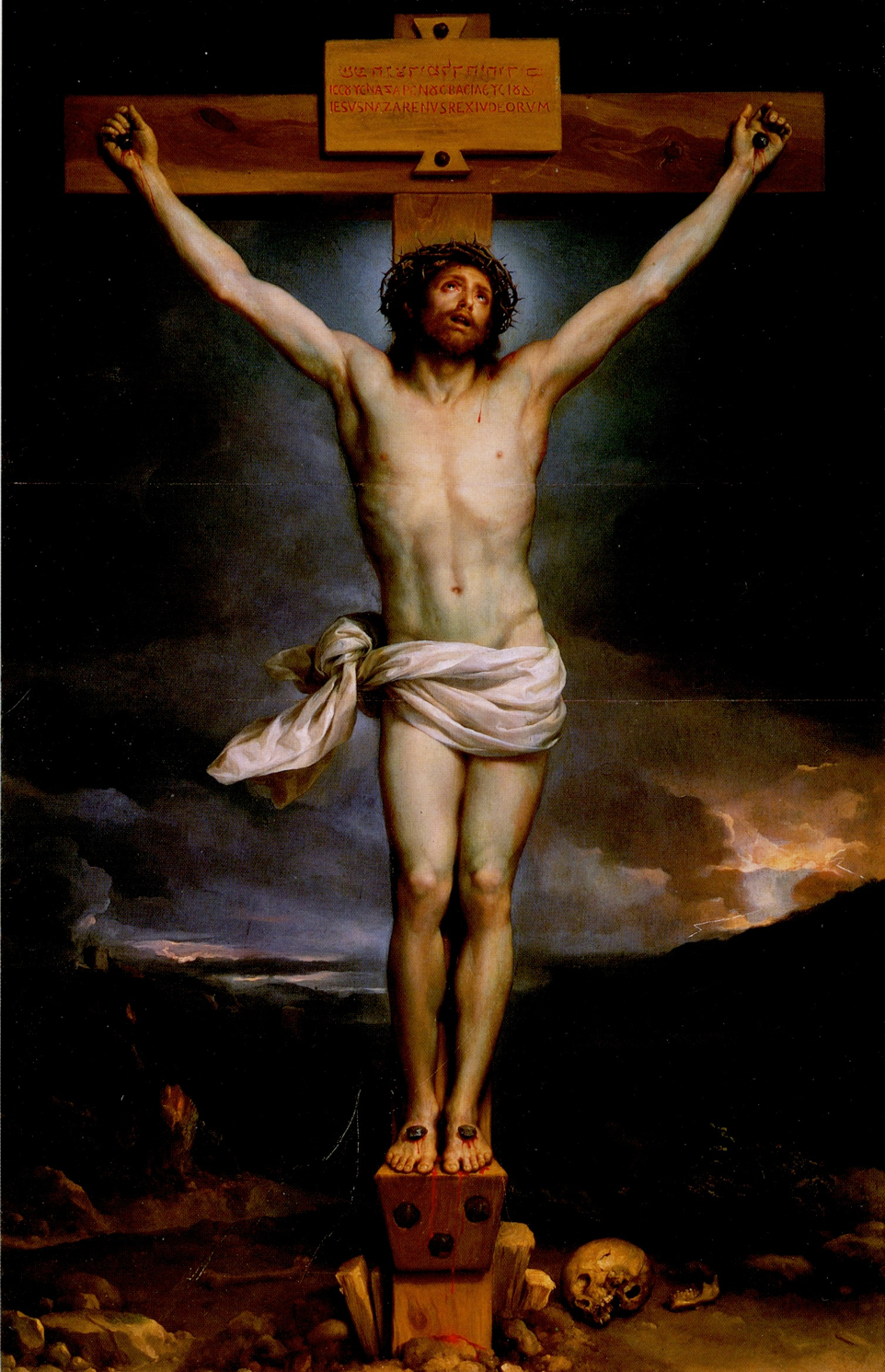
Today, contemplating the Cross, one sees love in action.
Saturday, 28 September 2013
Delineating Personalism
Posted by
Supertradmum
The editor of the Wanderer and another gentleman scholar in an interview were using the term "personalism" which I have criticized on this blog as a form of subjectivism. However, the term when referring to political systems means something a bit different and perhaps some clarifications are necessary. There are, in other words, good and bad personalism, as the term is vague and too encompassing.
I would have used a different term in the debate, but I think those involved were pointing to the latest developments of the use of the term.
Augustine and Aquinas taught the uniqueness of human creatures over all over creatures and the personal relationship each human has, because of the soul and the intellect, with God. Also, because there are Three Persons in One God, the Personhood of each may be stressed as separate and true.
So far, so good. The personalism of Aquinas and Augustine would have been the basis for Maritain's idea of the sanctity of the person in various systems of governance, as against communism and socialism, both which deny the sanctity and hierarchy of personhood.
Now, the isms, such as communism and socialism, deny the importance of personalism. Most people understand this.
However, the long and excellent philosophical aspect of personalism in the Catholic Church has been changed in recent times.
The problem is the locus of understanding the importance of self in reference to God. That we all have a character which is unique and a unique soul and the fact that the person is never a means to an end, that is, cannot be used or manipulated for either a government or another person, is clear to most of us.
But, the problem is the almost universal misunderstanding of self-fulfillment. The idea that a person can be fulfilled outside of God is simply false. Without a personal understanding that each one gets an identity from God, first as creature, then as adopted daughters and sons, and then as friends, and finally as lovers, we cannot.be self-fulfilled. Period.
When Blessed John Paul II and the Pope Emeritus spoke of self-fulfillment, they did not mean the understanding of the world and many liberal theologians, who claim that there is a natural fulfillment without grace.
No. Personalism must be based on the definitions given by the Catholic Church of what a person is, both pre-baptism and post-baptism. And, to add to the confusion of a lack of the traditional definitions of person coming from the great Church Fathers, is the denial of the need for grace.
On top of this, is the belief that men and women are the center of their individual lives, instead of God.
So, the bad personalism rests on a total separation of men and women from God. I suggest a keen reading of Benedict's Deus Caritas Est ,and my commentaries on it here and here and here.....
http://supertradmum-etheldredasplace.blogspot.ie/2012/05/on-love-and-answer-to-socialism-part.html
http://supertradmum-etheldredasplace.blogspot.ie/2012/05/love-and-church-against-socialism-part.html
http://supertradmum-etheldredasplace.blogspot.ie/2012/05/catholic-parish-life-vs-socialism.html
http://supertradmum-etheldredasplace.blogspot.ie/2012/05/eros-to-agape-and-caritas-continued.html
http://supertradmum-etheldredasplace.blogspot.ie/2012/05/part-five-caritas-vs-socialism.html
Saturday, 21 September 2013
THE Encyclical Against Kulturkampf
Posted by
Supertradmum
Etsi Multa
If you have not read this encyclical against the horrors of kulturkampf, take time to read it now, please.
This is what we are facing now.
A section.
Harassing of the Church
20. What We have recounted so far is common knowledge. Monks and virgins devoted to God are deprived of the common liberty of ordinary citizens and ejected with enormous cruelty, Catholic schools are daily being taken away from the care of the Church, and sodalities for pious works and even seminaries are dissolved. Additionally, the liberty of evangelical preaching is interfered with, hindered, teaching religion in the native language is forbidden in certain parts of the kingdom. Curates are withdrawn from their parishes, and prelates themselves are deprived of revenues coerced in many ways, and frightened with threat of imprisonment. While Catholics are vexed with all kinds of harassment such as these, how can We possibly acquiesce to what is suggested and not invoke the religion of Jesus Christ and the truth?
Government Support for Heretics
21. Nor is this the limit of the injuries which are committed against the Catholic Church. In addition the Prussian and other governments of the German Empire openly support those recent heretics who call themselves Old Catholics. Their abuse of such a name would be plainly ridiculous if it were not for the fact that so many monstrous errors of this sect against the principal teachings of the Catholic faith, so many sacrileges in divine service and the administration of the sacraments, so many grave scandals, and so much ruin of souls redeemed by the blood of Christ did not force tears from Our eyes.
Further Heresies
22. And surely what these sons of perdition intend is quite clear from their other writings, especially that impious and most imprudent one which has only recently been published by the person whom they recently constituted as a pseudo-bishop. For these writings attack and pervert the true power of jurisdiction of the Roman Pontiff and the bishops, who are the successors of blessed Peter and the apostles; they transfer it instead to the people, or, as they say, to the community. They obstinately reject and oppose the infallible magisterium both of the Roman Pontiff and of the whole Church in teaching matters. Incredibly, they boldly affirm that the Roman Pontiff and all the bishops, the priests and the people conjoined with him in the unity of faith and communion fell into heresy when they approved and professed the definitions of the Ecumenical Vatican Council. Therefore they deny also the indefectibility of the Church and blasphemously declare that it has perished throughout the world and that its visible Head and the bishops have erred. They assert the necessity of restoring a legitimate episcopacy in the person of their pseudo-bishop, who has entered not by the gate but from elsewhere like a thief or robber and calls the damnation of Christ upon his head.
http://www.ewtn.com/library/encyc/p9etsimu.htm
Thursday, 1 August 2013
Bl. John Paul II and Perfection Three
Posted by
Supertradmum
This vocation to perfect love is not restricted to a small group of individuals. The invitation, "go, sell your possessions and give the money to the poor", and the promise "you will have treasure in heaven", are meant for everyone, because they bring out the full meaning of the commandment of love for neighbour, just as the invitation which follows, "Come, follow me", is the new, specific form of the commandment of love of God. Both the commandments and Jesus' invitation to the rich young man stand at the service of a single and indivisible charity, which spontaneously tends towards that perfection whose measure is God alone: "You, therefore, must be perfect, as your heavenly Father is perfect" (Mt 5:48). In the Gospel of Luke, Jesus makes even clearer the meaning of this perfection: "Be merciful, even as your Father is merciful" (Lk 6:36).
"Come, follow me" (Mt 19:21)
19. The way and at the same time the content of this perfection consist in the following of Jesus, sequela Christi, once one has given up one's own wealth and very self. This is precisely the conclusion of Jesus' conversation with the young man: "Come, follow me" (Mt 19:21). It is an invitation the marvellous grandeur of which will be fully perceived by the disciples after Christ's Resurrection, when the Holy Spirit leads them to all truth (cf. Jn 16:13).
It is Jesus himself who takes the initiative and calls people to follow him. His call is addressed first to those to whom he entrusts a particular mission, beginning with the Twelve; but it is also clear that every believer is called to be a follower of Christ (cf. Acts 6:1). Following Christ is thus the essential and primordial foundation of Christian morality: just as the people of Israel followed God who led them through the desert towards the Promised Land (cf. Ex 13:21), so every disciple must follow Jesus, towards whom he is drawn by the Father himself (cf. Jn 6:44).
...
As he calls the young man to follow him along the way of perfection, Jesus asks him to be perfect in the command of love, in "his" commandment: to become part of the unfolding of his complete giving, to imitate and rekindle the very love of the "Good" Teacher, the one who loved "to the end". This is what Jesus asks of everyone who wishes to follow him: "If any man would come after me, let him deny himself and take up his cross and follow me" (Mt 16:24).
21. Following Christ is not an outward imitation, since it touches man at the very depths of his being. Being a follower of Christ means becoming conformed to him who became a servant even to giving himself on the Cross (cf. Phil 2:5-8). Christ dwells by faith in the heart of the believer (cf. Eph3:17), and thus the disciple is conformed to the Lord. This is the effect of grace, of the active presence of the Holy Spirit in us.
...
As he calls the young man to follow him along the way of perfection, Jesus asks him to be perfect in the command of love, in "his" commandment: to become part of the unfolding of his complete giving, to imitate and rekindle the very love of the "Good" Teacher, the one who loved "to the end". This is what Jesus asks of everyone who wishes to follow him: "If any man would come after me, let him deny himself and take up his cross and follow me" (Mt 16:24).
21. Following Christ is not an outward imitation, since it touches man at the very depths of his being. Being a follower of Christ means becoming conformed to him who became a servant even to giving himself on the Cross (cf. Phil 2:5-8). Christ dwells by faith in the heart of the believer (cf. Eph3:17), and thus the disciple is conformed to the Lord. This is the effect of grace, of the active presence of the Holy Spirit in us.
from Veritatis Splendor
Bl. John Paul II and Perfection Two
Posted by
Supertradmum
18. Those who live "by the flesh" experience God's law as a burden, and indeed as a denial or at least a restriction of their own freedom. On the other hand, those who are impelled by love and "walk by the Spirit" (Gal 5:16), and who desire to serve others, find in God's Law the fundamental and necessary way in which to practise love as something freely chosen and freely lived out. Indeed, they feel an interior urge — a genuine "necessity" and no longer a form of coercion — not to stop at the minimum demands of the Law, but to live them in their "fullness". This is a still uncertain and fragile journey as long as we are on earth, but it is one made possible by grace, which enables us to possess the full freedom of the children of God (cf. Rom 8:21) and thus to live our moral life in a way worthy of our sublime vocation as "sons in the Son".
More later-from Veritatis splendor
Subscribe to:
Posts (Atom)