Showing posts with label munds. Show all posts
Monday, 31 March 2014
Munds, Part Three
Posted by
Supertradmum
Dowry money in the Hebrew is called מֹהַר, or mohar. This is the money paid to the family of the woman, the wedding money. This word is found in many contexts in the Scriptures, such as in Genesis, Esther, Malachi, and the Song of Songs, to mention some.
Another word is similar, the zebed, or זֶבֶד, the wedding money or gift given by the woman to the man.
Now, remember that the name Zebedee comes from this word, zebed, gift.
John and James were the Sons of Zebedee, the sons of gift. This word is also found in numerous books of the Bible, including some of the above.
Now, the name implies that the man is the gift given back to the husband by the woman, the wife and mother. So, the Sons of Zebedee are the children of the man of the dowry, the endowment or gift.
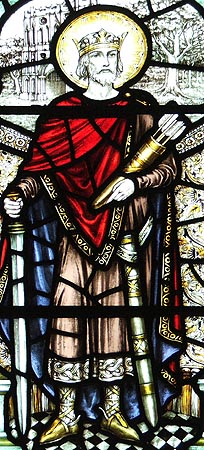
Nice. And, Zebedee becomes the name Edmund in the Anglo-Saxon.
Every child is a gift. Every child is an endowment and receives in baptism an endowment of grace.
It is the duty of the parent to protect that endowment, and like any investment, make it grow.
Such is virtue training.
Gifts are to be cherished and given back to God.
Have you given your children back to God? Are you training them to be gifts to the world?
A long time ago, I gave my child to God and to Mary. And, I heard God answer me, "I give you England in your son. You will always have England." God knows how much I love England. Why, I do not know.
I just have to get back there to claim my dowry, which is really Mary's Dowry, England. She just wants to share a little bit of England with me.
http://supertradmum-etheldredasplace.blogspot.co.uk/2013/06/walsingham-drama-in-three-acts.html
Sunday, 30 March 2014
On Munds, Part Two of Three
Posted by
Supertradmum
Tacitus in his work on the Germans, writes about munds. In one place, Tacitus writes that a mund is equal to five cows. Here is Iowa, that would amount to 4,000 USD for a prime Black Angus, but up to 100,000 USD for a show cow. Not a bad mund...
,...marriage in Germany is austere, and there is no feature in their morality that deserves higher praise. They are almost unique among barbarians in being satisfied with one wife each. The exceptions, which are exceedingly rare, are of men who receive offers of many wives because of their rank; there is no question of sexual passion. The dowry is brought by husband to wife, not by wife to husband. Parents and kinsmen attend and approve of the gifts, gifts not chosen to please a woman's whim or gaily deck a young bride, but oxen, horse with reins, shield, spear and sword. For such gifts a man gets his wife, and she in her turn brings some present of arms to her husband. In this interchange of gifts they recognize the supreme bond, the holy mysteries, the presiding deities of marriage. A woman must not imagine herself free to neglect the manly virtues or immune from the hazards of war. That is why she is reminded, in the very ceremonies which bless her marriage at its outset, that she is coming to share a man's toils and dangers, that she is to be his partner in all his sufferings and adventures, whether in peace or war. That is the meaning of the team of oxen, of the horse ready for its rider, of the gift of arms. On these terms she must live her life and bear her children. She is receiving something that she must hand over unspoilt and treasured to her children, for her son's wives to receive in their turn and pass on to the grandchildren.
Cows or land seem like good munds to me.
And, the ladies had the right to pass on their munds to their children or grandchildren.
Hmmm, I missed out on something here. I could have bought a comfortable house in Spain for four Black Angus show cows!
..
On Munds, Part One
Posted by
Supertradmum
The tradition of dowry has changed and in been in flux for centuries. The exchanging of swords became a sign of trust between a past enemy and the new friend. In the Icelandic annals, a new sword became a symbol of this old one of trust. The new sword could have been purchased by the new husband who would give it to his new wife. He could have been returning her father's sword, given to him, or he and she would have exchange swords.
By the time these customs were written down, the original customs had faded.
Why I am writing about this is that this type of thing is called a mund. The mund was a security for the woman, who was given land for her own posterity, so in case the man died, the widow would have something to live on. The mund is found in Beowulf, where it is called a "spear dowry", which would have been a cache of weapons. Weapons had a stable value. One could always sell these off, if needed. Would not a widow keep the weapons and pass these on to her son. The sons inherited stuff from the father, but so did the woman, for her upkeep and security.
The woman would not have to rely on brothers or uncles, which was a good thing. My saint, Etheldreda, had her own land ownership. As one betrothed, she had that security.specifically the male dowry. It's a Scandinavian concept, one made a promise of land, and if one broke the engagement or popped off that becomes the property of the woman betrothed and her family
The betrothal ceremony was extremely important, and legally binding. Christianity became controversial in some cultures, as it changed the emphasis from the engagement to the marriage. But, in England and in Germany, both stayed important.
The mund of the woman was usually money and that of the man, land. See an example, below.
What a great idea. The word mund is found in many Anglo-Saxon names, such as Edmund, Osmund, Garmund, Sigmund and others which include mund.
Mund means guardian, which is the shield for the wife. This is the security for the wife.
Any prefix makes sense with mund. Edmund means goodly or cute guardian. Ed is short from Edel, which means princely, or great. Etheldreda is from the same root, Ed being the diminutive.
Sigmund means victorious guardian, implying mund gotten in war.
Osmund means godly guardian, like the wonderful wizard of....as Os was a pagan god of the Anglo-Saxons.
In the first episode of By the Sword Divided, one sees played out in the series the old Anglo-Saxon idea of mund in the betrothal of Anne Lacey and John Fletcher, wherein, the fathers set the terms: Sir Martin Lacey gives money and Austin Fletcher gives lots of land, ships, and stuff from the New World.
Unless there were invasions, civil war, or pigginess from such monarchs as Henry VIII, who stole many a woman's mund, a woman could expect to have her mund until she died.
(Notes from Edmund. To be continued...)
Subscribe to:
Posts (Atom)