Recent Posts

Showing posts with label St. Ignatius Loyola. Show all posts

Sunday, 9 August 2015

Putting God Into A Box


Returning to the idea of discernment as understood by St. Ignatius, an idea which I covered in some posts earlier this year and last month, I want to emphasize a few points which may help some readers avoid the deadly fall into deceit when the times of tribulation come upon us.

One falls into deceit when one does not know one's self, and when one does not have a relationship with God. For St. Ignatius, one's relationship with God was a constant, something which "happened" all day, in every circumstance.

If one is talking with a friend, God is there in the conversation, When one is shopping, God is there with one, and when one is walking in the sunshine, God walks with one.

There is never, for the Catholic who is in sanctifying grace, a time when God is not in relationship.

For those who have been in love, we understand this permeation of love in all things, at all times.

God is conscious of us all the time. If He was not, we would not exist. In prayer, we attempt to become conscious of God, Who is with us all the time.

But, too many Catholics want to put God in a box. They do not want God to be in their living rooms, sitting by them at the computer, in the midst of a conversation.  The God-in-a-box is a safe God, a God controlled by one's own will.

Sometimes people remember their "conversion" or "reversion" experience as if that was the only time God was with them in some way.

It is good to remember important encounters with God, such as our First Communion Day, or the day one got married, or made a vow to a religious order and so on.

But, those peak moments do not define one's relationship with God.


God in one's life is not now and then, but always, all the time, everywhere.

God may be most obvious in suffering. Lately, I have encountered much I suffering and have tried to find God in that suffering.

Of course, I do find God in the suffering--the God of the Passion.

Every Friday, as part of my prayers for the Auxilium Christianorum, I pray the Litany of Humility.

Now, when one prays this, one must expect God to answer this litany. God takes us seriously when we pray.

Let me remind you of this litany. And, let me give you real examples of how God answers this, the God Who encounters us in ordinary as well as extraordinary events of our days.

O Jesus! meek and humble of heart, Hear me.
From the desire of being esteemed,

Deliver me, Jesus. Then, one loses a job, and loses status, becoming an invisible 

From the desire of being loved...Then, one is passed over by another, when one wants to be especially loved 
From the desire of being extolled ...Then, no one notices one's gifts or achievements
From the desire of being honored ...Ditto, and one is ignored even in small successes
From the desire of being praised ...Deeds are done unnoticed
From the desire of being preferred to others...One's friends have no time for one's company
From the desire of being consulted ...One is either told things one already knows, or one is not consulted when one has more knowledge
From the desire of being approved ...Then, one is actually not approved of, but finds only distrust and disdain from others; the following are the tests of saints...to no longer fear even betrayal or mistrust, or being unloved....because in holiness, they have found freedom...
From the fear of being humiliated ...Christ let Himself be put in a manger
From the fear of being despised...Christ allowed Himself to be hated by His Own People
From the fear of suffering rebukes ...Christ was slapped and spit upon
From the fear of being calumniated ...Christ was accused of false teaching
From the fear of being forgotten ...The foxes have holes and the birds of the air have nests....
From the fear of being ridiculed ..."If you are the Son of God, come down from the Cross."
From the fear of being wronged ...Judas, a friend, betrayed Christ
From the fear of being suspected ..."Is not this the carpenter's Son?"
That others may be loved more than I,
Jesus, grant me the grace to desire it.

That others may be esteemed more than I ...Finally, one takes joy in this...
That, in the opinion of the world,
others may increase and I may decrease ...Finally, one only wants to be hidden in God
That others may be chosen and I set aside ...One sits with Christ in the Garden of Gethsemane
That others may be praised and I unnoticed ...One comes to understand the truth of being lowly
That others may be preferred to me in everything...and, one rejoices in letting others be recognized over one
That others may become holier than I, provided that I may become as holy as I should…seeing that God has called one to be a little one, and not a great saint....

When one is able to fulfill the graces of this litany, a person would be completely free. God would not longer be in a box, but one would walk and talk and sleep in God constantly.

If a Catholic does not want to become truly humble, he or she should not say this prayer.

God answers this prayer and He is no longer in the box of one's own making.

Sometimes, God will take a person to the edge of Gethsemane and make one wait until one is strong enough spiritually to enter into the Garden. One can see the darkness, but not understand, until He allows one into the place of His Own suffering.

Then, and only then, does the Catholic become authentic. Until one really accepts suffering with Christ in His Passion, all is pretense and play.

Three times Christ asked Peter is he loved Him, because of the three denials of Peter.

Not only was Christ showing Peter how to forgive, but the necessity of being open to the daily encounter with God. 

It is too easy to betray God. It is too easy to put Him into a box.

Like St. Ignatius, one has to come to the knowledge that God is with us, all around us, in every circumstance, constantly.

In this realization, we come to knowledge of the self, and knowledge of God.

The more one knows one's self and knows God, the greater is one's capacity to love.

We meet Christ at Mass Who has allowed us to put Him in a box, the tabernacle.  Christ Present in the Host has become the Vulnerable God, the Hidden God in the Host. One thinks that one can manipulate this Small God. 

Those who have put God in a box cannot appreciate either spiritually or spiritually the great freedom which Christ has given us in the Eucharist.

We consume God. We become one with Him as He becomes one with us. We become the box, the tabernacle of God. We hold Him either in love and awe, or even in a darkness. For those who receive Him unworthily, (and only God can make us worthy), the Body of Christ is again, as during the Passion, put into the cell of satan, the prison of one's own making.

Christ has made Himself accessible to us in the Host. He is the God of Bethlehem's manger, the God of the prison of the Sanhedrin, the God on the Cross...

The sacrilege of receiving Christ when in serious sin is a mocking of the Passion of Christ, and a denial of His suffering.

Either one allows God to purify the body, soul, imagination, memory and will, in order to become a holy receptacle, or one mocks God by imprisoning Him in one's own self-centeredness and sin.

One loses the chance to become more like Christ, and in the narcissism of sin, one wants to make Christ into one's own image and likeness.

Only humilty and love can save one from this putting God into a box.


Once one understands and experiences love, the box of one's own self becomes a little place of heaven, the cell of contentment and peace.


But, this takes courage. 

Be a tabernacle, not a prison. Let God out of the box of selfishness, malice, mistrust, fear...let Him meet you in freedom.

He is always with us, always, desiring us to meet Him in freedom, humility and love.

All barriers, all boundaries melt away, and one becomes alive trusting in God.

Life becomes exciting and new, and one learns to live outside the box of conformity, false comfort, and selfishness.

Let God out of the box of your own making. Let Him lead you into freedom.

BTW, during the Protestant Revolt in England, the Protestants made fun of the True Presence, by referring to the Eucharist as the Jack-in-the-Box, a reference to an earlier myth that a local saint in Princes Risborough captured the devil and put him into a boot. This horrible disrespect and blasphemy of the Protestants towards the Eucharist displayed itself in the mockery of the Consecrated Hosts in many places, including the documented throwing of the Hosts on the ground at Fountains Abbey and the visitators forcing the horses to trample Christ.

They put Christ in the box of their own power, imaginations, hatred...

Those men crucified Him again and again and again...

The tabernacles of England were emptied for a long time because people wanted to put God into a box of their own making.

God is more than we know...


Thursday, 30 July 2015

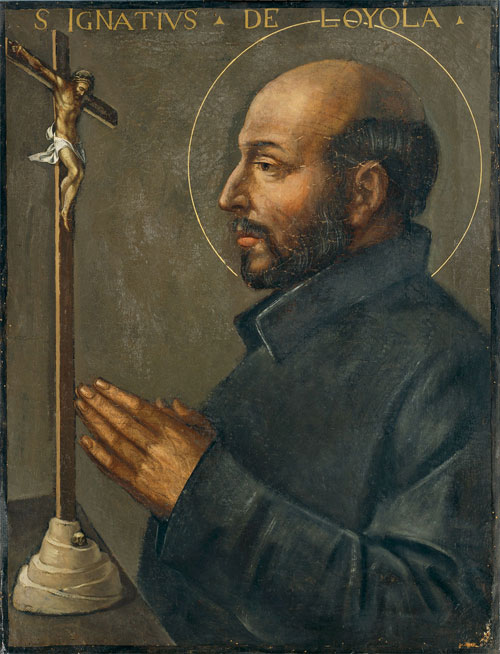
St. Ignatius Loyola, Again


As I just shared lots on St. Ignatius of Loyola, I refer you to the Framing Prayer series in order to celebrate his feast day tomorrow.

Here is another prayer of his, or at least,one connected to the Jesuit spirituality.


Anima Christi


Soul of Christ, sanctify me.
Body of Christ, save me.
Blood of Christ, inebriate me.
Water from the side of Christ, wash me.
Passion of Christ, strengthen me.
O Good Jesus, hear me.
Within your wounds hide me.
Permit me not to be separated from you.
From the wicked foe, defend me.
At the hour of my death, call me
and bid me come to you
That with your saints I may praise you
For ever and ever. Amen.

- See more at: http://www.ignatianspirituality.com/ignatian-prayer/prayers-by-st-ignatius-and-others/anima-christi#sthash.pLmg41s0.dpuf

Wednesday, 15 July 2015

Framing Prayer 25 Jesuits and Dying to Self

Lord, teach me to be generous. Teach me to serve you as you deserve; to give and not to count the cost, to fight and not to heed the wounds, to toil and not to seek for rest, to labor and not to ask for reward, save that of knowing that I do your will.

If there was ever a prayer for the Church Militant, it is this prayer of St. Ignatius. If the lay Catholic would say this prayer daily, what a difference there would be in the families, parishes, universal Church.

Let me unpack this prayer and show how it is connected to dying to self.
  1. Generosity. The life of a true Jesuit would be a definition of generosity-giving up one's will to God, as we saw in the Suscipe, indicates a generous spirit. And, remember, God will not be outdone in generosity.
  2. Service, but as taught by God. Service in God is completely detached, objective, and never self-seeking. There is no room for the ego in true service to God.
  3. Giving without cost....a parent knows this duty; a husband or wife knows this duty; many of our jobs demand such service without taking a look at the cost. How much more so for the building of the Kingdom...?
  4. Fighting and not even looking at one's wounds-a good self-forgetfulness. Today, some young man told me he responded to the needs of his neighbors because he needed to do mortification for his sins--this is a healthy forgetfulness of pain and suffering when going out of one's way for another.
  5. Not seeking rest--how many of us feel "entitled" to vacations, self-renewal days, and not find the task at hand refreshing because we are doing things for the wrong reasons?
  6. No reward....none....just working out of sheer love for God and His creatures.
  7. The will of God is the center of Jesuit dying to self--absolutely, not my will, but Thy will be done.
This little prayer could be memorized by any lay person and said during the day.

A true framework for out prayer is self-denial.

to be continued... one more on the Jesuits later...........


Framing Prayer 24-Jesuits and Movement


When I was in a community so long ago now, we were exhorted not to have a caravan, or even a little red wagon, but to be able to move freely, unencumbered to do God's will, The little red wagon represented "stuff", physical objects to which one could be attached and which take time away from prayer and God. Those who read my first blog may remember my article on this many years ago.

I see this daily in the States. Most lay people get too bogged down in things. One needs more than a little red wagon to move one's stuff; to be ready to move implies too much planning and anxiety.

One thing which appeals to me, and I shared some of my recent history on purpose earlier today to make the point, it the Jesuit history of movement. From the very days of St. Ignatius' own life, his travels to the Holy Land, to Paris, to his creation of the greatest missionary order the world has ever seen, one is struck by movement.

While the Benedictines grow in their vow of stability of place, the Jesuits grow spirituality by moving. I hope some of this spirituality rubs of on me.

Movement is the life of the missionary, especially one under obedience. A Jesuit is still told where to go for his ministry-as obedience is a vow taken seriously.

Look at the great missions in Europe. Look at the individual lives of the Jesuit saints. One can hardly keep up with studying their movements, such as St. Edmund Campion's moving from the leafy calm of Oxford to the bustle of Rome at the Venerabile, to the work in Bohemia, and, finally back to England for a relatively short mission and his murder in London at the hand of the Queen's butchers.

Movement marks the North American martyrs, the Asian martyrs, the South American martyrs.

Can we think of another such peripatetic order?


As I sit among the signs of moving, after a day yesterday of moving, I yearn for the stability of the monastery, the cell, but God allows me to go hither and yon with His message of love and freedom.

In order to teach freedom, one must be free, and only the free can move, quickly, peacefully.

When I was in my twenties, a long time ago. I heard that interior voice of Christ say to me "You are like the damsel fly, which moves here and there quickly. I love you for you respond quickly to me."

In my mind I saw the helicopter-like flight of the damselfly, an insect which is highly mobile and can change directions quickly, effortlessly.

One must be detached in order to do this. One must be free. The Jesuit vow of poverty allows them not only to be detached, but to be able to move, now, freely.


In these times, learn to move quickly in God. Listen to His Voice and be obedient to His call.

Learn to change directions, and not begrudge the call of God to leave all and follow Him.

We are all called to be disciples. And freedom marks this call.

I would love a house of prayer in order to contemplative and be a sign of contradiction in this world-a simple place of worship and intercession. But, God calls me forth, still, doing quiet things and remaining free. This is not an easy vocation, but the Jesuit example and prayer method can help me and you, especially in times of upheaval.

Yesterday was the feast day of Saint Kateri Tekakwitha. Without the movement of the Jesuits, we would not have this lovely young saint. A good article is found here on her.


Framing Prayer 23 Jesuits-God's Glory


Interestingly, all orders have a "character" which means the prayer of the order has a certain characteristic.

For me, for example, character of the Salesians is the love for youth, and the prayers reflect purity of heart.

For the Carmelites, as we have recently seen, the character is the embracing of the Cross, and the prayer is one of joining with Christ in His Passion.

For the Benedictines, the character is humility, a practical humility, and the prayer is one of humble discipline and simplicity.

I see the character of the Jesuits as primarily one of honesty,and the prayer reflects honesty regarding the self, and regarding others. How one is honest with others is through forgiveness.

For me, the Jesuit spirituality moves from the stark honesty of the awareness of one's sins, to the glory of the Resurrection. Even the order's motto, "Ad maiorem Dei gloriam" indicates this self-knowledge of sin, forgiveness and service pointing to giving all things to God for His glory, not for self, not vainglory.

One reason there are so many Jesuit martyrs has to do with this focus on God's glory in the world--one chooses suffering and death for Christ, forgiving others, moving on to glory.
 
The Resurrection reveals God's glory and service to others, as Christ commanded us to go forth and teach all nations, baptizing, saving souls. This stark commission of Christ may be clearly see in Jesuit spirituality and history.

The list of martyrs includes men from almost every nation. The glory of God is to fill the Earth, if not in peace, than in martyrdom.

Our prayers today could reflect this desire for honesty, forgiveness, service, God's glory.

Ignatius' great but simple prayer could be our own.

Can we laity make this our prayer as well daily in these hard times, and the worst to come?

A good prayer to teach your children, homeschoolers....

Suscipe

Take, Lord, and receive all my liberty,
my memory, my understanding,
and my entire will,
All I have and call my own.

You have given all to me.
To you, Lord, I return it.

Everything is yours; do with it what you will.
Give me only your love and your grace,
that is enough for me.


Tuesday, 14 July 2015

Framing Prayer 22 Jesuits and Detachment

The Jesuits, and the lay order of Jesuits, called the Secular Institute of Our Lady of the Way (Road), take a vow of poverty, as well as the vows of obedience and celibacy.

A hallmark of a true Jesuit, whether priest or lay member, is detachment. Lately, God has been leading me down the path, again, of detachment.

As some readers know, I have things in storage ruined and stolen. Then, I moved my few things,(mostly books and photos of a certain seminarian), into, the house of a friend of mine. After five weeks of feeling a bit "at home" and having some of my little red wagon of things around me, my friend's house incurred a flood. Many things were ruined, including almost 1000 USD worth of books.

As the basement still is wet after two weeks, I had to move my things back into storage, with the chapel things, which I had to wrap up and store.

Sitting in my little room, which is full of my and other people's stuff, (like a real English box room), I pondered the missionary like life of yours truly. Detachment includes, for me, at this time, not having the joy of my things, or the access to my smallish library. Loved icons were repacked, (the ones remaining), and off things went into storage, the great American symbol of our mobile and comparatively wealthy lifestyles. Of course, half the things belong to that certain seminarian in England, but I have not been able to afford to send him his own things.

Detachment means not grieving over soaked and ruined books, It means thanking God for trials regarding possessions. It means realizing that, really, all things belong to God and not me.

All I have are gifts from God, all.

A freak chemical accident of bug spray in the last storage facility ruined some things when the owner had to get rid of wasps. Scarily, the chemical ate through about six or seven boxes, destroying an expensive guilt given to me by the mother of a priest years ago,which I called my St. Therese's quilt, as it was covered with gold roses. That same mother just replaced that for me with a red one. God bless her.

She is as poor as I am and gave her only son to God to become a priest. One is blessed more in friendship than in goods.

But, that is what detachment for the Jesuits, and for us, is all about--priorities and making room in one's small heart for God.

Things cause worry, anxiety, time, space....the lack of things is truly freeing. I think some of the most peaceful days of my lift were those last four and a half years when I lived out of two suitcases and wandered about the West meeting fantastic people and praying.

I wonder is St. Paul had a knapsack or a large duffel bag. St. Ignatius carried practically nothing on his journeys, and was criticized by the Catholics in Paris for his rude clothing. (I look at my old jean jacket and wonder if I should carry this around....as my black jackets are not suited for outside work. I wonder what Ignatius would advise?)

The sadness which I offer to the Lord, and it is not a crushing sadness, is not to have a place where I can again set up the little blog chapel and have the books on shelves.

For now, God denies me this to teach me to be even more detached and to live in greater simplicity.

As I look at the beautiful Our Lady of Mt. Carmel statue given to me by a faithful blog reader, I think of St. Teresa of Avila's well-known story of losing all her things and her donkey in a flash flood when moving from one convent to another. This prompted her famous saying, "God, no wonder you have so many enemies the way you treat your friends."

She shares this incident with us to help us carry on.

St. Ignatius, like St. Paul, after his conversion, went off to pray with practically nothing. St. Ignatius' life was one of a series of trials, failures, abandonment, false accusations, set-backs, illness, and the working out over a relatively long period of time the form of his order. Sometimes people think saints figure out God's Will immediately, but each person has a different path and some are quite rockier than others. I suggest looking at the shorten biography of Ignatius here.

St. Ignatius' life was one trial leading to detachment after another. He worked out his call through the events of his life, as well as through the deep prayers and insights given to him by the Holy Spirit, which make up his Spiritual Exercises.

If St. Ignatius had been attached to home, family, status, fame, things, the order would never have been founded. If he has been attached to his own reputation or false peace among his members, the order would never have been founded.

Many times in his life, he had to decide to plunge forward with the insights given to him by God. He was even examined by the Inquisition, as was St. Teresa of Avila.

We can see that Ignatius, as well as other saints experienced many years of unsettled life.

What kept him focused was, simply, prayer and the evangelical counsels.

As lay persons, one can decide as well, like St. Ignatius, to follow Christ daily despite upsets, and to be obedient to the call of our lives, working out our salvation with the "stuff" of life.

Detachment creates peace and an inner stability.

to be continued..


Framing Prayer 21 The Jesuits and Mary


While some orders have a day of discipline, by setting aside certain hours for prayer and some for work and necessities, such as eating and sleeping, the Jesuit must organize his own day according to his work.

In this way, the day of the Jesuit, especially in the missions, would resemble a lay day. And, if the Jesuit teaches at one of the many colleges or universities, his day would be similar to that of a college professor--with a huge difference.

I assume that most readers do not know that the patron of the Jesuit order is Our Lady Mary, under the title of Madonna Della Strada, Our Lady of the Road.

St. Ignatius chose this devotion to Mary as she interceded for him under this title. But, for me, this name of Mary evokes the peripatetic nature of missionary work and the movement of the Jesuit order across the world. In addition, such a patron would help a lay person realize, in his or her busy life, that Mary is with him or her on the way.

Like the popes before him, Pope Francis has a great love for Mary, especially Our Lady Undoer of Knots. But, this love of Mary has been a mark of the Jesuit order from day one. This image of Mary may be found in the Gesu, the main Jesuit Church in Rome. I was there twice.

Other chapels are dedicated to Our Lady of the Road, like the one at Loyola in Chicago.


Mary calls each one of us to follow her to Jesus, to take up a "way", a life, which includes prayer and discipline.  One of the readings for the Feast of Our Lady of the Way, or Road (May 24th) follows. In this selection from Proverbs, the reader is exhorted to become wise, become just, and then, perfect. 


Proverbs 4:10-18Douay-Rheims 

10 Hear, O my son, and receive my words, that years of life may be multiplied to thee.
11 I will shew thee the way of wisdom, I will lead thee by the paths of equity:
12 Which when thou shalt have entered, thy steps shall not be straitened, and when thou runnest thou shalt not meet a stumbling block.
13 Take hold on instruction, leave it not: keep it, because it is thy life.
14 Be not delighted in the paths of the wicked, neither let the way of evil men please thee.
15 Flee from it, pass not by it: go aside, and forsake it.
16 For they sleep not except they have done evil: and their sleep is taken away unless they have made some to fall.
17 They eat the bread of wickedness, and drink the wine of iniquity.
18 But the path of the just, as a shining light, goeth forwards and increaseth even to perfect day.

Of course, one of my favorite paintings of Christ, mentioned several times on this blog, the original Sacred Heart by Batoni is also in the Gesu, and in the old Jesuit Church in Malta, the Church of the Circumcision, where I would go pray daily when I lived in Valletta.


This call to the devotion to Our Lady is advice not only for a Jesuit, but for us as well. Our prayers must be based on the words of God, on the Word of God and the Mother of the Word. We, too, must leave the way of evil and cling to Mary. The Post-Communion prayer for the day indicates that one must rely on Mary to intercede for us daily in our work and we are called to look to her for inspiration.
Lord,
we rejoice in your sacraments
and ask your mercy
as we honour the memory of the Virgin Mary.
May her faith and love inspire us to serve you more faithfully
in the work of salvation.
Grant this in the name of Jesus the Lord. Amen.
Perhaps Mary of the Road is a good companion for a lay person on the way to deep prayer and union with Christ.
to be continued....


Framing Prayer 20 The Jesuits and The Examen

Again, I think that Jesuit ways of prayer can easily be incorporated into lay lifestyles. Part of this is that the Jesuit approach is practical, concerned with daily metanoia, and tailor made for missionaries, on the go.

St. Ignatius writes this: “We should not fix our desires on health or sickness, wealth or poverty, success or failure, a long life or a short one.”  Detachment is the hallmark of any serious Catholic who wants to be a saint, but for the Jesuit who chooses poverty as a vow, it is a keystone of the approach to God, having nothing in the way for meditation or contemplation to bear fruit.

For the lay person, this ideal can be met by getting rid of superfluous distractions. So how can we tell if we are attached to something? Use the imagination and think of your life without this thing, person, place.

A lay person can easily find time to employ the Daily Examen of the Jesuits. I suggest what the Jesuits do, a morning and evening evaluation and reflection on your life. If one adds this to morning and evening prayer, it becomes a habit. And, as I noted in another post earlier this year, one can each this message to children as part of Confirmation preparation.

The examen is not merely an examination of conscience, a review of one's sins and imperfections, but a tool for discerning how the Holy Spirit is working in one's life. Discernment, from the gift of knowledge given in Confirmation,

Why this should be a daily examen is that one cannot perceive the movement of God unless one is "on" daily. Obviously, one cannot do the Examen outside of prayer. This would be falling into the new age technique of self-consciousness outside of God. When one does the Examen daily, it is a habit which is carried out throughout the day. One can stop one's self from sinning, see patterns of weakness and learn what is temptation and what is an imperfection.

In order to be in union with God, this habit of reflection, which only needs to take seconds after awhile, helps one through the purgation of the senses and the spirit.


Remember that it is God who gives the grace for such an Examen and the habit of reflection leading one through the Dark Night to Illumination. How wonderful is very young people can learn this early on in life.

Finally, the two daily examens end in gratefulness, in thanks for the graces of the day. Discernment is listening, and then acting on what is heard. The virtues of faith, hope and love grow daily through this easy method of daily conversion. One does not have to be self-absorbed to do this, and in fact, self-denial is really the reason for recognizing sin.

to be continued....

Monday, 13 July 2015

Framing Prayer 19 The Jesuits--Paying Attention


Starting now... perhaps the most useful approach to prayer for the laity--the Jesuit method. I want to begin with a basic idea that the Jesuits absolutely believe that God is always active and active now. This idea forms the foundation for our responses to God daily.

Remember when I wrote of active contemplation in the perfection series? The key is to still our hearts and minds so that we can be attentive. Attentiveness underlines the Jesuit way of prayer.

Do you pay attention to signs in your life regarding God's Presence?

Do you pay attention to the Word of God, in Scripture, as Mass, in the homily, in discussions with your friends?

Do you pay attention to excellent spiritual leaders?

Do you pay attention to movements of the Holy Spirit in your life, the ebb and flow of grace?

Attentiveness, of course, means that you cannot pay attention to trivia, to entertainment, to gossip, etc.?

Recently, someone told me that the good emphasis on excellence and individuality in the Jesuit order is connected to attentiveness. What talents has God given the priest to use in the world? What gifts are for the building up of the Kingdom? What does the Church need now?


God does not want to grab us by the face with His "two hands" and say "pay attention". He wants to meet us in the attentive time of prayer, in the silence of our hearts and minds.

Number one lesson today from the Jesuits--be attentive to God.


Sunday, 3 May 2015

On Having A Missionary Heart

The world has always hated missionaries. Look at the long list of martyred missionaries just among the Jesuit Order itself.

This is a partial list from wiki, on the ones which have pages. The list is much longer.


Y


And I add Z, Francis Xavier...http://en.wikipedia.org/wiki/Francis_Xavier

Recently, I have been thinking of the life of two Jesuits, St. Francis Xavier and St. Nicholas Owen.  St. Francis Xavier stated if there had been enough missionaries at the time he was travelling to China, China could have been converted. The Chinese, he believed, were then open to God's Word.

The fact that there are not enough missionaries and this is the fault of the laity for not raising children with missionary hearts.

Do you think it is easy being a missionary? No. Francis Xavier died at 46, being abandoned by his own countrymen, and worn out from his exertions.  He faced opposition, loneliness, separation from his family and friends, especially St. Ignatius Loyola. He faced horrible trips in nasty ships and overland. He kept the serious discipline of prayer and the Examen daily despite difficulties we cannot imagine. And, he came from a comfortable family, one not use to pain and poverty.

Do you think it is easy for anyone with a missionary heart to work in this world consistently? Daily, I walk to a nasty restaurant where the food and service are substandard, where the music is evil, where I sit and blog for those who need encouragement in the Church Militant and for those who want to learn the truth.

I have two foot injuries and back pain and yet I sit in uncomfortable surroundings to blog for you. I shall be in another place in two weeks and I do not even know where this will be. And, yet, I pray and blog, study, and read for the upbuilding of God's Church. I know I shall not live as long as my parents, who are 87 and 92, as all this poverty and moving takes a great toll on the body. I am thousands of miles away from those I love the most, as were the missionaries to North America. Holy detachment helps one not to think of them but with love for their salvation and in prayer. The soul is purified through such trials, and this is God's plan for all of us. To step out of our comfort zones and share His Love with all we can in our state in life. We are all called to this.

I understand why St. Paul wrote his brag and why St. Edmund Campion did as well. Proud to be Catholics, proud in God's own glory to spread the love of the Trinity to all. Nothing is too difficult, is what St. Francis Xavier teaches me.

Why? Because I have zeal for spreading the Good News of Christ, because I love Christ. I have been to many countries doing what I hope is God's Will. Look at this map from wiki on the travels of St. Francis and ask yourselves, "Where are the missionaries?"

"Xavier f map of voyages asia". Licensed under CC BY-SA 3.0 via Wikimedia Commons - http://commons.wikimedia.org/wiki/File:Xavier_f_map_of_voyages_asia.PNG#/media/File:Xavier_f_map_of_voyages_asia.PNG


I wish I had started blogging earlier, but I was a single mum raising a boy, I hope, to be a saint.

The other Jesuit who has been part of my thoughts is St. Nicholas Owen, mentioned on this blog before today. Here is that link. http://supertradmum-etheldredasplace.blogspot.com/2015/04/mea-culpa-nicholas-owen.html

For a long time, Nicholas was a lay man, but he worked with so many Jesuits who were martyred that he was inspired by the lives and deaths of those for whom he worked. 

His life is a great one to share with your boys, Moms and Dads. 

Sadly, too many Americans have been raised to be weak and not strong. I have also written on this before, and I add those posts at the end of this one.

Time for weak kids is over....over.

Saturday, 8 February 2014


Are your children in the Church Militant or the Church Mushy?

There is a famous story of a young girl in France, who was Jewish. On her way home from school, on July 15 or 16, 1942, she witnessed the infamous Vel d’Hiv roundup, when up to 13,000 Jews in Paris were taken to the old stadium Vélodrome d'Hiver and sent to Auschwitz. 

The young girl had enough sense not to go home, but turned around and went to the closest house. She knocked on the door and an older woman answered. The woman opened the door, looked at the girl, and let her in.

Through out the entire war and occupation of Paris, this woman pretended that this girl was her own. 

The child was saved by a brave woman, who would have been killed, if she was discovered hiding a Jewess.

The young girl was about twelve years old. 


I am sharing some of the details as I am writing to parents a harsh but necessary lesson.

As parents, it is our duty to protect our children from harm. 

It is not our duty to protect them from the truth of coming times of trials. Children in the next years will be facing a number of extremely difficult situations which will change their lives. 

These changes should not come as a shock or surprise to even those in grade school.

Like this young girl, who knew what was happening, and used her common sense to survive, we need to be training children to live in the Church Militant, not the Church Mushy.

There is a wrong way that parents look at suffering. Too many want to pretend that their children will not suffer. But, we have a duty to prepare our children spiritually for suffering.

What does this mean? I have written many posts on the formation of virtue in children from a young age. 

That is merely the first step. Formation in the virtues means reading books about virtues, going to Mass in the week, going to regular confession, saying the rosary, going to proper Adoration.


When my son was eight, I took him to the abortion vigil across from where a clinic was being built, and he said the rosary with the group there. The priest who led the vigils told me recently that my young son confided in him that he wanted to be a priest. 

There is a connection. Another priest who influenced my son at the age of thirteen came out of the Serbian-Croatian wars as a young man. He shared stories of horrible persecution, and so did his wife. They lost family members because of their religion. They are Byzantine Catholics. 

The lives of the martyrs should be shown as soon as possible, especially such great movies as A Man for All Seasons. Ten to twelve would be an appropriate age to begin with movies, but books can be read much earlier. One can share the news about the Christians being persecuted in Syria, or Bethlehem or Saudi Arabia, or Pakistan and show children the lives modern martyrs. Families can pray for these Christians.


Age 13-14

Agnes, Lucy, Tarcisius, Agatha, Odilo, Hugh of Lincoln,Peter Yu Tae-cho, the Ulma children, Ambrosio Kibuuka, Denis Ssebuggwawo, Kizito, Reparata,  and José Luis Sánchez del Río are either Servants of God or Blesseds, or Saints. 

They are all martyrs, and so are the seven sons of the Mother in the Book of Maccabees, which you can find here. http://supertradmum-etheldredasplace.blogspot.com/2013/08/the-mother-of-seven-brothers.html


They were aged three to eighteen when they were martyred-all of the above. The Church honors them. There are many more child or adolescent saints who were martyred. 

Denis SSebuggwawo, Age 16

I was reading books about the early martyrs at age seven. So was my son.

The third step, as stories and movies is step two, would be the praying to martyrs, especially if the child is named after one. I named my son after two martyrs, knowing the days to come would bring suffering, and he would need strong patrons. 

Talk about the reality of the political situation if it begins to impinge on the family. Do not hide the truth, for example, if your church is shut down because of the lack of vocations or a priest shortage, share this with the family. If there are heresies or contraception taught in the schools, talk about this. Children need to know the future of the Church as real and affecting their lives. This would be step four.

Step five would be explaining to them that to be a Catholic means making a decision for Christ and His Church even in hard times. 

Our children are surrounded more and more by people who hate the Church, hate Christ, and the ways of God. Step six would include discussions on what it means to be in the world, but not of the world. And, I would hope that parents would be living a life which is teaching this truth on a daily basis.

Parents, it is our duty to raise saints, not marshmallow children.


Those in the Church Mushy may not be able to save their souls in the times to come. We are responsible for teaching our children how to become saints in a hostile world.

And, of course, if you are helping your children become closer to Jesus, they will know that they are not alone.

Say the Guardian Angel prayer daily. I do. 

to be continued....


Grieving Over Lost Generations

Perhaps it is because God let me live for a while in California. Perhaps it is because God let me live for a while in New York. Perhaps it is one reason I have had to live in 12 states and visit 26 states,as well as living in Canada and Europe.

The Church is weak everywhere, but there are pockets of resistance. However, geography has had an impact. The old pioneer spirit has lasted much longer between the Ohio River and the Rockies than elsewhere.

It is obvious that the Church is much weaker on both coasts. It is obvious that there are more non-church going people than in the Midwest or the South.

Memories of Christianity have been snuffed out like smoking candles for two generations here.

I blame parents, fully, and not priests. In some missionary countries, Catholicism was kept solidly by the laity underground.

But, now, it is so clear to me that those generations of youth who had no Catholicity at home may very well be so closed as to not even want to consider converting.


I see this in the two generations after mine. Obviously, the Baby Boomer parents did not do their jobs.

God allowed me to see the rot in Catholic schools in the 1980s. Even then, I decided if I ever married and had children to home school them.

God allowed me to see the hypocrisy and outright hostility to Rome when St. John Paul II asked all the colleges and universities which are Catholic to insist on all teachers taking the Oath and Promise, so many times posted on this blog.

The laity is responsible for the end of the Christian culture in America and Europe, but more than that, those clergy, priests, bishops, and cardinals, who spread modernism or were just too selfish and greedy for power to object to the status quo, caved in.

For many, there are no preachers, no teachers, no missionaries.

It will get worse.

I am, today, grieving over the children who are now adults, who are labeled GenX. They are the most in danger, as they are true materialists.


I grieve for those Millennials who are children of the GenXers, who have never, ever had to sacrifice, do chores at home, work for anything and were raised as hothouse plants.

To be a member of the Church Militant is hard work. To be a saint is hard work.

It means sacrificing "stuff" to raise your children Catholic. It means being salt, being the sign of contradiction in the world, to really stand up daily for the Faith and never compromise.

My generation will be judged strongly, as we had the last of the great education of Catholics.

And, as I had Classical Education, I, too, shall be judged severely, which is one reason I continue this blog.  I have to make up for the wasted years, the sins of leading others astray when I was a youth.

Millions of people in America and Europe would go to hell today is there was a nuclear or natural, or planned disaster. Do not kid yourselves about this.

Stop spending time on trivia, any type of trivia is time away from your salvation and the salvation of others.


The last two generations spend more money on entertainment than all the rest before them. My friends in Iowa told me this.

When I was married, we went out to eat maybe four times a year,max. My parent went out once a month, but they had more money than my little family.

Now, I have some friends in the two coastal areas, California and the East Coast tell me that people go out everyday to eat and do not eat at home.

One of my dear friends, in her early forties, and an excellent cook, told me last March that people in her generation do not know how to cook. She is a Gen Xer. Their moms did not teach them how to cook, sew, can, clean, or take care of children.

The Millennials cannot do these things, either.

When my son was ten, for Christmas, I gave him a tool kit and a cook book. He can fix anything and is a fantastic cook.

Why? I made him do these things at home. He likes working with his hands.

How many kids have never done anything like fix steps, paint walls, plan and take care of an entire garden, learn easy plumbing jobs for maintenance, make things, bake.

Two generations are lost. I am not sure they can be found. If you are not planning podding, it may be too late.

Windows of opportunity for existing Catholics will open up, but, again, the time of mercy is short, coming to a close. I know this.

Our Lady warned us at Fatima, and Christ spoke to us over and over again about the consequences of sin.

In both nature and supernature, there are consequences.


Get holy, teach your children to be saints, to be martyrs.

If you are not, you are derelict in your duty as parents.

A wise woman said to me several days ago that it is clear to here why there are no vocations. Young people are simply too far away from God to hear His Voice. They have been totally seduced and given in to satan.

God forgive us parents for all our failings, for the results are two lost generations.

I was taught leadership training, that we could change the world and make it Catholic, moral, good, focused. What happened?

(PS: There is a manga on Dante's Divine Comedy. Has anyone read it? Is it good?)

And, in case you missed this, this is how lost they are...the lost generation. They make bad good and good bad.

 http://www.telegraph.co.uk/culture/culturenews/9140869/Dantes-Divine-Comedy-offensive-and-should-be-banned.html

More here and follow the tags at the bottom...

 http://supertradmum-etheldredasplace.blogspot.com/2014/06/death-of-civilization.html

and here


Friday, 14 February 2014


Another Lost Generation

Between WWI and WWII, a generation of men and women appeared who earned the label of the "Lost Generation" in Europe. These were the men born between 1883 to 1900. This label was not used for Americans, although American authors picked it up as a term, as few went to war, and this was the generation who really built up America in both industry and agriculture. 

However, in Europe, those who were in their twenties in the 1920s seemed to have been characterized by the trauma of being young in the years of the war, and not having the greatest of role models, as so many of the best and the brightest had been killed in WWI. 

We are now seeing a second "Lost Generation". But, which generation is the lost one? Some people, including myself, see more hope in the individualism of the Millenials than the over-conforming people of Gen-X. 

But, with regard to religion, the Gen-Xers are a "mixed bag" of those who go to church simply because it is still the thing to do, and those who are completely secularized. Gen-Xers in America are those born from 1965-1980. In America, the Baby Boomer cut off in 1965, but in Europe, as people after WWII delayed marriage, it is considered a bit later.


The Generations DefinedRoughly, 25-30 years is a generation. But, this is not merely based on age, but on a shared culture, and as the culture changes more quickly, so will the generational years be shortened. 

The Millenials are those born after 1980, or from 1981. 

A lost generation is one which lacks purpose because of being traumatized by war. The Baby Boomers, on the whole, are a positive, optimistic group who were highly successful, living in a time when education was still at a higher level, and where competition was considered a good. No one was afraid to speak of leadership training, for example, which is now a dirty phrase among the politically correct crowd.

The Gen-Xers have had focus as well but on the things of this world-money and status and this generation have been seen as much more conformist than the Baby Boomers. In America, the great symbol of the Gen-Xers was the SUV. Kids in my son's generation grew up watching DVDs and eating on the way to and from school in the family SUV.

This is the techno generation....and they are more introverted and loners.

But, the Millenials are not only more individualistic, they are the new lost generation.


They have not been traumatized by war, but by complete chaos in the world. They have been traumatized by watching wars and terrorism, violence and paganism on TV and in movies. They are surrounded by anti-heroes.

And, there is one huge reason for this. They were not "parented". Too many Gen-Xers wanted to be friends with their children, to the point of letting them call them by their first names. The Millenials have not been formed at all in the virtues, except for the few. 

"Here are Paula and Sam, my parents, " is something I began to hear in the generation who were never disciplined, never "grounded", whose parents just "talked" to them as discipline was without consequences.

I saw the huge change as I had stopped college teaching in 1986, and stopped working with youth as a chaplain in 1987 to get married and be a stay-at-home mom in 1988. When I returned to the world of academia, in 1997, I was shocked at the change. 

For the first time, I met youth who had never been disciplined, and never been inside a church. I was teaching in a Catholic high school, before going back to college teaching, and quickly saw the rot of the lack of parenting.

This is also the generation whose parents have never taught them any moral framework, and who have never learned to share. Why share when there are only two kids in the family?

The new lost generation is not inclined to religion or, ironically, are more religious than their parents. So, the extremes are more clearly seen in their groupings.

They are lost because they are beginning to perceive that they have no futures economically, and many have to put off marriage and having families because they are out of work. According to a Pew Research Document, 16% of the American Millenials of working age in 2013 were living in poverty, compared to 8% of the first wave of Baby Boomers.

Twice as many.....

We are losing our children or grandchildren to the greatest age of neo-paganism the world has ever seen. A post-Christian world is worse than a pre-Christian one, and parents who refused to form their children with religion and morals have created this lost generation. The rise of the occult in this generation is shocking and a direct result of the laissez faire attitude of parents.

It will be the job of those religious Millenials to bring some of their own generation into the Church, as few listened to anyone else. The peer group is all. The lost generation continue the heritage of  "peter pans" and "predators" instead of "protectors". 

But, sadly, the movement of converts will not make much of a difference to numbers, as the older generations die off and the new ones do not take their place in the pews. Up to one-third of this generation have been killed in abortion. 

The new lost generation have lost their souls. Pray that these young men and women are open to God's call and grace, given to all despite the failings of their parents.