Recent Posts

Showing posts with label marriage. Show all posts

Wednesday, 19 August 2015

Considering One's Own Soul

In 1979, around Christmas time, a young male friend of mine and I were discussing dating. We were both at Notre Dame and my friend was infatuated with a beautiful, rich, blond. I asked him why he had not asked her out for a date. He did not hesitate in his answer, "She would lead me away from God."

Now, this girl was a Catholic and a good young woman, as this man was a good man. But, in his wisdom, he could see that she would not be good for him as a wife, and he was dating to find a wife.

What struck me was that this wise young man knew what he needed to get to heaven. He understood the phrase, "Love your neighbor as yourself."  One must love one's self enough to follow God's way for one to get to heaven, not merely indulge in what one wants, what one desires.

I did not know this young woman well, but later found out that she lacked the depth of spirituality that this young man needed to fulfill his own role as an excellent husband. He wanted a wife who desired a deep relationship with God as he was pursuing. He wanted a wife who was serious about becoming a saint and raising holy children. The young man knew that one did not get married in order to change or save someone.

We did not see each other after this conversation, as life separated our friendship. But, I feel certain that he found an equal mate.

The Protestants have a phrase "unequal yoking" to mean that two people got married who never should have, and are not in the same place spiritually. Sometimes, people simply do not know their mate well enough when they get married, marrying an idea rather than a real person.


Sometimes people come together because of bad habits, or bad character traits. Narcissists frequently marry narcissists, for example. Alcoholics frequently marry addictive mates. Bullies sometimes marry victim types, and so on.

Some women have a bad habit of thinking that they can change a man. This idea is silly and unrealistic.

Some men have a have a bad habit of thinking that it is the woman in the marriage who needs to go to Church and bring the family to holiness, when it is the man who is the real priest of the domestic church, not the woman.

Unequal yoking can occur when one person has a conversion, or re-version experience, and comes into the Catholic Church, while the other does not.

My young friend sensed that, although that particular young lady was attractive, she and he would be unequally yoked.

The best marriages are those wherein the couple grow in love for Christ together, helping each other become more holy through love and care.

Too often, one of the two becomes holy through heroic virtue discovered through intense suffering.

Unequal yoking can also happen when the two people are not matched intellectually or emotionally.

.

But, the real problem with unequal yoking is the danger of one or both parties falling into sin and losing even eternal life with God.

One must love one's self enough not to let the other person in the marriage cause one to sin over and over and over. A person unequally yoked can fall away from God too easily if the other person is Godless.

One must consider one's own soul.

These seem like hard words, but too often the husband or wife gives in to the weaker and less holy person, not being challenged, nor challenging the situation.

It is too easy to just go with the flow and give in to sinful behavior.

Cooperating in and with sin dulls the conscience after a time.

Not all people should be martyrs to a bad marriage, one of unequal yoking. It is obvious when God gives grace to the suffering partner, as that person lives in a deep tranquility. Interior peace is a sign of God blessing the holy person to endure the unequal yoking.

I am reminded of a man who realized he married someone who could not help him get to heaven except through his own acceptance of suffering. The woman turned out to be completely caught up in the material world of status and success. Like the Bennets in Pride and Prejudice, there was a lack of respect at first, but this man caught himself in that sin, repented, and began to accept and love the wife he had chosen when less wise. He accepted his disappointment, as he had thought she was more religious than she actually was.

She came to understand that she could not love him as he loved her, much like David with childish Dora in David Copperfield.  Dora began to understand that she could not meet David's needs. Agnes was truly, all the time, David's equal, but he had to learn the hard way not to love out of infatuation, but out of respect for a person of character.

The man's wife became grateful when she realized his great love for her despite her serious failings. Slowly, very slowly, she began to change, but not without great suffering on the part of the husband.

My young friend did not marry the Dora, but waited for the Agnes to come along.


But, what does one do when one finds one's self unequally yoked? One can make a decision to honor the marriage promise and contract, finding ways to love without any expectation of being loved in return. This is love from the will, the most perfect love of all.

When one wills to love the other, one is free to accept serious inadequacies, and the disappointment of the type of marriage one thought one was going to enjoy until death.

Wilful love is the highest form of love. God blesses those who choose to love, really love and respect the other through the will. But, one must rely entirely on God for joy, kindness, fortitude, real love.

Sadly, too many parents do not train their children to have a realistic idea of equal yoking. The old patterns of courtship have disappeared, leaving young people on their own to figure out who should be their life-long mate.

A good marriage will bring joy. A marriage of unequal yoking will bring great suffering. A marriage accepted as highly imperfect, but coupled with love of the will, can bring about great holiness, and, even gratitude in the other person receiving such love, who may come to understand this love. But, this marriage will be one of great pain.

The key to choosing a "right mate" is to consider first one's own soul. One must ask the questions, "Will this person go to heaven with me, and help me get there, as I want to help him (or her) get there? Is Christ first in that person's life?"

Another question one may ask, "Do I want to become like this person?" Marriage makes two into one, and man and wife do become like each other for better, or for worse.

Sadly, these questions  seem to be ignored by most young. and even older people, when considering marriage.


Friday, 7 August 2015

A Re-post for My Sisters in The Lord

Especially for C, J, S, D, J, S, T, and others...
Saturday, 16 June 2012

A Meditation on Rebekah for My Sisters Online


The women of the Old Testament came into their own in the Catholic Church when I was in my twenties, as Bible Studies for the home and church groups became popular. However, I grew up with the Bible, perhaps an usual scenario for a Catholic family in the 1950s and 1960s, but we had Bible Study in my Catholic school and I had my own Bible, which I loved, illustrated not only with beautiful pictures, but with photos from the Holy Land. The drawings were by an order of nuns. I gave it away years ago to another child.

One of my favorite women, who is human and not as perfect as a saint, is Rebekah. Her caring spirit led her to happiness. Now, for some reason, I have always liked camels. I have actually ridden on a camel in the past, and would do so again. I like the fact that they as "ships of the desert", strong, resilient, and fast, apparently. The one I rode went at a leisurely pace.

Rebekah gave water to the servant of Abraham, Eliezer, and to his camels. Maybe that is one reason I like the story so much. She took care of the man and the animals quite freely and drawing water for thirsty camels, and some commentaries state there were ten, would take a long time, perhaps all morning. Some commentators have noted that the girl would have made 34 trips to the well, based on how much water the typical camel would take after a journey and how much water she could hold in her jar. This girl was not selfish! And, she was strong of mind and body, as well, as the Book of Genesis tells us, beautiful. I like Rebekah. She is a woman of the prairie, if I may use that term, like my ancestors, those women who worked hard and were kind and generous with whatever material things they had. Rebekah reminds us that if we are doing our duty, working hard at what God has called us to do, we shall be rewarded by His Grace. Rebekah was given gold and a nose ring, the signs of redemption. We have that sign of redemption through Jesus Christ in baptism

Rebekah met Eliezer at the well, always a sign of life in the Scriptures, whether in the Old or New Testament. Christ is the Living Water and this story points to the fulfillment of love in the New Covenant.

Rebekah freely , with her own will served Eliezer and his camels, but also, freely, agreed to the marriage to Isaac. She was asked if she would marry him and if she would leave her family and go back with Eliezer to Isaac. She said "yes". This was one brave girl. But, I would like to think that she answered in love. Love surrounds this story, as does the Presence of God. Eliezer prayed for a sign and  as soon as he prayed, his answer came. He trusted in God. Rebekah, a woman of virtue, responded in love and care to Eliezer and his needs.

I want to emphasize that, unusually for the time, Rebekah was asked whether she wanted to be married to the unknown Isaac. She replied "yes" and her yes led to life and goodness. She was given a gold coin and a nose ring, as I noted above, the sign of a person being redeemed from slavery at the time. We are redeemed and the sign of our redemption is the indelible mark we receive at baptism. All this is in Chapter 24. Free will is so important in our relationship with God. He desires that we love Him freely.

Rebekah had free will and she answered yes to a new life. To respond in the affirmative to God brings new life to people around us as well as to ourselves.

Be brave and kind, and like Rebekah, concentric circles of love and goodness will reach out to others from your soul.

One more note, Rebekah and Eliezer met at the well, always a sign of life in the Bible. Water was necessary for life and Christ is the Living Water, as He told the Woman at the Well.

Meetings at wells signify new life and conversion. Again, we are reminded of our baptisms. Live, love, give life, that is our role as Catholic women in the world

Sunday, 26 July 2015

The Mystery of Love


As we have learned from the philosophers, and from the Pope Emeritus, there are different kinds of love. You may want to go back and look at my comments on Deus Caritas Est and Caritas in Veritate.

Recently, I have been observing middle-aged and even older friends experiencing a renewal of love in their good marriages. This has been a revelation to me, as I have not seen such rediscoveries of bridal love among couples for a long time. Sometimes, one sees this renewal in very old couples, like my parents, who at 92 and 87, love and respect each other openly more than ever before in their long marriage of 67 years.

Perhaps, just perhaps, it takes a long time for couples to rediscover that first love, after years of trials, tribulations, sufferings, illness, financial difficulties, problems with children and so on. These episodes, and, indeed, crises, either bring a couple closer together, or separate them forever. A couple must face suffering together, no longer looking merely at each other, but at the day that life has brought them, the struggle they must face together to overcome successfully.


I have witnessed women truly becoming helpmates, as God created a wife to be--a servant who is cherished and respected above all other women on earth. I have seen men become real protectors and spiritual leaders.

But, the real key to this rediscovery of bridal love must be the central love of God, the finding of the God Within, the awareness of the Indwelling of the Trinity in ones' self and in one's mate.

When a person finally gets in touch with the Trinity Who dwells within, life and love bubble up in a new fountain of grace. When both the man and wife discover God within, the chemistry becomes almost magical. This spiritual awareness in the couple is the great mystery of love--finally, the man and the woman have become truly one as God intended.

When God becomes the heart of the marriage, the heart of both hearts, bridal love is renewed.

For those who keep faithful to their marriage contract, this bridal love will happen if they keep God's commandments, especially the first one.


No other gods can replace God in a marriage, neither money, or status, or success, or possessions, or even children. The couple become one when God is first in each of their hearts, minds, imaginations, memories and wills.

This type of love is only possible when the couple share sanctifying grace. This type of love is only possible when the couple is traveling together towards God, attempting to bring each other to heaven, to the fullness of life in God.

And, this is only possible when love transcends all else, becoming, truly, agape love.

Only a man and a woman can become one in Christ.

Only a man and a woman can experience the renewal of bridal love.

Only in and with God can this bridal love occur, that first love, which renews itself in Christ until death parts the couple.

But, this love lasts as that of brother and sister in Christ in heaven, the real love of heaven, agape love.

Sacrificial love is another name for bridal love. And, yes, it is passionate, not only in the body, but in the soul. Zeal for each other's salvation marks this good love.

Those who experience this mystery of love renewed bring life into the Church in a way others cannot. This is the gift of true marriage to the Church-marriage in Christ, marriage according to God's plan.

I have never experienced living with a husband for years and years and coming to this renewal of mutual bridal love. But, I do understand and experience the bridal love for Christ, as His bride, as a single person, who has been blessed with such graces to know that Christ loves me eternally in a special way. He loves me as a woman in a unique contract of commitment and service where He leads me.

Singles can experience bridal love in one way-through their total giving of themselves to God directly, and not through another person. This is our call. It is another way to the discovery of the God within, the Indwelling of the Trinity.

God never denies love. He shapes all holy loves to His will. That is the mystery of love.

Sunday, 19 July 2015

Repost on Priest's Wives

Sunday, 26 January 2014


The Vocation of The Priest's Wife and The Three Marys


Because for many months, I was close to some Ordinariate priests and met and talked with some of the wives when I was in England, even briefly, I observed a key to the mystery of the married Ordinariate priest which I would like to share. I have also met other women in the role of  "priest wives".

The Catholic people on the whole are not accustomed to the vicar's wife. Indeed, when we lived in Petersfield years ago, it took the parish several months to accept a married ex-Anglican, now Catholic priest for a pastor. The objections were all based on ignorance and prejudice and in the end, the priest and his wife were not only happily accepted, but greatly loved.

The problem with the normal person in the pew is that these Catholics do not understand that if the husband, who is a Catholic priest has a vocation, his wife has a vocation as well. I understand this vocation of the priest's wife, which is more than being the wife of a man who happens to be a priest, and a mother to his children.

The vocation of the priest's wife consists of the greatest sacrifice a woman can give to the Church, her husband to take on another Bride, the Bride of Christ, which is the Church

The priest's wife is not the first woman in the priest's life She is the third woman in the priest's life, and yet, a great support to his ministry, a point to which I shall return.

The First Woman in the heart of the married priest is the Bride of Christ, the one, true, holy, Catholic and apostolic Church. He is her protector, her guide, her spouse as he is alter Christus.

The Second Woman in the heart of the married priest is the Blessed Virgin Mary, the Theotokos, the Mother of us all. The priest takes her guidance and love and honors her above all women.

The Third Woman is his wife. And, this wife is the servant of the servant. If she is a stay-at-home mom, she organizes the life of the priest so that he can maximize his day of service to the Church. She is not first, ever, and must be scheduled, and disciplined.

If the Third Woman has a job out of necessity, in order to help support the priest and family, as so many now must after losing their pensions, houses, and other goods by converting to the Catholic Church, even having to go back to work to make ends meet, this job is the gift she gives to not only the family, but to the Church, easing the financial burden of a diocese or the Ordinariate.

If the Third Woman is called to be active in the daily workings of the Church, especially if the children are grown and gone, her relationship with the parish will demand her time and gifts, and she will support the work of her husband as he sees fit. I know one priest's wife who does so many things that she is just as busy as he is.

A priest's wife has been called by God to give her husband to the Church, and to the world. She knows that she is called to serve, and to sacrifice the normal comforts of married life.

She will not be rich, or have the normal aspirations of a married woman in the world of the laity, because even though she is lay, she has a vocation to be in the world, and not of the world in a direct manner.

Her world is one like the women who served Christ and His apostles, so that they could live out the vocation of the apostolic call.

I greatly honor the wives of the priests of the Ordinariate and other priest's wives who have come in via different manners into the Catholic Church. May we honor them as we would honor those women at the foot of the Cross.

Like the married women, a mother of a priest sacrifices the time and attention of a son, grandchildren and all the protection and love a son would give to a mother is he were not married to the Bride of Christ. Mothers of priests should understand priest's wives from the perspective of giving up a natural relationship for a supernatural one, as these sons and these husbands do not belong to us, but to God.

 "Now there stood by the cross of Jesus His mother, and His mother’s sister, Mary [the wife] of Clopas, and Mary Magdalene." We call these women, Mary Salome, Mary wife of Clopas, and Mary Magdalene, the Three Marys, or the Three Maries. Mary Salome, wife of  Zebedee and mother of the "Sons of Thunder," James and John, aided Christ and His apostles and stood watching the horror of the Passion and Death of Our Lord. Like Mary the Mother of God, she is one of my models


These women ministered to Christ, set aside their own status, their own resources, their own lives for the sake of the Gospel.


So, too, do our sisters who are the wives of our Catholic priests.


An Unusual, Controversial Catholic Subject-Celibacy in Marriage Mark Three Repost

Monday, 16 January 2012

An Unusual, Controversial Catholic Subject-Celibacy in Marriage


Now, I am not married, but I live a celibate life-style. However, I have an increasing number of friends, traditional Catholics, who have opted for celibacy in their marriages. This is not a new ideal in the Church, and although Christ wants most married couples to be fruitful and multiply, that is, to have the wonderful children God desires them to have, there have been and are couples, who for the sake of the kingdom, have chosen a different way. Of course, the norm, having children as God gives, creates saints, such as Blessed Louis and  Blessed Zelie Martin, Blessed Karl and Empress Zita, SS. Joachim and Anna, SS. Isidore and Maria (who vowed abstinence later in their marriage), and so on. This is not an exhaustive list.

However, the emphasis on celibacy should be rare, but seen as a call within a call. I also think there has to be good reason for not having children. The grand example are two of my favorite Catholics, Jacques and Raissa Maritain, who on the Isle of Wight, as Benedictine Oblates, took a vow of celibacy "for the sake of the Kingdom". Raissa writes in her diary, which I practically have memorized, that it was difficult for her, but she could see that Jacques was called to be in the world and she was his prayer backup, companion in holiness, and confidant, as well as best-friend. They shared philosophy, theology, and the dedication to bringing the Gospel into the workplace in the extreme. God called them to this.

I first met celibate married couples about twenty-five years ago. The first couple I met were in their forties and had a close relationship with the Church and the priest who was the pastor. They were very active in the Church, but did not have normal marital relations. They had chosen that way and had married later in life. The man had been in the Jesuit seminary for years, but left, as he did not think he had a priestly vocation. He found a wife who would support him in his spiritual walk. The second couple I met were in their early sixties. They had decided that past child-bearing age, they would make a celibate commitment. Since then, I have met another couple who have decided the same thing. Their "extra" time is spent in good works, praying and fasting. Obviously, these couples have spiritual directors. This call within a call is, also, obviously, by mutual consent.

Those with a worldly mindset and even some good Catholics may find this call repelling or unnatural. I would say that this call is rare, but not unnatural. I think that those who decide to live in the world, or are called so by God to remain among the laity, can exhibit a variety of calls "for the sake of the Kingdom". And, to be in a relationship which is celibate may be a sign of contradiction to the world as well as giving two people the necessary, daily support a brother and sister in Christ may give to each other. Intimacy has many faces, and the physical side of intimacy is only one aspect of relationship. I have written this to support my friends who have chosen this way and to encourage those who feel the need for companionship without sex to be comforted in that they are not alone. We are all called to be saints, and there are many ways, in Christ, through Mary, to be saints.

In addition, God did not intend people to live all alone. The fact that there are so many single, lonely individuals needs to be addressed by the Church. Those who for whatever reason cannot be a priest or nun or sister, have some options, but loneliness should not be the norm. Church communities have failed, especially in America, to support their singles. Many Catholics are singles for many reasons. There exists a judgmental attitude, which excludes those singles from the larger interaction in the Church. And, for those who desire celibacy in the world, that is an option, but it does not have to equal loneliness. I am very fortunate, as I do not experience the gnawing type of loneliness some do. I may miss my dear friends when apart from them, but that is different than the vague experience of loneliness many feel. We all need to reach out to those who feel this need, pray for them, and include them in our busy lives. To do otherwise is not to be Christian.

God Makes New Doughnuts Every Day Mark Three

New things..,

One, I may have found a House of Prayer to rent, as I have not raised enough money on gofundme to buy. However, I still need more money for the rental. I shall share more about this if it becomes a reality. Please consider helping me rent this house in a perfect place for a contemplative lay house. More later. See side bar for link to gofundme.

Two, as you know, the blog will be morphing into something different by mid-August. Part of this morph is a forum, which someone is helping me set-up even as I write.


This forum will be for an extremely select group of women, wives of married priests.

I apologize to other readers who may feel "left-out", but I am responding to a ministerial need.


If you are a wife married to a  priest, Ordinariate or Pastoral Provision, I shall be inviting you to join the forum once it is established. This most likely will be established this week, I hope. Or in three weeks, at the latest. 

Start to spread the word on facebook, as I am not on facebook.

God makes new doughnuts everyday.


Sunday, 12 July 2015

Framing Prayer 14 Carmelites and The Cross


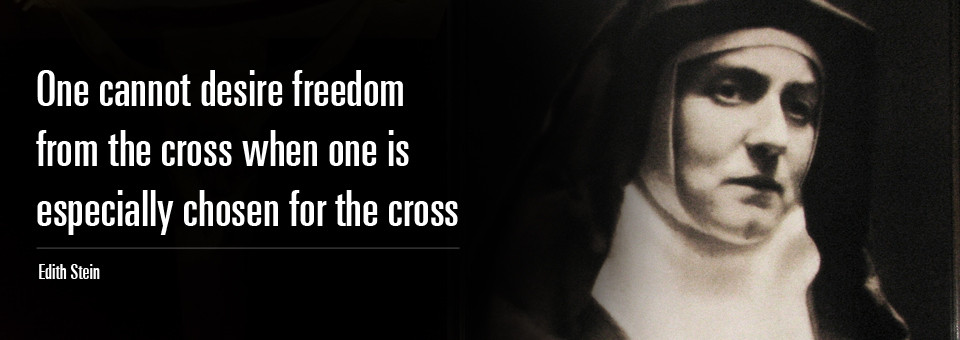
Continuing with the same meditation of St. Teresa Benedicta of the Cross, one reads:

"....there is also a danger that any natural affection may degenerate into passion with all of its devastating consequences. God has provided two remedies for this : marriage and virginity. Virginity is the more radical and precisely therefore the easier...Marriage is already a great mystery as the symbol of the bond between Christ and the Church and at the same time as its instrument. But virginity is still the deeper mystery. It is not only the symbol and instrument of bridal union with Christ and of the union's supernatural fruitfulness, but also participates in the union. It originates in the depths of the divine life and leads back to it again. The eternal Father in unconditional love has given his entire being to his Son. ..."

These thoughts are why one priest I know encourages young men to either choose celibacy as a brother, or get married, as there are graces in the decision of a lifestyle if one does not feel called to be a priest.

One's prayer flows out of one's vocation. God the Son came into the world into order to bring us all up to His Father. The saint writes, "This is the divine fertility of his (Jesus) eternal virginity: that he can give souls supernatural life."

"Divine virginity has a characteristic aversion to sin as the contrary of divine holiness."

And, yet, sinners find love from the true celibate, as they share in Christ's love. "Christ has come to tear sinners away from sin and to restore the divine image in defiled souls. He comes as a child of sin--his genealogy and the entire history  of the Old Covenant show this--and he seeks the company of sinners as as to take all the sins of the world upon himself and carry them away to the infamous wood of the cross, which thereby precisely becomes the sign of his victory."

St. Teresa Benedicta writes that the virginal soul has no fear of sin. Mary at the foot of the Cross, the most perfect of humans and most pure, "becomes the Mother of Grace."

For the laity, choice of vocation determines prayer, but the Carmelite embracing of the Cross may be a very useful focus in these times for many lay people.

This end the view taken from the works of Edith Stein. Tomorrow I move back to Elizabeth of the Trinity, looked at briefly early this year.


Monday, 4 May 2015

Yes, I am getting to gradualism-Three

So, how is St. John Paul II against the heresy of gradualism, which denies free will and grace?

Here, he is clear that marriage is a decision which demands the virtue of faith, given to all in baptism. In this grace, we all become prophets to the truth. We, through our lay lives in marriage, strengthen the Church and evangelize the unbelieving.

Again, God does not ask the impossible, and we all are given the theological virtue of faith, which like all the virtues, is made perfect in practice.

Do gradualists think the saint's words are mere poetry? Do they not believe this infallible document themselves? Have they never experienced the growth of faith through suffering in their own lives?

Maybe, maybe not...The entire point of gradualism is that people should be allowed the sacrilege of receiving Christ while they are in sin, instead of following the teaching of sacrifice and suffering put forward by St. John Paul II and others.

At the time of the wedding vow, faith is operative in both couples, unless there is an impediment, which only the Church can decide. In that moment, the couple agrees not only to love each other and subsequent offspring, but to evangelize through the sacrament and to build up the Church through their real, total love. They enter into the love of God Himself.

To throw this away, and worse, to turn against this sublime teaching mocks God, and God will not be mocked.

As a sharer in the life and mission of the church, which listens to the word of God with reverence and proclaims it confidently,[120] the Christian family fulfills its prophetic role by welcoming and announcing the word of God: It thus becomes more and more each day a believing and evangelizing community.
Christian spouses and parents are required to offer "the obedience of faith."[121] They are called upon to welcome the word of the Lord, which reveals to them the marvelous news--the good news--of their conjugal and family life sanctified and made a source of sanctity by Christ himself. Only in faith can they discover and admire with joyful gratitude the dignity to which God has deigned to raise marriage and the family, making them a sign and meeting place of the loving covenant between God and man, between Jesus Christ and his bride, the church.
The very preparation for Christian marriage is itself a journey of faith. It is a special opportunity for the engaged to rediscover and deepen the faith received in baptism and nourished by their Christian upbringing. In this way they come to recognize and freely accept their vocation to follow Christ and to serve the kingdom of God in the married state.
The celebration of the sacrament of marriage is the basic moment of the faith of the couple. This sacrament, in essence, is the proclamation in the church of the good news concerning married love. It is the word of God that "reveals" and "fulfills" the wise and loving plan of God for the married couple, giving them a mysterious and real share in the very love with which God himself loves humanity. Since the sacramental celebration of marriage is itself a proclamation of the word of God, it must also be a "profession of faith" within and with the church, as a community of believers, on the part of all those who in different ways participate in its celebration.

Marriage is not just between two people to control lust. The witness of marriage in the Church transcends the sub-human and brings people to a chance for perfection.

This profession of faith demands that it be prolonged in the life of the married couple and of the family. God, who called the couple to marriage, continues to call them in marriage.[122] In and through the events, problems, difficulties and circumstances of everyday life, God comes to them, revealing and presenting the concrete "demands" of their sharing in the love of Christ for his church in the particular family, social and ecclesial situation in which they find themselves.
The discovery of and obedience to the plan of God on the part of the conjugal and family community must take place in "togetherness," through the human experience of love between husband and wife, between parents and children, lived in the spirit of Christ.
Thus the little domestic church, like the greater church, needs to be constantly and intensely evangelized: hence its duty regarding permanent education in the faith.
52. To the extent in which the Christian family accepts the Gospel and matures in faith, it becomes an evangelizing community. Let us listen again to Paul VI: "The family, like the church, ought to be a place where the Gospel is transmitted and from which the Gospel radiates. In a family which is conscious of this mission, all the members evangelize and are evangelized.

Here we are back to my theme yesterday, that we are all called to evangelize and no one is left out of this command, not even the mother at home, or the dad at work.

We HAVE the grace to stay married and to be married in Christ. We are given that grace and we only have to agree to living in that grace.

This apostolic mission of the family is rooted in baptism and receives from the grace of the sacrament of marriage new strength to transmit the faith, to sanctify and transform our present society according to God's plan.
Particularly today the Christian family has a special vocation to witness to the paschal covenant of Christ by constantly radiating the joy of love and the certainty of the hope for which it must give account: "The Christian family loudly proclaims both the present virtues of the kingdom of God and the hope of a blessed life to come."[125]

Remember how I wrote yesterday that I had a missionary heart? All who are married are given that for their children and for the parish, the entire Church.

It should not be forgotten that the service rendered by Christian spouses and parents to the Gospel is essentially an ecclesial service. It has its place within the context of the whole church as an evangelized and evangelizing community. Insofar as the ministry of evangelization and catechesis of the church of the home is rooted in and derives from the one mission of the church and is ordained to the upbuilding of the one body of Christ,[128] it must remain in intimate communion and collaborate responsibly with all the other evangelizing and catechetical activities present and at work in the ecclesial community at the diocesan and parochial levels.
54. Evangelization, urged on within by irrepressible missionary zeal, is characterized by a universality without boundaries. It is the response to Christ's explicit and unequivocal command: "Go into all the world and preach the Gospel to the whole creation."[129]

Anything less is not the individual or couple living out their baptismal calls.

The Christian family's faith and evangelizing mission also possesses this Catholic missionary inspiration. The sacrament of marriage takes up and reproposes the task of defending and spreading the faith, a task that has its roots in baptism and confirmation,[130] and makes Christian married couples and parents witnesses of Christ "to the end of the earth,"[131] missionaries, in the true and proper sense, of love and life.
A form of missionary activity can be exercised even within the family. This happens when some member of the family does not have the faith or does not practice it with consistency. In such a case the other members must give him or her a living witness of their own faith in order to encourage and support him or her along the path toward full acceptance of Christ the savior.[132]
Animated in its own inner life by missionary zeal, the church of the home is also called to be a luminous sign of the presence of Christ and of his love for those who are "far away," for families who do not yet believe and for those Christian families who no longer live in accordance with the faith that they once received. The Christian family is called to enlighten "by its example and its witness those who seek the truth. "[133]
Just as at the dawn of Christianity Aquila and Priscilla were presented as a missionary couple,[134] so today the church shows forth her perennial newness and fruitfulness by the presence of Christian couples and families who dedicate at least a part of their lives to working in missionary territories, proclaiming the Gospel and doing service to their fellow man in the love of Jesus Christ.
Christian families offer a special contribution to the missionary cause of the church by fostering missionary vocations among their sons and daughters[135] and, more generally, "by training their children from childhood to recognize God's love for all people."[136]

Do some of the fathers in the synod not get it that marriage sanctifies? Adultery leads to perdition. Period. How is it that they think that those in mortal sin, according to Divine Law and the mystery of the sacrament, can receive grace? They cannot, and, in fact, insult God by putting their sin in His Face, as it were. Again, those who insists on this position cannot understand the freedom of will we all have, and grace, given to all.

56. The sacrament of marriage is the specific source and original means of sanctification for Christian married couples and families. It takes up again and makes specific the sanctifying grace of baptism. By virtue of the mystery of the death and resurrection of Christ, of which the spouses are made part in a new way by marriage, conjugal love is purified and made holy: "This love the Lord has judged worthy of special gifts, healing, perfecting and exalting gifts of grace and of charity."[138]

So we become saints in marriage. Yes, this is possible, with free will choosing real love through grace.


The gift of Jesus Christ is not exhausted in the actual celebration of the sacrament of marriage, but rather accompanies the married couple throughout their lives. This fact is explicitly recalled by the Second Vatican Council when it says that Jesus Christ "abides with them so that just as he loved the church and handed himself over on her behalf, the spouses may love each other with perpetual fidelity through mutual self-bestowal...For this reason, Christian spouses have a special sacrament by which they are fortified and receive a kind of consecration in the duties and dignity of their state. By virtue of this sacrament, as spouses fulfill their conjugal and family obligations they are penetrated with the spirit of Christ, who fills their whole lives with faith, hope and charity. Thus they increasingly advance toward their own perfection as well as toward their mutual sanctification, and hence contribute jointly to the glory of God."[139]
Christian spouses and parents are included in the universal call to sanctity. For them this call is specified by the sacrament they have celebrated and is carried out concretely in the realities proper to their conjugal and family life.[140] This gives rise to the grace and requirement of an authentic and profound conjugal and family spirituality that draws its inspiration from the themes of creation, covenant, cross, resurrection and sign, which were stressed more than once by the synod.
Christian marriage, like the other sacraments, "whose purpose is to sanctify people, to build up the body of Christ, and finally, to give worship to God,"[141] is in itself a liturgical action glorifying God in Jesus Christ and in the church. By celebrating it, Christian spouses profess their gratitude to God for the sublime gift bestowed on them of being able to live in their married and family lives the very love of God for people and that of the Lord Jesus for the church, his bride.

And if people fail, we have the sacrament of confession. One does not have to dump the conjugal relationship. One can forgive, one can ask forgiveness.

 An essential and permanent part of the Christian family's sanctifying role consists in accepting the call to conversion that the Gospel addresses to all Christians, who do not always remain faithful to the "newness" of the baptism that constitutes them "saints." The Christian family too is sometimes unfaithful to the law of baptismal grace and holiness proclaimed anew in the sacrament of marriage.
Repentance and mutual pardon within the bosom of the Christian family, so much a part of daily life, receive their specific sacramental expression in Christian penance. In the encyclical Humanae Vitae, Paul VI wrote of married couples: "And if sin should still keep its hold over them, let them not be discouraged, but rather have recourse with humble perseverance to the mercy of God, which is abundantly poured forth in the sacrament of penance."[146]

There is much in this encyclical on children, the family and preparation for marriage, but I am going to skip to these next selections.

And here the Pope-Saint addresses priest directly:

Priests and deacons, when they have received timely and serious preparation for this apostolate, must unceasingly act toward families as fathers, brothers, pastors and teachers, assisting them with the means of grace and enlightening them with the light of truth. Their teaching and advice must therefore always be in full harmony with the authentic magisterium of the church, in such a way as to help the people of God to gain a correct sense of the faith to be subsequently applied to practical life. Such fidelity to the magisterium will also enable priests to make every effort to be united in their judgments in order to avoid troubling the consciences of the faithful.

In the church, the pastors and the laity share in the prophetic mission of Christ: The laity do so by witnessing to the faith by their words and by their Christian lives; the pastors do so by distinguishing in that witness what is the expression of genuine faith from what is less in harmony with the light of faith; the family, as a Christian community, does so through its special sharing and witness of faith.

and again....the synod referred to here is the one in 1981
. ...the church cannot ignore the time of old age with all its positive and negative aspects. In old age married love, which has been increasingly purified and ennobled by long and unbroken fidelity, can be deepened. There is the opportunity of offering to others in a new form the kindness and the wisdom gathered over the years and what energies remain. But there is also the burden of loneliness, more often psychological and emotional rather than physical, which results from abandonment or neglect on the part of children and relations. There is also suffering caused by ill-health, by the gradual loss of strength, by the humiliation of having to depend on others, by the sorrow of feeling that one is perhaps a burden to one's loved ones, and by the approach of the end of life. These are the circumstances in which, as the synod fathers suggested, it is easier to help people understand and live the lofty aspects of the spirituality of marriage and the family, aspects which take their inspiration from the value of Christ's cross and resurrection, the source of sanctification and profound happiness in daily life, in the light of the great eschatological realities of eternal life.
In all these different situations let prayer, the source of light and strength and the nourishment of Christian hope, never be neglected.

Yes, I am getting to gradualism--2

St. John Paul II in Familiaris Consortio explains exactly the situation we see today, in 2015. He quotes the truly prophetic document, Humanae Vitae.

"The spouses participate in it as spouses, together, as a couple, so that the first and immediate effect of marriage (res et sacramentum) is not supernatural grace itself, but the Christian conjugal bond, a typically Christian communion of two persons because it represents the mystery of Christ's incarnation and the mystery of his covenant. The content of participation in Christ's life is also specific: Conjugal love involves a totality, in which all the elements of the person enter--appeal of the body and instinct, power of feeling and affectivity, aspiration of the spirit and of will. It aims at a deeply personal unity, the unity that, beyond union in one flesh, leads to forming one heart and soul; it demands indissolubility and faithfulness in definitive mutual giving; and it is open to fertility (cf. Humanae Vitae, 9). In a word, it is a question of the normal characteristics of all natural conjugal love, but with a new significance which not only purifies and strengthens them, but raises them to the extent of making them the expression of specifically Christian values."[33]
14. According to the plan of God, marriage is the foundation of the wider community of the family, since the very institution of marriage and conjugal love is ordained to the procreation and education of children, in whom it finds its crowning.

Where is this emphasis on purity in the words of some synod members? Have they forgotten that God always gives one grace sufficient to the task at hand-always? God never asks the impossible, which means that some of the false leaders in the synod have little faith, or simply, do not believe in grace.

And, as Pope Paul VI predicted, once marriage is undermined in a society, the Kingdom of God is damaged by compromise and laxity, or worse, serious sin. And, virginity is only understandable in the light of holy marriage as well. If human sexuality is denigrated in marriage, so, too, it is in celibacy.

When marriage is not esteemed, neither can consecrated virginity or celibacy exist; when human sexuality is not regarded as a great value given by the creator, the renunciation of it for the sake of the kingdom of heaven loses its meaning.
Rightly indeed does St. John Chrysostom say: "Whoever denigrates marriage also diminishes the glory of virginity. Whoever praises it makes virginity more admirable and resplendent. What appears good only in comparison with evil would not be particularly good. It is something better than what is admitted to be good that is the most excellent good."

And, hey, where is the example the married should expect from the holy celibates? Or have they left the path of celibacy themselves so that they no longer understand real love? If so, I personally feel sorry for them-what they are missing is the Love of the Bridegroom, Christ Himself.

Christian couples therefore have the right to expect from celibate persons a good example and a witness of fidelity to their vocation until death. Just as fidelity at times becomes difficult for married people and requires sacrifice, mortification and self-denial, the same can happen to celibate persons, and their fidelity, even in the trials that may occur, should strengthen the fidelity of married couples

Self-knowledge, THIS IS THE KEY.

Every man and woman in the world knows that adultery is a great evil to individuals, to children, to society. Self-knowledge allows one to be honest about one's sins. We all have to face our sins. All.

And without love in the world as an example for us all, we fall back into fear and self-conceit.


The inner principle of that task, its permanent power and its final goal, is love: Without love the family is not a community of persons and, in the same way, without love the family cannot live, grow and perfect itself as a community of persons. What I wrote in the encyclical Redemptor Hominis applies primarily and especially within the family as such: "Man cannot live without love. He remains a being that is incomprehensible for himself, his life is senseless, if love is not revealed to him, if he does not encounter love, if he does not experience it and make it his own, if he does not participate intimately in it.

Love can be seen in suffering. I see this daily, in myself, in those I love who are experiencing great pain either physically or mentally, in those who have lost a spouse to death or abandonment. Suffering does not deny love, Never....and it is only in the true sacrament of marriage that the Holy Spirit resides, not in false marriages of convenience or comfort. He will not be present unless those who underwent such a free choice contrary to God's Plan allow themselves to suffer in a new way of abstinence and even breaking-up for the sake of God.

What has been forgotten in the Synod is that love for God trumps all over loves, and that we cannot truly love another outside of love for God.

This conjugal communion sinks its roots in the natural complementarity that exists between man and woman and is nurtured through the personal willingness of the spouses to share their entire life project, what they have and what they are: For this reason such communion is the fruit and the sign of a profoundly human need. But in the Lord Christ God takes up this human need, confirms it, purifies it and elevates it, leading it to perfection through the sacrament of matrimony: the Holy Spirit who is poured out in the sacramental celebration offers Christian couples the gift of a new communion of love that is the living and real image of that unique unity which makes of the church the indivisible mystical body of the Lord Jesus.

Outside of life in the Holy Spirit, there is no life, only death. And the dignity of a man and a woman is seriously compromised by divorce and remarriage without the annulment of the Church. We see this clearly in false man-made religions which think polygamy is OK.

God loves each one of us too much for such a half-love, or quarter-love instead of total love.

I am reminded of a powerful scene in the newer movie on Anna of Siam, not the musical, where the king finally comes to realize what it means to love one woman. In this scene, he dances with Anna and admits that one woman can suffice a man, if that man truly loves. True love comes with total love.

The gift of the spirit is a commandment of life for Christian spouses and at the same time a stimulating impulse so that every day they may progress toward an ever richer union with each other on all levels--of the body, of the character, of the heart, of the intelligence and will, of the soul[47] --revealing in this way to the church and to the world the new communion of love, given by the grace of Christ.
Such a communion is radically contradicted by polygamy: This, in fact, directly negates the plan of God which was revealed from the beginning, because it is contrary to the equal personal dignity of men and women, who in matrimony give themselves with a love that is total and therefore unique and exclusive. As the Second Vatican Council writes: "Firmly established by the Lord, the unity of marriage will radiate from the equal personal dignity of husband and wife, a dignity acknowledged by mutual and total love."

This paragraph is so powerful, I hardly know how to unpack it. That love is unity, you have read on this blog regarding the pursuit of perfection. But, St. John Paul II really experienced God's union, or he would not have been able to write this passage below. The Catholic couple reveals Christ to us. How beautiful.

Christ renews the first plan that the creator inscribed in the hearts of man and woman, and in the celebration of the sacrament of matrimony offers "a new heart": thus the couples are not only able to overcome "hardness of heart,"[51] but also, and above all, they are able to share the full and definitive love of Christ, the new and eternal covenant made flesh. Just as the Lord Jesus is the "faithful witness,"[52] the "yes" of the promises of God[53] and thus the supreme realization of the unconditional faithfulness with which God loves his people, so Christian couples are called to participate truly in the irrevocable indissolubility that binds Christ to the church, his bride, loved by him to the end.[54]

The gift of the sacrament is at the same time a vocation and commandment for the Christian spouses, that they may remain faithful to each other forever, beyond every trial and difficulty, in generous obedience to the holy will of the Lord: "What therefore God has joined together, let not man put asunder."[55]

We daily see religions which do not hold the spiritual or physical equality of women in marriage.

Here is the Pope on this....

In creating the human race "male and female,"[64] God gives man and woman an equal personal dignity, endowing them with the inalienable rights and responsibilities proper to the human person. God then manifests the dignity of women in the highest form possible, by assuming human flesh from the Virgin Mary, whom the church honors as the mother of God, calling her the new Eve and presenting her as the model of redeemed woman. The sensitive respect of Jesus toward the women that he called to his following and his friendship, his appearing on Easter morning to a woman before the other disciples, the mission entrusted to women to carry the good news of the resurrection to the apostles--these are all signs that confirm the special esteem of the Lord Jesus for women. The apostle Paul will say: "In Christ Jesus you are all children of God through faith . . . There is neither slave nor free, there is neither male nor female; for you are all one in Christ Jesus."[65]

And here...

Authentic conjugal love presupposes and requires that a man have a profound respect for the equal dignity of his wife: "You are not her master," writes St. Ambrose, "but her husband; she was not given to you to be your slave, but your wife.... Reciprocate her attentiveness to you and be grateful to her for her love."[69] With his wife a man should live "a very special form of personal friendship."[70] As for the Christian, he is called upon to develop a new attitude of love, manifesting toward his wife a charity that is both gentle and strong like that which Christ has for the church.[71]

So, you are thinking, what has this to do with gradualism?

Here we go...individuals want to blame God for their sins. They want to deny both their own freedom to choose sin or holiness, and they want to change the teaching of the Church to accommodate this lie. But, the Church did not make up all these beautiful thoughts and rules of guidance for a holy life. God did and He entrusted His Church to share these truths.

The second lie is the denial of grace, which I have written about here on this blog under the tag grace and synod.

St. John Paul II again....

In the field of conjugal morality the church is teacher and mother and acts as such.
As teacher, she never tires of proclaiming the moral norm that must guide the responsible transmission of life. The church is in no way the author or the arbiter of this norm. In obedience to the truth which is Christ, whose image is reflected in the nature and dignity of the human person, the church interprets the moral norm and proposes it to all people of good will without concealing its demands of radicalness and perfection.

And is it hard to be holy, to give in total love?  Yes, yes, yes....Love is in the will. 

But it is one and the same church that is both teacher and mother. And so the church never ceases to exhort and encourage all to resolve whatever conjugal difficulties may arise without ever falsifying or compromising the truth: She is convinced that there can be no true contradiction between the divine law on transmitting life and that on fostering authentic married love.[91] Accordingly, the concrete pedagogy of the church must always remain linked with her doctrine and never be separated from it. With the same conviction as my predecessor, I therefore repeat: "To diminish in no way the saving teaching of Christ constitutes an eminent form of charity for souls."[92]
On the other hand, authentic ecclesial pedagogy displays its realism and wisdom only by making a tenacious and courageous effort to create and uphold all the human conditions--psychological, moral and spiritual--indispensable for understanding and living the moral value and norm.
There is no doubt that these conditions must include persistence and patience, humility and strength of mind, filial trust in God and in his grace, and frequent recourse to prayer and to the sacraments of the eucharist and of reconciliation.[93] Thus strengthened, Christian husbands and wives will be able to keep alive their awareness of the unique influence that the grace of the sacrament of marriage has on every aspect of married life including, therefore, their sexuality: The gift of the Spirit, accepted and responded to by husband and wife, helps them to live their human sexuality in accordance with God's plan and as a sign of the unitive and fruitful love of Christ for his church.

What the synod fathers of a certain bent, and bent is the word, are forgetting is that evil moves governments not to support marriage and children. Too many governments have passed laws contrary to both natural and revealed law.

Yes, it is hard to be happily and comfortably married today. But, that is because, primarily. societies have fallen into the hands of the enemies of marriage. JPII is too aware of this...


...the church openly and strongly defends the rights of the family against the intolerable usurpations of society and the state. In particular the synod fathers mentioned the following rights of the family: --The right to exist and progress as a family, that is to say, the right of every human being, even if he or she is poor, to found a family and to have adequate means to support it;
--The right to exercise its responsibility regarding the transmission of life and to educate children;
--The right to the intimacy of conjugal and family life;
--The right to the stability of the bond and of the institution of marriage;
--The right to believe in and profess one's faith and to propagate it;
--The right to bring up children in accordance with the family's own traditions and religious and cultural values, with the necessary instruments, means and institutions;
--The right, especially of the poor and the sick, to obtain physical, social, political and economic security;
--The right to housing suitable for living family life in a proper way;
--The right to expression and to representation, either directly or through associations, before the economic, social and cultural public authorities and lower authorities;
--The right to form associations with other families and institutions in order to fulfill the family's role suitably and expeditiously;
--The right to protect minors by adequate institutions and legislation from harmful drugs, pornography, alcoholism, etc.;
--The right to wholesome recreation of a kind that also fosters family values;
--The right of the elderly to a worthy life and a worthy death;
--The right to emigrate as a family in search of a better life.[112]

Satan and individual sin attack marriage, but the solution is not to change the institution, but one's interior life.

Sin is our choice in following the easy ways out of suffering, and I would state that most sin if not all, is an attempt to avoid sacrifice and suffering.

Gradualists believe not only in the two lies above, the denial of free will, and the denial of grace, but in the connection between the building of the Kingdom of God on earth and marriage. Gradualists do not seem to have Faith. They have lost the ability to think like Christ, like the Church, in believing that with grace all things are possible. ALL. And less some people think I write out of ignorance of suffering in marriage, let me assure them this is not so. I learned to accept grace and love in the will. I learned Love. And love gives life.

The Christian family also builds up the kingdom of God in history through the everyday realities that concern and distinguish its state of life. It is thus in the love between husband and wife and between the members of the family--a love lived out in all its extraordinary richness of values and demands: totality, oneness, fidelity and fruitfulness"[118]--that the Christian family's participation in the prophetic, priestly and kingly mission of Jesus Christ and of his church finds expression and realization. Therefore, love and life constitute the nucleus of the saving mission of the Christian family in the church and for the church.

And, yes, there will be one more on this subject....later on today...


Sunday, 3 May 2015

No I did not ignore Athanasius Yesterday--Here Is Our Athanasius

I have an entire series on the Doctors of the Church, so use the tags.

However, if we ever needed such a stalwart warrior of the Faith as Athanasius, it is now.

His clarity of mind and spirit are needed in the current members of the Synod. The truth is that we had an Athanasius speaking to us clearly on the definition of marriage as ordained by Christ, and this was St. John Paul II, who is still with us in the Church Triumphant.

I want to quote some short bits from Familiaris Consortio, which need to be considered seriously by the Synod fathers this year.

Illuminated by the faith that gives her an understanding of all the truth concerning the great value of marriage and the family and their deepest meaning, the church once again feels the pressing need to proclaim the Gospel, that is the "good news," to all people without exception, in particular to all those who are called to marriage and are preparing for it, to all married couples and parents in the world.
The church is deeply convinced that only by the acceptance of the Gospel are the hopes that man legitimately places in marriage and in the family capable of being fulfilled.
Willed by God in the very act of creation,[3] marriage and the family are interiorly ordained to fulfillment in Christ[4] and have need of his graces in order to be healed from the wounds of sin[5] and restored to their "beginning,"[6] that is, to full understanding and the full realization of God's plan.
At a moment of history in which the family is the object of numerous forces that seek to destroy it or in some way to deform it, and aware that the well-being of society and her own good are intimately tied to the good of the family,[7] the church perceives in a more urgent and compelling way her mission of proclaiming to all people the plan of God for marriage and the family, ensuring their full vitality and human and Christian development, and thus contributing to the renewal of society and of the people of God.

Notice that marriage between a man and a woman has been willed by God from the very beginning of the creation of humans. Only in Christ can marriages be sustained and healed. Not by changing the definition of marriage as that special relationship, as seen both in natural and revealed law, as the union between a man and a woman for the procreation of children and for their mutual contentment.

The Papal Saint saw the horrible evils besetting marriage, and now, some false leaders in the Church, just like Arius, want to change the Church's teaching in order to accommodate their own desires

We all have the graces we need to be holy and get to heaven. The Pope actually in this encyclical, which is infallible and supports over 2,000 years of teaching, comes against gradualism, which has so many people confused.

Let us look together at a few of his paragraphs. It is clear that this saint understands the stresses of the times.

Since God's plan for marriage and the family touches men and women in the concreteness of their daily existence in specific social and cultural situations, the church ought to apply herself to understanding the situations within which marriage and the family are lived today, in order to fulfill her task of serving.[8]
This understanding is therefore an inescapable requirement of the work of evangelization. It is, in fact, to the families of our times that the church must bring the unchangeable and ever new gospel of Jesus Christ, just as it is the families involved in the present conditions of the world that are called to accept and to live the plan of God that pertains to them. Moreover, the call and demands of the spirit resound in the very events of history, and so the church can also be guided to a more profound understanding of the inexhaustible mystery of marriage and the family by the circumstances, the questions and the anxieties and hopes of the young people, married couples and parents of today...

Before getting into gradualism, the Pope states clearly that the Church is not a democracy and does not follow the ideals of the majority. God's Word has always been accepted by the remnant.

The "supernatural sense of faith,"[13] however, does not consist solely or necessarily in the consensus of the faithful. Following Christ, the church seeks the truth, which is not always the same as the majority opinion. She listens to conscience and not to power, and in this way she defends the poor and the downtrodden. The church values sociological and statistical research when it proves helpful in understanding the historical context in which pastoral action has to be developed and when it leads to a better understanding of the truth. Such research alone, however, is not to be considered in itself an expression of the sense of faith.
Because it is the task of the apostolic ministry to ensure that the church remains in the truth of Christ and to lead her ever more deeply into that truth, the pastors must promote the sense of faith in all the faithful, examine and authoritatively judge the genuineness of its expressions and educate the faithful in an ever more mature evangelical discernment.

And St. John Paul II tells us that the world undermines God's teaching in many ways.

...signs are not lacking of a disturbing degradation of some fundamental values: a mistaken theoretical and practical concept of the independence of the spouses in relation to each other; serious misconceptions regarding the relationship of authority between parents and children; the concrete difficulties that the family itself experiences in the transmission of values; the growing number of divorces; the scourge of abortion; the ever more frequent recourse to sterilization; the appearance of a truly contraceptive mentality.
At the root of these negative phenomena there frequently lies a corruption of the idea and the experience of freedom, conceived not as a capacity for realizing the truth of God's plan for marriage and the family, but as an autonomous power of self-affirmation, often against others, for one's own selfish well-being.

And, we are not moving towards progress in this world, but devolution, the falling into more and more darkness. Here is JPII's take on this briefly:

This shows that history is not simply a fixed progression toward what is better, but rather an event of freedom, and even a struggle between freedoms that are in mutual conflict, that is, according to the wellknown expression of St. Augustine, a conflict between two loves: the love of God to the point of disregarding self, and the love of self to the point of disregarding God.

We are called to love God first, in complete freedom, to the point of self-denial.

OK, now the first blow against gradualism is the constant call of each of us to conversion:


What is needed is a continuous, permanent conversion which, while requiring an interior detachment from every evil and an adherence to good in its fullness, is brought about concretely in steps which lead us ever forward. Thus a dynamic process develops, one which advances gradually with the progressive integration of the gifts of God and the demands of his definitive and absolute love in the entire personal and social life of man. Therefore an educational growth process is necessary in order that individual believers, families and peoples, even civilization itself, by beginning from what they have already received of the mystery of Christ, may patiently be led forward, arriving at a richer understanding and a fuller integration of this mystery in their lives.

What the Pope means here by gradual is not letting a person remain in sin and receive the sacraments, but the gradual learning of the life of virtue when one is in sanctifying grace. JPII assumes that one in grace will grow holier by appropriating "interior detachment". Detachment from the consolation of this world would be an exterior sign of the growing detachment interiorly.

One cannot grow in faith, hope and love while in adultery, or same-sex relationships, as one has removed one's self from the event of conversion to God's Will, preferring one's own version of truth, choosing to be a little god one's self and determine right from wrong, which is relativism.

In this next section, the saint explains the greatness of love, in sacrificial love, as true love, demanded from all of us in each one of our situations.

God created man in his own image and likeness:[20] calling him to existence through love, he called him at the same time for love.
God is love[21] and in himself he lives a mystery of personal loving communion. Creating the human race in his own image and continually keeping it in being. God inscribed in the humanity of man and woman the vocation, and thus the capacity and responsibility, of love and communion[22]. Love is therefore the fundamental and innate vocation of every human being.
As an incarnate spirit, that is, a soul which expresses itself in a body and a body informed by an immortal spirit, man is called to love in his unified totality. Love includes the human body, and the body is made a sharer in spiritual love.
Christian revelation recognizes two specific ways of realizing the vocation of the human person, in its entirety, to love: marriage and virginity or celibacy. Either one is in its own proper form an actuation of the most profound truth of man, of his being "created in the image of God."
Consequently sexuality, by means of which man and woman give themselves to one another through the acts which are proper and exclusive to spouses, is by no means something purely biological, but concerns the innermost being of the human person as such. It is realized in a truly human way only if it is an integral part of the love by which a man and a woman commit themselves totally to one another until death. The total physical self-giving would be a lie if it were not the sign and fruit of a total personal self-giving, in which the whole person, including the temporal dimension, is present: If the person were to withhold something or reserve the possibility of deciding otherwise in the future, by this very fact he or she would not be giving totally.

How beautiful that the standard of God for marriage demands of us that we are truly most human when we are called to love until death, in a great decision, yes, in the will, of sacrificial love.

Such total giving is not possible when one wants one's own way, one's own temporary comfort, outside the natural and revealed laws of God.

The only "place" in which this self-giving in its whole truth is made possible is marriage, the covenant of conjugal love freely and consciously chosen, whereby man and woman accept the intimate community of life and love willed by God himself,[23] which only in this light manifests its true meaning. The institution of marriage is not an undue interference by society or authority, nor the extrinsic imposition of a form. Rather, it is an interior requirement of the covenant of conjugal love which is publicly affirmed as unique and exclusive in order to live in complete fidelity to the plan of God, the creator. A person's freedom, far from being restricted by this fidelity, is secured against every form of subjectivism or relativism and is made a sharer in creative wisdom.

True conjugal love, even in suffering, reveals something way beyond the couple. This covenant reveals God's Bridal Love for His People, the Church. 

Those cardinals and bishops who want to undermine God's perfect plan for marriage also want to undermine God's Love for His Church.

Is it possible that these men, and I could name several, have never experienced this Bridal Love themselves, and, therefore, cannot believe that God calls us all to this?

to be continued tomorrow..