Recent Posts

Showing posts with label places. Show all posts

Thursday, 16 October 2014

And, yet another poem of place repost

The Sleeping Lady of Malta

Thanks to Wiki for The Sleeping Lady of Malta, circa 1,500 BC


Of what does she dream, this heavy lady of Malta, resting on her hard bed,
hand under her head, like a goddess taking a break from listening to her votaries singing chants over the wine-dark sea?

Does she dream, or is her sleep dreamless, that of the dead, who no longer hold imagination or memory? Has she let go of the last images of the Middle Sea's ships bringing her necklaces of shells from Syracuse?
Is her dream one of the dancing star-skirted lady?

Did her dreams end abruptly, like one caught off-guard in the night, facing a soft journey into eternity?
Or, is she still dreaming, holding on to images which she creates for the people of Malta, who no longer know her name?

This lady wears the billowing skirts of many goddesses and reveals her breasts to the world, as if to say she is worthy of the worship from those who need fertility.
Those yearnings of Maltese maidens lie in the dust of Ħal-Saflieni-few want offspring now.

This lady's hair was done by one of the ancestor's of the blow-dry experts of Valletta, and she does not worry about her bare feet, so broken, so lost in memory. Does she does dream of some one, some god beyond the walls of Athens or Kedash?

Does he dream of her, he, buried in a cave or sandstorm, with his arm under his head? Or did he find a lissome lass of Dalmanutha or the ancient springs of Achsah? Maybe he preferred dark, like the tents of Kedar?

His left arm is under my head and his right arm embraces me. Daughters of Jerusalem,
I charge you: Do not arouse or awaken love until it so desires. And, so, perhaps, she sleeps into
this tumultuous century, dreaming of lost love....


copyright 2013 

More of my poetry of place

Friday, 8 November 2013


Poetry from Malta

Autumn and a Lady in Malta


There are no falling leaves here
Desert plants do not acknowledge
Autumn nor reveal the pains of
Melancholia.

Yet, autumn it is, despite oleander
And cacti; the sunshine mocks
Those who are in mourning, those
Who do not come to these isles.

A woman sits in a darkened room,
With faded rose and pale green
Chairs, her head in black, her
Dress, black, and as the Irish

Companioni exclaimed, loudly, “I see
You are in mourning.” The black-
Laced lady is in mourning, and wears
A bishop’s ring, not noticing it

In her darkness.  Mysterious loss,
Hidden in time and memory, and
Memory she must deny, move on
As the Virgin Queen said to her

Executed lovers. No discussion, no
Tears are allowed in this hot country,
Where feelings fall like leaves in
Colder countries, but blow away

As fast, as if once seen in oranges,
Yellows and reds, now purposefully
Ignored. No country for old men
Or old women, just kind children.

The lady in lace, surrounded by
Grayness, knows now she is alone,
Like so many other women of her
Age and status. The curse of widows

Is that all seem to think that memories
Sooth, coddle, sustain, but that would
Be madness, not reality. She knows
This truth and knows she is alone with

No Ulysses desiring her after twenty years
Absence; no Orpheus willing to go into
Hades to rescue her from the fading fires.
No one but the New God, to Whom she

Turns. but when she turns, she sees
Only the painted Baroque cross.  This is her
Way now, and in the darkness, she
Acquiesces, joining with the Sorrowful

Madre.  Life was offered and she chose
Life, never death, for she knows the
Plant must die in order for new seeds
To grow; so she waits, in the land of in-

Between, like a holding area in an
Airport, she waits, like a child in
The care of a Father who allowed
His Own Beloved Son to die.

She takes her mourning memories, pressed
Like violets in the family bible, and puts
Them in her amethyst ring, symbol of
Lost power and lost tradition. She does not weep.

Another Poem of Place by Me

Soul Propriete No. 3

As I stand at the large, half-opened window in the convent,
facing ancient bits of walls and new Victorian additions,
the voice of some clerk in London, whose duty was
to mark the beginnings and ends of properties
speaks to me in the sunlight.

His statement, etched in stone, until the last days of London,
clearly show the sole proprietor. 
"Half the Thickness of This Wall is in Paddington Parish" 
How exact the English were then, which they are not now.
How comforting was the Georgian mind for details.

1806, 1826, 1866, 1886, 1906, 1966, 2006, 2012
His voice clears the centuries with clear early 19th century
feet and inches. Does Paddington Parish really care about
half a thickness of wall? Taxes? Wall maintenance? Sole proprietor
of a closed alleyway which no one sees

Except me and a robin, clearly not interested in the mind of 
this maker. But, I am. Wondering at the great interests of
the new industrial world breaking into new views of walls
and ownership across England, those satanic mills
conquering small alleyways and arches.

There is still conquest in these words, an old lettering
a new idea of propriete mocked much later by Dickens,
who most likely walked this way at least once or twice.
Who knows? The footsteps of the past leading me, as 
I stare at a wall separating sole from soul.

My ideas are elsewhere, but the clerk's words ring out
reminding me of the little world I am leaving for awhile, 
a world I shall not miss that much, or at least that is
what I think today, listening to the cheeky robin
mocking the past and reminding me that even

The birds of the air have nests. I know Who is in charge.

Wednesday, 15 October 2014

Eden and Gethsemane Part Three

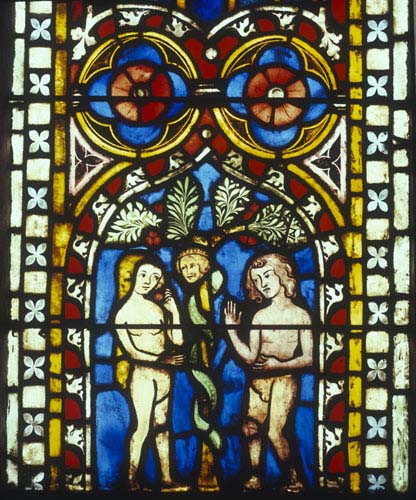
Only three persons walked in Eden. God the Father and Creator, Adam and Eve. The Divine Person spoke with His creatures in joy and love.

They, children of the earth but with souls made like unto God, had preternatural gifts. These flow from the fact that we were all made in the image and likeness of God, having, therefore, free will and reason.

These were sanctifying grace, bodily immortality, integrity, and infused knowledge. All these were lost in Original Sin. But, if I am to understand Eden, do I not need to understand these gifts, which are given again to men and women through Christ.

The first we can understand. It was a permanent gift, and if we continue without mortal sin, that is our permanent gift as well. 

The second we have gained through the Passion, Death and Resurrection, the sign of immortal life, the regained privilege to live with God forever. Connected to that was perfect health. This immortal life may be with or without God, but it is a gift and separates us, like knowledge, reason and free will, from the other animals. Our soul is immortal.

Parts of knowledge, the knowledge held by Adam and Eve, as the Catholic theologians teach us, were knowledge of regarding God, His attributes, (which may be learned again in contemplation at the stages of Illumination and Union),  the moral law involving man's relation to God, (what we would call understanding justice and mercy), and knowledge of science, which means knowledge of the physical (material) universe as well as the spiritual world, which now is mostly revealed to us through the teachings of the Church (Tradition) and Revelation ) the Scriptures.

Thanks to wikimedia commons..


Integrity, the third, means that the appetites were totally subjected to reason and free will. We can hardly, as creatures still burdened with concupiscence, a result of Original Sin, imagine what this state was like.

Those who are saints come very close to this on earth, outside the Beatific Vision.

Therefore, and I am working my way to the understanding of Eden as Gethsemane and Gethsemane as Eden, some of these gifts are renewed in the stages of perfection, but only with suffering.


But, the mystery remains...and what is obvious may be overlooked by me.

Again, three persons walked in Eden. Adam and Eve, husband and wife, walked with God.

Such is the mystery of an excellent marriage. Imagine a relationship with no tension!

What is obvious about Eden is that it was for our first parents, for their life, a place for them to be and have children.

Theirs....

Gethsemane did not belong to Christ as Man. He chose poverty and owned what he left to work for three years in His public ministry.

Gethsemane was a public place, with a cave where Christ could go with His closest friends and pray. They fell asleep, which so many Catholics are today.

God is saying that gifts are His to give and places are gifts. Pray for me as I continue to mull over Eden and Gethsemane. Once the light has come so that I truly understand what is happening through this meditation, if it is something I can share, I shall.

God makes new doughnuts everyday. And this meditation has levels of meaning, some I have not even begun to suspect.

to be continued...


Eden And Gethsemane Part Two

Eden, made by God, was perfect for plants, animals, humans. It was a "pleasant place", locus amoenus, in classical and Medieval literature, a garden with trees, grass, water and safety.

We all yearn for this safety, especially as the world crumbles around us. We are all desiring a safe haven.

Eden represents a place where God walked with man and woman, a meeting place of Divinity and humanity.

St. Bernard of Clairvaux in his sermons on The Song of Songs, is very aware of location and geography, tracing the comings and goings of both the Bride and the Bridegroom.

That couple is the idealized soul and Christ, or Christ and His Church. 

We humans need a place, a location to be. We are not and never will be in eternity disembodied spirits. That is a temporary state.

We need to be somewhere, as I remind God and my patrons regularly. Eden was a place, a real place, not merely a poetic metaphor for happiness in perfection.

Gethsemane is a place and we know where it is. The Franciscans discovered the ruins of an ancient church there and built a new one in the 20th century, marking the place of the Agony in the Garden.

But, we have no sure idea of where Eden was located. I learned that it was in the "fertile crescent", the land between the Tigris and Euphrates Rivers. Some scholars think it was in Lebanon, and those who hate Revelation, Tradition and the Catholic Church put it in Africa. Black Liberation Theologians want it there, of course, as to them the Blacks are the chosen people of God, not the Jews.

Returning to my theme of meditation these days, Eden and Gethsemane were two places where God walked, as Father and Creator with Adam and Eve, and as Christ, the Second Person in the Blessed Trinity.

Therefore, God is trying to get me to think about a real place, not merely a symbol, or metaphor, for, let us say, the spiritual life.


Recently, I referred to Eliot's Four Quartets, which I love and have taught. Eliot is a poet of place. That is obvious in his two greatest works. His study of Dante, another poet of place, inspired him.

Another great poet of place is David Jones, my favorite, and yet another, is Shakespeare.

John Donne may be added to the list of these "incarnational" poets who understand the importance of place as well as the mysterious dimension of spiritual homes.

So, in this roundabout way, I can see that God is talking to me about a place, in fact one which is both Eden and Gethsemane.

I am a poet of place as well, and herein lies my difficulty in understanding God's message to me.

One of my friends, a very wise man, said to me that God always means what He says and that He is very literal.

We poets are not always so direct.

Therefore, I am still meditating, reflecting, waiting for that epiphany.

Here is a repost of one of my poems of place.


Monday, 15 April 2013


White Roses on the Shore: a Long Poem by Supertradmum


White Roses on the Shore: Sea, ships and the bend of the coast

Part One: Ancona-"A star rises in midwinter"

Here, at this Ancona
I am beginning to forget you,
like we forget the histories of towns,
or the names of beautiful harbours.

But, memory, say the ancient holy ones,
can either aid us or be great rocks
in the heart and the mind-who recalls
the Valley of the Brambles, or

the Broken Bridge, or the Land
of the Grand Master. The henge is wrapped
in bureaucracy and Glastonbury’s martyrs
forgotten in silly action and false colours.

“But love, when perfect, is so powerful,
that we forget our own pleasure
in order to please God, whom we love”
wrote the Great Teresa—but what should

we keep in memory and what forget, as
I am forgotten in these walls?  The sea and
the ships bring my heart back in waves to you,
in greys, whites, reflecting my Clairvaux moods.

How can I grieve, like Odysseus on Circe’s isle,
waking out of drugged slumber from the depths
of the Middle Sea? “They say the sea is cold, but
the sea contains the hottest blood of all.”  This sea

holds mine and if I could send Love like ripples
to your shore, like tides to all whom I love, these
would be small white roses, riding on the dark sea,
small tokens lapping up on the far shores….

moving through time and memory, tossed over
the largest heart of all with a memory as old
as the song it sings, but it cannot sing the songs
of purged memory, the nocturnes of this day.

No white prayers come up from the deep, only
the praise of being warm in the cold, cold sea,
under the sail boats, under the rain and mist, the songs
vary outside my door—do those creatures on board

praise Him with persistent longing as the whales
below? What do they remember and what forget?
We have the missa and Word Incarnate, to remind
us of who we are and what we should remember.

Part Two: Telemachus- "They took a terrible vengeance"

Persistent love cannot be false, purified in the
gem polisher, made into some perfect stone
not born of passion, but compassion and pity;
not lust, but a reaching of the heart for completeness.

The young prince’s beard made mater’s decision
strong in pain and promise, being queen true to
her word, watching, weaving, weeping in the night
weary of those burning in envy and hatred.

Greed pitted itself against her age of fast happiness,
she wanted peace;  but, cannot the past be washed away,
the blood purified cleansed by the Blood of Him
Who showed Himself to a tribe unknown to

Telemachus? “Love is as strong as death” could
have been mater’s song as well as the desert groom,
coming up from the sheepfold, coming into the tent
looking for her who was dark and comely. Remembering.

Youth’s ascendancy tossed him into the sea of Mnemosyne,
into Menelaus’ grand company, but no wisdom there.
Sailors brought the son back to miracles and a goddess
he did not know.  He became a man, true, unlike others.

Wrapped in the courage of Pallas Athena, he did not see
like another youth of the sheepfold, He, Who broke the Seal of Death,
Ever-Young in the dawn of a foreign day. Did the bearded youth
look south, as I do today, towards the hot lands for courage,

missing the purple sea, far from this cold land of grey mist
this land rimmed by sunsets of orange and duck-egg blue?
Telemachus’ sun set quickly, like yours, fame for a thousand
years without a twilight, but there is no other way

than to be taught by one’s father the ways of war and wooing.
The Hyperborei knew this and blessed their bards, placing them
in the front lines of battle for fame and fortune. Such is the play
of poetry and war, youth and death, marriage and separation.

Part Three: Penelope- "How can I cherish my man?"

Orion’s Belt melts the clouds in this night’s brightness,
but Penelope’s constellation seemed smaller than mine,
this one who strides across the Bay and meets the hot
cliffs of the other lands of deeper waters and older tribes.

Memory and reflection were her gifts of love, she
affectionate emblem of faithfulness, like me, always
monogamous, notoriously faithful beyond waiting days.
A woman’s face grows old while the heart is purified.

She undid her weary work until minds of lust and greed
jackals, predators, circling her and showing themselves
not to be real men of the Middle Sea, but boys . While
she mourned the lion, the whelps played war.

Searching the shore in the grey mist of morning, she
with spring-love in her heart gave in for a moment, but
what we have is greater, stronger, divine Love holding
all in His Heart, Humanity reaching down to earth

like Orion capturing the sea. Penelope’s god was her
husband, but now God becomes the Husband, and even such
a man as her’s striving with Neptune to get home, could
not compare with the Crucified One.

Odysseus of collective memory regained his bride through
suffering, a man purified in water and wind, Poseidon’s
plaything, until humility was learned and earned.
Some of us, like the Poet, are “rememberers”,

the bards with bow and arrow in the line of honour,
passing on the muir Desunt caetera, repetition, memory,
love in names and titles never to be forgotten unless
carved in foreign lands. We forget to our own peril.

The missing have forgotten who they are and were and
what they were supposed to be. Like Adam, thrust out
of the green home, reflecting in nine-hundred years of
remorse, waiting for death, and then the harrowing.

Profane love, like coal, becomes a diamond heart over time
and heat and pressure. The God of History changed all,
for Penelope, for me, renewing hope in the heart
making one young in vision and mastery.

Without memory, there would be no people,
no poem, no bard in the front line of fire;
no children to carry on the reflections of the
mater and pater; nothing but death.

Part 4: Ithaca- "The soul of man"

I would sit quietly in the southern sunlight
and bring you tea, sitting not too close in
the heat of the day, in silence, where the
geraniums bloom under the low sierras

which hid the pain crying out for healing
and completeness. So much has been lost
in this generation lost to the confusion of
each Child of Our Time, like the sailors

stopping up their stubborn ears in order to reach
the wineskin of wind, of curiosity, destroying
years of peace and Odysseus’ domesticity, pushing
out again into the Ionian Sea; none returned but one.

Love and will were separated. We threw away chances,
for completeness, renewable, yes, but not the same, like
the queen’s lost years of childbearing.  But, there is
a greater mercy than Athena’ magic.  The shore is in view.

Ithaca’s rocky coast rises out of the sea a long way
from my cove, but love rides the white waves, regardless
of the temperature of the sea and shore. Odysseus’ soul
was healed before he found Penelope again.  So, climb

up and see the small raft and like the man of the Middle Sea
come home to who you are.  The New God is not Poseidon,
ruler of horses, but the One Who walked on the waves,
proving a new King of the blue sea not far from you.

The ships sail away. My heart stays with the Babe in the Womb
silent in waiting for the fullness of time, and here we have
our being, if we look in the same place for this healing God.
Find the raft hidden beneath the cliff and come home.

Part 5: The Unknown God-"I would know my shadow and my light"

The sons of Telemachus may have seen the sons
of the red-haired man,  in the market place of Athens,
speaking the words of Epimenides for we are indeed,
people of memory; “Men of Athens, I perceive that

in every way you are very religious,” or a varied translation.
Damaris and Dionysius  heard with the blood of Odysseus
calling them home to a different Love, choosing a Known
God faithful to time and memory, the One Who entered history

again and again and again, changing the darkness into dawn.
in a Resurrection some derided. The long song of Homer
created a space for a new mimesis, heart, home, memory, will,
understanding, for new descendants of the wandering man.

The Blood washed away the obstacles, the encumbrances,
the imperfections of the tribe, purging our own hearts so
that we could decide to do something somewhere, somehow.
The Vulnerable God gave us His courage.

Spousal love so praised by Homer and Solomon becomes
the norm for you, for me, for those who care to listen
to the song. Love is now my occupation-let it be yours.
Let the heart follow us home….

Per lumen gloriae fit creatura rationalis  Deiformis
Cum enim aligius intellectus creatus vidit
Deum per essentiam—ipsa essentia Dei fit intelligibilis
infellectus.

The waters by the dry sands will not let my voyage
be delayed—for we are humans, semper idem,
semper paratus waiting for God. And, “seven times
a day, I praise Thee for Thy righteous ordinances.”

Benedict took up the heart and home of the Known God.
“Let me live, that I may praise Thee.” And the God of
time and memory redeemed the grass, redeemed the springs,
redeemed the Middle Sea and this near sea, redeemed place.

Small waves like white roses on the sea gather on the sand.
I would send them out again, in wind and sun to the south,
to lap up on another shore, like small prayers in the dark.
Yield, bend,  gather the signs of memory at your feet in the waters.

copyright, 2013

Eden and Gethsemane to be continued....


The Garden of Eden Is The Garden of Gethsemane Part One

I am working on something which I still do not understand.

This is a concept which came to me in prayer.

For me, the Garden of Gethsemane is the Garden of Eden. And, the Garden of Eden is the Garden of Gethsemane. I am being told this...

Now, reflecting on Scripture, I can make some comparisons and parallels as well as oppositions.

Christ spoke is parables, but often He speaks to us plainly. This is not plain to me, yet. But, I intend to share some of the insights with you as this is an important point. When I am not sure of something, I stay with it, letting it "sit on the back burner". 

St. John in his gospel, as the Pope Emeritus pointed out in the last volume of Jesus of Nazareth, actually highlighted the comparison of Eden with Gethsemane.

Here are some of my thoughts on this comparison to date

Christ by perfect innocence and integrity faces Adam and Eve, facing each other, once in such innocence, now in sin and not integrity. Christ is the New Adam, just as Mary is the New Eve. But, Christ suffers for that status, undoing sin and death.

Adam and Eve walked with God, but God the Father allowed  Christ to suffer alone in Gethsemane. Christ faced satan by Himself, taking on the role of the New Adam. Christ was always with God, but in the Passion, He experienced Adam and Eve'sand, therefore, our abandonment through sin, as Christ took on our sin. But, Adame and Eve had an angelic apprehension of God, which was knowledge of Love. Christ showed us this love in His Passion

However, there is not contamination in Christ, no shame in being human, such as Adam and Eve experienced after the Fall. But Christ taking on our sins, all sins, accepted the consequences of that contamination and He saw all this in the Garden of Gethsemane.


Christ's Oneness with the Trinity is a mystery of Faith and we cannot understand the kind of intimacy that Adam and Eve had with God before the Fall. We just cannot grasp this type of perfect union, until God allows us to experience this through the levels of purgation.

Only Christ is Perfect and in His perfection, took the sin of Adam and Eve who lost this perfection

This union with God was like the union of perfection in prayer experienced by St. Teresa, and many others. Eden was a place of perfect communion with God the Father and Gethsemane is the place of prayer


The devil succeeded in ruining Adam and Eve's perfection but Christ undid all of that, giving us all the chance for renewal, eternal life. He squashed the head of the devil undoing the curse, a promise given immediately after the Fall. 

Genesis 3:

15 I will put enmities between thee and the woman, and thy seed and her seed: she shall crush thy head, and thou shalt lie in wait for her heel.

More thoughts: the Father and Creator walked with our first parents in Eden, and Christ walked with His disciples in Gethsemane. But, they slept, which is a sign of sin and corruption.

I see in my imagination that the Garden of Gethsemane is at one end of the portal and the Garden of Eden is at the other end. God sees all things at once, not separated.


We in the Church are made holy by Christ's Passion, Death and Resurrection.
The church is the mystical body of Christ we are sanctified in the divine heritage won by Christ.

Now, on the road to perfection, one must suffer, accept the Cross, as Christ did in Gethsemane. His acceptance of horrible pain, torture, abandonment, death led to our renewal of the status of children of God, the status of our first parents.

To rediscover who I am, who we are are truly human with immortal souls, we must re-discover our status as creatures, as children of God, heirs of heaven given to us by Christ in His Passion.

But, not without suffering. 

I am still meditating on this mystery for my personal life, that Eden is Gethsemane and Gethsemane is Eden.

You and I must rediscover what it means to be truly human with an immortal soul, created to share eternal joy and love with God and endowed with gifts.

Baptism makes us new, new creations. But, this freedom was won back in the Passion, after being lost in Eden.

to be continued...

The Agony in the Garden. Matthew 26:36-46
36 Then Jesus came with them to a place called Gethsemane, and he said to his disciples, “Sit here while I go over there and pray.”37 He took along Peter and the two sons of Zebedee, and began to feel sorrow and distress.38 Then he said to them, “My soul is sorrowful even to death. Remain here and keep watch with me.”39 He advanced a little and fell prostrate in prayer, saying, “My Father, if it is possible, let this cup pass from me; yet, not as I will, but as you will.”40When he returned to his disciples he found them asleep. He said to Peter, “So you could not keep watch with me for one hour?41Watch and pray that you may not undergo the test. The spirit is willing, but the flesh is weak.”42 Withdrawing a second time, he prayed again, “My Father, if it is not possible that this cup pass without my drinking it, your will be done!”43Then he returned once more and found them asleep, for they could not keep their eyes open.44He left them and withdrew again and prayed a third time, saying the same thing again.45 Then he returned to his disciples and said to them, “Are you still sleeping and taking your rest? Behold, the hour is at hand when the Son of Man is to be handed over to sinners.46Get up, let us go. Look, my betrayer is at hand.”