Recent Posts

Showing posts with label heaven. Show all posts

Thursday, 6 August 2015

Living in The Now


Moses before the Burning Bush met the God of the Present Moment. Moses was caught up into Eternity. He met the God Who Is, Who Was, and Who Always Will Be.

Moses learned to live in the present moment by completely trusting in God. Once, he failed, by striking the rock three times, out of a lack of trust. For this sin, he was denied entrance into the Promised Land.

So, it is with us. Our Promised Land is heaven.

Years ago on this blog, I wrote about living in the present. This idea comes from two main authors, Brother Lawrence, about whom I wrote a few weeks ago, and the excellent book by Jean Pierre de Caussade, Abandonment to Divine Providence.

Without repeating myself too much, I can say that to live in the present moment is the true way of the Christian. To live in the past makes one fall into the sin of sentimentality, and to live in the future leads to the sin of presumption.

All we have is the now, and in this moment, we live in the Presence of God, or we remove ourselves from that presence by seriously sinning, and by living in sin.

This living in the Presence of God is totally our own decision. We can either live trying to manipulate our lives, our environment, our spouses, our families, our friends, our mates at work, or we can live in the Presence of God , with a freedom which leaves manipulation behind.

The reason I am revisiting this point is that in the past six months here in America, I have, perhaps, met more narcissists and deniers than I have in years past.

Narcissists attempt to manipulate everyone and all facets of their environment, because they are the center of their universe. Deniers, those who are caught up in self-deceit, also attempt to control their own lives, and those lives around them.

Such people live in disdain for others, totally lacking in love, and, frequently, living a life of anger.

Angry people seem to be those who have not given their lives to God, but want total control. Anger can bubble up out of craven fear, or pride, or both.

God demands that we live in the now. Why? Because He is ever-present. He is eternal and for Him there is no past and no future.

The closer one becomes to God, the better one is able to live in the present moment, trusting in His Divine Providence daily.

A friend of mine has a favorite phrase, "God is Large and in charge." That phrase pretty well sums up living in the present moment.

St. Teresa of Avila noted that those who do not trust in God insult Him.

God, please give me and all my readers the grace of trust in you, in Divine Providence, the grace of living in the present moment.

That is all we really have.

Years ago, my son said to me that he did not know anyone who lived more in the present moment than me. I was surprised that my son noticed this, as when I first discovered Brother Lawrence in the early 1970s and Caussade in th early 1980s, I attempted to learn this lesson of living in the now.

Cancer brought this home to me in 2009. All I had was the moment, as the past bodily harmony and unity was gone, and the future could have been death.

One treasures each moment when one faces death.

Let us all live in the present moment and rejoice in the life of this sacred time, which is the now.

Looking back over and over again is a symptom of gross pride, as one wants to play God and pretend one has not sinned. Looking constantly in the future is the avoidance of the present suffering which God offers one.

Let us not fall into sin either through pride, or through fear. Too many people honestly believe that they are in control of their lives. No, God is, from birth until death.

Let us all live in the Now, Which is God.

"I am Who am."


Saturday, 18 April 2015

Recommended by a Reader Today-a Great Book!


http://www.catholictradition.org/Classics/4last-things.htm

The Four Last Things by Father Martin von Cochem is one most older Catholics would recognize. But, in recent times, priests have shied away from talking about the real deal of judgment, death, heaven and hell.

Preaching about love is always superior to preaching about punishment, but in our day, the entire long tradition of the Church on the Last Four Things has all but been forgotten.

I have referred to this book before on the blog and now I find that is, as the reader noted, should be required reading for all Catholics.

The section on mortal sin should be a must for all who are confused about the seriousness of mortal sin.

Most people do not think of death as bringing judgment. Some think one's soul merely merges with God's. Some people actually do not believe in the afterlife.

Everytime we pray the Hail Mary, we ask Our Lady to pray for us now and at the hour of our death.

The reason is that time is satan's last chance to snatch us away from God. The grace of final perseverance is a special grace, about which I have written. Look at the tag, "grace".

Here is a snippet from Father Cochem on this point.

The evil spirits will tempt their unhappy victim at the moment of death on various points, but especially in regard to the sins into which he has most frequently fallen. If during his lifetime he has cherished hatred towards any one, they will conjure up before his dying eyes the image of that person, rehearsing all he did to injure him, in order to revive the flame of hate towards that enemy, or kindle it anew. Or if any one has transgressed against purity, they will show him the accomplice of his sin, and strive to awaken the guilty passion felt for that individual. If he has been troubled with doubts concerning faith, they recall to his mind the article of belief which he had difficulty in accepting, representing it to him as untrue. If a man has a tendency to pusillanimity, the evil spirits encourage it in him, that they may perchance rob him of his hope of salvation. The man who has sinned through pride, and boasted of his good works, they seek to ensnare by flattery, assuring him that he stands high in the favour of God, and all he has done cannot fail to secure him a place in Heaven. Again, if in his lifetime a man has given way to impatience, allowing himself to be angry and irritated by every trifle, they make his illness appear most irksome to him that he may become impatient, and rebel against God for having sent upon him so painful a malady.

Or if he has been tepid and indevout, without fervour in prayer or assiduity in his religious exercises they try to maintain in his soul this state of apathy, suggesting to him that his physical weakness is too great even to allow him to join in the prayers his friends read to him. Finally, they tempt those who have led a godless life, and repeatedly fallen into mortal sin, to despair, representing their transgressions to be so great as to be past forgiveness. In a word, the spirits of evil assail mortals at the moment of death most fiercely at their most vulnerable point, just as a skillful general will storm a fortress on the side where he perceives the ramparts to be weakest. 

But the devils do not always confine themselves to tempting a man in regard to his chief failings and predominant faults; they frequently tempt him to sins of which he has not hitherto been guilty. For these crafty foes spare no pains to deceive the dying, and if they fail in one way, they attempt to succeed in another. These temptations are of no ordinary character. They are sometimes so violent that it is impossible for weak mortals to resist them without supernatural assistance. If it is all that any one in good health can do to withstand the assaults of the devil, and even such a one is often overcome by them, how difficult must it be for one who is enfeebled by sickness to struggle against foes so formidable!


Pray for purification on this earth so that your last minutes find you at peace with God.

Friday, 17 April 2015

CCC on Hope

Hope
1817 Hope is the theological virtue by which we desire the kingdom of heaven and eternal life as our happiness, placing our trust in Christ's promises and relying not on our own strength, but on the help of the grace of the Holy Spirit. "Let us hold fast the confession of our hope without wavering, for he who promised is faithful."84 "The Holy Spirit . . . he poured out upon us richly through Jesus Christ our Savior, so that we might be justified by his grace and become heirs in hope of eternal life."85
1818 The virtue of hope responds to the aspiration to happiness which God has placed in the heart of every man; it takes up the hopes that inspire men's activities and purifies them so as to order them to the Kingdom of heaven; it keeps man from discouragement; it sustains him during times of abandonment; it opens up his heart in expectation of eternal beatitude. Buoyed up by hope, he is preserved from selfishness and led to the happiness that flows from charity.
1819 Christian hope takes up and fulfills the hope of the chosen people which has its origin and model in the hope of Abraham, who was blessed abundantly by the promises of God fulfilled in Isaac, and who was purified by the test of the sacrifice.86 "Hoping against hope, he believed, and thus became the father of many nations."87
1820 Christian hope unfolds from the beginning of Jesus' preaching in the proclamation of the beatitudes. The beatitudes raise our hope toward heaven as the new Promised Land; they trace the path that leads through the trials that await the disciples of Jesus. But through the merits of Jesus Christ and of his Passion, God keeps us in the "hope that does not disappoint."88 Hope is the "sure and steadfast anchor of the soul . . . that enters . . . where Jesus has gone as a forerunner on our behalf."89 Hope is also a weapon that protects us in the struggle of salvation: "Let us . . . put on the breastplate of faith and charity, and for a helmet the hope of salvation."90 It affords us joy even under trial: "Rejoice in your hope, be patient in tribulation."91 Hope is expressed and nourished in prayer, especially in the Our Father, the summary of everything that hope leads us to desire.
1821 We can therefore hope in the glory of heaven promised by God to those who love him and do his will.92 In every circumstance, each one of us should hope, with the grace of God, to persevere "to the end"93 and to obtain the joy of heaven, as God's eternal reward for the good works accomplished with the grace of Christ. In hope, the Church prays for "all men to be saved."94 She longs to be united with Christ, her Bridegroom, in the glory of heaven:
Hope, O my soul, hope. You know neither the day nor the hour. Watch carefully, for everything passes quickly, even though your impatience makes doubtful what is certain, and turns a very short time into a long one. Dream that the more you struggle, the more you prove the love that you bear your God, and the more you will rejoice one day with your Beloved, in a happiness and rapture that can never end.95

Thursday, 9 April 2015

On heaven, an aside

 "After the universal judgment, the righteous will reign forever with Christ, glorified in body and soul"  CCC (No. 1042).

Wednesday, 8 April 2015

Heaven, Hell, Purgatory and Time--Part Three Heaven

2 Peter 3:10-13

10 But the day of the Lord will come like a thief, and then the heavens will pass away with a loud noise, and the elements will be dissolved with fire, and the earth and everything that is done on it will be disclosed.[a]
11 Since all these things are to be dissolved in this way, what sort of persons ought you to be in leading lives of holiness and godliness, 12 waiting for and hastening[b] the coming of the day of God, because of which the heavens will be set ablaze and dissolved, and the elements will melt with fire? 13 But, in accordance with his promise, we wait for new heavens and a new earth, where righteousness is at home.

Sadly, there is a lot of confusion on the Net, because of the myriad Protestant sites concerning the rapture, which is a heresy.

Catholics need to confine themselves to the ideas of the Second Coming and heaven to solid theologians and Church teaching throughout the ages.

The question as to time, especially the time between the particular judgment and the last judgment, was asked by a reader. Before answering this, one must considered what the soul, as separated from the body, knows or perceives. The separated soul has many abilities based on the time used on earth, as the intellectual or higher faculties remain but the senses are changed, as the soul does not have the body.

Garrigou-Lagrange writes this:

To have a just idea of the future life in general we must first see what theology teaches on the knowledge possessed by the soul separated from its body, the soul which no longer has the use of its senses, not even of imagination. Next, we study the state of the will, illumined by this new knowledge beyond the tomb.

We have said above [174] that the soul begins to be fixed either in good or evil by the last voluntary act, meritorious or demeritorious, which it makes at the very moment when it separates from the body. We have said further, that it completes this fixation by the act of the will which it produces at that precise instant where the state of separation begins. Then, since everyone judges according to his inclination, the humble soul continues to judge and will conformably to humility during its state of separation, whereas the proud man who has died in final impenitence continues to judge and to will according to his pride.

This fixity, either in good or in evil, is mysterious. But this mysteriousness is not without an analogue in facts which we meet with in the present life. The disposition wherewith we enter upon a permanent state often lasts throughout the entire duration of that state. The infant born into good surroundings has promise of lasting good health, whereas the child born into poor surroundings may anticipate feeble health. Again, he who with Christian motives enters marriage has good hopes of perseverance, whereas he who enters with an evil intention will not be blessed by God in this state, unless he is converted. He who enters religion for a good purpose ordinarily perseveres, whereas he who enters for an evil motive does not persevere, and has no profit from the religious life. These examples, in a way, illustrate the fixity of the soul after death, a fixation which is affirmed by revelation. [175]

The topic we now turn to, namely, the knowledge in the separated soul, will confirm this doctrine. It is immutability in knowledge that is the source of the immutability which is characteristic of the state of separation.

The central principle is this: Human intelligence, though it is the lowest of all intelligences, is nevertheless a genuine intelligence, an immaterial and spiritual power. [176]


Preternatural Knowledge

The separated soul, since it no longer has its body, no longer has sense operations, internal or external, because all these are operations of an animated organ. The separated soul retains the sensitive faculties, but only radically, since they do not exist actually anywhere except in the human composite. The human imagination, like the animal imagination, does not exist actually after the corruption of its material organ. The same holds good for the habitudes of the sense faculties. Remembrances of the sensitive memory do not exist actually in the separated soul. The separated soul can no longer see in the sense order, no longer imagine in the sense order.

But the separated soul does retain actually its higher faculties, its purely spiritual faculties, namely, intellect and will and the habits which are found in these faculties. But here we must draw a distinction. Reprobated souls can retain certain acquired sciences, but do not have virtues, either acquired or infused. They have lost infused faith and infused hope. But the souls in purgatory preserve their knowledge and their virtues, acquired or infused: faith, hope, charity, prudence, religion, patience, justice, humility. This truth is very important.

Similarly the separated soul preserves the habits which have remained in these faculties. Nevertheless the exercise of these acts is in part impeded, because these faculties have no longer the aid of the imagination or sense memory, an aid which is most helpful. What, for instance, would be a preacher who would no longer have the use of imagination in the service of his intelligence?

Theologians, generally, teach that the mode of being of the separated soul is preternatural, because the soul is made to animate its body. Hence it has also a preternatural mode of action, which it receives from God at the moment of separation, a mode consisting in infused ideas, similar to those of the angels, ideas which can serve it without the aid of the imagination. [177] Thus, to illustrate, a theologian who has become blind, and is no longer able to read, becomes a man of prayer and receives higher inspirations. It may be that formerly he worked too much and prayed too little. Now he consecrates himself to interior prayer and thereby becomes a better theologian.

But from this notion of infused ideas received by the separated soul there arises another difficulty, quite different from the preceding. Whereas the use of abstract and acquired ideas is difficult without the imagination, the use of infused ideas is difficult because they are too high for the natural intelligence, which is the lowest of intelligences and has as its proportioned object the lowest intelligible object, namely, sense objects. These infused ideas are too elevated, just as metaphysical conceptions are too high for an unprepared spirit, or as a giant's armor is too heavy for a young fighter. David preferred his sling to the armor of Goliath.

These deficiencies are balanced by perfections. First, the soul sees itself intuitively, as does the angel. [178] Consequently it clearly sees its spirituality, its immortality, its liberty. Further it sees in itself, as in a mirror, with perfect certitude, God, its Author and Creator. It answers the great philosophical problems with perfect clarity. St. Thomas says: "The soul in a certain real sense is thus more free to understand." Thus separated souls naturally know one another, although less perfectly than do the angels.

Can the separated soul know, not only universal truths, but also concrete facts? Yes, where it has special ties of family, friendship, and grace. Local distance is no impediment in this kind of knowledge, since it does not arise from sense but from infused ideas. [179] Thus a good Christian mother may recall in purgatory the children whom she has left on earth.


Finally, we are getting to the question at hand. Those souls in heaven have a different knowledge than those in purgatory. This knowledge is not only from merit, but infused.

Do these souls know what is happening on earth? St. Thomas replies: "In the natural order they do not know, because they are separated from the society of those who are still on the road to eternity. Nevertheless, if we restrict the question to the souls of the blessed, it is more probable to say that they, like the angels, do know what happens on earth, particularly what happens to those who are dear to them. This is a part of their accidental beatitude." [180] Those in purgatory too can have love of us, even though they do not know our actual state, just as we pray for them, although we do not know their actual state, their nearness, for example, to deliverance.


I return to the question of time

Here is Garrigou-Lagrange on this matter again, from a different perspective:

In beatified souls there is added to this double duration (eviternity and discontinuous time) also that of participated eternity, which measures their beatific vision of the divine essence and the love which results from this vision. This is one unique instant, an immovable eternity, entirely without succession. Yet this participated eternity differs from that of essential eternity which is proper to God, just as effect differs from cause. Participated eternity had a beginning. Further, the essential eternity of God measures everything that is in God, His essence, and all His operations, whereas participated eternity measures only the beatific vision and the love which follows. Eternity is like the invisible point at the summit of a cone, whereas continuous time is pictured by the base of this cone. Eviternity and discontinuous time are between these two, the one like a circular conic section, and the other like a polygon inscribed in this circular section.

So, what do the souls in heaven know about time on earth? 

What God wants them to know is the answer. They are not yet in the perfection which will come at the joining of the bodies and souls together in bliss at the Second Coming, but they are "living" out of time, but without their bodies, at least to this present day, as Christ has not returned in glory and the world continues on.

But, remember the Present Moment? When one is wrapped up with God, time no longer is the same as successive time, or solar time, which of course, does not affect heaven. Time is always present.

If time is always present in heaven, then one can extrapolate that the joining of the body and soul happens within that Present Moment in some mysterious way. 

That the Second Coming, with the resurrection of the bodies of all humans, is in time, one must recognize that on this point, and this point alone, the souls in heaven, too, await this joining of their complete humanity body and soul.

Waiting indicates time, but to put this time in to the format of solar time would be a huge error.

Heaven is eternal and in that eternity, the souls of the just await the Second Coming, but not in the time frame which we do. 

When Christ appeared in glory at the Transfiguration, He was seen with Moses and Elijah in glory, two saints whose bodies were already in glory. Mary is in glory with her assumed body. Perhaps, Enoch, who walked into heaven is another in glory with his body. Other than that, we can assume there is some sort of "waiting" outside of time.

More on this later.


Heaven, Hell, Purgatory, and Time Part One--Purgatory


This post is one on time-temporal, (solar time), and eternity. The concepts are not new.

First of all, let us look at purgatory. There are many misconceptions about indulgences regarding time.

I want to clear that up first. When one does an indulgence through a prayer, let us say, of thirty days, 
it does not mean thirty days off of purgatory, but the equivalent of a real penance lived out in life for thirty days.

For example, in the Catholic cultures before the Protestant Revolt, a priest could ask a person to go on a pilgrimage to Canterbury or Walsingham, for sixty days, walking or so on, for adultery. This penance had a time connected to the mortification. 

Later on, when the Church could not realistically expect the penitent to live out the penance in real time, because of wars and persecution, Rome decided on prayer penances. Therefore, a prayer which has a "thirty day indulgence" means the saying of it takes the place of a thirty day penance. These penances would have been fasts, scourgings, pilgrimages, and so on.

Garrigou-Lagrange, again, comes to the rescue concerning time in eternity or outside the world. These quotations are from Life Everlasting.

 Here is his introduction to the question of purgatory, which I tackle first. My comments are in blue.

How Long Must Souls Remain in Purgatory? [435] 

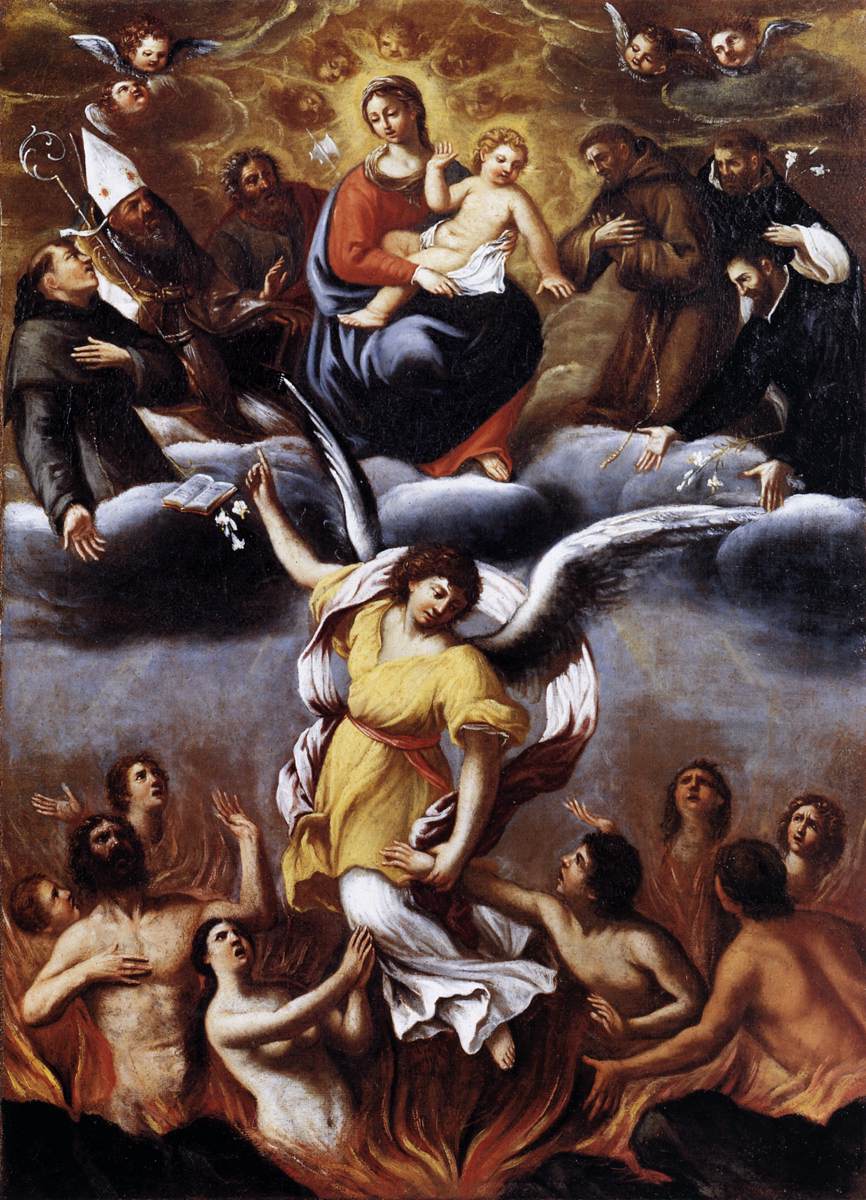
Purgatory itself will last until the last judgment. [436] "And these shall go into everlasting punishment, but the just into life everlasting." [437] Purgatory will then be no longer. The last of the elect will find, before dying, sufficient purification. "There will arise false Christs and false prophets, and they will perform great prodigies, even so as to deceive, if possible, even the elect." [438] A little before this text we read: "Unless those days had been shortened, no flesh should be saved, but for the sake of the elect those days shall be shortened." [439] The end of the world will come when the number of the elect is complete. Then purgatory will have an end.

But if the question regards the duration of purgatory for a particular soul, we can but answer that the punishment will be longer and more intense according to the expiation required. [440] Suffering corresponds to guilt, and its duration corresponds to the rootedness of sin. Thus one soul may suffer long, but with less affliction than another, whose more intense affliction brings earlier deliverance.

Let us illustrate by an analogy. Punishment on earth, say scourging, may be severe and brief, whereas imprisonment may be long and less severe. In the spiritual order, too, penance for a grave sin may be brief and severe, while for faults less grave but more deeply rooted, it may be long and mild.

Dominic Soto [441] and Maldonatus say that purgatory is so severe, and the suffrages of the Church so efficacious, that no soul remains there more than ten or twenty years. Theologians, all but unanimously, reject this view. Souls converted at the last moment, after a life of grave disorder, remain in purgatory much longer than ten or twenty years. Theological opinion, in general, favors long duration of purgatorial purification. [442] Private revelations mention three or four centuries, or even more, especially for those who have had high office and great responsibility.


I pray for souls in purgatory and have asked Mary to use the prayers to free those in purgatory longest. Years ago, I had the sense that one soul for whom I was praying had been in purgatory since the 1500s.

Garrigou-Lagrange explains purgatorial time as "discontinuous"  not solar, time.

To escape false imagining, let us again recall that purgatory is not measured by solar time, but by eviternity and discontinuous time. Discontinuous time, we have seen is composed of successive spiritual instants, and each of these instants may correspond to ten, twenty, thirty, sixty hours of our solar time, just as a person can remain thirty hours in ecstasy absorbed by one sole thought. Hence there is no proportion between our solar time and the discontinuous time of purgatory. But if it be revealed that a soul has been delivered from purgatory at a definite instant of our time, it means that this instant corresponds to the spiritual instant of its deliverance.

The closest events I have experienced as discontinuous time were both times of sorrow.  I went through three weeks of intense grief in 1995. I was so taken up in grief, that not only did I lose 40 pounds through stress and not eating, but I had no concept of time. I had to force myself to go through the needed actions of the days, as I had a seven year old boy.

Time was eaten up by an out-of-time experience of severe grief.

Again, in 2011, when I had a brief experience of my particular judgment, I was out of time. My guess is that this grief of realizing how one sin offends Almighty God lasted two and a half-hours, but it did not seem that long. In both of these instances, my experience was of  a "perpetual present".

Here is Garrigou-Lagrange on discontinuous time and "eviternity".

We must distinguish three kinds of duration: time, eternity, and an intermediate kind of duration, which is called eviternity.

On earth our duration is measured by continuous time, which is itself the measure of continuous movement, especially of the apparent movement of the sun. It is thus that we distinguish hours, days, years, and centuries. When the soul is separated from the body and is not yet beatified, it has a double kind of duration: eviternity and discontinuous time. Eviternity measures what is immutable in angels and separated souls. It is the measure of their substance, of their natural knowledge of self and God. Eviternity excludes succession. It is a perpetual present. Yet it differs from eternity, because it has had a beginning, and because it is united to discontinuous time which presupposes past and future.


To understand this, one must forget about continuous time.

Discontinuous time, then, is opposed to continuous or solar time. It is found in angels and separated souls, as the measure of successive thoughts and affections. One thought lasts for one spiritual instant. The following thought has its own spiritual instant. To illustrate: here on earth a person in ecstasy can remain two solar hours, or many hours, in one sole thought which represents to it one sole spiritual instant. Similarly, history characterizes different centuries, for example, the thirteenth or the seventeenth, by the ideas which predominate in each of these centuries. Thus we speak of the century of St. Louis, of the century of Louis XIV. Hence a spiritual instant, in the lives of angels and separated souls, can last many days, even many years, measured by our solar time, just as a person in ecstasy can remain thirty successive hours absorbed in one single thought.

Not being a person who is holy enough to experience what St. Teresa of Avila did in her Unitive State, ecstasies outside of time, I have not experienced the one single thought moment except in the two events above. Now, the souls in heaven experience time in a different manner than those in purgatory. All is in the Present Moment.

In beatified souls there is added to this double duration (eviternity and discontinuous time) also that of participated eternity, which measures their beatific vision of the divine essence and the love which results from this vision. This is one unique instant, an immovable eternity, entirely without succession. Yet this participated eternity differs from that of essential eternity which is proper to God, just as effect differs from cause. Participated eternity had a beginning. Further, the essential eternity of God measures everything that is in God, His essence, and all His operations, whereas participated eternity measures only the beatific vision and the love which follows. Eternity is like the invisible point at the summit of a cone, whereas continuous time is pictured by the base of this cone. Eviternity and discontinuous time are between these two, the one like a circular conic section, and the other like a polygon inscribed in this circular section.

So, time in purgatory is not like time in heaven. It has a beginning and an end. One is aware of purgation, and the goal, heaven. Eviternity is the status of time in purgatory. But, one's entire being is fixed on God. 

Continuous time flows without cessation. Its present flows continually from past to future. Our present life involves a succession of hours, in work, prayer, sleep. Eternity, on the contrary, is a continual present, without past or future, a unique instant of life which is possessed entirely and simultaneously. Eviternity approaches eternity. It permits us to conceive better the immutability of the life of the separated soul, not beatified, or not yet beatified: the immutability of knowledge which it has of itself, the immutability of the will fixed on its last end, good or evil.


When we pray and go into silence, learning to live in the Present Moment of God on earth, we are beginning to experience the eternity of God as we shall in heaven. This is the vertical movement of the soul within the horizontal time of work, sleep, eating and so on.

I learned this over the years by immersing myself in the Benedictine way. A monastic day allows one to concentrate on the vertical while being in the horizontal.

So, today, as usual, I got up, got dressed, made my bed, threw some clothes in the washing machine, went up to the chapel and said Lauds and a few other Third Order Prayers, as well a some intercessory prayers. Then, I came downstairs to eat breakfast, clean bathrooms, and so on. I say prayers at noon and at three...etc. making the day both horizontal and vertical, entering into the Benedictine way of being in silence as much as possible, (yesterday, I had to show the house to several people, which meant the schedule was out of kilter and I had to talk more than usual), returning to vertical time when I could. This is the discipline of the monastic day...work and prayer become one in silence, so that one learns to be in the Present Moment of God even while cleaning bathrooms. Prayer continues over into work if one is in silence.

Let us recall here the words of St. Augustine: "Unite thyself to the eternity of God, and thou thyself wilt be eternal. Unite thyself to the eternity of God. Watch with Him the events which come to pass below you." [182] Let us watch the successive moments of our terrestrial life, not only along the horizontal line of time which runs between the past and the future, but also on the vertical line which binds them at each instant to immovable eternity. Thus our acts will be more and more meritorious, more and more filled with love of God, and thus will pass from time into eternity, where they remain forever written in the book of life.

These different kinds of time, on earth, in purgatory, and in heaven, permit us to distinguish also in the present life two kinds of time: one corporeal, one spiritual. Corporeal time, solar time, measures the duration of our organism. Thus measured, one is eighty years of age, an old man; but, measured by spiritual time, his soul may remain very young. Thus, as we distinguish three ages of corporeal life, infancy, adult age, and old age, so in the life of the soul, we distinguish three ages, namely, the purgative life of beginners, the illuminative life of those who are progressing, the unitive way of those who are perfect.

EXACTLY! This purgation can last years-for Mother Teresa of Calcutta, fifty years...for John of the Cross only about ninety days.....

Perseverance is key...Purgation on earth and purgatory are "medicinal" punishments, states Aquinas--back to G-L:

This spiritual kind of time may explain salvation in unexpected quarters. Some great act, never retracted, has borne fruit.

I knew a young Jew, the son of an Austrian banker, in Vienna. He had decided on a lawsuit against the greatest adversary of his family, a lawsuit that would have enriched him. He suddenly recalled this word of the Pater Noster, which he had sometimes heard: "Forgive us our trespasses as we forgive those who trespass against us." He said to himself: "How would it be if, instead of carrying on this lawsuit, I would pardon him?" He followed the inspiration, forgave completely, renounced the lawsuit. At that same moment he received the full gift of faith. This one word of the Our Father became his pathway up the mountain of life. He became a priest, a Dominican, and died at the age of fifty years. Though nothing particularly important appeared in the remainder of his life, his soul remained at the height where it had been elevated at the moment of his conversion. Step by step he mounted to the eternal youth which is the life of heaven. The moral runs thus: One great act of self-sacrifice may decide not only our whole spiritual life on earth but also our eternity. We judge a chain of mountains by its highest peak.

I know of two moments which changed my life because of a decision based on Scripture. The first was losing all my six years of work on a doctorate because I had to be a whistleblower for a teacher doing evil and I was blackballed by his friends, including my dissertation advisor. Choosing truth over comfort became the way back to complete awareness of truth, increasing discernment and clarity of mind as well as of the soul.

The second was giving my son to God willingly and freely, allowing him to follow Christ in his vocation and me to suffer detachment, which taught me about relying on Divine Providence and living in humility. I had to do this act of the will of detachment again recently regarding living in England, my true home. I have given this up, trusting that God will find a way, if it is His Will. So, I live in the Present Moment again, following self-denial in order to find God within.

These types of decisions, in real time, take us out of time and place us in the Present Moment. The more we do this daily, the more the Present Moment becomes a way of life. If one is practicing the Present Moment of living in God, one understands these passages of Garrigou-Lagrange more clearly.

Back to purgatorial time....

After long discussions and wide historical researches on this particular point, it seems wise to conclude with St. Robert Bellarmine and Suarez as follows: "Although the existence of fire in purgatory is less certain than that of fire in hell, the doctrine which admits a real fire in purgatory must be classified as a sententia probabilissima. Hence the contrary opinion is improbable." [424] 

Both the last two popes before Francis stated that purgatory is not a place. However, we cannot deny a fire-like purgation. These statements were confusing to some and seem to contradict the long teaching of purgatorial fire, as well as visions of purgatory. Basically, one experiences fire either outside of us or inside, like a terrible purging of the mind, imagination, and will, which is like unto real fire.

Aquinas states this about place. "Incorporeal things are not in place after a manner known and familiar to us, in which way we say that bodies are properly in place; but they are in place after a manner befitting spiritual substances, a manner that cannot be fully manifest to us." [St. Thomas Aquinas, Summa Theologiae, Supplement, Q69, a1, reply 1]

Back to G-L:

This view rests on seven reasons: first, the consent of scholastic theologians. Second, the authority of St. Gregory the Great. [425] Third, the authority of St. Augustine. [426] Fourth, the concordant testimonies of St. Cyprian, St. Basil, St. Caesarius, of the liturgy, which begs refreshment for these souls. Fifth, the unanimous decision of the Latin fathers at the Council of Florence. Sixth, the very probable foundation found in First Corinthians. [427] Seventh, particular revelations, for example, those of St. Catherine of Ricci. She suffered forty days to deliver a soul from purgatory. A novice, touching her hand, said: "But, my mother, you are burning." "Yes, my daughter," she replied, "this fire is not seen, but it consumes like a burning fever."


Real fire is a possibility for purgatory, but interior fire is a certainty.

How can fire cause suffering in souls separated from their bodies? As we said above, [428] fire is an instrument of justice, as baptismal water is an instrument of grace. A soul which has refused the instruments of mercy must suffer from the instruments of justice.

I have been in terrible fevers, especially during the swine flu epidemic in America in the 1970s. When one is in delirium, as I was, one has a very high fever and one feels "out of time."

One cannot be "with" those in the room, or house. One is isolated in pain and suffering. Purgatory is like this, only much, much worse, because one has seen God and lost Him again. Only the perfect see God. All sins and tendencies toward sin must be purged from the person. 

The mode of this action remains mysterious. This fire has the power to bind the soul, [429] that is, to hinder it from acting as it would and where it would. It inflicts on the soul the humiliation of depending on a material creature. An analogy is seen in paralyzed persons who cannot act as they would.

More information may be found here-- Council of Florence, Decretum pro Graecis:  DS 1304; Council of Trent, Decretum de iustificatione:  DS 1580; Decretum de purgatorio: DS 1820). Look at this website for more. http://www.papalencyclicals.net/Councils/index.htm

to be continued....


Monday, 6 April 2015

Indwelling Part Two

St. Augustine writes this small paragraph on the Trinity, as a description. It is not my intent to concentrate on the nature of the Trinity, but the fact that the Trinity dwells within the baptized who are not in mortal sin. From On The Trinity, Book XV:

Let us, then, now seek the Trinity which is God, in the things themselves that are eternal, incorporeal, and unchangeable; in the perfect contemplation of which a blessed life is promised us, which cannot be other than eternal. For not only does the authority of the divine books declare that God is; but the whole nature of the universe itself which surrounds us, and to which we also belong, proclaims that it has a most excellent Creator, who has given to us a mind and natural reason, whereby to see that things living are to be preferred to things that are not living; things that have sense to things that have not; things that have understanding to things that have not; things immortal to things mortal; things powerful to things impotent; things righteous to things unrighteous; things beautiful to things deformed; things good to things evil; things incorruptible to things corruptible; things unchangeable to things changeable; things invisible to things visible; things incorporeal to things corporeal; things blessed to things miserable. And hence, since without doubt we place the Creator above things created, we must needs confess that the Creator both lives in the highest sense, and perceives and understands all things, and that He cannot die, or suffer decay, or be changed; and that He is not a body, but a spirit, of all the most powerful, most righteous, most beautiful, most good, most blessed.

What prevents the baptized from realizing the Indwelling of the Trinity? St. Augustine indicates that our weak minds can hardly understand the Scriptural references to the Trinity, much less us seeing the Trinity in nature? So, how can one realize the Indwelling and what are the barriers?


A person's understanding is based on knowledge, the imagination and memory. Here, notes St. Augustine, we are limited. Both wisdom and love give us hints as to the Presence of God. Chapter 8 in Book XV presents us with part of the solution.

know that wisdom is an incorporeal substance, and that it is the light by which those things are seen that are not seen by carnal eyes; and yet a man so great and so spiritual [as Paul] says, We see now through a glass, in an enigma, but then face to face. If we ask what and of what sort is this glass, this assuredly occurs to our minds, that in a glass nothing is discerned but an image. We have endeavored, then, so to do; in order that we might see in some way or other by this image which we are, Him by whom we are made, as by a glass. And this is intimated also in the words of the same apostleBut we with open face, beholding as in a glass the glory of the Lord, are transformed into the same image, from glory to glory, even as by the Spirit of the Lord.Beholding as in a glass, he has said, i.e. seeing by means of a glass, not looking from a watchtower: an ambiguity that does not exist in the Greek language, whence the apostolic epistles have been rendered into Latin. For in Greek, a glass, in which the images of things are visible, is wholly distinct in the sound of the word also from a watchtower, from the height of which we command a more distant view. And it is quite plain that the apostle, in using the word speculantes in respect to the glory of the Lord, meant it to come from speculum,not from specula. But where he says, We are transformed into the same image, he assuredly means to speak of the image of God; and by calling it the same, he means that very image which we see in the glass, because that same image is also the glory of the Lord; as he says elsewhere, For a man indeed ought not to cover his head, forasmuch as he is the image and glory of God, — a text already discussed in the twelfth book. He means, then, by We are transformed, that we are changed from one form to another, and that we pass from a form that is obscure to a form that is bright: since the obscure form, too, is the image of God; and if an image, then assuredly also glory, in which we are created as men, being better than the other animals. For it is said of human nature in itself, The man ought not to cover his head, because he is the image and glory of God. And this nature, being the most excellent among things created, is transformed from a form that is defaced into a form that is beautiful, when it is justified by its own Creator from ungodliness. Since even in ungodliness itself, the more the faultiness is to be condemned, the more certainly is the nature to be praised. And therefore he has added, from glory to glory: from the glory of creation to the glory of justification. Although these words, from glory to glory, may be understood also in other ways—from the glory of faith to the glory of sight, from the glory whereby we are sons of God to the glory whereby we shall be like Him, because we shall see Him as He is. But in that he has added as from the Spirit of the Lord, he declares that the blessing of so desirable a transformation is conferred upon us by the grace of God.

Here one perceives that as each baptized person is transformed into the image of God more and more by grace, then one begins to understand something of the Indwelling of the Trinity.

As one is changed into a new person through baptism, the life of the virtues, purgation and purification, one begins to enter into that Illuminative state where one begins, ever so slightly, to sense the Indwelling of the Trinity.


St. Teresa of Avila writes this: "The best place to find God is within yourself." And, again, "To talk to God, all we have to do is to close our eyes and look at Him present within us."

And, yet again: "However softly we speak, God will hear us. We need no wings to go in search of Him: He is within."

One must be in sanctifying grace to find God within.

This awareness comes from grace and purity of heart. St. Teresa went through the Dark Night, into Illumination and finally Union. Her words show us that the way to God is prayer, first of all, But, this disposition assumes that one is in grace, living in the sacramental life of the Church. Grace illuminates the mind and the heart-the wisdom and love mentioned by St. Augustine.

But, so few people sense the Presence of the Trinity, even after moving away from mortal sin. St. Augustine states that we have to be healed of our infirmities-of our limitation owing to our own sinful natures.

Here we are back to Garrigou-Lagrange's graph on the predominant fault list. One cannot get away from attacking this fault, as it blocks illumination and union with God. What blocks us from sensing the Indwelling of the Trinity in us can be simply stated as venial sins and the presence of the predominant fault.

Garrigou-Lagrange wrote a prayer for us to say, pleading with God to help us overcome, destroy, this fault which stops us from realizing that God dwells within us. Here is his prayer to overcome the predominant or predominate fault. One must choose suffering, however. How can we refuse God this grace? Too many people say they will wait until purgatory to be rid of imperfections and tendencies towards sin. But, not to seek holiness now weakens the Church, and earns one a lesser place in heaven than what God intended. He wants us to become saints, now.

Lord, make me know the obstacles I more or less consciously place in the way of the working of Thy grace in me. Then give me the strength to rid myself of them, and, if I am negligent in doing so, do Thou deign to free me from them, though I should suffer greatly.

Lord, show me the principal obstacle to my sanctification, the one that hinders me from profiting by graces and also by the exterior difficulties that would work to the good of my soul if I had greater recourse to Thee when they arise.

"Lord, here burn, here cut, and dry up in me all that hinders me from going to Thee, that Thou mayest spare me in eternity." St. Louis Bertrand

"Lord, take from me everything that hinders me from going to Thee. Give me all that will lead me to Thee. Take me from myself and give me to Thyself." St. Nicholas of Flue

Wednesday, 25 March 2015

Sin 101


I have listed points for Sin 101, because weekly I hear confusion about sin. Here are a few review points.

One: If one is in mortal sin when one dies, one goes to hell. This state would be one in which the person knew the action or thought was seriously sinful, and did it anyway.

Two: If one has apostastised and left the Church, being a "fallen away Catholic", one is living in mortal sin. The word apostasy is from aphístÄ“mi, meaning, I withdraw,  I revolt”. Once a Catholic, always a Catholic.

For a Catholic to willingly leave the Church is a serious error in judgment. One cuts one's self away from the sacraments, especially Confession and the Eucharist.

Three: Apropos One, there is no repenting after death, no choice after death. One's choices are made in this life. The next life is for punishment, purification or reward; that is, hell, purgatory, or heaven.

Four: One must willingly repent or choose to come back to the Church, or join the Church as a convert, before death. I know this sounds basic, but I hear almost weekly people saying after an apostate has died "Oh, he was a good man, and God will have mercy on him for his good works". No merit is gained when one is in mortal sin and leaving the Church is a mortal sin.

Five: We must pray daily for those who are in mortal sin, and when we have the chance, instruct them as to the state of their souls. We must speak to those who are open, and pray for those who are closed.

Six, Very few people die and go straight to heaven. Those who do are "saints". The souls in purgatory are not saints--they are the Church Suffering, not the Church Triumphant. And, they cannot merit anything. This means, contrary to some simplistic ideas I have heard both in the States and in England, the souls in purgatory cannot intercede or pray for us. People in purgatory are not saints. Saints are those in heaven.

Seven: There is no middle ground concerning grace. One is either in sanctifying grace or not. One is either in mortal sin, deadly sin, or not. 

Eight: Sin blocks the use of the virtues. Even venial sin blocks the flowering of the virtues. As Father Chad Ripperger and other good priests note, we all are called to not sin even venially. Venial sins weaken the Church and our relationship with God

Nine: The sacrament of confession is the only way to be absolved of mortal sin. The Eucharist takes away venial sin, but the graces of Confession should be sought for venial sins as well, as the grace of that sacrament helps us break away from venial sin and the tendency to sin.

Ten: If we have been told something is sinful by someone in authority and we still pursue this action or thought, we are responsible for that sin.

Eleven: One is automatically excommunicated as a lay person if one, has an abortion; physically attacks the pope; apostasy; schism; descration of the Eucharist, Body or Blood. One cannot return to full communion in the Church without first going to Confession and having the excommunication lifted. Priests need special faculties to remove excommunications and these are written out in their faculties. Not all priests have these faculties.

Twelve: The saints and some good priests remind us that purgatory is very, very painful. Ask to be purified here and now. You will do more good for the Church in that state of being free from egotism.