Recent Posts

Showing posts with label Incarnation. Show all posts

Sunday, 12 April 2015

Musings on Mercy and The Incarnation


Some Catholics are confused about the coming of Christ into the world and the fall of Lucifer. For clarification, one can look at the early commentators and Doctors of the Church. Some commentators on the Scriptures have indicated that Lucifer foresaw the creation of Mary, the Immaculate Conception, and hated the thought of a human woman being so perfect, that he rebelled in his arrogance.

St. Bernard of Clairvaux indicates that Lucifer saw the Incarnation, that Christ, the Second Person of the Blessed Trinity would become Man, and rebelled, again, out of disgust that God Himself would take on humanity.

The Lord, as St. Bernard notes, descended not merely to earth, but to hell, in the Harrowing of Hell, in order to free all those who died before His Salvific Action of the Passion. Only a few were spared hell, Elijah, Moses, and Enoch. Some modern lay persons have suggested that St. Joseph did not have to endure hell, but there is no Scriptural, nor ancient tradition of this, and in my mind, it must be ignored as fantasy.

God decided who endured this first limbo, or part of hell.

If Adam had not sinned, would Christ have come? Some theologians, such as Blessed Duns Scotus, states yes, and here is part of his various writings on this point found here.


“If man had not sinned, there would have been no need for our redemption.  But that God predestined this soul [of Christ] to so great a glory does not seem to be only on account of that [redemption], since the redemption or the glory of the soul to be redeemed is not comparable to the glory of Christ’s soul.  Neither is it likely that the highest good in creation is something that was merely occasioned only because of some lesser good; nor is it likely that He predestined Adam to such good before He predestined Christ; and yet this would follow [were the Incarnation occasioned by Adam’s sin].  In fact, if the predestination of Christ’s soul was for the sole purpose of redeeming others, something even more absurd would follow, namely, that in predestining Adam to glory, He would have foreseen him as having fallen into sin before He predestined Christ to glory.
“It can be said, therefore, that with a priority of nature God chose for His heavenly court all the angels and men He wished to have with their various degrees of perfection before He foresaw either sin or the punishment for sinners; and no one has been predestined only because somebody else’s sin was foreseen, lest anyone have reason to rejoice over the fall of another.”[1]
and...
“I say that the Incarnation of Christ was not foreseen as something occasioned [by sin], but that it was foreseen by God from all eternity and as a good more immediately proximate to the end…  Hence this is the order followed in God’s prevision. First, God understood Himself as the highest good.  In the second instant[2] He understood all creatures.  In the third He predestined some to glory and grace, and concerning some He had a negative act by not predestining.[3]  In the fourth, He foresaw that all these would fall in Adam.  In the fifth He preordained and foresaw the remedy—how they would be redeemed through the Passion of His Son, so that, like all the elect, Christ in the flesh was foreseen and predestined to grace and glory before Christ’s Passion was foreseen as a medicine against the fall, just as a physician wills the health of a man before he wills the medicine to cure him.”[4]
St. Francis de Sales notes this about the Incarnation, that God meant to join with man for love:
Now of all the creatures which that sovereign omnipotence could produce, he thought good to make choice of the same humanity which afterwards in effect was united to the person of God the Son; to which he destined that incomparable honour of personal union with his divine Majesty, to the end that for all eternity it might enjoy by excellence the treasures of his infinite glory. Then having selected for this happiness the sacred humanity of our Saviour, the supreme providence decreed not to restrain his goodness to the only person of his well-beloved Son, but for his sake to pour it out upon divers other creatures, and out of the mass of that innumerable quantity of things which he could produce, he chose to create men and angels to accompany his Son, participate in his graces and glory, adore and praise him for ever. And inasmuch as he saw that he could in various manners form the humanity of this Son, while making him true man, as for example by creating him out of nothing, not only in regard of the soul but also in regard of the body; or again by forming the body of some previously existing matter as he did that of Adam and Eve, or by way of ordinary human birth, or finally by extraordinary birth from a woman without man, he determined that the work should be effected by the last way, and of all the women he might have chosen to this end he made choice of the most holy virgin Our Lady, through whom the Saviour of our souls should not only be man, but a child of the human race.
So, it is possible, especially seeing the Fall of Lucifer, that Christ would have come to earth Incarnated.
He also clearly foresaw that the first man would abuse his liberty and forsaking grace would lose glory, yet would he not treat human nature so rigorously as he determined to treat the angelic. It was human nature of which he had determined to take a blessed portion to unite it to his divinity. He saw that it was a feeble nature, a wind which goeth and returneth not,57 that is, which is dissipated as it goes. He had regard to the surprise by which the malign and perverse Satan had taken the first man, and to the greatness of the temptation which ruined him. He saw that all the race of men was perishing by the fault of one only, so that for these reasons he beheld our nature with the eye of pity and resolved to admit it to his mercy. But in order that the sweetness of his mercy might be adorned with the beauty of his justice, he determined to save man by way of a rigorous redemption. And as this could not properly be done but by his Son, he settled that he should redeem man not only by one of his amorous actions, which would have been perfectly sufficient to ransom a million million of worlds: but also by all the innumerable amorous actions and dolorous passions which he 76 would perform or suffer till death, and the death of the cross, to which he destined him. He willed that thus he should make himself the companion of our miseries to make us afterwards companions of his glory, showing thereby the riches of his goodness, by this copious, abundant, superabundant, magnificent and excessive redemption, which has gained for us, and as it were reconquered for us, all the means necessary to attain glory, so that no man can ever complain as though the divine mercy were wanting to anyone.
It is interesting to note, as an aside, that St. Francis indicates that like St. John the Baptist, who was freed from Original Sin in the womb and born free of it, so too was Jeremiah. But, enough for now on the mystery of the Incarnation.


Sunday, 4 January 2015

We Are Not Equal Part Six


One of the readings in today's Divine Office is from Maximus the Confessor. One small paragraph contains the kernel of truth reiterated in the readings of the Mass.

 For surely the word of the Law and the Prophets when it is understood with faith is like a star which leads those who are called by the power of grace in accordance with his decree to recognise the Word incarnate.

The great teacher, Maximus, shows us that "those who are called by the power of grace" are given power in grace to respond to God's Will. These who are called and given power "in accordance with is decree", that is, according to God's Will, recognize Christ as the Savior, as the Incarnated Second Person of the Blessed Trinity. Those in the Synod who want to change Church teaching need to read Maximus today, as they must as priests, and ponder their own position.

The heresies I pointed out three days ago are here anticipated by Maximus--sin is not natural, which is against the Semi-Pelagians, as is the last statement, referring to man's pre-Original Sin nature.

Do the synodal fathers hear what they read today? Do they reflect on sin, grace, human nature and the call to holiness, which is possible in Christ, but not outside of Christ?

Here is the reason why God became a perfect man, changing nothing of human nature, except to take away sin (which was never natural anyway). His flesh was set before that voracious, gaping dragon as bait to provoke him: flesh that would be deadly for the dragon, for it would utterly destroy him by the power of the Godhead hidden within it. For human nature, however, his flesh was to be a remedy since the power of the Godhead in it would restore human nature to its original grace.


Sunday, 21 December 2014

On Today's Readings part three


Mary is called "highly favored" in some translations by the Archangel Gabriel, the messenger. In the Judaic tradition, Gabriel is not only the messenger of God, but the destroying angel at the Passover in Egypt.

That Gabriel, who caused, in God's will, the last plague, which led directly to the freeing of the Hebrews from slavery, is the angel who tells Mary she will be the Mother of the Messiah, the Son of God, seems to be a happy non-chance.

I do not see in my imagination a soft, cuddling, feminine image of Gabriel. I see strength, a spirit of power and grace. Gabriel bursts into history again, as he did in the Old Testament.


He who paved the way for Moses to lead the people to freedom comes to announce to Mary that she leads us to freedom through her Son, Jesus Christ.

Mary is highly favored, she is blessed. She, alone of all humans, from conception, is full of grace. Gabriel knows this. He would not only be full of love, but awe at the call of this woman. Mary, as the Theotokos, the God-Bearer, now becomes Queen of all angels.

Her call reminds us of the long salvation history of the Old Testament. Gabriel comes to this lowly Hebrew young woman, explains God's will for her life, and waits for her answer. He who destroyed the first born of the Egyptians, brings news of the First Born of all creation, the Incarnate One, the Son of God, prefigured in Moses. Christ is the Savior, the real freedom fighter of all mankind. Gabriel waits.

Fiat voluntas Dei.

Gabriel returns to God and history is never the same. God enters the world through the womb of a young daughter of the Jewish people. All history points to this moment and all history moves away from this moment. Human life would never be the same again. Praise God!


Friday, 5 September 2014

Yearly Rant Part Two

Realizing that Jesus did not wear trousers and Mary did not wear skirts, I am writing about our culture in the last 200 years with regard to dress. I think that the dress culture of Christ's day did change with Christianity and it would be interesting to follow those changes. One can say for sure that civilizations which were not Christianized until late did not see women moving into dresses until the 18th centuries or so.

Also, sems and priests wear cassocks, which is not a sign of transvestite dressing, but an older tradition,  most likely coming from the fact that most priests for centuries were not secular, but in orders, such as Benedictines, Dominicans, Franciscan and so on.

I am writing for women in 2014, for the sake of role-modeling for little girls and for the necessity of avoiding the lies of society regarding "gender identity" issues.

Women who get angry when I write or talk about modesty have a problem. This is like the group which gets really angry when I write or speak about Harry Potter. If there was not a deep-seated knowledge that things are wrong in one's pursuit of dress or entertainment, why get so angry?

A few more points on women's clothing regarding the evil of androgyny.

The Cultural Marxists and the Frankfort School of Marxism pushed androgyny. The writings of Antonio Gramsci (many posts on his on this blog) included these two phrases.

“I saw the revolutionary destruction of society as the one and only solution to the cultural contradictions of the epoch.” 

“Such a worldwide overturning of values cannot take place without the annihilation of the old values and the creation of new ones by the revolutionaries.”

Part of the cultural changes he endeavored to start were the destruction of marriage, the family unit, and the introduction of the acceptance of homosexuality, androgyny and contraception.


The Marxist succeeded in changing the West culturally, as did other "isms" such as radical feminism from Marie Stopes and Margaret Sanger.

You can sit and read my many posts on Gramsci, if you have not done so.

But, you may ask, why is androgyny "evil"? Why is this an issue now, in 2014?

A few very basic points:

God created man and woman separately for various reasons. The main reason is that the woman "compliments" the man in her differences. If married, as Eve was to Adam, she is to be the "helpmate".  Many women have rebelled against this helpmate ideal and do not want to help their husbands in their jobs, role as leader and priest in the domestic church, and even in intimacy.

The soul forms the body, not the other way around, and our souls, therefore, are not separate from our being a man or a woman, although these souls do not have gender. In other words, my soul, which is manifested through my femaleness, is that of a woman, and I come to God through that reality. We are not dualistic beings.  We are unified, body and soul. We are not just bodies, but souls, and when the soul leaves the body, we die, we can no longer function as a union of spirit and matter. Only when our bodies are Resurrected on the Last Day, will we be joined again in that unity, which is separated in death. And, we shall get back our renewed bodies, with gender. Mary is our guide in this. She is in heaven body and soul, and recognizable even here on earth.

Our souls work in a way not like those of the angels, who have no gender because they have no bodies. We are created as a man or a  woman and that creation is our identity. Our bodies determine our gender, and our roles, but we cannot separate the two . "Man and woman He created them". We are not angels, we are not genderless or sexless.

Here are a few quotations from the Catholic Encyclopedia to help with this.

 The soul may be defined as the ultimate internal principle by which we think, feel, and will, and by which our bodies are animated.

And... all our souls are unique, as are our bodies....We are created from the moment of conception male or female. Our souls and bodies are created together.
  • the rational soul, which is one with the sensitive and vegetative principle, is the form of the body. This was defined as of faith by the Council of Vienne of 1311;
  • the soul is a substance, but an incomplete substance, i.e. it has a natural aptitude and exigency for existence in the body, in conjunction with which it makes up the substantial unity of human nature;
  • though connaturally related to the body, it is itself absolutely simple, i.e. of an unextended and spiritual nature. It is not wholly immersed in matter, its higher operations being intrinsically independent of the organism;
  • the rational soul is produced by special creation at the moment when the organism is sufficiently developed to receive it. In the first stage of embryonic development, the vital principle has merely vegetative powers; then a sensitive soul comes into being, educed from the evolving potencies of the organism — later yet, this is replaced by the perfect rational soul, which is essentially immaterial and so postulates a special creative act. Many modern theologians have abandoned this last point of St. Thomas's teaching, and maintain that a fully rational soul is infused into the embryo at the first moment of its existence. (Our position now in the Church.)


Even God celebrates gender throughout the Bible and in the teachings of the Church. Christ's relationship with the Church and with the soul is that of the Bridegroom to the Bride, This fact is one reason why women who are feminine have an easier time coming to love God, as they can accept the female role of receiving.

But, the greatest saints, like St. Bernard and St. Augustine, allowed Christ to love them in the transcendent love which God pours into the soul. The Unitive State is one of receiving and being in Love.

This love is holy, is agape, is the complete sacrificial love of the Crucified One.


However, here is the real reason, the core of the evil of androgyny and why one can see this is from satan. Three connected points:

Androgyny denies the Incarnation.

Satan wants us to forget that Christ is both God AND Man, forever, in His Resurrected Body in heaven.

Androgyny also denies the Biblical account of Creation. Androgyny denies who we are as a person. I am unified in my femininity, body and soul.

Androgyny confuses the different roles of men and women, created by God.

The purposeful mixing up of the sense of identity makes people closed to the Incarnate God and to God the Father, and to the Spirit, Who was present at Creation.

Christ is fully Man and fully God. God the Father and God the Holy Spirit, as Spirits, do not have gender, but Christ, obviously, does.

He is not some odd transcendent, sexless, genderless being. That is the creed of some Gnostics and Neo-Gnostics.

In addition, through the Passion and Resurrection, we are made new. We are one nature, not two.

Christ redeemed humans on the Cross and redeemed nature. Gender differences are a great Good.

Man, though made of body and soul, is a unity. Through his very bodily condition he sums up in himself the elements of the material world. Through him they are thus brought to their highest perfection and can raise their voice in praise freely given to the Creator. For this reason man may not despise his bodily life. Rather he is obliged to regard his body as good and to hold it in honor since God has created it and will raise it up on the last day." Pastoral Constitution on the Church in the Modern World.


We were restored to grace in our bodies as well as our souls, through Christ's Redemptive Act.

Women who refuse absolutely refuse to dress like a woman in our society, to see the beauty of the feminine, are denying Christ's Redemption of the entire female person in our times and falling for the lies of androgyny. We women were made new, to rejoice in our femininity
as Catholic women and in the West, femininity is expressed through dress.

I am sorry, but I suspect something wrong about women who only wear men's clothes. It is unnatural and reflects not only a blind spot in the spirit, but perhaps severe sins, such as manipulation, rebellion, control.

Obviously, a woman may sin in these areas of emotional manipulation, rebellion and wanting control while wearing feminine clothing, but the constant expression of maleness can refer to a deeper problem.

Among my best friends, all wear dresses or skirts only.

Some change into trousers because of work around the house, but they only wear pants at home.

That is their decision. I wear skirts when washing windows on a ladder and when painting, or cleaning, or scrubbing floors.

Nuns manage to so all these things in long habits and so do I.

For a woman to deny her body as feminine is for her to deny her relationship with God as a woman.

If you are a woman and this article makes you angry, please stop and pray to Our Lady. Ask yourself this question: "Who am I?"


It is time to change, literally, your clothes.

I do not want to add to the misogyny I see on some other, even famous, Catholic blogs, but as a woman who learned to appreciate who I am before God and express myself through clothes, (even from the Good Will), I believe what I am writing needs to be addressed.

May I add that people have seen persons from heaven, hell and purgatory in visions or impressed upon the imagination. These people, without their bodies, are recognizable in their souls. The dead do not lose their gender-identity, as it were. If your great-grandmother is in heaven, she is there as a woman, not some odd transgendered soul. How do we recognize someone who is a man or a woman? Not merely by their bodies, but also, by their souls. We become holy through both our bodies and our souls. There is a mystery in this union.

More from the CCC.


PART ONE
THE PROFESSION OF FAITH

SECTION TWO
THE PROFESSION OF THE CHRISTIAN FAITH

CHAPTER ONE
I BELIEVE IN GOD THE FATHER

ARTICLE I
"I BELIEVE IN GOD THE FATHER ALMIGHTY, CREATOR OF HEAVEN AND EARTH"

Paragraph 6. Man
355 "God created man in his own image, in the image of God he created him, male and female he created them."218 Man occupies a unique place in creation: (I) he is "in the image of God"; (II) in his own nature he unites the spiritual and material worlds; (III) he is created "male and female"; (IV) God established him in his friendship.
I. "IN THE IMAGE OF GOD"
356 Of all visible creatures only man is "able to know and love his creator".219 He is "the only creature on earth that God has willed for its own sake",220 and he alone is called to share, by knowledge and love, in God's own life. It was for this end that he was created, and this is the fundamental reason for his dignity:

What made you establish man in so great a dignity? Certainly the incalculable love by which you have looked on your creature in yourself! You are taken with love for her; for by love indeed you created her, by love you have given her a being capable of tasting your eternal Good.221
357 Being in the image of God the human individual possesses the dignity of a person, who is not just something, but someone. He is capable of self-knowledge, of self-possession and of freely giving himself and entering into communion with other persons. And he is called by grace to a covenant with his Creator, to offer him a response of faith and love that no other creature can give in his stead.
358 God created everything for man,222 but man in turn was created to serve and love God and to offer all creation back to him:

What is it that is about to be created, that enjoys such honor? It is man that great and wonderful living creature, more precious in the eyes of God than all other creatures! For him the heavens and the earth, the sea and all the rest of creation exist. God attached so much importance to his salvation that he did not spare his own Son for the sake of man. Nor does he ever cease to work, trying every possible means, until he has raised man up to himself and made him sit at his right hand.223
359 "In reality it is only in the mystery of the Word made flesh that the mystery of man truly becomes clear."224
St. Paul tells us that the human race takes its origin from two men: Adam and Christ. . . The first man, Adam, he says, became a living soul, the last Adam a life-giving spirit. The first Adam was made by the last Adam, from whom he also received his soul, to give him life. . . The second Adam stamped his image on the first Adam when he created him. That is why he took on himself the role and the name of the first Adam, in order that he might not lose what he had made in his own image. The first Adam, the last Adam: the first had a beginning, the last knows no end. The last Adam is indeed the first; as he himself says: "I am the first and the last."225
360 Because of its common origin the human race forms a unity, for "from one ancestor [God] made all nations to inhabit the whole earth":226
O wondrous vision, which makes us contemplate the human race in the unity of its origin in God. . . in the unity of its nature, composed equally in all men of a material body and a spiritual soul; in the unity of its immediate end and its mission in the world; in the unity of its dwelling, the earth, whose benefits all men, by right of nature, may use to sustain and develop life; in the unity of its supernatural end: God himself, to whom all ought to tend; in the unity of the means for attaining this end;. . . in the unity of the redemption wrought by Christ for all.227
361 "This law of human solidarity and charity",228 without excluding the rich variety of persons, cultures and peoples, assures us that all men are truly brethren.

II. "BODY AND SOUL BUT TRULY ONE"
362 The human person, created in the image of God, is a being at once corporeal and spiritual. The biblical account expresses this reality in symbolic language when it affirms that "then the LORD God formed man of dust from the ground, and breathed into his nostrils the breath of life; and man became a living being."229 Man, whole and entire, is therefore willed by God.
363 In Sacred Scripture the term "soul" often refers to human life or the entire human person.230 But "soul" also refers to the innermost aspect of man, that which is of greatest value in him,231 that by which he is most especially in God's image: "soul" signifies the spiritual principle in man.
364 The human body shares in the dignity of "the image of God": it is a human body precisely because it is animated by a spiritual soul, and it is the whole human person that is intended to become, in the body of Christ, a temple of the Spirit:232
Man, though made of body and soul, is a unity. Through his very bodily condition he sums up in himself the elements of the material world. Through him they are thus brought to their highest perfection and can raise their voice in praise freely given to the Creator. For this reason man may not despise his bodily life. Rather he is obliged to regard his body as good and to hold it in honor since God has created it and will raise it up on the last day. 233
365 The unity of soul and body is so profound that one has to consider the soul to be the "form" of the body:234 i.e., it is because of its spiritual soul that the body made of matter becomes a living, human body; spirit and matter, in man, are not two natures united, but rather their union forms a single nature.
366 The Church teaches that every spiritual soul is created immediately by God - it is not "produced" by the parents - and also that it is immortal: it does not perish when it separates from the body at death, and it will be reunited with the body at the final Resurrection.235
367 Sometimes the soul is distinguished from the spirit: St. Paul for instance prays that God may sanctify his people "wholly", with "spirit and soul and body" kept sound and blameless at the Lord's coming.236 The Church teaches that this distinction does not introduce a duality into the soul.237 "Spirit" signifies that from creation man is ordered to a supernatural end and that his soul can gratuitously be raised beyond all it deserves to communion with God.238
368 The spiritual tradition of the Church also emphasizes the heart, in the biblical sense of the depths of one's being, where the person decides for or against God.239
 
* III. "MALE AND FEMALE HE CREATED THEM"
Equality and difference willed by God
369 Man and woman have been created, which is to say, willed by God: on the one hand, in perfect equality as human persons; on the other, in their respective beings as man and woman. "Being man" or "being woman" is a reality which is good and willed by God: man and woman possess an inalienable dignity which comes to them immediately from God their Creator.240 Man and woman are both with one and the same dignity "in the image of God". In their "being-man" and "being-woman", they reflect the Creator's wisdom and goodness.

370 In no way is God in man's image. He is neither man nor woman. God is pure spirit in which there is no place for the difference between the sexes. But the respective "perfections" of man and woman reflect something of the infinite perfection of God: those of a mother and those of a father and husband.241
"Each for the other" - "A unity in two"
371 God created man and woman together and willed each for the other. The Word of God gives us to understand this through various features of the sacred text. "It is not good that the man should be alone. I will make him a helper fit for him."242 None of the animals can be man's partner.243 The woman God "fashions" from the man's rib and brings to him elicits on the man's part a cry of wonder, an exclamation of love and communion: "This at last is bone of my bones and flesh of my flesh."244 Man discovers woman as another "I", sharing the same humanity.
372 Man and woman were made "for each other" - not that God left them half-made and incomplete: he created them to be a communion of persons, in which each can be "helpmate" to the other, for they are equal as persons ("bone of my bones. . .") and complementary as masculine and feminine. In marriage God unites them in such a way that, by forming "one flesh",245 they can transmit human life: "Be fruitful and multiply, and fill the earth."246 By transmitting human life to their descendants, man and woman as spouses and parents cooperate in a unique way in the Creator's work.247
373 In God's plan man and woman have the vocation of "subduing" the earth248 as stewards of God. This sovereignty is not to be an arbitrary and destructive domination. God calls man and woman, made in the image of the Creator "who loves everything that exists",249 to share in his providence toward other creatures; hence their responsibility for the world God has entrusted to them.

IV. MAN IN PARADISE
374 The first man was not only created good, but was also established in friendship with his Creator and in harmony with himself and with the creation around him, in a state that would be surpassed only by the glory of the new creation in Christ.
375 The Church, interpreting the symbolism of biblical language in an authentic way, in the light of the New Testament and Tradition, teaches that our first parents, Adam and Eve, were constituted in an original "state of holiness and justice".250 This grace of original holiness was "to share in. . .divine life".251
376 By the radiance of this grace all dimensions of man's life were confirmed. As long as he remained in the divine intimacy, man would not have to suffer or die.252 The inner harmony of the human person, the harmony between man and woman,253 and finally the harmony between the first couple and all creation, comprised the state called "original justice".
377 The "mastery" over the world that God offered man from the beginning was realized above all within man himself: mastery of self. The first man was unimpaired and ordered in his whole being because he was free from the triple concupiscence254 that subjugates him to the pleasures of the senses, covetousness for earthly goods, and self-assertion, contrary to the dictates of reason.
378 The sign of man's familiarity with God is that God places him in the garden.255 There he lives "to till it and keep it". Work is not yet a burden,256 but rather the collaboration of man and woman with God in perfecting the visible creation.
379 This entire harmony of original justice, foreseen for man in God's plan, will be lost by the sin of our first parents.
IN BRIEF
380 "Father,. . . you formed man in your own likeness and set him over the whole world to serve you, his creator, and to rule over all creatures" (Roman Missal, EP IV, 118).
381 Man is predestined to reproduce the image of God's Son made man, the "image of the invisible God" (Col 1:15), so that Christ shall be the first-born of a multitude of brothers and sisters (cf. Eph 1:3-6; Rom 8:29).
382 "Man, though made of body and soul, is a unity" (GS 14 § 1). The doctrine of the faith affirms that the spiritual and immortal soul is created immediately by God.
383 "God did not create man a solitary being. From the beginning, "male and female he created them" (Gen 1:27). This partnership of man and woman constitutes the first form of communion between persons" (GS 12 § 4).
384 Revelation makes known to us the state of original holiness and justice of man and woman before sin: from their friendship with God flowed the happiness of their existence in paradise.

218 Gen 1:27.
219 GS 12 § 3.
220 GS 24 § 3.
221 St. Catherine of Siena, Dialogue 4,13 "On Divine Providence": LH, Sunday, week 19, OR.
222 Cf. GS 12 § 1; 24 § 3; 39 § 1.
223 St. John Chrysostom, In Gen. Sermo 2,1: PG 54,587D-588A.
224 GS 22 § 1.
225 St. Peter Chrysologus, Sermo 117: PL 52,520-521.
226 Acts 17:26; cf. Tob 8:6.
227 Pius XII, Enc. Summi Pontificatus 3; cf. NA 1.
228 Pius XII, Summi Pontificatus 3.
229 Gen 2:7.
230 Cf. Mt 16:25-26; Jn 15:13; Acts 2:41.
231 Cf. Mt 10:28; 26:38; Jn 12:27; 2 Macc 6:30.
232 Cf. 1 Cor 6:19-20; 15:44-45.
233 GS 14 § 1; cf. Dan 3:57-80.
234 Cf. Council of Vienne (1312): DS 902.
235 Cf. Pius XII, Humani Generis: DS 3896; Paul VI, CPG § 8; Lateran Council V (1513): DS 1440.
236 1 Thess 5:23.
237 Cf. Council of Constantinople IV (870): DS 657.
238 Cf. Vatican Council I, Dei Filius: DS 3005; GS 22 § 5; Humani Generis: DS 3891.
239 Cf. Jer 31:33; Deut 6:5; 29:3; Isa 29:13; Ezek 36:26; Mt 6:21; Lk 8:15; Rom 5:5.
240 Cf. Gen 2:7,22.
241 Cf. Isa 49:14-15; 66:13; Ps 131:2-3; Hos 11:1-4; Jer 3:4-19.
242 Gen 2:18.
243 Gen 2:19-20.
244 Gen 2:23.
245 Gen 2:24.
246 Gen 1:28.
247 Cf. GS 50 § 1.
248 Gen 1:28.
249 Wis 11:24.
250 Cf. Council of Trent (1546): DS 1511.
251 Cf. LG 2.
252 Cf. Gen 2:17; 3:16,19.
253 Cf. Gen 2:25.
254 Cf. 1 Jn 2:16.
255 Cf. Gen 2:8.
256 Gen 2:15; cf. 3:17-19




Monday, 18 March 2013

DoC and Perfection: Athanasius: Part 91

What a joy it is to read the Doctors of the Church. The clarity of their writings clears the heart, head and mind of the cobwebs of confusion and deceit.

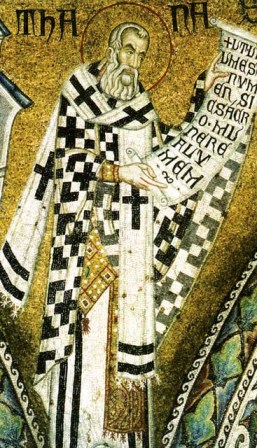
Athanasius is a genius. He is probably the most important Doctor of the ancient world. Without him, the Church could have crumbled under the weight of Arianism. It is said that 50% of the bishops were heretics when God raised up this amazing man to refute error and strengthen the Teaching Magisterium of the Church. His dates are 296-373. He was made an Archbishop at thirty years of age. 

I am in awe of all these men and women. I am in awe of how God raises up intellectual giants at the right time. The Church suffered great persecution at the time of Athanasius. He himself was imprisoned and exiled for a while. Even the great St. Nicholas was imprisoned for a short while. 

We need to remember this-that within the Church there are factions which want to destroy the Truth of Christ given to us in both Revelation, that is the Scriptures, and Tradition.


Here is a section from On the Incarnation by Athanasius. And, obviously, my comments are in blue. This section is connected to my them on perfection, as Athanasius clarifies the Indwelling of the Trinity for us, for all ages.

A man's personality actuates and quickens his whole body. If anyone said it was unsuitable for the man's power to be in the toe, he would be thought silly, because, while granting that a man penetrates and actuates the whole of his body, he denied his presence in the part. Similarly, no one who admits the presence of the Word of God in the universe as a whole should think it unsuitable for a single human body to be by Him actuated and enlightened.


So, immediately, we see that Athanasius is emphasizing the Presence of God in us as well as the fact of the Incarnation.

    But is it, perhaps, because humanity is a thing created and brought into being out of non-existence that they regard as unfitting the manifestation of the Savior in our nature? If so, it is high time that they spurned Him from creation too; for it, too, has been brought out of non-being into being by the Word. But if, on the other hand, although creation is a thing that has been made, it is not unsuitable for the Word to be present in it, then neither is it unsuitable for Him to be in man. Man is a part of the creation, as I said before; and the reasoning which applies to one applies to the other. All things derive from the Word their light and movement and life, as the Gentile authors themselves say, "In Him we live and move and have our being."[1] 

These words are so beautiful and comforting. We live and move and have our being in Christ, if we are in sanctifying grace.


Very well then. That being so, it is by no means unbecoming that the Word should dwell in man. So if, as we say, the Word has used that in which He is as the means of His self-manifestation, what is there ridiculous in that? He could not have used it had He not been present in it; but we have already admitted that He is present both in the whole and in the parts. What, then, is there incredible in His manifesting Himself through that in which He is? By His own power He enters completely into each and all, and orders them throughout ungrudgingly; and, had He so willed, He could have revealed Himself and His Father by means of sun or moon or sky or earth or fire or water. Had He done so, no one could rightly have accused Him of acting unbecomingly, for He sustains in one whole all things at once, being present and invisibly revealed not only in the whole, but also in each particular part. This being so, and since, moreover, He has willed to reveal Himself through men, who are part of the whole, there can be nothing ridiculous in His using a human body to manifest the truth and knowledge of the Father. 

Athanasius' style is easy to follow. His logic is impeccable  We see him moving from the Incarnation to the Redemption of Mankind through the Incarnation, Passion and Resurrection.

Does not the mind of man pervade his entire being, and yet find expression through one part only, namely the tongue? Does anybody say on that account that Mind has degraded itself? Of course not. Very well, then, no more is it degrading for the Word, Who pervades all things, to have appeared in a human body. For, as I said before, if it were unfitting for Him thus to indwell the part, it would be equally so for Him to exist within the whole.

Athanasius tells us that God did not think it degrading to become Man. Amazing.

    (43) Some may then ask, why did He not manifest Himself by means of other and nobler parts of creation, and use some nobler instrument, such as sun or moon or stars or fire or air, instead of mere man? The answer is this. The Lord did not come to make a display. He came to heal and to teach suffering men. For one who wanted to make a display the thing would have been just to appear and dazzle the beholders. But for Him Who came to heal and to teach the way was not merely to dwell here, but to put Himself at the disposal of those who needed Him, and to be manifested according as they could bear it, not vitiating the value of the Divine appearing by exceeding their capacity to receive it. 

How beautiful this is to read. Christ did not come to impress upon the world a greatness which would be overwhelming, but a Person Who would love and be loved. He made Himself understandable to us. He is "one of us".


    Moreover, nothing in creation had erred from the path of God's purpose for it, save only man. Sun, moon, heaven, stars, water, air, none of these had swerved from their order, but, knowing the Word as their Maker and their King, remained as they were made. Men alone having rejected what is good, have invented nothings instead of the truth, and have ascribed the honor due to God and the knowledge concerning Him to demons and men in the form of stones. Obviously the Divine goodness could not overlook so grave a matter as this. 

All creation, except the bad angels, and men, remained obedient to God. God could not ignore our disobedience.  God loves us so much that He pursues us even when we are in sin.

But men could not recognize Him as ordering and ruling creation as a whole. So what does He do? He takes to Himself for instrument a part of the whole, namely a human body, and enters into that. Thus He ensured that men should recognize Him in the part who could not do so in the whole, and that those who could not lift their eyes to His unseen power might recognize and behold Him in the likeness of themselves. For, being men, they would naturally learn to know His Father more quickly and directly by means of a body that corresponded to their own and by the Divine works done through it; for by comparing His works with their own they would judge His to be not human but Divine. 

And why is it that Christ wanted to teach us about God, about the Trinity? Because He wanted us to be like Him, as we were meant to be at the very beginning, before Original Sin.

Christ still calls us daily to this perfection-to be like Him.

And if, as they say, it were unsuitable for the Word to reveal Himself through bodily acts, it would be equally so for Him to do so through the works of the universe. His being in creation does not mean that He shares its nature; on the contrary, all created things partake of His power. Similarly, though He used the body as His instrument, He shared nothing of its defect,[2] but rather sanctified it by His indwelling. Does not even Plato, of whom the Greeks think so much, say that the Author of the Universe, seeing it storm-tossed and in danger of sinking into the state of dissolution, takes his seat at the helm of the Life-force of the universe, and comes to the rescue and puts everything right? What, then, is there incredible in our saying that, mankind having gone astray, the Word descended upon it and was manifest as man, so that by His intrinsic goodness and His steersmanship He might save it from the storm?

How important is this section. We see that the Son of God, the Second Person in the Blessed Trinity through His Goodness and His Leadership saves us, as does a pilot in a ship during a storm. These are comforting words for today. This ship imagery of the Church has come down to us through 2,000 plus years and is apropos today.


The Relics of St. Athanasius the Great, in the Church of S. Zaccaria, in Venice, Italy.

(44) It may be, however, that, though shamed into agreeing that this objection is void, the Greeks will want to raise another. They will say that, if God wanted to instruct and save mankind, He might have done so, not by His Word's assumption of a body, but, even as He at first created them, by the mere signification of His will. The reasonable reply to that is that the circumstances in the two cases are quite different. In the beginning, nothing as yet existed at all; all that was needed, therefore, in order to bring all things into being, was that His will to do so should be signified. But once man was in existence, and things that were, not things that were not, demanded to be healed, it followed as a matter of course that the Healer and Savior should align Himself with those things that existed already, in order to heal the existing evil. 

Modern people think that they have discovered "psychology". Here is the great Doctor of the 4th century writing of Healing-the healing of sin. Christ is the Healer, as well as the Savior  He heals our rebellion, our sin by entering into our lives. But, we must be open to this, and it is painful. We are all like Eustace in The Voyage of the Dawn Treader (I have not seen the movie). We are like dragons which must have our scales removed by Aslan, who is Christ in the books. This healing is the purgation in the steps of perfection.

For that reason, therefore, He was made man, and used the body as His human instrument. If this were not the fitting way, and He willed to use an instrument at all, how otherwise was the Word to come? And whence could He take His instrument, save from among those already in existence and needing His Godhead through One like themselves? It was not things non-existent that needed salvation, for which a bare creative word might have sufficed, but man—man already in existence and already in process of corruption and ruin. It was natural and right, therefore, for the Word to use a human instrument and by that means unfold Himself to all.

This is some of the best writing I have ever read on the need for Redemption and the great act of love, which is the suffering of Christ in the Passion and Death on the Cross.


    You must know, moreover, that the corruption which had set in was not external to the body but established within it. The need, therefore, was that life should cleave to it in corruption's place, so that, just as death was brought into being in the body, life also might be engendered in it. If death had been exterior to the body, life might fittingly have been the same. But if death was within the body, woven into its very substance and dominating it as though completely one with it, the need was for Life to be woven into it instead, so that the body by thus enduing itself with life might cast corruption off. Suppose the Word had come outside the body instead of in it, He would, of course, have defeated death, because death is powerless against the Life. But the corruption inherent in the body would have remained in it none the less. 

This is connected to my posting yesterday. Original Sin made us intrinsically corrupt, but the Redeeming Act of Christ changed us. 

Naturally, therefore, the Savior assumed a body for Himself, in order that the body, being interwoven as it were with life, should no longer remain a mortal thing, in thrall to death, but as endued with immortality and risen from death, should thenceforth remain immortal. For once having put on corruption, it could not rise, unless it put on life instead; and besides this, death of its very nature could not appear otherwise than in a body. Therefore He put on a body, so that in the body He might find death and blot it out. And, indeed, how could the Lord have been proved to be the Life at all, had He not endued with life that which was subject to death? Take an illustration. Stubble is a substance naturally destructible by fire; and it still remains stubble, fearing the menace of fire which has the natural property of consuming it, even if fire is kept away from it, so that it is not actually burnt. But suppose that, instead of merely keeping the fire from it somebody soaks the stubble with a quantity of asbestos, the substance which is said to be the antidote to fire. Then the stubble no longer fears the fire, because it has put on that which fire cannot touch, and therefore it is safe. It is just the same with regard to the body and death. Had death been kept from it by a mere command, it would still have remained mortal and corruptible, according to its nature. To prevent this, it put on the incorporeal Word of God, and therefore fears neither death nor corruption any more, for it is clad with Life as with a garment and in it corruption is clean done away. 

The simplicity of this writing proves the genius of Athanasius.

Life is renewed in Christ's Own Body. Not by a word from God, but in and with and through the Incarnation.

    (45) The Word of God thus acted consistently in assuming a body and using a human instrument to vitalize the body. He was consistent in working through man to reveal Himself everywhere, as well as through the other parts of His creation, so that nothing was left void of His Divinity and knowledge. For I take up now the point I made before, namely that the Savior did this in order that He might fill all things everywhere with the knowledge of Himself, just as they are already filled with His presence, even as the Divine Scripture says, "The whole universe was filled with the knowledge of the Lord."[3] If a man looks up to heaven he sees there His ordering; but if he cannot look so high as heaven, but only so far as men, through His works he sees His power, incomparable with human might, and learns from them that He alone among men is God the Word. Or, if a man has gone astray among demons and is in fear of them, he may see this Man drive them out and judge therefrom that He is indeed their Master. 


Christ is all things...all things lead to Christ. God filled the universe with the knowledge of Himself and we have access to this knowledge through grace. If we seek Him, we shall find Him.

Again, if a man has been immersed in the element of water and thinks that it is God—as indeed the Egyptians do worship water—he may see its very nature changed by Him and learn that the Lord is Creator of all. And if a man has gone down even to Hades, and stands awestruck before the heroes who have descended thither, regarding them as gods, still he may see the fact of Christ's resurrection and His victory over death, and reason from it that, of all these, He alone is very Lord and God.

There is a hell and Christ descended into it, as our Creed states. So, too, we must enter into our own private "hells", our own areas of darkness into order to come into the light.

For the Lord touched all parts of creation, and freed and undeceived them all from every deceit. As St. Paul says, "Having put off from Himself the principalities and the powers, He triumphed on the cross,"[4] so that no one could possibly be any longer deceived, but everywhere might find the very Word of God. For thus man, enclosed on every side by the works of creation and everywhere—in heaven, in Hades, in men and on the earth, beholding the unfolded Godhead of the Word, is no longer deceived concerning God, but worships Christ alone, and through Him rightly knows the Father.

There is only one way to heaven and that is through Christ. There is only one way to perfection and that is through Christ.


To be continued....