Recent Posts

Showing posts with label St. John of the Cross. Show all posts

Friday, 17 July 2015

Allowing Sin and Allowing Suffering

There are two thoughts concerning imperfections and sin in a good Catholic. The prevailing idea of Garrigou-Lagrange and some of the saints, including St. John of the Cross, is that one can move away from venial sin, overcome imperfections, and even transcend concupiscence, with the help of God's grace.

Some priests today believe that it is possible to stop sinning venially and even move from being tempted by certain things through purification of the mind, memory, understanding and imagination, so that one is practically free of concupiscence.

However, some saints, in particular, St. Teresa of Avila, believe that one sins venially until death.

Some saints believe temptation is a trial of greatly virtuous people.

Why the difference in perspective has concerned me until recently, when a very simple thought came to mind.

No two people are alike in their spiritual journey and, although the saints give us guidelines and provide examples from their own lives, no two saints are the same. All persons have a unique way in coming to holiness.

The key thought is this--and I put it in the form of a question. How does one learn humility and stay humble?

Three saints give us examples of how differently God works in the soul.

These are the three Teresas.

First, moving from the latest, modern day Teresa is Blessed Teresa of Calcutta, Mother Teresa.

It is a well-known fact, shared by a priest who was close to her, that Mother Teresa was in the Dark Night of the Soul for fifty years.

For fifty years, this saint lived on Faith and not consolation, not moving out of purgation and the long days of the Hidden God until almost immediately before her death, when she came into Illumination and Union, exhibiting a great peace.

Fifty years of purgation and the lack of the consolation of seeing things with the Eyes of God, not transcending her predominant fault until right before death, shows that this way was for her, a life of humility, but a humility of waiting on God and grace.

The length of time does not necessarily mean that Mother Teresa was a greater sinner than the other two Teresas, but that this is how God wanted her to become holy--through the suffering of self and the lack of consolation.

In other words, her life was one of sheer faith in God.

St. Therese of Lisieux is the second Teresa, but one who experienced, in a short life, Purgation, Illumination and Union, but also a time of intense suffering of temptations right before she died.

That she was tempted severely in the last months of her life has been shown by her request that the pain killers left in her room be removed at night so that she would not be tempted to suicide.

Her long days of pain were devoid of consolation from God. She could not even receive the Eucharist for many months before her death because of her physical condition.

But, one perceives no sin, only deep suffering, possibly for the intercession for sinners, rather than a suffering for purgation. Few are holy enough to offer themselves to God for love and suffer for others after Illumination and Union. But, this seems to have been her way--her "unfelt joy" but with complete confidence in God's Love.

St. Therese is one of those "meteor saints", young ones given tremendous graces of all three stages of the spiritual life as young people, only to suffer for others at the end, in a union with the Crucified Christ, in a pure state of sharing the Passion of Christ after great, graces of insight, illumined soul and oneness with God. Elizabeth of the Trinity would be another example of this type of holy life. Both these young Carmelites were called to sinless lives but still suffered for others, not for their own sins, but moving beyond purification to sheer intercessory union with Christ the Bridegroom in the mysterious union of the Cross in purity and sinlessness. St. Therese's profound humility allowed her to live in this role of intercessor in a most Christ-like fashion of purity and suffering.

St.Teresa of Avila provides us with another example of great suffering at the end of her life, but again, writing of being in the last great stage of holiness while on earth, the Unitive State, experiencing ecstasy, while claiming that it was possible to sin even venially after such dramatic and intense graces of oneness with God.

It seems to me that her way of staying humble was to have weaknesses even after unity. St. Teresa does not state that she, indeed, sinned venially after this life of the highest prayer one can experience on earth, but she states it is possible to do so. If God allows someone at this level of holiness to sin venially, it is for the greater good of revealing one to one's self in humility, the humility of weaknesses.

One should never compare one's self with others in the life of grace. Looking at the "cloud of witnesses" which make up the Church Triumphant, one sees the variety of graces played out in the lives of the saints.

But, God allows one to sin, not that He causes sin, but that He allows it for His greater glory, remains a mystery of both suffering and purgation.

The Pope Emeritus said one time that  “Holiness does not consist in never having erred or sinned. Holiness increases the capacity for conversion, for repentance, for willingness to start again, and, especially, for reconciliation and forgiveness. . . Consequently, it is not the fact that we have never erred but our capacity for reconciliation and forgiveness which makes us saints."

This idea makes us realize two things: one, that one must be willing to start over again and seek out God's mercy and never despair; and, two that some saints live in such an awareness of their sinfulness that they never sin again. Once reconciliation with God and the deep awareness of one's need for Christ's Sacrifice in order for one to be saved, the acceptance of the Passion in each individual soul, some saints live in such constant love and humility as to never sin again. Some are brought back to their nothingness by venial sin, or even the inability to move away from their predominant fault until just before death.

In other words, once one realizes the depth and breadth of one's sins, once one actually lives a humble life completely, one relies only on God's grace and not on one's own gifts or strength, being totally dependent on God for all things. Repentance is a daily task, conversion of heart, mind, soul, a daily job, and there can be no rest from the fight against the flesh, the devil and the world until death.

And, this brings me to one more point. Temptation comes from these three sources--the demons, the world, and self-love.

One can fall into venial sin, entertain temptations of the mind through each of these three sources of evil.

The first, the flesh, is one's own weakness. Not to commit venial sins and to overcome even concupiscence reveals that one has overcome one's self-love and is living a life of purity. John of the Cross must be one of the main examples of this grace.

The second, the devil, including his cohorts, will always be a possible source of sin until death, which is why all Christians should pray for the grace of final perseverance. The fight for the soul even at death can only be overcome with God's help. This is a lesson learned from the Little Flower, St. Therese.

The third, the world, was not such an issue for the three Teresas, as they removed themselves from the world by responding to God's call to enter Carmel, or in the case of Mother Teresa, to start a new order. But, she was in the world more than Little Therese. St. Teresa of Avila, as the head of a new order, also had to deal with worldly issues more than Little Therese.

We cannot judge a level of holiness or even a level of humility in persons. We cannot even judge suffering, as suffering is not quantifiable. What is great suffering for one person may not be so for another, and so on. The stigmatists, perhaps the most obvious of saints who suffer horrible pain, also experienced joy in being in union with Christ in His Passion. One cannot say, for example, that St. Padre Pio suffered more than Blessed Teresa of Calcutta, or that St. Therese of Lisieux suffered more than St. Teresa of Avila. These types of comparisons are based on judgments not in keeping with understanding the spiritual life, but a materialistic sort of approach to holiness, which is not only unhelpful, but inappropriate.

Each person created by God has a different way to holiness. One saint may struggle with sin all his life, while another may live in a unity of love and peace. The temperament of an individual, a personality or character created and formed by God's graces determines how that person becomes holy. God's grace and Providence determines the way to holiness for each individual.

Allowing sin in a person's life may be one way God brings a person to the depths of humility and self-knowledge. St. Paul's words haunt us on this concept of suffering through failings after prayer, and great grace.

He is teaching us never to give up, always to rely on God, and to fight evil within ourselves,as well as outside of ourselves.

I am reminded of the growing evil in this world and the growing activity of demonic influences. The absolute necessity for all Christians must be complete dependence on God. Once a person has come to rely on Divine Providence completely, all movement from sin becomes possible. God needs saints, but holiness begins with self-knowledge and true humility.

Romans 7:14-25

14 For we know that the law is spiritual; but I am of the flesh, sold into slavery under sin. 15 I do not understand my own actions. For I do not do what I want, but I do the very thing I hate. 16 Now if I do what I do not want, I agree that the law is good. 17 But in fact it is no longer I that do it, but sin that dwells within me. 18 For I know that nothing good dwells within me, that is, in my flesh. I can will what is right, but I cannot do it. 19 For I do not do the good I want, but the evil I do not want is what I do. 20 Now if I do what I do not want, it is no longer I that do it, but sin that dwells within me.
21 So I find it to be a law that when I want to do what is good, evil lies close at hand. 22 For I delight in the law of God in my inmost self, 23 but I see in my members another law at war with the law of my mind, making me captive to the law of sin that dwells in my members. 24 Wretched man that I am! Who will rescue me from this body of death? 25 Thanks be to God through Jesus Christ our Lord! So then, with my mind I am a slave to the law of God, but with my flesh I am a slave to the law of sin.




Monday, 13 July 2015

Framing Prayer 17 Humility and Love

Blessed Elizabeth of the Trinity gives us new insights into the virtue of humility. Amazingly, these are shared in retreat notes written by such a young person one sees clearly her holiness.

Elizabeth's insights into the Scriptures make one forget that she wrote over one-hundred years ago-- she is a saint with infused knowledge regarding the works of St. Paul, and the Gospels.

Let me share two of her insights into those who are humble. First,  "...their weakness turns into wisdom, and the imperfection of their acts, always insufficient in their eyes, will be the greatest delight of their lives."

In other words, one experiences joy when one sees one's sins, as then one understands the soul's real relationship to God and is grateful for His love and mercy. Perhaps, this is why some saints struggle with imperfections and even venial sins for years, while others are freed of these early on in their lives---for greater humility. St. Augustine comes to mind.

And, even more profound is this note from Elizabeth, an extension from a quotation from the Belgium mystic Ruybroeck . "...to be plunged into humility is to be plunged into God,  for God is at the bottom of the abyss. That is why humility, like charity, is capable of increasing."

Elizabeth was meditating on the words of both St. Teresa of Avila and Blessed John of Ruysbroeck, a mystic who wrote on humility. He used the word "abyss" but Elizabeth takes his reference to humility a step further and applies this experience of the Dark Night to an experience of bridal love, the bridal love of the soul of a contemplative, which joins with humility in the mystery of God's Presence within the soul-the Indwelling of the Trinity.

Ruysbroeck taught, among other things. that the contemplative life, a life which brings a clarity of mind, (Illuminative State) creates these following attributes in a person of prayer: a spiritual freedom from worldliness, including detachment from things and desires--which would correspond with the purgation of the senses and spirit as described by St. John of the Cross; an inward silence--the little "cell" of St. Catherine of Siena, which brings with it a purgation of the imagination; and lastly, union. Shades of Garrigou-Lagrange and the perfection series.....

Elizabeth was allowed to see the connection between deep humility and love. Her bridal love for Christ and the perception of Christ's bridal love for the individual soul create a bridge from the abyss of the Dark Night to the stage of enlightenment, which brings to the soul a seeing of the world and one's self as Christ does, and a living in constant virtue. In other words, Elizabeth's gift to us on these levels of prayer is that love moves one through the stages, and love is the reward of each stage.

It is significant that this young saint experienced the love of union with God, as did St. Therese of Lisieux, but both were asked to suffer after that unitive experience, as victims of reparation for others.

For the lay person, this seeking of the contemplative life cannot be seen as a luxury, but a necessity. 

(By the way, I just found out today that Dag Hammarskjöld's Markings, a book I came across as a teenager and which may have been the first book I read on the mystical life, was influenced by Ruysbroeck in a manner I missed as a young person. Interesting. I read it and moved on to the Catholic mystics, not dwelling on Markings, but using it as a reference--I had no one to explain the real meaning of contemplation found therein, but, thankfully was introduced to Ignatian spirituality, which put me on the right Catholic track.)

Elizabeth, even in the last sufferings of her illness, maintained her great faith and hope for union with Christ in heaven. She was very aware that she was destined for heaven. Her humility, founded on love, teaches us all that even in a young and simple life, one can endure suffering more easily when one has self-knowledge of one's sins and also clings to Christ.

Let us ask for these graces, in order to withstand the coming suffering we shall all have to face. After one more posting on Elizabeth of the Trinity, I shall move on to St. Ignatius.


Sunday, 12 July 2015

Framing Prayer 14 Carmelites and The Cross


Continuing with the same meditation of St. Teresa Benedicta of the Cross, one reads:

"....there is also a danger that any natural affection may degenerate into passion with all of its devastating consequences. God has provided two remedies for this : marriage and virginity. Virginity is the more radical and precisely therefore the easier...Marriage is already a great mystery as the symbol of the bond between Christ and the Church and at the same time as its instrument. But virginity is still the deeper mystery. It is not only the symbol and instrument of bridal union with Christ and of the union's supernatural fruitfulness, but also participates in the union. It originates in the depths of the divine life and leads back to it again. The eternal Father in unconditional love has given his entire being to his Son. ..."

These thoughts are why one priest I know encourages young men to either choose celibacy as a brother, or get married, as there are graces in the decision of a lifestyle if one does not feel called to be a priest.

One's prayer flows out of one's vocation. God the Son came into the world into order to bring us all up to His Father. The saint writes, "This is the divine fertility of his (Jesus) eternal virginity: that he can give souls supernatural life."

"Divine virginity has a characteristic aversion to sin as the contrary of divine holiness."

And, yet, sinners find love from the true celibate, as they share in Christ's love. "Christ has come to tear sinners away from sin and to restore the divine image in defiled souls. He comes as a child of sin--his genealogy and the entire history  of the Old Covenant show this--and he seeks the company of sinners as as to take all the sins of the world upon himself and carry them away to the infamous wood of the cross, which thereby precisely becomes the sign of his victory."

St. Teresa Benedicta writes that the virginal soul has no fear of sin. Mary at the foot of the Cross, the most perfect of humans and most pure, "becomes the Mother of Grace."

For the laity, choice of vocation determines prayer, but the Carmelite embracing of the Cross may be a very useful focus in these times for many lay people.

This end the view taken from the works of Edith Stein. Tomorrow I move back to Elizabeth of the Trinity, looked at briefly early this year.


Wednesday, 15 April 2015

Some Doctors of the Church on Hell


"What do you think? How many of the inhabitants of this city may perhaps be saved? What I am about to tell you is very terrible, yet I will not conceal it from you. Out of this thickly populated city with its thousands of inhabitants not one hundred people will be saved. I even doubt whether there will be as many as that!"St. John Chrysostom, Doctor and Father of the Church

St. Augustine states that most people will go to hell. The Church does not hold this as doctrine, but several other saints have seen hell and written about it. And, many Doctors of the Church agree with him.

"Not all, nor even a majority, are saved. . . They are indeed many, if regarded by themselves, but they are few in comparison with the far larger number of those who shall be punished with the devil." St. Augustine, Doctor and Father of the Church

A few....and if you want to be one of the few, as St. Alphonsus states, go live with the few. We need excellent companions to help us be holy. Pursuing holiness on one's own can be extremely difficult.

"The saved are few, but we must live with the few if we would be saved with the few. O God, too few indeed they are: yet amongst those few I wish to be!'" St. Alphonsus Maria de Liguori, Doctor of the Church

'If you would be quite sure of your salvation, strive to be among the fewest of the few. Do not follow the majority of mankind, but follow those who renounce the world and never relax their efforts day or night so that they may attain everlasting blessedness." St. Anselm, Doctor of the Church


"Even if bishops are driven from their Churches, be not dismayed. If traitors have arisen from among the very clergy themselves, let not this undermine your confidence in God. We are saved not by names, but by mind and purpose, and genuine love toward our Creator. Bethink you how in the attack against our Lord, high priests and scribes and elders devised the plot, and how few of the people were found really receiving the word. Remember that it is not the multitude who are being saved, but the elect of God. Be not then affrighted at the great multitude of the people who are carried hither and thither by winds like the waters of the sea. If but one be saved, like Lot at Sodom, he ought to abide in right judgment, keeping his hope in Christ unshaken, for the Lord will not forsake His holy ones. Salute all the brethren in Christ from me. Pray earnestly for my miserable soul." St. Basil the Great, Doctor and Father of the Church

...the Elect are much fewer than the damned, for the reprobate are much more numerous than the Elect." St. Alphonsus Maria de Liguori, Doctor of the Church

Remember, only the perfect see God.

"Only a small number of souls achieve perfect love." St. John of the Cross, Doctor of the Church


more saints on hell may be found here...

Monday, 6 April 2015

Indwelling Part Five


Two small blesseds, Francisco and Jacinta Marto, reveal to us lives centered on the Indwelling of the Holy Trinity. These children are not called "blessed" because Our Lady of Fatima visited them, but because they responded to her request for prayer and mortification. How was this so without grace and the awareness that God dwelt within?

Jacinta became totally committed to the salvation of souls who were possibly going to hell. She had experienced the love of Christ through the Eucharist, the love of the Father through her own surety of salvation, and the love of the Holy Spirit through her choice of accepting suffering. A true intercessor, she took strength not only from her love for the Blessed Virgin Mary, Our Lady of Fatima, but from Mary's message of the justice and mercy of God.

Jacinta shared with Our Lady the urgency of prayer and sacrifice because this little saint knew the love of God through Our Mother. Jacinta had two desires only-to save souls, and to be with God and Mary totally in heaven.

Simplicity, as John of the Cross and Teresa of Avila note, is the mark of purity of heart. Those with purity of heart, "see God". And, this means now, not only in fullness in heaven. The Indwelling of the Trinity is perceived, "seen" by the pure in heart.


Matthew 5:8 “Blessed are the pure in heart, for they will see God.

Francisco, likewise, turned to penance and suffering in order to join with Christ on the Cross and enter heaven. He moved away from venial sin into a state of purity unknown to most boys his age. When he was dying, he asked Jacinta to tell him of any sins she remembered. After saying he was sorry for those venial sins, he said that if he did not die, he would never sin again. This could only be said by a person in the advanced state of being purified of even venial sins and the tendency to sin. This grace comes with Illumination and Union. His dedication to suffering was a joining of his own sufferings to Christ's sufferings. Only love could spur such a child on to deeds and prayers of intercession. Only an awareness that God was with him constantly could give such a boy courage, temperance, justice and prudence in the face of criticism and pressure to deny Our Lady had come to him and the two girls.

The Indwelling of the Trinity would have become more real to these children, whose way of salvation included seeing Mary, Our Mother. Mary visited them not only to have them share her message to the world, but for their own salvation. Like another visionary saint, Bernadette, their way was denial of self which flowered from their growing awareness of the God within, allowed them to grow in sanctity.

Simplicity is key. I am letting St. Teresa have the last word in this short series to which I shall return in the future, as the topic is inexhaustible.

“Each of us has a soul, but we forget to value it. We don’t remember that we are creatures made in the image of God. We don’t understand the great secrets hidden inside of us."

Indwelling Part Four

I can state absolutely that the biggest blocks to discovering God within are the seeking of comforts and the avoidance of suffering. Once one accepts suffering and stops looking for comforts, one begins to see the light within.

This seeking of either physical or spiritual comforts stops the self-denial of the body and soul. Running away from suffering is the denial of the Cross.

My son told me something a while ago now which resonated with me. He said, "Mother, you got more serious about things after your cancer operation." Such wisdom from a man who observed a spiritual change in his mum when he was 21...

Yes, I did, because I faced death, having had a death experience in a previous operation and realizing that I could very well not make it through another serious one...I detached myself from many things, people, places  even my life, then, but not completely. That is why I am still suffering purgation.


St. John of the Cross notes this, and I repeat the ideas, if not the exact quotations, as there are at least 134 posts on this saint alone.

"If you purify your soul of attachment to and desire for things, you will understand them spiritually. If you deny your appetite for them, you will enjoy their truth, understanding what is certain in them...

How is it you dare to relax so fearlessly, since you must appear before God to render an account of the least word and thought?"

This saint states exactly what St. Bernard does--that one must fight the self daily in order to find God. Sin is merely the replacing of things, people, desires, for the God within.

One must be completely detached from all things, persons, places and self. God is within, but He wants to be found by the pure in heart. That is the end of purification. If one does not do this willingly, God may impose His Will upon us and send us great suffering in order to make one pure.

Even John of the Cross experienced great suffering at the hands of his own community. So did St. Padre Pio. So did St. Faustina. And so on...

St John of the Cross tells us that we shall not advance towards oneness with God until we get rid of ambition, desires, attachments.

But, God wills to be found. He waits within us. He waits for us to love solitude, holy books, meditation, contemplation. He waits until we guard our imaginations, memories, understanding and will to love Him more than anything or anyone else. St. John uses the word "guard", meaning that to pursue perfection, one must be "on guard".  There is, simply, no real rest until heaven.

A hard, but true thought from this saint..."The soul that walks in love neither rests nor grows tired."

We see an agreement here among the four saints mentioned so far, SS. Augustine, Teresa, Bernard, and John of the Cross for the need for purification and perseverance.

Teresa states, “God withholds Himself from no one who perseveres.”  

Augustine writes, "Holy Spirit, powerful Consoler, sacred Bond of the Father and the Son, Hope of the afflicted, descend into my heart and establish in it your loving dominion. Enkindle in my tepid soul the fire of your Love so that I may be wholly subject to you. We believe that when you dwell in us, you also prepare a dwelling for the Father and the Son. Deign, therefore, to come to me, Consoler of abandoned souls, and Protector of the needy. Help the afflicted, strengthen the weak, and support the wavering. Come and purify me. Let no evil desire take possession of me. You love the humble and resist the proud. Come to me, glory of the living, and hope of the dying. Lead me by your grace that I may always be pleasing to you."
Amen.

Bernard writes, 

"But it will be well to note what class of people takes comfort in the thought of God. Surely not that perverse and crooked generation to whom it was said, ‘Woe unto you that are rich; for ye have received your consolation’ (Luke 6.24). Rather, those who can say with truth, ‘My soul refuseth comfort’ (Ps. 77.2). For it is meet that those who are not satisfied by the present should be sustained by the thought of the future, and that the contemplation of eternal happiness should solace those who scorn to drink from the river of transitory joys. That is the generation of them that seek the Lord, even of them that seek, not their own, but the face of the God of Jacob." On Loving God

and John of the Cross, again


"He will be unable to reach perfection who does not strive to be content with having nothing, in such fashion that his natural and spiritual desire is satisfied with emptiness; for this is necessary in order to reach the highest tranquillity and peace of spirit. Hence the love of God in the pure and simple soul is almost continually in act."


The Indwelling of the Trinity is discovered by the pure in heart.

This is our goal, as stated clearly by St. John:

"The very pure spirit does not meddle with exterior attachments or human respect, but it communes inwardly with God, alone and in solitude as to all forms, and with delightful tranquility, for the knowledge of God is received in divine silence."

to be continued...maybe

Saturday, 4 April 2015

Holy Saturday in The Tomb

On this quiet day, go back and read all my posts on St. John of the Cross. Review the need for great purification. One venial sin is like the thread and one serious habit of sin is like the chain on the leg of the bird....


"One inordinate appetite alone....suffices to make the soul so captive, dirty, and unsightly, that until the appetite is purified, the soul is incapable of conformity with God in union."  And again he writes; "It makes little difference whether a bird is tied down by a thread or by a chain. The bird will be held down just the same.

24 Nov 2014
One more note on thoughts from St. John of the Cross. Posted by Supertradmum. Lost a post somewhere between this McDonald's and another one. C'est la vie. Let me just say that it was a goodbye to discussing the stages of ...
15 Dec 2013
I have many, many posts referring to St. John of the Cross. Please use the tags and choose something to celebrate his day. “Mine are the heavens and mine is the earth. Mine are the nations, the just are mine, and mine the ...
14 Dec 2012
The Perfection Series on my blog owes so much to St. John of the Cross. Today, on his great Carmelite feast, I quote him again. One line in the beginning of the stanas strikes me. The soul asks Christ, who is hidden in the ...
14 Dec 2012
It is the traditional covering of the marriage bed. The secret place of our hearts, as well. St. Bernard of Clairvaulx and St. John of the Cross understood this mystery of love and shared this with us. Here is more John of the Cross ...

10 Apr 2012
Poem of St. John of Cross--The Soul that Suffers with Longing to See God I live, but not in myself, and I have such hope that I die because I do not die. 1. I no longer live within myself and I cannot live without God, for having ...
15 Nov 2013
One more note on thoughts from St. John of the Cross. Posted by Supertradmum. Lost a post somewhere between this McDonald's and another one. C'est la vie. Let me just say that it was a goodbye to discussing the stages of ...
08 Feb 2013
The writings of St. John of the Cross are amongst my favorite spiritual reading, bravo for posting this short letter. I love that you put us the scanned pages rather than the regular copy and paste quote. To me it gives a much ...
04 Aug 2013
Garrigou-Lagrange has at interesting comparison concerning the experience of the passive purification of the Illuminative State leading up to Unitive State and St. Therese, St. Teresa, and St. John of the Cross. I do not think I ...

15 Dec 2012
If you say, you cannot find God, keep praying and keep looking. Again, from St. John and the same source. God is, as I said before, inaccessible and hidden, and though it may seem that you have found Him, felt Him, and ...
15 Apr 2013
As I come to the (almost) end of this long series, started in January of 2012, I emphasize, perhaps, the most loved of all those saints and Doctors who write on perfection, St. John of the Cross. More than all the rest, he is widely ...
01 Jun 2013
St. John of the Cross treats these favors at length in The Ascent of Mount Carmel,(6) distinguishing them with great care from infused contemplation, which belongs to the grace of the virtues and gifts, or sanctifying grace, ...
02 Dec 2014
A Carmelite priest wrote some interesting words in connection with St. John of the Cross on the subject of the purification of the memory. As I have struggled with this concept and with the actual beginnings of this change of ...

10 Jun 2013
from John of the Cross three. Posted by Supertradmum. Worldly people are in the habit of censuring those who give themselves up in earnest to God, regarding them as extravagant, in their withdrawal from the world, and in their manner of life. They say also of them that they are useless for all matters of importance, and lost to everything the world prizes ... Dedicated to St. Etheldreda: Abbess of Ely. Dedicated to St. Etheldreda: Abbess of Ely a blog since early 2007 ...
28 Jan 2013
The entrance into the illuminative way, which is the second conversion described by St. Catherine of Siena, Blessed Henry Suso, Tauler, and Father Lallemant, is called by St. John of the Cross the passive purification of the ...

Monday, 19 January 2015

On suffering, again.


What saved us then, what made our real despair still a conditional despair was precisely our suffering. That almost unconscious dignity of the mind saved our minds through the presence of an element which could not be reduced to the absurdity into which everything seemed to be trying to lead us.

I thought I was leaving the Maritains, but the times make me return to one phrase from a later book by Raissa We Have Been Friends Together, which I have.

The above phrase jolted me, jumped out of a page yesterday and gripped my heart. Suffering saves us from despair. This may sound the opposite to what psychologists tell the modern world. The world wants to avoid suffering, but as one sees to clearly today, suffering not only surrounds us, but conditions which will create intense suffering for the remnant have increased the risk of suffering.

How, then, can suffering keep one from despair? When one realizes the dignity of the individual human being, the capacity of humans to create great beauty and culture, the possibilities for love among men and women in a society, even in the darkest of days, one must see that life is not absurd.

Suffering causes one to focus intensely on the spiritual side of man. If one denies the soul, one is denying the very essence of a human being. A human cannot live without a soul and this soul, even in tremendous suffering, is alive because of one reason.

God.

Without God holding the soul, keeping the soul alive in His Providence and care, one dies.

As long as one lives, even in great suffering, and I can attest to this type of suffering, one is given chances for growth in this life. A long time ago, a Jewish-Catholic said to me that without God my life made no sense.

One's life does not make sense without God, and intense suffering brings one back daily to the mystery of God's own suffering, God, the Second Person of the Trinity, whose Passion and Death reveal the greatest love one can imagine.

Last week, I was accused of being a liar four times by a person who does not know me. I realized three things in this unfair, unjust accusation which impacted my life. I pray for him now. He only sees evil and cannot see good anymore. How sad. But, I learned three things in this encounter.

The first was that, as a sinner before God, even though I had not lied, I am not totally innocent, totally pure of sin. Therefore, I deserved, in some strange way, the accusation of evil although I had not committed any evil for which I was being accused. I was peaceful, but firm, calm and clear. However, God allowed this event to occur.

Only Christ could stand before the Sanhedrin, Pilate and Herod as the only completely Pure, Innocent Victim of complete injustice. Only Christ stands before evil without a shadow of sin.

Second, I realized that this is one reason why God wants me and all of us to endure the Dark Night and become pure. How can we stand before those who will persecute us, listening to the words of God, remaining peaceful, even loving, not wanting or even thinking of retaliation unless we are pure of heart?

One cannot respond to evil without anger or revenge unless one is pure of heart.

Third, God allows evil to come into one's life in order to purify us. The dignity of the soul and the human person remains hidden until suffering, which usually brings out the true state of the heart, imagination and soul. One wills, then, to forgive, to pray for one's enemies, to join with Christ on the Cross.

When one's own people turn against a person, one can only think of Christ's rejection by His Own, Beloved People, the Jews.

Raissa's comments draw me back into the mystery of suffering. Indeed, suffering is a crucible, but one in which the soul and mind are purified in order for one to become a saint. One finds the true dignity of being human, which is union with God.

There is no other way.

I think that this is what St. John of the Cross learned when he was imprisoned by his own order for nine months.

In those months, he moved through the two parts of the Dark Night into Illumination and Union.

Suffering opens the heart and mind for grace.


Wednesday, 14 January 2015

Dark Night Queries

A highly spiritual and intelligent reader asked me some questions on the Dark Night and I shall attempt to answer these in bullet point form.


  • The dryness of the Dark Night has nothing to do with circumstances of Liturgical aberrations or bad clergymen. 
  • The dryness of the Dark Night is personal, and internal, not external. God can use circumstances to begin the suffering, but the externals are not what is important.
  • Not having a community is not a sigh either of the Dark Night or Illuminative States. One can be alone in the secular world without support and still enter the Unitive State. It is God's call how this happens.
  • Those who are in the Dark Night for years are not to be judged, as God sees with His Eyes and we are extremely limited in discerning such growth. The short period of time for St. John of the Cross, about nine months, compared to Blessed Teresa of Calcutta's fifty years cannot be understood by us at all. God leads different people in different ways. The main point is that the Dark Night is the time of purgation of the senses and the spirit, as explained in the long series.
  • Depression and despondency are not necessarily indicators of the Dark Night. In fact, depression is a spiritual state not recognized as part of the spiritual life of purgation. None of us would necessarily recognize a person in the Dark Night, as they may be joyful with St. Therese's "unfelt joy" and working hard in the Church or in other jobs, or as parents in a family. Again, it is the interior journey which must be emphasized.
  • A good spiritual director may help, but I know from experience that these are few and far between. Many priests have not allowed themselves to enter into the Dark Night and live on the level of Faith. I have discovered about five in my entire life. The best priests to seek out with regard to the experience of the Dark Night are traditional Carmelites, FSSPs and Opus Dei priests.
  • DO NOT ask in the Dark Night "What am I to do?" One does not change direction of vocation in the Dark Night and the Dark Night is not about doing but being, and being passive. Asking what one should do is pride in disguise. One must ask for the graces to be purified.
  • Bitterness, cynicism, impatience and other connected sins rearing up in the Dark Night point to the predominant fault(s) of a person, such as pride, anger, greed and so on. Quickly deal with those in Confession and the process will continue more quickly.
  • The Dark Night is about learning who one really is before God-nothing, basically, but a sinful creature.
  • One is the Dark Night waits on God.
  • Meditating on the Passion of Christ must be part of the Dark Night and if one is doing this already, this is an indication that one is in the time of purgation.
To be continued...

Monday, 22 December 2014

The Last Days of Advent

As one grows older, time seems to go faster...I do not know why. This Advent seems to have flown by so quickly, I cannot imagine a faster period of time for me in the recent past.

Part of the rhythm of life is fasting, penance as against celebration, rejoicing.

As we enter the last few days of Advent, I would suggest a review of the past weeks. I would also suggest going to confession and doing an extra-careful examination of conscience.

This Advent has been a busy spiritual time for me as I have prayed much with other people and have had serious spiritual discussions with friends. It has been a time of discernment and suffering.

One cannot anticipate how God will use time that we generously give him.

Here are some pertinent words from St. Alphonsus, again, to help us in these next few days to keep focused on God....we should unite ourselves to the will of God as regards our degree of grace and glory. True, we should esteem the things that make for the glory of God, but we should show the greatest esteem for those that concern the will of God. We should desire to love God more than the seraphs, but not to a degree higher than God has destined for us. St. John of Avila says: “I believe every saint has had the desire to be higher in grace than he actually was. However, despite this, their serenity of soul always remained unruffled. Their desire for a greater degree of grace sprang not from a consideration of their own good, but of God’s. They were content with the degree of grace God had meted out for them, though actually God had given them less. They considered it a greater sign of true love of God to be content with what God had given them, than to desire to have received more.”
This means, as Rodriguez explains it, we should be diligent in striving to become perfect, so that tepidity and laziness may not serve as excuses for some to say: “God must help me; I can do only so much for myself.” Nevertheless, when we do fall into some fault, we should not lose our peace of soul and union with the will of God, which permits our fall; nor should we lose our courage. Let us rise at once from this fall, penitently humbling ourselves and by seeking greater help from God, let us continue to march resolutely on the highway of the spiritual life. Likewise, we may well desire to be among the seraphs in heaven, not for our own glory, but for God’s, and to love him more; still we should be resigned to his will and be content with that degree of glory which in his mercy he has set for us.
It would be a serious defect to desire the gifts of supernatural prayer—specifically, ecstasies, visions and revelations. The masters of the spiritual life say that souls thus favored by God, should ask him to take them away so that they may love him out of pure faith—a way of greater security. Many have come to perfection without these supernatural gifts; the only virtues worth-while are those that draw the soul to holiness of life, namely, the virtue of uniformity with God’s holy will. If God does not wish to raise us to the heights of perfection and glory, let us unite ourselves in all things to his holy will, asking him in his mercy, to grant us our soul’s salvation. If we act in this manner, the reward will not be slight which we shall receive from the hands of God who loves above all others, souls resigned to his holy will.


Tuesday, 16 December 2014

Today's First Reading

In the Old Testament, the idea of rebellion encompasses several aspects.

In some translations of other texts, rebellion indicates a need for healing.  But in today's reading, rebellion is clearly seen as having three other facets.

In the first instance, rebellion does not listen. Rebellion reveals an unteachable heart, a stubbornness about the truth. Sometimes in the Church this means not heeding authority or guidance, as well as defying Church teaching.

In the second aspect, rebellion is connected with a lack of discipline, either external or internal discipline. This lack of discipline could entail not studying the Faith, not going to frequent confession, compromising or never fasting, or not mortifying one's self in any way.

In the third description, rebellion is seen as a lack of trusting in Divine Providence, a serious sin of self-reliance, and perhaps even an ignoring of God's will and plan for one's life. If one insists on one's own way, this attitude indicates a rebellious spirit. There can be an arrogance about being rebellious.

In the last reference, the soul which is rebellious, or in this case, the entire city, refuses to come to God, refuses to pray and observe the liturgical rites of the Old Law, from the heart. How many Catholics have I met who do not think that missing Sunday Mass is a serious sin? They are not giving God what is due to Him as God, honor and worship.

Sadly, Western society romanticizes rebellion with the adulation of the anti-hero as well as the belief that men have a right, even a need to rebel.

A truly spiritually rebellious person exhibits a hardness of heart, a stubbornness no to listen, learn, pray, repent. An over-emphasis on being unique spiritually is a bad sign. See my posts on Benedictine spirituality and the need to move away from singularity. That Gnosticism is rife in the Church today indicates that many people have fallen into rebellion through the desire and pursuit of "secret" or "special" knowledge.

Today, the prophet calls us all to repentance, and meekness, as humility is a sign of compliance with God's will.


Zephaniah 3:1-2Douay-Rheims 

3 Woe to the provoking, and redeemed city, the dove.
2 She hath not hearkened to the voice, neither hath she received discipline: she hath not trusted in the Lord, she drew not near to her God.

Saturday, 6 December 2014

Perfection Series VIll Part XIII Relationship


Raissa's entire life consisted of a balance between intense contemplation and activity in the world. She advised her husband and edited his work. She supported his world-wide intellectual ministry. She also entertained a large group of friends. Her interior and exterior lives merged because of relationship.

All her dear friendships came out of her intense love for Christ. She loved intensely, but was called to that objectivity and detachment which marks the saint.

Contemplation, at the level she experienced it, is a combination of pure gift and a generous heart. One's disposition must be that of loving God above all others and all things in order to enter into the deep relationship found in recueillement. 

The intellect and soul demand much energy for this type of prayer, as do the friendships which spring out of this love for God. So, Raissa moved back and forth from her friendship, lover relationship with God and the deep friendships she and Jacques made so easily.

The contemplative in the world is just that, a praying person involved in many things. To move back and forth from the interior to the exterior life is a grace in and of itself. Until one is purified, this movement proves to be difficult and tiring.

Here is a significant quotation from her Journal.

Contemplative prayer is not a question of making God descend from heaven! He is already there, in us, by grace. It is a question of descending into ourselves, to the bottom of our soul, and that, once again, by sweeping away obstacles.

When one is relating to other people, the obstacles can include too much human love.

On Friday, I read this entry: (A boy, age 7, said:) "If God is everywhere and we don’t see him, we are looking through him all the time."

This is key to Raissa's spirituality. She looks at everything in the world through God. This type of viewing of reality happens when one is both humble and truthful.


Today I read this: Contemplation requires the simplification of this natural life, and this simplification is obtained by active and passive mortification.

Simplification cannot be denied. Simplification is key. Active mortification involves those penances done by choice. Passive mortification involves the sufferings God allows one to endure, but one must see the value and endure in peace and eventually, complete freedom.

In another entry, Raissa expresses that it is better to do nothing than to act outside of purified love.
I have written about this many times, noting that the weakness of the Church may be found in the egos of those who act impurely. 

Relationship with God will lead to purification, unless one breaks this relationship "off". Mortification must be endured. If one runs away from suffering, one leaves the road to perfection.

Many of us do not have to go looking for mortification. It comes to us in intense suffering. Raissa helps us to understand how to suffer.

Suffer and do it well.  Suffer in and with God. Suffer in relationship with the Crucified One.

When suffering overwhelms you, suffer thoroughly, suffer to the depths, but suffer before God, Raissa tells us.

To be continued....


Tuesday, 2 December 2014

And, a timely set of reposts....

Dark Night of the Soul Part 37-The Purification of the Memory Revisited


A Carmelite priest wrote some interesting words in connection with St. John of the Cross on the subject of the purification of the memory.

As I have struggled with this concept and with the actual beginnings of this change of memory, which is not really a loss, but a giving over to God the memories of the past, I am revisiting this step of the Dark Night. I have struggled with this, as a poet, writer and historian. When one is using one's memory for art or study or teaching, this purification process seems odd. But, St. John taught and preached and gave spiritual direction using his memory. At his state of holiness, this meant that God to bring to mind the things God wanted to impart, and that St. John was in the Will of God in his thoughts, speech, and deeds.

The goal of the purification of the memory by the Holy Spirit is primarily to create a state of freedom in the soul and mind. Memories can trap people into hatred, bitterness, lust, fantasies.

Father Phelim writes this, "The soul experiences tranquillity and peace of mind, and more importantly it grows in purity of conscience and purity of soul. The soul is free too from the suggestions, temptations and deceptions which the devil can arouse by means of thoughts and memories."

Now, many of us cling to memories of happier days, or past relationships which brought joy, or even loved ones who have passed away. Some use their memories for keeping hatred alive. I met a man here who is my age. He started talking about his family hatred of the British. He was horribly full of hate. I stopped him, and asked him if he thought God would let him take that hate into heaven. He said he would never forgive the past wrongs, never.

I pity him and say a Hail Mary for him, as he will not be able to take that hatred into heaven.

Father Phelim continues, "On the positive side the soul through recollection and forgetfulness of passing things acquires a spirit that is open and docile to the delicate movements of the Holy Spirit. It acquires too, a certain stability amidst difficulties, and a certain equanimity in the face of adversity. It is neither cast down by adversity or unduly elated by prosperity."

Father also cautions, "It is quite easy to confuse virtue with lofty ideas of God, whereas true virtue is always accompanied by deep humility and self-contempt. Indeed one degree of humility is of far greater worth than all manner of visions, revelations, or emotional feeling concerning God."

The purification of the memory takes away imaginings in the memory which may make one think they are holier than they actually are.  Memory cannot create one act of love as much as faith and hope do, writes Father. Deception and vanity prove to be the stumbling blocks to some who think they are on the way to holiness, Father notes.

When one allows God to purify the memory, such fantasies and imaginings of holiness disappear in the cold light of truth and emptiness. Sometimes, one has to grieve away memories holding one back from living in the present, the Presence of God. This is why in the convent, the nuns never talk about their pasts and no one knows about each others past. It may seem strange, but it takes away the living on past successes or even re-thinking past failures. The purified imagination lives totally in the present moment.

There will be more on this subject. Sadly, these comments are in a pamphlet, which is old. But, I shall write more of Father Phelim's insights in the next post as well.

to be continued...

Tuesday, 20 August 2013


Dark Night of the Soul Part 38-The Purification of the Memory Continued...


Father Phelim writes that the purification of the memory allows these steps in the soul to occur: one,  hope grows as memory is cleansed; two, this hope created a longing for God, Who will answer that longing; three, this hope increases as the soul is dispossessed of the past, of sin, of memory; four, once this happens, the soul will attain perfect possession of God in union.

There is a deep mystery here, which Fr. Phelim reminds us of in the reference to Luke 14:33. It is not just things one must give up, but the very part of one's being which one thinks is essential- memories. But, it is not merely the isolated memories one is giving up, but the faculty of memory itself. This is the insight, that the entire ability to remember is given over and God begins to purge that faculty as He chooses. The faculty, like that of understanding and the will gradually belongs to God alone.

Sometime, one must grieve over the giving up of memory. We must let memories go into the darkness of the Dark Night. One must be willing to stop thoughts which take one away from the deep suffering which is the Dark Night. Fr. Phelim reminds one that the devil uses memory and the imagination, especially, to seem like things which are in the light, when in reality, the images are of evil intent, intent on taking one away from faith in the unseen God and the hopeof being one with Him.

So likewise every one of you that doth not renounce all that he possesseth, cannot be my disciple.

This process is very painful. God cannot be held in any ideas one may have of Him or even how He worked in the past. How can one recognize God truly if one is stuffed full of images which take one away from the real moment of the now. 

The less one has, the closer one is getting to union with God...If one especially clings to memories of human love, God cannot enter into the soul. The soul is simply too crowded for His Presence.

Remember, that all of this is the passive purification of the soul, and if one runs about filling up the soul with activities, even those which seem good, the process is severely hindered.

Consumerism, Materialism, Pride and the Theological Virtues-The Dark Night of the Soul, Part 39


Catholics receive the theological virtues directly from God. We all have human virtues, but the theological virtues pave the way to heaven, allowing one to live in and with the Holy Trinity. The theological virtues, as most know, are faith, hope and charity.

Now, one wonders why these virtues do not flourish in the Church, through the lives of the members of the Church. What happens to stop the growth of faith, hope and love? As these are infused virtues, one would expect all Catholics to exhibit faith, hope and love.

Faith, as defined in the CCC, is the theological virtue by which we believe in God and believe all that he has said and revealed to us, and that Holy Church proposes for our belief, because he is truth itself. By faith "man freely commits his entire self to God."78 For this reason the believer seeks to know and do God's will. "The righteous shall live by faith." Living faith "work[s] through charity."79

To believe in God daily and to believe in Revelation and Tradition are no small feats. A Catholic who is orthodox, that is, obedient to all the Church teaches, and, in addition, gives his life to God totally, is living in and by faith.

One who lives in faith constantly prays and desires to know God, love God and do His Will.

This first theological virtue may be "sinned against", that is, one may turn against this gift and choose not to believe. For some, this is apostasy, the complete denial of faith. For others, the cause could be sloth, not cultivating a prayer life, or not receiving the sacraments frequently.

A habit of sin can destroy faith. One of the greatest enemies of faith is materialism, the belief that the life on earth is the only life, and that there is no eternal, no spiritual life, Materialism denies the soul, and the dignity of the person. This heresy is fast becoming the great heresy of Europe, where many no longer believe in heaven or hell, following the Marxist view of dialectic materialism.

Anarchists are usually materialists, denying a hierarchy of spirituality in the world.

Hope, the second theological virtue, is, according to the CCC, the theological virtue by which we desire the kingdom of heaven and eternal life as our happiness, placing our trust in Christ's promises and relying not on our own strength, but on the help of the grace of the Holy Spirit. "Let us hold fast the confession of our hope without wavering, for he who promised is faithful."84 "The Holy Spirit . . . he poured out upon us richly through Jesus Christ our Savior, so that we might be justified by his grace and become heirs in hope of eternal life."85

This virtue is the most misunderstood of all three. Notice the phrase, "relying not on our own strength, but on the help of the grace of the Holy Spirit". This virtue grows in the Dark Night of the Soul. Father Phelim quotes St. John of the Cross,  that, "the more things we possess the less scope and capacity there is for hoping and consequently, the less hope we have." He notes that the less we have in reality and in memory, the more able we are to possess God and hope in His love.

The great enemy of hope is consumerism. Consumerism, which is the greatest sin of the American people, demands that happiness may be bought. People become obsessed with buying more and more and more things, thereby becoming preoccupied with wealth and the consumption of goods obtained by wealth.

One cannot develop the virtue of hope when one is literally consumed with things. Those who possess things do not have room in their hearts, minds, and souls for God. The dispossession of things allows for the freedom to let God into one's being.  Hope rests on not having, and if one has one does not perfect hope for the love of God. Consumerism feeds selfishness, which stifles hope.

The third theological virtue is love. The CCC notes that Charity is the theological virtue by which we love God above all things for his own sake, and our neighbor as ourselves for the love of God.

Perhaps, most Catholics understand love, or charity, more that faith or hope. But, love cannot enter the soul, the heart or the mind without first faith and hope. Love is the fulfilment of faith and hope. When one is finally purged of selfishness and greed, of doubt and disobedience, love follows.

The great enemy of love is pride, as pride brainwashes the mind, the heart and the soul into denying the sacrifice of Christ on the Cross, Who loved us, as the CCC reminds us in the section on charity, while we were still enemies. Strong words. Pride denies that we were ever enemies of God, blaming others for our sins, as Eve blamed the serpent, and Adam blamed Eve.

All of these virtues are free gifts from God, but these can lie dormant for years and years unless one allows God to kill materialism, consumerism and pride in us.

That is one of the reasons for the Dark Night of the Soul, the purification of both the senses and the spirit.

To be continued..

The Dark Night Part 40 and Blaming Satan Three


The devil, as Father Phelim points out, can only"gain a foothold on the soul through the working on its faculties." This is why the Dark Night includes the destruction of images and memories which take one away from God.

Recently, in a drama I was watching, a woman spoke to her lover that she had already sinned against God and her husband by thinking of her lover. The woman and her lover did commit adultery in the play, and they were aware the entire year they were together, that they were sinning. Now, the drama timeline was written in a time, many years ago, when people still knew that adultery was a serious, mortal sin. Interesting to me was the depiction of these lost souls, who verbalized that they were both damned, but chose each other anyway. What is more interesting, is that they become more miserable as the year went on. They began to hate the life of lust that they had chosen freely.

But, notice, the two sinners were very aware that they had chosen mortal sin over God and given in to temptation. Again, although satan watched them and tempted them, they chose to sin. As they were both, in this drama, Christians, they had knowledge, but their wills were weakened by frequent contact, and by speaking of their "love". Free will is a mighty gift. Their wills led them to misery.

This is the nature of sin. It starts in the imagination, in the mind.  In the Dark Night, God pulls us away from any distractions from His grace, so that one can become pure enough for His coming as the Bridegroom.

Father Phelim did not have movies, television dramas, or novels to help him visualize sin, but he understands the roots of sin, as does St. John of the Cross. He notes that vanity and "disquiet" come from the roots of sin. Once one is purged of these roots of self-love, peace and "equanimity", (such a word is rarely used now), become the way of live for the person living in the Dark Night. The Dark Night steadies one to be able to fight satan, even to the point of moving away from venial sin and the desire for sin.

To be continued...

The Doctor of Divine Love and The Dark Night Part 41

Father Phelim lists six categories of goods, as he writes,"which tend to claim the soul's attention and very often fragment and waste its energies. This list follows: temporal goods, natural goods, sensual, moral, supernatural and spiritual.

As Father Phelim states, the soul must transcend all goods in order to focus on God. This first category covers "riches, rank, high offices, titles , status". Father Phelim writes that these are the thorns in the passage of the parable of the sower in Matthew 13. To be greedy is the old sin of idolatry.

The person who is free of such goods, has, as Fr. Phelim lists "great liberty of soul, a clarity of reason, tranquillity, and confidence in God. Not a bad list of virtues to have.

Natural goods, notes Father Phelim, are "bodily beauty, good looks, and comeliness of figure." Also, natural discretion, discernment, and understanding. Of course, these are gifts from God, but one must hold these things lightly in one's hands, as it were.

The evils which result in attachment to these gifts are vanity, presumption and "the lack of esteem for others." What is hard to read, is this phrase from Father, "Some even reach a stage where the things of God are tedious, troublesome and abhorrent."

When one gets to this stage of hating the things of God, one has chosen hell over heaven, sadly.

The great need of a person who wants to break away from such sins is that of detachment.

Detachment allows one to ignore praise, esteem and status and only desire doing what pleases God.

The third category includes sensual  goods, those of the five senses.

Any pleasures which come through the senses do not lead us directly to God. I want to stop here and return to this in the next post.

To be continued...

Dark Night of the Soul Part 42

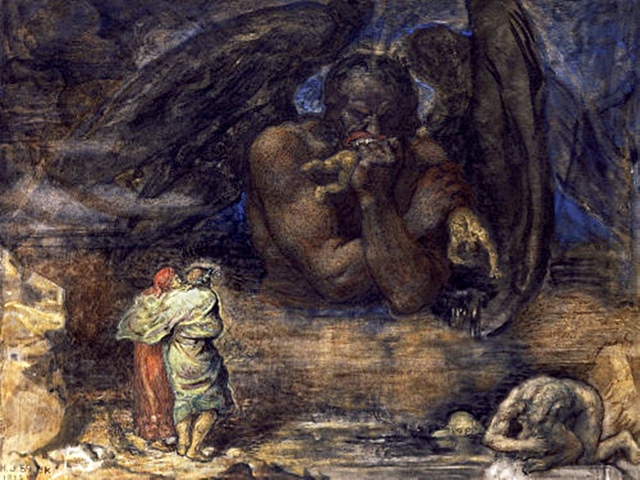
Remember that Judas was chosen to be one of the twelve. He had gifts. He was in the inner circle of Christ's companions. In this ancient drawing, he is in hell with Lucifer, as described by Dante. This is a warning to those of us who might think we are holy, as presumption is one of the sins needed to be purged in the Dark Night.

The goods labelled sensual, moral, supernatural and spiritual need to be examined briefly. Again, Father Phelim's pamphlets help me.

Vanity, or vainglory impede the growth of virtues. But the deep sins of gluttony, drunkenness, luxury, spiritual laziness, sensuality and the lack of penance lead one directly out of the Dark Night. This can happen.

Satan tempts and only vigilance keeps one from falling.

The moral goods also need to be purged. Father Phelim warns against edifying people who do good. He quotes St. John of the Cross,
"Many Christians today accomplish great acts which will profit them nothing for eternal life, because they have not sought in them the glory and honour which belong to God alone."

Harsh words, indeed. One must work entirely out of love for God alone.

If one relies, as Father Phelim notes using John, on the esteem of men and praise or recognition, there will be no recompense in heaven for such good moral works. One must work without praise and in a state of doing one's duty.

The next two categories are the most difficult for many Catholics, especially charismatics. Please note Father Phelim's words here.   The supernatural goods given for the building up of the Body of Christ "...do not imply holiness in those who exercise them."

God's gifts and charisms are NEVER a sign of holiness or purity of heart.

Frequently, charisms are misused, as Father emphasizes Two things help one in this regard-one, complete detachment from gifts and, two, the reluctance to use them. Father and St. John are clear on these two points.  One need not feel any rejoicing or emotions regarding the use of gifts and most likely, those who are doing so in a showy manner when exhibiting gifts lack holiness.

Lastly, spiritual goods, such as statues, medals, beautiful music and churches, and all manner of Christian art can become idols. One must realize they are there to help our faith and are not substitutes for holiness. I have see much magical thinking with regard to holy things which is dangerous.

The important aspect of spiritual goods is that these build our faith, increase our hope and encourage us in love.

The last warning on the use of goods pertains directly to charismatics and those prone to prayer meetings. St. John of the Cross writes, "We must not be anxious to cling to ceremonial inventions which are not approved by the Church. We must leave the method and manner of saying Mass to the priest whom the Church sets in her place giving him her orders as to how he is to do it."

Father Phelim warns us,  by reminding us that St. John  of the Cross rebukes those who experiment with new methods, "as if they knew more than the Church and the Holy Spirit."  Wow!

To be continued....