The only way to become holy is to be painfully honest with one's self. Begging God to shed light on one's predominant fault or faults means asking for humbling circumstances.
Some people are more humble by nature and the process of seeing and repenting of one's secret sins may be less painful than for those who are proud and less inclined to admit deep-seated tendencies toward sin.
If there was ever a time in the history of the Church for thousands of saints to arise, the time is now.
The synod revealed many kinds of deceit among the clergy, which some Catholics had not seen until this past week. For those of use who have worked on the inside, what we saw was the culmination of errors sent into seminaries and convents as long as I have been alive.
Modernism was condemned over a hundred and forty years ago.
But, for us in the pew, the message must be this today. Get holy and stay holy. Make your families holy and train your children to be saints.
Same old, same old mediocrity will not stay the tide of schism and the worldwide ruin of many diocese.
I have been writing about this for a long time.
Remember northern African witnessed thriving Catholic communities for hundreds of years. Where are these now? Remember that all the churches mentioned in the book of Revelation no longer exist.
Those who refuse to take seriously the signs of the times are wrapped up in deceit.
If you are not doing penance daily for the Church, you are deceiving yourself about the future of the Church in your own diocese.
I cannot warn you more than I have in the past seven years.
The time is now to face that we all need to become saints and cooperate with the graces God wants to give us now.
Think like a Catholic. We are living in the time of tribulation already and those who deny this want to deceive themselves. Things will get worse. We have been called to witness these times.
Be honest, and become a saint.
Showing posts with label conversion.. Show all posts
Showing posts with label conversion.. Show all posts
Wednesday, 29 October 2014
Thinking About Deceit
Today, on the bus, it came to me that many people live lives cocooned in deceit. Deceit, or lying to one's self about something, may be a reaction to hurt or deprivation. I think of the two brothers, Jamal and his brother Salim, in the movie Slumdog Millionaire, who each chose a different way to cope with poverty. One chose a life in the underground of crime, while the other one chose an ethical lifestyle.
I see prostitutes working the streets, encounter shopkeepers who lie, notice the number of homosexuals who openly are "couples" here, and children who are rude to their elders in public.
But, all these sins come from a root sin of deceit. These people, all children of God, have chosen lifestyles which force them to continue deceiving themselves about the goal of life. They have forgotten heaven, and hell.
Like Salim, they have settled for false love, power and money. Perhaps, they simply do not really know that there is an afterlife, and that all of us shall be called to account, not once, but twice.
I do not see any street ministry in Malta. I see no priests walking about, reaching out to these people. Why not? Why is there an assumption that those in deceit do not want to break out of such sad lifestyles? The churches, with myriad Masses daily, lack youth, except for tourists. But, not all who are wrapped up in deceit are young.
One growing problem here is the acceptance of sin. Too many families accept cohabitation, homosexuality, and contraception. It is taboo to openly discuss sin here, as if to mention evil is so offensive, one cannot address the dead souls who need life-giving words.
Deceit wraps up those who look the other way, think it is OK to cheat, or lie, or fornicate. Deceit wraps up the middle class so that an entire generation looks the other way and accepts sin.
The acceptance of sin is a sin in and of itself. If one accepts sin, one encourages the mortal sins of others. This is a problem with small islands. England has the same problem. Too many people are afraid of offending others by talking about truth.
Not to instruct the ignorant or not to admonish sinners are sins of omission.
Deceit has captured so many people, it is as if the Siege of Malta failed. The enemy is within the gates.
But, Malta is merely a microcosm of the macrocosm. The sins of Malta, a place which was once a shining Catholic City on a Hill, are the sins one finds among Catholics everywhere. Sadly, these things are more obvious on a small island.
There are many excellent priests here, and good laypeople who pray daily and love God. I am impressed by the number of people who daily visit the chapels of Adoration, even to say one prayer. There is a constant stream of people visiting Christ. Most are old, very old, but not all.
I pray that their prayers may be answered, as I am sure that many are praying for those in their families who are caught in the web of deceit.
The remnant here is under attack by the same enemies as we see elsewhere-consumerism, materialism, sexual promiscuity, idolatry, greed. the love of money. communism, socialism. The simplicity of the faithful Catholic who prayers her rosary and goes to the Adoration chapel may save some prisoners of deceit.
But, I fear that the evil which has been unleashed upon the earth will swallow up the good people here. The remnant is so small, so small....
Pray for Malta, pray for Europe. The gorgeous churches stand as witnesses to the past of Christendom, which is fast falling to the lies of modernism and secularism.
Tonight, I grieve for this beautiful country, these beautiful people, because so many have lost their way in the tangles of deceit and others look the other way. If there is ever a time when Malta needs saints, it is now.
I see prostitutes working the streets, encounter shopkeepers who lie, notice the number of homosexuals who openly are "couples" here, and children who are rude to their elders in public.
But, all these sins come from a root sin of deceit. These people, all children of God, have chosen lifestyles which force them to continue deceiving themselves about the goal of life. They have forgotten heaven, and hell.
Like Salim, they have settled for false love, power and money. Perhaps, they simply do not really know that there is an afterlife, and that all of us shall be called to account, not once, but twice.
I do not see any street ministry in Malta. I see no priests walking about, reaching out to these people. Why not? Why is there an assumption that those in deceit do not want to break out of such sad lifestyles? The churches, with myriad Masses daily, lack youth, except for tourists. But, not all who are wrapped up in deceit are young.
One growing problem here is the acceptance of sin. Too many families accept cohabitation, homosexuality, and contraception. It is taboo to openly discuss sin here, as if to mention evil is so offensive, one cannot address the dead souls who need life-giving words.
Deceit wraps up those who look the other way, think it is OK to cheat, or lie, or fornicate. Deceit wraps up the middle class so that an entire generation looks the other way and accepts sin.
The acceptance of sin is a sin in and of itself. If one accepts sin, one encourages the mortal sins of others. This is a problem with small islands. England has the same problem. Too many people are afraid of offending others by talking about truth.
Not to instruct the ignorant or not to admonish sinners are sins of omission.
Deceit has captured so many people, it is as if the Siege of Malta failed. The enemy is within the gates.
But, Malta is merely a microcosm of the macrocosm. The sins of Malta, a place which was once a shining Catholic City on a Hill, are the sins one finds among Catholics everywhere. Sadly, these things are more obvious on a small island.
There are many excellent priests here, and good laypeople who pray daily and love God. I am impressed by the number of people who daily visit the chapels of Adoration, even to say one prayer. There is a constant stream of people visiting Christ. Most are old, very old, but not all.
I pray that their prayers may be answered, as I am sure that many are praying for those in their families who are caught in the web of deceit.
The remnant here is under attack by the same enemies as we see elsewhere-consumerism, materialism, sexual promiscuity, idolatry, greed. the love of money. communism, socialism. The simplicity of the faithful Catholic who prayers her rosary and goes to the Adoration chapel may save some prisoners of deceit.
But, I fear that the evil which has been unleashed upon the earth will swallow up the good people here. The remnant is so small, so small....
Pray for Malta, pray for Europe. The gorgeous churches stand as witnesses to the past of Christendom, which is fast falling to the lies of modernism and secularism.
Tonight, I grieve for this beautiful country, these beautiful people, because so many have lost their way in the tangles of deceit and others look the other way. If there is ever a time when Malta needs saints, it is now.


Friday, 6 December 2013
No Cookie-Cutter Saints

Blessed Mother Teresa of Calcutta, I was told recently, told a priest that she never had clarity about her life. She just went day to day, working, praying, living in darkness as to God's Perfect Will.
She had rare moments of consolation.
Each saint experiences God differently, as each person is created uniquely. We cannot and should not judge how God works in the lives of those around us.
What may seem like something worldly may be the Perfect Will of God in someone's life.
To discern God's Will is part of our journey to perfection. If God withholds clarity, that is His Plan and one must humbly accept such a state. If one can only see the day presented today and nothing else, rejoice in that Plan.
Some people find their vocation and God's Will as young people. Some struggle in long years of searching for God's Perfect Will. Some people actually run away from God's Plan. St. Benedict Labre failed at everything he did. He is a great saint of humility and peace.
God's Will does not change, but He can will change in our lives, states Thomas Aquinas. But, all that God wills is good. There is an additional mystery that all things which happen to us are in the Will of God-even suffering and trials.
Here is a snippet from Thomas Aquinas: Thus in the case of the raising of Lazarus, one who looked only on inferior causes might have said: "Lazarus will not rise again," but looking at the divine first cause might have said: "Lazarus will rise again." And God wills both: that is, that in the order of the inferior cause a thing shall happen; but that in the order of the higher cause it shall not happen; or He may will conversely. We may say, then, that God sometimes declares that a thing shall happen according as it falls under the order of inferior causes, as of nature, or merit, which yet does not happen as not being in the designs of the divine and higher cause. Thus He foretold to Ezechias: "Take order with thy house, for thou shalt die, and not live" (Is. 38:1). Yet this did not take place, since from eternity it was otherwise disposed in the divine knowledge and will, which is unchangeable. Hence Gregory says (Moral. xvi, 5): "The sentence of God changes, but not His counsel"---that is to say, the counsel of His will. When therefore He says, "I also will repent," His words must be understood metaphorically. For men seem to repent, when they do not fulfill what they have threatened.
This is a mystery not accepted by most of the world, which rejects the value of suffering. God's Will may include tremendous suffering. St. Faustina suffered the ill treatment of nuns in her own house. St. Padre Pio suffered the ill treatment of men in his own house. St. Louis de Montfort met obstacle after obstacle on his path to perfection.
Many times, it is those in the Church, even other good people, who provide the suffering in one's life.
Such was the case for St. Damian of Molokai, who was stymied in his work by his own bishop. He was accused of pride and arrogance. The saint kept going on with the vision God had given Him
The vision or vocation of one saint is not the same as that of another. There is no such thing as a cookie-cutter saint.
If Catholics stand back and judge other Catholics by outward signs of success or even successful holiness, this type of attitude is not of God. God works in so many different ways.
I am learning that a friend of mine has become holy because of a divorce. She has become holy because of great suffering which has left her alone. Some people in her life criticize her. I see the re-birth of a beautiful soul.
Can one imagine the type of judgments Blessed Teresa of Calcutta endured? She was criticized for taking money when she received the Nobel Peace Prize. She was criticized for not working for political changes, or setting up hospitals, but only tending to the dying. She was criticized for having a ministry which gave dignity to death and suffering instead of taking it away.
Blessed Mother Teresa was criticized for having long periods of doubt and darkness, of not being on top of financial issues, of fraternizing with less than holy men and women for the sake of her missionaries.
There are over 5,000 sisters in her order in the world today. Her story is one of courage and persistence.
Do not judge anyone. Do not suppose you understand someone's spiritual life because of your own. Do not judge the suffering of another.
And, most of all, as warned by Father Ripperger, be suspicious of psychological explanations which may undermine the path to perfection. Psychology is limited. Those who were keen on psychology criticized both Blessed Teresa and Blessed John Paul II. They would only want to see wholeness rather than holiness. These are not the same thing. God may allow a person not to be what the world would call "whole" for the greater Glory of His Name. God may allow a person deep suffering for a reason. Blessed John Paul II was not physically whole at the end of his papacy. Yet, in that long illness, he was being made holy.
The world does not understand that mystery of suffering.

In the Dark Night, the soul and God move from brokenness to a deeper brokenness, that of the breaking of the ego.
The worldling does not understand suffering and purgation. To become a blessed was a hard road for Teresa of Calcutta. Perhaps that is her message for us today. Persevere totally in Faith. Keep going. Do not give up.
Rejoice in the suffering, somehow,as God is in both the overall picture and in the details.
Christ was abandoned by all His best friends but young John. Why? One simple reason--that His friends did not want to share in His Suffering. They ran away rather than suffer with Someone Who loved them. They ran away rather than enduring the pain of failure and rejection.
They ran away out of fear.
They did not want to stand up with He Who took on sin. Sometimes, we have to stand up with sinners; we are sinners as well. Only the falsely perfect reject the sinner. Guess what? I am a sinner and all my friends are sinners. But, we love each other through and even out of the sin.
Love and forgive, forgive and love-and be willing to suffer on your own and with others.
Do not be afraid. And, if, like my friend, who is so far away facing divorce, you find yourself suffering alone, know that you are being called to Calvary.
Blessed Teresa said this: “If someone criticizes you, first ask yourself, is it right? If he is right, apologize and change, and the issue is resolved. If he is not right, clarify and correct, but if that does not work, take up the unjust accusations with both hands and offer it to Jesus in union with his suffering, because he was slandered by all sides.”
In her case, such judgments were God's Plan for her sanctification. God works in the spiritual realm, and most people in the world do not understand what that means.
To be continued....
Saturday, 10 August 2013
Taking Pride in Sin

One of the curious questions which always comes up when one is discussing or in a class on Dante's Divine Comedy is why Dante reacts to certain sinners with awe and respect.
The examples are too many for this posting, but one sees the character of Dante changing as he moves through hell. Yet, one is puzzled by his honouring of some of the gross sinners who are forever damned. Now, one can say that there is nobility is all people, and even though that nobility is ruined by sin, one could stand back and admire a person for their former greatness.
However, I think the problem is in the character of Dante, a personification of the author, but also fictionalized, as the poem is allegorical. The living Dante walks through hell and can respond to those in eternal punishment in several ways. But, it is Dante's own sin, his own imperfections, which cause him to pity were one should not do so.
And, this thought leads me to another, which is that some of those in hell in the poem take pride in the very sins which sent them to horrible separation from God.
I see this in others around me. There is a perverse pleasure taken when people share their sins, as if bragging about weaknesses in order either to make excuses for sin, or to invoke pity, or to simply gloat, is acceptable. Those Christians who have come to know salvation through Christ's Passion and Death, remain ashamed of those sins, and those very sins aid one in coming to a real humility. Humility, being self-knowledge, the knowledge of one's sins, brings one to the honest appraisal of who one is before God.
But, to share those sins does not necessarily bring glory to God, or bring others to a desire for Christ's love.
Dante's own imperfections, which gradually are purified through his journey through hell, purgatory and heaven, present the reader with a clear understanding of the scandal of sin.
He reacts sometimes in pity, empathy, and horror, depending on the situation.
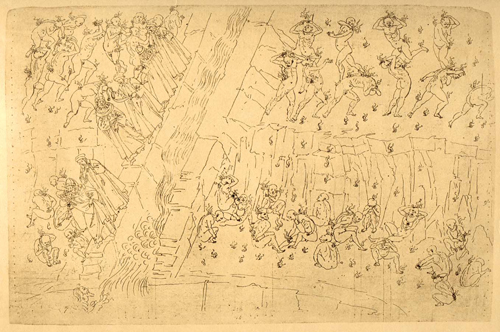
It is interesting that newer critics deny that Dante's descent into the seventh circle includes meeting homosexuals, a revision which is most deceitful. In that circle are the blasphemers and the usurers, as well, those who have sinned against God directly, which is why the homosexuals are not in the lesser punishment of the lustful.
Those who sin against God directly, that is against natural law and the transcendence of God, are doomed to dance in one place on the hot sands forever, in the circle designated for the Violent. Violence against God and against nature cause this incessant movement, as the sodomites were seen as having a disturbed, constantly moving, unsteady, and unstable existence.
Dante honours a poet he meets there, by lowering his head in respect,as he admired and copied this poet in life. But, the soul reaches out to him, as if to ask for acceptance. That type of empathy is no longer possible for those condemned to hell.
Sadly, I have noticed more and more people desiring acceptance in their sins. Those who identify with their sins want those who believe in objective truth to blur the distinctions between sin and personhood. Such is the desire of those caught up in the gay lifestyle. Acceptance of sin is a type of consent, and those who brag of their sins have lost not only the sense of sin, but the sense of shame.
In fact, another sin is added, which is that of rationalization. A man bragging to me about how much he drinks on the weekend is rationalizing his sins of intemperance and drunkeness. Bravado can be a form of deceit, rationalizing a weakness. Lying is another name for this type of rationalizing.
In a landslide movement of false tolerance of sin, almost every country of the West is or will be accepting homosexual relations, as well as cohabitation of heterosexuals without marriage, as normal and even as a good. Sin is added to sin in pretending that an evil is a good.
This has led more and more to people discussing their sins in public and encouraging others to do so.
What is evil has been accepted by many, even some Catholics, as a good. So too, are those who are living in heterosexual, non-married relationships talking about their lives as if nothing was really wrong. What merely a few decades ago was unmentionable is now part of bragging and pride.
To take pride in sinful behaviour must be one of the worst sins of all-the complete inversion of truth.
I caution Catholics to not discuss sin, either their own or others, of course, as this glorifies the Evil One.
And, discussing specific sins adds to the degradation of human dignity. If one is trying to help a person out of sin, and that person needs advice, that may be done privately in love and in great humility. But, if one is merely touting personal sins as an excuse for behaviour, or as an example of wilful confusion or loss, one is simply falling into pride.
The popular songs of Mexico provide examples of the glorifying of sin, but even here, in Ireland and across the sea in England, a growing tendency to publicize one's sins is gaining acceptance and even a prurient popularity. If you are engaged in conversations with someone who keeps bringing up their sins, stop them and encourage them to go to Confession. If the sin is a lifestyle, help that person truly convert. To emphasize the sin over grace is just plain self-deceit, as grace is always stronger than sin.
Do not enable sinners to continue in their sinful lifestyles.
One more example may help in understanding the problem. Someone was telling me how much they were in debt on credit cards. They were bragging about all the things they have, and the things they do with credit. I could not help them understand that this debt was sinful, and that their carelessness and lack of good stewardship was not something about which to speak in a cavalier fashion. I stop discussing such things with people if they are not willing to listen. Continual discussion encourages rationalization.
I have said to people. "Stop, I do not want to hear any more of this. You know what you need to do."
One cannot go on year after year discussing sin. Conversion is always possible as grace is freely given to all.
Part of the problem is that the Millenials, and even the Gen-Xers, lack boundaries. Do we really need to know everything about a person? Decorum and appropriateness in speech have disappeared.
Pride, the primal sin, pushes people into these public confessions. Pride, not humility....
Tuesday, 30 July 2013
Looking more at Genesis 18
 |
| Tiepolo, Abraham and the Three Angels |
17 And the Lord said: Can I hide from Abraham what I am about to do:
18 "Seeing he shall become a great and mighty nation, and in him all the nations of the earth shall be blessed?
19 For I know that he will command his children, and his household after him to keep the way of the Lord, and do judgment and justice: that for Abraham's sake the Lord may bring to effect all the things he hath spoken unto him.
20 And the Lord said: The cry of Sodom and Gomorrha is multiplied, and their sin is become exceedingly grievous.
21 I will go down and see whether they have done according to the cry that is come to me: or whether it be not so, that I may know.
22 And they turned themselves from thence, and went their way to Sodom: but Abraham as yet stood before the Lord.
I am struck by verse 21 today, which indicates to some unbelievers that The Holy Trinity did not know what was happening in the Five Cities. However, as we know, God is All-Knowing. Two points. One, God, I think, wanted to reveal Himself to the inhabitants of the cities to see if any would repent. God always give all people a chance for salvation, for conversion. The seeing of God was the last chance of those sodomites who had offended both men and God. Seeing Him could have caused repentance, but as we know from Chapter 19, the inhabitants demanded from Lot unnatural relations with his guests, a manifestation of the Son and the Holy Spirit, while the Father remained behind with Abraham, who was bargaining with Him. These "men" who were not men, went to find humble hearts which could turn to God at the last moment. This did not happen. God has all knowledge, but He wanted to share real love with the inhabitants, so He went into the city.
Secondly, who was crying out to God against Sodom , Gomorrah and the other three cities? Lot and his small family? I would think that many, many people were crying out to God for vengeance, as the sin of sodomy is one listed as crying out to God for vengeance.
Do we cry out to God for vengeance, which is justice? Are we so accepting of sin that the Trinity is not hearing any prayers for justice? Wait and see what will happen...
One can see my previous posts on this subject under the tags. I love the painting above, but the bread reminds me of a Big Mac. I guess I need some dinner.
31 Jan 2013
Catechism Online Link: A Reminder: The Four Sins Which Cry Out to God For Vengeance. Posted by Supertradmum. Free online edition http://www.remnantnewspaper.com/The%20Douay%20Catechism%20of%201649.pdf.
08 Jun 2013
Because of a note on another blog when I had to look up this reference, here is a reminder of the Four Sins Which Cry Out to God for Vengeance. 1867 The catechetical tradition also recalls that there are “sins that cry to ...
15 Jun 2013
Sin has no rights, period. Pedophiles, murderers, abortionists all sinners without rights, and homosexual acts are in the list of the four sins which cry out to God for vengeance in our catechism. Love the sinner, hate the sin.
09 Jan 2013
God will not ignore His Commandments being mocked. The sin of homosexuality is one of the four or five, depending on the list, which cries out to God for vengeance. Check out the the older catechisms on this point.
Sunday, 28 July 2013
While it is still legal....
Genesis 18
27. Abraham went early in the morning to the place where he had stood before the Lord; 28 and he looked down toward Sodom and Gomorrah and toward all the land of the Plain and saw the smoke of the land going up like the smoke of a furnace.


As in Canada, where it is illegal to use the term sodomy, and has been for at least ten years, (I was living in Calgary when a pastor in Edmonton was arrested in his own church after a sermon against sodomy, and that was in 2000.)
I have predicted the rise and fall of Catholic blogging since I began blogging in 2007.
But, while we have some freedom of speech, let me comment on today's Old Testament reading from Genesis 18.
Catholics, there is a ton of really bad commentary on this section, the destruction of Sodom and Gomorrah, plus the other cities. Some so-called theologians claim the greatest evil of the towns was greed. Some say the inhabitants were not hospitable.

God has already decided to destroy the towns when Abraham began his bargaining. Only a great friend of God could do such bargaining.
The Catholic interpretation holds that the sin of these cities was unnatural sex. Jude 7 is quite clear on this. The first section is from the Douay Rheims and the second from the Catholic Edition of the Revised Standard, considered the most accurate.
7 As Sodom and Gomorrha, and the neighbouring cities, in like manner, having given themselves to fornication, and going after other flesh, were made an example, suffering the punishment of eternal fire.
8 In like manner these men also defile the flesh, and despise dominion, and blaspheme majesty.
second version
7 just as Sodom and Gomor′rah and the surrounding cities, which likewise acted immorally and indulged in unnatural lust, serve as an example by undergoing a punishment of eternal fire.
Also, look at these texts, please, Romans 1: 26-28 and 32; 1 Cor: 6: 9-10.
Do not let the revisionist pastors delude you. And do not read other than solid Catholic commentary on these passages.
The Three Angels were the manifestation of the Trinity, which is clear from the text and held from the earliest days of the Church.
See also,
http://supertradmum-etheldredasplace.blogspot.ie/2012/12/peer-pressure-and-lots-wife.html
http://supertradmum-etheldredasplace.blogspot.ie/2013/07/on-pillars-and-wraiths-nod-to-zombies.html
Do not let the revisionist pastors delude you. And do not read other than solid Catholic commentary on these passages.
The Three Angels were the manifestation of the Trinity, which is clear from the text and held from the earliest days of the Church.
See also,
http://supertradmum-etheldredasplace.blogspot.ie/2012/12/peer-pressure-and-lots-wife.html
http://supertradmum-etheldredasplace.blogspot.ie/2013/07/on-pillars-and-wraiths-nod-to-zombies.html
Subscribe to:
Posts (Atom)