Recent Posts

Showing posts with label love. Show all posts

Sunday, 7 June 2015

The Devolution Question Yet Again And Some Maritain

I first learned about devolution from two men-one a major in the Army and the other a famous Catholic priest. They talked about the growing stupidity of people across the world as a planned and also, physical de-evolution of the species.

Lately, this idea, which I have written about before on this blog, of devolution, has become more obvious to me.

Points:
  1. Young people who have never heard of the Bilderberg Group, the Trilateral Commission or the Council on Foreign Relations. Amazing.
  2. Young people who have never, ever thought of the spiritual side of humans, who either ignore or deny the soul and are, therefore, practical atheists, denying the Spirit of God.
  3. Catholics who have never read one encyclical, not even Humanae Vitae.
  4. Catholics who do not know that there are four Eucharistic Prayers, many movable feasts, or who understand the liturgical year. and worse, do not read to find out. They do not know one can buy a missal, and are not interested in doing so.
  5. Young people who do not believe in natural law philosophy.
  6. Young people who have never studied American or Western History, or taken any other Humanities course.
  7. A complete lack of the ability to do mental math among the younger generations.
  8. Reading difficulties of those under sixty, causing serious problems with basic pronunciation and understanding of content which has been read.
  9. The inability to debate or discuss rationally.
  10. No sense of the goal or end of human beings and not interested in the big question of why we are here.
  11. Complete lack of interest in foreign affairs, geography, or world events.
  12. Complete lack of interest in eating in a healthy manner, thus creating an unhealthy body while still young.
  13. An interesting lack of common sense which I, as an ex-Montessori teacher, where children do practical things and learn common sense, plagues the younger generation.
All of these problems of thinking or living or degeneration I have met in the past three weeks. There are more examples, but these I have seen and experienced more than once in a short period of time. 

De-evolution is not merely a physical problem, but a spiritual problem. Why it is a spiritual problem is that the soul is the form of the body, which means that all movements of the intellect need to be under grace in order to be truly in God's will and effective. The Maritains note that those in the active life, which would include most of the laity, "have a more pressing need of prayer" and that the active people should "ask of the divine mercy the grace of a sufficient intensity of interior life for their very activity, at least in its mode of production, to proceed from the superabundance of their contemplation..."

Devolution is a direct result from a lack of commitment to a life of prayer in the active life, and spiritual sloth. The Maritains, in this little jewel I have been reading, quote St. Augustine. "The love of truth seeks a holy repose, the necessity which love imposes accepted justified toil...If no duty be imposed on us, let us be busy with the study and contemplation of truth; and if labours are laid on us, charity itself obliges us to accept them. Even so, however, the sweet contemplation of truth should not be abandoned, for fear that with the disappearance of their sweetness, we should be overwhelmed by our necessities."

Devolution happens when reflection ends. Man was created as a thinking, reflecting animal, an animal with an immortal soul, will and intellect. To ignore all or any create a bestial condition of emotional responses to stimuli instead of a studied, virtuous response.

To state this simply, spiritual sloth and indecision in following Christ and His Church lead to devolution. The mind becomes dulled by sin and excess.

Prayer and intelligence being the process of purification leading to perfect charity.

The Indwelling of the Trinity, given in baptism, but absent without baptism, gives each one of us the ability to contemplate, to decide to follow Christ, to love. Those in grace do not devolve or degenerate.

2 Peter 3:18Douay-Rheims 

18 But grow in grace, and in the knowledge of our Lord and Saviour Jesus Christ. To him be glory both now and unto the day of eternity. Amen


Again, Where Love Rests


Some people that have not remembered my blogs on where love is located. True charity is in the intellect and the will and not the heart. The heart is merely an image of the emotions, and this comes from Jewish theology which put the will in the heart, as well as the movements of the soul. However,
God in His Wisdom revealed to Catholics through Tradition that the intellect moves the will through grace to love in real charity.

Garrigou-Lagrange explains this and so do other great writers in his text below. As the Maritains stress, love comes out of the reflection of the intellect and the will to study and learn Sacred Doctrine, and not the heart. The heart has been confused in modern times for many reasons as the main "place" for love. But, one must decide to have a willing heart to pursue perfection in order to be charitable.


"Christian perfection consists essentially in charity",  states the Maritain. In fact, real perfection is real charity. The perfection of charity is the end of perfection and the pursuit of perfection leads to love of God and love of neighbor, the first love being necessary before the second.

The Maritains quote Cajetan: "The lowest degree of divine love is to love nothing more than God, nothing  contrary to God, nothing as much as God. He who does not reach this degree of Christian perfection in no way accomplishes the precept."

Perhaps Garrigou-Lagrange''s  selection would help.


CONFORMITY TO HIS WILL AND LOVE OF THE CROSS

Heroic charity toward God manifests itself in the first place by an ardent desire to please Him. In fact, to love someone not for one­self but for himself, is to wish him well, to wish what is suitable for him and pleasing to him. To love God heroically is, in the midst of even the greatest difficulties, to wish that His holy will be accomplished and His reign profoundly established in souls.

This holy desire to please God is a form of affective charity, which is proved by effective charity, or by conformity to the divine will, in the practice of all the virtues. The soul thus reaches unswerving fidelity in little things and in great things, or what is most difficult.

Heroic love of God is shown, we have seen, in the passive purification of the spirit, when it is a question of loving God for Himself, without any consolation, in great and protracted aridity, in spite of temptations to disgust, acedia, and murmuring, when the Lord seems to withdraw His gifts and leave the soul in anxiety. God is for this reason none the less infinitely good in Himself and deserves to be loved purely for Himself. If then, in spite of such prolonged dryness, the soul loves to be alone with God, especially before the Blessed Sacrament, and if it still continues to pray, if in spite of everything its life remains a perpetual prayer, this is a sign of heroic love of God.

As St. Francis de Sales (1) shows, heroic conformity to the divine will appears when the soul receives lovingly every agreeable or painful occurrence as coming either from the positive will of God, or from a divine permission directed toward a higher good. It then sees with ever greater clearness the truth of the words of Ecclesiasticus: "Good things and evil, life and death, poverty and riches, are from God." (2) The soul here becomes deeply convinced that God makes use even of the malice of men, for example, of persecutors, as an occasion of merit for those who wish to live only for Him. Thus Job accepted adversity, and in the same way David bore the insults of Semei. (3)

In the greatest difficulties, the saints, while doing what is in their power, say: "It will be as God wishes."

To this sign is added a confirmation: namely, one who thus renounces his own will and adheres heroically to the will of God finds a holy joy in this adherence. In conforming his will more and more to God's will, he has all that he wishes. He experiences the truth of the Psalmist's words: "O Lord, Thou hast crowned us, as with a shield of Thy good will." (4) This is what the martyrs have particularly experienced.

In his explanation of the Canticle of Canticles, St. Bernard describes the ascending degrees of heroic charity as follows: "Divine love leads to an unceasing search for God, to continual labor for Him; it bears indefatigably all trials in union with Christ; it gives a true thirst for God; it makes us run rapidly toward Him; it gives us a holy boldness and an undaunted audacity; it attaches us inseparably to God; it burns and consumes us with a very sweet ardor for Him; finally, in heaven, it likens us completely to Him." (5)

These degrees of perfect charity are explained in a short work attributed to St. Thomas,(6) and also by St. John of the Cross in The Dark Night,(7) where he shows that the second last degree is the transforming union, the prelude of that of heaven. "The Apostles," he says, "experienced this sweetness of ardent love when the Holy Ghost descended visibly upon them." (8)

The greatest sign of heroic charity toward God, is love of the cross. The patience and conformity to the divine will of which we have spoken, lead to this love.

In The Dialogue of St. Catherine of Siena, the Lord says: "It now remains to be told thee how it can be seen that souls have arrived at perfect love. This is seen by the same sign that was given to the holy disciples after they had received the Holy Spirit, when they came forth from the house, and fearlessly announced the doctrine of My Word, My only-begotten Son, not fearing pain, but rather glorying therein. They did not mind going before the tyrants of the world to announce to them the truth, for the glory and praise of My name." (9)

In the same Dialogue we read: "Such as these, . . . as if enamored of My honor, and famished for the food of souls, run to the table of the most holy cross." (10) "They slacken not their pace on account of the persecutions, injuries, or pleasures of the world. They pass by all these things, . . . their affection clothed in the affection of charity, and eating the food of souls with true and perfect patience, which patience is a sign that the soul is in perfect love, loving without any consideration of self." (11) "Such as these do not feel any separation from Me. . . . I remain continually both by grace and feeling in their souls." (12)

In other words, the eminent exercise of charity is accompanied in a proportionate degree by the act of the gift of wisdom, which enables us, says St. Thomas,(13) to know God present in us in a quasi­experimental manner. This is truly the mystical life, the summit of the normal development of grace and the prelude of the life of heaven. This summit cannot exist without love of the cross, and love of the cross does not exist without the contemplation of the mystery of the redemption, of the mystery of Christ dying for love of us.

Consequently, in The Dialogue, the Lord, speaking to St. Catherine of Siena for herself and for her spiritual children, says: "It is right for thee, and My other servants who have learned My truth in this way, to sustain, even unto death, many tribulations and injuries and insults in word and deed, for the glory and praise of My name; thus wilt thou endure and suffer pains"; (14) that is, with patience, gratitude, and love.

Such are the great signs of heroic love of God: perfect conformity to His will in trials and love of the cross. There is also another sign, perfect charity toward one's neighbor, which we shall now discuss.


HEROIC CHARITY TOWARD ONE'S NEIGHBOR: THE ARDENT DESIRE FOR HIS SALVATION AND RADIATING GOODNESS TOWARD ALL

Charity leads us to love our neighbor in God and for Him; that is, because God loves him and as God loves him. It makes us desire that our neighbor may belong entirely to God and glorify Him eternally.

Heroic love of neighbor already exists when one promptly dominates strong temptations to envy, discord, isolation, so different from solitude; likewise when one quickly surmounts temptations to presumption, which incline one, in the wake of certain insults, to wish to get along without the help of others - of friends, director, superiors.

Perfect charity appears when, in the midst of great difficulties, one loves one's neighbor, mente, ore, et opere, that is, judging him with benevolence, speaking well of him, helping him in his necessity, perfectly pardoning offenses, and making oneself all to all. This charity is still more obvious if by preference one seeks out, as St. Vincent de Paul did, friendless and fallen souls, poor, strayed, and gravely guilty creatures, in order to lift them up, rehabilitate them, and set them back on the road to heaven.

A chief characteristic of heroic love of neighbor is an ardent desire for the salvation of souls, a thirst for souls, which recalls Christ's words on the cross: "I thirst." St. John used to say: "My little children, let us not love in word nor in tongue, but in deed and in truth." (15)

Heroic love of neighbor led some saints to the point of wishing to sell themselves as slaves that they might deliver captives and thus rescue families from wretched poverty. This zeal inspired St. Paul to write: "I wished myself to be an anathema from Christ, (16) for my brethren, who are my kinsmen according to the flesh, who are Israelites." (17)

This zeal inspired the apostolic activity of great missionaries, of St. Francis Xavier, St. Louis Bertrand, Las Casas, St. Peter Claver. Nearer our own day, it is the inspiration of apostles, like St. John Bosco, who are completely engrossed in bringing back to God the misguided masses in our Christian countries who no longer know the Gospel.

Another sign of heroic love of neighbor is radiating goodness toward all amid the greatest difficulties, according to the evangelical beatitude: "Blessed are the peacemakers," that is, those who not only preserve peace in most difficult moments, but who give it to others and hearten the most troubled. This eminent sign appears in Mary, the Consoler of the Afflicted, and in all those who resemble her. Our Lord says: "Love one another as I have loved you." (18) "By this shall all men know that you are My disciples." (19)

Communicative goodness, love of neighbor carried even to daily and hidden sacrifice, is the indisputable mark of the presence of God in a soul. This goodness, which is as strong as it is gentle, sometimes leads one to correct others, but without bitterness, sharpness, or impatience. And that the correction may be effective, it points out the good, the salutary seed which should be developed in the one who deserves the reprimand. Then the person receiving the reproof feels that he is loved and understood; he takes courage. If the Blessed Virgin were to appear and tell us our defects, she would do so with such goodness that we would immediately accept her corrections and draw from them the strength to make progress.(20)

Perfect charity toward one's neighbor springs from close union with God, and it leads one's neighbor to this same union, according to our Savior's words: "I pray. . . for them also who through their word shall believe in Me; that they all may be one, as Thou, Father in Me, and I in Thee." (21) The more united the soul is to God, the more it draws others to Him, never to itself. In the soul united to God, shines forth the divine goodness, which radiates, attracts powerfully and sweetly, and ends by triumphing over all obstacles.(22)

An incident from the life of St. Catherine of Siena will serve to illustrate this teaching. One day Peter Ventura, a Sienese involved in the affairs of the government, was brought to Catherine with his heart full of implacable hatred. "Peter," Catherine said to him, "I take all your sins on myself, I shall do penance in your place. But grant me a favor; go to confession." "I have just been to confession recently," said the Sienese. "That is not true," replied the saint, "it is seven years since you went to confession," and, one by one, she enumerated all the sins of his life. Stupefied, Peter admitted his guilt, repented of his sins, and pardoned his enemies. By promising Peter Ventura that she would take his sins on herself and expiate them, the saint had truly offered herself as a victim, and the Lord required of His servant, or rather His spouse, expiation through suffering. She interpreted literally Christ's words: "Love one another, as I have loved you."

In the same heroic manner St. Catherine obtained the conversion of Andrea Mei, a Sienese invalid, who had grievously calumniated her. The saint with consummate devotion nursed this woman, who was being eaten by a cancer. The unfortunate creature had the sorry courage to impugn the virginal honor of her devoted nurse, and these evil remarks spread abroad. Catherine, however, did not cease to tend her with the same zeal. Her patience and humility triumphed over Andrea Mei. One day the saint, as she approached the sick woman's bed, was surrounded by light, as if resplendent in glory; "Pardon!" cried the guilty woman. Catherine threw her arms around her neck, and their tears mingled. It was like the radiation of the divine goodness and the realization of our Savior's words: "The glory which Thou hast given Me, I have given to them; that they may be one, as We also are one." (23)

Two souls united in God by charity are like two candles whose flames unite and fuse.

Charity, which thus triumphs over wickedness, makes the saints share in the victory of Christ over sin and the devil. It is one of the glories of His mystical body; through it shine forth the grandeur of the life of the Church, its fruitfulness in every kind of good and of works of mercy. It is the confirmation of the divine origin of the Church.


Footnotes
   
1. Treatise on the Love of God, Bk. VIII, chaps. 5 f.; Bk. IX, chaps. 3-6, 15 f.
2. Ecclus. 11: 14.
3. Cf. II Kings 16: 10.
4. Ps. 5:13.
5. The Canticle of Canticles, V, 8; VIII, 6.
6. Opus., 61.
7. The Dark Night, Bk. II. chaps. 18-20.
8. Ibid., chap. 20.
9. The Dialogue, chap. 74.
10. Ibid., chap. 78.
11. Ibid., chap. 76.
12. Ibid., chap. 78.
13. Summa, IIa IIae. q.45. a.2.
14. The Dialogue, chap. 4.
15. Cf. I John 3:18.
16. Not for eternity. but for a more or less protracted period.
17. Rom. 9:3 f.
18. John 15: 12.
19. Ibid., 13:35.
20. We find an example of this goodness united to deep humility in the life of the foundress of the Cenacle, who at the age of thirty-three resigned as superior general, and for almost fifty years obeyed like a simple sister. She was so obedient that it was only at the end of her life that those about her understood all that the Lord had given her and how closely she was united to Him. He had hidden her, but the radiation of her goodness in humility ended by revealing her. It was she who, by her love for God and souls, bore the burden of the congregation of which she was truly the foundress. Cf. P. H. Perroy, S.J., Une grande humble, Paris, 1916.
21. John 17:20 f.
22. One of the characteristics of heroic charity is to bear with great generosity the sufferings that come from those one loves. Thus saints who, like St. Catherine of Siena and St. Joan of Arc, had a great love for the Church, have also had to suffer particularly from the faults of churchmen. This suffering was in the nature of reparation.
23. John 17:22.

Saturday, 11 April 2015

Indigence

One must come to the point where one honestly recognizes one's extreme poverty in the Face of God. This is infused knowledge and one must beg for it. A great grace, self-knowledge opens the door to al the rest of the grace, including detachment.

But, one cannot simply will these states. God remains the source of all grace and love, as well as self-knowledge.


St. Catherine of Siena, too, taught the same doctrine: that the knowledge of God and that of our indigence are like the highest and the lowest points of a circle which could grow forever.(25) This infused knowledge of our misery is the source of true humility of heart, of the humility which leads one to desire to be nothing that God may be all,amare nesciri et pro nihilo reputari. Infused knowledge of the infinite goodness of God gives birth in us to a much more lively charity, a more generous and disinterested love of God and of souls in Him, a greater confidence in prayer.
As St. John of the Cross says: "The love of God is practiced, because the soul is no longer attracted by sweetness and consolation, but by God only. . . . In the midst of these aridities and hardships, God communicates to the soul, when it least expects it, spiritual sweetness, most pure love, and spiritual knowledge of the most exalted kind, of greater worth and profit than any of which it had previous experience, though at first the soul may not think so, for the spiritual influence now communicated is most delicate and imperceptible by sense." (26) Garrigou-Lagrange Three Ages of the Interior Life

Monday, 6 April 2015

Indwelling Part Three


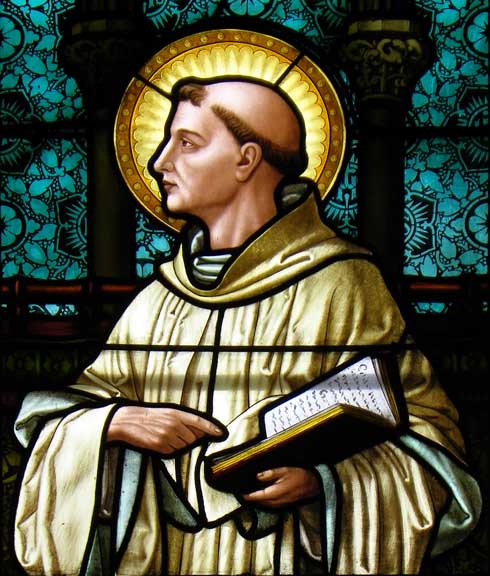
Perhaps the saint who most explains the Indwelling of the Trinity is my favorite, St. Bernard of Clairvaux. Those who have followed this blog know there are now at least sixty posts on this great saint of love.

His own experience communicated in the eloquence of his words helps us to draw closer to the understanding of the Indwelling of the Holy Trinity in us. One word stands out in his works--love.

One of my posts underlines the key to finding God within. We cannot find God unless we are willing to do violence to our own egos and self-will in order to see the love of God.

Saturday, 2 August 2014

"Man's Life on Earth Is Ceaseless Warfare" Perfection Series III


This title is a direct quotation from St. Bernard of Clairvaux, the saint who has accompanied me for most of my adult life.

He adds to the truth that we are all called to perfection. In the first of his sermons on the Song of Songs, he notes this: "Before the flesh has been tamed and the spirit set free by zeal for truth, before the world's glamour and entanglements have been firmly repudiated, it is a rash enterprise on man's part to presume to study spiritual doctrines....'an unspiritual person cannot accept anything of the spirit of God.'"

He, of course, is describing what I have been trying to teach on this blog for years-that unless we allow God to purify us, we cannot approach the intimacy with God He wants each one of us, while on earth, to know.

God calls us all to love, to "the gift of  holy love, the sacrament of endless union with God."

In this union is the real renewal of our lives. How can we serve the Church without this renewal?

Again, there are too many worldly Catholics who have not allowed God to start the purgation, in order to make the hole in the heart for Him to fill.

I am starting the third series on perfection this week. This is the road we must all take now. The time for criticism and explanations of failures in the Church is over. I shall give warnings, but am backing off from the criticisms. We know what we have to do-become saints.

Thursday, 26 March 2015

Knowledge of Divine Things Twenty-Six Caritas in Veritate One


I cannot do justice to the end of Fides et Ratio, but you all can read it yourselves. I want to move on to Caritas in Veritate, because of circumstances with time.

Again, I may not have the Internet much longer....

The entire theme of the then Pope Benedict XVI's encyclical is that love is in truth an truth is in love.

Simple, but not really.

What this encyclical has to do with faith and reason will become clear as I move along in the text.

Here is part of the preamble or introduction.

All people feel the interior impulse to love authentically: love and truth never abandon them completely, because these are the vocation planted by God in the heart and mind of every human person. The search for love and truth is purified and liberated by Jesus Christ from the impoverishment that our humanity brings to it, and he reveals to us in all its fullness the initiative of love and the plan for true life that God has prepared for us. 

Typical Benedict, is that he gets to the pith of the matter immediately. All of us want love and all of us deep down inside, as humans, wnat truth. But this desire and journey have to be purified, (yes! perfection again) and freed by the intiative and salvation which comes through Christ alone.

In Christ, charity in truth becomes the Face of his Person, a vocation for us to love our brothers and sisters in the truth of his plan. Indeed, he himself is the Truth (cf. Jn 14:6).

What a packed sentence: only in Christ can we love first Him, as a Person, and then all others. Christ is truth.

This seeking is an intellectual pursuit, btw, and not merely emotional. In fact, when searching for the Truth, Who is a Person, we must be prepared for a ruthlessness of seeing ourselves as we really are.

Charity is love in Christ, not some gooey emotional feeling. Remember, love is in the will.

2. Charity is at the heart of the Church's social doctrine. Every responsibility and every commitment spelt out by that doctrine is derived from charity which, according to the teaching of Jesus, is the synthesis of the entire Law (cf. Mt 22:36- 40). It gives real substance to the personal relationship with God and with neighbour; it is the principle not only of micro-relationships (with friends, with family members or within small groups) but also of macro-relationships (social, economic and political ones). For the Church, instructed by the Gospel, charity is everything because, as Saint John teaches (cf. 1 Jn 4:8, 16) and as I recalled in my first Encyclical Letter, “God is love” (Deus Caritas Est): everything has its origin in God's love, everything is shaped by it, everything is directed towards it. Love is God's greatest gift to humanity, it is his promise and our hope.

Two years ago, I walked you through Deus Caritas Est. Some of you may have time to go back and review those posts.

All commitment comes from charity. All personal relationships which are good and true are based on charity.  We start with the small groups around us and spread out this detached love to all.

Love orders all relationships, and is the great gift of God. Yes, we receive faith and hope through God's love for us. But, because this love is in the will, one must always see it as connected with truth, even in the market place. There is, simply, no real charity without truth. As the Pope Emeritus points out here, relativism destroys charity, as it becomes disconnected with truth.

I am aware of the ways in which charity has been and continues to be misconstrued and emptied of meaning, with the consequent risk of being misinterpreted, detached from ethical living and, in any event, undervalued. In the social, juridical, cultural, political and economic fields — the contexts, in other words, that are most exposed to this danger — it is easily dismissed as irrelevant for interpreting and giving direction to moral responsibility. Hence the need to link charity with truth not only in the sequence, pointed out by Saint Paul, of veritas in caritate (Eph 4:15), but also in the inverse and complementary sequence of caritas in veritate. Truth needs to be sought, found and expressed within the “economy” of charity, but charity in its turn needs to be understood, confirmed and practised in the light of truth. In this way, not only do we do a service to charity enlightened by truth, but we also help give credibility to truth, demonstrating its persuasive and authenticating power in the practical setting of social living. This is a matter of no small account today, in a social and cultural context which relativizes truth, often paying little heed to it and showing increasing reluctance to acknowledge its existence.

to be continued...


Monday, 12 January 2015

Catholic Love-Romantic Love-Musings

The Jews and Greeks seem to be the first people to create an ideal of Romantic Love, as seen in the Song of Songs and Greek poetry.

Other peoples, and I confine my discussion to the West, did not have this ideal, which grew into the cult of Romance one sees in French history, literature, and music, spilling into England early in the Middle Ages.

The ideal of courtly love is missing among many peoples. I am not going to point to various groupings, but one can make the connections one's self.

A brilliant friend of mine noted that the secular humanists align themselves with others who do not understand romantic love, or agape, Christian love.


Here are two quotations from the CCC from St. Basil and St. Augustine:

Part 3: Life in Christ 1828-1829

"The practice of the moral life animated by charity gives to the Christian the spiritual freedom of the Children of God. He no longer stands before God as a slave, in servile fear, or as mercenary looking for wages, but as a son responding to the love of him who "first loved us."

1829
"Love is itself the fulfillment of all are works. There is the goal; that is why we run: we run toward it, and once we reach it, in it we shall find rest. "

Readers can go back into my archives and look at the commentaries on the Pope Emeritus's encyclical on love.

The point of this post is that without an understand that God is Love, some people either secularists, or those from other man-made religions, cannot move towards repentance, conversion and a life of sacrificial love.

Secularists see this type of life as perverted, as one atheist professor at a major Catholic university told me.

He said bluntly that any type of sacrificial love was unnatural and to be discouraged, choosing instead a like of hedonism. His view is that Christ's message is actually dangerous.

It is dangerous. This message creates martyrs. This message of love creates heroes.

Now, back to Romantic Love.

Without a sense that we are all children of God through baptism and united as such and without the idea that the goal of life is living in love, a person's viewpoint of the world becomes one of the necessity for power and violence.

A brilliant friend of mine, an "Arab expert", taught the religion and language of those areas for years, and spent a long time in the Middle East. Recently, he wrote this to me,

I remember that many of the Iraqis who were not overt "religious people" were trying to understand romantic love. They loved romantic novels and stories about falling in love because it is something that Islam could not give them. Islam gave them a sadistic orgiastic culture. The consciences of some revolted against this and this is something in natural law that tells them that something is wrong. Islam and Secularism are prisons of desperation.

It is interesting that the Hindus have a sense of Romantic Love, as seen in Bollywood stories.

The understanding that all women deserve love and honor is foreign to some seculars and others.

Of course, the love the Church has for Our Lady Mary fed into the cult of Romantic Love. Mary became the knights' "Lady".

To be continued...


Tuesday, 23 December 2014

The Loss of The Normal

Montessori training changed my life in my early twenties. I had a strong Catholic upbringing and clarity regarding roles, virtues, responsibilities and talents.

I did not have a sense of what a normalized child was like by definition. I had these characteristics myself, but to see these being nurtured in an excellent environment helped me to understand what education was really all about.

As I have noted on this blog before, here is the list of what makes up a normalized child.

(1) Love of work
(2) Concentration
(3) Self-discipline
(4) Sociability. 

For a brief moment in history, the West had the chance to join education with religion in the nurturing of normal children.

Then, because of social and secular forces, the moment was lost.

It may never occur again.

Yes, individual parents will create normalized children, mostly through home schooling, if it is done correctly in discipline and with an appreciation of the intellectual capabilities of the child.

However, outside the ability of the few, the vast majority of youth are being trained to be sub-normal, abnormal.

Do youth learn to love to work? Do they have the natural concentration given by God, which before television and computers was determined at forty-five minutes for a three-year old on one subject? Are children trained to have self-discipline, which happens when external discipline becomes internalized? Are young people truly socialized, able to work with people of various ages and backgrounds?

The sad answer is a resounding "no". I have come to the unhappy conclusion that the vast majority of youth are abnormal and will become abnormal adults.

Those who have been baptized have not been trained to cooperate with grace. Virtue training is completely absent from most homes.

Work is not encouraged. I was trying to show a young lady with whom I was camping along with her family how to scale a fish and her father would not let me, saying it was inappropriate for a teen to learn such a thing. 

I was astounded by his attitude, which was based on a skewed idea of class structure and the fact that he did not want his children to learn how to do menial tasks.

All children need to learn to do menial work. Learning to do simple chores creates confidence and reveals talents.

To be snobbish is a real fault of parents, which means they are creating princes and princesses, peter pans and peter pams, instead of capable grown-ups.

The abnormal has become the rule.

What does this mean for society? 

Chaos. 

With the loss of the sense of the normal comes a sense of the less than normal as being the rule. 

The abnormal in behavior, expectations, even play determines that a society is doomed to fail for the lack of responsible, caring adults.

A culture dominated by the abnormal, by the narcissists, those with borderline personality disorders or co-dependencies cannot last long. A culture wherein young people do not know how to be self-disciplined or control their desires and emotions is a dying culture.

This is what is happening in the West. We have committed psychological suicide as Westerners moving away from centuries of moral sensibilities,  and common sense, as well as true religion.


Monday, 15 December 2014

Footnote to yesterday's post on marriage

http://supertradmum-etheldredasplace.blogspot.com/2014/12/part-xxvi-of-perfection-series-xiii.html

I used the short quotation on marriage from Raissa, but I want to expand using a footnote of Jacques regarding the perfection of the species as one of the reasons for marriage.

He writes this: "For the perfecting of the species, that is to say in order that the highest exigencies of the natural law with regard to the human species should be recognised and supernaturally confirmed and that the rigour which is thus demanded from each one should raise the moral level of the species."

This type of idea is why I keep saying that lay people must stop blaming the clergy and nuns for the lack of faith among the laity.

We are all called to the perfection of the species, and marriage is one way in which this is done.

How?

For each person to come to perfection demands that rigour noted by Jacques. That following of God's moral law is absolutely the duty of each one of us. All humans experience natural law, even in this perverted world, which denies natural law, even as a basis of human law. as we see with abortion laws, for one example, as human laws in contradiction to natural law.

The Ten Commandments are merely an extra clarification of natural law. Jacques is noting that those in marriage relationships, in families, need to see how their individual and group actions inform the larger world. First, the couple and family recognize natural law and then take the next step, which is putting it into context of the soul, heart, mind, the very reason why people were created in the first place.

This supernatural confirmation happens in virtue training, in the formation of character, in cooperation with the graces received in baptism. Parents have this duty to lead their children into the life of virtue, but of course, they cannot lead where they are not willing to go themselves.

The moral level of the species has dropped and this is the fault of the laity, as well as the clergy and other religious. No one is exempt from blame, or repentance and accepting the duty, the call of God to perfection.

What Raissa expressed so beautifully, Jacques summarizes, like the excellent philosopher he was, the whole point of the perfection of individuals in marriage leading to the perfection of the species.

Follow the tags for many of my posts on virtues and virtue training.

To be continued....


Sunday, 14 December 2014

Part XXVI of Perfection Series XIII Darcy, Maritain, Eliza, Raissa

Because I love the works of Jane Austen so much, having read the novels many times over, taught a few, and watching the movies and series several times as well, I have come to some conclusions for the approach a Catholic could take towards her work. I want to examine in a short space ideals of marriage in order for readers to understand the type of unity which is necessary for our times.

First of all, Austen was a master at understanding human nature, both in the apprehension of virtues and vices. She was a keen observer of people. She was also raised in a religious atmosphere, wherein character formation would have been part of the training of a young person.

She, no doubt, learned the Anglican version of virtues early on, with a strong sense of the necessity for virtue not only for the individual, but for society, and by extension, the nation.

Second, her world was not so circumscribed that she did not come into contact with the less scrupulous. Her "villains" and those exhibiting such weaknesses of the flesh as fornication, adultery, gambling and abuse of alcohol, as well as the evil of greed, are in each book. That vices affect families and bring down the ruin of society Austen makes clear.

Third, she was also aware of the failings of those great families and "houses" which should have produced leaders, but merely, more and more, were producing greed and corruption. This view is most obvious in Mansfield Park and in Sense and Sensibility. The upper classes were decaying, and London, according to Austen, seethed with sin and provided a corrupting influence, which reached out into the old country houses, like an octopus with giant tentacles.

But, what I want to examine is the view of God in Austen's marriages in her society, briefly, of course, as this is a blog post and not a dissertation.

I have found it interesting that Austen holds marriage as the key to a good society. Really good marriages keep the life of virtue alive and provide stability to the nation as a whole. This is in keeping with Catholic Church teaching, and Anglican teaching at the time of Austen's writing.

Divorce is despicable in her books, and being single not a good place of protection for a female.

However, I am more interested in the fact that because of her Protestant upbringing, Austen had to place virtue in marriage and in specific "houses". In other words, virtue training for children, and character formation would be limited to one's choice of mate and for honorable, church-going families. It is clear that Austen was aware that not all marriages not made in heaven, but founded on lust and folly, as especially seen in Pride and Prejudice, wherein Mr.and Mrs. Bennet do not have a holy marriage, and of course, neither do Lydia and Wickham.

This theme is also seen in Persuasion, where Mrs. Clay and Mr. William Eliot join in an unholy union. Mrs. Clay is a social climber and Mr. Eliot seems to want to be perverse and deceitful in several areas, as seen in his financial dealings with Mrs. Smith's husband.


Another unholy marriage is depicted between the clergyman Mr. Elton, in Emma, (the clergyman being another social climber), who marries for money to the horrid Augusta Hawkins, whose name always reminds me of pirates. And, in Mansfield Park, we see the result of a marriage made for money merely and not love or respect, ending in adultery and shame, in comparison to Fanny and Edmund's good marriage.

Back to the main point....

The trouble with Jane Austen's world is that there is no place for a single person to find God or for the development of saintliness in marriage. It seems that marriage is the only place where people can truly find love and fulfillment. The ideal of Catholic spirituality depending on one's total focusing on God as an individual is never emphasized or even hinted at except in the virtuous single lives of such as Elinor Dashwood, or Anne Eliot, who eventually gets married, or Jane Bennet, who is obviously naturally, if not supernaturally "good". Does holy love only exist in special, unique marriages?

My answer, as a Catholic, is "no".

The most "holy" character is my favorite, Fanny Price, in Mansfield Park, which modern interpretations in film miss entirely as a model of virtue and humility. The humble Fanny is the center of calm and honesty in the book and she represents the old ways which use to be found in the great houses of England. Fanny is the heart of Mansfield Park, the great house crumbling from vice on the inside, even as one brought in from the outside.

Outside of finding love in marriage, there is little deep love in Austen. Now, one may say, that is not the point of her books, but I think it is. For the Protestant, celibacy is not a virtue or a truly noble way of life. All the clergymen in Austen must get married, and in fact, Austen sees that clergymen could be a source of gossip and temptation to unwed women unless they marry, and so on.

The Anglican stance against celibacy and chastity have pride of place in Austen. The family is all, and love between husband and wife the greatest good in a society. That this is true for Catholics, is also clear, but I think we have a deeper understanding of the sacrament and the ideal relationship between a husband and a wife. Catholics know that God must be the center of an ideal marriage, not society or class structure, or even romance involving hearts and minds.


Now, I do not need a novelist to be a theologian or even a saint, but I think that the popularity of Austen in the past thirty years has something to do with the denigration of celibacy and chastity.

There still is, especially in American society, a strong belief that a woman or man cannot possibly be happy and fulfilled outside of a sexual relationship.

Here, on the other hand, is Raissa on marriage. I want to highlight three points.

",,,,(marriage) this sacrament is for temporal humanity and for the perfecting of the species."

First, we see in this line that perfection is part of marriage, in that the husband and wife should perfect each other and train their children in the virtues, forming character, which carries down in posterity and into society.

Second, she writes this:

"But does there then remain nothing for heaven of the union of a husband and wife, faithful to each other until death?---What remains is friendship may have created of purely spiritual union between them, of similarity of soul, of equality of merits, perhaps, in a life in which everything has been in common."

I want to unpack this statement and expand on it. As readers know from one of my earliest posts, the Maritains made a commitment of celibacy in their marriage in order to become more perfect in serving the world through Jacques' ministry of philosophy and Raissa's call to intense prayer.

One can see this here if one missed it.
http://supertradmum-etheldredasplace.blogspot.com/2014/11/without-contemplatives-there-can-be-no.html

Here, again, is the line I want to examine.

What remains is friendship may have created of purely spiritual union between them, of similarity of soul, of equality of merits, perhaps, in a life in which everything has been in common."

But, the friendship idea is one part of the multi-faceted description of marriage in that short statement of Raissa's above. Friendship in the Lord, an ideal which I have cherished since my twenties, is a particular grace of intense love totally built on love for God first. The love one has for God spills out into friendship, which sometimes leads to marriage and great intimacy, and sometimes not.

Raissa and Jacques experienced this, and Eliza Bennet expresses this need, but one does not see it in the book as it unfolds. One only sees the romantic attraction and some meeting of the minds and hearts, but not the meeting of the souls.

This friendship, as Raissa knows, must be a spiritual union. Now, I think Austen was hinting at this by having some of her heroines marry clergyman, such as Elinor Dashwood marrying Edward Ferrars, and Fanny Price marrying Edmund Bertram. Of course, we all know that Austen herself was in love, at one time, with a clergyman. The Anglican cleric is a symbol of virtuous continuity, stability and religion in Austen.

These characters represent a spiritual life, but one does not see it in the novels as a truly spiritual friendship, as noted by Raissa. That Austen sees that Fanny and Edmund, and Elinor and Edward have similarities of souls is a good. But, the description of those friendships do not go far enough for the Catholic reader, especially for young men and women who want to understand marriage.

Raissa means a profound union of holiness while on earth, a striving for perfection on the part of both husband and wife. This ideal has been lost among Catholics. How often have I heard people say, "Oh, if he just finds a religious, good woman to marry, he will convert", or be saved.

This is simply day-dreaming and putting the onus of becoming holy on one person, possibly leading to an unhappy, unequally yoked union. Similarity of souls means that both parties want to become saints, not merely one dragging the other along into heaven.


The next point is what Raissa terms "equality of merits". Now, I do not think see means equality of talents or gifts, such as intellectual or physical gifts at this point in the sentence.

What she means is "spiritual merits", again, pointing to the fact that both husband and wife desire God first and virtue over anything else.

Merit in Catholic terminology, which I have written about on this blog, is defined and described in the CCC, which I reproduce again here. Before one reads this, may I state that in marriage, the couple works with grace, with the understanding that they are both children of God, brother and sister in Christ, working with God in order to bring each other to heaven.

God initiates merit, but in cooperating with grace, these gifts become part of who each person is, a question of being and not just action. Therefore, in a good marriage, there is an equality of merit, again, an "equal yoking" between the two souls who are becoming one. St. Therese, the Little Flower, is quoted at the end of this section of the CCC, but I shall save that quotation until the end of this post.


III. MERIT
You are glorified in the assembly of your Holy Ones, for in crowning their merits you are crowning your own gifts.59
2006 The term "merit" refers in general to the recompense owed by a community or a society for the action of one of its members, experienced either as beneficial or harmful, deserving reward or punishment. Merit is relative to the virtue of justice, in conformity with the principle of equality which governs it.
2007 With regard to God, there is no strict right to any merit on the part of man. Between God and us there is an immeasurable inequality, for we have received everything from him, our Creator.


2008 The merit of man before God in the Christian life arises from the fact that God has freely chosen to associate man with the work of his grace. The fatherly action of God is first on his own initiative, and then follows man's free acting through his collaboration, so that the merit of good works is to be attributed in the first place to the grace of God, then to the faithful. Man's merit, moreover, itself is due to God, for his good actions proceed in Christ, from the predispositions and assistance given by the Holy Spirit.
2009 Filial adoption, in making us partakers by grace in the divine nature, can bestow true merit on us as a result of God's gratuitous justice. This is our right by grace, the full right of love, making us "co-heirs" with Christ and worthy of obtaining "the promised inheritance of eternal life."60 The merits of our good works are gifts of the divine goodness.61 "Grace has gone before us; now we are given what is due. . . . Our merits are God's gifts."62
2010 Since the initiative belongs to God in the order of grace, no one can merit the initial grace of forgiveness and justification, at the beginning of conversion. Moved by the Holy Spirit and by charity, we can then merit for ourselves and for others the graces needed for our sanctification, for the increase of grace and charity, and for the attainment of eternal life. Even temporal goods like health and friendship can be merited in accordance with God's wisdom. These graces and goods are the object of Christian prayer. Prayer attends to the grace we need for meritorious actions.
2011 The charity of Christ is the source in us of all our merits before God. Grace, by uniting us to Christ in active love, ensures the supernatural quality of our acts and consequently their merit before God and before men. The saints have always had a lively awareness that their merits were pure grace.

In a truly holy marriage, the couple grows together, as one, in grace and merit. We see this in the lives of Blessed Louis and Zelie Martin, and most likely, when Blessed Karl's wife, Zita, is made blessed, in their relationship, as man and wife, under terrible circumstances.

The last point of Raissa's in this short quotation, is that the husband and wife, in order to reach a state of spiritual friendship, should have shared everything in common. By this she would mean intellectual capacities, philosophy of life, spirituality, prayer life, and vision. This type of union would lend itself to great holiness. It is harder and harder in our society to find this type of compatibility, which was taken for granted even when I was a young person.

Jane Austen was an Anglican and she never married. Raissa was a Catholic and was married, albeit in an unusual union. One must see that the emphasis on the outward life, the forms of religion, and the fact that Anglicanism was and still is the national religion of England, and therefore, in Austen's world the soul of the national character, varies from the emphasis on the inward life of Raissa and Jacques, which formed the core of their marriage.

As Catholics, and I address those who are not yet married, this deep union of souls is one which will lead the two to God, and allow for both to walk on the way to perfection.

That some reach perfection because of the lack of this friendship is the Lord is all too tragic and too common among Catholics.

Raissa and Jacques did not live in the stable times of Jane Austen. They lived through two world wars, and the terrible onslaught of communism, Nazism and all the forms of modernism against the Church they loved so much.


We are in their world, not Austen's world, which, although changing because of the industrial revolution and the migration to the cities, still had the stability of agricultural life and the big house families.

I suggest that our models for marriages are not Darcy and Liz, or Marianne and Brandon, but Raissa and Jacques, Karl and Zita, Louis and Zelie, truly a challenge for us today.

Here is the promised quotation, from a celibate saint, Therese, who, like Bernard of Clairvaux, could be called a "saint of love".


After earth's exile, I hope to go and enjoy you in the fatherland, but I do not want to lay up merits for heaven. I want to work for your love alone. . . . In the evening of this life, I shall appear before you with empty hands, for I do not ask you, Lord, to count my works. All our justice is blemished in your eyes. I wish, then, to be clothed in your own justice and to receive from your love the eternal possession of yourself.63


Perfection Series VIII Part XXIII Pivotal Love


Raissa writes a hard paragraph and some may be able to identify with these words.

If anyone is able to educe from a human love a genuinely unselfish and spiritual love, even though the roots of this love are in the whole man, his love is pure of sin. A very rare love. And which presupposes that God's place is reserved in the centre of the soul, or at the summit of the spirit; and which is like a fulcrum God uses in human nature in order to transfigure it.

A pure love is one without concupiscence, a love completely chaste. Now, this type of love is possible in marriage as well as in the single state. It is easier for those who are celibate to find this type of love, which is why the call to the convent or monastery is a more perfect way.

To find this unselfish and spiritual love, one must suffer the loss, even the absence of consolation from the beloved. Raissa sacrificed her intense love for Jacques so that he could do the work God called him to do in both Europe and other parts of the world. Why this love is so rare is that humans desire both consolation and response in love.

Psychologists do not like unrequited love or sacrificial love unless they understand this sublime call. Few do and those who do not criticize intense love without fulfillment, as it this type of love were abnormal.

This type of love is supernatural, above nature. Psychologists for the most part deny the soul. Therefore, they cannot understand the value of sacrificial love. They cannot see that God is the center of the soul and that the person aspires to love God in purity of heart and purity of mind.

God uses human love as a "fulcrum", an essential element, like the pivot on which the lever rests.

For some, this human love may have been consummated in a marriage. For others, this love remains unanswered, but still the central point allowing a person to come totally to God.

Raissa calls this love rare. I call it necessary today in this time of growing persecution and trials.

Without Catholics who are willing to "go the distance" in denying self and turning to contemplative prayer, the Church will not have the power she needs to face the coming tribulation. Saints are necessary now more than ever, and this type of pure, selfish love is more necessary now than ever.

The martyrs understood this type of love. They underwent suffering without receiving human love. They were more than rejected, they were tortured and killed for the sake of Love.  They "went the distance".

I pray that those called to suffer in this way find support in their families, from their spouses. It is extremely hard to face this intense way alone, as I know from experience. Yes, one is alone in the purification, but to have needs met and to have protection are necessities. Solitude demands protection.

It is interesting that Raissa's spiritual director told Jacques that she was not to change her schedule or activities when in this deep suffering. This is my cross, to have to change, to move, to not be still while called to this sacrificial love. Please join me in prayer for that stability, which forms the basis for purgation in convents and monasteries. Schedules and routine free a person up to enter into the depths of the interior life.

to be continued...

Monday, 8 December 2014

Perfection Series VIII Part XVII Raissa on A Roll

I could call this post, "Even the desert is a place".

Several significant lines from Raissa's Journal seem to fit into the ongoing discussion on perfection.

The first entry relates to the post earlier on philosophy and the training of the intellect. Raissa makes it clear that now is the time (1919) for the Faith to be defended by the Intellect. 

And, it is now.

Like the Benedictines, she makes the connection between the pursuit of the love of Truth, the love of God, and study.

Obedience to God in the Faith must be rational. Raissa quotes Pascal, "Submission and use of reason, in which true Christianity consists."

Who among Catholics know this, believe this? I hope my readers have come to this, if they did not know it already.

What we witnessed recently in the Synod were anti-intellectualism, the lack of reason, and the lack of obedience to Church teaching. 

Here is Raissa in her own words: Truth is the rule of the intellect and of the will, it has an absolute and legitimate power over the whole man. Not to follow the truth which the intellect shows us is to disobey God; for the intellect is, in us, a certain similitude of the uncreated light. (St. Thomas).

Then, she writes something which I could have written if I were more intelligent, for this is my experience. God meets me in my intellect and always has.

I remember a day in Bristol, when I was studying and teaching at the University, when I was working on the poetry of David Jones. I can remember the moment as if it happened yesterday.

Sitting at my desk in Wills Hall, facing west, out the large latticed window, I was struck with Beauty and taken up into the Presence of God. The study of the beauty of the words of poetry brought me directly into contact with Beauty Himself. That the intellectual pursuit for Truth and Beauty leads to God has been known by many. Here is Raissa again....

I give thanks to God who put in my heart such an ardent love of truth when, ignorant of the divine Truth, I lived among skeptics and atheists. That desire which the physical sciences could not satisfy because they are partial, and which modern philosophies completely frustrated by their relativism, was fulfilled by the revelation of Catholic doctrine and of Thomistic philosophy.

Her way was through theology and philosophy. But, she had to endure great suffering as well.

As I sit in bed trying to get warm, because I cannot afford heat, suffering from aches and pains, tendinitis, caused by the cold and pain in old frostbite areas, which hurt in the cold, and having chilblains flare up from the cold, I am struck that Raissa had to suffer while being purified in her intellect and heart. I get headaches from the cold, and pains in my fingers. She experienced many severe illnesses. She was almost constantly ill some years.

Why? Look at the saints who have had to suffer both physical and existential pain. The list is long.

The connection cannot be denied. When I first read her so long ago, I was attracted to her because she suffered, like I do, from very painful sciatica and other illnesses. Today, I had an asthma attack from the cold as well.  I was so disappointed, as my prayers for healing have not been answered. Raissa's illnesses were chronic and many days she had to spend in bed from weakness. Thankfully, I only need a "down day" here and there.

Her suffering was a part of her Dark Night. She admitted that she was in Purgatory for one year, 1918-1919, without consolation, with dryness in prayer, not being moved by sermons, with a shattered soul.

Why suffering must accompany this deep desire for Truth is explained by Raissa in one line.

"It is the sublime but everyday truth of Christianity that suffering united to love works salvation."

This is it....pure and simple. All metaphysical or existential suffering, physical or spiritual suffering, heart or head suffering, when coupled with love, becomes redemptive, not only for us, but for others.

In the past two weeks, when my active contemplation was a chore, dry and hard because I could not concentrate on God or His Attributes, it dawned on me, through a small moment of grace in the Adoration Chapel in Sliema, that this was exactly what God wanted--me to be in the driest of deserts before Him, trusting and loving without images, or any response from that Vulnerable God, who was before me under the Species of The Host.

This is my mortification-active contemplation without results. Raissa explains this as well, "Total abnegation is my path (so badly followed by me). All possible mortification, interior. In fact, it depends entirely on myself to create the 'desert'".

Several days ago, before I read this line as if I were reading it for the first time this morning, I came to the same realization in prayer at Adoration. I had to be content with the desert.

I had to create the desert interiorly, the nothingness of my own self, joined with the via negativa which has been my life. No permanent home, no companionship, no security, no family near me, very few things...which fit into two suitcases.

I knew this in 1985, so long ago, but I fought it over and over and over. To embrace the via negativa is to choose to be in the desert constantly, with aridity of soul and body. I wanted the via affimativa. but one does not choose the way God makes one holy. But, as a poet, a writer, I am plunged into the affirmation of life, of beauty, of symbols and images. That is another suffering, to be torn in one's gifts and ministry in the pursuit of contemplation. To go against one's natural instincts to find the nothing which is all.

But, now I know to rest in the desert. If there are no words, nothing but rocks and sands, I am content.

This is God's Will and once I really accepted it, the peace came like waves in the sea.

This is the peace which passes all understanding, not a peace because one is experiencing goodness, kindness or comfort, but a peace when one is suffering intensely on many fronts, including pain in the heart, including grief.

Create your own desert, in a way similar, to which you have been called by me through St. Catherine of Siena to create the cell in your soul. where you can go.

Now, I understand what was told to me at the beginning of this stay in Malta, that the Garden of Eden is the Garden of Gethsemane-only in pain and suffering can some of us find Love and perfection.

Raissa spoke to me so long ago, but I had to travel many paths to get to the place she found in 1921-the interior desert. She was 38.

Pray that God gives me stability in order to be able to rest in this desert, for even a desert is a place.

Let me close this post with Raissa's words from July 13th, 1921,

To love. To abandon oneself. Nothing else is necessary to sanctification.  No, nothing, not even silence with God if that is rendered impossible by real obstacles, interior or exterior...Love God, love, love. That is the one thing necessary.

to be continued....


Saturday, 6 December 2014

Yet another post for St. Nicholas' Day

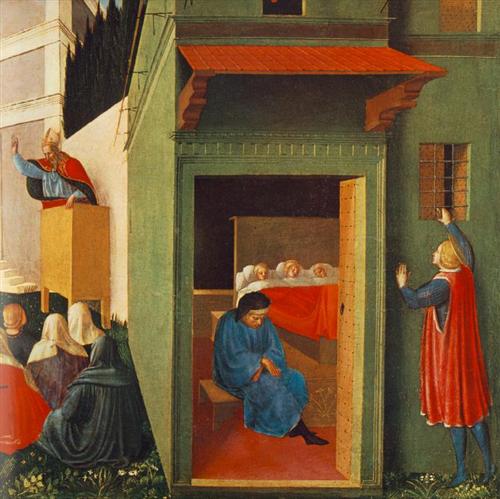
Did you ever wonder why pawnbrokers have three golden balls as their symbol? It is because St. Nicholas is their patron saint, and the three golden balls remind all people of the three poor girls, who could not get married as they had no dowries.

This story is also why we give chocolate coins covered in gold foil to each other on this day.


Here is the story.  A man, who was a widower, had three daughters of marrying age. But, in those days, a young woman could not get married without a dowry. In fact, the father was worried the girls would have to be sold into slavery in order to eat and live. St. Nicholas heard of the plight of this man and his girls, so one night, he threw a bag of gold through the window of the small house for the oldest girl. The next morning, they found the bag of gold coins. Immediately, the oldest girl danced about the room, singing praises to God. After she hugged her sisters and father, the father went to the intended man with the dowry and plans were made for the wedding.

That night, St. Nicholas threw another bag of gold through the window for the second daughter's dowry. When the household awoke, the second girl picked up the bag and sank to her knees. Now, she could marry the young man of her choice, a man who had been secretly praying for a dowry for her. Remember, fathers would not consent to their sons getting married without the dowries.

Can you imagine the anxiety of the third girl, who was wondering whether she would get a bag of gold for her dowry? This child wanted to know from where the money came, so at midnight, when St. Nicholas threw the third bag of gold through the open window, the youngest daughter got up quietly and looked out the door. She saw St. Nicholas rushing through the small alleyway which led away from their house. Now, she knew. She woke up her father and sisters, showed them the money, and they all knelt down and thanked God for St. Nicholas' goodness and generosity.


Needless to say, the father went to St. Nicholas to thank him, but St. Nicholas kept his eyes on the floor and said nothing.

However, I like to think that the girls had a triple wedding, which the town talked about for years and years.

Such is yet one more story for this happy feast day of St. Nicholas. I use to read this story to my son before he could read it himself. God bless all homeschooling mums today, and God bless all women who are overlooked for marriage because they are poor. Yes, this happens. May St. Nicholas provide for all of you today.

More thoughts on the day may be found here...
http://guildofblessedtitus.blogspot.com/2014/12/st-nicholas-day-thoughts.html