
Sunday, 3 March 2013
Doctors of the Church series resumes tomorrow
Apologies, I have an eye infection and being on the computer is difficult. Pray for me and I shall do more writing tomorrow. Thank you.


From Fr.Z, Arinze on Mortal Sin
http://wdtprs.com/blog/2013/03/dont-believe-in-mortal-sin-card-arinze-explains-the-situation-to-you/
"Judas on only betrayed Christ once."
And was condemned.
"Judas on only betrayed Christ once."
And was condemned.
.jpg)
On discernment and prudential judgement
Let me start with prudential judgement.
The CCC states this about prudence:
1806 Prudence is the virtue that disposes practical reason to discern our true good in every circumstance and to choose the right means of achieving it; “the prudent man looks where he is going.” “Keep sane and sober for your prayers.” Prudence is “right reason in action,” writes St. Thomas Aquinas, following Aristotle. It is not to be confused with timidity or fear, nor with duplicity or dissimulation. It is called auriga virtutum (the charioteer of the virtues); it guides the other virtues by setting rule and measure. It is prudence that immediately guides the judgment of conscience. The prudent man determines and directs his conduct in accordance with this judgment. With the help of this virtue we apply moral principles to particular cases without error and overcome doubts about the good to achieve and the evil to avoid.
When we need to apply reason which is right, that is formed by a Catholic conscience and steeped in Catholic teaching, to a certain situation, that is when we use prudential judgement.
One cannot merely decide on any moral issue with feelings or fear, but only with clear reason based on the virtue of prudence.
Most issues, except doctrines, dogmas and sins which are intrinsically evil, allow for some prudential judgement.
I can decide yes or no to go to a restaurant on Sunday with my TLM friends after Mass. I cannot use prudential judgement regarding having or helping an abortion.
I can use prudential judgement as to believing in some private revelations of the saints, but not in believing in the Immaculate Conception, which is a teaching of the Church-a dogma.
Discernment is another gift given to us by the Holy Ghost and is connected to prudence and part of the gift of wisdom.
Discernment helps us understand right from wrong and flows from a well-formed conscience.
I think that discernment comes from self-knowledge.
If one is humble and acknowledges sin in one's self, discernment grows, becomes more keen.
Habitual sinners of serious sin lose discernment.
They lose the ability to judge wisely.
They lost the ability to sense and see right from wrong.
The closer one gets to God, the more clear one sees spiritual realities, like sin, virtue, one's vocation in life.
One must become objective. One cannot be a saint without objectivity. I must be able to look in the mirror and see what is real and true.
A saint must be rational. A saint must be peaceful and reflective.
Discernment helps bring about clarity and clarity creates more discernment.
Discernment includes discerment of spirits and one of the simplest summaries is found in the Catholic Encyclopedia on line.
An excellent lesson is that given by St. Ignatius Loyola in his "Spiritual Exercises". Here we find rules for the discernment of spirits and, being clearly and briefly formulated, these rules indicate a secure course, containing in embryo all that is included in the more extensive treatises of later date. For a complete explanation of them the best commentaries on the "Exercises" of St. Ignatius may be consulted. Of the rules transmitted to us by a saint inspired by Divine light and a learned psychologist taught by personal experience, it will suffice to recall the principal ones. Ignatius gives two kinds and we must call attention to the fact that in the second category, according to some opinions, he sometimes considers a more delicate discernment of spirits adapted to the extraordinary course of mysticism. Be that as it may, he begins by enunciating this clear principle, that both the good and the evil spirit act upon a soul according to the attitude it assumes toward them. If it pose as their friend, they flatter it; if to resist them, they torment it. But the evil spirit speaks only to the imagination and the senses, whereas the good spirit acts upon reason and conscience. The evil labours to excite concupiscence, the good to intensify love for God. Of course it may happen that a perfectly well-disposed soul suffers from the attacks of the devil deprived of the sustaining consolations of the good angel; but this is only a temporary trial the passing of which must be awaited in patience and humility. St. Ignatius also teaches us to distinguish the spirits by their mode of action and by the end they seek. Without any preceding cause, that is to say, suddenly, without previous knowledge or sentiment, God alone, by virtue of His sovereign dominion, can flood the soul with light and joy. But if there has been a preceding cause, either the good or the bad angel may be the author of the consolation; this remains to be judged from the consequences. As the good angel's object is the welfare of the soul and the bad angel's its defects or unhappiness, if, in the progress of our thoughts all is well and tends to good there is no occasion for uneasiness; on the contrary, if we perceive any deviation whatsoever towards evil or even a slight unpleasant agitation, there is reason to fear. Such, then, is the substance of these brief rules which are nevertheless so greatly admired by the masters of the spiritual life. Although requiring an authorized explanation, when well understood, they act as a preservative against many illusions.
To be continued...
To be continued...
Saturday, 2 March 2013
Shoes
Ok, since thousands of people are talking about and showing Benedict's new shoes, I thought I would show you my new shoes.
 I feel silly today.

I want a pope.........Instaurare Omnia in Christo, "to restore all things in Christ."
After many conversations this week with good Catholics, it is clear that we need leaders in the intellectual life of the Church.
Piety is just not enough. Too many of the laity are stuck in piety. They have not developed an adult faith.
We need another scholar pope. Pastoral is not enough.
We need priests who know how to interpret the Scripture from the Catholic point of view.
We need intellectual priests to help us all with apologetics and evangelizing.
We need nuns who have vision for the future because they know the past.
I know of fantastic Catholic libraries which no one touches, elegant books gathering dust.
The tradition of the ages is being lost daily with Religion-Lite.
We no longer need Religion-Lite.
We do not need popular priests, or popular bishops or media popular cardinals.
We need seriously holy men at the top, in the middle and at the bottom of the hierarchical ladder.
We need mature men, with experience not merely with people but with God.
I want a new pope who is, first of all, a man of prayer.
I want a pope who is a saint, like St. Pius X.
Piety is just not enough. Too many of the laity are stuck in piety. They have not developed an adult faith.
We need another scholar pope. Pastoral is not enough.
We need priests who know how to interpret the Scripture from the Catholic point of view.
We need intellectual priests to help us all with apologetics and evangelizing.
We need nuns who have vision for the future because they know the past.
I know of fantastic Catholic libraries which no one touches, elegant books gathering dust.
The tradition of the ages is being lost daily with Religion-Lite.
We no longer need Religion-Lite.
We do not need popular priests, or popular bishops or media popular cardinals.
We need seriously holy men at the top, in the middle and at the bottom of the hierarchical ladder.
We need mature men, with experience not merely with people but with God.
I want a new pope who is, first of all, a man of prayer.
I want a pope who is a saint, like St. Pius X.
 |
| Thanks to Wiki |
Part 65: DoC: Augustine and Perfection

Continuing with the great Augustine, I am going to look at one small quotation from the same source as yesterday.
II. "We must next ask," he says, "whether sin comes from will, or from necessity? If from necessity, it is not sin; if from will, it can be avoided." We answer as before; and in order that we may be healed, we pray to Him to whom it is said in the psalm: "Lead Thou me out of my necessities."
I do not need the red type here.
I want to pull apart this small idea and show how it is connected to the pursuit of perfection.
Firstly, the term necessity is one you have seen before on this blog. If we do something out of our own needs, then the thing we do is imperfect. This does not mean it is "wrong", but necessity brings with it selfishness and self-interest. If the necessity is a serious flaw, it causes serious sin.
For example, if I love someone out of my own limitations, wanting someone else to complete me, I am not loving that person freely. If I am healed, and note that Augustine uses that term, then I am freed from need.
This is possible. I think some married couples who have been married for a long time move from eros to philos then to agape, and finally,caritas, that is, pure love. I have referred to this last year when writing about Benedict, Pope Emeritus' encyclical on love.
Caritas is loving someone for the sake of God alone.
That type of love is not connected to self, but transcends the self.
Can we experience this? Yes, absolutely.
But, and this is the second big point here, only though God is this type of freedom to love purely possible.
Augustine moved from very carnal and selfish love to a sublime love of God.
For him, this happened through suffering. Perhaps that is the way for most of us.
The soul becomes ordered once necessities are both repented of and healed.
I know of a young woman who did not want to love a man and was not open to a relationship.
She had been hurt to many times. She was closed to real love. I felt sorry for her.

But, she needed to be healed and this is not a psychological game, but an interior purifying which only God can do. But, one must face the pain of loss and rejection in order to obtain the purity of heart which opens one up to God.
The purgation state cleanses us of self. The illumination which follows sheds light into our soul and shows us the habits which cause the sin and the imperfections. That is the grace of light. God wants to heal all those things.
St. Augustine fought the love of God for a long time. He kept running away. Finally, he stopped. His passion for love was purified so that he could love God not out of necessity, but out of freedom.
How wonderful it is to love someone, or Someone, freely.
Pray that God leads you out of necessity. Then, you will really know love. And, Love is a Person.
To be continued....
Part 64: DoC: Augustine and Perfection--Can One Not Sin?

CHAP. XX. (43.) NO MAN IS ASSISTED UNLESS HE DOES HIMSELF ALSO WORK. OUR COURSE IS A CONSTANT PROGRESS.
But what is the import of the last statement which he has made: "If any one say, 'May it possibly be that a man sin not even in word?' then the answer," says he, "which must be given is, 'Quite possible, if God so will; and God does so will, therefore it is possible.'" See how unwilling he was to say, "If God give His help, then it would be possible;" and yet the Psalmist thus addresses God: "Be Thou my helper, forsake me not;" where of course help is not sought for procuring bodily advantages and avoiding bodily evils, but for practising and fulfilling righteousness.
The point here is that anything is possible with God. St. Mary never sinned and was conceived without sin. St. John the Baptist was cleansed of Original Sin in the womb.
Righteousness or justice, that is, purity in the eyes of God, derives grace in and from His Will for us.
Now, this is a great insight of Augustine's. It is OUR FAITH OR LACK OF FAITH which determines our perfection.
If we believe that God wants us to be perfect and if we cooperate with that grace, then we shall be.
If we do not believe, this perfection will not happen as God intended. We shall fall short of His ideal. We have free will either to answer the call to perfection or NOT.
Hence it is that we say: "Lead us not into temptation, but deliver us from evil." Now no man is assisted unless he also himself does something; assisted, however, he is, if he prays, if he believes, if he is "called according to God's purpose;" for "whom He did fore-know, He also did predestinate to be conformed to the image of His Son, that He might be the first-born among many brethren. Moreover, whom He did predestinate, them He also called; and whom He called, them He also justified; and whom He justified, them He also glorified."
You who are reading this are already on the way. Take heart. You would not be reading and pondering these words of Augustine is you were not called.

We run, therefore, whenever we make advance; and our wholeness runs with us in our advance (just as a sore is said to run when the wound is in process of a sound and careful treatment), in order that we may be in every respect perfect, without any infirmity of sin whatever,--a result which God not only wishes, but even causes and helps us to accomplish.
Here it is again--the call, to get rid, with God's help of any imperfection and all sin!
And this God's grace does, in co-operation with ourselves, through Jesus Christ our Lord, as well by commandments, sacraments, and examples, as by His Holy Spirit also; through whom there is hiddenly shed abroad in our heads that love, "which maketh intercession for us with groanings which cannot be uttered," until wholeness and salvation be perfected in us, and God be manifested to us as He will be seen in His eternal truth.
 |
| Tagaste |
Remember, that in baptism and confirmation, we have the Indwelling of the Holy Spirit. More than just the Holy Spirit (just!), we have the Indwelling of the Trinity.
The Triune God is with us....recall the words of the Mass.
Through him, and with him, and in him,
O God, almighty Father,
in the unity of the Holy Spirit,
all glory and honor is yours,
for ever and ever.
To be continued...
Part 63: DoC Series: Augustine and Perfection
 |
| Augustine in his monastery and with the Christ Child |
from A TREATISE CONCERNING MAN'S PERFECTION IN RIGHTEOUSNESS,
BY AURELIUS AUGUSTIN, BISHOP OF HIPPO;
IN ONE BOOK,
ADDRESSED TO EUTROPIUS AND PAULUS, A.D. 415. found here and my comments are in dark red.
There are still some people who deny that we are called to perfection.
They think that we are just supposed to "get by". There is no just getting by the Lord.
CHAP. IX. (20.) WHO MAY BE SAID TO WALK WITHOUT SPOT; DAMNABLE AND VENIAL SINS.
Having premised these remarks, let us carefully attend to the passages which he whom we are answering has produced, as if we ourselves had quoted them. "In Deuteronomy, 'Thou shalt be perfect before the Lord thy God.' Again, in the same book, 'There shall be not an imperfect man among the sons of Israel.' In like manner the Saviour says in the Gospel, Be ye perfect, even as your Father which is in heaven is perfect.' So the apostle, in his second Epistle to the Corinthians, says: 'Finally, brethren, farewell. Be perfect.' Again, to the Colossians he writes: 'Warning every man, and teaching every man in all wisdom, that we may present every man perfect in Christ.' And so to the Philippians: 'Do all things without murmurings and disputings, that ye may be blameless, and harmless, as the immaculate sons of God.' In like manner to the Ephesians he writes: 'Blessed be the God and father of our Lord Jesus Christ, who hath blessed us with all spiritual blessings in heavenly places in Christ; according as He hath chosen us in Him before the foundation of the world, that we should be holy and blameless before Him.' Then again to the Colossians he says in another passage: 'And you, that were sometime alienated, and enemies in your mind by wicked works, yet now hath He reconciled in the body of His flesh through death; present yourselves holy and unblameable and unreprovable in His sight.' In the same strain, he says to the Ephesians: 'That He might present to Himself a glorious Church, not having spot, or wrinkle, or any such thing but that it should be holy and without blemish. So in his first Epistle to the Corinthians he says 'Be ye sober, and righteous, and sin not.' So again in the Epistle of St. Peter it is written 'Wherefore gird up the loins of your mind, be sober, and hope to the end, for the grace that is offered to you: . . . as obedient children, not fashioning yourselves according to the former lusts in your ignorance: but as He who hath called you is holy, so be ye holy in all manner of conversation; because it is written, Be ye holy; for I am holy.' Whence blessed David likewise says: 'O Lord, who shall sojourn in Thy tabernacle, or who shall rest on Thy holy mountain? He that walketh without blame, and worketh righteousness.' And in another passage: 'I shall be blameless with Him.'
 |
| The Death of Monica |
The entire section above I have put in bold and may be considered a summary of all I have posted so far on perfection.
Christ calls us and gives us the grace. He does the work, if we merely cooperate.
And yet again: 'Blessed are the blameless in the way, who walk in the law of the Lord.' To the same effect it is written in Solomon: 'The Lord loveth holy hearts, and all they that are blameless are acceptable unto Him.'" Now some of these passages exhort men who are running their course that they run perfectly; others refer to the end thereof, that men may reach forward to it as they run. He, however, is not unreasonably said to walk blamelessly, not who has already reached the end of his journey, but who is pressing on towards the end in a blameless manner, free from damnable sins, and at the same time not neglecting to cleanse by almsgiving such sins as are venial.
 |
| The Funeral of St. Augustine. all photos from Apsidal chapel, Sant'Agostino, San Gimignano |
Remember, dear readers, a long time ago last year, when I started this series, I wrote that God wanted us free not only from mortal sin, but from venial sin, and, in fact, those imperfections which hold us back.
The passage below fills us with hope.
For the way in which we walk, that is, the road by which we reach perfection, is cleansed by clean prayer. That, however, is a clean prayer in which we say in truth, "Forgive us, as we ourselves forgive." So that, as there is nothing censured when blame is not imputed, we may hold on our course to perfection without censure, in a word, blamelessly; and in this perfect state, when we arrive at it at last, we shall find that there is absolutely nothing which requires cleansing by forgiveness.
The object is not merely to avoid purgatory, (I think some people do not believe in purgatory), but to build up the Body of Christ, the Church, through the gifts and insights and graces released after those purgative states. Only those actions which are done in the states following purgative state are those of God and not of our own needs and weaknesses. At the Illuminative State, our works are those totally in the Will of God and of His planning and grace. No wonder so many projects in the Church fail-these are human and not Divine.
To be continued....
Friday, 1 March 2013
Odds and Ends and the Attic Treasures.....Poll Results....

I find it odd that when I had the poll for which posts people liked the most, on the top deck were the lives of the saints and martyrs, and the perfection series. However, since I have been highlighting those two areas, my numbers of readers has gone done, and the number of comments has plummeted.


Either those who voted were not representative of the silent majority, or people are too busy to read, or I am still not meeting needs.
However, in the next few weeks, I shall continue the Doctors of the Church and perfection series, do saints, and cover all the papal news.

I have not written about socialism, as I am taking a break from the evil geniuses, such as Gramsci and others.
So, if any of you want to make a comment, I am open to input.
By the way, did anyone else have the set of Junior Classics with which I grew up? Just wondering...
I had almost all of the original set. Guess what my favourite fairy tale is?.
Pax.
The shoes seen round the world...

Benedict, Pope Emeritus, has new shoes. No, these are not red, but burgundy.
Here is the story and some of the photos.
http://www.npr.org/blogs/thetwo-way/2013/03/01/173183720/the-pope-emeritus-new-shoes-and-the-mexican-man-who-makes-them


Part 62: DoC and Perfection: St. Augustine of Hippo
One forgets the world of St. Augustine was very much like ours today.
He grew up and went to a classical school.
He went to the theatre most likely in or near Tagaste (Thagaste).
He went to the University at Carthage and went to the Roman baths there.
He was a man of the world.
He understood, from first-hand, as we see in his masterpiece, the two cities: the City of God and the City of Man.
He was a citizen of both at one time of his life.
He went to Rome to teach rhetoric. He went to Milan.
Then, all changed and he became a Catholic. Then, a monk.
People forget that he lived in a community and took vows. He then was ordained and became a bishop.
Above all, his scholarship shows the genius that he was. but a genius with all the struggles and temptations found in the City of Man.
Perhaps more than any of those Doctors I have highlighted here on this blog so far, Augustine speaks to us today.
We are on the edge of the ruin of Western Civilization. We are heading into neo-barbarism.
The Fall of Rome marked a time of the end of civilization and culture which was taken for granted by millions of people. The barbarian culture was not one of civilization.
But, the rot in the culture of Rome led to the relatively easy take over the the City of Man.
God had a plan. The City of God was to grow even more out of pain and suffering-the ashes of the great pagan civilization. And, a New Rome was built on the ruins of the old.
Even on, especially on the edge of destruction of all we have taken for granted, is the way of perfection needed. Do not wait, do not procrastinate.
Augustine could have said no to the way of perfection. He could have run away from the hard way.
When he was in his garden, he heard child-like voice saying this,
"Take and read". He was led to this passage in St. Paul in Romans:
"Not in rioting and drunkenness, not in chambering and wantonness, not in strife and envying, but put on the Lord Jesus Christ, and make no provision for the flesh to fulfill the lusts thereof"
Even though Augustine was consecrated and appointed Bishop of Hippo, he lived in a monastic lifestyle.
He is called the patron saint of the "regular clergy" which is very interesting.
The way of perfection is for all of us. We only need to say yes.
He grew up and went to a classical school.
He went to the theatre most likely in or near Tagaste (Thagaste).
He went to the University at Carthage and went to the Roman baths there.
 |
| Augustine at Tagaste all from the Apsidal chapel, Sant'Agostino, San Gimignano |
He was a man of the world.
He understood, from first-hand, as we see in his masterpiece, the two cities: the City of God and the City of Man.
He was a citizen of both at one time of his life.
He went to Rome to teach rhetoric. He went to Milan.
 |
| Augustine on his way to Rome to teach |
Then, all changed and he became a Catholic. Then, a monk.
People forget that he lived in a community and took vows. He then was ordained and became a bishop.
Above all, his scholarship shows the genius that he was. but a genius with all the struggles and temptations found in the City of Man.
Perhaps more than any of those Doctors I have highlighted here on this blog so far, Augustine speaks to us today.
 |
| Augustine teaching in Rome |
We are on the edge of the ruin of Western Civilization. We are heading into neo-barbarism.
The Fall of Rome marked a time of the end of civilization and culture which was taken for granted by millions of people. The barbarian culture was not one of civilization.
 |
| Augustine reading St. Paul |
But, the rot in the culture of Rome led to the relatively easy take over the the City of Man.
God had a plan. The City of God was to grow even more out of pain and suffering-the ashes of the great pagan civilization. And, a New Rome was built on the ruins of the old.
Even on, especially on the edge of destruction of all we have taken for granted, is the way of perfection needed. Do not wait, do not procrastinate.
Augustine could have said no to the way of perfection. He could have run away from the hard way.
When he was in his garden, he heard child-like voice saying this,
"Take and read". He was led to this passage in St. Paul in Romans:
"Not in rioting and drunkenness, not in chambering and wantonness, not in strife and envying, but put on the Lord Jesus Christ, and make no provision for the flesh to fulfill the lusts thereof"
Even though Augustine was consecrated and appointed Bishop of Hippo, he lived in a monastic lifestyle.
He is called the patron saint of the "regular clergy" which is very interesting.
The way of perfection is for all of us. We only need to say yes.
 |
| The Baptism of Augustine by St. Ambrose |
A Room with a View: DoC: Part 61; Continuation of St. Augustine
Our last pope, Benedict XVI, is a great Augustinian scholar. I am sure he will have time to read this Doctor of the Church in the next two months, with this room with a view, if Benedict so desires.
 |
| Thagaste, birthplace of Augustine |
As with the other Doctors, St. Augustine has written much on perfection. I can only highlight a few sections in the next few days.
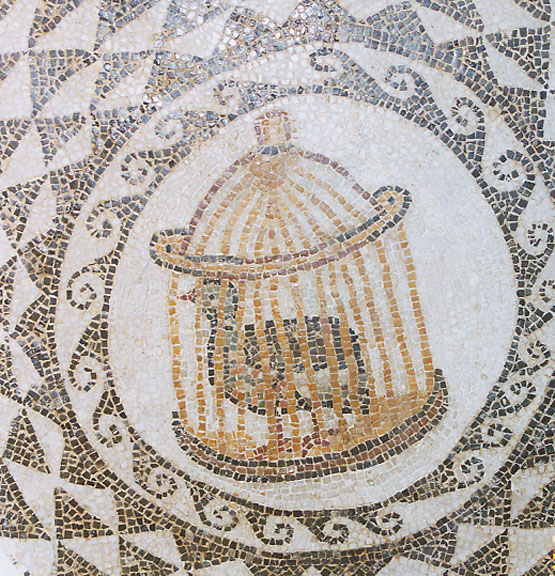 |
| Roman mosaic from ruins of Carthage, not to far from Hippo |
Looking at a sermon of St. Augustine's (his works took over long aisles in the Notre Dame library when I was there), one can perceive this dialectic in his thought. In this perfection series, I am addressing the laity, so that we can understand our way to God.
| Tractate on John's Gospel (Tract. 124, 5, 7: CCL 36, 685-687) My comments are in non-italics. |
There are two ways of life that God has commended to the Church. One is through faith, the other is through vision. One is in pilgrimage through a foreign land, the other is in our eternal home; one in labour, the other in repose; one in a journey to our homeland, the other in that land itself; one in action, the other in the fruits of contemplation.
Here, in this dualism, one sees the day of work and prayer, so loved by the Benedictines. But, the lay path to perfection is similar: work and prayer.
The first life, the life of action, is personified by the Apostle Peter; the contemplative life, by John. The first life is passed here on earth until the end of time, when it reaches its completion; the second is not fulfilled until the end of the world, but in the world to come it lasts for ever. For this reason Peter is told “Follow me”, but Jesus adds, “If I want John to stay behind till I come, what does it matter to you? You are to follow me”.
I have referred to this on line before. The progress is from purgation to action to contemplation. But, without the purgation, our actions are no more than vain operations of our own necessities, rather than the work of God.
You are to follow me by imitating me in the enduring suffering; he is to remain till I come to restore the blessings that last for ever. To put it more clearly: let action, which is complete in itself, follow me and follow the example of my passion; but let contemplation, which has only begun, remain until I come, wait until the moment of its completion.
This is subtle: suffering is the purgation of the mind, body, soul, and will. Action must follow this, must follow the Passion, and contemplation will follow. Now, Christ comes to us at death, but He also comes to us in our daily lives, if we allow Him to enter into these lives.
Sometimes, He enters like lightening, striking the very core of our beings. Sometimes, he comes like the soft wind in the Old Testament. But, if one is open, He responds to that open heart, soul, mind and will.
It is the fulness of patience to follow Christ loyally even to death; the fulness of knowledge lies in wait until Christ comes again, when it will be revealed and made manifest. The ills of this world are endured in the land of the dying; the good gifts of God will be revealed in the land of the living. We should not understand “I want him to stay behind until I come” as meaning to remain permanently but rather to wait: what is signified by John will not be fulfilled now, but it will be fulfilled, when Christ comes. On the other hand, what is signified by Peter, to whom Jesus says “follow me”, must be realised now or it will never be fulfilled.
The boldness of this statement is keen. One is asked to follow Christ and if one is baptized, that promise has already been made in one's life. The now is all one has to follow Christ. One has NO other time, but the now.
But we should not separate these great apostles. They were both part of the present life symbolized by Peter and they were both part of the future life symbolized by John.
Considered as symbols, Peter followed Christ and John remained; but in their living faith both endured the evils of the present life and both looked forward to the future blessings of the coming life of joy.
Peter was crucified on the upside down cross. He followed the way of perfection through martyrdom. John, who experienced the Death of Christ on the Cross by staying with Him on Golgotha, did not die a martyr, but was exiled. Sometimes, one has to choose exile, self-exile, like Benedict has done.
It is not they alone that do this but the whole of the holy Church, the bride of Christ, who needs to be rescued from the trials of the present and to be brought to safety in the joys of the future. Individually, Peter and John represent these two lives, the present and the future; but both journeyed in faith through this temporal life and both will enjoy the second life by vision, eternally.
What we do, each one of us, we do for Christ's Bride, the Church. As seen in the passage below, each one of us has a call. Peter was married, had a business; he followed Christ's call. John was celibate, and had a special love for Christ. He is like Bernard and Augustine.
All the faithful form an integral part of the body of Christ, and therefore, so that they may be steered through the perilous seas of this present life, Peter, first among the Apostles, has received the keys of the kingdom of heaven, to bind and loose from sin. And also for the sake of the faithful, so that they may keep the still and secret heart of his mode of life, John the evangelist rested on Christ’s breast.
It is not Peter alone who binds and looses sins, but the whole Church. It is not John alone who has drunk at the fountain of the Lord’s breast and pours forth what he had drunk in his teaching of the Word being God in the beginning, God with God, of the Trinity and Unity of God — of all those things which we shall see face to face in his kingdom but now, before the Lord comes, we see only in images and reflections — not John alone, for the Lord himself spreads John’s gospel throughout the world, giving everyone to drink as much as he is capable of absorbing.
This is key. Let God purify you so that you can absorb all that is to be in your lives...
We are all called to perfection. To be continued....
|


Your time is not your own...
| The shut doors at Castel Gandolfo |
I have been thinking about what it means to be given time. Time is a gift.
The quotation I put on this blog last night, which Benedict said at his last Angelus address refers to the fact that we must have priorities regarding time.
Here is the quotation of Benedict repeated--"Loving the church also means having the courage to make tough choices, suffering, having always before you the good of the church and not yourself."
 |
| New stamp-Sede Vacante |
Benedict loves the Church and only wants to serve the Church. These should be motives for all of our lives.
When I had an adult re-conversion at the age of 22, one of the gifts I was given was great love for Holy Mother Church.
As baptized Catholics, we are given this gift, but sometimes we lose it, by an over-critical spirit, or cynicism, or sin.
Benedict calls us to glorify God no matter what we do, large or small. Sometimes the small is very small.
We are only given a short space of time on earth. Our priorities must follow the knowledge that when we die, we must give an account to God, as did the men in the story of the talents, as to what we did with time and talents.
These thoughts are not about diocesan programs or self-help books. These thoughts look toward perfection, the cooperation with grace.
Your time is not your own....
Prayer for a New Pope
The collect of the Missal for the election of a Pope from AngelQueen...
O Lord, with suppliant humility, we entreat Thee,
that in Thy boundless mercy Thou wouldst grant the most holy Roman Church a pontiff,
who by his zeal for us, may be pleasing to Thee,
and by his good government may ever be honoured by Thy people for the glory of Thy name. Through Our Lord Jesus Christ.
V/ Most Sorrowful and Immaculate Heart of Mary,
R/ pray for us who have recourse to Thee!
V/ Saint Pie V.
R/ pray for us.
V/ Saint Pie X.
R/ pray for us.
By the way, I made a mistake a few days ago, and the General Meetings start on March 4th at 9:30 am, not the conclave. Hopefully, the conclave will follow soon after those meetings.
that in Thy boundless mercy Thou wouldst grant the most holy Roman Church a pontiff,
who by his zeal for us, may be pleasing to Thee,
and by his good government may ever be honoured by Thy people for the glory of Thy name. Through Our Lord Jesus Christ.
V/ Most Sorrowful and Immaculate Heart of Mary,
R/ pray for us who have recourse to Thee!
V/ Saint Pie V.
R/ pray for us.
V/ Saint Pie X.
R/ pray for us.
Ah, Hollande, again....not a class act
http://www.thelocal.fr/page/view/hollande-under-fire-after-making-pope-joke#.US_jI8YqyZw.twitter
My Grandma use to say, "You can't make a silk purse out of a sow's ear".

My Grandma use to say, "You can't make a silk purse out of a sow's ear".
Happy St. David's Day

To all the Welsh, happy national holyday
My favourite poet and painter is David Jones.

Wear a leek in your hat and give daffodils today.
from wiki
St David (Welsh: Dewi Sant) was born towards the end of the fifth century. He was a scion of the royal house of Ceredigion, and founded a Celtic monastic community at Glyn Rhosyn (The Vale of Roses) on the western headland of Pembrokeshire (Sir Benfro), at the spot where St David's Cathedral stands today. David's fame as a teacher and ascetic spread throughout the Celtic world. His foundation at Glyn Rhosin became an important Christian shrine, and the most important centre in Wales. The date of Dewi Sant's death is recorded as 1 March, but the year is uncertain – possibly 588. As his tearful monks prepared for his death St David uttered these words: 'Brothers be ye constant. The yoke which with single mind ye have taken, bear ye to the end; and whatsoever ye have seen with me and heard, keep and fulfil'.
Subscribe to:
Posts (Atom)