Recent Posts

Monday, 3 June 2013

On the Second Conversion Again

There seems to be few people who understand the second conversion. I have tried to explain it and will try again, as it is an important milestone on the way to perfection. It opens the door for the passive purgation. Without the second conversion, one is not yet working for God, but only for one's self.

The second conversion is the beginning of the complete dying to self. Without this dynamic death, there is no union with God.

One gives up all of one's ideas of who one is and what one should do. It is all about being and not doing.


This process started for me in Missouri in 2009, when I had cancer and studied the word of Teresa of Avila and Catherine of Siena in my convalescence, beginning to understand the radical change one must allow God to do in order to be new. I lost many things, a job, possessions, even the love of some family members, not one who visited me when I had cancer.  Then in Malta, in 2011, when I began to beg God daily for a change of heart, I experienced the evil of venial sin and imperfections in the sight of God.  I got sidetracked, but the Holy Spirit continued in both stints in the monastery, when my will was under that of obedience, to destroy my self-will. Then, one day, one no longer has any knowledge of one's self and loses all concept of who one is. One is like a tabula rasa. a new creation, only desiring passionately Christ and His Will. The second conversion is dramatic, and usually comes for nuns at the time of the novitiate. One no longer has a will except in Christ. One refers all one does to the Will of God,and not one's self. The process is not yet finished. All the nooks and crannies where there lurks bits of my self-love and self-will must be purged. I will this daily.

In the world, it is much harder to stay focused, as one is constantly driven from this process by being distracted by many things. But, one must simplify one's life as much as possible to follow this path. However, all this started when I was in the world and I am in the world again, 

Contemplative prayer and simplicity are essential. One can interrupt the process and have to start all over again, although God is patient, He stands and waits for us.


The great advantage in the monastery is that one is surrounded by women who have experienced this and are only doing God's Will. This strengthens one, to be surrounded by those who have said yes to God. I looked up one day at dinner and realized I was surrounded by Brides of Christ. I was overwhelmed with love for them for His Sake.

In the world, it is almost impossible to find such people. I am praying for two other women to join me on this journey, just two. Join me in prayer, please.

All Catholics, not just nuns and priests, are called to this second conversion.

One has many examples to see what it means in lay people in the Old Testament: the akedah of Abraham (I wrote a poem on this in the early '80s and it was published, but I do not have it here); the years in the desert of Moses; the encounter of Nathan and David over Bathsheba, and the death of the baby; the following of Ruth with Naomi and her entrance into a foreign land in obedience and love; the death of the wife of Jeremiah; the purging of Job, and so on.

The Holy Spirit is already present in the first conversion, but the second kills the will.

Pray, think, reflect, act....until the passive purgation, when God does all the work. Love is the answer, as it was for Ruth when she decided to go with Naomi.


Here is a nice description of the second conversion of Teresa of Avila. Beg for it. Beg to serve and love God with all your heart, your mind and your soul. This is only another beginning, and far from the end.


Teresa began her novitiate with great zeal, continued in it, and ended by taking upon herself the usual vows. Some time later, however, she once more lost her fervor in the service of God, because she conversed too long and too often with people of the world and thus neglected her prayers and lost her love for devout exercises. One day, going into church to pray, her eyes fell upon a picture of Our Savior representing Him covered with wounds. At the same moment, her inmost soul was deeply moved by the thought that Christ had suffered so much for her, and that she had hitherto been so ungrateful and disobedient to Him. Her heart became so filled with grief, that it seemed to her as if it would break. Hence, sinking down before the image, she began to weep bitterly over her inconstancy, and said, with the most perfect trust: "Lord, I will not rise from the ground, until Thou hast bestowed sufficient strength on me, not to sin in future, but to serve Thee faithfully and with my whole heart." This short but fervent prayer of Teresa was heard by the Almighty. Her heart was suddenly and forever changed; all affection for human beings was banished from it; her love of God and her delight in prayer and other spiritual exercises renewed, and the resolution taken to continue henceforth in the same. From that hour Teresa vacillated no more in the service of God, but persevered, with uninterrupted and daily increasing zeal, in the path of virtue and perfection.

One must persevere. 

God afterwards revealed to her that she owed her conversion to the intercession of St. Joseph and of the Blessed Virgin; hence she sought also to obtain the grace of perseverance by their aid. To this end, she represented frequently to herself the example of St. Magdalen and St. Augustine, and thus animated herself against a relapse. She repented daily most bitterly of the faults of her past life and endeavored to atone for them by wearing rough penitential garments, by scourging herself, and by other penances, although, according to the words of her confessors, she had not been guilty of great sin. One day, God showed her a terrible place in hell, saying that she would have been precipitated into it, if she had continued in her frivolous conversations at the convent-gate with people of the world, and in her neglect of devotional exercises. 


We all talk too much. We can relapse, as I did and get off track. The acceptance of suffering and penances help one to focus.

Her hair stood on end at this revelation, and her eagerness to serve God most faithfully and also to persuade others to do the same, was newly awakened. For this reason, she determined to use all possible means, in order to institute once more the original austerity of the Carmelites, from which, by consent of the spiritual authorities, they had somewhat departed. God Himself inspired her with these thoughts and promised her His aid in the execution of them. But as this was an undertaking which had never yet been attempted by a woman, it is easy to imagine the many and great obstacles she had to overcome. Many of the Clergy and laity opposed her plans, and she was slandered and persecuted on account of them. 

Expect this negativity, as those who do not love God first in all things, simply do not understand.

Here is St. Teresa again...

"There is only one God; if we displease Him, there is no other from whom to seek help. Man dies only once; if therefore his death is unhappy, there is no chance left to remedy the mistake. One soul only do we possess; and if this is lost, there is no hope of salvation."


And, here is the priest author again.


Teresa saw the place in hell which would have been hers, if she had not discontinued her idle discourses and her indifference in the worship of the Most High. Hence, she often gave humble thanks to God that He had not condemned her, and she learned by it how hurtful even a menial sin can become, since it may lead us gradually to the path of everlasting perdition. You have still more reason to give thanks to God that He did not call you away in your sin.


This was a great grace to see this. This is similar to being in a state of the particular judgement. 

How long would you already have been in hell? If idle, empty conversation would have led Teresa gradually into hell, what may you not have to fear if you do not abstain from so much sinful talking in which you indulge? Learn also that you should not esteem a venial sin, however small it appears to you, as trifling; for, it may slowly lead you to damnation.

We talk too much. We are caught up in stupid things, like entertainment and gourmet food. We accumulate things which distract us and take up too much time. We do not have time.

Many other lessons, which the life of St. Teresa contains, I leave to yourself to consider. One thing only I request of you. Call to mind frequently the words which the Saint uttered in her ecstasy: "Only one God! Only one death! Only one soul! "Love this only God, and do not offend Him. Take earnest care of your only, your precious, your immortal soul. "Keep thyself, therefore, and thy soul carefully." (Deut., iv.)

I also add Teresa's own account of her vision of hell and the place Satan had made for her. Found at this site...


"A long time after the Lord had already granted me many of the favors I've mentioned and other very lofty ones, while I was in prayer one day, I suddenly found that, without knowing how, I had seemingly been put in hell. I understood that the Lord wanted me to see the place the devils had prepared there for me and which I merited because of my sins. This experience took place within the shortest space of time, but even were I to live for many years I think it would be impossible for me to forget it. 

The entrance it seems to me was similar to a very long and narrow alleyway, like an oven, low and dark and confined; the floor seemed to me to consist of dirty, muddy water emitting foul stench and swarming with putrid vermin. At the end of the alleyway a hole that looked like a small cupboard was hollowed out in the wall; there I found I was placed in a cramped condition. All of this was delightful to see in comparison with what I felt there. What I have described can hardly be exaggerated.

"But as to what I then felt, I do not know where to begin if I were to describe it; it is utterly inexplicable. I felt a fire in my soul but such that I am still unable to describe it. My bodily sufferings were unendurable. I have undergone most painful sufferings in this life, and, as the physicians say, the greatest that can be borne, such as the contraction of my sinews when I was paralyzed, without speaking of other ills of different types - yet, even those of which I have spoken, inflicted on me by Satan; yet all these were as nothing in comparison with what I then felt, especially when I saw that there would be no intermission nor any end to them. 


"These sufferings were nothing in comparison with the anguish of my soul, a sense of oppression, of stifling, and of pain so acute, accompanied by so hopeless and cruel an infliction, that I know not how to speak of it. If I say that the soul is continually being torn from the body it would be nothing - for that implies the destruction of life by the hands of another - but here it is the soul itself that is tearing itself in pieces. I cannot describe that inward fire or that despair, surpassing all torments and all pain. I did not see who it was that tormented me, but I felt myself on fire, and torn to pieces, as it seemed to me; and I repeat it, this inward fire and despair are the greatest torments of all. 


"Left in that pestilential place, and utterly without the power to hope for comfort, I could neither sit nor lie down; there was no room. I was placed as it were in a hole in the wall; and those walls, terrible to look on of themselves, hemmed me in on every side. I could not breathe. There was no light, but all was thick darkness. I do not understand how it is; though there was no light, yet everything that can give pain by being seen was visible.

"Our Lord at that time would not let me see more of Hell. Afterwards I had another most fearful vision, in which I saw the punishment of certain sins. They were the most horrible to look at, but because I felt none of the pain, my terror was not so great. In the former vision Our Lord made me really feel those torments and that anguish of spirit, just as if I had been suffering them in the body there. I know not how it was, but I understood distinctly that it was a great mercy that Our Lord would have me see with my own eyes the very place from which His compassion saved me. I have listened to people speaking of these things and I have at other times dwelt on the various torments of Hell, though not often, because my soul made no progress by the way of fear; and I have read of the diverse tortures, and how the devils tear the flesh with red-hot pincers. But all is as nothing before this: It is a wholly different matter. In short, the one is a reality, the other a description; and all burning here in this life is as nothing compared with the fire that is there.

"I was so terrified by that vision - and that terror is on me even now as I write - that though it took place nearly six years ago, the natural warmth of my body is chilled by fear even now when I think of it. And so, amid all the pain and suffering which I may have had to bear, I remember no time in which I do not think that all we have to suffer in this world is as nothing. It seems to me that we complain without reason. I repeat it, this vision was one of the grandest mercies of God. It has been to me of the greatest service, because it has destroyed my fear of trouble and of the contradictions of the world, and because it has made me strong enough to bear up against them, and to give thanks to Our Lord who has been my Deliverer, as it now seems to me, from such fearful and everlasting pains.

"Ever since that time, as I was saying, everything seems endurable in comparison with one instant of suffering such as those I had then to bear in Hell. I am filled with fear when I see that, after frequently reading books which describe in some manner the pains of Hell, I was not afraid of them, nor made any account of them. Where was I? How could I possibly take any pleasure in those things which led me directly to so dreadful a place? Blessed forever be Thou, O my God! And oh, how manifest is it that Thou didst love me much more than I did love Thee! How often, O Lord, didst Thou save me from that fearful prison! And how I used to get back to it contrary to Thy will.

"It was that vision which filled me with very great distress which I felt at the sight of so many lost souls, especially of the Lutherans - for they were once members of the Church by Baptism - and also gave me the most vehement desires for the salvation of souls; for certainly I believe that to save even one from those overwhelming torments, I would willingly endure many deaths. If here on earth we see one whom we specially love in great trouble or pain, our very nature seems to bid us compassionate him; and if those pains be great, we are troubled ourselves. What, then, must it be to see a soul in danger of pain, the most grievous of all pains, forever? It is a thought no heart can bear without great anguish. Here we know that pain at last ends with life, and that there are limits to it, yet the sight of it moves us so greatly to compassion; that other pain has no ending, and I know not how we can be calm when we see Satan carry so many souls daily away.
"This also makes me wish that, in a matter which concerns us so much, we did not rest satisfied with doing less than we can do on our part - that we left nothing undone. May Our Lord vouchsafe to give us His grace for that end." 


To be continued...


A Seminarian in Rome

A virtual look at my friend Guillermo's first trip to Rome with an American group. I am sure his mother, who like me, has no husband, and gave her only son to God, is very proud. Pray for Maria, a great friend of mine, and for me.  Guillermo is a great friend of my son, and he was instrumental in encouraging Supertradson to go into the seminary.

He also was in France, as one can see from the photos at the end, in Ars and other places. The picture of the Pope is one he took at the Adoration yesterday, where the group had great seats.


On Finding and Choosing Spiritual Directors-No Nuns with Mazes, Please


I was blessed with many long years of excellent spiritual direction. That was from 1971-2001, in my twenties, thirties and forties, or so, and 2006-2010, with a hiatus in Canada, and Alaska, where the problem of finding a director was exacerbated by so many disobedient nuns and priests, and lay people who insisted on charging. I did find one excellent fssp priest for awhile.


Then, I moved to Europe again, after some absence, and could not find one at all. Confessors argued with me as to what was a sin and what was not a sin. I finally found two priests, one in Westminster and one in Surrey, who understand the road to perfection.

One of the reasons why I wanted to live in the monastery  and be a nun was for formation, found in the Benedictine Rule. It is superb. The Rule forms. The day forms. Obedience forms.

Outside the monastery, where the Rule of Benedict and the Novice Mistress direct, secular priests have been the best for me, and one great nun who was a Carmelite trained in Ignatian spirituality, and now unavailable.

There are hardly any priests or nuns trained in spiritual direction here. Why, I do not know.


I had clergy and nuns trained in Ignatian spirituality, Carmelite spirituality, Benedictine spirituality. I was fortunate to be formed by praying religious and praying clergy. I was spoiled for choice.

These men and women, of course, did not charge for spiritual direction. If someone charges for spiritual direction, this person is not doing God's Will. What is freely given should be freely given again and again and again.

Bad spiritual direction is worse than none, as a person who pursues a life of perfection will not be ignored by God.

Do not be afraid to ask. I went up to a world-famous priest when I was a student at Notre Dame and asked him to be my spiritual director. I had read many of his books. How astounded I was when he told me that no one had ever asked him to do this before! He was my director for three years.

However, here, in this fair country, there are too many lay people without training, outside of orthodoxy, and without years of theology and counseling classes who are giving direction. It is scary how many are led astray  by such self-appointed gurus. It is dangerous from a psychological point of view.

The priest shortage has brought about the need for lay people to look elsewhere for advice.

However, I have a few helpful hints in choosing a good spiritual director; this list is similar to one I posted in the past:

1) make sure the director you are choosing has a spiritual director as well.;

2) spiritual direction since the late 20th century has always been free and it should be still;

3) make sure the person has qualifications from conservative and orthodox universities, colleges, seminaries, as so many are now falsely formed themselves, lack discernment, and give bad direction; your director must be an orthodox Catholic; stay away from centers caught up in New Age stuff and nuns with mazes;

4) ask questions if you do not know the person already; go for those who have excellent reputations;

5) pray and seek, seek and pray;

6) for the lay person, Ignatian spirituality is the most practical; try and find an orthodox person trained in Ignatian spirituality; I think there is someone at the Harrington Street Latin Mass Church in Dublin who would fit the bill; maybe readers can share information on solid directors;

7) make sure the spiritual director's life is in order; if a lay person's family is in crisis, or if a priest is disobedient in one thing (as there are probably more hidden disobedience), do not choose that person;

8) steer clear of so-called Gnostic seers who claim to give direction; some of these have stepped over into the occult;

9) if you cannot find one, be humble, talk to a good Confessor, and pray for purified discernment;

10) if you are a married woman and your husband is an excellent, praying, practicing Catholic, he is your spiritual director; in fact, I do not think a married woman should seek out other directors if she is in a good marriage;

11) remember that spiritual direction is NOT psychological counseling; those who confuse this are dangerous providers.


God  bless your journey to perfection.

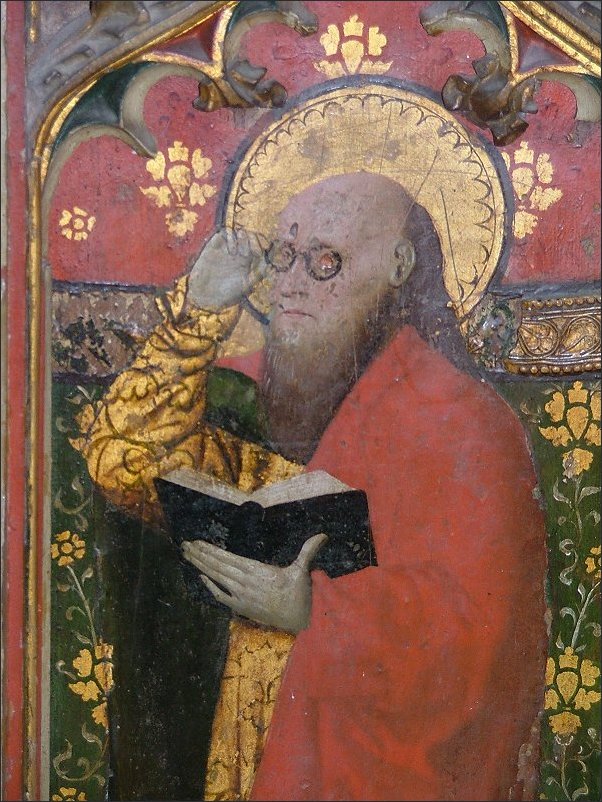
And a prayer request. As some of you know, I lost my glasses in Walsingham. I have ordered new ones, but am borrowing someone's in order to blog. I see very blurred, so excuse errors. Prayers, please, that these glasses come in sooner than expected.

I cannot see anything far and hardly anything near.  Here is a painting from St. Agnes in Cawston, Norfolk, showing St. Matthew in glasses.

This was most likely done by the Norwich Masters in the 15th century. I shall write more on this church and others with magnificent rood screens soon. More here..


Nice article on disobedience in the clergy

http://catholicsacristan.blogspot.co.uk/2013/06/canon-fire-part-three.html

Why suffering for perfection?

Thanks to Wiki for the photo of Alaskan Fireweed


So many Catholics know avoid suffering and even "hate" it.  When we really suffer, we suffer in the body, the spirit, and the emotions. Real suffering involves the entire person and that is the point. 

Suffering is the only thing which purifies our mind, heart and spirit.

Suffering is the only thing which destroys our self-will.

The wonderful John Hardon, who should be canonized, wrote this:

Expiation.  First, then, regarding expiation. There are two ways of expiating because there are really two things to expiate. Expiation is already the pursuit of holiness. Nevertheless, it is one thing to remove sin and grow in holiness thereby; it is another thing to grow in virtue and grow in holiness thereby. Expiation has to do with sin. When anyone sins the person does two things wrong. First of all, God is offended; there is a breach of the friendly relationship between the Creator and the creature, which sin either partly, or if it is grave, completely breaks. But sin also causes disorder. It is not only that God is offended, but there is havoc, damage, harm done to the person who sins and generally to many other people besides.
Consequently, when we talk about expiation, on the first level it is expiation through reparation to God. Since He has been offended, the offense must somehow be repaired. A few doublets will bring out the implication. Disobedience must be made up by obedience; dishonor by honor; indifference by respect; the turning away from God in sin must be replaced by the turning toward God by reparation. The theological term that we use referring to the turning away from God is always an “aversion” from God. “Version” means turn, so “aversion” means to turn from. And we know that this is not a movement of muscles or geographic direction; it is of the heart. Consequently, to expiate sin, one must make up with more turning towards God; where there has been a lack of love there must be more love. Expiation is, therefore, deeply personal. Where sin consists, essentially, in the love of self, it is repaired by the love of God; and if there has been more self-love in the sin committed, there must be more God-love in the reparation offered.
Second, there must also be expiation through mortification. That word has a very technical meaning. In context, it means that besides offense against God there has been disorder in the world, harm caused and injury done. There must be mortification by sacrifice of creatures where there has been indulgence of creatures. Whenever we sin, we attach ourselves to a creature to which we have no right and prefer it, either more or less or completely, to God. The essence of expiation as mortification is that we voluntarily give up a creature to which we do have a right, in order to make up for the indulgence of a creature to which we did not have a right. To miss that is to have missed a great deal.
So we have various comparatives: self-indulgence is expiated through self-denial where the denial is of things to which we have a right—otherwise it is not mortification. If we don’t have a right to the creature it cannot be called mortification because we are not to choose that creature anyway. Again, pleasure and pain: in sin we embrace a pleasure; in mortification we embrace a pain with our wills.

Sanctification.  Now, why is there suffering for sanctification? We could hardly know this except for God’s becoming man. Job struggled with it, and we know he didn’t do too good a job. The mystery was raised, but the final answer came only with Christ. We now know because of Christ that suffering can be not only expiatory, but also sanctifying. God became man to show us that it can be done and how it can be done, and of course, the fact that He did it tells us that it should be done.
The essential element in the use of suffering as a means of sanctification is that a person voluntarily accepts the suffering out of love for God. If that is not present, the whole thing is meaningless. This was Christ’s motive. So it is not merely the tolerance of suffering. We are told in revelation that “having the joy set before Him” He chose the cross by preference. Suffering must become sacrifice to be sanctifying.
This implies, at least relatively speaking, innocence in the person who suffers. In other words, the suffering he has is not that which has been brought on by his own sin. We know that we deserve a lot of suffering, but all kinds of suffering can come our way which we did not bring on ourselves and for which we are not responsible, culpable agents. That element of innocence is important. It can relieve people of much worry, so that they no longer hopelessly ask, “Why me?” That’s the first letter of the alphabet; that is precisely what Christ is teaching us. He was the absolutely sinless, innocent Lamb of God and He suffered for other people’s sins. The notion of altruism and of vicarious suffering is very close to the heart of suffering as the means of sanctification. Suffering is the much more sacrificial when we least deserve the pain we experience. That’s hard to take! When we have it coming, we say to ourselves if we’re honest, “What did you expect? The last time you met her you told her off; so now she told you off. Tit for tat.” But if someone told you off, and you have been extraordinarily kind to her, that’s where suffering for sanctification starts.

http://www.therealpresence.org/eucharst/pea/suffer.htm


Butcher, Baker, Candlestickmaker, but Catholics Need Not Apply

Well, it is becoming increasingly clear that Catholics, who are faithful in England and in some states America where SSM is allowed, will be forbidden some jobs. Those with good consciences will not be able to support SSM in any way, such as this couple, who refused to make a cake.


A Catholic with a conscience could not provide cakes, flowers, hotel rooms, rental cars, or such, to homosexuals or lesbians who think they are getting married, which they are not, as marriage is between a man and a woman.

Remember, a few days ago, I posted a link to ministers in England who said many jobs would be closed Christians once SSM is a reality. 


Already in England, bed and breakfast owners, even if the b an bs are in their own homes, cannot refuse homosexual or gay couples. And, this is the case in Hawaii as well.


My concern is that so many Catholics will compromise, as they did in the first wave of the Protestant Revolt under Henry VIII. If all Catholics had stayed firm, England would still be Catholic today. He wanted adultery to be legalized. Now, we have people who have pushed yet another aberration of marriage.

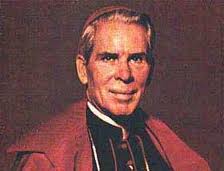
Venerable Fulton J. Sheen reminds us that tolerance is not in the list of virtues.

Statistics, superstition, and magical thinking again....


I just read a statistic that only 3% of the world's population has OCD. I must have met 1.5% of them in Great Britain and Ireland!

Superstition is part of the OCD syndrome in that those who are superstitious. Of course, spiritually  minded people can fall into superstition, but supposing an even or action is directly related in a irrational manner to another. This attitude has nothing to do with FAITH.

The CCC, my favourite book this past weekend, has something to say about superstition. It is a serious sin and deadens the virtues of faith, hope, and charity.

III. "YOU SHALL HAVE NO OTHER GODS BEFORE ME"

2110 The first commandment forbids honoring gods other than the one Lord who has revealed himself to his people. It proscribes superstition and irreligion. Superstition in some sense represents a perverse excess of religion; irreligion is the vice contrary by defect to the virtue of religion.
Superstition
2111 Superstition is the deviation of religious feeling and of the practices this feeling imposes. It can even affect the worship we offer the true God, e.g., when one attributes an importance in some way magical to certain practices otherwise lawful or necessary. To attribute the efficacy of prayers or of sacramental signs to their mere external performance, apart from the interior dispositions that they demand, is to fall into superstition.41

I have met many Catholics in Ireland and England who are superstitious and not faithful. They do not see the difference and this is connected to magical thinking. These good people are self-deceived into thinking that the externals of faith mean they are saved.

Interior disposition is ALL in real religion. The externals, such as pilgrimages, novenas, medals and other devotions cannot make up for conversion of the heart, the mind and the soul.

Why is superstition in the same category of sin as idolatry? Because one is hoping in something else rather than God Himself.

People are superstitious because it is easier to be so than to have real faith and hope.

Here is a reminder of those definitions.

 Faith
1814 Faith is the theological virtue by which we believe in God and believe all that he has said and revealed to us, and that Holy Church proposes for our belief, because he is truth itself. By faith "man freely commits his entire self to God."78 For this reason the believer seeks to know and do God's will. "The righteous shall live by faith." Living faith "work[s] through charity."79
1815 The gift of faith remains in one who has not sinned against it.80 But "faith apart from works is dead":81 when it is deprived of hope and love, faith does not fully unite the believer to Christ and does not make him a living member of his Body.
1816 The disciple of Christ must not only keep the faith and live on it, but also profess it, confidently bear witness to it, and spread it: "All however must be prepared to confess Christ before men and to follow him along the way of the Cross, amidst the persecutions which the Church never lacks."82 Service of and witness to the faith are necessary for salvation: "So every one who acknowledges me before men, I also will acknowledge before my Father who is in heaven; but whoever denies me before men, I also will deny before my Father who is in heaven."83

Hope
1817 Hope is the theological virtue by which we desire the kingdom of heaven and eternal life as our happiness, placing our trust in Christ's promises and relying not on our own strength, but on the help of the grace of the Holy Spirit. "Let us hold fast the confession of our hope without wavering, for he who promised is faithful."84 "The Holy Spirit . . . he poured out upon us richly through Jesus Christ our Savior, so that we might be justified by his grace and become heirs in hope of eternal life."85
1818 The virtue of hope responds to the aspiration to happiness which God has placed in the heart of every man; it takes up the hopes that inspire men's activities and purifies them so as to order them to the Kingdom of heaven; it keeps man from discouragement; it sustains him during times of abandonment; it opens up his heart in expectation of eternal beatitude. Buoyed up by hope, he is preserved from selfishness and led to the happiness that flows from charity.
1819 Christian hope takes up and fulfills the hope of the chosen people which has its origin and model in the hope of Abraham, who was blessed abundantly by the promises of God fulfilled in Isaac, and who was purified by the test of the sacrifice.86 "Hoping against hope, he believed, and thus became the father of many nations."87
1820 Christian hope unfolds from the beginning of Jesus' preaching in the proclamation of the beatitudes. The beatitudes raise our hope toward heaven as the new Promised Land; they trace the path that leads through the trials that await the disciples of Jesus. But through the merits of Jesus Christ and of his Passion, God keeps us in the "hope that does not disappoint."88 Hope is the "sure and steadfast anchor of the soul . . . that enters . . . where Jesus has gone as a forerunner on our behalf."89 Hope is also a weapon that protects us in the struggle of salvation: "Let us . . . put on the breastplate of faith and charity, and for a helmet the hope of salvation."90 It affords us joy even under trial: "Rejoice in your hope, be patient in tribulation."91 Hope is expressed and nourished in prayer, especially in the Our Father, the summary of everything that hope leads us to desire.
1821 We can therefore hope in the glory of heaven promised by God to those who love him and do his will.92 In every circumstance, each one of us should hope, with the grace of God, to persevere "to the end"93 and to obtain the joy of heaven, as God's eternal reward for the good works accomplished with the grace of Christ. In hope, the Church prays for "all men to be saved."94 She longs to be united with Christ, her Bridegroom, in the glory of heaven:
Hope, O my soul, hope. You know neither the day nor the hour. Watch carefully, for everything passes quickly, even though your impatience makes doubtful what is certain, and turns a very short time into a long one. Dream that the more you struggle, the more you prove the love that you bear your God, and the more you will rejoice one day with your Beloved, in a happiness and rapture that can never end.95


To be continued...


Sunday, 2 June 2013

A Phrase from the Pope's Prayer at Adoration


Today, in the Adoration in St. Peter's, the Pope said in his prayer that we should know and appreciate and remember the "benefits of redemption".

I have been pondering that term today and think that these points can be made regarding the benefits of redemption.

We, as baptized Catholics, are redeemed. We have been brought into a relationship with the Trinity and rejoice in that relationship. We are called, in our baptismal vows, to feed the virtues and grow in holiness.

This is our call , our vocation as Christians.

The Pope has reminded us today, in his prayer to Jesus, the Eucharistic Heart of Jesus, that we must love those benefits given to us through Our Lord's Passion, Death, and Resurrection.

Here are some of the benefits.

1) Freedom to be children of God and to be the persons God created us to be.

2) The Sacraments, which give us life, the life of God, and the life of God Himself, sanctifying grace.

3) The Church, as an institution, in which is our salvation, teaching and safety.

4) Community as God's People are the sign of the Presence of Christ-"See how they love one another."

To be continued...

The Universal Papal Hour of Adoration

Photo from Guillermo

Beautiful. I am sure the Dear Lord, Who loves us with an everlasting love, was pleased with the millions of prayers of love around the world today.

The results for us should be life-changing.


Blessed John Paul II on Confirmation--a long and serious preparation, please

The grace conferred by the sacrament of Confirmation is more specifically a gift of strength. The Council says that through "the sacrament of Confirmation...the Holy Spirit endows them [the baptized] with special strength" (LG 11). This gift corresponds to the need for greater zeal in facing the "spiritual battle" of faith and charity [4] , in order to resist temptation and give to the world the witness of Christian word and deed with courage, fervor and perseverance. In the sacrament, the Holy Spirit confers this zeal.
Jesus noted the danger of being ashamed to profess the faith: "Whoever is ashamed of me and of my words, the Son of Man will be ashamed of when he comes in his glory and in the glory of the Father and of the holy angels" (Lk 9:26; cf. Mk 8:38). Being ashamed of Christ is often expressed in those forms of "human respect" by which one hides one's own faith and agrees to compromises which are unacceptable for someone who wants to be Christ's true disciple. How many people, even Christians, make compromises today!
Through the sacrament of Confirmation, the Holy Spirit fills the individual with the courage to profess his faith in Christ. According to the Council text which we began with, professing this faith means "to spread the faith by word and deed" as consistent and faithful witnesses.
Since the Middle Ages, theology, which developed in a context of generous commitment of "spiritual combat" for Christ, has not hesitated to highlight the strength given by Confirmation to Christians who are called "to serve as soldiers for God." Theology continues to see in this sacrament the value of sacrifice and consecration which is included in its origin from the "fullness of Christ's grace" (cf. Summa Theol., III. q. 72, a. 1, ad 4). St. Thomas Aquinas explains the fact that Confirmation is distinguished from Baptism and comes after: "The sacrament of Confirmation is, as it were, the final completion of the sacrament of Baptism, in the sense that by Baptism (according to St. Paul) the Christian is built up into a spiritual dwelling (cf. 1 Cor 3:9), and is written like a spiritual letter (cf. 2 Cor 3:2-3); whereas by the sacrament of Confirmation, like a house already built, he is consecrated as a temple of the Holy Spirit, and as a letter already written, is signed with the sign of the cross" (Summa Theol., III, q. 72, a. 11).
As we know, there are pastoral problems regarding Confirmation, especially concerning the appropriate age for receiving this sacrament. There has been a recent tendency to delay the time of conferral until the age of fifteen to eighteen, so that the recipient's personality may be more mature and he can consciously make a more serious and stable commitment to Christian life and witness.
Others prefer a younger age. In any case, there must be hope that there will be a thorough preparation for this sacrament, which will allow those who receive it to renew their baptismal promises with full awareness of the gifts they are receiving and the obligations they are assuming. Without a long and serious preparation, they run the risk of reducing the sacrament to a mere formality or external ritual, or even losing sight of the essential sacramental aspect by insisting exclusively on the moral commitment involved.
http://www.vatican.va/holy_father/john_paul_ii/audiences/alpha/data/aud19920401en.html

Five meetings do not fall under the category of "long". 

Again and again on magical thinking with scary results...


Can I blame Walt Disney and Tinker Bell? Can I try and find a pattern as to why so many men and women in their 70s on down do not understand the theology of the sacraments?

Magical thinking seems to be the most common problem I constantly meet with Catholics regarding Baptism, Confirmation and the Last Rites.

Serious problems exist because many Catholics do not understand that the sacraments bring responsibility and must be met with responsibility.

Magical thinking is indicated by people who think that baptism of infants whose parents are either atheists, (a priest told me today that many priest baptize infants of practicing atheists and a priest in Walsingham a few years ago baptized anyone's children without preparation of any kind), or non-practicing Catholics. This is against the Canons, but indicates a lack of understanding on the part of the priests and the parents. Why would atheists, who have no intention of raising their children Catholic, desire baptism? Why would fallen away Catholics seek baptism for their children, when there is no demand that they come back into the Church or take classes?

Why do priests baptize infants and children of pagans, who will not raise their children in the Faith? I now know several priests in different dioceses who know the Canons and ignore these. Why?

Is this taught in the seminaries? Are bishops aware that this goes on in their dioceses?

Baptism takes away Original Sin and gives sanctifying grace. It makes a child an adopted child of God, and a member of the Catholic Church.

Magical thinking states that baptism saves a person once and for all-the fundamental option.

Magical thinking supposes the person stays in sanctifying grace without the sacraments or training to be a Catholic.

Why are priests baptizing babies of couples they will never see in Church again, thus putting that couple into the position breaking promises to raise the child Catholic? Why are priests not asking parents to raise the child Catholic?

Magical thinking is protestant. My attempting to talk with a few priests on this subject caused me not to be hired as a catechist in their parishes. The same magical thinking applies to Confirmation, when priests confirm young people who are not going to Mass on Sunday and are contracepting.

Magical thinking also effects many people who read the mystics and think that the writings are infallible. I have written on this. Not all the writings of those who have received personal, even approved, visions, are infallible and to believe such is magical thinking.

For example, only the Church can grant indulgences, not mystics. The Church may take blessings promised from God and make these promises into a set of indulgences-such as the Divine Mercy novena and Divine Mercy Sunday guidelines for the indulgence. But, not all things in St. Faustina's writings have been given indulgences.

Magical thinking wishes that people are saved without their free will being involved.

Magical thinking denies free will. We choose God and good. We have a lifetime to do this. We must respond to grace and work for our salvation in fear and trembling, states St. Paul.

Sanctifying grace is not a permanent state, nor is it once and for all, as many protestants believe. It can be lost and in the case of mortal sin. We are deprived of sanctifying grace by the sin of Adam and Eve, and we must, therefore, be baptized. But we can lose that state of grace and those who no longer go to Sunday Mass, or abort, or contracept, or are in irregular marriages, have not only removed themselves from sanctifying grace, but from the community of God, the Church.

Here is the CCC on this point:

1861 Mortal sin is a radical possibility of human freedom, as is love itself. It results in the loss of charity and the privation of sanctifying grace, that is, of the state of grace. If it is not redeemed by repentance and God's forgiveness, it causes exclusion from Christ's kingdom and the eternal death of hell, for our freedom has the power to make choices for ever, with no turning back. However, although we can judge that an act is in itself a grave offense, we must entrust judgment of persons to the justice and mercy of God.


Anything less is magical thinking. Here is the CCC again.

The Baptism of infants
1250 Born with a fallen human nature and tainted by original sin, children also have need of the new birth in Baptism to be freed from the power of darkness and brought into the realm of the freedom of the children of God, to which all men are called.50 The sheer gratuitousness of the grace of salvation is particularly manifest in infant Baptism. The Church and the parents would deny a child the priceless grace of becoming a child of God were they not to confer Baptism shortly after birth.51
1251 Christian parents will recognize that this practice also accords with their role as nurturers of the life that God has entrusted to them.52
1252 The practice of infant Baptism is an immemorial tradition of the Church. There is explicit testimony to this practice from the second century on, and it is quite possible that, from the beginning of the apostolic preaching, when whole "households" received baptism, infants may also have been baptized.53
Faith and Baptism
1253 Baptism is the sacrament of faith.54 But faith needs the community of believers. It is only within the faith of the Church that each of the faithful can believe. The faith required for Baptism is not a perfect and mature faith, but a beginning that is called to develop. The catechumen or the godparent is asked: "What do you ask of God's Church?" The response is: "Faith!"
1254 For all the baptized, children or adults, faith must grow after Baptism. For this reason the Church celebrates each year at the Easter Vigil the renewal of baptismal promises. Preparation for Baptism leads only to the threshold of new life. Baptism is the source of that new life in Christ from which the entire Christian life springs forth.
1255 For the grace of Baptism to unfold, the parents' help is important. So too is the role of the godfather and godmother, who must be firm believers, able and ready to help the newly baptized - child or adult on the road of Christian life.55 Their task is a truly ecclesial function (officium).56 The whole ecclesial community bears some responsibility for the development and safeguarding of the grace given at Baptism.

1257 The Lord himself affirms that Baptism is necessary for salvation.60 He also commands his disciples to proclaim the Gospel to all nations and to baptize them.61Baptism is necessary for salvation for those to whom the Gospel has been proclaimed and who have had the possibility of asking for this sacrament.62 The Church does not know of any means other than Baptism that assures entry into eternal beatitude; this is why she takes care not to neglect the mission she has received from the Lord to see that all who can be baptized are "reborn of water and the Spirit." God has bound salvation to the sacrament of Baptism, but he himself is not bound by his sacraments.
1258 The Church has always held the firm conviction that those who suffer death for the sake of the faith without having received Baptism are baptized by their death for and with Christ. This Baptism of blood, like the desire for Baptism, brings about the fruits of Baptism without being a sacrament.
1259 For catechumens who die before their Baptism, their explicit desire to receive it, together with repentance for their sins, and charity, assures them the salvation that they were not able to receive through the sacrament.
1260 "Since Christ died for all, and since all men are in fact called to one and the same destiny, which is divine, we must hold that the Holy Spirit offers to all the possibility of being made partakers, in a way known to God, of the Paschal mystery."63 Every man who is ignorant of the Gospel of Christ and of his Church, but seeks the truth and does the will of God in accordance with his understanding of it, can be saved. It may be supposed that such persons would have desired Baptism explicitly if they had known its necessity.
1261 As regards children who have died without Baptism, the Church can only entrust them to the mercy of God, as she does in her funeral rites for them. Indeed, the great mercy of God who desires that all men should be saved, and Jesus' tenderness toward children which caused him to say: "Let the children come to me, do not hinder them,"64 allow us to hope that there is a way of salvation for children who have died without Baptism. All the more urgent is the Church's call not to prevent little children coming to Christ through the gift of holy Baptism


As to the Last Rites...

some people have been led to believe by some religious leaders, lay and priests, that people can be saved by certain prayers of others outside of the indulgences granted by the Vatican. Again, this is magical thinking. Faith allows us to pray for the dead and have Masses said for the dead. But, plenary indulgences are for the souls in purgatory, and may be prayed for those who have died outside the Church, but these indulgences are not prayers outside the merit of the entire Catholic Church. Quite the contrary. The Church passes the merit onto those people.

Prayers which are not given approval by the Church cannot provide a living person with a magical assurance that someone is in heaven.

We are called to evangelize and no amount of magical thinking can substitute for spreading the Gospel.

Continuing with the higher gifts...


I am skipping the chapter in Garrigou-Lagrange on visions, as it is self-explanatory and easy to read. One finds it here.

I want to move on to the emphasis on the purification of the intellect and imagination, which follows the purification of the passions and emotions. I cannot say enough times that these gifts only come after great pain for most people and the complete death of self-will.

If one has not experienced the second conversion, in which the will dies and only God's Will is desire, the gifts will not be given. Only a clear pipe can carry clean water.


Here is a long passage on "words" from God. Many people think that any movement of the mind in religion is from God. Let us look at Garrigou-Lagrange. I am having trouble with fonts today, so bear with me--mostly a very poor Internet connection


Ch 55: Supernatural Words and Divine Touches
 

Supernatural words are manifestations of God's thought which are heard either by the exterior senses or by the interior senses or immediately by the intellect.

THE DIFFERENT KINDS OF SUPERNATURAL WORDS

An auricular supernatural word is a vibration formed in the air by the ministry of angels. For example, St. Luke records (1) that Zachary heard the angel Gabriel speak to him. The same angel Gabriel said to Mary: "Hail, full of grace." (2) Like corporal visions, these locutions are subject to illusions; the same rules should be applied to them to discern those of divine origin.
Imaginary supernatural words are heard by the imagination, when the person is either awake or asleep. They sometimes seem to come from heaven; at other times from the depths of one's heart. They are perfectly distinct, although not heard with bodily ears.(3) They are not easily forgotten; those especially which contain a prophecy remain graven on the memory. (4) To recover the exact statement of the words heard, it is sometimes necessary that the person who has heard them should recollect himself and make mental prayer; in this way he can avert the slightest variation.

G-L presupposes that the person is already in the Illuminative, if not the Unitive State, as Mary Our Mother was. Obviously, one needs a spiritual director at this stage.


These supernatural words can be distinguished from those of our spirit by the fact that they are not heard at will, and that they are words and works at one and the same time. For example, when they reprove us for our faults, they suddenly change our interior dispositions and render us capable of undertaking everything for the service of God.(5) It is then easy to discern them.(6)

Correction is easily discerned. Some people have experienced a similar experience such as the particular judgement, wherein their sins were shown for the horror they are. However, the fruit, that is, repentance and change, validate the interior words heard.


When imaginary words come from the devil, they not only do not produce good effects, but, on the contrary, produce evil effects. The soul is disturbed, troubled, frightened, disgusted; and if it experiences any sensible pleasure, it is very different from divine peace.(7) These diabolical words resemble supernatural words of divine origin as glass beads resemble diamonds. It is often easy to perceive the difference immediately.

Without purification first, one is not capable of discerning the self from God, or the evil one from God.


Intellectual words are heard directly by the intellect without the intermediary of the senses or imagination, in the way the angels communicate their thoughts to one another at will. They suppose a divine light and the coordination of pre-existent acquired ideas, and at times of infused ideas.(8) As St. Teresa says: "It is a wordless language, which is the tongue of the fatherland." (9)

One does not ask for these graces. One does not ask for words of knowledge. And, if you know people who do this in ministries, please beware.

Theologians teach, with St. John of the Cross, that intellectual words may be either successive, formal, or substantia1.(10) We shall recapitulate their teaching here.

I repeat this...., if you are involved in groups which claim to be getting so-called words of knowledge without this discipline and complete orthodoxy, beware.

In addition, these words come through intense prayer and recollection.


Successive intellectual words are produced only in the state of recollection; they come from our spirit which is enlightened by the Holy Ghost, and with such facility and new views that the understanding cannot imagine that they spring from its own depths.(11) These successive words are subject to illusion, for the spirit, which at the beginning followed only the truth, may deviate and even go seriously astray, inasmuch as the devil often insinuates himself into these successive words, especially when people are attached to them. He acts thus with even greater reason toward those who are bound to him by a tacit or formal act, with heretics who persist in their errors, and especially with heresiarchs.(12)

I am convinced that the great heretics, like Calvin and Luther were at advanced stages of holiness when spiritual pride took over. Satan was able to lead them astray from what could have originally been valid views to heresies.


Successive words come from God when they simultaneously produce in the soul an increase of charity and humility. But it is sometimes difficult clearly to discern supernatural love from a certain natural love, and true humility from pusillanimity. Therefore it is not easy to recognize the divine origin of successive words.(13) They should not be desired, for obscure faith is far superior to them.(14)

Desire simple faith, not these gifts. Also, if someone is charging for such knowledge, you can be sure these people are not from God.

Formal intellectual words are so called because the soul knows formally that they are uttered by another, without any contribution on its part. . . and it can hear them when not recollected, and even when far from thinking of what is said." (15) They are, therefore, quite different from those we have discussed, and are at times very precise; for example, Daniel says that an angel spoke to him.(16) The Lord sometimes leads souls in this way to great things, at the same time allowing a certain repugnance to the fulfillment of the divine order to subsist(17) If, on the contrary, God inspires humiliating things, He gives greater facility to accomplish them.(18)
These formal intellectual words are in themselves free from illusions, since the understanding cannot contribute anything to them, and the devil cannot act immediately on the intellect.(19) 

Real humility....is the key. 


Nevertheless his artifices may be taken for words of God, by confounding what immediately touches the intellect with what takes place in the imagination. "Consequently," says St. John of the Cross,(20) "what they say should not be immediately translated into action, nor should they be held in esteem no matter what their origin. It is indispensable to make them known to an experienced confessor or to a discreet and learned person. . . . If an experienced person is not to be found, the soul should keep whatever is substantial and sure in these words; disregard the rest; and speak of it to no one, lest a counselor be found who would do the soul more harm than good. The soul should not place itself at the mercy of anyone at all, for it is of prime importance whether one acts judiciously or is deceived in such matters."

How many false seers there are in the world right now--many. These people seek out directors who agree with them and sometimes those who are not in perfect orthodoxy.  Many are deceived by priests who support false prophets. 

Substantial intellectual words are formal locutions which effect immediately what they announce. We read in The Ascent of Mount Carmel:
For example, God says formally to a soul: Be good!, and instantly the soul becomes good. Or He says: Love Me!, and at once the soul possesses and experiences in itself true love of God. Or again He may say: Fear nothing!, and at that very instant, strength and peace come upon that soul. . . Thus, God said to Abraham: "Walk before Me, and be perfect," (21) and instantly perfection was given to him, and thenceforth he walked reverently before God. . . . A single one of these words instantly operates more good than the efforts of a lifetime. When the soul receives such locutions, it has only to abandon itself; it is useless to desire or not to desire them, for there is nothing to repulse, nothing to fear. The soul ought not even to seek to effect what is said, for God never utters substantial words in order that we should translate them into acts; He Himself brings about their effect. This is what distinguishes them from successive and formal locutions. . . . Illusion is not to be feared here, for neither the understanding nor the devil can interfere in this matter. . . . Substantial words are, therefore, a powerful means of union with God. . . . Happy the soul to which God addresses them.(22)
Even among the saints, this efficacious word can be rare. God does all the work and the person receiving such words, in a sense, is the passive witness of the Almighty Word of God in the soul. Impatience is not a sign of this level of holiness, but a sin and imperfection of the passive purgation.


To be continued....


God's words are living flames in purified souls.(23)

"Why this waste?" Find me, Oh Christ.


There is so much suffering in this world. The only way to understand it is to keep one's eyes on Christ. He took all this suffering into His Own Being, Body and Soul. He offers us His Heart for our puny, little hearts; hearts which not only do not understand, but run away from suffering.

When times are very difficult, run to join Him on the road to Calvary. This is our own real consolation if we agree to cooperate with the graces of purification. If we love someone, do we not want to be with that person, no matter what? I do.

If we complain, or try to run away from the suffering, we may leave the road of perfection and incur the penalty of purgatory. Worse, we may even leave His way entirely.

Accept the suffering which is given. It is given in love. Only love answers the question of "Why this waste?"

Mother General reminded me the last time I saw her that all Catholics are called to have an intimate relationship with Christ. We are called to enter into the mystery of Love.

We move, as I have noted before, using St. Bernard of Clairvaux, from children of a loving Father, to students of the Master and, finally, lovers of the Bridegroom. He seeks us. We need to let Him find us.

Take the Heart of Jesus which He offers you today, in the Eucharistic Heart of Jesus.

When the Perfection Series Is Ended, Thomas Aquinas Is Next

http://vultus.stblogs.org/the-eucharistic-face-of-christ/
Prayers, please.
So much to do and so little time in which to do it.


Yearning, I adore you, wondrous hidden God,
Bread of Life by bread concealed, speaking heart to heart.
Give me now the faith that sees darkly through the veil,
Let your presence draw me in where my senses fail.
Seeing, touching, tasting, fail to grasp you, Lord.
Hearing only stirs up faith; faith clings to your word.
This is truth enough for me: all that you have said.
Faith alone discerns your Face, radiant Living Bread.
Seeing you upon the Cross, flesh and blood I find;
Here your flesh and blood are hid, veiled in sacred signs.
Trusting in your mercy, like the dying thief,
I confess you, God and Man; this is my belief.
Unlike Thomas touching, probing hands and side,
I see not but name you still God and Prince of Life.
Hold me in your presence, stronger make my faith,
Bolder make my hope in you, fire me with Love’s flame.
Wonderful memorial of the Crucified!
Sacred Banquet, Bread from heav’n, Wellspring gushing light!
Let your life be life to me, feed and feast my mind,
Be to me the sweetness I was meant to find.
In the wounded Pelican, faith sees something more.
She with blood sustains her young; you your blood outpoured
All the world to cleanse of sin. Bathe me in that tide,
Though a single drop makes pure those drawn to your side.
Jesus, here your Face is hid, from my sight concealed,
How I thirst to meet your gaze gloriously revealed!
After life’s obscurity, let me wake to see
Beauty shining from your Face for eternity. Amen.
Original Latin text: Saint Thomas Aquinas (1225-1274)
English translation: Father Mark Daniel Kirby, O.Cist., 2004

Happy Feast of Corpus Christi (for most of us)

http://vultus.stblogs.org/the-eucharistic-face-of-christ/

See the Face and the Heart of Christ in the Eucharist...