Tuesday, 6 August 2013
Not good news
http://rt.com/usa/washington-post-sold-jeff-bezos-080/
On the new owner of WaPo from above article:
Though Bezos is a self-described libertarian and largely considered opaque on political matters, his contributions indicate he leans towards supporting Democrats and was an instrumental donor to a successful referendum on gay marriage in Washington state last year, giving $2.5 million in support of Referendum 74.
On the new owner of WaPo from above article:
Though Bezos is a self-described libertarian and largely considered opaque on political matters, his contributions indicate he leans towards supporting Democrats and was an instrumental donor to a successful referendum on gay marriage in Washington state last year, giving $2.5 million in support of Referendum 74.


On the Dark Night, Part 25

God has given me an incredible memory. When I remember, however, I am brought into the past. What God wants is to transform memory into something transcendent. The shadows of memory are to be turned into light.
I did not know what this meant until I was discussing the movements of the Dark Night with a friend who has been through this state. He gave me an insight from his own journey which helped me unravel this mystery of memory.
My perplexing question rested on memories of having an experience of human love. To remember such love seemed to me to be taking me away from both the present, and stopping me from moving into the purification of the senses and the soul. One never forgets people one has loved.
Then, my friend said two things which put the entire dilemma of memory into perspective. The first is that memory is not to be forgotten.
Memory is not to be forgotten, but transcended and transformed into something else. This something else is pure love, without expectation and with suffering. The memory is to lead to understanding, and Mr. Richert states it perfectly: Through understanding, we see the world and our life within it in the larger context of the eternal law and the relation of our souls to God.
To break out of the chain of memory, one must be willing to face truth, loss, love, suffering.
This is the transcendence, leading to the now and the much bigger picture of eternity. All things remembered fall into a great mystery wherein all one can know is that events which have happened and people which have been met and loved are part of a huge plan of God. One may not see that plan fulfilled on earth, but one is absolutely sure one will understand fully in heaven. In the meantime, one rests in the light of God's Will.
The will in enlightened to let go of all and place all in God's Perfect Plan. Perhaps the memory is a shaft of light in one's darkness which haunts one. Suddenly, one see that light as not merely a small piece of grace, a small piece of God's Life, but an entire lightness which illumines the intellect, the heart, the soul.
What one wills is to live in the mystery of God totally. At this stage, one does not even know God in the same manner as before, as He is revealing Himself in Darkness, in mystery. I share John of the Cross's poem again below.
All of this experience and knowledge of God happens if one is willing to suffer. The suffering is the loss of what is real in memory, but becomes real in the now, not as memory but as the present moment, and seen as part of the light of God Himself. God lets us experience and know Him, even for a few moments.
We are not in control of God coming to us in the Dark Night, where memory melts into light. All is grace.
I am so glad my friend explained that memory is not to be forgotten or pushed down, but transformed into a random harvest completely controlled by the Will of God.
The second thing which my friend unravelled was that one cannot pretend to know what God is doing with one's memory, understanding and will. As long as the willingness is there, God will guide one, minute by minute, hour by hour, day by day.
He said it is as if the breath of God was felt on one's neck. I could hardly believe that my friend had never read this poem, as he used almost the exact same words as St. John. I highlight those words.
On a dark night
On a dark night,
Kindled in love with yearnings
--oh, happy chance!--
I went forth without being observed,
My house being now at rest.
Kindled in love with yearnings
--oh, happy chance!--
I went forth without being observed,
My house being now at rest.
In darkness and secure,
By the secret ladder, disguised
--oh, happy chance!--
In darkness and in concealment,
My house being now at rest.
By the secret ladder, disguised
--oh, happy chance!--
In darkness and in concealment,
My house being now at rest.
In the happy night,
In secret, when none saw me,
Nor I beheld aught,
Without light or guide,
save that which burned in my heart.
In secret, when none saw me,
Nor I beheld aught,
Without light or guide,
save that which burned in my heart.
This light guided me
More surely than the light of noonday
To the place where he
(well I knew who!) was awaiting me
-- A place where none appeared.
More surely than the light of noonday
To the place where he
(well I knew who!) was awaiting me
-- A place where none appeared.
Oh, night that guided me,
Oh, night more lovely than the dawn,
Oh, night that joined
Beloved with lover,
Lover transformed in the Beloved!
Oh, night more lovely than the dawn,
Oh, night that joined
Beloved with lover,
Lover transformed in the Beloved!
Upon my flowery breast,
Kept wholly for himself alone,
There he stayed sleeping,
and I caressed him,
And the fanning of the cedars made a breeze.
Kept wholly for himself alone,
There he stayed sleeping,
and I caressed him,
And the fanning of the cedars made a breeze.
The breeze blew from the turret
As I parted his locks;
With his gentle hand
He wounded my neck
And caused all my senses to be suspended.
As I parted his locks;
With his gentle hand
He wounded my neck
And caused all my senses to be suspended.
I remained, lost in oblivion;
My face I reclined on the Beloved.
All ceased and I abandoned myself,
Leaving my cares
forgotten among the lilies.
My face I reclined on the Beloved.
All ceased and I abandoned myself,
Leaving my cares
forgotten among the lilies.
Time of The Eucharist, Part Four
A reminder that I still want to set up a House of Adoration in Walsingham, and the house is still for sale.

The Time of The Eucharist Part Three
From the Dialog of St. Catherine of Siena:

“See, dearest daughter, in what an excellent state is the soul who receives, as she should, this Bread of Life, this Food of the Angels. By receiving this Sacrament she dwells in Me and I in her, as the fish in the sea, and the sea in the fish—thus do I dwell in the soul, and the soul in Me—the Sea Pacific. In that soul grace dwells, for, since she has received this Bread of Life in a state of grace, My grace remains in her, after the accidents of bread have been consumed. I leave you the imprint of grace, as does a seal, which, when lifted from the hot wax upon which it has been impressed, leaves behind its imprint, so the virtue of this Sacrament remains in the soul, that is to say, the heat of My Divine charity, and the clemency of the Holy Spirit. There also remains to you the wisdom of My only-begotten Son, by which the eye of your intellect has been illuminated to see and to know the doctrine of My Truth, and, together with this wisdom, you participate in My strength and power, which strengthen the soul against her sensual self-love, against the Devil, and against the world. You see then that the imprint remains, when the seal has been taken away, that is, when the material accidents of the bread, having been consumed, this True Sun has returned to Its Center, not that it was ever really separated from It, but constantly united to Me. The Abyss of My loving desire for your salvation has given you, through My dispensation and Divine Providence, coming to the help of your needs, the sweet Truth as Food in this life, where you are pilgrims and travelers, so that you may have refreshment, and not forget the benefit of the Blood. See then how straitly you are constrained and obliged to render Me love, because I love you so much, and, being the Supreme and Eternal Goodness, deserve your love.”

“See, dearest daughter, in what an excellent state is the soul who receives, as she should, this Bread of Life, this Food of the Angels. By receiving this Sacrament she dwells in Me and I in her, as the fish in the sea, and the sea in the fish—thus do I dwell in the soul, and the soul in Me—the Sea Pacific. In that soul grace dwells, for, since she has received this Bread of Life in a state of grace, My grace remains in her, after the accidents of bread have been consumed. I leave you the imprint of grace, as does a seal, which, when lifted from the hot wax upon which it has been impressed, leaves behind its imprint, so the virtue of this Sacrament remains in the soul, that is to say, the heat of My Divine charity, and the clemency of the Holy Spirit. There also remains to you the wisdom of My only-begotten Son, by which the eye of your intellect has been illuminated to see and to know the doctrine of My Truth, and, together with this wisdom, you participate in My strength and power, which strengthen the soul against her sensual self-love, against the Devil, and against the world. You see then that the imprint remains, when the seal has been taken away, that is, when the material accidents of the bread, having been consumed, this True Sun has returned to Its Center, not that it was ever really separated from It, but constantly united to Me. The Abyss of My loving desire for your salvation has given you, through My dispensation and Divine Providence, coming to the help of your needs, the sweet Truth as Food in this life, where you are pilgrims and travelers, so that you may have refreshment, and not forget the benefit of the Blood. See then how straitly you are constrained and obliged to render Me love, because I love you so much, and, being the Supreme and Eternal Goodness, deserve your love.”
Monday, 5 August 2013
Why are so many Catholics nasty?

Well, a young person said to me that she was not interested in becoming a Catholic, or a Christian, (she is not), because Catholics and other Christians were so mean to each other.
She has a point.
I have been thinking about this today in light of many problems in the Church in England and in Ireland, both very small islands with little space.
One cannot just "light out for the territories" as Huckleberry Finn did.
There is no West, which needs settling and where one can be a loner, with a small community, surrounded by prairie grass and cows. Neither, can we be falsely tolerant.
A few months ago in London, Michael Voris rightly and loudly told some ladies who were passing out heretical information at one of his talks to stop doing that. He was pointing out to all the danger of The Warning. He was correct in his attempt to prevent people from losing their immortal souls by following a false seer.
No, the Church is a community. We are supposed to be working together. So, why is it so fragmented and why is this fragmentation getting worse daily? Some of the fragmentation is a result of some people having embraced a spirit of disobedience to Church teaching and doctrine. Some people defend heresy and sin. They become nasty. Some people defend sin. They become nasty.
Nastiness is sin. It involves maliciousness and spitefulness, serious sins. Period. My generation learned manners and appropriate behaviour. We have boundaries.
We know that attacking a person is not on-is the fallacy of ad hominem and ends discussion.
Too many people hid behind their agendas or careers in the Church. If one has a platform, be he a priest, deacon, or RE director, or professor, one cannot hide in that authority, but must, absolutely, must, become holy.
If one is not orthodox, one cannot become holy.
This is the problem. People think that if they are a Eucharistic Minister, or a youth minister, or a headmaster of a Catholic school, that they have arrived in holiness and, therefore, have a right to be nasty, malicious.
Nastiness is simply pride.
One of the most talented and gifted saints we have had in our Church is St. Bernard of Clairvaux. Apparently, he was such a gentlemen and so good-looking, that some of his contemporaries worried about his celibate vocation. But, never was there a man who could articulate the Love of God as well as he has done for us.
This saint reveals that to be a saint, one must be a gentleman.
A gentle man.
Have we lost this sense of holiness which tempers the blood and makes one humble in the face of criticism, even hatred?
I get nasty comments in my com box. Some are from women and some are from men. The nastiness is not really directed at me, as I am merely the messenger. But, those who are rude and even boldly coarse, using very bad language, are those who have not learned how to engage in the mutual pursuit of truth and goodness.
We are here to help each other. Those who affirm me, affirm the Church, and make the Church stronger.
Those who hate me, hate the Church and her message. I pray for those who hate. Perhaps, they hate themselves. Perhaps, they are so wounded they cannot see beyond their pain.
But, I, too, was like that and truth brought me back to God.
Nastiness tries to drown the voice of truth. Nastiness reveals a selfish pettiness, which can be forgiven, but which is most unfortunate for those involved. Argumentation and debate are done in calmness, with reason and good, common sense.
Someone wrote on another blog last month that Padre Pio was an example of gentleness . Yes, with those who were truly repentant, he exhibited encouragement and love. But, he also loved in a harsh manner those who were not repentant. And, he told them so.
He was not nasty. He was not petty. He was honest for the sake of immortal souls.
A woman came to him asking for Confession. The room was like a doctor's waiting room, full of those who were seeking the Sacrament. Padre Pio saw the woman from a short distance and yelled across the room something like this and I paraphrase. "I shall not hear your Confession until you repent. Your son is in hell because of you."
Now, some people might call that nastiness. I call that witnessing to the truth. I hope this woman changed from whatever horrible sin she was committing.
One does not want to speculate. But, the saint was given knowledge from God to correct this poor woman caught in sin.
However, nastiness is not truth. It is merely the hitting back of a wounded soul, like a wounded animal trying to win one last battle. It does not further the pursuit of truth, but hinders it. One who is nasty is on the defensive, and we do not have to defend ourselves. We only have to defend the truth of our Faith.
There is a battle in the Church in England and Ireland and it is turning into a full-blown war. One must learn to deal with falsehood, lies, deceitful agendas, careerists who are both lay and clergy. One must learn how to deal with serious sin and heresy. But, one does not need to fall into nastiness. We shall see out and out schism in our lifetimes, both here and in the States, because of heresy. Nastiness is not the way to combat evil.
Christ answered the Pharisees with truth and wit. He was not tolerant of sin. But, neither did He speak behind people's backs or ruin reputations with lies and innuendo. He called the Pharisees and Sadducees horrible names for the sake of their own souls-but he met with those who came to him for teaching and truth.
O generation of vipers, how can you speak good things, whereas you are evil? for out of the abundance of the heart the mouth speaketh. Matthew 12:34.
Notice that Christ told them what their sin was clearly. He saw their evil hearts. He knew them. So many times we do not know people who are being nasty to us. Rarely do I even know where the person lives or in what parish. I hear nastiness from people I shall never meet. Women who have been nasty to me in parishes in the past never confronted me with any substantial information against me to my face. It was all done behind my back and because they could not bear the truth. Sadly, they never wanted to talk to me about why they were upset. They did not want to face the lies which had led them astray. All of them are involved in New Age religions and heresies. All of them have strayed farther and farther from the Church. It is so sad.
I pray for all of us-that we may seek the truth in the Church-that we may all learn, if we have not already, appropriate ways to discuss, argue, uphold the Faith without being rude or crude.
That young woman who walked away from the Church failed in one important thing. She forgot to look at the nastiness of her own soul, as we are all sinners before God. This is the secret to humility, knowing one's self. Patience and humility end nasty tendencies. To be a man or woman of God, one must become a gentleman or gentlewoman. The few prophets among us are clearly marked as such, like Michael Voris. But, he did not lash out against the women personally. He told them what they were supporting and promoting was serious error. That is not nastiness.
That is tough love. But, may I add that we have a generation or two of people who think anything said negatively is nastiness. That is not true. We have a thin-skinned group who want no correction, no criticism, not life-giving teaching which contradicts what they have come to believe.
This state of affairs creates tension. This hyper-sensitivity is actually a symptom of relativism.
Relativism needs tough love.
Problems in Gibraltar-Prayers Please

There is increasing harassment from the Spanish government on the citizens of Gibraltar. Cameron made a statement today. The Foreign Minister of Spain seems to be picking a fight.
http://www.itv.com/news/update/2013-08-05/gibraltar-mep-my-constituents-are-being-harassed/
http://www.chronicle.gi/headlines_details.php?id=30349
http://www.panorama.gi/
| PANORAMAdailyGIBRALTAR:• The Gibraltar Government issued the following statement late last night: Her Majesty's Government of Gibraltar notes the publication of various belligerent and threatening news reports in the Spanish media over the weekend, culminating in an interview with the Foreign Secretary of the Kingdom of Spain, Jose Maria Margallo with Spanish newspaper ABC. and more there |

EEIUU; Brave New World Burgers

What stem cells were used for this, btw? I hope just cow bits. Scary...
http://www.france24.com/en/20130805-uk-scientists-serve-world-first-vitro-beef-burger-lab-petri
and good news I missed earlier
http://www.france24.com/en/20130718-monsanto-drops-request-grow-gm-crops-european-union
The Time of The Eucharist Part Two

In today's readings, we hear the story of the complaints of the Hebrews who wanted food. They got manna and for awhile they were fine. Of course, we see how they wanted meat as well as they complained about the manna. Moses had to pray to God, and he was wearied of his grumbling people. Murmuring against God and His Will is a huge sin. But, God listened to Moses and the people got meat.
from Numbers, we have this reading:
'Why do you treat your servant so badly? Why have I not found favour with you, so that you load on me the weight of all this nation? Was it I who conceived all this people, was it I who gave them birth, that you should say to me, "Carry them in your bosom, like a nurse with a baby at the breast, to the land that I swore to give their fathers"? Where am I to find meat to give to all this people, when they come worrying me so tearfully and say, "Give us meat to eat"? I am not able to carry this nation by myself alone; the weight is too much for me. If this is how you want to deal with me, I would rather you killed me! If only I had found favour in your eyes, and not lived to see such misery as this!'
from Matthew, we have this Gospel:

When evening came, the disciples went to him and said, 'This is a lonely place, and the time has slipped by; so send the people away, and they can go to the villages to buy themselves some food'. Jesus replied, 'There is no need for them to go: give them something to eat yourselves'. But they answered 'All we have with us is five loaves and two fish'. 'Bring them here to me' he said. He gave orders that the people were to sit down on the grass; then he took the five loaves and the two fish, raised his eyes to heaven and said the blessing. And breaking the loaves handed them to his disciples who gave them to the crowds. They all ate as much as they wanted, and they collected the scraps remaining; twelve baskets full. Those who ate numbered about five thousand men, to say nothing of women and children.
We have the Bread from Heaven, the Eucharist, and still we complain for more. Our desires, which mostly grow inordinate, hide the beauty of God in our lives.
Do not let the seeking for meat distract you from seeking Christ in the Eucharist. The time to do that is now.

The Time of The Eucharist

This is the Time of the Eucharist. Many can get to Mass not only on Sunday, but during the week. Many can attend Benediction. Some can sign up for Adoration.
The Time of the Eucharist is a time of peace and great blessing. But, this time will not last long.
The reality of the coming dire shortage of priests across Europe and America had not yet impacted the lives of most Catholics, but it will.
Again, from statistics gathered in 2010, the number of Catholics in the world is about 1.1 billion. The number of seminarians in all the major seminaries of the world is 118,990 approximately.
Do the maths. Today, you and I have the generosity of God Who has given us His Son in the Eucharist. Tomorrow, next week, next month, a year, two years, this may not be the case.
In England already, many parishes in certain areas do not have daily Mass.
This is also true for some places in North America, both in Canada and in the States.
Too often those city-folks who have access to multiple Masses a day forget that a great number of Catholics in the world live outside of cities.

This is the Time of the Eucharist. Take advantage of the great love God gives us through the Body and Blood of His Son.
Well, free speech is being nibbled away by ....
http://online.wsj.com/article/SB10001424127887323997004578643883120559180.html?mod=WSJ_MIDDLENexttoWhatsNewsSecond
As stated in this article, the majority of Twitter's users are outside the U.S.
The good will suffer because of the evil....
One can block people for abuse, which is important in controlling discussion, and one can report abuse and child porn, for example, which is a great good. However, political enemies can report someone with whom they disagree as spam and the person would be suspended from twittering for other reasons, like tweeting too much, or using words deemed offensive. One's employer can stop one from twittering as well. One can get banned from twitter. This problem could spill over into religious discussions, say in Egypt, if Copts were twittering. Where does this end?
Of course, criminal abuse must be stopped. The recent problems in Britain created and still create fear in the women who experienced bomb and rape threats for supporting a woman on a ten-pound note, replacing Darwin, thank God. Sadly, these horrible threats must end. Again, the problem is one of barbarity and living in an age of violence and immorality, hatreds and prejudices. http://www.ndtv.com/article/world/bid-to-honour-jane-austen-sets-off-rash-of-misogynist-abuse-online-401454
Obviously, I am against trolls, who are sick people like on line stalkers, there with malice to disrupt.
http://rt.com/news/twitter-anti-abuse-button-018/
http://www.france24.com/en/20130803-uk-twitter-boss-tony-wang-apologises-abuse-victims
Read this as well...
http://www.americanbar.org/publications/litigation_journal/2012_13/summer/representing_the_anonymous_client.html

As stated in this article, the majority of Twitter's users are outside the U.S.
The good will suffer because of the evil....
One can block people for abuse, which is important in controlling discussion, and one can report abuse and child porn, for example, which is a great good. However, political enemies can report someone with whom they disagree as spam and the person would be suspended from twittering for other reasons, like tweeting too much, or using words deemed offensive. One's employer can stop one from twittering as well. One can get banned from twitter. This problem could spill over into religious discussions, say in Egypt, if Copts were twittering. Where does this end?
Of course, criminal abuse must be stopped. The recent problems in Britain created and still create fear in the women who experienced bomb and rape threats for supporting a woman on a ten-pound note, replacing Darwin, thank God. Sadly, these horrible threats must end. Again, the problem is one of barbarity and living in an age of violence and immorality, hatreds and prejudices. http://www.ndtv.com/article/world/bid-to-honour-jane-austen-sets-off-rash-of-misogynist-abuse-online-401454
Obviously, I am against trolls, who are sick people like on line stalkers, there with malice to disrupt.
http://rt.com/news/twitter-anti-abuse-button-018/
http://www.france24.com/en/20130803-uk-twitter-boss-tony-wang-apologises-abuse-victims
Read this as well...
http://www.americanbar.org/publications/litigation_journal/2012_13/summer/representing_the_anonymous_client.html
Day People vs. Night Hawks

When I am healthy and sleeping well, I like to go to bed early and get up early. This would mean a six a.m. rise and a ten p.m. beddy-bye time. When I lived in Malta for awhile years ago, I went to bed at nine and was up at four. Valletta, where I lived, was quiet at night and noisy in the early morning. Sometimes, I need only six hours of sleep. I use to go on five. I was hyper-active.
If I am doing a lot of physical labour, I need more rest. I need eight hours.
However, since I have moved to the big city of Dublin, I have had to change my habits.
The afternoon is drop-dead quiet, but starting at 10 p.m. or slightly later, noise starts. I live in a building of flats, and the noisiest part of the day is from 10 p.m. until 3 a.m.. It is half past midnight, and there are several young people in the hallway, talking, which happens daily. Someone is moving out of a flat below me. There are parties outside. Cars and people go to and fro. Daily, a dog barks until his master comes home. Taxis drop people off, pick people up.
The city does not die down as one would expect, as there is an ebb and flow of noise. Someone told me before I came that Dublin rolls up at five in the late afternoon. That is not true of this neighbourhood, Also, almost daily, a large helicopter flies in and out of the down-town near my building. . It may be connected to the government, or a hospital. Sometimes, it makes many flights, back and forth about midnight.
 |
| Nighthawks by Edward Hopper, 1942 |
But, even in the country, far away from here, in a tiny village where two of my friends live, the pubs stay open until 3 a.m. I have witnessed this, as I stayed with my friends for two weeks last year, and they live next to the pub. I can tell you that the most popular song in the teeny-tiny village is American Pie by Don McLean .
Maybe the Celts are night people. I am a day person. Apparently, night owls are smarter. Supertradson is a night owl.
Check out these studies http://thedailyneuron.com/night-owls-are-smarter/
and here http://www.careerealism.com/night-owls-early-birds/ These two studies noted that night owls are more successful. One noted that poets are night owls. I am a day person poet.
However, the Madrid study noted that day people are happier. We do not have to go to the pub at night and sing sad songs about the past....
But, my habits have changed, and I am beginning to become a night person. This is a recent development.
I may have to take regular naps. I have never napped. Never. I do not come from napping genes. When my son was a baby, he never napped. My mother did not believe me until we visited my family when son was five months old. She was amazed. "Your son never naps," she said. I had told her that over the phone, but she had to witness this fact. I took the baby to the doctor. "He never naps," I said. The doctor replied, "Oh, you just have one like that. He is probably highly intelligent and does not want to miss out on anything."
My cats napped.
Actually, I miss the American Night Hawks which are evening and early night birds. They mark the beginning of summer. They eat nasty flying insects and make amazing calls as well as sounds with their wings.

Well, I may have to learn how to nap in the quiet afternoons on a daily basis.
UPDATE: People below are still moving out and it is 1:19 a.m.. Night-flight, perhaps?
Money Talk Picking a Beef
A quarter pounder with cheese meal in the Midwest is 5.49 USD.
A quarter pounder with cheese meal in Dublin is 6.99 Euros, which is 9.28 USD today. (Irish beef is really expensive.)
A quarter pounder with cheese meal in London is 4.79 pound sterling, which is 7.32 USD today.
A similar sized hamburger with Stilton cheese from Badass in St. Julian's, Malta, the Posh Burger, is 11 Euros, with salad and fries, no drink included, which is 14.60 USD today. I cannot remember how much the quarter pounder with cheese meal was in St. Julian's in January, and I do not have my receipt. Much less expensive than the Posh Burger...

The WiFi is key.
The quarter pounder with cheese meal in New York City is 7.29 USD and minimum wage for Mac workers is currently 7.25 USD, four cents under the meal price. But, the minimum wage is going up in December to 8 USD. Some people just eat one full meal a day, btw.
McDonald's had revenues for 2012 of $27.6 Billion USD.
A quarter pounder with cheese meal in Dublin is 6.99 Euros, which is 9.28 USD today. (Irish beef is really expensive.)
A quarter pounder with cheese meal in London is 4.79 pound sterling, which is 7.32 USD today.
A similar sized hamburger with Stilton cheese from Badass in St. Julian's, Malta, the Posh Burger, is 11 Euros, with salad and fries, no drink included, which is 14.60 USD today. I cannot remember how much the quarter pounder with cheese meal was in St. Julian's in January, and I do not have my receipt. Much less expensive than the Posh Burger...
The WiFi is key.
The quarter pounder with cheese meal in New York City is 7.29 USD and minimum wage for Mac workers is currently 7.25 USD, four cents under the meal price. But, the minimum wage is going up in December to 8 USD. Some people just eat one full meal a day, btw.
McDonald's had revenues for 2012 of $27.6 Billion USD.
On Rain
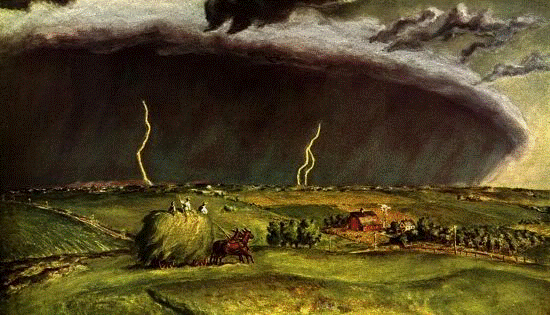 |
| "The Line Storm," by John Steuart Curry |
A person was writing to me about suffering recently and sadly, was comparing herself with others in the spiritual life.
Now, I would like to compare types of rain. Rain in Dublin is not the same as rain in London, is not the same as rain in Minneapolis, is not the same as rain in Mississippi.
Rain in Dublin stops and starts in strange intervals. It is rarely constant and is dirty, and I assume it is, as at this very moment, coming off the Atlantic. It is not regular here is Dublin, and it can be middling light to hard in the same hour.
Rain in London is constant when it comes, and it is more regular in consistency. It smells differently than Dublin rain and feels fresher. Of course, the movement of the Jet Stream directly affects London and Britain depending on whether it is coming from the north, or has moved south. It does not stop and start but lasts longer, imo, than in Dublin.
Rain in Minneapolis happens frequently at night, and, like other build-up of rains on the prairie and near the Mississippi River, the rain is fierce and comes with thunder showers and lightening. In the summer, as in other parts of the Midwest, the rain is a result of severe convection and even sheer winds, but Minneapolis is farther north than most of the severe thunderstorms, as one experiences in Davenport, Iowa, for example, when the rolling of the thunder is heard for miles away. Flooding is common in some areas as when it rains, it pours, but the skies and air feel fresh and clean afterwards. If the rain comes off the western prairies, it can be dirty. The Midwest has extreme weather, hot and cold.
Missisippi State rain comes in from the north and from the south, and there are cyclonic and anti-cyclonic winds, and subtropical ridges which affect rainfall. Rain falls in torrents. Mississippi, unlike Ireland and England, which have temperate climates, has a subtropical climate. The rain, to me, does not seem to cool things down as in Iowa or Minneapolis.
Now, what is the point of this lay person's description of types of rain?
Suffering is the same. For some people, it is constant and one must learn to live in suffering. For some, suffering comes in light or middling manners, and for some, in torrents.
One lives in a certain climate and adapts. One must accept suffering and adapt not only in the body but in the soul. Adaptation means acceptance.
How silly it would be for me to want a continental American thunderstorm, which I miss, in Dublin, or a constant, almost soothing London rain in Mississippi. We do not chose our rain, and we most certainly do not chose the suffering God allows in our lives.
Now, and I have written on this before, suffering can be a consequence of our own sins, others sins against us, or Original Sin.
Some of the worst pain I ever suffered was from a root canal done improperly by a very expensive dentist. He had to re-do it and in the end, I lost the tooth anyway.
Was he incompetent? Was it just that the tooth could not be saved anyway? Was it that he was actually negligent? The reason for the months of pain does not matter any more, but the suffering had to be endured, patiently.
The same with cancer. One must accept such suffering and deal with the consequences and not rail against God. After the initial shock, one must go into one's prayer corner and deal with the loss.
Some people suffer for years with cancer, and some for merely weeks. One woman who is related to someone I know, had no pain, went for a check-up for a tummy problem and died three weeks later of cancer.
We must not compare the sufferings we are allowed to experience with the suffering of others. This is one of the answers to Job and Job's so-called friends, who were wrong, wrong, wrong.
Forgiveness of ourselves and others is the beginning of dealing with suffering. Without forgiveness we waste suffering. The real reason for suffering is purification of the senses and the soul. No one becomes perfect, becomes a saint without suffering-no one.
The pleasure and importance and the pain of rain can be lost on those who only want clear skies.
 |
| Curry, "Tornado Over Kansas", 1929 |
Sunday, 4 August 2013
Greenwald, The Guardian, and Snowden
http://www.theguardian.com/commentisfree/2013/aug/04/readers-editor-care-edward-snowden
http://www.theguardian.com/commentisfree/2013/aug/04/congress-nsa-denied-access
Our culture in the US government is now against whistle blowers and the American people have fallen into distrust for the government. Not news...
Also, look at some articles here-http://rt.com/news/
http://www.theguardian.com/commentisfree/2013/aug/04/congress-nsa-denied-access
Our culture in the US government is now against whistle blowers and the American people have fallen into distrust for the government. Not news...
Also, look at some articles here-http://rt.com/news/
On Not Entertaining Goats

“Doctrinal preaching certainly bores the hypocrites; but it is only doctrinal preaching that will save Christ’s sheep. The preacher’s job is to proclaim the faith, not to provide entertainment for unbelievers–in other words, to feed the sheep rather than amuse the goats.” – (Packer, A Quest For Godliness , 285).
http://atwistedcrownofthorns.com/2013/08/02/doctrinal-preaching-bores-only-hypocrites/
I found this amazingly apropos quotation on a Protestant site yesterday morning. The reason I am quoting it refers to my post the other day that there is no separation between doctrine and Scripture. Now, unpacking this quotation one sees several key points for bloggers.
1) Some hypocrites have criticized our Catholic clergy and specifically the Church for upholding doctrines which are all Bible based. Hypocrites want the world, the flesh and the devil for approval, comfort, and status.
2) Only doctrinal teaching will save Christ's sheep-and not emotionalism or happy-clappy Masses. I am impressed that this person understand's Christ's own mission to teach.
3) We all as baptized Christians have been called into the world to preach, to teach.
4) And, my favourite part of this-we are not hear to amuse the goats. Wow! Catholic bloggers, take heart. Entertaining goats is the job of the mass media. Passing on the Faith is our baptismal duty.
Now, Michael who runs this blog above and Catholics would disagree on most doctrinal positions, but the premise of the statement holds true for Christianity in general and Catholicism specifically. All Christians must hold true to the teachings of Christ. We also have the benefit of the Early Church Fathers, who commented and interpreted these Scriptures for us.
We have the benefit of the graces of baptism. Let us not squander those graces by entertaining goats.
Thank you, Michael, for this thought. We can all think of the times we failed to preach, teach, live by example and merely entertained purely for the sake of entertaining, that is pandering to those who really do not want the Truth. Not my job...........I do not herd goats.
Tracking readership by country

I have been tracking readership by country in order to get a view as to who wants what to read and from where.
The results may surprise you.
The highest readership is made up of Americans, of course, who will read all political, theological and cultural posts readily.
That may not surprise you. But, what is surprising is the group which comes in second, which most of you would think would be English readership when it comes to spiritual topics.
The UK readers are usually second highest when I make write about current issues in the Church in England, or English politics. The UK readership is very provincial, which is not a criticism, but an observation.
The English are not interested in the perfection or spirituality posts. They are more interested in the pragmatic postings.
Is this not interesting?
The group after the Americans which are most interested in the spirituality posts are the Germans and the Russians, and then, the Ukrainians.
Perhaps these nationalities are more apt to pursue philosophical and spiritual topics. One imagines a group of trad Catholics sitting around a cafe in Moscow discussing Etheldredasplace on perfection, with men in beards and smoking cigars with ladies in black skirts who are trim from riding bicycles, contemplating on the higher stages of holiness.
 |
| Actually, a cafe in Krakow |
Seriously, this is an interesting phenomenon, which I have noticed over a period of time.
Is it a national characteristic to be more interested in spirituality than political hot topics regarding religious freedom? Is it a question of anti-intellectualism in English Catholicism, which is a huge problem for the Church in England?
Is it that the British have so many good blogs that mine is not a priority? My blog is heavily geared to the American and English audience as it is, obviously, in English and I am an Anglophile American.
But, I am really intrigued by the Europeans who follow certain topics more than the Brits.
Comments from my beloved British would be appreciated. Maybe I should write about rugby, or cricket.
UPDATE: The English have made a come-back as of August 6th. Maybe they were all listening to Test Match Special....

The Third Converson
What to expect after the Dark Night-from Garrigou-Lagrange. The Unitive State is attained by all saints, which is why the Church recognizes that these people are saints and canonizes them. I shall post more about the last stages of the Dark Night, but thought you all needed a bit of encouragement as to the goal.
 |
| Trees at Wonersh near Guildford |
Ch 40 : The Spiritual Age of the Perfect, Their Union with God
|
| The painful passive purification just described is followed by a resurrection of the soul and a new life. The apostles experienced this change when, after being deprived of the presence of Christ's humanity on Ascension Day, they were on Pentecost transformed, enlightened, strengthened, and confirmed in grace by the Holy Ghost that they might preach the Gospel to the ends of the known world and seal their preaching with their blood. We shall point out here the principal signs of the age of the perfect so far as it is distinguished from the age of beginners and that of proficients. We shall indicate particularly what characterizes the knowledge of God and of self in the perfect and also their love of charity. QUASI-EXPERIMENTAL AND ALMOST CONTINUAL KNOWLEDGE OF GOD After the passive purification of the spirit, which is like a third conversion and transformation, the perfect know God in a quasiexperimental manner that is not transitory, but almost continual. Not only during Mass, the Divine Office, or prayer, but in the midst of external occupations, they remain in the presence of God and preserve actual union with Him. The matter will be easily understood by our considering the egoist's contrary state of soul. The egoist thinks always of himself and, without realizing it, refers everything to himself. He talks continually with himself about his inordinate desires, sorrows, or superficial joys; his intimate conversation with himself is endless, but it is vain, sterile, and unproductive for all. The perfect man, on the contrary, instead of thinking always of himself, thinks continually of God, His glory, and the salvation of souls; he instinctively makes everything converge toward the object of his thoughts. His intimate conversation is no longer with himself, but with God, and the words of the Gospel frequently recur to his mind to enlighten from on high the smallest pleasurable or painful facts of daily life. His soul sings the glory of God, and from it radiate spiritual light and fervor, which are perpetually bestowed on him from above. The reason for this state is that the perfect man, unlike the beginner, no longer contemplates God only in the mirror of sensible things or of the Gospel parables, about which it is impossible to think continually. Neither does he, like the proficient, contemplate God only in the mirror of the mysteries of the life of Christ, a prayer that cannot last all day long; but, in the penumbra of faith, he contemplates the divine goodness itself, a little as we see the diffused light that always surrounds us and illumines everything from above. According to the terms used by Dionysius the Mystic and preserved by St. Thomas,(1) this is the movement of circular contemplation, superior to the straight and the oblique movements. The straight movement, like the flight of the lark, rises from a sensible fact recalled in a parable to a divine perfection, from the sight of the prodigal son to infinite mercy. The oblique movement rises, for example, from the mysteries of the childhood of Christ to those of His passion, of His glory, and finally to the infinite love of God for us. The circular movement is similar to the flight of the eagle, which, after soaring aloft, delights in describing the same circle several times, then hovers seemingly motionless in the light of the sun, scrutinizing the depths of the horizon. Here it is a question of a knowledge of the radiating goodness of God. The soul sees now in a quasi-experimental manner that everything God has done in the order of nature and that of grace is intended to manifest His goodness, and that if He permits evil, like a dissonance, it is for a higher good, which is glimpsed at times and which will appear on the last day. This contemplation, by reason of its superior simplicity, may be continual and, far from hindering us from beholding the sequence of events, lets us see them from above, somewhat as God sees them as a man on a mountain sees what is happening on the plain below. It is like the prelude or the aurora of the vision of the fatherland, although the soul is still in the obscurity of faith. |
Teresa of Avila, Therese of Lisieux and John of the Cross and the Purification of the Spirit Pt. 24
"ad lucem per crucem, and of the progressive configuration of the soul to Christ crucified."
Garrigou-Lagrange has at interesting comparison concerning the experience of the passive purification of the Illuminative State leading up to Unitive State and St. Therese, St. Teresa, and St. John of the Cross. I do not think I need to comment here, but merely highlight some key ideas. If we all aspired to this state, can you imagine how strong and mighty the Church would be on Earth? This following the road to perfection is for me the real evangelization needed today. I make a few comments in blue.
Such is the simultaneous passive purification of faith, hope, and love of God and of souls in God, a purification which, in the case of St. Teresa of the Child Jesus, is united to reparatory suffering for sinners.
Garrigou-Lagrange has at interesting comparison concerning the experience of the passive purification of the Illuminative State leading up to Unitive State and St. Therese, St. Teresa, and St. John of the Cross. I do not think I need to comment here, but merely highlight some key ideas. If we all aspired to this state, can you imagine how strong and mighty the Church would be on Earth? This following the road to perfection is for me the real evangelization needed today. I make a few comments in blue.
 |
| Spring in Kent, 2013 |
Such is the simultaneous passive purification of faith, hope, and love of God and of souls in God, a purification which, in the case of St. Teresa of the Child Jesus, is united to reparatory suffering for sinners.
Then the most pure motive of this love of charity appears in all its elevation: namely, that God is sovereignly lovable in Himself, infinitely more so than all the gifts which He has given us and which we expect from Him. Here the acts of faith, hope, and charity fuse, so to speak, in an act of perfect abandonment to the divine will, while the soul repeats the words of Christ on the cross: "Father, into Thy hands I commend My spirit." (32)
Then the soul understands what St. John of the Cross says: "For this is a certain fire of love in the spirit whereby the soul, amidst these dark trials, feels itself wounded to the quick by this strong love divine. . . . And inasmuch as this love is infused in a special way, the soul corresponds only passively with it, and thus a strong passion of love is begotten within it. . . . The soul is itself touched, wounded, and set on fire with love. . . . The soul, however, amidst these gloomy and loving pains, is conscious of a certain companionship and inward strength which attends upon it and invigorates it." (33)
St. Teresa speaks in like manner of this last purification which precedes the transforming union: "She sees herself still far away from God, yet with her increased knowledge of His attributes, her longing and her love for Him grow ever stronger as she learns more fully how this great God and Sovereign deserves to be loved. . . . She is like one suspended in mid-air, who can neither touch the earth nor mount to heaven; she is unable to reach the water while parched with thirst, and this is not a thirst that can be borne, but one which nothing will quench." (34)
Again, one cannot skip these progressive steps. The purification of the senses and spirit in the Dark Night is absolutely necessary for one to become a saint.
Again, one cannot skip these progressive steps. The purification of the senses and spirit in the Dark Night is absolutely necessary for one to become a saint.
At the end of this trial, charity toward God and one's neighbor is purified of all alloy, as gold in the crucible is freed from its dross. And not only is the love of charity thus purified, but notably increased. The soul now makes intense and heroic acts of charity, which obtain immediately the increase of grace which they merit, and with sanctifying grace increase greatly at the same time all the infused virtues and the seven gifts of the Holy Ghost, which are connected with charity.
The love of God and of souls then becomes increasingly disinterested, ever more ardent and forgetful of self. We admire the purity of the conjugal love of the sailor's wife who does not cease to think of her absent husband, who may be dead, since for several months she has had no word that he is still alive. She loves him as if he were present, and brings up her children in the love of their father who has disappeared. How can we fail to admire the purity of love in these spouses of Jesus Christ who, like St. Teresa of Lisieux, remain for a long time, for months and months, deprived of His presence, in the greatest darkness and aridity, and who do not cease to love Him with a love as strong as it is pure, for the sole motive that He is infinitely good in Himself and incomparably more so than all His gifts! In this state the tenderness of love is transformed into the strength of union, according to the expression of the Canticle of Canticles: "Love is strong as death," (35) and even stronger, for no trial can overthrow love. The soul then remembers that in our Lord, who fashions souls to His image, love on the cross was stronger than spiritual death, that it was the conqueror of sin and the devil, and by the resurrection the victor over death which is the result of sin. In the passive purifications, described by St. John of the Cross, the Christian and Catholic mystic relives these great truths of faith; thereby the soul is configured to Christ in His sorrowful life, before being configured to Him in His glorious life for eternity.
I grew up in a Mississippi River town which has an area of Victorian houses on what is called the Gold Coast. These houses have Widow's Peaks, which are high balconies made for the wife of a sailor to stand and look at the ships coming in to see if her husband had returned. I lived in one such Victorian house for awhile, not this one shown, but similar. The faithfulness of the woman on the Widow's Peak is still a moving metaphor for Love which is stronger than Death.
I grew up in a Mississippi River town which has an area of Victorian houses on what is called the Gold Coast. These houses have Widow's Peaks, which are high balconies made for the wife of a sailor to stand and look at the ships coming in to see if her husband had returned. I lived in one such Victorian house for awhile, not this one shown, but similar. The faithfulness of the woman on the Widow's Peak is still a moving metaphor for Love which is stronger than Death.
 |
| Widow's Peak in Davenport, Iowa |
St. Teresa (36) speaks of this purification, but does not distinguish as clearly as St. John of the Cross does, what essentially constitutes it from the sufferings which quite often accompany it, and which she herself experienced, as we see from her autobiography.(37)
In The Interior Castle she writes:
O my God, how many troubles both interior and exterior must one suffer before entering the seventh mansion! Sometimes, while pondering over this I fear that, were they known beforehand, human infirmity could scarcely bear the thought nor resolve to encounter them, however great might appear the gain. . . . They really seem to have lost everything.
I shall not enumerate these trials in their proper order, but will describe them as they come to my memory, beginning with the least severe. This is an outcry raised against such a person by those amongst whom she lives. . . . They say she wants to pass for a saint, that she goes to extremes in piety to deceive the world. . . . Persons she thought were her friends desert her, making the most bitter remarks of all. They take it much to heart that her soul is ruined - she is manifestly deluded - it is all the devil's work - she will share the fate of so-and-so who was lost through him. . . . They make a thousand scoffing remarks of the same sort.
Such trials are not clear ways to God, but God's way of leading us to humility. People will not understand you and will speak against your efforts to become holy.
It is very difficult to find a priest who understands this stage of purification. Many will say that one is being too hard on one's self or scrupulous. Apparently, such a priest has not experienced these stages.
Ochs House, Daveport, Iowa

I know someone who feared she would be unable to find any priest who would hear her confession,(38) to such a pass did things come. . . . The worst of it is, these troubles do not blow over but last all her life. . . . How few think well of her in comparison with the many who hate her! . . . Experience has shown the mind that men are as ready to speak well as ill of others, so it attaches no more importance to the one than to the other. . . . [Later] the soul is rather strengthened than depressed by its trials, experience having taught it the great advantages derived from them. It does not think men offend God by persecuting it, but that He permits them to do so for its greater gain. . . .
Our Lord now usually sends severe bodily infirmity. . . . Yet, oh! the rest would seem trifling in comparison could I relate the interior torments met with here, but they are impossible to describe. Let us first speak of the trial of meeting with so timorous and inexperienced a confessor that nothing seems safe to him; he dreads and suspects everything but the commonplace, especially in a soul in which he detects any imperfection, for he thinks people on whom God bestows such favors must be angels, which is impossible while we live in our bodies. He at once ascribes everything to the devil or melancholy. . . .
One of the severe trials of these souls, especially if they have lived wicked lives, is their belief that God permits them to be deceived in punishment for their sins. While actually receiving these graces they feel secure and cannot but suppose that these favors proceed from the Spirit of God; but this state lasts a very short time, while the remembrance of their misdeeds is ever before them, so that when, as is sure to happen, they discover any faults in themselves, these torturing thoughts return. The soul is quieted for a time when the confessor reassures it, although it returns later on to its former apprehensions; but when he augments its fears they become almost unbearable: Especially is this the case when such spiritual dryness ensues that the mind feels as if it never had thought of God nor ever will be able to do so. When men speak of Him, they seem to be talking of some person heard of long ago.Memory changes and is purified. One's ideas of Who God is are swept away. One waits for God to reveal Himself as and when He wishes to do so. One must be patient in love.
 |
| London at Night Inversed |
All this is nothing without the further pain of thinking we cannot make our confessors understand the case and are deceiving them. . . She believes all that the imagination, which now has the upper hand, puts before her mind, besides crediting the falsehoods suggested to her by the devil, whom doubtless our Lord gives leave to tempt her. . . .
In short, there is no other remedy in such a tempest except to wait for the mercy of God who, unexpectedly, by some casual word or unforeseen circumstance, suddenly dispels all these sorrows. . . . It praises our Lord God like one who has come out victorious from a dangerous battle, for it was He who won the victory. The soul is fully conscious that the conquest was not its own as all weapons of self-defence appeared to be in the enemies' hands. Thus it realizes its weakness and how little man can help himself if God forsake him.(39)Finally, when one is truly humble, the Bridegroom approaches the Bride.
Tauler speaks in like strain, as we noted earlier. His teaching on this subject, which should be read, will be found in his sermons for the Monday before Palm Sunday (nos. 7, 8), for Easter Sunday, for the Monday before Ascension Thursday, and in the third sermon for the Ascension.(40)
It would be easy to show by quotations from other masters that the teaching of St. John of the Cross is entirely conformable to the tradition of the great spiritual writers, to what they have said of the royal way of the cross, ad lucem per crucem, and of the progressive configuration of the soul to Christ crucified. We read in St. Paul's Epistle to the Romans: (41) "Heirs indeed of God, and joint heirs with Christ: yet so, if we suffer with Him, that we may be also glorified with Him."
Subscribe to:
Posts (Atom)