Recent Posts

Tuesday, 28 January 2014

Doctors of the Church 2:68 Aquinas Day continued..

Thomas Aquinas Series on Sloth Continued...laziness in reason is a mortal sin


I have noted that anti-intellectualism is not only dividing the Church into groupings, but weakening the Church's ability to evangelize. Sloth is behind this anti-intellectualism, as sloth is not only a sin of the body but of the mind.

We have been given reason to use and not to use this reason indicates a blockage of consent to learn the Faith.


The Church gives us all we need to work our way through the states of purification, but it is WORK. There is nothing easy about being a Catholic.


But, another sin connected to sloth is pride. Why? Pride keeps one from realizing how much one does not know. A humble person understands that knowledge of self and God means a life-long struggle in suffering and the stripping of self-love. Here is Aquinas on sloth again from this source. 


Brueghel's Pride


Note that sloth regarding sensuality is mostly a venial sin, but sloth regarding reason is a mortal sin.

Those only seeking consolations need to seriously consider whether their gnostic tendencies point to sloth in rational discourse.


As stated above (I-II, 88, 1,2), mortal sin is so called because it destroys the spiritual life which is the effect ofcharity, whereby God dwells in us. Wherefore any sin which by its very nature is contrary to charity is a mortal sin by reason of its genus. And such is sloth, because the proper effect of charity is joy in God, as stated above (Question 28, Article 1), while sloth is sorrow about spiritual good in as much as it is a Divine good. Therefore sloth is a mortal sin in respect of its genus. But it must be observed with regard to all sins that are mortal in respect of their genus, that they are not mortal, save when they attain to their perfection. Because the consummation of sin is in the consent of reason: for we are speaking now of human sins consisting in human acts, the principle of which is the reason. Wherefore if the sin be a mere beginning of sin in the sensuality alone, without attaining to the consent of reason, it is a venial sin on account of the imperfection of the act. Thus in the genus of adultery, the concupiscence that goes no further than the sensuality is a venial sin, whereas if it reach to the consent of reason, it is a mortal sin. So too, the movement of sloth is sometimes in the sensuality alone, by reason of the opposition of the flesh to the spirit, and then it is a venial sin; whereas sometimes it reaches to the reason, which consents in the dislike, horror and detestation of the Divine good, on account of the flesh utterly prevailing over the spirit. On this case it is evident that sloth is a mortal sin

Doctors of the Church 2:67 Aquinas Day

The Deceitfulness of Sloth-Thomas Aquinas Series


Bruegel's Sloth
Recently, and correctly, His Eminence Cardinal Raymond Burke stated that the lack of catechesis was one if not the reason for the weakening of the Church. I, as an ex-catechist, agree wholeheartedly. No one is interested in hiring me or taking me on as a volunteer catechist because people simply do not want it.

But, I think the reason behind this lack of catechesis must be addressed and I have tried to do so on this blog. The root problem lies in the anti-intellectualism which crept into the Church most likely after World War II. I use that date as the push for pan-Christianity in the face of pagan Nazism and the dialectic materialism of Communism created a panic even between the wars in the upper echelons of the Church, driving many leader and theologians to desire a false ecumenism.

The movement to accept Protestantism into the mainstream liturgy, prayer and thought of the Catholic Church brought with it anti-intellectualism, which is directly related to sola fide and sola Scriptura. A good protestant did not need anything but the Scriptures, his own interpretation and his own relationship with God to be saved, omitting all the Tradition, the great writings of the Church for a millenium and a half before Luther.

This anti-intellectualism is rife in the Catholic Church in England. To find people in the pew who read, much less study the Faith is rare, indeed. The emphasis for most is on experience, as I have pointed out here before and sadly, both private revelations, approved and unapproved, as well as the charismatic focus on consolations from God.

Until the pastors address this anti-intellectualism in the Church here, factions and heresies will grow and continue to fragment the Church, making the Church unable to address the issues of the day.

Catechesis is lacking, but people can find all the information they want online.

Why do they not?

Sloth?

I have too many lay people tell me they do not have time, and then they proceed to tell me what shows they watched this weekend.

Sad.

Dangerous.

Until bishops and priests address anti-intellectualism and the complete waste of time syndrome, which makes people feel that they are entitled to down time, the Church will continue to rot away from within.

Down-time is a new phrase of the past twenty years. I do not know what down-time is and neither do the nuns of Tyburn, who have 45 minutes of recreation a day.

Why do we feel entitled to down-time? The most productive people I know pray and go to Mass and read and still have time for work, family and even fun.

Kicking the ball around outside with the kids is important, but not canned entertainment.

Musical lessons, sports, all these things find the mind.

The more one prays, the less down-time one needs.

I am not sure we can stop the rot of the Church at large until priests from the pulpit challenge their parishioners to grow up and study their faith and, of course, pray.

 Thomas Aquinas writes on sloth-not the entire discussion which is found here.

Sloth, according to Damascene (De Fide Orth. ii, 14) is an oppressive sorrow, which, to wit, so weighs uponman's mind, that he wants to do nothing; thus acid things are also cold. Hence sloth implies a certain weariness of work, as appears from a gloss on Psalm 106:18, "Their soul abhorred all manner of meat," and from the definition of some who say that sloth is a "sluggishness of the mind which neglects to begin good."

Now this sorrow is always evil, sometimes in itself, sometimes in its effect. For sorrow is evil in itself when it is about that which is apparently evil but good in reality, even as, on the other hand, pleasure is evil if it is about that which seems to be good but is, in truth, evil. Since, then, spiritual good is a good in very truth, sorrow about spiritual good is evil in itself. And yet that sorrow also which is about a real evil, is evil in its effect, if it so oppresses man as to draw him away entirely from good deeds. Hence the Apostle (2 Corinthians 2:7) did not wish those who repented to be "swallowed up with overmuch sorrow."

Accordingly, since sloth, as we understand it here, denotes sorrow for spiritual good, it is evil on two counts, both in itself and in point of its effect. Consequently it is a sin, for by sin we mean an evil movement of the appetite, as appears from what has been said above (10, 2; I-II, 74, 4).

.....

Since sloth is sorrow for spiritual good, if we take spiritual good in a general way, sloth will not be a special vice, because, as stated above (I-II, 71, 1), every vice shuns the spiritual good of its opposite virtue. Again it cannot be said thatsloth is a special vice, in so far as it shuns spiritual good, as toilsome, or troublesome to the body, or as a hindrance to the body's pleasure, for this again would not sever sloth from carnal vices, whereby a man seeks bodily comfort and pleasure.

Wherefore we must say that a certain order exists among spiritual goods, since all the spiritual goods that are in the acts of each virtue are directed to one spiritual good, which is the Divine good, about which there is a special virtue, viz. charity. Hence it is proper to each virtue to rejoice in its own spiritual good, which consists in its own act, while it belongs specially to charity have that spiritual joy whereby one rejoices in the Divine good. On like manner the sorrow whereby one is displeased at the spiritual good which is in each act of virtue, belongs, not to any special vice, but to every vice, but sorrow in the Divine good about which charity rejoices, belongs to a special vice, which is called sloth. This suffices for the Replies to the Objections.

To be continued...

Doctors of the Church 2:66 Aquinas Day

Job's Reactions from Aquinas, Part One


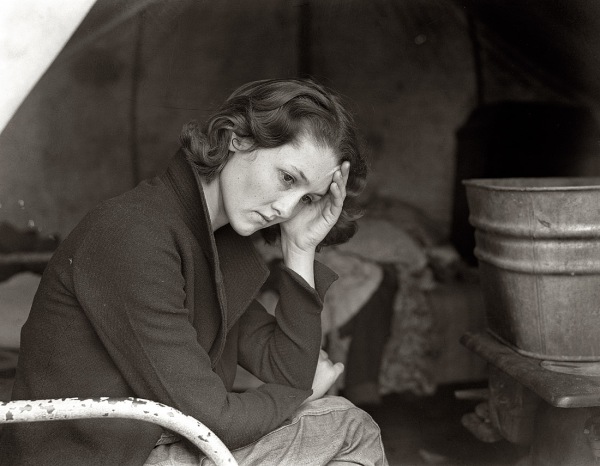
November 1936. “Daughter of migrant Tennessee coal miner. Living in American River camp near Sacramento, California.” http://theselvedgeyard.wordpress.com/2009/12/06/photography-of-dorothea-lange-an-american-archive-hard-times/

One must ask the question, what does it mean to persist in righteousness in the face of suffering?
20 Then Job arose and rent his robe; he shaved his head and he fell on the ground and worshipped. 21 He said: Naked I came from my mother’s womb, and naked I shall return there; The Lord gave; the Lord has taken away. As God pleased, so it has been done. Blessed be the name of the Lord! In all these things, Job did not sin with his lips, nor did he say anything foolish against God.
After the adversity of blessed Job has been narrated, the text treats the patience Job showed in adversity. As evidence of what is said here know that there was a difference of opinion among the ancients philosophers as to corporeal goods and the passions of the soul. For the Stoics said that exterior goods were not goods of man and that there could be no sorrow for their loss in the soul of the wise man. But, the opinion of the Peripatetics was that some of the goods of man are truly exterior goods, though these are certainly not the principal ones. Nevertheless, they are like instruments ordered to the principal good of man which is the good of the mind. Because of this, they conceded that the wise man is moderately sad in the losses of exterior goods, namely his reason is not so absorbed by sadness that he leaves righteousness. This opinion is the more true of the two and is in accord with the teaching of the Church as is clear from St. Augustine in his book, The City of God.
I think modern man forgets that reason is part of spiritual growth. There is immoderate grief and moderate grief. This sounds awful to some. But, grief can be absorbed into a quiet acceptance.


So Job followed this opinion and truly showed sorrow in adversity; yet this sadness was so moderated that it was subject to reason. The text therefore continues, “Then Job arose, and rent his robe,” which is usually an indication of sadness among men. Note however that the text says, “Then”, namely after he heard about the death of his children, so that he might seem more sad over their loss than the loss of his possessions. For it is characteristic of a hard and insensible heart to not grieve over dead friends, but it is characteristic of virtuous men to not have this grief in an immoderate way as St. Paul says in 1 Thessalonians, “But we would not have you ignorant, brethren, concerning those who are asleep, that you may not grieve as others do who have no hope.” (4:13) This was true in the case of blessed Job and so the state of his mind appears in his exterior act. Since his reason stood upright, the text fittingly says that “Job arose” although men in grief usually prostrate themselves. For though he suffered grief, but not a grief which penetrated as far as disturbing the his interior reason, he showed a sign of his sadness in exterior actions in two ways: namely as to what is outside the nature of the body, and so the text says, “he rent his robe”; and as to those things which proceed from the nature of the body, “he shaved his head,” which among those who care for their hair, usually indicates grief. These two signs then fittingly correspond to the adversities mentioned, for the tearing of the robe corresponds to the loss of his possessions, and the cutting of the hair corresponds to the loss of his sons. Then the mind stands upright when it humbly is submitted to God. For each thing exists in a higher and more noble state to the extent that it stands firm in what perfects it more, like air when it is subject to light, and matter when it is subject to form. Therefore the fact that the mind of blessed Job was not dejected by sadness, but persisted in its righteousness, clearly shows that he humbly subjected himself to God. So the text continues, “and he fell on the ground, and worshipped,” to show evidence for his devotion and humility.
This section points to the Resurrection from the dead, which some commentators note may have not been the belief at the time Job was written. I disagree. As in the Book of Tobit, there is a constant awareness of the characters that this world is not ALL. 

Job revealed the state of his mind not only by deeds, but also by words. For he rationally demonstrated that although he suffered sadness, he did not have to yield to sadness. First, he demonstrated from the condition of nature so the text said, “He said: Naked I came forth from my mother’s womb,” namely, from the earth which is the common mother of everything, “and naked shall I return there,” i.e., to the earth. Sirach speaks in the same vein saying, “Great hardship has been created for man, and a heavy yoke lies on the sons of Adam from the day they come forth from their mother’s womb until the day they return to their burial in the mother of them all.” (40:1) This can also be interpreted in another way. The expression, “from my mother’s womb” can be literally taken as the womb of the mother who bore him. When he says next “naked I shall return there,” the term “there” establishes a simple relation. For a man cannot return a second time to the womb of his own mother, but he can return to the state which he had in the womb of his mother in a certain respect, namely in that he is removed from the company of men. In saying this he reasonably shows that a man should not be absorbed with sadness because of the loss of exterior goods, since exterior goods are not connatural to him, but come to him accidentally. This is evident since a man comes into this world without them and leaves this world without them. So when these accidental goods are taken away if the substantial ones remain man ought not to be overcome by sadness although sadness may touch him. http://dhspriory.org/thomas/SSJob.htm#182
To be continued....

Doctors of the Church 2:65

Aquinas on Job and Tobias-and musings on American suffering...


So Scripture says of Tobias, “Thus the Lord permitted him to be tempted so that an example might be given to posterity of his patience, like blessed Job.” (Tob. 2:12) Be careful not to believe that the Lord had been persuaded by the words of Satan to permit Job to be afflicted, but he ordered this from his eternal disposition to make clear Job’s virtue against the false accusations of the impious. Therefore, false accusations are placed first and the divine permission follows.


It is interesting that two of the most intriguing books in the Old Testament deal with angels, suffering and men with families. These themes are, of course, not accidents, but detailed histories woven into morality stories for us to learn about higher virtues.
The type of suffering into which both Job and Tobias enter is not due to their sins, but because of their virtues.
God is perfecting them. And, as Thomas points out in the above paragraph, the stories are for our benefit-examples not only of patience, but the deep patience of suffering.

America as a whole nation experienced intense suffering during The Great Depression and droughts which happened at the same time. The Dust Bowl of Oklahoma and other states remain scarred in the memories.
That generation is disappearing, My mother remembers tramps everywhere in St. Louis and her mother feeding people on the steps of the back porch. She remember people selling apples on the street. 
We endured great suffering during the Civil War, our greatest war. 
No one is immune from suffering. But, we need not fear. 
There are different types of reasons for suffering. The first is indifferent or natural evils, such as drought, tornadoes, floods. Humans have always faced these and these are not demonic, just natural.
The second type is malicious, such as murder, abortion, or abuse. Negligence is also malicious, as is greed and all the seven deadly sins.
The third type is accidental, which is merely owing to man's errors or a combination of nature and sin, such as the buildings collapsing two weeks ago, killing people.
But, notice what the great Thomas states about natural suffering: 
Consider that since all this aforementioned adversity comes from Satan, it is necessary to confess that with God’s permission demons can bring about turbulence in the air, can stir up the winds and can make fire fall from heaven. For although corporeal matter obeys only the nod of God the Creator for the reception of forms, and does not obey the nod of either the good or the wicked angels, corporeal nature is still born to obey spiritual nature as far as local movement is concerned. Evidence of this appears in men, for the members of the body are moved at the mere command of the will to pursue the act desired by the will. Whatever then can be done only with local motion, can be done by not only the good but also the wicked angels from their natural power, unless prohibited by divine power. The winds the rains and other like disturbances in the atmosphere come about only from the motion of the vapors released from the earth and the water. Thus the natural power of a demon is sufficient to procure these things. However, sometimes they are prohibited from this by divine power so that they are not permitted to do everything which they can do naturally. Nor is this contrary to what is said in Jeremiah, “Are there any among the false gods of the nations which can give rain?” (14:22) For it is one thing that the rain takes place by natural cause and this is the office of God alone who orders natural causes to this; it is another thing to use artificially those natural causes ordered by God to rain to produce rain or wind sometimes in an almost extraordinary way

Many Catholics cannot deal with the suffering of the innocent, but we call these people saints, or martyrs.
As in Job, as Thomas points out, Satan wants to bring us to impatience and blasphemy. One of the most famous photos of the Depression is Dorothea Lange's of a California Mother. Here is a description. 
Florence Owens Thompson and her children in Nipomo, California is a photo taken in February of 1936.  The woman had seven children. Here is part of an interview from the photographer.
I saw and approached the hungry and desperate mother, as if drawn by a magnet. I do not remember how I explained my presence or my camera to her, but I do remember she asked me no questions. I made five exposures, working closer and closer from the same direction. I did not ask her name or her history. She told me her age, that she was thirty-two. She said that they had been living on frozen vegetables from the surrounding fields, and birds that the children killed. She had just sold the tires from her car to buy food. There she sat in that lean- to tent with her children huddled around her, and seemed to know that my pictures might help her, and so she helped me. There was a sort of equality about it.
(From: Popular Photography, Feb. 1960).

Migrant Mother, as she was called, was a pea picker.
Daily, perhaps, God allows us to face suffering not only for our own perfection, but for that of others.
If we cooperate, like Job, and face the mystery, we shall not only be purified, but deified, as Bernard writes.
I grew up with these photos, as my parents were alive and remembered such sad tales. Thankfully, my dad's family did not experience the Depression, but some did.
Many young men traveled to find work which did not exist. 

February 1939. Calipatria, Imperial Valley. Car on siding across tracks from pea packing plant. Twenty-five year old itinerant, originally from Oregon. “On the road eight years, all over the country, every state in the union, back and forth, pick up a job here and there, traveling all the time.”
What Job and Tobias experienced shadowed what we all experience to some extent. Catholics, perhaps, or those who love the Lord and contemplate His Passion, know that suffering is part of the human experience,  part of who we are as human beings.  Suffering is a great mystery. But, many people do not want to engage in the sufferings of others. They want to avoid suffering, as if it is a disease, like the measles.
I know this from experience. In the greatest times of suffering in my life, I have either been alone or with one person, my son. Sadly, those who suffer are ostracized, like Job. Even his wife scolded him.
This child could have been my mother, my aunts, anyone caught up in the times of trouble.
December 1935. “Resettled farm child. From Taos Junction to Bosque Farms project, New Mexico.”
And the woman below told people the same thing I have told people. June 1938. Outskirts of El Paso, Texas. “Young Negro wife cooking breakfast. ‘Do you suppose I’d be out on the highway cooking my steak if I had it good at home?’ Occupations: hotel maid, cook, laundress.”

She had to explain her suffering to someone who obviously did not understand that her state was not her choice. She was a Job, a Tobias.

Her suffering is my suffering, and it should be yours as well. That is one of the lessons of Job. 


To be continued..

Doctors of the Church 2:64

The eternal question: if there is no hope for good, how can there be a merciful, loving God? Aquinas Series..


Why evil? I am working on the Commentary on Job by Thomas Aquinas, found here. http://dhspriory.org/thomas/SSJob.htm

Here are some gleanings....

1) Because all men and women are given free will and the grace necessary for eternal life, and still some make bad decisions moving away from goodness and truth;

2) Because each one of us must be converted to God, moving ever closer to God, and this process demands suffering to take us away from sin and error;

3) Because, as St. Thomas states, there is an order in the universe set up by Divine Providence and each one of us must come to cooperate in that order; many do not;

4) Original Sin.....

5) Suffering points to the Resurrection and the Redeemer, Christ;

6) Because one moves from fear to love and suffering helps us to do that; if we focus on the Son of God Who was crucified; here is Aquinas on Job directly;

Since man’s good is threefold, namely of the body, of the soul, and
of external things, they are ordered to one another in such a way
that the body is for the sake of the soul whereas external things are
for the sake of the body and soul. Therefore, just as it is wrong if
someone intentionally subordinates the goods of the soul to the
advantage of external goods, so it is wrong if someone intentionally
subordinates the goods of the soul to the health of the body. And
indeed, that Job abounded in the practice of the virtues, which are
the goods of the soul, could be sensibly manifest to all.

To be continued...

Doctors of the Church 2:63 Aquinas Day

Aquinas Series.. When people suffer, we talk too much...


When people suffer, others react in less than perfect ways; some criticize, which is the most common response; some, who have not suffered enough, are glib and even rude; some talk people out of suffering; some just talk and talk and talk
Here is Aquinas on Job again...the featured series this week.

The afflictions of the sick are customarily alleviated by cures applied externally which are pleasant. But Job was not alleviated in such a way, for the text continues, “Job scraped the bloody matter with a shard.” In this the text shows that pleasant and soothing remedies are not applied to him. “And he sat in a dungheap,” in which the text shows that he did not restore himself to health in a pleasant place, or in the gentleness of straw or with some pleasant smell, but he more used their opposite. This can have happened in two ways: either because after he was struck by the Lord, he voluntarily afflicted and humiliated himself even more to more easily obtain mercy, or because he lost everything he had, and so he could not afford suitable cures for himself. This is probable enough from what the Lord said above, and it does not seem that Satan had acted except with the power given him to harm something.
In their afflictions, men customarily find solace in words of those offering consolation. But the affliction of Job was accompanied by irritating words, which were as much more provocative as the person who spoke them was more closely connected to him. The text continues, “Then his wife said to him,” for she was the only person whom the devil left untouched so that through her he who had deceived the first man through a woman might assault the mind of the just man. This woman first broke out in words of mockery, “Do you still hold fast your simplicity?” as if she said: At least after so many chastisements you should know that it was useless for you to guard simplicity. The same is said by a person like her in the prophet Malachi, “It is vain to serve God. What is the profit in keeping his commandments.” (3:14) Second, she proceeds to words of perverse suggestion saying, “Bless (i.e., Curse) God.” as if she said: From the fact that adversity came upon you when you were blessing God, curse God and you will enjoy prosperity. Lastly, she concludes in words of despair saying, “and die”, as if she said: Regard yourself as dead because nothing is left for you in remaining in simplicity except dying. Or “Bless God and die;” can be understood in another way to mean that since after so much reverence for God you have been so afflicted with adversity, if you still bless God, nothing remains, but for you to wait for death.

The holy man who had born his troubles patiently, could not bear the injury done to God, for there follows, “But he said to her: You have spoken like one of the foolish women speaks.” He rightly accuses of foolishness one speaking against the divine wisdom. He shows that she spoke foolishly when he adds, “If we received good at the hand of the Lord and shall we not tolerate evil?” In this he teaches the perfect wisdom of man, for since temporal and corporeal goods should not be loved except because of spiritual and eternal ones, when the latter are conserved as the more principal ones, man should not be dejected if he is deprived of the former nor puffed up if he has an abundance of them. Job teaches us therefore that we should have such a steadfastness of spirit that both if temporal goods are given to us by God, we should so use them that we are not puffed up in pride from them, and we would so sustain the contrary evil that our soul is not dejected from their lack. This accords with what St. Paul says in Philippians in the last chapter, “I know how to be humbled and how to enjoy prosperity.” (4:12) and further on, “I can do all things in him who gives me comfort.” (4:13) Finally the conclusion is Job persevered in innocence when it is said, “In all these things Job did not sin with his lips.

Doctors of the Church 2:62 Aquinas Day

More from St. Thomas on Modesty-Part of the Aquinas Series


No comment at this point...Thomas on modesty again...

2:2; 169 It is not in the outward things themselves which man uses, that there is vice, but on the part of man who uses them immoderately. This lack of moderation occurs in two ways. First, in comparison with the customs of those among whom one lives; wherefore Augustine says (Confess. iii, 8): "Those offenses which are contrary to the customs of men, are to be avoided according to thecustoms generally prevailing, so that a thing agreed upon and confirmed by custom or law of any city or nation may not be violated at the lawless pleasure of any, whether citizen or foreigner. For any part, which harmonizeth not with its whole, is offensive." Secondly, the lack of moderation in the use of these things may arise from the inordinate attachment of the user, the result being that a man sometimes takes too much pleasure in using them, either in accordance with the custom of those among whom he dwells or contrary to such custom. Hence Augustine says (De Doctr. Christ. iii, 12): "We must avoid excessive pleasure in the use of things, for it leads not only wickedly to abuse the customs of those among whom we dwell, but frequently to exceed their bounds, so that, whereas it lay hidden, while under the restraint of established morality, it displays its deformity in a most lawless outbreak."
In point of excess, this inordinate attachment occurs in three ways. First when a man seeks glory from excessive attention to dress; in so far as dress and such like things are a kind of ornament. Hence Gregory says (Hom. xl in Ev.): "There are some who think that attention to finery and costly dress is no sin. Surely, if this were no fault, the word of God would not say so expressly that the rich man who was tortured in hell had been clothed in purple and fine linen. No one, forsooth, seeks costly apparel" (such, namely, as exceeds his estate) "save for vainglory." Secondly, when a man seeks sensuous pleasure from excessive attention to dress, in so far as dress is directed to the body's comfort. Thirdly, when a man is too solicitous [Cf. 55, 6] in his attention to outward apparel.
Accordingly Andronicus [De Affectibus] reckons three virtues in connection with outward attire; namely "humility," which excludes the seeking of glory, wherefore he says that humility is "the habit of avoiding excessive expenditure and parade"; "contentment" [Cf. 143, Objection 4], which excludes the seeking of sensuous pleasure, wherefore he says that "contentedness is the habit that makes a man satisfied with what is suitable, and enables him to determine what is becoming in his manner of life" (according to the saying of theApostle, 1 Timothy 6:8): "Having food and wherewith to be covered, with these let us be content;"--and "simplicity," which excludes excessive solicitude about such things, wherefore he says that "simplicity is a habit that makes a man contented with what he has."
In the point of deficiency there may be inordinate attachment in two ways. First, through a man's neglect to give the requisite study or trouble to the use of outward apparel. Wherefore the Philosopher says (Ethic. vii, 7) that "it is a mark of effeminacy to let one's cloak trail on the ground to avoid the trouble of lifting it up." Secondly, by seeking glory from the very lack of attention to outward attire. Hence Augustine says (De Serm. Dom. in Monte ii, 12) that "not only the glare and pomp of outward things, but even dirt and the weeds of mourning may be a subject of ostentation, all the more dangerous as being a decoy under the guise of God's service"; and the Philosopher says (Ethic. iv, 7) that "both excess and inordinate defect are a subject of ostentation."
Reply to Objection 1. Although outward attire does not come from nature, it belongs to natural reason to moderate it; so that we are naturally inclined to be the recipients of the virtue that moderates outward raiment.
Reply to Objection 2. Those who are placed in a position of dignity, or again the ministers of the altar, are attired in more costly apparel than others, not for the sake of their own glory, but to indicate the excellence of their office or of the Divine worship: wherefore this is not sinful in them. Hence Augustine says (De Doctr. Christ. iii, 12): "Whoever uses outward things in such a way as to exceed the bounds observed by the good people among whom he dwells, either signifies something by so doing, or is guilty of sin, inasmuch as he uses these things for sensual pleasure or ostentation."
Likewise there may be sin on the part of deficiency: although it is not always a sin to wear coarser clothes than other people. For, if this be done through ostentation or pride, in order to set oneself above others, it is a sin of superstition; whereas, if this be done to tame the flesh, or to humble the spirit, it belongs to the virtue of temperance. Hence Augustine says (De Doctr. Christ. iii, 12): "Whoever uses transitory things with greater restraint than is customary with those among whom he dwells, is either temperate or superstitious." Especially, however, is the use of coarse raiment befitting to those who by word and example urge others to repentance, as did theprophets of whom the Apostle is speaking in the passage quoted. Wherefore a gloss on Matthew 3:4, says: "He who preaches penance, wears the garb of penance."
Reply to Objection 3. This outward apparel is an indication of man's estate; wherefore excess, deficiency, and mean therein, are referable to the virtue of truthfulness, which the Philosopher (Ethic. ii, 7) assigns to deeds and words, which are indications of something connected with man's estate.

Doctors of the Church 2:61 Aquinas Day

Thomas Aquinas and Modesty 3 in the re-post series


As I noted in one of the recent posts on modesty, this virtue is connected to the virtue of temperance.

Our society has completely lost reverence for temperance, which is the virtue of restraint.

Here is the Catholic Encyclopedia on Temperance, followed by a short section of Thomas. One can clearly see that the CE article is based on Thomistic Philosophy

Temperance is here considered as one of the four cardinal virtues. It may be defined as the righteous habit which makes a man govern his natural appetite for pleasures of the senses in accordance with the norm prescribed by reason. In one sense temperance may be regarded as a characteristic of all the moral virtues; the moderation it enjoins is central to each of them. It is also according to St. Thomas (II-II:141:2) a special virtue. Thus, it is the virtue which bridles concupiscence or which controls the yearning for pleasures and delights which most powerfully attract the human heart. These fall mainly into three classes: some are associated with the preservation of the human individual; others with the perpetuation of the race, and others still with the well-being and comfort of human life. Under this aspect temperance has for subordinate virtues, abstinence, chastity, and modesty.Abstinence prescribes the restraint to be employed in the partaking of food and drink. Obviously the measure of this self-restraint is not constant and invariable. It is different for different persons as well as for different ends in view. The diet of an anchorite would not do for a farm labourer. Abstinence is opposed to the vices of gluttony and drunkenness. The disorder of these is that food and drink are made use of in such wise as to damage instead of benefit the bodily health. Hence gluttony and drunkenness are said to be intrinsically wrong. That does not mean, however, that they are always grievous sins. Gluttony is seldom such; drunkenness is so when it is complete, that is when it destroys the use of reason for the time being. Chastity as a part of temperance regulates the sensual satisfactions connected with the propagation of the human species. The contrary vice is lust. As these pleasures appeal with the special vehemence to human nature, it is the function of chastity to impose the norm of reason. Thus it will decide that they are altogether to be refrained from in obedience to a higher vocation or at any rate only availed of with reference to the purposes of marriage. Chastity is not fanaticism; much less is it insensibility. It is the carrying out of the mandate of temperance in a particular department where such a steadying power is acutely needed.
The virtue of modesty, as ranged under temperance, has as its task the holding in reasonable leash of the less violent human passions. It brings into service humility to set in order a man's interior. By transfusing his estimates with truth, and increasing his self-knowledge it guards him against the radical malice of pride. It is averse to pusillanimity, the product of low views and a mean-spirited will. In the government of the exterior of a man modesty aims to make it conform to the demands of decency and decorousness (honestas). In this way his whole outward tenor of conduct and method of life fall under its sway. Such things as his attire, manner of speech, habitual bearing, style of living, have to be made to square with its injunctions. To be sure the cannot always be settled by hard and fast rules. Convention will often have a good deal to say in the case, but in turn will have its propriety determined by modesty. Other virtues are enumerated by St. Thomas as subordinate to temperance inasmuch as they imply moderation in the management of some passion. It ought to be noted, however, that in its primary and generally understood sense temperance is concerned with what is difficult for a man, not in so far as he is a rational being precisely, but rather in so far as he is an animal. The hardest duties for flesh and blood are self-restraint in the use of food and drink and of the venereal pleasures that go with the propagation of the race. That is why abstinence and chastity may be reckoned the chief and ordinary phases of this virtue. All that has been said receives additional force of we suppose that the self-control commanded by temperance is measured not only by the rule of reason but by the revealed law of God as well. It is called a cardinal virtue because the moderation required for every righteous habit has in the practice of temperance a specially trying arena. The satisfactions upon which it imposes a check are at once supremely natural and necessary in the present order of human existence. It is not, however, the greatest of moral virtues. That rank is held by prudence; then come justice, fortitude, and finally temperance.

http://www.newadvent.org/cathen/14481a.htm 

Thomas writes on temperance and refers to modesty as well.


Origen says (Hom. viii super Luc.): "If thou wilt hear the name of this virtue, and what it was called by the philosophers, know that humility which God regards is the same as what they called metriotes, i.e. measure or moderation." Now this evidently pertains to modesty or temperance. Therefore humility is a part of modesty or temperance.
I answer that, As stated above (137, 2, ad 1; 157, 3, ad 2), in assigning parts to a virtue we consider chiefly the likeness that results from the mode of the virtue. Now the mode of temperance, whence it chiefly derives its praise, is the restraint or suppression of the impetuosity of a passion. Hence whatever virtues restrain or suppress, and the actions which moderate the impetuosity of the emotions, are reckoned parts of temperance. Now just as meekness suppresses the movement of anger, so does humility suppress the movement of  hope, which is the movement of a spirit aiming at great things. Wherefore, like meekness, humility is accounted a part of temperance. For this reason the Philosopher (Ethic. iv, 3) says that a man who aims at small things in proportion to his mode is not magnanimous but "temperate," and such a man we may call humble. Moreover, for the reason given above (Question 160, Article 2), among the various parts of temperance, the one under which humility is comprised is modesty as understood by Tully (De Invent. Rhet. ii, 54), inasmuch as humility is nothing else than a moderation of spirit: wherefore it is written (1 Peter 3:4): "In the incorruptibility of a quiet and meek spirit."
Reply to Objection 1. The theological virtues, whose object is our last end, which is the first principle in matters of appetite, are the causes of all the other virtues. Hence the fact that humility is caused by reverence for God does not prevent it from being a part of modesty or temperance.
Reply to Objection 2. Parts are assigned to a principal virtue by reason of a sameness, not of subject or matter, but of formal mode, as stated above (137, 2, ad 1; 157, 3, ad 2). Consequently, although humility is in the irascible as its subject, it is assigned as a part of modesty or temperance by reason of its mode.
Reply to Objection 3. Although humility and magnanimity agree as to matter, they differ as to mode, by reason of which magnanimity is reckoned a part of fortitude, and humility a part of temperance.

Question 161 same part http://www.newadvent.org/summa/3161.htm

Why this is connected to modesty is the application of the virtue of temperance to meekness and quietness.

Modesty is meek and quiet. Loud talk, or raucous actions show the opposite spirit. Sometimes, we see older women being loud and over-exuberant, and we know that there is something not quite right with their spirits. The meek and humble woman speaks quietly and is not strident. This is the COMPETE opposite of the feminist mode.

Temperance and meekness indicate that a soul has found peace within herself. What has clothing to do with this, one may ask?

Modesty does not attract anyone. Modesty humbly causes a person to be overlooked. Can one imagine the difference between a modest woman and one who purposefully draws attention, even sexual attention to herself?

As I have warned women about the 3Ps, I warn men about the woman who has to be the center of attention in a room of men, the woman who flirts and entices. These characteristics are the opposite of modesty.

A little lesson from Jane Austen....on the lack of modesty in one case and the shock that immodesty should cause in a good, innocent soul.


You may wonder at a combination of Thomas Aquinas and Jane Austen. Austen understood, as did Thomas, and Aristotle, that the virtues of fortitude, justice, nnd temperance are the moral virtues, which are the natural virtues. 

Natural virtues "preserve", protect and perfect human nature. The moral virtues perfect the appetites. Prudence, by the way, is an intellectual virtue.

Temperance it is which restrains the undue impulse of concupiscence for sensible pleasure, while fortitude causes man to be brave when he would otherwise shrink, contrary to reason, from dangers or difficulties. Temperance, then, to consider it more particularly, is that moral virtue which moderates in accordance with reason the desires and pleasures of the sensuous appetite attendant on those acts by which human nature is preserved in the individual or propagated in the species. The subordinate species of temperance are:
  • abstinence, which disposes to moderation in the use of food;
  • sobriety, which inclines to moderation in the use of spirituous liquors;
  • chastity, which regulates the appetite in regard to sexual pleasures; to chastity may be reduced modesty, which is concerned withacts subordinate to the act of reproduction.
The virtues annexed to temperance are:
  • continence, which according to the Scholastics, restrains the will from consenting to violent movements or concupiscence;
  • humility, which restrains inordinate desires of one's own excellence;
  • meekness, which checks inordinate movements of anger;
  • modesty or decorum, which consists in duly ordering the external movements of anger; to the direction of reason.
To this virtue may be reduced to what Aristotle designated as eutrapelia, or good cheer, which disposes to moderation in sports, games, and jests, in accordance with the dictates of reason, taking into consideration the circumstance of person, season, and place. 

http://www.newadvent.org/cathen/15472a.htm