Recent Posts

Friday, 21 February 2014

Repost of the five most popular posts

Tuesday, 22 October 2013

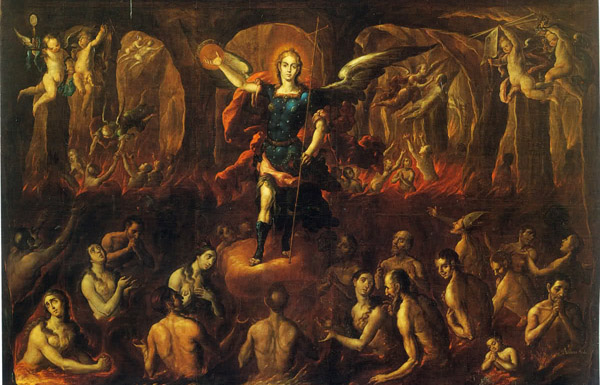
Purgatory or The Dark Night


St. John of the Cross calls the Dark Night a "purgatory".  And, as he, and later Garrigou-Lagrange tell us over 
and over, only the perfect see God.

Knowing that only those who have gone through the Dark Night of the Senses and who go into the Dark Night of 
the Spirit actually are pure enough to be free of the ego and work for God in the Church and not themselves. one wonders why more people do not cooperate with the graces of the Dark Night.

The list I made yesterday, distilling some of the characteristics of the Dark Night from John of the Cross' writings shows that one can endure this purgation here and now.

Why wait until purgatory? Why put off what can be done for the benefit of the Church as a whole and not merely for one's own benefit?

Many Church leaders are stuck in the lowest stages of spiritual growth. This is often too obvious, as actions 
from those cardinals, bishops, priests, nuns, lay people who are caught up in acting out of their egos rather 
than doing God's work are clear, if one is allowing God to deal with one in purification.

I do not need to name personages, but it is clear to me that too many cardinals and bishops are acting totally 
out of worldly standards of seeking fame, status, or achieving worldly goals. If we had more leaders who could 
give us good examples of humility and a purified will, the Church would be in a different place.

That so many of the laity think they can only achieve purgatory, instead of perfection, is a tragedy of our times. 
One is not a saint if one makes it to purgatory. Sorry, saints are those willing to go through purgatory on earth, 
another name for the Dark Nights of the Senses and Spirit.

To be continued..

Repost of five most popular posts on the blog

Sunday, 14 July 2013

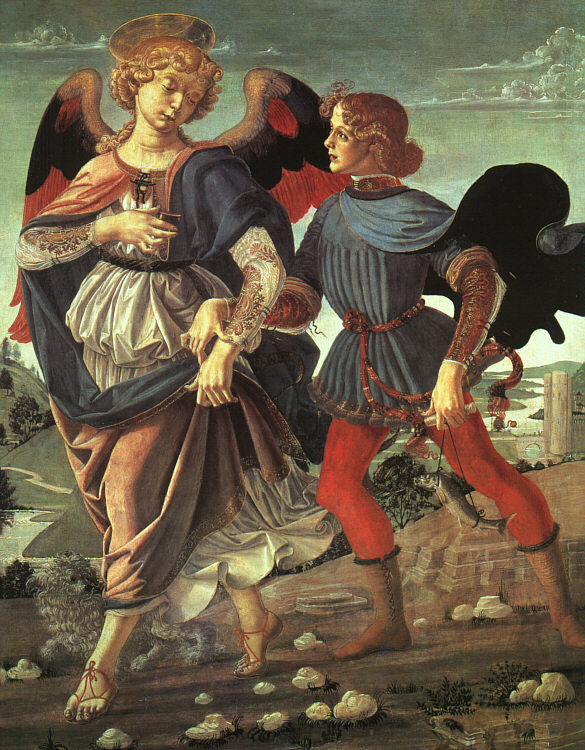
On Meeting Angels


Twice I have met people who may not have been people but angels. I know this sounds odd, but we do have 
such an encounter in the Book of Tobit and the fruit of such meetings determines truth.

The first was last October, when I was staying in the monastery. A nun who was the superior of her order came 
to stay in my hall on a silent retreat. I was instructed not to speak with her, which was fine, as I was being 
obedient, quiet, and not inclined to speak with guests.

I shall not give all the very interesting details, but after 24 hours, she came to me and said she was at the 
monastery for me, and that she would speak with me daily. As I was getting no feedback at the time, I was 
delighted but puzzled.

After the ten days, much advice and counselling from her experience as a superior, and after many prayers for me, plus notes and letters, she left. She had a sense of humour and at least once, we had a great laugh.

She did not want me to join that order. She gave me a book she just happened to have about a priest whose 
ministry is writing.

When I finally left the convent, I phoned the order where she was superior. I phoned two of their houses. The 
order has no such sister of that name and no superior of that name.

I had a hard time understanding this. I began to review her contacts with me. She never ate or drank anything in 
front of me. She only talked of sensible and pastoral things, such as me getting more sleep and not pushing myself. She also taught me how to approach God in Adoration. She also gave me two cards with angels on them.

I think she was an angel.

Today, I may have had another encounter with an angel. I went to a local coffee house for an iced chai, which for 
some reason I was craving. I sat outside and an Irishman started talking to me.

He talked sense about everything political, obviously being a real Catholic, not a socialist, and one who could see 
the signs of the times. He was the first older Irishman bar one I have met who understands the way of the world. 
And, he told me Ireland has lost her identity, which was the point of two of my recent posts, here and on another 
log.

But, what was so strange were two comments he made to me. I asked him what his job was and his reply was this.
"If I told you my job, I would no longer have it." So, naturally, I asked him if he worked for the government, and 
he said no very strongly.

I was puzzled, as this man, who told me he grew up in the country, who does not have a computer or never goes 
on the internet (amazing) could hold a 45 minute conversation on all the levels of moral decay, political ruin, and 
such in Ireland and the EU in detail. He was very strong against Masonic influence here. He was some type of 
genius outside the box.

But, then, a second strange statement came with his strong country accent-"Good luck on your journey." I said I 
was not going anywhere for several months. But, he repeated it "Good luck on your journey".

Now, I suppose angels do not believe in luck, but they do act like normal people, as did Raphael, in the above book, who basically "lied" to Tobit about who he was-one of his first cousins once removed or something.

But, what journey did this person mean today?  I went back and thought about the strange encounter.

Bingo! My journey towards perfection. I have been bogged down in the awareness of sinful inclinations and 
whether I was too evil for God to answer my prayers. I have been in darkness for weeks. My "angel" was 
underlining something said to me in Confession this morning as well. God is in charge and His Divine Providence guides every prayer. All of our desires and prayers are in His Will, if we are allowing Him to guide us. We must 
persist in prayer and on the journey to perfection, even though we cannot see a thing, either physical or spiritual. 
Also, what happens around us is there to help us on our way.

We pray in the Will of God and act in the Will of God daily, if this is our desire and if we are willing to undergo purification. The outcome of this discussion was the welling up of the awareness of God's particular love for me.

I am so fortunate as to have found a holy, wonderful confessor as well. What a treat. He understands the journey 
of perfection, which is rare for priests.

I am fortunate that God encouraged me over chilled chai.  The handshake of this man was so strong I could hardly believe it. One never knows when one is entertained or entertaining angels.

I needed this little encouragement. By the way, this person had such a sense of humour, I was laughing off and on. 
He told me that the only two places which were the real Ireland were Dublin and Cork. He knew Cobh. He said all 
the rest was grass and wind.

He also said that the Irish say that  further west one travels in Ireland, the more one understands why the Wise Men came from the East.

Now, I am much more peaceful on my journey today after this odd encounter. I have been encouraged in my world view, to see the end of Western Civ and the downfall of Europe, which he prophesied, as part of God's Providence, 
and that good will come out of ruin. He also said all the countries would go back to being separate in order to find themselves....I think this is true. He knew all about the current corruptions of Europe and America.

He also said, (what we know on this blog), that the evil has come from poor Catholic education, bad priests, and 
evil politicians, as well as the greed of the banks.  He noted that he never used credit cards and was not in debt. 
(I do not use credit cards and I have no debt.) This person said that now the Irish judge people by a price tag and 
that everyone has one-in the mind of the secularist. He said that Ireland was now a police-state and that people 
had lost their independence. My observations have been supported.

I do not know, but anyone today who is completely au fait and never on line must be inspired. He quoted a book, 
one from the 1940s, which I shall look up.

Odd encounter of a second kind. No third. I forgot another one in Malta. For another day....
Repost of the five most popular posts of Supertradmum


Monday, 16 January 2012


An Unusual, Controversial Catholic Subject-Celibacy in 

Marriage


Now, I am not married, but I live a celibate life-style. However, I have an increasing number of friends, 
traditional Catholics, who have opted for celibacy in their marriages. This is not a new ideal in the Church, 
and although Christ wants most married couples to be fruitful and multiply, that is, to have the wonderful 
children God desires them to have, there have been and are couples, who for the sake of the kingdom, 
have chosen a different way. Of course, the norm, having children as God gives, creates saints, such as 
Blessed Louis and  Blessed Zelie Martin, Blessed Karl and Empress Zita, SS. Joachim and Anna, 
SS. Isidore and Maria (who vowed abstinence later in their marriage), and so on. This is not an exhaustive list.

However, the emphasis on celibacy should be rare, but seen as a call within a call. I also think there 
has to be good reason for not having children. The grand example are two of my favorite Catholics, 
Jacques and Raissa Maritain, who on the Isle of Wight, as Benedictine Oblates, took a vow of celibacy 
"for the sake of the Kingdom". Raissa writes in her diary, which I practically have memorized, that it was 
difficult for her, but she could see that Jacques was called to be in the world and she was his prayer backup, companion in holiness, and confidant, as well as best-friend. They shared philosophy, theology, and the 
dedication to bringing the Gospel into the workplace in the extreme. God called them to this.

I first met celibate married couples about twenty-five years ago. The first couple I met were in their forties 
and had a close relationship with the Church and the priest who was the pastor. They were very active in the 
Church, but did not have normal marital relations. They had chosen that way and had married later in life. 
The man had been in the Jesuit seminary for years, but left, as he did not think he had a priestly vocation. 
He found a wife who would support him in his spiritual walk. The second couple I met were in their early sixties. They had decided that past child-bearing age, they would make a celibate commitment. Since then, I have met 
another couple who have decided the same thing. Their "extra" time is spent in good works, praying and fasting. Obviously, these couples have spiritual directors. This call within a call is, also, obviously, 
by mutual consent. And this arrangement is called a "Josephite Marriage."

Those with a worldly mindset and even some good Catholics may find this call repelling or unnatural. 
I would say that this call is rare, but not unnatural. I think that those who decide to live in the world, or 
are called so by God to remain among the laity, can exhibit a variety of calls "for the sake of the Kingdom". 
And, to be in a relationship which is celibate may be a sign of contradiction to the world as well as giving 
two people the necessary, daily support a brother and sister in Christ may give to each other. Intimacy has 
many faces, and the physical side of intimacy is only one aspect of relationship. I have written this to support 
my friends who have chosen this way and to encourage those who feel the need for companionship without 
sex to be comforted in that they are not alone. We are all called to be saints, and there are many ways, 
in Christ, through Mary, to be saints.

In addition, God did not intend people to live all alone. The fact that there are so many single, lonely 
individuals needs to be addressed by the Church. Those who for whatever reason cannot be a priest or 
nun or sister, have some options, but loneliness should not be the norm. Church communities have failed, 
especially in America, to support their singles. Many Catholics are singles for many reasons. There exists a judgmental attitude, which excludes those singles from the larger interaction in the Church. And, for those 
who desire celibacy in the world, that is an option, but it does not have to equal loneliness. I am very fortunate, as I do not experience the gnawing type of loneliness some do. I may miss my dear friends when apart from them, 
but that is different than the vague experience of loneliness many feel. We all need to reach out to those 
who feel this need, pray for them, and include them in our busy lives. To do otherwise is not to be Christian.

(And, yes, chastity may be a better word for this post, so do not make comments on the difference between  
chastity and celibacy).

Perfection Series II: xxxviii


More from Garrigou-Lagrange on reason and faith.

The certitude of prudence, as explained by Aquinas, [1387] following Aristotle, contains that which is true in limited pragmatism. Prudence is a virtue, even an intellectual virtue, in the moral order, a virtue which transcends opinion, and reaches a practical certitude on the goodness of the act in question. The truth of the practical intellect, Aristotle [1388] has said, differs from that of the speculative intellect. Speculative truth means conformity with objective reality. But since the intellect is limited to the necessary truths of reality, it cannot attain infallible conformity with the contingent and variable elements of reality. The contingent, as such, cannot be the subject matter of a speculative science. Truth in the practical intellect, on the contrary, means conformity with good will, with good intention. When for instance, presented with an unsuspected poisoned drink, a man proceeds to partake, his speculative error does not prevent his having a true prudential judgment based on his intention to obey charity and politeness. Practical truth can coexist with speculative error. Pragmatism can claim this partial truth.

Pragmatism Must Return to Tradition
One chief difficulty, proposed by the philosophy of action, appears in St. Thomas [1389] in the form of an objection. The thesis is: Goodness in the will depends on reason. The objection runs thus: The reverse is true, because as the Philosopher [1390] says, truth conformed to right appetite is the goodness of the practical intellect, and right appetite means good will In other words, each man's judgment follows his fundamental inclination, bad or good. If this fundamental inclination is bad, the judgment will be wrong. But if the inclination is good, the judgment too will be right and true, just as spiritual pragmatism maintains.

The saint's answer runs thus: The Philosopher is speaking here of the practical intellect, as engaged in the order of means, to find the best road to a presupposed goal, for this is the work of prudence. Now it is true that in the order of means the goodness of the reason consists in its conformity with the will's inclination to the right end and goal. But, he adds, this very inclination of the will presupposes the right knowledge of the end, and this knowledge comes from reason. [1391].

Prudential certitude, then, does presuppose right intention in the will, but this right intention itself derives its rectitude from those higher principles of reason which are true by their conformity with objective reality, with our nature and our last end. To reduce all truth to prudential certitude means to destroy prudential certitude itself.

To this extreme we seem to be led by those who, abandoning the eternal notion of truth as conformity with objective reality, propose rather to define truth as conformity of spirit with the exigencies of human life, a conformity known by a constantly developing experience, moral and religious. Here we are surely near the following modernistic proposition: Truth is not more immutable than is man himself, since it evolves with him, in him, and through him. [1392].

The pragmatism we are here dealing with is not, we must acknowledge, the grovelling pragmatism of social climbers or politicians, who utilize mendacity as practical truth, as sure road to success. It is rather the pragmatism of good and honest men who claim to have a high level of religious experience. But they forget that man's will, man's intention, can be right and good only by dependence on the objective and self-supporting principles of man's nature and man's destination, as known by reason and revelation, principles which impose on him the duty of loving God, above all things, man himself included. This truth, the source of man's good will and intention, rests on its conformity with the highest levels of reality, on the nature of our soul and our will, on the nature of God and God's sovereign goodness, on the nature of infused grace and charity, which are proportioned to God's own inner and objective life.

The consequences, then, even of this higher pragmatism, are ruinous, though unforeseen by those who meddle with the traditional definition of truth. We noted above [1393] the remark of M. Maurice Blondel that the abstract and chimerical definition of truth as "conformity of intellect to reality" should be abandoned in favor of "conformity of mind with life." That was in 1906. Though he later attempted to draw near to St. Thomas, he still wrote: [1394] "No intellectual evidence, even that of ah solute and ontologically valid principles, is imposed on us with a certitude that is spontaneous and infallibly compelling; not more than our objective idea of the absolute Good acts on our will as it would if we already had the intuitive vision of perfect goodness."
To admit parity here would be a grave error, because our adherence to first principles is necessary, [1395] whereas our choice to prefer God to all else is, in this life, free. Here below God is not known as a good which draws us invincibly, whereas the truth of the principle, say of contradiction, can simply not be denied. He who knows the meaning of the two words "circle" and "square" has necessary and compelling evidence of the objective impossibility of a square circle.

The higher pragmatism does not, it is true, sacrifice truth to utility. But to abandon the traditional definition of truth is to unsettle all foundations, in science, in metaphysics, in faith, in theology. Prudential truth rests on an order higher than itself. The enthusiasm of hope and charity, if it is not to remain a beautiful dream of religious emotion, must rest on a faith which is in conformity with reality, not merely with the exigencies of our inner life, or even with our best intentions Nothing can be intended except as known. Unless the intellect is right in its judgment on the end to be attained, there can be no rectitude in the will. The good, says St. Thomas, [1396] belongs first to reason under the form of truth, before it can belong to the will as desirable, because the will cannot desire good unless that good is first apprehended by the reason.


The Thinking Like Catholics Tags and The Perfection Series II: xxxvii

I have many tags or labels on "thinking like Catholics." Sadly, there are many readers who still do not understand what it means to conform one's mind to the mind of Christ.

I cannot stress enough the importance of seeing things through the lens of the Second Person of the Blessed Trinity. This ideal forms the prayer, "Thy Kingdom Come, Thy Will Be Done".

Garrigou-Lagrange in his book, Reality, A Synthesis of Thomistic Thought, warns us through other authors, as well as his own admonitions, to seek a philosophical viewpoint which underlines the Catholic Faith.


Here we may well listen to Pierre Charles, S. J.: "In favor of the history of dogma, and in discredit of metaphysics, an extremely virulent relativism had been, almost without notice, introduced into the teaching of doctrine. Psychology replaced ontology. Subjectivism was substituted for revelation. History inherited the place of dogma. The difference between Catholics and Protestants seemed reduced to a mere practical attitude in regard to the papacy. To arrest and correct this baneful and slippery attitude, Pius X had the proper gesture, brusk and definitive. Anglican modernism today shows all too well the frightening consequences to which, without the intervention of the Holy See, doctrinal relativism might have led us.

To many Catholics stew in anti-intellectualism, as if pursuing the rational impeded their growth to perfection. The opposite, which is the reliance on experience, leads to the gross errors of Protestantism.

"Papal condemnation has brought to light, in many Catholic theologians, a gaping void: the lack of philosophy. They shared the positivistic disdain for metaphysical speculation. Sometimes they proclaimed a highly questionable fideism. Fashion led them to ridicule philosophy, to jeer at its vocabulary, to contrast its infatuated audacity with the modesty of scientific hypotheses. The pope, by describing and synthesizing the modernistic error, compelled theology to re-examine, not so much particular problems, but rather fundamental religious notions, so skillfully distorted by the school of innovators. The philosophic bone-structure began to reappear ever more clearly as indispensable for the entire theological organism." [1350]

More later....


At The Church of The Holy Sepulcher at Night


Pray for this seminarian and all seminarians, please.

Prayers at The Wailing Wall


A seminarian friend of mine is putting prayers of mine, and others in his family and among his friends, in the crack of the Wailing Wall.

How cool is that?


If you have never read Dr. Sanity................

http://drsanity.blogspot.com/2009/05/narcissism-pathological-lying-and.html

Boycotting Jane Austen Quizzes And Other Comments


Hmm, it use to be fun to do the Jane Austen character tests, which some on this blog did in 2012. However, some of the newer tests have proved to be so inadequate and just plain "off", that these simple pleasures have fallen from grace.

I have a theory on this. Too many newer interpretations of Jane Austen heroines seem to be created by those who either have not read the books, or do not understand the world of Austen.

One cannot read literature from a 21st century point of view. Women and men had different roles in 1811 and later, and although the society was in a state of flux because of the wars, including the War of 1812, creating new wealth and changing the nature of leadership in the countryside, with the new rich, such roles remained relatively settled.

The newer tests have too many responses which demand a knowledge of popular culture which includes sleazy references. Not good for died-in-the-wool literature buffs are references to singers or movies or other things such persons may not know.

Which brings me to the real purpose of this post. The lack of real understanding of days past and the hubris of the modern mind that somehow the present culture is superior to cultures in the past, reveals a crassness, and a lack of empathy for those people who lived generations ago.

Hubris in a culture may be exhibited by barbarians, who think that their lifestyles somehow, even though non-reflective and violent, lie in a false strength based on power and might.

The barbarians at the gate of Rome hated the culture which they met. Many reasons may have led to their hatred of that civilization besides the desire for riches from plunder.

Think about the barbarians at the gate today. Their god is money. Barbarians only understand one thing-pleasure, and those who love Jane Austen realize that her books continually made fun of those characters who only wanted status and money-the barbarians of 1811.

Our culture has become so debased, we cannot even share humor, as the cultural norms for deciding things has changed so drastically that main ideas of history and literary criticism can no longer be shared.

Sad days....


Thursday, 20 February 2014

Comments from professional readers?

http://www.dailymail.co.uk/health/article-2563992/Scientists-discover-violence-gene-turns-children-video-game-addicts-say-linked-ADHD.html#

New Auxilliary Bishop of Miami

http://vassallomalta.wordpress.com/2014/02/20/pope-names-caribbean-missionary-as-new-miami-auxiliary-bishop/

From Michael Voris and Michael Dornan

http://www.cdc.gov/hiv/statistics/basics/ataglance.html


HIV in the United States: At A Glance

CDC estimates that 1,144,500 persons aged 13 years and older are living with HIV infection, including 180,900 (15.8%) who are unaware of their infection1. Over the past decade, the number of people living with HIV has increased, while the annual number of new HIV infections has remained relatively stable. Still, the pace of new infections continues at far too high a level— particularly among certain groups.
HIV Incidence (new infections): The estimated incidence of HIV has remained stable overall in recent years, at about 50,000 new HIV infections per year2. Within the overall estimates, however, some groups are affected more than others. MSM continue to bear the greatest burden of HIV infection, and among races/ethnicities, African Americans continue to be disproportionately affected.
HIV Diagnoses (new diagnoses, regardless of when infection occurred): In 2011, an estimated 49,273 people were diagnosed with HIV infection in the United States. In that same year, an estimated 32,052 people were diagnosed with AIDS. Overall, an estimated 1,155,792 people in the United States have been diagnosed with AIDS3.
Deaths: An estimated 15,529 people with an AIDS diagnosis died in 2010, and approximately 636,000 people in the United States with an AIDS diagnosis have overall3. The deaths of persons with an AIDS diagnosis can be due to any cause—that is, the death may or may not be related to AIDS.

By Risk Group

Gay, bisexual, and other men who have sex with men (MSM) of all races and ethnicities remain the population most profoundly affected by HIV.
In 2010, the estimated number of new HIV infections among MSM was 29,800, a significant 12% increase from the 26,700 new infections among MSM in 20082.
Although MSM represent about 4% of the male population in the United States4, in 2010, MSM accounted for 78% of new HIV infections among males and 63% of all new infections2. MSM accounted for 52% of all people living with HIV infection in 2009, the most recent year these data are available1.
In 2010, white MSM continued to account for the largest number of new HIV infections (11,200), by transmission category, followed closely by black MSM (10,600)2.
The estimated number of new HIV infections was greatest among MSM in the youngest age group. In 2010, the greatest number of new HIV infections (4,800) among MSM occurred in young black/African American MSM aged 13–24. Young black MSM accounted for 45% of new HIV infections among black MSM and 55% of new HIV infections among young MSM overall2.
Since the epidemic began, an estimated 302,148 MSM with an AIDS diagnosis have died, including an estimated 5,909 in 20103.

Why America Is No Longer Great


Mammon is now the god of America. He is now the god of most Americans and even Catholics.

If Christ was ever the God of this people, He is no longer. The main component pushing politics of all the parties is, simply, money.

Mammon is now the god of society, as well as politics. The reference of most families is till the false American Dream of success and comfort.

If Christ had ever been the centre of American families, He is no longer, having been replaced by gross narcissism and self-idolatry.

Mammon is also the god of many churches.  Mammon is also the god of many Catholic television and radio stations.

There are very few real journalists and fewer prophets.

I actually cannot listen to some of the so-called main stream Catholic media, as the real issues are being ignored.

Be careful. There is too much dysinformational in the medias, including some far-right medi

Be careful. Those groups who remain poor are from God, as the god of Mammon rewards his own.

Pray that you are free from any ties and idolatry of Mammon.


How the once great Catholic universities have fallen...

http://www.cardinalnewmansociety.org/CatholicEducationDaily/DetailsPage/tabid/102/ArticleID/2997/Notre-Dame%E2%80%99s-Performing-Arts-Center-Shows-NC-17-Rated-Movie.aspx

Hysterical

http://extramustard.si.com/2014/02/19/david-attenborough-curling/

Thanks to David for this. Smiles...

Europeans and Americans, pay attention and pray

http://www.nytimes.com/2014/02/20/world/europe/violence-in-ukraine-creates-deepening-clash-between-east-and-west.html?_r=0

Apologies


Some goofy errors corrected in titles today Net was on and off and on and off.

Fun. There is a doe eating grass cleared by it constantly pawing the ground in the back here. Photo is of buck, obviously. Suppose to RAIN today....

Crazy!

Perfection Series II: xxxvi

I think of Blessed Margaret Pole, one of my patrons I have adopted when thinking of confidence. She had to face the fact that she was being persecuted by her godson.

Such hard times.

Garrigou-Lagrange again:


While fulfilling our daily duties, then, we must abandon ourselves to almighty God in a spirit of deep faith, which must also be accompanied by an absolutely childlike confidence in His fatherly kindness. Confidence (fiducia or confidentia), says St. Thomas, [72] is a steadfast or intensified hope arising from a deep faith in the goodness of God, who, according to His promises, is ever at hand to help us—Deus auxilians. [73]
As the psalms declare: "Blessed are they that trust in the Lord" (2: 12) ; "They that trust in the Lord shall be as Mount Sion: he shall not be moved forever that dwelleth in Jerusalem" (124: 1) ; "Preserve me, O Lord, for I have put my trust in Thee" (15: 1) ; "In Thee, O Lord, have I hoped, let me not be confounded" (30: 1).
St. Paul (Rom. 4: 18) reminds us how Abraham, in spite of his advanced years, believed in the divine promise that he would be the father of many nations, and adds: "Against hope, he believed in hope.... In the promise also of God he staggered not by distrust: but was strengthened in faith,, giving glory to God: most fully knowing that whatsoever He has promised, He is able to perform."

Garrigou-Lagrange also writes about Providence providing us with “sustained moral energy”. This phrase deserves thought and reflection. Sustained moral energy seems to me to be the ability to persevere in times of trial and even harsh persecution.

The great Dominican also notes that persistence in prayer is a sign of faith and the correspondence of prayer and believing in Providence.

If one is in sanctifying grace, one is moving towards and in the will of God.

Prayer, indeed, is a supernatural energy with an efficacy coming from God and the infinite merits of Christ, and from actual grace that leads us on to pray. It is a spiritual energy more potent than all the forces of nature together. It can obtain for us what God alone can bestow, the grace of contrition and of perfect charity, the grace also of eternal life, the very end and purpose of the divine governance, the final manifestation of its goodness.
He also states:

At a time when so many perils threaten the whole world, we need more to reflect on the necessity and sublimity of true prayer, especially when it is united with the prayer of our Lord and of our Lady. The present widespread disorder must by contrast stimulate us constantly to reflect that we are subject not only to the often unreasoning, imprudent government of men, but also to God's infinitely wise governance. God never permits evil except in view of some greater good. He wills that we co-operate in this good by a prayer that becomes daily more sincere, more humble, more profound, more confident, more persevering, by a prayer united with action, in order that each succeeding day shall see more perfectly realized in us and in those about us that petition of the Our Father: "Thy will be done on earth as it is in heaven." At a time when Bolshevism is putting forth every effort against God, it behooves us to repeat it again and again with ever deepening sincerity, in action as well as in word, so that as time goes on God's reign may supersede the reign of greed and pride. Thus in a concrete, practical way we shall at once see that God permits these present evils only because He has some higher purpose in view, which it will be granted us to see, if not in this world. at any rate after our death

Two Views of The History of Warfare: Washington Hall, West Point


Can you spot one saint?


John Smeaton Clarification

http://protectthepope.com/?p=10010