Recent Posts

Thursday, 15 March 2012

Oliver Plunkett II

The Examination of Edward Fitzharris. The Arraignment and Please of Edward Fitzharris. The Tryal and Condemnation of Sr. Oliver Plunket. An Answer to the Protestation of the Nineteen Lords Against the Rejecting of the Impeachment of Mr. Fitzharris.

I am holding in my hands the original 1681 book, bound in white leather, as it was once presented to a Pope, given by Cardinal Conway to Msgr. John Hanly, the Postulator of the Cause of St. Oliver Plunkett, on 21 June 1976. I am honored and humbled to be able to see, old and use this book.

This book, published in1681, in London, for Thomas Fox, at the Sign of the Angel in Westminster-hall, was printed by the order of the House of Commons. The Speaker of the House W. Williams ordered and approved the printing. It is made up of sections, printed at different times.

It is a treasure of Catholic history. I shall lightly refer to the section on Edw. Fitzharris and the Popish Plot, returning to that in another blog, as I want to concentrate on the section relating to St. Oliver Plunket, here spelled with one t.

That Edward Fizharris was accused of attempting to kill the King, along with armies from Holland, Flanders, France and Italy, and connected with the murder of Sir Edmund Bury-Godfrey, along with so-called conpiracy involving the Duke of York and a certain Father Bedingfield is set out. Another printing from the Spring Term of 1681 carries on the trial proceedings, which obviously fall short of any fair trial as determined by Magna Carta, and this is seen in the trial of St Oliver Plunkett. There are no attempts at real information. The entire trial is printed, with all the notes regarding the Jury and all the dialogues. That the jury was “stacked” with anti-Catholics and that the Lord Chief Justice, and the witnesses convicted a man of treason for being a Catholic is clear. This sets the stage for the non-trial judgement of St. Oliver Plunket. Despite the lack of justice, I am impressed with the details of the trial proceedings and the minutiae of the notes, which were taken down verbatim by hand and then printed into the book I know have before me.

The section on the Tryal and Condemnation of Fitz-Harris and Dr Oliver Plunket, were printed for Francis Tyton and Thomas Basset, Booksellers in Fleetstreet, in 1681. Francis Pemberton, the Lord Chief Justice (L. C. J. below) appointed these printers.The evidence of two witnesses were enough to have a person condemned. What one had to do was discredit those witnesses. But, of course, the condemnation was purely because of this part of the trial. Here are some of the notes regarding the witnesses.


Mr. Serj Jefferies. :What Religion is Mr. Fitz-Harris of?
Mr. Everard: he was always looked upon to be a Papist?
Fitz-Harris: When did you see me at Mass?
Mr. Att. Gen. Hath he not owned himself so?
Mr. Everard. He hath owned himsrlf at several times to be a Papist.


And so on...

With the Tryal of Dr Oliver Plunket, the sham is more obvious. The saint was arraigned on May 3, 1681 “for High-Treason, for endeavouring and compassing the Kings Death, and to levy War in Ireland, and to alter the Religion there, and to introduce a Forreign power.”

That the saint could not get witnesses from Ireland because of bad sea winds did not seem to interfere with the puppet show. Plunket defended himself, having excellent legal training in Rome. His great intelligence is seen in the transcript of the trial, and one must remember that he had been imprisoned in Ireland and in England for nineteen months before this trial. The Popish Plot for which Plunkett was supposedly guilty saw the execution of Lord Staffor, on of the five Catholic lords who had been imprisoned in the Tower in connection with the plot. He was 85 when executed and was Cardinal Howard's uncle, the family which helped Oliver Plunkett in prison. That the Protestant were allowed to hold sway over such false proceedings showed the political need for Charles II,(to whom Oliver Plunkett had written a plea or petition of freedom), to prove his loyalty to the Church of England, and Parliament. The hypocrisy of the times may be highlighted in the fact that his own queen, Catherine of Branganza, had as many as twenty chaplains housed in her palace, who she allowed and encouraged, to work in London and the surrounding areas at night, while they slept most of the day.

Plunket asked for a deferral of the trial for ten days to allow his witnesses, but he was denied.


The details of the trial and the so-called veracity of the two witnesses make for interesting but frustrating reading, as one knows the outcome. I shall skip to the end of the trial and the conversation between Plunket and the Lord Chief Justice.

    L.C. J. Look you, Mr. Plunket, You have been here indicted of a very great and hainous Crime, the great and most hainous of all Crimes, and that is, High Treason; and truly yours is a Treason of the highest Nature, 'tis a Treason in truth against God and your King, and the Countrey where you lived. You have done as musch as you could to dishonor God in this Cafe; for the bottom of your Treason was, your setting up your false Religion, than which, there is not any thing more displeasing to God, and more pernicious to Mankind in the world. A Religion that is ten times worse than all the heathenish Superstitions, the most dishonorable and derogatory to God and his Glory of all Religions or pretended Religions, whatsoever, for it undertakes to dispense with Gods Laws, and to pardon the breach of them. So that certainly a greater Crime there cannot be committed against God, than for a man to endeavour the Propagation of that Religion....”

a bit later, after St. Oliver Plunkett had pointed out legal errors in the trial, he stated:

“God Almighty bless your Lordship. And now my Lord, as I am a dead Man to this World, and as I hope for Mercy in the other World, I was never guilty of any of the Treasons laid to my Charge, as you will hear in time; and my Character you may receive from my Lord
Chancellor of Ireland, my Lord Berkley, my Lord, Essex and the Duke of Ormond.


Then the Keeper took away his Prisoner, and upon Friday the first of July, he was executed according to the Sentence. FINIS.

In a letter, his last, to Mr. Michael Plunkett, written on June 16, 1681, the saint wrote:

On the 8th of this month I was put on trial, accused of trying to bring in the Catholic religion, of having seventy thousand men ready for a rebellion, of having collected money for them, of having surveyed all the fortresses and ports in Ireland, and of having assigned the port of Carlingford for a landing of the French. I insisted that I should have time to bring my witnesses from Ireland, but in vain.

I objected that a crime alleged to have been committed in Ireland ought to be tried there also, and that the jury of twelve should be taken from there so that the character of the persons involved in the case might be better known. But all was denied to me. The chief accusers were two Franciscan relgious, viz., one McMoyer and Hugh Duffy, as well as a priest for the MacClaves. Four laymen also appeared, i.e.. two O'Neills, one Hanlon and Florence MacMoyer: these four I never laid eyes on in my life.

Master MacMoyer swore that he had seen with Neil O'Neill who went to the congregation of the Propaganda, letters sent by me to Cardinal Baldeschi, Prince Colonna and the bishop of Aix for the purpose of procuring forces from abroad for an invasion of Ireland. When I brought forward the argument that it had never been known that anybody cited for a particular crime before a tribunal in Ireland should again be summoned here to be tried, it was of no avail—the judge replied that a certain O'Rourke had been summoned here and tried. I answered that this man had been declared a rebel by public edict and had been arrested in Scotland. Sentence of death had been passed against me without any hope of reprieve. Thus those who once beheaded my statue have now achieved the same object in the case of its prototype, through the agency of two of their brethren. It was Friar MacMoyer who persuaded the other friar and laymen to do what they have done. I forgive them all, and with Saint Stephen I say, “Lord do not lay this sin to their charge”. I believe I am to die about the end of this month.

Please show this letter or its contents to all my friends, and beg them ardently that they pray for me. I never tried to introduce the Catholic religion except by teaching and preaching only. I have never in conscience been guilty of any conspiracy or rebellion, directly or indirectly. Oh how I wish I were are free of every other crime and sin against the divine precepts as I am of this! It is essential therefore that all my friends pray for me, as I hope they will.

Your kinsman, Oliver Plunkett.


By the way, Msgr. Hanly has the original painting, which is copied here, with the difference that the pike is not broken in the original, as Msgr. asked for this change when the IRA decommissioned their weaponry. This copy is in the church, at the shrine, in Drogheda. Msgr. explained to me the symbolism in the painting. Of course, St. Oliver is dressed as a bishop of his day. The children on the right represent his school which he started with his own money, under the care of the Jesuits, in Drogheda. The many people represent all the thousands of Irish the saint confirmed. The priest in the front represents those men he ordained, and the renewal of the priesthood he demanded in Ireland. The ruins on the left-hand side represent the fact that Rome stands, although Ireland fell, and that the Church will last through persecution. The gallows is self-explanatory.

On Oliver Plunkett I

The Letters of Saint Oliver Plunkett

Edited and Translated with an introduction by Monsignor John Hanly 1979

I have spent several delightful hours over the past few days listening and discussing St. Oliver Plunkett with the former rector of the Irish College in Rome and the postulator for St. Oliver, Mgsr. John Hanly. I have discovered so many treasures in the Letters, pointed out to me by Msgr. Hanly, to now have a new perspective on the erudition and greatness of the last martyr of Ireland and England.

The Letters need to be studied, not merely read, not only for the history of the penal times, and not only for the revelation of the character of the great saint, but for the insights and timeliness of the state of the clergy and education in Ireland in the 17th century. Of all the many themes, all important, I chose to highlight a few references from the Letters regarding the importance of seminary training. If I had time, I would write more on the beauty of the Letters themselves, written by a great scholar of classical education, with legal training and humor.

I shall quote from Letter 100 in the book, written in Dublin, on the 27 of September, 1671. and in Italian, as most of the letters were written. At this time, St. Oliver Plunkett had some freedom to work and act in Ireland, but of course, this was not to last:

I have been a year and seven months in this country now, and I think I have given so many reports on the spiritual affairs of my province that my superiors can almost touch with their hands and see with their eyes what its condition is, and of what temper it is. In fact, it is in many ways unwell and there is the danger that the illness may progress and become more serious, if our superiors (in Rome) and physicians-in-chief do not provide us with medicines, purgatives and preservatives. Generally speaking, the lack of learning on the part of the clergy is great, despite the fact that the Irish, and especially the Ulstermen, are intelligent and quick-witted; what us is this if their talent cannot be cultivated?

Plunkett write on to state that despite his founding of schools, there still are not “men fit to be leaders or to hold controversy with Protestant ministers or laity”

He continues, “In my poor opinion it would be a great act of charity to help....give them an education in Catholic countries and especially in Rome.. Those who are educated in Rome are less suspect to the present government, which regards Rome as a neutral state not attached to either Spain or France; and besides, these young men are more loyal to the spritual interests of Rome...those trained in Rome understand better the mind of the holy see, they have grasped its principals, they know better how to correspond with Piazza di Spanga: Propaganda, in a word, all Rome is a great book

Those who closed the Irish embassy should listen to St. Oliver Plunkett...

May I add that the great saint was also very clear as to the heresies of the day, the aberrations of sacramental life, the laxity of the orders, and the need for catechesis. Does this sound familiar?

In addition, one of the most eloquent pleas from this man was the desire for truth with regard to the lax bishops and clergy. One of his phrases, in Letter 195 notes, “As the proverb says, the blind man is no judge of colour...and thus Father..., who is himself quite ignorant, is no judge of ….'s learning.

Would that the recent Visitations would be so honest. Pray to St Oliver Plunkett for excellent clergy in Ireland, a change in the seminary training to come back to the classics and to orthodoxy. 

Wednesday, 14 March 2012

Enough--record nine blog day....

If you don't look at Maru listed on my blog list....

My son added the caption.

It's Pi Day

POTUS has Mao-Envy

Take a look at this....the States are in trouble if the Narcissist can get away with this and has his party's support. Ugh!

http://www.wftv.com/news/news/local/vets-angry-over-american-flag-featuring-obama/nLR5Q/#comments

More Persecution of Christians to Come in Northern Ireland, England, Scotland and Wales

I know I have several posts today, but I need to refer to the new movement in England to ban the wearing of crosses or crucifixes in the workplace. Here is the news item. Although Muslims, Sikhs and other persons can wear their symbols, the cross seems to bother some Conservatives in the government. This is out and out persecution of Christians. Thankfully, some Anglicans, including the former Archbishop of Canterbury, Dr. Carey, have come out against this. Carey said ministers and courts were "dictating" to believers, calling it another example of Christianity being marginalized in the public square."The reasoning is based on a wholly inappropriate judgment of matters of theology and worship about which they can claim no expertise," he charged. "The irony is that when governments and courts dictate to Christians that the cross is a matter of insignificance, it becomes an even more important symbol and expression of our faith," he added. 

The Pope and the Irish Eucharistic Congress

Today, on the news in Ireland, it was announced that the Pope, Benedict XVI, will broadcast on live television, some type of homily or commentary at the last Mass of the Eucharistic Congress. He will not be in Ireland, contrary to rumors here.

On Benedictine Balance


This is a dangerous posting. So many people have fallen into hedonism and selfishness that to write about not being vigilant and strict with one's self all the time may seem inappropriate. However, I want to caution some of my traditional friends on being too harsh with themselves. Perhaps my perspective is so Benedictine, a way which always considers the weak, that I write this cautionary tale from St. Anthony Abbot:   A desert hunter saw Anthony Abbot “horsing around” with his fellow monks. The hunter expressed shock, even scandal, when he saw the monks enjoying themselves at some recreation. Anthony Abbot told the hunter to string his bow and shoot at a near target. The hunter did so. Then, the Abbot told the hunter to shoot another arrow. The hunter did so. When the Abbot asked the hunter to shoot a third, the hunter replied, “If I bend my bow so much at a time, it will break.” Anthony Abbot replied. “So it is with my monks. If I do not give them rest and recreation, they will break.”

The point of this story is relatively clear. But I think the larger question has to do with the works of piety and prayer. Christ warns us not to pile on repetitious prayers one after another. He decidedly does tell us to pray and fast. Fasting is ignored for the most part today. And, so much fasting is what I call “token fasting”, such as giving up luxuries, such as chocolate or going out to dinner. Such is the wealth of the States, that fasting resembles ordinary life for the rest of the world.

However, there is a stage wherein the great words of St. Benedict apply to all. When he writes of the balance of work, study and prayer, he indicates that all three activities are important in a day for a person pursuing holiness. An entire day of prayer is not natural for us lowly humans. The necessity of work and the need for study, such as the reading of Scripture daily, create a rhythm of activity, all focused on Christ. To omit one is folly and shows a lack of appreciation for the needs of the human, who is body and spirit. Above all rules, that of St. Benedict reveals an understanding of what it means to be an organized, healthy human being.

That Anthony Abbot recognized the needs of his community shows the Holy Spirit working within the Church in all ages.

To balance this approach, one must be more harsh with one's self than most people in the world. We cannot slack off in the pursuit of salvation, that is, in cooperating with grace. However, we are clay, and God has given us guidelines for the good of our bodies and our souls.
St. Thomas More wore a hair-shirt and he said when in prison that he wished he had been harder on himself in order to prepare for his martyrdom. His example were the Carthusians being stretched on hurdles and taken to Tyburn, singing in the mud and grime. If one is called to such serious penances, one must have a spiritual director. But, for the lay person, the joyous accepting of daily sufferings without complaining may be enough penance. May we all realize that complaining is a sin and if we refrain, we change our entire outlook on life to one of gratitude and joy.


On the Laity Using the Breviary

Several months ago, Father Z on his famous and excellent blog, ran a poll on how many and what type of the Liturgy of the Hours were said by his readers. I was pleasantly surprised not only at the number of lay people who prayed the Breviary, but how many hours some actually covered in a day.

Now, I must admit, I rarely do more than either Lauds or Vespers, choosing one or the other depending on my schedule. Rarely do I do Sext, Prime and Terce, which are in my Monastic Diurnal, which is from St. Michael's in Farnborough. Now that the Baronius Press has published a three volume set of the Breviary in the Extraordinary Form, I shall be interested in looking at that in detail, although I am partial to my Benedictine Breviary.

What seemed a great blessing and encouragement to me were the numbers of the laity who said two or more of the hours per day. I find that a refreshing obedience to the call of several Popes in the past asking the laity to take part in the Daily Office. What does this trend mean?

I think, ironically, it means two habits among the laity which are distinct. The first is that there are more single lay people, who take time to say the Liturgy of the Hours alone, or possibly, in a group. That younger people have picked up the Daily Office and are using it for prayer exhibits a sign of renewal among the younger adults.

The second trend is that more married couples are praying the Divine Office, or parts of it, together. I am reminded of a humorous story told by an old Irish friend of mine, Paddy. He is in his eighties, and was telling me that his brother in his late sixties was getting married for a third time, being a widower twice. When his brother, Mike, went to the local priest, the priest asked him why he wanted to get married again, seeing that Mike and his wife-to-be were beyond child-bearing age. Mike did not miss a beat and answered, “I want someone to answer the rosary I start up every night.” Mike's point was that for him, praying was easier with someone than without. Several of my married friends pray with their husbands, especially now that some are retired. They find this so rewarding, that they admit they wished they had done this their entire married life instead of waiting until the children were raised and gone.

Here is a lovely painting of St. Dominic reading the Breviary. There is something to be said about praying out loud with others. The interaction between the body and the soul is important to us mortals. Community prayer also keeps us from too much introspection and selfish concerns. However, there are thousands of clergy and lay people who say the Divine Office daily alone.

Those of us single ones may find praying alone easy as we have been doing it for such a long time, but the point of using the Breviary as laity should be considered by all. May I quote St. Benedict, on the Opus Dei, whose Rule I have been revisiting here for a week or so. Please note that eleven of the chapters in the Rule are dedicated to praying, and for the Benedictine, this means praying the Divine Office. Indeed, nothing is to be preferred to the work of God.

Can Ireland become the Isle of Saints Again? Oliver Plunkett and Margaret Ball

I have had the joy and privilege of seeing the preserved head of St. Oliver Plunkett in Drogheda. Now, I have a personal tie to him, as part of him is at Downside Abbey, which is connected to my academic training. Also, I have met and spoken with the postulator of St. Oliver Plunkett, and the seventeen martyrs of Ireland, Msgr.  John Hanley, former rector of the Irish College in Rome and a great scholar as well as a gentleman. Msgr. Hanley's knowledge of St. Oliver Plunkett makes him the world expert on this saint and possibly all the seventeen saints of Ireland. He talked with me several times and gave a fantastic presentation in the local church on St. Oliver.


I would like to highlight one of the saints, St. Margaret Ball. Here is a link on these martyrs for your perusal. St. Margaret was betrayed by her son and husband, a cruel event, marking her as a martyr before her death in prison.


 Born Margaret Bermingham about 1515 in Skreen, Co Meath, she married Bartholomew Ball, a prosperous merchant in Dublin. Her eldest son, Walter, however, became a Protestant and an opponent of the Catholic faith. Margaret provided 'safe houses' for bishops and priests passing through Dublin and would invite Walter to dine with them, hoping for his re-conversion.
Walter was elected Mayor of Dublin. He had his mother arrested and drawn through the streets on a wooden hurdle, as she could no longer walk, to Dublin Castle. Here she remained imprisoned for the rest of her life. If she had renounced her faith she could have returned home, but she refused and died in prison aged 70 in 1584. The chapel-of-ease at Santry in Larkhill parish was named in her honour.


Thanks to wiki for the two photos of the Drogheda shrine. Above is the shrine at Downside. 

Tuesday, 13 March 2012

Indwelling of the Holy Trinity Part Two-charity


One of the marks of the real Christian is charity. Serenity in the face of interruptions to our lives or inconveniences caused by the real needs of others shows us the presence of charity in our hearts and minds.

In addition, as Garrigou-Lagrange tells us, only those who live in charity keep the Indwelling of the Holy Trinity. Why is that? That we receive the Trinity in Baptism and Confirmation marks us as Christians. That we preserve this Life of God in us means that we must cooperate with grace, sanctifying grace given only through the Sacraments.


There is no other way to obtain sanctifying grace except through the Sacramental Life of the Church. There is no running around the goal post in order to score. When the Church teaches that we are all saved through the merits of the Catholic Church, this is partly what is being taught.

How sad that several generations of Catholics think they will get to heaven just because they are good.
There is no other way to obtain sanctifying grace except through the Sacramental Life of the Church. There is no running around the goal post in order to score. When the Church teaches that we are all saved through the merits of the Catholic Church, this is partly what is being taught.

How sad that several generations of Catholics think they will get to heaven just because they are “good”. This is not the teaching of Christ or the Church.

Many of the Church Fathers in the earliest centuries of our theology have pointed out the fact that the Holy Trinity dwells in those who are “in charity”. This means that if one “abides in Love”, as taught by St. John the Evangelist, and practices that Love (practice means pragmatic, that is reality, doing things, not merely feeling, but duty).

There are stages of love, just as there are stages of the interior life. Pope Benedict XVI in his encyclical on love, explains the different types, which have been mentioned on this blog as well. But, a married couple, for example, move from the romance of eros, to the self-dying pure love of giving without expectation, that is, Divine Love. A couple may have a life-time to learn this type of self-giving. But, the mark of the Christian is just this same type of charity.


Above is an icon of the Transfiguration. Christ left the glory of the Trinity to share Himself with us in the Incarnation. The ultimate charity is sharing who we are with others, not merely what we have materially. We have the lives of the saints to show us charity in action. We need only think of the Little Flower and her little way of accepting daily crosses and offering up sufferings to God. We have the charity of the great St. Vincent de Paul, or the love in action of St. Francis travelling to the Saladin in order to convert him. We have the example of the French Jesuits, who even after returning to France, came back to the States and were killed in horrible ways. But, charity can mean the simple acceptance of the loved one for who he or she is. The acceptance of another human being, the recognition and encouragement of that person's uniqueness and gifts, is also charity.


On the Indwelling of the Holy Trinity: thoughts for Lent

Theophoroi” or God-bearers. When was the last time you heard a sermon on the Indwelling of the Trinity? I referred to this Truth of the Catholic Church before on this blog, but I return to it today after several discussions with lay friends who had never heard of this before.


Garrigou-Lagrange is my basis for explanation, but we have the Fathers of the Church, and the Scriptures as the foundation of all following teaching. The great Dominican synthesizes centuries of teaching. I am not going to emphasize the Indwelling of the Trinity is all created things, but in the specific soul which is Baptized into Christ. Garrigou-Lagrange notes the Scriptures relating to the Coming of the Spirit in the Gospels, and particularly the Priestly Prayer of Christ in the Gospel of John. But, I want to move on from the references to the Holy Spirit and comment on the Indwelling of the entire Trinity, the Father, the Son and the Holy Ghost. But, before I do that, I want to look at Garrigou-Lagrange's shedding light on the foundations necessary for this Indwelling.

Obviously, only those who are Baptized, and I capitalize the word for emphasis, have this Indwelling. But, there is more to the Life of God in each one of us than the first Sacrament of Initiation. The spiritual writer notes St. Thomas Aquinas, stating, that Pope Leo XIII (why is he not canonized?) used Thomistic explanations in his encyclical on the Holy Spirit Divinun illud munus: For God is in all things by His essence, power, and presence, according to His one common mode, as the cause existing in the effects which participate In His goodness. Above and beyond this common mode, however, there is one special mode belonging to the rational nature wherein God is said to be present as the object known is in the knower, and the beloved in the lover. And since the rational creature by its own operation of (supernatural) knowledge and love attains to God Himself, according to this special mode, God is said not only to exist in the rational creature, but also to dwell therein as in His own temple. So no other effect can be put down as the reason why the divine Person is in the rational creature in a new mode, except sanctifying grace. . . . Again, we are said to possess only what we can freely use or enjoy: but to have the power of enjoying the divine Person can only be according to sanctifying grace.

The great heresies of our time deny the need for sanctifying grace for salvation or for spiritual growth. Someone commented to me one time that to “be good” was the only thing necessary to get to heaven. Sadly, this is not the case, nor are the young taught, even in so-called Catholic schools, the real need for the Sacraments.

Notice in the above selection that the term “rational” in relationship to human nature is clearly delineated. Why? Catholicism stresses knowing God and loving Him, not merely experiencing Him in some sort of Quietist or Pentecostal manner. Do we not want to know everything about a person we love? Do we not want to find out all about that person? That sanctifying grace moves us to knowledge of the Indwelling of the Trinity demands that we receive the Sacraments on a regular basis. Without sanctifying grace, the initial gift of God at Baptism is starved of spiritual food.

Garrigou-Lagrange is clear that we all share in the Indwelling of the Trinity, only in degrees. This is true not only of all of us, but of the saints. The saint who has the fullness of the Indwelling of the Trinity is, of course, the Theotokos, the Mother of God. That the Doctors of the Church exhibit this rational knowledge and are God-bearers in a smaller sense than Mary, Mother of God, indicates a degree of holiness. But, Garrigou-Lagrange shows us over and over again, that all are called to such holiness, albeit in different degrees. God-bearers is the term quoted from St. Ignatius of Antioch, who used the term “theophoroi” or God-bearers. This term applies to us, the members of the Church Militant today, in 2012. I include an icon of St. Joseph of Arimathea, who brought Christ and the Grail to England. He, indeed, is a model God-bearer. To be continued...

Monday, 12 March 2012

New Catholic Shrine in England


If you are in England and have not heard this great news, check out Father Ed Tomlinson's site. St. Augustine's in Ramsgate is now an official Catholic Shrine. Praise God.http://www.tunbridgewells-ordinariate.com/blog/?p=2461

There is a weekly, Sunday Tridentine Mass at this parish. I love this church, and it is a little gem of Pugin beauty.

The Holy Well of St. Ciaran and the Book of Kells

I suppose there are enough holy wells in Ireland to fill the Thames, but yesterday I visited the holy well of Saint Ciarán of Disert-Kieran, in Country Meath. St. Ciarán the Devout who apparently wrote a 'Life of St Patrick', shares a name with two more famous saints. He died on June 14th, 775  and that date is his feast day. 


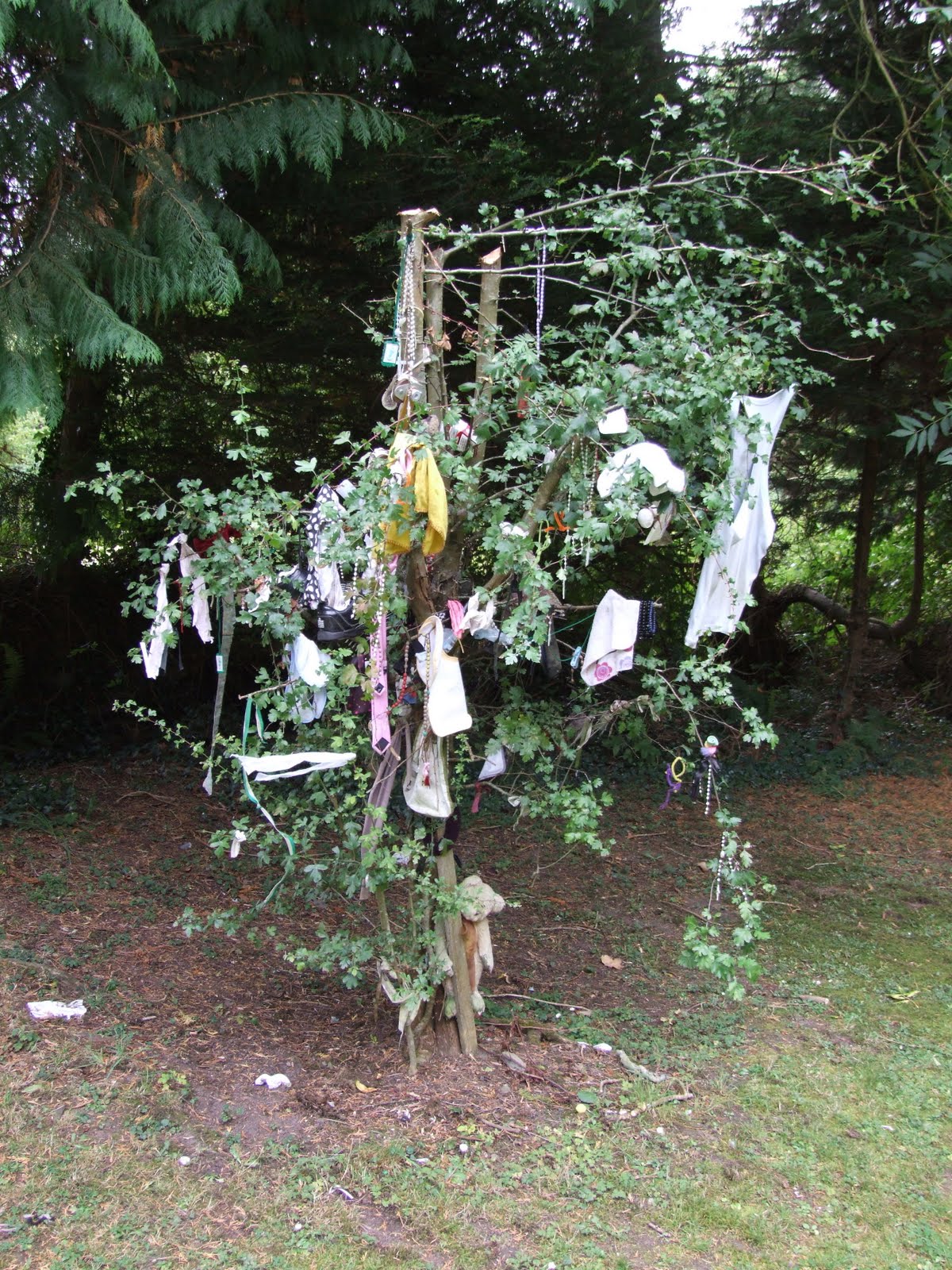
Now, this place is very small, with limestone outcroppings and the cold, cold water coming from the well. As it is not built up, the entire ambiance is one of prayer and peace. Gypsies place ribbons and other pieces of cloth on the trees for favors in prayer. This custom pre-dates Christianity, and goes back to the Romans, at least. I blessed myself with the water, and felt like this was the "real Ireland". May St. Ciaran bless this country with many more saints.


In addition, for those who cannot get to Dublin, to Trinity College Library, there is a facsimile of the Book of Kells in Kells itself. This stunning book is open to two pages, which one may study for hours and not absorbed all the symbolism. The artwork is stunning and, indeed, proves this book to be one of the treasures of the world.


The fact that the original was saved from the violent Vikings is a large miracle in and of itself. I saw the page of the earliest Western depiction of the Virgin and Child, created before 800 A.D. Here is the wiki link. And, thanks to wiki for the picture here. Perhaps, I am reading too much into it, but Jesus has bright red Celtic hair, and Mary, the Theotokos, has a strong, maternal Irish face. The facsimile communicated the glory of the artists. 

Perfection Part Eleven -Silence

On Perfection continued...

These posts seem to be popular, so I shall do two today. It is Lent, and such meditations may be helpful for some, including myself.


The overlap of the Carmelite, Benedictine and Dominican spiritual ways can be clearly seen in the the call to some silence during the day. Now, as busy lay people, we must create these little shells of silence so that we can hear the Voice of God, the small, still Voice. Without silence, one is not in touch with one's own soul or with God.

I have known extremely busy people. Not only are these people busy during the day, but when they come home at night, they have the television on until they go to bed. From the minute they wake up in the morning, when they turn on the radio, read the paper, run about doing necessary or unnecessary activities, these Catholics are never silent. I would be exhausted without silence.

If I do not have time in the morning and in the evening, at the very least, for reading Scripture, one of the Hours, such as Vespers, I cannot act as a serene, human being. Silence gives me grounding for the entire day, and if I practice silence, it can remain within me for the entire day. This is the beauty of silence, it becomes a wellspring of life within us, overcoming other noises and confrontations.

Silence breaks down anxiety and fear. The most fearful people I know cannot bear silence. They must keep moving, keep doing, even if they are retired. The rhythm of life which includes silence gives a richness to one's existence and keeps one from falling into superficiality.

Why some people are afraid of silence is that they are afraid of suffering. In silence, I see my sins, my failings, my failures. In silence, I face the need for conversion daily. In silence, I meet God, who is All Goodness, All Innocence, All Perfection.

Only in Faith can one approach silence, as in silence one meets the God of Mercy and Forgiveness.

I have talked with friends as to how to create more silence in their day. Some want to do so and some want to keep running away from God, which to me, is running away from Love.

Silence is never boring, as some may believe, unless one thinks God is boring. The Infinite is so beyond me, that only is silence can I meet God.

We are fast approaching Holy Week, when in the Passion of Christ, we see Him keeping silent before both the Sanhedrin and Herod. Christ said little in front of Pilate, but He was calling Pilate to Himself, and was trying to make the Roman see. Christ remained silent because He did not need to defend Himself. He is God. He is Man. He stood in silence, in Perfection, and those who judged Him unfairly could not see the Silence which stood before them, as they had never met Him in silence. Those who meet God, know Him when they see Him.

Perfection Part Ten-Docility

Reading Garrigou-Lagrange again and again, I am struck with the idea of docility. Now, some of us are made more or less docile. As a person with a strong will and strong character, docility is something I have had to learn. My saintly mother, who is 84, is docile by nature, most sweet-tempered, and a joy to be around. Not all of us are created the same. The idea of modern psychologically which states in popular terms that we can be all we want to be is simply not true in one sense and very true in another. Garrigou-Lagrange insists that docility may be learned or acquired by all, and should be the goal of the saint. In fact, one cannot grow in holiness without docility.

Now, docility is not “wimpiness” or a lack of character. One must have character and person-hood in order to seek spiritual docility. To live in fear, fear of anything or anyone, is no docility. In fact, really craven fear hinders one from coming to trust in Providence, another great theme of Garrigou-Lagrange. Unless one trusts in Providence, one cannot grow in docility of spirit.

Perhaps two of the most individual and strong saints, mentioned last week on this blog, SS. Teresa of Avila and Therese, the Little Flower, demonstrated in their autobiographies, that they had powerful, personal characters. They knew who they were, they knew their talents and limitations, they were capable of facing their own lack of perfection and cooperating with grace to attain such perfection.

In my little mini-series on perfection, in which I have tried to make Garrigou-Lagrange more accessible to modern readers, I have found that the simple message of perfection rests in the desire and seeking of docility. Now, for any woman in the modern world who is a feminist, my statement sounds like heresy. In the age of the emerging woman, which is a false idea by the way, as one only has to look at the great saints here mentioned, plus SS. Etheldreda, Gertrude, Brigid, Bridget, Matilda, Hilda, Eanswyth, Catherine of Siena, and so on to see powerful women acting in public spheres in the Church for centuries, women are supposed to be what I call “Bolsheviks”, that is, contradictory and totally independent. Of course, this is a physical, psychological and spiritual impossibility, created to destroy vocations as well as society. The Bolshevik mentality lends itself to splendid and, indeed, painful isolation. Some men fall into this mode of being, to the loss of their soul's growth and even salvation, as it is in dying to self that one gains heaven.

Docility requires greater courage than action. One must control one's desires, tongue, plans, in fact, give up control one's own life and trying to control the lives of others. This is also a goal of the Benedictine Rule, which I love so much. To be obedient to one's superior is to give up control. To give up control, is to become docile.

Obedience, dying to self, docility. The great spiritual masters, such as Garrigou-Lagrange and St. Benedict tell us that this is the only way to happiness and holiness.

As Garrigou-Lagrange notes, the ultimate docility is the giving of our soul completely to God. This action is connected to detachment and to listening in contemplation. By the way, without some silence in one's life, one cannot attain either docility or detachment. Silence is the absolute sine qua non of the spiritual life.  

And now for something completely different

And now, for something completely different.

How does one make Dwarves into heroes? For the coming movie of The Hobbit, the Disney idea of dwarves simply would not work. The idea of small creatures (they are not homo sapiens in Tolkein's world) being mighty warriors and winners of battles has been deftly portrayed by the actors and make-up personnel of the coming epic. I share a photo from one of the fan websites.


If I had boys and girls at home adolescent age and up, I would encourage this type of movie, as they need role models of all shapes and sizes. The Church Militant in the making, that is our children, can learn good material and spiritual lessons from The Hobbit.

Sunday, 11 March 2012

Read this, please

If you do not read any other blog in America except the great Fr. Z's, may I again suggest a look at Dr. Sanity. Check this out for style and brilliance. http://drsanity.blogspot.com/2012/03/obamas-duplicitous-stance-toward-israel.html

A tip of the hat to the Headfort Arms


I would like to thank Olivia and her brother at the Headfort Arms for letting me blog away in their hotel. This hotel has great food and great hospitality. It is located in one of the oldest buildings in Kells, in County Meath. The old family of the Headfort's held sway over the land here for a long time. The hotel is part of a group of Irish businesses who are trying to turn back the "chill" of the Celtic Tiger; that is, the impersonalism and harshness which came with the sudden prosperity in the '90s and early 2000's here. Sadly, the old Irish businesses and the local produce need encouragement to come back to the older, more hospitable times. Most of the meat, vegetables, and even the soaps and toiletries in the rooms are from local producers. Olivia and her family, who have owned the establishment for over forty years, are doing a great job in bringing back the old Ireland. If you visit, come here for a stay.