Recent Posts

Monday, 4 February 2013

Saints of February continued...Humbeline

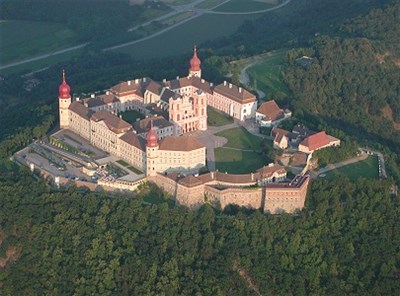
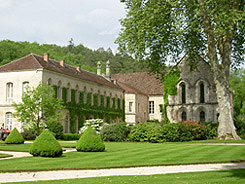
Fontenay, founded by St.  Bernard
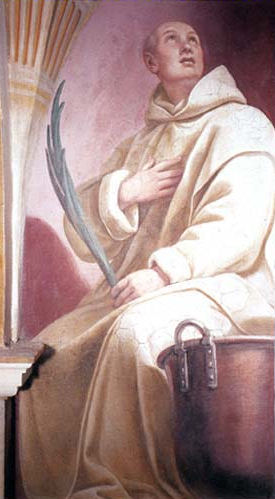
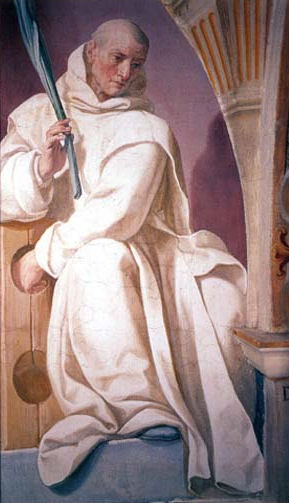
The first Cistercian monastery for women was established at Tart in the diocese of Langres (now Dijon) in 1125, by nuns from the abbey of Jully, a dependence of Molesme, where St. Humbeline, sister of St. Bernard, lived and died. St Stephen Harding established Tart as Citeaux's own daughter house and entrusted it to the pastoral care of the abbot of Citeaux. From then on individual monasteries of women as well as whole federations of nuns sought to ally themselves with the Cistercian monks first in France and then in Spain, where the royal monastery of Las Huelgas was founded in 1180. This, the next quotation, and photo from http://www.ocso.org/index.php?option=com_content&view=article&id=122&Itemid=178&lang=en

If you share abundantly in the sufferings of him who died for you, you will also share abundantly in comfort through him, and thus your soul will come to delight in him and refuse to be comforted by anything else. - St Bernard of Clairvaux, Lenten Sermons on Psalm 90, Preface


Non nobis Domine, non nobis, sed nomini tuo da gloriam (Not to us Lord, not to us, but to Your Name give the glory) Motto of the Knight Templar, whose patron is Bernard of Clarivaux.


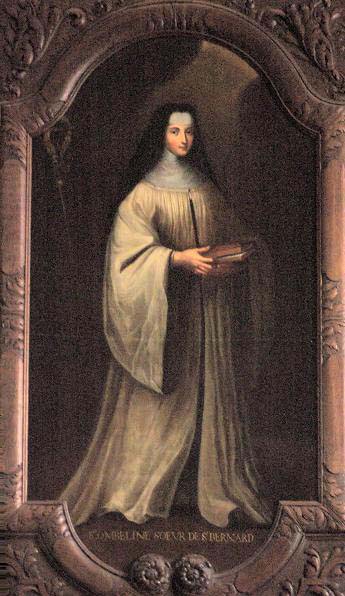
One of my favourite saints is the sister of St. Bernard of Clarivaux, who died at the fairly young age after establishing twelve houses of nuns under the rule of her brother's order-the Cistercians. She was Bernard's younger and only sister.

What is amazing about here is that not only did she manage to be an abbess of great happiness, love and organization, but that she was married before she became a nun, and asked her husband's permission after five years of marriage to go into the convent.

I think he could see that he was no match for the young member of that great family, so Guy de Marcy gave in to her request and let her go. She and her daughter entered the harsh rule of the renewed Benedictines, where the young woman became holy. Like her mother, also a Blessed, she died young. Blessed Alith died at 40 and Blessed Humbeline was no older than 44  and some chroniclers put her age at late 30s. Her common dates are 1092-1136.

Her sister-in-law Elizabeth also was an abbess before her and together they built up the earliest foundations of women Cistercians. Strong ladies...............

The monastery of Jully where Humbeline was abbess no longer exists.
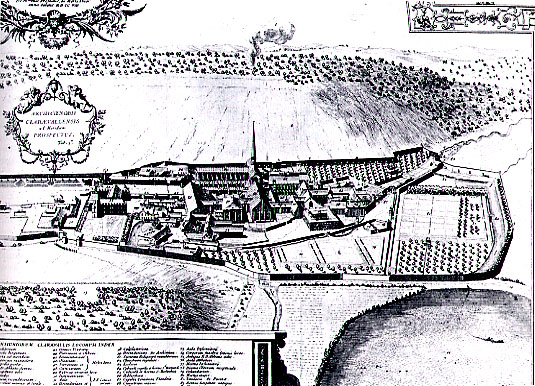
Clairvaux

All the members of St. Bernard of Clairvaux's immediate family are either Blesseds or Saints, including his father and mother. Here they are listed, plus a cousin and in-law.

Claivaux
These are: Blessed Tescelin, Lord of Fontaines, and Blessed Aleth of Montbard, his parents; Blessed Gaudry, his uncle; his brothers, Blesseds Guy, Andrew, Bartholomew, Gerard; cousin Robert, (whose wife, Elizabeth became the abbess who received Humbeline after both husband and wife went into perspective monasteries), Nivard the heir and youngest brother (a great favourite in Spain to this day); and his sister, Humbeline.

What a family! See the book here and others, for more details.


By the way, St. Bernard of Clairvaux is one of the founders and supporters of the Knights Templar, as well as their patron, as noted above. Thanks to wiki for the photo here of the Temple Church in London, from which the entire area of the Middle and Inner Temples gets the names

Blessed Humbeline's Feast Day is February 12th. This is from her liturgy: 

God our Father, You are the hope of everyone
who feels truly widowed and alone. Through
the intercession of Saint Humbeline, May we submit
to you in sincere humility, And so pass through the
good things of this world as not to lose the good
things of the world to come.


Challenge to the Church Militant; Sacrifice a Splendid Isolation


The Church is only as strong as Her weakest member. We are all members. If we are strong, the Church is strong. If we are weak, the Church is weak.

So often I hear criticisms concerning priests, bishops, nuns. The laity create good families or not. From those good families come good vocations.

If seminaries accept weak men, the Church's hierarchy will remain weak, and become weaker. This is still happening in America and in Europe.

The laity can always do something. Pray. Fast. Write. Use the positions each lay person has in the Church to influence the Church for good.


The Holy Spirit directs the Church, but we must cooperate.

If we are disobedient, the Church becomes anaemic.

If we are grieved or disappointed or angry, we must pray.

Great saints flourished in times of weakness and the Church grew stronger.

St. Dominic, St. Catherine of Siena, St. Thomas More, St. Philip Howard, St. Maximilian Kolbe and so on.

Today, many of my friends are discouraged and even grieved with political events and governmental decisions.

Those who have lost the faith seem to be in control. But, the Church can still be strong in the winds of persecution.


The Church will last until Christ comes again. If She remains in your parish, as the True Church, it will be because the laity remain strong.

After the fall of Rome, millions of people witnessed a huge change in culture, civilization, personal comfort.

St. Benedict's own family were from the remnants of the fallen, enormous nation, which had created such great things from which we still benefit.

But, in the face of ruin, Benedict did something new. He went into a cave and prayed about what to do.


He created spiritual shock troops. Rome did not look like what She does today.


Make something new.  Think about what you can make new and how.

This newness must happen now.

Do not give in to discouragement, but pray how you and I can become shock troops.

The Benedictine Rule not only saved and re-created  Europe through prayer, fasting, discipline, reading, writing, making schools and libraries, building churches and even infrastructures of business, but created holy men and women.

Choose to be holy and choose to be a saint.

Surround yourself with good people. Create communities where and when you can. Do not waste time. I have studied the Bruderhof since the 1970s. I was a member of a large lay community at one time. I have stayed for months with Benedictines. I understand how a community withstands the world or does not do so. The laity cannot remain isolated and alone. Take people in. Move. Be prepared to sacrifice an splendid isolation.

The Church is only as strong as Her weakest members. Be strong. Choose to be strong.

Churches will be abandoned. This will shock some. It has happened before.


My son is one of only two seminarians in his year. The priests are horribly overworked now.

Things will change.

The laity must be strong and families must pray for more vocations.

Imagine a world without the sacraments.

Fathers, brothers, sister, mothers, choose to be strong.


Please be the Church Militant and not the Church Queasy. Create communities where you are. Do it now.

Pray and become perfect, cooperating with God's Plan for your life.

St. Agatha, pray for us

http://romanchurches.wikia.com/wiki/Sant'Agata_in_Trastevere?file=Agata_in_Trastevere.jpg

Many saints have their feast days this week, but I want to concentrate on St. Agatha. She is a personal patron of mine, as I am a cancer survivor. She helped me through a very hard two years, 2009-2010.


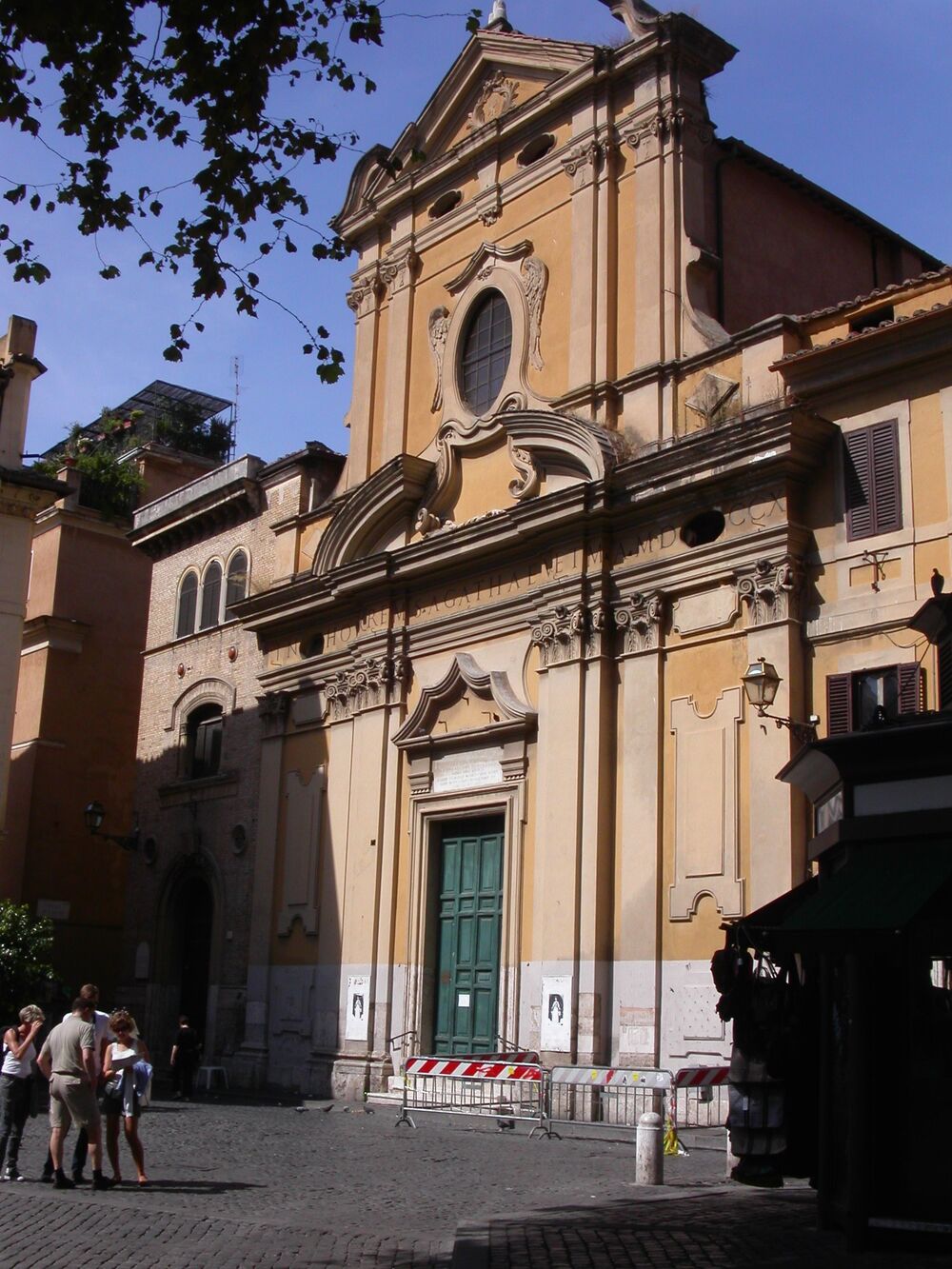
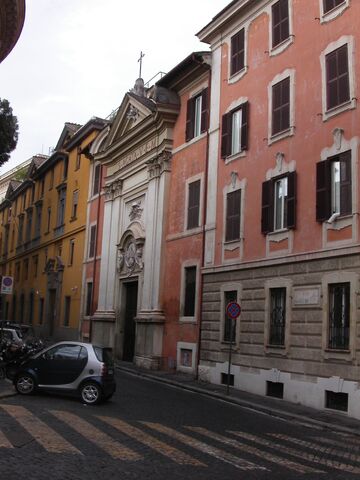
Her church in Rome is Sanctae Agathae in Urbe. There is another church in Trastevere dedicated to her as well. The first church pictured here is that one. I would live in Trastevere, if I could, and go to church in the many lovely ones there.

The one below is build on a site which had a church there in the 4th century. It went over to the Arians, but was re-consecrated by St. Gregory the Great. This church witnessed many renovations and even a period under the Benedictine Order. It is now the church of Cardinal Raymond Burke

http://romanchurches.wikia.com/wiki/Sant%27Agata_dei_Goti


The relics of many martyrs are found in this church. In some countries, festivals begin today and go through her feast day, celebrating this brave virgin. Apparently, she was twenty when she was killed. She was made of stern stuff, for sure and loved Christ before all.

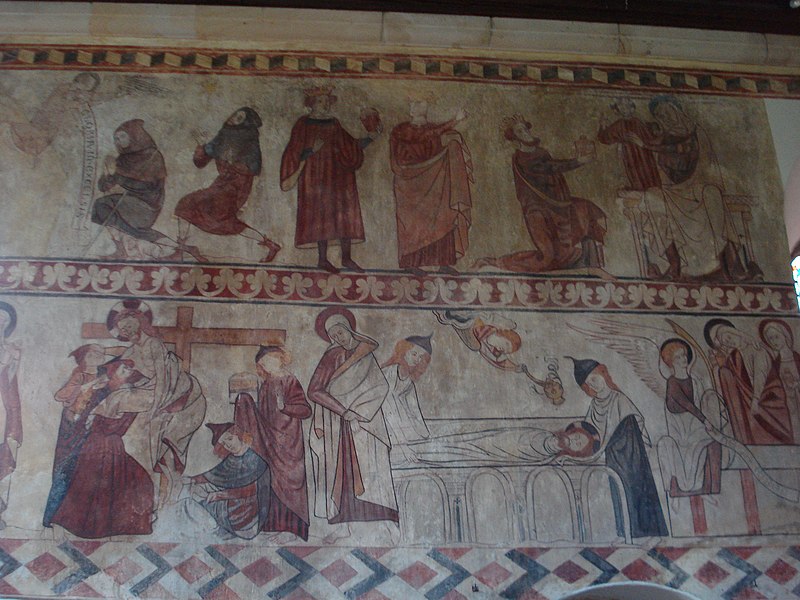
St. Agatha was a very popular saint in the Middle Ages. We know her story of torment and indignity before her martydom. In England, there is a church in Yorkshire with 13th century paintings of Christ on the walls. This church is dedicated to St. Agatha.

http://upload.wikimedia.org/wikipedia/commons/thumb/b/b0/St_agatha_fresco2.JPG/800px-St_agatha_fresco2.JPG


Sunday, 3 February 2013

Immediate Prayers Please

Emergency, please pray for a 25 year old girl named Clare who has a blood clot in her brain and might not make it through the night.


Thank you. Let us pray to Fulton J. Sheen together.

UPDATE: I am sorry to report that Clare died at about 2:00 GMT this morning. Pray for her parents, please.

May the souls of the faithful departed, rest in peace. Amen.

Just thinking on a Sunday morning

I am concerned that National Health in the States will be another veiled means of eugenics.

Already, costs and fines will affect Catholics and Evangelicals who follow God's Law and do not use contraceptives or get abortions. Large families will be penalized.

Already, data for those who are overweight or drinking or smoking will be collected, which hits the poor, who are more inclined to be eating fast food and such.

Already, certains immigrant groupings with certain lifestyles in families will be hit with high costs.

Now, some of us knew this in 2009. But, I am concerned about those minority groups who just wanted "free health care" without realizing, or being helped to understand the intrusiveness of this new plan.

Eugenics is behind PP and other groups, as we know, both Margaret Sanger and Marie Stopes being steeped in this philosophy. Check out these links. The same mind-set is behind some national health ideals. One can apply the term race to whomever seems a threat to one's idea of society.

Catholics, Jews, etc. could become undesirables....wait and see. Thanks, Wiki, for the poster.


The Jewel in the Crown


1 Corinthians 13

Douay-Rheims 1899 American Edition (DRA)
1 If I speak with the tongues of men, and of angels, and have not charity, I am become as sounding brass, or a tinkling cymbal.
And if I should have prophecy and should know all mysteries, and all knowledge, and if I should have all faith, so that I could remove mountains, and have not charity, I am nothing.
And if I should distribute all my goods to feed the poor, and if I should deliver my body to be burned, and have not charity, it profiteth me nothing.
Charity is patient, is kind: charity envieth not, dealeth not perversely; is not puffed up;
Is not ambitious, seeketh not her own, is not provoked to anger, thinketh no evil;
Rejoiceth not in iniquity, but rejoiceth with the truth;
Beareth all things, believeth all things, hopeth all things, endureth all things.
Charity never falleth away: whether prophecies shall be made void, or tongues shall cease, or knowledge shall be destroyed.
For we know in part, and we prophesy in part.
10 But when that which is perfect is come, that which is in part shall be done away.
11 When I was a child, I spoke as a child, I understood as a child, I thought as a child. But, when I became a man, I put away the things of a child.
12 We see now through a glass in a dark manner; but then face to face. Now I know I part; but then I shall know even as I am known.
13 And now there remain faith, hope, and charity, these three: but the greatest of these is charity.

The Charterhouse Martyrs, Two


It is ironic that after falling into the hands of the prominent Protestant North family, the Charterhouse grounds was purchased by the Duke of Norfolk, who was executed in the attempt to get Mary, Queen of Scots crowned Queen of England. When he died, the land and buildings passed to his grandson, St. Philip Howard, who never lived there.

So many saints surround the history of these buildings. It always amazes me at the audacity of Protestants who built houses out of the ruins of monasteries. This happened all over England, including at the Charterhouse.

Passing from hand to hand and from Catholic back to Protestant, the houses became a charity in 1611 and a school. John Wesley was a student there from 1714-1720. Part of the area was damaged in World War II, which, of course, only added to the odd history of the Carthusian foundation, stemming from a burial ground used during the Black Death and holding, perhaps, up to 60,000 dead.

That saints and sinners walked the old, restored, and newer halls seems like a strange procession of persons either going against the tide of pressures threatening their religious freedom, or those who benefited from these harsh and cruel changes.

The present Master is charming and gave me a tour last summer. His sensitivity to the Catholic history is admirable. The charity houses up to 40 "brothers", who are poor old men. They live in the shadows of some of the greatest men to have walked this earth, the Carthusian martyrs, Thomas More, and Philip Howard.

That we all need formation in these hard times is why I highlighted the Charterhouse today.


Are you willing? The Charterhouse Martyrs

 I am reading a history of the London Charterhouse. One of the things which struck me today was the line which referred to St. Thomas More's years here, between 1499 and 1503, when he lived in the same manner as the religious there, the Carthusians.

Years later, he saw these same men dragged on hurdles, "like bridegrooms to their weddings" through his window in the Tower of London.

Now, what came to my mind was the years of preparation these monks had for a holy death, and the years of formation St. Thomas More had for his martyrdom.

Formation has been a topic in my perfection series. Without formation, we cannot advance to the enjoyment of the Love of God.

We cannot build up the Kingdom.

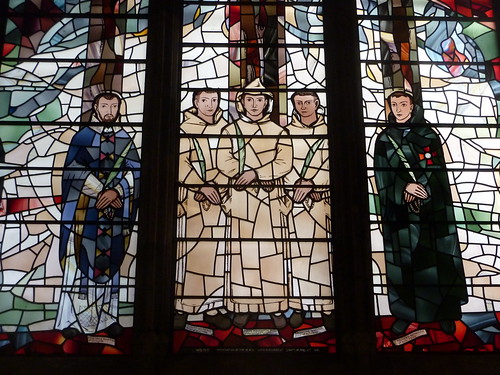
In 1538, the entire order of Carthusians, the entire monastery was suppressed. Here is a list of all the martyrs.


    • Saint John Houghton, prior of the London Charterhouse, executed at Tyburn, London, on May 4, 1535.
    • Saint Robert Lawrence, prior of Beauvale Charterhouse, executed at Tyburn, London, on May 4, 1535.
    • Saint Augustine Webster, prior of Axholme Charterhouse, executed at Tyburn, London, on May 4, 1535.
    • Blessed Humphrey Middlemore, vicar of the London Charterhouse, executed at Tyburn, London, on June 19, 1535.
    • Blessed William Exmew, procurator of the London Charterhouse, executed at Tyburn, London, on June 19, 1535.
    • Blessed Sebastian Newdigate, choir monk of the London Charterhouse, executed at Tyburn, London, on June 19, 1535.
    • Blessed John Rochester, choir monk of the London Charterhouse, exiled by the government to the Charterhouse of St Michael at Hull in Yorkshire, executed at York on May 11, 1537, by being hanged in chains from the city battlements until dead.
    • Blessed James Walworth, choir monk of the London Charterhouse, exiled by the government to the Charterhouse of St Michael at Hull in Yorkshire, executed at York on May 11, 1537, by being hanged in chains from the city battlements until dead.
    • Blessed William Greenwood, laybrother of the London Charterhouse, died of starvation in Newgate Prison, London on June 6, 1537
    • Blessed John Davy, deacon, choir monk of the London Charterhouse, died of starvation in Newgate Prison on June 8. 1537
    • Blessed Robert Salt, laybrother of the London Charterhouse, died of starvation in Newgate Prison, London on June 9, 1537
    • Blessed Walter Pierson, laybrother of the London Charterhouse, died of starvation in Newgate Prison, London on June 10, 1537
    • Blessed Thomas Green (perhaps alias Thomas Greenwood), choir monk of the London Charterhouse, died of starvation in Newgate Prison, London on June 10, 1537


  • Blessed Thomas Scryven, laybrother of the London Charterhouse, died of starvation in Newgate Prison, London on June 15, 1537
  • Blessed Thomas Redyng, laybrother of the London Charterhouse, died of starvation in Newgate Prison, London on June 16, 1537
  • Blessed Richard Bere, choir monk of the London Charterhouse, died of starvation in Newgate Prison, London on August 9, 1537
  • Blessed Thomas Johnson, choir monk of the London Charterhouse, died of starvation in Newgate Prison, London on September 20, 1537
  • Blessed William Horne, laybrother of the London Charterhouse, hanged, disembowelled, and quartered at Tyburn, London on August 4, 1540. from Wiki and thanks


What these men had in common with St. Thomas More was preparation. Are you willing to be prepared for the hard times which are coming? Are you willing?

The Michael Voris Generation

There are times...when I wonder how many reflective people are there in the world? This week, I have been surrounded by thoughtful, intelligent Catholics, who not only pray and go to Mass frequently, if not daily, but also read and reflect on their adult appropriation of the Faith.


These types of Catholics whom I have met are usually under the age of thirty. They are young marrieds, or career types, or still in the educational process, becoming what they are called to be. I am calling these Millennials the Michael Voris Generation, taking over from the John Paul II Catholics.

A mark of these young people is that they want two things: the first is to love God and neighbour; the second is to grow in holiness. They want the real deal and will seek out the truth.

These are William, John, Ed, David, Alexander, Zak, Margaret, Claz, Slawomir, and many others who have decided they are active members of the Church Militant. These young people have decided to live for Christ and not for themselves. They are strong Catholics both spiritually and intellectually and they are getting stronger daily.

The difference between them and the previous generation is a toughness and confidence in God in hard times and a thirst for the details of the Faith. No resting for these men and women....They are not confused about doctrine. They are obedient to the Church in all things. They are focussed.

They pray, they go to adoration, they support the Church, they love the TLM or are beginning to do so.  They look for the best books and they study the Scriptures. They understand that their baptismal promises are real. Most of them, not all, are converts to Catholicism. They are Americans, Scots, English, Polish, Spanish, Filipino, Latino, Asian. None are Irish. The movement of the Holy Spirit has called them out of darkness into light.

In 2011, Pope Benedict XVI gave a talk on what it means to be a saint and how to become a saint.

In part of  his talk, he said this and to summarize, the Pope reminded us that holiness is a call from God.

That only through Christ are we made holy....

That the graces of baptism and our cooperation make us holy...

That we need to reach high, to the standard set by God Himself in the Person of Christ....

That we need to be open to the movements of the Holy Spirit...


That the love of Christ leads us to holiness..

Here are some of the Pope's ideas taken from a much longer speech.


What does it mean to be saints? Who is called to be a saint? Often it is thought that holiness is a goal reserved for a few chosen ones. St. Paul, however, speaks of God's great plan and affirms: "[God] chose us in him [Christ], before the foundation of the world, to be holy and without blemish before him. In love he destined us" (Ephesians 1:4). And he speaks of all of us. At the center of the divine design is Christ, in whom God shows his Face: the Mystery hidden in the centuries has been revealed in the fullness of the Word made flesh. And Paul says afterward: "For in him all the fullness of God was pleased to dwell" (Colossians 1:19). In Christ the living God has made himself close, visible, audible, tangible so that all can obtain his fullness of grace and truth (cf. John 1:14-16). 

Because of this, the whole of Christian existence knows only one supreme law, the one St. Paul expresses in a formula that appears in all his writings: in Christ Jesus. Holiness, the fullness of Christian life does not consist of realizing extraordinary enterprises, but in union with Christ, in living his mysteries, in making our own his attitudes, his thoughts, his conduct. The measure of holiness is given by the height of holiness that Christ attains in us, of how much, with the strength of the Holy Spirit, we mold all our life to his. It is our conforming ourselves to Jesus, as St. Paul affirms: "For those he foreknew he also predestined to be conformed to the image of his Son" (Romans 8:29). And St. Augustine exclaimed: "My life will be alive full of You" (Confessions, 10, 28). In the Constitution on the Church, the Second Vatican Council spoke with clarity of the universal call to holiness, affirming that no one is excluded: "The classes and duties of life are many, but holiness is one -- that sanctity which is cultivated by all who are moved by the Spirit of God, and who ... follow the poor Christ, the humble and cross-bearing Christ in order to be worthy of being sharers in His glory" (No. 41).

However, the question remains: How can we journey on the path of holiness, how can we respond to this call? Can I do so with my own strength? The answer is clear: A holy life is not primarily the fruit of our own effort, of our actions, because it is God, the thrice Holy (cf. Isaiah 6:3), who makes us saints, and the action of the Holy Spirit who encourages us from within; it is the life itself of the Risen Christ, which has been communicated to us and which transforms us. To say it again according to Vatican Council II: "The followers of Christ are called by God, not because of their works, but according to His own purpose and grace. They are justified in the Lord Jesus, because in the baptism of faith they truly become sons of God and sharers in the divine nature. In this way they are really made holy. Then too, by God's gift, they must hold on to and complete in their lives this holiness they have received" (ibid., 40). 

Hence, holiness has its main root in baptismal grace, in being introduced into the paschal mystery of Christ, with which his Spirit is communicated to us, his life as the Risen One. St. Paul points out the transformation wrought in man by baptismal grace and even coins a new terminology, forged with the preposition "with": "We were indeed buried with him through baptism into death, so that, just as Christ was raised from the dead by the glory of the Father, we too might live in newness of life" (Romans 6:4). However, God always respects our liberty and asks that we accept this gift and that we live the demands it entails. He asks that we allow ourselves to be transformed by the action of the Holy Spirit, conforming our will to the will of God.


...... and here is more


Perhaps we might ask ourselves: Can we, with our limitations, our weakness, reach so high? During the liturgical year, the Church invites us to recall a line-up of saints, who have lived charity fully, have been able to love and to follow Christ in their daily lives. In all the periods of the history of the Church, in every latitude of the geography of the world, the saints belong to all the ages and to all states of life; they are the concrete faces of all peoples, languages and nations. And they are very different among themselves. In reality, I must say that also, according to my personal faith, many saints, not all, are true stars in the firmament of history. And I would like to add that for me not only the great saints that I love and know well are "road signs," but also the simple saints, that is, the good persons that I see in my life, who will never be canonized. They are ordinary people, to say it somehow, without a visible heroism, but in their everyday goodness I see the truth of the faith. This goodness, which they have matured in the faith of the Church, is for me a sure defense of Christianity and the sign of where the truth is.
In the communion with saints, canonized or not canonized, which the Church lives thanks to Christ in all her members, we enjoy their presence and company and cultivate the firm hope of being able to imitate their way and share one day the same blessed life, eternal life.
These people will be saints, because that is what they want to be.


Saturday, 2 February 2013

More on the supposed improved obamacare from Catholic Fire

http://catholicfire.blogspot.co.uk/

Blooms on February First


I saw daffodils blooming today next to the stream which goes through the town. Cheery colours. Also, the sky tonight is purple, gold, orange and blue.

England is so beautiful.

St. Blase


St. Blasius was Bishop of Sebaste in Armenia. He was martyred in the reign of Licinius 
(316).  His miracle was saving a boy from choking on a fish bone which is why we get our throats blessed tomorrow. Be careful eating fish. Here is the blessing, which I hope you all hear.

"Per intercessionem S. Blasii liberet te Deus a malo gutteris et a quovis alio malo" (May God at the intercession of St. Blasius preserve you from throat troubles and every other evil).  
Catholic Encyclopedia

You've got to be kidding

http://blog.adw.org/2013/02/funeral-etiquette-why-bringing-a-funeral-procession-through-a-burger-drive-thru-is-a-bad-idea/

From the INTJ and the INFP

From Kavi  

Candle Mass from the Catholic Encyclopedia


Also called: Purification of the Blessed Virgin (Greek Hypapante), Feast of the Presentation of Christ in the Temple. Observed 2 February in the Latin Rite.
According to the Mosaic law a mother who had given birth to a man-child was considered unclean for seven days; moreover she was to remain three and thirty days "in the blood of her purification"; for a maid-child the time which excluded the mother fromsanctuary was even doubled. When the time (forty or eighty days) was over the mother was to "bring to the temple a lamb for aholocaust and a young pigeon or turtle dove for sin"; if she was not able to offer a lamb, she was to take two turtle doves or two pigeons; the priest prayed for her and so she was cleansed. (Leviticus 12:2-8)
Forty days after the birth of Christ Mary complied with this precept of the law, she redeemed her first-born from the temple(Numbers 18:15), and was purified by the prayer of Simeon the just, in the presence of Anna the prophetess (Luke 2:22 sqq.). No doubt this event, the first solemn introduction of Christ into the house of God, was in the earliest times celebrated in theChurch of Jerusalem. We find it attested for the first half of the fourth century by the pilgrim of Bordeaux, Egeria or Silvia. The day (14 February) was solemnly kept by a procession to the Constantinian basilica of the Resurrection, a homily on Luke 2:22 sqq., and the Holy Sacrifice. But the feast then had no proper name; it was simply called the fortieth day after Epiphany. This latter circumstance proves that in Jerusalem Epiphany was then the feast of Christ's birth.
From Jerusalem the feast of the fortieth day spread over the entire Church and later on was kept on the 2nd of February, since within the last twenty-five years of the fourth century the Roman feast of Christ's nativity (25 December) was introduced. InAntioch it is attested in 526 (Cedrenue); in the entire Eastern Empire it was introduced by the Emperor Justinian I (542) in thanksgiving for the cessation of the great pestilence which had depopulated the city of Constantinople. In the Greek Church it was called Hypapante tou Kyriou, the meeting (occursus) of the Lord and His mother with Simeon and Anna. The Armenians call it: "The Coming of the Son of God into the Temple" and still keep it on the 14th of February (Tondini di Quaracchi, Calendrier de la Nation Arménienne, 1906, 48); the Copts term it "presentation of the Lord in the Temple" (Nilles, Kal. man., II 571, 643). Perhaps the decree of Justinian gave occasion also to the Roman Church (to Gregory I?) to introduce this feast, but definite information is wanting on this point. The feast appears in the Gelasianum (manuscript tradition of the seventh century) under the new title of Purification of the Blessed Virgin Mary. The precession is not mentioned. Pope Sergius I (687-701) introduced aprocession for this day. The Gregorianum (tradition of the eighth century) does not speak of this procession, which fact provesthat the procession of Sergius was the ordinary "station", not the liturgical act of today. The feast was certainly not introduced by Pope Gelasius to suppress the excesses of the Lupercalia (Migne, Missale Gothicum, 691), and it spread slowly in the West; it is not found in the "Lectionary" of Silos (650) nor in the "Calendar" (731-741) of Sainte-Geneviève of Paris. In the East it was celebrated as a feast of the Lord; in the West as a feast of Mary; although the "Invitatorium" (Gaude et lætare, Jerusalem, occurrens Deo tuo), the antiphons and responsories remind us of its original conception as a feast of the Lord. The blessing of the candles did not enter into common use before the eleventh century; it has nothing in common with the procession of the Pupercalia. In the Latin Church this feast (Purificatio B.M.V.) is a double of the second class. In the Middle Ages it had an octave in the larger number of dioceses; also today the religious orders whose special object is the veneration of the Mother of God(Carmelites, Servites) and many dioceses (Loreto, the Province of Siena, etc.) celebrate the octave.


Blessing of candles and procession

According to the Roman Missal the celebrant after Terce, in stole and cope of purple colour, standing at the epistle side of thealtar, blesses the candles (which must be of beeswax). Having sung or recited the five orations prescribed, he sprinkles andincenses the candles. Then he distributes them to the clergy and laity, whilst the choir sings the canticle of Simeon"Nunc dimittis". The antiphon "Lumen ad revelationem gentium et gloriam plebis tuæ Israel" is repeated after every verse, according to the medieval custom of singing the antiphons. During the procession which now follows, and at which all the partakers carry lighted candles in their hands, the choir sings the antiphon "Adorna thalamum tuum, Sion", composed by St. John of Damascus, one of the few pieces which, text and music, have been borrowed by the Roman Church from the Greeks. The other antiphonsare of Roman origin. The solemn procession represents the entry of Christ, who is the Light of the World, into the Temple of Jerusalem. It forms an essential part of the liturgical services of the day, and must be held in every parochial church where the required ministers can be had. The procession is always kept on 2 February even when the office and Mass of the feast is transferred to 3 February. Before the reform of the Latin liturgy by St. Pius V (1568), in the churches north and west of the Alps this ceremony was more solemn. After the fifth oration a preface was sung. The "Adorna" was preceded by the antiphon "Ave Maria". While now the procession in held inside the church, during the Middle Ages the clergy left the church and visited thecemetery surrounding it. Upon the return of the procession a priest, carrying an image of the Holy Child, met it at the door and entered the church with the clergy, who sang the canticle of Zachary, "Benedictus Dominus Deus Israel". At the conclusion, entering the sanctuary, the choir sang the responsory, "Gaude Maria Virgo" or the prose, "Inviolata" or some other antiphon inhonour of the Blessed Virgin.


Sigh, the good old days..............

From Old Tan Book on Masonry

 I would only add that there is an occult dimension not explored here, as well as the heresies of indifferentism and relativism. They want the complete destruction of the Church. Too bad, so sad...we shall be here until Christ returns again, albeit maybe, very small.


TEN REASONS CATHOLICS CANNOT BE MASONS (there are more)

Freemasonry, contrary to public perception, is a secret society rather than a fraternity. Its principles are fundamentally contrary to the Catholic faith and explicitly deny key tenets of Christianity. Below are ten reasons why Catholics cannot be Masons or participate in their activities.
1). The Holy See on Nov. 26, 1983, at the direction of the Pope, issued a "Declaration on Masonic Associations" restating the Church's position condemning the basic principles of Freemasonry. It also states that Catholics who join Masonic organizations are in a state of grave sin and are automatically denied Holy Communion.

2). God as described in Masonic works is an impersonal "Great Architect of the Universeî," not the personal God of the Patriarchs, the One True God of Revelation, the Father, the Son and Holy Spirit.

3). Masonic writings specifically deny that God has revealed Himself and His truths to us, or that He ever established a Church.

4). In Masonry Jesus Christ is portrayed as merely a man, a great teacher, on a par with Buddha or Mohammed and His Divinity is denied.

5). The Trinity is denied and compared to the "trinitiesî"of pagan religions. The Holy Spirit is blasphemed by Masonry's denial of the Divine Inspiration of Scripture.

6). Christianity is considered a derivative of ancient pagan religions and like all religions deliberately ladens itself with error. God is portrayed as a deceiver who leads many men away from truth as not all are worthy of it.

7). All truth is relative according to Masonry, thereby rejecting objective, absolute truth and therefore the dogmas of the Catholic faith.

8). Freemasonry is portrayed as the foundation of all religion and it is built on Naturalism, a system of belief that makes human nature and human reason supreme in all things.

9). At the various degrees when an oath is sworn, even the initial ones, it is a blood oath swearing for example, "binding myself by no less penalty than that of having my throat cut from ear to ear, my tongue torn out by its roots, and buried in the sands of the sea..." This is a real oath sworn with one's hand on the Bible or Torah, etc.

10). One can easily be deceived by Masonry's rituals and symbols that an objective transformation of man is being carried out. This will lead one away from the workings of God's grace especially manifested in the Sacraments instituted by Christ. Remember, Masonry denies Christís Divinity and therefore His role as our Savior.
For further information the book "Freemasonry: Mankind's Hidden Enemy"can be obtained from TAN BOOKS, Rockford,IL., ($8.00 retail). Your local bookstore can order it for you. 

Something coming about which the Great Fr. Z, and I disagree

Valentine's Day. My view is that anything which celebrates love is a good start for evangelization. See my series last year on the Pope's encyclical.

Eros can lead to Caritas.

With grace...

And mercy..

And forgiveness...


And self-giving


And freedom....


And self-denial.....


And openness....


And goodness.....


And kindness....


And patience....


And God.....


And, the Indwelling of the Holy Trinity....