Recent Posts

Saturday, 26 April 2014

Attributes of God Part Four: Omniscience

In order to understand God's Omniscience, one must start with the knowledge that God is timeless, eternal, infinite. God's knowledge is unlimited by matter or time. God does not see things in sequences, as we do, but "all at once".

God's knowledge is complete, perfect. God is immutable and knows all.

The mind of man gets bogged down in time with cause and effect, with the decision of good and evil. Man wants to deny that God sees all, good and evil, as then God can be blamed for evil. ("Why does God let such and such happen?")

In this section of the Summa Contra Gentiles, Aquinas writes about Providence, (Summa contra Gentiles, I, 67, 10). But, let me go to Garrigou-Lagrange for an explanation. I have read his books, Providence and Predestination and am shortly to begin those again. These two books tie into his great work on perfection, which I have unpacked on this blog-The Three Ages of The Interior Life.

I shall return to those two former books in a few weeks, but want to give a short view of how both Divine Providence and Predestination fit in with the Attribute of Omniscience.

I can only quote one part in this short series, but I think this section on providence will help some understand the love and good will of the Omniscient God. I have highlighted in red some of the pertinent passages for this post.


The infallibility of providence touching everything that happens, including even our present and future free actions, is stressed in the Old Testament no less clearly than its universal extent. In this connection we must cite especially the prayer of Mardochai (Esther 13: 9-17), in which he implores God's help against Aman and the enemies of the chosen people:
O Lord, Lord almighty King, for all things are in Thy power, and there is none that can resist Thy will, if Thou determine to save Israel. Thou hast made heaven and earth, and all things that are under the cope of heaven. Thou art the Lord of all, and there is none that can resist Thy majesty. Thou knowest all things, and Thou knowest that it was not out of pride and contempt or any desire of glory that I refused to worship the proud Aman.... But I feared lest I should transfer the honor of my God to a man.... And now, O Lord, O King, O God of Abraham, have mercy on Thy people, because our enemies resolve to destroy us.... Hear my supplication.... And turn our mourning into joy, that we may live and praise Thy name.
Not less touching is Queen Esther's prayer in those same circumstances (14: 12-19), bringing out even more clearly the infallibility of providence regarding even the free acts of men; for she asks that the heart of King Assuerus be changed, and her prayer is answered: "Remember, O Lord, and show Thyself to us in the time of our tribulation, and give me boldness, O Lord, King of gods, and of all power. Give me a well ordered speech in my mouth in the presence of the lion: and turn his heart to the hatred of our enemy; that both he himself may perish, and the rest that consent to him. But deliver us by Thy hand: and help me who hath no helper, but Thee, O Lord, who hast the knowledge of all things. And Thou knowest that I hate the glory of the wicked.... Deliver us from the hand of the wicked. And deliver me from my fear." In fact, as we read a little later on (15: 11), "God changed the king's spirit into mildness; and all in haste and in fear [seeing Esther faint before him], he leaped from his throne and held her in his arms till she came to herself." Thereupon, after speedily assuring himself of Aman's treachery, he sent him to his punishment, and leant all the weight of his power to the Jews in defending themselves against their enemies. [34]
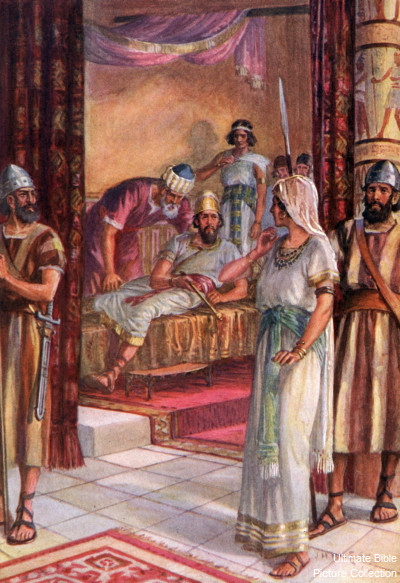


From this it is plain that divine providence extends infallibly not only to the least external happening but also to the most intimate secrets of the heart and every free action; for, in answer to the prayer of the just, it brings about a change in the interior dispositions of the will of kings. Socrates and Plato never rose to such lofty conceptions, to such firm convictions on this matter of the divine governance.
Many other texts in the Bible to the same effect are repeatedly insisted upon by both St. Augustine and St. Thomas.
In Proverbs, for instance, we read (21: 1) : "As the division of the waters, so the heart of the king is in the hand of the Lord: whithersoever He will He shall turn it. Every way of man seemeth right to himself: but the Lord weigheth the hearts." Again, in Ecclesiasticus (33: 13) we read: "As the potter's clay is in his hand, to fashion and order it: all his ways are according to his ordering. So man is in the hand of Him who made Him: and He will render to him according to His judgment." Again, Isaias in his prophecies against the heathen (14:24) says: "The Lord of hosts hath sworn, saving: Surely as I have thought, so shall it be. And as I have purposed, so shall it fall out: that I will destroy the Assyrian in My land... and his yoke shall be taken away from them." "This is the hand, " the prophet adds, "that is stretched out upon all nations. For the Lord of hosts hath decreed, and who can disannul it? And His hand is stretched out, and who shall turn it away?" Always there is the same insistence on the liberty of the divine election, on a universal and infallible providence reaching down to the minutest detail and to the free actions of men.
3) For what end has this universal and infallible providence directed all things? Though the psalms do not bring that full light to bear which comes with the Gospel, they frequently answer this question when they declare that God directs all things to good, for the manifestation of His goodness, His mercy, and His justice, and that He is in no way the cause of sin, but permits it in view of a greater good Providence is thus presented as a divine virtue inseparably united with mercy and justice, just as true prudence in the man of virtue can never be at variance with the moral virtues of justice, fortitude, and moderation which are intimately connected with it. Only in God, however, can this connection of the virtues reach its supreme perfection.
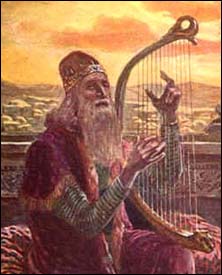


Again and again we find in the psalms such expressions as these: "All the ways of the Lord are mercy and truth" (24:10) ; "All His works are done with faithfulness. He loveth mercy and judgment [Heb., justice and right] ; the earth is full of the mercy of the Lord" (32: 4-5) ; "Show, O Lord, Thy ways to me, and teach me Thy paths. Direct me in Thy truth, and teach me; for Thou art God my Savior, and on Thee I have waited all the day long. Remember, O Lord, Thy bowels of compassion; and Thy mercies that are from the beginning of the world. The sins of my youth and my ignorances do not remember. According to Thy mercy remember me: for Thy goodness' sake, O Lord" (24: 4-7)." The Lord ruleth me: and I shall want nothing. He hath set me in a place of pasture. He hath brought me up on the water of refreshment: He hath converted my soul. He hath led me on the paths of justice, for His name's sake. For though I should walk in the midst of the shadow of death, I will fear no evils, for Thou art with me. Thy rod and Thy staff: they have comforted me" (22: 1-5)." In Thee, O Lord, have I hoped, let me never be confounded.... My lots are in Thy hands. Deliver me out of the hands of my enemies, and from them that persecute me. Make Thy face to shine on Thy servant: save me in Thy mercy.... O how great is the multitude of Thy sweetness, O Lord, which Thou has hidden from them that fear Thee! Which Thou has wrought for them that hope in Thee, in the sight of the sons of men. Thou shalt hide them in the secret of Thy face from the disturbance of men. Thou shalt protect them in Thy tabernacle from the contradiction of tongues" (30: I, 16, 17, 20).

God knows who will respond to His grace and those who will not. His knowledge of all does not stop our free will from choosing either to be for or against him. Those who choose to believe in Providence fall into the group who are Predestined to be with God forever. He knows all.

Omniscience is not force, is not the overwhelming of one's will in violence. Love is free and God know who wills to love Him.

Later on in the book, Garrigou-Lagrange writes this:

Abandonment to the divine will is thus one of the fairest expressions of hope combined with charity or love of God. Indeed, it involves the exercise to an eminent degree of all the theological virtues, because perfect self-abandonment to providence is pervaded by a deep spirit of faith, of confidence, and love for God. And when this self-abandonment, far from inducing us to fold our arms and do nothing as is the case with the Quietists, is accompanied by a humble, generous fulfilment of our daily duties, it is one of the surest ways of arriving at union with God and of preserving it unbroken even in the severest trials. Once we have done our utmost to accomplish the will of God day after day, we can and we must abandon ourselves to Him in all else. In this way we shall find peace even in tribulation. We shall see how God takes upon Himself the guidance of souls that, while continuing to perform their daily duties, abandon themselves completely to Him; and the more He seems to blind their eyes, the saints tell us, the more surely does He lead them, urging them on in their upward course into a land where, as St. John of the Cross says, the beaten track has disappeared, where the Holy Ghost alone can direct them by His divine inspirations.

God's perfect knowledge does not mean that He takes away our freedom to love or not to love.

Here is a footnote from Garrigou-Lagrange's book linked above. References are to Aquinas.

The free mode in our choice consists in the indifference that dominates our will in its actual process of tending to a particular object presented as good under one aspect and not good under another, and consequently as unable to exert an invincible attraction upon it (Ia IIae, q. 10, a. 2). This free mode in our choice is still within the sphere of being, of reality, and as such comes under the adequate object of the divine omnipotence. On the contrary, this cannot be so with the disorder of sin. God, in His causation infallible, can no more be the cause of sin than the eye can perceive sound (Ia IIae, q. 79, a. 1, 2).


to be continued...

Attributes of God Part Four: Omniscience, Omnipotence, Omnibenevolence, Omnipresence-first Omnipotence


"Omni" means all, so one can see immediately that God is all knowing, all powerful, all goodness, and all presence.

As "omnipotence" is the easiest to grasp, let me start with a quick view of this Attribute. Of course, this entire series is a horrible, short abbreviation, and mere introduction to the Church's teaching on God. I can only encourage readers to continue with studying Aquinas and his commentators.

The power of God is both logical and infinite. God cannot contradict Himself, which is a teaching wherein we separate ourselves from the second largest religion in the world. Here is Aquinas on the first part of his discussion on God's power.

Power is twofold--namely, passive, which exists not at all in God; and active, which we must assign to Him in the highest degree. For it is manifest that everything, according as it is in actand is perfect, is the active principle of something: whereas everything is passive according as it is deficient and imperfect. Now it was shown above (3, 2; 4, 1 and 2), that God is pure act, simply and in all ways perfect, nor in Him does any imperfection find place. Whence it most fittingly belongs to Him to be an active principle, and in no way whatsoever to be passive. On the other hand, the notion of active principle is consistent with active power. For active power is the principle of acting upon something else; whereas passive power is the principle of being acted upon by something else, as the
Philosopher says (Metaph. v, 17). It remains, therefore, that in God there is active power in the highest degree.
Reply to Objection 1. Active power is not contrary to act, but is founded upon it, for everything acts according as it is actual: but passive power is contrary to act; for a thing is passive according as it is potential. Whence this potentiality is not in God, but only active power.
Reply to Objection 2. Whenever act is distinct from power, act must be nobler than power. But God's action is not distinct from His power, for both are His divine essence; neither is His existence distinct from His essence. Hence it does not follow that there should be anything in God nobler than His power.
Reply to Objection 3. In creatures, power is the principle not only of action, but likewise of effect. Thus in God the idea of power is retained, inasmuch as it is the principle of an effect; not, however, as it is a principle of action, for this is the divine essence itself; except, perchance, after our manner of understanding, inasmuch as the divine essence, which pre-contains in itself all perfection that exists in created things, can be understood either under the notion of action, or under that of power; as also it is understood under the notion of "suppositum" possessing nature, and under that of nature. Accordingly the notion of power is retained in God in so far as it is the principle of an effect.
Reply to Objection 4. Power is predicated of God not as something really distinct from His knowledge and will, but as differing from them logically; inasmuch as power implies a notion of a principle putting into execution what the will commands, and what knowledge directs, which three things in God are identified. Or we may say, that the knowledge or will of God, according as it is the effective principle, has the notion of power contained in it. Hence the consideration of the knowledge and will of God precedes the consideration of His power, as the cause precedes the operation and effect.

Our imaginations cannot grasp the power of God as actual, as we live in a world of potential. God's Knowledge and Will are not separated from His power. All are part of His Divine Essence. 

We are separated, divided in our beings with regard to power, knowledge, will, and action because of sin. Sin separates man's ability to be whole in a way God is Simplicity and Unity. Original sin destroyed this correlation of action, thought, decision, knowledge in all humans, only brought back into harmony through the grace of baptism. 

That God is Infinite, another Attribute, allows us to understand His Omnipotence.

Here is the great Doctor again.

As stated above (Article 1), active power exists in God according to the measure in which He is actual. Now His existence is infinite, inasmuch as it is not limited by anything that receives it, as is clear from what has been said, when we discussed the infinity of the divine essence (7, 1). Wherefore, it is necessary that the active power in God should be infinite. For in every agent is it found that the more perfectly an agent has the form by which it acts the greater its power to act. For instance, the hotter a thing is, the greater the power has it to give heat; and it would have infinitepower to give heat, were its own heat infinite. Whence, since the divine essence, through which God acts, is infinite, as was shown above (Question 7, Article 1) it follows that His power likewise is infinite.
Reply to Objection 1. The Philosopher is here speaking of an infinity in regard to matter not limited by any form; and such infinity belongs to quantity. But the divine essence is otherwise, as was shown above (Question 7, Article 1); and consequently so also His power. It does not follow, therefore, that it is imperfect.
Reply to Objection 2. The power of a univocal agent is wholly manifested in its effect. The generative power of man, for example, is not able to do more than beget man. But the power of a non-univocal agent does not wholly manifest itself in the production of its effect: as, for example, the power of the sun does not wholly manifest itself in the production of an animal generated from putrefaction. Now it is clear that God is not a univocal agent. For nothing agrees with Him either in species or in genus, as was shown above (3, 5; 4, 3). Whence it follows that His effect is always less than His power. It is not necessary, therefore, that the infinite power of God should be manifested so as to produce an infinite effect. Yet even if it were to produce no effect, the power of God would not be ineffectual; because a thing is ineffectual which is ordained towards an end to which it does not attain. But the power of God is not ordered toward its effect as towards an end; rather, it is the end of the effect produced by it.
Reply to Objection 3. The Philosopher (Phys. viii, 79) proves that if a body had infinite power, it would cause a non-temporal movement. And he shows that the power of the mover of heaven is infinite, because it can move in an infinite time. It remains, therefore, according to his reckoning, that the infinite power of a body, if such existed, would move without time; not, however, the power of an incorporeal mover. The reason of this is that one body moving another is a univocal agent; wherefore it follows that the whole power of the agent is made known in its motion. Since then the greater the power of a moving body, the more quickly does it move; the necessary conclusion is that if its power were infinite, it would move beyond comparison faster, and this is to move without time. An incorporeal mover, however, is not a univocal agent; whence it is not necessary that the whole of its power should be manifested in motion, so as to move without time; and especially since it moves in accordance with the disposition of its will.

God is not limited in His power. His power has no limitations of time, the material, nor ordered to any particular end. Again, in the limitations of humans, one has difficulty imagining such a Being of Power Who Is Infinite. But, we can reason that such a God can exist and does.

Many modern people question God's ability to have infinite and complete, that is "all" power. A good discussion on this can be found here.

Aquinas writes:

All confess that God is omnipotent; but it seems difficult to explain in what His omnipotence precisely consists: for there may be doubt as to the precise meaning of the word 'all' when we say that God can do all things. If, however, we consider the matter aright, since power is said in reference to possible things, this phrase, "God can do all things," is rightly understood to mean that God can do all things that are possible; and for this reason He is said to be omnipotent. Now according to the Philosopher (Metaph. v, 17), a thing is said to be possible in two ways.
First in relation to some power, thus whatever is subject to human power is said to be possible to man.
Secondly absolutely, on account of the relation in which the very terms stand to each other. Now God cannot be said to be omnipotent through being able to do all things that are possible to created nature; for the divine power extends farther than that. If, however, we were to say that God is omnipotent because He can do all things that are possible to His power, there would be a vicious circle in explaining the nature of His power. For this would be saying nothing else but that God isomnipotent, because He can do all that He is able to do.
It remains therefore, that God is called omnipotent because He can do all things that are possible absolutely; which is the second way of saying a thing is possible. For a thing is said to be possible or impossible absolutely, according to the relation in which the very terms stand to one another, possible if the predicate is not incompatible with the subject, as that Socrates sits; and absolutely impossible when the predicate is altogether incompatible with the subject, as, for instance, that a man is a donkey.  It helps if one has studied Logic here...

It must, however, be remembered that since every agent produces an effect like itself, to each active power there corresponds a thing possible as its proper object according to the nature of that act on which its active power is founded; for instance, the power of giving warmth is related as to its proper object to the being capable of being warmed. The divine existence, however, upon which the nature of power in God is founded, is infinite, and is not limited to any genus of being; but possesses within itself the perfection of all being. Whence, whatsoever has or can have the nature of being, is numbered among the absolutely possible things, in respect of which God is called omnipotent. Now nothing is opposed to the idea of being except non-being. Therefore, that which implies being and non-being at the same time is repugnant to the idea of an absolutely possible thing, within the scope of the divine omnipotence. For such cannot come under the divine omnipotence, not because of any defect in the power of God, but because it has not the nature of a feasible or possible thing. Therefore, everything that does not imply a contradiction in terms, is numbered amongst those possible things, in respect of which God is called omnipotent: whereas whatever implies contradiction does not come within the scope of divine omnipotence, because it cannot have the aspect of possibility. Hence it is better to say that such things cannot be done, than that God cannot do them. Nor is this contrary to the word of theangel, saying: "No word shall be impossible with God." For whatever implies a contradiction cannot be a word, because no intellect can possibly conceive such a thing.

The second largest religion in the world gets tripped up on the above point. Theologians in that group think that God can contradict Himself, as contradiction is possible. But, the understandings of Perfection and what is possible are missing from their arguments. Their god is movable and contradictory.

Reply to Objection 1. God is said to be omnipotent in respect to His active power, not to passive power, as was shown above (Article 1). Whence the fact that He is immovable or impassible is not repugnant to His omnipotence

Aquinas rightly shows a comparison to help us understand the difference in perfect and imperfect action..

Reply to Objection 2. To sin is to fall short of a perfect action; hence to be able to sin is to be able to fall short in action, which is repugnant to omnipotence. Therefore it is that God cannot sin, because of His omnipotence. Nevertheless, the Philosopher says (Topic. iv, 3) that God can deliberately do what is evil. But this must be understood either on a condition, the antecedent of which is impossible--as, for instance, if we were to say that God can do evil things if He will. For there is no reason why a conditional proposition should not be true, though both the antecedent and consequent are impossible: as if one were to say: "If man is a donkey, he has four feet." Or he may be understood to mean that God can do some things which now seem to be evil: which, however, if He did them, would then be good. Or he is, perhaps, speaking after the common manner of the heathen, who thought that men became gods, like Jupiter or Mercury.

Many in today's world think that evil comes from God, or that the "evil force" is equal to God, as in neo-dualism.

And, as the Church moves to Mercy Sunday, God's omnipotence regarding mercy finds a place in our hearts, as well as in our minds.

Reply to Objection 3. God's omnipotence is particularly shown in sparing and having mercy, because in this is it made manifest that God has supreme power, that He freely forgives sins. For it is not for one who is bound by laws of a superior to forgive sins of his own free will. Or, because by sparing and having mercy upon men, He leads them on to the participation of an infinite good; which is the ultimate effect of the divine power. Or because, as was said above (Question 21, Article 4), the effect of the divine mercy is the foundation of all the divine works. For nothing is due to anyone, except on account of something already given him gratuitously by God. In this way the divine omnipotence is particularly made manifest, because to it pertains the first foundation of all good things.

Reply to Objection 4. The absolute possible is not so called in reference either to higher causes, or to inferior causes, but in reference to itself. But the possible in reference to some power is named possible in reference to its proximate cause. Hence those things which it belongs to God alone to do immediately--as, for example, to create, to justify, and the like--are said to be possible in reference to a higher cause. Those things, however, which are of such kind as to be done by inferior causes are said to be possible in reference to those inferior causes. For it is according to the condition of the proximate cause that the effect has contingency or necessity, as was shown above (14, 1, ad 2). Thus is it that the wisdom of the world is deemed foolish, because what is impossible to nature, it judges to be impossible to God. So it is clear that the omnipotence of God does not take away from things their impossibility and necessity.

If you want to read about what God can do and not, look at the rest of this section for starters.Many agnostics and atheists get hung up on the relationship between God allowing us our free will and the presence of evil in the world. As we are made in God's image and likeness, and as satan was given free will himself, God allows the actions of will, even to the point of allowing, in his permissive will, evil. 

That God does not want evil seems clear, but that His omnipotence allows for freedom strikes some people as a lack of power. I shall come back to this discussion in the next post.

http://www.newadvent.org/summa/1025.htm

Next post will cover, again painfully briefly, Omniscience

Friday, 25 April 2014

Examinations of Conscience Repeats

Father Z posted these on his blog in 2011. Father Tim Finigan wrote these for his parish in Blackfen.
I highly recommend these. Please remember to use Catholic sources for such and not any other group's, as Jansenism has invaded some orders in the past and some of the examinations were not healthy or balanced.
These are.


Confession leaflet for children
- A5 leaflet suitable for children aged 7-10.
Confession leaflet for teenagers
- A4 tri-fold leaflet suitable for young people 11-16.
Confession leaflet for adults – A4 tri-fold
leaflet for adults.

A great link


http://www.religionnews.com/2014/04/24/meet-women-behind-miracles-credited-john-paul-ii-john-xxiii/
These notes and videos cannot be put on the blog, so please go, read and look.

Praise God in His saints.

Canonizations are part of the infallibility of the Church. If one is having difficulties with these canonizations, please pray. God will show you the way.

I was not a great fan of Blessed John Paul II, and God brought me to repentance concerning my own arrogance at judging him. Usually, we do not know the mind of God except through His Church.

Obedience is found in humility.

John Paul II taught me the truth of God allowing one to experience one's purgatory on earth. Saints are those who go to heaven when they die. The Church recognizes the virtues of their lives for us to emulate.

May the Blesseds, John Paul II and John XXIII bless me and you this weekend. Those who rave against goodness will have to answer to God for pride and, even, envy. Ideologies sometimes keep people from simple truths.

I ask these two men for many things today and through the weekend, as I have so many needs. I trust that they hear me according to God's Will. I have gone to them with a list. May they hear my many prayers.

Pray and believe.


I touched a saint and I am asking that he touch me


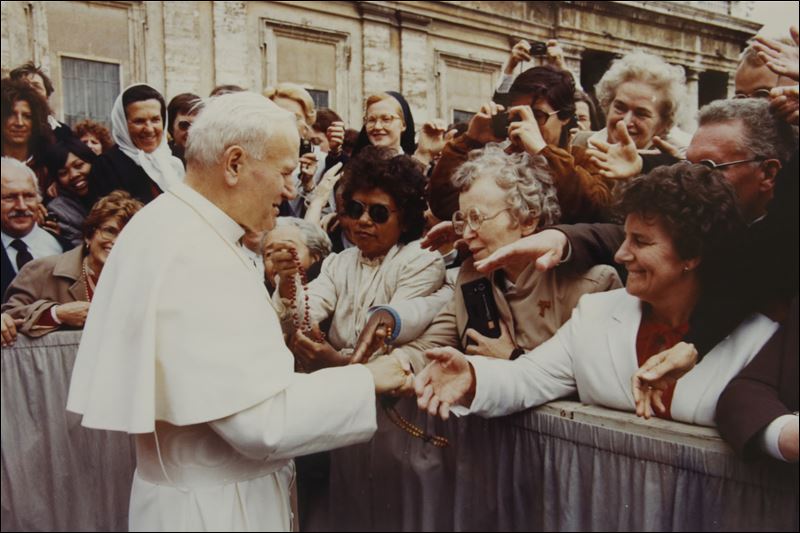
Well, years ago, when I was a guest at the Venerabile in Rome, I attended several Masses of Blessed John Paul II. At one, I was in the front of a barrier at the Gesu for Epiphany Mass. Blessed John Paul II was walking by in order to go up to the altar, when he stopped to bless a little toddler in the arms of a dad standing next to me. As John Paul II reached out to bless the boy, I, like those bold ladies in the New Testament, reached out and touched the Pope.

Those were the days before hyper-security. Now, since my eyes were operated on last month, I have had serious troubles with both. I have seen the specialist who just told me to come back if things got worse.

Instead, I prayed to Blessed John Paul II and asked him to heal the problems with both eyes.

I reminded him that I touched him, and that time does not matter in the world of the spirit.

Today, there is a difference in my eyes. I believe Blessed John Paul II will heal the problems. The worst of the symptoms are gone for the first time, but the problems are not gone completely. Please join me in prayer for a complete healing of both of my eyes.

I shall keep you posted on this.

The End of Manipulation, Maybe

Ladies' Home Journal is closing down this summer, going from a monthly to a quarterly publication. Some are stating that this is because of the demise of print. But, I think magazines have misunderstood the modern woman and have missed opportunities for growth because of ideologies.


Few women have time to sit down and read articles on celebrity friendships, make-up, or travels of the First Lady.  Women have their own lives, and do not need to read vicarious stories involving other women whose lives may be more boring than their own.

Few live in such isolation that they must live out dreams through the stories of others.

The days of learning to be "one of the gang" through magazines are long gone. Mags once gave identity to American women of the middle class, forming several generations into conformists regarding dress, recipes and decorating the spare room.

Those women who work read journals regarding their careers. They read news sources online, yes, but also read more specific articles for information, not for entertainment.

What the ladies' mags seem not to understand is that women are way more intelligent than the editorial or feature staffs.

This transition is not simply about whether the Net is making print obsolete. This transition reveals the dated manipulation of women's lives via advertising and other's opinions.

The younger generations simply want to do their own thing and not be told what to buy and what to wear.

I would like to see the demise of most women's mags, as these are merely brain-washing engines for continuing consumerism.

If a woman does research online and goes directly to a source for clothes or shoes or recipes, skipping the flipping through pages stage, why not?

Women do not need Ladies' Home Journal.


Third Attribute: Simplicity


This Attribute may be the most easy to comprehend. God is not a composite Being. The Church tells us that our soul is "simple". Aquinas says it best, in my opinion.

Summa Theologica I;3 http://www.newadvent.org/summa/1003.htm

On the contrary, Augustine says (De Trin. iv, 6,7): "God is truly and absolutely simple."
I answer that, The absolute simplicity of God may be shown in many ways.
First, from the previous articles of this question. For there is neither composition of quantitative parts in God, since He is not a body; nor composition of matter and form; nor does His nature differ from His "suppositum"; nor His essence from His existence; neither is there in Him composition of genus and difference, nor of subject and accident. Therefore, it is clear that God is nowise composite, but is altogether simple.
Secondly, because every composite is posterior to its component parts, and is dependent on them; but God is the first being, as shown above (Question 2, Article 3).
Thirdly, because every composite has a cause, for things in themselves different cannot unite unless something causes them to unite. But God is uncaused, as shown above (Question 2, Article 3), since He is the first efficient cause.
Fourthly, because in every composite there must be potentiality and actuality; but this does not apply to God; for either one of the parts actuates another, or at least all the parts are potential to the whole.
Fifthly, because nothing composite can be predicated of any single one of its parts. And this is evident in a whole made up of dissimilar parts; for no part of a man is a man, nor any of the parts of the foot, a foot. But in wholes made up of similar parts, although something which is predicated of the whole may be predicated of a part (as a part of the air is air, and a part of water, water), nevertheless certain things are predicable of the whole which cannot be predicated of any of the parts; for instance, if the whole volume of water is two cubits, no part of it can be two cubits. Thus in every composite there is something which is not it itself. But, even if this could be said of whatever has a form, viz. that it has something which is not it itself, as in a white object there is something which does not belong to the essence of white; nevertheless in the form itself, there is nothing besides itself. And so, since God is absolute form, or rather absolute being, He can be in no way composite. Hilary implies this argument, when he says (De Trin. vii): "God, Who is strength, is not made up of things that are weak; nor is He Who is light, composed of things that are dim."
Reply to Objection 1. Whatever is from God imitates Him, as caused things imitate the first cause. But it is of the essence of a thing to be in some sort composite; because at least its existence differs from its essence, as will be shown hereafter, (4, 3).
Reply to Objection 2. With us composite things are better than simple things, because the perfections of created goodness cannot be found in one simple thing, but in many things. But the perfection of divine goodness is found in one simple thing (4, 1 and 6, 2).

The purpose of looking at the Attributes of God is to come into active contemplation of God. This active contemplation, obviously, brings us closer to Him as we use our reason and open ourselves to the infusion of knowledge from God, as much as He desires to give.

Sometimes, one can only contemplate God in love, when looking at the Attributes.

To be continued....

Attribute Two: Unity

Yet to us there is but one God, the Father, of whom are all things, and we unto him; and one Lord Jesus Christ, by whom are all things, and we by him. i Corinthians 8:6 DR


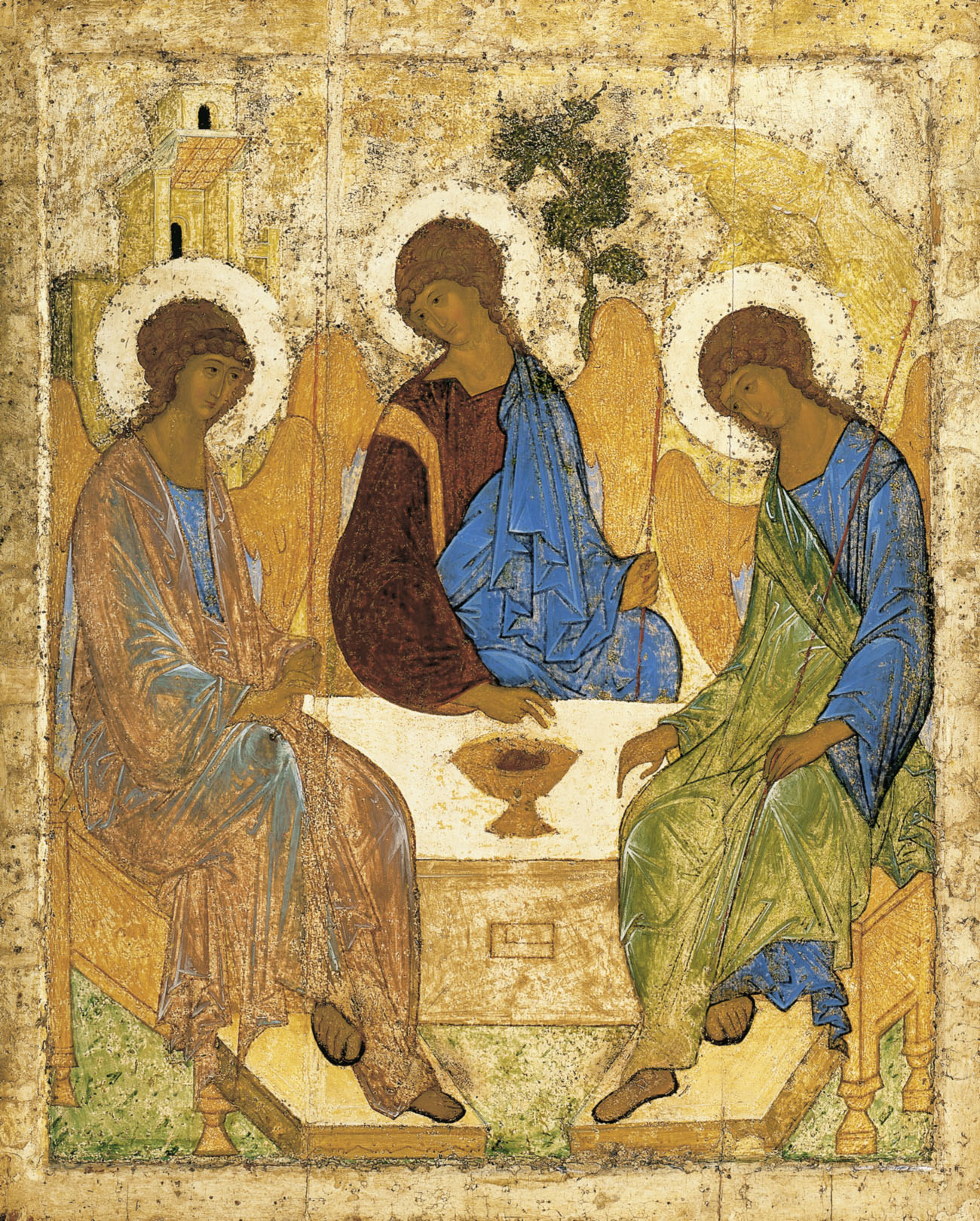
Garrigou-Lagrange has another book in which he looks at the Trinity. Now, the Mystery of the Triune God separates us from many other "faiths".

Unity is one of the Attributes of God. Here is a long selection from the book, The Trinity and God the Creator,  and then a comment in blue.

First Article: Whether There Is A Trinity In God
The difficulty arises from the fact that everything that is triune is threefold, whereas God is not threefold since He possesses the greatest unity. Nevertheless the reply is in the affirmative as an article of faith. In the Athanasian Creed we read, "The Unity is to be worshiped in Trinity and the Trinity in Unity."[327]
Theology offers the following explanation. In God there is a transcendental plurality of persons. The term "Trinity" according to revelation limits this plurality to the three persons. Therefore the term Trinity can rightly be used.
Reply to the first objection. Etymologically the term "Trinity" seems to signify the unity of three, but in a special way it signifies the transcendental number of persons of one essence. Thus we cannot say that the Father is the Trinity. The term "Trinity" signifies at the same time the number of persons and the unity of the essence.
Reply to the second objection. St. John declared, "And these three are one" (I John 5:7). Hence we have the name "Trinity."
Reply to the third objection. Nevertheless in God there is no triplicity because triplicity denotes a proportion of inequality as do duplicity and quadruplicity. Thus we cannot say that God is threefold. That which is threefold has in a sense been tripled, as, for instance, a triple crown signifies the union of three crowns.
If God were said to be threefold, the three persons together would be more than one alone, and one person would not have infinite perfection. But we can say that the persons are threefold and the processions are twofold, because by adding person and procession we exclude sufficiently the multiplicity of nature.
Reply to the fourth objection. Unity in Trinity signifies that there is one nature in three persons, and Trinity in unity signifies three persons in one nature.
Reply to the fifth objection. We cannot say that the Trinity is threefold for this would mean that there were three supposita of the Trinity, whereas there are only three supposita of the Deity.
First corollary. From the foregoing the Thomists, especially Gonet, conclude that those things that belong to the persons by reason of the essence alone are predicated only singly. Those things, however, that belong to the persons by reason of the persons alone are predicated only in the plural. Those things that belong to the persons by reason of the essence and the relations are predicated both in the singular and in the plural.
The reason for this rule is that in God all things are one and the same except where there is the opposition of relation; only the relations are multiplied in God, the essence is not. This was defined by the Council of Toledo: "Number is discovered in the relation of the persons; but we find nothing that is numbered in the substance of the divinity. Thus number is indicated only in this, that they are mutually related; and they lack number in this, that they are in themselves."[328]

From this rule it follows that it is correct to say that there are three persons or three hypostases in God but not three individuals because the nature is multiplied in individuals. In its formal signification person denotes personality; in its material signification it denotes nature. On the other hand, the individual in its formal signification denotes nature; in its material signification it denotes personality.

This Truth to me is most awesome. God has "personality" and that is what distinguishes this definition of the Trinity from "individuality". That there are Three Persons in One God of one substance seems clear in the above clarification. Garrigou-Lagrange goes on to say that "...the Fourth Lateran Council, which said that the Father, the Son, and the Holy Ghost are "co-omnipotent and co-eternal, one principle of all things."[350]"

These Three Persons are One, but are knowable because of certain "notions" given through Revelation. These notions are defined as a "notion is that which is the proper reason for knowing a divine person." 

Theology and philosophy, that is reason, can lead us to some understandings through the notions, but we need Revelation to help us know the Trinity.

Of course, Christ told us that He revealed the Father and that the Holy Spirit would come after His Ascension. That Christ came to reveal the Trinity is clear from the Annunciation. Christ became Incarnate by the power of the Holy Spirit and through the Fatherhood of God.

Mary was one of the first to have the Trinity revealed to her, and the only human to have experienced the Trinity as Three Persons intimately.

Personality indicates that God, like us made in His image and likeness, have knowledge of self. God reveals Himself to us as One, but in notions, which indicate relationship.

Here is the Dominican again.


Thus we have paternity, filiation, common active spiration, passive spiration, to which we add innascibility, because the person of the Father is known not only by paternity but also by the fact that He is from no one and that He is the principle without a principle. This notion is in conformity with the dignity of the Father, ....[370]

We may come to understand the Unity of God through Creation, through relationship with Him. His Unity is that there is only One God, One Infinite Being, as explained by the Church.

Here is Garrigou-Lagrange again.

The perfect intellect, however assimilates its Word most perfectly, not only intentionally, but really in nature and in a nature that is numerically one, so that the divine Word is not accidental but substantial, at the same time living and understanding, because in God being and understanding and being understood are the same. Revelation affirms that this substantial Word is the person of the Son of God. This is true generation, which primarily deserves the name generation; other kinds of generation are generation by participation and secondarily, although they are prior in our knowledge. Therefore St. Paul said," or this cause I bow my knees to the Father of our Lord Jesus Christ, of whom all paternity in heaven and earth is named" (Eph. 3:14 f.).[170]

My response to this small bit of explanation and guidance is pure awe and wonder. Actively contemplating on the Unity of God brings one closer to Him in this Oneness. Such is the grace He wants to give us.

I can only dip into the great complexity of the Attributes of God, but this little series may whet your appetite to study more.

To be continued.... and find more here https://www.ewtn.com/library/THEOLOGY/TRINITY.HTM#05


Attribute One: Perfection continued


Now, there are two erroneous views on perfection regarding God. The first is that only God as Spirit is perfect and that the material is imperfect. This is no longer true since the Redemptive action of Christ on the Cross, redeeming nature as well as spirit. As the Incarnate God, Christ joins the perfection of man with the perfection of God. The Hypostatic Union in Christ means that the Divine Nature is truly one with the Human Nature of Christ. Arians deny even today this Union, and we see heretical sects, such as the Christian Scientists denying the material, human nature of Christ, stating that it was an illusion.

The Nicene Creed is clear on this Hypostatic Union. This Union is Perfect. Christ's Will was Divine and Human. He is One Person with Two Natures, but "consubstantial with the Father".  There is only One God, one Substance, with Three Divine Persons. Christ is begotten not made.

Christ is Body and Soul, in Heaven. His Resurrected Body bears the wounds of the Cross, a great mystery of His victory over sin and death.


The Nicene Creed

I believe in one God,
the Father almighty,
maker of heaven and earth,
of all things visible and invisible.
I believe in one Lord Jesus Christ,
the Only Begotten Son of God,
born of the Father before all ages.
God from God, Light from Light,
true God from true God,
begotten, not made, consubstantial with the Father;
through him all things were made.
For us men and for our salvation
he came down from heaven,
and by the Holy Spirit was incarnate of the Virgin Mary,
and became man.
For our sake he was crucified under Pontius Pilate,
he suffered death and was buried,
and rose again on the third day
in accordance with the Scriptures.
He ascended into heaven
and is seated at the right hand of the Father.
He will come again in glory
to judge the living and the dead
and his kingdom will have no end.
I believe in the Holy Spirit, the Lord, the giver of life,
who proceeds from the Father and the Son,
who with the Father and the Son is adored and glorified,
who has spoken through the prophets.
I believe in one, holy, catholic and apostolic Church.
I confess one Baptism for the forgiveness of sins
and I look forward to the resurrection of the dead
and the life of the world to come. Amen.

The second common modern error, which is old, but rehashed, is that God is not perfect, that He is somehow an image of man. the Greek gods were made in the image of man and so too, some people attribute to God the imperfections of man.

to be continued....


Attribute One: Perfection

Be you therefore perfect, as also your heavenly Father is perfect. Matthew 5:49 DR

Aquinas writes this below, on God as Perfect.

All created perfections are in God. Hence He is spoken of as universally perfect, because He lacks not (says the Commentator, Metaph. v) any excellence which may be found in any genus. This may be seen from two considerations. First, because whatever perfection exists in an effect must be found in the effective cause: either in the same formality, if it is a univocal agent---as when man reproduces man; or in a more eminent degree, if it is an equivocal agent---thus in the sun is the likeness of whatever is generated by the sun's power. Now it is plain that the effect pre-exists virtually in the efficient cause: and although to pre-exist in the potentiality of a material cause is to pre-exist in a more imperfect way, since matter as such is imperfect, and an agent as such is perfect; still to pre-exist virtually in the efficient cause is to pre-exist not in a more imperfect, but in a more perfect way. Since therefore God is the first effective cause of things, the perfections of all things must pre-exist in God in a more eminent way. Dionysius implies the same line of argument by saying of God (Div. Nom. v): "It is not that He is this and not that, but that He is all, as the cause of all." Secondly, from what has been already proved, God is existence itself, of itself subsistent (Question [3]Article [4]). Consequently, He must contain within Himself the whole perfection of being. For it is clear that if some hot thing has not the whole perfection of heat, this is because heat is not participated in its full perfection; but if this heat were self-subsisting, nothing of the virtue of heat would be wanting to it. Since therefore God is subsisting being itself, nothing of the perfection of being can be wanting to Him. Now all created perfections are included in the perfection of being; for things are perfect, precisely so far as they have being after some fashion. It follows therefore that the perfection of no one thing is wanting to God. This line of argument, too, is implied by Dionysius (Div. Nom. v), when he says that, "God exists not in any single mode, but embraces all being within Himself, absolutely, without limitation, uniformly;" and afterwards he adds that, "He is the very existence to subsisting things."

In this sense, perfection is a wholeness, a completeness of all that is good. God is not wanting in anything. And, all that is rests in Him. Nothing that is created exists outside of God. God, as the First Principle, is Perfect.

When God calls us to perfection, He is calling us to be all that He intended us to be. This cannot be done without His grace. This is the reason for purgation, to be emptied of all that stands in the way of our perfection in God.

God is the Essential Being and we participate in that. And, as we are made in the 'image and likeness of God", the image being free will and intellect, and the likeness being grace, which we must regain in baptism, we participate in the perfection of God according to how God has called us to that perfection.

God alone is totally Perfect. 

http://www.newadvent.org/summa/1004.htm

New Series Coming Up-The Attributes of God


As much as I like Suarez, I am going to use St. Thomas Aquinas in a new series on the Attributes of God.

There is some confusion on this topic, as Protestants have come up with their own list. Of course, I shall refer to the greatest Doctor of the Church on this matter.

I hope to cover all these attributes in the next few days. But, today, let me list those according to Aquinas.

He divides the Attributes into those of divine substance and those of divine operation

Those of divine substance are: simplicity, perfection, goodness, infinity, immensity, immutability, eternity, unity, invisibility and ineffability.

Those of divine operation are: knowledge, will, love, justice, mercy, and providence.

More coming up...most of the information will be from The One God by Garrigou-Lagrange. See you all later.