Recent Posts

Monday, 22 June 2015

More Good Stuff--Finally, A Mention of Subsidiarity

When I try to talk to Americans about simplifying their lives. I either get blank stares or anger.

Why? 

IV. POLITICS AND ECONOMY IN DIALOGUE FOR HUMAN FULFILMENT

189. Politics must not be subject to the economy, nor should the economy be subject to the dictates of an efficiency-driven paradigm of technocracy. Today, in view of the common good, there is urgent need for politics and economics to enter into a frank dialogue in the service of life, especially human life. Saving banks at any cost, making the public pay the price, foregoing a firm commitment to reviewing and reforming the entire system, only reaffirms the absolute power of a financial system, a power which has no future and will only give rise to new crises after a slow, costly and only apparent recovery. The financial crisis of 2007-08 provided an opportunity to develop a new economy, more attentive to ethical principles, and new ways of regulating speculative financial practices and virtual wealth. But the response to the crisis did not include rethinking the outdated criteria which continue to rule the world. Production is not always rational, and is usually tied to economic variables which assign to products a value that does not necessarily correspond to their real worth. This frequently leads to an overproduction of some commodities, with unnecessary impact on the environment and with negative results on regional economies.[133] The financial bubble also tends to be a productive bubble. The problem of the real economy is not confronted with vigour, yet it is the real economy which makes diversification and improvement in production possible, helps companies to function well, and enables small and medium businesses to develop and create employment.
190. Here too, it should always be kept in mind that “environmental protection cannot be assured solely on the basis of financial calculations of costs and benefits. The environment is one of those goods that cannot be adequately safeguarded or promoted by market forces”.[134] Once more, we need to reject a magical conception of the market, which would suggest that problems can be solved simply by an increase in the profits of companies or individuals. Is it realistic to hope that those who are obsessed with maximizing profits will stop to reflect on the environmental damage which they will leave behind for future generations? Where profits alone count, there can be no thinking about the rhythms of nature, its phases of decay and regeneration, or the complexity of ecosystems which may be gravely upset by human intervention. Moreover, biodiversity is considered at most a deposit of economic resources available for exploitation, with no serious thought for the real value of things, their significance for persons and cultures, or the concerns and needs of the poor.
191. Whenever these questions are raised, some react by accusing others of irrationally attempting to stand in the way of progress and human development. But we need to grow in the conviction that a decrease in the pace of production and consumption can at times give rise to another form of progress and development. Efforts to promote a sustainable use of natural resources are not a waste of money, but rather an investment capable of providing other economic benefits in the medium term. If we look at the larger picture, we can see that more diversified and innovative forms of production which impact less on the environment can prove very profitable. It is a matter of openness to different possibilities which do not involve stifling human creativity and its ideals of progress, but rather directing that energy along new channels.

First of all, for people to want to use resources responsibly, they have to believe in personal responsibility.

Second of all, we must decide to live more simply...Here is Francis quoting Benedict.

Benedict XVI has said that “technologically advanced societies must be prepared to encourage more sober lifestyles, while reducing their energy consumption and improving its efficiency”.[135]

And, more on balance....

Put simply, it is a matter of redefining our notion of progress. A technological and economic development which does not leave in its wake a better world and an integrally higher quality of life cannot be considered progress. Frequently, in fact, people’s quality of life actually diminishes – by the deterioration of the environment, the low quality of food or the depletion of resources – in the midst of economic growth. In this context, talk of sustainable growth usually becomes a way of distracting attention and offering excuses. It absorbs the language and values of ecology into the categories of finance and technocracy, and the social and environmental responsibility of businesses often gets reduced to a series of marketing and image-enhancing measures.
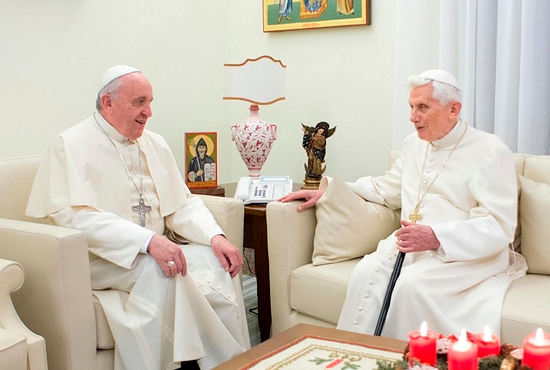


195. The principle of the maximization of profits, frequently isolated from other considerations, reflects a misunderstanding of the very concept of the economy. As long as production is increased, little concern is given to whether it is at the cost of future resources or the health of the environment; as long as the clearing of a forest increases production, no one calculates the losses entailed in the desertification of the land, the harm done to biodiversity or the increased pollution. In a word, businesses profit by calculating and paying only a fraction of the costs involved. Yet only when “the economic and social costs of using up shared environmental resources are recognized with transparency and fully borne by those who incur them, not by other peoples or future generations”,[138] can those actions be considered ethical. An instrumental way of reasoning, which provides a purely static analysis of realities in the service of present needs, is at work whether resources are allocated by the market or by state central planning.


196. What happens with politics? Let us keep in mind the principle of subsidiarity, which grants freedom to develop the capabilities present at every level of society, while also demanding a greater sense of responsibility for the common good from those who wield greater power. Today, it is the case that some economic sectors exercise more power than states themselves. But economics without politics cannot be justified, since this would make it impossible to favour other ways of handling the various aspects of the present crisis. The mindset which leaves no room for sincere concern for the environment is the same mindset which lacks concern for the inclusion of the most vulnerable members of society. For “the current model, with its emphasis on success and self-reliance, does not appear to favour an investment in efforts to help the slow, the weak or the less talented to find opportunities in life”.[139]

more later....

Global or Personal Solutions--STM's Critique


In the section preceeding these paragraphs, references to international meetings, conferences and treaties on dealing with environmental problems provide a review of international efforts. The appeal to the U.N. seems to be a naive, but well-intended appeal to the international community which has not come to any real agreements on environmental care.

Here  lies the crux of the problem of a solution. And I choose bullet points to cover this serious problem.

  • Big corporations work hand in hand with special interests groups undermining national interests, such as the Bilderberg Group, the Trilateral Commission, and the Council for Foreign Relations. The Pope makes no mention of those groups which do not have either the poor or the vanishing middle class in mind, but only strive to create a master-class, and, mostly likely a slave class to support that. Until the UN is seen by Catholics for what it is, an anti-Catholic, anti-Christian, anti-pro-life entity, any desire to use this institution reveals blinders of great naivete.
  • What is missing is the really deep root of the lack of personal morality among the vast majority of people making decisions either in New York, Washington, London, or Brussels. Until men and women share a Christian philosophy of life, a world- view of natural law philosophy and a strong belief in the building of the Kingdom of God, all talk of cooperation between nations, (which are disappearing as distinct entities), seems out-of-touch with reality. 
  • The Pope may be optimistic and hopeful about the need for global cooperation, but he must also address personal conversion and the renewal of a shared vision of stewardship which no longer exists. 
  • Special interest groups have become anti-life, such as the Bill and Melinda Gates Foundation. The African bishops have spoken clearly about Western anti-life and pro-homosexual agendas among so-called Western charities, but this seems to be a point not directly addressed here, although indirectly addressed above.
  • Technology has spurted ahead of morality in the area of progress, and this is where the Catholic Church is weak--in moral theology which addresses the real issues of selfishness among those special interests and how to combat the evil of "big" as opposed to "small" groups. Those with a European perspective and those with an American one can see the omissions in this section.
  • Perhaps false hope in global governance is a blind spot, but only the Vatican can provide the real leadership for global renewal of Christian virtue and values. The Kingdom of God on earth must lead others, not follow others. Catholic teaching must inform all levels of science and technology.
  • Perhaps the lack of understanding even among those who work in and for the Vatican that it is Catholicism that must lead the world into responsible stewardship and not global government has do to with the over-reaction against St. John Paul II's real awareness of the dangers of both socialism and communism. The new threat is even more sinister, as it hides like a nice big brother, while in reality being the hideous hydra of greed and special interests.
  • There are few in the world today, East or West, North or South, with moral frameworks to judge what the Pope is trying to teach here.
170. Some strategies for lowering pollutant gas emissions call for the internationalization of environmental costs, which would risk imposing on countries with fewer resources burdensome commitments to reducing emissions comparable to those of the more industrialized countries. Imposing such measures penalizes those countries most in need of development. A further injustice is perpetrated under the guise of protecting the environment. Here also, the poor end up paying the price. Furthermore, since the effects of climate change will be felt for a long time to come, even if stringent measures are taken now, some countries with scarce resources will require assistance in adapting to the effects already being produced, which affect their economies. In this context, there is a need for common and differentiated responsibilities. As the bishops of Bolivia have stated, “the countries which have benefited from a high degree of industrialization, at the cost of enormous emissions of greenhouse gases, have a greater responsibility for providing a solution to the problems they have caused”.[127]

This section below reveals a wisdom and sense of reality about false environmental solutions. Ploy is an appropriate word here. I wish the Pope would identify more "ploys".


171. The strategy of buying and selling “carbon credits” can lead to a new form of speculation which would not help reduce the emission of polluting gases worldwide. This system seems to provide a quick and easy solution under the guise of a certain commitment to the environment, but in no way does it allow for the radical change which present circumstances require. Rather, it may simply become a ploy which permits maintaining the excessive consumption of some countries and sectors.

172. For poor countries, the priorities must be to eliminate extreme poverty and to promote the social development of their people. At the same time, they need to acknowledge the scandalous level of consumption in some privileged sectors of their population and to combat corruption more effectively. They are likewise bound to develop less polluting forms of energy production, but to do so they require the help of countries which have experienced great growth at the cost of the ongoing pollution of the planet. Taking advantage of abundant solar energy will require the establishment of mechanisms and subsidies which allow developing countries access to technology transfer, technical assistance and financial resources, but in a way which respects their concrete situations, since “the compatibility of [infrastructures] with the context for which they have been designed is not always adequately assessed”.[128] The costs of this would be low, compared to the risks of climate change. In any event, these are primarily ethical decisions, rooted in solidarity between all peoples.

But, to be fair to Francis, he is merely stating Benedict's own views here. Let us be honest about this.

As Benedict XVI has affirmed in continuity with the social teaching of the Church: “To manage the global economy; to revive economies hit by the crisis; to avoid any deterioration of the present crisis and the greater imbalances that would result; to bring about integral and timely disarmament, food security and peace; to guarantee the protection of the environment and to regulate migration: for all this, there is urgent need of a true world political authority, as my predecessor Blessed John XXIII indicated some years ago”.[129] Diplomacy also takes on new importance in the work of developing international strategies which can anticipate serious problems affecting us all.

St. John Paul II's "true world political authority" does not exist, except in Christendom, long gone. If the Catholic Church had the leadership necessary to again influence global interests, one could trust such efforts. But, as it is, the Church has been weakened by false ideologies of socialism and communism, as well as the practical relativism mentioned by Francis above.

Neither St. John Paul II or the Pope Emeritus could control the special interests in the Vatican. (cf. Malachi Martin, E. Michael Jones and others). It seems like Francis has fallen into the same level of ineffectiveness in controlling those who are not having the best interests of the Catholic Church in mind-those who hate the ideal of Christendom-the false ecumenism we see in the Synod, and the practical relativism of some Catholics in high places, even here in the US.

Until there are saints who can lead us back to earthly reality as seen through the eyes of Christ, and not a false millennialism, these arguments remain incomplete at best, and naive.


I wonder if this next paragraph which I have selected here reflects Benedict, or is a development of those influences described above?


177. Given the real potential for a misuse of human abilities, individual states can no longer ignore their responsibility for planning, coordination, oversight and enforcement within their respective borders. How can a society plan and protect its future amid constantly developing technological innovations? One authoritative source of oversight and coordination is the law, which lays down rules for admissible conduct in the light of the common good. The limits which a healthy, mature and sovereign society must impose are those related to foresight and security, regulatory norms, timely enforcement, the elimination of corruption, effective responses to undesired side-effects of production processes, and appropriate intervention where potential or uncertain risks are involved. There is a growing jurisprudence dealing with the reduction of pollution by business activities. But political and institutional frameworks do not exist simply to avoid bad practice, but also to promote best practice, to stimulate creativity in seeking new solutions and to encourage individual or group initiatives.

This paragraph below is good but limited, as international groups, such as the ones listed by me above, and others not listed, fall into power politics are well as national interests.

178. A politics concerned with immediate results, supported by consumerist sectors of the population, is driven to produce short-term growth. In response to electoral interests, governments are reluctant to upset the public with measures which could affect the level of consumption or create risks for foreign investment. The myopia of power politics delays the inclusion of a far-sighted environmental agenda within the overall agenda of governments. Thus we forget that “time is greater than space”,[130] that we are always more effective when we generate processes rather than holding on to positions of power. True statecraft is manifest when, in difficult times, we uphold high principles and think of the long-term common good. Political powers do not find it easy to assume this duty in the work of nation-building.

But, these following paragraphs seem to contradict those above--YES! Let local governments, even very small ones decide on programs and policies to meet local needs. But, what must come first is the missing moral framework--Catholic stewardship based on natural law and Revelation, as well as Tradition.

179. In some places, cooperatives are being developed to exploit renewable sources of energy which ensure local self-sufficiency and even the sale of surplus energy. This simple example shows that, while the existing world order proves powerless to assume its responsibilities, local individuals and groups can make a real difference. They are able to instil a greater sense of responsibility, a strong sense of community, a readiness to protect others, a spirit of creativity and a deep love for the land. They are also concerned about what they will eventually leave to their children and grandchildren. These values are deeply rooted in indigenous peoples. Because the enforcement of laws is at times inadequate due to corruption, public pressure has to be exerted in order to bring about decisive political action. Society, through non-governmental organizations and intermediate groups, must put pressure on governments to develop more rigorous regulations, procedures and controls. Unless citizens control political power – national, regional and municipal – it will not be possible to control damage to the environment. Local legislation can be more effective, too, if agreements exist between neighbouring communities to support the same environmental policies.

AMEN!


180. There are no uniform recipes, because each country or region has its own problems and limitations. It is also true that political realism may call for transitional measures and technologies, so long as these are accompanied by the gradual framing and acceptance of binding commitments. At the same time, on the national and local levels, much still needs to be done, such as promoting ways of conserving energy. These would include favouring forms of industrial production with maximum energy efficiency and diminished use of raw materials, removing from the market products which are less energy efficient or more polluting, improving transport systems, and encouraging the construction and repair of buildings aimed at reducing their energy consumption and levels of pollution. Political activity on the local level could also be directed to modifying consumption, developing an economy of waste disposal and recycling, protecting certain species and planning a diversified agriculture and the rotation of crops. Agriculture in poorer regions can be improved through investment in rural infrastructures, a better organization of local or national markets, systems of irrigation, and the development of techniques of sustainable agriculture. New forms of cooperation and community organization can be encouraged in order to defend the interests of small producers and preserve local ecosystems from destruction. Truly, much can be done!

To be continued....more later....

Technology vs. Morality

131. Here I would recall the balanced position of Saint John Paul II, who stressed the benefits of scientific and technological progress as evidence of “the nobility of the human vocation to participate responsibly in God’s creative action”, while also noting that “we cannot interfere in one area of the ecosystem without paying due attention to the consequences of such interference in other areas”.[109] He made it clear that the Church values the benefits which result “from the study and applications of molecular biology, supplemented by other disciplines such as genetics, and its technological application in agriculture and industry”.[110] But he also pointed out that this should not lead to “indiscriminate genetic manipulation”[111] which ignores the negative effects of such interventions. Human creativity cannot be suppressed. If an artist cannot be stopped from using his or her creativity, neither should those who possess particular gifts for the advancement of science and technology be prevented from using their God-given talents for the service of others. We need constantly to rethink the goals, effects, overall context and ethical limits of this human activity, which is a form of power involving considerable risks.


I am going backwards a bit the encyclical because I did not emphasize this enough.


For the record, I have been against GMOs for a very long time. This section restates the great necessity of an ethical framework for agribusiness, which does not exist. Those of us from the Midwest have nicknames for some of the biggest polluters of the Mississippi and other rivers, companies into GMO technology. Also, if one followed the collapse of certain areas of farming in India years ago, part of this crisis had to do with multi-international companies pushing GMOs in areas which could not sustain such plants.

The moral repercussions of intensive farming must be identified and addressed. Years ago, in a debate class, I had my student look into the most famous, (or infamous) company in Iowa regarding GMOs and the negative impact on the environment.

The loss of many animals, songbirds and butterflies, as well as honey bees has been connected to GMOs. 

The loss of the family farm has to be one of the great tragedies of modern agribusiness schemes. As an old farmer from Missouri told me once, he was sick of the government and business interests telling him how to farm property in his family for over a hundred years. He became so exasperated, he sold a heritage farm.

These issues have not been addressed by the Church in America to the extent these should be. That the Pope begins this discussion is essential.


It is difficult to make a general judgement about genetic modification (GM), whether vegetable or animal, medical or agricultural, since these vary greatly among themselves and call for specific considerations. The risks involved are not always due to the techniques used, but rather to their improper or excessive application. Genetic mutations, in fact, have often been, and continue to be, caused by nature itself. Nor are mutations caused by human intervention a modern phenomenon. The domestication of animals, the crossbreeding of species and other older and universally accepted practices can be mentioned as examples. We need but recall that scientific developments in GM cereals began with the observation of natural bacteria which spontaneously modified plant genomes. In nature, however, this process is slow and cannot be compared to the fast pace induced by contemporary technological advances, even when the latter build upon several centuries of scientific progress.
134. Although no conclusive proof exists that GM cereals may be harmful to human beings, and in some regions their use has brought about economic growth which has helped to resolve problems, there remain a number of significant difficulties which should not be underestimated. In many places, following the introduction of these crops, productive land is concentrated in the hands of a few owners due to “the progressive disappearance of small producers, who, as a consequence of the loss of the exploited lands, are obliged to withdraw from direct production”.[113] The most vulnerable of these become temporary labourers, and many rural workers end up moving to poverty-stricken urban areas. The expansion of these crops has the effect of destroying the complex network of ecosystems, diminishing the diversity of production and affecting regional economies, now and in the future. In various countries, we see an expansion of oligopolies for the production of cereals and other products needed for their cultivation. This dependency would be aggravated were the production of infertile seeds to be considered; the effect would be to force farmers to purchase them from larger producers.

135. Certainly, these issues require constant attention and a concern for their ethical implications. A broad, responsible scientific and social debate needs to take place, one capable of considering all the available information and of calling things by their name. It sometimes happens that complete information is not put on the table; a selection is made on the basis of particular interests, be they politico-economic or ideological. This makes it difficult to reach a balanced and prudent judgement on different questions, one which takes into account all the pertinent variables. Discussions are needed in which all those directly or indirectly affected (farmers, consumers, civil authorities, scientists, seed producers, people living near fumigated fields, and others) can make known their problems and concerns, and have access to adequate and reliable information in order to make decisions for the common good, present and future. This is a complex environmental issue; it calls for a comprehensive approach which would require, at the very least, greater efforts to finance various lines of independent, interdisciplinary research capable of shedding new light on the problem.

Again, the Pope refers to the dignity of the human being which is overlooked in much research.

136. On the other hand, it is troubling that, when some ecological movements defend the integrity of the environment, rightly demanding that certain limits be imposed on scientific research, they sometimes fail to apply those same principles to human life. There is a tendency to justify transgressing all boundaries when experimentation is carried out on living human embryos. We forget that the inalienable worth of a human being transcends his or her degree of development. In the same way, when technology disregards the great ethical principles, it ends up considering any practice whatsoever as licit. As we have seen in this chapter, a technology severed from ethics will not easily be able to limit its own power.

A key concept for this Pope is that no moral issue can be isolated from another. We in the pro-life moment should know this as well.

It is essential to seek comprehensive solutions which consider the interactions within natural systems themselves and with social systems. We are faced not with two separate crises, one environmental and the other social, but rather with one complex crisis which is both social and environmental. Strategies for a solution demand an integrated approach to combating poverty, restoring dignity to the excluded, and at the same time protecting nature.

Let me skip down to the section on the common good. The common good must be a consideration of each individual's responsible decisions. Is what I do good not only for myself but for others, for the culture, for Western Civilization, for the spreading of the Gospel?

IV. THE PRINCIPLE OF THE COMMON GOOD
156. Human ecology is inseparable from the notion of the common good, a central and unifying principle of social ethics. The common good is “the sum of those conditions of social life which allow social groups and their individual members relatively thorough and ready access to their own fulfilment”.[122]

157. Underlying the principle of the common good is respect for the human person as such, endowed with basic and inalienable rights ordered to his or her integral development. It has also to do with the overall welfare of society and the development of a variety of intermediate groups, applying the principle of subsidiarity. Outstanding among those groups is the family, as the basic cell of society. Finally, the common good calls for social peace, the stability and security provided by a certain order which cannot be achieved without particular concern for distributive justice; whenever this is violated, violence always ensues. Society as a whole, and the state in particular, are obliged to defend and promote the common good.

Sadly, some Catholics simply do not believe that the Church over and over again, has called us to give special attention to the poor, in St. John Paul II's phrase, "a preferential option" for the poor.

158. In the present condition of global society, where injustices abound and growing numbers of people are deprived of basic human rights and considered expendable, the principle of the common good immediately becomes, logically and inevitably, a summons to solidarity and a preferential option for the poorest of our brothers and sisters. This option entails recognizing the implications of the universal destination of the world’s goods, but, as I mentioned in the Apostolic Exhortation Evangelii Gaudium,[123] it demands before all else an appreciation of the immense dignity of the poor in the light of our deepest convictions as believers. We need only look around us to see that, today, this option is in fact an ethical imperative essential for effectively attaining the common good. 

I have written on this blog and others that the basic questions need to be asked, and need to be part of the New Evanelization. Without discussing these basic questions, youth have absolutely no moral framework with which to judge any pro-life or pro-Christian answer.

The Portuguese bishops have called upon us to acknowledge this obligation of justice: “The environment is part of a logic of receptivity. It is on loan to each generation, which must then hand it on to the next”.[124] An integral ecology is marked by this broader vision.
160. What kind of world do we want to leave to those who come after us, to children who are now growing up? This question not only concerns the environment in isolation; the issue cannot be approached piecemeal. When we ask ourselves what kind of world we want to leave behind, we think in the first place of its general direction, its meaning and its values. Unless we struggle with these deeper issues, I do not believe that our concern for ecology will produce significant results. But if these issues are courageously faced, we are led inexorably to ask other pointed questions: What is the purpose of our life in this world? Why are we here? What is the goal of our work and all our efforts? What need does the earth have of us? It is no longer enough, then, simply to state that we should be concerned for future generations. We need to see that what is at stake is our own dignity. Leaving an inhabitable planet to future generations is, first and foremost, up to us. The issue is one which dramatically affects us, for it has to do with the ultimate meaning of our earthly sojourn.

I am beginning to think that those who do not like the movement of this encyclical are probably readers who were critical of the phenomenological approach of St. John Paul II, as much of his way of looking at realty is in this shared perspective of this section.

The "Me" Generation and the growth of narcissistic personalities in our society are not new phenomena, but here, the Pope refers to the Idiocracy state to come if things cannot be changed both spiritually and physically.

161. Doomsday predictions can no longer be met with irony or disdain. We may well be leaving to coming generations debris, desolation and filth. The pace of consumption, waste and environmental change has so stretched the planet’s capacity that our contemporary lifestyle, unsustainable as it is, can only precipitate catastrophes, such as those which even now periodically occur in different areas of the world. The effects of the present imbalance can only be reduced by our decisive action, here and now. We need to reflect on our accountability before those who will have to endure the dire consequences.


162. Our difficulty in taking up this challenge seriously has much to do with an ethical and cultural decline which has accompanied the deterioration of the environment. Men and women of our postmodern world run the risk of rampant individualism, and many problems of society are connected with today’s self-centred culture of instant gratification. We see this in the crisis of family and social ties and the difficulties of recognizing the other. Parents can be prone to impulsive and wasteful consumption, which then affects their children who find it increasingly difficult to acquire a home of their own and build a family. Furthermore, our inability to think seriously about future generations is linked to our inability to broaden the scope of our present interests and to give consideration to those who remain excluded from development. Let us not only keep the poor of the future in mind, but also today’s poor, whose life on this earth is brief and who cannot keep on waiting. Hence, “in addition to a fairer sense of intergenerational solidarity there is also an urgent moral need for a renewed sense of intragenerational solidarity”.[125]

So far, except for two paragraphs on global warming, I cannot disagree with what has been stated, as most of the above has been said before by other popes, either in encyclicals or in letters, or speeches.

But, the crunch section follows, and I shall return to that later today.


OK Just a Hint

I shall return to the encyclical with a few criticisms later today.  I have to "do" some things first today.

Readers should ponder these bullet points, however.


  • Virtue lies with individual responsibility first, then corporate or communal responsibility.
  • Laws exist because people do not take personal responsibility.
  • Catholics have bought the entire Pelagian and Protestant teaching on wealth, salvation, and poverty, and good works.
  • A lack of clear moral teaching has weakened the Church from within and the encyclical does not address the need for a clear moral apologetic. Why this has disappeared, imho, has to do with the demiss of Classical Education.
  • America and the rest of the West has completely lost the ability to judge economic growth and the need for redistribution because of a lack of understanding of previous Catholic teaching. The Pope assumes people know this teaching, but they do not.
  • Consequentialism (read at least the Wiki definition if you do not know what this is) is not the basis for Catholic moral teaching.
  • Natural law is being denied, even by Catholics
  • The Pope assumes people have been reading St. John Paul II and Benedict on social teaching, and moves in the similar mindset of their view on globalism, despite JPII's correct hatred of communism and the long Church's teaching, (rightly so), against socialism--there are other alternatives.
  • Americans are not being objective about their own sell-out to gross consumerism and narcissism, and are refusing to be open to a needed corrective. But, the corrective needs to be more focused on personal conversion, responsibility and the need for a Catholic world view, instead of a Protestant or secular one.
  • I do not like the reference to global legal take-over of personal responsibility, but the Pope is writing to a horribly irresponsible world--there are other ways, like repentance and conversion.
  • To be honest, I believe the West is too far down the road in decay of morality that only God, Who will intervene, can bring about the needed correctives, after punishment. There are precedents in both the Old and New Testament.

more later, am on the run...

Today's Snippet from Julian

"Our prayer brings great joy and gladness to our Lord. He wants it and awaits it. By his grace he can make us as like him in inward being as we are in outward form. This is his blessed will.

So he says this, 'Pray inwardly, even though you fin no joy in it. for it does good, though you feel nothing, see nothing, yes even though you think you cannot pray. For when you are dry and empty, sick and weak, your prayers please me, though there be little enough to please you. All believing prayer is precious to me.'

God accepts the good-will and work of his servants, no matter how we feel."


From Today 's Office of Readings


Judith 8:25-27 Douay-Rheims

25 Were destroyed by the destroyer, and perished by serpents.

26 As for us therefore let us not revenge ourselves for these things which we suffer.

27 But esteeming these very punishments to be less than our sins deserve, let us believe that these scourges of the Lord, with which like servants we are chastised, have happened for our amendment, and not for our destruction.


People ask me, "Why do we have to live in these hard times?"

Now, as a Boomer, I have parents who lived through World War II. My dad is a veteran of the Battle of the Bulge. That war created extremely hard times.

For awhile, we all witnessed, at least in the West, times of peace, despite the Cold War and various smaller wars here and there. But, the sins of abortion, euthanasia, and sodomy cry out to a God, Who is Purity and Innocence Himself, as seen in Christ, as well as shared attributes in the Trinity.

This Holy God sends trials, such as the serpents in the desert, whose bites were healed through the intercession of Moses, a sign revealing the coming Savior Who would save us from sin through His Passion and Death. 

Numbers 21:9 Douay-Rheims

9 Moses therefore made a brazen serpent, and set it up for a sign: which when they that were bitten looked upon, they were healed.


Christians suffer as well as those who live in sin and turn away from God. But, we, too, need to be punished in order to see our sins, know ourselves, and come to God in humility.

If one accepts suffering as deserved, which it is, these times become days of grace, not merely hard times.


My Thoughts Today on Two Great Saints

Found here......

http://guildofblessedtitus.blogspot.com/2015/06/why-promised-land.html

And happy name day to those named after SS. Thomas More and John Fisher.


Note

I shall continue the commentary on the encyclical later today....have been busy bakson


My July 4th

may be a day of fasting and  prayer, if........

http://www.wnd.com/2015/06/supreme-court-caught-messing-with-marriage-case/

Varying points of view and you thought things could not get worse....

http://www.theguardian.com/commentisfree/2013/jan/02/praise-vallaud-belkacem-hate-speech-twitter

http://www.jihadwatch.org/2015/06/islam-and-the-proposed-changes-to-the-french-curriculum

Sunday, 21 June 2015

A Journey into The Past: The Courage To Be Happy

While visiting my parents for Father's Day, today, I was given a medium size box by my mother of all the letters and postcards I had sent her from England, from when I moved there in the first few days of January, 1985, until I came back eleven years later. She also gave me some things from when we lived in Canada, from 2000, for a few years.

Amazing. The overwhelming message of these notes, as I pursued them this afternoon, was one of happiness at being in England, and the wonderful people I had met. Of course, after the birth of STS, most of the notes have to do with Baby.

We all have "Golden Years" in our lives. I have had many. My time at Notre Dame was magical, as all grads, even trad grads, admit. My times in England again, many years later, my months in Ireland, Malta and France likewise were wonder years. But, those early days in England have to be considered some of the happiest of my life--most likely, the happiest.

I even wrote, on December 14th, 1985, that I was "so happy here...." in Norton St. Philip.

But, happiness must be seen as only part of the warp and weft of our lives. Some mothers, and I agree wholeheartedly, look back and see the "baby-days" as some of the happiest times of their lives.

In another notes, dated June 22, 1988, almost exactly 27 years ago,  from Hayward's Heath, I wrote that baby "is so cute". He still is...lol.

As one grows older, the past seems farther and farther away, as if one lived in fairyland for awhile under blue skies and puffy white clouds.

However, another thing was buried under the letters, cards, and postcards in this box, a book I bought in 1975--imagine!

The title, Seeking Purity of Heart.

The knowledge of self, the knowledge of others, and the knowledge of God form the themes in this book, just like in this blog. I bought this exactly 40 years ago, and I am marvelling that God has been so faithful in my pursuit, inconsistent as it has been, of  "the gift of ourselves to God" as the subtitle states.

Like so many of us, I wish I has paid attention to all the graces earlier, even though in 1975 I was in a lay community and in a celibate commitment for three years to that community. God has been very, very, very patient with me. I stand, still wrapped in the beginner stage of the purification, not yet moving into Illumination or Union, after all this time.


One line in this old book resonates with me today. "Repentance and conversion, ongoing for our whole lives, is the opposite side of the coin of falling in love with God."

God has been wooing me all of my life. The great happiness turned to sorrow, and then to a growing, slowing building joy which passes all understanding in the face of suffering, which most people, including myself, cannot understand. But, one must know one's self before absorbing the outpouring of God's love, as St. Bernard, and the compiler of this little book notes. Suffering unmasks the ego.

Only when one grows in sensitivity, compassion and humility, can one let go of the ego and truly love persons in and with God. This has been the long lesson of my life.

The key to real joy and holiness, as St. Bernard, and so many other saints have shared with us, is totally falling in love with God. From this experience, one desires only one thing-God Himself.

God is all I want, all I want to think about, and why I am willing to continue to ask for purity of heart and suffering.

Under all these letters, notes, cards, and postcards from some of the happiest days of my life, lies the real message--freedom in God, which includes knowledge of one's self, others, and finally, Him.

Poverty of heart leads to purity of heart. Purity of heart brings about a deep integrity of one's personhood.  Purity of heart brings real happiness. I am not afraid to be happy, despite my sins and imperfections.

I have learned what real happiness entails-the one thing necessary--sitting at the feet of Jesus, contemplating His in love and rest.

Let me end this little journey into the past, by moving up into the present moment through the words of Pope Francis, from January of this year.

“Blessed are the pure in heart, for they shall see God” (Mt 5:8). Dear young men and women, as you see, this beatitude speaks directly to your lives and is a guarantee of your happiness. So once more I urge you: Have the courage to be happy! 

http://w2.vatican.va/content/francesco/en/messages/youth/documents/papa-francesco_20150131_messaggio-giovani_2015.html


Another Gleam of Light from Julian


I saw in truth that God does all things, however small they may be. And I saw that nothing happens by chance, but by the far-sighted wisdom of God. If it seems like chance to us, it is because we are blind and blinkered.  The things planned before the world began come upon us suddenly, so that in our blindness we say they are chance. But God knows better. Constantly and lovingly he brings all that happens to its best end.
....

When a soul holds on to God in trust---whether in seeking him or contemplating him--this is the highest worship it can bring.
...

For his soul's health a man is sometimes left on his own; but his sin is not always the cause. Bliss is lasting; pain is passing...

It is God' s will that we should rejoice with him in our salvation, and that we should be cheered and strengthened by it.,.

Happy Father's Day...

...to all dads and to all priests and bishops, our spiritual fathers.

Remember the true Father of us all, God, Our Father, who loves each one of us dearly.

More from The Encyclical

This is the seventeenth post on the new encyclical. There will be more posts here on this work.

I do not have time to cover all the gems, but the phrase, "practical relativism" must be pondered by readers of this text.

I want to move back to the section noting St. Benedict's rule of work and prayer. This line jumps out at me, of course,

127. We are convinced that “man is the source, the focus and the aim of all economic and social life”.[100] Nonetheless, once our human capacity for contemplation and reverence is impaired, it becomes easy for the meaning of work to be misunderstood.[101]

Gaudium et Spes and St. John Paul II's Centesimus Annus, as well as the Rule of St. Benedict are being used here by Francis, and as one can see, those who said this document deviated from Catholic teaching are simply wrong. Look at the points being reiterated here or implied.


The main and underlying point of all is that man is the focus of all economic and social life, not governments, not nations, not special interest groups. Added to this are these notes:
  1. Contemplation is a necessary, not a luxury, as many think it is. 
  2. Reverence flows from prayer, from reflection, from contemplation.
  3. If these reasonable gifts which belong to human beings are set aside or even lost, work is no longer seen as profitable for the soul, or as needing dignity. 
  4. Work is misunderstood, as so many jobs have become mere drudgery, or worse, inhuman.
  5. Until contemplation and reverence are restore, human beings will not be able to redeem work.
Here are some key paragraphs from the section on the ecology of daily life.

Many intensive forms of environmental exploitation and degradation not only exhaust the resources which provide local communities with their livelihood, but also undo the social structures which, for a long time, shaped cultural identity and their sense of the meaning of life and community. The disappearance of a culture can be just as serious, or even more serious, than the disappearance of a species of plant or animal. The imposition of a dominant lifestyle linked to a single form of production can be just as harmful as the altering of ecosystems.

For those who are regular readers of this blog, you know this destruction of local communities has been a complaint of mine. I have written of suburbs as "demonic" structures guaranteed to destroy communal life, with no shops, no churches, no schools within walking distance. 


Daily in Malta, I would see friends just being "out and about". This is community. In England, after Mass, my little family would naturally "bump into" others walking and going to the coffee shops. A community needs a stable but open environment. 


I dislike car cultures and the lack of public transport, which also can bring people together. I remember years and years ago, meeting a dear person who I had met when he gave a lecture at my university. We met again at a train station by chance and had a lovely conversation.

The small communities are disappearing everywhere, and this loss of communal life can hardly be replicated, although some are trying to do so. Recall my many, many posts on community and podding. We lose something of the human when we all live far apart and cannot just drop in or see each other daily.

Small communities create identity. My son can identify with being from Sussex, or my mother from a particular neighborhood in St. Louis, and so on. One remembers favorite trees and lakes, small streams one used to watch wildlife live, like small molluscs or fish, or turtles. This is part of life, and the pattern of God's glory in the world.

I remember talking to a friend of mine who had never hear a morning chorus of birds until she came from the western side of the Rockies to England. She became enchanted with the early singing of the birds.

Animals, plants, people make up communities. Our lives are formed by the habits of each creature God has created.

You who read this blog know I love the sky and follow the movements of the stars and planets. All creation brings us closer to God, and those who cannot appreciate these beautiful gifts, or who are denied the possibility of loving creation become less than human. Here is Francis, again.


We make every effort to adapt to our environment, but when it is disorderly, chaotic or saturated with noise and ugliness, such overstimulation makes it difficult to find ourselves integrated and happy.

I am very "zen" in my tastes and living spaces if I have a choice, which most of the time I do not. To let nature join in my space creates joy and peace. Monasteries invented cloisters, which universities took over as places of reflection and contemplation. Would that all humans had this right, this need met in their living spaces. Many humans do not and are forced to live in ugly, crowded, deteriorating habitats because of the greed of others.

Brazilian police have been documented as killing street children, to get rid of them. This is merely one example of the "practical relativism" to which the Pope refers.

One can have dignity in poverty, but only if a community supports this dignity. Too often, the poor become scapegoats of anxiety and financial depression. Too often the poor are no longer supported by families or the local communities. South Carolina made homelessness illegal last August, allowing the government to "put away" vulnerable people. The is enough room and enough natural beauty for everyone.


148. An admirable creativity and generosity is shown by persons and groups who respond to environmental limitations by alleviating the adverse effects of their surroundings and learning to orient their lives amid disorder and uncertainty. For example, in some places, where the façades of buildings are derelict, people show great care for the interior of their homes, or find contentment in the kindness and friendliness of others. A wholesome social life can light up a seemingly undesirable environment. At times a commendable human ecology is practised by the poor despite numerous hardships. The feeling of asphyxiation brought on by densely populated residential areas is countered if close and warm relationships develop, if communities are created, if the limitations of the environment are compensated for in the interior of each person who feels held within a network of solidarity and belonging. In this way, any place can turn from being a hell on earth into the setting for a dignified life.

149. The extreme poverty experienced in areas lacking harmony, open spaces or potential for integration, can lead to incidents of brutality and to exploitation by criminal organizations. In the unstable neighbourhoods of mega-cities, the daily experience of overcrowding and social anonymity can create a sense of uprootedness which spawns antisocial behaviour and violence. Nonetheless, I wish to insist that love always proves more powerful. Many people in these conditions are able to weave bonds of belonging and togetherness which convert overcrowding into an experience of community in which the walls of the ego are torn down and the barriers of selfishness overcome. This experience of a communitarian salvation often generates creative ideas for the improvement of a building or a neighbourhood.[117]

The poor are made invisible and considered not the gifts God has given to us all for tlc.

And, in this section, Francis reminds us of the powerful reality of the moral law, natural law, which holds together various cultures and societies, creating the basis for a shared communal life.

155. Human ecology also implies another profound reality: the relationship between human life and the moral law, which is inscribed in our nature and is necessary for the creation of a more dignified environment. Pope Benedict XVI spoke of an “ecology of man”, based on the fact that “man too has a nature that he must respect and that he cannot manipulate at will”.


...It is enough to recognize that our body itself establishes us in a direct relationship with the environment and with other living beings. The acceptance of our bodies as God’s gift is vital for welcoming and accepting the entire world as a gift from the Father and our common home, whereas thinking that we enjoy absolute power over our own bodies turns, often subtly, into thinking that we enjoy absolute power over creation. Learning to accept our body, to care for it and to respect its fullest meaning, is an essential element of any genuine human ecology. Also, valuing one’s own body in its femininity or masculinity is necessary if I am going to be able to recognize myself in an encounter with someone who is different. In this way we can joyfully accept the specific gifts of another man or woman, the work of God the Creator, and find mutual enrichment. It is not a healthy attitude which would seek “to cancel out sexual difference because it no longer knows how to confront it”.[121]

A big no to androgyny and gender confusion here....

to be continued later today....

Small Is Beautiful, and Work Is Noble---from The Encyclical

Those of us who grew up in the seventies read the great book, Small is Beautiful. I have always believed this, and knew this was part of the needed simplicity of lifestyle which is being denied by many.  For many of us, this book was our second bible. Those who formed communities, including myself, were Catholic back-to-earth types, re-learning the skills of our grandmothers and grandfathers, skills which were becoming lost in the culture. This book was written in 1973, and  I am sure this section reflects the long tradition of the Church on the nobility and peace of good, simple work.


28. We were created with a vocation to work. The goal should not be that technological progress increasingly replace human work, for this would be detrimental to humanity. Work is a necessity, part of the meaning of life on this earth, a path to growth, human development and personal fulfilment. Helping the poor financially must always be a provisional solution in the face of pressing needs. The broader objective should always be to allow them a dignified life through work. Yet the orientation of the economy has favoured a kind of technological progress in which the costs of production are reduced by laying off workers and replacing them with machines. This is yet another way in which we can end up working against ourselves. The loss of jobs also has a negative impact on the economy “through the progressive erosion of social capital: the network of relationships of trust, dependability, and respect for rules, all of which are indispensable for any form of civil coexistence”.[104] In other words, “human costs always include economic costs, and economic dysfunctions always involve human costs”.[105] To stop investing in people, in order to gain greater short-term financial gain, is bad business for society.
129. In order to continue providing employment, it is imperative to promote an economy which favours productive diversity and business creativity. For example, there is a great variety of small-scale food production systems which feed the greater part of the world’s peoples, using a modest amount of land and producing less waste, be it in small agricultural parcels, in orchards and gardens, hunting and wild harvesting or local fishing. Economies of scale, especially in the agricultural sector, end up forcing smallholders to sell their land or to abandon their traditional crops. Their attempts to move to other, more diversified, means of production prove fruitless because of the difficulty of linkage with regional and global markets, or because the infrastructure for sales and transport is geared to larger businesses. Civil authorities have the right and duty to adopt clear and firm measures in support of small producers and differentiated production. To ensure economic freedom from which all can effectively benefit, restraints occasionally have to be imposed on those possessing greater resources and financial power. To claim economic freedom while real conditions bar many people from actual access to it, and while possibilities for employment continue to shrink, is to practise a doublespeak which brings politics into disrepute. Business is a noble vocation, directed to producing wealth and improving our world. It can be a fruitful source of prosperity for the areas in which it operates, especially if it sees the creation of jobs as an essential part of its service to the common good.

Working My Way Through

We have the freedom needed to limit and direct technology; we can put it at the service of another type of progress, one which is healthier, more human, more social, more integral. Liberation from the dominant technocratic paradigm does in fact happen sometimes, for example, when cooperatives of small producers adopt less polluting means of production, and opt for a non-consumerist model of life, recreation and community. Or when technology is directed primarily to resolving people’s concrete problems, truly helping them live with more dignity and less suffering. Or indeed when the desire to create and contemplate beauty manages to overcome reductionism through a kind of salvation which occurs in beauty and in those who behold it. An authentic humanity, calling for a new synthesis, seems to dwell in the midst of our technological culture, almost unnoticed, like a mist seeping gently beneath a closed door. Will the promise last, in spite of everything, with all that is authentic rising up in stubborn resistance? Laudato si, paragraph 112

The Pope also states that technological advances have outstripped moral interpretations of such. He decries over and over again utilitarianism and the lack of reflection regarding the advances made by humans in technology. He reminds us how technology has been grossly misused in the past, against members of one's own nation, as it in Holocaust. 

And, paragraph 113---describes modern urban decay, ugliness, and gross utilitarianism.

There is also the fact that people no longer seem to believe in a happy future; they no longer have blind trust in a better tomorrow based on the present state of the world and our technical abilities. There is a growing awareness that scientific and technological progress cannot be equated with the progress of humanity and history, a growing sense that the way to a better future lies elsewhere. This is not to reject the possibilities which technology continues to offer us. But humanity has changed profoundly, and the accumulation of constant novelties exalts a superficiality which pulls us in one direction. It becomes difficult to pause and recover depth in life. If architecture reflects the spirit of an age, our megastructures and drab apartment blocks express the spirit of globalized technology, where a constant flood of new products coexists with a tedious monotony. Let us refuse to resign ourselves to this, and continue to wonder about the purpose and meaning of everything. Otherwise we would simply legitimate the present situation and need new forms of escapism to help us endure the emptiness.

and....


Nobody is suggesting a return to the Stone Age, but we do need to slow down and look at reality in a different way, to appropriate the positive and sustainable progress which has been made, but also to recover the values and the great goals swept away by our unrestrained delusions of grandeur.

and

A misguided anthropocentrism need not necessarily yield to “biocentrism”, for that would entail adding yet another imbalance, failing to solve present problems and adding new ones. Human beings cannot be expected to feel responsibility for the world unless, at the same time, their unique capacities of knowledge, will, freedom and responsibility are recognized and valued.

and, very "Benedict":

Our relationship with the environment can never be isolated from our relationship with others and with God. Otherwise, it would be nothing more than romantic individualism dressed up in ecological garb, locking us into a stifling immanence.

and, very St. John Paul II:

120. Since everything is interrelated, concern for the protection of nature is also incompatible with the justification of abortion. How can we genuinely teach the importance of concern for other vulnerable beings, however troublesome or inconvenient they may be, if we fail to protect a human embryo, even when its presence is uncomfortable and creates difficulties? “If personal and social sensitivity towards the acceptance of the new life is lost, then other forms of acceptance that are valuable for society also wither away”.......................

123. The culture of relativism is the same disorder which drives one person to take advantage of another, to treat others as mere objects, imposing forced labour on them or enslaving them to pay their debts. The same kind of thinking leads to the sexual exploitation of children and abandonment of the elderly who no longer serve our interests. It is also the mindset of those who say: Let us allow the invisible forces of the market to regulate the economy, and consider their impact on society and nature as collateral damage. In the absence of objective truths or sound principles other than the satisfaction of our own desires and immediate needs, what limits can be placed on human trafficking, organized crime, the drug trade, commerce in blood diamonds and the fur of endangered species? Is it not the same relativistic logic which justifies buying the organs of the poor for resale or use in experimentation, or eliminating children because they are not what their parents wanted? This same “use and throw away” logic generates so much waste, because of the disordered desire to consume more than what is really necessary. We should not think that political efforts or the force of law will be sufficient to prevent actions which affect the environment because, when the culture itself is corrupt and objective truth and universally valid principles are no longer upheld, then laws can only be seen as arbitrary impositions or obstacles to be avoided.


This middle section is superb. And, I shall get back to my discussion on Benedictine and Ignatian communities soon.

Here is the Pope...touching on this subject.

126. We can also look to the great tradition of monasticism. Originally, it was a kind of flight from the world, an escape from the decadence of the cities. The monks sought the desert, convinced that it was the best place for encountering the presence of God. Later, Saint Benedict of Norcia proposed that his monks live in community, combining prayer and spiritual reading with manual labour (ora et labora). Seeing manual labour as spiritually meaningful proved revolutionary. Personal growth and sanctification came to be sought in the interplay of recollection and work. This way of experiencing work makes us more protective and respectful of the environment; it imbues our relationship to the world with a healthy sobriety.

http://w2.vatican.va/content/francesco/en/encyclicals/documents/papa-francesco_20150524_enciclica-laudato-si.html#_ftn84

To be continued....