Twice in three weeks, I have disagreed with Mary Kenny of The Catholic Herald, which is the best Catholic newspaper in GB at this time. It may be her editors and the person who writes the headlines, which do not help her article. This week, she shows that she has no understanding of the seriousness of the defection of the nuns and sisters of the LCWR in America, something which is being discussed for weeks and weeks at length at wdtprs. Ms. Kenny should read the real deal.
Those of us who have put up with the tyranny of the majority of nuns and sisters who have taught heresy and have stood against Humanae Vitae and the Gospel of Life, know what we have been up against since the early 1970s. I have written about this myself, how the nuns at my campus installed NOW as early as 1970-1971 academic year, giving them the right to counsel girls who were pregnant. Duh. This is not news. The Vatican has taken a very long time in dealing with a serious problem of defection among the nuns.
I suggest Mary does her homework. The Obamacare package may be declared unconstitutional within 70 hours, God willing, and those of us who have followed this bill and actually read the sections which not only support contraception and abortion facilities, but deny freedom of conscience to those in the insurance and health industries, know what we are up against, as do all, that is all the bishops, who signed the statement of non-support, realizing the act is an attack on religious freedom in the States.
Either Ms. Kenny does her homework before writing or she should not choose a subject about which she is ignorant. This action of the CDF is not about politics, it is about core teachings of the Catholic Church and whether nuns and sisters are living out their vows. This list of areas where these sisters leave Church doctrine is too long for me to repeat. One can read my comments on Fr. Z. He is covering this situation nicely.
Monday, 25 June 2012
St. John Southworth, pray for us and pray for England

Today in the Diocese of Westminster, it is the feast day of the martyr St. John Southworth. I did not know this until I attended Mass this morning. His body is in Westminster Cathedral. Of all the martyrs, his story is one of pathos and a sense that not all of England wanted the harsh penalties against priests. Judging by the readings of the trial and commentaries, Father Southworth was considered a holy man by the Protestants, who knew of his long hours of working with those struck down by the plague in London. That type of ministry is heroic, indeed. This saint was one of the last martyrs killed under the laws of Elizabeth I. Another interesting aspect of this saint's life is that, because he was honored, the Duke of Arundel was permitted to keep his remains, which were then taken to the English College at Douai, where they disappeared, purposefully hidden, during the French Revolution. In 1927, the body was found in a garden of a house, and sent to London, where one can now see the martyrs remains in the Cathedral. Even in death, this saint experienced persecution.
The martyrs provide us with guides as to how to live out our lives-faithful to the Gospels and to the Pope. This saint's life surpassed so many of his contemporaries. May he inspire and help us today.
The saint's family was connected to that of the Southworths of Samlesbury Hall in Lancashire. I have not visited there, but the house has an interesting website.


A Heritage of Luther--No Cause for Celebration in My Mind
I had forgotten, until I was re-reading the history of Anglicanism again, that John Smyth, the founder of the first English Baptist Church, baptized himself, as he had concerns over the "true rite". That must have been difficult. "I baptize me"? This would have been shortly before 1612, a mere 400 years ago. Within 100 years of Henry VIII's break with Rome, in England alone, there were dozens of break-way, Protestant groups. Besides the Baptists, and Anglicans, (low at that time), there were Quakers, Brownists, Independents, Fifth-Monarchy Men, Sabbatarians, Calvinists, Congregationalists, Adamites, Armenians, Ranters, Puritans, Muggletonians, Socinians, Philadelphians, Sweet Singers of Israel, Levellers, Diggers, Scots Presbyterians, Covenenters of other sorts, Laudians, and some I am probably forgetting.
Why some Catholics insist on celebrating Luther in 2017, the 500th anniversary of the beginning of the Revolt, I do not understand. A Revolt, not a Reformation....sorry.

Why some Catholics insist on celebrating Luther in 2017, the 500th anniversary of the beginning of the Revolt, I do not understand. A Revolt, not a Reformation....sorry.

On Alaska, families, saints, and the passing of ways

My post last week on dancing in Alaska, and Matt's dancing reminded me to tell you all that Alaska is one of the most beautiful places to visit or live in the entire world.
The people are fantastic, and the Catholics friendly. Like Lake Wobegone, "all the women are strong, all the men are good looking, and all the children are above average."
There is something mystical about the mountains and the sea, as if one sensed Alaska was some ancient place which belongs to God Alone. And, it is warmer in some places than Minnesota. I know, as I have lived in both places. (I do not count Fairbanks, but I think International Falls, Minnesota beats even Fairbanks for the coldest temperatures.)
One place to visit is the ANHC, the Alaska Native Heritage Center, where I danced. On the site, is an amazing interactive map of the indigenous peoples. One reason I am writing this post is an idea which is connected to what I have been thinking for two weeks on gender roles. The people of Alaska, although varied, have kept traditional male and female roles.
For example, the Yup'iks and the Cup'iks have this note on their section: Cultural roles and social rank were largely determined by gender and individual skills. Successful hunters, nukalpiit, usually become group leaders. Women roles included child rearing, food preparation and sewing.
The men and women are proud to have kept their traditional roles.
What happened to us? The Inupiaq note that Division of labor was by gender.
The Unangax and Alutiiq (Sugpiaq) note that:
Still important (...in these...)cultures are kinship and family relationships. These connections persist throughout the regions and are important in the management of the village, as well as decision-making related to everyday life. Today, many Elders reminisce about the past, mentioning the culture of sharing and helping one another in the villages of their youth. Village members would punish those who violated the rules of conduct of the village. The most serious form of punishment was banishment.
The Eyak, Tlingit, Haida and Tsimshian had a highly organized society and marriage were arranged by the families. The Athabascans note that:
Clan elders made decisions concerning marriage, leadership, and trading customs. Often the core of the traditional culture was a woman and her brother, and their two families. In such a combination the brother and his sister's husband often became hunting partners for life. Sometimes these hunting partnerships started when a couple married.
Traditional Athabascan husbands were expected to live with the wife's family during the first year, when the new husband would work for the family and go hunting with his brothers-in-law. A central feature of traditional Athabascan life was (and still is for some) a system whereby the mother's brother takes social responsibility for training and socializing his sister's children so that the children grow up knowing their clan history and customs.
Many of these customs are lost, and Christianity enhanced some. But, the common thread is the importance of the family. Can we go back to this lost priority in our sophisticated climate?

The Catholic Church knows the importance of the family, children and the rule of law. We have been given the old and the new, nature and Revelation. Can we go back to simpler times and have the families we desire, full of commitment and love, duty and history? I know the natives have problems now, partly owing to the worst influences of imports and odd laws.

By the way, I have the icon of the saints of Alaska. There are several. One native is a martyr. Here is his story. And, we can honor the Orthodox Saints who are martyrs, as per an agreement with Rome in about 1922, which maybe a reader can find online for me. Here is one of my favorite Alaska saints, the Great Innocent.
St. Innocent was born in 1797 to a poor family in a remote village in a rural area of Irkutsk Province in Russia, and named Ioann (John). He was orphaned at the age of six, and assigned to the seminary at Irkutsk at nine. Shortly after he arrived, the relics of St. Innocent of Irkutsk were found, whose name and apostolic ministry young Ioann later would inherit. He was a hard working and outstanding student, who also was seen as humble and kind, and for these qualities he was given the name of Veniaminov after the late Bishop Veniamin of Irkutsk who was beloved by the faithful.
After he was ordained to the priesthood, he spent a year as a parish priest in Irkutsk, and then volunteered to go into missionary work in Alaska, though many other clergy were afraid to do so, because they had heard it was a wild country filled with dangerous savages. His wife broke into tears when she heard the news of this mission, but was unable to dissuade him, so at age 26, he and his family traveled over 2,000 miles, taking over a year to complete this arduous journey, and arrived finally in the Aleutian Islands in 1824.
He built a church with his own hands, traveled to remote areas by kayak, dog sled, even reindeer. He learned six dialects of the native language and developed the first written alphabet for the native Aleuts. He translated the Bible and other sacred books into their language. Years later, he also translated scriptural books into other Alaskan native languages. He also studied all aspects of the local area, and wrote ethnographic, geographical and linguistic works for which he later was elected an honorary member of the Russian Geographical Society and Moscow Royal University.
He returned to Russia to seek more resources and support for the Alaska mission, where, after his wife died, he took monastic vows and the name Innocent, after Bishop Innocent of Irkutsk. He was later consecrated Bishop, and was assigned to the new see of Kamchatka-kurils and the Aleutian Islands, to which he returned, tirelessly building churches, guiding priests, seeking to bring the Gospel and the Holy Orthodox Church to native peoples of Alaska. He encouraged the use of English, and the use of indigenous clergy.
He was later made Archbishop, and later, having returned to Russia, ultimately became Metropolitan of Moscow, where he continued his missionary zeal, establishing and guiding an Orthodox Missionary Society. He is perhaps especially remembered for his zeal to bring the gospel to the world. The apostolic preaching of Metropolitan Innocent spread to a vast territory including Alaska and Chukotka, the Aleutian, Kurils and Commander Islands, eastern Siberia, the Amur region, Kamchatka and the Far East. Metropolitan Innocent brought the light of Christian faith to the Aleutians, Koloshes, Kurils, Eskimo, Kenai, Chugaches, Kamchadals, Oliutores, Negidales, Mongols, Samogirs, Golds, Gulyaks, Koryaks, Tungus, Chukcha, Yakutians, and Kitians.
The preaching of the gospel was a primary achievement in the life of Metropolitan Innocent and occupied a special place in his apostolic service. The metropolitan had a great homiletic gift and was a remarkable preacher. He never missed an opportunity to preach and talk to people and tirelessly instructed his clergy to do the same.
Holy St. Innocent, pray to God for us.
Our Father among the saints, St. Innocent, Metropolitan of Moscow, Enlightener of Siberia & America, is commemorated on March 31.
Troparion in Tone III: O holy hierarch Innocent our father, thou who wast first to teach the tribes which before lay in heathen darkness, and first to show them the way to salvation, who didst labor as an apostle in the enlightenment of Siberia and America: Entreat the Master of all, that He grant peace to the whole world and great mercy to our souls.
Kontakion in Tone IV: Thou wast a true and truthful teacher; for, having thyself done what the Lord commanded, thou didst thereby teach and instruct in piety those who came to thee, didst enlighten unbelievers to recognize the true Faith, illumining them with holy baptism. Wherefore, thou rejoicest with the apostles, receiving the honor of an evangelist of Christ.
Next time, I shall write about my very favorite Alaskan saint, Herman
Sunday, 24 June 2012
The Grumblings of War
 |
| Winter 1944-1945, Battle of the Bulge and thanks again, Dad, for your service |
Quick Fourth Post as I am off to Mass. Last week over lunch, a close friend of mine I only see a few times every year and I were discussing how the financial situation in Europe (she is from the States as well) resembled the world before both of the Great Wars. We noted that the financial crises of Germany and the West before the years in which my dad spent his youth fighting in France and Germany very much looked like the situation today.
Now, if two ladies over lunch can see this, why is this not being discussed in Catholic circles, such as Mass? If we are on the brink of chaos, brought on by many bad decisions and greed, can we not pray that war is averted? But, one must be honest to pray about such a terrible prospect.
She and I are of the age where we actually studied Western Civilization and American History in high school and in college.
I know from experience, that in some states since the early 1980s, these courses were not required. And, even in Britain (and I have taught GCSE History prep) the discussion is muted and politically correct to the point of being innocuous.
Wake up, Catholics, and pray.
I have been justified in my opinions by those greater than I. Check out this link.http://www.moneynews.com/Headline/rogers-Europe-bailouts-war/2012/06/22/id/443184?s=al&promo_code=F485-1
The "Discipline of the Soul"

An Islamic scholar wrote that calligraphy was "the discipline of the soul". My son is teaching himself kanji, (and has been for five years), and I learned calligraphy years ago, using it for various things. As a writer, even as a child, I was intrigued with pens, pencils, papers, brushes, and all the tools of the trade, as one should be.


I have found that I write less and less in my own life. I have been using the computer my entire adult life, from 1970 on. Keyboarding was taught as typing in my high school. All my papers in graduate school were required to be typed (1979-1984), and I required my university students to type all their papers. As I also taught critical thinking, I believe there is a correlation between writing, typing and thinking. I am concerned also as there is an art of handwriting which will be lost. Now, in England, the type of penmanship used is not the common one in the States. I learned Palmer Method, which was the most common in the Catholic private schools at one time, along with D'Nealian, a simplified version. Copperplate, like Spencerian, is another American version, which we all know from the Declaration of Independence. Most English students, I believe, learned other forms, including a simplified version. Zaner-Bloser was another American script taught about the time I was learning Palmer Method. I wonder what most English students have learned up to this time?


Here is the article which started all these thoughts....
Technology has taken over communication so much that many adults now go six weeks without writing anything by hand.
One in three Brits admits not having done so for SIX MONTHS and one in six believe it is a waste of time even to teach writing in schools. Those who do still write say it is usually for their own eyes only and many confess their script has become so scruffy they can hardly read it themselves.
 |
| The Laws of Hywel Dda manuscript, 14th Century |
Half no longer see any need to bother writing neatly or to check spelling. And four out of ten use text-style abbreviations such as “u” for “you”.

Emails and texts are being increasingly used to send messages while more banking, document-editing and other business is done electronically.
The research was carried out for print and post specialist Docmail. Managing director Dave Broadway said: “It’s a shame handwriting is in general decline, but it has come about from the need for convenience and quick communication.”
Chaplains Under Fire-Prayers Please
 |
| from Chaplains Under Fire |
 |
| Photo by Sgt. Steele, June 1944. SOURCE: U.S. Marines (public domain) |
 |
| SOURCE: U.S. Marine Corps photo by Lance Cpl. Andrew P. Roufs (public domain) |
Spiritual Warfare in North Carolina
Christians are being persecuted in the States. The trend to take Christ completely out of the culture is so obvious, but here is an article from The Christian Post which highlights the problem.
.jpg)
Police Chaplains Told Not to Pray in Jesus' Name at this link, points out the hideousness of selective prejudice. I am printing the entire article. If this tendency does not stop, only minority "church" chaplains will be allowed to practice. From Romans 1:16, we hear Paul stating this: For I am not ashamed of the gospel. For it is the power of God unto salvation to every one that believeth, to the Jew first, and to the Greek. DR
If we are not ashamed of Christ, He will not be ashamed of us.....Here is the article in full.
Volunteer chaplains who serve the officers of the Charlotte-Mecklenburg Police Department (CMPD) in North Carolina have been told that they are no longer permitted to pray in the name of Jesus at public events.
Chaplains have been used for years in the department to not only support the officers, crime victims and their families, but to also offer prayers at public ceremonies and events. Terry Sartain, senior pastor of Horizon Christian Fellowship and a CMPD chaplain, was scheduled to pray at a recent promotion ceremony, but he backed out after he was told he could no longer pray in Jesus' name at public events or on public property.
The phone call he received about the policy change was "nice," he says, and he was offered the opportunity to withdraw "because they really respect my faith and the work that I've done as a chaplain." Sartain has worked with the CMPD for seven years.
"I understand the government's position, it's just I don't like it. I hate it, but I'm not going to compromise," Sartain told The Christian Post on Thursday.
He added, "Whether people believe it or not, Jesus has jurisdiction, divine rights over every human being ... The importance is it's not the words 'in Jesus name' but the only thing I have to bless people with is Jesus. He has given me his life, and I have nothing to offer. Christians only have Christ to offer."
Major John Diggs, who oversees the department's volunteer chaplain program, told The News & Observer that the decision to get rid of "Jesus" in department prayers was made about a month ago. The goal, he says, is to show respect for the variety of religious beliefs held by the over 2,000 department employees.
Saturday, 23 June 2012
Political Pro-Life Activity in Iowa

So many political events are occurring it is hard to keep up with the reading, but as an Iowan, this article in The Christian Post caught my eye. Iowa GOP Demand End to Medicaid Abortion Coverage for Rape and Incest Victims reveals that:
A group of GOP representatives in Iowa has filed a petition seeking to end Medicaid-paid abortions for victims of rape and incest, while Democrats claim that a ban would not only re-victimize affected women but also threaten the state's entire Medicaid budget.The government program overseen by the Iowa Department of Human Services currently also covers abortions for fetuses that are physically or mentally deformed, which the Republican lawmakers are seeking to put an end to as well, the Des Moines Register reported."The 41 representatives who signed on to the petition want the law followed," Rep. Dawn Pettengill of Mount Auburn said in an email to the Register. "As far as I know, 41 lawmakers have never had to petition an agency to follow the law." Pettengill initiated the request for a ban.The lawmaker added that current government funding for abortions is "in conflict with the express language and intent of the laws enacted by the General Assembly and signed by the Governor."
Now, this is a welcome movement away from the liberalism which has shaken the state for over forty years. The movement back to GOP and pro-life roots shows that the incremental work of both Catholics and Evangelicals in the state is bearing fruit.
I encourage my fellow Iowans not to let up on the political activism regarding pro-life issues. In the neighboring states of Nebraska and Missouri, great success followed political involvement by all the pro-life groups.
Some people look for immediate results, but the process of change can be slow. This petition and action on the part of so many lawmakers proves that change can occur.
God protect this work and may the Catholics and Evangelicals work together for the common goal of protecting life.
Our Lady, Mary

Because of several things which have happened in the past few weeks, including my pilgrimage to Walsingham, I have been thinking of the title of Mary, "Our Lady". Now, in these modern times, many English speaking persons in America, and other countries, do not understand the title "Lady". Here, in Europe and specifically, in England, this title involves several layers of meaning, and I would like to comment on all as applicable to Our Lady, Mary, and why we need to meditate on this title.
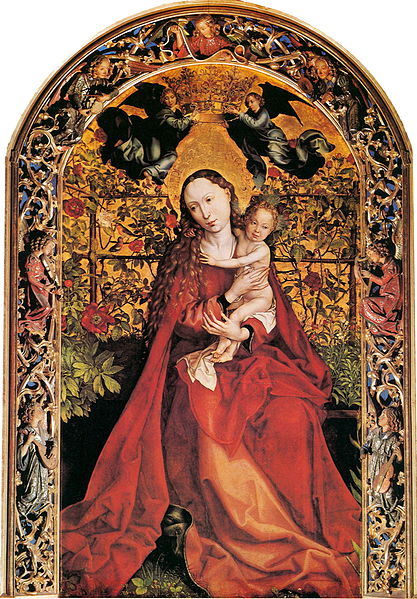
The first dictionary meaning is the ancient meaning of "a woman having proprietary rights or authority especially as a feudal superior". This is quite straight forward, as a landed gentry would have a wife whose title would be lady, or, as in the case of many, even medieval ladies, women could own land in certain countries in their own right. That Mary, Our Lady has been given authority over us is part of the teaching of the Catholic Church. Her rank and honor stem from her Immaculate Conception, as well as her "Fiat", her "yes" to God which brought Christ into the World, the Incarnate Word. Even in the Magnificat, we see Mary acknowledging humbly, her exalted status as the Mother of God. The English "lady" could be the wife of a knight or other member of the peerage. That Mary is exalted is a teaching of our Church. She is the Bride, the Mother, the Sister. She is Queen and First Lady.
The second meaning may be, but is not necessarily, connected. In this definition, "a woman receiving the homage or devotion of a knight or lover", is an extension of the first definition, with a slight twist. The lady of propriety would be married, but the woman receiving homage of a knight or lover could be any exalted lady of rank he would choose to honor. One sees this in the poetry of courtly love and the French Romances. For example, in Eric and Enid, one of my favorites, we see in some translations, the use of the word Damsel for Lady. The Lady is loved and fair, pure and worthy of love. This ideal is also found in romances other than the Welsh, French or English, such as Parzifal, in German. The language referring to a lady was transferred very quickly to Our Lady, Mary, and poetry relating to her as the perfectly loved one became increasingly popular. This type of lady, and therefore, Mary, was seen as superior to other women and therefore, worthy of honor.

1. I saw three ships come sailing in,
On Christmas day, on Christmas day,
I saw three ships come sailing in,
On Christmas day in the morning.
I saw three ships come sailing in,
On Christmas day in the morning.
2. And what1 was in those ships all three?
On Christmas day, on Christmas day,
And what was in those ships all three?
On Christmas day in the morning.
On Christmas day, on Christmas day,
And what was in those ships all three?
On Christmas day in the morning.
3. Our Saviour Christ and his lady2
On Christmas day, on Christmas day,
Our Saviour Christ and his lady,
On Christmas day in the morning.
On Christmas day, on Christmas day,
Our Saviour Christ and his lady,
On Christmas day in the morning.
4. Pray whither sailed those ships all three?
On Christmas day, on Christmas day,
Pray whither sailed those ships all three?
On Christmas day in the morning.
On Christmas day, on Christmas day,
Pray whither sailed those ships all three?
On Christmas day in the morning.
5. Oh, they sailed into Bethlehem,
On Christmas day, on Christmas day,
Oh, they sailed into Bethlehem,
On Christmas day in the morning.
On Christmas day, on Christmas day,
Oh, they sailed into Bethlehem,
On Christmas day in the morning.
6. And all the bells on earth shall ring,
On Christmas day, on Christmas day,
And all the bells on earth shall ring,
On Christmas day in the morning.
On Christmas day, on Christmas day,
And all the bells on earth shall ring,
On Christmas day in the morning.
7. And all the Angels in Heaven shall sing,
On Christmas day, on Christmas day,
And all the Angels in Heaven shall sing,
On Christmas day in the morning.
On Christmas day, on Christmas day,
And all the Angels in Heaven shall sing,
On Christmas day in the morning.
8. And all the souls on earth shall sing,
On Christmas day, on Christmas day,
And all the souls on earth shall sing,
On Christmas day in the morning.
On Christmas day, on Christmas day,
And all the souls on earth shall sing,
On Christmas day in the morning.
9. Then let us all rejoice, amain,
On Christmas day, on Christmas day,
Then let us all rejoice, amain,
On Christmas day in the morning
On Christmas day, on Christmas day,
Then let us all rejoice, amain,
On Christmas day in the morning
There are many more such poems and carols. In addition, Our Lady was painted as a "lady", especially in the ideal of the Garden Enclosed, as she was fruitful as a Virgin. This label came originally from the Song of Songs, and became connected to the ideal of the lady during medieval and Renaissance times. Some of those paintings are here on this post.
A third view of Lady Mary denotes her gentility and manners. This last ideal of the Lady Mary has been lost in our popular culture. Partly, this is owing to the emphasis on Mary's Jewishness, her simplicity and humility. But, those characteristics are included in the title as well.

That women who are Catholics should model themselves on the Gentle Mary, and on the Mary of manners is an ideal so foreign that one knows hardly where to begin in explaining the necessity for this meditation and understanding of Our Mother, Lady Mary.
Gentility is part of the life of grace. A woman of grace shows forth not merely a gentleness, but a courtesy, a decorum, a mode of acting, speaking, walking, eating, dressing.
When I was in college, in my first year, all the girls had to take two courses. One was personal health and the other was manners, or decorum. The second was taught by the woman who trained, yearly, the Miss Iowa contestants.

We learned how to walk, stand, get in and out of cars, talk, speak on the phone, greet guests, write invitations, set formal tables, pour tea and sherry, wear hats, wear gloves, have discussions, and in general, be mannerly to all, young and old. We were taught "grace" and as Catholics, we had "grace" to help us. Some of us learned these traits in our homes, but the encouragement at an age when we were dating, going out to dances, proms, dinners, preparing for careers, and perhaps, meeting our prospective in-laws, these traits were handy, as well as important. And, our model, (despite the car and telephone bits) was Our Lady, Mary. She would have been a lady, serving and being peaceful in all situations, being modest and gentle to all and with whom, it would have been a joy to be.
We actually earned a grade for these two courses. Needless to say, feminism was on the rise and tore into these classes, so that within five years of my graduating, both courses were dropped. With the dropping of the college dress code came the dropping of manners and appropriate dress, as well as social skills. The change happened in the 1970s.
This was not progress. With the dumbing down of curriculum came the dumbing down of behavior, and the disappearance of manners. Also, there was feminism, which taught women to act and dress like men. In addition, the "cult of the ugly", which I have written about here before, became popular. Women lost their beauty to "goth" and "jeans". In college, we could not wear trousers, except on Saturdays, and if we went out, we had to wear a coat over the trousers. We could not wear sandals, or socks. We dressed appropriately for dinner. These rules have been re-introduced in some Catholic colleges in the States with varying success.
I love being with my older female friends, those in their eighties and seventies, who learned what I did. To spend a day in the atmosphere of gentility and grace is wonderful, especially today. I miss the level of discussion, and the entire Christian decorum of these few ladies I do know. We were taught that gossip was wrong, that laughing too loudly was coarse and that being intelligent about current affairs was part of being a lady. Of course, my mother falls into this category and the entire family knows she is a lady, par excellence. So, too were my grandmothers and great-grandmothers, and for those role models, I am grateful. Even the great-grandmother who was on the Oregon Trail acted in a ladylike fashion. One great-grandmother was a lady in society. Traits and customs were handed down in the Catholic circles which made up my family.

Mary as Our Lady is a meditation I wish to share with the younger sisters (and brothers) who have missed this grace in their lives and who may not even value manners, decorum, gentility. Some who read this may even become angry, and misunderstand the message of beauty and peace herein.
One of the saddest things for me on my return to England was the awareness of the dropping of such ladylike behavior in the society at large. I do not know what happened. I partly blame the hatred of the elite, a hatred of supposed weakness, and the hatred of religion, as religion, the Catholic Culture, created manners. A sign of the saint is gentility, a result of the interior life of virtue. And, as you know, the interior life of the virtues is a great theme of this blog.

If one is humble, one is a lady.
My soul doth magnify the Lord.
If a woman or a girl has not thought of Our Lady as a role model, as an ideal woman, "the" Ideal Woman, I challenge her to do so now.
More than ever, we need ladies.
Guest Blogger on Dress
How To Dress For Mass by Catholic Knight
Occasionally I'll invite a non-Catholic friend to mass with me, and when I do, this question frequently comes up. "What should I wear?"
Wow! If they only knew how profound of a question that really is. You see, I live in the Bible Belt of the United States, and here most people are Baptist or Pentecostal. These good folks have little knowledge of Catholicism, and so they really don't know what to expect. Most of the time I tell them to simply dress semi-formal. A clean shirt and slacks (or skirt for the ladies) will do nicely. That's mainly because there aren't that many traditional Catholic churches out here, and most Catholic tradition in this area has gone by the wayside anyway. Sadly, most Catholics don't even know how to dress for mass anymore. So that's why I decided to publish this post. How should we dress for mass, in an ideal world, where we honor our Catholic tradition fully and without shame? The following are some suggestions. Please excuse the diagrams, they were designed for a medical college. Just mentally insert a cross, or saint medal, where the ID badge is...
 Men probably have the most simple dress code for Sunday mass, though probably not the most comfortable. The idea of "putting on your Sunday best" is not necessarily for your benefit. Men wear business suits on the job, or for social occasions (such as weddings, funerals, etc.) as a sign of respect. The idea of the suit comes from the Renaissance period, back when men started using scarves and jackets to appear in public. The idea was to excuse one's self (or one's body) from public view, so as to focus attention on the things that matter most -- such as business, conversation, manners, courtesy, etc. The tradition carries on today in what we know as "the corporate world" where certain standards of decorum are expected and maintained. This is done for the benefit of clients and customers, as a sign of respect and courtesy. Likewise, it stands to reason that this same manner should spill over into the Church -- particularly how one dresses for mass? If ever there was a time to excuse one's self (or body) from attention, so that it may be more appropriately directed where it matters (namely the Eucharist), it is during mass. Consequently, the tradition of wearing a suit, or at least a long-sleeve shirt with a tie, became the norm in all churches (Catholic and Protestant) in the western world. The custom only fell by the wayside recently (in the 1970s) as a sign of cultural disintegration in our society. Most people don't even know why the custom exists anymore, and a good number of them no longer practice it, showing up to mass in bluejeans, shorts, T-shirts and ball caps. Speaking of hats, since the time of the apostles, it has long been the Christian custom for men to remove their hats during mass. The directive to do so can be found in the Bible (1st Corinthians 11), and while it is no longer required in canon law, any man who approaches the Eucharist with his head covered would be seen as showing a tremendous amount of disrespect. Though most people may not know the reason why anymore, this tradition is still ingrained in the American psyche. Most men still remove their ball caps upon entering a home, or during the singing of the national anthem. If such respect is shown among men, then it is certainly owed to God as well.
 The same idea of excusing one's self (or body) applies to women as well. However, it should be understood that in spite of the feminist propaganda we so commonly hear, female dress codes have always been far more lax in Christian churches than male dress codes. Women have always been free to explore a little fashion expression, varying between skirts to dresses, long-sleeve and middle-length sleeve, collar or no collar, along with an endless array of scarves, lace, patterns and jewelry. As a general rule, a dress or skirt is acceptable so long as it goes down below the knee while both standing and sitting. The neckline on a dress or blouse is almost always acceptable so long is it does not reveal the shoulder, bust or cleavage. The sleeves are acceptable so long as they do not reveal the shoulder or axillary area beneath the arm -- elbow length or longer is recommended. Basically common sense in modesty should prevail in all areas of dress, and for Catholic women especially, the model set by Our Lady (The Blessed Virgin Mary) should come to mind. We should remember that Our Lord always enjoyed the presence of women during his earthly ministry, and their beauty is something he calls us all to admire with the highest respect. So it is only natural that when a woman excuses her self (or body), she would do so in a way that complements her feminine appeal and dignity. In other words, she excuses herself with style and grace.
Beyond that, there is but one more element of dress that speaks volumes of our Catholic identity -- the mantilla...


The mantilla comes to Catholicism directly from our Jewish roots in apostolic times (1st Corinthians 11). In fact, Orthodox Jewish women continue with this same custom today. I have written extensively about the mantilla in a previous post... , but suffice it to say that while it is no longer required in the Code of Canon Law, it is nevertheless a Catholic tradition that has never been abrogated. In fact, Catholic women all around the world continue to practice it. Only in the United States, Canada and Australia has the custom been dropped, and mainly because of feminist propaganda suggesting that the practice of female head covering was a means of male domination. We have to understand that in the industrialized West, Catholic women are under tremendous peer pressure to not cover their heads during worship. So few women do it anymore, that the lack of practice actually does more to discourage the practice than the ridiculous propaganda against it. Some women may fear what others may think if they should wear a mantilla. It's sort of a fashion phobia, wherein they think "nobody else is wearing one, so I'll look out of place if I do." While some women fear a feminist lashing if they practice good Catholic modesty, afraid they may be accused of "submitting" to male dominance. Such fears are unwarranted. Most hard-core feminists left the Church long ago, and as for the fashion phobia, the vast majority of women in Church would probably join in the practice if just a few brave women stood up to the plate.
According to Catholic Christian tradition (found in 1st Corinthians 11) the head covering requirement falls equally upon both men and women. According to the custom, men are to take their hats off during religious ceremonies, while women are to put a covering on. This is for two reasons. The first is just like the manner of dress described above -- which is to excuse one's self. Saint Paul points out to us that a woman's glory is the beauty of mankind, and that is manifested in her hair. Women go to great lengths to make their hair beautiful, regardless of the style or trend, and that's a good thing. But during the mass, the focus is to always be on the Eucharist, and as a sign of modesty and respect, the woman excuses her beautiful hair (by covering it) to call more attention to the greater beauty of God's presence in the Eucharist.
Secondly, Saint Paul makes the unusual command of telling the men to uncover their heads, which actually contradicts traditional Jewish custom. Now you have to understand, Paul's instruction to do this contradicts a thousand years of Jewish tradition. It was a radical departure from the norm. This was not to exult men, but rather humiliate them. Paul is putting them in their place. You see, Jews put such a high reverence on the holy presence of God, that it was considered a frightfully embarrassing thing for anyone to be found in his presence uncovered. But Paul is telling the men to humiliate themselves by doing just that. He's telling them that they represent the image of Christ in the New Covenant, and since Christ exposed himself on the cross, and in the Eucharist, men too must expose their heads both as a symbol of humility as well as authority (Christ's authority that is, not their own)...
The Church is made pure by the glory of Christ, and that which is pure should be veiled. So the purified Church, being the veiled bride of Christ, is illustrated in the woman's head covering. It was typical of Saint Paul to take an ordinary custom like this and turn it into a big theological illustration. But it's a teaching illustration that is just as relevant today as it was 2,000 years ago.
All of this may seem overwhelming for most Catholics today. Contemporary pop culture has done so much to erode our religious traditions. But I've been wanting to write about this for a while, and so here it is, to do with as you will. I hope that it's been of service to at least some of you. God bless.
Wow! If they only knew how profound of a question that really is. You see, I live in the Bible Belt of the United States, and here most people are Baptist or Pentecostal. These good folks have little knowledge of Catholicism, and so they really don't know what to expect. Most of the time I tell them to simply dress semi-formal. A clean shirt and slacks (or skirt for the ladies) will do nicely. That's mainly because there aren't that many traditional Catholic churches out here, and most Catholic tradition in this area has gone by the wayside anyway. Sadly, most Catholics don't even know how to dress for mass anymore. So that's why I decided to publish this post. How should we dress for mass, in an ideal world, where we honor our Catholic tradition fully and without shame? The following are some suggestions. Please excuse the diagrams, they were designed for a medical college. Just mentally insert a cross, or saint medal, where the ID badge is...
 Men probably have the most simple dress code for Sunday mass, though probably not the most comfortable. The idea of "putting on your Sunday best" is not necessarily for your benefit. Men wear business suits on the job, or for social occasions (such as weddings, funerals, etc.) as a sign of respect. The idea of the suit comes from the Renaissance period, back when men started using scarves and jackets to appear in public. The idea was to excuse one's self (or one's body) from public view, so as to focus attention on the things that matter most -- such as business, conversation, manners, courtesy, etc. The tradition carries on today in what we know as "the corporate world" where certain standards of decorum are expected and maintained. This is done for the benefit of clients and customers, as a sign of respect and courtesy. Likewise, it stands to reason that this same manner should spill over into the Church -- particularly how one dresses for mass? If ever there was a time to excuse one's self (or body) from attention, so that it may be more appropriately directed where it matters (namely the Eucharist), it is during mass. Consequently, the tradition of wearing a suit, or at least a long-sleeve shirt with a tie, became the norm in all churches (Catholic and Protestant) in the western world. The custom only fell by the wayside recently (in the 1970s) as a sign of cultural disintegration in our society. Most people don't even know why the custom exists anymore, and a good number of them no longer practice it, showing up to mass in bluejeans, shorts, T-shirts and ball caps. Speaking of hats, since the time of the apostles, it has long been the Christian custom for men to remove their hats during mass. The directive to do so can be found in the Bible (1st Corinthians 11), and while it is no longer required in canon law, any man who approaches the Eucharist with his head covered would be seen as showing a tremendous amount of disrespect. Though most people may not know the reason why anymore, this tradition is still ingrained in the American psyche. Most men still remove their ball caps upon entering a home, or during the singing of the national anthem. If such respect is shown among men, then it is certainly owed to God as well.
 The same idea of excusing one's self (or body) applies to women as well. However, it should be understood that in spite of the feminist propaganda we so commonly hear, female dress codes have always been far more lax in Christian churches than male dress codes. Women have always been free to explore a little fashion expression, varying between skirts to dresses, long-sleeve and middle-length sleeve, collar or no collar, along with an endless array of scarves, lace, patterns and jewelry. As a general rule, a dress or skirt is acceptable so long as it goes down below the knee while both standing and sitting. The neckline on a dress or blouse is almost always acceptable so long is it does not reveal the shoulder, bust or cleavage. The sleeves are acceptable so long as they do not reveal the shoulder or axillary area beneath the arm -- elbow length or longer is recommended. Basically common sense in modesty should prevail in all areas of dress, and for Catholic women especially, the model set by Our Lady (The Blessed Virgin Mary) should come to mind. We should remember that Our Lord always enjoyed the presence of women during his earthly ministry, and their beauty is something he calls us all to admire with the highest respect. So it is only natural that when a woman excuses her self (or body), she would do so in a way that complements her feminine appeal and dignity. In other words, she excuses herself with style and grace.
Beyond that, there is but one more element of dress that speaks volumes of our Catholic identity -- the mantilla...


The mantilla comes to Catholicism directly from our Jewish roots in apostolic times (1st Corinthians 11). In fact, Orthodox Jewish women continue with this same custom today. I have written extensively about the mantilla in a previous post... , but suffice it to say that while it is no longer required in the Code of Canon Law, it is nevertheless a Catholic tradition that has never been abrogated. In fact, Catholic women all around the world continue to practice it. Only in the United States, Canada and Australia has the custom been dropped, and mainly because of feminist propaganda suggesting that the practice of female head covering was a means of male domination. We have to understand that in the industrialized West, Catholic women are under tremendous peer pressure to not cover their heads during worship. So few women do it anymore, that the lack of practice actually does more to discourage the practice than the ridiculous propaganda against it. Some women may fear what others may think if they should wear a mantilla. It's sort of a fashion phobia, wherein they think "nobody else is wearing one, so I'll look out of place if I do." While some women fear a feminist lashing if they practice good Catholic modesty, afraid they may be accused of "submitting" to male dominance. Such fears are unwarranted. Most hard-core feminists left the Church long ago, and as for the fashion phobia, the vast majority of women in Church would probably join in the practice if just a few brave women stood up to the plate.
According to Catholic Christian tradition (found in 1st Corinthians 11) the head covering requirement falls equally upon both men and women. According to the custom, men are to take their hats off during religious ceremonies, while women are to put a covering on. This is for two reasons. The first is just like the manner of dress described above -- which is to excuse one's self. Saint Paul points out to us that a woman's glory is the beauty of mankind, and that is manifested in her hair. Women go to great lengths to make their hair beautiful, regardless of the style or trend, and that's a good thing. But during the mass, the focus is to always be on the Eucharist, and as a sign of modesty and respect, the woman excuses her beautiful hair (by covering it) to call more attention to the greater beauty of God's presence in the Eucharist.
Secondly, Saint Paul makes the unusual command of telling the men to uncover their heads, which actually contradicts traditional Jewish custom. Now you have to understand, Paul's instruction to do this contradicts a thousand years of Jewish tradition. It was a radical departure from the norm. This was not to exult men, but rather humiliate them. Paul is putting them in their place. You see, Jews put such a high reverence on the holy presence of God, that it was considered a frightfully embarrassing thing for anyone to be found in his presence uncovered. But Paul is telling the men to humiliate themselves by doing just that. He's telling them that they represent the image of Christ in the New Covenant, and since Christ exposed himself on the cross, and in the Eucharist, men too must expose their heads both as a symbol of humility as well as authority (Christ's authority that is, not their own)...
1st Corinthians 11:3-16He does this to draw attention to a theological truth. In marriage, the husband represents Christ, and the wife represents the Church. The glory of Christ is to be exposed, just as he was exposed on the cross, and is daily exposed in the Eucharist. (Certainly a humiliating thing for God.) So likewise the man's head should be exposed in the Church. But this exposure is also a sign of authority (Christ's authority) in the sense that God intended in the order of nature for the woman to complement the man, not vice versa, and so for the sake of the angels (who worship God with us, and are watching us) we must demonstrate that all things have been put back into order through the authority of Christ. This is why men must have their heads exposed - for a sign of Christ's humility and authority. While the women must have their heads covered - for a sign of the Church's modesty and purity.
Now I want you to realize that the head of every man is Christ, and the head of the woman is man, and the head of Christ is God. Every man who prays or prophesies with his head covered dishonors his head. And every woman who prays or prophesies with her head uncovered dishonors her head—it is just as though her head were shaved. If a woman does not cover her head, she should have her hair cut off; and if it is a disgrace for a woman to have her hair cut or shaved off, she should cover her head. A man ought not to cover his head, since he is the image and glory of God; but the woman is the glory of man. For man did not come from woman, but woman from man; neither was man created for woman, but woman for man. For this reason, and because of the angels, the woman ought to have a sign of authority on her head. In the Lord, however, woman is not independent of man, nor is man independent of woman. For as woman came from man, so also man is born of woman. But everything comes from God. Judge for yourselves: Is it proper for a woman to pray to God with her head uncovered? Does not the very nature of things teach you that if a man has long hair, it is a disgrace to him, but that if a woman has long hair, it is her glory? For long hair is given to her as a covering. If anyone wants to be contentious about this, we have no other practice—nor do the churches of God.
The Church is made pure by the glory of Christ, and that which is pure should be veiled. So the purified Church, being the veiled bride of Christ, is illustrated in the woman's head covering. It was typical of Saint Paul to take an ordinary custom like this and turn it into a big theological illustration. But it's a teaching illustration that is just as relevant today as it was 2,000 years ago.
All of this may seem overwhelming for most Catholics today. Contemporary pop culture has done so much to erode our religious traditions. But I've been wanting to write about this for a while, and so here it is, to do with as you will. I hope that it's been of service to at least some of you. God bless.
Friday, 22 June 2012
This is Awesome
Matt has charities you can give to as well...check them out. http://www.wherethehellismatt.com/give
SS. Thomas More and John Fisher at the "end point of the Reformation"

Father Edward Holloway, of the Faith Movement in England, coined the phrase used by the priest at Mass this morning, regarding this feast day of SS. Thomas More and John Fisher.
"The end point of the Reformation", the phrase used by Fr. Hugh, refers to the fact that England is still reeling from the secularization and fragmentation of Faith brought on by Henry VIII's break with Rome, and with morality.
Indeed, it was not only Tradition that was broken by the English Revolt, but the cultural positions on morality and ethics, pushing the English into a relativism and individualism the results of which we see today in society.
Nothing is new and all have roots in sin and degradation. That a society with law and juries would put to death such lights of Europe at Thomas More and John Fisher created a schizophrenia of justice and a break with the Greco-Roman tradition of law and order impacts us all in the West today.

To state that we are still experiencing the Reformation, or Revolt, as I prefer to call it, is an insight into the long arm of evil reaching down into our present day--the results of the Revolt were the Enlightenment and the relegation of the Catholic Truth into private lives and out of the public domain. This was the continuation of Machiavelli's real politique, not invented by him, but defined, and part of the reality of English history, up to the present time. The modernist heresies are all embedded in this Revolt, as well, with Tradition and authority undermined to the point of complete disdain for the Scriptures and the Liturgy as well as the Vatican.
The fight continues and we shall see more martyrs, some "green" and some "red". Suffering for the Faith is the test of the real Catholic. If you are not suffering for your Faith, at this point of the Reformation, you are not living your Faith.
I would like to quote Michael Davies as well today, as it was not the people who wanted change, but one leader and his minions:
If the Protestant claim that because the Reformation in England happened it must have been both necessary and wanted is incorrect, then why did it take place? The answer is simple. The innovations in both doctrine and liturgy during the reigns of Henry VIII, Edward VI, and Elizabeth I were imposed on the people from above without any evidence of popular support for the changes among the people. The Protestant historian Sir Maurice Powicke accepts this unequivocally: "The Reformation in England was a parliamentary transaction. All the important changes were made under statutes, and the actions of the King as supreme head of the Church were done under a title and in virtue of powers given to him by statute." 31The only instance of such popular support for religious change in England was for the restoration of the Catholic Faith during the tragically brief reign of Mary Tudor. Another Protestant historian, Professor S. T. Bindoff notes that soon after Mary's accession to the throne in 1553: ". . . the Mass was being celebrated in London churches 'not by commandment but of the people's devotion', and news was coming in of its unopposed revival throughout the country." 32 Catholicism flourished once again in Mary's reign. http://www.catholictradition.org/Saints/john-fisher5.htm
Also from Davies book, two notes which caught my eye--one, that John Fisher was ordained at 22, with a Papal Dispensation. Happy event! The second was that one of his sisters, Elizabeth, a Dominican nun, refused to take the Oath of Supremacy, and fled England, living and dying on the then island of Zeeland, part of the Netherlands. We do not know anything about her, but she had to become an exile for her faith in the Primacy of Peter.
We have a leadership crisis in the Church world-wide, but especially in GB and America. Let us pray to these great men whose feast we celebrate today, June 22nd, for leaders, both lay and clerical. Otherwise, the end point of the Revolt will end in a desiccation in the Church--a worse scenario than under the "reforming" Tudors.
SS. Thomas More and John Fisher, pray for us. And, happy name day to my son.
The Church needs real men, please

My mini-poll is giving me interesting results. I have been writing to women, with some articles on men, but may have to include more "guy stuff". I knew I had sems and male collegians reading, as some have written to me. However, as men are, or should be the leaders of their families and the leaders in our Church, specifically in the hierarchy, I shall think and pray about posts. I do have several on men, which some have commented on in the past.
My series on the Pope's encyclicals on love and the posts on not being afraid to commit, as in this week's posts, are directed to men and women, but men specifically.http://supertradmum-etheldredasplace.blogspot.co.uk/2012/05/on-love-and-answer-to-socialism-part.html
That series is quite long.
http://supertradmum-etheldredasplace.blogspot.co.uk/2012/06/unless-you-become-like-little-childyou.html
Having a think....but of course, I know men like to learn about women as well. We are such a mystery. And, if there ever was a time to combat the growing and pernicious move towards androgyny in our culture, is it now.
http://supertradmum-etheldredasplace.blogspot.co.uk/2012/05/love-in-cold-climate.html
Specific guy posts from the past: http://supertradmum-etheldredasplace.blogspot.co.uk/2012/05/protectors-predators-and-peter-pans.html
http://supertradmum-etheldredasplace.blogspot.co.uk/2012/01/lost-boys-lost-civilizations.html
http://supertradmum-etheldredasplace.blogspot.co.uk/2012/05/passive-ones.html
http://supertradmum-etheldredasplace.blogspot.co.uk/2012/03/on-lunge-line.html
http://supertradmum-etheldredasplace.blogspot.co.uk/2012/03/hail-mary-full-of-grace-lord-is-with.html
http://supertradmum-etheldredasplace.blogspot.co.uk/2012/03/on-making-boys-into-men.html
http://supertradmum-etheldredasplace.blogspot.co.uk/2012/06/wait-and-hope.html
Subscribe to:
Posts (Atom)