Recent Posts

Showing posts with label modest wedding. Show all posts

Sunday, 2 November 2014

OK I Am Old-Fashioned

Growing up in a family where more than one woman were dress makers, one a milliner, and all were drop-dead stylish, I knew that the season brought different colors of clothes out for public wear.

After Labor Day in the States, no one wore white shoes, or used a white bag, unless these were bling-type whites for Christmas or New Year's parties. Here are Max Mara's Spring and Summer whites below, with a Summer red at the top here.


White stayed in the summer, just as pastels were worn in the Spring, and bright fall-leave colors dotted the streets in the form of dresses, skirts, sweaters, and jackets in Autumn.

In the Autumn, we wore red, orange, yellow, mustard, olive green, brown, tan and golden hues rivaling the leaves of the trees and plants.

Once snow set in, we went into winter colors; deep reds, blues, black, and emerald green.

Now, this may sound boring to some of the Millennials, but I am having difficulty seeing ladies in white lace, white shoes, using white bags and wearing pastels in November. And, it is not that warm here.


Most people in Church had to wear jackets or coats this morning. Winter is settling into Malta early this year.

Florals are in for Fall and Winter, which is lovely-such feminine, almost Alpine colors, dark but cheerful are being seen in dresses and skirts.

But, those who are clinging to summer colors seem to be making a statement, and to wear low cut tops at Church speaks loudly that the lady is gauche. It is almost as if these few ladies are saying they do not want Summer to end.

What happened and when did designers drop Fall colors? I am glad to see that Marksies and Max Mara, a place I cannot afford, but have been in several times with a friend who wanted me to go shopping with her for my opinion, are showing traditional Autumn colors.


Now, black and white are seasonless. And, this morning at Mass, many women showed up in black or black and some white mixed in, including one lovely lady in a Max Mara black and white checked skirt. Very wintery and retro...

I love it when women dress up for Sunday Mass here and most do.

I was the only one out of maybe 100 women with a hat on, Fall color, of course, but one other lady was wearing a chapel veil.

Men also dress up for Mass here, most, not all, wearing suit jackets. Sadly, there are two regulars who insist on jeans and these men, in their fifties, look ridiculous. They are not poor and the jeans are designer, but in my mind, jeans on men in Church indicate a Peter Pan. Wear jeans anywhere but in Church, please....

Bring back seasonal colors, is my cry for fashion.

BTW, for Winter, grey is in and so are skirts and dresses. Here is Max Mara again. Styles are feminine and ladylike. I wish Americans dressed like this for Holy Mass. I, of course, would add a few scarves to the lower tops.....

I am grateful that I grew up in a family where women wanted to look and act feminine. Of course, on my budget, I have some "pre-worn" finds from America and a few things from my mother dragging me shopping this Summer. But, those are put away, and the blacks and greys plus a dark wine (cranberry?) or two have surfaced out of the suitcases.  I love Autumn and Winter colors.


Friday, 5 September 2014

Yearly Rant Part Two

Realizing that Jesus did not wear trousers and Mary did not wear skirts, I am writing about our culture in the last 200 years with regard to dress. I think that the dress culture of Christ's day did change with Christianity and it would be interesting to follow those changes. One can say for sure that civilizations which were not Christianized until late did not see women moving into dresses until the 18th centuries or so.

Also, sems and priests wear cassocks, which is not a sign of transvestite dressing, but an older tradition,  most likely coming from the fact that most priests for centuries were not secular, but in orders, such as Benedictines, Dominicans, Franciscan and so on.

I am writing for women in 2014, for the sake of role-modeling for little girls and for the necessity of avoiding the lies of society regarding "gender identity" issues.

Women who get angry when I write or talk about modesty have a problem. This is like the group which gets really angry when I write or speak about Harry Potter. If there was not a deep-seated knowledge that things are wrong in one's pursuit of dress or entertainment, why get so angry?

A few more points on women's clothing regarding the evil of androgyny.

The Cultural Marxists and the Frankfort School of Marxism pushed androgyny. The writings of Antonio Gramsci (many posts on his on this blog) included these two phrases.

“I saw the revolutionary destruction of society as the one and only solution to the cultural contradictions of the epoch.” 

“Such a worldwide overturning of values cannot take place without the annihilation of the old values and the creation of new ones by the revolutionaries.”

Part of the cultural changes he endeavored to start were the destruction of marriage, the family unit, and the introduction of the acceptance of homosexuality, androgyny and contraception.


The Marxist succeeded in changing the West culturally, as did other "isms" such as radical feminism from Marie Stopes and Margaret Sanger.

You can sit and read my many posts on Gramsci, if you have not done so.

But, you may ask, why is androgyny "evil"? Why is this an issue now, in 2014?

A few very basic points:

God created man and woman separately for various reasons. The main reason is that the woman "compliments" the man in her differences. If married, as Eve was to Adam, she is to be the "helpmate".  Many women have rebelled against this helpmate ideal and do not want to help their husbands in their jobs, role as leader and priest in the domestic church, and even in intimacy.

The soul forms the body, not the other way around, and our souls, therefore, are not separate from our being a man or a woman, although these souls do not have gender. In other words, my soul, which is manifested through my femaleness, is that of a woman, and I come to God through that reality. We are not dualistic beings.  We are unified, body and soul. We are not just bodies, but souls, and when the soul leaves the body, we die, we can no longer function as a union of spirit and matter. Only when our bodies are Resurrected on the Last Day, will we be joined again in that unity, which is separated in death. And, we shall get back our renewed bodies, with gender. Mary is our guide in this. She is in heaven body and soul, and recognizable even here on earth.

Our souls work in a way not like those of the angels, who have no gender because they have no bodies. We are created as a man or a  woman and that creation is our identity. Our bodies determine our gender, and our roles, but we cannot separate the two . "Man and woman He created them". We are not angels, we are not genderless or sexless.

Here are a few quotations from the Catholic Encyclopedia to help with this.

 The soul may be defined as the ultimate internal principle by which we think, feel, and will, and by which our bodies are animated.

And... all our souls are unique, as are our bodies....We are created from the moment of conception male or female. Our souls and bodies are created together.
  • the rational soul, which is one with the sensitive and vegetative principle, is the form of the body. This was defined as of faith by the Council of Vienne of 1311;
  • the soul is a substance, but an incomplete substance, i.e. it has a natural aptitude and exigency for existence in the body, in conjunction with which it makes up the substantial unity of human nature;
  • though connaturally related to the body, it is itself absolutely simple, i.e. of an unextended and spiritual nature. It is not wholly immersed in matter, its higher operations being intrinsically independent of the organism;
  • the rational soul is produced by special creation at the moment when the organism is sufficiently developed to receive it. In the first stage of embryonic development, the vital principle has merely vegetative powers; then a sensitive soul comes into being, educed from the evolving potencies of the organism — later yet, this is replaced by the perfect rational soul, which is essentially immaterial and so postulates a special creative act. Many modern theologians have abandoned this last point of St. Thomas's teaching, and maintain that a fully rational soul is infused into the embryo at the first moment of its existence. (Our position now in the Church.)


Even God celebrates gender throughout the Bible and in the teachings of the Church. Christ's relationship with the Church and with the soul is that of the Bridegroom to the Bride, This fact is one reason why women who are feminine have an easier time coming to love God, as they can accept the female role of receiving.

But, the greatest saints, like St. Bernard and St. Augustine, allowed Christ to love them in the transcendent love which God pours into the soul. The Unitive State is one of receiving and being in Love.

This love is holy, is agape, is the complete sacrificial love of the Crucified One.


However, here is the real reason, the core of the evil of androgyny and why one can see this is from satan. Three connected points:

Androgyny denies the Incarnation.

Satan wants us to forget that Christ is both God AND Man, forever, in His Resurrected Body in heaven.

Androgyny also denies the Biblical account of Creation. Androgyny denies who we are as a person. I am unified in my femininity, body and soul.

Androgyny confuses the different roles of men and women, created by God.

The purposeful mixing up of the sense of identity makes people closed to the Incarnate God and to God the Father, and to the Spirit, Who was present at Creation.

Christ is fully Man and fully God. God the Father and God the Holy Spirit, as Spirits, do not have gender, but Christ, obviously, does.

He is not some odd transcendent, sexless, genderless being. That is the creed of some Gnostics and Neo-Gnostics.

In addition, through the Passion and Resurrection, we are made new. We are one nature, not two.

Christ redeemed humans on the Cross and redeemed nature. Gender differences are a great Good.

Man, though made of body and soul, is a unity. Through his very bodily condition he sums up in himself the elements of the material world. Through him they are thus brought to their highest perfection and can raise their voice in praise freely given to the Creator. For this reason man may not despise his bodily life. Rather he is obliged to regard his body as good and to hold it in honor since God has created it and will raise it up on the last day." Pastoral Constitution on the Church in the Modern World.


We were restored to grace in our bodies as well as our souls, through Christ's Redemptive Act.

Women who refuse absolutely refuse to dress like a woman in our society, to see the beauty of the feminine, are denying Christ's Redemption of the entire female person in our times and falling for the lies of androgyny. We women were made new, to rejoice in our femininity
as Catholic women and in the West, femininity is expressed through dress.

I am sorry, but I suspect something wrong about women who only wear men's clothes. It is unnatural and reflects not only a blind spot in the spirit, but perhaps severe sins, such as manipulation, rebellion, control.

Obviously, a woman may sin in these areas of emotional manipulation, rebellion and wanting control while wearing feminine clothing, but the constant expression of maleness can refer to a deeper problem.

Among my best friends, all wear dresses or skirts only.

Some change into trousers because of work around the house, but they only wear pants at home.

That is their decision. I wear skirts when washing windows on a ladder and when painting, or cleaning, or scrubbing floors.

Nuns manage to so all these things in long habits and so do I.

For a woman to deny her body as feminine is for her to deny her relationship with God as a woman.

If you are a woman and this article makes you angry, please stop and pray to Our Lady. Ask yourself this question: "Who am I?"


It is time to change, literally, your clothes.

I do not want to add to the misogyny I see on some other, even famous, Catholic blogs, but as a woman who learned to appreciate who I am before God and express myself through clothes, (even from the Good Will), I believe what I am writing needs to be addressed.

May I add that people have seen persons from heaven, hell and purgatory in visions or impressed upon the imagination. These people, without their bodies, are recognizable in their souls. The dead do not lose their gender-identity, as it were. If your great-grandmother is in heaven, she is there as a woman, not some odd transgendered soul. How do we recognize someone who is a man or a woman? Not merely by their bodies, but also, by their souls. We become holy through both our bodies and our souls. There is a mystery in this union.

More from the CCC.


PART ONE
THE PROFESSION OF FAITH

SECTION TWO
THE PROFESSION OF THE CHRISTIAN FAITH

CHAPTER ONE
I BELIEVE IN GOD THE FATHER

ARTICLE I
"I BELIEVE IN GOD THE FATHER ALMIGHTY, CREATOR OF HEAVEN AND EARTH"

Paragraph 6. Man
355 "God created man in his own image, in the image of God he created him, male and female he created them."218 Man occupies a unique place in creation: (I) he is "in the image of God"; (II) in his own nature he unites the spiritual and material worlds; (III) he is created "male and female"; (IV) God established him in his friendship.
I. "IN THE IMAGE OF GOD"
356 Of all visible creatures only man is "able to know and love his creator".219 He is "the only creature on earth that God has willed for its own sake",220 and he alone is called to share, by knowledge and love, in God's own life. It was for this end that he was created, and this is the fundamental reason for his dignity:

What made you establish man in so great a dignity? Certainly the incalculable love by which you have looked on your creature in yourself! You are taken with love for her; for by love indeed you created her, by love you have given her a being capable of tasting your eternal Good.221
357 Being in the image of God the human individual possesses the dignity of a person, who is not just something, but someone. He is capable of self-knowledge, of self-possession and of freely giving himself and entering into communion with other persons. And he is called by grace to a covenant with his Creator, to offer him a response of faith and love that no other creature can give in his stead.
358 God created everything for man,222 but man in turn was created to serve and love God and to offer all creation back to him:

What is it that is about to be created, that enjoys such honor? It is man that great and wonderful living creature, more precious in the eyes of God than all other creatures! For him the heavens and the earth, the sea and all the rest of creation exist. God attached so much importance to his salvation that he did not spare his own Son for the sake of man. Nor does he ever cease to work, trying every possible means, until he has raised man up to himself and made him sit at his right hand.223
359 "In reality it is only in the mystery of the Word made flesh that the mystery of man truly becomes clear."224
St. Paul tells us that the human race takes its origin from two men: Adam and Christ. . . The first man, Adam, he says, became a living soul, the last Adam a life-giving spirit. The first Adam was made by the last Adam, from whom he also received his soul, to give him life. . . The second Adam stamped his image on the first Adam when he created him. That is why he took on himself the role and the name of the first Adam, in order that he might not lose what he had made in his own image. The first Adam, the last Adam: the first had a beginning, the last knows no end. The last Adam is indeed the first; as he himself says: "I am the first and the last."225
360 Because of its common origin the human race forms a unity, for "from one ancestor [God] made all nations to inhabit the whole earth":226
O wondrous vision, which makes us contemplate the human race in the unity of its origin in God. . . in the unity of its nature, composed equally in all men of a material body and a spiritual soul; in the unity of its immediate end and its mission in the world; in the unity of its dwelling, the earth, whose benefits all men, by right of nature, may use to sustain and develop life; in the unity of its supernatural end: God himself, to whom all ought to tend; in the unity of the means for attaining this end;. . . in the unity of the redemption wrought by Christ for all.227
361 "This law of human solidarity and charity",228 without excluding the rich variety of persons, cultures and peoples, assures us that all men are truly brethren.

II. "BODY AND SOUL BUT TRULY ONE"
362 The human person, created in the image of God, is a being at once corporeal and spiritual. The biblical account expresses this reality in symbolic language when it affirms that "then the LORD God formed man of dust from the ground, and breathed into his nostrils the breath of life; and man became a living being."229 Man, whole and entire, is therefore willed by God.
363 In Sacred Scripture the term "soul" often refers to human life or the entire human person.230 But "soul" also refers to the innermost aspect of man, that which is of greatest value in him,231 that by which he is most especially in God's image: "soul" signifies the spiritual principle in man.
364 The human body shares in the dignity of "the image of God": it is a human body precisely because it is animated by a spiritual soul, and it is the whole human person that is intended to become, in the body of Christ, a temple of the Spirit:232
Man, though made of body and soul, is a unity. Through his very bodily condition he sums up in himself the elements of the material world. Through him they are thus brought to their highest perfection and can raise their voice in praise freely given to the Creator. For this reason man may not despise his bodily life. Rather he is obliged to regard his body as good and to hold it in honor since God has created it and will raise it up on the last day. 233
365 The unity of soul and body is so profound that one has to consider the soul to be the "form" of the body:234 i.e., it is because of its spiritual soul that the body made of matter becomes a living, human body; spirit and matter, in man, are not two natures united, but rather their union forms a single nature.
366 The Church teaches that every spiritual soul is created immediately by God - it is not "produced" by the parents - and also that it is immortal: it does not perish when it separates from the body at death, and it will be reunited with the body at the final Resurrection.235
367 Sometimes the soul is distinguished from the spirit: St. Paul for instance prays that God may sanctify his people "wholly", with "spirit and soul and body" kept sound and blameless at the Lord's coming.236 The Church teaches that this distinction does not introduce a duality into the soul.237 "Spirit" signifies that from creation man is ordered to a supernatural end and that his soul can gratuitously be raised beyond all it deserves to communion with God.238
368 The spiritual tradition of the Church also emphasizes the heart, in the biblical sense of the depths of one's being, where the person decides for or against God.239
 
* III. "MALE AND FEMALE HE CREATED THEM"
Equality and difference willed by God
369 Man and woman have been created, which is to say, willed by God: on the one hand, in perfect equality as human persons; on the other, in their respective beings as man and woman. "Being man" or "being woman" is a reality which is good and willed by God: man and woman possess an inalienable dignity which comes to them immediately from God their Creator.240 Man and woman are both with one and the same dignity "in the image of God". In their "being-man" and "being-woman", they reflect the Creator's wisdom and goodness.

370 In no way is God in man's image. He is neither man nor woman. God is pure spirit in which there is no place for the difference between the sexes. But the respective "perfections" of man and woman reflect something of the infinite perfection of God: those of a mother and those of a father and husband.241
"Each for the other" - "A unity in two"
371 God created man and woman together and willed each for the other. The Word of God gives us to understand this through various features of the sacred text. "It is not good that the man should be alone. I will make him a helper fit for him."242 None of the animals can be man's partner.243 The woman God "fashions" from the man's rib and brings to him elicits on the man's part a cry of wonder, an exclamation of love and communion: "This at last is bone of my bones and flesh of my flesh."244 Man discovers woman as another "I", sharing the same humanity.
372 Man and woman were made "for each other" - not that God left them half-made and incomplete: he created them to be a communion of persons, in which each can be "helpmate" to the other, for they are equal as persons ("bone of my bones. . .") and complementary as masculine and feminine. In marriage God unites them in such a way that, by forming "one flesh",245 they can transmit human life: "Be fruitful and multiply, and fill the earth."246 By transmitting human life to their descendants, man and woman as spouses and parents cooperate in a unique way in the Creator's work.247
373 In God's plan man and woman have the vocation of "subduing" the earth248 as stewards of God. This sovereignty is not to be an arbitrary and destructive domination. God calls man and woman, made in the image of the Creator "who loves everything that exists",249 to share in his providence toward other creatures; hence their responsibility for the world God has entrusted to them.

IV. MAN IN PARADISE
374 The first man was not only created good, but was also established in friendship with his Creator and in harmony with himself and with the creation around him, in a state that would be surpassed only by the glory of the new creation in Christ.
375 The Church, interpreting the symbolism of biblical language in an authentic way, in the light of the New Testament and Tradition, teaches that our first parents, Adam and Eve, were constituted in an original "state of holiness and justice".250 This grace of original holiness was "to share in. . .divine life".251
376 By the radiance of this grace all dimensions of man's life were confirmed. As long as he remained in the divine intimacy, man would not have to suffer or die.252 The inner harmony of the human person, the harmony between man and woman,253 and finally the harmony between the first couple and all creation, comprised the state called "original justice".
377 The "mastery" over the world that God offered man from the beginning was realized above all within man himself: mastery of self. The first man was unimpaired and ordered in his whole being because he was free from the triple concupiscence254 that subjugates him to the pleasures of the senses, covetousness for earthly goods, and self-assertion, contrary to the dictates of reason.
378 The sign of man's familiarity with God is that God places him in the garden.255 There he lives "to till it and keep it". Work is not yet a burden,256 but rather the collaboration of man and woman with God in perfecting the visible creation.
379 This entire harmony of original justice, foreseen for man in God's plan, will be lost by the sin of our first parents.
IN BRIEF
380 "Father,. . . you formed man in your own likeness and set him over the whole world to serve you, his creator, and to rule over all creatures" (Roman Missal, EP IV, 118).
381 Man is predestined to reproduce the image of God's Son made man, the "image of the invisible God" (Col 1:15), so that Christ shall be the first-born of a multitude of brothers and sisters (cf. Eph 1:3-6; Rom 8:29).
382 "Man, though made of body and soul, is a unity" (GS 14 § 1). The doctrine of the faith affirms that the spiritual and immortal soul is created immediately by God.
383 "God did not create man a solitary being. From the beginning, "male and female he created them" (Gen 1:27). This partnership of man and woman constitutes the first form of communion between persons" (GS 12 § 4).
384 Revelation makes known to us the state of original holiness and justice of man and woman before sin: from their friendship with God flowed the happiness of their existence in paradise.

218 Gen 1:27.
219 GS 12 § 3.
220 GS 24 § 3.
221 St. Catherine of Siena, Dialogue 4,13 "On Divine Providence": LH, Sunday, week 19, OR.
222 Cf. GS 12 § 1; 24 § 3; 39 § 1.
223 St. John Chrysostom, In Gen. Sermo 2,1: PG 54,587D-588A.
224 GS 22 § 1.
225 St. Peter Chrysologus, Sermo 117: PL 52,520-521.
226 Acts 17:26; cf. Tob 8:6.
227 Pius XII, Enc. Summi Pontificatus 3; cf. NA 1.
228 Pius XII, Summi Pontificatus 3.
229 Gen 2:7.
230 Cf. Mt 16:25-26; Jn 15:13; Acts 2:41.
231 Cf. Mt 10:28; 26:38; Jn 12:27; 2 Macc 6:30.
232 Cf. 1 Cor 6:19-20; 15:44-45.
233 GS 14 § 1; cf. Dan 3:57-80.
234 Cf. Council of Vienne (1312): DS 902.
235 Cf. Pius XII, Humani Generis: DS 3896; Paul VI, CPG § 8; Lateran Council V (1513): DS 1440.
236 1 Thess 5:23.
237 Cf. Council of Constantinople IV (870): DS 657.
238 Cf. Vatican Council I, Dei Filius: DS 3005; GS 22 § 5; Humani Generis: DS 3891.
239 Cf. Jer 31:33; Deut 6:5; 29:3; Isa 29:13; Ezek 36:26; Mt 6:21; Lk 8:15; Rom 5:5.
240 Cf. Gen 2:7,22.
241 Cf. Isa 49:14-15; 66:13; Ps 131:2-3; Hos 11:1-4; Jer 3:4-19.
242 Gen 2:18.
243 Gen 2:19-20.
244 Gen 2:23.
245 Gen 2:24.
246 Gen 1:28.
247 Cf. GS 50 § 1.
248 Gen 1:28.
249 Wis 11:24.
250 Cf. Council of Trent (1546): DS 1511.
251 Cf. LG 2.
252 Cf. Gen 2:17; 3:16,19.
253 Cf. Gen 2:25.
254 Cf. 1 Jn 2:16.
255 Cf. Gen 2:8.
256 Gen 2:15; cf. 3:17-19


Yearly Blog Rant Part One

Zelie and Louis Martin, pray for us
OK. I moved from trousers or pants into skirts in the 1970s. The community to which I belonged had a dress code. I never turned back except for a few months in the nineties. Then, I repented and went back completely to skirts and dresses. Why? I re-discovered my femininity in my twenties and was happy to be a woman.

Always.

I have never wanted to be or act like a man. Why should I when God made me to know, love and serve Him in this world and to praise Him and be happy with Him in the next as a woman.

I am ranting today because of something I began to see clearly in England in 2011. I was shocked at the change in society there from late 1995 and 2011; the defeminization of women. And, since I have been in the States, I see it even more clearly.

Androgyny is from satan. It is evil. I shall write more of that in a second rant.

If a Catholic woman no matter what her age cannot wear skirts and dresses daily, there is a problem with her spiritual life.

I am sorry to say this boldly, but wearing trousers has nothing to do with being cold or having certain types of jobs. One can always change at work and after work if one must wear trousers.

As to being cold, my close friends know that I suffer horribly from the cold. My son use to call me the "lizard" as I cannot create warmth in my body if it is cold outside. I have had frostbite three times (which stays with one forever) and chilblains, from which I suffer all the time. So, cold is not an excuse.

To ignore one's femininity can come from many sources. And all of these are bad.

1) Self-hatred, thinking one is ugly, fat or unattractive and therefore one "dresses down";

2) Control issues-one wants to be in charge in the family, literally, as the old saying goes, "wearing the pants in the family";

3) Sexual sins, such as lesbianism and other sins related to sex make a woman more of a man;

4) Sexual manipulation of men. All men I have asked about this question tell me they are more "turned on" by jeans and capris than by skirts or dresses. As a friend of mine from California states, "Women's clothes now are all about sex."

5) Modesty, which is a virtue, is not merely covering up parts which should not be shown, it is an attitude. Modesty is part of temperance, which controls concupiscence. From the Catholic Encyclopedia:

 The virtue of modesty, as ranged under temperance, has as its task the holding in reasonable leash of the less violent human passions. It brings into service humility to set in order a man's interior. By transfusing his estimates with truth, and increasing his self-knowledge it guards him against the radical malice of pride. It is averse to pusillanimity, the product of low views and a mean-spirited will. In the government of the exterior of a man modesty aims to make it conform to the demands of decency and decorousness (honestas). In this way his whole outward tenor of conduct and method of life fall under its sway. Such things as his attire, manner of speech, habitual bearing, style of living, have to be made to square with its injunctions. To be sure the cannot always be settled by hard and fast rules. Convention will often have a good deal to say in the case, but in turn will have its propriety determined by modesty

If you are a Catholic woman and wearing trousers daily, stop and pray. Your interior disposition is out of whack and maybe God wants to reveal a predominant fault concerning rebellion, control or lust.

To be continued...


Tuesday, 28 January 2014

Doctors of the Church 2:62 Aquinas Day

More from St. Thomas on Modesty-Part of the Aquinas Series


No comment at this point...Thomas on modesty again...

2:2; 169 It is not in the outward things themselves which man uses, that there is vice, but on the part of man who uses them immoderately. This lack of moderation occurs in two ways. First, in comparison with the customs of those among whom one lives; wherefore Augustine says (Confess. iii, 8): "Those offenses which are contrary to the customs of men, are to be avoided according to thecustoms generally prevailing, so that a thing agreed upon and confirmed by custom or law of any city or nation may not be violated at the lawless pleasure of any, whether citizen or foreigner. For any part, which harmonizeth not with its whole, is offensive." Secondly, the lack of moderation in the use of these things may arise from the inordinate attachment of the user, the result being that a man sometimes takes too much pleasure in using them, either in accordance with the custom of those among whom he dwells or contrary to such custom. Hence Augustine says (De Doctr. Christ. iii, 12): "We must avoid excessive pleasure in the use of things, for it leads not only wickedly to abuse the customs of those among whom we dwell, but frequently to exceed their bounds, so that, whereas it lay hidden, while under the restraint of established morality, it displays its deformity in a most lawless outbreak."
In point of excess, this inordinate attachment occurs in three ways. First when a man seeks glory from excessive attention to dress; in so far as dress and such like things are a kind of ornament. Hence Gregory says (Hom. xl in Ev.): "There are some who think that attention to finery and costly dress is no sin. Surely, if this were no fault, the word of God would not say so expressly that the rich man who was tortured in hell had been clothed in purple and fine linen. No one, forsooth, seeks costly apparel" (such, namely, as exceeds his estate) "save for vainglory." Secondly, when a man seeks sensuous pleasure from excessive attention to dress, in so far as dress is directed to the body's comfort. Thirdly, when a man is too solicitous [Cf. 55, 6] in his attention to outward apparel.
Accordingly Andronicus [De Affectibus] reckons three virtues in connection with outward attire; namely "humility," which excludes the seeking of glory, wherefore he says that humility is "the habit of avoiding excessive expenditure and parade"; "contentment" [Cf. 143, Objection 4], which excludes the seeking of sensuous pleasure, wherefore he says that "contentedness is the habit that makes a man satisfied with what is suitable, and enables him to determine what is becoming in his manner of life" (according to the saying of theApostle1 Timothy 6:8): "Having food and wherewith to be covered, with these let us be content;"--and "simplicity," which excludes excessive solicitude about such things, wherefore he says that "simplicity is a habit that makes a man contented with what he has."
In the point of deficiency there may be inordinate attachment in two ways. First, through a man's neglect to give the requisite study or trouble to the use of outward apparel. Wherefore the Philosopher says (Ethic. vii, 7) that "it is a mark of effeminacy to let one's cloak trail on the ground to avoid the trouble of lifting it up." Secondly, by seeking glory from the very lack of attention to outward attire. Hence Augustine says (De Serm. Dom. in Monte ii, 12) that "not only the glare and pomp of outward things, but even dirt and the weeds of mourning may be a subject of ostentation, all the more dangerous as being a decoy under the guise of God's service"; and the Philosopher says (Ethic. iv, 7) that "both excess and inordinate defect are a subject of ostentation."
Reply to Objection 1. Although outward attire does not come from nature, it belongs to natural reason to moderate it; so that we are naturally inclined to be the recipients of the virtue that moderates outward raiment.
Reply to Objection 2. Those who are placed in a position of dignity, or again the ministers of the altar, are attired in more costly apparel than others, not for the sake of their own glory, but to indicate the excellence of their office or of the Divine worship: wherefore this is not sinful in them. Hence Augustine says (De Doctr. Christ. iii, 12): "Whoever uses outward things in such a way as to exceed the bounds observed by the good people among whom he dwells, either signifies something by so doing, or is guilty of sin, inasmuch as he uses these things for sensual pleasure or ostentation."
Likewise there may be sin on the part of deficiency: although it is not always a sin to wear coarser clothes than other people. For, if this be done through ostentation or pride, in order to set oneself above others, it is a sin of superstition; whereas, if this be done to tame the flesh, or to humble the spirit, it belongs to the virtue of temperance. Hence Augustine says (De Doctr. Christ. iii, 12): "Whoever uses transitory things with greater restraint than is customary with those among whom he dwells, is either temperate or superstitious." Especially, however, is the use of coarse raiment befitting to those who by word and example urge others to repentance, as did theprophets of whom the Apostle is speaking in the passage quoted. Wherefore a gloss on Matthew 3:4, says: "He who preaches penance, wears the garb of penance."
Reply to Objection 3. This outward apparel is an indication of man's estate; wherefore excess, deficiency, and mean therein, are referable to the virtue of truthfulness, which the Philosopher (Ethic. ii, 7) assigns to deeds and words, which are indications of something connected with man's estate.

Doctors of the Church 2:61 Aquinas Day

Thomas Aquinas and Modesty 3 in the re-post series


As I noted in one of the recent posts on modesty, this virtue is connected to the virtue of temperance.

Our society has completely lost reverence for temperance, which is the virtue of restraint.

Here is the Catholic Encyclopedia on Temperance, followed by a short section of Thomas. One can clearly see that the CE article is based on Thomistic Philosophy

Temperance is here considered as one of the four cardinal virtues. It may be defined as the righteous habit which makes a man govern his natural appetite for pleasures of the senses in accordance with the norm prescribed by reason. In one sense temperance may be regarded as a characteristic of all the moral virtues; the moderation it enjoins is central to each of them. It is also according to St. Thomas (II-II:141:2) a special virtue. Thus, it is the virtue which bridles concupiscence or which controls the yearning for pleasures and delights which most powerfully attract the human heart. These fall mainly into three classes: some are associated with the preservation of the human individual; others with the perpetuation of the race, and others still with the well-being and comfort of human life. Under this aspect temperance has for subordinate virtues, abstinence, chastity, and modesty.Abstinence prescribes the restraint to be employed in the partaking of food and drink. Obviously the measure of this self-restraint is not constant and invariable. It is different for different persons as well as for different ends in view. The diet of an anchorite would not do for a farm labourer. Abstinence is opposed to the vices of gluttony and drunkenness. The disorder of these is that food and drink are made use of in such wise as to damage instead of benefit the bodily health. Hence gluttony and drunkenness are said to be intrinsically wrong. That does not mean, however, that they are always grievous sinsGluttony is seldom such; drunkenness is so when it is complete, that is when it destroys the use of reason for the time being. Chastity as a part of temperance regulates the sensual satisfactions connected with the propagation of the human species. The contrary vice is lust. As these pleasures appeal with the special vehemence to human nature, it is the function of chastity to impose the norm of reason. Thus it will decide that they are altogether to be refrained from in obedience to a higher vocation or at any rate only availed of with reference to the purposes of marriage. Chastity is not fanaticism; much less is it insensibility. It is the carrying out of the mandate of temperance in a particular department where such a steadying power is acutely needed.
The virtue of modesty, as ranged under temperance, has as its task the holding in reasonable leash of the less violent human passions. It brings into service humility to set in order a man's interior. By transfusing his estimates with truth, and increasing his self-knowledge it guards him against the radical malice of pride. It is averse to pusillanimity, the product of low views and a mean-spirited will. In the government of the exterior of a man modesty aims to make it conform to the demands of decency and decorousness (honestas). In this way his whole outward tenor of conduct and method of life fall under its sway. Such things as his attire, manner of speech, habitual bearing, style of living, have to be made to square with its injunctions. To be sure the cannot always be settled by hard and fast rules. Convention will often have a good deal to say in the case, but in turn will have its propriety determined by modesty. Other virtues are enumerated by St. Thomas as subordinate to temperance inasmuch as they imply moderation in the management of some passion. It ought to be noted, however, that in its primary and generally understood sense temperance is concerned with what is difficult for a man, not in so far as he is a rational being precisely, but rather in so far as he is an animal. The hardest duties for flesh and blood are self-restraint in the use of food and drink and of the venereal pleasures that go with the propagation of the race. That is why abstinence and chastity may be reckoned the chief and ordinary phases of this virtue. All that has been said receives additional force of we suppose that the self-control commanded by temperance is measured not only by the rule of reason but by the revealed law of God as well. It is called a cardinal virtue because the moderation required for every righteous habit has in the practice of temperance a specially trying arena. The satisfactions upon which it imposes a check are at once supremely natural and necessary in the present order of human existence. It is not, however, the greatest of moral virtues. That rank is held by prudence; then come justicefortitude, and finally temperance.

http://www.newadvent.org/cathen/14481a.htm 

Thomas writes on temperance and refers to modesty as well.


Origen says (Hom. viii super Luc.): "If thou wilt hear the name of this virtue, and what it was called by the philosophersknow that humility which God regards is the same as what they called metriotes, i.e. measure or moderation." Now this evidently pertains to modesty or temperance. Therefore humility is a part of modesty or temperance.
I answer that, As stated above (137, 2, ad 1; 157, 3, ad 2), in assigning parts to a virtue we consider chiefly the likeness that results from the mode of the virtue. Now the mode of temperance, whence it chiefly derives its praise, is the restraint or suppression of the impetuosity of a passion. Hence whatever virtues restrain or suppress, and the actions which moderate the impetuosity of the emotions, are reckoned parts of temperance. Now just as meekness suppresses the movement of anger, so does humility suppress the movement of  hope, which is the movement of a spirit aiming at great things. Wherefore, like meekness, humility is accounted a part of temperance. For this reason the Philosopher (Ethic. iv, 3) says that a man who aims at small things in proportion to his mode is not magnanimous but "temperate," and such a man we may call humble. Moreover, for the reason given above (Question 160, Article 2), among the various parts of temperance, the one under which humility is comprised is modesty as understood by Tully (De Invent. Rhet. ii, 54), inasmuch as humility is nothing else than a moderation of spirit: wherefore it is written (1 Peter 3:4): "In the incorruptibility of a quiet and meek spirit."
Reply to Objection 1. The theological virtues, whose object is our last end, which is the first principle in matters of appetite, are the causes of all the other virtues. Hence the fact that humility is caused by reverence for God does not prevent it from being a part of modesty or temperance.
Reply to Objection 2. Parts are assigned to a principal virtue by reason of a sameness, not of subject or matter, but of formal mode, as stated above (137, 2, ad 1; 157, 3, ad 2). Consequently, although humility is in the irascible as its subject, it is assigned as a part of modesty or temperance by reason of its mode.
Reply to Objection 3. Although humility and magnanimity agree as to matter, they differ as to mode, by reason of which magnanimity is reckoned a part of fortitude, and humility a part of temperance.

Question 161 same part http://www.newadvent.org/summa/3161.htm

Why this is connected to modesty is the application of the virtue of temperance to meekness and quietness.

Modesty is meek and quiet. Loud talk, or raucous actions show the opposite spirit. Sometimes, we see older women being loud and over-exuberant, and we know that there is something not quite right with their spirits. The meek and humble woman speaks quietly and is not strident. This is the COMPETE opposite of the feminist mode.

Temperance and meekness indicate that a soul has found peace within herself. What has clothing to do with this, one may ask?

Modesty does not attract anyone. Modesty humbly causes a person to be overlooked. Can one imagine the difference between a modest woman and one who purposefully draws attention, even sexual attention to herself?

As I have warned women about the 3Ps, I warn men about the woman who has to be the center of attention in a room of men, the woman who flirts and entices. These characteristics are the opposite of modesty.

A little lesson from Jane Austen....on the lack of modesty in one case and the shock that immodesty should cause in a good, innocent soul.


You may wonder at a combination of Thomas Aquinas and Jane Austen. Austen understood, as did Thomas, and Aristotle, that the virtues of fortitude, justice, nnd temperance are the moral virtues, which are the natural virtues. 

Natural virtues "preserve", protect and perfect human nature. The moral virtues perfect the appetites. Prudence, by the way, is an intellectual virtue.

Temperance it is which restrains the undue impulse of concupiscence for sensible pleasure, while fortitude causes man to be brave when he would otherwise shrink, contrary to reason, from dangers or difficulties. Temperance, then, to consider it more particularly, is that moral virtue which moderates in accordance with reason the desires and pleasures of the sensuous appetite attendant on those acts by which human nature is preserved in the individual or propagated in the species. The subordinate species of temperance are:
  • abstinence, which disposes to moderation in the use of food;
  • sobriety, which inclines to moderation in the use of spirituous liquors;
  • chastity, which regulates the appetite in regard to sexual pleasures; to chastity may be reduced modesty, which is concerned withacts subordinate to the act of reproduction.
The virtues annexed to temperance are:
  • continence, which according to the Scholastics, restrains the will from consenting to violent movements or concupiscence;
  • humility, which restrains inordinate desires of one's own excellence;
  • meekness, which checks inordinate movements of anger;
  • modesty or decorum, which consists in duly ordering the external movements of anger; to the direction of reason.
To this virtue may be reduced to what Aristotle designated as eutrapelia, or good cheer, which disposes to moderation in sports, games, and jests, in accordance with the dictates of reason, taking into consideration the circumstance of person, season, and place. 

http://www.newadvent.org/cathen/15472a.htm


Saturday, 31 August 2013

The Modest Little Black Dress

http://global.nytimes.com/2013/08/06/fashion/06iht-fblack06.html?ref=global  And, now for something completely different.


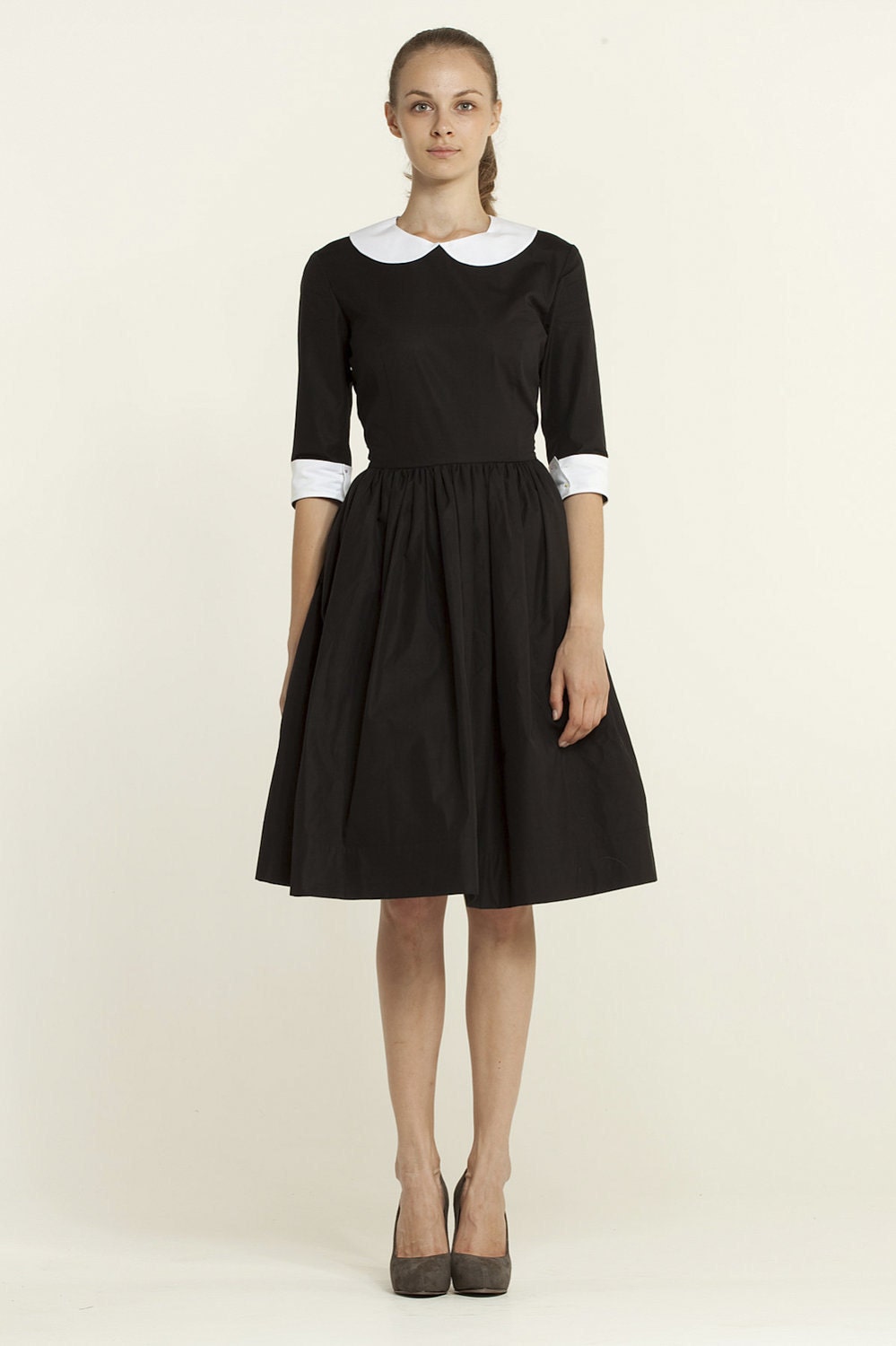
Because my family did societal things, my mother and myself, at an older date, had the little black dress. Now, ours were more modest. But, even, today, there is room for such a dress in a wardrobe. Here are some modest versions and a website of an excellent Catholic seamstress.


My mother had more than one. One was made of taffeta, which is hardly seen. In fact, one of the sad things about clothes since the 1980s, had been the disappearance of fine cloth. Many types of cloth common in the 1950s-1980s are gone.

Sad. And, just because of dryers. Here is a website showing modern, modest clothes and here is the seamstress' website.

'