Recent Posts

Showing posts with label Raissa's Journal. Show all posts

Friday, 24 July 2015

Three Definitions from The Maritains


Silent Prayer: "...not meditation in which the soul is occupied in considering ideas, concepts and images, but a wordless, intuitive, and quite simple prayer, a loving attention to God in which the soul is primarily occupied in letting God having His way with it and which, as St. Thomas expresses it, it suffers divine things in a silence void of words, concepts and images.


Recueillement: "an inner state which, far from being ‘concentration’ due to voluntary effort, is rather a gift received, a quiet absorption of the soul which, far from being inertia, is a secret and unifying activity too deep to be perceived."


Contemplation"Christian contemplation is the fruit of the gift of Wisdom; and this gift, although a habitus of the intelligence… depends essentially on charity, and consequently on sanctifying grace, and causes us to know God by a sort of connaturality – in an affective, experimental and obscure manner, because superior to every concept and image."


More on this later today....

Thursday, 23 July 2015

More Musings....


Well, my tech adviser, STS, has decided that my readers will be able, being so trained in arcane words, to follow a new blog called Recueillement. 

As he is traveling hither and yon for two weeks, this will not be in place until August 15th, along with the new forum. So, watch this space....

The reason, of course, I want Recueillement for a title is that the new blog will be based on reflections, meditations and contemplation. It also means a moment of reverence... or quiet absorption --perfect, for writings about God.

Musing, again, on this word, I discussed with STS the fact that the French, who invented the word, seem so much better at this act of recollection than the sons and daughters of the Anglo-Saxons, the Americans and British peoples.

STS claims it is part of the French character to be so inclined to reflection. I wonder...

Not having any bone, blood, or tissue of Anglo-Saxon in me, I can identify with recueillement and those of you who followed the various Maritain series will recognize the word. If you could remember Etheldredasplace, you can easily handle this label.

So, why is it that certain people's have a character for action and some for contemplation? Why is France the home of so many contemplative orders, even today, when these types of orders are becoming extinct in other parts of the West?

I suspect the French penchant for philosophy and art have something to do with recueillement. The last time I was in France, this past January, of course, my confreres and I ended up in a tavern drinking various things and talking about philosophy, liturgy, Pope Francis, and not the weather.

This type of discussion would be common in my experience of a certain type of Frenchman, as well as the British expats. Recueillement would be second-nature to such people. Needless to say, I am usually the only woman in these discussions, being interested in these topics rather than in food, fashion, or kids....Oh, well. But, therefore, I blog....

Musing on recueillement reminds me of a comment from Raissa:

All the sources are in You ...
Every great vocation gives one called the ability of a certain union with God, in particular relative to whose essence is transcendent to the multiplicity of his attributes; and very marked vocations are distinguished from each other by their relatedness to a particular the divine attributes...


Btw, would you have guessed that Garrigou-Lagrange was the spiritual director of the Maritain's Thomist Circle?


Monday, 15 June 2015

One Last Gem from The Maritains


I want to share a bit more from the book, Prayer and Intelligence. 

This holy couple gives advice to the laity who are caught up in the frenzy of the world.

Here are some points to help the laity when events and time do not allow for contemplation.

1) Throw one's self into one's "littleness" and embrace humility.

2) Abandon one's self to God's mercy.

3) Abandon one's self to God's Providence.

4) Constantly give thanks for all thinks, taking joy in the Lord.

5) Be kind to all creatures, great and small.

6) Abstain from judging others.

7) Enlarge one's heart by admiring, understanding the freedom and variety of how God's ways are in the world.

8) Prepare one's soul for the counsels of perfection , if one is not able to do these (poverty, chastity, obedience) in the same way as religious in the ways outlined below.

9)Work on purity of heart, which "cleanses the intelligence and the will from the imprint of created things...a spiritual chastity"..

10) Work on detachment "which causes us to make use of ourselves and created things 'as if not using them'...a kind of spiritual poverty".

11) Abandon one's self to Providence, "which causes us to cast all our care on God and give us up to his good pleasure....like a spiritual obedience, which penetrates to the most intimate depth of the soul, and, while it makes us free of the whole created world, (and) obliges us to depend in everything on the conduct of the Holy Spirit."

This is the whole perfection series in a nutshell.

In these ways, the Maritains write that one will be able to take up one's cross daily, faithfully following the Lord, and living in His Presence. In addition, one will "adhere with his whole soul...to Him who is above all thought and who wishes to transform us into himself by love."

Actually, I shall return to this book again at a later time,,,as there is more.


Saturday, 13 June 2015

The Force of The Soul

This little book, which I bought many, many years ago at a second-hand bookstore, supplies the wisdom of the great spiritual writers is a succinct manner.

More quotations to share:

from St Teresa  "...we should grow more in virtue (humility) by contemplating the divine Perfections, than by keeping the eyes of our soul fixed on the vile clay of our origin....The best method of acquiring self-knowledge is to apply ourselves to the knowledge of God. His greatness makes us see our lowliness, his purity reveals our stains, and his humility show us how far we are from being humble. We draw to advantages from this practice; one, a clearer vision of our own nothingness in contrast to the divine grandeur...the other, that our intelligence and our will become ennobled and capable of every kind of good."

The Interior Castle, First Manson, Chapter ii.

The Maritains, who were both Benedictine Oblates, wrote this as well:

"The study of the Sacred Doctrine and of Holy Scripture is also a normally necessary means of the attainment of contemplation. This is what the ancients called, with S. Benedict, lectio divina. 'It is no mere cold and abstract speculation, it is not an affair of simply human curiosity or of superficial reading, it is a serious, profound and persevering research into Truth itself. It is informed by prayer and tenderness. It is called lectio, and it is but the first degree of the ascending scale: lectio, cogitation, studium, meditatio, oratio, contemplatio; but S. Benedict knew well that in the case of a loyal and courageous soul he others would in their turn be added...The method of prayer of the ancients was simple and easy: it consisted in self-forgetfulness and living in habitual recollection,  in assiduously steepig their souls in the beauty of the mysterious, in taking an interest in all the aspects of the supernatural economy following the inspiration of that Spirit of God who alone can teach us to pray..." 

Dom Delatte in Commentary on the Rule of S. Benedict 

The Maritains refer to the "dissipation" and feverishness of our modern daily lives. This is why I have written so much here on simplicity. A true Catholic, in order to concentrate more on God and His ways, on Himself, must simplify one's lifestyle.

There are so many things one can omit from a daily schedule. Talking without necessity may be the first way.

Again, the Maritains: "It is probable that may souls deprive themselves of the choice graces of higher states of prayer because they are unable to sacrifice themselves with the  requisite generosity to the exigencies for this heart to heart communion with God."

The writers refer to S. Teresa yet again: "There is but one road which reaches God, and that is prayer; if anyone shows you another, you are being deceived."

And, to S. John of the Cross: "Mental prayer should take precedence of every other occupation; it is the force of the soul."


Great works and activities in the Church will not save us--we are not saved by good works, but by the holiness of those works, which come from a pure heart and pure mind.

Without mental prayer, one thrashes around uselessly, creating things in the world which are not only ephemeral, but not part of the Kingdom of God.

As a parent, I created a quiet house in order to teach solitude and listen for the small, still voice of God at home. Too many activities wear out the soul and the body, taking away energy from the interior life, which takes energy.

Prayer demands attention and energy. The Maritains admit that those of us in the world fall into imperfections and many venial sins because of the lack of contemplation.  Here is a crunch idea--if there are no contemplative houses of prayer in your area, praying for you and interceding for the Church in the area, one is absolutely in need of personal contemplative prayer, as one has no external support.


There is NO orthodox, obedient, contemplative house in this entire diocese. Pray that if God wants me to start this here, the needed benefactors come forth. I found several houses with three bedrooms, with room for a chapel, for three to six women, for under 100,000 USD. That is not a lot for the Heart of Prayer at the center of activity here in this wounded place. I need a benefactor. I have a priest who says the Latin Mass who is encouraging me, although he does not live very close to the location of the houses for sale. However, his moral support has been gratifying.

Pray for this cause. If it does not happen here, God will lead me somewhere else, and this area will keep lacking the Heart of Prayer it needs to survive the coming onslaught of evil. A diocese without a Heart of Prayer cannot endure, as the laity need this backup, this bulwark of prayer power-the force of the soul.


Great Summary of The Entire Perfection Series


"Without contemplation, no great advance will be made in virtue and we shall never be able to help others towards it. Without contemplation we shall never completely abandon our weaknesses and imperfections. We shall always remain attached to the earth and we shall never rise much above the sentiments of human nature. Never shall we be able to give God a perfect service. With contemplation, we shall do more for ourselves and others in one month, than we shall do without it in ten years." (Pere Lallemant. Spiritual Doctrine, from the Maritains' book Prayer and Intelligence.

Thursday, 11 June 2015

More Tidbits from The Maritains

P rayer is simplicity and purity of mind reaching up to God and allowing Him to just Be with us. Too often, many things, thoughts, people stop us from that simplicity and purity. Modern life dictates against simplicity and purity. Go back into the perfection series for more on purity, but look at the small ways here in which one can break away from unnecessary complexity.

One of the great problems of those who are trying to become closer to God could be called, as the Maritains do, the "reflex of the mind". Too often, through habitual sin, or even the sins of families, one reverts back to such reflexes, which stop the growth of holiness. We fall into spiritual illusions. I talk to people who are on the right path, but fall into habits of mind, like judgment, criticism, negativity, scrupulosity,  spiritual sloth.

One of the most common reflexes of the mind which I have encountered since I have been back to the States has been identified by the Maritains as a psychological knee-jerk reaction involving "psychological curiosity".

Oh my, yes. Since January, I have heard numerous Catholics try and explain away sin in terms of psychological weaknesses. I left off on point four the other day regarding the descriptions and definitions of contemplation. As we continue to examine these, we see the opposite of "staring at one's navel" as we use to say in the seventies--the over examination of self. One cannot explain away sin. God will not allow us to explain ourselves when we stand before Him and see the depth of our failings. But, now, we can learn to do this type of contemplation of our nothingness and His Goodness.

Here are some more of the tidbits from the Maritains.

Point Six, "The contemplative life consists in a sort of holy leisure and repose...."

One must be still and seek solitude. God does not like rivals to His Person, His time, His ways.

Point Seven, "The contemplative life is related to divine things, and the active to human things; which is why St. Augustine says in the book De Verbis Domini: 'In the beginning was the Word, this is he to whom Mary listened: and the Word was made Flesh, this is he whom Martha served.'"

But, we can be so focused on the things of daily life, that we miss the small, still voice of God speaking to us in the midst of even chaos. To train one's mind to disregard such confusion is to break through the reflexes of the mind.

Point Eight, "The contemplative life is related to what is specifically proper to man, that is, the intellect, while the lower forces common to human and to animal life take part in the operations of the active life...."

One of my favorite psalms embodies this call-Psalm 24 DR. This is a good prayer for those in tribulation.

Verse 9 refers to those who allow God to humble them in the Nights.

Psalm 24 Douay-Rheims 

24 Unto the end, a psalm for David. To thee, O Lord, have I lifted up my soul.
In thee, O my God, I put my trust; let me not be ashamed.
Neither let my enemies laugh at me: for none of them that wait on thee shall be confounded.
Let all them be confounded that act unjust things without cause. shew, O Lord, thy ways to me, and teach me thy paths.
Direct me in thy truth, and teach me; for thou art God my Saviour; and on thee have I waited all the day long.
Remember, O Lord, thy bowels of compassion; and thy mercies that are from the beginning of the world.
The sins of my youth and my ignorances do not remember. According to thy mercy remember thou me: for thy goodness' sake, O Lord.
The Lord is sweet and righteous: therefore he will give a law to sinners in the way.
He will guide the mild in judgment: he will teach the meek his ways.
10 All the ways of the Lord are mercy and truth, to them that seek after his covenant and his testimonies.
11 For thy name's sake, O Lord, thou wilt pardon my sin: for it is great.
12 Who is the man that feareth the Lord? He hath appointed him a law in the way he hath chosen.
13 His soul shall dwell in good things: and his seed shall inherit the land.
14 The Lord is a firmament to them that fear him: and his covenant shall be made manifest to them.
15 My eyes are ever towards the Lord: for he shall pluck my feet out of the snare.
16 Look thou upon me, and have mercy on me; for I am alone and poor.
17 The troubles of my heart are multiplied: deliver me from my necessities.
18 See my abjection and my labour; and forgive me all my sins.
19 Consider my enemies for they are multiplied, and have hated me with an unjust hatred.
20 Keep thou my soul, and deliver me: I shall not be ashamed, for I have hoped in thee.
21 The innocent and the upright have adhered to me: because I have waited on thee.
22 Deliver Israel, O God, from all his tribulations.

more later....

Monday, 8 June 2015

The Vision of The Principle

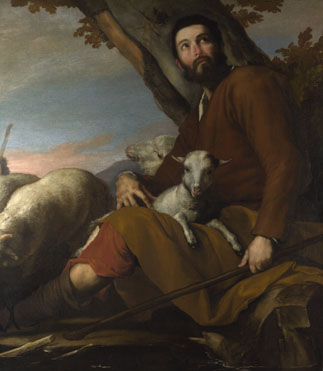
For centuries, the Fathers and Doctors of the Church have likened the two wives of Jacob to the active or contemplative life. In modern times, in order not to make active women feel bad about their lives, priests have not quoted these passages comparing Leah to the active life and Rachel to the contemplative life.

I remember reading about this many, many decades ago. To make the distinction is not to dis women in the active life, (I was a single mum, working, homeschooling, keeping the books, etc. and I did not feel dissed), but to reflect on the two ways which must both end up in the same place, perfection.

Aquinas, again quoted by the Maritains, states, "Absolutely speaking and in itself, the contemplative life is better than the active. The Philosopher proves this by eight reasons."

Here theses are with more explanation as to the comparison of Rachel to Leah.

One, "The contemplative life is suitable to man in regard to his most perfect possession, the intellect, and in relation to the proper objects of that faculty, namely the intelligibles, while the active life is concerned with exterior things. Wherefore the name of Rachel, who represents the contemplative life, means the vision of the principle, the active life being represented by Lia, who suffered from weak eyes..." Maritains quoting St. Gregory here.

Rachel was the great beloved wife of Jacob who bore him his favorite sons, Joseph and Benjamin. His long time of labor in order to "pay" for her to her father, Laban, represents the long journey of purgation in the Dark Nights, purging one of sins.

Laban tricked Jacob, (a punishment from God for Jacob tricking his own father), and gave Leah to him first. Finally, Jacob won Rachel, the desire of his heart, and his soul mate.

Rachel came to represent the contemplative life, not only because of her name, but because she represented the true desire, the purer love. of Jacob's heart.

Our truest desire is for God alone. That is the key to following the contemplative life. Being back in the States, I have seen the terrible distractions and waste of energy for so many things which are not necessary to the spiritual life.


The second point, Two, has been discussed by those in monasteries.

"The contemplative life can be more continuous (though this continuity cannot be referred to the supreme act of contemplation); this is why Mary, who symbolises contemplative life, s shewn us as always at the feet of the Lord.:


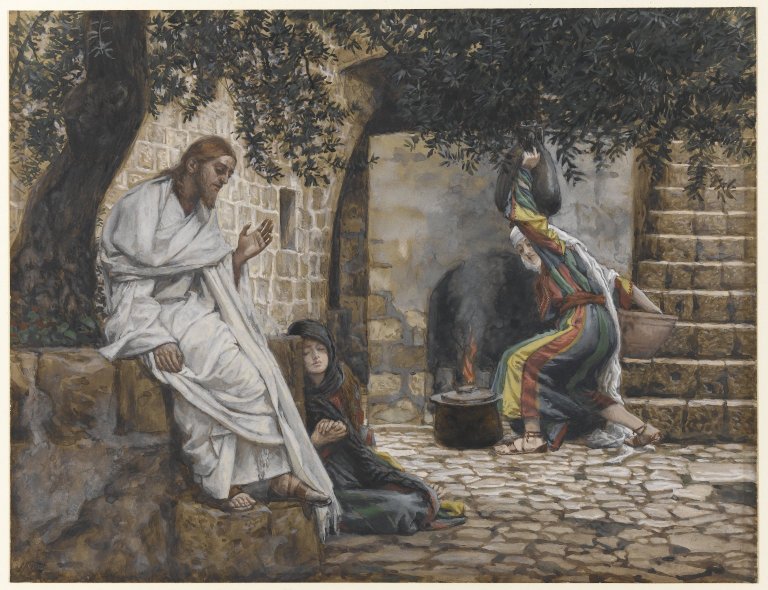
Three, "The delectation of the contemplative life is greater than that of the active; this is the meaning of S. Augustine's saying that Martha was worried while Mary was feasting."

Four, "In the contemplative life man is more self-sufficient for he depends in this exercise less on external things; wherefore it is said in Luke IV, 'Martha, Martha, thou are troubled and worried about many things."

One reason I love going to Europe is that I can walk and not have to drive or have a car, eat much more simply, get to daily Mass and Adoration easily, and have a lower lifestyle. Americans have fallen into Satan's trap of complicating their lives by desires for novelties and more and more things. When one settles for less, one is freer to meet God daily.

Five, "The contemplative life is loved for its own sake, while the active life is ordained for something beyond itself; wherefore it is said in Ps. 26, (translated) ' One thing I have asked of the Lord, this will I seek after; that I may dwell in the house of the Lord all the days of my life. That I may see the delight of the Lord, and may visit his temple.'"

I shall continue with the next three points later. I am still looking for the small place where I can pray and for two women, two only, to join me in contemplation, and, thankfully, after slightly over two weeks of being here, starting tomorrow, I can go back into my monastic schedule. Thank God.

May I add that since the late 1970s, when some mothers had to go to work, that I thought this was a lie from Satan to destroy the contemplative atmosphere of a disciplined, well-ordered home, where the mother was the quiet center of life and order.


When there is no home-centered woman, it is much harder to have daily rosary or novenas in the home, or other times of meditation.

Home schooling moms of my generation, even those with many children. created that quiet atmosphere of prayer and study, very monastic, very simple, thus leading themselves and their children into a place of contemplation. Consumerism and financial lies about "having it all" caused some of the chaos. Women's lib created some of the deceit that a mother's role at home had no value. Of course, without that still center, families cannot easily come to listen and know God or the life of virtue.  A home can be active and yet quiet...like the old Montessori schools wherein we whispered and the children worked in a quiet hum of activity.

to be continued.... 


Aquinas on Contemplation from The Maritains

This quotation is so beautiful, I just have to share it with you.....

From the same little book I have been using for the past few days, Prayer and Intelligence, by Jacques and Raissa Maritain.

"The contemplative life consists in a sort of leisure, a repose....a liberty of spirit" in which man,"burns with a desire of seeing the beauty of God"....and offers him, "his soul in sacrifice", it has its beginning and end in love, it is "directly and immediately concerned with the love of God himself, "it is ordained not to any kind of love of God, but to the perfect love of Him" and constitutes in a certain sense a commencement of beatitude...."

The burning desire for God makes one desire silence in order to hear the Bridegroom speak in the soft, love voice of love.

Again, I cannot stress the important of choosing simplicity of lifestyle. One can choose to eliminate so many unnecessary things, events, thoughts, which crowd out the voice of Christ.

Simplicity means choosing the smallest, the simplest, the plain, over the complicated.

Remember, without a schedule, one cannot become holy, and without simplicity, one cannot hear God.

A Hierarchy of Virtues


The theological virtues help us practice the moral virtues. But, the Maritains point out that there is a hierarchy of virtue. Faith "attains God in obscurity, remaining as it were from a distance from Him in so far as Faith is belief in that which is not seen." Therefore, we live in Faith when we are not in union with God, do not perceive Him or do not experience being in His Presence.

Hope, as the CCC notes, "is the theological virtue by which we desire the kingdom of heaven and eternal life as our happiness, placing our trust in Christ's promises and relying not on our own strength, but on the help of the grace of the Holy Spirit."

Hope is, again, based on desires unfulfilled. We use hope to trust in God and not rely on ourselves but on God. 

Faith and hope form the basis of our walk in the Dark Nights of the Senses and Spirit. Once a person is purified, the virtue of love takes over the soul and mind. Here are the Maritains on this point:

"...charity attains god immediately in Himself, making an intimate union precisely with that which is concealed in Faith. And thus, although Faith regulates love and union with God in so far as it proposes the  object to the will: nevertheless, in virtue of the union by which love adheres immediately to God, the intelligence is moved by the affective experience of the soul to judge of divine things in a higher fashion than belongs to the obscurity of Faith..."

One cannot love but very imperfectly without the necessary purification of the senses and soul. Thus, those who have a hard time loving in truth have tried to love without the purgation of those faults which stand in the way of union. This is one reason why love must be purified in marriage, through sacrificial actions. 

But, the more one loves God, the more one wants to love Him and others, as love leads to greater understanding and forbearance. Then, discernment "kicks in". Only those who are orthodox and those who allow God to purify their imaginations, wills, intellect and senses can have true discernment of higher things, such as God's will.

If one is confused, go back to the posts on Divine Knowledge I did this year. Divine Knowledge comes from love. When one realizes the Indwelling of the Trinity, this love becomes a way of life. We shall finally, in heaven, in the Beatific Vision, have knowledge of God as He really is.

Sunday, 7 June 2015

The Devolution Question Yet Again And Some Maritain

I first learned about devolution from two men-one a major in the Army and the other a famous Catholic priest. They talked about the growing stupidity of people across the world as a planned and also, physical de-evolution of the species.

Lately, this idea, which I have written about before on this blog, of devolution, has become more obvious to me.

Points:
  1. Young people who have never heard of the Bilderberg Group, the Trilateral Commission or the Council on Foreign Relations. Amazing.
  2. Young people who have never, ever thought of the spiritual side of humans, who either ignore or deny the soul and are, therefore, practical atheists, denying the Spirit of God.
  3. Catholics who have never read one encyclical, not even Humanae Vitae.
  4. Catholics who do not know that there are four Eucharistic Prayers, many movable feasts, or who understand the liturgical year. and worse, do not read to find out. They do not know one can buy a missal, and are not interested in doing so.
  5. Young people who do not believe in natural law philosophy.
  6. Young people who have never studied American or Western History, or taken any other Humanities course.
  7. A complete lack of the ability to do mental math among the younger generations.
  8. Reading difficulties of those under sixty, causing serious problems with basic pronunciation and understanding of content which has been read.
  9. The inability to debate or discuss rationally.
  10. No sense of the goal or end of human beings and not interested in the big question of why we are here.
  11. Complete lack of interest in foreign affairs, geography, or world events.
  12. Complete lack of interest in eating in a healthy manner, thus creating an unhealthy body while still young.
  13. An interesting lack of common sense which I, as an ex-Montessori teacher, where children do practical things and learn common sense, plagues the younger generation.
All of these problems of thinking or living or degeneration I have met in the past three weeks. There are more examples, but these I have seen and experienced more than once in a short period of time. 

De-evolution is not merely a physical problem, but a spiritual problem. Why it is a spiritual problem is that the soul is the form of the body, which means that all movements of the intellect need to be under grace in order to be truly in God's will and effective. The Maritains note that those in the active life, which would include most of the laity, "have a more pressing need of prayer" and that the active people should "ask of the divine mercy the grace of a sufficient intensity of interior life for their very activity, at least in its mode of production, to proceed from the superabundance of their contemplation..."

Devolution is a direct result from a lack of commitment to a life of prayer in the active life, and spiritual sloth. The Maritains, in this little jewel I have been reading, quote St. Augustine. "The love of truth seeks a holy repose, the necessity which love imposes accepted justified toil...If no duty be imposed on us, let us be busy with the study and contemplation of truth; and if labours are laid on us, charity itself obliges us to accept them. Even so, however, the sweet contemplation of truth should not be abandoned, for fear that with the disappearance of their sweetness, we should be overwhelmed by our necessities."

Devolution happens when reflection ends. Man was created as a thinking, reflecting animal, an animal with an immortal soul, will and intellect. To ignore all or any create a bestial condition of emotional responses to stimuli instead of a studied, virtuous response.

To state this simply, spiritual sloth and indecision in following Christ and His Church lead to devolution. The mind becomes dulled by sin and excess.

Prayer and intelligence being the process of purification leading to perfect charity.

The Indwelling of the Trinity, given in baptism, but absent without baptism, gives each one of us the ability to contemplate, to decide to follow Christ, to love. Those in grace do not devolve or degenerate.

2 Peter 3:18Douay-Rheims 

18 But grow in grace, and in the knowledge of our Lord and Saviour Jesus Christ. To him be glory both now and unto the day of eternity. Amen


Tuesday, 2 June 2015

A Re-Discovered Jewel

Among the books I am sorting out in a friend's basement, I have found one of my favorite books, which I think is out of print. Prayer and Intelligence by Jacques and Raissa Maritain. This little book refers to the spiritual and physical life which leads to perfection.

I decided to share some of the pearls from this little book and set aside the encyclical on the Mystical Body of Christ for now.

The first section defines the relationship between Sacred Doctrine and the soul. Over and over again on this blog, I have written that one must be completely dependence on God's action in the soul and use our intellect and all our faculties "with a view to our sanctification and that our neighbour."

We must dedicate ourselves, and consecrate our intellect to the service of God.  We must move our will by our consecrated intellect to know and love God, and then to know and love our neighbor. What is behind the purification of the intellect was stated in my perfection series--and that is prayer.

Prayer leads to the purification of the senses and the spirit, as also noted by the Maritains in this book, the process leading to the clarification and purification of the intellect. One must leave the sensory world in order to grow more perfect. The Maritains state here that the intellect grows more perfect "in proportion to its emancipation from sensory image.

Prayer allows the Spirit to share knowledge with us and only prayer, "by supernaturally rectifying our faculties of desire enables us to convert the truth into practice."

Interesting is the point the Maritains make that "Prayer, particularly in the case of intellectuals, can only preserve a perfectly right direction and escape the dangers which threaten it, on condition of being supported and fed by Theology.

Of course, the Maritains mean orthodox theology.

They go on to note that the study and knowledge of Sacred Doctrine shorten the spiritual journey. Sacred Doctrine "saves the soul from a number of errors, illusions and blind alleys."

And, here is a key point--"In relation to the purgative life, it (knowledge of Sacred Doctrine) possesses an ascetic virtue which succeeds in detaching the sould from the degradations and trivialities of self-love. "

For those in the illuminative state, or life, the purfication that it beings simplifies the gaze of the soul and turns it from the human self to God alone."

I shall comment on their explanation of Sacred Doctrine and the Unitive State later....

Tuesday, 3 March 2015

Choosing Poverty

I thought that poverty was just foisted upon me and that I had to learn to accept it when a little memory came to my mind, or rather three little happenings, from a long time ago.

One of my first, if not my very first, spiritual director, was a sister from the Cenacle order. She told me one day that she wanted to be like Christ in every way even in poverty, chastity, and obedience. She loved Christ so much this was her only desire.

Being very young, I wanted to emulate her poverty of heart and prayed likewise to be like Christ, as much as I was supposed to be, in everything. Sister Elizabeth's prayer was based on the Scripture passage below:

Matthew 8:20

20 And Jesus saith to him: The foxes have holes, and the birds of the air nests: but the son of man hath not where to lay his head.

Shortly after Sister shared this with me, and after I had hesitantly (and I have to admit, halfheartedly) said this prayer, two young men, one of whom I had known for a long time, proposed to me. They were both extremely wealthy, and in fact, one was a millionaire heir of a large, national company. I said "no" to each one, not loving either one, and wanting to marry for love, of course, despite, the fact that both were good men. I went on to enter a lay community for seven years, making a four year celibate commitment as well within that time, which meant I did not date and gave my self entirely up to God. After leaving the community and going back to graduate school, I ended up teaching in England and the rest, as they say, is history.
I lived simply in all those years, and even in marriage lived simply. This plan of God's became critical as I was thrust into being a single mum and so on. From that time to this, except for a few prosperous years, my life was marked and still is, by real poverty and even, penury.
This past week, I had the chance to rejoice in this poverty, realizing how God had taken my little prayer, so long ago, seriously. To be like Christ in this world, in my very being is still, and even more so, (being in the long Dark Night of purgation), a real desire of my heart. Once one embraces the love of poverty, joy follows.
Thanking God for being faithful to me despite myself and for giving me the ability to live without even the basics sometimes, I realized, finally, the fact that I had no "stuff" to clog my heart and mind, that poverty had carved out in my heart, mind, soul and will a place for God to rest.
I am in the enviable position of having less and less between me and the daily experience of God's Presence. I would not have chosen this way. 
The truth is that from baptism, God dwells within. This Indwelling of the Trinity lies within each baptized Catholic who is in sanctifying grace. One only has to allow God to remove the "stuff" which blocks the love of God in one's life to come forward in power and in peace.
I had other chances to be comfortable, through compromise, which I refused. Walking toward Christ means walking towards Golgotha. The way involves many choices, but if one is focused on Christ, one moves towards the same goal as He moved towards, the Cross. 
I have many crosses, as do most people. The greatest one is not material poverty, but the fact that I have been asked to give my son back to God, which I did when he was still a baby. Or rather, I sensed almost immediately after his birth, that this child did not belong to me, but that I was merely his caretaker until God called him away from me. This is real poverty for me, knowing that my son belongs to God alone, and that I must live so far away from him and not enjoy his company even once a week, or even once a month, or even once a year. But, there is a quiet joy in this giving up of happy family events. Poverty of spirit involves giving up the heart and mind, as well as the body, to God. The imagination and will must also be given over for joy to come forth, in a quiet, but perceptible manner. One must be poor in the mind, disciplining thoughts, as well as in the body, disciplining desires.
Purgation is death, which is why so many fight it, as we all have a survival instinct. But, to face the death of purgation is to allow God to make one poor, really poor. Each soul in purgatory is totally naked in his own eyes and in the eyes of God. One sees one's real poverty of self.
Recently, a friend of mine and I were discussing death. We had experienced several deaths since the turning of the year among friends and acquaintances.  All the people who had died in the past two months were younger than we are. One was a multi-millionaire, who died a strange and lonely death. In the last moments, she experienced a great poverty of spirit. No one was with her when she died. 
God waits for us to get serious about Him. He waits until we are ready to understand that His Life on earth must be chosen individually. To live in the Present Moment, without a safety net, is to allow God to be God every moment of the day and night.
As I write this, yet another storm will hit this city any minute. People will experience inconvenience and hardship. Some will die. But, death can be embraced daily so that the final death on earth is merely the last scene for which one has practiced all one's life. Poverty allows one to die daily and realize daily that the last day is like this death, only final. One has no fake stage props on which to rely.
I would not choose another life now, having finally seen the jewels which surround me in the form of graces of detachment and objectivity. Like someone waking out of a long dream, I am awake to a new reality of freedom and increasing Love, Who has a name, the Lord of Poverty, Jesus Christ. Christ was hungry, He was sore from lack of comforts, He was thirsty. He even had no room to call His own once He began His public life. He chose to be like all of us, poor. His poverty was so great because He left the throne of heaven to walk among men. We cannot even comprehend His great poverty.
Things are for us to use without attachment. Things are tools for life, not substitutes for love. Love can be expressed in things, but Christ wants more than this. He wants each one to desire to be like Him in all things. To be a "slave" means that one is directly and absolutely dependent on another. Christ became a slave so that we can be raised up with Him. This rising will be fulfilled at the last trumpet, but another rising can be experienced long before that last day. This is the rising of the mind, the heart, the imagination, the will, the body to God alone in every breath that one takes each day. 
Wait not until death to die to self, but follow the path now to death of self. Only when the last gasp of egotism leaves one's person can one experience the true Love of God. I am hoping for that day to happen here on earth, not only for my benefit, but for that of the entire Church, which I love more than my own self.  Like Sister Elizabeth, I only want to be, as much as God called me to be, like Christ.

Philippians 2:5-7

Let the same mind be in you that was[a] in Christ Jesus,
who, though he was in the form of God,
    did not regard equality with God
    as something to be exploited,
but emptied himself,
    taking the form of a slave,
    being born in human likeness.
And being found in human form

After Raissa Maritain died, Jacques left public life and went into seclusion to pray and meditate for the rest of his days. His death to the world in which he lived so fully mirrored the death of his beloved wife and sister in grace. I like to think that Raissa's death allowed Jacques to choose his real vocation at last, that of a contemplative, like her. His hidden life gained him great freedom of spirit and in this, he found the great love which Raissa knew before she left this world, the Love Who is Christ.
The hidden life is one of poverty of spirit. I end this little meditation with a prayer I say every Friday, the Litany of Humility by Rafael Cardinal Merry del Val (1865-1930), Secretary of State for Pope Saint Pius X:
O Jesus! meek and humble of heart, Hear me.
From the desire of being esteemed,
Deliver me, Jesus.
From the desire of being loved...
From the desire of being extolled ...
From the desire of being honored ...
From the desire of being praised ...
From the desire of being preferred to others...
From the desire of being consulted ...
From the desire of being approved ...
From the fear of being humiliated ...
From the fear of being despised...
From the fear of suffering rebukes ...
From the fear of being calumniated ...
From the fear of being forgotten ...
From the fear of being ridiculed ...
From the fear of being wronged ...
From the fear of being suspected ...

That others may be loved more than I,
Jesus, grant me the grace to desire it.

That others may be esteemed more than I ...
That, in the opinion of the world,
others may increase and I may decrease ...
That others may be chosen and I set aside ...
That others may be praised and I unnoticed ...
That others may be preferred to me in everything...
That others may become holier than I, provided that I may become as holy as I should…


Monday, 19 January 2015

On suffering, again.


What saved us then, what made our real despair still a conditional despair was precisely our suffering. That almost unconscious dignity of the mind saved our minds through the presence of an element which could not be reduced to the absurdity into which everything seemed to be trying to lead us.

I thought I was leaving the Maritains, but the times make me return to one phrase from a later book by Raissa We Have Been Friends Together, which I have.

The above phrase jolted me, jumped out of a page yesterday and gripped my heart. Suffering saves us from despair. This may sound the opposite to what psychologists tell the modern world. The world wants to avoid suffering, but as one sees to clearly today, suffering not only surrounds us, but conditions which will create intense suffering for the remnant have increased the risk of suffering.

How, then, can suffering keep one from despair? When one realizes the dignity of the individual human being, the capacity of humans to create great beauty and culture, the possibilities for love among men and women in a society, even in the darkest of days, one must see that life is not absurd.

Suffering causes one to focus intensely on the spiritual side of man. If one denies the soul, one is denying the very essence of a human being. A human cannot live without a soul and this soul, even in tremendous suffering, is alive because of one reason.

God.

Without God holding the soul, keeping the soul alive in His Providence and care, one dies.

As long as one lives, even in great suffering, and I can attest to this type of suffering, one is given chances for growth in this life. A long time ago, a Jewish-Catholic said to me that without God my life made no sense.

One's life does not make sense without God, and intense suffering brings one back daily to the mystery of God's own suffering, God, the Second Person of the Trinity, whose Passion and Death reveal the greatest love one can imagine.

Last week, I was accused of being a liar four times by a person who does not know me. I realized three things in this unfair, unjust accusation which impacted my life. I pray for him now. He only sees evil and cannot see good anymore. How sad. But, I learned three things in this encounter.

The first was that, as a sinner before God, even though I had not lied, I am not totally innocent, totally pure of sin. Therefore, I deserved, in some strange way, the accusation of evil although I had not committed any evil for which I was being accused. I was peaceful, but firm, calm and clear. However, God allowed this event to occur.

Only Christ could stand before the Sanhedrin, Pilate and Herod as the only completely Pure, Innocent Victim of complete injustice. Only Christ stands before evil without a shadow of sin.

Second, I realized that this is one reason why God wants me and all of us to endure the Dark Night and become pure. How can we stand before those who will persecute us, listening to the words of God, remaining peaceful, even loving, not wanting or even thinking of retaliation unless we are pure of heart?

One cannot respond to evil without anger or revenge unless one is pure of heart.

Third, God allows evil to come into one's life in order to purify us. The dignity of the soul and the human person remains hidden until suffering, which usually brings out the true state of the heart, imagination and soul. One wills, then, to forgive, to pray for one's enemies, to join with Christ on the Cross.

When one's own people turn against a person, one can only think of Christ's rejection by His Own, Beloved People, the Jews.

Raissa's comments draw me back into the mystery of suffering. Indeed, suffering is a crucible, but one in which the soul and mind are purified in order for one to become a saint. One finds the true dignity of being human, which is union with God.

There is no other way.

I think that this is what St. John of the Cross learned when he was imprisoned by his own order for nine months.

In those months, he moved through the two parts of the Dark Night into Illumination and Union.

Suffering opens the heart and mind for grace.


Tuesday, 13 January 2015

Raissa's Journal Perfection Series VIII Part XXXX

This will be the last posting on Raissa'a Journal, at least for a while. I shall move on to another book soon.

I want to merely highlight three things in this post and move on.

Several selections from her book follow. She addressed someone who hated the idea of God, who actually hated her and who hated Catholics. She engaged elegantly in the arguments necessary to aid conversion, but her telling description of this man's state of mind reveals the mindset of many today of those who want to turn over all the goodness of Western Civilization.

In a letter, she writes, "Do you really find in the paganism that precede those twenty centuries (of Christianity), the true direction of life which the blood of Christians has turned aside from its course? I that the direction in which you want to go? Towards subjugation to the gods of the city, towards cruelty in the service of luxury, towards the slavery which alone would sustain such a civilisation? No, doubtless. It would not be worth the trouble of wanting to change everything; our capitalist and atheist society, itself the result of the so-called Renaissance, has almost rediscovered the tradition..."

Raissa notes that God cannot be driven out of societies which want justice and mercy. But, for those societies which do not want justice or mercy, loyalty or love, God can be driven out to a certain extent.

But, as she states, "It is difficult to drive God our altogether. Invariably he returns humbly disguised under one name or another; and under the name we have chosen he makes himself loved without our knowledge."

Such are the saints, who remind us of God in the world through holiness and a type of purity given to them. This leads to another point on the command of love by Love, who is God.

Let me share her insights here: "Passivity...in the sense of the first and principal action of the Holy Spirit in the mystical life, is ontologically the essential characteristic. Psychologically, this passivity, passio divinorum, is expressed not only by the ligature and (apparent)death of our natural faculties, but also, in certain cases, by the heightening of them..."

"In contemplation, this passivity manifests itself above all by ligature, powerlessness, annihilation, because our faculties of knowing are utterly disproportionate to the object of contemplation, which is God in Himself. Here the intellect must recognise its incapcity, and submit to love which, through the infusion of divine Wisdom, connaturalises the soul with God and makes it know him with an obscure and ineffable certainty.

By the other Gifts, whose object is in some way more particularised, the Holy Spirit, on the contrary, heightens our faculties and proportions them to arduous, heroic, saintly acts, by setting them to work himself, by enlightening them and strengthening them."

In the passivity of the Dark Night, this passivity leads to the obscurity, the darkness of the purifying Night.

Again, Raissa on this point, "....the purifying Night, infinitely painful, which ceases when the soul has attained the degree of purity and holiness willed by God....St. John of the Cross says: 'the fire begins by blackening the wood; it does not set it aflame until it has dried it out.' Therefore one has to pass through nights, through all the anguishes and terrors of the night, see oneself engulfed in darkness and be dried up with suffering, before the soul is truly set on fire, kindled into flame that does not consume like natural fire, the vivifying flame of eternal life."

Lastly, "God is perceived as Love because he attracts and unites, makes one suffer, or gives one joy, reveals himself to the soul as its end, its repose, its beatitude."

Raissa, like myself and another friend of mine, makes the connection between Love of God, God's Love and Romantic Love. One is allowed to suffer in Romantic Love. Raissa writes "The demands of Christ as regards his disciples are absolutely inhuman; they are divine. There is not doubt about it, he who wishes to be Christ's disciple--must hate his own life. The image of Jesus Crucified is for the disciple.

...it is not the sinner, the "worldly" one, who has the greatest fear of God---rather it is those who, having been chosen as disciples, know that they are, and will be, more severely treated. From these, all in demanded."

In my humble opinion, the remnant will be and is made up of the disciples, only. for the times will be so difficult that only those who give all to God, who seek His Love, will be able to survive and not be confused.

In a post, soon, I shall described some of the remnant people's I have met, who are suffering already and becoming saints in the process.

Monday, 12 January 2015

Reposts involving meditations on death, sin, the universe

09 Jul 2012
The Four Last Things form a topic which has been the subject preached from the pulpits of the world, that is, until recent times. Now, it is both politically incorrect and indecent, apparently, to speak of Death, Judgment, Hell and ...
23 Oct 2014
We are, as Catholic, to think about the Four Last Things. These are, as some of you know, Death, the Last Judgment, Hell and Heaven. These things are rarely spoken of from the pulpits of either America or Europe, to the ...
09 Jul 2012
Catholics seem to be doing a run around the goal by not talking about the four last things nor teaching their children that we must prepare for our particular judgment. Many Catholics do not know what the particular judgement ...
27 Oct 2014
Again, synchronicity considering I just wrote about the Four Last Things. He stressed that we should consider death daily. He shared his e-mail with me and I shall write to him. God makes new doughnuts every day. Yesterday ...
18 Feb 2012
... 1595; St-Omer, 1610; London, 1867; his "Fourfold Meditations of Four Last Things" (once attributed to Southwell ), London, 1895; his "Verses on the Passion", by the Cath. Record Soc., VI, 29. from the Catholic Encyclopedia ...
01 Jul 2014
One cannot "rage" into the night. As much as I love the poetry of Dylan Thomas, I disagree with his famous poem. He missed the point, which is that we must prepare AT ALL TIMES to die. Thinking on the Four Last Things is ...
15 Jul 2014
The priest's fault, according to the diocesan school office, would be that he had spoken to his young students about The Four Last Things, among which he mentioned hell and purgatory; “lessons not suitable for children at ...
28 Jul 2014
If one does not face death, one will pretend one is immortal. So many young people think they are immortal. This idea is dangerous. It is time for priests to begin to preach about death and the four last things again. We all need ...
13 Jun 2014
Noise blocks out thoughts of sin, of the four last things. Noise covers up the need for listening to God. Cardinal Manning writes this in his chapter on “The Gift of Counsel”: “…the characteristic mark of these latter days; I mean ...
09 Jun 2012
He mentioned the emphasis on the Four Last Things, which has been lost. His emphasis on the spirituality of the TLM and Trent was great and a much needed conversation. This is a huge subject which I hope he continues on ...
12 Dec 2012
My generation was raised with manners, but we never used this word "tact"to criticize strong feelings regarding heaven, hell, or the four last things. Some Millenials do not want to hear the Truth unless is comes in a nice ...
31 Jul 2013
... and the Jesuits . According to Randy Engels and Steven Brady a homosexual Priest hates speaking and even thinking of the four last things which answered a lot of my questions regarding contemporary preaching.
19 Jun 2013
... as we were working in an very affluent area, as well as with others not so affluent, and with youth who were narcissistically caught us in themselves and needed some good old fashioned awareness of the four last things.
28 Oct 2014
No teaching about cohabitation,contraception,or any teaching on the four last things;or actual and sanctifying grace;or redemption,.Instead we are fed a diet of missy messy pottage of love-love-lone.My mind aches and i pray ...
09 Jul 2012
Four, the goal is self-realization, not god of God, really. Five, the early Christians threw out this nutsy stuff as part of the occultic thinking of both the West and East, realizing that myth, paganism and magic would not save one, ...
09 Jul 2012
The last episode, which happened in January, was covered by very few news agencies. No one is reporting these abuses but about six sites which I found, and all are Christian based. Why? And, why are not the feminists in ...
10 Dec 2013
http://supertradmum-etheldredasplace.blogspot.com/2012/07/on-four-last-things.html · http://supertradmum-etheldredasplace.blogspot.com/2012/07/on-fear-of-death-among-catholics.html and more from St. Alphonsus.... 1.
18 Sep 2013
It is so sad, as none of these things are true and we do not even need to follow private revelations anyway. So why do .... As you know, there are more posts on this in the last three or four days, so check those out. God is a ...
24 Aug 2014
(Mt. 24:4–31). Thus, these things that are now happening to Christians are not new or sudden; since the good and righteous, and those who are devoted to God in the law of innocence and the fear of true religion, advance always through afflictions, wrongs, the severe and manifold penalties of troubles, and in the hardship of a narrow path. Thus, at the very beginning of the world, ..... We are in the beginning of the last stage. But, many Catholics think that persecution ...

04 Sep 2014
Thursday, 4 September 2014 ... One of my dear friends, in her early forties, and an excellent cook, told me last March that people in her generation do not know how to cook. She is a Gen Xer. Their moms did not teach them how to cook, sew, can, clean, ... How many kids have never done anything like fix steps, paint walls, plan and take care of an entire garden, learn easy plumbing jobs for maintenance, make things, bake. Two generations are lost. I am not sure they can be found.
28 Aug 2013
As Montessori writes, the child of four knows the difference between the water in the holy water stoup and that of the sink where he washes his hands. Here are her words, ... They has machines for making hosts, all without electricity, and all of these things wheat and hosts were part of the Bishop's procession on Corpus Christi. The grapes were ... Also, the reference to the Last Supper with little characters of Jesus and the Twelve can be part of this. If little peasant ...
01 Feb 2013
I strongly disagreed with Bl. John Paul II's apologies concerning some things in our Catholic past, as these merely added to the vilification and did not end such weak thinking. If one grew up as I did in the Lutheran Midwest, ...