- Vatican spokesman says decision left aides "incredulous" and expects new Pope in place before end of March -
@reutershttp://bbc.in/Y5OBvH - Vatican spokesman confirms Pope Benedict XVI is not resigning because of any difficulties in the papacy http://bbc.in/Y5NIDu
Monday, 11 February 2013
More tweets--EWTN Europe is useless
 BBC Breaking News


Tweets on the Pope's Decision
- The resignation points above all to Benedict XVI's humility and courage – this is a remarkably brave step for a Pope to take.
- Pope Benedict has never been afraid to serve the Church in his papacy. His decision to retire, first in 600 years speaks of his integrity.
- RT
@JohnGreatbatch1: Shocked at news but what a wonderful sign of humility. All of us in Ordinariate so grateful for what he has done for us
- England and Wales have no voting-age cardinal
#Poperesigns - After pope's resignation takes effect Feb. 28, there will be 117 cardinal-electors, including 14 from US-Canada, eligible to join conclave
 Damian Thompson
 Fr Patrick Brennan
 UKOrdinariate
 The Tablet
 Catholic News Svc
Pope retiring at end of month
http://worldnews.nbcnews.com/_news/2013/02/11/16924342-pope-benedict-xvi-to-resign-on-feb-28-vatican-says?lite
Catholic News Service claims enclave will vote within two weeks. Not yet on EWTN. Why not?
Catholic News Service claims enclave will vote within two weeks. Not yet on EWTN. Why not?
- Fr Lombardi expects elections for new pope will happen in about 15 days. Obviously B16 will not be in conclave
- When pope resigns he will head to papal villa at Castel Gandolfo then when work done on monastery in Vatican will move there
The Passion and the Eucharist
Joseph of Arimathea helps take down the Body of Christ with a ladder. Nicodemus takes the Body of Christ. Our Blessed Lady receives Him, as do John and Mary Magdalen. This is the Eucharist. Take My Body; Take My Blood Christ had said the night before at the Last Supper. The Passion started at the Last Supper. The Eucharist is the Sacrificial Body and Blood of Christ given to us for all ages until the end of the world. The Mass is the Unbloody Sacrifice.
How fortunate we are to have the Catholic Faith. Thank you, Jesus, thank you.
 |
| http://www.conceptionabbey.org/basilica/beuronese-murals?start=19 |
Part Fourteen: Bonaventure continued in the Doctors of the Church series
I highly recommend reading some if not all the works of Bonaventure if you are attracted to Franciscan spirituality and perfection. He is a great theologian. One cannot praise his works enough. Unlike Thomas Aquinas, the Aristotelian, Bonaventure is a Platonist, and may appeal to that group of philosophers sympathetic to Plato today. He was made a cardinal and was present at the Council of Lyon.
I can only look at his work briefly, as excellent as his many things are.
There is a story that St. Thomas Aquinas visited Bonaventure when he was writing his life of St. Francis,
and found him in ecstasy. Thomas said, "Let us leave a saint to work for a saint".
Out of all his writings, I am choosing a section on silence, the largest problem of the laity today.
This is from Holiness of Life.

 |
Francisco de Zurbarán 1598 -1664
Saint Bonaventure and St Thomas Aquinas before the Crucifix |
I can only look at his work briefly, as excellent as his many things are.
There is a story that St. Thomas Aquinas visited Bonaventure when he was writing his life of St. Francis,
and found him in ecstasy. Thomas said, "Let us leave a saint to work for a saint".
Out of all his writings, I am choosing a section on silence, the largest problem of the laity today.
This is from Holiness of Life.
"In the multitude of words there shall not
want sin." I quote from the Book of Proverbs.
Obviously, a religious aiming to perfect
his ways, will find silence a very helpful
virtue. To speak seldom, and then but briefly,
prevents sin. Where there is too much talk,
God is in one way or another offended, and
reputations suffer. On the other hand let only
the virtue of silence come into its own and
people get their due. If we deal fairly with
one another, and practise the virtue of justice,
we establish the bond of peace. This means
that where silence is observed the fruits of
peace are gathered as easily as fruit is gathered
from a heavily laden tree.

Of all places in the world peace is essential
in the cloister. Silence is of paramount importance
.... because by
means of silence peace of mind and body is
preserved. Dilating on the virtue of silence
Isaias the prophet said: "The work of justice
shall be peace, and the service of justice shall
be quietness" ! or silence. It is as though he
said : The nature of silence is such that it
acts as a preservative of the godly virtue justice.

It encourages peaceful ways and enables
men to live in peace and harmony. We
may lay it down as a principle that unless a man
diligently "sets a guard to his tongue," he
must lose all the graces he has acquired and
necessarily and quickly fall into evil ways.

"The tongue," wrote the Apostle St. James,
"is indeed a little member and boasteth great
things." It is "a fire, a world of iniquity."
According to the commentators, St. James
meaning is that almost all evil deeds are inspired
or perpetrated by the tongue.
How can the lay person in the world create silence? I suggest several things.
The first is not having a television. The second is not having the radio on all
the time. Third, simplify your life so that you are less busy. One does not need to do all the activities offered to one, even in a parish or community.
Learn to cultivate interior silence, so that you can be in a room with people
and still be silent.
If one cannot cultivate silence, one will be lost in the rush of chaos to come.
St. Bonaventure Part Thirteen of the Doctors of the Church

St. Bonaventure's writings are worth reading if anyone is interested in the development of "Franciscanism". I think it is fair to say that without Bonaventure, there would be no Franciscan Order, which to me, is the meaning of this painting.
As this series is concentrating on spirituality and perfection, I shall choose just a few sections from St. Bonaventure. He is called the Seraphic Doctor and he died in 1274. He wrote quite a bit on the life of prayer and mysticism, so one is "spolied for choice."
The language is that of the Bride and Bridegroom.
Here is one small section and by now, those of you who are following this series, will recognize the movements of purification, illumination and unity. Bonaventure's language is similar to that of St. John of the Cross.
The flesh of Christ, therefore, flowered like the rose through the beauty of brightness (per pulchritudinem claritatis). For as the rose in its beauty is among flowers, so the splendour of light is among colour. "As the refulgent rainbow among the clouds of glory, and as the flower of roses in the days of spring, so did he shine in the temple of God" (Ecclus 50. 8, 7). The "clouds of glory" (or of the heavenly homeland) are those who have the first robe and are looking forward to the second. For a cloud has a relationship to the serenity that follows and the rain that precedes. The saints have a similar relationship to the flesh because of their desire for their bodies. The "refulgent rainbow" (the Son of God) has a stringed instrument, namely the uprightness of the inflexible divinity and the curved wood of the humanity in humility. "The flower of roses in the days of spring" refers to the flesh reddened in blood in springtime and now "shining in the temple of God", that is, the Church tnumphant. That "city has no need of the sun, nor of the moon, to shine in it. For the glory of God has enlightened it, and the Lamb is its lamp" (Apoc. 21. 23). And in another place, "the Gentiles shall walk in your light" (Is. 60. 7), when he "will conforin our lowly body to his glorious body" (Phil. 3. 21), so that we may shine like the sun, when its light will be sevenfold (cf Is. 30. 26) [44]
Part Twelve: The Franciscan Doctors of the Church-St. Anthony of Padua

As you all have seen, I am not writing about the Doctors of the Church in a chronological order. One can find the lists on line. I am also emphasizing the spirituality of these great saints that fit into the discussion of the stages of perfection.
The next three Doctors of the Church I shall look at the Franciscans who are Doctors.
These three are SS. Anthony, Bonaventure, and Lawrence Brindisi. First of these is Anthony. St. Anthony of Padua, perhaps, is the most known and favourite of all the doctors. He usually is asked to find keys or rosaries. However, this saint has many more attributes, which help us understand the way to perfection.
St. Anthony, he is called the Doctor Evangelicus – the “Evangelical Doctor”, was not made a Doctor of the Church until 1946, which is a long time after he died, in the year 1231, at the age of thirty-six. How one sees the life of perfection in St. Anthony is most obvious in his intense spirit of purity. Purity of heart is given as a gift to some and created through suffering for most of us and reveals that a person has come to the stage of Illumination and most likely Unity.
The writings of St. Anthony are copious, so I shall look at three small sections only today. The first is on prayer.
"Prayer is an outpouring of affection towards God, ....talk with Him, rest of the enlightened mind...Prayer is also urging the temporal goods needed for the present life, but those which apply to the Lord with true Christian spirit, always make his own will, but urges them to pray only to the (present) need: only Heavenly Father knows what we really need in the temporal . Prayer is finally giving thanks, that recognize the benefits received and offered in return to God all our works, so that our prayer is continuous".
One of the points here is that prayer is love. If we love someone, we want to be with them and we desire more than anything to be with that person. We know, do we not, that someone does not love us, if that person does not want to spend time with us. "He is just not into you," we say to someone who is wondering whether someone loves them.
The reference to the enlightened mind in the above short passage refers to those who are living in sanctifying grace and have made a commitment to follow Christ in suffering to the stages of perfection. The enlightened mind comes when one decides to put on the mind of Christ, to think like Christ, and to think with the mind of the Church.
Purity of heart and purity of mind go together. This idea that there is a heart and mind dichotomy is simply not true. The stages of prayer reflect common everyday prayers, praise in love, asking for our temporal needs, and giving thanks. The psalms frequently reflect this order. This order appeals to the heart and the mind.
What is significant in this passage is that prayer is continuous. How we do this depends on our vocation, as continually being in prayer takes practice and confidence. Even at work, if one can be silent, one can be in an attitude of prayer. Of course, noise is hard to fight in these days.
Many people think this is impossible, but the earlier in life one begins this, the easier it is to be in prayer. Remember that St. Anthony died at the age of 36 and managed to cooperate with grace in prayer.

Christ, the power of God and the wisdom of God, reaches everywhere; satisfying the angels in
heaven with his vision, mercifully encouraging sinners on earth to repentance, and punishing in
hell the demons and sinners who have passed beyond hope. He reaches everywhere by reason
of his purity, because he is light, and in him there is no darkness [1Jn 1.5]. He is a vapour that
warms the chill of our faithlessness, and that exists by the same power as God the Father. He is
an emanation, the splendour of a consubstantial, equal and co-eternal glory, which proceeds
somehow from the brightness of the Almighty, which exists in a single brightness with the
Almighty. He is pure, because no evil can approach the supreme Good, and therefore no defiled
thing comes into her, because Good is always simple. She is the brightness of eternal light, and
a mirror in which the Father is seen: whence, He who sees me sees also my Father[Jn 14.9].
Unspotted, because He did no sin, neither was guile found in his mouth [1Pt 2.22]. The image of
his goodness, the full representation which exists with him in the same goodness; and being but
one (with the Father) he can do all things (because he is almighty), and remaining
unchangeable, he renews all things by ruling and ordering them. No wonder that he cast out
from the temple those who sold and bought, and that the priests and Levites could not withstand him!
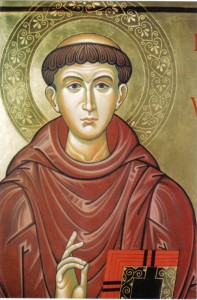
The point of this long section for us today is that Christ is pure and we must become pure to meet Him, either here on earth or in Purgatory. St. Anthony is frequently seen holding the Child Christ, Who appeared to him. That Christ appeared to him as a Child emphasizes Anthony's child-life purity.
The simplicity of Christ is His goodness and His purity. So, too, Anthony, in becoming a Franciscan, chose poverty and simplicity of lifestyle in following Christ.
The Wisdom of the Father was a warming vapour by his Incarnation, when the winter of infidelity was past, the rain of demonic persecution was over and gone, and the flowers of eternal promise appeared in our land [cf. Cant 2.11-12]. Wisdom was an emanation of glory in the working of miracles, and the brightness of the eternal light in his resurrection. He will be to us an unspotted mirror in eternal blessedness, where we shall see him as he is [cf. 1Jn 3.2], and his wisdom will be reflected in us. St Augustine asks, "What will that love be, when each of us will see our own faces reflected in each other’s, as clearly as we now see each other’s faces?"
This passage is mysterious in some ways, but the idea of the Incarnation being Wisdom is also said eloquently in the Gospel of St. John. The Logos, the Eternal Word, is Wisdom.
To be continued....
Lenten Thoughts on Vocations
For my friends who are new converts and my Protestant friends:
What wondrous love is this, O my soul, O my soul!
What wondrous love is this, O my soul!
What wondrous love is this that caused the Lord of bliss
To bear the dreadful curse for my soul, for my soul,
To bear the dreadful curse for my soul.
When I was sinking down, sinking down, sinking down,
When I was sinking down, sinking down,
When I was sinking down beneath God’s righteous frown,
Christ laid aside His crown for my soul, for my soul,
Christ laid aside His crown for my soul.
To God and to the Lamb, I will sing, I will sing;
To God and to the Lamb, I will sing.
To God and to the Lamb Who is the great “I Am”;
While millions join the theme, I will sing, I will sing;
While millions join the theme, I will sing.
And when from death I’m free, I’ll sing on, I’ll sing on;
And when from death I’m free, I’ll sing on.
And when from death I’m free, I’ll sing and joyful be;
And through eternity, I’ll sing on, I’ll sing on;
And through eternity, I’ll sing on.
Words: Attributed to Alexander Means.
Music: From The Southern Harmony and Musical Companion, by William Walker (New York: Hastings House, 1835)
This Lent, I pray especially for men and women who do not know their vocation, their call from God. Look at the young John in this painting. He is so innocence, so open, so loving. I pray for all of you, young and old, who love God with your whole heart and whole mind and whole soul, but do not know what to do.
Pray for discernment and peace. Christ's blood is flowing over Mary and John here, as a symbol of His Life in them. The Immaculate Conception was redeemed from the moment of her creation. John was led to a hard but love-filled life. What more can we want than this Wondrous Love? The serenity of this painting strikes me as the Truth of Calvary-a perfect act of Divine Love.
 |
| http://www.conceptionabbey.org/basilica/beuronese-murals?start=18 |
Sunday, 10 February 2013
Lenten Crosses
Mary meeting her Son is the most painful of all the Stations of the Cross for a mother. What can be worse than watching a dear one suffer and be helpless in the face of that intense suffering?
The Holy Mother of God shared in her Son's Passion and Death. So, we are asked at some point to do the same and enter into the suffering of Christ. This is different than suffering the consequences of our own sins. This is extra. This is gift. This is entering into Love.
 |
| http://www.conceptionabbey.org/basilica/beuronese-murals?start=17 It is better to carry cheerfully, with joy, the cross or crosses which Christ has given you than to take on crosses. Only do more penance with the advice of a priest, a good traditional priest. Giving up chocolate is great, but living without the comfort of a family and accepting the joy of being criticized may be your Lenten Way. A TLM priest recently told me not to take on extra things, as poverty and being alone without a community or mate were crosses to be endured in joy and peace in my life. He is right, of course. One has a tendency to fight suffering instead of giving in to it. For, even if it is inevitable, one needs to make an act of wilful acceptance. Pray for acceptance for the crosses in your life. These might be isolation, misunderstandings, lack of love, illness, grief. God invites us to carry His Cross with Him. What an honour What a gift. You may be one of those He is asking to carry His Cross this very day, this Lent, for the rest of your life. I can think of one dear friend of mine who has a great cross to bear because of one mistake in his life. If I pray for him, I enter into his suffering and that of Christ. So it is with us. But, once we have been purged of sin, Christ invites us again to be with Him and share in His suffering. This was clear to me when I accepted having cancer. Suffering with peace and even joy is possible. Do not waste suffering, or run away from suffering. |
Philippians, "Conversatio nostra in coelis est" (3:20),

I follow too many calendars, but today, Febuary 10th, happily most of the calendars agree on the feast day of St. Scholastica, the sister of St. Benedict. Here is her story about the storm from the Pope, St. Gregory the Great.
From Gregory the Great (c. 540-604), Dialogues, Book II (Life and Miracles of St. Benedict). Courtesy of the Saint Pachomius Library. from this website: http://www.osb.org/gen/scholastica.html and murals location are listed under the photographs.
CHAPTER THIRTY-THREE: Of a Miracle Wrought by his Sister, Scholastica.
GREGORY: Who is there, Peter, in this world, that is in greater favor with God than St. Paul? Three times he petitioned our Lord to be delivered from the thorn of the flesh, and yet he did not obtain his petition. Speaking of that, I must tell you how there was one thing which the venerable father Benedict would have liked to do, but he could not.
His sister, named Scholastica, was dedicated from her infancy to our Lord. Once a year she came to visit her brother. The man of God went to her not far from the gate of his monastery, at a place that belonged to the Abbey. It was there he would entertain her. Once upon a time she came to visit according to her custom, and her venerable brother with his monks went there to meet her.
They spent the whole day in the praises of God and spiritual talk, and when it was almost night, they dined together. As they were yet sitting at the table, talking of devout matters, it began to get dark. The holy Nun, his sister, entreated him to stay there all night that they might spend it in discoursing of the joys of heaven. By no persuasion, however, would he agree to that, saying that he might not by any means stay all night outside of his Abbey.
At that time, the sky was so clear that no cloud was to be seen. The Nun, hearing this denial of her brother, joined her hands together, laid them on the table, bowed her head on her hands, and prayed to almighty God.
Lifting her head from the table, there fell suddenly such a tempest of lightning and thundering, and such abundance of rain, that neither venerable Benedict, nor his monks that were with him, could put their heads out of doors. The holy Nun, having rested her head on her hands, poured forth such a flood of tears on the table, that she transformed the clear air to a watery sky.
After the end of her devotions, that storm of rain followed; her prayer and the rain so met together, that as she lifted up her head from the table, the thunder began. So it was that in one and the very same instant that she lifted up her head, she brought down the rain.
 |
| http://www.conceptionabbey.org/basilica/beuronese-murals?start=13 |
The man of God, seeing that he could not, in the midst of such thunder and lightning and great abundance of rain return to his Abbey, began to be heavy and to complain to his sister, saying: "God forgive you, what have you done?" She answered him, "I desired you to stay, and you would not hear me; I have desired it of our good Lord, and he has granted my petition. Therefore if you can now depart, in God's name return to your monastery, and leave me here alone."
Departure Delayed
But the good father, not being able to leave, tarried there against his will where before he would not have stayed willingly. By that means, they watched all night and with spiritual and heavenly talk mutually comforted one another.
Therefore, by this we see, as I said before, that he would have had one thing, but he could not effect it. For if we know the venerable man's mind, there is no question but that he would have had the same fair weather to have continued as it was when he left his monastery. He found, however, that a miracle prevented his desire. A miracle that, by the power of almighty God, a woman's prayers had wrought.
Is it not a thing to be marveled at, that a woman, who for a long time had not seen her brother, might do more in that instance than he could? She realized, according to the saying of St. John, "God is charity" [1 John 4:8]. Therefore, as is right, she who loved more, did more.
 |
| http://www.conceptionabbey.org/basilica/beuronese-murals?start=14 |
PETER: I confess that I am wonderfully pleased with that which you tell me.
CHAPTER THIRTY-FOUR: How Benedict Saw the Soul of his Sister Ascend into Heavenly Glory.
GREGORY: The next day the venerable woman returned to her nunnery, and the man of God to his abbey. Three days later, standing in his cell, and lifting up his eyes to heaven, he beheld the soul of his sister (which was departed from her body) ascend into heaven in the likeness of a dove.
 |
| http://www.conceptionabbey.org/basilica/beuronese-murals?start=15 |
Rejoicing much to see her great glory, with hymns and praise he gave thanks to almighty God, and imparted the news of her death to his monks. He sent them presently to bring her corpse to his Abbey, to have it buried in that grave which he had provided for himself. By this means it fell out that, as their souls were always one in God while they lived, so their bodies continued together after their death.
 |
| http://www.conceptionabbey.org/basilica/beuronese-murals?start=16 |
Links to the eleven posts on the Doctors of the Church and Perfection Series

Obviously, not in chronological order. More to come.
http://supertradmum-etheldredasplace.blogspot.co.uk/2013/02/on-being-bridefrom-st-ephrem-and.html
http://supertradmum-etheldredasplace.blogspot.co.uk/2013/02/doctors-of-church-series-part-two.html
http://supertradmum-etheldredasplace.blogspot.co.uk/2013/02/st-john-of-avila-part-three-of-series.html
http://supertradmum-etheldredasplace.blogspot.co.uk/2013/02/part-four-and-more-on-st-john-of-avila.html
http://supertradmum-etheldredasplace.blogspot.co.uk/2013/02/doctors-of-church-series-part-five-on.html
http://supertradmum-etheldredasplace.blogspot.co.uk/2013/02/part-six-on-catherine-of-siena-lay-and.html
http://supertradmum-etheldredasplace.blogspot.co.uk/2013/02/on-doctors-of-church-part-seven-two.html
http://supertradmum-etheldredasplace.blogspot.co.uk/2013/02/part-eight-doctors-of-church-hildegard.html
http://supertradmum-etheldredasplace.blogspot.co.uk/2013/02/part-nine-doctors-of-church-hildegard.html
http://supertradmum-etheldredasplace.blogspot.co.uk/2013/02/part-ten-of-doctors-of-church-four.html
http://supertradmum-etheldredasplace.blogspot.co.uk/2013/02/pope-benedict-xvi-on-st-hildegard-of.html
Saturday, 9 February 2013
St. Faustina on Children and More

One of my highly intelligent readers sent me an interesting note on children, which overlaps with a comment I made regarding the need for parents for raise saints.
St. Faustina's vision is not, of course, infallible, as private visions are not so.
However, she is a saint and we can read her Diary and use it for private meditations. This is from Notebook II, Section 765.
On one occasion, I saw the convent of the new congregation. As I walked about, inspecting everything, I suddenly saw a crowd of children who seemed to be no older than five to eleven years of age. When they saw me they surrounded me and began to cry out, "Defend us from evil," and they led me into the chapel which was in this convent. When I entered the chapel, I saw the distressful Lord Jesus. Jesus looked at me graciously and said that He was gravely offended by children: You are to defend them from evil. From that moment, I have been praying for children, but I feel that prayer alone is not enough.
Defending children from evil means several things:
1) they must learn how to pray and have a personal relationship with Christ;
2) they need parents to teach them right from wrong and to help them form their consciences;
3) they need to be protected from bad tv, computer porn, sexualized movies;
4) they need to go to daily Mass, adoration, and confession on a regular basis;
5) they need a quiet house in which to learn how to reflect;
6) they need to see parents who love and respect each other.
7) either going to private schools which do NOT have sex education or home school
8) to provide Catholic teaching for the children which is orthodox.
9) they need their parents to monitor their friends and where they go and what they do
10) they need their parents to help them develop the virtues given to them at baptism and confirmation
Even children can go to hell.
Millennials are more stressed--Evangelize!
"Millennials are growing up at a tough time. They were sheltered in many ways, with a lot of high expectations for what they should achieve. Individual failure is difficult to accept when confronted with a sense you're an important person and expected to achieve. Even though, in most instances, it's not their fault — the economy collapsed just as many of them were getting out of college and coming of age — that does lead to a greater sense of stress," he says.
Overall, the survey finds that 20% of Americans report extreme stress, which is an 8, 9 or 10 on the stress scale. Still, the extreme-stress report has declined since 2010, when the number was 24%. Also on the decline are unhealthy coping behaviors. Since 2008, eating to manage stress dropped from 34% to 25% in 2012. And drinking alcohol as a stress reliever dipped from 18% to 13%.
Among other survey findings:
- 35% of Americans say their stress increased in the past year.
- 69% of those with high stress say their stress increased in the past year, compared with 13% of those who report low stress (a 1, 2 or 3 on the scale).
- In the past five years, 60% of those surveyed have tried to reduce their stress; 53% are still trying.
- Top stressors include money (69%), work (65%) and the economy (61%).
- For Millennials, top stress sources are work (cited by 76%), money (73%) and relationships (59%). The economy came in fifth, at 55%, just behind family responsibilities, cited by 56%.
Wow, where is Dr Sanity when we need her?
http://greatcatholichomilies.com/2013/02/sorry-world-%E2%80%94-narcissism-is-not-a-virtue-but-humility-is/
I have written a lot about narcissism here and in my previous blog.
I missed this fact. Read this and more at the above site.
Wow. Thanks to Lisa Graas for the heads-up on this one.
It was announced in 2010 that Narcissism would for the first time be removed from the fifth edition of the Diagnostic and Statistical Manual of Mental Disorders (DSM). This was a surprise to many even within the psychological community. Narcissism can be defined as a disorder which causes a person to fixate on oneself, one’s ideas, and one’s works. In general, it is characterized by a need for constant attention.
Around the Net, on tlc............

Every day, this cat waits for this dog to go by at the same time...and joins him for a walk.
Wish we all had friends like this, don't you?

Subscribe to:
Posts (Atom)