Recent Posts

Wednesday, 27 February 2013

Part 58: Doctors of the Church and Perfection: St. Augustine

St. Augustine of Hippo

The Classical Doctors of the Church and Perfection
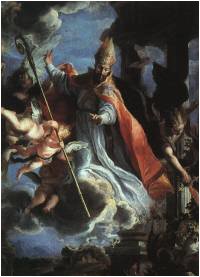
Sadly, I leave the great and sweet St. Bernard behind and move to the Doctors of the Church in the Classical Period. St. Augustine will be the focus for a few days.  May I state that he has most likely been one of the greatest influences on modern spirituality for many reasons. I cannot do him justice on this blog, what will merely highlight some ideas

By the way, before I dig in, there are now over 200 postings on perfection. I may put these into a book form, if I can find someone interested in helping me get it published. I have copious notes.

At this time, on this day in history, we should all return to Augustine's City of God. If any book of the Classical Period would give us perspective on the events of today, it is Augustine's critique of Rome and his understanding of the two cities.

To see him in the line of those who teach us how to be perfect, I shall start with this. We must acknowledge that our wills are free in order to pursue perfection. Reason and faith go together. From Book Five

Now, against the sacrilegious and impious darings of reason, we assert both that God knows all things before they come to pass, and that we do by our free will whatsoever we know and feel to be done by us only because we will it. But that all things come to pass by fate, we do not say; nay we affirm that nothing comes to pass by fate; for we demonstrate that the name of fate, as it is wont to be used by those who speak of fate, meaning thereby the position of the stars at the time of each one's conception or birth, is an unmeaning word, for astrology itself is a delusion. 

This next section is hard for many people who cannot understand that God knows all things and yet, within that Divine Knowledge and Plan, we have free will. For an adult Catholic, that is over the age of 18 or so, this means taking responsibility for our journey to holiness.


But an order of causes in which the highest efficiency is attributed to the will of God, we neither deny nor do we designate it by the name of fate, unless, perhaps, we may understand fate to mean that which is spoken, deriving it from fari, to speak; for we cannot deny that it is written in the sacred Scriptures, God has spoken once; these two things have I heard, that power belongs unto God. Also unto You, O God, belongs mercy: for You will render unto every man according to his works. Now the expression, Once has He spoken, is to be understood as meaning  immovably, that is, unchangeably has He spoken, inasmuch as He knows unchangeably all things which shall be, and all things which He will do. We might, then, use the word fate in the sense it bears when derived from fari, to speak, had it not already come to be understood in another sense, into which I am unwilling that the hearts of men should unconsciously slide. But it does not follow that, though there is for God a certain order of all causes, there must therefore be nothing depending on the free exercise of our own wills, for our wills themselves are included in that order of causes which is certain to God, and is embraced by His foreknowledge, for human wills are also causes of human actions; and He who foreknew all the causes of things would certainly among those causes not have been ignorant of our wills.

Of course, God is knowledgeable of our wills, our decisions. But He has allowed us choices, which are all included in His Will. As we have seen in the past few weeks, many people have made good and bad choices in their lives. Yet, all is in the Will of God. All.

For even that very concession which Cicero himself makes is enough to refute him in this argument. For what does it help him to say that nothing takes place without a cause, but that every cause is not fatal, there being a fortuitous cause, a natural cause, and a voluntary cause? It is sufficient that he confesses that whatever happens must be preceded by a cause. For we say that those causes which are called fortuitous are not a mere name for the absence of causes, but are only latent, and we attribute them either to the will of the true God, or to that of spirits of some kind or other. And as to natural causes, we by no means separate them from the will of Him who is the author and framer of all nature. But now as to voluntary causes. They are referable either to God, or to angels, or to men, or to animals of whatever description, if indeed those instinctive movements of animals devoid of reason, by which, in accordance with their own nature, they seek or shun various things, are to be called wills.

Silly modern philosophers and anthropologists no longer make distinctions between human actions and animal actions. Instinctive behaviour is very far from acts of the will. We are in charge, unless we have fallen into years of habitual sin.

And when I speak of the wills of angels, I mean either the wills of good angels, whom we call the angels of God, or of the wicked angels, whom we call the angels of the devil, or demons. Also by the wills of men I mean the wills either of the good or of the wicked. And from this we conclude that there are no efficient causes of all things which come to pass unless voluntary causes, that is, such as belong to that nature which is the spirit of life. For the air or wind is called spirit, but, inasmuch as it is a body, it is not the spirit of life. The spirit of life, therefore, which quickens all things, and is the creator of every body, and of every created spirit, is God Himself, the uncreated spirit. In His supreme will resides the power which acts on the wills of all created spirits, helping the good, judging the evil, controlling all, granting power to some, not granting it to others. For, as He is the creator of all natures, so also is He the bestower of all powers, not of all wills; for wicked wills are not from Him, being contrary to nature, which is from Him.


This is comforting, or should be. If we have given ourselves to Christ, then our wills slowly but surely become conformed to his.

Then, the Holy Spirit is in charge and the flowering of the virtues occurs.


As to bodies, they are more subject to wills: some to our wills, by which I mean the wills of all living mortal creatures, but more to the wills of men than of beasts. But all of them are most of all subject to the will of God, to whom all wills also are subject, since they have no power except what He has bestowed upon them. The cause of things, therefore, which makes but is made, is God; but all other causes both make and are made. Such are all created spirits, and especially the rational. Material causes, therefore, which may rather be said to be made than to make, are not to be reckoned among efficient causes, because they can only do what the wills of spirits do by them. How, then, does an order of causes which is certain to the foreknowledge of God necessitate that there should be nothing which is dependent on our wills, when our wills themselves have a very important place in the order of causes? Cicero, then, contends with those who call this order of causes fatal, or rather designate this order itself by the name of fate; to which we have an abhorrence, especially on account of the word, which men have become accustomed to understand as meaning what is not true. But, whereas he denies that the order of all causes is most certain, and perfectly clear to the prescience of God, we detest his opinion more than the Stoics do. For he either denies that God exists,— which, indeed, in an assumed personage, he has labored to do, in his book De Natura Deorum,— or if he confesses that He exists, but denies that He is prescient of future things, what is that but just the fool saying in his heart there is no God? 

How sad it is that we know so many people who deny that there is a God of History, One Who has entered into the lives of men and woman and does so constantly.

The atheists and agnostics act as if there was a separation between God and them, God and human activity. The Star Wars generation believes in Fate, rather than in free will.

We must not lose the fact that we are responsible for our own lives.
We must decide to follow the path of perfection, given to us in our baptismal graces.

For one who is not prescient of all future things is not God. Wherefore our wills also have just so much power as God willed and foreknew that they should have; and therefore whatever power they have, they have it within most certain limits; and whatever they are to do, they are most assuredly to do, for He whose foreknowledge is infallible foreknew that they would have the power to do it, and would do it. Wherefore, if I should choose to apply the name of fate to anything at all, I should rather say that fate belongs to the weaker of two parties, will to the stronger, who has the other in his power, than that the freedom of our will is excluded by that order of causes, which, by an unusual application of the word peculiar to themselves, the Stoics call Fate.

To be continued.....

Server problems

Can anyone explain why the Net has been so bad for days and days? I have lost work and had to re-do work. I have had parts of things saved and not all. I have written things on other blogs only to have these disappear into thin air...

It is time consuming.

Pray for all of us bloggers, as I am not the only one having troubles. It is an international problem.

Signs of things to come?

Tuesday, 26 February 2013

Just in case you have some extra cash and you do not want to give to the seminarian fund at right....

http://canonlawblog.wordpress.com/2013/02/26/betting-on-the-conclave/


No more red shoes for the Pope

I really hope he does not miss them.

I would.

Sign, but brown is more humble, I suppose....thanks, Wiki, for the photos.


from Vatican Insider


Ratzinger will still be addressed as “Your Holiness” and is to be given the title “Pope Emeritus” when he steps down from the Throne of St. Peter. He will wear a simple white cassock but will no longer be able to wear the red papal shoes. The first Congregation of Cardinals will be held on 4 March

ANDREA TORNIELLIVATICAN CITY
Joseph Ratzinger will be keeping his papal name when he leaves the Throne of Peter after 8 pm on 28 February: he will keep the name Benedict XVI and the title “His Holiness” and will be called 'Pope Emeritus' or 'Roman Pontiff Emeritus'.

During a press conference this morning, the Vatican’s spokesman explained that Ratzinger will continue to wear the “simple white” papal cassock, but without the shoulder cape. Fr. Lombardi also said he would no longer wear the red papal shoes. “The Pope did have a brown pair as well – the spokesman explained – and was particularly fond of a pair of shoes that were given to him as a gift in Leon, during his trip to Mexico in 2012.”

more at site....

Great Article on the Hypocrisy of Sanger


Here at this site is the excellent article in Crisis Magazine.
A snippet:
Today, New York City’s public school students—underage and without parental knowledge—are given access to birth control pills, Depo-Provera injections, and the insertion of plastic IUDs to prevent pregnancy. In an analysis of the records of 40 school based health centers in New York City—most of them in schools with large minority populations, the New York Post revealed that about 22,400 students sought reproductive care from January, 2009 through 2012.
In addition to these routine contraceptives, the City’s schools are providing students with Plan-B, the “morning-after pill” to prevent pregnancy. The Post reports that “handouts of the morning-after pill to sexually active students have skyrocketed” from 5,039 doses given to teenage students during the 2009-10 school year, to 12,721 doses given in 2011-12. Under New York State law, minors can obtain reproductive services without their parent’s permission.

New Organization for the Diocese of Portsmouth

This is exciting. Take a look at this PDF file.

Thanks to Fr. James Bradley for the heads up.

http://www.portsmouthdiocese.org.uk/docs/Review-Announcement-210213.pdf

And, just yesterday, here in England, I heard the Malthusian argument

From this site, http://www.ncregister.com/daily-news/demographic-disaster-looms-for-america?utm_source=dlvr.it&utm_medium=twitter#When:2013-02-26 12:30:01


...a new book, What to Expect When No One’s Expecting: America’s Coming Demographic Disaster (Encounter Books), adds to a growing list of books on the population implosion and says demographic winter is coming to America, too.
“In reality, from Africa to Asia, from South America to Eastern Europe, and from Third World jungles to the wealthy desert petro-kingdoms, nearly every country in every region is experiencing declines in fertility,” writes the new book’s author, Weekly Standard editor Jonathan Last. Every First World country has birth rates below the threshold replacement level of 2.1 children per woman (the 0.1 is to account for deaths from disease, war and famine), he observes, but even developing countries like Brazil and Iran are seeing decline.

The Pope's New Name

The retired name of the Pope has been bandied around. Here is finally the real deal.


Fr. Lombardi announced that after the Pope's resignation, he will officially be called "His Holiness, Benedict... 

Telegraph video of Part of Cormac Murphy O'Connor's Press Conference

http://www.telegraph.co.uk/news/religion/9894410/Cardinal-Murphy-OConnor-on-Pope-Benedict-XVI-and-Cardinal-OBriens-resignation.html

Figolli--thinking of Easter


Figolli is a marzipan goodie from Malta for Easter. If one wants a different Easter treat, other than the usual for the family, try this.


For the pastry:
  • 400 grams butter or margarine
  • 800 grams flour
  • 200 grams sugar
  • 3 egg yolks
  • 1/2 teaspoon grated lemon rind
  • Water to mix
For the filling:
  • 400 grams sugar
  • 400 grams almonds
  • 1 tablespoon orange blossom eater
  • 3 egg whites


Sieve flour into a large bowl or food processor. Rub in the margarine or butter to a cornmeal consistency (or pulse until it gets there). Add the sugar and lemon rind and mix or pulse again. Mix in the egg yolks and enough water to make a stiff dough.
Prepare the filling by grinding together the sugar and almonds in a spice grinder or blender (or the food processor, though a grinder seems to work best). Add the orange-blossom water and fold the beaten egg whites into this mixture.
Dust a work surface with flour and roll the pastry out. Use cookie cutters or custom-created cardboard shapes to cut out two identical shapes for each figolla.
Spread a thick (about 1 centimeter) layer of the almond filling onto half the pastry shapes you've made, leaving about 1 cm of space around the edges of each one. Then cover each with its corresponding half. Push the edges together slightly and bake for 1/2 hour in a moderate oven (325-350F, 175C).
Allow to cool and decorate with chocolate and / or icing, making fanciful designs around the edges, and filling in faces and other features as desired.

Another version is found here.

http://tisjir.com/tag/maltese-sweets/

Fish Soup Recipes for Lent-borrowed-and suggestions for light meals


When one is fasting, the meals one does eat should include protein.
As seen above, olives, chick peas, eggs, bread sticks and tuna can be healthy and filling.
Here are some larger meal meatless soups.
Cacciucco is a fish stew made in the Tuscan port of Livorno.

Prep Time: 1 hour

Cook Time: 30 minutes

Total Time: 1 hour, 30 minutes

Ingredients:

  • 1 1/2 to 2 pounds of mixed fish (see list below)
  • A half a medium onion, minced
  • 2 cloves garlic 
  • A bunch of parsley, minced
  • 2 tablespoons olive oil
  • 3/4 pound sliced fresh or canned plum tomatoes (if they're fresh, blanch and peel them) 
  • 2 tablespoons red wine vinegar diluted in 3/4 cup of water
  • Salt to taste 
  • Crumbled or minced hot red pepper (about a half teaspoon, or to taste - don't overdo it)
  • Toasted Italian bread rubbed with garlic

Preparation:

The Fish: Whatever is in season (it needn't be expensive), for example, sole, mullet, catfish, dogfish, goby, squid, octopus, fresh shellfish (see The Joy of Cooking for treatment instructions), and shrimp. Chop the large fish, but leave the small ones whole.

Procedure: Sauté the onion, parsley, and garlic in the oil in a deep bottomed pot. Once the onion has turned translucent, stir in the chopped tomatoes and season the mixture to taste. This is one of the few hot North Italian dishes, so don't feel you must be sparing with the red pepper. When the tomatoes are done, stir in the water and vinegar. Simmer the for a few more minutes and remove the garlic. Blend the sauce and return it to the fire with the fish, and, if you wish, sprinkle another tablespoon or two of olive oil into the pot. Simmer the cacciucco until the fish is done, 10-15 minutes. Meanwhile, toast several slices of bread and rub them with a crushed clove of garlic.

Once the fish is done, line the bottoms of your bowls with the toasted bread, ladle the cacciucco over them, and serve.
Yield: 4-6 servings 
Fish Bouillabaisse 
same yield
same process...

Ingredients

  • Rouille
  • 6 slices baguette
  • olive oil
  • coarse salt
  • freshly ground pepper
  • 1 12 tsps orange zest (freshly grated)
  • 1 leaf parsley (chopped fresh, garnish)
  • 5 lbs red snapper (monkfish or striped bass bones heads removed)
  • 2 cups tomato paste
  • 12 cup olive oil
  • coarse salt
  • black pepper
  • 6 carrots (sliced 14 inch thick on the bias)
  • 2 fennel bulbs (sliced 14 inch thick on the bias)
  • 1 bunch celery (sliced 14 inch thick on the bias)
  • 2 onions (sliced)
  • 3 leeks (white parts only sliced)
  • 6 cloves garlic (sliced)
  • 6 cloves 16 cups Homemade Fish Stock (sliced)
  • 2 tbsps saffron (fresh)
  • 1 cup pernod (2 tablespoons)
  • 750 mls white wine (chardonnay)
  • 2 cups crushed tomatoes (canned)
  • 12 shrimp (jumbo)
  • 24 ozs monkfish (pieces)
  • 24 ozs striped bass (pieces)
  • 1 12 lbs cuttlefish (cleaned)
  • 3 cups extra-virgin olive oil
  • 2 oranges (halved and sliced)
  • 2 red onions (thinly sliced)
  • 1 cup fronds (chopped green fennel)
  • 2 cups olive oil
  • 2 cups carrots (finely chopped)
  • 2 cups chopped celery (finely)
  • 2 cups fennel (finely chopped)
  • 1 tbsp saffron
  • 2 lbs mussels (scrubbed and debearded)
  • 2 lbs clams (cockle)


In a Time Machine

http://goo.gl/Yfpqr

DoC and Perfection: Bernard of Clairvaux Part 57; The love of strength

I am sure that readers can tell by now that I cannot write enough on my favourite male saints, Bernard of Clairvaux. I hope you have received his insights and experiences of God with the pleasure and amazement with which I have chosen these.

His writings would fill my little room. But, his three volumes of his Sermons on the Canticle of Canticles are all I would need for meditations for years to come.

I have not commented much, as how can one in my lowly state comment on a soul who came to unity with God before he died? That Bernard was given illumination by God about love and the soul is clear.


Therefore, here is one more section, which I share.


But there is something else that moves me, arouses and enflames me even more.
Good Jesus, the chalice you drank, the price of our redemption, makes me love you
more than all the rest. This alone would be enough to claim our love. This, I say, is what
wins our love so sweetly, justly demands it, firmly binds it, deeply affects it. Our Savior
had to toil so hard in this, in fact in making the whole world the Creator did not labor so
much. Then he spoke and they were made; he commanded and they were created. But
in saving us he had to endure men who contradicted his words, criticized his actions,
ridiculed his sufferings, and mocked his death. See how much he loved us. 

Add to this
the fact that he was not returning love but freely offering it. For who had given him
anything first, that it should be returned to him? As St John said: "Not that we had loved
him, but that he first loved us." He loved us even before we existed, and in addition he
loved us when we resisted him. According to the witness of St Paul: "Even when we
were still his enemies we were reconciled to God through the blood of his Son." 
If he had not loved his enemies, he could not have had any friends, just as he would have
had no one to love if he had not loved those who were not.

In our darkness and stupidity, Christ loves us first. He waits; he freely gives.


His love was sweet, and wise, and strong. I call it sweet because he took on a human
body, wise because he avoided sin, strong because he endured death. Even though he
took a body, his love was never sensual, but always in the wisdom of the Spirit. "A Spirit
before our face is Christ the Lord," jealous of us but with the jealousy of God, not man,
and certainly not like that of the first man, Adam, for Eve. So those whom he sought
after in a body, he loved in the spirit and redeemed in power. How sweet it is to see as
man the Creator of humanity. While he carefully protected nature from sin, he forcefully
drove death from that nature also. In taking a body he stooped to me, in avoiding sin he took counsel with himself, in accepting death he satisfied the Father. 

A dear friend, a
wise counselor, a strong helper. Should I not willingly entrust myself to the one who had
the good will, the wisdom, the strength to save me? He sought me out, he called me
through grace; will he refuse me as I come to him? I fear neither force nor fraud which
can snatch me from his hand. He is the one who conquered all things, even death, and
tricked the serpent, the seducer of the world, with a holy deception. He was more
prudent than the one, more powerful than the other. He took to himself a true body but
only the likeness of sin, giving a sweet consolation to weak men in the one and in the
other hiding a trap to deceive the devil. To reconcile us to the Father he bravely suffered
death and conquered it, pouring out his blood as the price of our redemption. His divine
majesty would not have sought me in chains unless he had loved me so tenderly, but he
added wisdom to his affection by which he deceived the serpent. Then he added
patience with which to appease his divine Father who had been offended.
These are the qualities of love of which I promised to tell you. But I have shown them to

you first in Christ, to make them so much more acceptable to you.

Be simple and look for the one thing that matters....

Christian, learn from Christ how you ought to love Christ. Learn a love that is tender,
wise, strong; love with tenderness, not passion, wisdom, not foolishness, and strength,
lest you become weary and turn away from the love of the Lord. Do not let the glory of
the world or the pleasure of the flesh lead you astray; the wisdom of Christ should
become sweeter to you than these. The light of Christ should shine so much for you that
the spirit of lies and deceit will not seduce you. 

Finally, Christ as the strength of God
should support you so that you may not be worn down by difficulties. 

Nothing can separate us from the love of God.


Let love enkindle
your zeal, let knowledge inform it, let constancy strengthen it. Keep it fervent, discreet,
courageous. See it is not tepid, or temerarious, or timid. See for yourself if those three
commands are not prescribed in the law when God says: "You shall love the Lord your
God with your whole heart, your whole soul and your whole strength." It seems to me, if
no more suitable meaning for this triple distinction comes to mind, that the love of the
heart relates to a certain warmth of affection, the love of the soul to energy or judgment
of reason, and the love of strength can refer to constancy and vigor of spirit.


So love the
Lord your God with the full and deep affection of your heart, love him with your mind
wholly awake and discreet, love him with all your strength, so much so that you would
not even fear to die for love of him. As it is written: "For love is strong as death, jealousy
is bitter as hell." Your affection for your Lord Jesus should be both tender and intimate,
to oppose the sweet enticements of sensual life. Sweetness conquers sweetness as
one nail drives out another. No less than this keep him as a strong light for your mind
and a guide for your intellect, not only to avoid the deceits of heresy and to preserve the
purity of your faith from their seductions, but also that you might carefully avoid an
indiscreet and excessive vehemence in your conversation. Let your love be strong and
constant, neither yielding to fear nor cowering at hard work. Let us love affectionately,
discreetly, intensely. We know that the love of the heart, which we have said is
affectionate, is sweet indeed, but liable to be led astray if it lacks the love of the soul.
And the love of the soul is wise indeed, but fragile without that love which is called the
love of strength.

To be continued....

Part 56: DoC and Perfection: Bernard on the Song of Songs


On this blog, I have already referred to the sermons of St. Bernard of Clairvaux on the Song of Songs, or
Canticle of Canticles. These sermons may be considered his masterpiece as a Doctor of the Church. 
Today, I emphasize the love of the Bride for the Bridegroom, which is the love of the soul for Christ, by 
noting his sermon on the angels.
Again, Bernard's sensitivity and insights indicate a man in the Unitive State. May we all aspire and ask God
for the graces necessary for perfection, which is our destination.

SERMON 19 THE LOVES OF THE ANGELS 
 
The love-inspired bride will go on speaking, will chatter without end about her 
Bridegroom's excellence; and in order to entice more favors from him she shows that 
the ones already received have not been fruitless. To the words that have so long 
preoccupied us she adds: "That is why the 
maidens love you beyond measure." In 
effect she means: "It was not in vain, not without purpose, that you emptied out the 
power of your name, Beloved, and poured it on 
my breasts; that is why the maidens 
love you so much." But why exactly? Because of 
the outpouring of your name, because 
of the breasts it has suffused. It is this that aroused their love of the Bridegroom, this 
that inspired their affections. No sooner had the bride received the infused gift than 
they, who could never stay far from their mother's side, at once perceived its fragrance. 
Filled with its sweetness they proclaim: "God's love has been poured into our hearts 
through the Holy Spirit who has been given to us." The bride commends their 
devotedness: "This, Beloved," she says, "is the fruit of the outpouring of your name, it 
is why the maidens love you. They perceive the outpouring of something that surpasses 
their capacity to absorb in its entirety; and so they give you their love." Thus, as far as 
the maidens are concerned, the outpouring makes your name knowable, knowledge 
makes it lovable. Those whose capacity is greater enjoy the name in its fullness without 
the need for an outpouring. 

What St. Bernard is saying is that we have little understanding  of the movement of Love from God.
We ask and cooperate with grace without understanding. It is
 part of the humility of the soul not to 
understand until God gives us understanding.

The angels, looking with undeviating gaze into the 
profound abyss of the divine 
judgments, are filled with inexpressible joy at the sight of their supreme righteousness; it 
is their glory that, through their ministry, these judgments are put into operation and 
made known to men. For this reason they so rightly love 
the Lord Christ. Scripture says: 
"The truth is they are all spirits whose work is service, sent to help those who will be the 
heirs of salvation. And the archangels - whom we must regard as differing in some 
degree from those called angels - experience a delight that is filled with awe as they 
enter more closely into the counsels of eternal wisdom, and are commissioned to 
execute them with supreme skill at the proper place and time. Here you have the reason 
why these in turn love the Lord Christ. 

Do we stop and think that the angels have already been taken up into their reason for creation; that is, the
good angels have found their rest in the Love of God? How wonderful to think of how happy these spirits 
are, knowing God completely and serving Him.


But this is the destiny of all of us. We are all called to this perfection in Love.
That is why we were created. That is who we are to become.
In some ways, the Song of Songs is the recapturing of Eden before the Fall.


Other blessed spirits are named Virtues because 
their God-given vocation is to explore and admire with a 
happy curiosity the hidden and 
eternal causes of signs and wonders, signs that they display 
throughout the earth 
whenever they please by the powerful manipulation of the 
elements. As a consequence.  
these naturally burn with love for the Lord of Hosts, for Christ,
the power of God. 
For it is 
an occupation full of sweetness and grace to contemplate the obscure mysteries of 
wisdom in Wisdom itself, a source of the greatest honor and glory that the effects 
produced by causes hidden in the Word of God should be revealed for the world's 
admiration by their ministry. 


This Pope Does Nothing By Accident


The Sanctify the Day, (start to say some of the Hours)


A  few selections from the

APOSTOLIC CONSTITUTION
Laudis Canticum


The song of praise of the Church

The song of praise that echoes forever in the halls of heaven and that Jesus Christ, the High Priest, introduced in this exile has been consistently continued faithful and the Church, with a wonderful variety of ways.

The Liturgy of the Hours, Eucharistic complement

The Liturgy of the Hours gradually evolved to become the local church prayer, so that, in times and places established and chaired by the priest became a necessary complement to the perfect act of divine worship is the Eucharistic Sacrifice, which extends well and spreads to every moment of the life of men....


The Divine Office is prayer of clergy, religious and laity

Whenever the Office is prayer of the whole people of God, has been ready and prepared so that they can participate in it not only the clergy but also religious and laity themselves. Introducing various forms of celebration, we have tried to respond to the specific needs of people of different order and condition: prayer can adapt to the various communities that celebrate the Liturgy of the Hours, according to their status and vocation.


The Liturgy of the Hours is sanctification of the day, so the order of the sentence has been renovated so that the canonical hours can adapt more easily to the different times of day, given the conditions in which it develops human life in our time.

The laity can make the day holy by saying one or two of the Hours. 

Ave Regina Caelorum


Ave, Regína cælórum,
ave, Dómina angelórum,
salve, radix, salve, porta,
ex qua mundo lux est orta.

Gaude, Virgo gloriósa,
super omnes speciósa;
vale, o valde decóra,
et pro nobis Christum exóra.