Monday, 18 March 2013
On Pysanky
Posted by
Supertradmum
I am 50% Czech and these eggs, or similar, were made by my ancestors. Here is Wiki on pysanka
Many other eastern European ethnic groups decorate eggs using wax resist for Easter. These include the Belarusians (пісанка, pisanka), Bulgarians (писано яйце, pisano yaytse),Croats (pisanica), Czechs (kraslice), Hungarians (hímestojás), Lithuanians (margutis), Poles (pisanka), Romanians (ouă vopsite, incondeiate or impistrite), Serbs (pisanica),Slovaks (kraslica), Slovenes (pisanica, pirhi or remenke) and Sorbs (jejka pisać).
.
If you have never had an Ukrainian Easter, I cannot describe what you have missed.
Eye Candy from Japan
Posted by
Supertradmum
The cherry blossom festivals have started in Japan. These will go on until about April 1st this year because of the warm weather. 2013 dates have been pushed up or back depending on your point of view.
Here are some photos to cheer your heart.Above are places for festivals.
Sakura means both cherry blossom and beautiful girl.
God bless the Japanese.
May they have a peaceful year.
Sigh, I would love a kimono or two.
Ten Percent Tax on Savings in Cyprus Causes Empty ATMs
Posted by
Supertradmum
http://www.theage.com.au/world/atms-drained-as-bailout-tax-triggers-run-on-bank-deposits-20130317-2g8rx.html
This type of thing is just the beginning.....photo from six hours ago and it is 1:00 GMT now.
Just a matter of time and bloggers will be effected...
Posted by
Supertradmum
http://www.thesun.co.uk/sol/homepage/news/4846904/D-Day-for-press-freedom-MPs-urged-not-to-vote-for-law.html
I cannot understand what is happening to democracy in Britain. It is disappearing fast.
Now, a bill which may curtail freedom of the press, which would effect all of us.
This is the result of a Parliament out of control.
God, help us.
DoC and Perfection: Athanasius: Part 91
Posted by
Supertradmum
What a joy it is to read the Doctors of the Church. The clarity of their writings clears the heart, head and mind of the cobwebs of confusion and deceit.
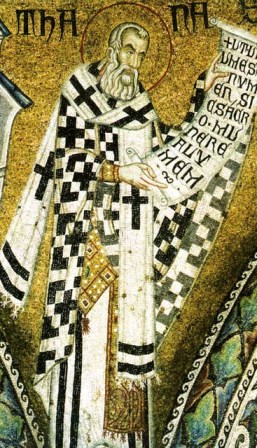
Athanasius is a genius. He is probably the most important Doctor of the ancient world. Without him, the Church could have crumbled under the weight of Arianism. It is said that 50% of the bishops were heretics when God raised up this amazing man to refute error and strengthen the Teaching Magisterium of the Church. His dates are 296-373. He was made an Archbishop at thirty years of age.
I am in awe of all these men and women. I am in awe of how God raises up intellectual giants at the right time. The Church suffered great persecution at the time of Athanasius. He himself was imprisoned and exiled for a while. Even the great St. Nicholas was imprisoned for a short while.
We need to remember this-that within the Church there are factions which want to destroy the Truth of Christ given to us in both Revelation, that is the Scriptures, and Tradition.
Here is a section from On the Incarnation by Athanasius. And, obviously, my comments are in blue. This section is connected to my them on perfection, as Athanasius clarifies the Indwelling of the Trinity for us, for all ages.
A man's personality actuates and quickens his whole body. If anyone said it was unsuitable for the man's power to be in the toe, he would be thought silly, because, while granting that a man penetrates and actuates the whole of his body, he denied his presence in the part. Similarly, no one who admits the presence of the Word of God in the universe as a whole should think it unsuitable for a single human body to be by Him actuated and enlightened.
So, immediately, we see that Athanasius is emphasizing the Presence of God in us as well as the fact of the Incarnation.
But is it, perhaps, because humanity is a thing created and brought into being out of non-existence that they regard as unfitting the manifestation of the Savior in our nature? If so, it is high time that they spurned Him from creation too; for it, too, has been brought out of non-being into being by the Word. But if, on the other hand, although creation is a thing that has been made, it is not unsuitable for the Word to be present in it, then neither is it unsuitable for Him to be in man. Man is a part of the creation, as I said before; and the reasoning which applies to one applies to the other. All things derive from the Word their light and movement and life, as the Gentile authors themselves say, "In Him we live and move and have our being."[1]
These words are so beautiful and comforting. We live and move and have our being in Christ, if we are in sanctifying grace.
Very well then. That being so, it is by no means unbecoming that the Word should dwell in man. So if, as we say, the Word has used that in which He is as the means of His self-manifestation, what is there ridiculous in that? He could not have used it had He not been present in it; but we have already admitted that He is present both in the whole and in the parts. What, then, is there incredible in His manifesting Himself through that in which He is? By His own power He enters completely into each and all, and orders them throughout ungrudgingly; and, had He so willed, He could have revealed Himself and His Father by means of sun or moon or sky or earth or fire or water. Had He done so, no one could rightly have accused Him of acting unbecomingly, for He sustains in one whole all things at once, being present and invisibly revealed not only in the whole, but also in each particular part. This being so, and since, moreover, He has willed to reveal Himself through men, who are part of the whole, there can be nothing ridiculous in His using a human body to manifest the truth and knowledge of the Father.
Athanasius' style is easy to follow. His logic is impeccable We see him moving from the Incarnation to the Redemption of Mankind through the Incarnation, Passion and Resurrection.
Does not the mind of man pervade his entire being, and yet find expression through one part only, namely the tongue? Does anybody say on that account that Mind has degraded itself? Of course not. Very well, then, no more is it degrading for the Word, Who pervades all things, to have appeared in a human body. For, as I said before, if it were unfitting for Him thus to indwell the part, it would be equally so for Him to exist within the whole.
Athanasius tells us that God did not think it degrading to become Man. Amazing.
(43) Some may then ask, why did He not manifest Himself by means of other and nobler parts of creation, and use some nobler instrument, such as sun or moon or stars or fire or air, instead of mere man? The answer is this. The Lord did not come to make a display. He came to heal and to teach suffering men. For one who wanted to make a display the thing would have been just to appear and dazzle the beholders. But for Him Who came to heal and to teach the way was not merely to dwell here, but to put Himself at the disposal of those who needed Him, and to be manifested according as they could bear it, not vitiating the value of the Divine appearing by exceeding their capacity to receive it.
How beautiful this is to read. Christ did not come to impress upon the world a greatness which would be overwhelming, but a Person Who would love and be loved. He made Himself understandable to us. He is "one of us".
Moreover, nothing in creation had erred from the path of God's purpose for it, save only man. Sun, moon, heaven, stars, water, air, none of these had swerved from their order, but, knowing the Word as their Maker and their King, remained as they were made. Men alone having rejected what is good, have invented nothings instead of the truth, and have ascribed the honor due to God and the knowledge concerning Him to demons and men in the form of stones. Obviously the Divine goodness could not overlook so grave a matter as this.
All creation, except the bad angels, and men, remained obedient to God. God could not ignore our disobedience. God loves us so much that He pursues us even when we are in sin.
But men could not recognize Him as ordering and ruling creation as a whole. So what does He do? He takes to Himself for instrument a part of the whole, namely a human body, and enters into that. Thus He ensured that men should recognize Him in the part who could not do so in the whole, and that those who could not lift their eyes to His unseen power might recognize and behold Him in the likeness of themselves. For, being men, they would naturally learn to know His Father more quickly and directly by means of a body that corresponded to their own and by the Divine works done through it; for by comparing His works with their own they would judge His to be not human but Divine.
And why is it that Christ wanted to teach us about God, about the Trinity? Because He wanted us to be like Him, as we were meant to be at the very beginning, before Original Sin.
Christ still calls us daily to this perfection-to be like Him.
And if, as they say, it were unsuitable for the Word to reveal Himself through bodily acts, it would be equally so for Him to do so through the works of the universe. His being in creation does not mean that He shares its nature; on the contrary, all created things partake of His power. Similarly, though He used the body as His instrument, He shared nothing of its defect,[2] but rather sanctified it by His indwelling. Does not even Plato, of whom the Greeks think so much, say that the Author of the Universe, seeing it storm-tossed and in danger of sinking into the state of dissolution, takes his seat at the helm of the Life-force of the universe, and comes to the rescue and puts everything right? What, then, is there incredible in our saying that, mankind having gone astray, the Word descended upon it and was manifest as man, so that by His intrinsic goodness and His steersmanship He might save it from the storm?
How important is this section. We see that the Son of God, the Second Person in the Blessed Trinity through His Goodness and His Leadership saves us, as does a pilot in a ship during a storm. These are comforting words for today. This ship imagery of the Church has come down to us through 2,000 plus years and is apropos today.
(44) It may be, however, that, though shamed into agreeing that this objection is void, the Greeks will want to raise another. They will say that, if God wanted to instruct and save mankind, He might have done so, not by His Word's assumption of a body, but, even as He at first created them, by the mere signification of His will. The reasonable reply to that is that the circumstances in the two cases are quite different. In the beginning, nothing as yet existed at all; all that was needed, therefore, in order to bring all things into being, was that His will to do so should be signified. But once man was in existence, and things that were, not things that were not, demanded to be healed, it followed as a matter of course that the Healer and Savior should align Himself with those things that existed already, in order to heal the existing evil.
Modern people think that they have discovered "psychology". Here is the great Doctor of the 4th century writing of Healing-the healing of sin. Christ is the Healer, as well as the Savior He heals our rebellion, our sin by entering into our lives. But, we must be open to this, and it is painful. We are all like Eustace in The Voyage of the Dawn Treader (I have not seen the movie). We are like dragons which must have our scales removed by Aslan, who is Christ in the books. This healing is the purgation in the steps of perfection.
For that reason, therefore, He was made man, and used the body as His human instrument. If this were not the fitting way, and He willed to use an instrument at all, how otherwise was the Word to come? And whence could He take His instrument, save from among those already in existence and needing His Godhead through One like themselves? It was not things non-existent that needed salvation, for which a bare creative word might have sufficed, but man—man already in existence and already in process of corruption and ruin. It was natural and right, therefore, for the Word to use a human instrument and by that means unfold Himself to all.
This is some of the best writing I have ever read on the need for Redemption and the great act of love, which is the suffering of Christ in the Passion and Death on the Cross.
You must know, moreover, that the corruption which had set in was not external to the body but established within it. The need, therefore, was that life should cleave to it in corruption's place, so that, just as death was brought into being in the body, life also might be engendered in it. If death had been exterior to the body, life might fittingly have been the same. But if death was within the body, woven into its very substance and dominating it as though completely one with it, the need was for Life to be woven into it instead, so that the body by thus enduing itself with life might cast corruption off. Suppose the Word had come outside the body instead of in it, He would, of course, have defeated death, because death is powerless against the Life. But the corruption inherent in the body would have remained in it none the less.
This is connected to my posting yesterday. Original Sin made us intrinsically corrupt, but the Redeeming Act of Christ changed us.
Naturally, therefore, the Savior assumed a body for Himself, in order that the body, being interwoven as it were with life, should no longer remain a mortal thing, in thrall to death, but as endued with immortality and risen from death, should thenceforth remain immortal. For once having put on corruption, it could not rise, unless it put on life instead; and besides this, death of its very nature could not appear otherwise than in a body. Therefore He put on a body, so that in the body He might find death and blot it out. And, indeed, how could the Lord have been proved to be the Life at all, had He not endued with life that which was subject to death? Take an illustration. Stubble is a substance naturally destructible by fire; and it still remains stubble, fearing the menace of fire which has the natural property of consuming it, even if fire is kept away from it, so that it is not actually burnt. But suppose that, instead of merely keeping the fire from it somebody soaks the stubble with a quantity of asbestos, the substance which is said to be the antidote to fire. Then the stubble no longer fears the fire, because it has put on that which fire cannot touch, and therefore it is safe. It is just the same with regard to the body and death. Had death been kept from it by a mere command, it would still have remained mortal and corruptible, according to its nature. To prevent this, it put on the incorporeal Word of God, and therefore fears neither death nor corruption any more, for it is clad with Life as with a garment and in it corruption is clean done away.
The simplicity of this writing proves the genius of Athanasius.
Life is renewed in Christ's Own Body. Not by a word from God, but in and with and through the Incarnation.
(45) The Word of God thus acted consistently in assuming a body and using a human instrument to vitalize the body. He was consistent in working through man to reveal Himself everywhere, as well as through the other parts of His creation, so that nothing was left void of His Divinity and knowledge. For I take up now the point I made before, namely that the Savior did this in order that He might fill all things everywhere with the knowledge of Himself, just as they are already filled with His presence, even as the Divine Scripture says, "The whole universe was filled with the knowledge of the Lord."[3] If a man looks up to heaven he sees there His ordering; but if he cannot look so high as heaven, but only so far as men, through His works he sees His power, incomparable with human might, and learns from them that He alone among men is God the Word. Or, if a man has gone astray among demons and is in fear of them, he may see this Man drive them out and judge therefrom that He is indeed their Master.
Christ is all things...all things lead to Christ. God filled the universe with the knowledge of Himself and we have access to this knowledge through grace. If we seek Him, we shall find Him.
Again, if a man has been immersed in the element of water and thinks that it is God—as indeed the Egyptians do worship water—he may see its very nature changed by Him and learn that the Lord is Creator of all. And if a man has gone down even to Hades, and stands awestruck before the heroes who have descended thither, regarding them as gods, still he may see the fact of Christ's resurrection and His victory over death, and reason from it that, of all these, He alone is very Lord and God.
There is a hell and Christ descended into it, as our Creed states. So, too, we must enter into our own private "hells", our own areas of darkness into order to come into the light.
For the Lord touched all parts of creation, and freed and undeceived them all from every deceit. As St. Paul says, "Having put off from Himself the principalities and the powers, He triumphed on the cross,"[4] so that no one could possibly be any longer deceived, but everywhere might find the very Word of God. For thus man, enclosed on every side by the works of creation and everywhere—in heaven, in Hades, in men and on the earth, beholding the unfolded Godhead of the Word, is no longer deceived concerning God, but worships Christ alone, and through Him rightly knows the Father.
There is only one way to heaven and that is through Christ. There is only one way to perfection and that is through Christ.
To be continued....
Athanasius is a genius. He is probably the most important Doctor of the ancient world. Without him, the Church could have crumbled under the weight of Arianism. It is said that 50% of the bishops were heretics when God raised up this amazing man to refute error and strengthen the Teaching Magisterium of the Church. His dates are 296-373. He was made an Archbishop at thirty years of age.
I am in awe of all these men and women. I am in awe of how God raises up intellectual giants at the right time. The Church suffered great persecution at the time of Athanasius. He himself was imprisoned and exiled for a while. Even the great St. Nicholas was imprisoned for a short while.
We need to remember this-that within the Church there are factions which want to destroy the Truth of Christ given to us in both Revelation, that is the Scriptures, and Tradition.
Here is a section from On the Incarnation by Athanasius. And, obviously, my comments are in blue. This section is connected to my them on perfection, as Athanasius clarifies the Indwelling of the Trinity for us, for all ages.
A man's personality actuates and quickens his whole body. If anyone said it was unsuitable for the man's power to be in the toe, he would be thought silly, because, while granting that a man penetrates and actuates the whole of his body, he denied his presence in the part. Similarly, no one who admits the presence of the Word of God in the universe as a whole should think it unsuitable for a single human body to be by Him actuated and enlightened.
So, immediately, we see that Athanasius is emphasizing the Presence of God in us as well as the fact of the Incarnation.
These words are so beautiful and comforting. We live and move and have our being in Christ, if we are in sanctifying grace.
Very well then. That being so, it is by no means unbecoming that the Word should dwell in man. So if, as we say, the Word has used that in which He is as the means of His self-manifestation, what is there ridiculous in that? He could not have used it had He not been present in it; but we have already admitted that He is present both in the whole and in the parts. What, then, is there incredible in His manifesting Himself through that in which He is? By His own power He enters completely into each and all, and orders them throughout ungrudgingly; and, had He so willed, He could have revealed Himself and His Father by means of sun or moon or sky or earth or fire or water. Had He done so, no one could rightly have accused Him of acting unbecomingly, for He sustains in one whole all things at once, being present and invisibly revealed not only in the whole, but also in each particular part. This being so, and since, moreover, He has willed to reveal Himself through men, who are part of the whole, there can be nothing ridiculous in His using a human body to manifest the truth and knowledge of the Father.
Athanasius' style is easy to follow. His logic is impeccable We see him moving from the Incarnation to the Redemption of Mankind through the Incarnation, Passion and Resurrection.
Does not the mind of man pervade his entire being, and yet find expression through one part only, namely the tongue? Does anybody say on that account that Mind has degraded itself? Of course not. Very well, then, no more is it degrading for the Word, Who pervades all things, to have appeared in a human body. For, as I said before, if it were unfitting for Him thus to indwell the part, it would be equally so for Him to exist within the whole.
Athanasius tells us that God did not think it degrading to become Man. Amazing.
How beautiful this is to read. Christ did not come to impress upon the world a greatness which would be overwhelming, but a Person Who would love and be loved. He made Himself understandable to us. He is "one of us".
All creation, except the bad angels, and men, remained obedient to God. God could not ignore our disobedience. God loves us so much that He pursues us even when we are in sin.
But men could not recognize Him as ordering and ruling creation as a whole. So what does He do? He takes to Himself for instrument a part of the whole, namely a human body, and enters into that. Thus He ensured that men should recognize Him in the part who could not do so in the whole, and that those who could not lift their eyes to His unseen power might recognize and behold Him in the likeness of themselves. For, being men, they would naturally learn to know His Father more quickly and directly by means of a body that corresponded to their own and by the Divine works done through it; for by comparing His works with their own they would judge His to be not human but Divine.
And why is it that Christ wanted to teach us about God, about the Trinity? Because He wanted us to be like Him, as we were meant to be at the very beginning, before Original Sin.
Christ still calls us daily to this perfection-to be like Him.
And if, as they say, it were unsuitable for the Word to reveal Himself through bodily acts, it would be equally so for Him to do so through the works of the universe. His being in creation does not mean that He shares its nature; on the contrary, all created things partake of His power. Similarly, though He used the body as His instrument, He shared nothing of its defect,[2] but rather sanctified it by His indwelling. Does not even Plato, of whom the Greeks think so much, say that the Author of the Universe, seeing it storm-tossed and in danger of sinking into the state of dissolution, takes his seat at the helm of the Life-force of the universe, and comes to the rescue and puts everything right? What, then, is there incredible in our saying that, mankind having gone astray, the Word descended upon it and was manifest as man, so that by His intrinsic goodness and His steersmanship He might save it from the storm?
How important is this section. We see that the Son of God, the Second Person in the Blessed Trinity through His Goodness and His Leadership saves us, as does a pilot in a ship during a storm. These are comforting words for today. This ship imagery of the Church has come down to us through 2,000 plus years and is apropos today.
![]() |
| The Relics of St. Athanasius the Great, in the Church of S. Zaccaria, in Venice, Italy. |
Modern people think that they have discovered "psychology". Here is the great Doctor of the 4th century writing of Healing-the healing of sin. Christ is the Healer, as well as the Savior He heals our rebellion, our sin by entering into our lives. But, we must be open to this, and it is painful. We are all like Eustace in The Voyage of the Dawn Treader (I have not seen the movie). We are like dragons which must have our scales removed by Aslan, who is Christ in the books. This healing is the purgation in the steps of perfection.
For that reason, therefore, He was made man, and used the body as His human instrument. If this were not the fitting way, and He willed to use an instrument at all, how otherwise was the Word to come? And whence could He take His instrument, save from among those already in existence and needing His Godhead through One like themselves? It was not things non-existent that needed salvation, for which a bare creative word might have sufficed, but man—man already in existence and already in process of corruption and ruin. It was natural and right, therefore, for the Word to use a human instrument and by that means unfold Himself to all.
This is some of the best writing I have ever read on the need for Redemption and the great act of love, which is the suffering of Christ in the Passion and Death on the Cross.
This is connected to my posting yesterday. Original Sin made us intrinsically corrupt, but the Redeeming Act of Christ changed us.
Naturally, therefore, the Savior assumed a body for Himself, in order that the body, being interwoven as it were with life, should no longer remain a mortal thing, in thrall to death, but as endued with immortality and risen from death, should thenceforth remain immortal. For once having put on corruption, it could not rise, unless it put on life instead; and besides this, death of its very nature could not appear otherwise than in a body. Therefore He put on a body, so that in the body He might find death and blot it out. And, indeed, how could the Lord have been proved to be the Life at all, had He not endued with life that which was subject to death? Take an illustration. Stubble is a substance naturally destructible by fire; and it still remains stubble, fearing the menace of fire which has the natural property of consuming it, even if fire is kept away from it, so that it is not actually burnt. But suppose that, instead of merely keeping the fire from it somebody soaks the stubble with a quantity of asbestos, the substance which is said to be the antidote to fire. Then the stubble no longer fears the fire, because it has put on that which fire cannot touch, and therefore it is safe. It is just the same with regard to the body and death. Had death been kept from it by a mere command, it would still have remained mortal and corruptible, according to its nature. To prevent this, it put on the incorporeal Word of God, and therefore fears neither death nor corruption any more, for it is clad with Life as with a garment and in it corruption is clean done away.
The simplicity of this writing proves the genius of Athanasius.
Life is renewed in Christ's Own Body. Not by a word from God, but in and with and through the Incarnation.
Christ is all things...all things lead to Christ. God filled the universe with the knowledge of Himself and we have access to this knowledge through grace. If we seek Him, we shall find Him.
Again, if a man has been immersed in the element of water and thinks that it is God—as indeed the Egyptians do worship water—he may see its very nature changed by Him and learn that the Lord is Creator of all. And if a man has gone down even to Hades, and stands awestruck before the heroes who have descended thither, regarding them as gods, still he may see the fact of Christ's resurrection and His victory over death, and reason from it that, of all these, He alone is very Lord and God.
There is a hell and Christ descended into it, as our Creed states. So, too, we must enter into our own private "hells", our own areas of darkness into order to come into the light.
There is only one way to heaven and that is through Christ. There is only one way to perfection and that is through Christ.
To be continued....
Sunday, 17 March 2013
Holy Mary, Your Mother, My Mother, the Mother of the Church, the Mother of God
Posted by
Supertradmum
As we enter Passion Week with this First Sunday of the Passion in the Tridentine Liturgy, let us turn our hearts and mind to Mary, the Theotokos. Mary, Mother of the Church, pray for us.
St. Patrick and the Hill of Tara
Posted by
Supertradmum
I have driven past this several times, but have not gone up the Hill of Tara.
St. Patrick did the unbelievable and lit a fire on Easter, causing the Druids and the King to realize that another God had entered Ireland. Fires were forbidden on that sacred hill, so St. Patrick did something very symbolic.
We need symbols, as we are body and blood, flesh and spirit. Patrick's fire spread all over Ireland as Christianity grew.
We need more Patricks, and more great symbolic actions, as well as real confrontation with evil.
Catholics, take note; myth buster in first paragraph
Posted by
Supertradmum
This is from a New York Times article: there is more here.
A husband must have “guardianship” over his wife, not an equal “partnership” with her, the group declared. Daughters should not have the same inheritance rights as sons. Nor should the law cancel “the need for a husband’s consent in matters like travel, work or use of contraception” — a reform in traditional Islamic family law that was enacted under former President Hosni Mubarak and credited to his wife, Suzanne...
Some Egyptian feminists, though, called the statement a vindication of their warnings that the Brotherhood might lead Egypt in a more conservative and patriarchal direction...
“They do not believe that when domestic violence is present, the women should resort to the justice system or the legal process,” said Ghada Shahbandar of the Egyptian Organization for Human Rights. “It should be kept at home and under the protection of the family — that is their claim. And there is no such thing as marital rape because a husband is entitled to have sex with his wife any time that he wants.”
Slowing down for a day and a link
Posted by
Supertradmum
Internet problems are not causing a problem, but real life as we know it is causing me to slow down the blogging today. Backsoon.
Pray for our brothers and sisters in Christ. And, read this: http://www.jihadwatch.org/2013/03/sudan-systematically-targeting-nubian-christians.html
St. Paul on Perfection from Today's Novus Ordo Mass
Posted by
Supertradmum
The way to perfection is the road of love.
I believe nothing can happen that will outweigh the supreme advantage of knowing Christ Jesus my Lord. For him I have accepted the loss of everything, and I look on everything as so much rubbish if only I can have Christ and be given a place in him. I am no longer trying for perfection by my own efforts, the perfection that comes from the Law, but I want only the perfection that comes through faith in Christ, and is from God and based on faith. All I want is to know Christ and the power of his resurrection and to share his sufferings by reproducing the pattern of his death. That is the way I can hope to take my place in the resurrection of the dead. Not that I have become perfect yet: I have not yet won, but I am still running, trying to capture the prize for which Christ Jesus captured me. I can assure you my brothers, I am far from thinking that I have already won. All I can say is that I forget the past and I strain ahead for what is still to come; I am racing for the finish, for the prize to which God calls us upwards to receive in Christ Jesus. Philippians 3:8-14
On the Diocese of Ely
Posted by
Supertradmum
This is all from the Catholic Encyclopedia online and just for fun.
As you know, St. Etheldreda is the patroness of this blog.
ANCIENT DIOCESE OF ELY (ELIENSIS; ELIA OR ELYS).
Ancient diocese in England. The earliest historical notice of Ely is given by Venerable Bede who writes (Hist. Eccl., IV, xix): "Ely is in the province of the East Angles, a country of about six hundred families, in the nature of an island, enclosed either with marshes or waters, and therefore it has its name from the great abundance of eels which are taken in those marshes." This district was assigned in 649 to Etheldreda, or Audrey, daughter of Anna, King of the East Angles, as a dowry in her marriage with Tonbert of the South Girvii. After her second marriage to Egfrid, King of Northumbria, she became a nun, and in 673 returned toEly and founded a monastery on the site of the present cathedral. As endowment she gave it her entire principality of the isle, from which subsequent Bishops of Ely derived their temporal power. St. Etheldreda died in 679, and her shrine became a place of pilgrimage. In 870 the monastery was destroyed by the Danes, having already given to the Church four sainted abbesses, Sts. Etheldreda, Sexburga, Ermenilda, and Werburga. Probably under their rule there was a community of monks as well as a convent of nuns, but when in 970 the monastery was restored by King Edgar and Bishop Ethelwold it was a foundation for monks only. For more than a century the monastery flourished, till about the year 1105 Abbot Richard suggested the creation of the See of Ely, to relieve the enormous Diocese of Lincoln. The pope's brief erecting the new bishopric was issued 21 Nov., 1108, and in Oct., 1109, the king granted his charter, the first bishop being Harvey, former Bishop of Bangor. The monastery church thus became one of the "conventual" cathedrals. Of this building the transepts and two bays of the nave already existed, and in 1170 the nave as it stands today (a complete and perfect specimen of late Norman work) was finished. As the bishops succeeded to the principality of St. Etheldreda they enjoyed palatine power and great resources. Much of their wealth they spent on their cathedral, with the result that Ely can show beautiful examples of gothic architecture of every period, including two unique features, the unrivaled Galilee porch (1198-1215) and the central octagon (1322-1328) which rises from the whole breadth of the building and towers up until its roof forms the only Gothic dome in existence. The western tower (215 feet) was built between 1174 and 1197, and the octagon was added to it in 1400. Of the cathedral as a whole it is true that "a more vast, magnificent and beautiful display of ecclesiastical architecture and especially of the different periods of the pointed style can scarcely be conceived" (Winkles, English Cathedrals, II, 46). It is fortunate in having perfect specimens of each of the successive styles of Gothic architecture: the Early English Galilee porch, the Decorated lady-chapel (1321-1349), and the Perpendicular chantry of Bishop Alcock (c. 1500)
The original Catholic diocese was much smaller than the present Anglican see and consisted of Cambridgeshire alone, while even of this county a small part belonged to Norwich diocese. The bishops of Ely usually held high office in the State and the roll includes many names of famous statesmen, including eight lord chancellors and six lord treasurers. Two bishops — John de Fontibus and Hugh Belsham — were reputed as saints, but never received formal cultus; the former was commemorated on 19 June. The following is the list of bishops:--
- Harvey, 1109
- Nigel, 1133 (lord treasurer)
- William Longchamp 1189 (lord chancellor)
- Eustace, 1198 (lord chancellor)
- John de Fontibus, 1220 (lord treasurer)
- Geofrrey de Burgh, 1225
- Hugh Norwold, 1229
- William de Kilkenny, 1255 (lord chancellor)
- Hugh Belsham, 1257
- John Kirkby, 1286 (lord treasurer)
- William de Louth, 1290
- Ralph Walpole, 1299
- Robert Orford, 1302
- John Keeton, 1310
- John Hotham, 1316 (lord chancellor and lord treasurer)
- Simon Montacute, 1337
- Thomas de Lisle, 1345
- Simon Langham*, 1362 (lord chancellor)
- John Barnet, 1366 (lord treasurer)
- Thomas Fitz-Alan (or Arundel), 1374 (lord chancellor)
- John Fordham, 1388
- Philip Morgan, 1426
- Vacancy (Cardinal Louis of Luxemburg, administrator), 1435
- Thomas Bourchier*, 1444
- William Gray, 1454 (lord treasurer)
- John Morton, 1479 (lord chancellor)
- John Alcock, founder of Jesus College, Cambridge, 1486
- Richard Redman, 1501
- James Stanley, 1506
- Nicholas West, 1515
- Thomas Goodrich, 1533 (lord chancellor)
- Thomas Thirlby, 1554-1559
Bishop Goodrich showed reforming tendencies and during his pontificate the monastery with all its dependencies was suppressed. The last Catholic bishop was Thomas Thirlby, who was one of the eleven confessor-bishops imprisoned by Elizabeth and who died at Lambeth in 1570. In the diocese there were one archdeaconry and 141 parishes. The arms of the see were: gules, three ducal crowns, or.
Gules three Ducal Coronets two and one Or. from this site...
Bishop William de Luda is found using these arms as early as 1290. They are those assigned to S. Etheldreda, Queen of Northumbria and founder of the Abbey of Ely, in whose honour the cathedral church is dedicated. The reverse, Or three Ducal Coronets two and one Gules, are the arms of St. Osyth, Queen of the East Saxons and founder of a nunnery at Chick in Essex, who was murdered by the Danes about the year 676.
Happy St. Patrick's Day
Posted by
Supertradmum
I pray that St. Patrick may return and expel all the snakes from Ireland-the snakes of greed, contraception, abortion, apostasy.
St. Patrick, intercede for Ireland.
Subscribe to:
Posts (Atom)


