Recent Posts

Wednesday, 10 April 2013

Unreal City


Sometimes, some of us are blessed with being in the right place at the right time, or the wrong place at the right time.

In my life, since my twenties, when I was living in Minneapolis in a lay community, I had premonitions in my soul and input from friends and spiritual advisors that things in the next thirty years or more, were going to get bad.

The fact that the cultures of Europe and America are not only post-Christian, but anti-Christian has not shocked me.

I have been prepared for over forty years for persecution and have tried to cooperate with grace in order to be strong.

I am strong in my spirit and in my mind. I wish my body were stronger, but no matter, God is in charge. I must pray for perseverance. We all must.


We are now at the crossroads of massive changes in all countries of the West. Catholics will and must choose between being cultural or counter-cultural.

Thankfully, my dad, when I was 16, a long time ago, told me that to be a Catholic was to be counter-cultural.

He was correct then, and more so now.

If there are any Catholics still living with the old head in the sand syndrome, they must stop hiding from the reality of these massive changes which were predicted and known by some of us for a long time.


For some, life is the status quo. May I quote T. S. Eliot from The Wasteland, which I first studied in depth in 1979:

I. The Burial of the Dead
April is the cruellest month, breeding
Lilacs out of the dead land, mixing
Memory and desire, stirring
Dull roots with spring rain.
Winter kept us warm, covering
Earth in forgetful snow, feeding
A little life with dried tubers.
Summer surprised us, coming over the Starnbergersee
With a shower of rain; we stopped in the colonnade,
And went on in sunlight, into the Hofgarten,
And drank coffee, and talked for an hour.
Bin gar kine Russin, stamm' aus Litauen, echt deutsch.
And when we were children, staying at the archduke's,
My cousin's, he took me out on a sled,
And I was frightened. He said, Marie,
Marie, hold on tight. And down we went.
In the mountains, there you feel free.
I read, much of the night, and go south in the winter.

   What are the roots that clutch, what branches grow
Out of this stony rubbish? Son of man,
You cannot say, or guess, for you know only
A heap of broken images, where the sun beats,
And the dead tree gives no shelter, the cricket no relief,
And the dry stone no sound of water. Only
There is shadow under this red rock,
(Come in under the shadow of this red rock),
And I will show you something different from either
Your shadow at morning striding behind you
Or your shadow at evening rising to meet you;
I will show you fear in a handful of dust.
               Frisch weht der Wind
               Der Heimat zu,
               Mein Irisch Kind,
               Wo weilest du?
"You gave me hyacinths first a year ago;
"They called me the hyacinth girl."
–Yet when we came back, late, from the Hyacinth garden,
Your arms full, and your hair wet, I could not
Speak, and my eyes failed, I was neither
Living nor dead, and I knew nothing,
Looking into the heart of light, the silence.
Oed' und leer das Meer.

   Madame Sosostris, famous clairvoyante,
Had a bad cold, nevertheless
Is known to be the wisest woman in Europe,
With a wicked pack of cards. Here, said she,
Is your card, the drowned Phoenician Sailor,
(Those are pearls that were his eyes. Look!)
Here is Belladonna, the Lady of the Rocks,
The lady of situations.
Here is the man with three staves, and here the Wheel,
And here is the one-eyed merchant, and this card
Which is blank, is something he carries on his back,
Which I am forbidden to see. I do not find
The Hanged Man. Fear death by water.
I see crowds of people, walking round in a ring.
Thank you. If you see dear Mrs. Equitone,
Tell her I bring the horoscope myself:
One must be so careful these days.


   Unreal City,
Under the brown fog of a winter dawn,
A crowd flowed over London Bridge, so many,
I had not thought death had undone so many.
Sighs, short and infrequent, were exhaled,
And each man fixed his eyes before his feet.
Flowed up the hill and down King William Street,
To where Saint Mary Woolnoth kept the hours
With a dead sound on the final stroke of nine.
There I saw one I knew, and stopped him, crying: "Stetson!
"You who were with me in the ships at Mylae!
"That corpse you planted last year in your garden,
"Has it begun to sprout? Will it bloom this year?
"Or has the sudden frost disturbed its bed?
"Oh keep the Dog far hence, that's friend to men,
"Or with his nails he'll dig it up again!
"You! hypocrite lecteur!—mon semblable—mon frère!"


If you are a Catholic in denial about the coming great persecutions, wake up out of your sleep. Otherwise, you will not be prepared for what is to come.

In my next post, I have some suggestions....


Two Christians Being Burned with Molotov Cocktails Outside Cairo Cathedral on Sunday/Tear Gas Used


And, America has just sent the Egyptian government tear gas. I am not kidding. From the Commentator, on line
.http://www.thecommentator.com/article/3200/us_teargas_arrives_in_egypt_for_muslim_brotherhood_use

What is the US government up to? Looks like it supports the persecution of Christians and other non-Muslim Brotherhood groups. From the article:

Five containers carrying around 140,000 teargas canisters were apparently shipped to the Egyptian Interior Ministry by the Aramex International courier service.
The Egypt Independent reports that the shipping documents state that only the Egyptian government may use the canisters, and that they are forbidden to re-export the shipment or sell it to third parties.
The documents state that the shipment set sail from the port of Wilmington in Pennsylvania on 14 March on board the SS Jamestown. A letter of credit was forwarded without specifying the name of the bank. The Egyptian government paid the freight fees.
Shocking television images showed police fire tear gas at St. Mark’s cathedral — symbol of the Coptic community which has long complained of discrimination and has been the target of frequent sectarian attacks.
Morsi “promised to do everything to protect the cathedral but in reality we don’t see this,” Tawadros (head of the Coptic Church) told the private ONTV channel in a call-in.
When asked why, Tawadros said he believed “it comes under the category of negligence and poor assessment of events.” Two people died in Sunday’s clashes which erupted after the funeral service of four Christians killed in earlier violence in a town north of Cairo. One Muslim was also killed in those confrontations.
Tawadros said the church had never before in its history witnessed this level of attack.
“This flagrant assault on a national symbol, the Egyptian church, has never been subjected to this in 2,000 years,” Tawadros said.


Prehistoric Googling

I hope today to find, with the help of a friend, as I am still under the weather, a copy of Bellarmine's On the Mind's Ascent to God on the Ladder of Created Things.


If I cannot, I shall move on to Peter Canisius.

More later....UPDATE LATE

Will move on to Peter Canisius. The library my friend checked for me had one copy of Bellarmine's famous book, and it is checked out.


We have lost leaders in the Church and in society for one reason; the destruction of liberal arts education based on Christianity


I am reminded of a fantastic book I read over twelve years ago on the ending of religious faith in the major universities in the States.

If one has followed this blog, one knows that I was a classical education teacher and curriculum advisor, and have much experience in giving talks to boards and parents on liberal education.

The liberal arts were created to help a young person learn how to think.

That the Christian and Catholic schools at all levels did this well for over two centuries in some cases and a century in others, in the States (and colonies) was, in my opinion, part of God's plan for the raising up of leaders who would not only spread the Gospel, but who would incorporate Christianity into the government and culture. 

Western Civilization was created by the Catholic Church through Catholic education.

If you are lamenting the lack of leadership in the Church, the lack of leadership training in the schools, which caved into leftist ideologues, who despise elitism and especially religious elitism, is the main reason for this disastrous consequence.

One reason we have a leadership crisis in the clergy, including weak-minded bishops and even cardinals, is this lack of training in the liberal arts-one must learn how to think and use the virtues.

Virtues are connected to learning and formation. This has been totally lost in most Catholic schools and long gone in the public sector.

The Light is gone. Do not kid yourselves, parents. If you send your children to a school which is not teaching the liberal arts, your children will not only not learn how to think, but will become automatons of the culture. That is exactly what tyrants want-unthinking publics.

For more on this discussion and some of the ramifications today, go here to this blog for more...http://www.catholicbandita.com/operation-silence-santorum/


To know your history-rebel group wants caliphate

http://www.latimes.com/news/world/worldnow/la-fg-wn-iraq-al-qaeda-syria-militants-20130409,0,6119945.story

And, if you do not know what the caliphate is, read this good summary.

http://en.wikipedia.org/wiki/Caliphate

Are American schools teaching World History or Western Civilization?


Part 111: Doctors of the Church and Perfection: Bellarmine

Sadly, I cannot find a copy of the great book On the Mind's Ascent to God on the Ladder of Created Things, which is a seminal work by Bellarmine. The old series of the Classics of Western Spirituality had a volume which included this work in pieces, but that series is out of print. The footnotes are horribly liberal as well as the commentary.

However, I can briefly share three overview points about his work, which he purposefully modeled on Bonaventure's great work, The Ascent of the Mind to God. That Bellarmine was also influenced by Bernard of Clairvaux, we have seen here already.

Three quick points. One, Bellarmine is follows the via affirmativa not the via negativa. This is a departure from Bernard and to me, a very Baroque ideal. God is to be found in the beauty of Creation and the world around us as well as in ourselves.

Secondly, the soul, the anima, holds the will and imagination, which we would see in St. Ignatius of Loyola's writings. The soul is the seat of the intellectual, which is an important point to Bellarmine. Also, as an Aristotelian, Bellarmine used Aristotle to help the reader understand humanity and how to become more human, that is, more holy or spiritual.

Thirdly, Bellarmine in good Jesuit fashion, sees God in the world, working out our salvation with what comes our way. God is ever-Present to us Catholics in grace and we only need to see.this.

A very cursory look at a huge work, but I cannot get to the libraries this week.

Next, I shall look at St, Peter Canisius.

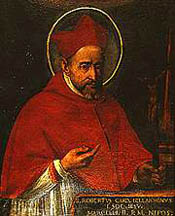
Part 110: Doctors of the Church and Perfection: Robert Bellarmine


Bellarmine's On the Ascent of the Mind to God is a treatise on the way to achieve perfection.

I laid the groundwork from his other work yesterday, and now go more into detail.

Here is a snippet for meditation:


From a treatise On the Ascent of the Mind to God by Saint Robert Bellarmine 
(Ante exsilium, nn 1-3: PG 52, 427*-430)

Incline my heart to your decrees 

Sweet Lord, you are meek and merciful. Who would not give himself wholeheartedly to your service, if he began to taste even a little of your fatherly rule? What command, Lord, do you give your servants? Take my yoke upon you, you say. And what is this yoke of yours like? My yoke, you say, is easy and my burden light. Who would not be glad to bear a yoke that does not press hard but caresses? Who would not be glad for a burden that does not weigh heavy but refreshes? And so you were right to add: And you will find rest for your souls. And what is this yoke of yours that does not weary, but gives rest? It is, of course, that first and greatest commandment: You shall love the Lord your God with all your heart. What is easier, sweeter, more pleasant, than to love goodness, beauty and love, the fullness of which you are, O Lord, my God?

Is it not true that you promise those who keep your commandments a reward more desirable than great wealth and sweeter than honey? You promise a most abundant reward, for as your apostle James says: The Lord has prepared a crown of life for those who love him. What is this crown of life? It is surely a greater good than we can conceive of or desire, as Saint Paul says, quoting Isaiah: Eye has not seen, ear has not heard, nor has it so much as dawned on man what God has prepared for those who love him.

Truly then the recompense is great for those who keep your commandments. That first and greatest commandment helps the man who obeys, not the God who commands. In addition, the other commandments of God perfect the man who obeys them. They provide him with what he needs. They instruct and enlighten him and make him good and blessed. If you are wise, then, know that you have been created for the glory of God and your own eternal salvation. This is your goal; this is the center of your life; this is the treasure of your heart. If you reach this goal, you will find happiness. If you fail to reach it, you will find misery.

May you consider truly good whatever leads to your goal and truly evil whatever makes you fall away from it. Prosperity and adversity, wealth and poverty, health and sickness, honors and humiliations, life and death, in the mind of the wise man, are not to be sought for their own sake, nor avoided for their own sake. But if they contribute to the glory of God and your eternal happiness, then they are good and should be sought. If they detract from this, they are evil and must be avoided.


To be continued...

Tuesday, 9 April 2013

The main media is not covering this murder case--

http://www.philly.com/philly/news/local/20130409_Former_Gosnell_employee_testifies_that_problem_abortion__quot_really_freaked_me_out_quot_.html

Good, as usual, Buchanan blog post

http://buchanan.org/blog/where-have-all-the-workers-gone-5525

Friends in England Do Not Believe This

We saw this in Des Moines in 1996. They were falling out of the trees. Very interesting.


http://news.yahoo.com/blogs/sideshow/cicadas-coming-151907579.html


http://www.usnews.com/news/newsgram/articles/2013/04/08/cicadas-ready-to-re-emerge-after-17-years


From horse meat to camel stew--ah, the poor French president

http://www.ibtimes.co.uk/articles/455043/20130409/francois-hollande-mali-camel.htm

camel stew, but not the same camel

Time for an anti-socialism reminder

One cannot be a Catholic and a socialist. Thanks to my friends, I repost this great list. Thanks to ftpstudentaction, again! And, as these statements were from the Chair of Peter, this condemnation of socialism is an infallible truth of the Catholic Church. Do not kid yourself on this point.


Pius-IX
PIUS IX (1846-1878)

The Overthrow of Order

“You are aware indeed, that the goal of this most iniquitous plot is to drive people to overthrow the entire order of human affairs and to draw them over to the wicked theories of this Socialism and Communism, by confusing them with perverted teachings.”
(Encyclical Nostis et Nobiscum, December 8, 1849)


Leo-XIII
LEO XIII (1878-1903)

Overthrow is Deliberately Planned

“... For, the fear of God and reverence for divine laws being taken away, the authority of rulers despised, sedition permitted and approved, and the popular passions urged on to lawlessness, with no restraint save that of punishment, a change and overthrow of all things will necessarily follow. Yea, this change and overthrow is deliberately planned and put forward by many associations of communists and socialists.”
(Encyclical Humanum Genus, April 20, 1884, n. 27)

Debasing the Natural Union of Man and Woman

“They [socialists, communists, or nihilists] debase the natural union of man and woman, which is held sacred even among barbarous peoples; and its bond, by which the family is chiefly held together, they weaken, or even deliver up to lust.
(Encyclical Quod Apostolici Muneris, December 28, 1878, n. 1)

The Harvest of Misery

“...there is need for a union of brave minds with all the resources they can command. The harvest of misery is before our eyes, and the dreadful projects of the most disastrous national upheavals are threatening us from the growing power of the socialistic movement.”
(Encyclical Graves de Communi Re, January 18, 1901, n. 21)

St-Pius-X
SAINT PIUS X (1903-1914)

The Dream of Re-Shaping Society will Bring Socialism

“But stranger still, alarming and saddening at the same time, are the audacity and frivolity of men who call themselves Catholics and dream of re-shaping society under such conditions, and of establishing on earth, over and beyond the pale of the Catholic Church, ‘the reign of love and justice’ ... What are they going to produce? ... A mere verbal and chimerical construction in which we shall see, glowing in a jumble, and in seductive confusion, the words Liberty, Justice, Fraternity, Love, Equality, and human exultation, all resting upon an ill-understood human dignity. It will be a tumultuous agitation, sterile for the end proposed, but which will benefit the less Utopian exploiters of the people. Yes, we can truly say that the Sillon, its eyes fixed on a chimera, brings Socialism in its train.”
(Apostolic Letter Notre Charge Apostolique ["Our Apostolic Mandate"] to the French Bishops, August 15, 1910, condemning the movement Le Sillon)
Benedict-XV
BENEDICT XV (1914-1922)

Never Forget the Condemnation of Socialism 

“It is not our intention here to repeat the arguments which clearly expose the errors of Socialism and of similar doctrines. Our predecessor, Leo XIII, most wisely did so in truly memorable Encyclicals; and you, Venerable Brethren, will take the greatest care that those grave precepts are never forgotten, but that whenever circumstances call for it, they should be clearly expounded and inculcated in Catholic associations and congresses, in sermons and in the Catholic press.”
(Encyclical Ad Beatissimi Apostolorum, November 1, 1914, n. 13)


Pius-XI
PIUS XI (1922-1939)

Socialism Cannot Be Reconciled with Catholic Doctrine

“We make this pronouncement: Whether considered as a doctrine, or an historical fact, or a movement, Socialism, if it remains truly Socialism, even after it has yielded to truth and justice on the points which we have mentioned, cannot be reconciled with the teachings of the Catholic Church because its concept of society itself is utterly foreign to Christian truth.”
(Encyclical Quadragesimo Anno, May 15, 1931, n. 117)

Catholic Socialism is a Contradiction

“[Socialism] is based nevertheless on a theory of human society peculiar to itself and irreconcilable with true Christianity. Religious socialism, Christian socialism, are contradictory terms; no one can be at the same time a good Catholic and a true socialist.” (Ibid. n. 120)

Pius-XII
PIUS XII (1939-1958)

The Church Will Fight Socialism to the End 

“[The Church undertook] the protection of the individual and the family against a current threatening to bring about a total socialization which in the end would make the specter of the 'Leviathan' become a shocking reality. The Church will fight this battle to the end, for it is a question of supreme values: the dignity of man and the salvation of souls." (“Radio message to the Katholikentag of Vienna,” September 14, 1952 inDiscorsi e Radiomessaggi, vol. XIV, p. 314)

The All-Powerful State Harms True Prosperity 


"To consider the State as something ultimate to which everything else should be subordinated and directed, cannot fail to harm the true and lasting prosperity of nations." (Encyclical Summi Pontificatus, October 20, 1939, n. 60)

John-XXIII
JOHN XXIII (1958-1963)

“No Catholic could subscribe even to moderate socialism”

“Pope Pius XI further emphasized the fundamental opposition between Communism and Christianity, and made it clear that no Catholic could subscribe even to moderate Socialism. The reason is that Socialism is founded on a doctrine of human society which is bounded by time and takes no account of any objective other than that of material well-being. Since, therefore, it proposes a form of social organization which aims solely at production; it places too severe a restraint on human liberty, at the same time flouting the true notion of social authority.” (Encyclical Mater et Magistra, May 15, 1961, n. 34)

Paul-VI
PAUL VI (1963-1978)

Christians Tend to Idealize Socialism

“Too often Christians attracted by socialism tend to idealize it in terms which, apart from anything else, are very general: a will for justice, solidarity and equality. They refuse to recognize the limitations of the historical socialist movements, which remain conditioned by the ideologies from which they originated.” (Apostolic Letter Octogesima Adveniens, May 14, 1971, n. 31)

John-Paul-II
JOHN PAUL II (1978-2005)

Socialism: Danger of a "simple and radical solution"

“It may seem surprising that ‘socialism’ appeared at the beginning of the Pope's critique of solutions to the ‘question of the working class’ at a time when ‘socialism’ was not yet in the form of a strong and powerful State, with all the resources which that implies, as was later to happen. However, he correctly judged the danger posed to the masses by the attractive presentation of this simple and radical solution to the ‘question of the working class.’" (Encyclical Centesimus Annus - On the 100th anniversary of Pope Leo XIII'sRerum Novarum, May 1, 1991, n. 12)

Benedict-XVI
BENEDICT XVI (2005 - 2013)

We do not Need a State which Controls Everything

“The State which would provide everything, absorbing everything into itself, would ultimately become a mere bureaucracy incapable of guaranteeing the very thing which the suffering person - every person - needs: namely, loving personal concern. We do not need a State which regulates and controls everything, but a State which, in accordance with the principle of subsidiarity, generously acknowledges and supports initiatives arising from the different social forces and combines spontaneity with closeness to those in need. … In the end, the claim that just social structures would make works of charity superfluous masks a materialist conception of man: the mistaken notion that man can live ‘by bread alone’ (Mt 4:4; cf. Dt 8:3) - a conviction that demeans man and ultimately disregards all that is specifically human.” (EncyclicalDeus Caritas Est, December 25, 2005, n. 28)

Shame in Brixton

http://www.ibtimes.co.uk/articles/455054/20130409/thatcher-death-party.htm.

How civilization has died....even a charity shop was vandalized.

Anarchy.

Why I love history


Trolls in print-horrible

http://blogs.telegraph.co.uk/news/timstanley/100211357/the-swps-fanatics-have-outdone-themselves-with-their-margaret-thatcher-is-dead-rejoice-cover/


One Margaret Thatcher Quotation

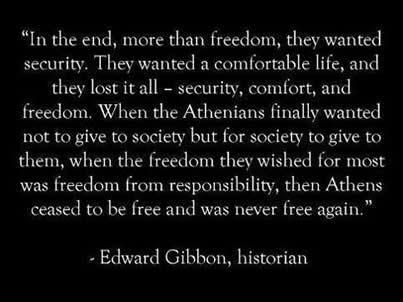
 "I think we have gone through a period when too many children and people have been given to understand 'I have a problem, it is the Government’s job to cope with it!' or 'I have a problem, I will go and get a grant to cope with it!' 'I am homeless, the Government must house me!' and so they are casting their problems on society and who is society? There is no such thing! There are individual men and women and there are families and no government can do anything except through people and people look to themselves first… There is no such thing as society. There is living tapestry of men and women and people and the beauty of that tapestry and the quality of our lives will depend upon how much each of us is prepared to take responsibility for ourselves and each of us prepared to turn round and help by our own efforts those who are unfortunate."

Part 109: Doctors of the Church and Perfection: Robert Bellarmine


The Church has been so blessed to have seen the rise of great defenders of the Faith just when needed.

Bellarmine is untangling many of the false ideas of Protestantism in his works and clarifying simple, as well as complex teachings, which had fallen into confusion.

We have seen his comments on the Theological Virtues, and we saw his comments on the Evangelical Counsels, , that is, his advice on an examination of conscience which helps one achieve those counsels.

Now, he moves to the Four Cardinal Virtues, and emphasizes three virtues which had become misunderstood in the wake of  the Protestant Revolt. However, I want to emphasize his section on prayer, as  here one clearly sees the movement from purgation to perfection. I shall make comments in blue.


In fine, that prayer can obtain many gifts, St. John Chrysostom beautifully teaches us in his " two 
books" on Prayer, in which he employs the comparison of the human hands. For as man is born 
naked and helpless, and in want of all things, and vet cannot complain of his Creator, because He has 
given him hands, which are the organ of organs, and by which he is enabled to provide for himself 
food, garments, house, &c.; so also the spiritual man can do nothing without the divine .assistance; 
but he possesses the power of prayer, the organ of all spiritual organs, whereby he can easily provide 
for himself all things. 

Besides these three primary advantages of prayer, there are also many others. For, in the first place, 
prayer enlightens the mind; man cannot directly fix the eye of his soul upon God, who is the light, without  being enlightened by Him. “Come ye to him and be enlightened” saith David. 

This enlightenment can come both in the purgation state and, obviously, in the state of illumination, when one has infused knowledge about Scripture and God. One of the problems with modern Catholics is that they do not leave enough time for prayer. One hour a day in prayer, plus one hour a day in reading Scripture, that is, the lectio divina, should bring about enlightenment with regard to one's sins and failings.


Secondly, prayer nourishes 
our hope and confidence; for the oftener we speak with another, the more confidently do we approach to him. 


Thirdly, it inflames our charity, and makes our soul more capable of receiving greater gifts, as St. Augustine 
affirms. 


Fourthly, it increases humility and chaste fear, for he who goes to prayer, acknowledges that he is a 

beggar before God, and therefore humbles himself before Him, and is most careful not to offend Him, of whose 
assistance he stands in need in everything.


One can see in these steps, the necessity for prayer on the way to perfection. In fact, much purgation takes place directly in prayer, especially before the Eucharist in Adoration. Adoration is a great gift to modern Catholics on the road through purgation to illumination.


Fifthly, prayer produces in our mind a contempt of all earthly goods; 

for all temporal objects must appear mean and contemptible in the eyes of him who continually meditates on 
things spiritual and eternal.(See St. Augustine, (Lib. ix. Confess))


Sixthly, prayer gives us incredible delight, 
since by it we begin to taste how sweet is the Lord. And how great this sweetness is, we may understand from this circumstance alone, that some I have known pass not only nights, but even whole days and nights in prayer, without any trouble or inconvenience. In fine, besides the utility and the pleasure, prayer also adds
dignity and honour to us. For even the angels themselves honour that soul which they see is so often and so familiarly admitted, to speak with the divine Majesty. 

What Bellarmine is describing is an advanced stage of the illuminative state. Such a devotion to prayer becomes a necessity to one seeking union with Christ. But, what is our prayers are unanswered? Read on...

We will now speak on the method of praying well, in which chiefly consists the Art of living well, 
and consequently the Art of dying well. For what our Lord says, “Ask and it shall be given to you, 
for every one that asketh, receiveth;" St. James, in his epistle, declares it to be understood with the condition, if we ask properly. “You ask and receive not, because you ask amiss." (chap, iv.) We may reason then as follows: he who properly asks for the gift of living well, will doubtless receive it; and he who properly asks for perseverance in a good life until death, and by this a happy death also, will certainly obtain it. We will, therefore, briefly explain the conditions of prayer, that so we may learn how to pray well, live well, and die well. 

I am sure you have met people who have their prayers answered regularly. Their prayer is efficacious. One begins to ask those who exhibit efficacious prayer for intercessions. The answers lie in both the purity of heart, mind and soul of the one who prays, and in the strength of the virtues practiced.


The first condition is faith, according to the words of the apostle, " How then shall they call upon 
him, in whom they have not believed?” and with this St. James agrees, " Let him ask in faith, nothing 
wavering." 

After purgation, one begins to pray in the Will of God, being closer to God through purity.

But this necessity of faith is not so to be understood, as if it were necessary to believe that God would 
certainly grant what we ask, for thus our faith would often prove false, and we should therefore 
obtain nothing. We must believe, then, that God is most powerful, most wise, most High, and most 
faithful; and therefore that He knows, and that He can and is prepared to do what we beg, of Him, if 
He shall think proper, and it be expedient for us to receive what we ask. This faith Christ required of 
the two blind men who desired to be cured; "Do you believe, that I can do this unto you?" With the 
same faith did David pray for his sick son; for his words prove, that he believed not for certain that God would grant his request, but only that He could grant it; "Who knoweth whether the Lord may not give him to me, and the child may live?"

God did not answer David's prayer, nor did He answer Paul's prayer.

It cannot be doubted but that with the same faith the apostle Paul prayed to be delivered from the “sting of the flesh," since he prayed with faith, and his faith would have been false if he believed that God would certainly grant what at that time he asked; for he did not then obtain his request. 

And with the same faith does the Church pray, that all heretics, pagans, schismatics, and bad Christians may be converted to penance; and yet it is certain 
they are not all converted. Concerning which matter consult St. Prosper in his books " On the 
Vocation of the Gentiles." 

For those tempted to believe in the heresy of universal salvation, Bellarmine's advice to read St. Prosper may be apropos. 

Another condition of prayer, and that a very necessary one, is hope or confidence. For although we 
must not by faith, which is a work of the understanding, imagine that God will certainly grant our 
requests, yet by hope, which is an act of the will, we may firmly rely upon the divine goodness, and 
certainly hope that God will give us what we ask for. This condition our Lord required of the 
paralytic, to whom He said, " Be of good heart, son, thy sins are forgiven thee." The same the apostle 
requires of all, when he says, “Let us go therefore with confidence to the throne of grace ;" and long 
before him, the prophet thus introduces God, saying, " Because he hath hoped in me, I will deliver 
him." But because hope springs from perfect faith, therefore when the Scripture requires faith in the 
great things, it adds something regarding hope; hence we read in St. Mark, "Amen I say to you, that 
whosoever shall say to this mountain, Be thou removed and be cast into the sea, and shall not 
stagger in his heart, but believe that whatsoever he saith shall be done; it shall be done unto him: "
of which faith producing confidence, are to be understood the words of the apostle; " If I should have 
all faith, so that I could remove mountains, & c

Confidence increases after purgation. Once one is living the life of the virtues, there occurs a corresponding growth of confidence in Divine Providence. 
. 
Hence, John Cassian writes in his Treatise on Prayer, that it is a certain sign of our request being 
granted, when in prayer we hope that God will certainly give us what we ask; and when in our 
petitions we do not in any way hesitate, but pour forth in prayers with spiritual joy.

A third condition is charity or justice, by which we are delivered from our sins; for none but the 
friends of God obtain the gifts of God. Thus David speaks in the Psalms: " The eyes of the Lord are 
upon the just; and his ears unto their prayers: " and in another place, " If I have looked at iniquity in 
my heart, the Lord will not hear me.” 

The peace of the person who is abiding in the Lord is a great witness of the state of illumination.

And in the New Testament our Lord himself says: " If you abide in me, and my words (precepts) 
abide in you, - you shall ask whatsoever you will, and it shall be done unto you." And the beloved 
disciple saith: "Dearly beloved, if our heart do not reprehend us, we have confidence towards God: 
and whatsoever we shall ask, we shall receive of him; because we keep his commandments, and do 
those things which are pleasing in his sight." (1 Epist. of St. John iii. 21, 22.) This is not contrary to the doctrine, that when the publican asked of God the forgiveness of his sins, he returned home 
"justified;" for a penitent sinner does not obtain his request as a sinner, but as a penitent; for as a 
sinner he is the enemy of God; as a penitent, the friend of God. He that commits sin, does what is not 
pleasing unto God; but he who repents of his sins, does what is most pleasing to Him. 

A fourth condition is humility, by which he that prays, confides not in his own justice, but in the 
goodness of God: "But to whom shall I have respect, but to him that is poor and little, and of a 
contrite spirit, and that trembleth at my words?" (Isaias lxvi. 2.) And Ecclesiasticus adds: "The 
prayer of him that humbleth himself, shall pierce the clouds: and till it come nigh he will not be 
comforted: and he will not depart till the Most High behold." (xxxv. 21.) 

Here, the modern men and women fail miserably  Either falling into vainglory or into false humility  one avoids the reality of facing one's self.

A fifth condition is devotion, by which we pray not negligently, as many are accustomed to do, but 
with attention, earnestness, diligence, and fervour: our Lord severely blames those who pray with 
their lips only; thus He speaks by Isaiah: "This people draw near me with their mouth, and with their 
lips glorify me; but their heart is far from me." (xxix. 13.) This virtue springs from a lively faith, and consists not in habit alone, but in deed. For he who attentively and with a firm faith considers how great is the Majesty of God, how great our nothingness, and how important those things are we ask for, cannot possibly help praying with the greatest humility, reverence, devotion, and fervour. 

We shall here add powerful testimonies from two of the holy fathers. St. Jerome in his Dialogues 
against the Luciferians, says: "I commence prayer: I should not pray, if I did not believe; but if I had 
true faith, this heart, which God sees, I would cleanse; I would strike my breast: I would water my 
cheeks with my tears: I would neglect all attention to my body and become pale; I would throw 
myself at the feet of my Lord, and wash them with my weeping, and wipe them with my hair: I 
would clasp the cross, and not depart before I had obtained mercy. Now most frequently during my 
prayers, I am walking either along the porticos, or am counting my usury; or being carried away by evil thought; I entertain those things which it is shameful to speak of. Where is our faith ? Do we suppose that Jonas prayed thus? The three children? Daniel in the lions den? Or the good thief on the cross?" 


St. Bernard, in his Sermon on the Four Methods of Praying, thus writes "It especially behoves us, during the time of prayer, to enter the heavenly chamber that chamber I mean, in which the King of kings sitteth on his royal throne, surrounded by an innumerable and glorious army of blessed spirits. 

We have lost the ability to be humble in the West. Part of this has been the culture of entitlement and the lack of disciplining children. Without discipline, a person grow up with a will which has not been bent to obedience and humility. One sees this daily.

With what reverence then, with what fear, with what humility, ought dust and ashes to approach, 
we who are nothing but vile creeping insects! With what trembling, earnestness, care, and solicitude, 
ought miserable man to stand before the divine Majesty, in presence of the angels, in the assembly of 
the just? In all our actions then, we have much need of vigilance, especially in prayer."

Vigilance in prayer means intellectual engagement. "Paying attention"....

The sixth condition is perseverance, which our Lord in two parables has recommended in St. Luke; 
the first is concerning him who went in the night to a friend to ask for the loan of two loaves; who 
being refused because of the unseasonable hour, yet by perseverance obtained his request. (St. Luke 
xi.) The second is concerning the widow who besought the judge to free her from her adversary; and 
the judge, although a very bad man, and one that feared neither God nor man, yet being overcome by the perseverance and importunity of the woman, he delivered her from her adversary. From these 
examples our Lord concludes, that much more ought we to persevere in prayer to God, because He is 
just and merciful. And, as St. James adds: "He giveth to all abundantly, and upbraideth not ;" that is, 
hegives liberally to all who ask His gifts; and He " upbraideth not" their importunity, should they be 
too troublesome in their importunities; for God has no measure in His riches nor in His mercy. St. 
Augustine, in his explanation of the last verse of Psalm lxv. adds these words: " If thou shalt see that thy prayer is not rejected, thou art secure, because his mercy is not removed from thee."

A mystery begins to unfold.  The more one prays, the more one wants to pray. The more one prays, the more God reveal Himself to the person. The more God reveals Himself, the more one desires God. One moves from the purgation of sins and imperfections, to illuminations, and finally to unity.

It is obvious that, like the other Doctors of the Church, Bellarmine experienced these steps in order to share with us the way to perfection.

To be continued...

Part 108: Doctors of the Church and Perfection: Robert Bellarmine

Part of the road to perfection, as one has seen in this long series, is the formation of the mind to the Mind of Christ. When I have taught this, some have said to me, "How can I know the Mind of Christ?" The answer is simple, one follows the Teaching Magisterium of the Church, receiving the sacraments frequently, and forming an adult conscience. We must do this. We have no option to ignore the formation of conscience in our lives.

It is the duty of parents to teach this method to their children. The formation of children begins as early as possible, depending on the child, but by seven, when a child can discern good and evil (for many it is earlier), the method of daily examen can begin. Do you want your children to become saints? Do you want them to walk in the way to perfection?

Here is Bellarmine at his Jesuit best


But some one may reply: "What advice do you give to teach us to watch as we ought, and by 
watching to prepare for a good death?" Nothing more useful occurs to me, than for us frequently and 
seriously to examine our conscience, that so we may prepare for death...

In fine, there are hardly any Catholics, who, when near death, do not confess 
their sins. But what shall we say of those who are snatched away by a sudden death? 
What of those who are afflicted with madness, or fall into delirium before confession? What of those 
who, being grievously afflicted by their disease, cannot even think of their sins ? What of those who 
sin whilst dying, or die in sin, as they do who engage in an unjust war, or in a duel, or are killed in 
the act of adultery? 

It is extremely important for those who live in the world to develop this habit. Do not wait until your children are teens, start when they are in preparation for the sacrament of Confession at the latest.

Prudently to avoid these and other like misfortunes, nothing can be imagined more useful than for 
those who value their salvation, , twice every day, morning and night, diligently to examine their 
conscience; what they have done during the night, or the preceding day; what they have said, 
desired, or thought of, in which sin may have entered; and if they shall discover anything mortal, let them not defer seeking the remedy of true contrition, with a resolution to approach the sacrament of penance on the very first opportunity. 
Wherefore, let them ask of God the gift of contrition, let them ponder on the enormity of sin, let them 
detest their sins from their heart, and seriously ask themselves who is the "offended and the 
offenders." Man, a worm, offends God the Almighty; a base slave, the Lord of heaven and earth! 
Spare not then your tears, nor cease to strike your breast: in fine, make a firm resolution never more 
to offend God, never more to irritate the best of Fathers. If this examination be continued morning 
and night, or at least once in the day, it can scarcely happen that we shall die in sin, or mad, or 
delirious. Thus it will be, that every preparation being made for a good death, neither its uncertainty will trouble us, nor the happiness of eternal life fail us.

To be continued...

Part 107: Doctors of the Church and Perfection: Robert Bellarmine

In the former section, Bellarmine writes about Faith. Here, he continues looking at the necessity of Hope and Love, those Theological Virtues, all three, we receive in baptism. There are many good Catholics who do not think we should admonish the wicked or even those among us who are weak. This idea is a false charity. Read on... Bellarmine describes exactly the need for the purgation state, the state of purification. Real love, that is the virtue of charity, must be connected to a pure heart and a pure mind., as well as a pure soul.

Without this purity, we cannot enter into the life of the virtues, given to us. Sadly, many Catholics desire to blur distinctions between sin and goodness, impurity and purity.


Hear what the wise man thinks of the hope of the wicked: "The hope of the wicked is as dust, which 
is blown away with the wind, and as a thin froth which is dispersed by the storm: and a smoke that 
is scattered abroad by the wind; and as the remembrance of a guest of one day that passeth by."
(Wisdom v. 15.). 


Thus the wise man admonishes the wicked, that their hope is weak not strong; short not lasting; they may indeed, whilst they are alive, entertain some hopes, that someday they will repent and be reconciled to God: but when death overtakes them, unless the Almighty by a special grace move their heart, and inspire them with true sorrow, their hope will be changed into despair, and they will exclaim with the rest of the wicked: "Therefore we have erred from the way of truth, and the light of justice hath not shined unto us, and the sun of understanding hath not risen upon us. What hath pride profited us? or what advantage hath the boasting of riches brought us? All those things are passed away like a shadow," &c. (Wisdom v. 6 8.) Thus doth the wise man admonish us, that if we wish to live well and die well, we must not dare to remain in sin, even for one moment, nor allow ourselves to be deceived by a vain confidence, that we have as yet many years to live, and that time will be given to us for repentance. 


Such a vain confidence hath deceived many, and will deceive many more, unless they wisely learn 
whilst they have time the Art of dying well. “There now remaineth charity, the third virtue, which is justly called the “queen of virtues;" with this no one can perish, without it no one can live, either in this life or in the next. But that alone is true charity which springs from a " pure heart: " it is "from God," as St. John saith; and also more clearly St. Paul, "The charity of God is poured forth in our hearts by the Holy Ghost, who is given to us." (Epist. to Romans v. 5.) Charity is therefore said to come from a "pure heart," because it is not enkindled in an impure heart, but in one purified from its errors by faith, according to the words of the apostle Peter: "purifying their hearts by faith: " and by divine hope, it is also purified from the love and desire of earthly things. 

For as a fire cannot be enkindled in wood that is green or damp, but only in dry wood; so also the fire of charity requires a heart purified from earthly affections, and from a foolish confidence in its own strength. 

Bellarmine does not mince words, nor should we. The misunderstanding of the nature of real love keeps many from following the way of perfection. As Bellarmine notes above, we must be purified of errors concerning the Faith.  One of the problems with today's Catholics, for example, is that too many want to compromise regarding the Teachings of the Church, with contraception, for example. Just as many Evangelicals practice brith control, these Catholics are held back in their walk to Christ, not allowing God to purify their hearts and minds and souls. Many problems, including the proliferation of sin, occurs. 


From this explanation we can understand what is true charity, and what false and feigned. For should we delight to speak of God, and shed even tears at our prayers should we do many good works, give alms and often fast; but yet allow impure love to remain in our heart, or vain glory, or 
hatred to our neighbour, or any other of those vices that make our hearts depraved this is not true 
and divine charity, but only its shadow. With the greatest reason then does St. Paul, when speaking 
of true and perfect justice, not mention simply, faith, hope, and charity: but he adds, “Now the end of the commandment is charity from a pure heart, and a good conscience, and an unfeigned faith." This is the true Art of living and dying well, if we persevere till death in true and perfect charity

There is a false faith, a "feigned faith" if we do not allow our selves to be conformed to the mind of the Church regarding Faith and Morals. Bellarmine sees this plainly, writing at the greatest time of chaos concerning the Protestant Revolt.

We must each decide not to live in the shadowland of feigned faith.

To be continued...

Part 106: Doctors of the Church and Perfection-the Jesuits: Robert Bellarmine

One may be surprised that only two Doctors of the Church are Jesuits, but they do belong to a new order than, for example, the Franciscans and Benedictines.

St. Robert Bellarmine has been "bad-mouthed" in the past decades because of his part in the Galileo Controversy. Saints are not infallible and remember, that the issue concerning Galileo was not his idea that the earth goes about the sun, but that he stated in matters of truth, science trumps Scripture. That was his mistake, and one can study this on one's own.

Robert Bellarmine arrived at a crucial time in the history of the Church. The confusion following the Protestant Revolt demanded theologians and Church leaders with brilliance and the ability to write. He has both.

For my purposes, I shall be looking at one document carefully which is connected to the ideals of perfection. Bellarmine wrote The Art of Dying Well, a title which should appeal to many of my readers.

One of the biggest problems I have encountered in Catholics concerning the road to perfection is that many simply do not believe we are all called to start upon and come to the goal of this journey.

How many people I have met in a short period of time who believe only in universal salvation; that is, the salvation of all people regardless of their lives. It is as if the idea of the Merciful Saviour has deadened some Catholics view of consequences for evil, or merely, tepidity. The way of perfection begins with orthodoxy and faith. Bellarmine makes an excellent point on the difference between real faith and fake faith. His words are echoed later, down the centuries, in Bonhoeffer.

Let me start with this section from the cited book:

Let us begin with faith, which is the first of all the virtues that exists in the heart of a justified man. 
Not without reason, doth the apostle add " unfeigned" to faith. For faith begins justification, provided 
it be true and sincere, not false or feigned. The faith of heretics does not begin justification, because it 
is not true, but false; the faith of bad Catholics does not begin justification, because it is not sincere, 
but feigned. It is said to be feigned in two ways: when either we do not really believe, but only 
pretend to believe; or when we indeed believe, but do not live, as we believe we ought to do. 
In both these ways it seems the words of St. Paul must be understood, in his Epistle to Titus: "They 
profess that they know God: but in their works they deny him." (chap. i. 16.) Thus also do the holy 
fathers St. Jerome and St. Augustine, interpret these words of the apostle. 
Now, from this first virtue of a just man, we may easily understand, how great must be the multitude of those who do not live well, and who therefore die ill. I pass by infidels, pagans, heretics, and atheists, who are completely ignorant of the Art of dying well. And amongst Catholics, how many are there who in words, " profess to know God, but in their works deny him?" Who acknowledge the mother of our Lord to be a virgin, and yet fear not to blaspheme her? Who praise prayer, fasting, alms deeds, and other good works, and yet always indulge in the opposite vices ? I omit other things that are known to all. Let not those then boast that they possess “unfeigned” faith, who either do not believe what they pretend to believe, or else do not live as the Catholic Church commands them to do; and therefore they acknowledge by this conduct, that they have not yet begun to live well: nor can they hope to die happily, unless by the grace of God they learn the Art of living well. 


Another virtue of a just man is hope, or "a good conscience," as St. Paul has taught us to call it. This 
virtue comes from faith, for he cannot hope in God who either does not know the true God, or does 
not believe Him to be powerful and merciful. But to excite and strengthen our faith, that so it may be called not merely hope, but even confidence, a good conscience is very necessary. For how can any one approach God, and ask favours from Him, when he is conscious of heaving committed sin, and of not having expiated it by true repentance ? Who asks a benefit from an enemy? Who can expect to be relieved by him, who he knows is incensed against him ? 

I have met many, many converts in the past two years here in England and some have formed good consciences and some have not. The latter group, mostly, has been, sadly, badly catechized. But, a good conscience is the beginning of the purification stage. Without this formation of conscience, perfection is, simply, impossible.

To be continued....