Friday, 25 April 2014
Third Attribute: Simplicity
Posted by
Supertradmum
This Attribute may be the most easy to comprehend. God is not a composite Being. The Church tells us that our soul is "simple". Aquinas says it best, in my opinion.
Summa Theologica I;3 http://www.newadvent.org/summa/1003.htm
On the contrary, Augustine says (De Trin. iv, 6,7): "God is truly and absolutely simple."
I answer that, The absolute simplicity of God may be shown in many ways.
First, from the previous articles of this question. For there is neither composition of quantitative parts in God, since He is not a body; nor composition of matter and form; nor does His nature differ from His "suppositum"; nor His essence from His existence; neither is there in Him composition of genus and difference, nor of subject and accident. Therefore, it is clear that God is nowise composite, but is altogether simple.
Secondly, because every composite is posterior to its component parts, and is dependent on them; but God is the first being, as shown above (Question 2, Article 3).
Thirdly, because every composite has a cause, for things in themselves different cannot unite unless something causes them to unite. But God is uncaused, as shown above (Question 2, Article 3), since He is the first efficient cause.
Fourthly, because in every composite there must be potentiality and actuality; but this does not apply to God; for either one of the parts actuates another, or at least all the parts are potential to the whole.
Fifthly, because nothing composite can be predicated of any single one of its parts. And this is evident in a whole made up of dissimilar parts; for no part of a man is a man, nor any of the parts of the foot, a foot. But in wholes made up of similar parts, although something which is predicated of the whole may be predicated of a part (as a part of the air is air, and a part of water, water), nevertheless certain things are predicable of the whole which cannot be predicated of any of the parts; for instance, if the whole volume of water is two cubits, no part of it can be two cubits. Thus in every composite there is something which is not it itself. But, even if this could be said of whatever has a form, viz. that it has something which is not it itself, as in a white object there is something which does not belong to the essence of white; nevertheless in the form itself, there is nothing besides itself. And so, since God is absolute form, or rather absolute being, He can be in no way composite. Hilary implies this argument, when he says (De Trin. vii): "God, Who is strength, is not made up of things that are weak; nor is He Who is light, composed of things that are dim."
Reply to Objection 1. Whatever is from God imitates Him, as caused things imitate the first cause. But it is of the essence of a thing to be in some sort composite; because at least its existence differs from its essence, as will be shown hereafter, (4, 3).
Reply to Objection 2. With us composite things are better than simple things, because the perfections of created goodness cannot be found in one simple thing, but in many things. But the perfection of divine goodness is found in one simple thing (4, 1 and 6, 2).
The purpose of looking at the Attributes of God is to come into active contemplation of God. This active contemplation, obviously, brings us closer to Him as we use our reason and open ourselves to the infusion of knowledge from God, as much as He desires to give.
Sometimes, one can only contemplate God in love, when looking at the Attributes.
To be continued....
Attribute Two: Unity
Posted by
Supertradmum
Yet to us there is but one God, the Father, of whom are all things, and we unto him; and one Lord Jesus Christ, by whom are all things, and we by him. i Corinthians 8:6 DR
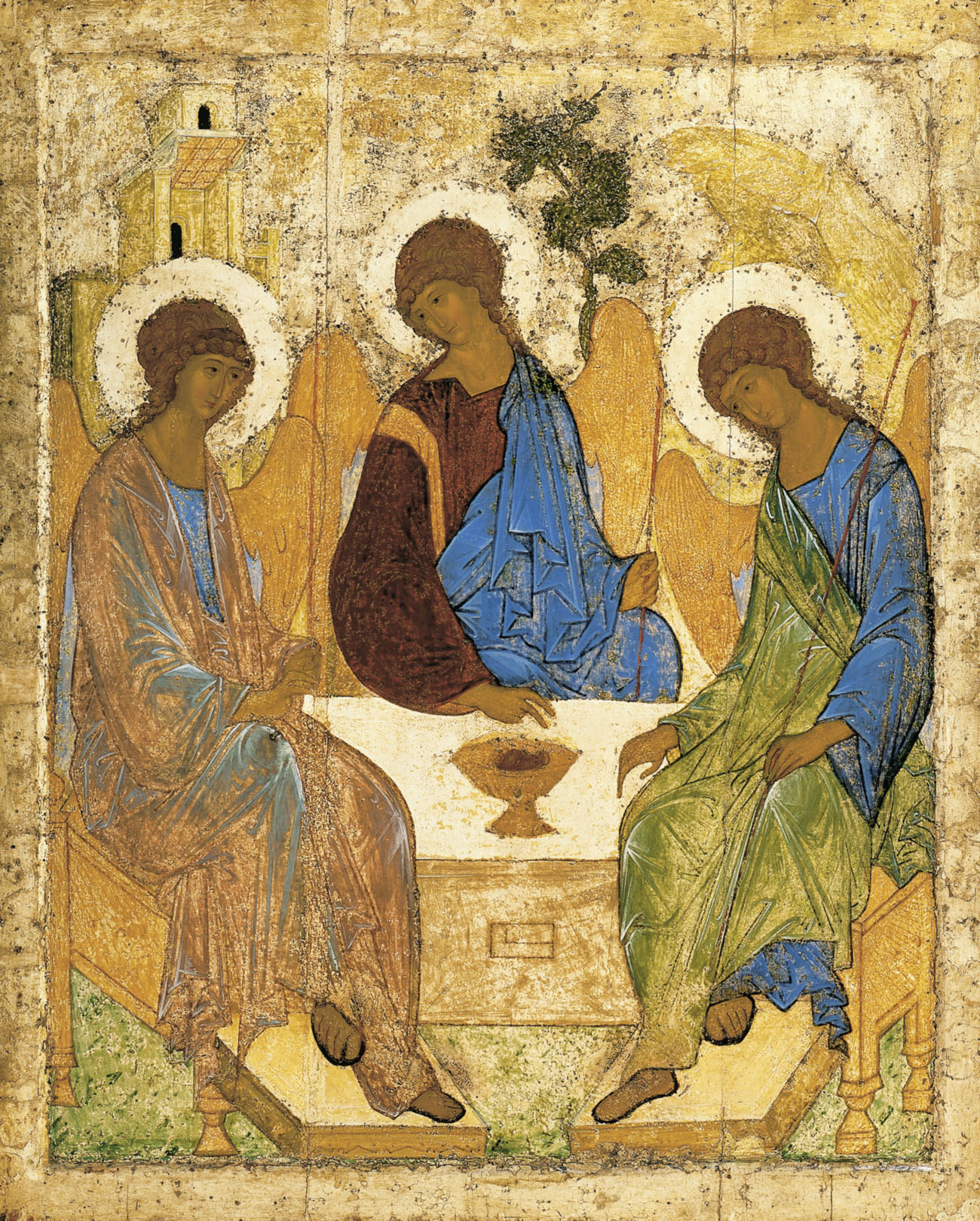
Garrigou-Lagrange has another book in which he looks at the Trinity. Now, the Mystery of the Triune God separates us from many other "faiths".
Unity is one of the Attributes of God. Here is a long selection from the book, The Trinity and God the Creator, and then a comment in blue.
First Article: Whether There Is A Trinity In God
The difficulty arises from the fact that everything that is triune is threefold, whereas God is not threefold since He possesses the greatest unity. Nevertheless the reply is in the affirmative as an article of faith. In the Athanasian Creed we read, "The Unity is to be worshiped in Trinity and the Trinity in Unity."[327]
Theology offers the following explanation. In God there is a transcendental plurality of persons. The term "Trinity" according to revelation limits this plurality to the three persons. Therefore the term Trinity can rightly be used.
Reply to the first objection. Etymologically the term "Trinity" seems to signify the unity of three, but in a special way it signifies the transcendental number of persons of one essence. Thus we cannot say that the Father is the Trinity. The term "Trinity" signifies at the same time the number of persons and the unity of the essence.
Reply to the second objection. St. John declared, "And these three are one" (I John 5:7). Hence we have the name "Trinity."
Reply to the third objection. Nevertheless in God there is no triplicity because triplicity denotes a proportion of inequality as do duplicity and quadruplicity. Thus we cannot say that God is threefold. That which is threefold has in a sense been tripled, as, for instance, a triple crown signifies the union of three crowns.
If God were said to be threefold, the three persons together would be more than one alone, and one person would not have infinite perfection. But we can say that the persons are threefold and the processions are twofold, because by adding person and procession we exclude sufficiently the multiplicity of nature.
Reply to the fourth objection. Unity in Trinity signifies that there is one nature in three persons, and Trinity in unity signifies three persons in one nature.
Reply to the fifth objection. We cannot say that the Trinity is threefold for this would mean that there were three supposita of the Trinity, whereas there are only three supposita of the Deity.
First corollary. From the foregoing the Thomists, especially Gonet, conclude that those things that belong to the persons by reason of the essence alone are predicated only singly. Those things, however, that belong to the persons by reason of the persons alone are predicated only in the plural. Those things that belong to the persons by reason of the essence and the relations are predicated both in the singular and in the plural.
The reason for this rule is that in God all things are one and the same except where there is the opposition of relation; only the relations are multiplied in God, the essence is not. This was defined by the Council of Toledo: "Number is discovered in the relation of the persons; but we find nothing that is numbered in the substance of the divinity. Thus number is indicated only in this, that they are mutually related; and they lack number in this, that they are in themselves."[328]
From this rule it follows that it is correct to say that there are three persons or three hypostases in God but not three individuals because the nature is multiplied in individuals. In its formal signification person denotes personality; in its material signification it denotes nature. On the other hand, the individual in its formal signification denotes nature; in its material signification it denotes personality.
This Truth to me is most awesome. God has "personality" and that is what distinguishes this definition of the Trinity from "individuality". That there are Three Persons in One God of one substance seems clear in the above clarification. Garrigou-Lagrange goes on to say that "...the Fourth Lateran Council, which said that the Father, the Son, and the Holy Ghost are "co-omnipotent and co-eternal, one principle of all things."[350]"
These Three Persons are One, but are knowable because of certain "notions" given through Revelation. These notions are defined as a "notion is that which is the proper reason for knowing a divine person."
Theology and philosophy, that is reason, can lead us to some understandings through the notions, but we need Revelation to help us know the Trinity.
Of course, Christ told us that He revealed the Father and that the Holy Spirit would come after His Ascension. That Christ came to reveal the Trinity is clear from the Annunciation. Christ became Incarnate by the power of the Holy Spirit and through the Fatherhood of God.
Mary was one of the first to have the Trinity revealed to her, and the only human to have experienced the Trinity as Three Persons intimately.
Personality indicates that God, like us made in His image and likeness, have knowledge of self. God reveals Himself to us as One, but in notions, which indicate relationship.
Here is the Dominican again.
Thus we have paternity, filiation, common active spiration, passive spiration, to which we add innascibility, because the person of the Father is known not only by paternity but also by the fact that He is from no one and that He is the principle without a principle. This notion is in conformity with the dignity of the Father, ....[370]
We may come to understand the Unity of God through Creation, through relationship with Him. His Unity is that there is only One God, One Infinite Being, as explained by the Church.
Here is Garrigou-Lagrange again.
The perfect intellect, however assimilates its Word most perfectly, not only intentionally, but really in nature and in a nature that is numerically one, so that the divine Word is not accidental but substantial, at the same time living and understanding, because in God being and understanding and being understood are the same. Revelation affirms that this substantial Word is the person of the Son of God. This is true generation, which primarily deserves the name generation; other kinds of generation are generation by participation and secondarily, although they are prior in our knowledge. Therefore St. Paul said," or this cause I bow my knees to the Father of our Lord Jesus Christ, of whom all paternity in heaven and earth is named" (Eph. 3:14 f.).[170]
My response to this small bit of explanation and guidance is pure awe and wonder. Actively contemplating on the Unity of God brings one closer to Him in this Oneness. Such is the grace He wants to give us.
I can only dip into the great complexity of the Attributes of God, but this little series may whet your appetite to study more.
To be continued.... and find more here https://www.ewtn.com/library/THEOLOGY/TRINITY.HTM#05
Attribute One: Perfection continued
Posted by
Supertradmum
Now, there are two erroneous views on perfection regarding God. The first is that only God as Spirit is perfect and that the material is imperfect. This is no longer true since the Redemptive action of Christ on the Cross, redeeming nature as well as spirit. As the Incarnate God, Christ joins the perfection of man with the perfection of God. The Hypostatic Union in Christ means that the Divine Nature is truly one with the Human Nature of Christ. Arians deny even today this Union, and we see heretical sects, such as the Christian Scientists denying the material, human nature of Christ, stating that it was an illusion.
The Nicene Creed is clear on this Hypostatic Union. This Union is Perfect. Christ's Will was Divine and Human. He is One Person with Two Natures, but "consubstantial with the Father". There is only One God, one Substance, with Three Divine Persons. Christ is begotten not made.
Christ is Body and Soul, in Heaven. His Resurrected Body bears the wounds of the Cross, a great mystery of His victory over sin and death.
The Nicene Creed
I believe in one God,
the Father almighty,
maker of heaven and earth,
of all things visible and invisible.
the Father almighty,
maker of heaven and earth,
of all things visible and invisible.
I believe in one Lord Jesus Christ,
the Only Begotten Son of God,
born of the Father before all ages.
God from God, Light from Light,
true God from true God,
begotten, not made, consubstantial with the Father;
through him all things were made.
For us men and for our salvation
he came down from heaven,
and by the Holy Spirit was incarnate of the Virgin Mary,
and became man.
For our sake he was crucified under Pontius Pilate,
he suffered death and was buried,
and rose again on the third day
in accordance with the Scriptures.
He ascended into heaven
and is seated at the right hand of the Father.
He will come again in glory
to judge the living and the dead
and his kingdom will have no end.
I believe in the Holy Spirit, the Lord, the giver of life,
who proceeds from the Father and the Son,
who with the Father and the Son is adored and glorified,
who has spoken through the prophets.
who proceeds from the Father and the Son,
who with the Father and the Son is adored and glorified,
who has spoken through the prophets.
I believe in one, holy, catholic and apostolic Church.
I confess one Baptism for the forgiveness of sins
and I look forward to the resurrection of the dead
and the life of the world to come. Amen.
I confess one Baptism for the forgiveness of sins
and I look forward to the resurrection of the dead
and the life of the world to come. Amen.
The second common modern error, which is old, but rehashed, is that God is not perfect, that He is somehow an image of man. the Greek gods were made in the image of man and so too, some people attribute to God the imperfections of man.
to be continued....
Attribute One: Perfection
Posted by
Supertradmum
Be you therefore perfect, as also your heavenly Father is perfect. Matthew 5:49 DR
Aquinas writes this below, on God as Perfect.
All created perfections are in God. Hence He is spoken of as universally perfect, because He lacks not (says the Commentator, Metaph. v) any excellence which may be found in any genus. This may be seen from two considerations. First, because whatever perfection exists in an effect must be found in the effective cause: either in the same formality, if it is a univocal agent---as when man reproduces man; or in a more eminent degree, if it is an equivocal agent---thus in the sun is the likeness of whatever is generated by the sun's power. Now it is plain that the effect pre-exists virtually in the efficient cause: and although to pre-exist in the potentiality of a material cause is to pre-exist in a more imperfect way, since matter as such is imperfect, and an agent as such is perfect; still to pre-exist virtually in the efficient cause is to pre-exist not in a more imperfect, but in a more perfect way. Since therefore God is the first effective cause of things, the perfections of all things must pre-exist in God in a more eminent way. Dionysius implies the same line of argument by saying of God (Div. Nom. v): "It is not that He is this and not that, but that He is all, as the cause of all." Secondly, from what has been already proved, God is existence itself, of itself subsistent (Question [3], Article [4]). Consequently, He must contain within Himself the whole perfection of being. For it is clear that if some hot thing has not the whole perfection of heat, this is because heat is not participated in its full perfection; but if this heat were self-subsisting, nothing of the virtue of heat would be wanting to it. Since therefore God is subsisting being itself, nothing of the perfection of being can be wanting to Him. Now all created perfections are included in the perfection of being; for things are perfect, precisely so far as they have being after some fashion. It follows therefore that the perfection of no one thing is wanting to God. This line of argument, too, is implied by Dionysius (Div. Nom. v), when he says that, "God exists not in any single mode, but embraces all being within Himself, absolutely, without limitation, uniformly;" and afterwards he adds that, "He is the very existence to subsisting things."
In this sense, perfection is a wholeness, a completeness of all that is good. God is not wanting in anything. And, all that is rests in Him. Nothing that is created exists outside of God. God, as the First Principle, is Perfect.
When God calls us to perfection, He is calling us to be all that He intended us to be. This cannot be done without His grace. This is the reason for purgation, to be emptied of all that stands in the way of our perfection in God.
God is the Essential Being and we participate in that. And, as we are made in the 'image and likeness of God", the image being free will and intellect, and the likeness being grace, which we must regain in baptism, we participate in the perfection of God according to how God has called us to that perfection.
God alone is totally Perfect.
http://www.newadvent.org/summa/1004.htm
New Series Coming Up-The Attributes of God
Posted by
Supertradmum
As much as I like Suarez, I am going to use St. Thomas Aquinas in a new series on the Attributes of God.
There is some confusion on this topic, as Protestants have come up with their own list. Of course, I shall refer to the greatest Doctor of the Church on this matter.
I hope to cover all these attributes in the next few days. But, today, let me list those according to Aquinas.
He divides the Attributes into those of divine substance and those of divine operation
Those of divine substance are: simplicity, perfection, goodness, infinity, immensity, immutability, eternity, unity, invisibility and ineffability.
Those of divine operation are: knowledge, will, love, justice, mercy, and providence.
More coming up...most of the information will be from The One God by Garrigou-Lagrange. See you all later.
Thursday, 24 April 2014
One cannot be a cynic and a Catholic....
Posted by
Supertradmum
cyn·i·cal
[sin-i-kuh
adjective
1.
distrusting or disparaging the motives of others; like or characteristic of a cynic.
2.
showing contempt for accepted standards of honesty or morality by one's actions, especially byactions that exploit the scruples of others.
3.
bitterly or sneeringly distrustful, contemptuous, or pessimistic.
http://dictionary.reference.com/browse/cynical
And a sin, folks....based on slander, judgment, hatred, bitterness, or pessimism, all which are not Catholic virtues, and, indeed, are vices...
Statistic growing
Posted by
Supertradmum
...4 percent of ordinands report being home schooled at some time in their educational
background, with diocesan ordinands being slightly more likely that religious ordninands to have
been home schooled (5 percent compared to 2 percent). Among those who were home schooled,
the average length of time they were home-schooled was seven years. 2013 report on ordinations in the USA.
background, with diocesan ordinands being slightly more likely that religious ordninands to have
been home schooled (5 percent compared to 2 percent). Among those who were home schooled,
the average length of time they were home-schooled was seven years. 2013 report on ordinations in the USA.
http://www.usccb.org/beliefs-and-teachings/vocations/ordination-class/upload/Ordination-Class-of-2013-report-FINAL.pdf
Less than 45% went to Catholic schools...out of 2 million Catholic school students, the ratio is alarming!
Considering in the US that there are only about 150,000 Catholic home schooled children at this time, (mostly a Protestant thing still), this statistic of 4% is huge.
Father John Hardon said, “Home schooling in the United States is the necessary concomitant of a culture in which the Church is being opposed on every level of her existence and, as a consequence, given the widespread secularization in our country, home schooling is not only valuable or useful but it is absolutely necessary for the survival of the Catholic church in our country.”
http://www.ewtn.com/library/HOMESCHL/HARHOMSC.HTM
I would add the same is true for Great Britain--the survival of the Faith depends on home schooling.
Bishops and Closing Down Parishes
Posted by
Supertradmum
Some bishops want to close parishes which are not financially viable. In the absence of parishes in the red, they look at sacramental liveliness, such as how many marriages, how many baptisms per year, and so on, not counting funerals.
I suggest a simple means of deciding as to whether a parish should be allowed to stay open or not. If a parish has not had a priestly vocation for 50 years, that parish should be on the top of the list for closure.
If a Catholic school has not had a vocation for 50 years, the school should be closed.
Viability means more than numbers of lay sacraments or finances. The spiritual life of a parish could be determined by vocations.
It is interesting that the last six vocations in this diocese, have all been Latin Mass young men.
Interesting.
From Colossians 1
Posted by
Supertradmum
from DR; the all who have asked me to pray for them.
9 Therefore we also, from the day that we heard it, cease not to pray for you, and to beg that you may be filled with the knowledge of his will, in all wisdom, and spiritual understanding:
10 That you may walk worthy of God, in all things pleasing; being fruitful in every good work, and increasing in the knowledge of God:
11 Strengthened with all might, according to the power of his glory, in all patience and longsuffering with joy,
12 Giving thanks to God the Father, who hath made us worthy to be partakers of the lot of the saints in light:
13 Who hath delivered us from the power of darkness, and hath translated us into the kingdom of the Son of his love,
14 In whom we have redemption through his blood, the remission of sins;
15 Who is the image of the invisible God, the firstborn of every creature:
Loss of Identity Part Ten
Posted by
Supertradmum
This is the last post on this subject for now.
Here is an interesting question. What if an entire people loses identity?
Europe was created out of the culture and civilization left behind by the Romans and Greeks. But, it was the Catholic Church which created Europe. Without the Catholic identity, Europe will disappear and become something else, something without roots, without beauty, without God.
America has lost the Christian identity of the founders. Again, what is lost can only be found through prayer and serious reflection, as well as repentance. Sin is a result of this lost sense of self, of a people of God.
Sin steps in when identity becomes muddled. If we know we are loved by God, we move towards perfection, towards union with Him.
Other nations have lost their identities. Look at Brazil. When the people become separated from who they are, the nation suffers.
Malta has lost her identity.
Sadly, in so many so-called free nations, freedom is fast disappearing. Freedom comes from the natural law, from laws based on God's laws, not made-up laws by men and women who have lost their identity.
As citizens, we have a right to expect leaders to have a Christian identity and uphold natural law and the Ten Commandments. Without leaders with identity, our nations will morph into global anarchism or become the prey of those who want one world government. Those without identity will be permanently smothered by those who are stronger and have identified with evil.
Yes, some choose to identify with evil.
And, in this world, there is no such thing as a neutral identity.
This is why I am so against Common Core and other forms of godless education. Even most Catholic schools, especially in Great Britain, have sold out to those who have lost their Christian, even Catholic identities.
Who do you want to form your children?
Who do you want as leaders, spouses, clergy?
We need leaders, and ourselves, to truly find out who we are. We are first and foremost, as baptized Catholics, children of God. Secondly, we have heritages and loyalties to our families and ancestors, unless these were evil. Thirdly, we have loyalties to country, to nation. Patriotism is a minor virtue, but only those who know who they are can be virtuous. Make sure your loyalties are for worthy causes, not unworthy ones.
Please find out who you are. Please pray and get the true advice you need. We all are here for a purpose. Here, again on this blog, is Cardinal Newman's prayer.
God knows me and calls me by my name.…
God has created me to do Him some definite service;
He has committed some work to me
which He has not committed to another.
I have my mission—I never may know it in this life,
but I shall be told it in the next.
Somehow I am necessary for His purposes…
I have a part in this great work;
I am a link in a chain, a bond of connection
between persons.
He has not created me for naught. I shall do good,
I shall do His work;
I shall be an angel of peace, a preacher of truth
in my own place, while not intending it,
if I do but keep His commandments
and serve Him in my calling.
Therefore I will trust Him.
Whatever, wherever I am,
I can never be thrown away.
If I am in sickness, my sickness may serve Him;
In perplexity, my perplexity may serve Him;
If I am in sorrow, my sorrow may serve Him.
My sickness, or perplexity, or sorrow may be
necessary causes of some great end,
which is quite beyond us.
He does nothing in vain; He may prolong my life,
He may shorten it;
He knows what He is about.
He may take away my friends,
He may throw me among strangers,
He may make me feel desolate,
make my spirits sink, hide the future from me—
still He knows what He is about.…
Let me be Thy blind instrument. I ask not to see—
I ask not to know—I ask simply to be used.
from Meditations and Devotions,
"Meditations on Christian Doctrine,"
"Hope in God—Creator", March 7, 1848
Loss of Identity Part Nine
Posted by
Unknown
When one finally discovers who one actually is in the eyes of God, one experiences a great freedom. Those who have never experienced this freedom cannot imagine what it is to be free in God. This freedom comes in and through love. This love allows us to be "all we can be" only in Christ.
Rules and regulations help us to become disciplined, of course, as I have written on this blog in the perfection series.
But, it is not the rules and regulations which create freedom, but only allow this to happen. As in Tyburn, the nuns respond to the Rule of St. Benedict and this becomes habitual.
Habitual rules open the door for holiness, but do not create holiness, which was the error of thinking of the Pharisees and Sadducees.
I am trying, with the help of friends, to re-create my schedule to allow for more contemplative prayer. So far, not bad--but the construct is difficult without a community. The joy of having others doing what one is attempting to do cannot be reproduced, but a lay person in the world must try.
When one has lost one's identity, slowly, but surely, one can find this in prayer. But, the scary thing for many is to take the first step towards love. For those who have been hurt or are wary of disappointment, one cannot take that first step without help.
Freedom can only come in love. What do I mean? Love creates trust. Love forgives. Love accepts one as one is, but has hope for new life, always.
To be affirmed in love takes risk.
For those who have lost their identity and do not know who they are in the world, pray and look to Our Lady, Mary. Mary will lead one to Christ, and in and through Christ, to one's real self. Mary allowed God, through her yes, to help create the Man Christ. Christ could not have been Incarnated without the cooperation of Our Lady. She will help those who have lost identity be re-created. Pray and trust.
to be continued...
A Warrior
Posted by
Supertradmum
John Smeaton on Michael Voris is great. See Wednesday night's Mike'd Up.
Loss of Identity Part Eight
Posted by
Supertradmum
Love answers all dilemmas, all tragedies, all sadness. The cry of Christ from the Cross, And about the ninth hour Jesus cried with a loud voice, saying: Eli, Eli, lamma sabacthani? that is, My God, my God, why hast thou forsaken me? Matthew 27:46, DR, is the cry of those who do not know who they are or where they are going.
Christ allowed Himself to feel the abandonment of identity. He always was with God and the Spirit, from all eternity, and in the womb of Mary, from conception. But, in His Passion, He identified with us, not with His Godliness.
Here is St. Paul on this matter. In Philippians 2, he states that Christ emptied Himself, as some feel when they lost who they are. But, the story does not end there. Can you who have lost yourselves find yourselves in God, in Christ?
Notice how Paul wants us to believe that God can make us new. Paul challenges us to have faith that God is working in us to make us who we are to be in Him.
5 For let this mind be in you, which was also in Christ Jesus:
6 Who being in the form of God, thought it not robbery to be equal with God:
7 But emptied himself, taking the form of a servant, being made in the likeness of men, and in habit found as a man.
8 He humbled himself, becoming obedient unto death, even to the death of the cross.
9 For which cause God also hath exalted him, and hath given him a name which is above all names:
10 That in the name of Jesus every knee should bow, of those that are in heaven, on earth, and under the earth:
11 And that every tongue should confess that the Lord Jesus Christ is in the glory of God the Father.
12 Wherefore, my dearly beloved, (as you have always obeyed, not as in my presence only, but much more now in my absence,) with fear and trembling work out your salvation.
13 For it is God who worketh in you, both to will and to accomplish, according to his good will.
On Identity Part Seven
Posted by
Supertradmum
T. S. Eliot helps us understand the finding of our true identity in East Coker. He had to leave St. Louis and go to England, where he found himself in his roots, in his heritage. For some of us, leaving the land of our immigrant ancestors is part of finding out who we are.
I came into my own as a person in England, and why, I do not know. The European roots of my family reached down into my heart, my mind, my soul and drew me back to the shores of places wherein I was most at home, both physically and spiritually. Until I get back, I am not home, I am not wholly who I am.
When I came to live in England finallly, in 1985, after visiting there years before, I knew I was home both physically and spiritually. Of your charity, as the memorial states, which I saw so many years ago, of your charity pray for me to come home. One of the best spiritual advisers I ever had told me that if one is in sanctifying grace, the deepest desires of our hearts are from God.
Why some of us are called to another place is a mystery. But, perhaps this poem helps.
I
In my beginning is my end. In succession
Houses rise and fall, crumble, are extended,
Are removed, destroyed, restored, or in their place
Is an open field, or a factory, or a by-pass.
Old stone to new building, old timber to new fires,
Old fires to ashes, and ashes to the earth
Which is already flesh, fur and faeces,
Bone of man and beast, cornstalk and leaf.
Houses live and die: there is a time for building
And a time for living and for generation
And a time for the wind to break the loosened pane
And to shake the wainscot where the field-mouse trots
And to shake the tattered arras woven with a silent motto.
In my beginning is my end. Now the light falls
Across the open field, leaving the deep lane
Shuttered with branches, dark in the afternoon,
Where you lean against a bank while a van passes,
And the deep lane insists on the direction
Into the village, in the electric heat
Hypnotised. In a warm haze the sultry light
Is absorbed, not refracted, by grey stone.
The dahlias sleep in the empty silence.
Wait for the early owl.
In that open field
If you do not come too close, if you do not come too close,
On a summer midnight, you can hear the music
Of the weak pipe and the little drum
And see them dancing around the bonfire
The association of man and woman
In daunsinge, signifying matrimonie—
A dignified and commodiois sacrament.
Two and two, necessarye coniunction,
Holding eche other by the hand or the arm
Whiche betokeneth concorde. Round and round the fire
Leaping through the flames, or joined in circles,
Rustically solemn or in rustic laughter
Lifting heavy feet in clumsy shoes, Earth feet, loam feet, lifted in country mirth
Mirth of those long since under earth
Nourishing the corn. Keeping time,
Keeping the rhythm in their dancing
As in their living in the living seasons
The time of the seasons and the constellations
The time of milking and the time of harvest
The time of the coupling of man and woman
And that of beasts. Feet rising and falling.
Eating and drinking. Dung and death.
Dawn points, and another day
Prepares for heat and silence. Out at sea the dawn wind
Wrinkles and slides. I am here
Or there, or elsewhere. In my beginning.
II
What is the late November doing
With the disturbance of the spring
And creatures of the summer heat,
And snowdrops writhing under feet
And hollyhocks that aim too high
Red into grey and tumble down
Late roses filled with early snow?
Thunder rolled by the rolling stars
Simulates triumphal cars
Deployed in constellated wars
Scorpion fights against the Sun
Until the Sun and Moon go down
Comets weep and Leonids fly
Hunt the heavens and the plains
Whirled in a vortex that shall bring
The world to that destructive fire
Which burns before the ice-cap reigns.
That was a way of putting it—not very satisfactory:
A periphrastic study in a worn-out poetical fashion,
Leaving one still with the intolerable wrestle
With words and meanings. The poetry does not matter.
It was not (to start again) what one had expected.
What was to be the value of the long looked forward to,
Long hoped for calm, the autumnal serenity
And the wisdom of age? Had they deceived us
Or deceived themselves, the quiet-voiced elders,
Bequeathing us merely a receipt for deceit? The serenity only a deliberate hebetude,
The wisdom only the knowledge of dead secrets
Useless in the darkness into which they peered
Or from which they turned their eyes. There is, it seems to us,
At best, only a limited value
In the knowledge derived from experience.
The knowledge imposes a pattern, and falsifies,
For the pattern is new in every moment
And every moment is a new and shocking
Valuation of all we have been. We are only undeceived
Of that which, deceiving, could no longer harm.
In the middle, not only in the middle of the way
But all the way, in a dark wood, in a bramble,
On the edge of a grimpen, where is no secure foothold,
And menaced by monsters, fancy lights,
Risking enchantment. Do not let me hear
Of the wisdom of old men, but rather of their folly,
Their fear of fear and frenzy, their fear of possession,
Of belonging to another, or to others, or to God.
The only wisdom we can hope to acquire
Is the wisdom of humility: humility is endless.
The houses are all gone under the sea.
The dancers are all gone under the hill.
III
O dark dark dark. They all go into the dark,
The vacant interstellar spaces, the vacant into the vacant,
The captains, merchant bankers, eminent men of letters,
The generous patrons of art, the statesmen and the rulers,
Distinguished civil servants, chairmen of many committees,
Industrial lords and petty contractors, all go into the dark,
And dark the Sun and Moon, and the Almanach de Gotha
And the Stock Exchange Gazette, the Directory of Directors,
And cold the sense and lost the motive of action.
And we all go with them, into the silent funeral,
Nobody's funeral, for there is no one to bury.
I said to my soul, be still, and let the dark come upon you
Which shall be the darkness of God. As, in a theatre,
The lights are extinguished, for the scene to be changed
With a hollow rumble of wings, with a movement of darkness on darkness,
And we know that the hills and the trees, the distant panorama
And the bold imposing façade are all being rolled away—
Or as, when an underground train, in the tube, stops too long between stations And the conversation rises and slowly fades into silence
And you see behind every face the mental emptiness deepen
Leaving only the growing terror of nothing to think about;
Or when, under ether, the mind is conscious but conscious of nothing—
I said to my soul, be still, and wait without hope
For hope would be hope for the wrong thing; wait without love,
For love would be love of the wrong thing; there is yet faith
But the faith and the love and the hope are all in the waiting.
Wait without thought, for you are not ready for thought:
So the darkness shall be the light, and the stillness the dancing.
Whisper of running streams, and winter lightning.
The wild thyme unseen and the wild strawberry,
The laughter in the garden, echoed ecstasy
Not lost, but requiring, pointing to the agony
Of death and birth.
You say I am repeating
Something I have said before. I shall say it again.
Shall I say it again? In order to arrive there,
To arrive where you are, to get from where you are not,
You must go by a way wherein there is no ecstasy.
In order to arrive at what you do not know
You must go by a way which is the way of ignorance.
In order to possess what you do not possess
You must go by the way of dispossession.
In order to arrive at what you are not
You must go through the way in which you are not.
And what you do not know is the only thing you know
And what you own is what you do not own
And where you are is where you are not.
IV
The wounded surgeon plies the steel
That questions the distempered part;
Beneath the bleeding hands we feel
The sharp compassion of the healer's art
Resolving the enigma of the fever chart.
Our only health is the disease
If we obey the dying nurse
Whose constant care is not to please
But to remind of our, and Adam's curse,
And that, to be restored, our sickness must grow worse.
The whole earth is our hospital Endowed by the ruined millionaire,
Wherein, if we do well, we shall
Die of the absolute paternal care
That will not leave us, but prevents us everywhere.
The chill ascends from feet to knees,
The fever sings in mental wires.
If to be warmed, then I must freeze
And quake in frigid purgatorial fires
Of which the flame is roses, and the smoke is briars.
The dripping blood our only drink,
The bloody flesh our only food:
In spite of which we like to think
That we are sound, substantial flesh and blood—
Again, in spite of that, we call this Friday good.
V
So here I am, in the middle way, having had twenty years—
Twenty years largely wasted, the years of l'entre deux guerres
Trying to use words, and every attempt
Is a wholly new start, and a different kind of failure
Because one has only learnt to get the better of words
For the thing one no longer has to say, or the way in which
One is no longer disposed to say it. And so each venture
Is a new beginning, a raid on the inarticulate
With shabby equipment always deteriorating
In the general mess of imprecision of feeling,
Undisciplined squads of emotion. And what there is to conquer
By strength and submission, has already been discovered
Once or twice, or several times, by men whom one cannot hope
To emulate—but there is no competition—
There is only the fight to recover what has been lost
And found and lost again and again: and now, under conditions
That seem unpropitious. But perhaps neither gain nor loss.
For us, there is only the trying. The rest is not our business.
Home is where one starts from. As we grow older
The world becomes stranger, the pattern more complicated
Of dead and living. Not the intense moment
Isolated, with no before and after,
But a lifetime burning in every moment
And not the lifetime of one man only
But of old stones that cannot be deciphered.
There is a time for the evening under starlight, A time for the evening under lamplight
(The evening with the photograph album).
Love is most nearly itself
When here and now cease to matter.
Old men ought to be explorers
Here or there does not matter
We must be still and still moving
Into another intensity
For a further union, a deeper communion
Through the dark cold and the empty desolation,
The wave cry, the wind cry, the vast waters
Of the petrel and the porpoise. In my end is my beginning
Alter Christus, Not Alter John Waynes
Posted by
Supertradmum
"A Bit Worried About Stereotypes" could be the subtitle of this post.
Priests from all times were not necessarily John Waynes. If one looks at the lives of the saints, many of the male saints were full of so-called feminine traits. I am thinking of the great Doctor of the Church, St. Bernard of Clairvaux, for one, whose long series of sermons on the Song of Songs, would not have been given without insights into courtly love. He could not have been the great saint he was without the attitude of love towards the Bridegroom. In fact, a saint has to come to the union with God in an intimate manner of receiving, not giving, which is the opposite of the normal masculine manner. Read St. John of the Cross as well.
St. Bernard was raised a nobleman and passed those traits on to his monks.
He was not afraid of conflict, either. He called the great crusade. There is in the life of a gentleman, times for fighting and times for singing.
Why do we make dichotomies when these might not exist?
I can think of saints like SS. Francis de Sales, Alphonsus, John Henry Newman, Francis Borgia, Louis IX and Edward I, who were gentle men and saints. To be a gentleman is a goal of all Catholic men, hopefully and discussed on this blog many times.
I think it is dangerous to stereotype men as if outward appearances or even traits define masculinity or femininity.
The great saints who wrote on Love, such as St. Augustine and St. Francis, may be passed by on the streets today as not the American notion of manly.
I have noticed over the years that English gentlemen are much more balanced in their masculinity than American men, on the whole. They have nothing to prove and are comfortable being men, yet intellectual and interested in the arts, as many American men think are "sissy" things to do and pursue.
St. Anselm re-introduced the Trivium and Quadrivium into the seminaries for several reasons. One was to stop the ordaining of uneducated men, and the other was to make sure priests were gentlemen, who knew how to identify the stars and planets, to sing and even to dance. They learned all the subjects of both those classical curricula for a reason-to become whole, mature men.
The priest represents God and is an alter Christus. He is not an alter John Wayne. The priest needs to be a protector male, of course, but of the Faith, of Truth, of the Body of Christ, of his flock. He does not need to know how to raise cattle or fix a toilet.
(Although I know one sem close to me who was trained by his mum to be a handy-man and does fix stuff, rip up carpet, sand and oil floors, as well as does gardening, cleaning, cooking, ironing, laundry and so on.)
The helpless male is not the type we want for either the priesthood or for marriage. But, one cannot ignore the need for the scholars, the artists, the singers and composers. In our cry for more men, we must not deny that even men have different talents to bring to the Church.
It is not merely a question of either masculine or feminine traits, but men who are mature in their own selves, in their identities. Too often the gifts of empathy and gentleness are seen as feminine. These are traits of Christ Himself. Alter Christus, not alter John Waynes, please....
Obstacles to Regaining Identity Part Six
Posted by
Supertradmum
If one has never had an identity and must find the one God intended one to have, that is a huge struggle for an adult. This painful journey ends in glory, however, as one finally comes into the role God had given that person from conception.
If one had an identity and lost it, the journey may be as easy as leaving the place where one is in order to find one's self again. This place could be physical or spiritual.
One thinks of the book The Wizard of Oz. Dorothy, taken into a completely foreign world of her imagination, came back a changed person. She learned to love "home". But home was not just Kansas. Home meant relationships with Auntie Em, Hickory, Hunk, and Zeke. She cannot fantasize about place and is happy to be just Dorothy.
Notice that the lion stands for courage against fears, the scarecrow for the brain, which includes memory an understanding, and the tin man for the heart. Do we not see in the spiritual life that the memory, understanding, will, heart and virtues (the opposite of fears) give us life if these are purified?
Note also that the yellow brick road did not bring Dorothy home-someone pointed this out to me when I was thinking of this book. The yellow brick road does not go home, does not lead to identity. She only had to find out what was in her own heart, memory, understanding, will and virtues to go home.
That is what the Wizard told her, basically. Dorothy had all she needed to go home in the red slippers and in the real, true desires of her heart.
The red slippers represent love and once she realized the love she had for home, Dorothy could go there. She already had what she needed to go home all the time in the story. So it is with us. We have all we need, unless we never had an identity, which is a much harder journey. But, if we did and lost it, we can find it through the heart, the head, and the virtues.
What if a person has not experienced love or is closed to love? They keep choosing false yellow brick roads, like cults, false identities, drugs, drink, or money to dull their senses and wills.
How many adults have fantasized themselves into a role in the world which is based on false premises, and without relationship? The idolization of consumerism has created a sub-cultural of adults without identity, those who merely live for the day, for things, for status.
Those people who have had a keen spiritual life may also have lost identities. I think of those who have desired to be spiritually something they are not. Or worse, not attempting to become the saint God has wanted them to be from all eternity. Can one not accept being a "little one" for God instead of a great saint.
This is what St. Benedict Labre teaches me. He was a pilgrim who could not find a home on this earth. But, his love led him to Rome, which became his spiritual as well as physical home. He found an identity contrary to the world, but simple, hidden, until the miracles at the end of his short life and after his death.
His obstacles were other people who could not see his worth. But, there are other obstacles.
The obstacles to regaining identity may be listed as follows:
1) fear, fear at losing a false identity for the real one;
2) family, fear of either embracing the past for healing or lack of forgiveness, even hatred;
3) false sense of duty towards something constructed or someone who has been an influence-one man I knew did not convert to Catholicism until he was 72, until his mother died, as she hated Catholics. Obviously, he was denying a call, an identity larger and stronger than her hatred;
4) pride, the biggest obstacle, as one may have to admit one has been mistaken in one's identity to the point of having a thwarted, unfilled life.
5) other people, especially if one is in a cult, as it is hard to break away from perceived love and a false reality;
6) fear of discovering again the pre-cult, pre-trauma, lost identity without a support group, without love;
7) the lack of a support group or counselors who understand the need for finding the pre-cult or lost identity; some counselors play along with the game of false identity, which is continuing a lie;
8) a lack of understanding that prayer and healing, the sacramental life, and confession especially, help find the lost identity.
Sometimes it takes a tornado, or at least a psychological one, to uncover our true selves.
One cannot completely deny one's past and heritage in order to find identity lost. God has a plan by putting us among a certain people, and for some, that may be a people not one's own, but called into being by God Himself. There is a mystery about identity which defies definition.
Those who persist in deceit if it is their own doing, and not something done to them, may need purgatory to find out who God wanted them to be. Purgatory purges the imagination and will, the heart, the mind, the soul and leads one to the truth of sin and falsity.
This purgatory may be accomplished on earth, with the help of a loving support group, who are steeped in the truth themselves. Plus, they may be healed enough to accomplish the good thing God wanted them to do on earth, by being themselves.
to be continued....
Subscribe to:
Posts (Atom)