Recent Posts

Sunday, 19 October 2014

Thoughts in the middle of the night

Ants crawling on me in the bed at three in the morning, flea bites on my legs from being on the bus swelling up into welts, money transfer difficulties leaving me cashless, no consolations from God--this must be the Dark Night of the Soul.

Seriously, when things pile up negatively, one can ask God two questions. The first should be this one-Lord, show me my sins which deserve these punishments so I can repent.

The second is, Lord show me for whom to use these sufferings. Do not waste suffering.

Satan is also angry at his set-back in Rome. Notice, it is the laity who have risen and called the bishops to task. That is our job when the bishops stray. The faithful are called to prayer, work, suffering.

There are about 157 recorded species of spiders in Malta, btw, not counting pet imports.

And, I saw one of these on my walk. It was the size of a small dinner plate...

the Beady Spider Steatodo paykulliana maybe, I am not sure, or one of the below...it was more black and white and huge....

Read about nasties here....http://staff.um.edu.mt/csav1/srg/arachnida.html

and here http://www.timesofmalta.com/articles/view/20130529/environment/Cathedral-spiders.471698

and here http://www.timesofmalta.com/articles/view/20101023/opinion/close-ups-of-maltese-nature-44.332649

and here http://www.timesofmalta.com/articles/view/20131023/environment/A-striped-spider.491590

and here http://www.mepa.org.mt/argiope

and here http://naturalmalta.blogspot.com/2013/03/orb-spiders.html

I also found out there are Brown Recluse in Malta. Interesting-these are in Missouri, Iowa and states south as well. These cause great damage.

There are also wolf spiders here, which act similar to the ones in Iowa--ground beasties, not web-makers. Several Maltese spiders do not make webs but hunt on the ground.

The downside of a beautiful island!!! But, we have spiders in Iowa and New York as well----

A type of wolf spider


From Michael Voris-Modernists Pushed Back

POPE FRANCIS’ CLOSING ADDRESS AT THE SYNOD

At the conclusion of the Extraordinary Synod on the Family, Pope Francis addressed the assembled Fathers, thanking them for their efforts and encouraging them to continue on their journey.

Below, is Vatican Radio’s provisional translation of Pope Francis’ address to the Synod Fathers:
Dear Eminences, Beatitudes, Excellencies, Brothers and Sisters,
With a heart full of appreciation and gratitude I want to thank, along with you, the Lord who has accompanied and guided us in the past days, with the light of the Holy Spirit.
From the heart I thank Cardinal Lorenzo Baldisseri, Secretary General of the Synod, Bishop Fabio Fabene, under-secretary, and with them I thank the Relators, Cardinal Peter Erdo, who has worked so much in these days of family mourning, and the Special Secretary Bishop Bruno Forte, the three President delegates, the transcribers, the consultors, the translators and the unknown workers, all those who have worked with true fidelity and total dedication behind the scenes and without rest. Thank you so much from the heart.
I thank all of you as well, dear Synod fathers, Fraternal Delegates, Auditors, and Assessors, for your active and fruitful participation. I will keep you in prayer asking the Lord to reward you with the abundance of His gifts of grace!
I can happily say that – with a spirit of collegiality and of synodality – we have truly lived the experience of “Synod,” a path of solidarity, a “journey together.”
And it has been “a journey” – and like every journey there were moments of running fast, as if wanting to conquer time and reach the goal as soon as possible; other moments of fatigue, as if wanting to say “enough”; other moments of enthusiasm and ardour. There were moments of profound consolation listening to the testimony of true pastors, who wisely carry in their hearts the joys and the tears of their faithful people. Moments of consolation and grace and comfort hearing the testimonies of the families who have participated in the Synod and have shared with us the beauty and the joy of their married life. A journey where the stronger feel compelled to help the less strong, where the more experienced are led to serve others, even through confrontations. And since it is a journey of human beings, with the consolations there were also moments of desolation, of tensions and temptations, of which a few possibilities could be mentioned:
- One, a temptation to hostile inflexibility, that is, wanting to close oneself within the written word, (the letter) and not allowing oneself to be surprised by God, by the God of surprises, (the spirit); within the law, within the certitude of what we know and not of what we still need to learn and to achieve. From the time of Christ, it is the temptation of the zealous, of the scrupulous, of the solicitous and of the so-called – today – “traditionalists” and also of the intellectuals.
- The temptation to a destructive tendency to goodness [it. buonismo], that in the name of a deceptive mercy binds the wounds without first curing them and treating them; that treats the symptoms and not the causes and the roots. It is the temptation of the “do-gooders,” of the fearful, and also of the so-called “progressives and liberals.”
- The temptation to transform stones into bread to break the long, heavy, and painful fast (cf. Lk 4:1-4); and also to transform the bread into a stone and cast it against the sinners, the weak, and the sick (cf Jn 8:7), that is, to transform it into unbearable burdens (Lk 11:46).
- The temptation to come down off the Cross, to please the people, and not stay there, in order to fulfil the will of the Father; to bow down to a worldly spirit instead of purifying it and bending it to the Spirit of God.
- The temptation to neglect the “depositum fidei” [the deposit of faith], not thinking of themselves as guardians but as owners or masters [of it]; or, on the other hand, the temptation to neglect reality, making use of meticulous language and a language of smoothing to say so many things and to say nothing! They call them “byzantinisms,” I think, these things…
Dear brothers and sisters, the temptations must not frighten or disconcert us, or even discourage us, because no disciple is greater than his master; so if Jesus Himself was tempted – and even called Beelzebul (cf. Mt 12:24) – His disciples should not expect better treatment.
Personally I would be very worried and saddened if it were not for these temptations and these animated discussions; this movement of the spirits, as St Ignatius called it (Spiritual Exercises, 6), if all were in a state of agreement, or silent in a false and quietist peace. Instead, I have seen and I have heard – with joy and appreciation – speeches and interventions full of faith, of pastoral and doctrinal zeal, of wisdom, of frankness and of courage: and of parresia. And I have felt that what was set before our eyes was the good of the Church, of families, and the “supreme law,” the “good of souls” (cf. Can. 1752). And this always – we have said it here, in the Hall – without ever putting into question the fundamental truths of the Sacrament of marriage: the indissolubility, the unity, the faithfulness, the fruitfulness, that openness to life (cf. Cann. 1055, 1056; and Gaudium et spes, 48).
And this is the Church, the vineyard of the Lord, the fertile Mother and the caring Teacher, who is not afraid to roll up her sleeves to pour oil and wine on people’s wound; who doesn’t see humanity as a house of glass to judge or categorize people. This is the Church, One, Holy, Catholic, Apostolic and composed of sinners, needful of God’s mercy. This is the Church, the true bride of Christ, who seeks to be faithful to her spouse and to her doctrine. It is the Church that is not afraid to eat and drink with prostitutes and publicans. The Church that has the doors wide open to receive the needy, the penitent, and not only the just or those who believe they are perfect! The Church that is not ashamed of the fallen brother and pretends not to see him, but on the contrary feels involved and almost obliged to lift him up and to encourage him to take up the journey again and accompany him toward a definitive encounter with her Spouse, in the heavenly Jerusalem.
The is the Church, our Mother! And when the Church, in the variety of her charisms, expresses herself in communion, she cannot err: it is the beauty and the strength of the sensus fidei, of that supernatural sense of the faith which is bestowed by the Holy Spirit so that, together, we can all enter into the heart of the Gospel and learn to follow Jesus in our life. And this should never be seen as a source of confusion and discord.
Many commentators, or people who talk, have imagined that they see a disputatious Church where one part is against the other, doubting even the Holy Spirit, the true promoter and guarantor of the unity and harmony of the Church – the Holy Spirit who throughout history has always guided the barque, through her Ministers, even when the sea was rough and choppy, and the ministers unfaithful and sinners.
And, as I have dared to tell you , [as] I told you from the beginning of the Synod, it was necessary to live through all this with tranquillity, and with interior peace, so that the Synod would take placecum Petro and sub Petro(with Peter and under Peter), and the presence of the Pope is the guarantee of it all.
We will speak a little bit about the Pope, now, in relation to the Bishops [laughing]. So, the duty of the Pope is that of guaranteeing the unity of the Church; it is that of reminding the faithful of  their duty to faithfully follow the Gospel of Christ; it is that of reminding the pastors that their first duty is to nourish the flock – to nourish the flock – that the Lord has entrusted to them, and to seek to welcome – with fatherly care and mercy, and without false fears – the lost sheep. I made a mistake here. I said welcome: [rather] to go out and find them.
His duty is to remind everyone that authority in the Church is a service, as Pope Benedict XVI clearly explained, with words I cite verbatim: “The Church is called and commits herself to exercise this kind of authority which is service and exercises it not in her own name, but in the name of Jesus Christ… through the Pastors of the Church, in fact: it is he who guides, protects and corrects them, because he loves them deeply. But the Lord Jesus, the supreme Shepherd of our souls, has willed that the Apostolic College, today the Bishops, in communion with the Successor of Peter… to participate in his mission of taking care of God’s People, of educating them in the faith and of guiding, inspiring and sustaining the Christian community, or, as the Council puts it, ‘to see to it… that each member of the faithful shall be led in the Holy Spirit to the full development of his own vocation in accordance with Gospel preaching, and to sincere and active charity’ and to exercise that liberty with which Christ has set us free (cf. Presbyterorum Ordinis, 6)… and it is through us,” Pope Benedict continues, “that the Lord reaches souls, instructs, guards and guides them. St Augustine, in his Commentary on the Gospel of St John, says: ‘let it therefore be a commitment of love to feed the flock of the Lord’ (cf. 123, 5); this is the supreme rule of conduct for the ministers of God, an unconditional love, like that of the Good Shepherd, full of joy, given to all, attentive to those close to us and solicitous for those who are distant (cf. St Augustine, Discourse 340, 1; Discourse 46, 15), gentle towards the weakest, the little ones, the simple, the sinners, to manifest the infinite mercy of God with the reassuring words of hope (cf. ibid., Epistle, 95, 1).”
So, the Church is Christ’s – she is His bride – and all the bishops, in communion with the Successor of Peter, have the task and the duty of guarding her and serving her, not as masters but as servants. The Pope, in this context, is not the supreme lord but rather the supreme servant – the “servant of the servants of God”; the guarantor of the obedience and the conformity of the Church to the will of God, to the Gospel of Christ, and to the Tradition of the Church, putting aside every personal whim, despite being – by the will of Christ Himself – the “supreme Pastor and Teacher of all the faithful” (Can. 749) and despite enjoying “supreme, full, immediate, and universal ordinary power in the Church” (cf. Cann. 331-334).
Dear brothers and sisters, now we still have one year to mature, with true spiritual discernment, the proposed ideas and to find concrete solutions to so many difficulties and innumerable challenges that families must confront; to give answers to the many discouragements that surround and suffocate families.
One year to work on the “Synodal Relatio” which is the faithful and clear summary of everything that has been said and discussed in this hall and in the small groups. It is presented to the Episcopal Conferences as “lineamenta” [guidelines].
May the Lord accompany us, and guide us in this journey for the glory of His Name, with the intercession of the Blessed Virgin Mary and of Saint Joseph. And please, do not forget to pray for me! Thank you!
[The hymn Te Deum was sung, and Benediction given.]
Thank you, and rest well, eh?

And from the BBC, nonsense
http://www.bbc.com/news/world-europe-29677779

Saturday, 18 October 2014

Beatification Mass Time

9:30 am for two hours--I shall be at Mass here

See EWTN for details, or other Catholic online stations.

Great Blog with Great News on Synod

http://southernorderspage.blogspot.com/2014/10/breath-sigh-of-relief-thank-st-john.html

and original

http://rorate-caeli.blogspot.com/2014/10/relatio-synodi-paragraphs-on-communion.html

Perfection Series VI: XII Reparation and Religious Life


If you are a young woman and feel the call to live a life of Reparation, there is an order for you.

The Sisters of Reparation of the Sacred Heart have this website. I highly recommend some of my younger readers to consider this order.


http://www.sistersofreparation.org/spirituality.html

They have had "nun camps".  http://www.sistersofreparation.org/nun-camp.html

I also recommend Tyburn, which also has 24/7 Adoration. See my past posts on this order.

Thanks to my spiritual brother Emile for this information

On Fasting


Recently, I have been thinking about questions readers have asked me about fasting.

It is dangerous to fast excessively and dangerous never to fast.

Check out what type of fasting you should do with your spiritual director.

The early Church fasted on Monday, Wednesday and Friday, a custom kept in some Eastern Rites.

I know some Latin Rite Catholics who abstain from meat on Wednesday and Friday.

But, one must be sensible about fasting. Sometimes, God does not want us to rely on outward signs of mortification.

Inward signs can be not speaking in a group discussion, holding back one's opinion on Church matters, letting someone else lead even if your gifts are better.

Fasting from criticism or from sadness could also take the place of food fasting.

Americans eat too much and too often compared with Europeans. Greed and gluttony are huge problems. I see few fat people here in Malta and when I do, they turn out to be English or American tourists.

Interesting.

But, if one decides to fast, please ask a priest for advice. Sometimes, for many reasons, we should not be fasting.

One can fall into self-deceit and delusion about excessive penances. Having said that, all of us should be doing some mortification.

Zeal without guidance could be the sins of pride and self-deception. Satan can actually deceive persons concerning material penances which are excessive. In fact, this same deception is that connected to those who follow after false seers. Pride, Gnosticism, Apostasy are all connected. Fasting also must be for a purely objective purpose, such as for the Pope intentions. Fasting means nothing without spiritual discipline.

A Reminder

http://cal-catholic.com/?p=15131

Later Reporting

After Mass in the morning, I shall write about the canonization.

Perfection VI: XI Reparation

Many types of suffering may be used in reparation. For example, illness or aches and pains make perfect offerings for one's own sins and the failings of others.

I have chronic pain in some parts of my body as I cannot get surgery as there is no one to care for me in that situation. Therefore, I assign pain to my seminarians and deacons for whom I pray--simple: foot pain for Deacon....., sciatic for ....., shoulder injury pain for ....and knee pain for.....and so on. But, this is not intercessory prayer. It is reparation for the failings, sins, imperfections so that those men may become holy.

Other types of suffering can be matched to a sin or failing. I suffer from poverty, and so I can pray for a specific person who is wealthy and closed to God, for example. If I am suffering from anxiety, I can work on my need to rely completely on Divine Providence, while offering up anxiety for someone who is asleep about the times in which we live and so on....

Reparation can become an entire way of life, a daily habit. Years ago, I was in extreme pain from an injury and had to walk up six flights of steps daily to get to my apartment. I offered each step for someone to be healed of something, and my climbing those stairs several times a day reminded me to pray for this person. But, this was not intercessory prayer for healing of illness, but healing related to sin and a sinful life.

Remember that Christ forgave the paralytic's sin first before He healed that man's body. Why? Because sin causes illness, Original sin, our sin, the sins against us create an atmosphere of illness and dejection. So, in forgiving the sins of the man, Christ healed the entire person.

Reparation asks God to heal sin, heal rebellion, heal apostasy. Reparation joins in the suffering of Christ on the Cross not to make a person feel good but to save that person's soul, including one's own.

In this is an irony, if one is called to a life of Reparation, this is who one saves one's own soul.

And so on...do not waste any opportunity to pray, to do reparation. Again, I think that most reparation is for our own sins and predominant faults until we are in the Illuminative State, but I am willing to be corrected on that matter. It takes a real purity of heart to offer up sacrificial love for someone else, and that indicates that one should be in the state of Illumination.

If a person is called to a life of Reparation, God will give discernment accordingly. One must not assume that and this type of thinking needs the input of a spiritual director.

With a spiritual director years ago, I offered up any merit I obtain for the souls in purgatory. They are my special group I pray for daily.

to be continued...

Perfection Series VI: X Reparation and Friendship


You may distinguish between worldly friendship and that which is good and holy, just as one distinguishes that poisonous honey from what is good--it is sweeter to the taste than ordinary honey, owing to the aconite infused;-- and so worldly friendship is profuse in honeyed words, passionate endearments, commendations of beauty and sensual charms, while true friendship speaks a simple honest language, lauding nought save the Grace of God, its one only foundation.


That strange honey causes giddiness; and so false friendship upsets the mind, makes its victim to totter in the ways of purity and devotion, inducing affected, mincing looks, sensual caresses, inordinate sighings, petty complaints of not being loved, slight but questionable familiarities, gallantries, embraces, and the like, which are sure precursors of evil; whereas true friendship is modest and straightforward in every glance, loving and pure in caresses, has no sighs save for Heaven, no complaints save that God is not loved sufficiently.
That honey confuses the sight, and worldly friendship confuses the judgment, so that men think themselves right while doing evil, and assume their excuses and pretexts to be valid reasoning. They fear the light and love darkness; but true friendship is clear-sighted, and hides nothing--rather seeks to be seen of good men.
Lastly, this poisonous honey leaves an exceeding bitter taste behind; and so false friendship turns to evil desires, upbraidings, slander, deceit, sorrow, confusion and jealousies, too often ending in downright sin; but pure friendship is always the same--modest, courteous and loving--knowing no change save an increasingly pure and perfect union, a type of the blessed friendships of Heaven.


When young people indulge in looks, words or actions which they would not like to be seen by their parents, husbands or confessors, it is a sure sign that they are damaging their conscience and their honour. Our Lady was troubled when the Angel appeared to her in human form, because she was alone, and he spoke to her with flattering although heavenly words. O Saviour of the world, if purity itself fears an Angel in human shape, how much more need that our impurity should fear men, although they take the likeness of an Angel, if they speak words of earthliness and sensuality! 

We can make reparation for our friends in order to enter into more perfect friendships. If one sees an imperfection in a friend, one may pray and do penance so that person becomes a saint. Leading others to perfection through suffering is a great gift of real love in friendship. St. Alphonsus understands that we cannot do all by ourselves. We need each other.

Do you want to be perfect? Surround yourselves with those who want to be perfect.

to be continued....


St. Alphonsus on Friendship--For My Blog Friends-Perfection VI: IX Reparation


Do you, my child, love every one with the pure love of charity, but have no friendship save with those whose intercourse is good and true, and the purer the bond which unites you so much higher will your friendship be.
If your intercourse is based on science it is praiseworthy, still more if it arises from a participation in goodness, prudence, justice and the like; but if the bond of your mutual liking be charity, devotion and Christian perfection, God knows how very precious a friendship it is!
Precious because it comes from God, because it tends to God, because God is the link that binds you, because it will last for ever in Him. Truly it is a blessed thing to love on earth as we hope to love in Heaven, and to begin that friendship here which is to endure for ever there. I am not now speaking of simple charity, a love due to all mankind, but of that spiritual friendship which binds souls together, leading them to share devotions and spiritual interests, so as to have but one mind between them.
Such as these may well cry out, "Behold, how good and joyful a thing it is, brethren, to dwell together in unity!" (1) Even so, for the "precious ointment" of devotion trickles continually from one heart to the other, so that truly we may say that to such friendship the Lord promises His Blessing and life for evermore.


To my mind all other friendship is but as a shadow with respect to this, its links mere fragile glass compared to the golden bond of true devotion. Do you form no other friendships. I say "form," because you have no right to cast aside or neglect the natural bonds which draw you to relations, connexions, benefactors or neighbours.
My rules apply to those you deliberately choose to make. There are some who will tell you that you should avoid all special affection or friendship, as likely to engross the heart, distract the mind, excite jealousy, and what not. But they are confusing things. They have read in the works of saintly and devout writers that individual friendships and special intimacies are a great hindrance in the religious life, and therefore they suppose it to be the same with all the world, which is not at all the case.


Whereas in a well-regulated community every one's aim is true devotion, there is no need for individual intercourse, which might exceed due limits;--in the world those who aim at a devout life require to be united one with another by a holy friendship, which excites, stimulates and encourages them in well-doing. Just as men traversing a plain have no need to hold one another up, as they have who are amid slippery mountain paths, so religious do not need the stay of individual friendships; but those who are living in the world require such for strength and comfort amid the difficulties which beset them.
In the world all have not one aim, one mind, and therefore we must take to us congenial friends, nor is there any undue partiality in such attachments, which are but as the separation of good from evil, the sheep from the goats, the bee from the drone--a necessary separation.
No one can deny that our Dear Lord loved S. John, Lazarus, Martha, Magdalene, with a specially tender friendship, since we are told so in Holy Scripture; and we know that S. Paul dearly loved S. Mark, S. Petronilla, as S. Paul Timothy and Thecla. (2) S. Gregory Nazianzen boasts continually of his friendship with the great S. Basil, of which he says: "It seemed as though with two bodies we had but one soul, and if we may not believe those who say that all things are in all else, at least one must affirm that we were two in one, and one in two --the only object that both had being to grow in holiness, and to mould our present life to our future hopes, thereby forsaking this mortal world before our death." And S. Augustine says that S. Ambrose loved S. Monica by reason of her many virtues, and that she in return loved him as an Angel of God.
What need to affirm so unquestionable a fact! S. Jerome, S. Augustine, S. Gregory, S. Bernard, and all the most notable servants of God, have had special friendships, which in nowise hindered their perfection. S. Paul, in describing evil men, says that they were "without natural affection," (3) i.e. without friendship. And S. Thomas, in common with other philosophers, acknowledges that friendship is a virtue, and he certainly means individual friendships, because he says that we cannot bestow perfect friendship on many persons.


So we see that the highest grace does not lie in being without friendships, but in having none which are not good, holy and true. 


How hard this is for those of us whose friendships based on perfection as not close by--but even thousands of miles apart. Also, difficult are those who leave the path of perfection, side-tracked into more human centered friendships. 

Honor those who want to help you become perfect.

One can do reparation for one's friends, to help them become more holy.


More from St. Alphonsus later. To be continued....


Missing Reports/Children's Lives Ruined

http://www.jihadwatch.org/2014/10/robert-spencer-in-frontpage-britain-muslim-rape-gangs-run-wild

Anthropologists In France Make Comments

http://www.israelnationalnews.com/News/News.aspx/186188#.VEJDxvnF8UC

Follow this blog as well as mine and those recommended

http://southernorderspage.blogspot.com/2014/10/when-liturgy-and-common-sense-collide.html

Hacking

English friends and Maltese friends have has their email accounts hacked recently. Some in the past weeks and some yesterday. Do not open emails with the title READ ENTIRE DOCUMENT. Connected is a virus which deletes all your emails accounts.

Maliciousness.

SEE. not the only who sees this as the beginning

http://blogs.cbn.com/thebrodyfile/archive/2014/10/17/ted-cruz-tells-brody-file-real-risk-of-pastors-being.aspx

Wow News from Rome

http://cmtvnews.com/2014/10/17/breaking-pope-harming-the-church/

Cardinal Burke.....synod weakening the Church's discipline on marriage on purpose!

Some nations have sense

http://www.washingtonpost.com/news/morning-mix/wp/2014/10/17/cruise-ship-carrying-texas-ebola-nurse-refused-entry-in-belize/

and new reports out today that Ebola may be airborne.


Tolerance Gone Nutsy

http://tampa.cbslocal.com/2014/10/17/satanic-group-wants-to-put-display-in-capitol-rotunda-showing-devil-descending-into-hell/


A Plea for Intolerance by Fulton J. Sheen
written in 1931

 
“America, it is said, is suffering from intolerance-it is not. It is suffering from tolerance. Tolerance of right and wrong, truth and error, virtue and evil, Christ and chaos. Our country is not nearly so overrun with the bigoted as it is overrun with the broadminded.”
 “Tolerance is an attitude of reasoned patience toward evil … a forbearance that restrains us from showing anger or inflicting punishment. Tolerance applies only to persons … never to truth. Tolerance applies to the erring, intolerance to the error … Architects are as intolerant about sand as foundations for skyscrapers as doctors are intolerant about germs in the laboratory.

Tolerance does not apply to truth or principles. About these things we must be intolerant, and for this kind of intolerance, so much needed to rouse us from sentimental gush, I make a plea. Intolerance of this kind is the foundation of all stability.

Feast Day of St. Luke

Collect: Lord God, who chose Saint Luke to reveal by his preaching and writings the mystery of your love for the poor, grant that those who already glory in your name may persevere as one heart and one soul and that all nations may merit to see your salvation. Through our Lord Jesus Christ, your Son, who lives and reigns with you in the unity of the Holy Spirit, one God, for ever and ever.

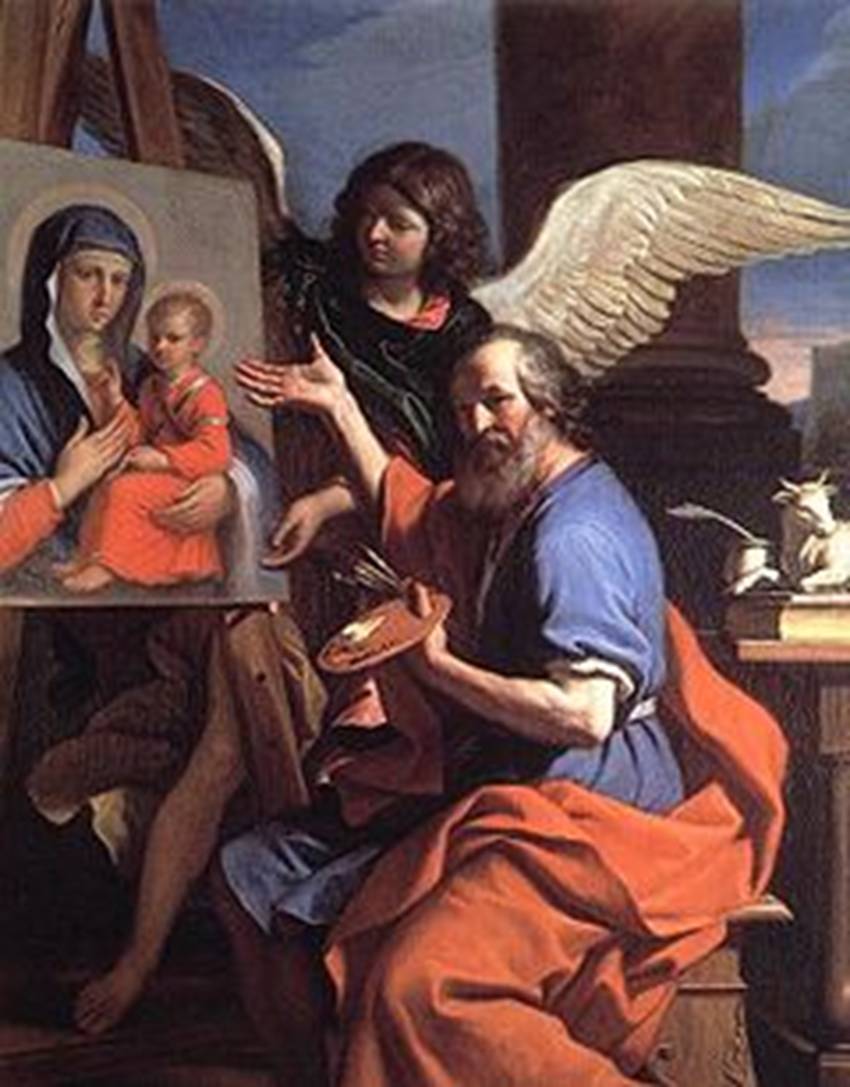
Luke has always intrigued me as a person and a writer. He was a physician and, according to tradition, a personal friend of Our Lady, painting the first icon of her while she lived. So, he was also an artist. He may have painted the first icons of Peter and Paul as well.

It is well-known that Luke's Gospel is the Gospel of Women, He has more references to women when Christ was walking this earth than the other three gospel writers.

Perhaps his work as a doctor and his personal relationship with Mary indicate a sensitive man, a man who notices and likes women.

Luke is also the author of the Acts of the Apostles. Therefore, we can add to his many talents, traveling and evangelizing.

Now, no offense to doctors, and I have three friends who are doctors, so intense are their jobs, that they do not have the inclination to do anything but "doctor". This is because they are so busy and so overworked that, unless they go on vacation, they rarely have time to read, travel, much less paint. They must keep up with their fields or specializations, which takes time--a lot of time.

Luke's life is not one of sameness. He presents a complicated personality. Was he married? Did he have children? Or like so many doctors today by necessity, was he married to his work? Was his friendship with Mary an outlet for his need for feminine conversation? Did he meet Mary when John took her to Ephesus? It is said he was not married and became a Catholic through St. Paul. How he met Mary, then, would be a mystery.


We do not know much about Luke, but his writing style is that of a Greek, not a Hebrew, and so is his name. It is said he came from Antioch in Syria, a highly "Hellenistic" city of that time.

Luke is the patron saint of artistsphysicianssurgeonsstudents,glass-workers, brewers, and butchers--a very odd group of people. 


Think of Luke today and pray for our doctors. They are under such stress at this time for many reasons.

I think as a doctor Luke must find it amusing that his relics are in three places: Prague, Thebes, and Padua, all pieces of a human from the time of  Luke's death and a man of Syrian descent. 

Even his relics are intriguing.