Recent Posts

Thursday, 14 February 2013

For those who do not know Archbishop Ganswein

Archbishop Georg Ganswein will continue as private secretary to the Pope after his retirement, as the media is stating.


He has a fascinating history and here is a link. I guess if we were all paying attention, we could have noticed his consecration as an Archbishop as a sign of Pope Benedict's resignation. Paul Collins, an ex-priest, in Australia noticed this. And, Vanity Fair did a cover on him without his or the Vatican's permission. Such is Italy....

Anyway, have a good read.


Cool-Pope Benedict's Next Home

http://www.patheos.com/blogs/deaconsbench/2013/02/benedicts-next-home/


More on Pope's schedule


Article on Pope's comments this morning...http://www.bbc.co.uk/news/world-europe-21458783
"Even if I am withdrawing into prayer, I will always be close to all of you... even if I remain hidden to the world," he told a meeting of Roman priests.
His schedule
  • 17-23 February - Lenten retreat, most normal Vatican functions suspended
  • 24 February - Pope recites Angelus for the last time
  • 27 February - Last weekly audience, in St Peter's Square
  • Evening of 28 February - Pope leaves office
  • From 15 March - Conclave to elect new Pope


Next week the Pope will carry out no public engagements after which he will hold one more public audience on 27 February, in St Peter's Square.
On 28 February he will fly off to the papal retreat at Castel Gandolfo, where he will stay while Church leaders go through the complicated ritual of choosing a successor.

For Priests

http://www.catholicherald.co.uk/multimedia/2013/02/14/pope-tells-priests-i-will-always-be-close-to-you-even-though-i-will-be-hidden/

Catholic Herald this morning, as Pope Benedict XVI tells priests that although he will be hidden, he is with them.

Winner of Competition for Love Comment


I think we people read this excellent comment, and the creative juices ran dry....This is superb and thanks so much to the person who sent this in. God bless you on this special day of Love.


What is “Love”? In modern times it has come to mean that emotional feeling or attachment that exists between people. As we all know, often through hard experience, this emotion can fade in time and will often not survive strong turbulence or unbalance. This love does not seem to be what we may call “True Love” nor is it really what has been understood as “True Love” from the 1st century until the Protestant Schism, and even then it did not take real root until the 19th and 20th century’s. So how do we discover what “True Love” is? We must look at our greatest model, Our Lord and Our Lady, in this case in the context of the Holy Family.

Our Lady was deeply in Love, a Love beyond any mere mortal love, hers was a divine Love, perfect as it was completely for God, because of God and was fully reciprocated by God. This Love did not give into fear, when the Angel Gabriel came in the annunciation what was it that made Our Lady agree despite the risks that an unwed mother would face? It was not the fact that she would be able to live comfortably, not some yearning for sexual fulfilment she hoped these divine espousals would bring. Not even the desire for power or prestige or for Her own good, no it was because she was willing to sacrifice anything for the Beloved and she knew he would sacrifice everything for Her. She saw in that moment the enormity of what God was proposing an incarnation in the flesh the most perfect union, indeed God himself becoming Man, enclosing himself deep within her in a way never before conceived.

Joseph too was a party to this Love for he shared in this Love of God. He too was willing to trust completely in God and he understood that Love of God can be expressed in Love for The Woman so in Chaste Continent Love he took the Blessed Virgin to himself and his Love for Her and for God were one. He was not afraid to work himself to the bone for Her, as he knew that everything he gave to her would be perfectly reciprocated not just by her but by God Himself.

So I will answer what is Love? Love is the total self giving of yourself to another either to god or Man, knowing that this total self giving is the will of God and thus the Love between Men is the Love of God. Thus we can say that Total self-Giving with humble trust in God is True-Love.

On Cyril and Methodius

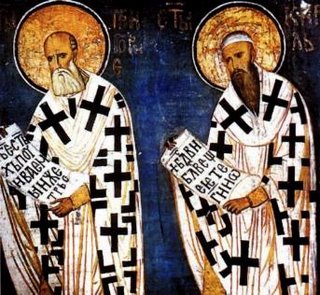
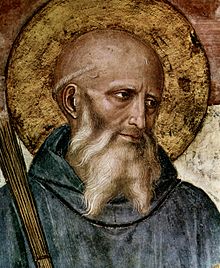
These two saints are very dear to my heart for two reasons. First of all, they are the Patrons of Europe, along with Benedict. Their contribution to the making of a Christian Europe is the stuff of legend.

That they were brothers makes them special as well.

But, the second reason is that my ancestors on my mother's side are all from Bohemia and Moravia. We have personal connections with these areas of Europe where the brothers worked and prayed. Here is a significant section from OrthoWiki:


In 860, Emperor Michael III and Photius, Patriarch of Constantinople, sent the brothers to the Khagan of the Khazars on a missionary expedition in an attempt to forestall the Khagan from embracing Judaism. The mission was unsuccessful as the Khagan chose Judaism for his people, but many people embraced Christianity. Upon their return, Constantine was appointed professor of philosophy in the university.
Then in 862 the two brothers were invited by Prince Rastislav of Great Moravia to preach Christianity in his domains. This request was a fallout of the efforts of the Slavic princes in central Europe attempting to maintain their independence from their Germanic neighbors. Rastislav was looking for Christian missionaries to replace those from the Germans. In the end this mission would continue for the rest of the brothers' lives, as the brothers were dedicated to the idea that Christianity should be presented to the people in their native languages as was the practice in the East. To accomplish their work they developed the Glagolitic alphabet, the precursor of the Cyrillic alphabet, and began the translation of the Scriptures and Christian literature into the Slavic language.
The German clergy had used their liturgical language, Latin, as a measure to maintain their influence in Moravia and therefore were unhappy with the work of Constantine and Methodius, and they used this difference to attack the brothers. After laboring for about four years, the brothers were called by Nicholas I to appear in Rome to defend their work. The area in which they worked was within the jurisdiction of Rome. However, before their arrival, in 869 Nicholas died and was succeeded by Adrian II. After Adrian was convinced of the orthodoxy of the brothers, he approved their use of Slavonic in their church services and commended their work. He then consecrated Methodius bishop. Constantine took monastic vows in a Greek monastery in Rome. He was given the name Cyril, the name by which he is now commonly known. Cyril was not to return to Moravia as he died shortly thereafter. The date of Cyril's death is uncertain, but appears to have been shortly after his consecration, both perhaps in February 869, with his death most probably on February 14.
Adrian II reestablished the old diocese of Panonia, as the first Slavonic diocese of Moravia and Pannonia, independent of the Germans, at the request of the Slavic princes Rastislav, Svatopluk, and Kocel. Here Methodius was appointed to the new diocese as archbishop. However, on returning to Moravia in 870, King Louis and the German bishops summoned Methodius to a synod at Radisbon, where they deposed him and sent him to prison. After the Germans suffered military defeats in Moravia, John VIII freed him three years later and restored Methodius as Archbishop of Moravia. Soon his orthodoxy was again under question by the Germans, particularly over the use of Slavonic. Once again John VIII sanctioned the use of Slavonic in the liturgy but with the stipulation that the Gospel must first be read in Latin before the reading in Slavonic. Also, Methodius' accuser, Wiching, was named a vicar bishop to Methodius, and from this position he continued to oppose him. With his health damaged during his long struggle with his opponents, Methodius died on April 6, 885, after having recommended as his successor his disciple, the Moravian Slav, Gorazd. The brothers are remembered on May 11. St. Cyril's repose is also commemorated on February 14, and St. Methodius' repose is also commemorated on April 6.http://orthodoxwiki.org/Cyril_and_Methodius
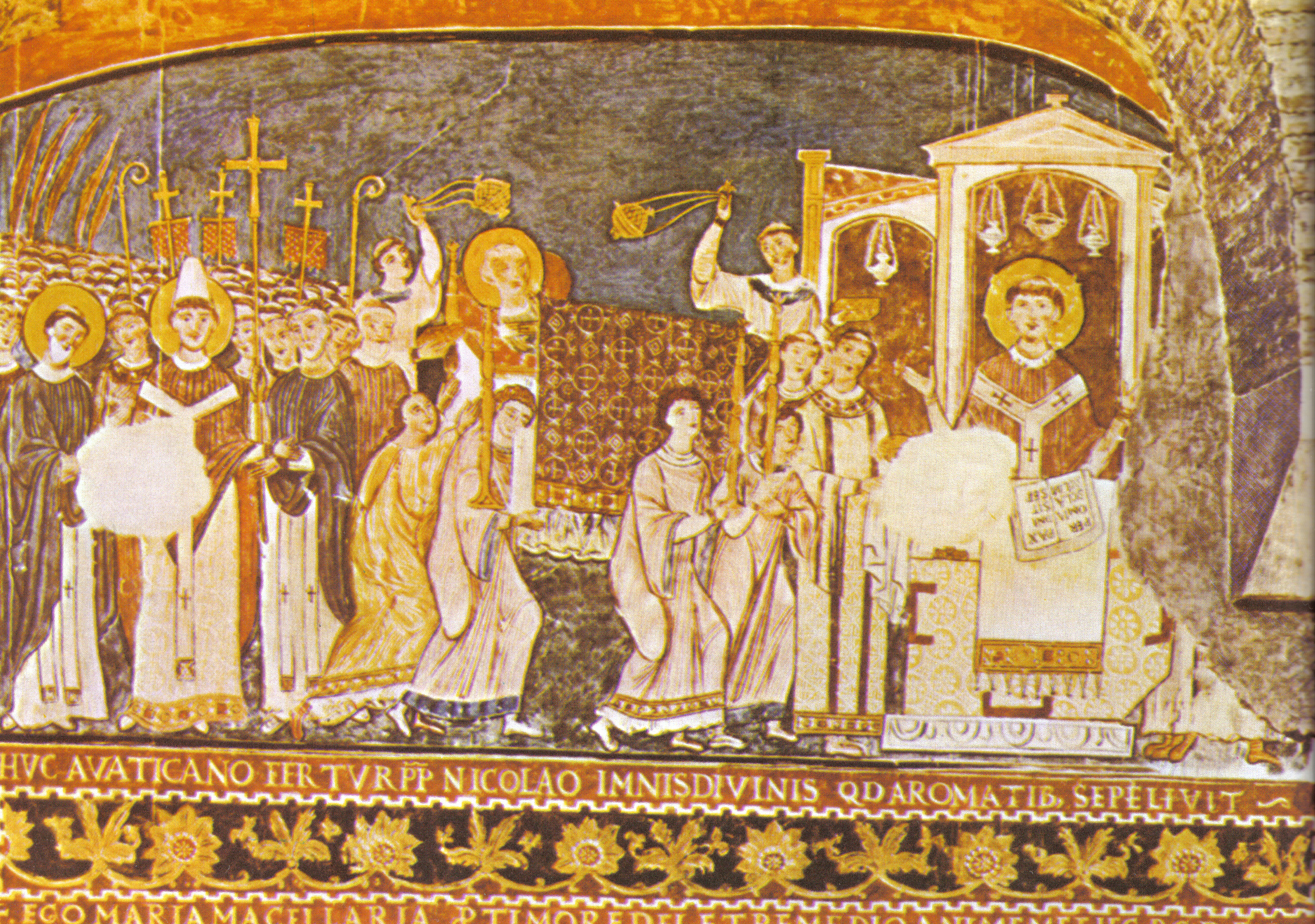
St. Cyril is buried in San Clemente's, one of the most amazing churches in Rome. It is a basilica.

Pope John Paul II at the tomb of St. Cyril in Rome
I was in that church before the altar was there, or at least, it was not "up" when I visited and I could go up and touch the icon mosaic of St. Cyril. I thanked him, indeed. 

From the Orthodox Divine Liturgy:

Troparion (Tone 4)
O Cyril and Methodius, inspired by God,
You became equal to the Apostles by your life.
Since you were teachers of the Slavs,
Intercede with the Master of all
That He may strengthen all Orthodox peoples in the True Faith,
And that He may grant peace to the world
And great mercy to our souls.
Kontakion - Tone 3
Let us praise the two priests of God who enlightened us,
And poured upon us the fount of the knowledge of God by translating the Holy Scripture.
O Cyril and Methodius, as abundant learning has been drawn from this work,
We exalt you who now stand before the Most High,
Interceding with fervor for the salvation of our souls.


And, happy St. Valentine's Day....contest winner will be posted later today.


Part Twenty on the Doctors of the Church-Albert


Albert the Great highlights the need for purity of heart. One moves beyond meditation to contemplation after much time of practice and guidance. Do not think that this cannot be a path for a lay person, as we are all called to this.

Chapter 3

What the perfection of man consist of in this life

Now the more the mind is concerned about thinking and dealing with what is merely lower and human, the more it is separated from the experience in the intimacy of devotion of what is higher and heavenly, while the more fervently the memory, desire and intellect is withdrawn from what is below to what is above, the more perfect will be our prayer, and the purer our contemplation, since the two directions of our interest cannot both be perfect at the same time, being as different as light and darkness. 

The sign of illumination is this movement into light....and Albert describes the state of unity as well here.

He who cleaves to God is indeed translated into the light, while he who clings to the world is in the dark. So the supreme perfection of man in this life is to be so united to God that all his soul with all its faculties and powers are so gathered into the Lord God that he becomes one spirit with him, and remembers nothing except God, is aware of and recognises nothing but God, but with all his desires unified by the joy of love, he rests contentedly in the enjoyment of his Maker alone.

This next section reminds me greatly of St. Ignatius of Loyola and his purification of reason, memory and will. 

 Now the image of God as found in the soul consists of these three faculties, namely reason, memory and will, and so long as they are not completely stamped with God, the soul is not yet deiform in accordance with the initial creation of the soul. 

For the true pattern of the soul is God, with whom it must be imprinted, like wax with a seal, and carry the mark of his impress. But this can never be complete until the intellect is perfectly illuminated, according to its capacity, with the knowledge of God, who is perfect truth, until the will is perfectly focused on the love of the perfect good, and until the memory is fully absorbed in turning to and enjoying eternal happiness, and in gladly and contentedly resting in it. And since the glory of the beatitude which is achieved in our heavenly homeland consists in the complete fulfilment of these three faculties, it follows that perfect initiation of them is perfection in this life.

I cannot stress the important of this section enough for our journey into the understanding of perfection. Albert, more than many, writes clearly of the Illuminative and Unitive States here.

There will be...


...many posts on Albert the Great and perfection over the next few days. He is called The Great for very good reasons.

Part Nineteen on the Doctors of the Church and Perfection-the Dominicans

I shall save the best one until last, the Universal Doctor of the Church, Thomas Aquinas, and as we already looked at St. Catherine of Siena, a Third Order Dominican, I can concentrate on St. Albert the Great today.

Again, I am emphasizing the spirituality of these wonderful saints with a view to the journey to perfection. It would take ten lifetimes to examine all the writings of these great minds and great souls.

St. Albert the Great was the teacher of Thomas Aquinas. We do not know exactly when he was born, but he died in 1280 and was no older than 87.


He has much to say on everything, having written at least 31 volumes. Here is a little selection on perfection. It is interesting that this section, a reading for Ash Wednesday is used. There are no accidents.


Chapter 1

On the highest and supreme perfection of man, in so far as it is possible in this life

I have had the idea of writing something for myself on and about the state of complete and full abstraction from everything and of cleaving freely, confidently, nakedly and firmly to God alone, so as to describe it fully (in so far as it is possible in this abode of exile and pilgrimage), especially since the goal of Christian perfection is the love by which we cleave to God. In fact everyone is obligated, to this loving cleaving to God as necessary for salvation, in the form of observing the commandments and conforming to the divine will, and the observation of the commandments excludes everything that is contrary to the nature and habit of love, including mortal sin. Members of religious orders have committed themselves in addition to evangelical perfection, and to the things that constitute a voluntary and counselled perfection by mean s of which one may arrive more quickly to the supreme goal which is God. The observation of these additional commitments excludes as well the things that hinder the working and fervour of love, and without which one can come to God and these include the renunciation of all things, of both body and mind, exactly as one’s vow of profession entails. Since indeed the Lord God is Spirit, and those who worship him must worship in spirit and in truth, in other words, by knowledge and love, that is, understanding and desire, stripped of all images. This is what is referred to in Matthew 6.6, ‘When you pray, enter into your inner chamber,’ that is, your inner heart, ‘and having closed the door,’ that is of your senses, and there with a pure heart and a clear conscience, and with faith unfeigned, ‘pray to your Father,’ in spirit and in truth, ‘in secret.’ This can be done best when a man is disengaged and removed from everything else, and completely recollected within himself. There, in the presence of Jesus Christ, with everything, in general and individually, excluded and wiped out, the mind alone turns in security confidently to the Lord its God with its desire. In this way it pours itself forth into him in full sincerity with its whole heart and the yearning of its love, in the most inward part of all its faculties, and is plunged, enlarged, set on fire and dissolved into him.

Albert is stressing the loneliness and individuality of our walk to perfection. This movement of the Holy Spirit takes intense prayer.

Be sincere.  Be focussed. To be continued.....

Wednesday, 13 February 2013

The Pope's Last Public Mass on Ash Wednesday

And, the most beautiful aspect, including the singing of the Litany, was the long standing ovation given by the cardinals, bishops, priests, nuns and laity in Rome.

What a humble man Benedict is. He did let a little smile escape. Here is Benedict receiving ashes today.


Part Eighteen on Doctors of the Church and Perfection: St. Francis de Sales

Here is a section on imperfection from St. Francis de Sales. Tomorrow, the Dominicans, but this great saint of love is worth reading. 

Thus Saint Jerome says that Saint Paula had so strong a tendency to excessive sorrow, that when she lost her husband and children she nearly died of grief: that was not a sin, but an imperfection, since it did not depend upon her wish and will. Some people are naturally easy, some oppositions; some are indisposed to accept other men's opinions, some naturally disposed to be cross, some to be affectionate--in short, there is hardly any one in whom some such imperfections do not exist. Now, although they be natural and instinctive in each person, they may be remedied and corrected, or even eradicated, by cultivating the reverse disposition.

The reverse dispositions are the key.

For example, if one is talkative, be more silent. If one is prone to negativity, be more positive; if one is prone to be overly-affectionate and clinging, be more objective; if one is disposed to be judgemental, be more accepting and kind

Not rocket science...but we need graces and God is only too happy to give us such if we ask. 

Here is more on perfection from the great saint.


1. Prayer opens the understanding to the brightness of Divine Light, and the will to the warmth of Heavenly Love--nothing can so effectually purify the mind from its many ignorances, or the will from its perverse affections. It is as a healing water which causes the roots of our good desires to send forth fresh shoots, which washes away the soul's imperfections, and allays the thirst of passion.

2. But especially I commend earnest mental prayer to you, more particularly such as bears upon the Life and Passion of our Lord. If you contemplate Him frequently in meditation, your whole soul will be filled with Him, you will grow in His Likeness, and your actions will be moulded on His. He is the Light of the world; therefore in Him, by Him, and for Him we shall be enlightened and illuminated; He is the Tree of Life, beneath the shadow of which we must find rest;--He is the Living Fountain of Jacob's well, wherein we may wash away every stain. Children learn to speak by hearing their mother talk, and stammering forth their childish sounds in imitation; and so if we cleave to the Savior in meditation, listening to His words, watching His actions and intentions, we shall learn in time, through His Grace, to speak, act and will like Himself. Believe me, my child, there is no way to God save through this door. Just as the glass of a mirror would give no reflection save for the metal behind it, so neither could we here below contemplate the Godhead, were it not united to the Sacred Humanity of our Saviour, Whose Life and Death are the best, sweetest and most profitable subjects that we can possibly select for meditation. It is not without meaning that the Saviour calls Himself the Bread come down from Heaven;--just as we eat bread with all manner of other food, so we need to meditate and feed upon our Dear Lord in every prayer and action. His Life has been meditated and written about by various authors. I should specially commend to you the writings of Saint Bonaventura, Bellintani, Bruno, Capilla, Grenada and Da Ponte.
3. Give an hour every day to meditation before dinner;--if you can, let it be early in the morning, when your mind will be less cumbered, and fresh after the night's rest. Do not spend more than an hour thus, unless specially advised to do so by your spiritual father.
4. If you can make your meditation quietly in church, it will be well, and no one, father or mother, husband or wife, can object to an hour spent there, and very probably you could not secure a time so free from interruption at home.
5. Begin all prayer, whether mental or vocal, by an act of the Presence of God. If you observe this rule strictly, you will soon see how useful it is.
6. It may help you to say the Creed, Lord's Prayer, etc., in Latin, but you should also study them diligently in your own language, so as thoroughly to gather up the meaning of these holy words, which must be used fixing your thoughts steadily on their purport, not striving to say many words so much as seeking to say a few with your whole heart. One Our Father said devoutly is worth more than many prayers hurried over.
7. The Rosary is a useful devotion when rightly used, and there are various little books to teach this. It is well, too, to say pious Litanies, and the other vocal prayers appointed for the Hours and found in Manuals of devotion,--but if you have a gift for mental prayer, let that always take the chief place, so that if, having made that, you are hindered by business or any other cause from saying your wonted vocal prayers, do not be disturbed, but rest satisfied with saying the Lord's Prayer, the Angelic Salutation, and the Creed after your meditation.
8. If, while saying vocal prayers, your heart feels drawn to mental prayer, do not resist it, but calmly let your mind fall into that channel, without troubling because you have not finished your appointed vocal prayers. The mental prayer you have substituted for them is more acceptable to God, and more profitable to your soul. I should make an exception of the Church's Offices, if you are bound to say those by your vocation--in such a case these are your duty.
9. If it should happen that your morning goes by without the usual meditation, either owing to a pressure of business, or from any other cause, (which interruptions you should try to prevent as far as possible,) try to repair the loss in the afternoon, but not immediately after a meal, or you will perhaps be drowsy, which is bad both for your meditation and your health. But if you are unable all day to make up for the omission, you must remedy it as far as may be by ejaculatory prayer, and by reading some spiritual book, together with an act of penitence for the neglect, together with a stedfast resolution to do better the next day.


St. Francis de Sales, the Fourth Franciscan out of Three!!!!!! Doctors of the Church Series continued


I made a terrible mistake and apologize to the Franciscans. St. Francis de Sales, Doctor of the Church, was a Third Order Franciscan

Naughty me. Mea culpa....

So, before tackling the great Dominicans, I need to cover this great man's writings on spirituality. This is Part 17 of the series.

He was only 56 when he died in 1622, but left behind wonderful writings for us. Here is a bit of his great insights into the holy life.

I concentrate today on the second purification on the way to perfection. This Doctor is a great saint for teaching us the way to perfection.

Notice how the saint refers to the mind as an attribute of the soul. Without going into that study, his ideas are close to those of St. Bernard of Clairvaux (my favourite DoC) who also saw the mind as part of the soul. This idea is not so common in modern theologians.

His clarity about breaking away from the habits of venial sin can be traced here in these selections from Introduction to the Devout Life.  The pages can be found before, one and after this link.


Be sure, my child, that if you seek to lead a devout life, 
you must not merely forsake sin; but you must further 
cleanse your heart from all affections pertaining to sin; for, to say nothing of the danger of a relapse, these wretched affections will perpetually 
enfeeble your mind, and clog it, so that you will be unable to be diligent, 
ready and frequent in good works, wherein nevertheless lies the very essence of all true devotion. 

Souls which, in spite of having forsaken sin, 
yet retain such likings and longings, remind us of those persons who, without being actually ill, are pale and sickly, languid in all they do, eating without appetite, 
sleeping without refreshment, laughing without mirth, 
dragging themselves about rather than walking briskly. 

Such souls as I have described lose all the grace of their good deeds, which are probably few and feeble, through their spiritual languor.

This last point has been made by Garrigou-Lagrange and other writers; that we get no merit unless we are in the state of illumination. I know this is hard, but it is true.

The work we do in the Illumination State comes from the Holy Spirit, and not from ourselves. 
Here is the great saint on this purification of tendencies.

We must make up our minds not to commit even one venial sin in order to avoid these tendencies to sin. I finally found one good priest in London, and a younger one at that, who understands this and can give absolution accordingly, instead of denying that this is possible. We need more priests who understand that we must fight against the tendencies to venial sin.


You will find then, my child, that besides the mortal sins and their affections from which your soul has already been purged, you are beset by sundry inclinations and tendencies to venial sin; mind, I do not say you will find venial sins, but the inclination and tendency to them. Now, one is quite different from the other. We can never be altogether free from venial sin,--at least not until after a very long persistence in this purity; but we can be without any affection for venial sin.
It is altogether one thing to have said something unimportant not strictly true, out of carelessness or liveliness, and quite a different matter to take pleasure in lying, and in the habitual practice thereof. But I tell you that you must purify your soul from all inclination to venial sin;--that is to say, you must not voluntarily retain any deliberate intention of permitting yourself to commit any venial sin whatever. It would be most unworthy consciously to admit anything so displeasing to God, as the will to offend Him in anywise. Venial sin, however small, is displeasing to God, although it be not so displeasing as the greater sins which involve eternal condemnation; and if venial sin is displeasing to Him, any clinging which we tolerate to mortal sin is nothing less than a resolution to offend His Divine Majesty. Is it really possible that a rightly disposed soul can not only offend God, but take pleasure therein?
These inclinations, my child, are in direct opposition to devotion, as inclinations to mortal sin are to love:--they weaken the mental power, hinder Divine consolations, and open the door to temptations;--and although they may not destroy the soul, at least they bring on very serious disease. 

"Dead flies cause the ointment to send forth a stinking savour," says the Wise Man.He means that the flies which settle upon and taste of the ointment only damage it temporarily, leaving the mass intact, but if they fall into it, and die there, they spoil and corrupt it. Even so venial sins which pass over a devout soul without being harboured, do not permanently injure it, but if such sins are fostered and cherished, they destroy the sweet savour of that soul--that is to say, its devotion. The spider cannot kill bees, but it can spoil their honey, and so encumber their combs with its webs in course of time, as to hinder the bees materially. Just so, though venial sins may not lose the soul, they will spoil its devotion, and so cumber its faculties with bad habits and evil inclinations, as to deprive it of all that cheerful readiness which is the very essence of true devotion; that is to say, if they are harboured in the conscience by delight taken therein. 
A trifling inaccuracy, a little hastiness in word or action, some small excess in mirth, in dress, in gaiety, may not be very important, if these are forthwith heeded and swept out as spiritual cobwebs;--but if they are permitted to linger in the heart, or, worse still, if we take pleasure in them and indulge them, our honey will soon be spoilt, and the hive of our conscience will be cumbered and damaged. But I ask again, how can a generous heart take delight in anything it knows to be displeasing to its God, or wish to do what offends Him?


So this saint backs up St. Benedict on frivolity and unnecessary mirth, as in the other posts today and previously on laughter and silliness.


The Shock of the Real


It dawned on me today that Christ did not correct Martha because she was making the dinner or getting the wine, or setting the table. No.

He corrected her because she was not listening. Martha was in a bubble world of busyness. She had created that bubble. Her bubble stopped her from hearing Christ. She preferred her bubble world to the reality of The Son of God. Her bubble insulated her from listening to whatever was outside. Her mind was talking, talking, talking about food, dishes, wine, water...whatever while the God of Gods was sitting in her living room.

One can listen while one is doing chores. The beauty of the Benedictine life is such that prayer continues into work, as work is done, if it is done as it should be, in silence.

Mary was silent in her interior life. Her mind and heart were not "busy". She knew how to quiet herself in order to hear God.

She waited to hear Christ. Martha could have been listening while she was DOING. One can learn to do this. One can teach one's self and ask God for the grace to hear Him all day long. To be in His Presence is the shock of the real...........

But, apparently, Martha was not "in the presence of Christ". Her mind and heart and soul were full of anxiety and fretting. She became angry and frustrated because Mary was listening to Christ. Oh my....!

That is why Christ corrected her.


One of my Benedictine mentors wrote something apropos my comments on silence.

Talking most of the day creates a bubble in the mind and around the soul which separates one from reality.

He noted that silence and reflection are absolutely necessary for both discernment and problem solving.

He went on to emphasize that silence is necessary for salvation.

Wow.

False wisdom, false sense of superiority, fantasy and escapism form the soul and these things abound in talk, talk, talk.

We do not face ourselves or the reality of others is speech.

I have seen that conversation which bears fruit involves silence and thinking skills, as well as prayer.

We interfere with our capacity to find salvation if we talk too much or listen to talking too much.

Thanks to Orthowiki


Women need more conversation than men, but that need can be exaggerated. In stillness, we can solve many problems. Martha had to learn how to slow down, even stop, and listen to God.


God wants to enter into our hearts, minds and souls, but He can not if we are always listening to something or someone, or talking.

God will not interrupt us, unless by illness or even death. Seriously, we sometimes need the shock of the real in order to hear God.

How sad. How very unnecessary. We could be listening all day long in the solitude of our minds and hearts. If we do not learn how to do this, we may lose our very souls.

Here is the Orthodox prayers for the feast of Martha and Mary in the summer. Mary had the gift of wisdom and Martha learned, but Christ had to correct her. We hear that correction down to this present day.

Let us not pass up God because our minds and hearts and souls are too full of busyness.

Calm down, take a deep breath, trust in God, and wait in silence for the coming of Christ this Lent.

Be not shocked by the real. "Be real and face the situation", as a friend of mine use to say a long time ago. He is now a priest.


Troparion (Tone 3)
You fervently believed in Christ and His marvelous acts,
O Martha and Mary, sisters of Lazarus.
You were adorned with radiant virtues
and were found worthy to be numbered with the saints;
together with holy Lazarus pray to God for us.
Apolytikion (Tone 3)
Since ye believed in Christ with strong and ardent faith,
and ever worshipped His divine and mighty deeds,
ye both adorned yourselves with all the splendour of sacred virtues.
With your holy brother now,
ye are also vouchsafed to dwell with the ranks of Saints on high,
O ye sisters of Lazarus;
and with him, O wise Mary and Martha,
ye pray for us all unto the Master.
Kontakion (Tone 3)
In the town of Bethany, ye dwelt of old;
now in Heaven ye abide in Paradise,
where our Lord's countenance shineth.
For ye gave your hearts and souls up with fervent longing
unto Him that is the Life and the Resurrection;
as ye stand on high, O Mary and Martha,
pray Him to grant salvation to us.


On Silence and False Wisdom

Thanks to Wikimedia


I hope I do not disappoint readers by putting off the great Dominican Doctors of the Church until tomorrow. For two reasons, I am switching topics for today, Ash Wednesday. By the way, another of my Ash Wednesday meditations is on the blog of the Guild of Titus Brandsma and you can click on my blog roll on the side. Or here, http://guildofblessedtitus.blogspot.co.uk/2013/02/the-feast-of-crown-of-thorns.html

Firstly, because of all the media attention on the Holy Father today, and the absolutely ridiculous blogsites and websites which are wallowing in false prophecies, mysteries, and an over-abundance of speculation,  I am thrown back into some great thoughts from one of my Benedictine masters.

I cannot give his name, but rely on him for insights into silence. Today, of all days, we all need to think on the gravity of noise pollution affecting our minds.

I have said on two or three other posts that only when we are in contemplation can we hear the real Voice of God. If we do not tune our minds, hearts and souls to Christ almost constantly, we shall be swept into all types of evil.

Here are a few points from my Benedictine mentor. I shall write two posts on this subject today.

Firstly, to define two sins which comes from too much talking, cynicism and disillusionment, who must see these as serious sins. That young people and old think they can live in a critical attitude 24/7. either making fun of serious topics or being hyper-critical reveals a serious lack of discernment concerning their own souls.

Flippancy and fun cover up both a vacuous mind and one which has fallen into the adversarial spiritual realm of disillusionment and a lack of faith. Grumpiness is not a virtue, either, nor is a constant complaining of events or people.

Watch these tendencies in your own lives, please. It is better to be silent than negative. And negativity reveals a deeper sin, that of a lack of trust in Divine Providence.

Secondly, and this is repetition for which I have received negative comments on this blog, but which remains a truism, laughter and too much hilarity destroys the ability to be kind, serious, industrious, reflective, diligent, and solid in our characters.

As my mentor noted, "penthos", a Greek word and ideal, means a "salutary sadness". Why?

A sadness is good, which reveals our minds to us and brings about a humble state. This means that we are no longer proud and haughty.

Arrogance is loud and demeaning, But, truth about one's self brings a sobriety, a moderation in speech and action.

The over-active lack focus, and the over-talkative lack humility. St. Benedict is very clear on these aspects. Now, in the lay life, we do not have to be upset if our lives fall short of the Benedictine ideal. But, we must try, we must.

In all of the noise and speculations on line, there is little holiness of reflection one would expect.

Pope Benedict XVI shows us the way with his very few words. We do not need to read into his words. He is tired, and he desires more silence. He knows a young man can carry on into the hard times ahead. Period. Let us respect his discretion. Respect his reticence.

We do not need to go further than this. Do not look for signs or portents, as the political events tell us the state of the soul of the world, which is very, very sick.

We cannot solve problems merely by talk, talk, talk. Problems are solved in prayer and reflection.

I worked in administration for a short while in a government office. The amount of useless and contradictory meetings would astound taxpayers. I could not handle the purposeful deceit, the lack of humility  the arrogance and the endless talking which did not solve problems, but on the contrary, created a smoke-screen of noise, words, and stupidity.

The holy ideals of seriousness, character,

Gospel in Rome audience was Christ's temptation in the desert

The Pope said he felt the prayers of the Church the last few days. He also said to use Lent to make room for Christ in your hearts. He looks very tired.

Watching Pope's Audience

Back soon.

Give up noise for Lent and here is how


Many lay people do not know how to create silence. They carry noise around them and wear it like a coat.

I have been with families that watch DVDs in the car as soon as the kids are in the van, before and after school. There is no discussion or conversation concerning the day.

I have been in houses when the television is on most of the day, or at least half of the day. I have been in cars where the individuals have to listen to the radio or tapes or CDs, not realizing that such a time could be one of silence.

And when you are praying, speak not much, as the heathens. For they think that in their much speaking they may be heard. Matthew 6:7


Silence is destroyed by talking as well. I visited a community of lay people years ago and one of the things which struck me was the peaceful silence of the houses. The married couples said as little as possible, and the children were peacefully quiet. Meal times were times for conversation about the day, and the children left the rooms in quiet and peace to do their homework.  This was in an Anabaptist community. Silence during dishes was like that of the nuns in France, who do not speak when working together. They do not need to do so and therefore, open their minds and hearts to God.

Ecclesiastes 5:2 Do not be quick with your mouth, do not be hasty in your heart to utter anything before God. God is in heaven and you are on earth, so let your words be few.

Part of the silence was created by scheduling. A lack of schedule makes one tense and without the ability to have times of silence. For example, a man coming home from work can ask his wife and family for a time of silence before dinner, for his own prayer time and unwinding from the day.


Pray more from the heart and mind and less from the mouth.

I have seen this in families and it creates a good atmosphere. The wife should not pile problems onto the husband as he walks through the door.

The parents should give each other time for prayer, either in the morning or in the evening.


Family prayer is separate. The family rosary and night prayers together do not need to take that long. A half-hour or so is enough and that could leave time for each parent to help the other in private prayer time.

Scheduling orders one's life and if one can think this "How does my life revolve around silence?", instead of "How do I fit silence into my busy day?", an attitude change can occur.

Talking about problems is only part of solving things. Prayer is the way to solve problems as well as activity. I have Montessori training. I had a Montessori school for a while. The instructor, the directoress, always uses a quiet voice, The children are shown the exercises in silence.

There is nothing so wonderful as the low hum of children, even pre-schoolers, working in a large room. Their concentration and happiness as working creates silence, only broken by the small hum of activity. To see this, is to glimpse into the way life was a long time ago, when silence was part of all of our lives, not just the monks.

Problems demand talking and silence in order to be solved. Thinking cannot happen without silence. Love cannot grow without silence as well as communication.

And, not all problems can be solved. Some things must be endured and silence puts all those trials and stresses into perspective. Not all love can be spoken. Love can be shared in silence.

This Lent, give up noise so that you can hear God.


The Imperative of Silence: Noise is rebellion


While in the monastery last year, I lived with the nuns in the silence of the day. I have tried to cooperate with grace and cultivate an interior silence outside the convent. Some of the great Benedictine writers have distilled Benedictine's writings. The great saint is very strict on silence. Here are some points.

1) Silence involves a "radical renunciation", as one is renouncing self and others in order to be silent.

2) Noise is "rebellion" and the author of noise is the evil one. Noise is rebellion because one is filling up the void in one's spirit which is necessary for God to fill. Noise does not merely distract one from God, but actually makes one closed to God's working in one's spirit.

3) There is virtue in refraining from giving one's opinion. There is virtue is listening to opinions. Not all knowledge is equal in value and, in fact, most of our knowledge is not necessary to our salvation. Reality shows on television, for example, merely clog our time and our ability to hear God speak in the quietness of our hearts.

4) St. Benedict states that even excellent conversation about spiritual things should be avoided, if possible. One can get too much information and input without processing this information in the heart and mind and soul.

5) Silence allows for this processing and for healing. Without silence, the deep parts of our spirit cannot be reached and we go through life unnecessarily burdened with the past.

When I was in Ireland, I was burdened by the number of people who live in the past. One attractive lady told me that she would never marry an Irishman who lived in the past, and that so many do. Why? Too much talking and too much activity stops healing.

6)When we talk, say the Benedictines, we lose focus. How true. Focussing on God takes energy. When we talk, we dissipate that energy. We lose ground in our journey towards God.

7) And, this is so important--we need to feel and sense the VOID in us. Many people keep too active and too noisy in order to fill up the voids in themselves. The opposite must be true in order to gain heaven. We must face all the voids and let God enter into those holes in our lives. Firstly, only He can satisfy the longings of our hearts and, secondly, only He can heal those causes of the voids, some of which are sins.

8) Lay people ask me frequently, how can I have more silence? Here are the answers: a) do less, simplify your lives; b) do not have a television or a radio, or if you do, keep them only for emergencies;  remember St. Elizabeth Ann Seton's vision of the streets being vacant in the villages and families being inside staring at black boxes, as if mesmerized. Remember what Thomas Merton said, which I have quoted here before on this blog that television is the opposite of contemplation. And that the very energies of passivity which most men use in watching television are the very energies which God gave us for contemplation. Watching television, simply, is idolatry.

More next post...

and thanks to my Benedictine mentors for these thoughts..........


On Love as we approach St. Valentine's Day


From our dear Pope Benedict XVI, who is here helping us on the way to perfection: humility and love.

This proper way of serving others also leads to humility. The one who serves does not consider himself superior to the one served, however miserable his situation at the moment may be. Christ took the lowest place in the world—the Cross—and by this radical humility he redeemed us and constantly comes to our aid. Those who are in a position to help others will realize that in doing so they themselves receive help; being able to help others is no merit or achievement of their own. This duty is a grace. The more we do for others, the more we understand and can appropriate the words of Christ: “We are useless servants” (Lk 17:10). We recognize that we are not acting on the basis of any superiority or greater personal efficiency, but because the Lord has graciously enabled us to do so. There are times when the burden of need and our own limitations might tempt us to become discouraged. But precisely then we are helped by the knowledge that, in the end, we are only instruments in the Lord's hands; and this knowledge frees us from the presumption of thinking that we alone are personally responsible for building a better world. In all humility we will do what we can, and in all humility we will entrust the rest to the Lord. It is God who governs the world, not we. We offer him our service only to the extent that we can, and for as long as he grants us the strength. To do all we can with what strength we have, however, is the task which keeps the good servant of Jesus Christ always at work: “The love of Christ urges us on” (2 Cor 5:14).

Lent is a beginning


I thank the Anglicans for this prayer:


God of new beginnings, help me as I begin this new phase in my life. Reassure me when I find it difficult to adjust to different demands and guide me in the new situations I’ll face in the coming weeks. Thank you for new opportunities, and help me to grasp them with hope and courage. Even when I feel uncertain, help me always remember your guiding presence before me.
Through Christ our Lord, Amen.