Sunday, 26 May 2013
Well. sometimes conspiracy theorists are correct!
http://www.telegraph.co.uk/news/worldnews/europe/10080015/Its-time-we-knew-the-real-gay-marriage-story.html
a snippet and read the entire article and get righteously angry....our rights as Christians will suffer horribly.
An irony of all this was that among the amendments defeated by the Government was one proposing that heterosexuals should be given an equal right to homosexuals to enter into civil partnerships.Originally, in 2010, Theresa May had been all for this, as was Equal Love, which supported a case by eight gay and non-gay couples to be taken to the ECHR. But when the Government checked the financial implications of allowing non-gay couples to enjoy civil partnerships, finding that the resulting tax privileges could cost the Treasury up to £4 billion a year, it ruled that this was a step it couldn’t afford. When it comes to equality, it seems that money takes precedence – and that some people must be considered more equal than others.
a snippet and read the entire article and get righteously angry....our rights as Christians will suffer horribly.
An irony of all this was that among the amendments defeated by the Government was one proposing that heterosexuals should be given an equal right to homosexuals to enter into civil partnerships.Originally, in 2010, Theresa May had been all for this, as was Equal Love, which supported a case by eight gay and non-gay couples to be taken to the ECHR. But when the Government checked the financial implications of allowing non-gay couples to enjoy civil partnerships, finding that the resulting tax privileges could cost the Treasury up to £4 billion a year, it ruled that this was a step it couldn’t afford. When it comes to equality, it seems that money takes precedence – and that some people must be considered more equal than others.


On this day of the Trinity, let us remember the home is the center of God's life in the world
Outside the Mass today, where there were beautifully behaved children, including little girls in white mantillas, I thought that the Trinity is replicated in the home over and over in real love among the members of the family.
The Father, the Son. and the Holy Spirit, as the priest reminded us, are in us from baptism, but we do not understand what this means and must grow into a relationship with the Trinity.
Good Catholic families can reflect the Love of the Trinity. We do not understand this great mystery, but a truly holy family can point the way.
Love constantly being shared and moving out to reach out to others reveals a small image of the Trinity.

The Father, the Son. and the Holy Spirit, as the priest reminded us, are in us from baptism, but we do not understand what this means and must grow into a relationship with the Trinity.
Good Catholic families can reflect the Love of the Trinity. We do not understand this great mystery, but a truly holy family can point the way.
Love constantly being shared and moving out to reach out to others reveals a small image of the Trinity.
More on the passive purification: faith, hope and love

The greatest evils for the laity are the constant distractions and movements of modern life which stop the natural growth of the soul. Just as the body grows, so, too, must the soul, or it will die.
Modern society has lost the rhythm of nature. Electric lights keep us up late and get us going early. Commuting is a huge waste of time and cause of stress for millions of people. The constant movement of activities creates families and, therefore, a culture, which can no longer reflect.
Most people waste an incredible amount of time talking senselessly, watching television, seeking daily entertainment.
In the past, and in most monasteries, the rhythm of life, which includes work and prayer, with very little recreation, creates and created a lifestyle which was created for one reason and that was and is the worship of God in the Kingdom of God on earth, His Church.
Until we re-discover the silence outside and within us, we shall not grow spiritually.
One must simplify one's life, or the soul shrivels and dies.
Purgatory is punishment, and suffering on earth can lead to great perfection, and hopefully the union with God which He intends all of us to experience.
Here is a long passage which should help define the path to the last stage of perfection.
 |
| Thanks to wiki for a log cabin in Iowa |
THE LOVE OF CONFORMITY AND OF SUBMISSION TO GOD'S GOOD PLEASURE
Lastly, in this state of trial, the soul should, as St. Francis de Sales well shows,(21) be penetrated with Christ's words: "My meat is to do the will of Him that sent Me." (22) In spiritual tribulations and afflictions, the soul should nourish itself with the will of God so that self-love may die definitively in it, that the soul may be truly stripped of self-love, and that the reign of the divine will may be established in the depths of its will. The soul will obtain this grace if it accepts, for love of God, to do and suffer all that He wishes, as obedience, circumstances, and the interior light of the Holy Ghost may indicate.
Too many people are running around doing what they think is God's Will, which is really nothing else but self-aggrandisement and self-will. Self-love must die, as only then can the heart have room for the Love of God.
We can only love the Other insofar as we are free to love. Having hearts and minds cluttered with the goo of selfishness does not permit the Love of God into one's being. God remains on the outside, calling, knocking, but not in the intimate relationship He so desires.
Consequently the soul should be penetrated with the evangelical beatitudes: blessed are the poor in spirit, the meek, those who shed the tears of contrition; those who hunger and thirst after justice and preserve this zeal in spite of all difficulties; blessed, too, are the merciful, the clean of heart, the peacemakers; blessed are they who suffer persecution for justice, when they are insulted and persecuted because of the Savior. Their reward is great in heaven, and even on earth they will receive the hundredfold of all that has been taken from them; they will receive it especially in close union with God and in working for the salvation of their neighbor.
In our times, listening to another may be the greatest love we can give. Stopping and paying attention to our neighbor is of primary importance. But in this stage, one does this for the love of God, and not for the love of self or even the person. Christ is seen in others.
Souls that pass through this denudation and are calumniated ought often to reread what St. Paul says to the Romans: "If God be for us, who is against us? . . . Christ Jesus. . . maketh intercession for us.. Who then shall separate us from the love of Christ? Shall tribulation, or distress, or famine, or nakedness, or danger, or persecution, or the sword? . . . But in all these things we overcome, because of Him that hath loved us. For I am sure that neither death nor life nor angels nor principalities nor powers nor things present nor things to come nor might nor height nor depth nor any other creature shall be able to separate us from the love of God," (23) nor be able to make God abandon the just, if they do not abandon Him first.
Judgement comes swift and heavy to one in the state of passive purification. Some people sense a spiritual reality which threatens them. Some hate goodness and want to undermine it. Some are envious, but do not want to go through the suffering necessary to enter into union with God. One adult person made fun of me recently because I was in the chapel praying. She was threatened, for some reas
on, by me being able to pray. I was kind. The next list of items is very important.

In this period of purification, one should ask our Lord for the love of the cross, for the desire to share in His holy humiliations in the measure willed by Providence.
You will not be understood for loving the cross. Just do it.
The soul should ask Him also to let it find in this desire the strength to bear whatever may come, the peace, and sometimes the joy, to restore its courage and that of souls that come to it.(24)
Courage is essential in the passive purification. One must endure.
Then this trial, hard as it may be at times, will seem good to it; at least the soul will believe that it is salutary and sanctifying for it.
Thomas a Kempis, rightly so below, reminds us that the cross protects us from enemies. What can anyone or anything do to us if we accept all suffering? Life becomes much more bearable and easier if one stops fighting suffering, if one takes up the Cross.
Then it will more readily grasp the great meaning of the words of The Imitation on the royal road of the cross: "In the cross is salvation; in the cross is life; in the cross is protection from enemies. In the cross is infusion of heavenly sweetness; in the cross is strength of mind; in the cross is joy of spirit; in the cross is height of virtue; in the cross is perfection of sanctity. . . . No man hath so heartfelt a sense of the Passion of Christ as he whose lot it hath been to suffer like things. . . . If thou carry the cross willingly, it will carry thee. . . . If thou carry it unwillingly, thou makest it a burden to thee, and loadest thyself the more. . . . For the sufferings of this life are not worthy to be compared with the glory to come." (25)
Do we actually believe these words? If one does not want to join with the Beloved, who is Christ, one will not attain heaven, or even the possibilities of becoming the peson God wants you to be.
Do we actually believe these words? If one does not want to join with the Beloved, who is Christ, one will not attain heaven, or even the possibilities of becoming the peson God wants you to be.
The painful purification we are speaking of creates a great void in the soul by driving out self-love and pride, and gives it an increasingly eager desire for God. St. Francis de Sales explains this effect, saying:
As man can be perfected only by the divine goodness, so the divine goodness can scarcely so well exercise its perfection outside itself as upon our humanity. The one has great need and capacity to receive good, the other great abundance and inclination to bestow it. Nothing is so suitable to indigence as a liberal abundance; nothing so agreeable to a liberal abundance as extreme indigence. . . . The more needy the indigent man is, the more eager he is to receive, as a vacuum is to be filled. Therefore the meeting of abundance and indigence is sweet and desirable; and if our Lord had not said that it is better to give than to receive, one could hardly say which has greater contentment, abundant good in diffusing and communicating itself or failing and indigent good in receiving. . . . Divine goodness has, therefore, more pleasure in giving its graces than we in receiving them.(28)
Even in human love, one must learn to love selflessly, without hidden motives or great insecurities. If we put ourselves and needs first, the love is not real, and needs to be purified.
Loving others for the sake of God alone and loving God for His Own sake are the highest loves of all.
The void created in the soul that is stripped of self-love and pride causes it to become, therefore, increasingly capable of receiving divine grace, the abundance of charity. In this sense the Apostle says: "God. . . giveth grace to the humble," and He makes them humble in order to fill them to overflowing.
Why the humble? Very simple. If one has self-love, one is still a sinner and motivated by pride and not by the love of God in ministry. Recently, I read a comment by a false seer who claimed that her mistakes was that she was a sinner. St. Bernard and the other Doctors of the Church which I have placed on this blog, state repeatedly that sin and even the tendency towards sin stops discernment and the ability to really work for God in ministries.
Self-love in all the nooks and crannies of the soul must be routed out and destroyed.
Why the humble? Very simple. If one has self-love, one is still a sinner and motivated by pride and not by the love of God in ministry. Recently, I read a comment by a false seer who claimed that her mistakes was that she was a sinner. St. Bernard and the other Doctors of the Church which I have placed on this blog, state repeatedly that sin and even the tendency towards sin stops discernment and the ability to really work for God in ministries.
Self-love in all the nooks and crannies of the soul must be routed out and destroyed.
All we have just said shows the profound truth of St. Thomas' words: "The love of God is unitive (congregativus), inasmuch as it draws man's affections from the many to the one; so that the virtues, which flow from the love of God, are connected together. But self-love disunites (disgregat) man's affections among different things, so far as man loves himself, by desiring for himself temporal goods, which are various and of many kinds." (27) The love of God causes the light of reason and that of grace to shine increasingly in us, whereas sin stains the soul, taking away from it the brilliance of the divine light.(28) The purification of the spirit removes these stains, which are in our higher faculties, that they may be resplendent with the true light, which is the prelude of that of eternity.

There are no short-cuts to holiness...to be continued.
There are no short-cuts to holiness...to be continued.
Meet the Yellowhammer and the Song Thrush
A charming bird practically walked with me to church this morning, on my way to a Latin Mass. It is the yellowhammer and absolutely a bird which wants attention.
It accompanied me for more than half a mile before disappearing into fields of rapseed plants, which are blooming at this time of year.
The song is fine and cheerful.

In addition, a Song Thrush has entertained me in the evening hours, before dusk, which is about 9 ish at this point.
The song is amazingly varied and loud. What a treat!

It accompanied me for more than half a mile before disappearing into fields of rapseed plants, which are blooming at this time of year.
The song is fine and cheerful.
In addition, a Song Thrush has entertained me in the evening hours, before dusk, which is about 9 ish at this point.
The song is amazingly varied and loud. What a treat!
Passive Purification: Where we part company with the Christian Scientists. Plus Benedict Labre....
The Christian Scientists either deny suffering, or avoid it. This is not the way of Christ or the teaching of the Church. Penances, mortifications must be accepted and for some, created, if one has a cushy life. I have a Christian Scientist friend who says he is not into this suffering thing. I used to say that, but no more.

Here is Garrigou-Lagrange on this point.
FAITH IN THE MYSTERY OF THE CROSS
In the trial of which we are speaking, the soul must, therefore firmly believe in what God has told of the great efficacy of the purifying cross in the life of the Church and in its own personal spiritual life. That this faith may be practical, it must tell itself that the cross is necessary and good for it. St. Louis Bertrand, during this period of his life, used often to repeat the words of St. Augustine: "Lord, burn, cut, do not spare now, that in eternity Thou mayest spare." The soul must believe that it is good for it to be thus painfully purified, that this purification is one of the distinctive signs of the children of God, and that this profound and painful purification glorifies the Lord.
If God has not given you penances, like bad health, or poverty, or lack of love, or loss of status, you must choose penances. Those good nuns with whom I was living take on tremendous penances. No complaining in Tyburn, as all is done for the love of God...
It must be penetrated with St. Paul's words: "We have this treasure [of divine grace] in earthen vessels, that the excellency [of the Gospel] may be of the power of God, and not of us. In all things we suffer tribulation, but are not distressed; we are straitened, but are not destitute; we suffer persecution, but are not forsaken; we are cast down, but we perish not: always bearing about in our body the mortification of Jesus, that the life also of Jesus may be made manifest in our bodies." (5) "Power is made perfect in infirmity. Gladly therefore will I glory in my infirmities, that the power of Christ may dwell in me." (6) "Ought not Christ to have suffered these things, and so to enter into His glory?" (7) "We are the sons of God. And if sons, heirs also; heirs indeed of God and joint heirs with Christ: yet so, if we suffer with Him, that we may be also glorified with Him." (8)

The power of God only works through those of us who are poor, nobodies, ill, and ignored. Why? Because, obviously, then we know the power, the ideas, the completion is from God and not ourselves. Those who are completely lowly, can reflect God's power. But, the middle class especially only wants saints from their own class. They cannot deal with difference or someone who is challenging them outside their comfort zones. If a person is homeless or poor, they cannot see God in those people, as their hard hearts are not open to the call of purification. Only those who are open to the Cross in their own lives can see Christ Crucified in the lives of others.
As sanctifying grace is a participation in the divine nature and makes us like to God, habitual grace, as Christian and as coming from Christ crucified, configures us to Him and prepares us to carry our cross in imitation of Him. In this sense it adds a special modality to sanctifying grace as it was on the first day of creation in the angels and in Adam in the state of innocence. St. Thomas points this out in treating of baptismal grace.(9)
The cross is a mystery and God chooses our crosses, we do not. Sanctifying grace is the life of God, which is shared through suffering. Why? Because Christ invites us to join Him, the God-Man in His redemptive suffering. This can be a joy, if one truly enters into this suffering for the love of God.
Thus we know the mystery of the redemption in a more living, profound, and quasi-experiential manner. We then comprehend how greatly deceived were the Jews who said to our Lord: "If Thou be the Son of God, come down from the cross." (10) They should have said, on the contrary, as did the centurion on witnessing the death of our Savior: "Indeed this man was the Son of God." (11) Christ never appeared greater than during His passion, when He said: "My kingdom is not of this world." (12) "Father, forgive them, for they know not what they do." (13) "It is consummated." (14) Christ's victory over sin and the devil on Good Friday is far greater than the victory He won over death by His resurrection. The resurrection of His body is only a sign of the power He has to restore life to souls, to forgive them their sins.

For Westerners, especially the British and the Americans, this acceptance of hardships is an almost impossible ideal to accept. We have had a comfort-seeking lifestyle for over fifty years, and the mindset is always to avoid suffering at all costs. Some of us are too poor and lowly to be able to avoid suffering, so we accept these states as graces from God. But, even the poor and lowly can curse God and die. Those are graces wasted, sadly.
The cross is thus a distinctive sign of the Christian who is configured to his Savior. Therefore, as a rule, among the signs of predestination are named: patience in adversity for the love of God, love of enemies in spite of their insults and calumnies, love of the poor, especially when personal affliction supernaturally inclines us to help them. "Because I am not unacquainted with evil things. I know how to commiserate the wretched."
Forgive, forgive, forgive and love, love, love. I pray daily for some of those is my life who have actually been like Judas and betrayed me. God forgave Judas, even though he did not forgive himself, and in his own rejection of God's love, he separated himself forever from God's eternal love. Let us forgive so that both ourselves and our enemies go to heaven.
The soul that is in the night of the spirit should, therefore, often contemplate the passion of Christ, following the example of the saints, and ask for light to have a more profound understanding of the holy humiliations of our Savior and of their infinite redemptive value.

...
The soul must also recommend itself to the saints that they may intercede for it, especially those who were particularly tried in this manner, such as St. John of the Cross, St. Paul of the Cross, St. Benedict Joseph Labre, and the holy Cure of Ars.
Asking for light is essential. But, sometimes God has one walk in darkness, in order to increase Faith.
Patience is a key virtue for the passive purification of the Illuminative State. St. Benedict Labre is becoming one of my patron saints, along with St. Joseph Cupertino and St. Bernard of Clairvaux. May they help me on my way and you on your way of purification.
Modern commentaries tend to think Benedict Labre was mentally ill. No, he was radically following the mystic call to purification and union with God, but few understand this. Remember, this good saint was a lay person...
to be continued...
Good news regarding the second conversion and passive purification
If one cooperates, the process of passive purification, the way most of us must take, states the experts, goes much more quickly, than if one fights suffering. This is why the nuns embrace the penances and poverty of their state. They are on the fast road to union with God.
Here is a helpful paragraph from Garrigou-Lagrange. I have read de Caussade several times and do highly recommend him. Also, of course, like many of you, I have read St. John of the Cross. I have read bits of the book by St. Francis de Sales, which is mentioned. I have not read Boudon.
GENEROUS ACCEPTANCE
There is, first of all, a general rule. These afflicted souls should be treated with kindness and helped that they may be led to full conformity to the divine will. The first rule of direction is that these souls should accept this trial generously for as long a time as, according to the good pleasure of God, it may last, and they should live in abandonment to the divine will. Moreover, as a general rule, the more generously they accept this purification, the quicker it will end, since the effect for which God wills it, will be more promptly accomplished. If it is more intense, it will generally be shorter (like the purification of purgatory) unless the soul is to suffer specially for sinners, over and above its personal purification.
Excellent books have been written on abandonment to Providence in this period of the spiritual life. Besides The Dark Night (Bk. II) of St. John of the Cross, there is the Treatise on The Love of God (Bk. IX) of St. Francis de Sales on the love of submission and of holy indifference in spiritual afflictions.(1) In the seventeenth century, Father A. Piny, O.P., wrote Le plus parfait, or the way of abandonment to the will of God, and also L'Etat du pur amour. In the same period we find Les saintes voies de la croix by the Venerable Henry Mary Boudon; in the eighteenth century, Abandonment to Divine Providence by Father de Caussade, S.J.; and recently (1919), Le saint abandon by Dom Vitalis Lehodey, O.C.R.
I have warned people about quietism last year in a blog or two, and here is a reminder from Garrigou-Lagrange.
In this question of abandonment, two dangers must be avoided: quietism and the opposing error. Quietism or semi-quietism denies the necessity of our cooperation and goes so far as to demand in these trials the sacrifice of our hope or desire of salvation.(2) On the contrary, we must in this case, as St. Paul says: "Against hope believe in hope." (3)
The contrary error would consist in exaggerating the necessity of our cooperation while diminishing that of prayer and disregarding the efficacy of our petitions and the conduct of Providence which directs all. It would amount to a sort of practical naturalism. Tried souls should, on the contrary, pray particularly, ask the help of God to persevere in faith, trust, and love. They must be told that, if they continue to pray in this severe trial, it is a sign that, in spite of appearances, their prayer is granted; for no one can continue to pray without a new actual grace. And God who, from all eternity, has foreseen and willed our prayers, excites them in us.
I have had a terrible trial for three years, about which few people know. I am still asking God to help me directly with this. Perseverance is a grace. One lives by Faith, which is hoping and trusting in God for that which is not seen.
To this general rule of the generous acceptance of the trial in conformity with the divine will, must be added three special rules relating to the three theological virtues, by which especially one must live during the night of the spirit. Here more particularly is verified the expression: "The just man liveth by faith." (4) The night of the spirit is that of faith whose object is obscure mysteries which appear so much the more obscure in proportion as they are higher above the senses. St. Thomas often says: "Fides est de non visis," the object of faith is things not seen. One does not believe on testimony what one sees.
I cannot emphasize this boldface section enough. Only by Faith and not anxiety or pushing or impatience, does the passive purification lead to light and finally, union with God.
To be continued....
Saturday, 25 May 2013
Do bishops actually read these things before giving imprimaturs?
Deception for our Times? Questioning Anne a Lay Apostle
by Kevin Symonds on Mar 19, 2012 in Featured, Vocations
 Scandal is developing around an American woman living in Ireland who claims to be a Catholic mystic but hides her true identity, misleads people, takes in millions of dollars and is protected by influential people.
For the past several years, Kathryn Ann Clarke, going under the name of “Anne a lay apostle” has been travelling around the world to promote alleged messages from heaven she claims to receive in the form of locutions (i.e. hearing interior voices supposedly from heaven).[i] She established a non-profit organization entitled “Direction For Our Times” (DFOT) to spread her “messages.”
In her travels, Kathryn gained the support of many popular and respected Catholic figures, including her Bishop, Leo O’Reilly of the Diocese of Kilmore, and popular spiritual writers Sr. Briege McKenna and Fr. Kevin Scallon.
For nearly seven years Sr. McKenna and Fr. Scallon promoted Kathryn around the world. Surprisingly, these two writers publicly pulled their support in August, 2011.[ii] Neither McKenna nor Scallon have fully explained why and they have not issued any further public comment. However, a look at public DFOT records and other documents might offer some insight.
According to the Illinois Charitable Organization Annual Report for the year 2010, Kathryn Clarke makes over $60,000 per year.[iii] The Annual Report shows Kathryn has an executive team with some members that are paid between $49-70,000. Her spiritual director/chaplain, Fr. Darragh Connolly, received $33,000 in 2009 for his services. These monies are given despite Catholic Church doctrine against profiting from alleged heavenly messages.[iv]
In response to the monies Kathryn is “compensated,” Fr. Connolly stated in March 2012 to the Anglo-Celt that, “Anne does not profit from the Word of God no more than anyone who works in the Church.” He proceeded to distinguish between Kathryn’s writings and administrative work, saying, “It was decided by the board that Anne should be compensated for her tireless leadership and administrative work for this international apostolate. Anne receives no compensation for the writing of books nor any royalties from the sale of these books.”[v]
According to official Irish business records, the list of DFOT Ireland board of directors was formally established in 2007 and was changed in 2010.[vi] The Illinois Annual Reports show another board for the DFOT-USA organization and a few names cross over between the two records. Connolly did not specify to the Anglo-Celt which board (or in what country and year) voted to “compensate” Kathryn.
Moreover, DFOT states on its web site, “[DFOT] was created to focus specifically on the mission of spreading the messages revealed to Anne, a lay apostle.”[vii] The consistency of this focus with the monies Kathryn receives for her work to spread “messages” she wrote was not addressed by Connolly, nor the fact many of Kathryn’s family and friends are on her payroll.[viii]
Aside from possible nepotism/cronyism, Kathryn Clarke lives a double life—one as Anne the “locutionist” and the other as Kathryn Clarke, writer and domestic violence prevention advocate.
In 2002, Kathryn Clarke gave a $400 campaign contribution to her Lutheran friend and co-worker Karla Fiaoni.[ix] At the time, Kathryn was receiving her alleged locutions and Fiaoni was running for a judicial position in the State of Illinois with pro-choice views.[x] In a 2010 election for another judicial position, Fiaoni was endorsed by the Lesbian and Gay Bar Association.[xi] This endorsement came while Fiaoni worked as Secretary to DFOT and after her conversion to Catholicism in 2006 after reading Kathryn’s writings as “Anne.”[xii]
Kathryn herself appears to endorse same-sex relationships while paying lip-service to Catholic Church teaching.
In 2004, Kathryn published a novel entitled, “The Breakable Vow” with HarperCollins Publishers. Accompanying the book was a curriculum that positively discusses same-sex relationships and sexual activity outside of marriage.[xiii] This is in direct contradiction to Catholic Church teaching and which Kathryn—as Anne—claims to support. The Breakable Vow is still available for sale, giving Kathryn further financial revenues in addition to those stated above.
Previous attempts to question Kathryn’s claims and her apparent double life have been rebuffed by Kathryn and her close associates.[xiv]
Between 2007 and 2008, Fr. Darragh Connolly stated that he and Bishop O’Reilly are “fully aware” of certain questions surrounding Kathryn. He characterized the questions as “malicious and completely unfounded” and more recently to the Anglo-Celt as “tripe and trash.”[xv] Theologian Dr. Mark Miravalle dismissed further questions that arose after Sr. Briege and Fr. Scallon publicly withdrew their support of Anne, and claimed Kathryn’s writings come from God.[xvi] In 2008, Kathryn herself characterized the questions surrounding her as an issue of her “not being holy enough.”[xvii]
Meanwhile, DFOT solicited tens of thousands of dollars from its “lay apostles” to purchase Holy Trinity Abbey in Kilnacrott, Ireland.[xviii] DFOT claims Jesus wanted the Abbey in order to bring healing to people after one of the Abbey’s deceased members, Fr. Brendan Smyth, abused many children.[xix] Monies for the purchase of the Abbey were given despite the fact that the 2010 Illinois Annual Report indicates a less-than-satisfactory DFOT oversight of its finances.[xx]
Unfazed by the mounting questions about its oracle, DFOT continues with its self-styled “rescue mission.” Citing the authority of Bishop O’Reilly and a commission established in 2009 to examine Kathryn’s claims, Fr. Connolly stated DFOT is not obligated to give a response.[xxi]
[i] <http://www.directionforourtimes.org>.
[ii] <http://www.sisterbriege.com/> (Accessed 11 August, 2011).
[iii] <http://www.illinoisattorneygeneral.gov/charities/search/> (Accessed 12 August, 2011). For the requested information, type “Direction For Our Times” in the Organization box. The Registration # is: 01049389. The EIN # is: 371501869. The $60,000+ figure is consistent for 3 consecutive years and does not include benefits or compensation given Kathryn for travelling expenses.
[iv] <http://www.scribd.com/doc/73756470/Normae-Congregationis-2010-translation> (Accessed 20 February, 2012). Section I:B:c.
[v] <http://www.anglocelt.ie/news/roundup/articles/2012/03/07/4009416-heavenly-messages-are-destined-for-kilnacrott/> (Accessed 7 March, 2012).
[vi] Ibid. See also the business forms for Direction For Our Times Ireland Limited available for purchase at <http://www.cro.ie>. The 2010 (current) Ireland board is comprised of Fr. Darragh Connolly, Rev. John Canon Murphy, Jane Gomulka, Eustace Mita, James Clarke and Nora McCarthy. The 2007 (previous) Ireland board was composed of the following: Kathryn Clarke, James Clarke, Fr. Darragh Connolly, Fr. Paul Casey, Fr. John Cooney and Fr. John Murphy.
[vii] This information can be found in DFOT’s “History of Mission” document found online: <http://www.directionforourtimes.org/about/history-of-mission/> (Accessed 2 November, 2011).
[viii] With respect to the current Direction For Our Times Ireland board, Fr. Connolly knew Kathryn before he was appointed chaplain. Fr. Murphy is Kathryn’s parish priest. Jane Gomulka is a long-time friend of Kathryn’s. James Clarke & Nora McCarthy are relatives (husband and niece respectively) of Kathryn. Eustace Mita is the DFOT treasurer and the only one who does not have a known prior connection to Kathryn.
[ix]<http://www.elections.il.gov/CampaignDisclosure/ContributionsSearchByCandidates.aspx?ddlCanSearchOrderBy=Last%20or%20Only%20Name%20-%20A%20to%20Z&txtCanLastName=fiaoni&txtCanFirstName=karla%20osantowsk> (Accessed 20 February, 2012).
[x] C.f. Karla Fiaoni, An Illustration of Grace. (Chicago: Gabriel Press, 2011), 123-128. Hereafter Fiaoni followed by page number. See also <http://www.anillustrationofgrace.com>.
[xi] <http://leyhane.blogspot.com/2010/01/15th-subcircuit-lipinski-vacancy.html> (Accessed 31 January, 2012). See also: <http://primaries2010.elections.chicagotribune.com/editorial/karla-marie-fiaoni/> (Accessed 31 January, 2012).
[xii] Fiaoni, 135-154. The Annual Reports lists Karla Fiaoni as Secretary for DFOT from 2005-2010.
[xiii] Kathryn Clarke, The Breakable Vow. (New York: HarperCollins/Avon Books, 2004), 409, 461. Contrast this information with Kathryn’s book (as Anne), Lessons in Love: Moving Toward Divine Intimacy. (Justice: Direction For Our Times, 2010), 187-198.
[xiv] The attempts can be found via the following web sites: <http://www.catholicforum.com/forums/showthread.php?3296-More-on-quot-Anne-A-Lay-Apostle-quot> (Accessed 23 October, 2011);
<http://www.unitypublishing.com/Apparitions/anne.htm> (Accessed 17 November, 2011); <http://www.unitypublishing.com/Apparitions/anna’name.htm> (Accessed 17 November, 2011); <http://www.unitypublishing.com/Apparitions/Anna’sBishop.htm> (Accessed 17 November, 2011).
[xv] <http://eu-es.facebook.com/topic/php?uid=2358128050&topic=3648> (Accessed 27 August, 2011). This letter is no longer available but is documented. See also, <http://www.phatmass.com/phorum/topic/64918-direction-for-our-times/page__25__20> (Accessed 16 December, 2011). <http://www.anglocelt.ie/news/roundup/articles/2012/03/07/4009416-heavenly-messages-are-destined-for-kilnacrott/> (Accessed 7 March, 2012)
[xvi] <http://www.motherofallpeoples.com/Articles/General_Mariology/you-will-know-them-by-their-fruits.html> (Accessed 20 February, 2012).
[xvii] <http://www.directionforourtimes.org/about/supporters-of-mission> (Accessed 21 November, 2011). The quote is in the last article written by Deal Hudson in June, 2008 entitled, “Receiving Messages from God in Ireland?”
[xviii]<http://www.directionforourtimes.com/An%20Opportunity%20for%20Grace_WEBSITE.pdf> (Accessed 12 August, 2011). There is no date attached to this document, but page 12 indicates it was composed around 2008.
[xix] C.f. Ali Bracken’s article entitled, “Let abuser rest in peace” in the Irish Daily Mail, published on February 16, 2012, page 17.
[xx] See the Annual Report for 2010 available through the information in endnote i.
[xxi] Personal statement of Fr. Darragh Connolly to this author made on March 8, 2012 via phone.
Kevin Symonds writes from South Carolina. He received his B.A. and M.A. in Theology from Franciscan University of Steubenville and is the author of the book, Private Revelation: What Does the Catholic Church Teach?
When I read the first three books a few years ago, I had serious questions about some of the statements. Also, I think the use of the word "apostle" is dubious. I think there is enough to question the authenticity of these so-called messages. Again, these may only be from the woman's personal mediations. I am, of course, of the mind that no recompense should ever go to seers. Never. Also read this from the EWTN, http://www.womenofgrace.com/blog/?p=10696
When I read the first three books a few years ago, I had serious questions about some of the statements. Also, I think the use of the word "apostle" is dubious. I think there is enough to question the authenticity of these so-called messages. Again, these may only be from the woman's personal mediations. I am, of course, of the mind that no recompense should ever go to seers. Never. Also read this from the EWTN, http://www.womenofgrace.com/blog/?p=10696
A repeat of the warnings from bishops, if you do not believe me....
MARIA DIVINE MERCY
"Maria Divine Mercy is an Irish woman who claims to be a prophetess who asserts she receives messages and visions from Jesus and Mary, especially about the end times and the end of the world. She claimed that she had predicted that Pope Benedict would be forced to resign, and that Pope Francis is an impostor.
"We are informed that some people are circulating these alleged messages, together with holy pictures. Please inform your people that these matters do not have the approval of the Church, and their dissemination is to be discontinued, and any message or leaflets are to be disposed of. The Archbishop believes that he must give authoritative guidance in this matter. [signed]--Alina Tsakonas, Personal Assistant, Office of the Vicar General."
It is not clear what influence such a statement has outside the archbishop's own diocese. (The Slovakian Bishops Conference also has warned against the revelation.) from spirit daily
Two links are above underlined.
Two links are above underlined.
"We are Church"--arrgghh
I hate this phrase from the mouths of some priests and laypeople. As Catholics, there is a huge difference between saying that and "We are in the Catholic Church." To be in the Church is to be connected with the Church Militant, Church Suffering in purgatory, and Church Triumphant. The entirety of the Church is not in a parish Church, although that parish may represent part of the charism of the Church, THE CHURCH. To minimize the one, holy, catholic and apostolic Church to a local church is to ignore the institutional identity of the Church.
We can say, "We are members of the Church", as the Church is an institution created by Christ for our salvation. Here is a section from the Baltimore Catechism: The Church is no mere voluntary organization but a divine creation ordained by Christ for our salvation. In union with the pope, the successor to Peter, the bishops--the successors of the other apostles--teach the truths of the Christian Faith to all.
Reminders from the CCC.
We can say, "We are members of the Church", as the Church is an institution created by Christ for our salvation. Here is a section from the Baltimore Catechism: The Church is no mere voluntary organization but a divine creation ordained by Christ for our salvation. In union with the pope, the successor to Peter, the bishops--the successors of the other apostles--teach the truths of the Christian Faith to all.
Reminders from the CCC.
862 "Just as the office which the Lord confided to Peter alone, as first of the apostles, destined to be transmitted to his successors, is a permanent one, so also endures the office, which the apostles received, of shepherding the Church, a charge destined to be exercised without interruption by the sacred order of bishops."375 Hence the Church teaches that "the bishops have by divine institution taken the place of the apostles as pastors of the Church, in such wise that whoever listens to them is listening to Christ and whoever despises them despises Christ and him who sent Christ."376
863 The whole Church is apostolic, in that she remains, through the successors of St. Peter and the other apostles, in communion of faith and life with her origin: and in that she is "sent out" into the whole world. All members of the Church share in this mission, though in various ways. "The Christian vocation is, of its nature, a vocation to the apostolate as well." Indeed, we call an apostolate "every activity of the Mystical Body" that aims "to spread the Kingdom of Christ over all the earth."377
864 "Christ, sent by the Father, is the source of the Church's whole apostolate"; thus the fruitfulness of apostolate for ordained ministers as well as for lay people clearly depends on their vital union with Christ.378 In keeping with their vocations, the demands of the times and the various gifts of the Holy Spirit, the apostolate assumes the most varied forms. But charity, drawn from the Eucharist above all, is always "as it were, the soul of the whole apostolate."379
865 The Church is ultimately one, holy, catholic, and apostolic in her deepest and ultimate identity, because it is in her that "the Kingdom of heaven," the "Reign of God,"380 already exists and will be fulfilled at the end of time. The kingdom has come in the person of Christ and grows mysteriously in the hearts of those incorporated into him, until its full eschatological manifestation. Then all those he has redeemed and made "holy and blameless before him in love,"381 will be gathered together as the one People of God, the "Bride of the Lamb,"382 "the holy city Jerusalem coming down out of heaven from God, having the glory of God."383 For "the wall of the city had twelve foundations, and on them the twelve names of the twelve apostles of the Lamb."384
IN BRIEF
866 The Church is one: she acknowledges one Lord, confesses one faith, is born of one Baptism, forms only one Body, is given life by the one Spirit, for the sake of one hope (cf. Eph 4:3-5), at whose fulfillment all divisions will be overcome.
867 The Church is holy: the Most Holy God is her author; Christ, her bridegroom, gave himself up to make her holy; the Spirit of holiness gives her life. Since she still includes sinners, she is "the sinless one made up of sinners." Her holiness shines in the saints; in Mary she is already all-holy.
868 The Church is catholic: she proclaims the fullness of the faith. She bears in herself and administers the totality of the means of salvation. She is sent out to all peoples. She speaks to all men. She encompasses all times. She is "missionary of her very nature" (AG 2).
869 The Church is apostolic. She is built on a lasting foundation: "the twelve apostles of the Lamb" (Rev 21:14). She is indestructible (cf. Mt 16:18). She is upheld infallibly in the truth: Christ governs her through Peter and the other apostles, who are present in their successors, the Pope and the college of bishops.
870 "The sole Church of Christ which in the Creed we profess to be one, holy, catholic, and apostolic, . . . subsists in the Catholic Church, which is governed by the successor of Peter and by the bishops in communion with him. Nevertheless, many elements of sanctification and of truth are found outside its visible confines"(LG 8).
Do not like this prince of the Church; prayers for him
http://www.lifesitenews.com/news/cuomo-the-cardinal-and-canon-915?utm_source=LifeSiteNews.com+Daily+Newsletter&utm_campaign=46871c262d-LifeSiteNews_com_Intl_Full_Text_05_24_2013&utm_medium=email&utm_term=0_0caba610ac-46871c262d-397449058
We have a severe leadership crisis in the Church, both in Great Britain and in America.
Serious lack of orthodoxy and clarity damages the unity and harmony of the one, holy, Catholic and universal Church.
We must all stop pretending things are "just fine" in the hierarchy. Pray and fast.
We have a severe leadership crisis in the Church, both in Great Britain and in America.
Serious lack of orthodoxy and clarity damages the unity and harmony of the one, holy, Catholic and universal Church.
We must all stop pretending things are "just fine" in the hierarchy. Pray and fast.
The Anglican Cafe
The Norton Anglican Cafe, my favourite wifi place in Walsingham, presents a totally schizophrenic experience.
Surrounded by gorgeous flowers, visited by Anglican clergy and other Anglicans with plummy accents, the food is quite good. But, one has to listen to music from the 1960s, Saturday Night Fever, Hello Mrs. Robinson, rap and other weird songs, which are, frankly, decadent. Nasty words from Frank Sinatra songs and show tunes which are far from holy in the lyrics break into one's consciousness, jarring the otherwise bucolic and serene setting. Do Anglicans like this sort of music?
It is as if the seamy side of New York has crashed into the little, holy corner of England like a bolt of satanic lightning. But, one can one expect? Most people's sensitivities are not the same as mine, or they just ignore the horrible words and less than satisfactory singing.
I am retreating into the little cell in my mind.
Masonic Priest
A Catholic priest at the posh French ski station of Megeve has been stripped of his functions at the request of the Vatican for being a member of a Masonic lodge, his parish said Friday.
Father Pascal Vesin of the Sainte-Anne d'Arly-Montjoie parish was ordered by the bishop of Annecy, Yves Boivineau, to halt his functions due to his "active membership" of the Grand Orient de France, a large Masonic organisation.
A statement from the parish said the move had been "made at Rome's request."
It said the bishop had asked Vesin earlier to forsake Freemasonry, which he had refused to do.
In March, the Holy See's Congregation for the Doctrine of the Faith asked for priest's departure. Three members of the diocese of Annecy then met him but Vesin said he would not quit his membership of the Lodge.
Freemasonry of all types – regular or irregular, legitimate or "diverted" – has been condemned by many popes.
Freemasonry is a fraternal organisation that arose from the loose grouping of medieval masons, or stone workers, in the building industry. Early organisational forms included lodges and craft guilds.
Critics have likened it to a secret society as certain aspects are kept private.
Father Pascal Vesin of the Sainte-Anne d'Arly-Montjoie parish was ordered by the bishop of Annecy, Yves Boivineau, to halt his functions due to his "active membership" of the Grand Orient de France, a large Masonic organisation.
A statement from the parish said the move had been "made at Rome's request."
It said the bishop had asked Vesin earlier to forsake Freemasonry, which he had refused to do.
In March, the Holy See's Congregation for the Doctrine of the Faith asked for priest's departure. Three members of the diocese of Annecy then met him but Vesin said he would not quit his membership of the Lodge.
Freemasonry of all types – regular or irregular, legitimate or "diverted" – has been condemned by many popes.
Freemasonry is a fraternal organisation that arose from the loose grouping of medieval masons, or stone workers, in the building industry. Early organisational forms included lodges and craft guilds.
Critics have likened it to a secret society as certain aspects are kept private.
Buying things

A friend of mine is moving and getting new appliances. I have had to buy a new phone. One of the things I am learning is both the very poor quality of customer service in England and the limited competition. In fact, for most things, there is little or no competition.
Customer service in England for buying appliances and phones is abysmal. Four times in shops, I have received wrong and misleading information, which, when I checked specs or prices or service online or with the company was positively contradictory.
Most people in shops simply do not care. This poor customer service is not confined to one company. Another friend of mine had trouble with lying service reps in a store in a posh area of London.
There are three reasons for poor customer service. One, many of those waiting on us simply do not care, and will not be in the shop when one goes back to complain. Turn over in phone shops is appalling.
Two, there are less geeks in England than in America, that is, these guys are not interested, really, in computers, phones, the Net or all the paraphernalia surrounding technology. They do not have an interest in their work. The work is merely a job. I am not going so far as to say there is ignorance, but having been given absolutely wrong information several times from the same shop, after asking detailed questions, I am convinced that there is either poor training, or a lack of real interest.
Three, no competition. There are so few phone companies, the existing ones do not really care if the service is first rate. For example, my phone company has no family plans. Unbelievable.
Do not get me started on fridges and washing machines or dryers.
Sad days when one must rely on the Net or on talking to someone in a far away country to get the information one cannot get locally.

"patience produces roses."

One must become very patient and wait for God. One must willingly be objective and see one's sins in the horror which these are. One must fight temptations to impatience.
Above all, at this stage, one must learn how to suffer, perhaps even constantly.
My comments in blue.
THE EFFECTS OF THE PASSIVE PURIFICATION OF THE SENSES
If we bear these trials well, they produce precious effects in us. It is said that "patience produces roses." Among the effects of the passive purification of the senses, must be numbered a profound and experimental knowledge of God and self.
St. John of the Cross points out: "These aridities and the emptiness of the faculties as to their former abounding, and the difficulty which good works present, bring the soul to a knowledge of its own vileness and misery." (20)
This is a repetition from an earlier post, but cannot be said too often. Knowledge of self brings humility. Can anyone really love another person unless one knows who one is?
This is a repetition from an earlier post, but cannot be said too often. Knowledge of self brings humility. Can anyone really love another person unless one knows who one is?
This knowledge is the effect of nascent infused contemplation, which shows that infused contemplation is in the normal way of sanctity. St. John of the Cross says: "The soul possesses and retains more truly that excellent and necessary virtue of self-knowledge, counting itself for nothing, and having no satisfaction in itself, because it sees that of itself it does and can do nothing. This diminished satisfaction with self, and the affliction it feels because it thinks that it is not serving God, God esteems more highly than all its former delights and all its good works." (21)
With this knowledge of its indigence, its poverty, the soul comprehends better the majesty of God, His infinite goodness toward us, the value also of Christ's merits, of His precious blood, the infinite value of the Mass, and the value of Communion. "God enlightens the soul, making it see not only its own misery and meanness, . . . but also His grandeur and majesty." (22)
St. Bernard of Clairvaux notes in his sermons on the Song of Songs that God, the Bridegroom, demands an honesty from the Bride and removes Himself from her if she is caught in falsities. The Bride must decide to be completely honest with herself in order to be loved and to love.
St. Bernard of Clairvaux notes in his sermons on the Song of Songs that God, the Bridegroom, demands an honesty from the Bride and removes Himself from her if she is caught in falsities. The Bride must decide to be completely honest with herself in order to be loved and to love.

St. Teresa speaks in like manner: "For instance, they read that we must not be troubled when men speak ill of us, that we are to be then more pleased than when they speak well of us, . . . with many other things of the same kind. The disposition to practice this must be, in my opinion, the gift of God, for it seems to me a supernatural good." (23) "People may desire honors or possessions in monasteries as well as outside them (yet the sin is greater as the temptation is less), but such souls, although they may have spent years in prayer, or rather in speculations (for perfect prayer eventually destroys these vices), will never make great progress nor enjoy the real fruit of prayer." (24)
One must be completely detached from everything and, also, objective about one's self and others.
One must be completely detached from everything and, also, objective about one's self and others.
St. Catherine of Siena, too, taught the same doctrine: that the knowledge of God and that of our indigence are like the highest and the lowest points of a circle which could grow forever.(25) This infused knowledge of our misery is the source of true humility of heart, of the humility which leads one to desire to be nothing that God may be all,amare nesciri et pro nihilo reputari. Infused knowledge of the infinite goodness of God gives birth in us to a much more lively charity, a more generous and disinterested love of God and of souls in Him, a greater confidence in prayer.
As St. John of the Cross says: "The love of God is practiced, because the soul is no longer attracted by sweetness and consolation, but by God only. . . . In the midst of these aridities and hardships, God communicates to the soul, when it least expects it, spiritual sweetness, most pure love, and spiritual knowledge of the most exalted kind, of greater worth and profit than any of which it had previous experience, though at first the soul may not think so, for the spiritual influence now communicated is most delicate and imperceptible by sense." (26)
Again, this section is worth repeating. Does not one love someone not for what that person can give us, but merely, or not merely, who that person is? Do we not desire to be with the Beloved without wanting anything but Him?
Again, this section is worth repeating. Does not one love someone not for what that person can give us, but merely, or not merely, who that person is? Do we not desire to be with the Beloved without wanting anything but Him?
The soul travels here in a spiritual light and shade; it rises above the inferior obscurity which comes from matter, error, and sin; it enters the higher obscurity which comes from a light that is too great for our weak eyes. It is the obscurity of the divine life, the light of which is inaccessible to the senses and to natural reason. But between these two obscurities, the lower and the higher, there is a ray of illumination from the Holy Ghost; it is the illuminative life which truly begins. Then are realized the Savior's words: "He that followeth Me walketh not in darkness, but shall have the light of life," (27) and he already has it.
The obscurity is not frightening, but like a cave which is safe from all the storms of life. This safe place is like being in the womb of God. Then, in this dimness, one receives a light which penetrates all the darkness. However, one soon realizes that the light and the dark are the same thing. One cannot comprehend the light from God, as this life is too great to understand or even absorb, so for the person receiving this light, this creates a temporary darkness, as when a light is switched on and one's eyes have to take a few seconds to adjust to the light. However, when one gets accustomed to the light, one begins to see more and more Truth, Who is God.
The obscurity is not frightening, but like a cave which is safe from all the storms of life. This safe place is like being in the womb of God. Then, in this dimness, one receives a light which penetrates all the darkness. However, one soon realizes that the light and the dark are the same thing. One cannot comprehend the light from God, as this life is too great to understand or even absorb, so for the person receiving this light, this creates a temporary darkness, as when a light is switched on and one's eyes have to take a few seconds to adjust to the light. However, when one gets accustomed to the light, one begins to see more and more Truth, Who is God.

Normal means normal. God wants all people to undergo this process-all. And, as purgatory is punishment, God desires that all enter into this purification now, on earth, where there is merit.
Later the passive purification of the spirit will have as its purpose to supernaturalize our spirit, to subject it fully to God in view of perfect divine union, which is the normal prelude to that of eternity.
Someone asked me today how long this passive purification takes. I have no idea. I think some nuns in the monastery may experience this in the third to fifth year, before final vows. For others, this happens before they enter, and for others, a long time, perhaps until death. I do not know how long this takes.
These are the superior laws of the life of grace, or of its full development, in its relation to the two parts of the soul. The senses should, in the end, be fully subjected to the spirit, and the spirit to God.
First, the rational takes over and then the spirit. There is nothing anti-intellectual about this process.
Finally, it should be pointed out that the passive purification of the senses, even for those who enter it, is more or less manifest and also more or less well borne. St. John of the Cross points out this fact when he speaks of those who show less generosity: "The night of aridities is not continuous with them, they are sometimes in it, and sometimes not; they are at one time unable to meditate, and at another able as before. . . . These persons are never wholly weaned from the breasts of meditations and reflections, but only, as I have said, at intervals and at certain seasons." (28)
The key at this stage is to recognize that meditation must be given up and not sought. One lives in Faith and in the knowledge that God will reveal Himself as He pleases.
In The Living Flame, the mystical doctor, explaining why this is so, says: "Because these souls flee purifying suffering, God does not continue to purify them; they wish to be perfect without allowing themselves to be led by the way of trial which forms the perfect." (29)
Perhaps the most important point is found in the above statement. One must accept trial and suffering. The nuns at Tyburn understand this. They accept penances and take on more than "necessary" in order to cooperate with this passive purification. The crosses sent by God do not matter. Suffering does not matter. One must accept this way, if one wants to be united to the Crucified God. If one pulls back, the graces are withheld until one opens one's heart again and again, begging the Bridegroom to return. God chooses the trials, a person does not.
To be continued...
The key at this stage is to recognize that meditation must be given up and not sought. One lives in Faith and in the knowledge that God will reveal Himself as He pleases.
In The Living Flame, the mystical doctor, explaining why this is so, says: "Because these souls flee purifying suffering, God does not continue to purify them; they wish to be perfect without allowing themselves to be led by the way of trial which forms the perfect." (29)
Perhaps the most important point is found in the above statement. One must accept trial and suffering. The nuns at Tyburn understand this. They accept penances and take on more than "necessary" in order to cooperate with this passive purification. The crosses sent by God do not matter. Suffering does not matter. One must accept this way, if one wants to be united to the Crucified God. If one pulls back, the graces are withheld until one opens one's heart again and again, begging the Bridegroom to return. God chooses the trials, a person does not.
To be continued...
On Mystical Marriages
There are several saints, and some not yet canonized women, who had experienced the mystical marriage with Christ.
Here are some. But, does one have to be named Catherine, I wonder? Seriously, I place an incomplete list at the end of this post of other saints who experienced this, and a brief description from the Catholic Encyclopedia.
St. Catherine of Alexandria, (4th Century)

St. Catherine of Siena, (25 March 1347 in Siena – 29 April 1380)

St. Catherine de Rici, (AD 1522 – 1589)

Here are some. But, does one have to be named Catherine, I wonder? Seriously, I place an incomplete list at the end of this post of other saints who experienced this, and a brief description from the Catholic Encyclopedia.
St. Catherine of Alexandria, (4th Century)

St. Catherine of Siena, (25 March 1347 in Siena – 29 April 1380)

St. Catherine de Rici, (AD 1522 – 1589)

Some other saints who experienced this are SS. Teresa of Avila, Angela of Foligno, Collete, Veronica Guiliani, Maria de Agreda, and Mary Magdalen de Pazzi, whose feast day is today.
Here are some characteristics of a mystical marriage.
- The first is an almost continual sense of the presence of God, even in the midst of external occupations. This favour does not of itself produce an alienation of the senses; ecstasies are more rare. Nor does this permanent sense of God's presence suffice to constitute the spiritual marriage, but is only a state somewhat near to it.
- The second element is a transformation of the higher faculties in respect to their mode of operation: hence the name "transforming union"; it is the essential note of the state. The soul is conscious that in its supernatural acts of intellect and of will, it participates in the Divine life and the analogous acts in God. To understand what is meant by this, it must be remembered that in heaven we are not only to enjoy the vision of God, but to feel our participation in His nature. Mystical writers have sometimes exaggerated in describing this grace; it has been said that we think by the eternal thought of God, love by His infinite love, and will by His will. Thus, they appear to confound the two natures, the Divine and the human. They are describing what they believe they feel; like the astronomers, they speak the language of appearances, which we find easier to understand. Here, as in human marriage, there is a fusion of two lives.
- The third element consists in an habitual vision of the Blessed Trinity or of some Divine attribute. This grace is sometimes accorded before the transforming union. Certain authors appear to hold that in the transforming union there is produced a union with the Divine Word more special than that with the other two Divine Persons; but there is no proof that this is so in all cases. St. Teresa gives the name of "spiritual betrothal" to passing foretastes of the transforming union, such as occur in raptures.
And on today's saint (a day she shares with others, as you shall read later here); all from the Catholic Encyclopedia:

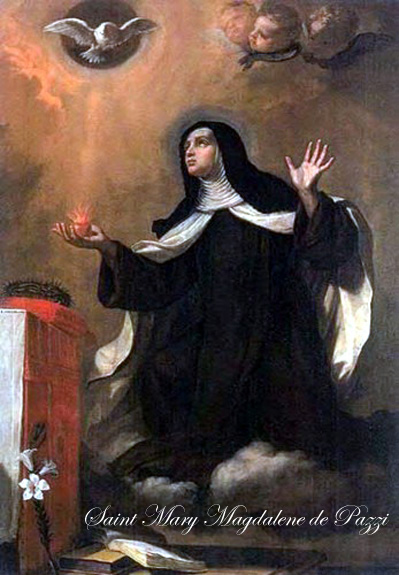
Carmelite Virgin, born 2 April, 1566; died 25 May, 1607. Of outward events there were very few in the saint's life. She came of two noble families, her father being Camillo Geri de' Pazzi and her mother a Buondelmonti. She was baptized, and named Caterina, (note, Catherine) in the great baptistery. Her childhood much resembled that of some other women saints who have become great mystics, in an early love of prayer and penance, great charity to the poor, an apostolic spirit of teaching religious truths, and a charm and sweetness of nature that made her a general favourite. But above all other spiritual characteristics was Caterina's intense attraction towards the Blessed Sacrament, her longing to receive It, and her delight in touching and being near those who were speaking of It, or who had just been to Communion. She made her own First Communion at the age of ten, and shortly afterwards vowed her virginity to God. At fourteen she was sent to school at the convent of Cavalaresse, where she lived in so mortified and fervent a manner as to make the sisters prophesy that she would become a great saint; and, on leaving it, she told her parents of her resolve to enter the religious state. They were truly spiritual people; and, after a little difficulty in persuading them to relinquish their only daughter, she finally entered in December, 1582, the Carmelite convent of Santa Maria degl' Angeli, founded by four Florentine ladies in 1450 and renowned for its strict observance. Her chief reason for choosing this convent was the rule there followed of daily Communion.
Caterina was clothed in 1583, when she took the name of Maria Maddalena; and on 29 May, 1584, being then so ill that theyfeared she would not recover, she was professed. After her profession, she was subject to an extraordinary daily ecstasy for forty consecutive days, at the end of which time she appeared at the point of death. She recovered, however, miraculously; and henceforth, in spite of constant bad health, was able to fill with energy the various offices to which she was appointed. She became, in turn, mistress of externs--i.e. of girls coming to the convent on trial--teacher and mistress of the juniors, novicemistress (which post she held for six years), and finally, in 1604, superior. For five years (1585-90) God allowed her to be tried by terrible inward desolation and temptations, and by external diabolic attacks; but the courageous severity and deep humility of the means that she took for overcoming these only served to make her virtues shine more brilliantly in the eyes of her community.
From the time of her clothing with the religious habit till her death the saint's life was one series of raptures and ecstasies, of which only the most notable characteristics can be named in a short notice.
- First, these raptures sometimes seized upon her whole being with such force as to compel her to rapid motion (e.g. towards some sacred object).
- Secondly, she was frequently able, whilst in ecstasy, to carry on work belonging to her office--e.g., embroidery, painting, etc.--with perfect composure and efficiency.
- Thirdly--and this is the point of chief importance--it was whilst in her states of rapture that St. Mary Magdalen de' Pazzi gave utterance to those wonderful maxims of Divine Love, and those counsels of perfection for souls, especially in thereligious state, which a modern editor of a selection of them declares to be "more frequently quoted by spiritual writers than those even of St. Teresa". These utterances have been preserved to us by the saint's companions, who (unknown to her) took them down from her lips as she poured them forth. She spoke sometimes as of herself, and sometimes as the mouthpiece of one or other of the Persons of the Blessed Trinity. These maxims of the saint are sometimes described as her "Works", although she wrote down none of them herself.
This ecstatic life in no wise interfered with the saint's usefulness in her community. She was noted for her strong common-sense, as well as for the high standard and strictness of her government, and was most dearly loved to the end of her life by all for the spirit of intense charity that accompanied her somewhat severe code of discipline. As novice-mistress she was renowned for a miraculous gift of reading her subjects' hearts--which gift, indeed, was not entirely confined to her community. Many miracles, both of this and of other kinds, she performed for the benefit either of her own convent or of outsiders. She often saw things far off, and is said once to have supernaturally beheld St. Catherine de' Ricci in her convent at Prato, reading a letter that she had sent her and writing the answer; but the two saints never met in a natural manner. To St. Mary Magdalen's numerous penances, and to the ardent love of suffering that made her genuinely wish to live long in order to suffer with Christ, we can here merely refer; but it must not be forgotten that she was one of the strongest upholders of the value of suffering for the loveof God and the salvation of our fellow-creatures, that ever lived. Her death was fully in accordance with her life in this respect, for she died after an illness of nearly three years' duration and of indescribable painfulness, borne with heroic joy to the end. Innumerable miracles followed the saint's death, and the process for her beatification was begun in 1610 under Paul V, and finished under Urban VIII in 1626. She was not, however, canonized till sixty-two years after her death, when Clement IX raised her to the altars in 28 April, 1669. Her feast is kept on 25 May.
Subscribe to:
Posts (Atom)